JAC Class 9 English Solutions Moments Chapter 8 A House is not a Home

Jharkhand Board JAC Class 9 English Solutions Moments Chapter 8 A House is not a Home Textbook Exercise Questions and Answers.

JAC Board Class 9 English Solutions Moments Chapter 8 A House is not a Home

JAC Class 9 English A House is not a Home Textbook Questions and Answers

Think About it

Question 1.
What does the author notice one Sunday afternoon ? What is his mother’s reaction? What does she do?
एक रविवार को अपरान्ह् लेखक क्या देखता है? उसकी माँ की क्या प्रतिक्रिया है ? वह क्या करती है ?
Answer:
The author notices smoke pouring in through the seams of the ceiling. The smoke begins to fill the room so quickly that they can barely see. In a short while, the whole roof is engulfed in fire and somehow they come out. His mother runs back and comes out with a box full of important documents. She again runs into the house, to get some important things.

लेखक छत के जोड़ों में से धुआँ निकलता हुआ देखता है । धुआँ इतनी तेजी से कमरे में भरने लगता है कि वे मुश्किल से ही कुछ देख पाते हैं । शीघ्र ही पूरी छत में आग लग जाती है और वे किसी तरह वे बाहर आते हैं और महत्त्वपूर्ण कागजातों के बक्से के साथ बाहर आती है। वह फिर तेजी से के लिए घर के अन्दर भागती है।

JAC Class 9 English Solutions Moments Chapter 8 A House is not a Home

Question 2.
Why does he break down in tears after the fire ?
आग लगने के बाद वह (लेखक) फूट-फूटकर क्यों रोने लगता है ?
उसकी माँ वापिस दौड़ती है कुछ आवश्यक चीजों को लेने
Answer:
After the fire in his home, he does not see his pet cat whom he loves very much. He feels his heart broken. All the unpleasant things such as new school, the fire and the cat – all come to his mind and he breaks down into tears.

अपने घर में आग लगने के बाद वह (लेखक) अपनी पालतू बिल्ली जिसको वह बहुत प्यार करता है, को नहीं देखता है । उसको अपना दिल टूटा हुआ महसूस होता है। सभी दुःखद घटनाएँ जैसे- नया स्कूल, आग, बिल्ली उसके दिमाग में आती हैं और वह फूट-फूटकर रोने लगता है ।

Question 3.
Why is the author deeply embarrassed the next day in school? Which words show his fear and insecurity?
अगले दिन स्कूल में लेखक बहुत अधिक शर्मिंदा क्यों हो जाता है ? कौन-से शब्द उसके डर और असुरक्षा को दर्शाते हैं ?
Answer:
Next day after the fire, the author is in no mood to go to school but his mother compels him to go. He is wearing the same dress that he wore on the Sunday morning. Since everything was burnt in the fire, he has no books, notebooks or school bag. So, he feels embarrassed. The words, “I just wanted to curl up and die” show his mental state of fear and insecurity.

अगली प्रातः आग के बाद लेखक की मनःस्थिति स्कूल जाने की नहीं है लेकिन उसकी माँ उसको जबरदस्ती स्कूल भेजती है । वह उन्हीं कपड़ों को पहने हुए है जो उसने रविवार की प्रातःकाल पहने थे । चूँकि उसकी सभी चीजें आग में जल गयी हैं इसलिए उसके पास पुस्तकें, कापियाँ अथवा स्कूल बैग नहीं है । इसलिए वह बहुत असहज महसूस करता है । निम्नलिखित शब्द उसकी डर और असुरक्षा युक्त मानसिक स्थिति को दर्शाते हैं – ” मैं बस अपने आप में सिमटकर रहना चाहता था और मर जाना चाहता था । ”

JAC Class 9 English Solutions Moments Chapter 8 A House is not a Home

Question 4.
The cat and the author are very fond of each other. How has this been shown in the story? Where was the cat after the fire? Who brings it back and how?
बिल्ली और लेखक एक-दूसरे को बहुत चाहते हैं । कहानी में यह कैसे दिखाया गया है ? आग लगने के बाद बिल्ली कहाँ थी ? उसे कौन वापिस लाता है और कैसे ?
Answer:
The author had great affection for his cat. The author had rescued the cat when she was a kitten. He cried inconsolably when he couldn’t find his cat after the fire. then the house caught fire, the cat was frightened, and it ran far away. A lady took her in and found out whom she belonged to. That lady brought her back to the author.

लेखक का बिल्ली के प्रति अत्यधिक लगाव था । जब बिल्ली छोटी थी उस समय लेखक ने उसे बचाया था । वह अधीरता से रोया था जब आग लगने के बाद उसे बिल्ली नहीं मिली थी। आग लगने के समय, बिल्ली डरकर दूर भाग गई थी । एक स्त्री ने उसे अपने घर में रखा और पता लगाया कि वह (बिल्ली) किसकी थी । वही स्त्री उसे वापिस लेखक के पास लेकर आई ।

Question 5.
What actions of the schoolmates change the author’s understanding of life and people, and comfort him emotionally? How does his loneliness vanish and how does he start participating in life ?
स्कूल के साथियों के कौन से कार्य लेखक के जीवन तथा लोगों के प्रति समझ को बदलते हैं तथा उसे भावनात्मक रूप से राहत देते हैं ? उसका एकाकीपन कैसे गायब हो जाता है और वह कैसे जीवन में भाग लेने लगता है ?
Answer:
The schoolmates showed genuine concern for the author. They pooled money and bought a lot of things for him. Their concern touched his heart and changed his feelings towards them. The friendly atmosphere around gave new hope to his life. Now he started taking part in the activities of life.

स्कूल के साथियों ने लेखक के प्रति वास्तविक चिंता दिखाई। उन्होंने पैसा इकट्ठा करके उसके लिए बहुत सारी चीजें खरीदीं । अपने प्रति उनके लगाव ने उसके दिल को छू लिया और उनके प्रति उसकी भावनाओं को बदल दिया । चारों ओर के मित्रवत् वातावरण ने उसको जीवन के प्रति नई आशा दी । अब उसने जीवन की गतिविधियों में भाग लेना प्रारम्भ कर दिया ।

Question 6.
What is the meaning of “My cat was back and so was I” ? Had the author gone anywhere ? Why does he say that he is also back?
इसका क्या अर्थ है कि “मेरी बिल्ली वापिस आ गई थी और मैं भी”? क्या लेखक कहीं गया था ? वह क्यों कहता है कि वह भी वापिस आ गया है ?
Answer:
‘My cat was back and so was I’ means that he had found his cat and he himself had found a new outlook on life. When the fire broke out in the author’s house, his pet cat got scared and ran over a mile away from the house. A kind lady brought her back.

After the fire in which the author lost everything, the way his schoolmates and neighbours helped him, touched his heart. This changed author’s opinion and feelings towards them and life. He made friends and now his life was interested. Physically, he hadn’t gone anywhere, but mentally and emotionally, he had drifted far away. He said this when he found his cat, new friends and re-discovered zest for life.

JAC Class 9 English Solutions Moments Chapter 8 A House is not a Home

‘मेरी बिल्ली वापिस आ गयी और मैं भी, का अर्थ है कि उसे (लेखक को) उसकी बिल्ली मिल गयी थी और उसे स्वयं को जीने के लिए नया दृष्टिकोण मिल गया था। जब लेखक के घर में आग लगी तो उसकी बिल्ली डरकर लगभग एक मील दूर चली गयी । एक दयालु महिला इसे वापिस लाई । आग, जिसमें लेखक का सब कुछ नष्ट हो गया था, के बाद जिस तरह से उसके साथियों तथा पड़ोसियों ने उसकी सहायता की, उसने उसके दिल को छू लिया । इसने लेखक की उनके ( स्कूल के साथियों) एवं जीवन के प्रति दृष्टिकोण तथा भावनाओं को बदल दिया । उसने मित्र बना लिये और जीवन में पुनः रुचि लेने लगा । वह शारीरिक रूप से कहीं नहीं गया था लेकिन मानसिक एवं भावनात्मक रूप से वह बहुत दूर चला गया था । उसने उक्त बात तब कही जब उसको बिल्ली, नये मित्र एवं जीवन में रुचि वापिस मिल गयी ।

Talk About it

Question 1.
Have any of your classmates/schoolmates had an experience like the one described in the story where they needed help? Describe how they were helped
क्या कभी आपकी कक्षा / स्कूल के किसी साथी को वैसा अनुभव हुआ जैसा कि कहानी में बताया गया और जहाँ उन्हें सहायता की आवश्यकता पड़ी हो ? वर्णन करो कि कैसे उनकी सहायता की गई।
Answer:
There had been a theft in one of my friend’s house. The thieves took away everything from his house when his whole family had gone to attend a marriage. My family and two other neighbours helped them by supplying beddings and other essential things. It was winter season and quilts or blankets were necessary to ward off the cold. In the morning, I gave my friend my other set of uniform to attend school. My mother cooked breakfast, lunch and dinner for the next two days. We also contributed some money from the neighbourhood to help them.

मेरे एक मित्र के घर में चोरी हो गयी थी । जब उसका पूरा परिवार एक विवाह समारोह में शामिल होने गया था तब चोर उसका पूरा घर साफ कर गये। मेरे परिवार तथा दो अन्य पड़ोसियों ने उनके लिए बिस्तर व अन्य आवश्यक वस्तुएँ प्रदान करके सहायता की। यह जाड़े का समय था और ठंड से बचने के लिए रजाईयों अथवा कम्बलों की आवश्यकता थी । सुबह मैंने अपने मित्र को स्कूल जाने के लिए अपनी दूसरी यूनीफॉर्म दी। मेरी माँ ने उनके लिये अगले दो दिन तक नाश्ता, दोपहर तथा रात का भोजन बनाया हमने उनकी सहायता के लिए पड़ोसियों से कुछ चंदा भी इकट्ठा किया।

JAC Class 9th English A House is not a Home Important Questions and Answers

Answer the following questions in about 30 words each:

निम्नलिखित प्रत्येक प्रश्न का उत्तर लगभग 30 शब्दों में दीजिए :

Question 1.
What happened one Sunday afternoon when the author was at home?
एक रविवार की दोपहर बाद क्या घटित हुआ जब लेखक घर पर था ?
Answer:
One Sunday afternoon when the author was at home, he smelled something strange. He saw smoke inside the room. A fire had broken out in his house.

एक रविवार की दोपहर बाद जब लेखक घर पर था, उसने कुछ अजीब गंध महसूस की। उसने कमरे में धुआँ देखा। उसके घर में आग लग गई थी ।

Question 2.
What did the author’s mother do when the house was on fire ?
जब घर में आग लगी थी उस समय लेखक की माँ ने क्या किया ?
Answer:
The author’s mother ran out with a small metal box which contained important documents. She ran back into the house to get the pictures and letters of her dead husband.

लेखक की माँ एक धातु के बक्से के साथ बाहर दौड़ीं जिसमें महत्त्वपूर्ण दस्तावेज रखे हुए थे । वह अपने मृत पति के चित्रों व पत्रों को लेने के लिए वापिस घर के अन्दर भागीं ।

JAC Class 9 English Solutions Moments Chapter 8 A House is not a Home

Question 3.
What did the author do on seeing his house on fire ?
अपने घर में आग लगी हुई देखकर लेखक ने क्या किया ?
Answer:
Seeing the house on fire, the author and his mother ran out into the front yard. Then he ran to his neighbours to call the fire department.

घर में आग लगी हुई देखकर लेखक और उसकी माँ बाहर सामने के आँगन में भागे । फिर वह (लेखक) अग्निशमन विभाग को फोन करने के लिए अपने पड़ोसियों के घर भागा ।

Question 4.
What was the reaction of the author when he saw his mother running into the burning house?
लेखक की क्या प्रतिक्रिया थी जब उसने अपनी माँ को जलते हुए मकान में भागकर जाते हुए देखा ?
Answer:
When she first ran into the house, he just kept gaping at her. But when she ran into the house again, he shouted to stop her and ran after her.

जब वह पहली बार घर के अंदर भागी, वह बस उनको अवाक् देखता रह गया । लेकिन जब वह दोबारा घर में दौड़ी तो वह उन्हें रोकने के लिए चीखा और उनके पीछे भागा ।

Question 5.
Why did the author’s mother have to borrow money from his grandparents?
लेखक की माँ को उसके दादा-दादी से धन उधार लेने की आवश्यकता क्यों पड़ी ?
Answer:
Everything in the house was burnt. She had to buy many things. She had no credit cards or any identification to withdraw money from the bank. So, she had to borrow money from his grandparents.

घर में सब कुछ जल चुका था । उन्हें बहुत-सी चीजें खरीदनी थीं । उनके पास क्रेडिट कार्ड या कोई भी पहचान पत्र नहीं था जिससे वे बैंक से रुपया निकाल सकतीं । इसलिए उन्होंने उसके दादा-दादी से धन उधार लिया।

Question 6.
When did the author feel overwhelmed with a sigh of relief ?
लेखक ने भावनाओं के वशीभूत होकर राहत की साँस कब ली ?
Answer:
The author was overwhelmed when his schoolmates and teachers gifted him many things. They all invited him to their homes. Many people who had never spoken to him before were coming to introduce themselves. Thus he took a sigh of relief.

लेखक भावनाओं के वशीभूत तब हो गया था जब उसके स्कूल के साथीगण और अध्यापकों ने उसे बहुत सी चीजें उपहार में दी। उन्होंने उसे अपने घरों पर आमंत्रित किया। कई लोग जिन्होंने पहले कभी उससे बात तक न की थी वे आ आ कर अपना परिचय दे रहे थे। उसने राहत की साँस ली।

Question 7.
Why did the author feel ‘isolated’? What did his old teachers advise him when he went to them?
लेखक को अकेलापन क्यों महसूस होता था ? जब वह अपने पुराने अध्यापकों के पास गया उन्होंने उसे क्या सलाह दी ?
Answer:
The author joined a new school. His closest friends had been sent to a different high school. So, he felt ‘ isolated’. His old teachers advised him to take part in school activities.

लेखक एक नये स्कूल में गया । उसके घनिष्ठतम मित्रों को एक अन्य हाईस्कूल विद्यालय में भेज दिया गया था । अतः, वह अकेलापन महसूस करता था । उसके पुराने अध्यापकों ने उसे स्कूल की गतिविधियों में भाग लेने की सलाह दी ।

Question 8.
What another ‘loss’ did the author realize after five hours ? How did he react ?
पाँच घण्टे बाद लेखक को कौन-सी एक अन्य हानि याद आई ? उसने उसके प्रति कैसी प्रतिक्रिया की ?
Answer:
After five hours, the fire was finally extinguished. Then the author realized that his cat was nowhere to be found. He broke down in tears. It was yet another great loss which he had to bear.

पाँच घण्टे बाद अन्ततः आग बुझा दी गयी थी । तब लेखक ने महसूस किया कि उसकी बिल्ली कहीं भी नहीं मिली । वह फूट-फूट कर रोने लगा । यही उसकी एक अन्य भारी हानि थी जिसे उसको झेलना था।

Question 9.
What was the change in the author’s life one month after the fire broke out ? How did he feel it?
आग लगाने के एक महीने बाद लेखक के जीवन में क्या परिवर्तन आया ? उसने इसे कैसे महसूस किया ?
Answer:
There came a change in the author’s life one month after the fire broke out. He had made new friends. His house was being rebuilt. He realized that his life was also starting afresh.

आग लगने के एक महीने बाद लेखक के जीवन में एक परिवर्तन आया। उसके नये मित्र बन गए थे । उसका घर पुनः बन रहा था । उसने महसूस किया कि उसका जीवन भी नये सिरे से शुरू हो रहा था ।

Question 10.
‘When I turned around to see who it was, I couldn’t believe my eyes. Explain the statement.
‘जब मैंने मुड़कर देखा कि यह कौन था तो मुझे अपनी आँखों पर विश्वास नहीं हुआ ।’ इस कथन की व्याख्या कीजिए ।
Answer:
A woman with a cat came to him one day. She asked if the cat belonged to him. He couldn’t believe his eyes as it was his own cat. It had run away from him at the time of fire.

एक दिन एक औरत एक बिल्ली के साथ लेखक के पास आयी । उसने पूछा कि क्या वह बिल्ली उसकी है । उसको अपनी आँखों पर विश्वास नहीं हुआ क्योंकि बिल्ली उसकी ही थी । यह आग लगने के समय उससे दूर भाग गयी थी ।

JAC Class 9 English Solutions Moments Chapter 8 A House is not a Home

Question 11.
How did the writer feel in school the next day after the fire broke out ?
आग लगने के अगले दिन स्कूल जाने पर लेखक ने कैसा महसूस किया ?
Answer:
The author was embarrassed because he was not in proper dress. Everything in the school was strange to him. He felt the loss of his feeling of security his old schoolmates, his house and his cat.

लेखक को स्वयं पर शर्म आ रही थी क्योंकि उसने उचित कपड़े नहीं पहने हुए थे । उसे स्कूल में सब कुछ बहुत अजीब लग रहा था । उसने अनुभव किया कि उसकी सुरक्षा की भावना, उसके पुराने स्कूल के मित्र, उसका घर और उसकी बिल्ली सब-कुछ उससे छिन चुका था ।

Question 12.
What would his cat do when the author got up early in the morning ?
जब लेखक सुबह जल्दी उठता था, उस समय उसकी बिल्ली क्या करती थी ?
Answer:
When the author got out of bed early in the morning, he disturbed the cat’s sleep. She would tag along after the author, climb up his dress and crawl into his pocket and there she fell asleep.

जब लेखक सुबह जल्दी बिस्तर से उठता था तो वह बिल्ली की नींद में बाधा डालता था । वह लेखक के साथ-साथ चिपककर बाहर आ जाती थी, उसके कपड़ों पर चढ़ जाती थी और रेंगकर उसकी जेब में घुस जाती थी और वहाँ घुसकर वह सो जाती थी ।

Answer the following questions in about 60 words each:

निम्नलिखित प्रत्येक प्रश्न का उत्तर लगभग 60 शब्दों में दीजिए :

Question 1.
What happened one Sunday afternoon ? How did the author and his mother behave? – एक रविवार के तीसरे पहर क्या हुआ ? लेखक और उसकी माँ ने कैसा बर्ताव किया ?
Answer:
One Sunday afternoon, the author saw smoke pouring in through the seams of the ceiling. Seeing the fire, the author and his mother came out into the front yard. The author ran to call the fire department from his neighbour’s house. His mother ran out of the house with a small metal box containing important documents. She then rushed back again into the house to take the pictures and letters of her dead husband.

एक रविवार की दोपहर के बाद लेखक ने छत की दरारों से धुआँ निकलते देखा। आग देखकर लेखक और उसकी माँ सामने के आँगन में दौड़ गये । लेखक अपने पड़ोसी के घर से अग्निशमन विभाग को फोन करने के लिए दौड़ा । उसकी माँ एक छोटे-से धातु के बक्से के साथ घर से बाहर आयीं जिसमें महत्त्वपूर्ण दस्तावेज़ थे । फिर वह अपने मृत पति की तस्वीरों और पत्रों को लेने के लिए वापिस घर में भागीं ।

Question 2.
‘I just wanted to curl up and die’. Why did the author feel so?
‘मैं बस अपने आप में सिमटकर रहना चाहता था और मर जाना चाहता था ।’ लेखक ने ऐसा क्यों महसूस किया ?
Answer:
The next day after the fire broke out in his house, the author went to school. He was in his old dress. He was wearing tennis shoes borrowed from his aunt. He had no books or homework. He felt that his feeling of security, his old school friends, his house and his cat- all had gone. He felt so depressed that he wanted to curl up and die.

अपने घर में आग लगने के अगले दिन लेखक स्कूल गया । उसने अपनी पुरानी ड्रैस पहनी हुई थी । उसने अपनी बुआ से उधार लिये हुए टेनिस वाले जूते पहने हुए थे । उसके पास पुस्तकें या गृहकार्य नहीं थे। उसने महसूस किया कि उसकी सुरक्षा की भावना, उसके पुराने स्कूल के मित्र, उसका घर और उसकी बिल्ली सब कुछ उससे छिन चुके थे । उसने स्वयं को इतना हताश महसूस किया कि वह अपने आप में सिमटकर रहना चाहता था और मर जाना चाहता था ।

JAC Class 9 English Solutions Moments Chapter 8 A House is not a Home

Question 3.
What had happened to the author’s cat ? How did he react in her absence ? How was it restored to him ?
लेखक की बिल्ली को क्या हुआ था ? उसकी अनुपस्थिति में लेखक की क्या प्रतिक्रिया हुई ? उसे बिल्ली कैसे वापिस मिली ?
Answer:
The author’s house was on fire one Sunday afternoon. His cat ran away during it. Thinking about it, he started weeping. He also went to the burnt house to find it out, but he could not find it. A month later the author was watching his house being rebuilt. Then a woman came to him with a cat. She asked him if the cat was his. The author could not believe his eyes because it was his own cat.

एक रविवार दोपहर के बाद लेखक के घर में आग लग गई। इस दौरान उसकी बिल्ली भाग गई । उसके बारे में सोचकर उसने रोना आरम्भ कर दिया । उसे ढूँढ़ने के लिए वह जले हुए घर में भी गया परन्तु वह उसे नहीं मिल सकी । एक महीने पश्चात् लेखक अपने घर को दोबारा बनते हुए देख रहा था । तभी एक महिला एक बिल्ली के साथ उसके पास आई । उसने उससे पूछा कि क्या वह बिल्ली उसकी थी । लेखक अपनी आँखों पर विश्वास नहीं कर सका क्योंकि यह उसी की बिल्ली थी ।

Question 4.
How did the author feel great loss ?
लेखक ने कैसे अनुभव किया कि उसका बहुत बड़ा नुकसान हुआ है ?
Answer:
In the beginning of his first year of high school, the author felt lonely. He missed his old school. He also missed his friends from the previous school and old teachers. He lost his feeling of security. Then accidently one day, a fire broke out in his house and his everything got burnt down in it. Much to his horror, his beloved cat too went missing during the fire. Then, the author felt a great loss.

हाईस्कूल में अपने पहले वर्ष की शुरुआत में, लेखक ने अकेलेपन का अनुभव किया। उसे अपने पुराने स्कूल की याद आती थी। उसे अपने पहले वाले स्कूल के मित्रों और पुराने अध्यापकों की भी याद आती थी। उसकी सुरक्षा की भावना समाप्त हो गई थी। फिर अचानक एक दिन उसके घर में आग लग गई और उसका सब-कुछ जल गया। इससे भी बढ़कर भयावह बात यह हुई कि आग के दौरान उसकी प्रिय बिल्ली भी गायब हो गई। उस समय लेखक ने बहुत नुकसान का अनुभव किया।

A House is not a Home Summary and Translation in Hindi

About the Story

यह कहानी किशोरावस्था की चुनौतियों और बड़े होने की समस्याओं पर प्रकाश डालती है । लेखक अपनी समस्याओं से कैसे उबरता है ? यह जानने के लिए पूरी कहानी पढ़िये ।

Word-Meanings And Hindi Translation

My first year …………… nonetheless. (Page 49)

Meanings : awkward (ऑ: क्वॅड) अजीब, अनुपयुक्त | junior (जून्यॅ (र)) seniority (सीनिऑरिटि) = वरिष्ठता, प्रवरता । upper (अपॅ (र)) = उच्चतर | grade (ग्रेड) = (यहाँ) दर्जा, कक्षा । levels (लेवॅल्ज़) = स्तरों | could afford (कुड अफॉ: ड) = could give प्रदान कर सकता था । as a freshman ( ऐज़ अ फ्रेशमैन) = starting right from the beginning, नये सिरे से सब कुछ शुरू करना । twice ( ट्वाइस) = two times, दोगुना । worse (वॅ:स) अधिक बुरा, बदतर closest (क्लोजिस्ट्) = निकटतम । isolated (आइसॅलेटिड ) = lonely, अकेला, एकाकी | missed (मिस्ट् ) = felt their absence, याद आती थी; कमी खलती थी ।

encourage (इन्करिज्) प्रोत्साहित करना । to get involved (टु गेट इन्वॉल्व्ड) = to take part, हिस्सा लेना activities (एक्टिविटीज़) = गतिविधियाँ | in time (इन् टाइम) = not late, समय रहते, शीघ्र ही । adjust (एडजस्ट) = change oneself accordingly, समायोजित कर लेना | probably (प्रॉबॅब्लि) possibly, सम्भवतः, शायद । end up (एन्ड् अप्) (Ph.v) = to find yourself in a place or situation that you did not plan or expect, अनियोजित या अप्रत्याशित स्थान या स्थिति में पहुँचना ।

they made me promise = वे मुझसे वचन लेते थे । come by = प्राप्त करने में सफल होना, ( यहाँ पर निश्चित रूप से आना) । understood (अन्ड्स्ट्रुड) = समझता था । psychology (साइकॉलोजी) = मनोविज्ञान । comfort (कम्फॅट) = soothing, ‘राहत, आरा । nonetheless (ननदलेस) = in spite of that, फिर भी, के बावजूद भी ।

हिन्दी अनुवाद – हाईस्कूल का पहला वर्ष मुझे अजीब लगा । जूनियर हाईस्कूल में मैं अपनी कक्षा में प्रथम स्थान पर था और मुझे उच्चतर स्तर पर होने की सभी ज्येष्ठताएँ (बढ़त ) प्राप्त थीं, ऐसे में जूनियर हाईस्कूल छोड़ कर नये सिरे से सब कुछ शुरू करना अजीब लगा । नया स्कूल मेरे पुराने स्कूल से दोगुना बड़ा था और इससे भी अधिक बुरी बात यह हुई कि मेरे घनिष्ठतम मित्रों को अन्य विभिन्न हाईस्कूल विद्यालयों में भेज दिया गया था । मैं बहुत अकेला महसूस करता था ।

मुझे अपने पुराने अध्यापकों की इतनी अधिक याद आती थी कि मैं उस स्कूल में वापिस जाता था और उनसे मिलता था । वे मुझे स्कूल की गतिविधियों में हिस्सा लेने के लिए प्रोत्साहित करते थे ताकि मैं नये लोगों से मिल सकूँ । वे मुझसे कहते थे कि समय रहते अर्थात् शीघ्र ही मैं नये स्कूल में स्वयं को समायोजित कर लूँगा और सम्भवतः मैं नये स्कूल को पुराने वाले से भी अधिक प्रेम करने लगूँगा । उन्होंने मुझसे वचन लिया कि जब ऐसा हो जाए, तब भी समय-समय पर मैं उनसे मिलने आता रहूँ। मैं समझता था कि वे ऐसा किस मानसिकता से कह रहे थे ( मैं समझता था कि मुझे खुश करने के लिए ही वे ऐसा कह रहे थे ।) परन्तु फिर भी मुझे इससे कुछ राहत मिली ।

JAC Class 9 English Solutions Moments Chapter 8 A House is not a Home

One Sunday afternoon …………… into the house. (Pages 49-50)

Meanings: not long after (नॉट लांग आफ्ż (र)) = कुछ दिनों बाद ही । fall (फॉल) season, पतझड़ के मौसम का । autumn (ऑटम) = गरमी और जाड़े के बीच का मौसम, पतझड़ | windy (विन्डि) = तूफानी | fireplace ( फाइअप्लेस) = अंगीठी । as usual (ऐज़ यूश्जुअल) हमेशा की तरह । tabby (टैबि) = भूरे या सलेटी फर वाली लाइनदार या धब्बेदार, झबरीली बिल्ली | lying (लाइंग) = लेटी हुई । purring (परिंग) = घुरघुराती हुई । occasionally (ॲकेश्ज़नलि) = now and then, कभी-कभी, जब-तब | swatting (स्वैटिंग) = hitting, प्रहार करना । entertainment (एण्ट: टेन्मण्ट) = amusement, मनोरंजन, मन बहलाना ।

sake (सेक) = के लिए, की खातिर । rescued (रेस्क्यूड) = saved बचाया । kitten (किटॅन) = बिल्ली का बच्चा । somehow (समहाउ) = in a way that is not known, किसी तरह । responsible (रिस्पॉन्सॅबॅल्) जिम्मेदार | stoking (स्टोकिंग) = adding coals to fire, आग में कोयले डाल रही । smelled ( स्मेल्ड) = गन्ध आई । strange (स्ट्रेन्ज् ) = विचित्र | noticed (नोटिस्ट) = ध्यान दिया । smoke (स्मॉक् ) = धुआँ । pouring in (पोरिंग इन) = coming in, अन्दर आई । through (थ्रू) से होकर । seams ( सीम्ज़ ) (here) joining lines, खाँचे, जोड़ । ceiling (सीलिंग्) = ( भीतरी) छत | barely (बेॲलि) = hardly, मुश्किल से ही । groping . (ग्रोपिंग) = locating things with the touch of hand, टटोलते हुए | yard (याड) : open area in a house, आँगन । engulfed (इन्गल्फ्ट) = totally covered, पूरी तरह घिरा हुआ । flames (फ्लेम्ज़) = लपटें | spreading (स्प्रेडिंग) = moving to other places, फैल रहीं ।

हिन्दी अनुवाद – हाईस्कूल की कक्षाएं शुरू करने के कुछ दिनों बाद ही एक रविवार के अपरान्ह मैं अपने घर में भोजन के कमरे में पड़ी मेज पर बैठा गृहकार्य कर रहा था यह पतझड़ के मौसम का ठण्डा व तूफानी दिन था तथा हमारी अंगीठी में आग जल रही थी । हमेशा की तरह मेरी लाल झबरीली बिल्ली मेरे सभी कागजातों पर लेटी हुई जोर-जोर से घुरघुरा रही थी और जब-तब मनोरंजन के लिए मेरी कलम पर बैठे छोटे कीड़े जैसे मक्खी को मारती थी । वह कभी मुझसे दूर नहीं रहती थी । जब वह छोटी थी तब मैंने उसे बचाया था और किसी तरह वह जानती थी कि मैं ही उसे ‘अच्छा जीवन’ देने के लिए जिम्मेदार था ।

मेरी माँ घर को अच्छा और गर्म रखने के लिए आग में कोयले डाल रही थीं । अचानक मुझे अजीब सी गन्ध आई और तब मैंने ध्यान दिया…… छत के जोड़ों में से होकर धुआँ अन्दर आ रहा था। धुआँ इतनी तेज़ी से कमरे में भरने लगा कि हम मुश्किल से ही कुछ देख सकते थे । सामने के दरवाज़े का रास्ता टटोलते हुए हम सब सामने के आँगन में भागे । जब तक हम बाहर निकले, सारी छत को लपटों ने निगल (घेर) लिया था और आग तेजी से फैल रही थी । मैं अग्निशमन विभाग को फोन करने के लिए पड़ोसियों के घर भागा जबकि मैंने अपनी माँ को वापिस घर के अन्दर भागते हुए देखा ।

My mother ………….. he said. (Page 50)

Meanings: carrying (कैरिइंग) लिये हुए | documents (डॉक्युमेण्ट्स) = papers, दस्तावेज़ । dropped (ड्रॉप्ट) = put in a haste, डाल दिया । case (कंस) सन्दूक, बक्स । crazed (क्रेज़्ड) = like one who is mad, पागलों जैसी । state (स्टेट) = condition, दशा । certain (सॅटेन) = sure, सुनिश्चित, पक्के विश्वास से । screamed (स्क्रीम्ड) = shouted, चीखा | grasp (ग्रास्प) = hold, पकड़ | yelling (येलिंग ) shouting, चीखते हुए। held on to me (हेल्ड ऑन टु मी) = kept me in his hold, मुझे पकड़े रखा । logically (लॉजिकल) = in a reasonable manner, समझदारी से, तार्किक रूप से ।

हिन्दी अनुवाद तब मेरी माँ महत्त्वपूर्ण दस्तावेजों से भरा हुआ एक छोटा-सा धातु का बक्सा लिये हुए घर से बाहर दौड़ती हुई आईं । उन्होंने बक्से को लॉन में डाल दिया और पागलों की तरह फिर वापिस घर में भागीं । मैं जानता था कि वह किस चीज़ के पीछे थीं (अर्थात् वह क्या लेने गई थीं)। मेरे पिताजी की तभी मृत्यु हो गई थी जब मैं छोटा था, और मुझे पक्का विश्वास था कि वह उनके चित्रों तथा पत्रों को लपटों के हवाले नहीं होने देना चाह रही थी । उनके पास पिताजी को याद करने के लिए वे ही एकमात्र चीजें थीं। फिर भी मैं उन पर चीखा, “माँ! नहीं!’

मैं दौड़कर उनके पीछे जाने ही वाला था जब मैंने महसूस किया कि एक बड़े हाथ ने मुझे पीछे खींच लिया । यह एक आग बुझाने वाले व्यक्ति का हाथ था । मैंने ध्यान भी नहीं दिया था कि गली पहले ही अग्निशमन विभाग की गाड़ियों से भर चुकी थी । मैं अपने आपको उसकी पकड़ से मुक्त कराने की कोशिश कर रहा था और साथ ही चीख रहा था, ” तुम समझ नहीं रहे हो, मेरी माँ वहाँ अन्दर है ।” उसने मुझे पकड़े रखा जबकि अन्य आग बुझाने वाले लोग मकान के अन्दर दौड़े । वह जानता था कि मैं बहुत समझदारी का काम नहीं कर रहा था और यह भी जानता था कि यदि वह मुझे जाने देता तो मैं भाग जाता । वह ठीक था । उसने कहा, “ठीक है, वे उन्हें (तुम्हारी माँ को) ले आयेंगे।”

He wrapped …………..losing her. (Pages 50-51)

Meanings: wrapped (रैप्ट) = covered, लपेट दिया | blanket (ब्लैकिट्) = कम्बल| emerged (इमॅ:ज़्ड्) = came out, बाहर आया, निकला । in tow (इन दो) = following closely behind, पीछे-पीछे। hugged (हग्ड) = embraced, गले से लगा लिया । (एवर) + कभी । argued (ऑरग्यूड) = put one’s views to oppose something, बहस की। vanished ( वैनिश्ट) : ‘disappeared, गायब हो गये ।

हिन्दी अनुवाद – उसने मेरे चारों ओर एक कम्बल लपेट दिया और मुझे अपनी कार में बैठा दिया। जल्दी ही एक आग बुझाने वाला हमारे मकान से मेरी माँ के पीछे-पीछे निकला । वह तेज़ी से उन्हें गाड़ी पर लाया और उन्हें एक ऑक्सीजन मास्क पहना दिया। मैं भागकर वहाँ गया और उन्हें गले से लगा लिया । उन्हें खोने के विचार से वे सभी पल मेरी स्मृति से गायब हो गये जब कभी मैंने उनसे बहस की थी या उनसे घृणा की थी ।

JAC Class 9 English Solutions Moments Chapter 8 A House is not a Home

“She’s going to ………….. spend the night. (Page 51)

Meanings: inhaled (इन्हेल्ड) = breathed in, साँस के साथ अन्दर ले लिया । a little (अ लिट्ल) थोड़ा-सा । dazed (डेज़्ड) = shocked, स्तम्भित होकर । finally (फ़ाइनॅॉल) = at last, अन्ततः । out (आउट) (यहाँ ) बुझ गई । almost (ऑलमोस्ट) = nearly, लगभग | struck (स्ट्रक ) = came to mind suddenly, अचानक से दिमाग में आया । horror (हॉरें (र)) = fear, भय । realised (रियलाइज़्ड) = felt, महसूस किया | all at once (ऑल एट वन्स) = एकदम से |

hit me ( हिट मी) = came to my mind, मेरे दिमाग में आया । broke down (ब्रोक डाउन) ‘ = came out in large quantity, फूट पड़े । suffering (सफ़रिंग) = bearing, पीड़ित हो रहा । loss (लॉस) = harm, नुकसान | big time (बिग टाइम) = for long, बहुत लम्बे समय तक । dangerous (डेन्जरस) = खतरनाक । imagine (इमेजिन ) = कल्पना करना । regardless (रिगाडलस) = बेपरवाह, बिना ध्यान दिये । piled (पाइल्ड) = sat, बैठ गये । just (जस्ट) = only, मात्र । made our way (मेड आउॲ (र) वे) went towards, की ओर चल दिये ।

हिन्दी अनुवाद – आग बुझाने वाले ने कहा, “वह ठीक हो जायेंगी, बस उनकी साँस के साथ थोड़ा-सा धुँआ अन्दर चला गया था ।” और तब वह आग बुझाने के लिए वापिस दौड़ा जबकि मेरी माँ और मैं वहाँ साम्भित होकर बैठे रहे । मुझे याद है कि मैं अपने मकान को जलता हुआ देख रहा था और सोच रहा था कि इस विषय में मैं कुछ भी नहीं कर सकता | अन्ततः पाँच घण्टे बाद आग बुझा दी गई । हमारा मकान लगभग पूरी तरह जल गया था । परन्तु तभी अचानक मेरे दिमाग में आया……मुझे अपनी बिल्ली दिखाई नहीं दी थी ।

मेरी बिल्ली कहाँ थी ? मैंने महसूस किया कि वह कहीं नहीं मिलने वाली और इस बात से मेरा भय और बढ़ गया । तभी एकदम मेरे दिमाग में आया – नया स्कूल, आग, मेरी बिल्ली – मेरे आँसू फूट पड़े और मैं बहुत रोया । मैं बहुत समय तक इस नुकसान से पीड़ित रहा । आग बुझाने वालों ने उस रात हमें मकान में वापिस नहीं जाने दिया । यह अब भी बहुत खतरनाक था । मेरी बिल्ली चाहे मर गई हो या जीवित हो, उसके बारे में जाने बिना मैं वहाँ से जाने की कल्पना भी नहीं कर सकता था । परन्तु उस की परवाह किये बिना ही मुझे जाना पड़ा । हम मात्र अपने शरीर पर अपने कपड़े पहने हुए और आग बुझाने वालों के कुछ कम्बल लिये अपनी कार में बैठ गये और वह रात बिताने के लिए अपने दादा-दादी के घर की ओर चल दिये ।

The next day ………. curl up and die. (Page 51)

Meaning: broke out (ब्रोक आउट) = लगी थी, फैली थी kicked them off (किक्ट देम ऑफ) = took them off, उन्हें निकाल फेंका था । casualty (केश्ज्युअल्टि) victim of mishap, दुर्घटना का शिकार । borrow (बॉरो) = उधार लेना | totally (टोटॅलि) = completely, पूरी तरह से । embarrassed (ऍम्बेरस्ड) feeling unease, awkward, असहज । weird (वीअड्) = strange, अजीब, अटपटे | backpack (बैक्पैक्) पीठ पर ले जाया जाने वाला बड़ा थैला, (यहाँ ) स्कूल बैग ।

destined (डेस्टिन्ड) = written in destiny, भाग्य में लिखा । outcast (आउटकास्ट) = different from all others, बहिष्कृत, परित्यक्त । geek (गीक) = a boring person wearing unfashionable clothes, बेढंगे वस्त्र पहनने वाला उबाऊ व्यक्ति, बेढंगा | grow up (ग्रो अप) बड़ा होना । handle ( हैण्डल) = face, निपटना, सामना करना । curl up (कॅल अप) सिमट जाना ।

हिन्दी अनुवाद – अगले दिन, सोमवार को मैं स्कूल गया । जिस समय आग लगी थी उस समय के वही कपड़े मैं अभी भी पहने हुए था जो मैंने उस सुबह चर्च जाने के लिए पहने थे, परन्तु मेरे पास जूते नहीं थे । मैंने अपना गृहकार्य करते समय उन्हें उतार दिया था । वे भी आग के शिकार हो गये थे । इसलिए मुझे अपनी बुआ से टेनिस खेलते समय : पहने जाने वाले जूते उधार लेने पड़े । मैं स्कूल न जाकर घर क्यों नहीं रुक सकता था ? मेरी माँ यह बात नहीं सुनतीं (मानतीं) परन्तु मैं प्रत्येक बात से बहुत असहज महसूस कर रहा थीं ।

जो कपड़े मैंने पहने हुए थे वे अजीब लग रहे थे। न मेरे पास पुस्तकें थीं और न कोई गृहकार्य, और मेरा स्कूल ले जाने वाला बैग भी नष्ट ही चुका था । उस स्कूल बैग में मेरा पूरा जीवन था। जितना अधिक मैं सँभलने की कोशिश करता, उतना ही अधिक बुरी स्थिति में होता जाता । क्या मेरे भाग्य में यही लिखा था कि मैं सारे जीवन सेबसे अलग और असामाजिक व्यक्ति बनकर रहूँ ? मुझे ऐसा ही लगा । यदि जीवन इसी प्रकार व्यतीत होना था तो फिर मैं बड़ा होना, परिवर्तित होना या जीवन का सामना करना नहीं चाहता था । मैं बस अपने आप में सिमटकर रह जाना और मर जाना चाहता था ।

I walked around ……………up in smoke. (Pages 51-52)

Meanings: zombie (जॉम्बी) = a dull and apathetic person, भावनाशून्य व्यक्ति । surreal (सरीअल) = very strange, बहुत अजीब । happen (हैपन) = take place, घटित होना | security (सिक्युअरटि) = safety, सुरक्षा | ripped away ( रिप्ट अवे) = torn away, झपट लिया गया । was shocked (वॉज़ शॉक्ट) = was pained and surprised, दु:ख हुआ, धक्का लगा । damage ( डैमिज) = loss, नुकसान । destroyed(डिस्ट्राइड) = lost, नष्ट हो गया । heroically ( हिरोइकलि ) = with bravery, बहादुरी से । rescue ( रेस्क्यू) save, बचाना। ached ( एक्ट) = was in pain, दुखी था । to grieve ( टु ग्रीव) = to observe sorrow, दुःख मनाना । rushed me out ( रश्ट मी आउट) : took me out quickly, मुझे तेजी से बाहर ले आईं । identification (आइडेन्टिफिकेशन) = पहचान । withdraw (विद्ड्रॉ) = take out निकालना ।

हिन्दी अनुवाद मैं भावनाशून्य व्यक्ति की तरह स्कूल में इधर-उधर घूमता रहा । सब कुछ बहुत अजीब लग रहा था और मुझे नहीं पता था कि आगे क्या होने वाला था । वह सारी सुरक्षा अर्थात् मेरी वे सब वस्तुएँ जिनसे मैं परिचित था जैसे – पुराने स्कूल के मेरे मित्र, मेरा मकान और मेरी बिल्ली सब-कुछ मुझसे झपट लिए गए थे। जब मैं उस दिन स्कूल के बाद उस स्थान के पास से गुजरा जहाँ मेरा मकान हुआ करता था, मुझे यह देखकर धक्का लगा कि वहाँ कितना अधिक नुकसान हुआ था जो कुछ जला नहीं था, वह पानी और उन लोगों द्वारा आग बुझाने के लिए प्रयोग किये गये कैमिकल्स (रसायनों) से नष्ट हो गया था।

एकमात्र भौतिक चीजें जो नष्ट नहीं हुई थीं, वे थीं – फोटो एलबम्स दस्तावेज़ और कुछ दूसरी व्यक्तिगत चीजें जिन्हें मेरी माँ किसी तरह बहादुरी से बचा पाई थीं। लेकिन मेरी बिल्ली जा चुकी थी और मेरा हृदय उसके लिए दुखी था । दुःख मनाने के लिए बिल्कुल समय नहीं था । मेरी माँ मुझे तेजी से मकान से बाहर ले आईं । हमें रहने के लिए एक स्थान ढूँढ़ना था और मुझे स्कूल के लिए कुछ कपड़े खरीदने थे । हमें अपने दादा-दादी से पैसे उधार लेने पड़े क्योंकि हमारे पास न कोई क्रेडिट कार्ड था, न नकदी और न ही बैंक से पैसे निकालने के लिए कोई पहचान-पत्र | सब कुछ धुएँ में नष्ट हो गया था ।

That week ……….. .looking for. (Page 52)

Meaning: rubble (रॅबॅल्) = leftovers of a destroyed structure idebris, मलबा । lot ( लॉट्) भूखण्ड | rented (रैण्टिड) = took on rent, भाड़े पर लिया । apartment (अपाटमॅण्ट्). = कमरा, फ्लैट | debris (डेब्रिज़) = मलबा vulnerable (वल्नंरबल ) = that may easily be injured, असुरक्षित, कोमल । tag along (टैग अलाँग) चिपक जाती थी । robe ( रोब) = dress, कपड़े। crawl (क्रॉल) = रेंगकर चले जाना । missing (मिसिंग) = feeling the absence, याद आ रही।

terribly ( टेरब्लि ) = very much, बहुत अधिक । seems (सीम्ज़) = लगता है, प्रतीत होता है । spreads (स्प्रेड्ज़) फैलती है । including (इन्क्लूडिंग) = शामिल करते हुए । aware (अवेअ (र)) = having knowledge, अवगत, जानने वाले । plight (प्लाइट) = great sorrow, misfortune, दुर्दशा, दुर्भाग्य | embarrassed ( एम्बैरस्ट) = feeling unease awkward, ‘असहज । as if (ऐज़ इफ़) = जैसे कि, मानो । somehow (सम्हाउ ) = in some way, किसी प्रकार से । responsible ( रिस्पॉन्सिब्ल ) जिम्मेदार | start off (स्टार ऑफ ) शुरू करना । attention ( अटेन्शन) = ध्यान ।

हिन्दी अनुवाद- उस हफ्ते वह मलबा जो हमारा मकान हुआ करता था, काफी कुछ साफ किया जा रहा था । यद्यपि हमने पास ही में एक अपार्टमेण्ट भाड़े पर ले लिया था फिर भी मैं उन लोगों को मलबा उठाते हुए देखने जाता, इस आशा में कि शायद कहीं मेरी बिल्ली मिल जाये । वह जा चुकी थी । मैं उसे एक कोमल छोटे-से बिल्ली के बच्चे के रूप में समझकर सोचता रहता । सुबह जल्दी जब मैं उसकी नींद में बाधा डालते हुए बिस्तर से निकलता था तो वह मुझसे चिपक जाती थी, वह मेरे कपड़ों पर चढ़ जाती थी और रेंगकर मेरी जेब में जाकर सो जाती थी ।

मुझे उसकी बहुत याद आ रही थी । हमेशा ऐसा देखने को मिलता है कि बुरी खबर तेज़ी से फैलती है और मेरे मामले में भी ऐसा ही हुआ । हाईस्कूल में सबको, जिनमें अध्यापकगण भी शामिल थे, मेरे दुर्भाग्य के बारे में पता था . मैं असहज था जैसे कि मानो इस दुर्घटना के लिए किसी प्रकार मैं ही जिम्मेदार था । एक नये स्कूल में किस प्रकार सुन्दर नारंगी महीन रोये (फर) में मुँह छिपाकर रो पड़ा । वह खुशी से घुरघुरायी । मेरे मित्र मुझे गले लगा रहे थे, बिल्ली को गले लगा रहे थे और इधर-उधर उछल रहे थे ।

JAC Class 9 English Solutions Moments Chapter 8 A House is not a Home

Apparently …………….. so was I. (Page 54)

Meanings: apparently (अपैरेंट्ल) = clearly, स्पष्ट रूप से । freaked (फ्रीक्ट) = afraid, डरी हुई। destroyed (डिस्ट्रॉइड) = damaged, नष्ट हो गये। wonderful (वॅण्ड: फुल) = so good, इतनी अच्छी । took in (टुक इन) (ph.v.) = allowed to stay in one’s home, अपने घर में रखा । somehow (समहाउ) = in some way, किसी प्रकार | sorely (सोर्लि) = seriously, very much, बहुत अधिक । curled up (कॅ:ल्ड् अप) सिमट कर बैठ गई । lap (लैप) = गौद । overwhelming (ओ: ह्वेमिंग) = great, अत्यधिक, अभिभूत कर देने वाली । loss (लॉस) = harm, नुकसान । tragedy (ट्रेजडि ) = sorrowful incident, दुःखद घटना । diminish (डिमिनिश) = lessen, कम होना । gratitude (ग्रेटिट्यूड) = कृतज्ञता | purr ( पर). घुरघुराहट की आवाज़ | beloved (बिलव्ड) = loving, प्रिय ।

हिन्दी अनुवाद स्पष्ट रूप से मेरी बिल्ली आग से इतना डर गई थी कि वह भागकर एक मील दूर चली गई थी । उसके गले के पट्टे पर हमारा फोन नम्बर था परन्तु हमारे फोन नष्ट हो गये थे और उनका कनेक्शन कट गया था । उस, अच्छी महिला ने उसे अपने घर में रखा और यह पता लगाने के लिए कड़ी मेहनत की कि यह किसकी बिल्ली थी ।

किसी न किसी प्रकार उसे पता था कि यह बिल्ली किसी को बहुत प्रिय है और कोई इसे बहुत अधिक याद करता है । जब मैं वहाँ अपने मित्रों के साथ बैठा हुआ था और मेरी बिल्ली मेरी गोद में सिमटी हुई थी, उस समय नुकसान और दुःखद घटना को अभिभूत कर देने वाली भावनाएँ कम होती हुई प्रतीत हुईं। मैंने अपने जीवन के प्रति, अपने नये मित्रों, एक अपरिचित (महिला) की दयालुता और अपनी प्रिय बिल्ली की जोरदार घुरघुराहट के प्रति कृतज्ञता अनुश्र्व की। मेरी बिल्ली वापिस आ गई थी और मैं भी उस (दुःखद घटना) से उबर चुका था ।

 

JAC Class 9 Maths Solutions Chapter 2 बहुपद Ex 2.5

Jharkhand Board JAC Class 9 Maths Solutions Chapter 2 बहुपद Ex 2.5 Textbook Exercise Questions and Answers.

JAC Board Class 9 Maths Solutions Chapter 2 बहुपद Exercise 2.5

प्रश्न 1.
उपयुक्त सर्वसमिकाओं का प्रयोग करके निम्नलिखित के गुणनफल ज्ञात कीजिए :
(i) (x + 4 ) (x + 10)
(ii) (x + 8 ) (x – 10)
(iii) (3x + 4 ) (3x – 5)
(iv) \(\left(y^2+\frac{3}{2}\right)\left(y^2-\frac{3}{2}\right)\)
(v) (3 – 2x) (3 + 2x).
हल:
(i) (x + 4 ) (x + 10)
सर्वसमिका
(x + a) (x + b) = x2 + (a + b)x + ab
= x2 + (4 + 10 )x + 10 × 4
= x2 + 14x + 40.

(ii) (x + 8) (x – 10)
सर्वसमिका
[(x + a) (x + b) = x2 + (a + b)x + ab]
= x2 + (8 – 10)x + 8 × (-10)
= x – 2x – 80.

(iii) (3x + 4) (3x – 5) = 3x(3x – 5) + 4(3x – 5 )
= 9x2 – 15x + 12x – 20
= 9x2 – 3x – 20.

(iv) \(\left(y^2+\frac{3}{2}\right)\left(y^2-\frac{3}{2}\right)\)
सर्वसमिका
(a + b) (a – b) = (a)2 – (b)2 से
= (y2)2 – (\(\frac{3}{2}\))2 = y4 – \(\frac{9}{4}\)

(v) सर्वसमिका (x + y) (x – y) = x2 – y2 से
(3 – 2x) (3 + 2x) = (3)2 – (2x)2
= 9 – 4x2

JAC Class 9 Maths Solutions Chapter 2 बहुपद Ex 2.5

प्रश्न 2.
सीधे गुणा किए बिना निम्नलिखित गुणनफलों के मान ज्ञात कीजिए :
(i) 103 × 107
(ii) 95 × 96
(iii) 104 × 96.
हल:
(i) सर्वसमिका
(x + a) (x + b) = x2 + (a + b) + ab
103 × 107 = (100 + 3) (100 + 7)
= (100)2 + (3 + 7) (100) + 3 × 7
= 10000 + 1000 + 21
= 11021.

(ii) सर्वसमिका
(x + a)(x + b) = x2 + (a + b) + ab
95 × 96 = (100 – 5) (100 – 4)
= (100)2 + (- 5 – 4) (100) + (-5) × (-4)
10000 – 900 + 20 = 9120.

(iii) सर्वसमिका (a + b) (a – b) = a2 – b2
104 × 96 = (100 + 4) (100 – 4)
= (100)2 – (4)2
= 10000 – 16 = 9984.

प्रश्न 3.
उपयुक्त सर्वसमिकाएँ प्रयोग करके निम्नलिखित के गुणनखण्ड कीजिए:
(i) 9x2 + 6xy + y2
(ii) 4y2 – 4y + 1
(iii) x2 – \(\frac{y^2}{100}\)
हल:
(i) 9x2 + 6xy + y2
सर्वसमिका
a2 + 2ab + b2 = (a + b)2
= (3x)2 + 2 × 3x × y + (y)2
= (3x + y)2.

(ii) 4y2 – 4y + 1
सर्वसमिका a2 – 2ab + b2 = (a – b)2
= (2y)2 – 2 × 2y × 1 + (1)2.
= (2y – 1)2.

(iii) x2 – \(\frac{y^2}{100}\) = \((x)^2-\left(\frac{y}{10}\right)^2\)
[सर्वसमिका a2 – b2 = (a + b)(a – b) से]
= \(\left(x+\frac{y}{10}\right)\left(x-\frac{y}{10}\right)\)

JAC Class 9 Maths Solutions Chapter 2 बहुपद Ex 2.5

प्रश्न 4.
उपयुक्त सर्वसमिकाओं का प्रयोग करके निम्नलिखित में से प्रत्येक का प्रसार कीजिए:
(i) (x + 2y + 4z)2
(ii) (2x – y + z)2
(iii) (-2x + 3y + 2z)2
(iv) (3a – 7b – c)2
(v) (-2x + 5y – 3z)2
(vi) \(\left[\frac{1}{4} a-\frac{1}{2} b+1\right]^2\)
हल:
(i) (x + 2y + 4z)2
सर्वसमिका (x + y + z)2 = x2 + y2 + z2 + 2xy + 2yz + 2zx से
= (x)2 + (2y)2 + (4z)2 + 2(x)(2y) + 2(2y) (4z) + 2(4z) (x)
= x2 + 4y2 + 16z2 + 4xy + 16yz + 8zx.

(ii) (2x – y + z)2
सर्वसमिका (x + y + z)2 = (x2 + y2 + z2) + 2xy + 2yz + 2zx
= (2x)2 + (y)2 + (z)2 + 2(2x) (-y) + 2(-y) (z) + 2(z) (2x)
= 4x2 + y2 + z2 – 4xy – 2yz + 4xz.

(iii) (-2x + 3y + 2z)2
सर्वसमिका (x + y + z)2 = (x2 + y2 + z2) + 2xy + 2yz + 2zx
= (-2x)2 + (3y)2 + (2z)2 + 2(-2x) (3y) + 2(3y) (2z) + 2(2z) (-2x)
= 4x2 + 9y2 + 4z2 – 12xy + 12yz – 8zx.

(iv) (3a – 7b – c)2
सर्वसमिका (x + y + z)2 = (x2 + y2 + z2) + 2xy + 2yz + 2zx
= (3a)2 + (-7b)2 + (-c)2 + 2(3a) (-7b) + 2(-7b) (-c) + 2(-c) (3a)
= 9a2 + 49b2 + c2 – 42ab + 14bc – 6ca.

(v) (-2x + 5y – 3z)2
सर्वसमिका (x + y + z)2 = x2 + y2 + z2 + 2xy + 2yz + 2zx
= (-2x)2 + (5y)2 + (-3z)2 + 2(-2x) (5y) + 2(5y) (-3z) + 2(-3z) (-2x)
= 4x2 + 25y2 + 9z2 – 20xy – 30yz + 12zx.

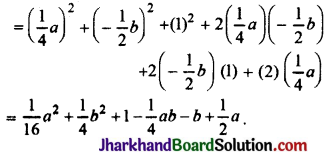
(vi) \(\left[\frac{1}{4} a-\frac{1}{2} b+1\right]^2\)
सर्वसमिका (x + y + z)2 = (x2 + y2 + z2) + 2xy + 2yz + 2zx
JAC Class 9 Maths Solutions Chapter 2 बहुपद Ex 2.5 1

JAC Class 9 Maths Solutions Chapter 2 बहुपद Ex 2.5

प्रश्न 5.
गुणनखण्ड कीजिए:
(i) 4x2 + 9y2 + 16z2 + 12xy – 24yz – 16xz
(ii) 2x2 + y2 + 8z2 – 2\(\sqrt{2}\)xy + 4\(\sqrt{2}\)yz – 8xz
हल:
(i) 4x2 + 9y2 + 16z2 + 12xy – 24yz – 16xz
= (2x)2 + (3y)2 + (-4z)2 + 2(2x) (3y) + 2(3y)(-4z) + 2(2x)(-4z)
सर्वसमिका [∵ x2 + y2 + z2 + 2xy + 2yz + 2xz = (x + y + z)2] से
= [2x + 3y + (-4z)]2
= (2x + 3y – 4z)2.

(ii) 2x2 + y2 + 8z2 – 2\(\sqrt{2}\)xy + 4\(\sqrt{2}\)yz – 8xz
सर्वसमिका (x + y + z2 = x2 + y2 + z2 + 2xy + 2yz + 2zx
= (\(\sqrt{2}\)x)2 + (-y)2 + (-2\(\sqrt{2}\)z)2 + 2(\(\sqrt{2}\)x) (-y) + 2(-y)(-2\(\sqrt{2}\)z) + 2(\(\sqrt{2}\)x)(-2\(\sqrt{2}\)z)
= [\(\sqrt{2}\)x + (y) + (2\(\sqrt{2}\)z)]2
= (\(\sqrt{2}\)x – y – 2\(\sqrt{2}\)z)2

प्रश्न 6.
निम्नलिखित घनों को प्रसारित रूप में लिखो :
(i) (2x + 1)3
(ii) (2a – 3b)3
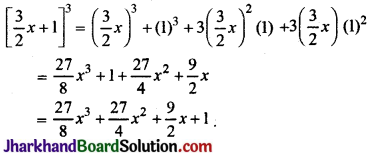
(iii) \(\left[\frac{3}{2} x+1\right]^3\)
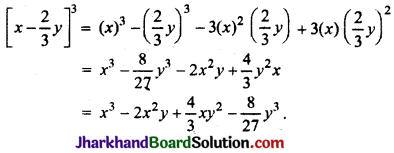
(iv) \(\left[x-\frac{2}{3} y\right]^3\)
हल:
(i) सर्वसमिका
(a + b)3 = a3 + b3 + 3a2b + 3ab2 से
(2x + 1)3 = (2x)3 + (1)3 + 3(2x)2 (1) + 3(2x) (1)2
= 8x3 + 1 + 12x2 + 6x
= 8x3 + 12x2 + 6x + 1.

(ii) सर्वसमिका
(x – y)3 = x3 – y3 – 3x2y + 3xy2 से
(2a – 3b)3 = (2a)3 – (3b)3 – 3(2a)2 (3b) + 3(2a) (3b)2
= 8a3 – 27b3 – 36a2b + 54ab2
= 8a3 – 36a2b + 54ab2 – 27b3.

(iii) सर्वसमिका
(x + y)3 = x3 + y3 + 3x2y + 3xy2
JAC Class 9 Maths Solutions Chapter 2 बहुपद Ex 2.5 2

(iv) सर्वसमिका
(x – y)3 = x3 – y3 – 3x2y + 3xy2
JAC Class 9 Maths Solutions Chapter 2 बहुपद Ex 2.5 3

JAC Class 9 Maths Solutions Chapter 2 बहुपद Ex 2.5

प्रश्न 7.
उपयुक्त सर्वसमिकाएँ प्रयोग करके निम्नलिखित के मान ज्ञात कीजिए :
(i) (99)3
(ii) (102)3
(iii) (998)3.
हल:
(i) सर्वसमिका
(x – y)3 = x3 – y3 – 3xy(x – y) से
∴ (99)3 = (100 – 1)3
= (100)3 – (1)3 – 3 × 100 × 1(100 – 1)
= 1000000 – 1 – 300(99)
= 1000000 – 1 – 29700
= 970299.

(ii) सर्वसमिका
(x + y)3 = x3 + y3 + 3xy(x + y) से
(102)3 = (100 + 2)3
= (100)3 + (2)3 + 3(100) (2) (100 + 2)
= 1000000 + 8 + 600 × 102
= 1000000 + 8 + 61200
= 1061208.

(iii) सर्वसमिका
(x – y)3 = x3 – y3 – 3xy(x – y) से
(998)3 = (1000 – 2)3
(1000)3 – (2)3 – 3 × 1000 × 2(1000 – 2)
= 1000000000 – 8 – 6000 × 998
= 1000000000 – 8 – 5988000
= 994011992.

प्रश्न 8.
निम्नलिखित में से प्रत्येक का गुणनखण्डन कीजिए :
(i) 8a3 + b3 + 12a2b + 6ab2
(ii) 8a3 – b3 – 12a2b + 6ab2
(iii) 27 – 125a3 – 135a + 225a2
(iv) 64a3 – 27b3 – 144a2b + 108ab2
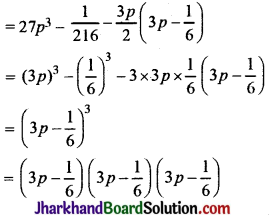
(v) 27p3 – \(\frac{1}{216}-\frac{9}{2} p^2+\frac{1}{4} p\)
हल:
(i) 8a3 + b3 + 12a2b + 6ab2
= 8a3 + b3 + 6ab(2a + b)
= (2a)3 + b3 + 3(2a) (b) (2a + b)
= (2a + b)3
= (2a + b) (2a + b) (2a + b).

(ii) 8a3 – b3 – 12a2b + 6ab2
= 8a3 – b3 – 6ab(2a – b)
= (2a)3 – b3 – 3(2a)(b)(2a – b)
= (2a – b)3
= (2a – b)(2a – b)(2a – b).

(iii) 27 – 125a3 – 135a + 225a2
= 27 – 125a3 – 45a(3 – 5a)
= (3)3– (5a)3 – 3 × 3 × 5a(3 – 5a)
= (3 – 5a)3
= (3 – 5a) (3 – 5a) (3 – 5a).

(iv) 64a3 – 27b3 – 144a2b + 108ab2
= 64a3 – 27b3 – 36ab(4a – 3b)
= (4a)3 – (3b)3 – 3 × 4a × 3b(4a – 3b)
= (4a – 3b)3
= (4a – 3b) (4a – 3b) (4a – 3b).

(v) 27p3 – \(\frac{1}{216}-\frac{9}{2} p^2+\frac{1}{4} p\)
JAC Class 9 Maths Solutions Chapter 2 बहुपद Ex 2.5 4

JAC Class 9 Maths Solutions Chapter 2 बहुपद Ex 2.5

प्रश्न 9.
सत्यापित कीजिए :
(i) x3 + y3 = (x + y) (x2 – xy + y2)
(ii) x3 – y3 = (x – y) (x2 + xy + y2).
हल:
(i) x3 + y3 = (x + y) (x2 – xy + y2)
दायाँ पक्ष = (x + y) (x2 – xy + y2)
= x(x2 – xy + y2) + (x2 – xy + y2)
= x3 – x2y + y2x + yx2 – xy2+ y3
= x3 + y3 = बायाँ पक्ष। इति सिद्धम्

(ii) x3 – y3 = (x – y) (x2 + xy + y2)
दायाँ पक्ष = (x – y) (x2 + xy + y2)
= x(x2 + xy + y2) – y(x2 + xy + y2)
= x3 + x2y + xy2 – yx2 – xy2 – y3
= x3 – y3 = बायाँ पक्ष। इति सिद्धम्

प्रश्न 10.
निम्नलिखित में से प्रत्येक का गुणनखण्ड कीजिए:
(i) 27y3 + 125z3,
(ii) 64m – 343n3
हल:
(1) 27y3 + 125z3 = (3y)3 + (5z)3
सर्वसमिका
x2 + y3 = (x + y) (x2 – xy + y2) से
= (3y + 5z) [(3y)2 – (3y)(5z) + (5z)2]
= (3y + 5z)(9y2 – 15yz + 25z2).

(ii) सर्वसमिका
x3 – y33 = (x – y) (x2 + xy + y2)
64m3 – 343n3 = (4m)3 – (7n)3
= (4m – 7n) [(4m)2 + (4m)(7n) + (7n)2]
= (4m – 7n)(16m2 + 28mn + 49n2).

प्रश्न 11.
गुणनखण्ड कीजिए :
27x3 + y3 – 9xyz.
हल:
27x3 + y3 + z3 – 9xyz
सर्वसमिका
x3 + y3 + z3(-3xyz) = (x + y + z) (x2 + y2 + z2 – xy – yz – zx)
= (3x)3 + (y)3 + (z)3 – 3(3x)(y)(z)
= (3x + y + z) [(3x)2 + (y)2 + (z)2 – (3x)y – yz – z(3x)]
= (3x + y + z)(9x2 + y2 + z2 – 3xy – yz – 3zx).

JAC Class 9 Maths Solutions Chapter 2 बहुपद Ex 2.5

प्रश्न 12.
सत्यापित कीजिए x3 + y3 + z3 – 3xyz = \(\frac{1}{2}\)(x + y + z) [(x – y)2 + ( y – z)2 + (z – x)2]
हल:
दायाँ पक्ष = \(\frac{1}{2}\)(x + y + z) [(x – y)2 + (y – z)2 + (z – x)2]
= \(\frac{1}{2}\)(x + y + z)(x2 – 2xy + y2 + y2 – 2yz + z2 + z2 – 2zx + x2)
= \(\frac{1}{2}\)(x + y + z)(2x2 + 2y2 + 2z2 – 2xy – 2yz – 2zx)
= (x + y + z)(x2 + y2 + z2 – xy – yz – zx)
[∵ a3 + b3 + c3 – 3abc = (a + b + c)(a2 + b2 + c2 – ab – bc – ca)]
सर्वसमिका से
= x3 + y3 + z3 – 3xyz
= बायाँ पक्ष इति सिद्धम् ।

प्रश्न 13.
यदि x + y + z = 0 हो, तो दिखाइए कि x3 + y3 + z3 = 3xyz है।
हल:
दिया है, x + y + z = 0 ⇒ x + y = -z
दोनों पक्षों का घन लेने पर,
(x + y)3 = (-z)3
⇒ x3 + y3 + 3xy(x + y) = -z3 (∵ x + y = -z)
⇒ x3 + y3 + 3xy(-z) = -z3
⇒ x3 + y3 + z3 = 3xyz, इति सिद्धम्।

प्रश्न 14.
वास्तव में घनों का परिकलन किए बिना निम्नलिखित में से प्रत्येक का मान ज्ञात कीजिए:
(i) (-12)3 + (7)3 + (5)3
(ii) (28)3 + (-15)3 + (-13)3.
हल:
(i) (-12)3 + (7)3 + (5)3
माना x = -12, y = 7, z = 5
यदि x + y + z = 0, तो x3+ y3 + z3 = 3xyz
⇒ -12 + 7 + 5 = 0
∵ सर्वसमिका x3 + y3 + z3 = 3xyz से
∴ (-12)3 + (7)3 + (5)3 = 3 × 3(-12) × 7 × 5
= -1260.

(ii) 283 + (-15)3 + (-13)3
28 + (-15) + (-13) = 28 – 28 = 0
अतः 283 + (-15)3 + (-13)3
= 3 × 28 × (-15) × (-13 )
= 16380.

JAC Class 9 Maths Solutions Chapter 2 बहुपद Ex 2.5

प्रश्न 15.
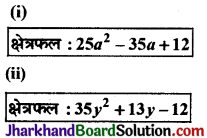
नीचे दिए गए आयतों, जिनमें उनके क्षेत्रफल दिए गए हैं, में से प्रत्येक की लम्बाई और चौड़ाई के लिए सम्भव व्यंजक दीजिए:
JAC Class 9 Maths Solutions Chapter 2 बहुपद Ex 2.5 5
हल:
आयत की लम्बाई और चौड़ाई क्षेत्रफल के गुणनखण्ड होंगे।
(i) आयत का क्षेत्रफल = लम्बाई × चौड़ाई
क्षेत्रफल = 25a2 – 35a + 12
= 25a2 – 15a – 20a + 12
= 5a (5a – 3) – 4(5a – 3)
= (5a – 3) (5a – 4)
∴ यदि लम्बाई (5a – 3) तो चौड़ाई = (5a – 4) तो चौड़ाई
और यदि लम्बाई = (5a – 4) तो चौड़ाई = (5a – 3) इकाई

(ii) क्षेत्रफल 35y2 + 13y – 12
= 35y2 + 28y – 15y – 12
= 7y (5y + 4) – 3(5y + 4)
= (5y + 4)(7y – 3)
∴ यदि लम्बाई = (5y + 4) तो चौड़ाई = (7y – 3) तो चौड़ाई
इकाई और यदि लम्बाई = (7y – 3) तो चौड़ाई = (5y + 4) इकाई.

JAC Class 9 Maths Solutions Chapter 2 बहुपद Ex 2.5

प्रश्न 16.
घनाभ (cuboids), जिनके आयतन नीचे दिए गए हैं की विमाओं के लिए संभव व्यंजक क्या हैं ?
JAC Class 9 Maths Solutions Chapter 2 बहुपद Ex 2.5 6
हल:
संभवत: घनाभों की भुजाएँ आयतन के गुणनखण्ड होंगे।
घनाभ का आयतन = लम्बाई × चौड़ाई × ऊँचाई
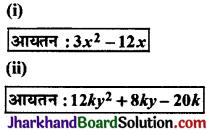
(i) आयतन = 3x2 – 12x = 3x(x – 4)
= 3 × x × (x – 4)
अतः संभवत: घनाभ की भुजाएँ क्रमश: 3, x और (x – 4) इकाई हैं।

(ii) आयतन = 12ky2 + 8ky – 20k
= 4k(3y2 + 2y – 5)
= 4k[3y2 + 5y – 3y – 5]
= 4k[(3y + 5) – 1(3y + 5)]
= 4k(3y + 5) (y – 1)
= 4k × (3y + 5) × (y – 1)
अतः सम्भवत: घनाभ की भुजाएँ क्रमश: 4k, (3y + 5) और (y – 1) हैं।

JAC Class 9 English Solutions Beehive Poem 2 Wind

Jharkhand Board JAC Class 9 English Solutions Beehive Poem 2 Wind Textbook Exercise Questions and Answers.

JAC Board Class 9 English Solutions Beehive Poem 2 Wind

JAC Class 9 English Wind Textbook Questions and Answers

Thinking about the Poem

Question 1.
What are the things the wind does in the first Stanza ?
पहले पद में हवा क्या-क्या कार्य करती है ?
Answer:
The wind breaks the shutters of the windows. It scatters the papers. It throws down the books that are kept in the book-shelf. It tears the pages of the books. It also brings rain again.

यह खिड़कियों के पट तोड़ देती है । यह पन्नों को बिखेर देती है । यह ताक में रखी हुई पुस्तकों को गिरा देती है। यह पुस्तकों के पन्नों को फाड़ देती है । यह दोबारा बरसात ले आती है ।

JAC Class 9 English Solutions Beehive Poem 1 The Road not taken

Question 2.
Have you ever seen anybody winnow grain at home or in a paddy field? What is the word in your language for winnowing? What do people use for winnowing? [Give the words in your language if you know them.]
क्या आपने कभी किसी को घर पर या धान के खेत पर फसल से अनाज निकालते हुए देखा है ? अनाज निकालने के लिए आपकी भाषा में कौनसा शब्द है ? लोग फसल से अनाज निकालने के लिए किस वस्तु का प्रयोग करते हैं । (यदि आप जानते हैं तो अपनी भाषा के शब्द बताइये)
Answer:
Yes, I have seen many people winnowing grain at many places, like homes and paddy fields etc.
We call it ‘ ओसाना’. People use ‘सूप’ (a winnowing basket) for it.

हाँ, मैंने कई स्थानों पर जैसे घरों, खेतों, इत्यादि पर लोगों को फसल से अनाज निकालते हुए देखा है । हम उसे ओसाना कहते हैं। लोग इसके लिए ‘सूप’ का प्रयोग करते हैं ।

Question 3.
What does the poet say the wind god winnows ?
कवि के अनुसार पवन देवता क्या फटकता है ?
Answer:
The poet says that the wind god winnows weak things, like – homes, doors, rafters, wood, bodies, lives and hearts. (only for destruction).

कवि के अनुसार पवन देवता कमज़ोर चीज़ों, जैसे घर, दरवाजे, कड़ियाँ, पेड़, शरीर, जिन्दगी तथा दिलों को ही फटकता है(बर्बाद करने के लिए )

JAC Class 9 English Solutions Beehive Poem 1 The Road not taken

Question 4.
What should we do to make friends with the wind ?
हवा से मित्रता करने के लिए हमें क्या करना चाहिये ?
Answer:
To make friendship with the wind, we should build strong homes. We must joint the doors firmly and make the body and heart firm and strong.

पवन से मित्रता करने के लिए हमें मजबूत घर बनाने चाहिये। हमें दरवाजे मजबूती से बंद करने चाहिये और शरीर तथा हृदय को मजबूत बनाना चाहिये ।

Question 5.
What do the last four lines of the poem mean to you ?
कविता की अंतिम चार पंक्तियों से आप क्या अर्थ लगाते हो ?
Answer:
Just as the wind blows out a lamp but it turns the strong fire into stronger, in the same way it makes a strong object stronger. If we are weaker, the strong will destroy us.

जिस प्रकार से हवा एक दीपक को बुझा देती है लेकिन तीव्र अग्नि को और प्रचण्ड कर देती है उसी प्रकार से यह ताकतवर को अधिक ताकतवर बनाती है । यदि हम कमज़ोर होंगे तो ताकतवर हमें नष्ट कर देंगे ।

Question 6.
How does the poet speak to the wind-in anger or with humour? You must also have seen or heard of the wind “crumbling lives”. What is your response to this? Is it like the poet’s ?
कवि पवन से कैसे बात करता है – क्रोध से या हँसी में ? आपने भी पवन को किसी का जीवन जर्जर करते हुए या विदीर्ण करते हुए देखा या सुना होगा । इसके प्रति आपकी क्या प्रतिक्रिया है ? क्या यह कवि जैसी ही है ?
Answer:
Seeing the hardness of wind and destruction made by it, the poet speaks to the wind in anger. I have seen and heard the wind crumbling the lives in the form of a storm. I am also angry with the wind when it causes destruction.

हवा की तीव्रता तथा उसके द्वारा किए गए विध्वंस को देखकर कवि हवा से क्रोध में बात करता है । मैंने हवा को तूफान के रूप में जीवन को तहस-नहस करते हुए देखा तथा सुना है । जब यह विनाश करती है तो मैं भी हवा से नाराज होता हूँ ।

II. The poem you have just read is originally in the Tamil. Do you know any such poems in your language?

जो कविता आपने अभी-अभी पढ़ी है, वह मूल रूप से तमिल में है। क्या आपको अपनी भाषा में ऐसी ही कोई कविता याद है ?
नोट : छात्र स्वयं ढूँढ़ने का प्रयास करें ।

JAC Class 9 English Solutions Beehive Poem 1 The Road not taken

JAC Class 9 English Wind Important Questions and Answers

Short Answer Type Questions

Question 1.
Why does the poet ask the wind to blow softly ?
कवि हवा को धीरे-धीरे बहने के लिए क्यों कहता है ?
Answer:
Hard blowing wind tends to destroy our lives. It breaks things and throws them here and there. It plays havoc with weak people, animals and things. But it is pleasant when it belows softly. So the poet asks it to blow softly.

तेज़ बहती हुई हवा हमारे जीवन को बर्बाद कर देती है । यह चीज़ों को तोड़ देती है और उन्हें इधर-उधर फेंक देती है । यह कमजोर लोगों, पशुओं, चीजों को बर्बाद कर देती है । किन्तु मंद बहती हवा आनन्ददायक होती है। इसलिए कवि इससे धीरे-धीरे बहने के लिए कहता है ।

Question 2.
What does the wind do when it blows hard ?
जब हवा तेज़ बहती है तो क्या करती है ?
Answer:
When the wind blows hard, it destroys our lives. It breaks the shutters of windows and scatters papers, throws down the books from the shelf and tears the pages of the books. It brings rain also.

जब हवा तेज़ बहती है तो यह हमारे जीवन को बर्बाद कर देती है । यह खिड़कियों के पट तोड़ देती है, कागज़ों को बिखेर देती है। यह पुस्तकों को ताक से नीचे गिरा देती है और पुस्तकों के पृष्ठ फाड़ देती है। यह वर्षा भी लाती है ।

Question 3.
When will the wind be our friend ?
हवा हमारी मित्र कब बनेगी ?
Or
What will we have to do to make friendship with the wind? वायु से मित्रता करने के लिए हमें क्या करना होगा ?
Answer:
In order to make friendship with the wind, we will have to be just as strong as the wind is. We will have to build our houses stronger and joint the doors tightly. We shall have to make our hearts strong too. Then the wind will be our friend.

हवा से मित्रता के लिए हमें वायु जितना ही शक्तिशाली बनना पड़ेगा । हमें अपने घर मजबूत बनाने होंगे और दरवाज़ों को कसकर बन्द करना होगा । हमें अपने हृदय को भी मजबूत बनाना होगा । तब हवा हमारी मित्र बन जाएगी ।

JAC Class 9 English Solutions Beehive Poem 1 The Road not taken

Question 4.
Why has the wind been called as ‘clever’ ?
हवा को चालाक क्यों कहा गया है ?
Answer:
The wind has been called clever because it behaves according to the opportunity. It makes fun of the weak people, animals and things. On the other hand, it makes friendship with those who are as powerful as the wind itself.

हवा को इसलिए चालाक कहा गया है क्योंकि यह अवसर के अनुसार व्यवहार करती है । यह कमज़ोर लोगों, पशुओं और चीज़ों का मजाक बनाती है । दूसरी ओर, अपने जैसे शक्तिशाली लोगों से यह मित्रता कर लेती है ।

Question 5.
Why do we praise the wind everyday ?
हम प्रतिदिन हवा की प्रशंसा क्यों करते हैं?
Answer:
Wind is much stronger than us. It is a well-known fact that we can face the strong persons either by being as strong as they are or by praising them. So we praise the wind to get its grace.

हवा हमसे अधिक शक्तिशाली है । यह बात सभी जानते हैं कि हम शक्तिशाली लोगों का सामना या तो उनके जितना शक्तिशाली बनकर कर सकते हैं या उसकी प्रशंसा करके । इसलिए हम हवा की कृपा प्राप्त करने के लिए उसकी प्रशंसा करते हैं ।

Question 6.
What does the poet not want from the wind ? कवि हवा से क्या नहीं चाहता है ?
Answer:
The poet does not want the wind to break the shutters of the windows. He does not want that it should scatter the papers or throw down the books from the book-shelf. He does not want from it to tear the pages of the books.

कवि नहीं चाहता है कि हवा खिड़कियों के पटों को तोड़े । वह नहीं चाहता कि हवा पन्नों को बिखेर दे या पुस्तकों को ताक से नीचे गिरा दे । वह नहीं चाहता कि हवा पुस्तकों के पृष्ठ फाड़ दे ।

Question 7.
What does the wind do with the weak ?
हवा कमज़ोर वस्तुओं के साथ क्या करती है ?
Answer:
The wind makes fun of the weak. It brings down weak houses, weak doors, weak rafters and weak trees. It crushes the weak lives and weak hearts. It does not let weaklings stand before it.

हवा कमज़ोरों का मजाक बनाती है । यह कमज़ोर घरों, कमज़ोर दरवाजों, कमज़ोर कड़ियों और कमज़ोर पेड़ों को गिरा देती है । यह कमज़ोर जीवन व कमज़ोर हृदयों को कुचल देती है । यह कमज़ोरों को अपने सामने टिकने नहीं देती है ।

JAC Class 9 English Solutions Beehive Poem 1 The Road not taken

Question 8.
Why should we become strong ?
हमें शक्तिशाली क्यों बनना चाहिए ?
Answer:
The wind, the symbol of strength, destroys the weak. It crushes them to nothing. If we request it not to do so, it does not listen to us. So in order to face its strength, we should become strong.

हवा, जो कि शक्ति का प्रतीक है, कमज़ोरों को बर्बाद कर देती है । यह उन्हें कुचल डालती है । यदि हम इससे ऐसा न करने की प्रार्थना करें तो यह हमारी सुनने वाली नहीं है । इसलिए इसकी शक्ति का सामना करने के लिए हमें शक्तिशाली बनना चाहिए ।

Question 9.
The wind god ‘winnows and crushes them all. How?
पवन देवता उन्हें ‘उड़ा कर ले जाता है तथा नष्ट कर देता है ।’ कैसे ?
Answer:
Winnowing means blowing a current of air through grain in order to remove chaff from it. In the same way wind god removes all sorts of weaklings from the world and leaves it with only the strong.

‘Winnowing’ का अर्थ होता है अनाज से भूसे को उड़ा देने वाले हवा के झोंके का बहना । इसी प्रकार से पवन देवता दुनिया से सभी कमजोर चीज़ों को हटा देता है और केवल शक्तिशाली को ही रहने देता है।

Wind Summary and Translation in Hindi

About the Poem:

हवा तेज चलती है और महाविनाश करती है । हम उससे किस प्रकार से मित्रता कर सकते हैं ?

About the Poet:

सुब्रमण्य भारती (1882 – 1921 ) एक महान तमिल कवि थे । वे स्वतन्त्रता प्राप्ति से पूर्व के समय में अपनी देशभक्ति के लिए प्रसिद्ध रहे। ए. के. रामानुजन कन्नड़ व अंग्रेजी भाषा के कवि हैं । वे विभिन्न शास्त्रीय एवं आधुनिक काव्य के अनुवादों के लिए प्रसिद्ध हैं ।

Word-Meanings And Hindi Translation

Stanza 1. Wind, come ………… fun at weaklings.. (Lines 1-8)

word-Meanings: wind (विन्ड्) = हवा । come softly (कम् सॉफ्ट्ल) = blow softly, धीरे-धीरे बहो । shutters (शट:ज़ ) = doors, दरवाजे । scatter (स्कैट् ) = spread, फैलाना, बिखेरना । shelf (शेल्फ्) projection on the wall to keep things on, ताक, अलमारी का खाना | threw down = नीचे फेंक दिया । tore (टॉर्) = damaged it by pulling into pieces, फाड़ दिया । brought (ब्रॉट्) = ले आये । poke fun at (पोक् फन् ऐट) = make fun of, मजाक बनाना । weaklings (वीकलिंग्ज़) कमजोर व्यक्ति / पशु ।

हिन्दी अनुवाद – कवि पवन से विनती करता है कि पवन (हवा), धीरे-धीरे बहो । खिड़कियों के दरवाजे मत तोड़ो । कागजों को मत बिखेरो । आलमारी से पुस्तकों को नीचे न गिराओ । वहाँ, देखो तुमने क्या कर डाला – तुमने उन सभी को नीचे फेंक दिया। तुमने पुस्तकों के पन्ने फाड़ डाले । तुम पुनः वर्षा ले आए। तुम कमजोर व्यक्ति या वस्तुओं का मजाक बनाने में बहुत चतुर हो ।

JAC Class 9 English Solutions Beehive Poem 1 The Road not taken

Stanza II. Frail …………. crushes them all. (Lines 9-12)

Word-Meanings: frail (फ्रेल) =weak, दुर्बल, कमज़ोर । crumbling (क्रम्ब्लिंग) = torn to pieces, जर्जर | wood (वुड ) लकड़ी (यहाँ) पेड़ | rafter (राफ्टॅ) = sloping beams supporting a roof, छत को सहारा देने वाली (लकड़ी की कड़ी) बल्ली । bodies (बॉडीज़) = शरीर । lives (लाइव्ज़े) = जीवन | wind god (विन्ड् गॉड्) = पवन देवता । winnows (विनोज़) : (here) crushes or destroys, नष्ट कर देता है। crush ( क्रश) = कुचलना, रौंदना ।

हिन्दी अनुवाद कमजोर जर्जर मकानों, जर्जर दरवाजों, जर्जर छतों की कड़ियों, जर्जर पेड़ों, जर्जर शरीरों, जर्जर जीवनों और जर्जर दिलों- इन सभी को पवन देवता उड़ा ले जाता है और कुचल डालता है ( नष्ट कर देता है) ।

Stanza III. He won’t ……………. with us. (Lines 13–18)

Word-Meaning: : what (वॉट्) = that, जो 1 so (सो) इसलिए । let’s (लेट्स) = किसी को कुछ करने का सुझाव देना, चलो हम ( यह कार्य करें) । joint (जॉइन्ट् ) = मिलाना, जोड़ना । firmly (फ़:म्लि) tightly, दृढ़तापूर्वक 1 practise ( प्रैक्टिस् ) = अभ्यास करना | steadfast (स्टेड्फास्ट्) = strong, अटल, अडिग, मजबूत । हिन्दी अनुवाद वह ( पवन देवता) जैसा तुम कहोगे वैसा नहीं करेगा । हमें पवन से दया की भीख नहीं माँगनी चाहिए। इसलिए, आओ हम मजबूत घर बनायें। आओ हम दरवाजों को मजबूती से जोड़ें। शरीर को मजबूत बनाने का अभ्यास करें । हृदय को मजबूत बनायें । यह सब करो और तब पवन देव हमारा मित्र बन जायेगा ।

Stanza IV. The wind ……………. every day. (Lines 19-22)

Word-Meanings : blows out (ब्लोज आउट् ) = puts out, बुझा देता है । weak fire ( वीक् फाइॲ) = कमजोर आग | makes roar and flourish = (the wind) makes the strong fires resound and thrive, (पवन) प्रचंड अग्नि को और भी प्रचंड कर देता है । flourish (फ्लरिश्) = grow well, फलना-फूलना, बढ़ना, फैलना ।

हिन्दी अनुवाद – पवन दुर्बल / कमज़ोर आग को बुझा देता है । प्रबल अग्नि को वह ( पवन देवता) और प्रचण्ड बना देता है । उसकी मित्रता अच्छी है । हम रोज उसकी प्रशंसा करते हैं ।

JAC Class 9 English Solutions Beehive Poem 1 The Road not taken

Explanation With Reference To Context & Comprehension Questions

Stanza 1.

Wind, come softly,
Don’t break the shutters of the windows.
Don’t scatter the papers.
Don’t throw down the books on the shelf.
There, look what you did-you threw them all down.
You tore the pages of the books.
You brought rain again.

Reference: These lines have been taken from the poem ‘Wind’ composed by the poet Subramania Bharati. The poem was originally composed in Tamil and translated into English by A.K. Ramanujan.

Context: These lines describe the strength of wind that crushes each and everything which is lacking the power.

Explanation:The poet requests the wind and asks it to blow softly. He asks the wind not to break the shutters of the windows. He asks the wind not to throw papers here and there. He requests the hard blowing wind not to throw down the books that are arranged in the bookshelf. He complains that it has thrown all the books on the floor and so it has torn the pages of the books. It has brought rain again.

संदर्भ : ये पंक्तियाँ कवि Subramania Bharati द्वारा रचित कविता ‘Wind’ से ली गई हैं। यह कविता मूल रूप से तमिल में लिखी गई थी और A. K. Ramanujan द्वारा इसका अंग्रेजी में अनुवाद किया गया।
प्रसंग : ये पंक्तियाँ हवा की शक्ति का वर्णन करती हैं जो प्रत्येक शक्तिहीन व्यक्ति या वस्तु को नष्ट कर डालती है।
व्याख्या: कवि वायु से विनती करता है और उससे धीरे-धीरे चलने के लिए कहता है। वह हवा से कहता है कि वह. खिड़कियों के पट न तोड़े। वह हवा से कहता है कि वह कागजों को इधर-उधर न बिखेरे। वह उससे कहता है कि वह ताक पर व्यवस्थित रूप से रखी हुई पुस्तकों को नीचे न गिराये । कवि तेज़ चलती हवा से शिकायत करते हुए कहता है कि उसने सभी पुस्तकों को ताक से नीचे गिरा दिया है जिससे पुस्तकों के पृष्ठ फट गए हैं। यह फिर से बारिश ले आई है।

JAC Class 9 English Solutions Beehive Poem 1 The Road not taken

Questions
1. How does the poet want the wind to blow ?
2. What are the three things that the wind does ?
3. What does the wind do to the books ?
4. What does the wind bring ?
Answers
1. The poet wants the wind to blow softly and gently.
1. The wind breaks the shutters, scatters the papers, and throws down the books from the shelf.
4. The wind brings rain.

Stanza 2.

You’re verycleveratpokingfun at weaklings.
rail crumbling houses, crumbling doors, crumbling rafters,
crumbling wood, crumbling bodies, crumbling lives,
crumbling hearts
the wind god winnowsand crushes them all.

Reference: These lines have been taken from the poem ‘Wind’ composed by the poet Subramania Bharati. The poem was originally composed in Tamil and translated into English by A.K. Ramanujan.

Context: These lines describe the strength of wind that destroys the weaklings.

Explanation: The poet requests the wind that it should not make fun of all weak things as well as creatures. The power of wind throws out and crushes all weak things; such as weak and easy to break houses, doors, rafters, wood, bodies, lives and hearts etc. They all fall victim to the might of wind.

‘संदर्भ : ये पंक्तियाँ कवि Subramania Bharati द्वारा रचित कविता ‘Wind’ से ली गई हैं। यह कविता मूल रूप से तमिल में लिखी गई थी और A. K. Ramanujan द्वारा इसका अंग्रेजी में अनुवाद किया गया।
‘प्रसंग’: ये पंक्तियाँ हवा की ताकत का वर्णन करती हैं जो हर कमजोर व्यक्ति/वस्तु का दमन कर डालती है।
व्याख्या : कवि हवा से विनती करता है कि वह कमजोर चीजों और कमजोर प्राणियों का मजाक न बनाए। हवा की शक्ति सभी कमजोर चीजों को बेकार कर देती है, जैसे कि – कमजोर व टूटने में आसान घर, दरवाजे, बल्लियाँ, पेड़, वस्तुएँ, व्यक्ति व हृदय, आदि सब हवा की शक्ति का शिकार बन जाते हैं।

JAC Class 9 English Solutions Beehive Poem 1 The Road not taken

Questions.
1. Whom does the wind make fun of ?
2. What does the word ‘crumbling’ signify ?
3. Name the crumbling things given in the stanza.
4. What does the wind do to crumbling things?
Answers.
1. The wind makes fun of weak persons, animals and things.
2. The word ‘crumbling’ signifies weak and easily breakable things which fall prey to the wind.
3. The crumbling things are houses, doors, rafters, wood, bodies, lives and hearts.
4. The wind winnows and crushes the crumbling things.

Stanza 3.

He won’t do what you tell him.
So, come, let’s build strong homes,
Let’s joint the doors firmly.
Practise to firm the body.
Make the heart steadfast.
Do this, and wind will be friends with us.

Reference: These lines have been taken from the poem ‘Wind’ composed by the poet Subramania Bharati. The poem was originally composed in Tamil and translated into English by A. K. Ramanujan.

Context:The lines are in the form of a message to face the power of the wind, we have to make ourselves strong.

Explanation:Now poet realizes that wind has great might and it is the nature of wind to flow. So it would not stop destroying us even when it is requested not to do so. Therefore, in order to face it, we have to build strong homes. We have to shut our doors firmly. We have to practise to make our body firm and the heart strong. Only then, we shall be able to face the wind strongly. Then wind will behave like friends with us. Here, through the example of wind, the poet wants to advise us that we should make ourselves physically and mentally strong to face the challenges of life because these challenges or problems will surely come and these will not listen to our requests like wind.

संदर्भ : ये पंक्तियाँ कवि Subramania Bharati द्वारा रचित कविता ‘Wind’ से ली गई हैं। यह कविता मूल रूप से तमिल में लिखी गई थी और A. K. Ramanujan द्वारा इसका अंग्रेजी में अनुवाद किया गया।
प्रसंग : ये पंक्तियाँ एक सन्देश के रूप में हमें हवा की शक्ति का सामना करने के लिए प्रेरित करती हैं और हमें स्वयं को शक्तिशाली बनने के लिए मजबूर करती है ।
व्याख्या : अब कवि स्वीकार कर लेता है कि हवा में असीम शक्ति है और बहना उसकी स्वाभाविक प्रकृति है। यह हमारे अनुरोध करने के बाद भी ऐसा करने से नहीं रुकेगी। इसलिए इसका सामना करने के लिए हमें मजबूत घर बनाने होंगे। हमें अपने दरवाजों को मजबूती से बन्द करना होगा। हमें अपने शरीर व हृदय को मजबूत बनाने का अभ्यास करना होगा। तभी हम हवा का सामना कर पायेंगे। तभी हवा हमसे मित्रवत् व्यवहार करेगी। यहाँ कवि हवा के उदाहरण द्वारा हमें सलाह देता है कि हमें शारीरिक और मानसिक रूप से मजबूत बनना होगा जीवन की चुनौतियों का सामना करने के लिए, क्योंकि ये समस्याऐं अवश्य आयेंगी और हवा की तरह हमारी प्रार्थना को नहीं सुनेंगी।

Questions
1. Does the wind listen to us?
2. What should we do to face the wind?
3. When will the wind be friends with us?
4. Why should we make ourselves strong?
Answers
1. No, the wind does not listen to us. It won’t do what we tell it to.
2. To face the wind we should build strong homes, joint the doors firmly, practise to firm the body and make the heart steadfast.
3. The wind will be friendly with us when we are as strong as the wind itself is.
4. We should make ourselves strong to face the wind.

JAC Class 9 English Solutions Beehive Poem 1 The Road not taken

Stanza 4

The wind blows out weak fires.
He makes strong fires roar and flourish.
His friendship is good.
We praise him every day.

Reference: These lines are taken from the poem ‘Wind’ composed by the poet Subramania Bharati. The poem was originally composed in Tamil and translated into English by A.K. Ramanujan. Context: These lines describe that we can face the power of the wind only by making ourselves strong.

Explanation : The weak fires are blown out by the wind. But it turns strong fires into eyen stronger. In the same way if we are strong, it will simply add to our strength. And then it will be our friend. Its friendship will do us good. We praise wind every day in order to be friends with it. The poet wants to say that challenges and adversities destroy those who are weak. Those who are physically and mentally strong, they become still more stronger when they face these challenges and thus, these unfavourable things become more favourable to them.

संदर्भ : ये पंक्तियाँ कवि Subramania Bharati द्वारा रचित कविता ‘Wind’ से ली गई हैं। यह कविता मूल रूप से तमिल में लिखी गई थी और A. K. Ramanujan द्वारा इसका अंग्रेजी में अनुवाद किया गया ।
प्रसंग : ये पंक्तियाँ वर्णन करती हैं कि हम स्वयं को मजबूत बनाकर ही हवा की शक्ति का सामना कर सकते हैं।
व्याख्या : कमजोर आग को हवा बुझा देती है। लेकिन तेज आग को यह और अधिक प्रचण्ड बना देती है। ठीक इसी प्रकार यदि हम शक्तिशाली हैं तो यह हमारी शक्ति में वृद्धि ही करेगी । फिर यह हमारी मित्र बन जायेगी। इसकी मित्रता से हमारा भला होगा। हम प्रतिदिन हवा की प्रशंसा करते हैं जिससे यह हमारी मित्र बन जाये । कवि कहना चाहता है कि चुनौतियाँ और कठिनाइयाँ उनको नष्ट करती हैं जो कमजोर होते हैं। जो शारीरिक और मानसिक रूप से मजबूत होते हैं, वे इन चुनौतियों का सामना करके और अधिक मजबूत बन जाते हैं और इस प्रकार, ये विपरीत परिस्थितियाँ उनके और अधिक अनुकूल हो जाती हैं ।

JAC Class 9 English Solutions Beehive Poem 1 The Road not taken

Questions
1. What does the wind do with the weak fire ?
2. What is the effect of wind on the strong fire?
3. Why is the friendship with wind good?
4. Why do we praise the wind?
Answers.
1. The wind blows out the weak fire.
2. It makes strong fire roar and flourish.
3. The friendship with wind is good because it makes us stronger to face the troubles of life.
4. We praise the wind because it is strong, and we want its friendship for becoming strong in our life.

JAC Class 9 Maths Solutions Chapter 4 दो चरों वाले रैखिक समीकरण Ex 4.3

Jharkhand Board JAC Class 9 Maths Solutions Chapter 4 दो चरों वाले रैखिक समीकरण Ex 4.3 Textbook Exercise Questions and Answers.

JAC Board Class 9 Maths Solutions Chapter 4 दो चरों वाले रैखिक समीकरण Exercise 4.3

प्रश्न 1.
दो घरों वाले निम्नलिखित रैखिक समीकरणों में से प्रत्येक का आलेख खींचिए :
(i) x + y = 4
(ii) x – y = 2
(iii) y = 3x
(iv) 3 = 2x + y.
हल:
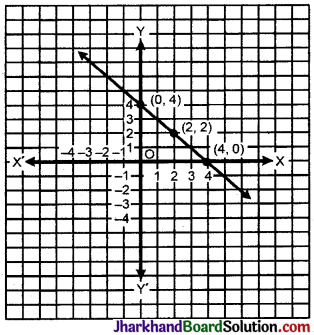
(i) दिया गया समीकरण
x + y = 4 ⇒ y = 4 – x
x = 0 के लिए, y = 4 – 0 = 4
x = 2 के लिए, y = 4 – 2 = 2
x = 4 के लिए, y = 4 – 4 = 0
सारणी:

x024
y420

JAC Class 9 Maths Solutions Chapter 4 दो चरों वाले रैखिक समीकरण Ex 4.3 1
बिन्दुओं (0, 4) (2, 2) तथा (4, 0) को ग्राफ पेपर पर निरूपित करके मिलाने पर एक सरल रेखा प्राप्त होती है।

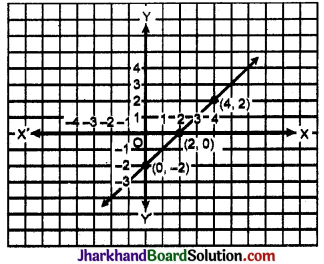
(ii) दिया गया समीकरण x – y = 2 ⇒ y = x – 2
x = 0 के लिए, y= 0 – 2 = -2
x = 2 के लिए, y = 2 – 2 = 0
x = 4 के लिए, y = 4 – 2 = 2
सारणी :

x024
y-202

JAC Class 9 Maths Solutions Chapter 4 दो चरों वाले रैखिक समीकरण Ex 4.3 2
बिन्दुओं (0, -2), (2, 0) और (4, 2) को ग्राफ पर निरूपित करके मिलाने पर एक सरल रेखा प्राप्त होती है।

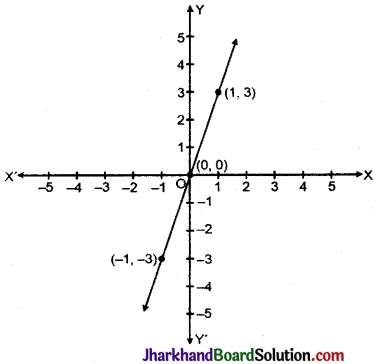
(iii) दिया गया समीकरण y = 3x
जब x = 0 हो, तो y = 3 × 0 = 0
जब x = 1 हो, तो y = 3 × (-1) = -3
सारणी :

x01-1
y03-3

JAC Class 9 Maths Solutions Chapter 4 दो चरों वाले रैखिक समीकरण Ex 4.3 3
बिन्दुओं (0, 0) (1, 3) और (-1, -3) को ग्राफ पेपर पर निरूपित करके मिलाने पर एक सरल रेखा प्राप्त होती है।

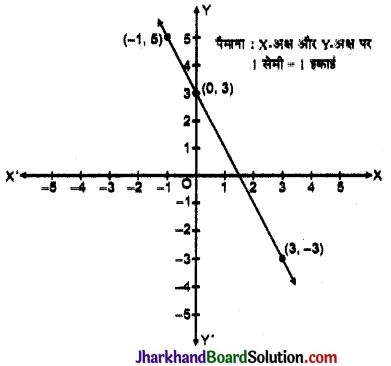
(iv) दिया गया समीकरण
3 = 2x + y ⇒ y = 3 – 2x
x = 0 के लिए, y = 3 – 2(0) = 3
x = 3 के लिए, y = 3 – 2 (3) = -3
x = -1 के लिए, y = 3 – 2 (-1) = 5
सारणी:

x03-1
y3-35

JAC Class 9 Maths Solutions Chapter 4 दो चरों वाले रैखिक समीकरण Ex 4.3 4
बिन्दुओं (0, 3), (3, 3) और (-1, 5) को ग्राफ पेपर पर निरूपित करके मिलाने पर एक सरल रेखा प्राप्त होती है।

JAC Class 9 Maths Solutions Chapter 4 दो चरों वाले रैखिक समीकरण Ex 4.3

प्रश्न 2.
बिन्दु (2, 14) से होकर जाने वाली दो रेखाओं के समीकरण लिखिए। इस प्रकार की और कितनी रेखाएँ हो सकती हैं ?
हल:
बिन्दु (2, 14) से होकर जाने वाली दो रेखाओं के समीकरण 7x – y = 0 तथा x + y = 16 है।
एक बिन्दु से अनन्त रेखाएं खींची जा सकती हैं। अतः वे समस्त रेखाएँ जो बिन्दु (2, 14) द्वारा सन्तुष्ट हो सकती हैं इस बिन्दु से खींची जा सकती हैं। इनकी संख्या अपरिमित रूप से अनेक होगी।

प्रश्न 3.
यदि बिन्दु (3, 4) समीकरण 3y = ax + 7 के आलेख पर स्थित है, तो का मान ज्ञात कीजिए।
हल:
∵ बिन्दु (3, 4) समीकरण 3y = ax + 7 के आलेख पर स्थित है।
बिन्दु (3, 4) समीकरण 3y = ax + 7 को सन्तुष्ट करेगा।
समीकरण में x = 3, y = 4 रखने पर
3(4) = a(3) + 7
12 = 3a + 7
3a = 5 ∴ a = \(\frac{5}{3}\)
अतः a = \(\frac{5}{3}\) बिन्दु (3, 4) समीकरण 3y = ax + 7 पर स्थित है।

प्रश्न 4.
एक नगर में टैक्सी का किराया निम्नलिखित है: पहले किलोमीटर का किराया ₹8 है उसके बाद की दूरी के लिए प्रति किलोमीटर का किराया ₹5 है। यदि तय की गई दूरी किलोमीटर हो और कुल किराया ₹y हो, तो इसका एक रैखिक समीकरण लिखिए और उसका आलेख खींचिए।
हल:
पहले किलोमीटर के लिए टैक्सी का किराया = ₹ 8 रुपये
अगले किलोमीटर के लिए टैक्सी का किराया = ₹ 5 प्रति किमी
कुल किराया = ₹ y
कुल दूरी = x किमी
अतः दो चरों का रैखिक समीकरण है:
y = 8 × 1 + 5 (x – 1)
⇒ y = 8 + 5x – 5
⇒ y = 5x + 3
अतः रैखिक समीकरण 5x – y + 3 = 0
यदि x = 0 हो, तो 5(0) – y + 3 = 0 ∴ y = 3
यदि x = -1 हो, तो 5 (-1) – y + 3 = 0
या – 5 – y + 3 = 0 ∴ y = -2
यदि x = 2 हो, तो 5(-2) – y + 3 = 0
या -10 – y + 3 = 0 ∴ y = -7
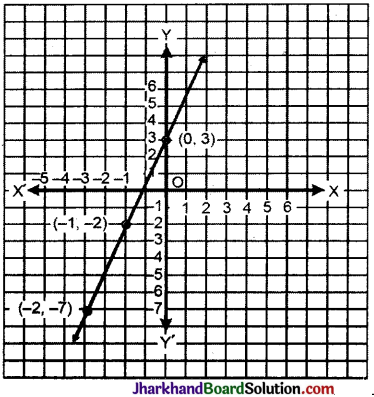
सारणी:

x0-1-2
y3-2-7

JAC Class 9 Maths Solutions Chapter 4 दो चरों वाले रैखिक समीकरण Ex 4.3 5
बिन्दुओं (0, 3), (-1, -2) और (-2, -7) को ग्राफ पेपर पर निरूपित करके मिलाने पर एक सरल रेखा प्राप्त होती है।

JAC Class 9 Maths Solutions Chapter 4 दो चरों वाले रैखिक समीकरण Ex 4.3

प्रश्न 5.
निम्नलिखित आलेखों में से प्रत्येक आलेख के लिए दिये गये विकल्पों में से सही समीकरण का चयन कीजिए:
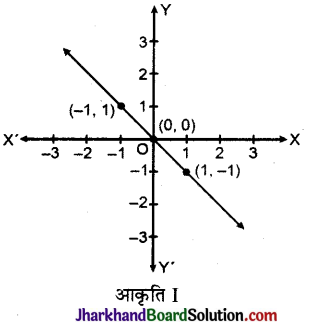
आकृति 1 के लिए
(i) y = x
(ii) x + y = 0
(iii) y = 2x
(iv) 2 + 3y = 7x
JAC Class 9 Maths Solutions Chapter 4 दो चरों वाले रैखिक समीकरण Ex 4.3 6

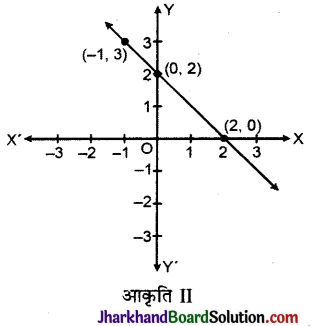
आकृति II के लिए
(i) y = x + 2
(ii) y = x – 2
(iii) y = – x + 2
(iv) x + 2y = 6
JAC Class 9 Maths Solutions Chapter 4 दो चरों वाले रैखिक समीकरण Ex 4.3 7
हल:
(i) आकृति I में बिन्दु (-1, 1), (0, 0) और (1, -1) एक सरल रेखा पर स्थित है अतः ये बिन्दु रैखिक समीकरण x + y = 0 को सन्तुष्ट करते हैं। अत: विकल्प (ii) सही है।
(ii) आकृति II में बिन्दु (-1, 3), (0, 2) और (2, 0) एक सरल रेखा पर स्थित हैं। अतः ये बिन्दु रैखिक समीकरण y = – x + 2 को सन्तुष्ट करते हैं। अतः विकल्प (iii) सही

प्रश्न 6.
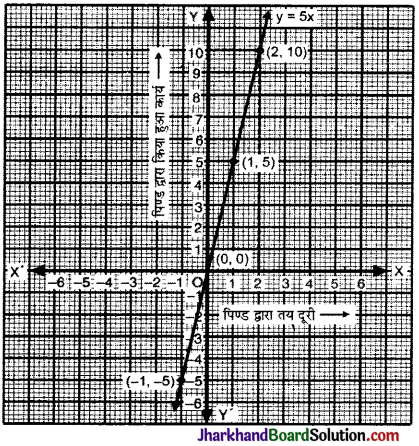
एक अचर बल लगाने पर एक पिण्ड द्वारा किया गया कार्य पिण्ड द्वारा तय की गई दूरी के अनुक्रमानुपाती होता है। इस कथन को दो चरों वाले एक समीकरण के रूप में व्यक्त कीजिए और अचर बल 5 मात्रक लेकर इसका आलेख खींचिए। यदि पिण्ड द्वारा तय की गई दूरी (i) 2 मात्रक, (ii) 0 मात्रक हो, तो आलेख से किया हुआ कार्य ज्ञात कीजिए।
हल:
माना अचर बल लगाने पर पिण्ड द्वारा किया
गया कार्य = y
पिण्ड द्वारा तय की गई दूरी = x
प्रश्नानुसार, समीकरण y = 5x
यदि x = 0 हो, तो y = 5(0) = 0
यदि x = 1 हो, तो y = 5(1) = 5
यदि x = – 1 हो, तो y = 5(-1) = -5
सारणी :

x01-1
y05-5

JAC Class 9 Maths Solutions Chapter 4 दो चरों वाले रैखिक समीकरण Ex 4.3 8
ग्राफ से स्पष्ट है:
(i) यदि पिण्ड द्वारा तय की गई दूरी 2 इकाई हो अर्थात्
x = 2 तब y = 10
∴ किया गया कार्य = 10 इकाई।
(ii) पिण्ड द्वारा तय की गयी दूरी 0 इकाई हो अर्थात्
x = 0 तब y = 0
∴ किया गया कार्य = 0 होगा।

JAC Class 9 Maths Solutions Chapter 4 दो चरों वाले रैखिक समीकरण Ex 4.3

प्रश्न 7.
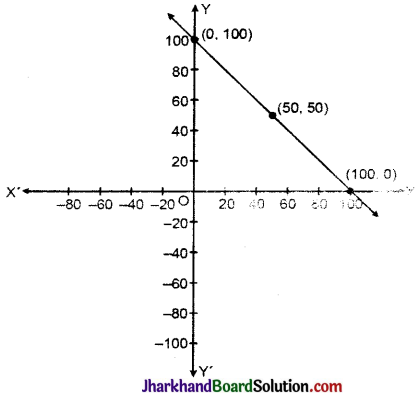
एक विद्यालय की कक्षा IX की छात्राएँ यामिनी और फातिमा ने मिलकर भूकम्प पीड़ित व्यक्तियों की सहायता के लिए प्रधानमंत्री राहत कोष में ₹ 100 अंशदान दिया। एक रैखिक समीकरण लिखिए जो इन आँकड़ों को सन्तुष्ट करता हो (आप उनका अंशदान ₹x और ₹y मान सकते हैं)। इस समीकरण का आलेख खींचिए।
हल:
माना कि यामिनी तथा फातिमा का प्रधानमंत्री राहत कोष में योगदान क्रमश: x रुपये तथा 3 रुपये है।
∴ ऊपर दिए गए आँकड़ों के लिए रैखिक समीकरण x + y = 100 या y = 100 – x
अत: यदि x = 0, तब y = 100 – 0 = 100
यदि x = 100, तब y = 100 – 100 = 0
यदि x = 50, तब y = 100 – 50 = 50
इन मानों के लिए सारणी इस प्रकार है:

x010050
y100050

पैमाना X-अक्ष और Y-अक्ष पर
माना 1 सेमी = ₹ 20
JAC Class 9 Maths Solutions Chapter 4 दो चरों वाले रैखिक समीकरण Ex 4.3 9
बिन्दुओं (0,100) (50, 50) और (100, 0) से होकर जाने वाली एक सरल रेखा प्राप्त होती है जो रैखिक समीकरण x + y = 100 को सन्तुष्ट करती है।

JAC Class 9 Maths Solutions Chapter 4 दो चरों वाले रैखिक समीकरण Ex 4.3

प्रश्न 8.
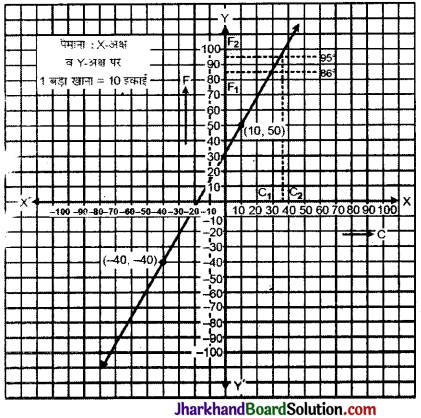
अमेरिका और कनाडा जैसे देशों में तापमान फारेनहाइट में मापा जाता है, जबकि भारत जैसे देशों में तापमान सेल्सियस में मापा जाता है। यहाँ फारेनहाइट को सेल्सियस में रूपांतरित करने वाला एक रैखिक समीकरण दिया गया है:
F = \(\left(\frac{9}{5}\right)^{\circ} \mathrm{C}+32\)
(i) सेल्सियस को X-अक्ष और फारेनहाइट को Y-अक्ष मानकर ऊपर दिए गए रैखिक समीकरण का आलेख खींचिए।
(ii) यदि तापमान 30°C है, तो फारेनहाइट में तापमान क्या होगा ?
(iii) यदि तापमान 95°F है, तो सेल्सियस में तापमान क्या होगा ?
(iv) यदि तापमान 0°C है, तो फारेनहाइट में तापमान क्या होगा ? और यदि तापमान 0°F है, तो सेल्सियस में तापमान क्या होगा ?
(v) क्या ऐसा भी कोई तापमान है जो फारेनहाइट और सेल्सियस दोनों के लिए संख्यात्मकतः समान है ? यदि हाँ, तो उसे ज्ञात कीजिए।
हल:
(i) F = \(\left(\frac{9}{5}\right)^{\circ} \mathrm{C}+32\)
⇒ C = \(\frac{5}{9}\) (F – 32)
जब C = -40, तब
F = \(\frac{9}{5}\) × (-40) + 32 = – 72 + 32 = -40
जब C = 10. तब
F = \(\frac{9}{5}\) × 10 + 32 = 18 + 32 = 50
उपरोक्त मानों की सारणी निम्न है-

C-4010
F-4050

JAC Class 9 Maths Solutions Chapter 4 दो चरों वाले रैखिक समीकरण Ex 4.3 10
हम X-अक्ष पर सेल्सियस ताप तथा Y-अक्ष पर फारेनहाइट प्रदर्शित करते हुए बिन्दुओं (-40, -40) तथा (10, 50) को अंकित करते हैं। इन बिन्दुओं को मिलाने पर हमें F = \(\frac{9}{5}\)C + 32 का ग्राफ प्राप्त होता है।
(ii) ग्राफ से स्पष्ट है कि जब C = 30°, तब F = 86°
अतः 30°C – 86°F.
(iii) ग्राफ से स्पष्ट है कि जब F = 95°, तब C = 35°
अतः 95°F – 35°C.
(iv) तथा 0°C = 32°F तथा 0°F = -17.8°C
(v) ग्राफ से स्पष्ट है कि वह तापमान जो संख्यात्मक रूप से फारेनहाइट तथा सेल्सियस में बराबर है वह -40° है अर्थात्
-40°C = -40°F.

JAC Class 9 Maths Solutions Chapter 11 रचनाएँ Ex 11.1

Jharkhand Board JAC Class 9 Maths Solutions Chapter 11 रचनाएँ Ex 11.1 Textbook Exercise Questions and Answers.

JAC Board Class 9 Maths Solutions Chapter 11 रचनाएँ Exercise 11.1

प्रश्न 1.
एक दी हुई किरण के प्रारम्भिक बिन्दु पर 90° के कोण की रचना कीजिए और कारण सहित रचना की पुष्टि कीजिए।
हल:
रचना: 1. किरण \(\overrightarrow{O A}\) खाँची।
2. इसके आरम्भिक बिन्दु को केन्द्र मानकर किसी भी त्रिज्या का एक चाप CDE लगाया जो OA को बिन्दु पर काटता है।
JAC Class 9 Maths Solutions Chapter 11 रचनाएँ Ex 11.1 1
3. C को केन्द्र मानकर समान त्रिज्या का चाप खींचा जो चाप CDE को D पर काटता है।
4. D को केन्द्र मानकर समान त्रिज्या का चाप खींचा जो CDE को E पर काटता है।
5. D और E को केन्द्र मानकर, तथा समान त्रिज्या से दो चाप लगाए जो एक-दूसरे को P बिन्दु पर काटते हैं।
6. OP को मिलाया। इस प्रकार ∠AOP = 90°.
सत्यापन: रचना, OE, ED, DO तथा CD को मिलाया।
अब क्योंकि OC = CD = OD
∴ ΔOCD एक समबाहु त्रिभुज है।
अतः ∠COD = 60°.
पुनः OD = DE = EO
∴ ΔODE भी एक समबाहु त्रिभुज है।
अतः ∠DOE = 60°.
चूँकि OP, ∠DOE को समद्विभाजित करता है। अतः ∠POD = 30°.
अब, ∠AOP = ∠COD + ∠DOP
= 60° + 30° = 90°.

JAC Class 9 Maths Solutions Chapter 11 रचनाएँ Ex 11.1

प्रश्न 2.
एक दी हुई किरण के प्रारम्भिक बिन्दु पर 45° के कोण की रचना कीजिए और कारण सहित रचना की पुष्टि कीजिए।
हल:
रचना: 1. किरण \(\overrightarrow{O A}\) खींची।
2. O को केन्द्र मानकर कोई भी त्रिज्या लेकर एक चाप खींचा, जो OA को B बिन्दु पर काटता है।
JAC Class 9 Maths Solutions Chapter 11 रचनाएँ Ex 11.1 2
3. B को केन्द्र मानकर समान त्रिज्या से चाप खींचा जो पहले खींचे गए चाप को बिन्दु C पर काटता है अब बिन्दु C को केन्द्र तथा समान त्रिज्या लेकर चाप खींचा जो पहले चाप को D बिन्दु पर काटता है।
4. C. बिन्दु से CD की आधी से अधिक त्रिज्या लेकर एक चाप खींचा।
5. इस प्रकार बिन्दु D को केन्द्र मानकर समान त्रिज्या का दूसरा चाप लगाया जो पहले चाप को E पर काटता है।
6. OE को मिलाया। इस प्रकार ∠AOE = 90°.
7. ∠AOE का समद्विभाजक OF खींचा। इस प्रकार ∠AOF = 45°.
सत्यापन : रचना में, ∠AOE = 90° और OF, ∠AOE का समद्विभाजक है।
∴ ∠AOF = \(\frac{1}{2}\)∠AOE
= \(\frac{1}{2}\) × 90° = 45°.

प्रश्न 3.
निम्नलिखित मापों के कोणों की रचना कीजिए:
(i) 30°
(ii) \(22 \frac{1}{2}^{\circ}\)
(iii) 15°
हल:
रचना करनी है : 30° कोण की।
विश्लेषण: 30° = \(\frac{1}{2}\) × 60°
JAC Class 9 Maths Solutions Chapter 11 रचनाएँ Ex 11.1 3
रचना: (1) किरण \(\overrightarrow{O A}\) खींची।
(2) किरण \(\overrightarrow{O A}\) के अन्त्य बिन्दु O को केन्द्र मानकर कोई त्रिज्या OB लेकर एक चाप लगाया।
(3) पुनः B को केन्द्र मानकर उसी त्रिज्या से एक अन्य चाप खींचा जो पहले चाप को बिन्दु C पर काटता है।
(4) बिन्दु C तथा B को केन्द्र मानकर चाप लगाए जो परस्पर D बिन्दु पर काटते हैं।
(5) OD को मिलाती हुवी रेखा खींची।
इस प्रकार ∠AOD = 30° जो अभीष्ट कोण है।

(ii) रचना करनी है: \(22 \frac{1}{2}^{\circ}\) के कोण की।
विश्लेषण: 90° के कोण का समद्विभाजक खींचने पर 45° का कोण प्राप्त होता है और पुनः 45° के कोण का समद्विभाजक खाँचने पर \(22 \frac{1}{2}^{\circ}\) का कोण प्राप्त होता है।
रचना : (1) एक किरण \(\overrightarrow{O A}\) खींचकर उसके अन्त्य बिन्दु O पर 90° का कोण बनाती हुयी रेखा OT खींची।
(2) ∠TOA = 90° का समद्विभाजक OC खींचा
∴ ∠COA = 45°
JAC Class 9 Maths Solutions Chapter 11 रचनाएँ Ex 11.1 4
(3) ∠COA – 45° का समद्विभाजक रेखाखण्ड OB खींचा। इस प्रकार \(22 \frac{1}{2}^{\circ}\) के दो कोण प्राप्त होते हैं।
अतः ∠BOA = \(22 \frac{1}{2}^{\circ}\) जो अभीष्ट कोण है।
(iii) रचना करनी है: 15° के कोण की।
विश्लेषण: 60° के कोण का अर्द्धक 30° का कोण बनाया। अब 30° के कोण का अर्द्धक कर 15° का कोण बनाते हैं।
रचना: (1) किरण OA खींचकर उसके अन्त्य बिन्दु O पर 60° बनाते हुए चाप लगाया। ∠COA = 60°.
(2) ∠COA का समद्विभाजक OD खींचा जो ∠DOA = 30° बनाता है।
(3) ∠DOA का समद्विभाजक OE खींचा।
JAC Class 9 Maths Solutions Chapter 11 रचनाएँ Ex 11.1 5
इस प्रकार ∠AOE = \(\frac{1}{2}\) × 30° = 15°
अत: ∠AOE = 15° जो कि अभीष्ट कोण है।

JAC Class 9 Maths Solutions Chapter 11 रचनाएँ Ex 11.1

प्रश्न 4.
निम्नलिखित कोणों की रचना कीजिए और चाँदे द्वारा मापकर पुष्टि कीजिए:
(i) 75°
(ii) 105°
(iii) 135°.
हल:
(i) रचना करनी है: 75° के कोण की।
JAC Class 9 Maths Solutions Chapter 11 रचनाएँ Ex 11.1 6
विश्लेषण: 75° = 90° – 15°
= 90° – [30° के कोण का \(\frac{1}{2}\)]
रचना : (1) ∠BOP = 60° बनाते हुए किरण OB तथा ∠POQ = 90° बनाते हुए किरण \(\overline{O Q}\) खींची।
(2) ∠BOQ = (90° – 60° = 30°) का समद्विभाजक OS खींचा, जिससे ∠QOS = 15°.
(3) स्पष्ट है कि
∠POS = ∠POQ – ∠QOS
= 90° – 15° = 75°
अतः ∠POS अभीष्ट कोण है।

(ii) रचना करनी है 105° के कोण की।
विश्लेषण: 60° + 30° + \(\left(30^{\circ} \times \frac{1}{2}\right)\) = 105°
अथवा 90° + \(\left(30^{\circ} \times \frac{1}{2}\right)\) = 105°
JAC Class 9 Maths Solutions Chapter 11 रचनाएँ Ex 11.1 7
रचना: (1) किरण \(\overline{O P}\) के अन्त्य बिन्दु O पर ∠COP = 120° बनाती हुयी रेखा CO तथा ∠QOP = 90° बनाती हुवी रेखा OQ खींची।
(2) ∠QOC का समद्विभाजक OS खींचा जिससे ∠QOS = 15°।
इस प्रकार, ∠POS = 90° + 15° = 105° जोकि अभीष्ट कोण है।

(iii) रचना करनी है: 135° के कोण की।
विश्लेषण: 135° = 90° + 45°.
JAC Class 9 Maths Solutions Chapter 11 रचनाएँ Ex 11.1 8
रचना: (1) रेखाखण्ड \(\overline{O P}\) के अन्त्य बिन्दु O पर 90° का कोण बनाती हुयी रेखा \(\overline{O P}\) खींची। इस प्रकार ∠ROQ = ∠ROP = 90°.
(2) ∠QOR का समद्विभाजक OS खींचा।
तब ∠POS = 90° + 45° = 135° जोकि अभीष्ट कोण है।

JAC Class 9 Maths Solutions Chapter 11 रचनाएँ Ex 11.1

प्रश्न 5.
एक समबाहु त्रिभुज की रचना कीजिए, जब इसकी भुजा दी हो। कारण सहित रचना कीजिए।
हल:
JAC Class 9 Maths Solutions Chapter 11 रचनाएँ Ex 11.1 9
रचना:
(1) रेखाखण्ड QR = 5 सेमी (माना) खींचा।
(2) Q और R को केन्द्र मान कर तथा 5 सेमी त्रिज्या लेकर दो चाप लगाए जो परस्पर P बिन्दु पर काटते हैं।
(3) PQ और PR को मिलाया। इस प्रकार ΔPQR अभीष्ट समबाहु त्रिभुज है।

JAC Class 9 Maths Solutions Chapter 5 युक्लिड के ज्यामिति का परिचय Ex 5.1

Jharkhand Board JAC Class 9 Maths Solutions Chapter 5 युक्लिड के ज्यामिति का परिचय Ex 5.1 Textbook Exercise Questions and Answers.

JAC Board Class 9 Maths Solutions Chapter 5 युक्लिड के ज्यामिति का परिचय Exercise 5.1

प्रश्न 1.
निम्नलिखित कथनों में से कौन-से कथन सत्य हैं और कौन-से कथन असत्य हैं ? अपने उत्तरों के लिए कारण भी दीजिए:
(i) एक बिन्दु से होकर केवल एक ही रेखा खींची जा सकती है।
(ii) दो भिन्न बिन्दुओं से होकर जाने वाली असंख्य रेखाएँ हैं।
(iii) एक सांत रेखा दोनों ओर अनिश्चित रूप से बढ़ाई जा सकती है।
(iv) यदि दो वृत्त बराबर हैं, तो उनकी त्रिज्याएँ बराबर होती हैं।
(v) आकृति में, यदि AB = PQ और PQ = XY है, तो AB = XY होगा ।
JAC Class 9 Maths Solutions Chapter 5 युक्लिड के ज्यामिति का परिचय Ex 5.1 1
हल:
(i) असत्य ।
एक कागज पर कोई बिन्दु X लें पेंसिल व पैमाने से X से जाने वाली कोई रेखा mi बनाइये। एक ओर रेखा X से गुजरती हुई बनाइये। इसी प्रक्रिया को करते हुए हम जितनी चाहें उतनी रेखाएँ X से बना सकते हैं।
JAC Class 9 Maths Solutions Chapter 5 युक्लिड के ज्यामिति का परिचय Ex 5.1 2

(ii) असत्य ।
एक कागज पर दो बिन्दु X तथा Y लें। अब कागज को इस प्रकार मोड़े कि कागज बिन्दुओं X तथा Y से होकर मुड़े पुनः प्रयास करते हुए कागज को अन्य प्रकार से मोड़े कि मोड़ X-Y बिन्दुओं पर हो यह असंभव है।
अतः स्पष्ट है कि दो बिन्दुओं से केवल एक रेखा खींची जा सकती है।
JAC Class 9 Maths Solutions Chapter 5 युक्लिड के ज्यामिति का परिचय Ex 5.1 3

(iii) सत्य ।
ज्यामिति में सांत रेखा ही रेखाखण्ड कहलाता है। रेखा को सिरों पर तीन बनाकर प्रदर्शित किया जाता है, किन्तु सांत रेखा (रेखाखण्ड) दो बिन्दुओं के मध्य की दूरी होती है जिसे
दोनों ओर अनिश्चित रूप से बढ़ाया जा सकता है।
JAC Class 9 Maths Solutions Chapter 5 युक्लिड के ज्यामिति का परिचय Ex 5.1 4

(iv) सत्य ।
बराबर (क्षेत्रफल) वाले वृत्त संपाती होते हैं।
अतः उनके केन्द्र से परिधि तक की दूरी बराबर होती है अर्थात् उनकी त्रिज्याएँ बराबर होती हैं।

(v) सत्य ।
ऐसी दो भिन्न वस्तुएँ किसी अन्य वस्तु के पूर्णत: बराबर हों, तो वे आपस में भी बराबर होती हैं। अतः दी गई आकृति में AB = PQ और PQ = XY, तो AB = XY होगा। अतः दिया हुआ कथन सत्य है।

JAC Class 9 Maths Solutions Chapter 5 युक्लिड के ज्यामिति का परिचय Ex 5.1

प्रश्न 2.
निम्नलिखित पदों में से प्रत्येक की परिभाषा दीजिए। क्या इनके लिए कुछ ऐसे पद हैं, जिन्हें परिभाषित करने की आवश्यकता है? वे क्या हैं और आप इन्हें कैसे परिभाषित करेंगे ?
(i) समांतर रेखाएँ
(ii) लम्ब रेखाएँ
(iii) रेखाखण्ड
(iv) वृत्त की त्रिज्या
(v) वर्ग।
हल:
(i) समान्तर रेखाएँ एक ही तल में स्थित इस प्रकार की दो सरल रेखाएँ जो आपस में एक-दूसरे को नहीं काटती हैं, समान्तर रेखाएँ कहलाती हैं।
समान्तर रेखाएँ आपस में बराबर दूरी पर रहती हैं अर्थात् दो समान्तर रेखाओं के प्रत्येक बिन्दु पर लम्बवत् दूरी सदैव बराबर रहती है।
समान्तर रेखाओं के लिए संकेत ‘||’ का प्रयोग किया जाता है जिसका तात्पर्य ‘समान्तर’ है।
JAC Class 9 Maths Solutions Chapter 5 युक्लिड के ज्यामिति का परिचय Ex 5.1 5
चित्र में रेखा AB, रेखा CB के समान्तर है जिसे AB || CD द्वारा व्यक्त करते हैं।

(ii) लम्ब रेखाएँ एक ही तल में स्थित दो सरल रेखाएँ जो एक-दूसरे के साथ समकोण बनाती हैं। लम्ब रेखाएँ कहलाती हैं। हम लिखते हैं ABCD.
JAC Class 9 Maths Solutions Chapter 5 युक्लिड के ज्यामिति का परिचय Ex 5.1 6

(iii) रेखाखण्ड: सरल रेखा का एक निश्चित भाग जो दो निश्चित बिन्दुओं के मध्य स्थित होता है। रेखाखण्ड कहलाता है। चित्र में AB या BA रेखाखण्ड है।
JAC Class 9 Maths Solutions Chapter 5 युक्लिड के ज्यामिति का परिचय Ex 5.1 7
AB रेखाखण्ड में प्रारम्भिक बिन्दु 4 और अन्तिम बिन्दु B है।

(iv) वृत्त की त्रिज्या वृत्त के केन्द्र से वृत्त की परिधि पर स्थित किसी बिन्दु के बीच की दूरी को वृत्त की त्रिज्या कहते हैं। चित्र में OA वृत्त की त्रिज्या है।
JAC Class 9 Maths Solutions Chapter 5 युक्लिड के ज्यामिति का परिचय Ex 5.1 8

(v) वर्ग वह चतुर्भुज जिसकी चारों भुजाएँ बराबर हाँ तथा प्रत्येक कोण समकोण हो, वर्ग कहलाता है। चित्र में ABCD वर्ग है।
JAC Class 9 Maths Solutions Chapter 5 युक्लिड के ज्यामिति का परिचय Ex 5.1 9
∠A – ∠B – ∠C – ∠D = 90°
तथा AB = BC = CD = DA.

JAC Class 9 Maths Solutions Chapter 5 युक्लिड के ज्यामिति का परिचय Ex 5.1

प्रश्न 3.
नीचे दी गई दो अभिधारणाओं पर विचार कीजिए:
(i) दो भिन्न बिन्दु A और B दिये रहने पर, एक तीसरा बिन्दु C ऐसा विद्यमान है, जो A और B के बीच स्थित होता है।
(ii) यहाँ कम से कम ऐसे तीन बिन्दु विद्यमान हैं कि वे एक रेखा पर स्थित नहीं हैं। इस स्थिति में बिन्दु A, B, C सरेखीय कहलाते हैं।
क्या इन अभिधारणाओं में कोई अपरिभाषित शब्द है ? क्या ये अभिधारणाएँ अवरोधी हैं ? क्या ये यूक्लिड की अभिधारणाओं से प्राप्त होती हैं ? स्पष्ट कीजिए।
हल:
यहाँ पर बहुत सारे अपरिभाषित पद हैं,
(i) दो बिन्दु तथा B दिये गये हैं, जहाँ बिन्दु C उनके बीच खींची गयी रेखा पर स्थित है।
(ii) बिन्दु तथा B दिये गये हैं। हम एक बिन्दु C ले सकते हैं, जो A तथा B से होकर गुजरती हुई रेखा पर स्थित नहीं है। इस स्थिति में यदि बिन्दुओं तथा B को C से मिलाया जाता है तो एक त्रिभुज की रचना होती है।
यह अभिगृहीत यूक्लिड के अभिगृहीतों पर आधारित नहीं है। हालाँकि ये अभिगृहीतों का अनुसरण करते हैं, क्योंकि दो दिए हुए विभिन्न बिन्दुओं से केवल एक ही रेखा गुजर सकती है।

प्रश्न 4.
दो बिन्दुओं A और B के बीच एक बिन्दु C ऐसा स्थित है कि AC = \(\frac{1}{2}\)AB है। एक आकृति खींचकर इसे स्पष्ट कीजिए।
हल:
दिया हैं बिन्दु C जो बिन्दुओं तथा B के बीच में इस प्रकार स्थित है कि
AC = BC.
JAC Class 9 Maths Solutions Chapter 5 युक्लिड के ज्यामिति का परिचय Ex 5.1 10
दोनों ओर AC जोड़ने पर,
AC + AC = AC + BC
या 2AC = AB
[∵ AC + CB, AB के बराबर है]
AC = \(\frac{1}{2}\)AB

प्रश्न 5.
प्रश्न 4 में, बिन्दु C रेखाखण्ड AB का मध्य-बिन्दु कहलाता है। सिद्ध कीजिए कि एक रेखाखण्ड का एक और केवल एक ही मध्य-बिन्दु होता है।
हल:
माना AB का D एक और मध्य- बिन्दु है।
∴ AD = DB ……(i)
लेकिन दिया गया है कि C, AB का मध्य बिन्दु है।
∴ AC = CB ….. (ii)
JAC Class 9 Maths Solutions Chapter 5 युक्लिड के ज्यामिति का परिचय Ex 5.1 11
समी (i) को (ii) में से घटाने पर,
AC – AD = CB – DB
या DC = DC
या 2DC = 0 ∴ DC = 0
अतः C व D सम्पाती हैं। इति सिद्धम् ।

JAC Class 9 Maths Solutions Chapter 5 युक्लिड के ज्यामिति का परिचय Ex 5.1

प्रश्न 6.
आकृति में, यदि AC BD है, तो सिद्ध कीजिए कि ABCD है।
JAC Class 9 Maths Solutions Chapter 5 युक्लिड के ज्यामिति का परिचय Ex 5.1 12
हल:
दिया है AC = BD …(i)
तथा AC = AB + BC …(ii)
[∵ बिन्दु B, A तथा C के बीच में स्थित है]
और BD = BC + CD. …..(iii)
[∵ बिन्दु C B तथा D के बीच में स्थित है]
AC और BD का मान समीकरण (ii) और (iii) से समीकरण (i) में प्रतिस्थापित करने पर,
AB + BC = BC + CD
यां AB + BC – BC = BC + CD – BC
[दोनों पक्षों में से BC घटाने पर]
अतः AB = CD. इति सिद्धम् ।

प्रश्न 7.
यूक्लिड की अभिगृहीतों की सूची में दिया हुआ अभिगृहीत 5 एक सर्वव्यापी सत्य क्यों माना जाता है ? (ध्यान दीजिए कि यह प्रश्न पाँचवीं अभिधारणा से सम्बन्धित नहीं है।)
हल:
यह सार्वभौमिक सत्य है कि कोई भी सम्पूर्ण वस्तु अपने किसी भी भाग (अंश) से बड़ी होती है।
अतः यह “पूर्ण अपने भाग से बड़ा होता है।” यह सदैव सत्य है।

JAC Class 9 Maths Solutions Chapter 10 वृत्त Ex 10.4

Jharkhand Board JAC Class 9 Maths Solutions Chapter 10 वृत्त Ex 10.4 Textbook Exercise Questions and Answers.

JAC Board Class 9 Maths Solutions Chapter 10 वृत्त Exercise 10.4

प्रश्न 1.
5 सेमी और 3 सेमी त्रिज्या वाले दो वृत्त दो बिन्दुओं पर प्रतिच्छेदित करते हैं तथा उनके केन्द्रों के बीच की दूरी 4 सेमी है। उभयनिष्ठ जीवा की लम्बाई ज्ञात कीजिए।
हल:
O तथा O’ केन्द्रों वाले वृत्तों की त्रिज्याएँ OA तथा O’A क्रमश: 5 सेमी व 3 सेमी हैं। OO’ = 4 सेमी है।
JAC Class 9 Maths Solutions Chapter 10 वृत्त Ex 10.4 1
ΔOAO’ में पाइथागोरस प्रमेय से,
(OA)2 = (O’A)2 + (OO’)2
52 = 32 + 42
25 = 9 + 16 = 25
अत: ΔOAQ’ समकोण त्रिभुज है, जिसमें सबसे बड़ी भुजा OA कर्ण है, तब ∠AO’O समकोण है।
∴ बिन्दु P और केन्द्र O’ सम्पाती होंगे
अतः AP = AO’ = 3 सेमी
∴ जीवा की लम्बाई = 2 × AP
= 2 × 3 = 6 सेमी

JAC Class 9 Maths Solutions Chapter 10 वृत्त Ex 10.4

प्रश्न 2.
यदि एक वृत्त की दो समान जीवाऐं वृत्त के अन्दर प्रतिच्छेदित करें, तो सिद्ध कीजिए कि एक जीवा के दोनों खण्ड दूसरी जीवा के संगत खण्डों के बराबर हैं।
हल:
दिया है वृत्त C (O, r) में जीवा AB = जीवा CD जो एक-दूसरे को बिन्दु पर प्रतिच्छेदित करती हैं।
सिद्ध करना है:
(i) CP = AP
(ii) PB = PD.
रचना: OM ⊥ AB
ON ⊥ CD खींचे। OP को मिलाया।
JAC Class 9 Maths Solutions Chapter 10 वृत्त Ex 10.4 2
उपपत्ति: AM = MB = \(\frac{1}{2}\)AB
तथा CN = ND = \(\frac{1}{2}\)CD
[केन्द्र से खींचा गया लम्ब जीवा को समद्विभाजित करता है]
JAC Class 9 Maths Solutions Chapter 10 वृत्त Ex 10.4 3
[∵ AB = CD (दिया है)]
ΔOMP तथा ΔONP में, OM = ON
[एक वृत्त की समान जीवाएँ केन्द्र से समान दूरी पर स्थित होती हैं।]
∠OMP = ∠ONP [प्रत्येक 90°]
OP = OP [उभयनिष्ठ]
ΔOMP ≅ ΔONP (RHS नियम से)
अतः MP = PN ……(2)
समीकरण (1) मैं (2) जोड़ने पर,
MB + MP = ND + PN
या BP = PD ……(2)
समीकरण (1) में से (2) को घटाने पर,
AM – MP= CN – PN
AP = CP ……(1)
अत: (i) AP = CP और (ii) PB = PD. इति सिद्धम्।

प्रश्न 3.
यदि एक वृत्त की दो समान जीवाएँ वृत्त के अन्दर प्रतिच्छेदित करें, तो सिद्ध कीजिए कि प्रतिच्छेदित बिन्दु को केन्द्र से मिलाने वाली रेखा जीवाओं से बराबर कोण बनाती हैं।
हल:
दिया है: वृत्त C (O, r) में जीवा AB = जीवा CD जो परस्पर P बिन्दु पर प्रतिच्छेदित करती हैं।
सिद्ध करना है: ∠OPE = ∠OPF.
रचना : OE ⊥ AB तथा OF ⊥ CD खींचे और OP को मिलाया।
JAC Class 9 Maths Solutions Chapter 10 वृत्त Ex 10.4 4
उपपत्ति: ΔOEP तथा ΔOFP में,
∠OEP = ∠OFP [प्रत्येक 90°]
OP = OP [उभयनिष्ठ]
OE = OF
[एक वृत्त की समान जीवाएँ केन्द्र से समान दूरी पर स्थित होती हैं]
∴ ΔOEP ≅ ΔOFP (RHS नियम से)
अतः ∠OPE = ∠OPF इति सिद्धम्।

JAC Class 9 Maths Solutions Chapter 10 वृत्त Ex 10.4

प्रश्न 4.
यदि एक रेखा दो संकेन्द्री वृत्तों (एक ही केन्द्र वाले वृत्तों) को, जिनका केन्द्र O है, A, B, C और D पर प्रतिच्छेदित करे, तो सिद्ध कीजिए AB = CD (देखिए आकृति)।
JAC Class 9 Maths Solutions Chapter 10 वृत्त Ex 10.4 5
हल:
OM ⊥ AD खींचा।
BC छोटे वृत्त की जीवा है तथा OM ⊥ BC
BM = CM ……(1)
AD बड़े वृत्त की जीवा है तथा OM ⊥ AD
AM = DM ……(2)
JAC Class 9 Maths Solutions Chapter 10 वृत्त Ex 10.4 6
(∵ वृत्त के केन्द्र से जीवा पर डाला गया लम्ब जीवा को समाद्विभाजित करता है)
समीकरण (2) में से (1) को घटाने पर,
AM – BM = DM – CM
∴ AB = CD. इति सिद्धम्।

प्रश्न 5.
एक पार्क में बने 5 मीटर त्रिज्या वाले वृत्त पर खड़ी तीन लड़कियाँ रेशमा, सलमा एवं मनदीप खेल रही हैं। रेशमा एक गेंद को सलमा के पास, सलमा मनदीप के पास तथा मनदीप रेशमा के पास फेंकती है। यदि रेशमा तथा सलमा के बीच और सलमा तथा मनदीप के बीच प्रत्येक की दूरी 6 मीटर हो, तो रेशमा और मनदीप के बीच की दूरी क्या है ?
हल:
दिया है: पार्क में 5 मीटर त्रिज्या का एक वृत्त है जिसका केन्द्र O है। तीन लड़कियाँ रेशमा, सलमा और मनदीप वृत्त पर क्रमश: A, B व C स्थानों पर खड़ी हैं। रेशमा और सलमा के बीच की दूरी AB = 6 मीटर तथा सलमा और मनदीप के बीच दूरी BC = 6 मीटर है।
ज्ञात करना है: रेशमा और मनदीप के बीच की दूरी = AC
गणना : त्रिज्याएँ OA और OB खींचीं और माना त्रिज्या OB, AC को बिन्दु P पर काटती है।
JAC Class 9 Maths Solutions Chapter 10 वृत्त Ex 10.4 7
ΔOAB में, OA = 5 मीटर (त्रिज्या), OB = 5 मीटर (त्रिज्या) तथा AB = 6 मीटर।
माना OP = x, तब BP = (5 – x)
ΔABP मै,
∠P = 90°
∴ AP2 = AB2 – BP2 = (6)2 – (5 – x)2
= 36 – (25 – 10x + x2)
AP2 = 11 + 10x – x2 ……(1)
पुन: ΔAPO में,
AP2 = AO2 – OP2
AP2 = 52 – x2 = 25 – x2 ……(2)
समी. (1) तथा (2) से,
11 + 10x – x2 = 25 – x2
या 10x = 14
x = \(\frac{14}{10}\) = \(\frac{7}{5}\)
x का मान समीकरण (2) में रखने पर,
JAC Class 9 Maths Solutions Chapter 10 वृत्त Ex 10.4 8
अतः रेशमा और मनदीप के बीच की दूरी 9.6 मीटर है।

JAC Class 9 Maths Solutions Chapter 10 वृत्त Ex 10.4

प्रश्न 6.
20 मीटर त्रिज्या का एक गोल पार्क (वृत्ताकार) एक कॉलोनी में स्थित है। तीन लड़के अंकुर, सैय्यद तथा डेविड इसकी परिसीमा पर बराबर दूरी पर बैठे हैं और प्रत्येक के हाथ में एक खिलौना टेलीफोन आपस में बात करने के लिए है। प्रत्येक फोन की डोरी की लम्बाई ज्ञात कीजिए।
हल:
दिया है: O केन्द्र वाला एक वृत्ताकार पार्क जिसकी त्रिज्या OA = OB = 20 मीटर है। वृत्त की परिधि पर तीन लड़के एक-दूसरे से
बराबर दूरी पर A, B व C स्थानों पर बैठे हैं।
अत: AB = BC = CA.
ज्ञात करना है: डोरी की लम्बाई AB.
रचना: AM ⊥ BC खींचा तथा BO को मिलाया।
गणना: चूँकि ΔABC एक समबाहु त्रिभुज है।
माना इसकी प्रत्येक भुजा = x
ऊँचाई AM = \(\sqrt{3}\)x
अब OM = AM – OA
= (\(\sqrt{3}\)x – 20) मीटर
समकोण ΔOBM में,
OB2 = BM2+ OM2
⇒ 202 = x2 + (\(\sqrt{3}\)x – 20)2
⇒ 400 = x2 + 3x2 – 40\(\sqrt{3}\)x + 400
⇒ 4x2 – 40\(\sqrt{3}\)x = 0
⇒ 4x (x – 10\(\sqrt{3}\)) = 0
या तो x = 0, (असंभव)
या x – 10\(\sqrt{3}\) = 0
⇒ x = 10\(\sqrt{3}\)
अब BC = 2BM = 2x = 20\(\sqrt{3}\) मीटर
अतः प्रत्येक फोन की डोरी की लम्बाई = 20\(\sqrt{3}\) मीटर।

JAC Class 9 English Solutions Beehive Chapter 5 The Snake and the Mirror

Jharkhand Board JAC Class 9 English Solutions Beehive Chapter 5 The Snake and the Mirror Textbook Exercise Questions and Answers.

JAC Board Class 9 English Solutions Beehive Chapter 5 The Snake and the Mirror

JAC Class 9 English The Snake and the Mirror Textbook Questions and Answers

Thinking About the Text

I. Discuss in pairs and answer each question below in a short paragraph (in around 30-40 words).

जोड़े बनाकर विचार-विमर्श कीजिये तथा नीचे दिये गये प्रत्येक प्रश्न का उत्तर एक संक्षिप्त अनुच्छेद (लगभग 30 से 40 शब्दों) में दीजिये ।

Question 1.
‘The sound was a familiar one.’ What sound did the doctor hear ? What did he think it was? How many times did he hear it? (Find the places in the text.) When and why did the sounds stop ?
‘ध्वनि परिचित थी ।’ डॉक्टर ने कौन-सी आवाज सुनी ? उसने उसे ( आवाज को) क्या समझा ? उसे वह कितनी बार सुनाई पड़ी ? (पाठ में से उन स्थानों को ढूँढ़िये ) । वह ध्वनि कब और क्यों बन्द हो गई ?
Answer:
The doctor heard the familiar sound of rats. He heard a noise from above. When he opened the door, he thought that the sound was made by the rats in the tiled roof. He heard the sound four times, three times from above and one dull thud sound. When the doctor sat in the chair, the sound from above stopped because the snake was about to jump on the ground at that time.

डाक्टर ने चूहों की चिर-परिचित आवाज सुनी। डॉक्टर ने ऊपर एक आवाज सुनी, जब उसने दरवाजा खोला। उसने सोचा कि खपरैल की छत में चूहों द्वारा आवाज की जा रही है । उसने यह आवाज चार बार सुनी तीन बार ऊपर से और एक धीमी सी धम्म की आवाज सुनी । जब डाक्टर कुर्सी पर बैठ गया तो ऊपर की आवाज बन्द हो गई क्योंकि उस समय साँप जमीन पर कूदने ही वाला था ।

JAC Class 9 English Solutions Beehive Chapter 5 The Snake and the Mirror

Question 2.
What two ‘important’ and ‘ earth shaking’ decisions did the doctor take while he was looking into the mirror ?
डॉक्टर ने दर्पण में देखते हुए कौन-से दो महत्त्वपूर्ण निर्णय लिये ?
Answer:
The doctor took two important decisions while he was looking into the mirror-

  • He would shave daily and grow a thin moustache to look more handsome.
  • He would always keep an attractive smile on his face to look more handsome.

डॉक्टर ने दर्पण में देखते हुए दो महत्त्वपूर्ण निर्णय लिए-

  • वह अधिक सुन्दर दिखने के लिए रोज दाढ़ी बनायेगा और पतली मूँछें रखेगा ।
  • वह अधिक सुन्दर दिखने के लिए हमेशा अपने चेहरे पर आकर्षक मुस्कान बनाए रखेगा ।

Question 3.
“I looked into the mirror and smiled,” says the doctor. A little later he says, “I forgot my danger and smiled feebly at myself.” What is the doctor’s opinion about himself when – (i) he first smiles, and (ii) he smiles again? In what way do his thoughts change in between, and why?
डॉक्टर कहता है, “मैंने दर्पण देखा और मुस्कुराया “। कुछ देर पश्चात् वह कहता है, “मैं खतरे को भूल गया और हल्के से अपने ऊपर मुस्कुराया ।” डॉक्टर की अपने बारे में क्या राय है जब वह
(i) पहली बार मुस्कुराता है और
(ii) वह दूसरी बार मुस्कुराता है’ ? इस बीच उसके विचार कैसे और क्यों बदल जाते हैं ?
Answer:
When the doctor first looks into the mirror, he smiles as he thinks he is an attractive bachelor doctor. The next time he smiles at himself because he feels he is a poor, foolish and stupid doctor. His vanity changes into humility. His thoughts got changed because of snake. He was quite near to death.

जब डॉक्टर दर्पण में देखता है तो वह मुस्कुराता है क्योंकि वह समझता है कि वह एक आकर्षक कुँआरा डॉक्टर है । अगली बार वह स्वयं पर इसलिए मुस्कुराता है क्योंकि वह महसूस करता है कि वह गरीब, मूर्ख तथा बुद्ध डॉक्टर है । उसका घमण्ड आत्मग्लानि में बदल जाता है। उसके विचार सर्प के कारण बदल गये। वह मृत्यु के बिल्कुल नजदीक था ।

JAC Class 9 English Solutions Beehive Chapter 5 The Snake and the Mirror

II. This story about a frightening incident is narrated in a humorous way. What makes it humorous?

(Think of the contrasts it presents between dreams and reality. Some of them are listed below):

एकं भयावह घटना वाली यह कहानी हास्यप्रद ढंग से सुनाई गई है । यह किस कारण हास्यप्रद है ? (उन विरोधाभासों के विषय में सोचिये जो इस कहानी में स्वप्नों एवं वास्तविकता के मध्य प्रस्तुत किये गये हैं। उनमें से कुछ नीचे दिये गये हैं

1. (i) The kind of person the doctor is (money, possessions)
डॉक्टर जिस प्रकार का आदमी है ( धन, सम्पत्ति )

(ii) The kind of person he wants to be (appearance, ambition)
वह जिस प्रकार का व्यक्ति बनना चाहता है ( स्वरूप, महत्त्वाकांक्षा )

2. (i) The person he wants to marry
वह व्यक्ति जिससे वह विवाह करना चाहता है

(ii) The person he actually marries
वह व्यक्ति जिससे वह वास्तव में विवाह करता

3. (i) His thoughts when he looks into the mirror
दर्पण में देखते समय उसके विचार

(ii) His thoughts when the snake is coiled around his arm
जब सर्प उसकी बाँह पर लिपट जाता है तब उसके विचार

Write short paragraphs on each of these to get your answer:
उत्तर पाने के लिए इनमें से प्रत्येक पर एक संक्षिप्त अनुच्छेद लिखिये :
Answer:
1. The doctor is a poor person. He has not sufficient money. He has about sixty rupees in his suitcase. He lives in an unelectrified rented house. He has just started his medical practice. He wants to be rich. He also likes to have a good appearance. That’s why he decides to grow a thin moustache.

डॉक्टर एक ́ निर्धन व्यक्ति है । उसके पास पर्याप्त धन नहीं है । उसके पास सूटकेस में लगभग साठ रुपये हैं। वह बिना बिजली वाले किराए के छोटे से मकान में रहता है । उसने डॉक्टरी अभी शुरू की है । वह धनवान बनना चाहता है । वह आकर्षक भी दिखना चाहता है । इसलिए वह पतली मूँछ उगाना चाहता है ।

2. The doctor wants to marry a woman doctor with a good medical practice and having a lot of money. She should be fat so that she may not run after him for his silly mistake and catch him. He actually marries a thin reedy woman. She has the gift of a sprinter.

डॉक्टर एक ऐसी महिला डॉक्टर से शादी करना चाहता है जिसका चिकित्सकीय व्यवसाय ठीक चलता हो और उसके पास बहुत सा धन हो । वह मोटी हो ताकि वह (पत्नी) उसकी किसी मूर्खतापूर्ण गलती के लिये उसे (डॉक्टर को) पकड़ने के लिए उसके पीछे न भाग सके । वास्तव में उसकी शादी एक अत्यन्त पतली महिला से होती है । उसमें (पत्नी में ) एक धावक की प्रतिभा है ।

JAC Class 9 English Solutions Beehive Chapter 5 The Snake and the Mirror

3. When he looks into the mirror, his thoughts are full of joy and satisfaction. He decides to grow a thin moustache and keep smile on his face. He finds his smile attractive. When the snake is coiled around his arm, he suddenly turns to a stone. He sits like a stone image in the flesh holding his breath. However, his mind is very active. He feels the great presence of God, the Creator. He decides to write the words ‘O God’ outside his little heart. These contrasts make the story humorous and we can’t help laughing while reading it.

जब वह दर्पण में देखता है तब उसके विचार आनन्द और संतोष से परिपूर्ण हैं । वह पतली मूँछ उगाना. चाहता है और अपने चेहरे पर मुस्कान रखना चाहता है । उसे अपनी मुस्कुराहट बहुत आकर्षक लगती है । जब सर्प उसकी बाँह पर लिपट जाता है तब वह अचानक पत्थर में बदल जाता है । वह शरीर में पत्थर की मूर्ति की तरह अपनी साँस रोककर बैठ जाता है । लेकिन उसका दिमाग बहुत सक्रिय है । वह सृष्टिकर्ता (संसार के रचयिता ) भगवान की उपस्थिति महसूस करता है । वह अपने छोटे-से दिल के बाहर ‘O God’ लिखने का निश्चय करता है । ये विरोधाभास कहानी को हास्यप्रद बनाते हैं और हम इसे पढ़ते समय हँसे बिना नहीं रह सकते ।

Thinking about Language

I. Here are some sentences from the text. Say which of them tell you, that the author :

(a) was afraid of the snake
(b) was proud of his appearance
(c) had a sense of humour
(d) was no longer afraid of the snake.

यहाँ पाठ में से कुछ वाक्य दिये गये हैं । इनमें से कौन-से वाक्य बताते हैं कि लेखक-
(a) सर्प से भयभीत था
(b) (उसे) अपने रूप पर गर्व था
(c) (उसमें) हास्य का भाव था
(d) अब सर्प से भयभीत नहीं था ।
1. I was turned to stone.
2. I was no mere image cut in granite.
3. The arm was beginning to be drained of strength.
4. I tried in my imagination to write in bright letters outside my little heart the words, “O God”.
5. I didn’t tremble. I didn’t cry out.
6. I looked into the mirror and smiled. It was an attractive smile.
7. I was suddenly a man of flesh and blood..
8. I was after all a bachelor, and a doctor too on top of it!
9. The fellow had such a sense of cleanliness…! The rascal could have taken it and used it after washing it with soap and water.
10. Was it trying to make an important decision about growing a moustache or using eye shadow and mascara or wearing a vermilion spot on its forehead?
Answer:
1. Sentences No. 1, 3, 4 and 5 tell us that the author was afraid of the snake.
2. Sentences No. 6 and 8 tell us that the author was proud of his appearance.
3. Sentences No. 9 and 10 tell us that the author had a sense of humour.
4. Sentences No. 2 and 7 tell us that the author was no longer afraid of the snake.

II. Expressions used to show fear :

भय दर्शाने के लिए प्रयुक्त अभिव्यक्तियाँ :

Can you find the expressions in the story that tell you that the author was frightened? Read the story and complete the following sentences:
क्या आप कहानी में से उन अभिव्यक्तियों को ढूँढ़ सकते हैं जो ये बताती हैं कि लेखक भयभीत था ? कहानी को पढ़िये और निम्नलिखित वाक्यों को पूरा कीजिये :
1. I was turned ……………….
2. I sat there holding ………………..
3. In the light of the lamp I sat there like ………………..
Answer:
1. I was turned to stone.
2. I sat there holding my breath.
3. In the light of the lamp I sat there like a stone image in the flesh.

JAC Class 9 English Solutions Beehive Chapter 5 The Snake and the Mirror

III. In the sentences given below some words and expressions are italicised. They variously mean that one:

(नीचे दिये गये वाक्यों में कुछ शब्द एवं अभिव्यक्तियाँ टेढ़े अक्षरों में हैं । उन शब्दों का प्रयोग यह दिखाने के लिए हुआ है कि कोई )

• is very frightened.
बहुत डरा हुआ है ।

• is too scared to move.
इतना डर गया है कि हिल नहीं सकता ।

• is frightened by something that happens suddenly.
किसी ऐसी वस्तु या घटना से डर जाता है जो अचानक घटित होती

• makes another feel frightened.
किसी और को भयभीत करता है ।

Match the meanings with the words/expressions in italics, and write the appropriate meaning next to the sentence. The first one has been done for you:

अर्थों को उन शब्दों / अभिव्यक्तियों से मिलाइये जो टेढ़े अक्षरों में छपी हैं तथा वाक्य के आगे सही (उपयुक्त) अर्थ लिखिये ।
पहले वाला वाक्य आपकी सहायता के लिये हल कर दिया गया है :

1. I knew a man was following me, I was scared out of my wits. (very frightened)
2. I got a fright when I realized how close I was to the cliff edge.
3. He nearly jumped out of his skin when he saw the bull coming towards him.
4. You really gave me a fright when you crept up behind me like that.
5. Walt until I tell his story – it will make your hair stand on end.
6. Paralysed with fear, the boy faced his abductors.
7. The boy hid behind the door, not moving a muscle.
Answer:
2. Frightened by something that happens suddenly.
3. Very frightened.
4. Frightened by something that happens suddenly.
5. Makes another feel frightened.
6. Too scared to move.
7. Too scared to move.

IV. Reported Questions

Study these sentences:
इन वाक्यों का अध्ययन कीजिये :

• His friend asked, “Did you see the snake the next day, doctor ?”
His friend asked the doctor whether/if he had seen the snake the next day.

• The little girl wondered, “Will I be home before the TV show begins?”
The little girl wondered if/whether she would be home before the TV show began.

• Someone asked, “Why has the thief left the vest behind ?”
Someone asked why the thief had left the vest behind.

do, will, can, have, are आदि से प्रारम्भ होने वाले प्रश्नों को रिपोर्ट करते समय अर्थात् इन्हें direct narration से indirect narration में बदलते वक्त if या whether का प्रयोग किया जाता है । इन प्रश्नों का उत्तर yes या no में दिया जा सकता है।

why/when/where/how/ which / what आदि से प्रारम्भ होने वाले प्रश्नों को रिपोर्ट करते समय अर्थात् इन्हें direct narration से indirect narration में बदलते वक्त इन्हीं शब्दों का प्रयोग किया जाता 1 प्रश्नों को रिपोर्ट करते समय अर्थात् इन्हें direct narration से indirect narration में बदलते वक्त if/ whether/why/when आदि के साथ ask, inquire तथाwonder इत्यादि reporting verb का प्रयोग, किया जाता है ।

Remember that in reported speech : याद रखिये कि Reported Speech में:

  • present tense को past tense में बदल देते हैं ।
  • here, today, tomorrow, yesterday आदि को there, that day, the next day, the day before आदि में बदल दिया जाता है ।
  • I / you को आवश्यकतानुसार me / him / he आदि में बदल दिया जाता है । उदाहरणार्थ :
  • He said to me, ‘I don’t believe you.’
    He said that he did not believe me.
  • She said to him, ‘I don’t believe you.’
    She told him that she did not believe him.

JAC Class 9 English Solutions Beehive Chapter 5 The Snake and the Mirror

Report these questions, using if/whether or why/when/where/how/which/what. Remember the underlined verbs change into the Past Tense.

if/whether या why/when/where/how/which/what का प्रयोग करते हुए इन प्रश्नों को Report कीजिये। स्मरण रखिये कि रेखांकित क्रियाएँ Past-Tense में बदल जाती हैं :

1. Meena asked her friend, “Do you think your teacher will come today?”
2. David asked his colleague, “Where will you go this summer?”
3. He asked the little boy, “Why are you studying English ?”
4. She asked me, “When are we going to leave ?”
5. Pran asked me, “Have you finished reading the newspaper ?”
6. Seema asked her, “How long have you lived here ?”
7. Sheila asked the children, “Are you ready to do the work?”
Answer:
1. Meena asked her friend if she thought her teacher would go that day.
2. David asked his colleague where he would go that summer.
3. He asked the little boy why he was studying English.
4. She asked me when we were going to leave.
5. Pran asked me if I had finished reading the newspaper.
6. Seema asked her how long she had lived there.
7. Sheila asked the children if they were ready to do the work.

Speaking

Using some of the expressions given above in exercise III, talk about an incident when you were very scared. You may have a competition to decide whose story was the most frightening.
ऊपर अभ्यास III में दी गयी कुछ अभिव्यक्तियों का प्रयोग करके किसी ऐसी घटना का वर्णन कीजिये जब आप बहुत डर गये थे । आप यह निर्णय करने के लिए कि किसकी कहानी सबसे अधिक डरावनी है एक प्रतियोगिता भी कर सकते हैं ।
Answer:
About three years ago I was going to my village. Suddenly a ghost appeared from somewhere. He stopped in front of me. I nearly jumped out of my skin to see the ghost. I could neither breathe nor cry. The ghost said in English, “I’ll eat you.” He caught me and was about to strangle me. But just then another ghost appeared. He said, “Hold! That’s my prize. I have been chasing him.”

I was frightened very much. I thought I was between the devils. While the ghosts were fighting, I tried to run away. But there appeared a strange figure. It was a dark giant with horns and long teeth. He was riding a huge bull. He had a snake in his hand which he used as a whip. I was non-plussed with fear.

He was the Lord of Death. He snared the ghosts and said to them, “How have you left your graves? Go back immediately.” The two ghosts disappeared into air. The Lord of Death said to me, “Your appointed time has not come. You will live till ninety. No one can harm you. Go home.” I walked away slowly. But I am scared out of my wits whenever I think of that encounter with strange beings.

Dictation

The following paragraph is about the Indian cobra. Read it twice and close your book. Your teacher will then dictate the paragraph to you. Write it down with appropriate punctuation marks.

नीचे दिया गया अनुच्छेद भारतीय काले नाग (कोबरा) के बारे में है । इसे दो बार पढ़िये और फिर अपनी पुस्तक बन्द कर दीजिये । फिर आपके अध्यापक इस अनुच्छेद को बोलकर लिखवायेंगे। इसे उचित विराम चिह्नों के साथ लिखिए :

Note – It’s a classroom activity – Do it with the help of your teacher.

JAC Class 9 English Solutions Beehive Chapter 5 The Snake and the Mirror

Writing

Question 1.
Try to rewrite the story without its humour, merely as a frightening incident. What details or parts of the story would you leave out ?
इस कहानी को बिना हास्य-विनोद के केवल डरावनी घटना के रूप में पुनः लिखने का प्रयास कीजिये । आप कहानी के कौन-से विवरण का भाग छोड़ेंगे ?
Answer:
A poor homeopath lived in a rented room. The room was very old. A number of rats ran on the beam to and fro supporting the roof. The doctor had been habitual to hear the regular noise of their activities.

It was a hot night. The doctor came to his room and lighted a kerosene oil lamp. He heard a noise above on the roof but he paid no attention to it. But after sometime a cobra fell down from above and landed on his shoulder. In no time, it coiled itself around his arm. The doctor was terrified. He was sitting like a statue. He could neither breathe nor cry. The snake spread its hood hardly three or four inches away from his face. He was sure that death was imminent. He silently prayed to God.

He was lucky. His prayer was granted. By chance the snake saw its reflection in the mirror on the table. God knows what attracted it. It uncoiled itself from his left arm and slithered on to the table. As the snake swayed its hood before the mirror, the doctor stood noiselessly and ran out of the room. He did not look behind till he reached a friend’s house.

Question 2.
Read the description given alongside the sketch (given in the text) from a photograph in a newspaper (Times of India 4 September, 1999). Make up a story about what the monkey is thinking, or why it is looking into a mirror. Write a paragraph about it.
Answer:
Do yourself.

Translation

The text you read is a translation of a story by a well-known Malayalam writer, Vaikom Muhammad Basheer.
जो पाठ आपने पढ़ा है वह मलयालम के प्रसिद्ध लेखक वैकम मोहम्मद बशीर की एक कहानी का अनुवाद है ।

किसी कहानी का एक भाषा से दूसरी भाषा में अनुवाद करते समय अनुवादक को किसी भी विवरण को अछूता नहीं छोड़ना चाहिये । यद्यपि एक ही पाठ्य वस्तु की भाषा और शैली विभिन्न अनुवादों में भिन्न-भिन्न (अलग-अलग) होती है । यहाँ, जापानी लेखक हरुकी मुरकामी के एक उपन्यास के प्रारम्भिक अनुच्छेदों के दो अनुवाद दिये गये हैं । उन्हें पढ़िये तथा उनके नीचे दिये गये प्रश्नों के उत्तर दीजिये :
Answer:

AB
When the phone rang I was in the kitchen, boiling a potful of spaghetti and whistling along with an FM broadcast of the overture to Rossini’s The Thieving Magpie, which has to be the perfect music for cooking pasta.

I wanted to ignore the phone, not only because the spaghetti was nearly done, but because Claudio Abbado was bringing the London Symphony to its musical clima.

I’m in the kitchen cooking spaghetti when the woman calls. Another moment until the spaghetti is done; there I am, whistling the prelude to Rossini’s La Gazza Ladra along with the FM radio. Perfect spaghetti-cooking music!

I hear the telephone ring but tell myself, ignore it. Let the spaghetti finish cooking. It’s almost done, and besides, Claudio Abbado and the London. Symphony Orchestra are coming to a crescendo.

Compare the two translations using the following points:
निम्नलिखित बिन्दुओं का प्रयोग करते हुए ऊपर दिये गये दोनों अनुवादों की तुलना कीजिये:

  • the tense of narration (past, present tense)
  • short incomplete sentences
  • sentence length

Which of these translations do you like? Give reasons for your choice.
इनमें से कौन-सा अनुवाद आपको पसन्द हैं ? अपनी पसन्द का कारण दीजिए ।
Answer:
Translation A is in the past tense. Translation B is in the present tense.
Translation A uses long sentences. Translation B uses short and broken sentences.
I like translation B because its sentences are short. It is personal, easy to understand and more expressive.

JAC Class 9 English Solutions Beehive Chapter 5 The Snake and the Mirror

JAC Class 9 English The Snake and the Mirror Important Questions and Answers

Short Answer Type Questions

Answer the following questions in about 30 words each:

निम्नलिखित प्रत्येक प्रश्न का उत्तर लगभग 30 शब्दों में दीजिये :

Question 1.
What possessions did the doctor have in his room ?
डॉक्टर के पास कमरे में क्या-क्या सामान था ?
Answer:
The doctor had about sixty rupees in his suitcase. He had a few shirts, dhotis and one solitary black coat. Moreover, he possessed a bed, a chair, a table and a lamp too.

डॉक्टर के पास नगदी के रूप में लगभग 60 रुपये सूटकेस में थे । उसके पास कुछ कमीजें, धोतियाँ और एकमात्र काला कोट था। इसके अतिरिक्त, उसके पास एक पलंग, एक कुर्सी, एक मेज तथा एक लैम्प भी थी ।

Question 2.
What another earth-shaking decision did the doctor make ?
डॉक्टर ने एक दूसरा महत्त्वपूर्ण निर्णय क्या लिया ?
Answer:
The doctor made another earth-shaking decision that being a bachelor, he would always keep an attractive smile on his face to look more handsome.

डॉक्टर ने एक दूसरा महत्त्वपूर्ण निर्णय यह लिया कि एक कुँआरा होते हुए वह अधिक सुन्दर दिखने के लिए अपने चेहरे पर हमेशा आकर्षक मुस्कान बनाये रखेगा ।

Question 3.
Why did the doctor want to marry a fat woman ?
डॉक्टर किसी मोटी महिला से विवाह क्यों करना चाहता था ?
Answer:
The doctor wanted to marry a fat woman for a valid reason. If he made some silly mistake, and needed to run away, she (his wife ) should not be able to run after him and catch him.

डॉक्टर एक ठोस कारण से मोटी महिला से विवाह करना चाहता था । यदि उससे कोई मूर्खतापूर्ण गलती हो जाये और उसे भागने की जरूरत पड़े तो वह ( उसकी पत्नी) उसके पीछे भागने में तथा उसे पकड़ने में समर्थ न हो सके ।

JAC Class 9 English Solutions Beehive Chapter 5 The Snake and the Mirror

Question 4.
How did the doctor react to the snake’s landing on him ?
सर्प के अपने ऊपर आ जाने पर डॉक्टर ने कैसी प्रतिक्रिया की ?
Answer:
When the doctor saw that the snake had landed on him, he neither jumped nor trembled. He even did not cry out. He sat there holding his breath like a stone image without any movement.

जब डॉक्टर ने सर्प को अपने ऊपर देखा तो वह न तो उछला, न ही काँपा । वह यहाँ तक कि चिल्लाया भी नहीं । वह अपनी साँस रोककर बिना हिले-डुले पत्थर की मूर्ति के समान बैठा रहा ।

Question 5.
What did the doctor feel when the snake coiled round his arm ?
जब साँप ने डॉक्टर की भुजा पर कुंडली मार ली तो उसने क्या महसूस किया ?
Answer:
The doctor felt some pain in his left arm. It was as if a thick rod of fire were slowly but powerfully crushing his arm. He felt that his arm was beginning to be drained of all strength.

डॉक्टर ने अपनी बायीं बाँह में कुछ दर्द अनुभव किया । उसे ऐसा लगा मानो कोई गर्म सलाख उसकी बाँह को धीरे-धीरे शक्तिपूर्वक कुचल रही हो । उसे अपनी बाँह की सारी शक्ति जाती हुई-सी अनुभव हुई ।

Question 6.
What was the doctor’s opinion about the snake when it was looking in the mirror ?
डाक्टर का साँप के बारे में क्या विचार था जब यह दर्पण में देख रहा था ?
Answer:
The doctor was of the opinion that the snake was looking itself into the mirror. Looking into the mirror, it might be admiring its own beauty. It might be trying to make an important decision about growing a moustache or doing other things.

डॉक्टर का विचार था कि सर्प दर्पण में स्वयं को निहार रहा था । दर्पण में देखकर यह शायद अपनी सुन्दरता पर इतरा रहा था । यह शायद मूँछें उगाने या अन्य कार्य करने का कोई महत्त्वपूर्ण निर्णय लेने का प्रयास कर रहा था ।

Question 7.
What did the doctor do next morning ?
अगली सुबह डॉक्टर ने क्या किया ?
Answer:
The next morning the doctor.went to his room at eight thirty with his friend and one or two others. He wanted to move his things from there. But he was surprised to see the conditions of the room. There was nothing left.

अगली सुबह साढ़े आठ बजे डॉक्टर अपने कमरे पर अपने मित्र तथा एक-दो अन्य लोगों के साथ गया । वह अपना सामान वहाँ से ले जाना चाहता था । लेकिन कमरे की स्थिति देखकर आश्चर्यचकित रह गया । वहाँ कुछ भी नहीं बचा था।

Question 8.
What did the doctor find when he reached his room to remove his things?
जब डॉक्टर अपने कमरे की चीजों को हटाने पहुँचा तो वहाँ उसने क्या पाया ?
Answer:
The doctor saw that some thief had removed most of his things. The room had been cleaned out. The thief had left behind only one thing, his dirty vest.

डॉक्टर ने देखा कि उसका ज्यादातर सामान कोई चोर चुराकर ले गया था । कमरे में से सभी कुछ चुरा लिया ‘ गया था । चोर ने केवल उसकी केवल एक चीज़ छोड़ दी थी, उसकी गंदी बनियान ।

Long Answer Type Questions

Answer the following questions in about 60 words each:
निम्नलिखित प्रत्येक प्रश्न का उत्तर लगभग 60 शब्दों में दीजिये

Question 1.
How was the doctor finally able to escape the snake ?
आखिरकार डॉक्टर सर्प से किस प्रकार बच पाया ?
Answer:
When the snake’s head was only three or four inches away from the doctor’s face, it suddenly turned its head. Then it started looking into the mirror. Seeing its reflection there, the snake seemed to have forgotten all the things. It loosened its grip on the arm of the doctor and crept onto the table and moved towards the mirror. The doctor made good use of this opportunity and he ran out of the room.

जब सर्प डॉक्टर के चेहरे से सिर्फ तीन या चार इंच की दूरी पर था तब इसने (सर्प ने) अचानक अपना सिर घुमाया । फिर उसने दर्पण में देखना शुरू कर दिया । उसमें अपना प्रतिबिम्ब देखता हुआ सर्प सब कुछ भूल चुका प्रतीत होता था । उसने डॉक्टर की बाँह पर रेंगा और अपनी पकड़ ढीली कर दी और वहाँ से वह मेज पर रेंगा और दर्पण की ओर बढ़ गया। डॉक्टर ने इस अवसर का अच्छा लाभ उठाया और वह कमरे के बाहर भाग गया ।

JAC Class 9 English Solutions Beehive Chapter 5 The Snake and the Mirror

Question 2.
Describe the role of the ‘Mirror’ in the story ‘The Snake and the Mirror’.
‘सर्प और दर्पण’ कहानी में ‘दर्पण’ की भूमिका का वर्णन कीजिए ।
Answer:
The mirror plays a very important role in this story. It attracts both the doctor and the snake. The doctor decides to shave daily and keep thin moustache to look more attractive. This is the mirror that saves him from the snake. When the snake looks into the mirror, it gets interested in looking closely at itself. This enables the doctor to escape and save himself.

दर्पण इस कहानी में बहुत महत्त्वपूर्ण भूमिका निभाता है । यह डॉक्टर और सर्प दोनों को आकर्षित करता है । डॉक्टर और अधिक आकर्षक लगने के लिए नित्यप्रति दाढ़ी बनाने और पतली मूँछें रखने का निर्णय लेता है । यह दर्पण ही है जो उसे सर्प से बचाता है । जब सर्प दर्पण में देखता है तो वह स्वयं को और समीपता से देखने में रुचि लेता है । इससे डॉक्टर को बच निकलने और अपने आप को बचाने का मौका मिल जाता है ।

Seen Passages

Read the following passages carefully and answer the questions given below them:

निम्नलिखित गद्यांशों को ध्यानपूर्वक पढ़िये तथा उनके नीचे दिये गये प्रश्नों के उत्तर दीजिये :

Passage -1.

It was a hot summer night; about ten o’clock. I had my meal at the restaurant and returned to my room. I heard a noise from above as I opened the door. The sound was a familiar one. One could say that the rats and I shared the room. I took out my box of matches and lighted the kerosene lamp on the table. The house was not electrified; it was a small rented room. I had just set up medical practice and my earnings were meagre. I had about sixty rupees in my suitcase. Along with some shirts and dhotis, I also possessed one solitary black coat which I was then wearing.

I took off my black coat, white shirt and not-so-white vest and hung them up. I opened the two windows in the room. It was an outer room with one wall facing the open yard. It had a tiled roof with long supporting cables that rested on the beam over the wall. There was no ceiling. There was a regular traffic of rats to and fro the beam. I made my bed and pulled it close to the wall. I lay down but I could not sleep. I got up and went out to the veranda for a little air, but the wind god seemed to have taken time off.

1. Where did the narrator have his meal?
वर्णनकर्त्ता ने भोजन कहाँ किया ?

2. Why did the narrator take out his box of matches?
वर्णनकर्त्ता ने माचिस की डिब्बी क्यों निकाली ?

3. How much money did the narrator earn ?
वर्णनकर्त्ता कितना धन कमाता था ?

4. What was the narrator wearing at that time?
वर्णनकर्त्ता उस समय क्या पहने हुए था ?

5. How much money did the narrator have in his suitcase ?
वर्णनकर्त्ता के सूटकेस में कितने रुपये थे ?

6. What was the time when the doctor had his dinner ?
वर्णनकर्त्ता ने जब अपना भोजन किया उस समय क्या बजा था ?

7. How was the roof of the room ?
कमरे की छत कैसी थी ?

8. What preparations did the narrator make to go to bed ?
वर्णनकर्त्ता ने सोने के लिए क्या तैयारी की ?

9. Find the word from the passage which is the opposite of – ‘ irregular’

10. Find the word from the passage which means ‘small in quantity’.
Answer:
1. The narrator had his meal at a restaurant.
वर्णनकर्त्ता ने एक भोजनालय में भोजन किया ।

2. The narrator took out his box of matches to light the kerosene lamp.
वर्णनकर्त्ता ने मिट्टी के तेल का लैम्प जलाने के लिए माचिस की डिब्बी निकाली।

3. The narrator earned a little money. His earnings were meagre.
वर्णनकर्त्ता कम धन कमाता था । उसकी आय अत्यल्प थी ।

4. The narrator was wearing his black coat, white shirt and a vest at that time.
वर्णनकर्त्ता बहुत उस समय अपना काला कोट सफेद शर्ट और एक बनियान पहने हुए था ।

JAC Class 9 English Solutions Beehive Chapter 5 The Snake and the Mirror

5. The narrator had about sixty rupees in his suitcase.
वर्णनकर्त्ता के सूटकेस में लगभग साठ रुपये थे ।

6. When the narrator had his dinner, it was about ten o’clock.
जब वर्णनकर्ता ने अपना भोजन किया उस समय लगभग दस बजे थे ।

7. The room had tiled roof supported by gables and beams.
कमरे में खपरैल की छत थी जिसे तिकोनी दीवारों व शहतीर से सहारा दिया गया था।

8. The narrator made his bed and pulled it close to the wall.
वर्णनकर्त्ता ने अपना बिस्तर लगाया व इसे दीवार के नज़दीक खींच लिया ।

9. regular

10. meagre.

Passage -2.

I went back into the room and sat down on the chair. I opened the box beneath the table and took out a book, the Materia Medica. I opened it at the table on which stood the lamp and a large mirror; a small comb lay beside the mirror.

One feels tempted to look into a mirror when it is near one. I took a look. In those days I was a great admirer of beauty and I believed in making myself look handsome. I was unmarried and I was a doctor. I felt I had to make my presence felt. I picked up the comb and ran it through my hair and adjusted the parting so that it looked straight and neat.

Again I heard that sound from above. I took a close look at my face in the mirror. I made an important decision – I would shave daily and grow a thin moustache to look more handsome. I was after all a bachelor, and a doctor! I looked into the mirror and smiled. It was an attractive smile. I made another earth-shaking decision. I would always keep that attractive smile on my face……. to look more handsome. I was after all a bachelor, and a doctor too on top of it ! Again came that noise from above. I got up, and paced up and down the room. Then another lovely thought struck me. I would marry.

1. Which book did the narrator take out from the box?
वर्णनकर्त्ता ने बक्से में से कौन-सी पुस्तक निकाली ?

2. What things were there on the table ?
मेज पर कौन-कौन सी वस्तुएँ थीं ?

3. What does one feel when one is near a mirror ?
जब कोई दर्पण के निकट हो तो वह क्या महसूस करता है ?

4. What was the narrator’s profession ?
वर्णनकर्त्ता का व्यवसाय क्या था ?

JAC Class 9 English Solutions Beehive Chapter 5 The Snake and the Mirror

5. What important decision did the narrator take ?
वर्णनकर्त्ता ने कौन-सा महत्त्वपूर्ण निर्णय लिया ?

6. Who smiled attractively looking into the mirror ?
दर्पण देखकर कौन आकर्षक ढंग से मुस्कराया?

7. What lovely thought struck the narrator?
वर्णनकर्ता के मन में क्या प्यारा-सा विचार आया ?

8. What was another earth-shaking decision?
दूसरा महत्त्वपूर्ण निर्णय क्या था ?

9. Find the word from the passage which is the opposite of -‘absence’

10. Find the word from the passage which means: ‘bachelor’.
Answer:
1. The narrator took out the book named ‘Materia Medica’ from the box.
वर्णनकर्त्ता ने बक्से में से ‘मैटीरिया मेडिका’ नामक पुस्तक निकाली ।

2. There were a lamp, a large mirror and a comb on the table.
मेज पर एक लैम्प, एक दर्पण तथा एक कंघा था ।

3. When one is near a mirror, one feels tempted to look into it.
जब कोई दर्पण के निकट होता है तो वह उसमें देखने को लालायित सा महसूस करता है ।

4. The narrator was a doctor by profession.
वर्णनकर्त्ता एक चिकित्सक था ।

5. The narrator took an important decision that he would shave daily and grow a thin moustache to look more handsome.
वर्णनकर्त्ता ने एक महत्त्वपूर्ण निर्णय लिया कि वह रोजाना दाढ़ी –बनायेगा तथा और अधिक सुन्दर दिखने के लिए पतली मूँछें रखेगा ।

6. The narrator smiled attractively looking into the mirror. दर्पण देखकर आकर्षक ढंग से वर्णनकर्त्ता मुस्कराया।

7. A lovely thought struck the narrator that he would marry.
वर्णनकर्त्ता के मन में यह प्यारा-सा विचार आया कि वह शादी करेगा ।

8. Another earth – shaking decision was that he would always keep attractive smile on his face.
दूसरा महत्त्वपूर्ण निर्णय यह था कि वह हमेशा अपने चेहरे पर एक आकर्षक मुस्कान रखेगा ।

9. presence

10. unmarried

Passage -3.

I felt then the great presence of the creator of this world and this universe. God was there. Suppose I said something and he did not like it…. I tried in my imagination to write in bright letters outside my little heart the words, ‘O God’.There was some pain in my left arm. It was as if a thick leaden rod – no, a rod made of molten fire – was slowly but powerfully crushing my arm. The arm was beginning to be drained of all strength. What could I do?

At my slightest movement the snake would strike me! Death lurked four inches away. Suppose it struck, what was the medicine I had to take? There were no medicines in the room. I was but a poor, foolish and stupid doctor. I forgot my danger and smiled feebly at myself.

It seemed as if God appreciated that. The snake turned its head. It looked into the mirror and saw its reflection. I do not claim that it was the first snake that had ever looked into a mirror. But it was certain that the snake was looking into the mirror. Was it admiring its own beauty? Was it trying to make an important decision about growing a moustache or using eye shadow and mascara or wearing a vermilion spot on its forehead?

1. Which medicine was not there in the narrator’s room?
वर्णनकर्ता के कमरे में कौन-सी दवा नहीं थी ?

2. What kind of doctor did the narrator consider himself?
वर्णनकर्त्ता स्वयं को किस प्रकार का डॉक्टर मानता था ?

3. When would the snake strike the narrator?
सर्प वर्णनकर्त्ता पर कब प्रहार कर सकता था ?

4. Was the snake really admiring its own beauty?
क्या सर्प वास्तव में अपने सौन्दर्य की प्रशंसा कर रहा था ?

JAC Class 9 English Solutions Beehive Chapter 5 The Snake and the Mirror

5. Why did the narrator smile at himself?
वर्णनकर्ता अपने आप पर क्यों मुस्कुराया ?

6. Who turned its head?
किसने अपना सिर घुमाया ?

7. Whose presence did the narrator feel?
वर्णनकर्त्ता को किसकी उपस्थिति का अहसास हुआ ?

8. What did the snake see in the mirror?
सर्प ने दर्पण में क्या देखा ?

9. Find the word from the passage which is the opposite of -‘thin’

10. Find the word from the passage which means: ‘praising’
Answer:
1. There was no medicine in the narrator’s room for the snake bite if the snake bit him.
यदि सर्प वर्णनकर्त्ता को काट लेता तो उसके उपचार के लिए वर्णनकर्त्ता के कमरे में कोई दवा नहीं थी ।

2. The narrator considered himself a poor, foolish and stupid doctor.
वर्णनकर्त्ता स्वयं को गरीब, मूर्ख व अल्पबुद्धि डॉक्टर मानता था ।

3. The snake would strike the narrator if he moved even a bit.
यदि वर्णनकर्त्ता जरा-सा भी हिलता तो सर्प वर्णनकर्त्ता पर प्रहार कर सकता था।

4. The narrator thought that probably the snake was admiring its own beauty. But it was not certain.
वर्णनकर्ता ने सोचा कि शायद सर्प अपने सौन्दर्य पर इतरा रहा था किन्तु यह बात निश्चित नहीं थी ।

5. The narrator smiled at himself because he was a doctor but he did not have any medicine to treat himself for the snake bite.
वर्णनकर्ता अपने पर इसलिए हँसा क्योंकि वह एक डॉक्टर था लेकिन उसके पास सर्प के काटने पर स्वयं के उपचार के लिए कोई दवाई नहीं थी|

6. The snake turned its head.
सर्प वे अपना सिर घुमाया।

7. The narrator felt the presence of God.
वर्णनकर्त्ता को भगवान की उपस्थिति का अहसास हुआ ।

8. The snake saw its reflection in the mirror.
सर्प ने दर्पण में अपनी परछाईं देखी ।

9. thick

10. admiring

JAC Class 9 English Solutions Beehive Chapter 5 The Snake and the Mirror

Passage – 4.

From there it crept onto the table and moved towards the mirror. Perhaps it wanted to enjoy its reflection at closer quarters. I was no mere image cut in granite. I was suddenly a man of flesh and blood. Still holding my breath I got up from the chair. I quietly went out through the door into the veranda. From there I leapt into the yard and ran for all I was worth.

“Phew!” Each of us heaved a sigh of relief. Somebody asked, “Doctor, is your wife very fat ?” “No,” the doctor said. “God willed otherwise. My life companion is a thin reedy person with the gift of a sprinter.” Someone else asked, “Doctor, when you ran, did the snake follow you ?”.

The doctor replied, “I ran and ran till I reached a friend’s house. Immediately I smeared oil all over myself and took a bath. I changed into fresh clothes. The next morning at about eight-thirty I took my friend and one or two others to my room to move my things from there. But we found we had little to carry. Some thief had removed most of my things. The room had been cleaned out! But not really, the thief had left behind one thing as a final insult!” “What was that? ” I asked.

The doctor said, “My vest, the dirty one. The fellow had such a sense of cleanliness……….! The rascal could have taken it and used it after washing it with soap and water.”

1. What did the narrator do when he reached his friend’s house ?
वर्णनकर्त्ता ने क्या किया जब वह अपने मित्र के घर पहुँचा ?

2. Why did the narrator take his friend and others to his room ?
वर्णनकर्त्ता अपने मित्र व अन्य लोगों को अपने कमरे पर क्यों ले गया ?

3. Who had removed most of the narrator’s things ?
वर्णनकर्त्ता के अधिकांश सामान को कौन ले गया था ?

4. Which thing had the thief left behind ?
चोर विवस वस्तु को छोड़ गया था ?

5. Why did the snake move towards the mirror ?
सर्प दर्पण की तरफ क्यों बढ़ा ?

6. How was the narrator’s wife ?
वर्णनकर्ता की पत्नी कैसी थी ?

7. When did the narrator become a man of flesh and blood ?
वर्णनकर्त्ता हाड़-माँस का आदमी कब बन गया ?

8. Why did the thief not take away the doctor’s vest ?
चोर डॉक्टर की बनियान को क्यों नहीं ले गया था ?

9. Find the word from the passage which is the opposite of – ‘clean ‘

10. Find the word from the passage which means : ‘possibly’
Answer:

1. When the narrator reached his friend’s house he smeared oil all over his body and took a bath. He changed into fresh clothes.
जब वर्णनकर्त्ता अपने मित्र के घर पहुँचा तो उसने अपने सारे शरीर पर तेल मला व स्नान किया । उसने एकदम साफ कपड़े पहने ।

2. The narrator took his friend and others to his room to move his things from there.
वर्णनकर्त्ता अपने कमरे से अपना सामान लाने के लिए अपने मित्र व अन्य लोगों को वहाँ ले गया ।

3. Some thief had removed most of the narrator’s things.
कोई चोर वर्णनकर्ता के अधिकांश सामान को ले गया था ।

4. The thief had left behind the narrator’s dirty vest.
चोर वर्णनकर्ता की गन्दी बनियान को छोड़ गया था ।

5. The snake moved towards the mirror to enjoy its reflection at closer quarters.
सर्पः अधिक समीप से अपने प्रतिबिम्ब का आनन्द लेने के लिए दर्पण की तरफ बढ़ा ।

6. The narrator’s wife was a thin reedy person with the gift of a sprinter.
वर्णनकर्त्ता की पत्नी पतली व सरकण्डे जैसी व तेज धावक की प्रतिभा वाली थी ।

7. When the snake released the narrator, he became a man of flesh and blood.
जब सर्प ने वर्णनकर्ता को मुक्त कर दिया तो वह हाड़-माँस का आदमी बन गया ।

JAC Class 9 English Solutions Beehive Chapter 5 The Snake and the Mirror

8. The thief did not take away the doctor’s vest because it was dirty.
चोर डॉक्टर की बनियान इसलिए नहीं ले गया था क्योंकि वह गन्दी थी

9. dirty

10. perhaps

The Snake and the Mirror Summary and Translation in Hindi

About The Lesson

‘सर्प और दर्पण’ स्वयं की खोज से सम्बन्धित एक कथा है जिसे बहुत विनोदपूर्ण ढंग से कहा गया है । वर्णनकर्त्ता एक घमंडी एवं मूर्ख नवयुवक है जो विषम स्थिति आने पर पल-भर में ही समझ जाता है कि वह कितना ‘गरीब, मूर्ख तथा बुद्ध’ व्यक्ति है ।

Before You Read ( पढ़ने से पूर्व )

क्या आप स्वयं को दर्पण में देखना पसन्द करते हैं ? ऐसे समय पर आप किसके बारे में सोचते आपके हैं ? क्या आपने किसी कुत्ते, बिल्ली या चिड़िया को कभी दर्पण में देखते हुए देखा है विचार में यह ( दर्पण में) क्या देखते हैं? अब एक डॉक्टर, एक सर्प व एक दर्पण के बारे में इस विनोदपूर्ण कहानी को पढ़िये ।

Who is who in the lesson

1. The doctor: A new Homeopathy doctor.
डॉक्टर : नया होम्योपैथिक चिकित्सक

2.The Mirror : A large mirror placed on the table which proved to be the doctor’s saviour.
दर्पण : मेज पर रखा ‘बड़ा दर्पण जो डॉक्टर के लिए रक्षक सिद्ध हुआ ।

3. The Snake : The snake fell from the ceiling onto the doctor’s arm.
साँप : साँप जो छत (ऊपर) से डॉक्टर की बाँह पर आ गिरा ।

Word-Meanings and Hindi Translation

1. “Has a snake ever …………….. lamp on the table. (Page 56)

Meaning: ever (एवर् ) = कभी । coiled (कॉइल्ड् ) = made a coil, कुण्डली बनाई | full-blooded (फुल्-ब्लॅडिड्) = powerful, जोशीला, प्रबल । cobra (कोबॅरा) = a poisonous snake, नाग | fell silent (फेल साइलण्ट्) = became silent, चुप हो गये । homeopath (होम्योपैथ्) होम्योपैथिक चिकित्सक | topic (टॉपिक्) प्रसंग, प्रकरण । discussing (डिस्कसिंग्) बातचीत कर रहे । listened ( लिस्न्ड् ) = सुना। attentively (अटेन्टिक्लि) = ध्यान से, मनोयोगपूर्वक । continued (कन्टिन्यूड् ) = जारी रखा । tale (टेल् ) = कहानी | meal (मील्) भोजन | restaurant ( रेस्ट्रॉन्ट) रेस्तराँ, भोजनालय | returned (रिटॅन्ड्) = लौटा | familiar (फमिलिअर्) = known, परिचित | shared (शेअर्स्) = सम्मिलित थे, साझेदार थे। took out (टुक आउट्) निकाला । box of matches (बॉक्स ऑव् मैचिस्) = माचिस की डिब्बी । lighted (लाइटिड्) = जलाया | kerosene (केरॅसीन) = मिट्टी का तेल ।

हिन्दी अनुवाद – ” क्या कभी कोई सर्प आपके शरीर के किसी अंग पर कुण्डली मारकर बैठा है? और वह भी एक प्रबल नाग ?” हम सब चुप हो गये । यह प्रश्न एक होम्योपैथी के चिकित्सक ने पूछा था । यह प्रसंग उस समय आया जब हम सर्पों के बारे में चर्चा कर रहे थे। डॉक्टर ने जब अपनी कहानी को कहना जारी रखा तो हम ध्यान से सुनते रहे । यह तेज गर्मी की एक रात थी; लगभग दस बजे थे। मैंने एक भोजनालय में भोजन किया और अपने कमरे पर लौट आया । जैसे ही मैंने दरवाजा खोला तो मुझे ऊपर से कुछ आवाज -सी सुनाई दी। आवाज परिचित थी । कोई भी कह सकता था कि चूहे और मैं कमरे में साझे रहते थे । मैंने अपनी माचिस की डिब्बी निकाली और मेज पर मिट्टी के तेल का लैम्प’ (चिराग ) जला दिया ।

JAC Class 9 English Solutions Beehive Chapter 5 The Snake and the Mirror

2. The house was not ………… was then wearing. (Page 56)

Meanings : electrified (इलेक्ट्रिफाइड् ) = had the facility of electricity, विद्युतीकृत, बिजली – युक्त । rented (रेण्टिड्) = on hire, किराये पर । set up ( सेट अप्) = started, प्रारम्भ की थी । medical (मेडिकल्) चिकित्सकीय, चिकित्सा का । practice ( प्रैक्टिस् ) व्यवसाय, पेशा । medical practice = work of a doctor, डाक्टर का कार्य | earnings (अर्निग्ज्) = कमाई | meagre (मीगर् ) = small in quantity, अल्प, बहुत कम । possessed (पज़ेस्ट् ) = (he) had, का स्वामी था, रखता था । solitary (सॉलिटॅरि) = only one, एकमात्र । wearing (विअरिंग्) = putting on, पहने हुए ।

हिन्दी अनुवाद – मकान में बिजली नहीं थी; यह एक छोटा-सा किराये का कमरा था । मैंने हाल ही में चिकित्सकीय व्यवसाय प्रारम्भ किया था और मेरी कमाई बहुत कम थी । मेरे पास सूटकेस में लगभग साठ रुपये थे । कुछ कमीजों और धोतियों के साथ ही मेरे पास एकमात्र एक काला कोट भी था जिसे मैं उस समय पहने हुए था ।

3. I took off my black ……….. taken time off. (Pages 56-57)

Meaning: took off (टुक ऑफ् ) = removed a piece of clothing, उतारा । vest (वेस्ट् ) = an under- garment, बनियान । hung up (हन्ग् अप्) = टाँग दिया। outer ( आउ) = बाहरी । facing (फेसिंग्) = to have your face towards something, की ओर अभिमुख, सम्मुख | open yard ( ऑपन याई) = खुला आँगन । tiled (टाइल्ड् ) = खपरैल वाली 1 roof (रूफ्) = छत । supporting (सॅपोटिंग् ) = giving support, थामे हुए, सहारा दिये हुए |

gables (गॅबल्जु) = upper part of a wall below a sloping roof, तिकोनी छत, ढालू छत के नीचे वाली दीवार का ऊपरी भाग | rested (रेस्टिड् ) = kept, रखी थीं । beam (बीम् ) = a long, sturdy piece of timber to support the roof, छत को सहारा देने के लिए लम्बा मजबूत लकड़ी का खम्भा । ceiling (सीलिंग्) = भीतरी छत regular (रेग्युलर् ) = done or happening often, नियमित । to and from (टु एंड फ्रोम) = आना और जाना। traffic (ट्रैफिक्) = आवागमन | close (क्लोज़) = निकट। lay down (ले डाउन्) = लेट गया । veranda (वरैन्डा ) = बरामदा । for a little air (फॉर अ लिट्ल एअर्) = थोड़ी हवा के लिए । wind god (विन्ड् गॉड ) = वायु देवता । seemed (सीम्ड् ) = appeared प्रतीत होता था। taken time off taken leave, अवकाश ले लिया।

हिन्दी अनुवाद मैंने अपना काला कोट, सफेद कमीज और मैली-सी बनियान उतारी और उन्हें टाँग दिया । मैंने कमरे की दोनों खिड़कियों को खोल दिया । यह बाहर की तरफ वाला कमरा था जिसकी एक दीवार खुले आँगन के सम्मुख थी । इस पर खपरैल वाली छत थी, जिसे सहारा देने के लिए लम्बी तिकोनी छत लगी हुई थी, जो दीवार के ऊपर एक बीम पर टिकी थी। इसमें भीतरी छत नहीं थी । बीमे से चूहों का नियमित आवागमन होता रहता था। मैंने अपना बिस्तर लगाया और इसे दीवार के निकट खींच लिया । मैं लेट गया किन्तु सो नहीं सका । I मैं खड़ा हुआ और थोड़ी-सी हवा खाने के लिए बरामदे में चला गया किन्तु ऐसा प्रतीत होता था कि वायु देवता ने भी अवकाश ले लिया था अर्थात् वायु भी नहीं वह रही थी।

4. I went back ……….. sound from above. (Page 57 )

Meanings: beneath (बिनीथ् ) = नीचे | mirror (मिरर् ) दर्पण । comb (कॉम्) = कंघा | beside (बिसाइड्) = बगल में | feels (फील्ज़) महसूस करता है । tempted (टेम्ट्ड् ि) = persuaded, attracted, प्रलोभित या लालायित admirer ( अड्माइअरर्) प्रशंसक । beauty (ब्यूटि ) सौन्दर्य believed (बिलीव्ह) = विश्वास करता था | handsome (हैन्सॅम् ) = सुन्दर, रूपवान । unmarried (अनमैरिड् ) = bachelar, अविवाहित । presence (प्रेर्जेन्स्) = उपस्थिति | picked up (पिक्ट् अप्) = lifted, उठाया। ran through my hair = बालों को काढ़ा, बालों को (कंधे से ) संवारा । adjusted (ॲड्जस्टिड् ) ठीक किया | parting ( पाटिंग ) the line in a person’s hair where it is divided in two with a comb, बालों में बनी माँग । straight (स्ट्रेट्) = सीधी । neat (नीटू) = clean, स्वच्छ, सुव्यवस्थित | sound (साउण्ड्) = voice, ध्वनि, आवाज । above (ॲबॅव्) = ऊपर ।

हिन्दी अनुवाद मैं कमरे में वापिस गया और कुर्सी पर बैठ गया । मैंने मेज के नीचे रखा हुआ बक्सा खोला और ‘मैटीरिया मेडिका’ नामक पुस्तक निकाली । मैंने इस पुस्तक को उस मेज पर खोला जिसके ऊपर लैम्प और एक बड़ा दर्पण रखा था; दर्पण के पास एक छोटा-सा कंघा भी पड़ा था । जब कोई दर्पण निकट हो तो कोई भी स्वयं को दर्पण में देखने के लिए लालायित हो जाता है । मैंने दर्पण में देखा । उन दिनों मैं सौन्दर्य का बड़ा प्रशंसक था और मैं स्वयं को दिखने में व सुन्दर बनाने पर विश्वास करता था। मैं अविवाहित था तथा एक डॉक्टर था । मैंने महसूस किया कि मुझे अपनी उपस्थिति का आभास कराना चाहिए था । मैंने कंघा उठाया और बालों में घुमाया तथा बालों में बनी माँग को ठीक किया ताकि वह सीधी व सुव्यवस्थित दिखाई दे । एक बार फिर मैंने वही ध्वनि ऊपर से आती सुनी ।

JAC Class 9 English Solutions Beehive Chapter 5 The Snake and the Mirror

5. I took a close look …………… that noise from above. (Page 57 )

Meanings: took a close look (टुक अ क्लोज़ लुक् ) = और अधिक निकट से देखा, ध्यान से देखा । important (इम्पॉटॅण्ट ) = of great value, महत्त्वपूर्ण । decision ( डिसीज़न् ) = a conclusion, निर्णय | shave (शेव्) = दाढ़ी बनाना । moustache (मस्टाश् ) = मूँछ । bachelor (बेचॅलर् ) = unmarried, कुँवारा । smiled (स्माइल्ड्) = grinned, मुस्कुराया । attractive ( अट्रेक्टिव्) = आकर्षक । earth-shaking ( अथ्-शेकिंग्) important, महत्त्वपूर्ण ।

हिन्दी अनुवाद मैंने दर्पण में अपने चेहरे को और अधिक निकट से देखा । मैंने एक महत्त्वपूर्ण निर्णय लिया – मैं रोजाना दाढ़ी बनाऊँगा और अधिक सुन्दर दिखने के लिए पतली मूँछें रखूँगा । आखिरकार मैं एक अविवाहित व्यक्ति था और एक डॉक्टर भी ! मैंने दर्पण में देखा और मुस्कुराया । यह एक आकर्षक मुस्कान थी । मैंने एक और महत्त्वपूर्ण निर्णय लिया । मैं हमेशा उस आकर्षक मुस्कान को अपने चेहरे पर रखूँगा….. और अधिक सुन्दर दिखने के लिए। आखिरकार, मैं एक कुँवारा था और सबसे बड़ी बात थी कि एक डॉक्टर भी था ! ऊपर से पुन: वही आवाज आई ।

6. I got up ………… were simultaneous. (Pages 57-58)

Meaning: paced (पेस्ड्) = walked at a steady speed, टहला । another (अनॅदर् ) = एक और । thought (थॉट्) = idea, विचार | struck ( स्ट्रक् ) = came into mind, सूझा, मन में आया । marry (मैरि) विवाह करना । plenty (प्लेण्टि ) = more in number, प्रचुर, प्रचुरता । valid (वैलिड् ) = legally or officially acceptable, ठोस, वैध । reason ( रीज़न्) = cause, कारण | silly (सिलि ) = foolishness, मूर्खतापूर्ण । mistake (मिस्टेक्) = error, भूल, गलती । needed (नीडिड्) = जरूरत पड़ी । resumed (रिज़्यूम्ड् ) = took again after a pause, पुनः ग्रहण की। in front of (इन फ्रन्ट ऑव् ) = before, के सामने । dull ( डल्) = not loud, मन्द, धीमी । thud (थड्) = a dull and heavy sound, धम्म ! धम से गिरने की आवाज । surely (शुअॅलि) = certainly, निश्चित रूप से | worry (वरि ) = चिन्ता करना | wriggled (रिगल्ड्) = crept, रेंगा। landed on (लैण्डिड ऑन्) = चढ़ गया । simultaneous (सिमल्टेनिअस्) = at the same time, एक ही समय पर, साथ-साथ |

हिन्दी अनुवाद – मैं खड़ा हुआ और कमरे में इधर-उधर टहलने लगा । फिर एक और प्यारा-सा विचार मेरे मन में आया । मैं विवाह करूँगा । मैं एक ऐसी महिला चिकित्सक से विवाह करूँगा जिसके पास प्रचुर धन हो और उसका चिकित्सकीय व्यवसाय अच्छा चलता हो । उसका मोटा होना आवश्यक था; एक ठोस कारण के लिए । यदि मैं कोई मूर्खतापूर्ण गलती कर दूँ और भागने की जरूरत पड़े तो वह मेरे पीछे भागने में और मुझे पकड़ने में समर्थ न हो सके !

अपने मन में इस प्रकार के विचारों के साथ ही मैंने मेज के सामने स्थित कुर्सी पर अपना स्थान पुनः ग्रहण किया। अब ऊपर से कोई आवाजें नहीं आ रही थीं । अचानक एक धीमी-सी धम्म् की आवाज (धम से गिरने की आवाज ) आई मानो कि कोई रबर का ट्यूब जमीन पर गिरा हो ……. निश्चित रूप से चिन्ता की कोई बात नहीं थी । फिर भी मैंने सोचा कि मैं मुइँ और एक नजर डालूँ । जैसे ही मैं मुड़ा एक मोटा सर्प कुर्सी के पीछे रेंगा और मेरे कन्धे पर चढ़ गया । सर्प का मेरे ऊपर चढ़ना और मेरा मुड़ना – ये दोनों घटनाएँ एक ही समय ( साथ – साथ) पर हुयीं।

7. I didn’t jump ……………. image in the flesh. (Page 58)

Meanings : jump (जम्पू) = hop, उछलना । tremble (ट्रेम्बॅल) = quiver, काँपना ( भय से ), थर्रा जाना । cry out (क्राइ आउट्) = shout, चिल्लाना | slithered (स्लिदई) = slided unsteadily, फिसलते हुए आगे बढ़ा । coiled (कॉइल्ड् ) = made something into a round shape, कुण्डली बना ली । elbow (ऐल्बो) कोहनी | hood (हुड्) = फन! spread out (स्प्रेड् आउट् ) = extended, फैला हुआ । hardly (हाडलि) मुश्किल से । correct (करेक्ट) = right, ठीक, सही ।

merely (मिअर्लि ) = only, मात्र, केवल । holding my breath (होल्डिंग माई ब्रेथ् ) = interruption of normal breath in nervousness, अपनी साँस रोके हुए। turned to stone (टर्नड् टु स्टोन् ) = became completely still, जड़ हो गया, मूर्तिवत् हो गया | active (एक्टिव्) =lively, सक्रिय । opened (ओपन्ड् ) = खुलता था । darkness ( डाकनिस) = अन्धकार। surrounded ( सराउण्ड्डि ) घिरा हुआ । a stone image (अ स्टोन इमेज् ) = पत्थर की मूर्ति | flesh (फ्लेश् ) = माँस (यहाँ) शरीर ।

हिन्दी अनुवाद मैं उछला नहीं। मैं काँपा भी नहीं । मैं चिल्लाया नहीं। ऐसा कोई भी काम करने लिए बिल्कुल समय नहीं था । सर्प मेरे कन्धे से फिसला और उसने कोहनी के ऊपर मेरी बायीं भुजा पर लिपटकर कुण्डली बना ली । उसका फन फैला हुआ था और उसका सिर मेरे चेहरे से मुश्किल से तीन-चार इंच दूर था ! मात्र यह कहना ही सही नहीं होगा कि मैं वहाँ साँस रोककर बैठा रहा । मैं पत्थर की तरह जड़-सा हो गया था । किन्तु मेरा दिमाग बहुत सक्रिय था । दरवाजा अँधेरे में खुलता था । कमरा अन्धकार से घिरा हुआ था । दीपक के प्रकाश में मैं वहाँ सशरीर पत्थर की मूर्ति बना बैठा रहा ।

JAC Class 9 English Solutions Beehive Chapter 5 The Snake and the Mirror

8. I felt then the great …….. What could I do ? (Page 58)

Meanings: felt (फेल्ट् ) = महसूस किया | presence (प्रेजॅन्स् ) = the state of existing, उपस्थिति । creator (क्रिएटर्) = God, स्रष्टा, सृष्टिकर्त्ता (ईश्वर) | universe ( यूनिर्वै: स् ) = the whole of space, ब्रह्माण्ड । suppose (सॅपोज़्) = think / assume, मान लो, कल्पना करो tried (ट्राइड्) = प्रयास किया । imagination (इमेजिनेशन्) = कल्पना। bright (ब्राइट् ) चमकीला, दीप्त | pain (पेन्) = दर्द, तकलीफ | thick (थिक् ) मोटी | leaden (लेडॅन्) सीसे की । rod (रॉड्) रॉड, छड़ी |

molten ( मोल्टॅन्) = made liquid by very great heat, पिघली हुई | fire (फायर् ) = आग | slowly (स्लोलि ) = धीरे-धीरे । powerfully (पाउॲफुलि) शक्तिपूर्वक, बलपूर्वक | crushing ( क्रशिंग्) = devastating, कुचल रही । drain of all strength = to make somebody weaker by slowly using all the strength, किसी व्यक्ति को धीरे-धीरे शक्ति से क्षीण कर देना । strength (स्ट्रेन्थ्) = शक्ति, ताकत ।

हिन्दी अनुवाद फिर मैंने इस विश्व व इस ब्रह्माण्ड के सृष्टिकर्ता (ईश्वर) की महान उपस्थिति महसूस की, वहाँ ईश्वर था । मान लो मैंने कुछ ऐसा कह दिया हो और उसे यह पसन्द नहीं हो…….मैंने अपनी कल्पना में अपने छोटे-से हृदय से बाहर चमकीले अक्षरों में ‘हे ईश्वर’ लिखने का प्रयास किया। मेरी बायीं भुजा में कुछ दर्द था । यह दर्द ऐसा था मानो कि एक ठोस सीसे की रॉड (छड़) नहीं, पिघली हुई आग से बनी छड़ धीरे-धीरे किन्तु बलपूर्वक मेरी भुजा को कुचल रही हो । ऐसा लग रहा था मानो भुजा से सारी शक्ति चूसी जा रही हो। मैं क्या कर सकता था

9. At my slightest …………… on its forehead ? (Pages 58-59)

Meaning: slightest (स्लाइटिस्ट्) = small in degree, अल्पतम, बिल्कुल थोड़ा-सा | movement (मूव्मॅन्ट्) = an act of moving, हलचल । strike (स्ट्राइक् ) = प्रहार करना, झपटना । death (डेथ्) मृत्यु । lurked (लॅ:क्ट्) = remained hidden छिपी हुई थी, घात में बैठी थी । away (अवे ) = दूर | medicine (मेडिसन्) औषधि, दवा । foolish (फुलिश्) = lacking good sense, मूर्ख । stupid (स्ट्युपिड् ) = foolish, बुद्धिहीन, बुद्धू 1 forgot (फॅगॉट्) भूल गया । danger (डेन्जर्) = खतरा । feebly (फीर्बेलि ) = weakly, हल्का-सा । seemed ( सीम्ड् ) = प्रतीत होता था । appreciated (अॅप्रीशिएटिड् ) = understood fully, समझा, महत्व समझा।

reflection ( रिफ्लेक्शन् ) = an image, प्रतिबिम्ब । claim (क्लेम्) = an assertion that something is true, दावा करना । certain (सॅ: टॅन्) निश्चित, पक्का | admiring (ॲडमाइरिंग्) appreciating, प्रशंसा कर रहा । own (ओन् ) = personal, स्वयं की, अपनी | beauty (ब्यूटि ) decision (डिसिजॅन्) = a resolution, निर्णय | growing (ग्रोइंग्) = बढ़ाना । eye shadow (आई शैडो ) = आँखों की पलकों पर लगाया जाने वाला सौंदर्यवर्द्धक पदार्थ । maskara (मैस्कारा) = a beauty product that is used to make the hairs around your eyes (eyelashes) dark and attractive, बरौनियों का अंजन, बरौनियों को रँगने का प्रसाधन। wearing (वेअरिंग्) = धारण करना । vermilion (वॅमिल्ॉन्) = a brilliant red pigment, सिन्दूर । spot (स्पॉट्) चिह्न, (यहाँ ) बिन्दी । forehead (फॉ: हैड्) = माथा, मस्तक । सौन्दर्य |

हिन्दी अनुवाद मेरी जरा-सी हलचल से ही सर्प मेरे ऊपर प्रहार कर देता ! मृत्यु चार इंच की दूरी पर घात लगाये बैठी थी । मान लो यदि वह (सर्प) हमला कर देता, तो कौन-सी दवा मुझे लेनी थी ? कमरे में कोई दवा नहीं थी मैं तो बस एक तुच्छ, मूर्ख व बुद्धिहीन डॉक्टर था । मैं खतरे को भूल गया और अपने ऊपर ही हल्का-सा मुस्कुराया । ऐसा प्रतीत हुआ मानो कि ईश्वर ने इस बात को समझ लिया । सर्प ने अपना सिर घुमाया । उसने दर्पण में देखा और अपने प्रतिबिम्ब को निहारा (देखा ) । मैं यह दावा नहीं करता कि यह पहला सर्प था जिसने कभी दर्पण में देखा हो । लेकिन यह बात निश्चित थी कि सर्प दर्पण में देख रहा था । क्या वह अपने सौन्दर्य की प्रशंसा कर रहा था ? क्या वह मूँछें उगाने के बारे में या अपनी पलकों पर सौंदर्यवर्द्धक पदार्थ और बरौनियों का अंजन लगाने या अपने माथे . पर सिन्दूर की बिन्दी लगाने का महत्त्वपूर्ण निर्णय कर रहा था ?

10. I did not know ……….. your wife very fat? (Page 59)

Meanings:anything (ऐनिथिंग् ) = कुछ भी । sex (सेक्स) = either of the two categories male or female, लिंग । male (मेल् ) = नर | female (फीमेल) = मादा | unwound (अन्वाउण्ड्) = uncoiled, कुण्डली को खोला । slithered (स्लिदई) = slided unsteadly, फिसला | lap (लैप्) गोद | crept (क्रेट्) = moved slowly and carefully, रेंगता हुआ गया । onto (ऑन्टु) = पर। perhaps (पॅहैप्स् ) = शायद | enjoy (इन्जॉय्) = take delight or pleasures, आनन्द लेना ।

at closer quarters (एट क्लोज़र क्वार्टर्स) = very nearly, अधिक निकट से । mere (मियर् ) = only, मात्र । image (इमेज्) मूर्ति | granite (ग्रैनिट्) = very hard grey rock often used as a building stone, ग्रेनाइट पत्थर | man of flesh and blood (मैन ऑव फ्लेश एण्ड ब्लड) हाड़-माँस का मानव शरीर holding my breath ( होल्डिंग माई ब्रेथ ) = अपनी साँस रोके हुए । quietly (क्वाइट्लि) = चुपचाप । through (थ्रू) = में होकर | leapt ( लीप्ट्) = jumped, कूद पड़ा । for all I was worth अपनी पूरी ताकत के साथ | phew (फ्यू). ओह (विस्मयादिबोधक शब्द ) | heaved (हीव्ड् ) = produced a sigh, साँस भरी । sigh (साइ) = a long, deep audible breath, आह, उच्छ्वास । relief (रिलीफ् )

हिन्दी अनुवाद मैं निश्चित तौर पर कुछ नहीं जानता था । सर्प का लिंग क्या था, वह नर था अथवा मादा ? मैं कभी भी नहीं जान पाऊँगा; क्योंकि सर्प ने मेरी भुजा से अपनी कुण्डली को खोला और धीरे-धीरे फिसलता हुआ मेरी गोद में आ गया । वहाँ से वह मेज पर रेंगता हुआ गया और दर्पण की तरफ बढ़ गया । शायद वह अधिक समीप से अपने प्रतिबिम्ब का आनन्द लेना चाहता था। अब मैं ग्रेनाइट पत्थर की मूर्ति मात्र नहीं था । मैं अचानक ही हाड़-माँस का आदमी बन गया था । मैं अब भी अपनी साँस को रोके हुए कुर्सी से उठा । मैं चुपचाप दरवाजे में से होकर बरामदे में आया । वहाँ से मैंने आँगन में छलाँग लगा दी और अपनी पूरी सामर्थ्य से दौड़ पड़ा । ‘ओह ‘Y’ हममें से प्रत्येक ने राहत की साँस ली । किसी ने पूछा, “डॉक्टर, क्या तुम्हारी पत्नी बहुत मोटी है ?” as a final insult!” (Pages 59-60)

Meanings: willed (farg) had a specific !evel of determination, इच्छा थी, इरादा था । otherwise (ॲर्दैवाइज्) = or else, भिन्न, अलग । life companion (लाइफ् कॅम्पैनिअन्) = a personwho will share your life and act as your life-partner, जीवन सँगिनी । reedy (रीडि) = (of a person) tall and thin, पतली व लम्बी। sprinter (स्प्रिन्टर् ) = an athlete who races over short distances, तेज धावक (तेज गति से दौड़ने वाला) । else (एल्स् ) = अन्य | follow (फॉलो ) = to come or go behind somebody, पीछा करना । replied (रिप्लाइड्) = answered, उत्तर दिया, जवाब दिया। reached (रीच्ट् ) = arrived, पहुँचा ।

immediately (इमीड्यॅट्लि) = at once, तत्काल, तुरन्त । smeared (स्मिअर्स्) = coat or mark messily with a sticky oily substance, किसी तेल जैसे पदार्थ को लगाया या मला । took a bath (टुक अ बाथ्) = स्नान किया। changed into (चेन्ज्ड इनटु) = कपड़े बदले (यहाँ) कपड़े पहने Ifound (फाउण्ड् ) = discovered, पाया । carry (कैरि) : bring, ले जाना । removed (रिमूव्ड् ) = took away, हटा लिया था, ले गया था । cleaned out (क्लीण्ड आउट) = stolen everything, सब कुछ चुरा लिया गया था । really (रिॲलि) = in fact, वास्तव में । thief ( थीफ् ) = चोर | insult (इन्सॅल्ट) = speak to or treat with disrespect, अपमान, अनादर ।

हिन्दी अनुवाद – “नहीं”, डॉक्टर ने कहा । ” ईश्वर की इच्छा भिन्न थी । मेरी जीवन संगिनी तेज धावक अर्थात् तेज गति से दौड़ने वाले खिलाड़ियों की तरह पतली व लम्बी है । ” किसी अन्य ने पूछा, “डॉक्टर जब तुम भागे तो क्या सर्प ने तुम्हारा पीछा किया ?” डॉक्टर ने उत्तर दिया, “जब तक मैं अपने एक मित्र के घर नहीं पहुँच गया तब तक मैं दौड़ता ही रहा। मैंने तुरन्त अपने शरीर पर तेल लगाया और स्नान किया । मैंने एकदम साफ कपड़े पहने । अगले दिन सुबह लगभग साढ़े आठ बजे मैं अपने मित्र एवं एक-दो अन्य लोगों को लेकर सामान हटाने के लिए अपने कमरे पर गया । किन्तु हमने वहाँ से ले जाने के लिए कुछ भी नहीं पाया। कोई चोर मेरा अधिकांश सामान ले जा चुका था । कमरे से सब कुछ चुरा लिया गया था ! किन्तु वास्तव में नहीं, चोर ने मेरा अन्तिम अपमान करने के लिए एक चीज छोड़ दी थी ।
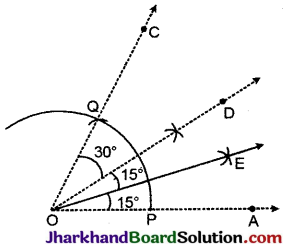
JAC Class 9 English Solutions Beehive Chapter 5 The Snake and the Mirror

12. “What was that?” ………. it’s own beauty!” (Page 60)

Meanings:vest (वेस्ट्) = undergarment, बण्डी, बनियान । dirty (डॅ:टि) = uncleaned, गन्दी I sense (सेन्स् ) = feeling, बोध, समझ । cleanliness (क्लेन्लिनस्) = the state or quality of being clean, स्वच्छता, सफाई | rascal (रॉस्कल्) = a rogue, बदमाश | laughed ( लाफ्ट्) हँसा । taken with (टेकन विद्) attracted by, मोहित हुआ | beauty (ब्यूटि ) = सौन्दर्य ।

हिन्दी अनुवाद – ” वह क्या चीज थी ?” मैंने पूछा ।डॉक्टर ने कहा, “मेरी बनियान जो गन्दी थी । उस व्यक्ति का स्वच्छता -बोध कितना अच्छा था…………! वह बदमाश इसे भी ले जा सकता था और साबुन व पानी से धोकर इसका उपयोग कर सकता था । ” “डॉक्टर, क्या अगले दिन आपने वह सर्प देखा ?” डॉक्टर हँसा, “मैंने तब से उसे कभी नहीं देखा । यह एक ऐसा सर्प था जो अपने ही सौन्दर्य पर मोहित हो गया था ।”
JAC Class 9 Maths Solutions Chapter 7 त्रिभुज Ex 7.1

Jharkhand Board JAC Class 9 Maths Solutions Chapter 7 त्रिभुज Ex 7.1 Textbook Exercise Questions and Answers.

JAC Board Class 9 Maths Solutions Chapter 7 त्रिभुज Exercise 7.1

प्रश्न 1.
चतुर्भुज ACBD में, AC = AD है और AB कोण को समद्विभाजित करता है (देखिए आकृति)। दर्शाइए कि ΔABC ≅ ΔABD है।
BC और BD के बारे में आप क्या कह सकते हैं ?
JAC Class 9 Maths Solutions Chapter 7 त्रिभुज Ex 7.1 1
हल:
ΔABC और ΔABD में,
AC = AD [दिया है]
∠CAB = ∠BAD [दिया है]
और AB = AB [उभयनिष्ठ]
ΔABC ≅ ΔABD [SAS नियम]
⇒ BC = BD
[∵ सर्वागसम त्रिभुजों के संगत भाग बराबर होते हैं]

JAC Class 9 Maths Solutions Chapter 7 त्रिभुज Ex 7.1

प्रश्न 2.
ABCD एक चतुर्भुज है, जिसमें AD = BC और ∠DAB = ∠CBA है (आकृति देखें) सिद्ध कीजिए कि
(i) ΔABD ≅ ΔBAC
(ii) BD = AC
(iii) ∠ABD = ∠BAC.
JAC Class 9 Maths Solutions Chapter 7 त्रिभुज Ex 7.1 2
हल:
AD = BC [दिया है]
(i) ΔABD तथा ΔBAC में,
∠DAB = ∠CBA [दिया है]
व AB = AB [उभयनिष्ठ]
∴ भुजा कोण-भुजा सर्वांगसमता गुणधर्म से,
ΔABD ≅ ΔBAC इति सिद्धम्।

(ii) ∵ ΔABD ≅ ΔBAC
⇒ BD = AC
(∵ सर्वागसम त्रिभुजों के संगत भाग बराबर होते हैं)

(iii) ΔABD तथा ΔBAC में,
AD = BC [दिया है]
∠DAB = ∠CBA [दिया है]
AB = AB [उभयनिष्ठ]
∴ भुजा कोण भुजा सर्वागसमता गुणधर्म से,
ΔABD ≅ ΔBAC
⇒ BD = AC
और ∠ABD = ∠BAC
[∵ सर्वागसम त्रिभुजों के संगत भाग बराबर होते हैं]
इति सिद्धम्।

प्रश्न 3.
एक रेखाखण्ड AB पर AD और BC दो बराबर लम्ब रेखाखण्ड हैं (देखिए आकृति)। दर्शाइए कि CD, रेखाखण्ड AB को समद्विभाजित करता है।
JAC Class 9 Maths Solutions Chapter 7 त्रिभुज Ex 7.1 3
हल:
चित्रानुसार
ΔAOD और ΔBOC मैं, ∠AOD = ∠BOC [शीर्षाभिमुख कोण]
∠DAO = ∠OBC [प्रत्येक 90°]
और AD = BC [दिया है]
∴ ΔAOD ≅ ΔBOC (AAS नियम)
∴ OA = OB
अत: CD, रेखाखण्ड AB को समद्विभाजित करती है।
इति सिद्धम्।

JAC Class 9 Maths Solutions Chapter 7 त्रिभुज Ex 7.1

प्रश्न 4.
l और m दो समान्तर रेखाएँ हैं जिन्हें समान्तर रेखाओं p और q का एक अन्य युग्म प्रतिच्छेदित करता है (देखिए आकृति)। दर्शाइए कि ΔABC ≅ ΔCDA है।
JAC Class 9 Maths Solutions Chapter 7 त्रिभुज Ex 7.1 4
हल:
चूंकि l तथा m समान्तर रेखाएँ दूसरी समान्तर रेखाओं P और q द्वारा प्रतिच्छेदित की जाती हैं। अतः AD || BC तथा AB || CD.
अत: ABCD समान्तर चतुर्भुज है व AB = CD और BC = AD
अब ΔABC और ΔCDA में,
∵ AB = CD [ऊपर सिद्ध किया है]
BC = AD [ऊपर सिद्ध किया है]
व AC = AC [उभयनिष्ठ]
∴ भुजा भुजा भुजा सर्वागममता गुणधर्म से,
ΔABC ≅ ΔCDA, इति सिद्धम्।
अन्य विधि: AD || BC तथा तिर्यक रेखा A उन्हें प्रतिच्छेदित करती है।
∴ ∠ACB = ∠CAD (एकान्तर कोण)
तथा ∠CAB = ∠ACD (एकान्तर कोण)
अब ΔABC तथा ΔCDA में
∠ACB = ∠CAD (एकान्तर कोण)
AC = CA (उभयनिष्ट)
∴ ΔABC ≅ ΔCDA इति सिद्धम|

प्रश्न 5.
रेखा l कोण A को समद्विभाजित करती है और B रेखा l पर स्थित कोई बिन्दु है BP और BQ कोण A की भुजाओं पर B से डाले गए लम्ब हैं (देखिए आकृति)| दर्शाइए कि :
(i) ΔAPB ≅ ΔAQB,
(ii) BP = BQ है अर्थात् बिन्दु B कोण A की भुजाओं से समदूरस्थ है।
JAC Class 9 Maths Solutions Chapter 7 त्रिभुज Ex 7.1 5
हल:
(i) ΔAPB तथा ΔAQB में,
∠APB = ∠AQB [∵ प्रत्येक = 90°]
∠PAB = ∠QAB
[∵ AB, ∠PAQ का समद्विभाजक है]
व AB = AB [उभयनिष्ठ]
ΔAPB ≅ ΔAQB (AAS नियम)
और (ii) BP = PQ,
[सर्वांगसम त्रिभुजों के संगत भाग]
अतः बिन्दु B, ∠A की भुजाओं से समदूरस्थ है।
इति सिद्धम्।

JAC Class 9 Maths Solutions Chapter 7 त्रिभुज Ex 7.1

प्रश्न 6.
आकृति में, AC = AE, AB = AD और ∠BAD = ∠EAC है। दर्शाइए कि BC = DE है।
JAC Class 9 Maths Solutions Chapter 7 त्रिभुज Ex 7.1 6
हल:
ΔABC तथा ΔADE में.
AB = AD [दिया है]
∠BAD = ∠DAC [दिया है]
दोनों ओर ∠DAC जोड़ने पर
∠BAD + ∠DAC = ∠EAC + ∠DAC
⇒ ∠BAC = ∠DAE
और AC = AE [दिया है]
ΔABC ≅ ΔADE [SAS नियम]
⇒ BC = DE इति सिद्धम्।

प्रश्न 7.
AB एक रेखाखण्ड है और इसका मध्य-बिन्दु है D और E रेखाखण्ड AB के एक ही ओर स्थित दो
बिन्दु इस प्रकार हैं कि ∠BAD = ∠ABE और ∠EPA = ∠DPB हैं (देखिए आकृति)। दर्शाइए कि
(i) ΔDAP ≅ ΔEBP, (ii) AD = BE.
JAC Class 9 Maths Solutions Chapter 7 त्रिभुज Ex 7.1 7
हल:
(i) ∠EPA = ∠DPB [दिया है]
दोनों ओर ∠DPE जोड़ने पर,
∠EPA + ∠DPE = ∠DPB + ∠DPE
⇒ ∠DPA = ∠EPB
अब, ΔDAP तथा ΔEBP में.
∠EPB = ∠DPA [सिद्ध किया है]
BP = AP [∵ P, AB का मध्य-बिन्दु है]
∠EBP =∠DAP [दिया है]
∴ ΔDAP ≅ ΔEBP [ASA नियम]
इति सिद्धम्।
और (ii) ∴ AD = BE
[∵ सर्वागसम त्रिभुजों के संगत भाग] इति सिद्धम् ।

JAC Class 9 Maths Solutions Chapter 7 त्रिभुज Ex 7.1

प्रश्न 8.
एक समकोण त्रिभुज ABC में, जिसमें कोण C समकोण है, M कर्ण AB का मध्य-बिन्दु है। C को M से मिलाकर बिन्दु D तक इस प्रकार बढ़ाया गया है कि DM = CM है। बिन्दु D को बिन्दु B से मिला दिया जाता है (देखिए आकृति) । दर्शाइए कि :
(i) ΔAMC ≅ ΔBMD,
(ii) ∠DBC एक समकोण है,
(iii) ΔDBC ≅ ΔACB
(iv) CM = \(\frac{1}{2}\)AB
JAC Class 9 Maths Solutions Chapter 7 त्रिभुज Ex 7.1 8
हल:
(i) ΔAMC तथा ΔBMD में,
AM = BM [∵ M, AB का मध्य-बिन्दु है]
∠AMC = ∠BMD [शीर्षाभिमुख कोण]
व CM = MD [दिया है]
∴ ΔAMC ≅ ΔBMD. [SAS नियम]
इति सिद्धम् ।

(ii) ∵ ΔAMC ≅ ΔBMD
∴ BD = CA
व ∠BDM = ∠ACM
[सर्वागसम त्रिभुजों के संगत भाग]
इसलिए तिर्यक रेखा CD, CA तथा BD को क्रमश: C तथा D पर बिन्दुओं पर इस प्रकार काटती है कि एकान्तर कोण
∠BDM = ∠ACM । अत: BD || CA.
⇒ ∠CBD + ∠BCA = 180°
[∵ तिर्यक रेखा के एक ही ओर के आन्तरिक कोण]
⇒ ∠CBD + 90° = 180° [∵ ∠BCA = 90°]
⇒ ∠DBC = 90°. इति सिद्धम्।

(iii) अब ΔDBC तथा ΔACB में,
BD = CA [भाग (i) से]
∠DBC = ∠ACB [प्रत्येक 90°]
BC = BC. [उभयनिष्ठ]
ΔDBC ≅ ΔACB. [SAS नियम ]
इति सिद्धम्।

(iv) CD = AB
[सर्वागसम त्रिभुजों के संगत भाग]
या \(\frac{1}{2}\)CD = \(\frac{1}{2}\)AB
या CM = \(\frac{1}{2}\)AB.
इति सिद्धम्।

JAC Class 9 English Solutions Moments Chapter 7 The Last Leaf

Jharkhand Board JAC Class 9 English Solutions Moments Chapter 7 The Last Leaf Textbook Exercise Questions and Answers.

JAC Board Class 9 English Solutions Moments Chapter 7 The Last Leaf

JAC Class 9 English The Last Leaf Textbook Questions and Answers

Think About it

Question 1.
What is Johnsy’s illness ? What can cure her, the medicine or the willingness to live ?
जॉन्सी को क्या बीमारी है ? उसका इलाज क्या है, दवा या जीने की चाह ?
Answer:
Johnsy is suffering from pneumonia. She has high fever. She is weak both mentally and physically. She has lost her desire to live. Only the willingness to live can cure her. The doctor has told her friend, Sue that no medicine can cure her unless she revives her desire to live.

जोन्सी निमोनिया से पीड़ित है । उसे तेज बुखार है । वह मानसिक और शारीरिक, दोनों रूपों से कमजोर है । वह जीने की चाह खो चुकी है। केवल जीने की इच्छा ही उसे बचा सकती है। डॉक्टर सू से कहा है कि उसे (जॉन्सी को) कोई दवा ठीक नहीं कर सकती, जब तक कि वह जीने की इच्छा को पुनः जाग्रत नहीं करती।

JAC Class 9 English Solutions Moments Chapter 7 The Last Leaf

Question 2.
Do you think the feeling of depression Johnsy has is common among the teenagers?
क्या आप सोचते हैं कि जॉन्सी जैसी उदासीनता की भावना युवाओं में सामान्य है ?
Answer:
Yes, I think the feeling of depression as Johnsy has, is common among teenagers. The young minds are immature, emotional and imaginative. Sometimes when they are physically and mentally weak, they nurse some baseless doubts. Such doubts are so strong that no logic can shake them away.

हाँ, मेरे विचार से जॉन्सी जैसी उदासीनता की भावना युवाओं में सामान्य है । युवा मस्तिष्क अपरिपक्व, भावुक एवं कल्पनाशील होते हैं । कभी-कभी जब वे मानसिक एवं शारीरिक रूप से कमजोर होते हैं तो वे अपने मन में कुछ न कुछ निराधार भ्रम पाल लेते हैं । ऐसे भ्रम इतने दृढ़ हो जाते हैं कि कोई भी तर्क उनको दूर नहीं कर सकता ।

Question 3.
Behrman has a dream. What is it? Does it come true ?
बेरमन का एक सपना है । वह क्या है ? क्या वह संच होता है ?
Answer:
Behrman has cherished a dream. He wants to paint a masterpiece. He has a kind, loving and sympathetic heart. He comes to know of Johnsy’s baseless but firm doubt that she will die with the falling of the last leaf. He decides to save Johnsy’s life by painting an ivy leaf. So, his dream comes true when he paints the leaf. But he sacrifices his life for it as he catches pneumonia and dies of it.

बेरमन का एक सपना है । वह एक उत्कृष्ट कलाकृति बनाना चाहता है । बेरमन का हृदय दयालु, प्रेमपूर्ण और सहानुभूतिपूर्ण है । उसे जॉन्सी के उस निराधार लेकिन दृढ़ भ्रम का पता चलता है कि अन्तिम पत्ती के गिरने के साथ वह मर जायेगी । वह आइवी पत्ती की चित्रकारी करके जॉन्सी के जीवन को बचाने का निश्चय करता है । इस प्रकार उसका सपना तब सच होता है, जब वह पत्ती को पेंट करता है। परन्तु उसे अपने जीवन का बलिदान करना पड़ता है क्योंकि उसे निमोनिया हो जाता है और वह मर जाता है ।

Question 4.
What is Behrman’s masterpiece ? What makes Sue say so?
बेरमन की उत्कृष्ट कलाकृति क्या है ? सू ऐसा क्यों कहती हैं ?
Answer:
Behrman’s masterpiece is the painting of an ivy leaf. Sue says so because Johnsy and she herself cannot make out that it is only a painting and not a real leaf. Moreover, its presence on the ivy creeper saves her friend Johnsy’s life who mistakes it to be a real leaf and revives her desire to live in her mind.

बेरमन की उत्कृष्ट कलाकृति आइवी की बेल की एक पत्ती है । सू ऐसा इसलिए कहती है क्योंकि जॉन्सी और वह (सू) स्वयं नहीं पहचान पाती हैं कि यह वास्तविक पत्ती न होकर एक बनाई गयी पत्ती है । इसके अतिरिक्त आइवी की बेल पर इसकी उपस्थिति सू की मित्र जॉन्सी की जान बचाती है क्योंकि वह इसको वास्तविक पत्ती समझती है और उसके मन में जीने की इच्छा जांगती है ।

Talk About it

Question 1.
Have felt depressed and rejected? How did you overcome such feelings? Share your experience with your classmates. क्या आपने स्वयं को कभी हताश एवं तिरस्कृत अनुभव किया है आप ऐसी भावनाओं से कैसे उबरे ? अपना अनुभव अपने सहपाठियों के साथ बाँटिये ।
Answer:
Yes I felt depressed and rejected when I participated in zonal debate competition. For the same, I gave good arguments to support my views. But I did not get any prize. ‘My talent had not been recognized perhaps’, was the first thought that came to my mind. When the surge of my feelings subsided, I analyzed myself and found that my style was not effective and my language was less forceful. That is why, I didn’t get any prize.

एक बार मैंने मंडलीय वाद-विवाद प्रतियोगिता में भाग लिया । इसके लिए मैंने अपने दृष्टिकोण के समर्थन में अच्छे से अच्छे तर्क दिये । लेकिन मुझे कोई पुरस्कार नहीं मिला। मैंने स्वयं को निराश अनुभव किया। ‘सम्भवत: मेरी प्रतिभा को पहचाना नहीं गया’- यह पहला विचार था जो मेरे मन में आया। जब मेरी भावनाओं का ज्वार (उफान ) थमा तो मैंने विश्लेषण किया और पाया कि मेरी शैली प्रभावशाली नहीं थी और मेरी भाषा में दम नहीं था । इसलिए मुझे कोई पुरस्कार नहीं मिला।

JAC Class 9 English Solutions Moments Chapter 7 The Last Leaf

JAC Class 9 English The Last Leaf Important Questions and Answers

Answer the following questions in about 30 words each:

निम्नलिखित प्रत्येक प्रश्न का उत्तर लगभग 30 शब्दों में दीजिए :

Question 1.
Why was Johnsy on her bed for a long time ?
जॉन्सी लम्बे समय तक बिस्तर पर क्यों रही थी ?
Answer:
Johnsy got ill. She had pneumonia. She was a pessimistic girl. She thought that her life would end with the fall of the last leaf of the ivy creeper. So, she was on her bed for a long time,

जॉन्सी बीमार थी । उसे न्यूमोनिया हो गया था। वह एक निराशावादी लड़की थी । वह सोचती थी कि उसका जीवन आइवी की बेल की अन्तिम पत्ती के गिरते ही समाप्त हो जायेगा । इसलिए वह लम्बे समय तक बिस्तर पर रही थी ।

Question 2.
Why did Johnsy keep looking out of the window ?
जॉन्सी लगातार खिड़की के बाहर क्यों देखती रहती थी ?
Answer:
Johnsy kept looking at the ivy creeper outside her window. She watched and counted the falling leaves of the ivy. She believed that she would die when the last leaf feel.

जॉन्सी अपनी खिड़की के बाहर आइवी की बेल को देखती रहती थी । वह गिरती हुई पत्तियों को देखती थी और उन्हें गिनती थी । उसे विश्वास था कि आखिरी पत्ती गिरने के साथ ही उसकी मृत्यु हो जायेगी ।

Question 3.
How did Sue try to keep Johnsy cheerful ?
सू जॉन्सी को किस प्रकार खुश रखने की कोशिश करती थी ?
Answer:
Sue tried her best to keep Johnsy cheerful. She used to talk about clothes and fashion. She also brought her drawing-board in Johnsy’s room and started painting. She whistled while painting.

सू अपनी तरफ से जॉन्सी को खुश रखने का श्रेष्ठतम प्रयत्न करती थी । वह उससे कपड़ों और फैशन की बातें करती थी । उसने जॉन्सी के कमरे में अपना ड्राइंग बोर्ड लाकर पेंटिंग शुरू कर दी । पेन्टिंग करते हुए वह सीटी बजाती थी ।

Question 4.
How did Behrman catch pneumonia ?
बेरमन को निमोनिया कैसे हो गया ?
Or
How did Behrman die ?
बेरमन की मृत्यु कैसे हुई ?
Answer:
In order to save Johnsy’s life, Behrman decided to paint a leaf on the wall. The night was stormy and it was raining heavily and he was standing in such weather for so long to complete the artistic leaf. Getting drenched in the rain, he caught pneumonia and died.

जॉन्सी का जीवन बचाने के लिए बेरमन ने दीवार पर एक पत्ती का चित्र बनाने का निश्चय किया। रात तूफानी थी और भारी वर्षा हो रही थी और वह कलात्मक पत्ती को बनाने के लिए काफी समय तक ऐसे मौसम में खड़ा रहा था। वर्षा में भीगने से उसे निमोनिया हो गया और वह मर गया ।

JAC Class 9 English Solutions Moments Chapter 7 The Last Leaf

Question 5.
How was it found that the last leaf was not real?
यह कैसे पता चला कि आखिरी पत्ती वास्तविक नहीं थी ?
Answer:
Some terms such as a ladder, a lighted lantern, some brushes and green and yellow paints were found near Behrman’s bed. Sue told Johnsy about the leaf which did not flutter when the wind blew. This proved that the last leaf was not real but it was painted by Behrman.

बेरमन के बिस्तर के पास कुछ सामान जैसे एक सीढ़ी, एक जलती हुई लालटेन, कुछ बुश और हरा व पीला रंग पाया गया। इसके अतिरिक्त सू ने जॉन्सी को उस पत्ती के विषय में बताया जो हवा के चलने पर हिलती तक न थी। तो इससे पता चला कि वह पत्ती वास्तविक नहीं थी बल्कि इसे बेरमन द्वारा चित्रित किया गया था ।

Question 6.
Who saved Johnsy’s life ?
जॉन्सी का जीवन किसने बचाया ?
Answer:
Behrman saved Johnsy’s life. He sacrificed his own life to save Johnsy’s life through his masterpiece the last leaf painted on the wall.

बेरमन ने जॉन्सी के जीवन को बचाया। उसने दीवार पर बनाई गयी अपनी उत्कृष्ट कृति – अन्तिम पत्ती- के माध्यम से जॉन्सी के जीवन को बचाने के लिए अपना जीवन बलिदान किया।

Question 7.
What kind of a friend was Sue to Johnsy ?
सू जॉन्सी की किस प्रकार की मित्र थी ?
Answer:
Sue was a true friend of Johnsy. When Johnsy fell ill, Sue cared for her the most and called the doctor. She tried to make Johnsy happy by talking about clothes and fashion.

सू जॉन्सी की सच्ची मित्र थी । जब जॉन्सी बीमार हुई, सू ने उसकी बहुत देखभाल की और डॉक्टर को बुलाया । वह कपड़ों और फैशन की बातें करके जॉन्सी को खुश रखने की कोशिश करती थी ।

Question 8.
What did the doctor tell Sue and why was he disappointed with Johnsy about her illness?
डाक्टर ने सू को क्या बताया और वह जॉन्सी की बीमारी के बारे में निराश क्यों था ?
Answer:
The doctor told Sue that Johnsy did not want to recover. He said that even the medicines would not work on her if she did not want to live. So, the doctor was disappointed with Johnsy about her illness.

डॉक्टर ने सू को बताया कि जॉन्सी ठीक (स्वस्थ ) होना नहीं चाहती थी । उसने कहा कि यदि वह जीना नहीं चाहती तो दवाएँ भी उस पर असर नहीं करेंगी । इसीलिए डॉक्टर जॉन्सी से उसकी बीमारी के बारे में निराश था ।

Question 9.
What was Behrman’s ambition in his life ?
बेरमन की अपने जीवन में क्या महत्त्वाकांक्षा थी ?
Answer:
Behrman was a sixty-year-old painter. His ambition in life was to paint a masterpiece which could give him name and fame. But his ambition was still to be fulfilled.

बेरमन एक साठ वर्षीय चित्रकार था । उसके जीवन की महत्त्वाकांक्षा एक सर्वश्रेष्ठ कलाकृति बनाना था जो उसे नाम और प्रसिद्धि दे सके । किन्तु उसकी महत्त्वाकांक्षा अभी पूर्ण होनी शेष थी ।

Question10.
What moral do we get from the story ‘The Last Leaf’ ?
‘द लास्ट लीफ’ कहानी से हमें क्या शिक्षा मिलती है ?
Or
What message does the writer, O. Henry want to convey through this story?
लेखक, ओ. हेनरी इस कहानी के माध्यम से क्या संदेश देना चाहते हैं ?
Answer:
This story gives us the message of friendship and sacrifice. Besides, the writer, O. Henry wants to convey the message that a person is what he feels he is. So, we must be positive and ambitious towards life and have strong will to live.

यह कहानी हमें बलिदान एवं मित्रता का संदेश देती है। इसके अतिरिक्त लेखक ओ. हेनरी यह संदेश देना चाहते हैं कि व्यक्ति वैसा ही होता है जैसा वह महसूस करता है। इसलिए हमें जिंदगी के बारे में सकारात्मक और महत्त्वाकांक्षी होना चाहिये और जीने के लिए दृढ़ इच्छा रखनी चाहिये|

JAC Class 9 English Solutions Moments Chapter 7 The Last Leaf

Answer the following questions in about 60 words each:

निम्नलिखित प्रत्येक प्रश्न का उत्तर लगभग 60 शब्दों में दीजिए :

Question 1.
What role did Sue play in saving Johnsy’s life?
सू ने जॉन्सी का जीवन बचाने में क्या भूमिका निभायी ?
Answer:
Johnsy was in strange and unusual belief that she would die with the fall of the last ivy leaf. Knowing it, her friend, Sue got disturbed. She used to talk about clothes and fashion to divert Johnsy’s mind. Sue even brought her drawing-board in Johnsy’s room for painting. Thus, Sue tried her best to keep Johnsy in good spirits so that she might get well soon.

जॉन्सी को विचित्र और असामान्य विश्वास था कि आइवी की अन्तिम पत्ती के गिरने के साथ वह भी मर जायेगी। यह जानकर उसकी सहेली सू परेशान हो गयी । वह जॉन्सी का ध्यान हटाने के लिए कपड़ों और फैशन की बात किया करती थी । और यहाँ तक कि सू पेंटिंग करने के लिए अपना ड्राइंग बोर्ड भी जॉन्सी के कमरे में ले आई। इस प्रकार, सू ने जॉन्सी को खुश रखने की हर सम्भव कोशिश की ताकि वह जल्दी ठीक हो जाये ।

Question 2.
Why was Johnsy waiting to die ?
जॉन्सी मरने का इन्तज़ार क्यों कर रही थी ?
Answer:
Johnsy had pneumonia. The medicines were not curing her. She watched the falling leaves of ivy creeper on the front wall. It was natural in the autumn season. But Johnsy was in strange and unusual belief that she would also die with the fall of the last leaf. She was waiting for the last leaf to fall. It took away her will to live.

जॉन्सी को निमोनिया हो गया था । दवाएँ उस पर असर नहीं कर रही थीं। वह सामने की दीवार पर लगी आइवी की बेल की झड़ती पत्तियों को देखती रहती थी । यह पतझड़ के मौसम में सामान्य था । लेकिन जॉन्सी को विचित्र और असामान्य विश्वास था कि अन्तिम पत्ती के गिरने के साथ वह भी मर जायेगी । वह अन्तिम पत्ती के गिरने का इन्तजार कर रही थी । इसके कारण उसकी जीने की इच्छा समाप्त हो गई थी ।

Question 3.
How did Behrman and his masterpiece ‘The Last Leaf save Johnsy’s life ?
बेरमन और उसकी सर्वश्रेष्ठ कलाकृति ‘अन्तिम पत्ती’ ने जॉन्सी की जान कैसे बचाई ?
Answer:
When Sue told Behrman about Johnsy’s illness, he said nothing and came to his room. But he painted “The Last Leaf” of the ivy creeper on the wall. Next morning, Johnsy saw this last leaf and was surprised that it did not fall in spite of heavy rain and storm. She regained her confidence and recovered soon. Thus, Behrman and the last leaf painted by him saved Johnsy’s life

जब सू ने बेरमन को जाँन्सी की बीमारी बताई तो वह कुछ भी नहीं बोला और अपने कमरे में आ गया । परन्तु उसने आइवी की बेल की ” अन्तिम पत्ती” दीवार पर चित्रित कर दी । अगली सुबह जॉन्सी ने अन्तिम पत्ती को देखा और उसे आश्चर्य हुआ कि भारी वर्षा और तूफान के बावजूद भी वह नहीं गिरी थी । उसका आत्मविश्वास लौट आया और वह शीघ्र ही ठीक (स्वस्थ ) हो गई । यह अन्तिम पत्ती बेरमन की सर्वश्रेष्ठ कलाकृति थी । इस प्रकार बेरमन और उसके द्वारा बनाई गयी अन्तिम पत्ती ने जॉन्सी का जीवन बचाया ।

Question 4.
Justify the appropriateness of the story’s title ‘The Last Leaf’.
कहानी के शीर्षक ‘अंतिम पत्ती’ का औचित्य सिद्ध कीजिये ।
Or
Why is the story named ‘The Last Leaf” ?
कहानी को ‘अन्तिम पत्ती’ नाम क्यों दिया गया है ?
Answer:
‘The Last Leaf’ is an appropriate title of the story. Johnsy used to watch the falling leaves of the ivy creeper and believed that she would die with the fall of the last leaf. An old painter, Behrman, heard about Johnsy’s silly idea about the last leaf. He decided to paint “The Last Leaf” on the ivy creeper to save her. This leaf saved Johnsy’s life by reviving her confidence and will to live. Thus, the story is aptly named ‘The Last Leaf’.

‘अन्तिम पत्ती’ कहांनी का उचित शीर्षक है। जॉन्सी आइवी की बेल की गिरती हुई पत्तियों को देखा करती थी और विश्वास करती थी कि . अन्तिम पत्ती गिरने के साथ ही वह भी मर जायेगी । एक वृद्ध चित्रकार, बेरमन, ने जांन्सी के अन्तिम पत्ती के मूर्खतापूर्ण विचार के बारे में सुना। उसने उसकी जान बचाने के लिए आइवी की बेल की पत्ती चित्रित करने का निर्णय कर लिया । इस पत्ती ने जॉन्सी में आत्मविश्वास और जीने की इच्छा जगाकर उसकी जान बचाई। इस प्रकार, कहानी को ‘अंतिम पत्ती’ नाम उचित ही दिया गया है।

JAC Class 9 English Solutions Moments Chapter 7 The Last Leaf

Question 5.
Characterise Behrman as a kind-hearted fellow and a true devotee of art.
एक दयालु व्यक्ति तथा कला के सच्चे पुजारी के रूप में बेरमन का चरित्र चित्रण कीजिए ।
Or
How did Behrman sacrifice his life ?
बेरमन ने अपना जीवन कैसे बलिदान कर दिया ?
Answer:
Behrman was an old painter. He heard about Johnsy’s strange belief that she would die with the fall of the last leaf from the ivy creeper. Then, Behrman decided to save her life by painting his masterpiece He painted the leaf, but due to bad weather he caught the cold and died of pneumonia. Seeing the last leaf intact Johnsy got well, but Behrman was no more in the world.

बेरमन एक वृद्ध चित्रकार था। उसने जॉन्सी के अजीब विश्वास के बारे में सुना कि आइवी की बेल से अन्तिम पत्ती गिरते ही वह भी मर जायेगी । तब बेरमन ने अपनी सर्वश्रेष्ठ कलाकृति बनाकर उसका जीवन बचाने का निश्चय किया ।उसने पत्ती तो चित्रित कर दी परन्तु खराब मौसम होने की वजह से उसे ठंड लग गई और वह निमोनिया से मर गया । आखिरी पत्ती को सुरक्षित देखकर जॉन्सी तो ठीक (स्वस्थ ) हो गई परन्तु बेरमन इस संसार में नहीं रहा ।

Question 6.
Give the central idea of the story ‘The Last Leaf.
कहानी ‘The Last Leaf’ का मुख्य विचार लिखिए ।
Answer:
A diseased mind is more dangerous than the disease itself. No doctor can save a patient who thinks of death as imminent. In this story Johnsy was bed-ridden with pneumonia. She had developed a foolish idea that she would die the moment the last ivy leaf fell down from the creeper. She had given up the will to live. Sue’s wise decision and Behrman’s masterpiece ‘The Last Leaf’ saved Johnsy. She realised her mistake and she regained her will to live.

बीमारी से अधिक खतरनाक बीमार दिमाग होता है। कोई भी डॉक्टर उस मरीज को अच्छा नहीं कर सकता जो मरने का विचार रखता हो। इस कहानी में, जॉन्सी निमोनिया से पीड़ित होकर बिस्तर पर पड़ी हैं। उसने (जॉन्सी ने) एक मूर्खतापूर्ण विचार पाल रखा था कि आइवी की बेल की आखिरी पत्ती गिरने के साथ ही उसकी मृत्यु हो जायेगी । उसने जीवित रहने की आशा छोड़ दी थी । सू के उचित निर्णय और बेरमन की उत्कृष्ट कलाकृति ‘आखिरी पत्ती’ ने जॉन्सी का जीवन बचाया । उसने (जॉन्सी ने) अपनी गलती स्वीकारी और उसमें फिर से जीने की इच्छा जाग्रत हुई ।

The Last Leaf Summary and Translation in Hindi

About the Story 

पतझड़ (शरत् ऋतु) का समय है । हवा बहुत तेज चल रही है और भारी वर्षा हो रही है । सिर्फ एक पत्ती को छोड़कर अंगूर की बेल (मारवल्ली) की सभी पत्तियाँ गिर चुकी हैं । अंतिम पत्ती क्यों नहीं गिरती है ? यह जानने के लिए पूरी कहानी पढ़िये ।

Word-Meanings And Hindi Translation

Sue and Johnsy ……………. will not help her.”(Page 44)

Meaning: autumn (ऑटम) पतझड़ की ऋतु, शरद् ऋतु । shared ( शेअड) = lived together, साथ रहती थीं । artists (आटिस्ट्स) = कलाकार । flat (फ्लैट ) apartment, फ्लैट, कक्ष | storey (स्टोरी) = मंजिल | seriously (सिअरिअस्ल ) = गम्भीर रूप से । pneumonia (न्यूमोनिआ ) = निमोनिया । would lie (वुड लाइ) = लेटी रहती थी । moving ( मूविंग ) = हिलना | gazing (गेजिंग) = looking continuously, टकटकी लगाकर देखते हुए। worried (वरिड्) = anxious, चिन्तित । sent for (सेण्ट फॉ (र)) = बुलाया । condition (कण्डिशन) = स्थिति, दशा। aside (असाइड) = in a corner, एक ओर । replied ( रिप्लाइड) = answered, उत्तर दिया । seems (सीम्ज़) = looks, प्रतीत होता है, लगता है । has made up her mind (हैज़ मेड अप ह (र) माइण्ड ) = has decided, ठान ली है, मन बना लिया है । get well (गेट वेल ) = to be cured, ठीक होना। she is not going to get well = वह ठीक नहीं होगी ।

हिन्दी अनुवाद – दो युवा कलाकार सू और जॉन्सी, एक छोटे फ्लैट में साथ-साथ रहती थीं । फ्लैट एक पुराने मकान की तीसरी मंजिल पर था ।
नवम्बर में जॉन्सी बहुत गम्भीर रूप से बीमार हो गई । उसे निमोनिया हो गया था। वह बिना हिले-डुले अपने बिस्तर पर पड़ी रहती थी और बस टकटकी लगाकर खिड़की के बाहर देखती रहती थी। उसकी मित्र, सू को बहुत चिन्ता हुई । उसने डॉक्टर को बुलाया । यद्यपि डॉक्टर रोज आता था, परन्तु जॉन्सी की हालत में कोई सुधार नहीं हुआ । एक दिन डॉक्टर सू को एक ओर ले गया और उससे पूछा, “क्या कोई बात जॉन्सी को परेशान कर रही है ?” सू ने उत्तर दिया, “नहीं । परन्तु आप यह क्यों पूछते हो?” डॉक्टर ने कहा, “ऐसा लगता है कि जॉन्सी ठीक (स्वस्थ) न होने का मन बना चुकी है । यदि वह जीना नहीं चाहती है तो दवाएँ उसकी मदद नहीं करेंगी ।”

JAC Class 9 English Solutions Moments Chapter 7 The Last Leaf

Sue tried ………….. its leaves. (Page 44)

Meanings: tried her best (ट्राइड ह (र) बेस्ट) did everything she could, भरसक कोशिश की । interest (इन्ट्रिस्ट्) = रुचि । to make Johnsy take an interest = ( कि ) जान्सी रुचि ले । fashion (फैशन) फैशन, ढंग | respond ( रिस्पाण्ड) = प्रतिक्रिया करना, जवाब देना । continued to lie (कॉन्टिन्यूड टु लाई ) = पड़ी रही । still (स्टिल) = even now, अब भी । brought (ब्रॉट) = लाई । drawing board (ड्रॉइंग बॉड) = आरेख पट्ट । to take mind off (टु टेक माइण्ड ऑफ़ ) = to divert the attention, ध्यान बँटाने के लिए। whistled (ह्विसल्ड) सीटी बजाती । suddenly (सडन्लि) = अचानक । whisper (विस्पॅ (र)) = speak very slowly, फुसफुसाना, बुदबुदाना ।

quickly (क्विक्लि) = fast, तेजी से । rushed ( रश्ट) = झपटी, दौड़ी । counting backwards (काउण्टिंग बैकवाड्ज़) = उल्टी गिनती गिनते हुए । looking (लुकिंग) = देख रही । anxiously ( एंक्शस्लि ) = चिन्ता से । ivy (आइवी) = आइवी बेल, तीन या पाँच बिंदु की छाप के पत्तों वाली बेल । creeper ( क्रीपर) = बेल । climbing (क्लाइम्बिंग) = going up, चढ़ते हुए। half-way up (हाफ़ वे अप) = आधी ऊँचाई तक । brick (ब्रिक) = ईंट । opposite (ऑपज़िट) = in front of, सामने। strong (स्ट्रॉंग) = (यहाँ ) तेज । shedding (शेडिंग) = झाड़ रही, छोड़ रही, अलग कर रही ।

हिन्दी अनुवाद – सूं ने भरसक कोशिश की कि जॉन्सी अपने चारों ओर की चीजों में रुचि ले। वह कपड़ों और फैशन की बात करती पर जॉन्सी कोई जवाब न देती । जॉन्सी अपने बिस्तर पर ही पड़ी रहती । सू अपना ड्राइंग बोर्ड (आरेख पट्ट) जॉन्सी के कमरे में ले आई और चित्रकारी करने लगी। जॉन्सी का ध्यान उसकी बीमारी से हटाने के लिए वह काम करते वक्त सीटी बजाती । अचानक सू ने जॉन्सी को कुछ बुदबुदाते हुए सुना । वह तेजी से बिस्तर की ओर दौड़ी और उसने जॉन्सी को उलटी गिनती गिनते हुए सुना । वह खिड़की के बाहर देख रही थी और कह रही थी, ” बारह ! ” कुछ समय बाद वह बुदबुदाई ‘ग्यारह’, फिर ‘दस’, फिर ‘नौ’, ‘आठ’, ‘सात’ । सू ने चिन्ता के साथ खिड़की से बाहर देखा । उसने एक पुरानी आइवी बेल को अपनी खिड़की के सामने वाली ईंटों की दीवार पर आधी ऊँचाई तक चढ़ते हुए देखा। बाहर तेज हवा में उस बेल से पत्तियाँ झड़ रही थीं ।

“What is it, ………….. sleep forever. (Page 45)

Meanings: whispered (विस्पॅ: ड्) = said very slowly, बुदबुदाई | faster ( फास्ट (र)) = अधिक तेजी से। almost (ऑलमोस्ट) = लगभग | autumn (ऑटम) = season in which trees shed their leaves, पतझड़ की ऋतु, शरद् ऋतु । with finality (विद फ़ाइनलिट्)ि = making final decision, अन्तिम निर्णय देते हुए । nonsense (नॉनसेन्स) = that lacks sense, बकवास । replied ( रिप्लाइड) = answered, उत्तर दिया । getting well (गेटिंग वेल् ) = recovering, ठीक (स्वस्थ ) होना । Confident (कॉन्फिडण्ट ) = having complete faith, आश्वस्त । bowl (बोल) = कटोरा । soup (सूप) = शोरबा, रसा । hungry (हंग्रि ) = भूखी । forever ( फॉ(र) एवँ (र)) = हमेशा के लिए ।

हिन्दी अनुवाद – ” यह सब क्या है, प्रिय ?” सू ने पूछा । जॉन्सी बुदबुदाई, ‘छः’ । ‘अब ये अधिक तेजी से गिर रही हैं। तीन दिन पहले यहाँ लगभग सौ पत्तियाँ थीं । अब केवल पाँच बची हैं। ” सू ने कहा, “यह पतझड़ है, और पत्तियाँ तो गिरेंगी ही ।” “जब आखिरी पत्ती गिरेगी तो मैं मर जाऊँगी, ” जॉन्सी ने अन्ततः कहा । ” मैं यह बात पिछले तीन दिनों से जान चुकी हूँ ।” “यह सब बकवास है, ” सू बोली, ” आइवी की पत्तियों का तुम्हारे ठीक (स्वस्थ ) होने से क्या सम्बन्ध है ? डॉक्टर को पूर्ण विश्वास है कि तुम ठीक (स्वस्थ ) हो जाओगी ।”जॉन्सी कुछ न बोली । सू गई और उसके लिए सूप का एक कटोरा ले आई । “मुझे कोई सूप नहीं चाहिए”, जॉन्सी बोली, “मुझे भूख नहीं है । अब केवल चार पत्तियाँ बची हैं । मैं अँधेरा होने से पहले आखिरी पत्ती को गिरते हुए देखना चाहती हूँ । फिर मैं हमेशा के लिए सो जाऊँगी ।”

JAC Class 9 English Solutions Moments Chapter 7 The Last Leaf

Sue sat …………… on the ground floor. (Pages 45-46)

Meanings: draw the curtain ( ड्रॉ द कॅ: टन) = पर्दा खींचकर बन्द कर देना । for = क्योंकि । begged (बेग्ड) = requested, निवेदन किया । poor (पुॲ (र)) = helpless, बेचारी । tired (टाइॲड्) = थकी हुई peacefully (पीसफलि) = शांतिपूर्वक । miner ( माइनँ (र)) = one who works in a mine, खदान में काम करने वाला खनिक | model (मॉडल्) = प्रतिमान, आदर्श | rushed down (रश्ट डाउन) | = went downstairs quickly, दौड़कर नीचे गई | ground floor (ग्राउण्ड फ्लो (र ) ) = भूतल ।

हिन्दी अनुवाद – सू जॉन्सी के बिस्तर पर बैठ गई, उसे चूमा और कहा, ” तुम मरने नहीं जा रही हो । मैं पर्दा नहीं खींच सकती क्योंकि मुझे रोशनी की जरूरत है । मैं अपनी पेंटिंग खत्म करना चाहती हूँ और अपने लिए कुछ पैसा पाना (कमाना ) चाहती हूँ । उसने जॉन्सी से विनती की, “मेरी प्यारी सखी, वायदा करो कि जब तक मैं चित्र बनाऊँ तब तक तुम बाहर नहीं देखोगी ।” जॉन्सी ने कहा, ठीक है । ‘अपनी पेंटिंग जल्दी खत्म करो क्योंकि मैं आखिरी पत्ती को गिरते हुए देखना चाहती हूँ । मैं इंतजार करते-करते थक गई हूँ । मुझे मरना है इसलिए मुझे भी इन बेचारी थकी हुई पत्तियों के समान शान्ति से मरने दो ।” “सोने की कोशिश करो,” सू ने कहा, “मुझे एक बूढ़े खनिक ( खान में काम करने वाला) का चित्र बनाना है । मैं बेरमन को अपना आदर्श मानकर उसे बुलाऊँगी ( चित्र बनाने के लिए)। सू नीचे दौड़ गई । बेरमन भूतल पर रहता था । .

He was ……………. back to his room. (Page 46)

Meaning : lifelong (लाइफ़लाँग) = जीवन भर का | dream (ड्रीम) = स्वप्न | masterpiece (मास्टॅ: पीस) = classic work, सर्वश्रेष्ठ रचना, उत्कृष्ट कलाकृति । remained (रिमेण्ड) = stayed, रहा । poured out (पॉड् आउट) = told, बताईं । worries (वरिज् ) = चिन्ताएँ । was convinced (वॉज़ कन्विन्स्ट) = was sure, मान बैठी थी। stupid (स्ट्युपिड्) = बेवकूफ, नासमझ । foolish (फूलिश् ) = मूर्ख | temperature (टेम्प्रच(र)) = ताप, तापमान, बुखार । complained (कॅम्प्लेण्ड) = said like complaining, शिकायत भरे लहजे में कहा । refuses (रिफ्यूज़िज़ ) : = says no, मना कर देती है, छोड़ दिया है । tiptoed ( टिपटोड) = went silently, दबे पाँव गये । peeped out (पीप्ट आउट) = looked out, झाँककर बाहर देखा । raining heavily (रेनिंग हेविलि) = तेज बारिश हो रही । icy cold (आइसि कोल्ड) = cold like ice, बर्फ जैसी ठण्डी, बर्फीली । blowing ( ब्लोइंग) = चल रही। seemed (सीम्ड) = लगता था, प्रतीत होता था । as though ( ऐज़ दो ) = जैसे कि ।

हिन्दी अनुवाद – वह एक साठ वर्षीय चित्रकार था । उसके जीवन भर का सपना एक सर्वश्रेष्ठ चित्र बनाना था परन्तु यह उसका सपना ही रहा । सू ने अपनी सारी चिन्ताएँ बेरमन को बतायीं । उसने (सू ने) उसे (बेरमन को ) बताया कि कैसे जॉन्सी मान बैठी हैं कि आखिरी पत्ती झड़ते ही वह मर जायेगी । ‘क्या वह पागल है ?” बेरमन ने पूछा, “वह इतनी मूर्ख कैसे हो सकती है ?” “उसे तेज बुखार आ रहा है,” सू ने शिकायत की । ” उसने खाना-पीना छोड़ दिया है और यह बात मुझे चिन्तित करती है ।” “मैं तुम्हारे साथ चलूँगा और जॉन्सी को देखूँगा, ” बेरमन ने कहा ।

वे दबे पाँव कमरे में गये । जॉन्सी सो रही थी । सू ने पर्दों को एक साथ मिला दिया अर्थात पर्दा खींच दिया और वे दोनों अगले कमरे में गये । उसने खिड़की के बाहर झाँका । बेल पर केवल एक पत्ती थी । तेज बारिश हो रही थी तथा बर्फीली हवा चल रही थी । ऐसा लगता था जैसे कि अब पत्ती किसी भी क्षण गिर पड़ेगी। बेरमन ने एक भी शब्द नहीं कहा । वह वापिस अपने कमरे में चला गया ।

Johnsy woke up. ……………. to the creeper.

Meanings: woke up (वोक अप) = जगी, सोकर उठी । feeble (फीब्ल) = weak, कमजोर, धीमी | voice (वॉइस्) = आवाज । nervous (नॅ:वस) = घबराई हुई । reluctantly (रिलक्टट्ल) = unwillingly, न चाहते हुए, बेमन से | exclaimed (इक्स्क्लेम्ड) = said with sudden surprise and happiness, अचानक आश्चर्य व खुशी से बोली ! ine creeper = अंगूर की बेल । in spite of (इन् स्पाइट ऑव) = के बावजूद | storm (स्टॉ:म्) = fast blowing wind, तूफान | fierce (फिॲस) = very fast, भयंकर, बहुत तेज । energetically (ऍनॅजेटिकॅलि) = with energy उत्साह से । happen (हैपन) = take place, होना । clinging (क्लिंगिंग) = holding tightly, चिपकी हुई ।

हिन्दी अनुवाद – अगली सुबह जॉन्सी सोकर उठी । बहुत धीमी आवाज में उसने सू से पर्दा हटाने को कहा । सू घबरा गई । बड़े बेमन से उसने पर्दा हटाया । अंगूर की बेल को देखकर सू आश्चर्य से बोली, “ओह ! देखो अंगूर की बेल पर अब भी एक पत्ती है। यह काफी हरी और स्वस्थ दिखाई देती है । तूफान और तेज हवा के बावजूद भी यह नहीं गिरी । ” “पिछली रात मैंने तेज हवा की आवाज सुनी थी,” जॉन्सी बोली, “मैंने सोचा था कि यह गिर गई होगी। यह आज अवश्य ही गिर जायेगी । तब मैं मर जाऊँगी ।” “तुम नहीं मरोगी, ” सू ने उत्साह से कहा, “तुम्हें अपने दोस्तों के लिए जीना है । अगर तुम मर गईं तो मेरा क्या होगा ? ” जॉन्सी कमजोरी से मुस्कुराई और उसने अपनी आँखें बन्द कर लीं । प्रत्येक घंटे के बाद वह बाहर देखती और पत्ती को वहीं पाती । ऐसा लगता था कि वह ( अंगूर की बेल से चिपकी पड़ी है ।

JAC Class 9 English Solutions Moments Chapter 7 The Last Leaf

In the evening, …………. no hope for him.” (Page 47)

Meanings : lay (ले) = kept lying, पड़ी रही । looked after ( लुक्ट आफ्ट (र)) = took care, देखभाल की। lovingly (लविंग्लि) = प्यार से । co-operated (को-ऑपरेटिड) = behaved in a helping manner, सहयोग दिया। depressed (डिप्रेस्ट) = hopeless, निराश, अवसादग्रस्त । gloomy (ग्लूमि) = lost in sorrow, दुःख में डूबी हुई । wicked (विकिड ) = bad, धूर्त, दुष्ट | realised (रियलाइज़्ड) = felt, महसूस किया । sin (सिन) : | = an action or way of behaving that is not allowed by a religion, पाप | hugged (हग्ड) = embraced, गले लगा लिया । combed her hair = अपने बालों में कंघी की । brightly (ब्राइटूलि) = प्रसन्नतापूर्वक । examining (इग्ज़ैमिनिंग) checking, जाँच करना | patient (पेशॅण्ट् ) = मरीज | will (विल) = इच्छा । recover (रिकवॅ (र)) = get well, ठीक (स्वस्थ ) होना । is suffering (इज़ सफरिंग) = पीड़ित है । hope (होप) = आशा ।

हिन्दी अनुवाद – शाम को एक और तूफान आया, किन्तु पत्ती नहीं गिरी । जॉन्सी लम्बे समय तक पत्ती को देखती – हुई, लेटी रही । तब उसने सू को बुलाया । “मैं एक बुरी लड़की हूँ । तुमने बहुत प्यार से मेरी देखभाल की और मैंने तुम्हें सहयोग नहीं दिया। मैं निराशा और दुःख में डूबी हुई थी । इस आखिरी पत्ती ने मुझे दिखा दिया है कि मैं कितनी दुष्ट थी । मैंने महसूस किया है कि …मरने की इच्छा करना पाप है ।” सू ने जॉन्सी को गले लगा लिया । फिर उसने उसे बहुत-सा गरम सूप दिया और एक शीशा भी दिया। जॉन्सी ने अपने बालों में कंघी की और खुशी से मुस्कराई । दोपहर बाद डॉक्टर आया । अपने मरीज की जाँच करने के बाद उसने सू से कहा, “जॉन्सी में अब जीने की इच्छा है । मुझे पूरा विश्वास है कि जॉन्सी अब जल्दी ठीक (स्वस्थ ) हो जायेगी । अब मुझे नीचे जाना है और बेरमन को देखना चाहिए । वह भी निमोनिया से पीड़ित है । लेकिन मुझे डर है कि उसके बचने की कोई आशा नहीं है ।”

The next morning the last leaf fell.” (Pages 47-48)

Meanings: janitor (जैनिटॅ (र)) = caretaker, रख-रखाव करने वाला, प्रतिहार | shivering ( शिवरिंग) : trembling, काँप रहा । stormy (स्टॉ:मि) = of storm, तूफानी । ladder (लैडॅ (र)) = सीढ़ी, नसैनी । lantern (लैन्टॅन्) = लालटेन । lighted (लाइटिड) = जलती हुई । lying (लाईंग ) = पड़ी हुई । floor (फ्लो (र)) = फर्श । wondered (वण्ड:ड्) = felt surprised, आश्चर्य हुआ । flutter (फ्लटॅ (र)) | = move with sound, फड़फड़ाना । blows (ब्लोज़) = बहती है । masterpiece ( मॉस्टॅ: पीस) = great work of art, सर्वश्रेष्ठ कलाकृति ।

JAC Class 9 English Solutions Moments Chapter 7 The Last Leaf

हिन्दी अनुवाद – अगली सुबह सू आई और जॉन्सी के बिस्तर पर बैठ गई । जॉन्सी का हाथ अपने हाथ में लेकर वह बोली, “मुझे तुम्हें कुछ बताना है । आज सुबह मि. बेरमन की निमोनिया से मृत्यु हो गई । वह केवल दो दिनों से बीमार थे । पहले दिन बिल्डिंग का रख-रखाव करने वाले ने उन्हें बिस्तर पर पाया । उनके कपड़े और जूते गीले थे और वे काँप रहे थे । वे उस तूफानी रात में बाहर थे ।” फिर उन्होंने एक सीढ़ी और जलती हुई लालटेन पाई जो उनके बिस्तर के पास पड़ी थीं । सीढ़ी के पास कुछ ब्रुश तथा हरे व पीले रंग फर्श पर पड़े थे । “प्रिय जॉन्सी, ” सू ने कहा, “खिड़की के बाहर देखो । उस आइवी की पत्ती को देखो । क्या तुम्हें आश्चर्य नहीं हुआ कि हवा चलने पर यह फड़फड़ाती क्यों नहीं है ? वह बेरमन की श्रेष्ठ कलाकृति है । उसने ( बेरमन ने ) उस रात तब वह पत्ती बनायी थी जब आखिरी पत्ती झड़ गयी थी । “

JAC Class 9 English Solutions Beehive Poem 1 The Road not taken

Jharkhand Board JAC Class 9 English Solutions Beehive Poem 1 The Road not taken Textbook Exercise Questions and Answers.

JAC Board Class 9 English Solutions Beehive Poem 1 The Road not taken

JAC Class 9 English The Road not taken Textbook Questions and Answers

Thinking about the Poem

Question 1.
Where does the traveller find himself ? What problem does he face ?
यात्री स्वयं को कहाँ पाता है ? वह किस समस्या का सामना करता है ?
Answer:
The traveller finds himself in the yellow forest where the road is divided into two different paths. He faces the problem of selection of path between the two roads in the yellow wood.

यात्री पतझड़ के मौसम में जंगल में अपने आपको वहाँ पाता है जहाँ रास्ता दो भिन्न-भिन्न भागों में बँटता है । उसके सामने उस पीले जंगल में उन दो रास्तों में से किसी एक का चुनाव करने की समस्या है ।

JAC Class 9 English Solutions Beehive Poem 1 The Road not taken

Question 2.
Discuss what these phrases mean to you.
इन वाक्यांशों के अभिप्राय पर चर्चा कीजिए ।
(i) a yellow wood
पीला जंगल।

(ii) it was grassy and wanted wear
यह घास युक्त था और उपयोग में नहीं आया था।

(iii) the passing there
वहाँ से गुजरने वाले लोग।

(iv) leaves no step had trodden black
किसी कदम ने पत्तियों पर चलकर उन्हें कुचला नहीं था ।

(v) how way leads on to way
कैसे एक रास्ता दूसरे रास्ते पर ले जाता है?
Answer:
(i) a yellow wood –
(a) It is the state of the forest in the autumn when leaves on the trees turn yellow before falling down.
यह पतझड़ के मौसम में जंगल की दशा है जब वृक्षों की पत्तियाँ झड़ने से पूर्व पीली पड़ जाती हैं।

(ii) it was grassy and wanted wear – The path was covered with grass and was not stepped.
रास्ता घासयुक्त था तथा यह (घास ) कुचली हुई नहीं थी क्योंकि इस रास्ते पर कोई भी नहीं चला था।

(iii) the passing there – It means the people walking on that road.
इसका अभिप्राय है उस पर चलने वाले लोग अर्थात् उन रास्तों से गुजरने वाले लोग ।

(iv) leaves no step had trodden black- The leaves had not turned black because no one had trampled them yet.
पत्तियाँ काली नहीं पड़ी थीं क्योंकि किसी ने भी उनको अभी तक कुचला नहीं था ।

JAC Class 9 English Solutions Beehive Poem 1 The Road not taken

(v) how way leads on to way – When one moves on a road, it leads to another road and then another one to some other road and so on. Thus, one goes very far away to come back.
जब कोई व्यक्ति किसी रास्ते पर चलता है तो वह रास्ता उसे किसी अन्य रास्ते पर ले जाता है और यह रास्ता अन्य रास्तों पर ले जाता है। यही क्रम आगे चलता रहता है। इस प्रकार, वह व्यक्ति अपने पहले छोड़े गये रास्ते से बहुत दूर चला जाता है और उस पर कभी वापसे नहीं आ पाता ।

Question 3.
Is there any difference between the two roads as the poet describes them–
जैसा कि कवि ने वर्णन किया है, क्या दोनों रास्तों में कोई अन्तर है-

(i) in the stanzas two and three ?
दूसरे व तीसरे पद में ।

(ii) in the last two lines of the poem ?
कविता की अंतिम दो पंक्तियों में ।
Answer.
(i) In the stanzas two and three, the poet finds no difference between the two roads. Both were equally worn out by the feet of the people and both of them were covered with untrodden dry leaves.
दूसरे व तीसरे पद में कवि दोनों रास्तों में कोई अन्तर नहीं पाता है । दोनों ही रास्तों को लोगों के कदमों द्वारा समान रूप से कुचला गया था तथा दोनों ही बगैर कुचली सूखी पत्तियों से ढके हुए थे ।

(ii) In the last two lines of the poem, the poet describes that there was a great difference between the two roads. One road was used by many people and the poet took the road less travelled by.
कविता की अन्तिम दो पंक्तियों में कवि दोनों रास्तों के बीच में बहुत अधिक अन्तर का वर्णन करता है । एक रास्ते को बहुत लोगों द्वारा प्रयोग किया गया था तथा कवि ने कम लोगों द्वारा प्रयोग किये गये रास्ते को चुना था ।

Question 4.
What do you think about the last two lines of the poem mean? (Looking back, does the poet regret his choice or accept it?)
आपके विचार में कविता की अन्तिम दो पंक्तियों का क्या अर्थ है ? ( क्या कवि पिछली बातों को याद करते हुए अपनी चयन पर दुखी होता है अथवा उसे स्वीकार करता है )
Answer:
Looking back, the poet regrets his choice. He says that his life might have been quite different if he had chosen the other way. We can say that the poet is sad because of his wrong choice of career.
पिछली बातों को याद करते हुए कवि अपनी पसंद पर दुखी होता है । वह कहता है कि यदि उसने दूसरा रास्ता अपनाया होता तो उसका जीवन बिल्कुल ही अगल होता । अतः हम कह सकते हैं कि कवि अपने जीवन के गलत चयन के कारण दुखी है ।

JAC Class 9 English Solutions Beehive Poem 1 The Road not taken

II.

Question 1.
Have you ever had to make a difficult choice (or do you think you will have difficult choices to make ) ? How will you make the choice ? (for what reasons ) ?
क्या आपको कभी कोई कठिन विकल्प चुनना पड़ा है (या आप सोचते हो कि आपको कभी कोई कठिन विकल्प चुनना पड़ेगा ) ? आप किसी विकल्प का चयन किस प्रकार करेंगे ? ( किन कारणों से ) ?
Answer:
Yes, I will have to make choice of taking optional subjects in class XI. I want to be a doctor so I would like to take Biology. I shall appear in Pre-Medical Entrance Test. As a doctor it will be possible for me to serve the poor villagers.

हाँ, मुझे कक्षा 11 में ऐच्छिक विषय का चयन करना पड़ेगा । मैं एक चिकित्सक बनना चाहता हूँ इसलिए मैं जीव विज्ञान लेना पसंद करूंगा । मैं Pre-Medical प्रवेश परीक्षा दूँगा । एक चिकित्सक के रूप में मैं गरीब ग्रामीणों की सेवा कर पाऊँगा ।

Question 2.
After you have made a choice do you always think about what might have been, or do …. : you accept the reality ?
विकल्प का चयन कर लेने के पश्चात् क्या आप सदा सोचते हैं कि यदि मैं वह चुनता तो क्या होता, या आप वास्तविकता को स्वीकार कर लेते हो ?
Answer:
It is human nature to think what might have been, but it spoils our present and consequently future also. So once I make a choice, I try to follow this and try to achieve it. I accept the reality without thinking other options.

यह सोचना कि क्या होता, एक मानवीय प्रकृति है, परन्तु यह दुविधा हमारे वर्तमान को व परिणामस्वरूप भविष्य को भी बिगाड़ सकती है । इसलिए जब मैं एक बार किसी विकल्प का चयन कर लेता हूँ तो मैं इसका अनुसरण करने की कोशिश करता हूँ व इसे पाने का प्रयास करता हूँ। मैं अन्य विकल्पों पर ध्यान दिये बिना वास्तविकता को स्वीकार कर लेता हूँ ।

JAC Class 9 English Solutions Beehive Poem 1 The Road not taken

JAC Class 9 English The Road not taken Important Questions and Answers

Short Answer Type Questions

Question 1.
Why was the poet sad ?
कवि दुखी क्यों था ?
Answer:
In the forest, the poet had two roads before him to move on. He was feeling sorry because he was only one person and he could not travel on both the roads at a time.

जंगल में, कवि के सामने दो रास्ते थे। कवि इसलिए दुखी था कि वह वहाँ अकेला था और वह एक ही समय में दो रास्तों पर नहीं चल सकता था।

Question 2.
What do the two roads stand for ?
दो रास्ते किस बात का प्रतीक हैं ?
Answer:
The two roads stand for the two opportunities or choices in life. This situation comes before everybody when one has to choose one option out of the two and it is very necessary to choose the right option.

दो रास्ते जीवन में दो अवसरों या विकल्पों के प्रतीक हैं । यह स्थिति प्रत्येक व्यक्ति के सामने आती है जब उसे उनमें से किसी एक का चयन करना होता है और सही रास्ता चुनना अत्यन्त आवश्यक होता है।

Question 3.
Why did the poet stand for long?
कवि काफी देर तक क्यों खड़ा रहा ?
Answer:
There were two roads before the poet and he had to choose the right one. He stood for long
trying to see which of the two was better so that he night get his destination.

कवि के समक्ष दो रास्ते थे और उसे सही रास्ते का चयन करना था । अतः वह यह देखने के लिए बहुत देर तक खड़ा रहा जिससे अच्छे रास्ते को पहचान सके ताकि वह अपने लक्ष्य तक पहुँचने के स्थान तक) पहुँच सके। कौन – सा रास्ता चुना गया ?

Question 4.
Which road was chosen by the poet ?
कवि द्वारा
Answer:
The poet was standing at a point where the road was divided into two different paths. Both looked same for him at first sight. But one of them was less travelled. He chose that less travelled path.

कवि एक ऐसे स्थान पर खड़ा था जहाँ सड़क दो भागों में बँट गयी थी। पहली नज़र में उसे दोनों रास्ते एक समान लगे थे । परन्तु उनमें से एक रास्ते पर कम लोगों ने यात्रा की थी । उसने वही कम उपयोग में लाया हुआ रास्ता चुना ।

Question 5.
Why did the poet choose the other road ?
कवि ने दूसरा रास्ता क्यों चुना ?
Answer:
There were two roads lying before the poet. He had to choose one of them. First he looked at one road and then at the other. The other road was grassy and less travelled by. So he chose the other road.

कवि के सामने दो रास्ते थे । उसे उनमें से एक को चुनना था। पहले उसने एक रास्ते को देखा और फिर दूसरे को । दूसरा रास्ता घासदार था और उस पर कम लोगों ने यात्रा की थी । इसलिए उसने दूसरा रास्ता चुना ।

Question 6.
What was the condition of both the roads that morning?
उस सुबह दोनों सड़कों की क्या स्थिति थी ?
Answer:
That morning the poet saw that both the roads were covered with dry and yellow leaves. Nobody had passed on them by then that day.

उस सुबह कवि ने देखा कि वे दोनों सड़कें सूखी-पीली पत्तियों से ढकी हुई थीं । उस दिन तब तक कोई भी उन पर होकर नहीं गुजरा था ।

JAC Class 9 English Solutions Beehive Poem 1 The Road not taken

Question 7.
What did the poet decide regarding the first road ?
पहले रास्ते के बारे में कवि ने क्या निश्चय किया ?
Answer:
Of the two roads lying before him, the poet chose the other one. The first road also looked to be good to him. But he decided to travel by the first road on some other day.

अपने सामने स्थित दो रास्तों में से कवि ने दूसरा रास्ता चुना । उसे पहला रास्ता भी अच्छा लग रहा था । लेकिन उसने निर्णय किया कि वह पहले रास्ते से होकर अन्य किसी दिन यात्रा करेगा।

Question 8.
What doubt had the poet ?
कवि को क्या सन्देह था ?
Answer:
Having chosen the other road to travel, the poet decided that he would travel by the first road on some other day. He was doubtful whether he would come back on the first road.

यात्रा के लिए दूसरा रास्ता चुन लेने पर कवि ने निश्चय किया कि वह पहले वाले रास्ते से किसी और दिन यात्रा कर लेगा । उसे सन्देह था कि क्या वह पहले रास्ते पर वापस आ पायेगा ।

Question 9.
Explain the philosophy hidden in the poem.
कविता में छिपी धारणा को समझाइये |
Answer:
The poem is about making choices in life. We always have to choose only one option out of many. Having chosen one of them, we pine for the other one. But the chosen way takes us farther and farther from the other one.

यह कविता जीवन में विकल्प का चयन करने के विषय में है । हमें हमेशा अनेक विकल्पों में से किसी एक को ही चुनना होता है । किसी एक को चुन लेने पर हमारे मन में दूसरे की चाह उत्पन्न होती है । लेकिन चुना हुआ रास्ता हमें दूसरे रास्ते से दूर, बहुत दूर ले जाता है ।

JAC Class 9 English Solutions Beehive Poem 1 The Road not taken

Question 10.
Justify the title of the poem ‘The Road Not Taken’.
कविता The Road Not Taken’ के शीर्षक का औचित्य सिद्ध कीजिए ।
Answer:
The poem presents roads as symbols to choices. We often regret after making wrong choice. The choice we opted out keeps pricking our heart. Thus, ‘The Road Not Taken’ is a very apt title for the poem.

यह कविता ‘The Road Not Taken’ को हमारे जीवन के चयन – विकल्पों के प्रतीक के रूप में प्रस्तुत करती है । हम अक्सर अपने गलत चयन कर लेने पर दुखी होते हैं । जिस विकल्प को हमने नहीं चुना वह हमारे हृदय में चुभता रहता है । इस प्रकार, ‘The Road Not Taken’ कविता के लिए बहुत सटीक शीर्षक है ।

The Road not taken Summary and Translation in Hindi

About the Poem :

यह प्रसिद्ध कविता जीवन संबंधी विकल्पों का चयन करने के विषय में है, तथा विशेषकर उन विकल्पों के बारे में है जो हमारे जीवन को ढालते हैं (अर्थात् हमारे व्यक्तित्व का निर्माण करते हैं)। रॉबर्ट फ्रॉस्ट एक अमेरिकन कवि हैं जो सामान्य और साधारण अनुभवों को भी सरल रूप में, लेकिन अन्तर्दृष्टि से लिखते हैं।

Word-Meanings And Hindi Translation

Stanza I. Two roads …………….. the undergrowth; (Lines 1-5)

Word-Meanings: diverged (डाइव:ज़्ड) = separated and took a different direction, एक-दूसरे से अलग होकर अलग-अलग दिशाओं में जा रही थीं । yellow wood (येलो वुड्) leaves of trees become yellow, पतझड़ ऋतु में पीली पत्तियों वाला जंगल ( क्योंकि इस मौसम में पत्तियाँ पीली पड़ जाती हैं ।) travel (ट्रैवल ) = यात्रा करना । long (लॉन्ग) = लंबे समय तक | stood ( स्टुड्) = खड़ा रहा। looked down (लुक्ट डाउन्) = saw downwards, (जमीन पर ) नीचे की ओर देखा । as far as ( ऐज़ू फार ऐज़) निर्दिष्ट स्थान तक, जहाँ तक | bent (बेन्ट) = turned, मुड़ी । undergrowth (अन्डॅरग्रोथ्) = झाड़-झंखाड़, झाड़ियों का झुरमुट ।

हिन्दी अनुवाद – पतझड़ की ऋतु में पीली पत्तियों वाले जंगल में एक स्थान पर दो सड़कें अलग-अलग दिशाओं में बँट रही थीं और मुझे यह दुःख था कि मैं अकेला यात्री होने के कारण दोनों रास्तों पर नहीं जा सकता था । मैं लम्बे समय तक खड़ा रहा और एक रास्ते की तरफ जहाँ तक मैं देख सकता था उस बिन्दु तक देखता रहा, जहाँ से यह रास्ता झाड़ियों के झुरमुट में मुड़ गया था ।

Stanza II. Then took …………… about the same. (Lines 6-10)

Word-Meanings: took (टुक् ) = (here) started, (यहाँ ) चल पड़ा । just as (जस्ट् ऐज़) = ठीक, बिल्कुल | fair (फेअर) = appropriate, सही, उचित । the better claim (द बेटर क्लेम ) बेहतर दावा या अधिकार I grassy (ग्रासि ) = घासदार | wanted wear (वॉन्टिड वेअर) = (here) had not been used more, यह रास्ता अधिक उपयोग में नहीं आया था। अतः बिल्कुल नया था। though (दो) = यद्यपि । worn (वॉन्) कहीं पर रास्ता बनाना (उसको चलते-चलते घिस दिया था ) | same (सेम् ) = equal, समान ।

हिन्दी अनुवाद – फिर मैं दूसरे रास्ते पर चल पड़ा, यह भी उतना ही अच्छा और शायद अधिक ठीक था क्योंकि यह ज्यादा घासदार था और अधिक उपयोग में नहीं आया था । यद्यपि वहाँ से गुजरने पर पता चला कि दोनों ही रास्तों को (लोगों ने) चलकर लगभग समान रूप से घिस दिया था । ( ऐसा प्रतीत होता है कि यह कवि की केवल कल्पना ही है कि वह दोनों रास्तों में से किसी एक को प्रयोग किया हुआ और दूसरे को बिना प्रयोग किया हुआ मानता था ।)

Stanza III. And both ……………. come back. (Lines 11-15)

Word Meanings: equally (इक्वलि) = समान रूप से | lay in leaves ( ले इन लीव्ज़) = covered with leaves, पत्तों से ढके हुए थे । no step had trodden black = the leaves were not crushed by anyone so far (none had walked on both the ways for some time) किसी के पैरों से पत्तियाँ कुचली नहीं गई थीं अर्थात् कुछ समय से कोई भी उन दोनों ही रास्तों पर चला ही नहीं था । kept the first for another day = पहली सड़क पर किसी अन्य दिन यात्रा करने का निश्चय किया । leads (लीड्ज़) = (सड़क या रास्ते का) किसी जगह जाना। doubted ( डाउटिड ) संदेह था । ever (एवर) कभी । हिन्दी अनुवाद और उस दिन प्रातः दोनों ही ( रास्ते )

यात्रा करने का निश्चय किया। हालाँकि मैं जानता था कि किस प्रकार से एक रास्ता आगे से आगे बढ़ता ही जाता है और मेरे मन में सन्देह था कि मैं शायद ही कभी वापिस आ पाऊँ । (पहली सड़क पर यात्रा करने के लिए।) समान रूप से ऐसी पत्तियों से ढके हुए थे जिन्हें किन्हीं कदमों द्वारा कुचला नहीं गया था ( अर्थात् कोई उन पर नहीं चला था ।) अरे ! मैंने पहले रास्ते पर किसी और दिन

Stanza IV. I shall be ……………….. the difference. (Lines 16 -20)

Word-Meanings: with asigh (विद् अ साइ) = आह भरकर | somewhere ( सम्वेॲ(र)) = कहीं । ages and ages (एजिज़ अन् एजिज़) = after a long period in the future, भविष्य में बहुत समय के पश्चात् । less travelled (लेस् ट्रैवल्ड) = कम उपयोग में आयी थी । difference (डिफरॅन्स) = change, अन्तर । हिन्दी अनुवाद. मैं बहुत लम्बी अवधि के पश्चात् भविष्य में कहीं आह भरकर यह कहता रहा होऊँगा कि एक स्थान पर जंगल में दो रास्ते भिन्न-भिन्न दिशाओं में जाते थे और मैंने वह रास्ता चुन लिया जिस पर कम लोग चले थे और केवल इसी ने मेरे जीवन में सारा अन्तर ला दिया है ।

JAC Class 9 English Solutions Beehive Poem 1 The Road not taken

Explanation With Reference To Context & Comprehension Questions

Stanza 1.

Two roads diverged in a yellow wood,
And sorry I could not travel both
And be one traveller, long I stood
And looked down one as far as I could
To where it bent in the undergrowth;

Reference: These lines have been taken from the poem “The Road Not Taken’ composed by the poet Robert Frost.
Context: Here the poet tells about the situation in which he had to choose a way out of two.
Explanation: The poet was passing through a forest that was yellow because of the autumn season. There at some place he found that the road diverged into two. Being alone, he could not travel on both the roads at the same time. Having been unable to decide on which way he should go first, he kept on standing there for a long. He looked at one road as far as he could. He looked at it upto the place where it bent in the bushes.

संदर्भ : ये पंक्तियाँ कवि Robert Frost द्वारा रचित कविता ‘The Road Not Taken’ से ली गई हैं।
प्रसंग : यहाँ कवि उस स्थिति के बारे में बताता है जिसमें उसे दो में से किसी एक रास्ते को चुनना था ।
व्यारव्या : कवि पतझड़ की ऋतु होने के कारण पीली हो गयी पत्तियों वाले एक जंगल में से गुजर रहा था। वहाँ वह एक ऐसे स्थान पर पहुँचा जहाँ से सड़क दो भागों में बँटती थी । अकेला होने के कारण वह दोनों सड़कों पर एक ही बार में नहीं जा सकता था । यह निश्चय करने में असमर्थ होकर कि कौन-से रास्ते पर पहले जाया जाये, वह वहाँ बहुत देर तक खड़ा रहा। उसने एक मार्ग पर जहाँ तक उसकी दृष्टि जा सकतीं थी, देखा । उसने इसे वहाँ तक देखा जहाँ पर यह झाड़ियों की ओर मुड़ता था ।

Questions
1. Where did the two roads diverge ?
2. Why did the poet feel sorry ?
3. Why did the poet stand long to decide which road to take?
4. Why has the wood been called yellow?
Answers
1. The two roads diverged in a yellow wood.
2.The poet felt sorry because he could not travel on both the roads.
3. The poet stood long to decide which way he should take because he wanted to make the right choice before starting to march forward.
4. It is because the leaves of the trees had turned yellow in autumn.

Stanza 2.

Then took the other, just as fair,
And having perhaps the better claim,
Because it was grassy and wanted wear;
Though as for that the passing there
Had worn them really about the same.

Reference: These lines have been taken from the poem “The Road Not Taken’ composed by the poet Robert Frost.
Context: Here the poet talks about his choice of a road out of the two. He wanted to move on the unused way first.
Explanation: The poet looked at one road as far as he could, then he walked on the other road. This road was as good as the first one. Perhaps it was better than the first road because it had grass on it and it was not worn out. However, he realised after passing some distance that the people, who had passed through it, had worn both the roads equally. According to the poet, all the ways have advantages, disadvantages, challenges equally but we think the way we are choosing is more easy.

संदर्भ : ये पंक्तियाँ कवि Robert Frost द्वारा रचित कविता ‘The Road Not Taken’ से ली गई हैं।
प्रसंग : यहाँ कवि दो सड़कों में से एक के अपने चयन के बारे में बताता है। वह बिना प्रयोग किए रास्ते पर जाना चाहता था ।
व्यारव्या : कवि ने एक सड़क को वहाँ तक देखा जहाँ तक वह देख सकता था, फिर वह दूसरी सड़क पर चल दिया। यह सड़क पहली सड़क जितनी ही अच्छी थी ।
सम्भवतः वह पहली सड़क से अधिक अच्छी थी क्योंकि वह घासदार थी तथा टूटी-फूटी नहीं थी। हालाँकि, वहाँ से गुजरने पर पता चला कि लोगों ने दोनों ही सड़कों को (उन पर चलकर) समान रूप से घिस दिया था। कवि के अनुसार, सभी रास्तों के अपने लाभ हानियाँ तथा चुनौतियाँ हैं लेकिन हम सोचते हैं कि जो रास्ता हमने चुना है वह अधिक सरल है।

JAC Class 9 English Solutions Beehive Poem 1 The Road not taken

Questions
1. Which road did the poet choose?
2. Why did the other road have the better claim?
3. Were both the roads same?
4. How had the roads been worn?
Answers
1. The poet chose the other road.
2.The other road had the better claim because it was grassy and was not much used.
3. Yes, both the roads were same because both of them were equally worn by the people.
4. The people passing from there had worn the roads.

Stanza 3.

And both that morning equally lay
In leaves no step had trodden black.
Oh, I kept the first for another day!
Yet knowing how way leads on to way,
I doubted if I should ever come back.

Reference: These lines have been taken from the poem “The Road Not Taken’ composed by the poet Robert Frost. Context. Here the poet tells about two roads out of which he has chosen one to walk on. Now he is not in dilemma to choose the path.
Explanation: That morning, both of those roads were covered with leaves. Nobody had yet walked on those leaves and turned them black by treading on them. The poet walked on the second road and thought of walking on the first on some other day. However, he knew well that one way leads to another and another to a lot of many other ways in the wood. Thus he was doubtful of his coming back and walking on that first road. Similarly, in our life, we do not come back on those options which we had left much before.

संदर्भ : ये पंक्तियाँ कवि Robert Frost द्वारा रचित कविता ‘The Road Not Taken’ से ली गई हैं।
प्रसंग : यहाँ कवि दो सड़कों के विषय में बताता है जिनमें से एक को उसने चलने हेतु चुन लिया है और अब वह मार्ग के चुनाव को लेकर दुविधा की स्थिति में नहीं है ।
व्याख्या : उस दिन प्रातः वे दोनों ही सड़कें पत्तियों से ढकी हुई थीं। अभी तक कोई उन पत्तियों पर चला नहीं था और उन्हें कुचला नहीं गया था। कवि दूसरी सड़क पर चल दिया और उसने सोचा कि वह पहली सड़क पर किसी और दिन चलेगा। हालांकि, वह अच्छी तरह जानता था कि जंगल में एक रास्ते से दूसरा रास्ता व दूसरे रास्ते से अन्य अनेक रास्ते मिल जाते हैं। इस प्रकार उसे अपने वापिस आने और पुनः उसे पहली वाली सड़क पर चलने के बारे में संशय था । उसी प्रकार हम अपने जीवन में उन विकल्पों पर वापस नहीं लोटते जिन्हें हम बहुत पहले छोड़ चुके थे ।

Questions
1. What was the condition of both the roads that morning?
2. What did the poet decide about the first road ?
3. What did the poet doubt ?
4. Why did the poet doubt his walking on the first road ?
Answers
1. Both the roads were equally covered with leaves and nobody had travelled on them.
2. The poet decided that he would travel on the first road on some other day.
3. The poet doubted whether it would be possible for him to walk on the first road on some other day.
4. He doubted it because he knew that the second road would lead him to many new ways.

Stanza 4.

I shall be telling this with a sigh
Somewhere ages and ages hence;
Two roads diverged in a wood, and I
I took the one less travelled by,
And that has made all the difference.

Reference: These lines have been taken from the poem ‘The Road Not Taken’ composed by the poet Robert Frost.
Context: In these lines, the poet tells about the natural human tendency of repenting over one’s own decision. That’s why he doesn’t want to go under the situation of repentence by not making right decision. He wants to have a difference.
Explanation: The poet chooses to travel on one road out of the two before him. He chooses the road which is less travelled by. But he knows that in future he will surely repent over his own choice of road. He will tell with regret that there were two roads before him to choose and his choice of the road has brought all the difference in his life. The poet wants to give us a message that the choice we make, has an impact on our future. Hence we should be careful enough while making decisions because these decisions shape your future life.

संदर्भ : ये पंक्तियाँ कवि Robert Frost द्वारा रचित कविता ‘The Road Not Taken’ से ली गई हैं।
प्रसंग : इन पंक्तियों में कवि मनुष्य की स्वयं के द्वारा लिए गए निर्णयों पर पछताने की स्वाभाविक प्रवृत्ति की ओर संकेत कर रहा है।
व्याख्या : कवि के सामने दो सड़कें हैं। वह इनमें से कम प्रयोग की गई एक सड़क से होकर यात्रा करने का निश्चय करता है। लेकिन वह जानता है कि भविष्य में वह निश्चय ही सड़क के अपने इस चयन पर पश्चात्ताप करेगा। वह दुःख के साथ कहेगा कि उसके सामने दो सड़कें थीं और उनमें से एक के चयन से ही उसके जीवन में सारा अन्तर आ गया है । कवि कविता द्वारा हमें यह संदेश देना चाहता है कि जो विकल्प हम चुनते हैं वे हमारे भविष्य पर गहरी छाप छोड़ते हैं। अतः हमें निर्णय लेते समय सावधान रहना चाहिए क्योंकि ये निर्णय हमारे भविष्य के जीवन को निर्धारित करते हैं।

JAC Class 9 English Solutions Beehive Poem 1 The Road not taken

Questions
1. Which road did the poet take?
2. What was the result of the poet’s going on the less travelled road?
3. Do you think that the ‘roads’ stand for opportunities ?
4. Why does the poet say with a sigh that by choosing one less travelled path has made all the difference?
Answers
1. The poet took the road which was used by only a few people.
2. The result of the poet’s going on the less travelled road was that his life was changed completely.
3. The ‘roads’ stand for opportunities. A decision of choosing one option sometimes makes or mars our future.
4. The poet says so because he could avail the opportunity.