JAC Class 9 English Solutions Beehive Poem 6 No Men are Foreign

Jharkhand Board JAC Class 9 English Solutions Beehive Poem 6 No Men are Foreign Textbook Exercise Questions and Answers.

JAC Board Class 9 English Solutions Beehive Poem 6 No Men are Foreign

JAC Class 9 English No Men are Foreign Textbook Questions and Answers

Thinking about the Poem

Question 1.
(i)”Beneath all uniforms “What uniforms do you think the poet is speaking about ?
“सभी वर्दियों के नीचे ……………” आपके विचार से कवि कौन-सी वर्दियों के बारे में बात कर रहा है ?
Answer:
The poet is speaking about the uniforms of armed forces of all different countries of the world.
कवि विश्व के समस्त विभिन्न देशों की सशस्त्र सेनाओं की वर्दियों के बारे में बात कर रहा है ।

(ii) How does the poet suggest that all people on earth are the same ?
कवि कैसे सुझाव देता है कि पृथ्वी पर सभी लोग एक समान हैं ?
Answer:
The poet says that all people need sun, air and water in the same manner. All people have eyes and hands. All people sleep, wake, breathe, work and die alike.

कवि कहता है कि सभी लोगों को धूप, हवा व पानी की समान रूप में आवश्यकता होती है । सभी लोगों के आँख व हाथ होते हैं । सभी व्यक्ति समान रूप से सोते हैं, जागते हैं, साँस लेते हैं, काम करते हैं व मरते हैं ।

JAC Class 9 English Solutions Beehive Poem 6 No Men are Foreign

Question 2.
In stanza 1, find five ways in which we all are alike. Pick out the words.
प्रथम पद में बताइये कौन – कौन से पाँच तरह से हम सब एक समान हैं । उन शब्दों को चुनिये ।
Answer:
These five ways are :

  • each of us has a similar body,
  • all of us breathe,
  • all of us walk,
  • all of us work, and
  • we live and die on the same earth.

वे पाँच तरीके हैं:

  • हम सभी का एक जैसा शरीर है,
  • हम सभी साँस लेते हैं,
  • हम सभी टहलते हैं,
  • हम सभी कार्य हैं, व
  • हम सभी एक ही धरती पर जीते हैं और मरते हैं ।

Question 3.
How many comimon features can you find in stanza II ? Pick out the words.
द्वितीय पद में आप कितने सर्वनिष्ठ लक्षणों को खोज सकते हो ? उन शब्दों को चुनिये ।
Answer:
We all need sun, air and water equally. We all live well during peace but we have to starve during the war. We all have hands to work.

हम सभी को समान रूप से धूप, हवा व पानी की जरूरत होती है । हम सभी शान्ति के दौरान आनन्द से रहते हैं लेकिन युद्ध के दौरान हमें भूखों मरना पड़ता हैं । हम सभी के पास काम करने के लिए हाथ हैं ।

Answer: 4.
“………whenever we are told to hate our brothers….” When do you think this happens? Why ? Who ‘tells’ us? Should we do as we are told at such times ? What does the poet say?
जब कभी भी हमें अपने भाईयों से नफरत करने को कहा जाये .” आपके विचार से ऐसा कब होता है ? क्यों हमसे कौन कहता है ?” क्या हमें ऐसे अवसरों पर वही करना चाहिये जो हमसे कहा जाता है ? कवि क्या कहता है ?
Answer:
It happens only when there is an enmity. It happens because of enmity. It is done by some of the persons who want to serve their own selfish interests. At such times we should not follow their words. The poet says that we should not hate our brothers.

ऐसा तभी होता है, जब शत्रुता होती है । ऐसा शत्रुता के कारण ही होता है । यह ऐसा कुछ लोगों द्वारा ही किया जाता है जो अपने स्वार्थ की पूर्ति करना चाहते हैं । ऐसे समय पर हमें उनकी बात नहीं माननी चाहिये । कवि कहता है कि हमें अपने भाईयों से नफरत नहीं करनी चाहिये ।

JAC Class 9 English Solutions Beehive Poem 6 No Men are Foreign

JAC Class 9 English No Men are Foreign Important Questions and Answers

Short Answer Type Questions

Question 1.
What is the central idea of the poem ‘No Men Are Foreign’?
कविता ‘No Men Are Foreign’ का मूल भाव क्या है ?
Answer:
The central idea of the poem is that all people living in different lands are same. They may have different ways of living, different languages or different manners but at bottom, they are all brothers.

कविता का मूल भाव यह है कि अलग-अलग देशों में रहने वाले सभी लोग समान हैं। उनके रहने का तरीका, ‘भाषा और तौर-तरीके अलग-अलग हो सकते हैं परन्तु गहराई से देखा जाये तो वे सभी आपस में भाई-भाई हैं।

Question 2.
What does the poem ‘No Men Are Foreign’ teach us ?
कविता ‘No Men Are Foreign ‘ हमें क्या सिखाती है ?
Answer:
The poem teaches us the lesson of human brotherhood. It tells us that nature belongs to all equally and we should not consider anybody as a stranger. Besides, it teaches us to shun hatred and wars.

यह कविता हमें मानवीय – भाईचारे का पाठ पढ़ाती है । यह बताती है कि प्रकृति समान रूप से सब की है और हमें किसी को भी अजनबी नहीं समझना चाहिए । इसके अलावा, यह हमें घृणा और युद्धों से बचने की सलाह देती है।

Question 3.
“They too, aware of sun and air and water, ” What does it signify ?
” वे भी सूर्य, हवा और जल से परिचित हैं” से क्या अभिप्राय है ?
Answer:
There is only one sun that benefits the whole earth. Air and water are also same on the whole earth. So the people living in other countries, too, enjoy these gifts of nature in the same way as we do.

सम्पूर्ण पृथ्वी को लाभ पहुँचाने वाला एक ही सूर्य हहैं । इसलिए दूसरे देशों में रहने वाले लोग भी प्रकृति के सम्पूर्ण पृथ्वी पर हवा और पानी भी एक जैसे ही इन उपहारों का हमारी तरह ही आनन्द उठाते हैं।

Question 4.
“A single body breathes.” Explain.”
एक ही शरीर साँस लेता है ।” समझाइये ।
Answer:
A single body breathes suggests that all people in the world are different but basically same. They all have the same breathing system to breathe and live. The differences among them are only outwardly.

” एक ही शरीर साँस लेता है” का तात्पर्य यह है कि विश्व के सभी प्राणी एक दूसरे से भिन्न है किन्तु मूल रूप से समान हैं । उन सबकी साँस लेने और जीवित रहने की समान प्रणाली है। उनके बीच भेद केवल बाहरी तौर पर हैं।

Question 5.
What do we actually do if we hate our brothers ?
यदि हम अपने भाईयों से घृणा करते हैं तो हम वास्तव में क्या करते हैं ?
Answer:
If we hate our brothers, it means we actually hate ourselves. By hating others, we really cheat and condemn ourselves. Thus, by hating others means we degrade ourselves.

यदि हम अपने भाईयों से घृणा करते हैं तो इसका अर्थ यह है कि वास्तव में हम स्वयं से घृणा करते हैं । दूसरों से घृणा करके, हम वास्तव में स्वयं को धोखा देते हैं और स्वयं पर दोषारोपण करते हैं । इस प्रकार, दूसरों से घृणा करके हम स्वयं को नीचे गिरा लेते हैं ।

JAC Class 9 English Solutions Beehive Poem 6 No Men are Foreign

Question 6.
What do ‘peaceful harvests’ and ‘war’s long winter’ stand for ?
‘शान्तिपूर्ण फसल’ और ‘युद्ध की लम्बी सर्दी से क्या अभिप्राय है ?
Answer:
When there is peace in the world, harvest is good and the people are fed well. But the period of war looks like a long winter season in which people get nothing to feed themselves. They are forced to starve.

जब विश्व में शान्ति होती है तो फसल अच्छी होती है और लोगों को खाने के लिए पर्याप्त भोजन मिलता है । परन्तु युद्ध की अवधि लम्बी सर्दी के मौसम की भाँति होती है जिसमें लोगों को खाने के लिए कुछ भी नहीं मिलता है । वे भूखों मरने के लिए बाध्य हो जाते हैं ।

Question 7.
What does ‘their hands are ours’ mean ?
‘उनके हाथ हमारे हाथ हैं, ‘ का क्या अर्थ है ?
Answer:
All human beings have two hands to work with. They all work hard with their hands. The people living in other countries use their hands in the same way as we do. Thus, their hands are our hands.

सभी मनुष्यों के पास कार्य करने के लिए दो हाथ होते हैं । वे सब अपने हाथों से कठिन परिश्रम करते हैं । दूसरे देशों में रहने वाले लोग भी अपने हाथों को हमारी ही तरह प्रयोग करते हैं । इस प्रकार, उनके हाथ हमारे ही हाथ हैं।

JAC Class 9 English Solutions Beehive Poem 6 No Men are Foreign

Question 8.
Explain how strength can be won by love ?.
समझाइये कि शक्ति को प्रेम से कैसे जीता जा सकता है ?
Answer:
‘Strength can be won by love’ is a well-known fact Howsoever strong one may be, we can easily overcome him by love and sympathy. Even the strongest person falls in the soothing power of love.

यह बात सभी जानते हैं कि शक्ति को प्रेम से जीता जा सकता है । कोई कितना भी शक्तिशाली क्यों न हो, हम उसे प्रेम व सहानुभूति से आसानी से जीत सकते हैं । यहाँ तक कि सबसे शक्तिशाली व्यक्ति भी प्रेम की सुखदायक शक्ति के आगे झुक जाता है।

Question 9.
What is the result of the war ?
युद्ध का क्या परिणाम होता है ?
Answer:
The war affects normal life of people and they are forced to starve. The weapons used in war pollute air and the whole earth is defiled. Thus, the war brings great disaster on the earth.

युद्ध से सामान्य जन-जीवन प्रभावित होता है और लोग भूखों मरने के लिए बाध्य हो जाते हैं । युद्ध में प्रयोग होने वाले अस्त्र हवा को दूषित कर देते हैं और सम्पूर्ण पृथ्वी प्रदूषित हो जाती है । इस प्रकार, युद्ध पृथ्वी पर बड़ा संकट उत्पन्न कर देता है।

Question 10.
How are no men foreign ?
कोई भी व्यक्ति विदेशी किस प्रकार नहीं हैं ?
Answer:
The people all over the world breathe in the same way. All enjoy the gifts of nature equally. All work hard for living. All know the power of love and are troubled by war. These similarities prove that no men are foreign.

JAC Class 9 English Solutions Beehive Poem 6 No Men are Foreign

सम्पूर्ण विश्व के लोग एक ही तरह से साँस लेते हैं। सभी लोग प्रकृति के उपहारों का समान रूप से आनन्द लेते हैं । सभी लोग जीवनयापन हेतु कठिन परिश्रम करते हैं । सभी प्रेम की शक्ति से परिचित हैं और युद्ध से परेशानी में पड़ जाते हैं । ये समानताएँ सिद्ध करती हैं कि कोई भी व्यक्ति विदेशी नहीं है अर्थात् सब हमारे जैसे ही हैं ।

No Men are Foreign Summary and Translation in Hindi

About the Poem :

क्या आपने कभी कुछ लोगों को अजनबी या अन्य देशों को विदेश माना है ? हमारे पास अन्य लोगों को अपनों से भिन्न मानने के कई तरीके हैं। वे एक भिन्न देश के होंगे या वे कोई अन्य भाषा बोलते होंगे । फिर भी कवि हमें इस कविता में वह अनेक तरीकों की याद दिलाता है जिनके द्वारा हम सभी एक समान हैं क्योंकि हम सभी मनुष्य हैं ।

Word-Meanings And Hindi Translation

Stanza I. Remember, no men ………… all shall lie. (Lines 1-4)

Word – Meanings : remember (रिमेमुर्ष) = याद रखो I strange (स्ट्रेन्ज् )= unknown, अजनबी। foreign (फॉरिन् ) = one who belongs to other countries, विदेशी । beneath (बिनीथ्) = नीचे । uniforms (यूनिफॉम्ज् )= वर्दियाँ। breathes (ब्रीद्ज़) = सांस लेता है । lie ( लाइ) = be buried, लेटना, (यहाँ) दफनाना ।

हिन्दी अनुवाद – याद रखिये कोई भी व्यक्ति अजनबी नहीं हैं, कोई भी देश परदेश नहीं हैं। सभी वेशभूषाओं (वर्दियों) के नीचे हमारे समान ही एक शरीर सांस लेता है । वह भूमि जिस पर हमारे भाई (अर्थात् सैनिक) चलते हैं, उस पृथ्वी पर मृत्यु के पश्चात् हम सभी दफना दिये जायेंगे ।

Stanza II. They, too, aware of ………….. from our own. (Lines 5-8)

Word-Meanings : aware (अवेअ र) = पूर्व परिचित होना, अवगत होना । fed (फेड्) = पोषण होता है । peaceful (पीस्फ्ल्) = शांतिपूर्ण । harvests (हाविस्ट्स्) = जमा की गई फसल । are fed by peaceful harvests = they all enjoy prosperity during peace time, शांतिकाल में समृद्धि का आनंद उठाते हैं। war’s = युद्ध की । starv’d = starved (स्टा:व्ड) = die with hunger, भूखे मरना । by war’s long winter starved = they all die of hunger during the time of warr, वे सभी. युद्ध के दौरान भूखे मरते हैं । lines (लाइन्ज) = हस्तरेखायें । labour ( लेबर) = hard work, परिश्रम, मेहनत ।

हिन्दी अनुवाद- वे भी सूर्य, वायु और जल से पूर्व परिचित हैं । वे शान्तिपूर्वक जमा की गई फसल से अपना पेट भरते हैं अर्थात् शांतिकाल में समृद्धि का आनंद उठाते हैं और युद्ध की लम्बी सर्दी में भूखे मरते हैं अर्थात् युद्ध के दौरान वे सभी भूखे मरते हैं। उनके हाथ हमारे हाथों जैसे ही हैं और उनके हाथों की लकीरों में हम पढ़ते हैं कि उनकी मेहनत हमारी मेहनत से भिन्न नहीं है।

Stanza III. Remember they ……………… and understand. (Lines 9-12)

Word Meanings: wake (वेक्) = जागना | strength (स्ट्रेन्थ्) = might, power, शक्ति | won (वन्) = overcome, जीता जाना ।.common (कॉमन् ) = general, आम, सामान्य । recognise ( रेकग्नाइज़्) = पहचानना । understand (अन्डॅ:स्टैन्ड्) = समझना ।

हिन्दी अनुवाद याद रखिये उनकी आँखें भी हमारी आँखों के ही समान हैं जो जागती या सोती हैं और उनकी शक्ति को भी प्रेम से जीता जा सकता है । प्रत्येक स्थान पर एक समान जीवन है जिसे सभी पहचान और समझ सकते हैं ।

JAC Class 9 English Solutions Beehive Poem 6 No Men are Foreign

Stanza IV. Let us remember. each other. (Lines 13-16)

Word Meanings: whenever (वेनएव (र)) = जब भी । hate (हेट् ) = घृणा करना । dispossess (डिसपज़ेज) = dislodge, deprive, वंचित करना, बेदखल करना । betray ( बिट्रे) = cheat, विश्वासघात करना । condemn (कन्डेम्) = accuse, दोषी या अपराधी ठहराना । arms (आ:म्ज्) = weapons, हथियार ।

हिन्दी अनुवाद – जब कभी भी हमें हमारे भाईयों से घृणा करने के लिए कहा जाये तो हमें याद रखना चाहिए कि ऐसा करके तो हम अपने आपको स्वयं से ही वंचित कर देंगे । हम अपने आपसे ही विश्वासघात करेंगे और अपने आप को ही दोषी ठहरायेंगे । याद रखिये, यह हम ही हैं जो एक-दूसरे के विरुद्ध हथियार उठाते अर्थात् आपस में लड़ते हैं ।

Stanza V. It is the human……….countries strange. (Lines 17-20)

Word Meanings: defile (डिफाइल् ) = make dirty; pollute, गंदा करना, दूषित करना । hells of fire (हेल्ज़ ऑव् फाइअ (र)) = fire of war, युद्ध की आग | outrage (आउट्रेज्) = (here) pollute, दूषित करना । innocence (इनस्न्स्) = purity शुद्धता । outrage the innocence = (here) pollute the purity शुद्धता को दूषित करना ।

हिन्दी अनुवाद यह मानव जाति की पृथ्वी है जिसे हम गन्दा करते हैं । हमारे द्वारा लगाई गई युद्ध की आग व धूल इस शुद्ध हवा को दूषित करती है जो सब जगह हमारी ही है । याद रखिये कोई व्यक्ति विदेशी नहीं है तथा कोई देश अजनबी नहीं है।

Explanation With Reference To Context & Comprehension Questions

Stanza 1.

Remember, no men are strange, no countries foreign
Beneath all uniforms, a single body breathes
Like ours; the land our brothers walk upon
Is earth like this, in which we all shall lie.

Reference: These lines have been taken from the poem ‘No Men Are Foreign’ composed by the poet James Kirkup.

Context: These lines are in the form of a message, that is we should consider the whole humanity as our brethren.

Explanation: The poet asks us to remember that nobody is a stranger to us and no country is a foreign country. Under the different type of dresses all have the same bodies and they breath alike. The soldiers of different countries are after all human beings. Therefore, they all are same in the true sense. The land in other countries is just like the land of our country. After death, we all shall lie in the same earth. In this sense, we are all alike. There is no difference among the people of different countries.

संदर्भ : ये पंक्तियाँ कवि James Kirkup द्वारा रचित कविता ‘No Men Are Foreign’ से ली गई हैं।
प्रसंग : ये पंक्तियाँ हमें यह संदेश देती हैं कि हमें सम्पूर्ण मानवता के प्रति भाईचारे का भाव रखना चाहिए।
व्याख्या : कवि कहता है कि हमें याद रखना चाहिए कि कोई भी हमारे लिए अजनबी नहीं है और कोई भी देश विदेश नहीं है । विभिन्न प्रकार के वस्त्रों के नीचे सभी के समान शरीर होते हैं और वे समान रूप से ही सांस लेते हैं। अलग-अलग देशों के सिपाही आखिरकार मनुष्य ही हैं। इसलिए, वास्तव में वे सब एक जैसे ही हैं। दूसरे देशों की धरती बिल्कुल हमारे देश की धरती जैसी ही है। मृत्यु के बाद हम सब एक ही धरती में दफनाये जायेंगे। इस रूप में, हम सब एक जैसे ही हैं। अलग-अलग देशों के लोगों के बीच कोई अन्तर नहीं है।

JAC Class 9 English Solutions Beehive Poem 6 No Men are Foreign

Questions
1. Who are strangers ?
2. Where shall we all lie ?
3. What does the poet ask us to remember?
4. How are people wearing different uniforms the same?
Answers
1. No men are strangers.
2. We shall all lie in this same earth.
3. The poet asks us to remember that no men are strange and no countries are foreign.
4. They are same because they breathe the same way.

Stanza 2.

They, too, aware of sun and air and water
Are fed by peaceful harvests, by war’s long winter starv’d
Their hands are ours, and in their lines we read
A labour not different from our own.

Reference: These lines have been taken from the poem ‘No Men Are Foreign’ composed by the poet James Kirkup.

Context: These lines describe the basic similarities among the people of different countries.

Explanation: The people belonging to different countries need sun, air and water equally. They all enjoy prosperity during the time of peace. The way they starve during the war and winter time is the same for those who belong to other countries. There hands are like our hands. They, too, have lines in their hands as we have in ours. They, too, work hard as we do.

संदर्भ : ये पंक्तियाँ कवि James Kirkup द्वारा रचित कविता ‘No Men Are Foreign से ली गई हैं।
प्रसंग : ये पंक्तियाँ अलग-अलग देशों के लोगों के बीच आधारभूत समानताओं का वर्णन करती हैं।
व्याख्या: सभी देशों के लोगों को समान रूप से धूप, हवा व पानी की आवश्यकता होती है। वे सभी शान्तिकाल में समृद्धि का आनन्द उठाते हैं । वे लोग जो दूसरे देशों में रहते हैं, उनके लिए भी युद्ध का समय तथा जाड़े का समय हमारी ही तरह एक समान रहता है। उनके हाथ हमारे ही हाथों की तरह होते हैं। उनके हाथों में भी हमारे हाथों की तरह रेखाएँ होती हैं। वे भी हमारी ही तरह परिश्रम करते हैं ।

Questions
1. What are they aware of like us ?
2. When do they starve ?
3. What do they enjoy ?
4. What do we read in the lines of their hands?
Answers
1. They are aware of the sun, air and water like us.
2. They starve during war’s long winter.
3. They enjoy prosperity in peaceful time.
4. We read that they too work hard the same way as we do.

JAC Class 9 English Solutions Beehive Poem 6 No Men are Foreign

Stanza 3.

Remember they have eyes like ours that wake
Or sleep, and strength that can be won
By love. In every land is common life
That all can recognise and understand.

Reference: These lines have been taken from the poem ‘No Men Are Foreign’ composed by the poet James Kirkup.

Context: These lines describe the basic similarities among the people of different countries.

Explanation: The poet asks us to remember that the people of other countries, too, have eyes like ours. They also wake up and sleep like us. Like us they, too, can be won by love. In all countries, people lead the same life that can be recognized and understood by all.

संदर्भ : ये पंक्तियाँ कवि James Kirkup द्वारा रचित कविता ‘No Men Are Foreign’ से ली गई हैं।
प्रसंग : ये पंक्तियाँ अलग-अलग देशों के लोगों के बीच आधारभूत समानताओं का वर्णन करती हैं।
व्याख्या : कवि कहता है कि हमें याद रखना चाहिए कि अन्य देशों के लोगों की आँखें भी हमारे जैसी ही होती हैं। वे भी हमारी ही भाँति जागते व सोते हैं। उन्हें भी हमारी ही भाँति प्रेम से जीता जा सकता है। सभी देशों में लोग एक जैसा ही जीवन जीते हैं, जिसे सभी पहचान व समझ सकते हैं।

Questions
1. Who are ‘they’ in this stanza?
2. How can we win strength?
3. What is common in every land?
4. What can all recognise and understand?
Answers
1. ‘They’ are the people living on other places or countries.
2. We can win strength by love.
3. Life of a man is common in every land.
4. All can recognise and understand life that is common in every land.

Stanza 4.

Let us remember, whenever we are told
To hate our brothers, it is ourselves
That we shall dispossess, betray, condemn
Remember, we who take arms against each other

Reference: These lines have been taken from the poem ‘No Men Are Foreign’ composed by the poet James Kirkup.

Context: Advising us not to hate anybody, the poet says that we are not meant to quarrel with each other.

Explanation: The poet tells that we should remember that hating others means hating ourselves. Whenever we are provoked to hate other human beings, in fact we not only end up our happiness, but also deceive and condemn ourselves. While taking arms against each other, we should remember that all human beings are our brothers.

संदर्भ : ये पंक्तियाँ कवि James Kirkup द्वारा रचित कविता ‘No Men Are Foreign’ से ली गई हैं।

प्रसंग : इन पंक्तियों में कवि हमें किसी से घृणा नहीं करने की सलाह देता हुआ कहता है कि हम आपस में लड़ने-झगड़ने के लिए नहीं बने हैं।

व्यारव्या: कवि कहता है कि हमें याद रखना चाहिए कि दूसरों से घृणा करने का तात्पर्य है स्वयं से घृणा करना । जब भी हमें दूसरे मनुष्यों से घृणा करने के लिए उकसाया जाता है तो वास्तव में हम स्वयं को प्रसन्नता से ही वंचित नहीं करते हैं, बल्कि स्वयं को धोखा भी देते हैं और इस प्रकार स्वयं की भर्त्सना भी करते हैं। एक-दूसरे के प्रति हथियार उठाते समय हमें याद रखना चाहिए कि सभी मनुष्य हमारे भाई हैं।

Questions
1. What will happen if we hate our brothers ?
2. What should we remember?
3. When do we take arms against each-other?
4 What does the poet mean by ‘our brothers’ ?
Answers
1. If we hate our brothers, we will dispossess, betray and condemn ourselves.
2. We should remember not to hate our brothers and not to take up arms against them.
3. We take up arms against each other when we hate others.
4. ‘Our brothers’ means the whole humanity.

JAC Class 9 English Solutions Beehive Poem 6 No Men are Foreign

Stanza 5.

It is the human earth that we defile
Our hells of fire and dust outrage the innocence
Of air that is everywhere our own.
Remember, no men are foreign and no countries strange.

Reference: These lines have been taken from the poem ‘No Men Are Foreign’ composed by the poet James Kirkup.

Context: These lines describe that wars cause great damage to the earth.

Explanation: Whenever we take arms against each other i.e. whenever a war is waged, our very own earth is polluted. The fire and dust caused by the attacks during war pollute the atmospheric air. Therefore, we must keep in mind that all human beings on the earth are our brothers and sisters and all countries are like our family.

संदर्भ : ये पंक्तियाँ कवि James Kirkup द्वारा रचित कविता ‘No Men Are Foreign’ से ली गई हैं।
प्रसंग : इन पंक्तियों में वर्णन है कि युद्धों से इस पृथ्वी को भारी क्षति होती है ।
व्याख्या : जब भी हम एक-दूसरे के विरुद्ध हथियार उठाते हैं अर्थात् जब भी युद्ध छिड़ता है तो हमारी ही धरती प्रदूषित होती है। युद्ध में होने वाले आक्रमणों के कारण फैलने वाली आग व धूल से वायुमंडल की हवा प्रदूषित होती है। इसलिए, हमें यह बात अवश्य ही ध्यान में रखनी चाहिए कि पृथ्वी पर समस्त मानव हमारे भाई-बहिन हैं और सभी देश हमारे परिवार की भाँति हैं ।

Questions.
1. How do we defile the earth?
2. What should we remember?
3. How do we pollute our air?
4. What does ‘hells of fire and dust’ mean ?
Answers
1. We defile the earth by hating and killing one-another.
2. We should remember that no men are foreign and no countries strange.
3. The air is polluted by the weapons of war.
4. It means the situation of war.

JAC Class 9 English Solutions Beehive Poem 9 The Snake Trying

Jharkhand Board JAC Class 9 English Solutions Beehive Poem 9 The Snake Trying Textbook Exercise Questions and Answers.

JAC Board Class 9 English Solutions Beehive Poem 9 The Snake Trying

JAC Class 9 English The Snake Trying Textbook Questions and Answers

(I) Thinking about the Poem

Question 1.
What is the snake trying to escape from?
साँप किससे बचने का प्रयास कर रहा है ?
Answer:
The snake is trying to escape from the pursuing stick.
साँप पीछा करते हुए डण्डे से बचने का प्रयास कर रहा है ।

Question 2.
Is it a harmful snake ? What is its colour ?
क्या यह एक हानिकारक साँप है ? इसका कौन-सा रंग है ?
Answer:
No, it is not a harmful snake as it has no poison in it. Its colour is green.
नहीं, यह एक हानिकारक साँप नहीं है क्योंकि इसमें विष नहीं है। इसका रंग हरा है ।

JAC Class 9 English Solutions Beehive Poem 9 The Snake Trying

Question 3.
The poet finds the snake beautiful. Find the words he uses to convey its beauty.
कवि को साँप सुन्दर लगता है । उन शब्दों को खोजिये जिनका प्रयोग उसने इसकी सुन्दरता बताने के लिए किया है।
Answer:
To convey the beauty of the snake, the poet uses the following words – how beautiful and graceful, small, green.
साँप की सुन्दरता बताने के लिए कवि इन शब्दों का प्रयोग करता है- कितना सुन्दर व आकर्षक, छोटा, हरा ।

Question 4.
What does the poet wish for the snake ?
कवि साँप के लिए क्या कामना करता है ?
Answer:
The poet wishes for the safety of the snake.
कवि साँप की सुरक्षा की कामना करता है ।

Question 5.
Where was the snake before anyone saw it and chased it away? Where does the snake disappear? ·
किसी के द्वारा देखे जाने तथा पीछा किये जाने से पूर्व साँप कहाँ पर था ? साँप कहाँ गायब हो जाता है ?
Answer:
The snake was on the sand before anyone saw it and chased it away. The snake disappears in the ripples among the reeds.
साँप के किसी के द्वारा देखे जाने तथा पीछा करके इसे भगा दिये जाने के पहले वह रेत पर था । साँप सरकण्डों के बीच लहरों में गायब हो जाता है ।

JAC Class 9 English Solutions Beehive Poem 9 The Snake Trying

(II)

Question 1.
Find out as much as you can about different kinds of snakes (from books in the library, or from the internet). Are they all poisonous? Find out the names of some poisonous snakes.
पुस्तकालय में पुस्तकों से या इंटरनेट से जितने अधिक विभिन्न प्रकार के साँपों के बारे में आप जानकारी जुटा सकते हैं, जुटाइए । क्या वे सभी जहरीले होते हैं ? कुछ जहरीले साँपों के नामों का पता लगाओ ।
Answer:
There are around 2700 snake species in the world. Most of them belong to four major families. All snakes are carnivorous animals. They swallow even the whole animals in one time. Some snakes kill their prey by squeezing. Some poisonous snakes kill their victims by injecting their poison into their bodies.

Some other snakes simply crush their prey in their jaws. Although snakes have no ears, they can detect vibrations. Their tongues are sensitive to smell, taste and touch. Krait, king cobra, cobra, russells, vipers, flower snakes, common rat snakes, coral snakes, anaconda, etc. are some famous names of snakes.

दुनिया में साँप की लगभग 2700 प्रजातियाँ हैं । उनमें से अधिकांश चार प्रमुख प्रजातियों के हैं । सभी साँप माँसाहारी जीव होते हैं । वे पूरे जानवर तक को एक साथ निगल जाते हैं । कुछ साँप अपने शिकार को दबाकर मार डालते हैं । कुछ जहरीले साँप अपने शिकार के शरीर में जहर छोड़कर मार डालते हैं। कुछ दूसरे साँप अपने शिकार को सामान्य रूप से अपने जबड़े से मसल देते हैं ।

यद्यपि, साँपों के कान नहीं होते हैं, परन्तु वे कंपन का पता लगा लेते हैं तथा उनकी जिह्वा सूँघने, चखने व स्पर्श के प्रति संवेदनशील होती है । Krait, king cobra, cobra, russells, vipers, flower snakes, common rat snakes, coral snake, anaconda, इत्यादि साँपों के कुछ उदाहरण प्रसिद्ध नाम हैं ।

Question 2.
Look for information on how to find out whether a snake is harmful.
जानकारी करो कि कैसे पता लगाया जाये कि कोई साँप हानिकारक है या नहीं ।
Answer:
Poisonous snakes have fangs. Fangs are a pair of hollow teeth at the front of the upper jaw. The fangs lie flat along the jaw. They swing forward when the snake bites.

जहरीले साँपों के जहरीले दाँत होते हैं । जहरीले दाँत ऊपर वाले जबड़े में आगे की ओर खोखले दाँतों का एक जोड़ा होता है। जहरीले दाँत जबड़े में समतल पड़े रहते हैं । जब साँप काटता है तो ये आगे जाते हैं ।

JAC Class 9 English Solutions Beehive Poem 9 The Snake Trying

Question 3.
As you know, from the previous lesson you have just read, there are people in our country who have traditional knowledge about snakes, who even catch poisonous snakes with practically bare hands. Can you find out something more about them?
पिछला पाठ जो आपने हाल ही में पढ़ा है उससे जैसा कि आप जानते हो हमारे देश में ऐसे लोग हैं जिन्हें साँपों के बारे में परम्परागत ज्ञान है तथा जो यहाँ तक कि जहरीले साँपों को भी लगभग नंगे हाथों से पकड़ लेते हैं । क्या आप उनके बारे में कुछ और पता लगा सकते हो
Answer:
Snake charmers have been entertaining people for many years. They can catch and keep snakes. They fascinate snakes with movements of their pipes and the snakes appear to sway to the music. Generally, they break the fangs. They earn their livelihood by it. As there are very few snakes now so they find it hard to earn their livelihood.

सपेरे वर्षों से लोगों का मनोरंजन करते आ रहे हैं । वे साँपों को पकड़ कर रख सकते हैं । वे अपनी बीन की हलचल द्वारा साँपों को आकर्षित कर लेते हैं तथा साँप उनके संगीत पर नाचने लगते हैं । सामान्यतया, वे जहरीले साँपों के दाँत तोड़ देते हैं । वे इनसे अपनी जीविका चलाते हैं । क्योंकि अब बहुत थोड़े साँप बचे अतः इनसे अब जीविका चलाना उनके लिए कठिन हो गया है ।

JAC Class 9 English The Snake Trying Important Questions and Answers

Short Answer Type Questions

Question 1.
Describe the appearance of the snake.
साँप के बाहरी रूप-रंग का वर्णन कीजिए ।
Answer:
The snake has a thin long body. It looks beautiful and graceful. When it is attacked, it curves its body. It is small and green. There is a snake which lives in water.

साँप का शरीर पतला व लम्बा होता है । यह सुन्दर व आकर्षक लगता है । जब इस पर हमला किया जाता है तो यह अपने शरीर को मोड़ लेता है । यह छोटा व हरा होता है । यह ऐसा साँप है जो पानी में रहता है।

Question 2.
Where does the snake hide itself ?
साँप अपने आप को कहाँ छिपाता है ?
Answer:
When the snake is attacked, it tries to save itself. It glides through the water away from the stroke and hides itself in the ripples among the green slim reeds.

जब साँप पर आक्रमण किया जाता है तो यह अपने आप को बचाने का प्रयास करता है । यह आघात की पहुँच से दूर पानी में सरक जाता है और अपने आप को हरे पतले सरकण्डों के बीच लहरों में छिपा लेता है ।

JAC Class 9 English Solutions Beehive Poem 9 The Snake Trying

Question 3.
How can you say that the snake is a very clever living being ?
आप कैसे कह सकते है कि साँप अत्यधिक चतुर जन्तु है ?
Answer:
We can say so by the action of the snake when it is attacked. It glides through the water away from the stroke. It vanishes in the ripples among the green slim reeds.

जब साँप पर हमला किया जाता है तो इसके क्रिया-कलाप से हम ऐसा कह सकते हैं । यह आघात से दूर पानी में सरक जाता है । यह पतले हरे सरकण्डों के बीच लहरों में गायब हो जाता है ।

Question 4.
In what light does the poem show human beings ?
यह कविता मनुष्यों का किस रूप में वर्णन करती है ?
Answer:
The poem shows human beings as merciless creatures. They have no concern for other creatures in the nature. They harm every other creature even though it is harmless to them.

यह कविता मनुष्यों को दयाहीन प्राणियों के रूप में वर्णन करती है । उन्हें प्रकृति में दूसरे प्राणियों की कोई चिन्ता नहीं है । वे प्रत्येक दूसरे प्राणी को हानि पहुँचाते हैं, भले ही वह उनके लिए हानिरहित हो ।

Question 5.
What message does the poem give us ?
यह कविता हमें क्या सन्देश देती है ?
Answer:
The poem gives us the message of being kind to all creatures. It tells about a harmless snake who is attacked. After that it has to run for its safety. This description arouses the feeling of pity for it in us.

The Snake Trying Summary and Translation in Hindi

About the Poem 

हममें से अधिकांश लोग साँपों को मृत्यु का ही प्रतीक मानते हैं । परन्तु इस कविता में साँप खुद ही एक शिकार है ।

Word-Meanings And Hindi Translation

Stanza I. The snake trying ………………. from the stroke. (Lines 1-7)

Word-Meanings: snake (स्नेक्) =serpent, साँप lescape (इस्केप्) = to get away from a place, बच निकलना। pursuing (पॅ: स्यूइड् ) = chasing, पीछा करती हुई | stick (स्टिक् ) = cane, छड़ी, डण्डा | curving (कॅ: विड्.) = bending gradually, बल खाती हुई, कुण्डली मारती हुई | thin (थिन) = slim, पतली, पतला | how beautiful (हाउ ब्यूटिफल् ) = कितना सुन्दर | graceful. ( ग्रेसफल) = आकर्षक | shapes (शेप्स् ) = मुद्राएँ | glides (ग्लाइड्ज़) = moves smoothly, सरकता है, फिसलता है |stroke (स्ट्रोक् ) = प्रहार

हिन्दी अनुवाद – साँप पीछा करते हुए डण्डे से बचने के प्रयास में अपने पतले लम्बे शरीर को अचानक बल खाते हुए मोड़ देता है । उसकी मुद्राएँ कितनी सुन्दर व आकर्षक हैं । वह डण्डे के प्रहार से दूर पानी में सरक जाता है ।

JAC Class 9 English Solutions Beehive Poem 9 The Snake Trying

Stanza II. O let him go …………… even to children. (Lines 8-11)

Word-Meanings: let him go (लेट् हिम् गो) = उसे जाने दो । reeds ( रीड्ज़) = tall plant like grass with hollow stems that grow near water, सरकण्डे | hide (हाइड् ) = छिपना । hurt (हॅट्) = चोट, आघात । harmless (हा:मूलस् ) = हानिरहित । even (ईव्न् ) = यहाँ तक कि ।

हिन्दी अनुवाद- अरे, उसे चोट खाए बिना सरकण्डों में छिपने के लिए पानी के ऊपर से जाने दो। वह छोटा और हरा है । यहाँ तक कि वह बच्चों के लिए भी हानिकारक नहीं है ।

Stanza III. Along the sand ………….. green slim reeds. (Lines 12-16)

Word Meanings : along (अलॉङ्) = साथ-साथ Isand (सैन्ड् ) = रेत । lay (ले) = लेटना | until (अन्टिल् ) = जब तक कि नहीं lobserved (अॅब्जे : व्ड़् ) = noticed, देखा गया | chased away (चेज्ड अवे ) pursued and forced to run away, पीछा करके भगा दिया । vanishes (वैनिशिज़् ) = disappears, गायब हो जाता है | ripples (रिप्ल्ज़) = waves, लहरें Islim (स्लिम्) = thin, पतले ।

हिन्दी अनुवाद वह उस समय तक रेत पर ही लेटा हुआ था जब तक कि उसको देखा नहीं गया और पीछा करके उसे भगा नहीं दिया गया, और अब वह हरे पतले सरकण्डों के बीच लहरों में गायब हो गया है ।

Explanation With Reference To Context & Comprehension Questions

Stanza 1.

The snake trying
to escape the pursuing stick, with sudden curvings of thin
long body. How beautiful
and graceful are his shapes!
He glides through the water away
from the stroke 

Reference: These lines have been taken from the poem “The Snake Trying’ composed by the poet W. W. E. Ross.

Context: In these lines, we see that a snake is attacked and so it tries to escape.

Explanation: Someone is trying to kill a snake with a stick. The snake is trying to run away from the stick that is pursuing it. He is taking fast curves in his thin and long body. These curvings are giving him very beautiful looks and graceful shapes. To avoid the stroke on his body, he glides away into the water.

संदर्भ : ये पंक्तियाँ कवि WWE. Ross द्वारा रचित कविता ‘The Snake Trying’ से ली गई हैं।

प्रसंग : इन पंक्तियों में हम देखते हैं कि जब किसी सर्प पर प्रहार किया जाता है तो वह उससे बचकर भागने का प्रयास करता है।

व्यारव्या : कोई व्यक्ति लाठी से एक साँप को मारने का प्रयास कर रहा है। साँप अपना पीछा करती हुई लाठी से दूर भागने का प्रयास कर रहा है। वह अपने पतले व लम्बे शरीर में तीव्र घुमाव बनाता है। इन घुमावों से वह बहुत सुन्दर व आकर्षक लगता है। अपने शरीर पर प्रहार से बचने के लिए वह दूर पानी में सरक जाता है।

JAC Class 9 English Solutions Beehive Poem 9 The Snake Trying

Questions
1. How does the snake try to escape the stick?
2.How does the body of the snake look to the poet?
3. Why does the snake glide through the water?’
4. How does the poet praise the snake?
Answers
1. The snake tries to escape the stick by sudden curving movements of its body.
2. The body of the snake looks beautiful and graceful to the poet.
3. The snake glides through the water to escape being hit by the pursuing stick.
4. The poet praises the snake by admiring his movement.

Stanza 2.

O let him go
over the water
Into the reeds to hide
without hurt. Small and green
he is harmless even to children.

Reference: These lines have been taken from the poem ‘The Snake Trying’ composed by the poet W.W.E. Ross.

Context: In these lines, the poet shows sympathy with the snake that is being pursued.

Explanation: The poet wants that the snake should be allowed to go without being harmed. Now the snake is in water. From there it should be allowed to go into the reeds where it may have enough space to hide itself. The snake is small and green. It is an aqua (water) snake. It has no poison inside it and so cannot harm even to children.

संदर्भ : ये पंक्तियाँ कवि WWE Ross द्वारा रचित कविता “The Snake Trying’ से ली गई हैं।

प्रसंग : इन पंक्तियों में कवि उस साँप के प्रति सहानुभूति का प्रदर्शन करता है जिसका मारने के लिए पीछा किया जा रहा है।

व्याख्या : कवि कहता है कि उस साँप को बिना कोई नुकसान पहुँचाये जाने दिया जाये। इस समय वह साँप पानी में है। वहाँ से उसे सरकंडों में जाने दिया जाये जहाँ वह छिप सके। वह एक छोटा व हरा साँप है। वह जल में रहने वाला साँप है उसके अन्दर विष नहीं है अतः बच्चों तक को नुकसान नहीं पहुँचा सकता है।

Questions
1.Who does the word ‘him’ here refer to ?
2. Where is the snake trying to hide itself?
3. Which is the colour of the snake?
4. What does the poet want?
Answers
1. The word ‘him’ here refers to the snake.
2. The snake is trying to hide itself in the reeds.
3. The colour of the snake is green.
4. The poet wants that the snake should be allowed to go unharmed.

JAC Class 9 English Solutions Beehive Poem 9 The Snake Trying

Stanza 3.

Along the sand
he lay until observed
and chased away, and now
he vanishes in the ripples among the green slim reeds.

Reference: These lines have been taken from the poem ‘The Snake Trying’ composed by the poet W.W.E. Ross.

Context: Here we see that when the snake is chased, it tries to hide itself.

Explanation: By the time nobody notices the snake, it lies along the sand. But when it is noticed and chased, it runs away and disappears in the ripples among the s green thin reeds.

संदर्भ : ये पंक्तियाँ कवि WWE Ross द्वारा रचित कविता ‘The Snake Trying’ से ली गई हैं।

प्रसंग : यहाँ हम देखते हैं कि जब साँप का पीछा किया जाता है तो वह छिपने का प्रयास करता है।

व्यारव्या: जब तक किसी का सौंप पर ध्यान नहीं जाता है, वह रेत के किनारे पड़ा रहता है। परन्तु जब उस पर ध्यान दिया जाता है और उसका पीछा किया जाता है तो वह भाग जाता है और हरे पतले सरकंडों के बीच लहरों में गायब हो जाता है।

Questions
1. Where did the snake lie?
2. Where did the snake vanish?
3. How did the snake feel when it is observed and chased away?
4.Until when did the snake lie along the sand ?
Answers
1. The snake lay along the sand.
2. The snake vanished in the ripples among the green slim reeds.
3. The snake felt unsafe when it was observed and chased away.
4. Until the snake was observed and chased away, it lay along the sand.

Green Snake

Read and Enjoy

पढ़िये और आनन्द लीजिए B.R. Lakshman Rao (Translated by A.K. Ramanujan)

Early morning, the day before yesterday,
Under a slab of stone,
In a crack.
Eyes glittering,
Forked tongue licking and flashing,
A frog swelling his belly,
He lay there quietly;
A baby snake, two hands long,
A green snake.

परसों सुबह तड़के एक पत्थर की शिला के नीचे एक दरार में दो हाथ लम्बा, हरे रंग का एक साँप का बच्चा शान्तिपूर्वक लेटा हुआ था । उसकी आँखें चमकीली थीं। वह बार-बार दो सिरों वाली जीभ को अपने मुँह पर फिरा रहा था। अचानक बाहर उसका पेट एक मेंढक (को खाने) की वजह से फूला हुआ था ।

“Poor thing. It’s a green snake. Still a baby.
What harm can it do ? ” I said.
My father replied,
“A snake’s a snake.”
And mother,
“That’s where everyone walks.
We don’t need trouble. Kill it. 
“I can’t.” I said.
Father struck him with a piece of firewood,
Chased him outside,
And killed him flat.

JAC Class 9 English Solutions Beehive Poem 9 The Snake Trying

” बेचारा । यह एक हरा साँप है। अभी बच्चा ही है। यह क्या नुकसान पहुँचा सकता है ?” मैंने कहा । मेरे पिताजी ने जवाब दिया, “एक साँप, साँप होता है । ” और मेरी माँ ने कहा, “यह वह जगह है जहाँ सभी आते-जाते हैं । हमें कोई परेशानी नहीं चाहिए | मारो इसे ।” “मैं नहीं मार सकता”. | मैंने कहा । मेरे पिताजी ने उस पर एक ईंधन की लकड़ी से प्रहार किया, उसका बाहर तक पीछा किया, और उसे मार डाला ।
JAC Class 9 Maths Solutions Chapter 1 संख्या पद्धति Ex 1.2

Jharkhand Board JAC Class 9 Maths Solutions Chapter 1 संख्या पद्धति Ex 1.2 Textbook Exercise Questions and Answers.

JAC Board Class 9 Maths Solutions Chapter 1 संख्या पद्धति Exercise 1.2

प्रश्न 1.
नीचे दिए गए कथन सत्य हैं या असत्य? कारण के साथ अपने उत्तर दीजिए।
(i) प्रत्येक अपरिमेय संख्या एक वास्तविक संख्या होती है।
(ii) संख्या रेखा का प्रत्येक बिन्दु \(\sqrt{m}\) के रूप का होता है, जहाँ m एक प्राकृत संख्या है।
(iii) प्रत्येक वास्तविक संख्या एक अपरिमेय संख्या होती है।
हल:
(i) यह कथन सत्य है, वास्तविक संख्याओं के समुच्चय में समस्त परिमेय तथा अपरिमेय संख्याएँ सम्मिलित की जाती हैं। अतः प्रत्येक अपरिमेय संख्या वास्तविक संख्या होती है।

(ii) यह कथन असत्य है, क्योंकि संख्या रेखा पर सभी वास्तविक संख्याएँ निरूपित की जा सकती हैं। यहाँ m एक प्राकृत संख्या है जो यह इंगित करती है कि \(\sqrt{1}\), \(\sqrt{2}\), \(\sqrt{3}\), \(\sqrt{4}\), \(\sqrt{5}\)…. बिन्दु ही संख्या-रेखा पर स्थित हैं उनसे अलग बिन्दु संख्या रेखा पर स्थित नहीं हो सकते। जबकि वास्तविकता यह है कि दी हुई किन्हीं दो क्रमिक संख्याओं को निरूपित करने वाले बिन्दुओं के मध्य विस्तृत अन्तराल होता है; जैसे: \(\sqrt{2}\) = 1.412… और \(\sqrt{3}\) = 1.732…. तब 1.412 और 1.732 के मध्य पड़ने वाली संख्याओं को भी संख्या-रेखा पर स्थान प्राप्त होता है। इसके अतिरिक्त ऋणात्मक संख्याएँ संख्या-रेखा पर स्थित होती हैं। अतः संख्या रेखा का प्रत्येक बिन्दु \(\sqrt{m}\) से व्यक्त नहीं किया जा सकता (जबकि m = एक प्राकृत संख्या हो)।

(iii) यह कथन असत्य है, क्योंकि परिमेय संख्याओं और अपरिमेय संख्या के संग्रह से वास्तविक संख्याओं के समुच्चय का निर्माण होता है अतः प्रत्येक अपरिमेय संख्या तो वास्तविक संख्या हो सकती है परन्तु प्रत्येक वास्तविक संख्या का अपरिमेय होना आवश्यक नहीं है जैसे : 2 एक वास्तविक संख्या है परन्तु यह अपरिमेय नहीं है।

JAC Class 9 Maths Solutions Chapter 1 संख्या पद्धति Ex 1.2

प्रश्न 2.
क्या सभी धनात्मक पूर्णांकों के वर्गमूल अपरिमेय होते हैं? यदि नहीं, तो एक ऐसी संख्या के वर्गमूल का उदाहरण दीजिए जो एक परिमेय संख्या है।
हल:
नहीं, सभी धनात्मक पूर्णांकों के वर्गमूल अपरिमेय नहीं होते हैं।
उदाहरण : \(\sqrt{1}\) = ±1, \(\sqrt{4}\) = ±2, \(\sqrt{9}\) = ±3, इत्यादि परिमेय संख्याएँ हैं।

प्रश्न 3.
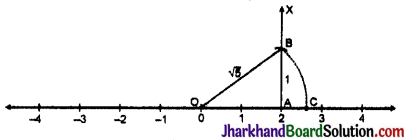
दिखाइए कि संख्या-रेखा पर \(\sqrt{5}\) को किस प्रकार निरूपित किया जा सकता है ?
हल:
(i) संख्या रेखा खींचकर OA = 2 इकाई ली।
(ii) OA के 4 बिन्दु पर OB = 1 इकाई लम्ब डाला।
(iii) O को B से मिलाया।
समकोण ΔOAB में पाइथागोरस प्रमेय से,
OB = \(\sqrt{O A^2+A B^2}\) = \(\sqrt{2^2+1^2}\) = \(\sqrt{5}\)
JAC Class 9 Maths Solutions Chapter 1 संख्या पद्धति Ex 1.2 1

O को केन्द्र मानकर OB त्रिज्या का चाप खींचा जो संख्या रेखा को C बिन्दु पर काटता है।
OC = OB = \(\sqrt{5}\) = 2.236 (लगभग)
अतः \(\sqrt{5}\) को संख्या रेखा पर बिन्दु C के रूप में निरूपित किया जा सकता है।

JAC Class 9 Maths Solutions Chapter 1 संख्या पद्धति Ex 1.2

प्रश्न 4.
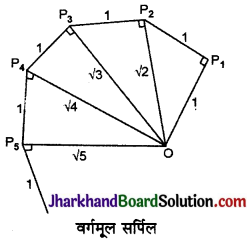
कक्षा में वर्गमूल सर्पिल की रचना क्रियाकलाप द्वारा करिये।
हल:
कागज की एक बड़ी शीट लेकर सबसे पहले एक बिन्दु O लिया और एकक लम्बाई का रेखाखण्ड OP1 खींचा। बिन्दु P1 पर लम्ब रेखाखण्ड P1P2 एकक लम्बाई का खींचा। अब O और P2 को मिलाया OP2 रेखाखण्ड \(\sqrt{2}\) को दर्शाता है। इसी प्रकार बिन्दु P2 पर एकक लम्बाई का रेखाखण्ड P2P3 खींचा, फिर P3 को O से मिलाया जो \(\sqrt{3}\) को निरूपित करता है। इसी प्रकार P3 पर एकक लम्बाई का लम्ब रेखाखण्ड P3P4 खींचा तथा P4 को O से मिलाया जो कि \(\sqrt{4}\) को निरूपित करता है।
JAC Class 9 Maths Solutions Chapter 1 संख्या पद्धति Ex 1.2 2
इसी प्रकार की पुनरावृत्ति के द्वारा \(\sqrt{2}\), \(\sqrt{3}\), \(\sqrt{4}\), \(\sqrt{5}\), \(\sqrt{6}\)… दशांने वाला एक वर्गमूल सर्पिल प्राप्त किया जा सकता है।

JAC Class 9 Maths Solutions Chapter 7 त्रिभुज Ex 7.3

Jharkhand Board JAC Class 9 Maths Solutions Chapter 7 त्रिभुज Ex 7.3 Textbook Exercise Questions and Answers.

JAC Board Class 9 Maths Solutions Chapter 7 त्रिभुज Exercise 7.3

प्रश्न 1.
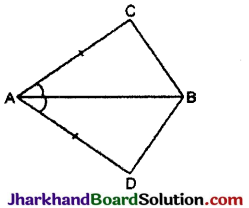
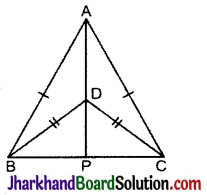
ΔABC और ΔDBC एक ही आधार BC पर बने दो समद्विबाहु त्रिभुज इस प्रकार हैं कि A और D भुजा BC के एक ही ओर स्थित हैं (देखिए आकृति)। यदि AD बढ़ाने पर BC को P पर प्रतिच्छेद करे, तो दर्शाइए कि :
(i) ΔABD ≅ ΔACD
(ii) ΔABP ≅ ΔACP
(iii) APकोण A और कोण D दोनों को समद्विभाजित करता है।
(iv) AP रेखाखण्ड BCका लम्ब समद्विभाजक है।
JAC Class 9 Maths Solutions Chapter 7 त्रिभुज Ex 7.3 1
हल:
(i) ΔABD तथा ΔACD में,
AB = AC [दिया है]
BD = DC [दिया है]
और AD = AD [उभयनिष्ठ]
∴ भुजा भुजा-भुजा सर्वांगसमता गुण से,
ΔABD ≅ ΔACD इति सिद्धम्।

(ii) ΔABP तथा ΔACP में.
AB = AC [दिया है]
∠BAP = ∠PAC
[∵ ΔABD ≅ ΔACD
या ∠BAD = ∠DAC
या ∠BAP = ∠PAC]
और AP = AP [उभयनिष्ठ]
ΔABP ≅ ΔACP. [SAS नियम]
इति सिद्धम्।

(iii) ∵ ΔABD ≅ ΔACD
∴ ∠BAD = ∠DAC
⇒ AD, ∠A को समद्विभाजित करता है। …(i)
ΔBDP तथा ΔCDP में,
BD = CD [दिया है]
BP = PC
[∵ ΔABP ≅ ΔACP या BP = PC]
तथा DP = DP [उभयनिष्ठ]
∴ ΔBDP ≅ ΔPDC [SAS नियम]
⇒ DP, ∠D को समद्विभाजित करता है। …(ii)
समीकरण (i) + (ii)
AP, ∠A तथा ∠D को समद्विभाजित करता है। इति सिद्धम्।

(iv) ∵ AP, BC पर स्थित है।
∠APB + ∠APC = 180° [समान्तर युग्म]
परन्तु ∠APB = ∠APC [सिद्ध किया है]
∴ ∠APB = ∠APC = \(\frac{1}{2}\)
तथा BP = PC [सिद्ध किया है]
या AP, BC का लम्ब समद्विभाजक है।
इति सिद्धम्।

JAC Class 9 Maths Solutions Chapter 7 त्रिभुज Ex 7.3

प्रश्न 2.
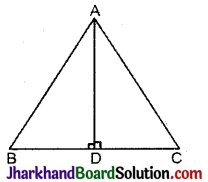
AD एक समद्विबाहु त्रिभुज ABC का एक शीर्षलम्ब है, जिसमें AB = AC है। दर्शाइए कि
(i) AD, रेखाण्ड BC को समद्विभाजित करता है।
(ii) AD, कोण 4 को समद्विभाजित करता है।
JAC Class 9 Maths Solutions Chapter 7 त्रिभुज Ex 7.3 2
हल:
(i) AD, शीर्ष A से खींचा गया लम्ब है, जो कि समद्विबाहु ΔABC के आधार BC के सम्मुख है।
AB = AC, ∠ADC = ∠ADB = 90°
अब ΔADB तथा ΔADC में,
AB = AC [दिया है]
∴ AD = AD [उभयनिष्ठ है]
तथा ∠ADC = ∠ADB [प्रत्येक 90°]
∴ ΔADB ≅ ΔADC [AAS नियम]
व BD = DC
तथा ∠BAC =∠DAC
∴ AD, BC को समद्विभाजित करता है। इति सिद्धम्।

(ii) ΔADB = ΔADC
अत: ∠BAD ∠CAD
इति सिद्धम् ।
⇒ AD, ∠A को समद्विभाजित करता है। इति सिद्धम्।

प्रश्न 3.
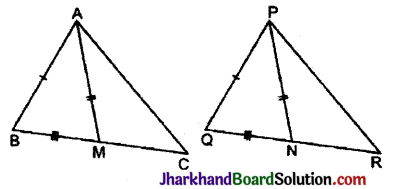
एक त्रिभुज ABC की दो भुजाएँ AB और BC तथा माध्यिका AM क्रमशः एक-दूसरे त्रिभुज की भुजाओं PQ और QR तथा माध्यिका PN के बराबर हैं (देखिए आकृति)।
JAC Class 9 Maths Solutions Chapter 7 त्रिभुज Ex 7.3 3
दर्शाइए कि :
(i) ΔABM ≅ ΔPQN
(ii) ΔABC ≅ ΔPQR.
हल:
ΔABC तथा ΔPQR में,
AB = PQ
BC = QR
तथा AM = PN
चूँकि AM तथा PN क्रमश: ΔABC तथा ΔPQR की माध्यिकाएँ हैं।
और BC = QR [दिया है]
⇒ \(\frac{1}{2}\)BC = \(\frac{1}{2}\)QR
⇒ BM = QN
अब, ΔABM तथा ΔPQN में,
AB = PQ [दिया है]
BM = QN
तथा AM = PN [दिया है]
ΔΑΒΜ ≅ ΔΡQΝ [sss नियम]
⇒ ∠B = ∠Q
अब ΔABC तथा ΔPQR में,
AB = PQ [दिया है]
∠B = ∠Q
BC = QR [दिया है]
∴ ΔABC = ΔPQR, [SAS नियम]

JAC Class 9 Maths Solutions Chapter 7 त्रिभुज Ex 7.3

प्रश्न 4.
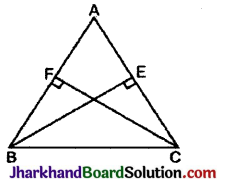
BE और CF त्रिभुज ABC के दो बराबर शीर्षलम्ब हैं। R.H.S. सर्वांगसमता नियम का प्रयोग करके सिद्ध कीजिए कि ΔABC एक समद्विबाहु त्रिभुज है।
JAC Class 9 Maths Solutions Chapter 7 त्रिभुज Ex 7.3 4
हल:
ΔBCF तथा ΔCBE में,
∠BFC = ∠CEB [∵ प्रत्येक 90°]
BC = BC [उभयनिष्ठ]
FC = EB (दिया है)
∴ ΔBCF ≅ ΔCBE (RHS नियम)
⇒ ∠FBC = ∠ECB
या ∠ABC = ∠ACB
⇒ AB = AC
∴ ΔABC एक समद्विबाहु त्रिभुज है। इति सिद्धम्।

प्रश्न 5.
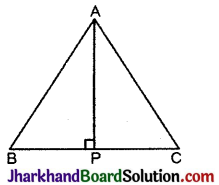
ABC एक समद्विबाहु त्रिभुज है, जिसमें AB = AC है। AP ⊥ BC खींचकर दर्शाइए कि ∠B ≅ ∠C है।
JAC Class 9 Maths Solutions Chapter 7 त्रिभुज Ex 7.3 5
हल:
ΔABP तथा ΔACP में,
AB = AC [दिया है]
AP = AP [उभयनिष्ठ]
∠APB = ∠APC [प्रत्येक 90°]
ΔABP ≅ ΔACP (RHS नियम)
या ∠B = ∠C इति सिद्धम्।

JAC Class 9 Maths Solutions Chapter 12 हीरोन का सूत्र Ex 12.2

Jharkhand Board JAC Class 9 Maths Solutions Chapter 12 हीरोन का सूत्र Ex 12.2 Textbook Exercise Questions and Answers.

JAC Board Class 9 Maths Solutions Chapter 12 हीरोन का सूत्र Exercise 12.2

प्रश्न 1.
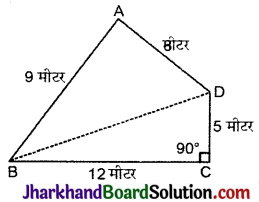
एक पार्क चतुर्भुज ABCD के आकार का है, जिसमें ∠C = 90°, AB = 9 मीटर, BC = 12 मीटर, CD = 5 मीटर और AD = 8 मीटर है। यह पार्क कितना क्षेत्रफल घेरे हुए है ?
हल:
विकर्ण BD खींचा जो चतुर्भुजाकार पार्क ABCD को दो ΔABD तथा ΔBCD में विभाजित करता हैं।
JAC Class 9 Maths Solutions Chapter 12 हीरोन का सूत्र Ex 12.2 1
1. समकोण त्रिभुज BCD का
क्षेत्रफल = \(\frac{1}{2}\) BC × CD
= \(\frac{1}{2}\) × 12 × 5 = 30 वर्ग मीटर
2. ∵ BD, समकोण त्रिभुज BCD का कर्ण है।
∴ ΔBCD में पाइथागोरस प्रमेय से,
BD2 = BC2 + CD2
= (12)2 + (5)2
= 144 + 25 = 169 = (13)2
BD2 = (13)2
∴ BD = 13 मीटर
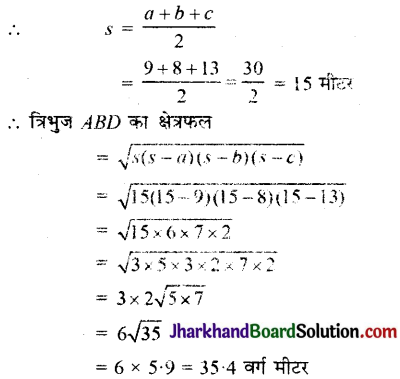
तब ΔABD में, a = 9 मीटर, b = 8 मीटर व c = 13 मीटर
JAC Class 9 Maths Solutions Chapter 12 हीरोन का सूत्र Ex 12.2 2
∴ पार्क का क्षेत्रफल = क्षे.फ. ΔBCD + क्षेत्रफल ΔABD
= 30 + 35.4 वर्ग मीटर
= 65.4 वर्ग मीटर
अतः पार्क का क्षेत्रफल = 65.4 वर्ग मीटर।

JAC Class 9 Maths Solutions Chapter 12 हीरोन का सूत्र Ex 12.2

प्रश्न 2.
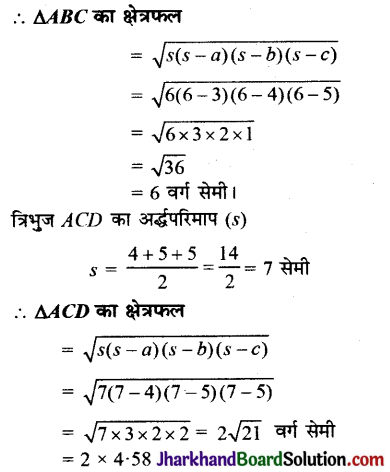
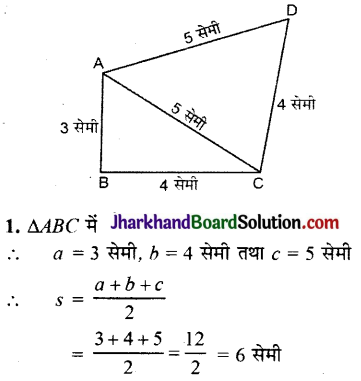
एक चतुर्भुज ABCD का क्षेत्रफल ज्ञात कीजिए, जिसमें AB = 3 सेमी, BC = 4 सेमी, CD = 4 सेमी, DA = 5 सेमी और AC = 5 सेमी है।
हल:
चित्रानुसार चतुर्भुज ABCD को विकणं AC
ΔABC व ΔACD में विभक्त करता है।
JAC Class 9 Maths Solutions Chapter 12 हीरोन का सूत्र Ex 12.2 3
JAC Class 9 Maths Solutions Chapter 12 हीरोन का सूत्र Ex 12.2 4
= 9.16 वर्ग सेमी या 9.2 वर्ग सेमी.
चतुर्भुज ABCD का क्षेत्रफल = ΔABC का क्षेत्रफल + ΔACD का क्षेत्रफल
= 6.0 + 9.2 = 15.2 वर्ग सेमी।

प्रश्न 3.
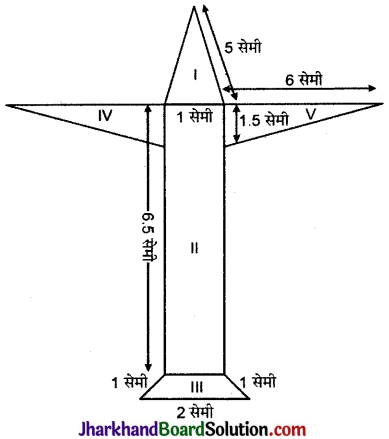
राधा ने एक रंगीन कागज से एक हवाई जहाज का चित्र बनाया जैसा कि आकृति में दिखाया गया है। प्रयोग किए गए कागज का कुल क्षेत्रफल ज्ञात कीजिए।
JAC Class 9 Maths Solutions Chapter 12 हीरोन का सूत्र Ex 12.2 5
हल:
हवाई जहाज को पाँच भागों में बाँटा गया है। अतः प्रत्येक भाग का क्षेत्रफल ज्ञात करना होगा।
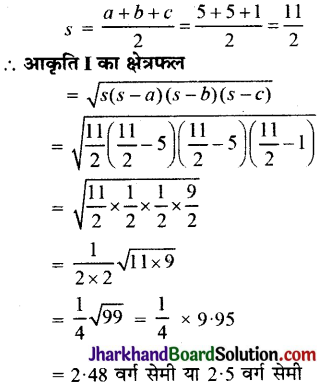
आकृति I समद्विबाहु त्रिभुज है।
a = 5 सेमी, b = 5 सेमी तथा c = 1 सेमी
JAC Class 9 Maths Solutions Chapter 12 हीरोन का सूत्र Ex 12.2 6
आकृति II आयत है।
आकृति II का क्षेत्रफल = लम्बाई × चौड़ाई
= 6.5 सेमी × 1 सेमी
= 6.5 वर्ग सेमी
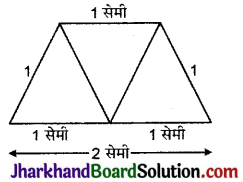
आकृति III समलम्ब चतुर्भुज है जिमसें समान्तर भुजाएँ 2 सेमी व 1 सेमी हैं और बराबर भुजाओं में से प्रत्येक 1 सेमी है।
JAC Class 9 Maths Solutions Chapter 12 हीरोन का सूत्र Ex 12.2 7
2 सेमी की भुजा के मध्य-बिन्दु से ऊपर की समान्तर भुजाओं को जोड़कर आकृति को सेमी भुजा वाले 3 समबाहु त्रिभुजों में विभक्त किया गया है।
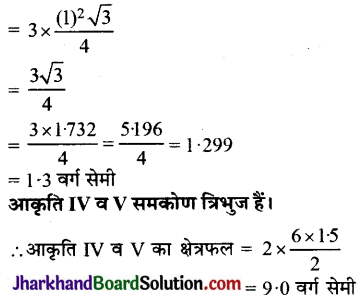
तब आकृति III का क्षेत्रफल
= 3 × 1 सेमी भुजा वाले समबाहु त्रिभुज का क्षेत्रफल
JAC Class 9 Maths Solutions Chapter 12 हीरोन का सूत्र Ex 12.2 8
∴ पूरी आकृति का क्षेत्रफल = 2.5 + 6.5 + 1.3 + 9.0
= 19.3 वर्ग सेमी
अतः प्रयोग किये कागज का क्षेत्रफल = 19.3 वर्ग सेमी।

JAC Class 9 Maths Solutions Chapter 12 हीरोन का सूत्र Ex 12.2

प्रश्न 4.
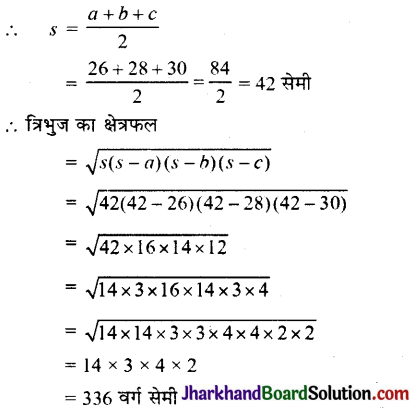
एक त्रिभुज और एक समान्तर चतुर्भुज का एक ही आधार है और क्षेत्रफल भी एक ही है। यदि त्रिभुज की भुजाएँ 26 सेमी, 28 सेमी और 30 सेमी हैं तथा समान्तर चतुर्भुज 28 सेमी के आधार पर स्थित है, तो उसकी संगत ऊँचाई ज्ञात कीजिए।
हल:
त्रिभुज में a = 26 सेमी, b = 28 सेमी व c = 30 सेमी
JAC Class 9 Maths Solutions Chapter 12 हीरोन का सूत्र Ex 12.2 9
∵ समान्तर चतुर्भुज का क्षेत्रफल = आधार × ऊँचाई
∴ 336 = 28 × ऊँचाई
∴ संगत ऊँचाई = \(\frac{336}{28}\)
= 12 सेमी
अतः समान्तर चतुर्भुज की संगत ऊँचाई 12 सेमी।

प्रश्न 5.
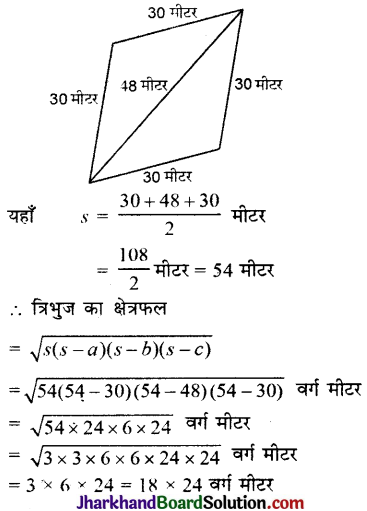
एक समचतुर्भुजाकार घास के खेत में 18 गायों के चरने के लिए घास है। यदि इस समचतुर्भुज की प्रत्येक भुजा 30 मीटर और बड़ा विकर्ण 48 मीटर है, तो प्रत्येक गाय को चरने के लिए इस घास के खेत का कितना क्षेत्रफल प्राप्त होगा ?
हल:
विकर्ण समचतुर्भुज को समद्विभाजित करता है, अतः खेत का क्षेत्रफल त्रिभुज का क्षेत्रफल का दोगुना होगा।
JAC Class 9 Maths Solutions Chapter 12 हीरोन का सूत्र Ex 12.2 10
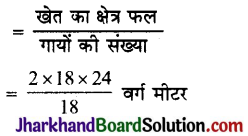
अतः समचतुर्भुज का क्षेत्रफल = 2 × 18 × 24 वर्ग मीटर
∴ 1 गाय को चरने के लिए क्षेत्रफल
JAC Class 9 Maths Solutions Chapter 12 हीरोन का सूत्र Ex 12.2 11
= 2 × 24 m2 = 48 वर्ग मीटर।

JAC Class 9 Maths Solutions Chapter 12 हीरोन का सूत्र Ex 12.2

प्रश्न 6.
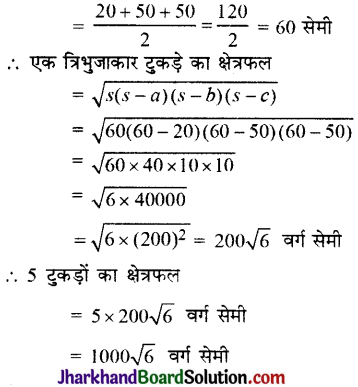
दो भिन्न रंगों के कपड़ों के 10 त्रिभुजाकार टुकड़ों को सिलकर एक छाता बनाया गया है। प्रत्येक टुकड़े की माप 20 सेमी, 50 सेमी और 50 सेमी है। छाते में प्रत्येक रंग का कितना कपड़ा लगा है ?
हल:
∵ छाते में 2 रंग हैं और उसे 10 त्रिभुजाकार टुकड़ों से सिला गया है।
JAC Class 9 Maths Solutions Chapter 12 हीरोन का सूत्र Ex 12.2 12
∴ प्रत्येक रंग के 5 टुकड़े होंगे।
प्रत्येक त्रिभुजाकार टुकड़े की माप 20, 50 व 50 सेमी है।
∴ a = 20 सेमी, b = 50 सेमी तथा c = 50 सेमी
∴ s = \(\frac{a+b+c}{2}\)
JAC Class 9 Maths Solutions Chapter 12 हीरोन का सूत्र Ex 12.2 13
अतः प्रयुक्त प्रत्येक रंग 1000\(\sqrt{6}\) वर्ग सेमी है।

प्रश्न 7.
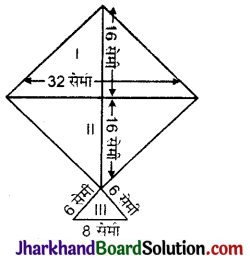
एक पतंग तीन भिन्न-भिन्न शेडों (shades) के कागजों से बनी है। इन्हें आकृति में I, II और III से दर्शाया गया है। पतंग का ऊपरी भाग 32 सेमी विकर्ण का एक वर्ग है और निचला भाग 6 सेमी, 6 सेमी और 8 सेमी भुजाओं का एक समद्विबाहु त्रिभुज है। ज्ञात कीजिए कि प्रत्येक शेड का कितना कागज प्रयुक्त किया गया है।
हल:
∵ वर्गाकार भाग का विकर्ण = 32 सेमी
और वर्ग के विकर्ण एक-दूसरे को समकोण पर समद्विभाजित भी करते हैं तथा वर्ग के विकर्ण समान होते हैं।
JAC Class 9 Maths Solutions Chapter 12 हीरोन का सूत्र Ex 12.2 14
Δ का क्षेत्रफल = \(\frac{1}{2}\) × आधार × ऊँचाई
भाग 1 का क्षेत्रफल = \(\frac{1}{2}\) × 32 × 16
= 256 वर्ग सेमी
भाग II का क्षेत्रफल = \(\frac{1}{2}\) × 32 × 16
= 256 वर्ग सेमी
भाग III में समद्विबाहु त्रिभुज है जिसमें a = 8 सेमी, b = 6 सेमी, c = 6 सेमी
s = \(\frac{a+b+c}{2}\)
= \(\frac{8+6+6}{2}\)
= \(\frac{20}{2}\) = 10 सेमी
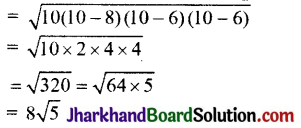
∴ भाग III का क्षेत्रफल = \(\sqrt{s(s-a)(s-b)(s-c)}\)
JAC Class 9 Maths Solutions Chapter 12 हीरोन का सूत्र Ex 12.2 15
= 8 × 2.236 वर्ग सेमी
= 17.88 वर्ग सेमी
अतः भाग I व भाग II प्रत्येक के कागज का क्षेत्रफल = 256 वर्ग सेमी तथा भाग III के लिए कागज का क्षेत्रफल = 17.88 वर्ग सेमी।

JAC Class 9 Maths Solutions Chapter 12 हीरोन का सूत्र Ex 12.2

प्रश्न 8.
किसी फर्श पर एक फूलोंकी डिजाइन 16 त्रिभुजाकार टाइलों से बनाया गया है, जिनमें से प्रत्येक की भुजाएँ 9 सेमी, 28 सेमी और 35 सेमी हैं। इन टाइलों को 50 पैसे प्रति सेमी2 की दर से पॉलिश कराने का व्यय ज्ञात कीजिए।
हल:
∵ प्रत्येक त्रिभुजाकार टाइल की माप 9 सेमी, 28 सेमी व 35 सेमी है।
JAC Class 9 Maths Solutions Chapter 12 हीरोन का सूत्र Ex 12.2 16
∴ a = 9 सेमी, b = 28 सेमी तथा c = 35 सेमी
s = \(\frac{a+b+c}{2}\)
= \(\frac{9+28+35}{2}\)
= \(\frac{72}{2}\) = 365 सेमी
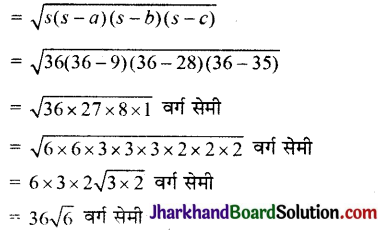
∴ प्रत्येक त्रिभुजाकार टाइल का क्षेत्रफल
JAC Class 9 Maths Solutions Chapter 12 हीरोन का सूत्र Ex 12.2 17
∴ 16 टाइलों का क्षेत्रफल
= 16 × 36\(\sqrt{6}\) = 576\(\sqrt{6}\) वर्ग सेमी
= 576 × 2.45 = 1.411.2 वर्ग सेमी
1 वर्ग सेमी पॉलिश का व्यय = 50 पैसे = \(\frac{1}{2}\) रु.
1411.2 वर्ग सेमी पॉलिश का व्यय = \(\frac{1}{2}\) × 1411.2
= 705.60 रु.
अतः टाइलों पर पॉलिश कराने का व्यय = 705.60 रु.

JAC Class 9 Maths Solutions Chapter 12 हीरोन का सूत्र Ex 12.2

प्रश्न 9.
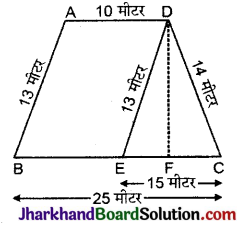
एक खेत समलम्ब के आकार का है जिसकी समान्तर भुजाओं की लम्बाई 25 मीटर और 10 मीटर तथा असमान्तर भुजाओं की लम्बाई 14 मीटर तथा 13 मीटर हैं। खेत का क्षेत्रफल ज्ञात कीजिए।
हल:
समलम्ब के आकार के खेत ABCD की समान्तर भुजा
BC = 25 मीटर
DA = 10 मी. तथा
AB = 13 मी.
CD = 14 मी.
D से DE || AB खींची जिससे ADEB एक समान्तर चतुर्भुज प्राप्त होता है जिसमें DE = AB = 13 मीटर।
JAC Class 9 Maths Solutions Chapter 12 हीरोन का सूत्र Ex 12.2 18
∵ BC = 25 मीटर और BE = AD = 10 मीटर
∴ EC = 25 – 10 = 15 मीटर
इस प्रकार समलम्ब दो भागों में विभक्त हो गया:
(1) एक समान्तर चतुर्भुज ADEB
(2) एक ΔCDE जिसकी भुजाएँ CD = 14 मीटर, DE = 13 मीटर व EC = 15 मीटर।
D से EC पर DF लम्ब डाला।
ΔCDE का क्षेत्रफल
= \(\frac{1}{2}\) × EC × DF = \(\frac{1}{2}\) × 15 × DF
= \(\frac{15}{2}\) × DF वर्ग मीटर।
अब ΔCDE में,
a = 14 मीटर, b = 13 मीटर, c = 15 मीटर
∴ s = \(\frac{a+b+c}{2}\)
ΔCDE का अर्द्ध परिमाप s
s = \(\frac{14+13+15}{2}\) = \(\frac{42}{2}\) = 21 मीटर
∴ ΔCDE का क्षेत्रफल
= \(\sqrt{s(s-a)(s-b)(s-c)}\)
= \(\sqrt{21(21-14)(21-13)(21-15)}\)
= \(\sqrt{21 \times 7 \times 8 \times 6}\)
= \(\sqrt{3 \times 7 \times 7 \times 2 \times 2 \times 2 \times 2 \times 3}\)
= 84 वर्ग मीटर।
तब ΔCDE के दोनों क्षेत्रफल समान होने चाहिए।
अतः \(\frac{15}{2}\) × DF = 84
∴ DF = \(\frac{84 \times 2}{15}=\frac{168}{15}\)
= 11.2 मीटर
समान्तर चतुर्भुज ADEB का क्षेत्रफल
= BE × DF
= 10 × 11.2 = 112 वर्ग मीटर
अत: समलम्ब ABCD का क्षेत्रफल
= समान्तर चतुर्भुज ADEB का क्षेत्रफल + ΔCDE का क्षेत्रफल
= (112 + 84) वर्ग मीटर
= 196 वर्ग मीटर।

JAC Class 9 English Solutions Beehive Chapter 11 If I Were You

Jharkhand Board JAC Class 9 English Solutions Beehive Chapter 11 If I Were You Textbook Exercise Questions and Answers.

JAC Board Class 9 English Solutions Beehive Chapter 11 If I Were You

JAC Class 9 English If I Were You Textbook Questions and Answers

Thinking About the Text

I. Answer these questions.

इन प्रश्नों के उत्तर दीजिए ।

Question 1.
“At last a sympathetic audience. ”
” आखिरकार एक सहानुभूतिपूर्ण श्रोता ”

(i) Who says this ?
यह कौन कहता है ?

(ii) Why does he say it ?
वह यह बात क्यों कहता है ?

(iii) Is he sarcastic or serious ?
वह व्यंग्य से बात कर रहा है या गम्भीरता से ?
Answer:
(i) Gerrard says this.
यह बात जिराई कहता है ।

(ii) He says it because the intruder is willing to know about him.
वह ऐसा इसलिए कहता है क्योंकि घुसपैठिया उसके बारे में जानने का इच्छुक है ।

(iii) He speaks the given dialogue sarcastically.
वह दिए गये संवाद को व्यंग्य से कहता है।

JAC Class 9 English Solutions Beehive Chapter 11 If I Were You

Question 2.
Why does the intruder choose Gerrard as the man whose identity he wants to take on?
घुसपैठिया जिरार्ड को उस व्यक्ति के रूप में क्यों चुनता है जिसकी विशिष्टता वह अपनाना चाहता है ?
Answer:
Gerrard looks much like the intruder. The intruder is a murderer and the police is after him. He hopes he can easily trick Gerrard. Besides, people know very little about him. That is why, the intruder wants to take on his identity.

जिरार्ड घुसपैठिये जैसा ही दिखता है अर्थात् वह उसकी जैसी ही कद-काठी का है । घुसपैठिया हत्यारा है और पुलिस उसके पीछे है। वह उम्मीद करता है कि वह जिरार्ड को आसानी से अपनी चालाकी में फँसा लेगा। इसके अलावा, लोग उसके ( जिरार्ड के बारे में बहुत कम जानते हैं । यही कारण है कि घुसपैठिया उसकी जैसी विशिष्टता या उसकी जैसी एकरूपता अपनाना चाहता है।

Question 3.
“I said it with bullets.
” मैंने गोलियाँ चला दीं ।”

(i) Who says this?
यह कौन कहता है ?

(ii) What does it mean ?
इसका क्या तात्पर्य है ?

(iii) Is it the truth ? What is the speaker’s reason for saying this ?
क्या यह सत्य है ? वक्ता के ऐसा कहने के पीछे क्या कारण है ?
Answer:
(i) Gerrard says this.
यह बात जिरार्ड कहता है ।

(ii) It means that he shot someone for his escape.
इसका तात्पर्य है कि उसने स्वयं के बचने के लिए किसी को गोलियाँ मार दीं ।

(iii) No, it is not the truth. The speaker says it to prove himself a criminal. He also says it to save himself from getting shot by the intruder.
नहीं, यह सत्य नहीं है द्वारा गोली मारी जाने से बचने के लिए भी ऐसा कहता है। वक्ता स्वयं को एक अपराधी सिद्ध करने के लिए ऐसा कहता है। वह घुसपैठिए

Question 4.
What is Gerrard’s profession? Quote the parts of the play that support your answer.
जिरार्ड का व्यवसाय क्या है ? अपने उत्तर के समर्थन में नाटक से अंश उद्धृत कीजिए ।
Answer:
Gerrard works in a theatre. Following part of the play supports this:
“Sorry I can’t let you have the props in time for rehearsal, I’ve had a spot of bother – quite amusing. I think I’ll put it in my next play. ”

जिरार्ड थियेटर (नाटक) में काम करता है । नाटक का निम्नलिखित अंश इस बात की पुष्टि करता है :
” अफ़सोस है कि मैं आपको समय पर रिहर्सल के लिए साजोसामान उपलब्ध नहीं करा सकता हूँ। मेरे साथ थोड़ी परेशानी हो गई है – काफ़ी रोचक। मैं सोचता हूँ कि इसे अपने अगले नाटक का हिस्सा बनाऊँगा।”

JAC Class 9 English Solutions Beehive Chapter 11 If I Were You

Question 5.
“You’ll soon stop being smart. ‘
“जल्दी ही तुम चालक बनना बंद कर दोगे । ”
(i) Who says this ? यह कौन कहता है ?
(ii) Why does the speaker say this ? वक्ता यह बात क्यों कहता है ?
(iii) What according to the speaker will stop Gerrard from being sinart?
वक्ता के अनुसार कौन सी बात जिरार्ड को चालाक बनने से रोकेगी ?
Answer:
(i) The intruder says this.
यह बात घुसपैठिया कहता है ।

(ii) The speaker says it to frighten Gerrard.
घुसपैठिया यह बात जिरार्ड को डराने के लिए कहता है ।

(iii) The speaker has a revolver. So he thinks he is more powerful than Gerrard. According to him, Gerrard would stop being smart once he knew what was going to happen to him.
वक्ता के पास रिवॉल्वर है । इसलिए वह सोचता है कि वह जिरार्ड से अधिक शक्तिशाली है । उसके अनुसार जिरार्ड तब होशियारी नहीं दिखायेगा जब उसे पता चलेगा कि उसके साथ क्या होने जा रहा है।

Question 6.
“They can’t hang me twice.”
” वे मुझे दो बार फाँसी पर नहीं लटका सकते हैं ।”
(i) Who says this ? यह कौन कहता है ?
(ii) Why does the speaker say it ? वक्ता यह बात क्यों कहता है ?
Answer:
(i) The intruder says this.
यह बात घुसपैठिया कहता है ।

(ii) He says it because he wants to tell Gerrard that he is already wanted for a murder, so he is not afraid of committing another murder.
वह ऐसा इसलिए कहता है क्योंकि वह जिरार्ड को बता देना चाहता है कि वह एक हत्या के अपराध के लिए पहले से ही वांछित है इसलिए उसे एक और हत्या करने में कोई डर नहीं है ।

Question 7.
“Amystery I propose to explain.” What is the mystery the speaker proposes to explain? “
एक ऐसा रहस्य जिसे मैं समझाना चाहता हूँ ।” वक्ता किस रहस्य को समझाना चाहता है ?
Answer:
The speaker wants to explain the mystery that he is a criminal himself and that the police are after him.
वक्ता यह रहस्य समझाना चाहता है कि वह स्वयं एक अपराधी है और पुलिस उसके पीछे पड़ी हुई है ।

Question 8.
“This is your big surprise.”
“यह तुम्हारे लिए बड़े आश्चर्य की बात है ।”

(i) Where has this been said in the play ?
नाटक में यह बात कहाँ कही गई है?

(ii) What is the surprise ?
आश्चर्य की बात क्या है ?
Answer:
(i) This has been said when Gerrard tells the intruder that he will surely be hanged if he takes on his identity.
यह बात तब कही गई है जब जिरार्ड घुसपैठिये से कहता है कि यदि वह ( घुसपैठिया) उसकी (जिरार्ड की ) जैसी एकरूपता अपनाता है तो उसका ( घुसपैठिये का) फाँसी पर लटकना निश्चित है।

(ii) The surprise is that Gerrard is wanted by police.
आश्चर्य की बात यह है कि पुलिस को जिरार्ड की तलाश है ।

Thinking About Language

I. Consult your dictionary and choose the correct word from the pairs given in brackets:

अपने शब्दकोष को देखिए और कोष्ठकों में दिये जोड़ों में से सही शब्द चुनियेः

1. The (site, cite) of the accident was (ghastly / ghostly).
2. Our college (principle / principal) is very strict.
3. I studied (continuously/continually) for eight hours.
4. The fog had an adverse (affect / effect) on the traffic.
5. Cezanne, the famous French painter, was a brilliant (artist/artiste).
6. The book that you gave me yesterday is an extraordinary (collage / college) of science, fiction and mystery.
7. Our school will (host / hoist) an exhibition on cruelty to animals and wildlife conservation.
8. Screw the lid tightly onto the top of the bottle and (shake/shape) well before using the contents.
Answer:
1.site, ghastly
2. principal
3. continuously
4. effect
5. artist
6. collage
7. host
8. shake
Collage (कॉलाज ) = a picture made by fixing pieces of paper, cloth, photograph onto a surface,
किसी सतह पर कागज, कपड़े, फोटो चित्रों आदि के टुकड़ों के साथ चिपकाकर बनाया गया चित्र ।

JAC Class 9 English Solutions Beehive Chapter 11 If I Were You

II. जब हम कहते कुछ हैं और उसका तात्पर्य कुछ और होता है जो प्रायः हमारी कही हुई बात का उल्टा होता है, तो वह irony (व्यंग्य) कहलाता है । जब कोई कुछ गलती करता है और आप कहते हैं, “ ओह ! बहुत समझदारी का काम किया !” तो यह व्यंग्य होता है । ‘समझदारी की कमी’ दिखाने के लिए आप ‘समझदार’ शब्द का प्रयोग करते हैं । प्रायः प्रयोग में आने वाली irony (व्यंग्य) से युक्त अभिव्यक्तियाँ हैं :

  • ओह, क्या वह चतुर नहीं था ! / ओह, वह चतुर था।
  • मुझे अवश्य कहना चाहिए, तुमने बड़ी सहायता की है !
  • तुमने अपने लिए बहुत अच्छा किया है, है न ?
  • ओह, बहुत मजेदार ! या कितना मजेदार है !

इन शब्दों को irony (व्यंग्य) के रूप में प्रयोग करते समय हमारे बोलने का तरीका कुछ अलग होता है। नाटक को ध्यान से पढ़िये और जिरार्ड द्वारा irony के रूप में प्रयोग किये गये शब्द व अभिव्यक्तियाँ चुनिये । फिर बताइये कि इन अभिव्यक्तियों का वास्तव में क्या अर्थ है । नीचे दो उदाहरण दिये गये हैं । ऐसी तीन अन्य अभिव्यक्तियाँ तथा उनका वास्तविक अर्थ भी लिखिए ।
What the author says – What he means .
Why, this is a surprise, Mr….er – He pretends that the intruder is a social visitor whom he is welcoming. In this way he hides his fear.
At last a syìnpathetic audience! – He pretends that the intruder wants to listen to him, whereas actually the intruder wants to find out information for his own use.
Answer:
JAC Class 9 English Solutions Beehive Chapter 11 If I Were You 1

  • Dictionary Use – अलग-अलग सन्दर्भ में एक ही शब्द के अलग-अलग अर्थ हो सकते हैं । देखिये :
  • The students are taught to respect different cultures.
  • The school is organising a cultural show.
  • His voice is cultured.

पहले वाक्य में culture (noun) का अर्थ है- जीवन का तरीका (संस्कृति); दूसरे वाक्य में cultural (adjective) का अर्थ है – कला, साहित्य व संगीत सम्बन्धी ( सांस्कृतिक); और तीसरे वाक्य में cultured (past participle) का अर्थ है – परिष्कृत, सभ्य ( सुसंस्कृत ) । प्रायः एक शब्दकोष चिह्नों के प्रयोग के माध्यम से आपको शब्द का सही अर्थ पहचानने में सहायता करता है।

Oxford Advanced Learner’s Dictionary, 2005 शब्दकोष से ‘culture’ शब्द की प्रविष्टि को देखिए । (Noun, verb, adjective, adverb, synonyms इत्यादि वे चिह्न हैं जो आपको (शब्द का) सही अर्थ व प्रयोग का पता लगाने में सहायता करते हैं और यह सूचना देते हैं कि वह शब्द कौन – सा part of speech है|) ? sympathy, familiarity, comfort, care और surprise शब्दों के लिए शब्दकोष में प्रविष्टियाँ देखिए । शब्दकोष में दी गई सूचना का प्रयोग करते हुए सारिणी को पूरा कीजिए ।
Answer:
JAC Class 9 English Solutions Beehive Chapter 11 If I Were You 2

Speaking

Imagine you are Gerrard. Tell your friend what happened when the Intruder broke into your house. (Clues: Describe.

(i) the intruder…………..his appearance, the way he spoke, his plan, his movements, etc……..
(ii) how you outwitted him.
कल्पना कीजिए कि आप जिरार्ड हैं। जब घुसपैठिया आपके घर में घुस आया तो क्या हुआ इसके बारे में अपने मित्र को बताइये ।
Answer:
1. It was about 7 a.m. Although it was cold and windy evening, I had to go to theatre for rehearsal. I was packing props in my bag. Suddenly an intruder broke into my house. He threatened me with a gun and asked me a few questions. He intended to kill me and take on my indentity to escape from the police. The intruder had a body structure like mine. His voice was cultured. His plan was to murder me. He was very cautious and careful while talking to me. He told me that he had murdered someone before and was not afraid to be hanged.

During the conversation, I thought of a false story to outwit him. I told him that I had also murdered a person and the police were still searching me. So I had already planned to disguise myself to run away without being caught. I offered him to escape with me in my car. He partly believed me. But to remove his doubts, he decided to open the door to look out for the police. I opened the door of cupboard. As he looked into it, I pushed him in the cupboard and locked him in it. Then I got relief.

JAC Class 9 English Solutions Beehive Chapter 11 If I Were You

2. Enact the play in the class. Pay special attention to words given in italics before a dialogue. These words will tell you whether the dialogue has to be said in a happy, sarcastic or ironic tone and how the characters move and what they do as they speak. Read these carefully before you enact the play.
इस नाटक को कक्षा में अभिनीत कीजिये । तिरछे लिखे गये शब्दों को संवाद बोलने से पूर्व विशेष ध्यान से पढ़िये । ये शब्द आपको बताते हैं कि संवाद प्रसन्नता में कहा जाना है या व्यंग्यात्मक लहजे में कहा जाना है। यह भी ध्यान रखिये कि पात्र कैसे गतिविधि करते हैं और बोलते समय क्या करते हैं । नाटक को अभिनीत करने से पूर्व इन्हें ध्यान से पढ़िये ।
Answer:
अध्यापक के निर्देशन में स्वयं कीजिये ।

Writing

I. Which of the words below describe Gerrard and which describe the Intruder ?

नीचे दिये शब्दों में से कौन-से शब्द जिरार्ड का वर्णन करते हैं और कौन-से शब्द घुसपैठिये का वर्णन करते?,
JAC Class 9 English Solutions Beehive Chapter 11 If I Were You 3
Answer:
Gerrard — smart, humorous, clever, cool, witty, nonchalant.
The Intruder — confident, flashy, clever.
Write a paragraph of around 60 words each about Gerrard and the Intruder to show what qualities they have. (You can use some of the words given above.)
जिरार्ड और घुसपैठिये की विशेषताओं को प्रदर्शित करने के लिए दोनों के बारे में एक-एक अनुच्छेद 60 शब्दों में लिखिए। (आप ऊपर दिये शब्दों में से कुछ का प्रयोग कर सकते हैं ।)
Answer:
Gerrard – Gerrard is a well-dressed and well mannered person. He is a reserved person. He rarely goes out and meets people. He remains calm even under most difficult situations. He shows himself nonchalant even to see an Intruder with a revolver. He talks to the Intruder in a humorous and friendly way and finds out much about him. He is a witty speaker. That is why, he be fools the Intruder who wants to kill him.

जिरार्ड जिरार्ड एक अच्छे कपड़े पहनने वाला शालीन व्यक्ति है । वह स्वयं तक ही सीमित रहता है। वह शायद ही कभी बाहर जाता है और लोगों से मिलता है । बहुत अधिक कठिन परिस्थितियों में भी वह शान्त रहता है । रिवॉल्वर लिये हुए एक घुसपैठिये को देखकर भी वह ऐसे दिखता है जैसे उस पर कोई फ़र्क नहीं पड़ता । वह घुसपैठिये से हँसी मज़ाक व मित्रवत् तरीके से व्यवहार करता है और उसके बारे में काफ़ी कुछ पता लगा लेता है । वह एक त्वरित बुद्धि वाला (चतुर) वक्ता है । इसीलिए वह उस घुसपैठिये को मूर्ख बना देता है जो उसे मारना चाहता है ।

The Intruder – The Intruder is a person with a criminal background. He has murdered someone and the police are after him. He wears flashy clothes. He is good at imitating others. He makes a plan to kill Gerrard and take on his identity. He has found out much about Gerrard to make this work easy. He is too confident of himself. He thinks himself very smart and clever. But in fact he is a fool. He is trapped by Gerrard.

JAC Class 9 English Solutions Beehive Chapter 11 If I Were You

घुसपैठिया – घुसपैठिया एक आपराधिक पृष्ठभूमि का व्यक्ति है । उसने एक हत्या की है और पुलिस उसके पीछे पड़ी है । वह भड़कीले कपड़े पहनता है। उसे दूसरों की नकल करना अच्छी तरह आता है । वह जिराई को मारने और उसकी एकरूपता या विशिष्टता अपनाने की योजना बनाता है । इस कार्य को सरल बनाने के लिए उसने जिरार्ड के बारे में काफ़ी कुछ पता लगा लिया है । उसे स्वयं पर बहुत अधिक विश्वास है । वह स्वयं को बहुत चतुर – चालाक समझता है । परन्तु वास्तव में वह मूर्ख है जिसे जिरार्ड द्वारा फंसा लिया जाता है ।

II. Convert the play into a story (150-200 words ). Your story should be as exciting and as witty as the play. Provide a suitable title to it.

इस नाटक को एक (150-200 शब्दों की) कहानी में बदलिये । आपकी कहानी उतनी ही उत्तेजनापूर्ण व बुद्धिमत्तापूर्ण होनी चाहिए जितना कि नाटक है। इसे एक उपयुक्त शीर्षक दीजिए ।
Answer:
Speaking Section में दी गई Story को III Person में रूपान्तरित कर आप एक अच्छी Story बना सकते हैं। शीर्षक How Gerrard outwits an Intruder

JAC Class 9 English If I Were You Important Questions and Answers

Short Answer Type Questions

Answer the following questions in about 30 words each:

निम्नलिखित प्रत्येक प्रश्न का उत्तर लगभग 30 शब्दों में दीजिये :

Question 1.
Describe Gerrard when we first see him on the stage.
जिरार्ड के बारे में बताइये जब हम उसे पहली बार स्टेज पर देखते हैं।
Answer:
On seeing Gerrard first on the stage we can say that he is a man of medium height. He is wearing horn-rimmed glasses. He is dressed in a lounge suit and a great coat.

जिरार्ड को प्रथम बार स्टेज पर देखकर हम कह सकते हैं कि वह मध्यम ऊँचाई का है । वह सींग के जैसी फ्रेम वाला चश्मा पहने हुए है । वह लाउन्ज सूट और बड़ा-सा कोट पहने हुए है|

Question 2.
How do you know that the intruder is a clever person ?
आपको कैसे पता चलता है कि घुसपैठिया एक चालाक व्यक्ति है ?
Answer:
The intruder wants to avoid the police. He makes a plan to kill Gerrard who is of the same build as he (is). He thinks of taking on Gerrard’s identity. These acts prove him as a clever person.

घुसपैठिया पुलिस से बचना चाहता है । वह जिरार्ड को मारने की योजना बनाता है जो उसकी जैसे ही कद काठी का है। उसके मन में जिरार्ड बनकर रहने की बात आती है । ये क्रियाकलाप उसे चालाक व्यक्ति सिद्ध करते हैं ।

Question 3.
Quote two examples from the play that prove that the intruder is over confident.
नाटक से दो उदाहरण उद्धृत कीजिए जो सिद्ध करते हों कि घुसपैठिये को स्वयं पर आवश्यकता से अधिक विश्वास है ।
Answer:
(i) “I’m as smart as you and smarter.”
(ii) “I’ve got brains and use them.” These two statements of the intruder prove that he is over confident.

(i) ” मैं तुम्हारे जितना ही, और उससे भी कहीं अधिक चालाक हूँ ।”
(ii) “मेरे पास दिमाग है और मैं उसका उपयोग ( भी ) करता हूँ ।”
घुसपैठिये के ये दो कथन यह सिद्ध करते हैं कि उसे स्वयं पर आवश्यकता से अधिक विश्वास है ।

JAC Class 9 English Solutions Beehive Chapter 11 If I Were You

Question 4.
What prompts the intruder to take on Gerrard’s identity ?
घुसपैठिये के मन में जिरार्ड बनकर रहने की बात क्यों आती है ?
Answer:
Gerrard is of the same build as the intruder is. The intruder is a murderer and the police are after him. To save himself from the police he wants to take on Gerrard’s identity.

जिरार्ड घुसपैठिये जैसी ही कद-काठी का है । घुसपैठिया हत्यारा है और पुलिस उसके पीछे लगी है। स्वयं को पुलिस से बचाने के लिए वह जिरार्ड जैसी एकरूपता अपनाना चाहता है।

Question 5.
What is the intruder’s motive behind talking to Gerrard ?
जिरार्ड से बात करने के पीछे घुसपैठिये का क्या इरादा है ?
Answer:
The intruder plans to pass the rest of his life as Gerrard. He has already found out many things about Gerrard. Now, he wants to learn the way how Gerrard talks and how he behaves. So he talks to him.

घुसपैठिये की योजना अपना बाकी जीवन जिरार्ड बनकर जीने की है । उसने पहले से ही जिरार्ड के बारे में बहुत-सी बातें पता कर ली हैं । अब वह सीखना चाहता है कि जिरार्ड कैसे बात करता है और वह कैसे व्यवहार करता है । इसलिए वह उससे बात करता है ।

Question 6.
Why was the intruder on a run ?
घुसपैठिया क्यों भागता फिर रहा था ?
Answer:
The intruder did a job in a town. There happened something wrong and he killed a . policeman. Now, the police were after him to arrest. So he was on a run.

घुसपैठिया शहर में एक नौकरी करता था । वहाँ कुछ गड़बड़ हो गई और उसने एक पुलिस वाले को मार दिया । अब, पुलिस गिरफ्तार करने के लिए उसके पीछे पड़ी हुई थी । इसलिए वह भागता फिर रहा था।

Question 7.
How was Gerrard ‘a bit queer’ ?
जिरार्ड ‘कुछ अजीब’ क्यों था ?
Answer:
Gerrard lived alone in a cottage on the outskirts of the town. He phoned his orders and very rarely went out. He suddenly went away somewhere and came back just the same way. Thus, he was ‘a bit queer.’

जिरार्ड शहर की बाहरी सीमा पर एक छोटे से घर में अकेला रहता था । वह अपनी चीजें फोन करके मँगाता था और कभी-कभार ही बाहर जाता था । वह अचानक कहीं चला जाता था और उसी प्रकार से ही अचानक वापिस आ जाता था । इस प्रकार वह ‘कुछ अजीब’ था ।

JAC Class 9 English Solutions Beehive Chapter 11 If I Were You

Question 8.
What reason does Gerrard give to the intruder for his being invested in this cloak of mystery ?
अपने रहस्यमय जीवन के पीछे जिरार्ड क्या कारण बताता है ?
Answer:
Gerrard tells the intruder that he is a murderer and the police are after him. If the police catch him, he is sure to be hanged. So, he is passing his life in a mysterious way.

जिरार्ड घुसपैठिए को बताता है कि वह एक हत्यारा है और पुलिस उसके पीछे लगी हुई है । यदि पुलिस उसे पकड़ लेती है तो उसका फाँसी पर चढ़ना निश्चित है । इसलिए वह रहस्यमय तरीके से अपना जीवन बिता रहा है…!

Question 9.
“Don’t be a fool. ” Whom does Gerrard say this and why?
“मूर्ख मत बनो ।” जिरार्ड यह बात किससे कहता है और क्यों ?
Answer:
Gerrard says this to the intruder who is going to shoot him. He says this to tell the intruder that by killing him, he will gain nothing. He will be hanged surely if he takes Gerrard’s identity.

जिरार्ड यह बात उस घुसपैठिये से कहता है जो उस पर गोली चलाने वाला है । वह यह बात घुसपैठिये को यह बताने के लिए कहता है कि उसे मारकर उसको (घुसपैठिए को) कुछ लाभ नहीं होगा । यदि वह जिराई की विशिष्टता या एकरूपता अपनाएगा तो उसको निश्चित ही फाँसी हो जाएगी ।

Question 10.
How does Gerrard lock the intruder in a cupboard ? जिरार्ड घुसपैठिये को एक अलमारी में कैसे बन्द कर देता है ?
Or
How does Gerrard trap the intruder? ·
जिरार्ड घुसपैठिये को अपने षड़यंत्र में कैसे फँसाता है ?
Answer:
Gerrard asks the intruder to see for himself through the door that the police are there. In fact the door is of a cupboard. As the intruder turns his head towards the door, Gerrard pushes him into the cupboard. He slams the door and locks it.

जिरार्ड घुसपैठिये से कहता है कि दरवाज़े में से झाँककर स्वयं देख लो कि वहाँ पुलिस है। यह दरवाजा वास्तव में एक अलमारी का दरवाज़ा है । जैसे ही घुसपैठिया अपना सिर दरवाजे की तरफ घुमाता है, जिरार्ड उसे अलमारी में धकेल देता है । वह एक झटके से दरवाज़े को बन्द करके ताला लगा देता है ।

JAC Class 9 English Solutions Beehive Chapter 11 If I Were You

Long Answer Type Questions

Answer the following questions in about 60 words each:

निम्नलिखित प्रत्येक प्रश्न का उत्तर लगभग 60 शब्दों में दीजिये :

Question 1.
Prove that Gerrard is ‘calm and nonchalant’.
सिद्ध कीजिए कि जिरार्ड शान्त और ठण्डे दिमाग वाला व्यक्ति है।
Answer:
We see that seeing an intruder in his house, Gerrard does not show any sign of fear or helplessness. He talks to him friendly. During the course of their talks, he finds out many things about this uninvited guest. In the end, he locks the intruder very cleverly in a cupboard. All these things prove that he is very calm and nonchalant.

हम देखते हैं कि अपने घर में एक घुसपैठिये को देखकर जिरार्ड बिल्कुल डरा हुआ या असहाय दिखाई नहीं देता है । वह उससे मित्रवत् बात करता है । बातचीत के दौरान वह इस बिन बुलाये मेहमान के बारे में काफ़ी – कुछ पता लगा लेता है । अन्त में वह बहुत चालाकी से घुसपैठिये को एक अलमारी में बन्द कर देता है । इन सब बातों से सिद्ध होता है कि वह बहुत शान्त और ठण्डे दिमाग वाला व्यक्ति है।

Question 2.
Draw a character sketch of Gerrard.
जिरार्ड का चरित्र चित्रण कीजिए ।
Answer:
Sophisticated – Gerrard is a richly dressed and well-mannered person. His way of talking is cultured.
Reserved – He lives alone. He very rarely goes out and meets very few people.
Cool-minded — Even under difficult situations, he keeps his mind cool. This attitude helps him come out of the difficulty.
Witty – Even under the threat of death, his mind works to weave a trap against the intruder.

सुसंस्कृत – जिरार्ड बहुत अच्छे कपड़े पहनने वाला शालीन व्यक्ति है । उसके बोलने का तरीका सभ्य है। संकोची तथा मनोभावों को छिपाकर रखने वाला – वह अकेला रहता है । वह शायद ही कभी बाहर जाता है और बहुत कम लोगों से मिलता है ।
उण्डे दिमाग वाला – कठिन परिस्थितियों में भी वह अपना दिमाग शान्त रखता है । इसी व्यवहार के कारण उसे परेशानी से बाहर आने में सहायता मिलती है ।
त्वरित-बुद्धि – मृत्यु को सामने देखकर भी उसका दिमाग घुसपैठिये के विरुद्ध एक षड़यंत्र रचने का काम करता है।

Question 3.
How does the play prove that wit (intelligence) always has an upper hand ?
यह नाटक कैसे सिद्ध करता है कि बुद्धि सदा अधिक शक्तिशाली होती है ?
Or
How does Gerrard trap the intruder ?
जिरार्ड घुसपैठिये को कैसे फँसाता है ?
Answer:
An intruder plans to kill Gerrard and take on his identity. Gerrard behaves him in a very cool manner. He tells him that he is a criminal and the police are after him. He asks him to see through the door for the police. The door, in fact, is of a cupboard. As the intruder turns his head, he pushes him into the cupboard and locks the door quickly. Thus, Gerrard’s life is saved due to wit (intelligence).

एक घुसपैठिये की जिरार्ड को मारकर उसकी विशिष्टता या एकरूपता अपनाने की योजना है । जिरार्ड उसके साथ अत्यन्त शान्ति से व्यवहार करता है । वह उसे बताता है कि वह एक अपराधी है और पुलिस उसके पीछे पड़ी हुई है । वह उससे पुलिस को देखने के लिए दरवाज़े से बाहर झाँककर देखने को कहता है। यह दरवाज़ा वास्तव में एक अलमारी का दरवाजा है । जैसे ही घुसपैठिया अपना सिर घुमाता है, वह उसे अलमारी में धकेल देता है और जल्दी से दरवाज़े को ताला लगा देता है । इस प्रकार त्वरित बुद्धि (चतुराई) से जिराई का जीवन बच जाता है ।

Question 4.
Who was the intruder? What was his planning ?
1. घुसपैठिया कौन था ? उसकी क्या योजना थी ?
Answer:
The intruder was a criminal. Earlier he did a job in a town. Something went wrong and he killed a policeman. Now the police having been after him, he was on a run. By chance he happened to see Gerrard who looked like him in body structure. So the intruder planned to kill Gerrard. He thought that after this he would take on his identity. And then he would lead a peaceful life.

घुसपैठिया एक अपराधी था । पहले वह शहर में नौकरी करता था । वहाँ कुछ गड़बड़ हो गई और उसने एक पुलिस वाले को मार दिया । अब पुलिस उसके पीछे लगी होने के कारण वह भागता फिर रहा था । संयोगवश ‘उसे जिरार्ड दिखाई दिया जो कद-काठी में उसी के जैसा था । इसलिए घुसपैठिये ने जिरार्ड को मारने की योजना बनाई । उसने सोचा कि इसके बाद वह उसकी विशिष्टता या एकरूपता अपना लेगा । और फिर वह अपना शान्ति का जीवन जीयेगा ।

Question 5.
Illustrate the following statement with reference to this play:
“In most melodramas the villain is foolish enough to delay his killing long enough to be frustrated.”
नाटक के संदर्भ में, नीचे दिये कथन की व्याख्या कीजिए : “ अधिकांश नाटकों में खलनायक इतना मूर्ख होता है कि वह हत्या में इतनी देर कर देता है कि उसे निराश होना पड़ता है । ”
Answer:
Gerrard says this as a general statement. But it proves absolutely true in case of this play. Gerrard keeps the intruder busy in talks. During the course of talks, he weaves such a trap around him (the intruder) that he gives him a push into the cupboard and locks him in it. Caught in the conversation, the intruder delays killing Gerrard and in the end he finds no chance to do it.

JAC Class 9 English Solutions Beehive Chapter 11 If I Were You

जिरार्ड यह बात एक सामान्य कथन के रूप में कहता है । लेकिन इस नाटक के बारे में यह पूरी तरह सत्य होती है । जिरार्ड घुसपैठिये को बातचीत में व्यस्त रखता है । बातचीत के दौरान वह उसके ( घुसपैठिये के ) चारों ओर एक ऐसा जाल बुनता है कि अन्त में वह उसे ( घुसपैठिये को) एक अलमारी में धक्का दे देता है और वह उसे अलमारी में बंद हो जाता है। बातचीत में फँसकर वह जिरार्ड को मारने में देर करता है और अंत में घुसपैठिए को जिरार्ड को मारने का कोई अवसर नहीं मिलता है।

Seen Passages

Read the following passages carefully and answer the questions given below them:

निम्नलिखित गद्यांशों को ध्यानपूर्वक पढ़िये तथा उनके नीचे दिये गये प्रश्नों के उत्तर दीजिये:

Passage – 1.

Gerrard : ‘Nonchalant’ is your word, I think.
Intruder : Thanks a lot. You’ll soon stop being smart. I’ll make you crawl. I want to know a few things, see.
Gerrard : Anything you like. I know all the answers. But before we begin i should like to change my position; you may be comfortable, but I am not.
Intruder: Sit down there, and no funny business. (Motions to a chair, and seats himself on the divan by the bag.) Now then, we’ll have a nice little talk about yourself!
Gerrard : At last a sympathetic audience! I’ll tell you the story of mylife.How as a child I was stolen by the gypsies, and why at the age of thirty-two, I find myself in my lonely Essex cottage, how…
Intruder: Keep it to yourself, and just answer my questions.You live here alone ?Well, do you?
Gerrard : I’m sorry. I thought you were telling me, not asking me. A question of
inflection; your voice is unfamiliar.
Intrudr: (with emphasis) Do you live here alone?
Gerrard : And if i don’t answer?
Intruder: You’ve got enough sense not to want to get hurt.
Gerrard : I think good sense is shown more in the ability to avoid pain than in the mere desire to do so. What do you think, Mr—er—
Intruder: Never mind my name. I like yours better, Mr Gerrard. What are your Christian names?
Gerrard : Vincent Charles.

1. What does the intruder threaten?
घुसपेठिया क्या धमकी देता है ?

2. What does Gerrard want ?
जिरार्ड क्या चाहता है ?

3. What does Gerrard start telling ?
जिरार्ड क्या बताना शुरू करता है ?

4. What does the intruder want ?
घुसपैठिया क्या चाहता है ?

5. Who lives alone ?
कौन अकेला रहता है ?

6. What will happen if Gerrard doesn’t answer?
जिरार्ड के उत्तर न देने पर क्या होगा ?

7. What is Gerrard’s Christian name ?
जिरार्ड का क्रिश्चियन नाम क्या है ?

8. Who was stolen in his childhood?
बचपन में कौन चुरा लिया गया था ?

9. Pick out the word from the passage which is the opposite of
गद्यांश में से वह शब्द छाँटकर लिखिए जिसका विलोम है – ‘familiar’

JAC Class 9 English Solutions Beehive Chapter 11 If I Were You

10. Find the word from the passage which means : ‘indifferent’
Answers:
1. The intruder threatens that he will make Gerrard crawl.
घुसपैठिया धमकी देता है कि वह जिरार्ड को रेंगने पर मजबूर कर देगा ।

2. Gerrard wants to change his position in the room.
जिरार्ड कमरे में अपनी स्थिति बदलना चाहता है ।

3. Gerrard starts telling the story of his life.
जिरार्ड अपने जीवन की कहानी बताना शुरू करता है ।

4. The intruder wants answers to his questions.
घुसपैठिया अपने प्रश्नों के उत्तर चाहता है ।

5. Gerrard lives alone.
जिरार्ड अकेला रहता है ।

6. In that case, the intruder will hurt him.
उस दशा में घुसपैठिया उसे चोट पहुँचायेगा ।

7. It is Vincent Charles Gerrard.
यह विन्सेन्ट चार्ल्स जिरार्ड है ।

8. Gerrard was stolen when he was a child.
जिरार्ड को तब चुरा लिया गया था जब वह बच्चा था ।

9. unfamiliar

10. nonchalant

Passage – 2.

Intruder: I happen to know that you never see tradespeople.
Gerrard : You seem to have taken a considerable amount of trouble. Since you know so much about me, won’t you say something about yourself? You have been so modest.
Intruder: I could tell you plenty.You think you’re smart, but I’m the top of the class round here.I’ve got brains and I use them. That’s how I’ve got where I have.
Gerrard : And where precisely have you got? It didn’t require a great brain to break into my little cottage.
Intruder: When you know why I’ve broken into your little cottage, you’ll be surprised, and it won’t be a pleasant surpriše.
Gerrard With you figuring so largely in it, that is understandable. By the way, what particular line of crime do you embrace, or aren’t you a specialist? Intruder My speciality’ s jewel robbery. Your car will do me a treat. It’s certainly a dandy bus.
Gerrard : I’m afraid jewels are few and far between in the wilds of Essex.
Intruder : So are the cops. I can retire here nicely for a little while.
Gerrard : You mean to live with me ? A trifle sudden isn’t it; you’ve not been invited.
Intruder : You won’t be here long; so I didn’t trouble to ask.
Gerrard : What do you mean ?
Intruder : This is your big surprise. I’m going to kill you.

1. Who never sees tradespeople ?
कौन व्यापारियों से कभी नहीं मिलता है ?

2. Who really thinks himself smart ?
वास्तव में अपने आप को चालाक कौन समझता है ?

3. Where has the intruder broken into ?
घुसपैठिया कहाँ घुस आया है ?

4. How can the intruder retire nicely for a little while in the house of Gerrard ?
घुसपैठिया जिरार्ड के घर में किस प्रकार कुछ समय के लिए आराम से रह सकता है?

5. What does the intruder call a dandy bus ?
घुसपैठिया किसे एक फैशनेबल बस बताता है ?

6. Where does Gerrard live ?
जिरार्ड कहाँ रहता है ?

7. What is the intruder going to do ?
घुसपैठिया क्या करने वाला है ?

8. What is the speciality of the intruder ?
घुसपैठिये की क्या विशेषता है ?

9. Find the word from the passage which is the opposite of- ‘always’

10. Find the word from the passage which means: ‘enough’
Answers:
1. Gerrard never sees tradespeople.
जिरार्ड कभी व्यापारियों से नहीं मिलता है ।

2. The intruder thinks himself smart.
घुसपैठिया अपने आप को चालाक समझता है ।

3. The intruder has broken into Gerrard’s cottage.
घुसपैठिया जिरार्ड के घर (कॉटेज) में घुस आया है ।

4. As there are few policemen in the town of Gerrard, so the intruder thinks that he can retire there nicely for a little while.
चूँकि जिरार्ड के कस्वे में पुलिस वाले ना के बराबर हैं अतः घुसपैठिया सोचता है कि वह वहाँ कुछ समय के लिए आराम से या अच्छी तरह रह सकता है।

5. The intruder calls Gerrard’s car a dandy bus.
घुसपैठिया जिरार्ड की कार को एक फैशनेबल बस बताता है ।

JAC Class 9 English Solutions Beehive Chapter 11 If I Were You

6. Gerrard lives in Essex.
जिरार्ड एसेक्स में रहता है ।

7. The intruder is going to kill Gerrard.
घुसपैठिया जिरार्ड को जान से मारने वाला है ।

8. The intruder’s speciality is jewel robbery.
घुसपैठिया आभूषण लूटने का विशेषज्ञ है ।

9. never

10. considerable

Passage -3.

Gerrard : You’re planning a gratuitous double, so to speak. Admitted you’ve nothing to lose, but what have you to gain.
Intruder : I’ve got freedom to gain. As for myself, I’m a poor hunted rat. As Vincent Charles Gerrard I’m free to go places and do nothing. I can eat well and sleep and without having to be ready to beat it at the sight of a cop.
Gerrard : In most melodramas the villain is foolish enough to delay his killing long enough to be frustrated. You are much luckier.
Intruder : I’m O.K. I’ve got a reason for every/thing. I’m going to be Vincent Charles Gerrard, see. I’ve got to know what he talks like. Now I know. That posh stuff comes easy. This is Mr V.C. Gerrard speaking. (Pantomime of phoning, in imitation cultured voice.) and that’s not all (He stands up.) Get up a minute (Gerrard stands.) Now take a loak at me.
Gerrard : You’re not particularly decorative.
Intruder : No ! Well, that goes for you, too. I’ve only got to wear specs and I’ll be enough like you to get away with it.
Gerrard : What about your clothes? They’ll let you down if you’re not careful.
Intruder : That’ll be all right. Yours will fit me fine.
Gerrard : That is extremely interesting, but you seem to miss the point of my remark. I said, you were luckier than most melodramatic villains. It was not a tribute to your intelligence. You won’t kill me for a very good reason.

1. Who according to Gerrard has nothing to lose ?
जिरार्ड के अनुसार किसके पास खोने को कुछ नहीं है ?

2. What will the intruder gain by killing Gerrard ?
जिरार्ड को जान से मारकर घुसपैठिये को क्या मिलेगा ?

3. Whom does Gerrard call foolish ?
जिरार्ड किसे मूर्ख कहता है ?

4. What seems easy to the intruder ?
घुसपैठिये को क्या आसान लगता है ?

5. How does the intruder look like ?
घुसपैठिया दिखने में कैसा है ?

6. What will the intruder do to look like Gerrard ?
जिरार्ड जैसा दिखने के लिए घुसपैठिया क्या करेगा ?

7. What will the intruder wear in place of his clothes?
घुसपैठिया अपने कपड़ों की जगह क्या पहनेगा?

8. Who calls himself a poor hunted rat ?
अपने को कौन एक बेचारा दुष्ट व्यक्ति कहता है ?

9. Pick out the word from the passage which is the opposite of-‘lose’

10. Find the word from the passage which means :’dejected’
Answer:
1. According to Gerrard the intruder has nothing to lose.
जिरार्ड के अनुसार घुसपैठिये के पास खोने के लिए कुछ नहीं है।

2. The intruder will gain freedom.
घुसपैठिए को आजादी मिलेगी ।

3. Gerrard calls foolish fellows to the most villains of melodramas.
जिरार्ड अधिकांश अतिनाटकों के खलनायकों को मूर्ख कहता है ।

JAC Class 9 English Solutions Beehive Chapter 11 If I Were You

4. Learning posh stuff seems easy to him.
उस घुसपैठिया को उच्च वर्ग के लोगों जैसे तौर-तरीके सीखना आसान लगता है ।

5. The intruder is not particularly decorative.
घुसपैठिया दिखने में कुछ खास अच्छा नहीं है ।

6. The intruder will wear Gerrard’s specs to look like him.
जिरार्ड जैसा दिखने के लिए घुसपैठिया उसका चश्मा पहन लेगा ।

7. The intruder will wear Gerrard’s clothes.
घुसपैठिया जिरार्ड के कपड़े पहन लेगा ।

8. The intruder calls himself so.
घुसपैठिया अपने आपको ऐसा कहता है ।

9. gain

10. frustrated

Passage – 4 .

Gerrard : You’ll let me go, and thank God you didn’t shoot sooner.
Intruder: Come on. What’s on your mind! Better be quick. This conversation bores me.
Gerrard : Your idea is to elude the police by killing me and taking on my identity?
Intruder : Yes I like the idea.
Gerrard : But are you sure it’s going to help you?
Intruder: Now listen here. I’ve got this all planned. I did a job in town. Things went wrong and i killed a cop. Since then I’ve done nothing but dodge.
Gerrard : And this is where dodging has brought you?
Intruder: It brought me to Aylesbury. That’s where I saw you in the car. Two other people saw you and started to talk. I listened. It looks like you’re a bit queer kind of a mystery man.
Gerrard : A mystery which! propose to explain.
Intruder: (disregarding him) You phone your orders and sometimes you go away suddenly
and come back just the same. Those are just the things I want to do. Hearing about you was one of my luckiest breaks.
Gerrard : Apparently you haven’t the intelligence to ask why I am invested in this cloak of mystery.
Intruder: (Preparing to shoot) As I said before, this conversation bores me.
Gerrard : Don’t be a fool. If you shoot, you’ll hang for sure. If not as yourself, then as Vincent Charles Gerrard.

1. Who will let Gerrard go ?
जिरार्ड को कौन जाने देगा ?

2. How does the intruder feel about the conversation?
घुसपैठिया बातचीत के बारे में कैसा महसूस करता है ?

3. Whose identity does the intruder plan to take on ?
घुसपैठिये को किसकी विशिष्टता या एकरूपता अपनाने की योजना है ?

4. Where did the intruder see Gerrard ?
घुसपैठिये ने जिरार्ड को कहाँ देखा था ?

5. What does the intruder want to do ?
घुसपैठिया क्या करना चाहता है ?

6. What was one of the luckiest breaks for the intruder ?
घुसपैठिये के लिए सबसे भाग्यशाली मौकों में से एक मौका क्या था ?

7. What is the intruder preparing to ?
घुसपैठिया किस बात के लिए तैयार हो रहा है ?

8. What did the intruder do before he started his present business?
अपना वर्तमान कार्य (घुसपैठिये का कार्य) प्रारम्भ करने से पूर्व वह क्या करता था ?

9.’ Pick out the word from the passage which is the opposite of- ‘later’

10. Find the word from the passage which means :’strange’
Answers:
1. The intruder will iet Gerrard go.
घुसपैठिया जिरार्ड को जाने देगा ।

2. The intruder feels bored about the conversation.
घुसपैठिया बातचीत से ऊब जाता है ।

3. He plans to take on Gerrard’s identity.
उसकी योजना जिरार्ड की विशिष्टता या एकरूपता अपनाने की है ।

4. He saw Gerrard at Aylesbury.
उसने जिरार्ड को ऐलिसवरी में देखा था ।

5. The intruder wants to live like a mysterious man.
घुसपैठिया एक रहस्यमय व्यक्ति की तरह रहना चाहता है ।

6. It was hearing about Gerrard.
यह जिरार्ड के बारे में सुनना था ।

7. The intruder is preparing to shoot Gerrard.
घुसपैठिया जिरार्ड पर गोली चलाने के लिए तैयार हो रहा है।

8. The intruder did a job in a town.
घुसपैठिया एक कस्बे में काम करता था ।

9. sooner

JAC Class 9 English Solutions Beehive Chapter 11 If I Were You

10. queer

If I Were You Summary and Translation in Hindi

Characters Of The Play

1. Mr Vincent Charles Gerrard: He is a very cultured man living in a small cottage.
मि. विन्सेन्ट चार्ल्स जिरार्ड : वह एक छोटे व पुराने घर में रहने वाला बहुत शालीन व्यक्ति है।

2. Intruder : He enters Gerrard’s home to murder him. He wants to take his place.
घुसपैठिया : वह जिरार्ड के घर में उसे मारने के लिए घुसता है । वह जिरार्ड का स्थान लेना चाहता है ।

About The Lesson

यह नाटक नाटककार जिरार्ड के बारे में है। वह किस प्रकार एक घुसपैठिए द्वारा मारे जाने से बचता है, इसका वर्णन इस नाटक में है। वह घुसपैठिया जिरार्ड की पहचान चुराना चाहता है और शांतिपूर्वक जीवन जीना चाहता है । जिरार्ड उसे मूर्ख बनाता है और एक आलमारी में उसे बंद कर देता है। फिर अंत में उसे वह एक सार्जेन्ट ( सिपाही ) को सौंप देता है।

Before You Read (पढ़ने से पूर्व )

जिरार्ड एक पुराने व छोटे सुनसान घर में अकेला रहता है । एक घुसपैठिया, जो कि एक अपराधी है, उसके घर में घुस आता है । उसका इरादा जिरार्ड को मारकर उसकी पहचान अपनाने का है । क्या वह सफल होता है ?

नीचे दिये शब्द व वाक्यांश नाटक में आये हैं । क्या आप उनका अर्थ जानते हैं ? जानने के लिए दिये हुए अर्थों से उनका मिलान कीजिए ।

cultured — an informal expression for a fashionable vehicle
count on — unnecessary and usually harmful
engaged — exaggerated
melodramatic — sophisticated; well mannered
to be smart — here, a tone of voice
inflection — avoid
wise guy — an unexpected opportunity for success
a dandy bus — trap
tradespeople — a Christian religious teacher who teaches on Sundays in Church
gratuitous — (American English) an informal way of saying that one is being too clever
dodge — occupied; busy
lucky break — merchants
Sunday school teacher — occupied; busy
frame — merchants
Answer:
JAC Class 9 English Solutions Beehive Chapter 11 If I Were You 4

Word-Meanings And Hindi Translation

Scene: A small cottage. turns quickly. (Pages 138-139)

Meanings: scene (सीन) = the place where something happens, दृश्य । cottage (कॉटिज) = a small and old house, एक छोटा व पुराना घर, कुटिया । interior (इन्टीरिअर) = inside part, अन्दर का भाग । entrance (एन्ट्रन्स) door to enter, प्रवेश द्वार | curtained (कॅ: टन्ड) = covered with a curtain, पर्दे से ढका हुआ। practical (प्रैक्टिकल) = in use, उपयोग में आने वाला । consisting (कॅन्सिस्टिंग) = having, जिसमें हैं । divan (दिवान) = a bed consisting of a thick base and a mattres, गद्दे वाला पलंग | upstage (अपस्टेज) = at or towards the back of the stage, स्टेज के पीछे की तरफ | towards (ट्वर्ड्ज़) = in the direction of somebody/something, की ओर |

JAC Class 9 English Solutions Beehive Chapter 11 If I Were You

curtain (कॅ:टेन) = a piece of cloth to cover a window etc., पर्दा । rises (राइज़िज़) = moves upward, उठता है | horn-rimmed glasses (हॉन रिम्ड ग्लासिज ) = a pair of glasses with frames made of material that looks like horn, चश्मा जिसका फ्रेम सींग की तरह दिखने वाले किसी अन्य पदार्थ से बना हो । dressed (ड्रेस्ट) = put on clothes, पहने हुए । lounge suit ( लाउन्ज सूट ) =a man’s suit consisting of a matching jacket and trousers, ऑफिस में या औपचारिक रूप से पहने जाने वाली पोशाक, लाउन्ज सूट | cultured (कल्चर्ड) = well mannered, सुसंस्कृत, शालीन । directly ( डिरेक्ट्ल) straight, सीधे । expect (इक्स्पेक्ट) = hope, आशा करता हूँ ।

count on (काउण्ट ऑन) = depend, निर्भर होना । puts down (पुट्स डाउन) = stop holding something & place it on the table, रख देता है । whilst (वाइल्स्ट) = while, जबकि । thus (दस) = in this way, इस प्रकार | engaged ( इंगेज्ड ) = busy, व्यस्त । similar (सिमलर) = same, समान। build (बिल्ड) = structure of someone’s body, कद-काठी | silently (साइलॅट्लि) = quietly, चुपके से । flashily ( फ्लैशिलि ) = attracting attention, चमकीला, भड़कीला । soft hat (सॉफ्ट हैट) = मुलायम हैट | bumps (बम्प्स) = strikes with a sound, जोर से टकराता है । accidentally (एक्सीडेण्ट्ल) = suddenly, अचानक से । sound (साउण्ड) = आवाज़ | turns (टन्ज़) = moves round a fixed point, मुड़ता है । quickly (क्विक्लि ) = fast, तेजी से ।

हिन्दी अनुवाद- दृश्य : एक छोटे व पुराने मकान के अन्दर का भाग । ठीक पीछे दाहिनी ओर एक प्रवेश द्वार है (जिस पर पर्दा डाला जा सकता है) । बायीं ओर एक अन्य दरवाजा हैं जो अवश्य ही उपयोग में आता होगा । फर्नीचर साधारण है जिसमें बायीं ओर एक छोटी मेज, एक या दो कुर्सियाँ और स्टेज के पीछे की तरफ दायीं ओर एक गद्दे वाला पलंग पड़ा है । मेज पर एक टेलीफोन है । (जब पर्दा उठता है उस समय जिरार्ड मेज के पास खड़ा हुआ एक फोन कॉल कर रहा है । वह मध्यम ऊँचाई है और सींग के जैसे फ्रेम वाला चश्मा पहने हुए है…… उसने लाउन्ज सूट और बड़ा-सा कोट पहना हुआ है । उसकी आवाज़ सुसंस्कृत ( शालीन ) है ।) जिरार्ड’ :………… ठीक है, उसे सीधे फोन करने के लिए कहिए । मुझे भी तो पता चले …………। हाँ, मैं आशा करता

हूँ कि मैं अभी यहीं होऊँगा लेकिन आप इस बात पर निर्भर मत रहना…… लगभग दस मिनट में । ठीक है । अलविदा। (वह फोन रख देता है और पलंग के बायीं ओर जाता है, जहाँ एक यात्रा में ले जाने वाला एक बैग रखा हुआ है और उसमें वह सामान रखना शुरू कर देता है । जब वह इस प्रकार ( इस कार्य में) व्यस्त है, उसी बीच एक दूसरा व्यक्ति जो कि कद-काठी में जिरार्ड के समान हैं, दायीं ओर से चुपके से प्रवेश करता है- उसके हाथ में रिवॉल्वर है । वह ओवरकोट और मुलायम हैट के साथ भड़कीले वस्त्रों में है। वह अचानक जोर से मेज से टकरा जाता है और उस ( टकराने की आवाज पर जिरार्ड तेजी से मुड़ता है ।)

Essex cottage, how… Gerrard: (pleasantly). (Pages 139 -140)

Meanings : pleasantly ( प्लेश्ज़ट्लि) = with pleasure, खुशी से । surprise (सॅ: प्राइज़) = amaze, आश्चर्य । er (अर) the sound that people make when they are deciding what to say next, कुछ विचार कर कहने से पहले निकलने वाला शब्द | intruder (इण्टूडर) = a person who enters a building illegally, घुसपैठिया । glad ( ग्लैड) = happy, प्रसन्न । pleased (प्लीज़्ड) = happy, खुश, प्रसन्न । paws (पॉज़) = the – feet of animals, पंजे । melodramatic (मेलोड्रैमेटिक) = behaving in an exaggerated or dramatic way, नाटकीय । original (ओरिजनल) = real, वास्तविक । perhaps (पॅ: हैप्स) = probably, शायद । calm (काम) = cool, शान्त ं। nonchalant (नॅन्ॉलण्ट ) = indifferent, उदासीन ।

alot ( अ लॉट) = so much, बहुत । crawl (क्रॉल) = moving slowly on one’s arms and legs, रेंगना । position (पॅज़ीशन ) = स्थिति । comfortable (कॅम्फॅ:टब्ल) that makes you feel physically relaxed, आरामदायक स्थिति में | funny business (फनि बिज़नस ) = (here) dirty trick, बेकार की चालाकी । motions (मोशन्ज़) = moves, goes, जाता है। seats himself (सीट्स हिमसेल्फ) = sits, बैठ जाता है । by (बाइ) = near के पास । sympathetic (सिम्पैथटिक) = consoling, सहानुभूतिपूर्ण | audience ( ऑडियन्स) = person willing to hear, श्रोता । stolen (स्टोलन ) theft, चुरा लिया गया। gypsies (जिप्सीज़) people who keep moving from one place to another,

हिन्दी अनुवाद – जिरार्ड : (खुशी से ) क्यों, यह आश्चर्य की बात है, श्रीमान् – अर
घुसपैठिया : मैं प्रसन्न हूँ कि तुम्हें मुझे देखकर खुशी हुई। मुझे नहीं लगता तुम ज्यादा देर तक खुश रह पाओगे । ये पंजे (अपने हाथ ) ऊपर करो !
जिरार्ड : यह सब बड़ा नाटकीय है, बहुत वास्तविक नहीं, शायद, लेकिन………
घुसपैठिया तुम शान्त दिखने की कोशिश कर रहे हो और – आँ- 1.
जिरार्ड : मेरे विचार से तुम्हारे शब्द का मतलब ‘उदासीन’ है।
घुसपैठिया : बहुत-बहुत धन्यवाद । तुम शीघ्र ही चालाक बनना बंद कर दोगे। मैं तुम्हें रेंगने पर मजबूर कर दूँगा । देखो, मैं कुछ बातें जानना चाहता हूँ ।
जिरार्ड : तुम जो भी चाहो करो। मैं सब उत्तर जानता हूँ। लेकिन बातचीत शुरू करने से पहले मैं अपनी स्थिति बदलना चाहूँगा: तुम आरामदायक स्थिति में हो सकते हो लेकिन मैं नहीं हूँ।
घुसपैठिया : वहाँ बैठ जाओ और कोई भी बेकार की चालाकी मत करना । ( कुर्सी तक जाता है और पलंग पर
रखे बैग के पास बैठ जाता है ।) तो अब हम तुम्हारे बारे में कुछ अच्छी बातें करेंगे ! मैं बच्चा
जिरार्ड : आखिर एक सहानुभूतिपूर्ण श्रोता ( मिल गया ) ! मैं तुम्हें अपने जीवन की कहानी सुनाऊँगा । जब था तब किस तरह से खानाबदोशों ने मुझे चुरा लिया और (अब) बत्तीस वर्ष की आयु में मैं क्यों एसेक्स (स्थान का नाम) में इस छोटे-से घर में अकेला रहता हूँ, कैसे

JAC Class 9 English Solutions Beehive Chapter 11 If I Were You

Intruder : Keep it ………….. careful, wise guy (Page 140)

Meanings:alone (अलोन्) = lonely, अकेला । inflection (इनफ्लेक्शन) = a change in the form of a word, सुर- परिवर्तन, उतार-चढ़ाव ( वाणी का ) | unfamiliar (अन्फमिलिअर) = not known, अपरिचित, अनजान । emphasis (इम्फैसिस ) = force, जांर । enough (इनफ़) = sufficient, पर्याप्त । sense (सेन्स) = the ability to think, समझदारी | to get hurt ( टु गेट हर्ट) = to get injured, चोट खाना । avoid (अवॉइड ) = बचना। Christian name= the name given at birth, नवजात शिशु का वह नाम जो माता-पिता रखते हैं। mere (मिअर) = only, केवल | desire (डिज़ाइअर) = wish, इच्छा । never mind (नेवर माइण्ड ) = don’t bother, परवाह मत करो । dealing (डीलिंग) = treating, व्यवहार कर रहे, बात कर रहे । guy (गाइ) = a man or a boy, व्यक्ति ।

हिन्दी अनुवाद – घुसपैठिया : यह बातें अपने पास रखो और केवल मेरे प्रश्नों का उत्तर दो। तुम यहाँ अकेले रहते हो ? हाँ, क्या ऐसा है ?
जिरार्ड : माफ करना । मैंने सोचा तुम मुझे बता रहे हो, न कि मुझसे पूछ रहे हो । सुर परिवर्तन का प्रश्न अर्थात् ऐसा सुर – परिवर्तन के कारण हुआ; तुम्हारी आवाज़ जानी-पहचानी नहीं है ।
घुसपैठिया : (जोर डालते हुए) क्या तुम यहाँ अकेले रहते हो ?
जिरार्ड : और यदि मैं उत्तर न दूँ तो ?
घुसपैठिया: तुममें इतनी समझदारी तो है कि तुम चोट खाना नहीं चाहोगे ।
जिरार्ड : मेरे विचार से ऐसा करने की तुलना में दर्द से बचने की क्षमता में अच्छी भावना अधिक दिखायी देती हैं। आप क्या सोचते हैं, श्रीमान् – अर ?
घुसपैठिया : मेरे नाम की परवाह मत करो । मुझे तुम्हारा नाम अधिक पसन्द है, श्रीमान् जिरार्ड । तुम्हारा जन्म के समय का नाम (क्रिश्चियन नेम) क्या है ?
जिरार्ड : विन्सेन्ट चार्ल्स ।
घुसपैठिय : क्या तुम कार चलाते हो ? जिरार्ड : नहीं ।
घुसपैठिया : यह झूठ है । तुम किसी मूर्ख से बात नहीं कर रहे हो । मैं तुम्हारे जितना ही चालाक बल्कि तुमसे भी कहीं अधिक चालाक हूँ, और मैं जानता हूँ कि तुम कार चलाते हो । अच्छा होगा कि सँभलकर रहो, बुद्धिमान व्यक्ति !

Gerrard Are you American …………. into my little cottage. (Pages 140-141 )

Meanings : merely (मिअं:लि) = only, केवल । clever (क्लेवॅर) = cunning, चालाकीपूर्ण, चतुर। imitation (इमिटेशन्) = copy, नकल । listen (लिसन) = to hear attentively, ध्यान से सुनो । hurt (हुं:ट) = to cause someone physical pain, चोट पहुँचाना । of course (ऑव कोर्स) = really, वास्तव में । glad (ग्लैड) = happy, प्रसन्न । assist (असिस्ट) = help, सहायता करना । possess (पज़ेस) = have, रखना । garage (गैरिज) = a building for housing a motor vehicle or vehicles, गैरेज, गैराज । round the corner (राउण्ड द कॉनॅर) = very near, निकट ही । often (ऑफ़न) = frequently, अक्सर। rarely (रेअलि) = hardly, मुश्किल से ही ।

surprisingly (सॅँप्राइज़िंग्लि) = amazingly, आश्चर्यजनक रूप से । take the trouble (टेक द ट्रब्ल) = to make an effort, (कुछ करने का) प्रयास करना, परेशानी उठाना । baker (बेकर) = one who bakes and sells bread, ब्रेड वाला, बेकरी चाला, नानबाई । green grocer (ग्रीन ग्रोसँर) = vegetable seller, सब्जी वाला। milkman (मिल्कमन) = someone who delivers milk, दूध वाला। quite charming (क्वाइट चा:मिंग) = attractive enough, काफ़ी आकर्षक ।

interesting (इन्ट्रिंट्टिग) = entertaining, रोचक । happen to know = came to know, पता चलता है। see (सी) = (here) meet, (यहाँ) मिलते हो । tradespeople (ट्रेड्स्पीपल) = businessmen, व्यापारी लोग । considerable (कन्सिडरब्ल) = much, काफ़ी । trouble (ट्रब्ल) = a difficulty, परेशानी, कष्ट । modest ( मॉडिस्ट) = polite, विनम्र । could tell = to give information, बता सकता

हिन्दी अनुवाद – जिरार्ड : क्या तुम अमेरिकन हो या यह (तुम्हारी वेशभूषा व चाल-ढाल ) केवल एक चालाकीपूर्ण नकल है. ?
घुसपैठिया : ध्यान से सुनो, यह बन्दूक कोई खिलौना नहीं है । मैं तुम्हें जान से मारे बिना चोट पहुँचा सकता हूँ और फिर भी अपने उत्तर पा सकता हूँ ।

जिरार्ड : वास्तव में, यदि तुम इसे (बन्दूक को) उसी तरह ही रखे रहोगे (जैसे कि रखी है) तो मुझे तुम्हारी सहायता करने ( तुम्हारे प्रश्नों के उत्तर देने में प्रसन्नता होगी । मेरे पास कार तो है और यह पास में बने गैराज में है। घुसपैठिया : बेहतर । क्या अक्सर यहाँ लोग आते रहते हैं ?
जिरा : बहुत मुश्किल से ही अर्थात् कभी-कभी । आश्चर्यजनक रूप से, लगभग ना के बराबर लोग ही मेरे पास’ आने की परेशानी उठाते हैं । वास्तव में वे हैं- ब्रेड वाला, सब्जी वाला और हाँ, तुम्हारे जितना आकर्षक कोई नहीं है । दूध वाला काफी आकर्षक हैं,परन्तु

घुसपैठिया : मुझे पता चला है कि तुम कभी व्यापारियों से नहीं मिलते हो । जिरार्ड : लगता है तुमने काफी परेशानी उठाई है (मेरे बारे में जानने के लिए) जब तुम मेरे बारे में इतना सब जानते हो तो क्या तुम भी अपने बारे में कुछ नहीं कहोगे ? तुम बहुत विनम्र रहे हो ।
घुसपैठिया : मैं तुम्हें बहुत कुछ बता सकता था। तुम अपने आपको चालाक समझते हो परन्तु मैं यहाँ ऐसे (चालाक) लोगों में सबसे ऊपर हूँ ।
मेरे पास दिमाग है और मैं उसका उपयोग करता हूँ । इसी कारण मैं वहाँ पहुँचा हूँ जहाँ मैं हूँ।
जिरार्ड : और तुम ठीक-ठीक कहाँ आये हो ? मेरे इस छोटे से घर में चुपके से घुस आने के लिए बहुत अधिक दिमाग की आवश्यकता नहीं थी ।

Intruder: When you know ………… just got to be done. (Page 141)

Meanings: break into (ब्रेक इन्दु) = enter by force, जबरदस्ती घुसना । figuring (फ़िगरिंग) = being part of a process, हिस्सा बन रहे । largely (लाज़लि) = greatly, अधिक । understandable (अण्ड : स्टैंडब्ल) intelligible, समझ में आने योग्य । by the way (बाई द वे) = well, प्रसंगवश, वैसे | particular (पॅटिक्यलर) special, विशेष । line (लाइन) = branch, शाखा । crime (क्राइम) = illegal doing, अपराध । embrace (इम्ब्रेस) = include, शामिल होना, सम्बन्धित होना |

specialist ( स्पेशलिस्ट ) = a person with deep knowledge of a particular subject, विशेषज्ञ । speciality (स्पेश्यएलिटि ) = a subject that you know a lot about, विशेषज्ञता, खासियत । jewel (ज्यूॲल) = a precious stone, आभूषण, रत्न | robbery (रॉबरि) = taking forcibly, looting, डकैती, लूट । do a treat (डू अ ट्रीट) = Help a lot, बहुत सहायता करना । certainly (सॅटन्लि) = surely, निश्चित रूप से ।

dandy (डेन्डि) = fashionable, बहुत अच्छी, फैशनेबल । few and far between (फ़्यू एन्ड फॉर बिटवीन) = not common, not very often, जब-तब बहुत कम। wilds (वाइल्ड्ज़) forest areas, वन्य क्षेत्रों । cops ( कॉप्स) = policemen, पुलिस वाले । nicely (नाइसलि) = in well manner, भलीभाँति । retire (रिटाइॲर) = (here) to live comfortably, आराम से रहना । for a little while (फॉर अ लिट्ल वाइल) = for some time, कुछ समय के लिए | trifle sudden (ट्राइफ़ल सडन ) = अचानक होने वाली छोटी-सी बात । invited (इन्वाटिड ) asked someone to join social event, आमन्त्रित किया गया। trouble (ट्रब्ल ) = take pain, परेशानी लेना । a little ( अ लिट्ल) = some, थोड़ा-सा, कुछ । harsh (हाश) = unkind, निर्दयी, निर्मम । heavy (हैवि) = hard कठोर । sarcasm (सॅ: कैज़्म) = irony, व्यंग्य | fancy ( फैन्सि) = attachment, लगाव ।

JAC Class 9 English Solutions Beehive Chapter 11 If I Were You

हिन्दी अनुवाद – घुसपैठिया: जब तुम्हें पता चलेगा कि मैं तुम्हारे छोटे-से घर में जबरदस्ती क्यों घुसा हूँ तो तुम आश्चर्यचकित रह जाओगे और यह कोई सुखद आश्चर्य नहीं होगा ।
जिरार्ड : तुम इसमें इतना अधिक भाग ले रहे हो (इतनी सक्रियता दिखा रहे हो), यह समझने योग्य ही है। वैसे तुम अपराध की किस विशेष शाखा से सम्बन्धित हो, या क्या तुम कोई विशेषज्ञ नहीं हो ?
घुसपैठिया : मैं आभूषण लूटने की विशेषज्ञता रखता हूँ । तुम्हारी कार मेरी बहुत सहायता करेगी । यह निश्चित रूप से फैशनेबल बस है ।
वन्य क्षेत्र में आभूषण न के बराबर हैं ।
जिरार्ड : मुझे अफसोस है कि एसेक्स के
घुसपैठिया : और इसी प्रकार पुलिस वाले भी ( बहुत कम हैं) । मैं कुछ समय के लिए यहाँ भलीभाँति आराम से रह सकता हूँ ।
जिरार्ड : तुम्हारा मतलब मेरे साथ रहने से है ? अचानक ही यह छोटी सी बात, क्या यह नहीं; तुम्हें आमन्त्रित नहीं किया गया है।
घुसपैठिया : तुम यहाँ अधिक देर तक नहीं रहोगे; इसलिए मैंने पूछने की परेशानी नहीं उठाई ।
जिरार्ड : तुम्हारा क्या मतलब है ?
घुसपैठिया : यही तुम्हारा बड़ा आश्चर्य है । मैं तुम्हें मारने वाला हूँ ।
जिरार्ड : यह थोड़ा निर्मम लगता है, है न ?
घुसपैठिया : (कठोर व्यंग्य के साथ) हाँ, मुझे यह करने में अफसोस होगा । वैसे मुझे तुमसे लगाव हो गया है लेकिन ऐसा अभी हाल में करना ही है

Gerrard: Why add ………… take a look at me. (Pages 141-142)

Meaning: add (ऐड) = to put something together, जोड़ना | murder ( मॅडॅर) = the crime of serious, illegal deeds, अपराध | grave (ग्रेव ) killing a person, कत्ल, हत्या । crimes ( क्राइम्ज़) गम्भीर | step (स्टेप) = कदम | fun (फ़न) = entertainment, मज़ाक | hunted ( हण्टिड) = (here) chased by police, पुलिस द्वारा पीछा किया जाना | rat (रेट) = an unpleasant person, दुष्ट व्यक्ति । wanted (वाण्टिंड) = on the search-list of the police, पुलिस द्वारा ” तलाशा जाना । hang ( हैं ) = to kill someone, फाँसी पर लटकाना । twice ( ट्वाइस) = two times, दो बार | gratuitous double (ग्रट्यूइटस् डबल) = more harmful, अधिक अनुचित | admitted (एडमिटिड ) = agreed, accepted, मान लिया । lose (लूज़) = to become unable to find, खोना, नुकसान होना। gain (गेन) = get as benefit, लाभ मिलना । beat (बीट) = avoid, बचना, बच भागना | sight ( साइट) = scene, दृश्य।

cop ( कॉप) = policeman, पुलिस वाला । melodramas ( मेलड्रामाज़ ) : plays full of excitement and emotions, उत्तेजना व भावनाओं से भरे नाटक, अतिनाटक | villain ( विलेन ) = bad guy, खलनायक । foolish (फूलिश) = mindless, मूर्ख | delay ( डिले) = defer, देर करना । frustrated (फ्रस्ट्रेटिड ) = dejected निराश | luckier (लकिॲ (र)) = more fortunate, अधिक भाग्यशाली | reason (रीज़न) = cause, कारण।। posh stuff (पॉश स्टफ़) = (here) behaviour of the people belonging to a high social class, उच्च वर्ग के लोगों का व्यवहार | pantomime (पेन्टमाइम) = full of expression, भाव से भरा । imitation ( इमिटेशन) = copying, नकल, अनुकरण । cultured (कल्चर्ड) = well mannered, सुसंस्कृत, शालीन । voice (वॉइस) = sound, आवाज़ | get up (गेट अप) = stand up, खड़े हो जाओ ।

हिन्दी अनुवाद – जिरार्ड : अपने दूसरे अपराधों में हत्या को क्यों और जोड़ते हो ? यह एक गम्भीर कदम है जो तुम उठा रहे हो ।
घुसपैठिया : मैं यह मज़ाक के लिए नहीं कर रहा हूँ । लम्बे समय से पुलिस मेरी तलाश में है । पहली हत्या के आरोप से ही पुलिस मेरी तलाश में है और वे मुझे दो बार फाँसी पर नहीं लटका सकते हैं ।
जिरार्ड : ऐसा कहा जा सकता है कि तुम अधिक अनुचित योजना बना रहे हो । मान लिया कि तुम्हारा कुछ नुकसान नहीं है पर तुम्हें इससे क्या लाभ मिलना है?
घुसपैठिया : मुझे लाभ के रूप में आजादी मिलनी है । जहाँ तक मेरी बात है, मैं एक नीच दुष्ट व्यक्ति हूँ । विन्सेन्ट चार्ल्स जिरार्ड बनकर मैं कहीं भी जाने और कुछ भी न करने के लिए स्वतंन्त्र हूँ । मैं मजे से खा सकता हूँ और सो सकता हूँ और किसी पुलिस वाले को देखते ही मुझे बचकर भागने के लिए तैयार नहीं रहना है ।
जिरार्ड : अधिकांश अतिनाटकों (सनसनीखेज नाटकों) में खलनायक अपनी मूर्खता से हत्या करने में इतनी देर कर देता है कि उसे निराश होना पड़ता है । तुम कहीं अधिक भाग्यशाली हो ।
घुसपैठिया : मैं ठीक हूँ । मेरे पास प्रत्येक बात का एक कारण है । अब मैं विन्सेन्ट चार्ल्स जिरार्ड बनने जा रहा हूँ, समझे । मुझे पता चल गया है कि वह कैसे बात करता है । अब मैं यह जानता हूँ अर्थात् उसकी तरह बात कर सकता हूँ। उच्च वर्ग के लोगों का व्यवहार सीखने में आसान है । मि. वी. सी. जिरार्ड बोल रहा हूँ। ( फोन पर बात करने जैसे भाव आवाज़ में लाते हुए और सभ्य लोगों की आवाज़ की नकल करते हुए) और बस यही काफी नहीं है। ( वह खड़ा होता है ।) एक मिनट के लिए खड़े जाओ (जिरार्ड खड़ा हो जाता है ।) अब एक नज़र मुझे देखो ।

JAC Class 9 English Solutions Beehive Chapter 11 If I Were You

Gerrard: You’re not …………….. didn’t shoot sooner. (Page 142)

Meanings : particularly (पॅ: टिक्यललि) = specially, कुछ खास । decorative (डेकरटिव) = good looking, दिखने में अच्छे । wear (विअर) = पहनना | specs (स्पेक्स) = spectacles, नज़र का चश्मा | enough (इनफ़) = sufficient, अधिक, काफी । get away with (गेट अवे विद्) = to escape, बच निकलना। let down ( लेट डाउन) = put to shame, शर्मिन्दा करना | careful (केॲरफल) = सावधान | extremely ( इक्स्ट्रीम्ल) very much, बहुत अधिक । miss the point (मिस द पॉइण्ट ) = take no notice, ध्यान नहीं देना । remark (रिमाक) = comment, टिप्पणी | melodramatic villains (मेलड्रैमेटिक विलेन्स) = अतिनाटकों के खलनायकों । tribute (ट्रिब्यूट) = admiration, सराहना | intelligence (इन्टेलिजन्स) = wisdom, बुद्धिमत्ता । thank God ( थैंक गॉड ) = an expression of relief, भगवान का शुक्र है । shoot (शूट) = hit with a bullet, गोली चलाना ।

हिन्दी अनुवाद – जिरार्ड : तुम दिखने में कुछ खास अच्छे नहीं हो ।
घुसपैठिया : नहीं ! वैसे, यह बात तुम्हारे विषय में भी है अर्थात् तुम भी कुछ खास नहीं हो। मुझे बस चश्मा पहनना है और मैं इतना अधिक तुम्हारे जैसा दिखूंगा कि मैं बच निकल पाऊँगा ।
जिरार्ड : तुम्हारे कपड़ों का क्या ? यदि तुम सावधान नहीं रहे तो वे तुम्हें शर्मिन्दा महसूस करा देंगे।
घुसपैठिया : वह सब ठीक हो जाएगा । तुम्हारे कपड़े मुझे अच्छी तरह फिट हो जायेंगे ।
जिरार्ड : यह बहुत अधिक रोचक है, लेकिन ऐसा लगता है तुमने मेरी टिप्पणी पर ध्यान नहीं दिया । मैंने कहा था कि तुम अधिकांश अतिनाटकों के खलनायकों से कहीं अधिक भाग्यशाली हो । यह तुम्हारी बुद्धिमत्ता की सराहना नहीं थी ।एक बहुत अच्छे कारण से तुम मुझे नहीं मारोगे ।
घुसपैठिया : तो यह तुम सोचते हो ।
जिरार्ड : तुम मुझे जाने दोगे और भगवान का शुक्र है कि तुमने जल्दी गोली नहीं चलाई ।

Intruder: Come on ………….. of a mystery man. (Page 142)

Meanings:quick (क्विक) = fast, तेजी से, जल्दी Iconversation (कॉन्व: सेशन) = dialogue, बातचीत । bores (af) = makes fed up, उबाती है । elude ( इल्यूड) = escape, बचना। identity (आइडेन्टिटि) individuality, विशिष्टता ( एकरूपता ) । dodge (डॉज) = run away escapingly, बचकर भागना, चकमा देना/ धोखा देना | dodging (डॉजिंग) = the act of running away escapingly, बचकर भागने का कार्य, चकमा/ धोखा । a bit (अ बिट) = some, थोड़ा-सा कुछ I queer (क्विॲर) = strange, अजीब । mystery man ( मिस्ट्रि मैन) ‘= a person that arouses curiosity, रहस्यात्मक व्यक्तित्व वाला व्यक्ति ।

हिन्दी अनुवाद – घुसपैठिया : चलो भी । तुम्हारे दिमाग में क्या है ! अच्छा होगा जल्दी बताओ। इस वार्तालाप से मैं ऊब गया हूँ ।
जिरार्ड : तुम्हारा ‘विचार मुझे मारकर और मेरी विशिष्टता ( एकरूपता) अपनाकर पुलिस से बच भागने का है ?
घुसपैठिया : हाँ, मुझे यह विचार अच्छा लगता है ।
जिरार्ड : लेकिन क्या तुम्हें पक्का विश्वास है कि इससे तुम्हें सहायता मिलेगी
घुसपैठिया : अब यहाँ सुनो । मैंने इस सब की योजना बना ली है । मैं शहर में नौकरी करता था । कुछ गड़बड़ हो गई और मैंने एक पुलिस वाले को मार दिया।तब से लेकर अब तक मैंने बचकर भागने के सिवाय और कुछ नहीं किया है ।
जिरार्ड : और यह वह जगह है जहाँ चकमा देते-देते तुम आ गये हो अर्थात् बचकर भागते-भागते तुम यहाँ आ गये हो ?
घुसपैठिया : बचकर भागते-भागते मैं ऐलिसबरी पहुँचा था । उसी स्थान पर मैंने तुम्हें कार में देखा । दो और लोगों ने तुम्हें देखा और बात करने लगे। मैंने (उस बात को ध्यानपूर्वक सुना। ऐसा लगता है तुम कुछ अजीब हो – एक प्रकार के रहस्यमयी व्यक्ति ।

Gerrard: A mystery which .there it is.. (Pages 142-143)

Meaning : mystery ( मिस्ट्रि ) = suspense, रहस्य | propose (प्रपोज़) = offer, प्रस्ताव रखना lexplain (इक्स्प्लेन) = clarify, स्पष्ट करना, समझाना | disregarding ( डिस्प्रिंगा : डिंग) = not giving importance, महत्व न देते हुए Iluckiest (लकिएस्ट) = most fortunate, सर्वाधिक भाग्यशाली | breaks (ब्रेक्स) = (here) chances,I apparently (अपैरट्लि) = clearly, स्पष्ट रूप से I am invested (इन्वेस्टिड) = spend time, समय बिताता हूँ। cloak (क्लोक) = loose upper clothing, चोगा । preparing ( प्रिपेअरिंग) = getting ready, तैयार होते हुए । shoot (शूट) = to hit with a bullet, गोली चलाने के लिए

hang (हैंग) = to be killed by tying a rope aroundsomeone’s neck, फाँसी पर चढ़ना । crook (क्रुक) = wicked person, दुष्ट, धूर्त | concerned (कन्सन्ड) =belonged, सम्बन्धित होना | Sunday schoolteacher (सन्डे स्कूल टीचर) = a teacher who teaches in Sunday school for religious education esp. in church, चर्च में रविवार स्कूल शिक्षक, पादरी । I said it with bullets = I fired, मैंने गोलियाँ चला दीं । got away (गॉट अवे) = escaped, बच निकला। unfortunately (अन्फॉचनट्लि) =due to badluck, दुर्भाग्यवश । should have burnt =should have damaged with fire or heat, जला देना चाहिए था । expecting (इक्स्पेक्टिंग) = anticipating, आशा कर रहा, आशंका कर रहा । trouble (ट्रब्ल ) = difficulty, परेशानी, गड़बड़ | clear off (क्लिअर ऑफ़ ) = run away, भाग जाना।

हिन्दी अनुवाद – जिरार्ड : एक ऐसा रहस्य है जिसके बारे में समझाने का मैं प्रस्ताव रखता हूँ।
घुसपैठिया : ( उसकी बात को महत्व न देते हुए) तुम अपनी चीजें मँगवाने के लिए फोन पर आदेश देते हो और कभी-कभी तुम अचानक बाहर चले जाते हो और उसी प्रकार ( अचानक ही ) वापिस भी आ जाते हो। ये बिल्कुल वही चीजें हैं जो मैं करना चाहता हूँ । तुम्हारे बारे में सुनना मेरे लिए सर्वाधिक भाग्यशाली मौकों में से एक मौका था ।
जिरार्ड : स्पष्ट है कि तुममें यह पूछने की इतनी बुद्धि नहीं है कि मैं क्यों इस रहस्यमय चोंगे को पहनकर समय बिताता हूँ। (मैं यह रहस्यमय जीवन क्यों जी रहा हूँ ।)

घुसपैठिया : (गोली चलाने के लिए तैयार होते हुए) जैसे कि मैंने पहले कहा था कि, इस बातचीत से मैं ऊब गया हूँ ।
जिरार्ड : मूर्ख मत बनो । यदि तुम गोली चलाओगे तो तुम्हारा फाँसी पर चढ़ना निश्चित हो जाएगा । यदि स्वयं के रूप में नहीं तो विन्सेन्ट चार्ल्स जिरार्ड के रूप में ( फाँसी पर चढ़ना निश्चित है ) ।
घुसपैठिया : यह क्या ( बात ) है ?

जिरार्ड : यह तुम्हारे लिए बड़ा आश्चर्य है । मैंने कहा था कि तुम मुझे नहीं मारोगे और मैं सही था । तुम्हारे विचार से मैं आज यहाँ तो कल वहाँ क्यों रहता हूँ? मैं क्यों कभी व्यापारी लोगों से नहीं मिलता हूँ ? तुम कहते हो कि मेरी आदतें तुम्हारे लिए उपयुक्त रहेंगी । तुम धूर्त (दुष्ट) हो । क्या तुम्हें मैं एक सन्डे स्कूल में पढ़ाने वाला शिक्षक या पादरी लगता हूँ ?
जहाँ तक मेरा सम्बन्ध है, खेल समाप्त हो चुका है । मेरे साथ कुछ गड़बड़ हो गई थी । मैंने गोलियाँ चला दीं और बचकर भाग निकला । दुर्भाग्यवश उन्होंने ( पुलिस वालों ने) मेरा एक आदमी पकड़ लिया और पुलिस के हाथ वे चीजें लग गयीं जो उस मूर्ख को जला देनी चाहिए थीं आज रात मुझे कुछ गड़बड़ होने की आशंका है । मेरा बैग पैक है और मैं भागने के लिए तैयार हूँ । (यह देखो ) यह वहाँ है ।

Intruder: It’s a bag ……. watching you. (Page 143)

Meanings: disguise (डिस्गाइज़) = to change the appearance, भेष बदलना outfit (आउटफिट) a set of clothes, वस्त्रों का सेट | false (फाल्स) = fake, नकली । moustaches ( मस्टैशिज़) = मूँछें | believe ( बिलीव ) = trust, विश्वास करना । musingly (म्यूजिंग्लि) = lost in thinking, विचारमग्न होकर । sake (सेक) = for the purpose of, खातिर । muddled (मड्ल्ड) = full of doubts, शंकाओं से भरा | frame (फ्रेम) = a plot, षडयंत्र । picks up (पिक्स अप ) : lift something, उठाता है । watching (वॉचिंग) = seeing carefully, नज़र रख रहा ।

हिन्दी अनुवाद – घुसपैठिया : ठीक है कि यह बैग हैं और यह बन्दूक है । ( परन्तु ) यह सब क्या है ? जिरार्ड : यह वेश बदलने का सामान है; नकली मूँछें और क्या-क्या नहीं अर्थात् सब कुछ है । क्या अब तुम्हें मुझ पर विश्वास हो गया है ?
घुसपैठिया : (विचारमग्न होकर ) मैं नहीं जानता हूँ ।
जिरार्ड : ईश्वर की खातिर अपने इस शंकाओं से भरे मन को साफ़ करो और चलो चलते हैं। मेरे साथ कार में आओ । मैं तुम्हें काम में ले सकता हूँ यदि तुम पाओ कि यह ( तुम्हें फँसाने के लिए) एक षड़यंत्र है तो तुम्हारे पास मैं कार में हूँ और उससे भी कहीं ज्यादा तुम्हारी बन्दूक भी तुम्हारे पास है।
घुसपैठिया : शायद तुम ठीक ( कह रहे ) हो ।
जिरार्ड : फिर समय बर्बाद मत करो (जाता है और हैट और बैग उठाता है।)
घुसपैठिया : बॉस, सावधान रहना, मेरी नज़र तुम पर है ।

Gerrard: I have got …………….. in the Public Bar. (Pages 143-144)

Meanings: posted (पोस्टिड) = made stand, खड़ा कर रखा । will ring up = will call on phone, , फोन करेगा। through (थ्रू) = से होकर । straight (स्ट्रेट) = direct, सीधे । steps away ( स्टेप्स अवे) = goes away aside, एक ओर हट जाता है। leans ( लीन्ज़) = bends, झुकता है । forward ( फॉ: वर्ड) = front, सामने । inspect (इन्स्पेक्ट) = see, check, देखना, जाँचना । push (पुश) = धक्का I knocking out (नॉकिंग आउट) : giving a hard hit, गिराते हुए। cupboard (कबड्) – almirah, अलमारी | slams ( स्लैम्ज़) = shuts with a jerk, एक झटके से बन्द कर देता है । locks ( लॉक्स) = closes so that it can only be opened with a key, ताला लगा देता है।

picks up (पिक्स अप ) = lifts, उठाता है । pointed (पॉइंण्टिड) = aimed in a clear way, ताने हुए । rattles (रैटल्ज़) = makes a poise in order to shake something, खड़खड़ाता है, बजाता (प्रॉप्स) = small objects used during a play, नाटक के साजोसामान | rehearsal (रिहॅ: सॅल) = a practice for public performance, रिहर्सल, पूर्वाभ्यास, पूर्वाभिनय । spot of bother (स्पॉट ऑव बॉदर) = some trouble, कुछ परेशानी। amusing ( अम्यूज़िंग) = interesting, रोचक । atonce ( ऐट वन्स) = immediately, तुरन्त । probably (प्रॉबब्लि ) = perhaps शायद । Public Bar (पब्लिक बॉर) = a public bar is a room where the furniture is plain and the drinks are cheaper सार्वजनिक शराबघर

JAC Class 9 English Solutions Beehive Chapter 11 If I Were You

हिन्दी अनुवाद – जिरार्ड : मैंने मुख्य सड़क पर एक आदमी को खड़ा कर रखा है। पुलिस को देखते ही वह फोन करेगा परन्तु मैं जाना नहीं चाहता हूँ (टेलीफोन की घण्टी बजती है ।) चलो ! वे हमारा पीछा कर रहे
हैं । यहाँ से होकर सीधे गैरेज की ओर (चलो) ।
घुसपैठिया : मैं कैसे मान लूँ कि तुम सच बोल रहे हो ?
जिरार्ड : ओह, मूर्खता मत करो । स्वयं देख लो ।

(जिरार्ड दरवाज़ा खोलता है और एक ओर हट जाता है । घुसपैठिया इसे देखने के लिए सामने झुकता है, वह जिरार्ड के बराबर में है लेकिन उसकी रिवॉल्वर तैयार है। जैसे ही वह अपना सिर घुमाता है जिरार्ड उसके हाथ से रिवॉल्वर गिराते हुए उसे अलमारी में धकेल देता है । वह एक झटके से दरवाजे को बन्द करके ताला लगा देता है, रिवॉल्वर उठाता है और फोन के पास जाता है, जहाँ वह बन्दूक को अलमारी के दरवाजे की ओर तानकर खड़ा हो जाता है ।) घुसपैठिया ( दरवाजा खड़खड़ाता है और चिल्लाता है) मुझे यहाँ से बाहर निकालो!

जिरार्ड : (फ़ोन पर बात करता है) हैलो । हाँ, बोल रहा हूँ। अफ़सोस है कि आपको रिहर्सल के लिए साजोसामान समय पर नहीं दे सकता हूँ, मेरे साथ कुछ परेशानी हो गई है- काफ़ी रोचक। मैं सोचता हूँ कि मैं इसे ( परेशानी वाली घटना को ) अपने अंगले नाटक का हिस्सा बनाऊँगा । सुनो, क्या तुम हमारे मित्र सारजेन्ट को तुरन्त यहाँ आने के लिए कह सकते हो ? वह तुम्हें शायद पब्लिक बार (सार्वजनिक शराबघर ) में मिलेगा।

JAC Class 9 English Solutions Beehive Poem 5 A Legend of the Northland

Jharkhand Board JAC Class 9 English Solutions Beehive Poem 5 A Legend of the Northland Textbook Exercise Questions and Answers.

JAC Board Class 9 English Solutions Beehive Poem 5 A Legend of the Northland

JAC Class 9 English A Legend of the Northland Textbook Questions and Answers

Thinking about the Poem

I.

Question 1.
Which country or countries do you think “the Northland’ refers to?
आपके विचार से ‘The Northland’ किस देश या देशों की ओर संकेत करता है
Answer:
The Northland’ refers to those countries which lie beside the North Pole. In this area during winter, the days are shorter and the nights are longer. The land is almost covered with snow. People use sledge pulled by reindeer for the purpose of travelling. Children wear fur coats.

नॉर्थलैण्ड उन देशों की ओर संकेत करता है जो उत्तरी ध्रुव के नज़दीक हैं । उन क्षेत्रों में दिन छोटे व रातें लम्बी होती हैं । जमीन अक्सर बर्फ से ढकी रहती है। लोग यात्रा के लिए रेनडियर द्वारा खींची जाने वाली स्लेज गाड़ी का प्रयोग करते हैं । बच्चे फर वाले कोट पहनते हैं ।

JAC Class 9 English Solutions Beehive Poem 5 A Legend of the Northland

Question 2.
What did Saint Peter ask the old lady for ? What was the lady’s reaction ?
संत पीटर ने बूढ़ी महिला से क्या माँगा ? उस महिला की क्या प्रतिक्रिया थीं ?
Answer:
Saint Peter asked the old lady for a cake to eat. The old lady became ready to give him a single cake. But she did not want to give him a big cake. So she made smaller and smaller cake. Owing to her greed, she could not give him that too.

संत पीटर ने बूढ़ी महिला से खाने को एक रोटी माँगी । वह महिला उन्हें एक रोटी देने को तैयार हो गई । लेकिन वह उन्हें एक बड़ी रोटी नहीं देना चाहती थी। अतः उसने छोटी से छोटी रोटी बनाई । लेकिन अपने लालच के कारण वह उस को भी नहीं दे पाई ।

Question 3.
How did he punish her ?
उन्होंने उसे किस प्रकार से सजा दी ?
Answer:
Being angry by the woman’s selfishness, Saint Peter cursed her to punish. As a punishment he cursed her to convert into a woodpecker. Now she had to live in the tree and get her scanty food by boring all day in the hard, dry wood.

उस औरत की स्वार्थपरता से नाराज होकर संत पीटर ने उसे एक कठफोड़वा पक्षी के रूप में बदल जाने का शाप देकर सजा दी । कठफोड़बा के रूप में उसे अब पेड़ों पर रहना पड़ता था और सूखी – कठोर लकड़ी में सूराख करके थोड़ा सा भोजन जुटाना पड़ता था ।

Question 4.
How does the woodpecker get her food ?.
कठफोड़वा अपना भोजन कैसे प्राप्त करता है ?
Answer:
The woodpecker gets her food by boring all day in the hard and dry wood.

कठफोड़वा अपना भोजन दिन भर कठोर व सूखी लकड़ियों में सूराख करके प्राप्त करता है ।

Question 5.
Do you think that the old lady would have been so ungenerous if she had known who Saint Peter really was ?What would she have done then?
यदि उस बूढ़ी महिला को यह ज्ञात होता कि संत पीटर वास्तव में कौन हैं, तो आपके विचार से क्या वह इतनी अनुदार होती ? उस समय वह क्या करती ?
Answer:
I think if the old lady had known who Saint Peter really was, she would not have been so ungenerous. She would have entertained him in a well manner instead.

मेरे विचार से यदि उस बूढ़ी महिला को यह ज्ञात होता कि संत पीटर वास्तव में कौन थे, तो वह इतनी अनुदार नहीं होती। इसके बजाय वह उनकी अच्छी खातिरदारी करती ।

Question 6.
Is this a true story ? Which part of this poem do you feel is the most important ?
क्या यह एक सच्ची कहानी है ? आप इस कविता के कौन-से भाग को सबसे महत्त्वपूर्ण महसूस करते हो ?
Answer:
No, it is not a true story. I feel that stanza No. 10 is the most important part of the poem because it highlights the climax of selfishness of a person in this materialistic world.

नहीं, ‘यह एक सच्ची कहानी नहीं है । मैं महसूस करता हूँ कि पद संख्या 10 इस कविता का सबसे महत्त्वपूर्ण भाग है क्योंकि यह इस भौतिक संसार में एक व्यक्ति के स्वार्थ की पराकाष्ठा की ओर ध्यान आकर्षित करता है ।

JAC Class 9 English Solutions Beehive Poem 5 A Legend of the Northland

Question 7.
What is a legend ? Why is this poem called a legend ?
पौराणिक कथा क्या होती है ? इस कविता को एक पौराणिक कथा क्यों कहा गया है?
Answer:
A legend is a story that is handed down from the past through popular oral tradition. Legends are generally related to unreliable account of some actually or possibly historical person, like saint, monarch, etc. This poem is a legend because it is related to the life of Saint Peter who was made angry by a selfish old lady and as a result she was changed into a woodpecker by him.

एक पौराणिक कथा वह कहानी होती है जो कि अतीत से मौखिक परम्परा के रूप में चली आ रही हो । ये कथाएँ सामान्यतया किसी वास्तविक या सम्भावित ऐतिहासिक व्यक्ति, जैसे संत, राजा इत्यादि के अविश्वसनीय वर्णन से सम्बन्धित होती हैं । यह कविता एक पौराणिक कहानी है क्योंकि यह संत पीटर के जीवन से सम्बन्धित है, जिन्हें एक स्वार्थी वृद्ध महिला द्वारा नाराज कर दिया गया था तथा परिणाम स्वरूप उसे ( उस बूढ़ी महिला को) उनके द्वारा कठफोड़वा पक्षी में बदल दिया गया था ।

Question 8.
Write the story of ‘A Legend of the Northland’ in about ten sentences.
‘नॉर्थलैण्ड की एक पौराणिक कथा’ को लगभग दस वाक्यों में लिखिए ।
Answer:
‘A Legend of the Northland’
Once St. Peter was travelling round the world for his preachings. One day he reached the door of an old woman’s cottage in Northland. She was making cakes. St. Peter was almost faint with hunger and travel. He asked her for a cake. She did not want to give a big cake, so she made smaller and smaller cakes.

But she was so selfish that she could not part with even a thin wafer like cake. St. Peter became angry at such a selfish behaviour of that lady. He turned her into a woodpecker. Now she has to get her little food by boring and boring into hard and dry wood.

नॉर्थलैण्ड की एक पौराणिक कथा
एक बार संत पीटर अपने उपदेशों के लिए संसार की यात्रा कर रहे थे। उसी दौरान एक दिन वह घूमते-घूमते नॉर्थलैण्ड में एक बूढ़ी महिला की कुटिया के दरवाजे पर पहुँचे । वह रोटियाँ बना रही थी । संत पीटर भूख व यात्रा से बहुत कमजोर हो गए थे । उन्होंने उससे केवल एक रोटी माँगी । वह इतनी स थी कि उन्हें बड़ी रोटी नहीं देना चाहती थी इसलिए उसने छोटी-से-छोटी रोटियाँ बनाईं । लेकिन वह इतनी स्वार्थी थी कि वह एक पतली वेफर जैसी रोटी भी उन्हें नहीं दे सकी । संत पीटर ऐसे स्वार्थपूर्ण व्यवहार से नाराज हो गए । उन्होंने उसे कठफोड़वा पक्षी में बदल दिया । अब वह कठोर, सूखी लकड़ी में छेद करके थोड़ा-सा भोजन प्राप्त करती है ।

II.

Question 1.
Let’s look at the words at the end of the second and fourth lines, viz., ‘ snows’ and ‘clothes’, ‘true’ and ‘you’, ‘below’ and ‘know’. We find that ‘snows’ rhymes with ‘clothes’, ‘true’ rhymes with ‘you’ and ‘below’ rhymes with ‘know ‘. Find more such rhyming words.
दूसरी व चौथी लाइन के अन्त में ‘snows’ तथा ‘clothes’, ‘true’ तथा ‘you’, ‘below’ तथा ‘know’ शब्दों को देखिए । हम देखते हैं कि snows और clothes, true और you, below और know में तुकबन्दी है। इस प्रकार के अन्य तुकबंदी के शब्द खोजो ।
Answer:
earth-hearth, done-one, lay-away, one-done, flat-that, myself-self, faint-saint, form- warm, food-wood, word-bird, same-flame.

JAC Class 9 English Solutions Beehive Poem 5 A Legend of the Northland

Question 2.
Go to the local library or talk to older persons in your locality and find legends in own language. Tell the class these legends..
your
स्थानीय पुस्तकालय में जाइए या अपने पड़ोस में किसी बुजुर्ग से बात कीजिए और अपनी भाषा में पौराणिक कथाओं का पता लगाइये। उन कथाओं को अपनी कक्षा में सुनाइये ।
Answer:
Do it yourself, स्वयं करें ।

JAC Class 9 English A Legend of the Northland Important Questions and Answers

Short Answer Type Questions

Question 1.
Describe the Northland.
नॉर्थलैण्ड का वर्णन कीजिए ।
Answer:
The Northland is a polar region where days are shorter and nights are longer in winter. For travelling here, people use sledges which are pulled by reindeer. People wear fur clothes.

नॉर्थलैण्ड एक ध्रुवीय प्रदेश है, जहाँ पर सर्दी में दिन छोटे व रातें लम्बी होती हैं । यहाँ यात्रा करने के लिए लोग रेनडियर द्वारा खींची जाने वाली स्लेज गाड़ियों का प्रयोग करते हैं। लोग फर वाले कपड़े पहनते हैं ।

Question 2.
Which legend does this poem tell about ?
यह कविता किस पौराणिक कथा के बारे में बताती है ?
Answer:
The poem tells about the legend of Saint Peter and an old woman. Once being hungry, St. Peter asked an old woman for a cake to eat. But the selfish woman did not give him any cake. Having been angry he changed her into a woodpecker.

यह कविता संत पीटर और एक बूढ़ी महिला की कहानी के बारे में बताती है। एक बार भूख लगने पर संत पीटर ने एक बूढ़ी महिला से खाने को एक रोटी माँगी । परन्तु उस स्वार्थी महिला ने उन्हें कोई रोटी नहीं दी । इसलिए नाराज होकर उन्होंने उसे कठफोड़वे में बदल दिया ।

Question 3.
What lesson does the story teach us ?
यह कहानी हमें क्या शिक्षा देती है ?
Answer:
The story teaches us to be generous. It teaches us to give up selfishness. We learn that selfishness gets us punished as the old woman was punished by Saint Peter.

यह कहानी हमें उदार बनने की शिक्षा देती है । यह हमें स्वार्थ को छोड़ देना सिखाती है । हमें इससे शिक्षा मिलती है कि स्वार्थ हमें संत पीटर द्वारा दण्डित बूढ़ी महिला के समान ही दण्ड दिलवा सकता है।

Question 4.
How did Saint Peter come to the old woman’s cottage ?
संत पीटर बूढ़ी महिला की कुटिया पर कैसे पहुँचे ?
Answer:
Once Saint Peter was travelling round the earth preaching the people. One evening, he was very hungry and almost faint due to his fasting. In such a state, he came to the old woman’s cottage.

एक बार, संत पीटर लोगों को उपदेश देते हुए पृथ्वी पर घूम रहे थे । एक शाम वह उपवास के कारण बहुत भूखे और कमजोर थे । ऐसी स्थिति में वह बूढ़ी महिला की कुटिया पर पहुँचे ।

Question 5.
What did the woman do on being asked to give away a cake ?
एक रोटी देने के लिए कहे जाने पर महिला ने क्या किया ?
Answer:
At first she agreed to give one. She made a very small cake but it seemed her as if it were too large to be given away. Then she made an even smaller cake and finally a wafer like thin cake. But due to her selfish nature she could not give him that too.

पहले वह एक रोटी देने के लिए तैयार हो गई । उसने एक बहुत छोटी रोटी बनाई लेकिन उसे लगा मानो कि वह रोटी दिए जाने के लिए बहुत बड़ी हो। फिर उसने एक और भी छोटी रोटी बनाई और अन्त में एक वेफर जितनी पतली रोटी बनाई । परन्तु अपने स्वार्थी स्वभाव के कारण वह उसे भी उन्हें नहीं दे सकी ।

JAC Class 9 English Solutions Beehive Poem 5 A Legend of the Northland

Question 6.
Why couldn’t the woman part away with any cake ?
वह महिला कोई रोटी क्यों नहीं दे सकी ?
Answer:
The woman was very selfish. She thought about herself only. Every time when she made a cake to give, it seemed her too large to be given away. So she could not part away with any cake.

वह स्त्री बहुत स्वार्थी थी । वह मात्र अपने ही बारे में सोचती थी । प्रत्येक बार जब भी उसने देने के लिए रोटी बनाई, वह उसे इतनी बड़ी लगी कि उसे दिया नहीं जा सकता था । इसलिए वह कोई रोटी नहीं दे पाई ।

Question 7.
What did the old woman say about her cakes and why?
उस बूढ़ी महिला ने अपनी रोटियों के बारे में क्या कहा और क्यों ?
Answer:
The old woman said that her cakes looked very small when she ate them herself. But when she had to give them to someone, they looked her very large. She said so because she was very selfish.

उस बूढ़ी महिला ने कहा कि जब वह अपनी रोटियाँ स्वयं खाती है तो वे उसे बहुत छोटी लगती हैं। परन्तु जब उसे उन्हें किसी को देना होता है तो वे उसे अत्यधिक बड़ी लगती हैं । उसने ऐसा इसलिए कहा क्योंकि वह बहुत स्वार्थी थी ।

Question 8.
What did the Saint do when the woman did not give him any cake ?
जब उस महिला ने संत को कोई रोटी नहीं दी तो उन्होंने क्या किया ?
Answer:
Saint Peter was almost faint due to the whole day fasting. When the woman did not give him any cake, he got angry at her selfish behaviour. He cursed her to change into a woodpecker and thus punished her.

सन्त पीटर सारा दिन उपवास रखने के कारण बहुत कमज़ोरी महसूस कर रहे थे । जब उस महिला ने उनको कोई रोटी नहीं दी तो वह उसके स्वार्थी व्यवहार पर क्रोधित हो गये । उन्होंने उसे एक कठफोड़वे के रूप में बदल जाने का शाप दे दिया और इस प्रकार उसे दण्डित किया ।

 A Legend of the Northland Summary and Translation in Hindi

About the Poem:

यह कविता एक बूढ़ी महिला की लोक-कथा का वर्णन करती है। जिसने अपने लालच के कारण संत पीटर को नाराज कर दिया था ।

Word-Meanings And Hindi Translation

Stanza I. Away …………. them throught

Word-Meanings: away (अवे) = दूर । where ( वेअँ) = जहाँ । few (फ्यू) = बहुत कम, निने-चुने। so long (सो लॉड) = quite lengthy, इसनी लम्बी । sleep through (स्लीप् थूर) = spending the entire duration of time in sleep, सो कर बिताना।

हिन्दी अनुवाद – बहुत दूर नार्थलैण्ड में जहाँ दिन बहुत छोटे होते हैं और शीतकाल में रातें इतनी लम्बी छोती हैं कि लोग उन्हें पूरी रात सोकर नहीं गुजार सकते हैं ।

Stanza II. Where they. furry clothes; (lines 5-8)

Word-Meanings: harnes’s (हा:नस्) = a kind of tool equipped with horse, (here) reindeer are attached to the sledges, घोड़े का साज, (यहाँ) रेण्डियर स्लेज गाड़ियों में जोत दिए जाते हैं । swift (स्विफ्ट् )= तेज । reindeer (रेन्डिअ) = उत्तरी ठण्डे प्रदेशों में पाया जाने वाला (हिरण जैसा) बड़ा भूरा-सा वन्य पशु (रेंडियर)। snows (स्नोज़) = हिमपात हंता है । cub (कब) = small ones, शावक, बच्चे । funny (फॅनि) = मनोरंजक । furry (फरि) = रोंएदार । sledge (स्लेज्) = बर्फ पर चलने वाली बिना पहियों की गाड़ी

हिन्दी अनुवाद – वहाँ जब हिमपात होता है तो लोग तेज दौड़ने वाले रेनडियरों को स्लेज गाड़ी में जोत देते हैं। और बच्चे अपने मनोरंजक एवं रोंएदार कपड़ों में भालू के शावकों (बच्चे) जैसे दिखाई देते हैं।

JAC Class 9 English Solutions Beehive Poem 5 A Legend of the Northland

Stanza III. They tell ………. tale to you. (Lines 9-12)

Word-Meanings: curious (क्युरिअस्) = strange, विचित्र, कुतूहलपूर्ण । ’tis = it is (इट इज़) = यह है । learn (लॅ:न् ) = सीखना । lesson (लेस्ट) = सबक, शिक्षा । tale (टेल) = काल्पनिक कथा, किस्सा।

हिन्दी अनुवाद – वे (वहाँ के लोग) एक विचित्र कहानी सुनाते हैं- मुझे विश्वास नहीं होता है कि यह सच्ची है। फिर भी यदि मैं तुम्हें वह काल्पनिक कथा सुनाऊँ तो तुम लोग शायद उससे कोई सबक सीख सकते हो ।

Stanza IV. Once, when …….. you know. (Lines 13-16)

Word-Meanings : once (वन्स्) = एक बार की बात है । good (गुड) = भले । world below (वॅल्ड् बिलो) = down on the earth, नीचे पृथ्वी पर । walked about (वाक्ट् अबाउद्) ए विभिन्न स्थानों पर इधर-उधर घूमे । preaching (प्रीचिंगु) = giving sermons, उपदेश देते हुए ( धर्मों का) । as he did = as he used to do, जैसा वे किया करते थे |:

हिन्दी अनुवाद – एक बार की बात है जब भले संत पीटर इस दुनिया में (नीचे पृथ्वी पर) निवास करते थे और जैसा कि आप जानते हो वह पृथ्वी पर धर्म का उपदेश देते हुए विभिन्न स्थानों पर घूमते थे। जैसा कि वे किया करते थे ठीक वैसा ही उन्होंने किया ।

Stanza V. He came the hearth. (Lines 17-20)

Word-Meanings: cottage ( कॉटिज्) = a small house, कुटिया । travelling ( ट्रेवलिंग) = journeying, यात्रा करते हुए । little woman ( लिट्ल् वुमन) = (here) old woman, कमजोर महिला (यहाँ) बूढ़ी महिला। cake (केक) = bread, रोटी 1 bake ( बेक् )= सेंकना । hearth ( हाथ्) = stove, चूल्हा ।

हिन्दी अनुवाद – पूरी पृथ्वी का भ्रमण करते हुए वे (संत पीटर) एक कुटिया के दरवाजे पर आये जहाँ. फ फर एक बूढ़ी महिला रोटी क्ना रही थी और उन्हें चूल्हे पर सेंक रही थी ।

Stanza VI. And being ……………….. a single one. (Lines 21-24)

Word-Meanings: faint (फेन्ट्) = weak, बहुत दुर्बल, कमजोर । fasting (फास्टिंग) = remaining hungry, उपबास रखना । almost (ऑलमोस्ट्) , near about, लगभग, करीब-करीब । was done (वाज डन् ) = was ended (nearly), (लगभग) दिन समाप्त हो गया था। store (स्टॉ(र)) = large collection, भण्डार। single (सिड्ग्रा) = only one, केषल एक ।

हिन्दी अनुवाद – टूँंक दिन करीष-करीब समाप्त हो चुका था, और उपवास से कमजोर होने के कारण उन्होंने उस (महिला) को अपनी रोटियों में से केबल एक रोटी देने को कहा ।

Stanza VII. So she ………………………………………….give away.

Word-Meanings : a very little (अ वेरि लिट्ल्) = बहुत ही छोटा । as. (अज़) = while, जेसे, जब। lay ( ले) = put to bake, (सेंकमे के लिए) डाला । seemed (सीम्ड) = appeared, प्रतीत हुआ । large (ला:ज) = very big, बड़ा। give away (गिव् अवे) = giving in alms, दान में देना ।

हिन्दी अनुवाद – इसलिए उसने एक बहुत ही छोटी रोटी बनाई लेकिन जब यह सिक रही थी तो उसने इसे देखा व सोचा कि यह इतनी बड़ी दिखाई देती है कि इसे दान ही नहीं दिया जा सकता ।

JAC Class 9 English Solutions Beehive Poem 5 A Legend of the Northland

Stanza VIII. Therefore …………… had done. (Lines 29-32)

Word-Meanings: therefore (देअफॉॅ) = इसलिए, अतएव I kneaded (नीडिड् ) = kneaded flour, आटा गूँधा | another (अनद्र) = एक और | still (स्टिल्) = yet, और भी’ turn over (ट:न् ओवर) = changing up and down, पलटना. I as large as the first had done = this cake seemed to her as large as was the first one, यह दूसरी रोटी भी उतनी ही बड़ी दिखाई दी जितनी कि पहली रोटी थी।

हिन्दी अनुवाद – इसलिए उसने एक और रोटी के लिए आटा गूँथा और पहले से भी छोटी रोटी बनाई। लेकिन जब उसने इसे पलटा तो यह पहले सेकी गई रोटी जितनी ही बड़ी दिखाई दी ।

Stanza IX. Then she ……………………. with that. (Lines 33-36)

Word-Meanings: tiny ( टाइनि) = very small, बहुत छोटा । scrap (स्क्रैप् ) = piece, टुकड़ा। dough (डो) = kneaded flour, गुँधा हुआ आटा, आटे की लोई । rolled (रॉल्ड) = बेला । flat (फ्लैद्) = even, सपाट, समतल | thin (थिन) = पतला I wafer (वेफर) = very thin bread, बहुत पतल़ी रोटी । part with (पा:ट प्रिद) = to be separated, अलग होना ।

हिन्दी अनुवाद – फिर उसमे छोटी-सी लोई ली और उसे बेल-बेलकर चपटा, कर दिया, और एक बहुत पतली रोटी की तरह से सेका लेकिन वह इस (पतली रोटी) को भी नहीं दे सकी ।

Stanza X. For the ………………… on the shelf (Lines 37- 40)

Word – Meanings: for (फॉर) = because, क्योंकि, चूंकि । too (टू) = very, अपेक्षा से अधिक । put ( पुट् )=kept, रख दियम shelf = ताक ।

हिन्दी अनुवाद – क्योंक ‘उसने कहा, “ज़ब मैं अपनी रोटियों को खाती हूँ तो वे बहुत ही छोटी लगती हैं लेकिन दूसरों को देने के लिए मुझे ये बहुत ही बड़ी लगती हैं ।” इसलिए उसने उन्हें ताक में रख दिया।

Stanza XI.Then good ……………. a saint. (Lines 41 – 44)

Word-Meanings : grew angry (ग्रू एंग्रि) = got annoyed, नाराज हो गये । faint (फेण्ट् ) = weak, दुर्बल, कमजोर। surely (श्युऊ:लि) = undoubtedly, निस्संदेह । such (सच्) = ऐसा, इस प्रकार का । enough (इनफ़) = very much, पर्याप्त । provoke (प्रवोक् ) = to make someone angry, भड़काना, नाराज कर देना। saint (सेन्ट) = holy priest, संत।

हिन्दी अनुवाद – क्योंकि भले संत पीटर भूखे और निर्बल थे इसलिए वे क्रोधित हो गये और निस्सदेह ऐसी महिला एक संत को नाराज करने के लिए पर्याप्त थी ।

Stanza XII. And he said ………… you warm. (Lines 45-48)

Word Meanings: far (फार) = too much, बहुत अधिक । selfish (सेल्फिश) = स्वार्थी । dwell (ड्वेल्) = live, एक स्थान पर रहना । human form (हृयूमन् फॉम्) = shape of a human, मानव रूप । shelter ( शैल्टट् ) = a place to live, पनाह, शरण, आश्रय। warm ( वाःम) = hot, गर्म ।

हिन्दी अजुवाद – और उन्होंमे (संत पीटर ने) कहा, ‘तुम इतनी अधिक स्वार्थी हो कि तुम मानव रूप में रहने के योग्य नहीं हो, तुम दोनों ही चीजें-भोजन व आश्रय पाने के योग्य नहीं हो और तुम इस योग्य भी नहीं हो कि तुम्हें गर्मी पाने के लिए आग मिले ।

JAC Class 9 English Solutions Beehive Poem 5 A Legend of the Northland

Stanza XIII. Now, you shall ………… dry wood. (Lines 49-52)

Word-Meanings: build (बिल्ड्) = create, बनाना, निर्माण करना । scanty (स्कैन्टि) = very little, अत्यल्प। boring (बॉरिड्) = making hole, छेद करके \mid wood (वुड) = लकड़ी।

हिन्दी अनुवाद – अब तुम्हें पक्षियों की ही तरह से घोंसला बनाना होगा । और दिन भर कठोर, सूखी लकड़ी में छेद (सुराख) करंके अपना थोड़ा सा भोजन जुटाना होगा ।

Stanza XIV.Then up ………… to a bird. (Lines 53-56)

Word-Meanings: through ( भ्रू) =across the space, में से होकर । chimney (चिम्नि) = passage for throwing out smoke, चिमनी, किसी भवन की छत में ऊपर निकला पाइप जिससे भवन का धुँआ निकल जाता है । out of (आउट् ऑव्) = में से। flew (फ्ल्यू) = उड़ी । woodpecker (वुड्पेकर) =a kind of bird with scarlet fur cap, कठफोड़वा।

हिन्दी अनुवाद – जैसे ही संत पीटर ने उस महिला को पक्षी बन जाने का शाप दिया, वह चिमनी में से होकर ऊपर चली गई। वह एक शब्द भी नहीं बोली। और चिमनी के ऊपर से एक कठफोड़वा नामक पक्षी निकलकर उड़ा क्योंकि वही नारी एक पक्षी के रूप में बदल गई थी ।

Stanza XV. She had in the flame. (Lines 57-60)

Word-Meanings scarlet (स्का:लट्) = bright red colour, चमकीला लाल रंग । same (सेम) = वैसी ही। left (लेफ्ट) = रह गया । rest (रेस्ट) = शेष, बाकी । burned (बन्ड्) = were burnt in fire, आग से जल गये । coal (कोल) = कोयला 1 . flame (फ्लेम् ) = a portion of fire, लपट, ज्वाला ।

हिन्दी अनुवाद – उसके सिर पर एक चमकीले लाल रंग की टोपी थी और वह वैसी ही रही लेकिन उसके बाकी सारे कपड़े आग की लपटों में जलकर कोयले के जैसे काले हो गये।

Stanza XVI. And every. for food. (Lines 61-64)

Word-Meanings ; country (कन्ट्रि) = rural area, देहात । wood (वुड) = forest, जंगल। very ( वेरि) = same, यही, वहीं। boring ( बोरिंग ) taking holes and holes, छेद करती रहती है।

हिन्दी अनुवाद – और स्कुल जाने वाले प्रत्येक देहाती बच्चे ने उसे जंगल में देखां होगो जहाँ पर वह आज भी पेड़ों पर रहती है और अपने भोजन के लिए (पेड़ों में) छेद’ (सुराख) करती रहती है।

Explanation Win Reference To Context & Comprenension Questions

Stanza 1.

Away, away in the Northland,
Where the hours of the day are few,
And the nights are so long in winter.
That they cannot sleep them throught.

Reference: These lines have been taken from the poem ‘A Legend of the Northland’ composed by the poet Phoebe Cary.

Context: These lines give a brief introduction of the Northland.

Explanation: The poet says that he is going to tell a legend that took place in the Northland. Northland is a place where in winter, the days are very short and nights are too long. There the nights are so long that the people can’t keep on sleeping for the whole night.

संदर्भ : प्रस्तुत पंक्तियाँ कवि Phoebe Cary द्वारा रचित कविता ‘A Legend of the Northland’ से ली गई हैं।.
प्रसंग : ये पंक्तियाँ नॉर्थलैण्ड का संक्षिप्त सा परिचय देती हैं ।
व्याख्या: कवि कहता है कि वह नॉर्थलैण्ड में घटित हुई एक पौराणिक कथा सुनाने जा रहा है। नॉर्थलैण्ड में सर्दियों में दिन बहुत छोटे होते है और रातें अत्यधिक लम्बी होती हैं। वहाँ रातें इतनी अधिक लम्बी होती हैं कि लोग पूरी रात सो नहीं पाते हैं।

JAC Class 9 English Solutions Beehive Poem 5 A Legend of the Northland

Questions
1. Which country does this legend belong to ?
2. Why do the people of the Northland have ‘few’ hours during the day in winter?
3. Why can the people of the Northland not sleep through the night?
4. Whom does ‘they’ in the fourth line indicate?
Answers
1. This legend belongs to the Northland.
2. In the polar region, like the Northland, the nights are longer but the days are shorter in winter. Therefore, they have ‘few’ hours during the day.
3. The people of the Northland can’t sleep through the night because there the nights in winter are too long.
4. ‘They’ in the fourth line indicates the people of Northland.

Stanza 2.

Where they harness the swift reindeer
To the sledges, when it snows;
And the children look like bear’s cubs
In their funny, furry clothes:

Reference: These lines have been taken from the poem ‘A Legend of the Northland’ com- posed by the poet Phoebe Cary.

Context: These lines give a brief introduction of sledges and reindeer besides the clothing of the children.

Explanation: In the Northland when it snows, fast moving animals such as- reindeer are attached to the sledges. These sledges run on the snow. It being very cold there, the children wear clothes made of fur. These clothes look very funny. The children look like bear’s cubs in these clothes.

संदर्भ : ये पंक्तियाँ कवि Phoebe Cary द्वारा रचित कविता ‘A Legend of the Northland’ से ली गई हैं।
प्रसंग : ये पंक्तियाँ बच्चों के पहनने के कपड़ों के अतिरिक्त स्लेज व रेंडियर का संक्षिप्त परिचय देती हैं।
व्यारव्या : नॉर्थलैण्ड में जब बर्फ गिरती है तो तेज चलने वाले पशु रेण्डियर स्लेज गाड़ियों में जोड़ दिये जाते हैं। ये स्लेज गाड़ियाँ बर्फ पर चलती हैं। बहुत ठण्ड होने के कारण वहाँ के बच्चे फर के बने कपड़े पहनते हैं। ये कपड़े बहुत विचित्र लगते हैं। बच्चे इन कपड़ों में भालू के शावकों जैसे दिखते हैं।

Questions
1. Which animal is used to pull the sledge?
2. How do the children of the Northland look like in winter?
3. Why do the children look like bear’s cubs in winter?
4. What are the sledges drawn upon?
Answers
1. Reindeer is used to pull the sledge.
2. They look like the cubs of a bear.
3. They look like the bear’s cub in winter because they wear dresses made of the fur of animals.
4. The sledges are drawn upon snow.

Stanza 3.

They tell them a curious story —
I don’t believe ’tis true;
And yet you may learn a lesson
If I tell the tale to you.

Reference: These lines have been taken from the poem ‘A Legend of the Northland’ composed by the poet Phoebe Cary.

Context: In these lines the poet is going to tell us a curious story about the Northland. Explanation: The poet says that a strange story is told in the Northland. The poet does not believe the story to be true. But he is sure that the stor, will surely give a lesson to the listeners if it is told.

संदर्भ : ये पंक्तियाँ कवि Phoebe Cary द्वारा रचित कविता ‘A Legend of the Northland’ से ली गई हैं। प्रसंग : इन पंक्तियों में कवि हमें एक अजीब कहानी सुनाने जा रहा है।

व्यारव्या : कवि कहता है कि नॉर्थलैण्ड में एक अजीब कहानी प्रचलित है । कवि कहता है कि उसे उस कहानी की सत्यता में तनिक भी विश्वास नहीं है, फिर भी उसे पूरा विश्वास है कि यदि वह कहानी लोगों को सुनायी जाये तो उससे सुनने वालों को कुछ न कुछ शिक्षा अवश्य मिलेगी।

JAC Class 9 English Solutions Beehive Poem 5 A Legend of the Northland

Questions
1. What does the poet want to tell?
2. What does the poet not believe?
3. Why does the poet want to tell the story?
4. Whom does ‘they’ refer to in the first line?
Answers
1. The poet wants to tell a strange story of Northland.
2. The poet does not believe that the story which he is going to tell may be true.
3. The poet wants to tell the story so that we may learn a lesson.
4. ‘They’ refers to the people of Northland.

Stanza 4.

Once, when the good Saint Peter
Lived in the world below,
And walked about it preaching,
Just as he did, you know.

Reference: These lines have been taken from the poem ‘A Legend of the Northland’ composed by the poet Phoebe Cary.

Context: In these lines the poet starts telling a story with the introduction of Saint Peter.

Explanation: The poet says that there was a time when good Saint Peter was alive in the world. As we all know that he walked about the world preaching people wherever he went.

संदर्भ : ये पंक्तियाँ कवि Phoebe Cary द्वारा रचित कविता A Legend of the Northland’ से ली गई हैं।
प्रसंग : इन पंक्तियों में कवि संत पीटर का परिचय देते हुए एक कहानी सुनाना शुरू करता है।
व्याख्या : कवि कहता है कि एक समय ऐसा था जब भले संत पीटर इस संसार में जीवित थे। जैसा कि अब हम सभी जानते हैं कि वह जहाँ भी जाते थे, लोगों को उपदेश देते हुए इस संसार में पैदल भ्रमण करते रहते थे ।

Questions
1. What did St. Peter do?
2. Why did St. (Saint ) Peter travel around the world ?
3. Is St. Peter still alive today?
4. What does St. Peter’s living in the world below mean ?
Answers
1. Saint Peter walked about the world and preached to the people.
2. He travelled around the world to preach to the people.
3. No, Saint Peter is not alive today.
4. It means that Saint Peter was alive then.

Stanza 5.

He came to the door of a cottage,
In travelling round the earth,
Where a little woman was making cakes,
And baking them on the hearth;

Reference: These lines have been taken from the poem ‘Legend of the Northland’ composed by the poet Phoebe Cary.

Context: These lines describe Saint Peter’s coming to the cottage of an old and little woman.

Explanation: Those days Saint was walking about on foot the whole world. While preaching people, he came to the door of a cottage. In that cottage, a little old woman was making cakes. She was baking those cakes on the hearth.

संदर्भ : ये पंक्तियाँ कवि Phoebe Cary द्वारा रचित कविता A Legend of the Northland’ से ली गई हैं।

प्रसंग : इन पंक्तियों में संत पीटर के एक बूढ़ी और छोटे कद की महिला की कुटिया पर पहुँचने का वर्णन है।

व्यारव्या : उन दिनों संत पीटर लोगों को उपदेश देते हुए सम्पूर्ण संसार में पैदल भ्रमण कर रहे थे। उस दौरान वह एक कुटिया के दरवाजे पर पहुँचे। उस कुटिया में एक बूढ़ी एवं नाटे कद की महिला रोटियाँ बना रही थी । वह उन रोटियों को चूल्हे पर सेंक रही थी ।

Questions
1. Where was Saint Peter travelling ?..
2. Where did St. Peter reach one day ?
3. What was the old woman doing in her cottage ?
4. What did Saint Peter see in the cottage ?
Answers
1. Saint Peter was travelling round the earth.
2. One day Saint Peter reached at the door of a cottage of an old woman.
3. The old woman was making cakes and baking them on the hearth.
4. Saint Peter saw an old woman making cakes and baking them on the hearth.

JAC Class 9 English Solutions Beehive Poem 5 A Legend of the Northland

Stanza 6.

And being faint with fasting,
For the day was almost done,
He asked her, from her store of cakes,
To give him a single one.

Reference: These lines have been taken from the poem ‘A Legend of the Northland’ composed by the poet Phoebe Cary.

Context: These lines describe Saint Peter’s asking for a cake from the old little lady who . was selfish.

Explanation: It was the time of evening, when Saint Peter reached the door of a cottage. Because of his fasting, he had been hungry during the whole. Now he was feeling weak. So he asked the old little woman to give him a cake out of her store of cakes.

संदर्भ : ‘पंक्तियाँ कवि Phoebe Cary द्वारा रचित कविता ‘A Legend of the Northland’ से ली गई हैं।

प्रसंग : इन पंक्तियों में संत पीटर द्वारा स्वार्थी महिला से एक रोटी माँगे जाने का वर्णन है।

व्यारव्या : जब संत पीटर कुटिया के दरवाजे पर पहुँचे, उस समय शाम हो गई थी। व्रत रखने के कारण वह पूरे दिन भूखे रहे थे। अब उन्हें कमजोरी महसूस हो रही थी। इसलिए उन्होंने उस वृद्ध महिला से कहा कि वह अपने रोटियों के भण्डार में से एक रोटी उन्हें दे दे।

Questions
1. Why was St Peter faint ?
2. What did the Saint ask her ?
3. Why did St Peter ask for a cake ?
4. What was the time of day then?
Answers
1. St Peter was faint because of fasting.
2. The Saint asked her for a cake.
3. St Peter asked for a cake because he was faint with fasting.
4. It was the time of evening.

Stanza 7.

So she made a very little cake,
But as it baking lay,
She looked at it, and thought it seemed
Too large to give away.

Reference: These lines have been taken from the poem ‘A Legend of the Northland’ composed by the poet Phoebe Cary.

Context: These lines describe how the little woman showed her miserly nature to Saint Peter.

Explanation: When Saint Peter asked the old little woman to give him a cake, she made a very little cake to give him. She started baking it. When the cake lay baking, she saw it and then thought it was so large that she could not give it away.

संदर्भ : ये पंक्तियाँ Phoebe Cary द्वारा रचित कविता ‘A Legend of the Northland’ से ली गई हैं।

प्रसंग : इन पंक्तियों में उस बूढ़ी नारी महिला ने अपनी कंजूस प्रवृत्ति का प्रदर्शन किया।

व्याख्या : जब संत पीटर ने उस नाटी महिला से एक रोटी माँगी तो उसने उनके लिए एक बहुत छोटी रोटी बनाई। उसने उसे सेंकना शुरू किया। रोटी सेंके जाते समय उस बूढ़ी महिला ने उसे (रोटी को) देखा और तब उसने सोचा कि वह रोटी इतनी बड़ी थी कि उसे दिया नहीं जा सकता था

Questions
1. Who made a very little cake?
2. Why did she make a very little cake?
3. How did the little cake appear to her?
4. Why did the old woman not give the cake to St Peter?
Answers
1. The old woman made a very little cake.
2. She made a very little cake because she did not want to give away a big cake.
3. The little cake appeared to her a very big one.
4. The cake seemed to her too large to give away so she did not give it to St Peter.

JAC Class 9 English Solutions Beehive Poem 5 A Legend of the Northland

Stanza 8.

Therefore she kneaded another,
And still a smaller one;
But it looked, when she turned it over,
As large as the first had done.

Reference: These lines have been taken from the poem ‘A Legend of the Northland’ composed by the poet Phoebe Cary.

Context: These lines describe the old little woman’s greed and selfishness.

Explanation: The little woman could not give away the very small cake that she had specially made for Saint Peter. So she kneaded flour again to make another smaller cake. After cutting this dough, she made a still smaller cake. In the process of baking, she turned it over and saw it. This cake seemed to her as large as the first one.

संदर्भ : ये पंक्तियाँ कवि Phoebe Cary द्वारा रचित कविता A Legend of the Northland’ से ली गई हैं।

प्रसंग : ये पंक्तियाँ उस बूढ़ी महिला के लालच व स्वार्थ का वर्णन करती हैं।

व्याख्या : उस बूढ़ी महिला ने विशेष रूप से संत पीटर को देने के लिए अत्यधिक छोटी रोटी बनाई थी, वह उसे दे नहीं पाई । इसलिए छोटी रोटी बनाने के लिए उसने पुनः आटा गूँथा । इस गुँथे हुए आटे से उसने पहले से भी अधिक छोटी एक रोटी बनाई। उस रोटी को सेंकने की प्रक्रिया में उसने उसे उलटा पलटा तो उसे यह रोटी पहली रोटी जितनी ही बड़ी लगी ।

Questions
1. Why did she knead another?
2. What did the old woman do with freshly kneaded flour?
3. What was the size of the second cake?
4. Why did she not give the second little cake to St Peter?
Answers
1. She kneaded another to make a smaller cake to give to St Peter.
2. She made a cake with it that was smaller than the first one.
3. The second cake was smaller in size than the first one.
4. She did not give the second cake to St Peter because it seemed to her as large as the first one.

Stanza 9.

Then she took a tiny scrap of dough,
And rolled and rolled it flat;
And baked it thin as a water
But she couldn’t part with that.

Reference: These lines describe that have been taken from the poem ‘A Legend of the Northland’ composed by the poet Phoebe Cary.
Context: These lines describe that the little woman makes yet another very small cake for St
Explanation: Now the little woman took a very small quantity of dough. She rolled it too much to make it quite flat. Now she baked this cake. It was as thin as a wafer. But she was so greedy that she could not give away even this wafer like cake to Saint Peter.

संदर्भ : ये पंक्तियाँ कवि Phoebe Cary द्वारा रचित कविता ‘A Legend of the Northland’ से ली गई हैं।
प्रसंग : इन पंक्तियों में यह वर्णन है कि वह बूढ़ी महिला संत पीटर के लिए एक और बहुत पतली रोटी बनाती है ।
व्यारव्या : अब उस बूढ़ी महिला ने बहुत थोड़ा-सा गुँथा हुआ आटा लिया। उसने इस आटे को अत्यधिक बेलकर चपटा कर लिया। अब उसने इस पापड़ जैसी पतली रोटी को सेंका। लेकिन वह इतनी लालची थी कि वह उस पापड़ जैसी पतली रोटी को भी संत पटर को न दे सकी।

Questions
1. What is the cake compared with ?
2. Why did she take a tiny scrap of dough ?
3. How did she make the cake flat?
4. Why couldn’t she part with the cake ?
Answers
1. The cake is compared with the wafer.
2. She took a tiny scrap of dough because she wanted to bake a still smaller cake for St Peter.
3. She made the cake flat by rolling it again and again.
4. She couldn’t part with the cake because she was very selfish.

Stanza 10.

For she said, “My cakes that seem too small
When I eat as them myself
Are yet too large to give away”
So she put them on the shelf.

Reference: These lines have been taken from the poem ‘A Legend of the Northland’ composed by the poet Phoebe Cary.

Context: These lines show the little woman’s greed at its extreme.

Explanation: The little woman said to herself that her cakes seemed very small to her when she herself ate them and the same cakes seemed to be very large when she wanted to give them away to anybody. Thinking this, she put all her cakes on the shelf. In this way she gave no cake to Saint Peter to eat.

संदर्भ : ये पंक्तियाँ कवि Phoebe Cary द्वारा रचित कविता ‘A Legend of the Northland’ से ली गई हैं।

प्रसंग : ये पंक्तियाँ उस बूढ़ी महिला के लालच की चरम सीमा को प्रदर्शित करती हैं ।

व्यारव्या : उस बूढ़ी महिला ने अपने मन में कहा जब अपनी रोटियाँ वह स्वयं खाती है तो उसे वे बहुत छोटी लगती हैं किन्तु जब उन्हीं रोटियों को वह किसी को देना चाहती है, तो वे बहुत बड़ी लगती हैं। यह सोचकर उसने अपनी सारी रोटियाँ ताक पर रख दीं। उसने संत पीटर को खाने को एक भी रोटी नहीं दी।

Questions
1. When did her cakes look smaller to her?
2. When did her cakes look large to her?
3. Why did her cakes look too large to give them away?
4. Why did she put the cakes on the shelf?
Answers
1. Her cakes looked smaller to her when she ate them herself.
2. Her cakes looked large to her when she had to give them away.
3. Her cakes looked too large to give them away because she was very greedy.
4. She put the cakes on the shelf because she didn’t want to give them away to St Peter.

JAC Class 9 English Solutions Beehive Poem 5 A Legend of the Northland

Stanza 11.

Then good Saint Peter grew angry,
For he was hungry and faint;
And surely such a woman
Was enough to provoke a saint.

Reference: These lines have been taken from the poem ‘A Legend of the Northland’ composed by the poet Phoebe Cary.
Context: These lines describe Saint Peter’s anger at the old little woman.
Explanation: When the old little woman did not give any cake to Saint Peter, he grew angry because he was hungry and weak. Such a greedy behaviour of the old little woman provoked even a saint.

संदर्भ : ये पंक्तियाँ कवि Phoebe Cary द्वारा रचित कविता ‘A Legend of the Northland’ से ली गई हैं।
प्रसंग : इन पंक्तियों में संत पीटर के बूढ़ी महिला से नाराज हो जाने का वर्णन है।
व्याख्या : जब उस बूढ़ी नाटी महिला ने संत पीटर को एक भी रोटी नहीं दी तो वह नाराज हो गये क्योंकि वह भूखे व कमजोर थे। उस महिला के ऐसे लालची व्यवहार ने एक संत को भी गुस्सा दिला दिया ।

Questions
1. Why did a good saint like St Peter grow angry?
2. What provoked the Saint?
3. What was the condition of St Peter?.
4. What does ‘such a woman’ mean?
Answers
1. He grew angry because the old woman did not give him even a single wafer-like cake.
2. The selfish behaviour of the old woman provoked the saint.
3. He was hungry and faint.
4. ‘Such a woman’ means that selfish woman who could not give away even a single wafer- like cake.

Stanza 12.

And he said, “You are far too selfish.
To dwell in a human form,
To have both food and shelter,
And fire to keep you warm.

Reference: These lines have been taken from the poem ‘A Legend of the Northland’ composed by the poet Phoebe Cary.

Context: These lines describe Saint Peter’s anger at the old little woman.

Explanation: Saint Peter told the little woman that she was so selfish that she could not live as a human being. He further said that she did not deserve food for herself, shelter to live in or fire to keep herself warm.

संदर्भ : ये पंक्तियाँ कवि Phoebe Cary द्वारा रचित कविता ‘A Legend of the Northland’ से ली गई हैं।
प्रसंग : ये पंक्तियाँ संत पीटर की बूढ़ी नाटी महिला से नाराजगी का वर्णन करती हैं।
व्याख्या : संत पीटर ने उस बूढ़ी महिला से कहा कि वह इतनी स्वार्थी है कि वह मानव रूप में रहने के योग्य नहीं है। उन्होंने कहा कि वह इस योग्य नहीं है कि उसे स्वयं के भोजन, रहने के लिए स्थान अथवा स्वयं को गर्म रखने के लिए आग मिले।

Questions
1. Whom does ‘he’ refer to in the first line ?
2. Why did the woman not deserve to live in a human form ?
3. Name the three things which St Peter deprived her of.
4.How did St Peter feel about the old woman?
Answers
1.’He’ refers to St Peter.
2. The woman did not deseve to live in a human form because she was very selfish and greedy.
3. The three things which St Peter deprived her of were-food, shelter and fire to keep her warm.
4. St Peter felt that the old woman was very selfish.

Stanza 13.

Now, you shall build as the birds do,
And shall get your scanty food
By boring and boring, and boring,have been
All day in the hard, dry wood.

Reference: These lines have been taken from the poem ‘A Legend of the Northland’ composed by the poet Phoebe Cary.

Context: These lines describe Saint Peter’s cursing the old little woman.

Explanation: Saint Peter became angry with the greedy nature of old little woman. He cursed her to build a nest and to live there like the birds after that day. He cursed that she would get her little food by boring in the hard and dry wood the whole day long.

संदर्भ : ये पंक्तियाँ कवि Phoebe Cary द्वारा रचित कविता A Legend of the Northland’ से ली गई हैं।
प्रसंग : इन पंक्तियों में संत पीटर के उस बूढ़ी नारी महिला को शाप देने का वर्णन है।
व्याख्या : संत पीटर उस वृद्ध नारी महिला से नाराज हो गये। उन्होंने उसे शाप दिया कि उसी समय से वह पक्षियों की भाँति घोंसला बनाएगी और उसमें रहेगी । उन्होंने उसे यह भी शाप दिया कि वह अपना थोड़ा बहुत भोजन दिन भर कठोर, सूखी लकड़ी में सुराख करके प्राप्त कर सकेगी।

Questions
1. How will she get her scanty food ?
2. How much food will the little woman get?
3. How will she build her house?
4. How did St Peter punish the old woman?
Answers
1. She will get scanty food.
2. She will get her scanty food by boring and boring all day in the hard and dry wood.
3. She will build her house as a bird does Conde.
4. St Peter punished her by changing her into a bird.

JAC Class 9 English Solutions Beehive Poem 5 A Legend of the Northland

Stanza 14.

Then up she went through the chimney,
Never speaking a word,
And out of the top flew a woodpecker,
For she was changed to a bird.

Reference: These lines have been taken from the poem ‘A Legend of the Northland’ composed by the poet Phoebe Cary.

Context: These lines describe how the little old woman was turned into a woodpecker. Explanation: As Saint Peter cursed the little woman to be a bird, she went up through the chimney. She did not speak a single word. This woodpecker was the old little woman who was changed into a bird.

संदर्भ : ये पंक्तियाँ कवि Phoebe Cary द्वारा रचित कविता ‘A Legend of the Northland’ से ली गई हैं।
प्रसंग : इन पंक्तियों में उस बूढ़ी महिला के कठफोड़वा पक्षी में बदल जाने का वर्णन है।
व्याख्या : जैसे ही संत पीटर ने उस बूढ़ी नाटी महिला को पक्षी बन जाने का शाप दिया, वह चिमनी (धुँआरा ) में होकर ऊपर चली गई। वह एक शब्द भी नहीं बोली। यह कठफोड़वा वही बूढ़ी महिला थी जो पक्षी में बदल गई थी ।

Questions
1.Name the bird which she was changed into.
2. Where did she reach when she was changed into a bird?
3. What did the old woman do after she had been changed into a bird?
4. Who was the woodpecker that flew out of the top of the chimney?
Answers
1.She was changed into a woodpecker.
2. She reached out through the top of the chimney when she was changed into a bird.
3. She went up through the chimney. She did not utter a word and flew away.
4. It was the selfish woman who was punished by St Peter.

Stanza 15.

She had a scarlet cap on her head
And that was left the same;
But all the rest of her clothes were burned
Black as a coal in the flame.

Reference: These lines have been taken from the poem ‘A Legend of the Northland’ composed by the poet Phoebe Cary.

Context: These lines describe the face and feature of the old little woman after being turned into a woodpecker.

Explanation: Before being turned into a woodpecker, the old little woman was wearing a red cap on her head. When she was turned into a woodpecker, the cap remained the same. But all other clothes of her body were burnt out. They turned black as a coal in the flame.

संदर्भ : ये पंक्तियाँ कवि Phoebe Cary द्वारा रचित कविता ‘A Legend of the Northland’ से ली गई हैं।
प्रसंग : इन पंक्तियों में उस वृद्ध बौनी महिला के एक कठफोड़वे में बदल जाने पर उसके रूप-रंग का वर्णन है।
व्याख्या : कठफोड़वे में बदलने से पहले उस बूढ़ी महिला ने अपने सिर पर एक लाल टोपी पहनी हुई थी। जब वह कठफोड़वे में बदल गई तो वह टोपी वैसी की वैसी रही। लेकिन उसके बाकी सभी कपड़े जल गये। वे लपटों में जलकर कोयले जैसे काले हो गये।

Questions
1. What did she have on her head?
2. What happened to the clothes of the old woman?
3. Which part of the woman’s dress was left the same?
4. How did her clothes turn black as coal?
Answers
1. She had a scarlet cap on her head.
2. All clothes except her cap were burnt in the flame.
3. The scarlet cap on her head was left the same.
4. Her clothes were burnt so they turned black as coal.

Stanza 16.

And every country schoolboy
Has seen her in the wood,
Where she lives in the trees till this very day,
Boring and boring for food.

Reference: These lines have been taken from the poem ‘A Legend of the Northland’ composed by the poet Phoebe Cary.

Context: Here, the poet describes the condition and habit of the old little woman after she was turned into a bird.

Explanation: Every school going boy in the villages has seen that woodpecker in the forest. That little woman in the form of a woodpecker lives in the trees even now. She always keeps on boring in the wood to get her food.

संदर्भ : ये पंक्तियाँ कवि Phoebe Cary द्वारा रचित कविता ‘A Legend of the Northland’ से ली गई हैं।
प्रसंग : इन पंक्तियों में कवि उस बूढ़ी महिला के एक पक्षी में बदल जाने के बाद की दशा का वर्णन करता है।
व्याख्या : विद्यालय जाने वाले प्रत्येक ग्रामीण लड़के ने जंगल में उस कठफोड़वे को देखा है। कठफोड़वे के रूप में वह बूढ़ी महिला अब भी पेड़ों में रहती है। वह अपना भोजन पाने के लिए सदैव लकड़ी में सुराख करती रहती है।

JAC Class 9 English Solutions Beehive Poem 5 A Legend of the Northland

Questions
1. Who has seen her in the wood?
2. Whom has every country schoolboy seen?
3. Where does she live now?
4. How does she get her food now?
Answers
1. Every country schoolboy has seen her in the wood.
2. Every country schoolboy has seen the woodpecker.
3. She lives in the trees now.
4. She gets her food by boring and boring in the hard, dry wood.

JAC Class 9 English E-mail Writing

Jharkhand Board JAC Class 9 English Solutions E-mail Writing Questions and Answers.

JAC Board Class 9 English E-mail Writing

Electronic Mail Or E-Mail

यह पत्र लेखन की एक सुविधाजनक पद्धति है। इसका उपयोग सभी अवसरों पर किया जा सकता है। पाने वाला संदेश को तुरंत ही प्राप्त कर लेता है। इसमें हम न केवल संदेश भेज सकते हैं अपितु कोई document, video, photo या अन्य किसी भी सामग्री को किसी भी format में तुरन्त भेज सकते हैं। पहले इस प्रकार से file transfer की एक limit होती थी लेकिन आज ज्यादा बड़ी file भी transfer कर सकते हैं।
ई-मेल शब्द इलेक्ट्रोनिक मेल का संक्षिप्त रूप है जिसको एक्सप्लोरर, फायर फ़ॉक्स, गूगल क्रोम इत्यादि का उपयोग कर एक कम्यूटर से दूसरे कम्य्यूटर तक आसानी से भेज सकते हैं। इसको भेजने के लिए आपको व पाने वाले को एक पते की आवश्यकता होती है। ये पते हमारे परम्परागत समाचार भेजने के पतों से भिन्न होते हैं। इन पतों को e-mail id के नाम से जाना जाता है।

यह e-mail id आप yahoo, gmail, rediff-mail इत्यादि पर मुफ्त में ही बना सकते हैं। यदि आप gmail पर अपनी id बनाते हैं तो वह इस प्रकार से होगी- [email protected], [email protected]

JAC Class 9 English E-mail Writing

किसी भी व्यक्ति का पता लिखते संमय बहुत ही सावधानी बरतनी चाहिये। यदि आप थोड़ी-सी भी गलती कर देते हैं तो आपका e-mail प्राप्त करने वाले तक नहीं पहुँचेगा। यदि आप yahoo पर id बनाकर e-mail भेजना चाहते हैं तो e-mail compose करने के लिए इस प्रकार की window आपके सामने खुलेगी-
JAC Class 9 English Letter Writing 2

इसमें दिये विभिन्न शब्दों के अर्थ इस प्रकार से हैं-

1. To वाला box – यहाँ पर उस व्यक्ति का पता लिखा जाता है जिस व्यक्ति को आप अपना e-mail भेजना चाहते हो।

2. Cc एवं Bcc वाले boxes – यदि आपको अपनी mail Carbon Copy बनानी है अर्थात् हम एक ही e-mail अन्य को भी भेजना चाहते हैं तो हम पाने वाले की e-mail id उक्त कॉलम में लिखेंगे। इसी प्रकार से द्वितीय कार्बन प्रति भेजने के लिए हम Bcc के सम्मुख प्राप्तकर्ता की e-mail id लिखेंगे।

3. Subject वाला box – एक e-mail तभी send किया जा सकेगा जब आप उसमें विषय लिखेंगे। प्राप्तकर्त्ता को आपके द्वारा भेजे गये e-mail का subject व आपकी e-mail id ही सबसे पहले mail box की सूची में दिखेंगी। mail को खोलने पर पूरा संदेश पढ़ा जा सकता है, अतः विषय ध्यान आकर्षित करने वाला होना चाहिये। प्राप्तकर्त्ता को ढेर सारे spam mail प्राप्त होते हैं और यदि आपका subject ध्यान आकर्षित करने में असफल रहता है तो प्राप्तकर्त्ता आपके mail को नहीं पढ़ेगा।

प्राप्तकर्ता को सम्बोधन या अभिवादन – पत्र की तरह से e-mail में सम्बोधन आवश्यक नहीं होता है। लेकिन यदि आप ऐसे व्यक्ति को संदेश भेज रहे हैं जिसके बारे में आप सोचते हैं कि वह उच्च पद वाला व्यक्ति है और आप उसका नाम जानते हैं तो आप उसके नाम के साथ Dear Mr Gupta इत्यादि का प्रयोग कर सकते हैं। यदि आप किसी व्यक्ति को उसके कार्यालयी पद के तहत e-mail भेज रहे हैं तो Dear Sir या Dear Madam आदि शब्दों का प्रयोग कर सकते हैं।

JAC Class 9 English E-mail Writing

भाषा और शैली – आपके e-mail की भाषा व शैली प्राप्तकर्त्ता पर आपके व्यक्तित्व की छाप छोड़ेगी। फिर भी हमें निम्नलिखित बातों को ध्यान में रखना चाहिये-

  • औपचारिक e-mail में भाषा उसी के अनुरूप होनी चाहिये।
  • शब्दों के संक्षिप्त रूप और दोस्तों के बीच e-mail में प्रयुक्त की जाने वाली अनौपचारिक भाषा का प्रयोग करने से बचें।
  • लोग कम्प्यूटर स्क्रीन पर लम्बे संदेशों को पढ़ना पसन्द नहीं करते हैं, अतः अपने संदेशों को जितना हो सके उतना छोटा करें और संक्षिप्त (छोटे) गद्यांशों का प्रयोग करें।
  • प्रत्येक गद्यांश को उपयोगी जानकारी देने वाला व स्वयं में पूर्ण बनायें।
  • आवश्यकता से अधिक pronouns का प्रयोग करने से बचें ।
  • अपनी Grammar तथा spellings को check करें। यह मानकर नहीं चलें कि e-mail में भाषा की शुद्धि का महत्व नहीं होता है।
  • कभी भी e-mail को पूरी तरह से Capital Letters का प्रयोग करके न भेजें। ऐसा करना चिल्लाने के समान माना जायेगा।
  • e-mail पर भेजने की दिनांक लिखने की आवश्यकता नहीं है क्योंकि प्राप्तकर्त्ता के mail box में दिनांक व समय स्वतः ही प्रदर्शित हो जाते हैं।

परीक्षा में आपको नीचे दिए गए उदाहरणानुसार box बनाकर mail लिखना है। प्रश्न में प्राप्तकर्त्ता का पता दिया भी हो सकता है और नहीं भी हो सकता है। यदि पाने वाले की e-mail id न दी हो तो हमें अपनी ओर से ही लिखनी होगी। आपके कोर्स में e-mail-formal letters to the principal of the school or to the editor of a Newspaper or a magazine हैं। हम यहाँ पर आपकी सुविधा के लिए कुछ e-mail दे रहे हैं जिनका आप भली भाँति अध्ययन करें।

1. You are Anurag Sharma from Govt Secondary School Sujangarh. Compose an application to be sent to the Headmaster of your school as an e-mail.

To[email protected]
Cc
Bcc
SubjectLeave application
TextDear Sir
Respectfully I beg to state that I have been suffering from fever since last night so I cannot attend school from today. Doctor has suggested me to take rest for three days. I am attaching my sickness certificate.
Kindly grant me leave for the same.
Thanking you
Yours obediently
Anurag Sharma
Class IX B


JAC Class 9 English E-mail Writing

2. You are Sunidhi. Compose an e-mail on ‘The Real Cause of Female Foeticides’ to be sent to [email protected].
Answer:

To[email protected]
Cc
Bcc
SubjectThe real cause of female foeticides.
TextDear Sir
It is an important matter to raise question of female foeticide. The real cause of it is the extravagance on the indian wedding. Parents of the daughters have to spend a large sum of money for dowry. There is no strict anti-dowry law and we don’t put shame to the person who demands dowry.
Yours faithfully
Sunidhi

JAC Class 9 English E-mail Writing

3. You are Nikita. You have read a news on ‘No Room for Extra Benefits’ related to corruption published in Dainik Jagaran. Compose an e-mail to be sent for the editorial column suggesting ‘How corruption be faced’.
Answer:

Tocomments@dainikjagaran
Cc
Bcc
SubjectHow corruption be faced.
TextDear Sir
With reference to the editorial’No Room for Extra Benefits’ (Feb. 16), the root of corruption is bureaucracy because they know that even if they are caught, they will be let off easily. If there is a law of seizing the assets of the corrupt officials, they will think twice before taking bribe.
Yours faithfully
Nikita

4. You are Neelam, a student of class IX B. Compare an e-mail to be sent to your principal stating the need for a bicycle stand in the school campus.
Answer:

To[email protected]
Cc
Bcc
SubjectFor the arrangement of bicycle stand.
TextDear Sir
Respectfully I want to draw your kind attention to the problem of bicycle stand in our school. There is no bicycle stand in our school campus. The students who come to school by bicycle have to put their bicycle in the sun. Many times they are got punctured.
I request you to make necessary arrangement, for bicycle stand.
Regards
Yours obediently
Neelam
Class IX B


JAC Class 9 English E-mail Writing

5. You are Umesh. Write an e-mail to [email protected] expressing your views on the ‘Problem of Home Work given to the Students’.
Answer:

To[email protected]
Cc
Bcc
SubjectProblem of home work given to the students.
TextDear Sir
Generally it is seen that the students are given so much home work after school that they have no time to play. The students lose all their energy in completing their home work. Due to it, parents have to face so many problems. It is an extra burden for students. Children cannot give their full attention to their studies as they are loaded with so much of homework. In my opinion home work should be given but not on a large scale. It should be in a way to recall what was taught in school.
Regards
Yours faithfully
Umesh

JAC Class 9 English E-mail Writing

6. Imagine that you are Sonakshi. Compose an e-mail drawing attention of your principal over the non-completion of syllabus in English and Maths. Don’t forget to mention the reason.
Answer:

To[email protected]
Cc
Bcc
SubjectNon-completion of syllabus in English and Maths.
Text


Dear Sir
Respectfully I am pained to state that the syllabus in English and Maths have not been completed yet. Our English teacher joined late. Our Maths teacher was ill for some time, so he did not come to school for 20 days.
We have made several requests earlier for alternative arrangements. Once again we request you to kindly make arrangements. so that our syllabus might be completed.
Regards
Yours obediently
Sonakshi
Class IX A


JAC Class 9 English E-mail Writing

7. You are Naman’. Write an e-mail to the editor of a magazine expressing your views on the road accidents caused by fast speed.
Answer:

To[email protected]
Cc
Bcc
SubjectFast, furious and fatal.
TextDear Sir
The tragic death of a 26 year-old-man on Jaipur-Ajmer Express way on Sunday once again highlights the fact that most Indians have no regard for road safety and traffic rules (Fast & Fatal 200 kmph, crash on Jaipur-Ajmer Express way kill 1, March 20). I think most of the accidents are a result of drivers’ disregard for the safety both of themselves and others.
Yours faithfully.
Naman


JAC Class 9 English E-mail Writing

8. You are Nilesh. Write an e-mail to the editor of Patrika expressing your views on ‘Positive Thinking’ to be published in the paper.
Answer:

To[email protected]
Cc
Bcc
SubjectPositive Thinking
TextDear Sir
A positive state of mind is not only good for ourselves but also benefits everyone with whom we come into contact. We should keep our thoughts positive because thoughts become our words. The greatness of a man is not in how much wealth he acquires, but in his integrity and his ability to affect those around him positively.
Yours faithfully
Nilesh


JAC Class 9 English Letter Writing

9. You are Sachin, captain of the football team of your school. Your team wants to play a friendly football match with Govt Secondary school, Sarola. Compose an email to be sent to your headmaster for getting the permission for the same.
Answer:

To[email protected]
Cc
Bcc
SubjectFor getting permission to play a friendly football match.
TextDear Sir
It is humbly requested that I am the captain of the football team of our school. We want to play a friendly football match with the team of Govt Secondary School, Sarola on the coming Sunday on the ground of our school. Kindly permit us to play the match. I, on the behalf of my team, assure you that we’ll play in a disciplined way.
I invite you and the staff to enjoy the match.
Thanking you
Yours obediently
Sachin.

JAC Class 9 English Grammar Clauses Exercises

Jharkhand Board JAC Class 9 English Solutions Grammar Clauses Exercises Questions and Answers.

JAC Board Class 9 English Grammar Clauses Exercises

Clauses, complex sentences की श्रेणी में आते हैं । अतः सबसे पहले यह जानना आवश्यक है कि एक Simple Sentence क्या होता है तथा एक Complex Sentence. की वाक्य रचना किस प्रकार की होती है, जैसे

  • I gave him a book.
  • She was playing football.
  • They will help us.

उपरोक्त तीनों ही वाक्य Simple Sentences हैं क्योंकि तीनों ही वाक्यों में केवल एक ही finite verb-gave, playing व help दी हुई है ।

JAC Class 9 English Grammar Clauses Exercises

परिभाषा के अनुसार –

A simple sentence is a sentence which has only one finite verb, and may have a subject and a predicate. एक साधारण वांक्य वह वाक्य होता है जिसमें केवल एक ही नियंत्रित क्रिया (finite verb) होती है व एक ही कर्ता व विधेय (predicate) हो सकता है ।

ऊपर दिये गये तीनों वाक्य Clause कहलाते हैं क्योंक एक Simple Sentence में केवल एक ही Clause प्रयुक्त होता है ।
अब पुन: इन वाक्यों को देखिये-

  • I told him then.
  • He was reading in the room.

इन दोनों ही वाक्यों को जोड़कर एक वाक्य एक प्रकार से बनाया जा सकता है ।

I told him when he was reading in the room.
उक्त वाक्य एक Complex Sentence कहलाता है क्योंकि

A complex sentence is a sentence which consists of two or more clauses.

एक जटिल वाक्य या मिश्रित वाक्य (Complex Sentence) वह होता है जिसमें दो या दो से अधिक उपवाक्य (Clauses) हों और यहाँ पर वाक्य He was reading in the room को then के स्थान पर when लगाकर जोड़ा गया है । चुंकि then एक adverb है, अतः यहाँ पर जोड़ा गया when he was reading in the room एक adverbial clause है। इस प्रकार से एक Complex Sentence में दो या दो से अधिक Subject-Predicate Structures हो सकते हैं । दूसरे शब्दों में,

A complex sentence is one that contains one main clause (Principal Clause) and one or more subordinate clauses.

एक Complex Sentence वह होता है जिसमें एक प्रधान उपवाक्य (Principal clause) तथा एक या अधिक आश्रित उपवाक्य (Subordinate Clauses) होते हैं ।

उक्त वाक्य में ‘I told him’ Principal Clause है तथा when he was reading in the room एक Sub-ordinate Clause है क्योंकि यह Principal Clause के लिये Adverb का काम रहा है । यहाँ पर यह स्पष्ट हो जाता है कि Subordinate Clause को Principal Clause से जोड़ने के लिए एक Conjunction का प्रयोग किया जाता है । यहाँ पंर दोनों वाक्यों को जोड़ने के लिएकwhen का प्रयोग किया गया है जो कि एक conjunction है ।

नोट – एक Principal Clause को Subordinate Clause से जोड़ने के लिए जिन conjunctions का प्रयोग किया जाता है वे Subordinating Conjunctions कहलाते हैं । अब निम्नलिखित उदाहरण को ध्यानपूर्वक देखो-

  • I know it.
  • The thief has escaped.

हम इन दोनों ही वाक्यों को इस प्रकार से जोड़ सकते हैं कि दूसरा वाक्य पहले वाक्य के object के स्थान पर लग जाये व object का काम करे।

I know that the thief has escaped.
Clause “that the thief has ecaped”, Principal Clause “I know” के लिए direct object का काम कर रहा है और
इस प्रकार से यह एक Subordinate Clause है ।

JAC Class 9 English Grammar Clauses Exercises

एक Complex sentence में Clauses की संख्या का पता लगाना अत्यन्त ही आसान है। एक Complex sentence में जितनी finite verbs होती हैं उसमें उतने ही Clauses होते हैं।

अर्थात् – The number of finite verbs = the number of clauses
जैसे – I am writing a book.

उक्त वाक्य में केवल एक ही finite verb-writing दी हुई है, अतः इसमें केवल एक ही Clause है व यह एक साधारण वाक्य (Simple sentence) है । लेकिन

This is the boy who stole my pen.
इस वाक्य में दो finite verbs-is व stole दी हुई हैं । अतः इस वाक्य में दो

Clauses –

  • This is the boy
  • who stole my pen हैं ।

who stole my pen एक Subordinate clause है तथा who एक Subordinating conjunction है ।

इसी प्रकार से – If you do not strike while the iron is hot, you cannot mould it. उक्त वाक्य में तीन finite verbs-strike, is व mould हैं । अतः उक्त वाक्य में तीन Clauses हैं ।

(i) If you do not strike
(ii) while the iron is hot
(iii) you cannot mould it तथा if व while दो Subordinating conjunctions हैं ।
तथा if व while दो Subordinating conjunctions हैं ।

JAC Class 9 English Grammar Clauses Exercises

Principal Clause व Subordinate Clause को पहचानना

एक Complex Sentence में Principal Clause व Subordinate Clause को पहचानना अत्यन्त ही आसान है ।

Shortcut – Subordinate Clause के पूर्व किसी न किसी Subordinating Conjunction का प्रयोग अवश्य ही होता है जबकि एक Principal Clause के पूर्व किसी भी Conjunction का प्रयोग नहीं होता है । जैसे – She feels that we should buy a car.
उक्त वाक्य में that का प्रयोग we should buy a car के पूर्व हुआ है, अतः यह एक Subordinate Clause है तथा She feels के पूर्व किसी भी Conjunction का प्रयोग नहीं हुआ है, अतः यह एक Principal Clause है ।

अन्य उदाहरण –
JAC Class 9 English Grammar Clauses Exercises 1

Test Exercise 1

Identify the main clause, the subordinate clause and the conjuction in each of the following sentences :

निम्नलिखित वाक्यों में प्रधान उपवाक्य, सहायक उपवाक्य व संयोजक को पहचानिये-
1. It depends on what you want.
2. Can you tell me when he left and where he has gone.
3. I am proud that you have won.
4. Do whatever you like.
5. If you want to talk to me, please call me between 5 and 6.
6. He asked me how I had done that.
7. Lock it up so that the children can’t get to it.
8. That you have come early is a good thing.
9. How useful these fruits are is quite clear.
10. Whether he will come is doubtful.
Answers:
JAC Class 9 English Grammar Clauses Exercises 8

1. Noun Cluses

A noun clause is a subordinate clause that can be used in one of the positions that is usually occupied by a noun/pronoun/noun phrase in a sentence – subject, object or complement.

एक Noun clause वह आश्रित उपवाक्य होता है जो किसी संज्ञा/सर्वनाम/noun phrase द्वारा किसी वाक्य में किये जा रहे कार्य को करे ।

JAC Class 9 English Grammar Clauses Exercises

अर्थात् – Noun Clause वह Clause है जो Noun का काम करे ।
Noun Clause को निम्नलिखित पाँच रूपों में पहचान सकते हैं-

(1) Subject to a Verb ( क्रिया के subject के रूप में ) :

  • What he said pleased me.
  • Where she is going is not known.
  • That he went there is uncertain.

उपर्युक्त वाक्यों में तिरछे छपे शब्द Subordinate Noun Clauses हैं । ये Sentences में subjects का कार्य करते हैं ।
नोट – ऐसा प्रयोग सदैव Principal Clause के पहले होता है और Principal Clause का कर्त्ता ‘it’ छिपा रहता

(2) Object to a Verb ( क्रिया के object के रूप में ) :

  • He told me that he was going to Kolkata.
  • I do not know where he lives.

उपर्युक्त वाक्यों में तिरछे छपे शब्द अपने-अपने Sentence में Object का कार्य कर रहे हैं । अतः ये Subordinate Noun Clauses हैं ।

नोट – ये प्रायः Principal Clause के बाद आते हैं ।

(3) Object to a Preposition (Preposition के कर्म के रूप में) :

  • Listen to what your teacher says.
  • It all depends on how she does.

उपर्युक्त वाक्यों में तिरछे अक्षरों में छपे Clauses, Subordinate Noun Clauses हैं । ये Prepositions to, on के बाद प्रयुक्त हुए हैं ।

(4) Complement to a Verb ( क्रिया के पूरक के रूप में) :

  • This is what I want to say.
  • Life is what we make.

उपर्युक्त वाक्यों में तिरछे अक्षरों में छपे Clauses अपूर्ण क्रिया के पूरक हैं । ये Subordinate Noun Clauses हैं और अपने पूर्व आने वाले Clauses के Verbs के Complements हैं।

(5) Case in Apposition to a Noun or Pronoun (संज्ञा/सर्वनाम के समानाधिकरण के रूप में ) :

  • The news that he died is incorrect.
  • It is good that he has come back.

जब एक Noun या Pronoun के बाद दूसरा Noun या Pronoun आये और वे दोनों समानार्थक हों अर्थात् एक ही व्यक्ति या वस्तु के लिए प्रयुक्त हों तो दूसरा Noun या Pronoun पहले वाले Noun या Pronoun का Case in Apposition कहलाता है ।

वाक्य 1 में news (Noun) के लिए $h e$ (Pronoun) died; वाक्य 2 में it (Pronoun) के लिए $h e$ (Pronoun) has come back; आये हैं । अतः ये सभी दूसरे शब्द पहले शब्दों के Case in Apposition हैं।

अध्ययन की सुविधा की दृष्टि से हम Noun Clause को दो भागों में बाँट सकते हैं-

  • That-Noun Clause – वे clause जो केवल statement को जोड़ने के लिए प्रयुक्त होते हैं ।
  • Question Clause – वे clause जो प्रश्नवाचक वाक्य को जोड़ने के लिए प्रयुक्त होते हैं ।

ये केवल statements को ही जोड़ते हैं तथा इनमें Subordinating conjunction के रूप में केवल that का ही प्रयोग किया जाता है । यह निम्नलिखित प्रकार से वाक्य में प्रयुक्त हो सकता है-

JAC Class 9 English Grammar Clauses Exercises

(A) Subject के रूप में : एक That-Noun clause एक वाक्य में subject का कार्य कर सकता है ।

  • That he will tell a lie is known to all.
  • That she has taken food is uncertain.

(B) Direct Object के रूप में एक That-Noun Clause एक सकर्मक क्रिया के direct-object का काम कर सकता है । जैसे –
JAC Class 9 English Grammar Clauses Exercises 2
उक्त उदाहरण कि that they have won the match एक that-noun clause है जो Principal clause “I know” के लिए Subordinate Clause का काम कर रहा है – कुछ क्रियाएँ ऐसी हैं जिनके साथ That-Noun Clause का प्रयोग oljeci के रूप में किया जा सकता है, जो निम्नलिखित हैं|JAC Class 9 English Grammar Clauses Exercises 5

(C) Subject Complement के रूप में : Linking verb ‘be’ (is, am, are, was, were) के पश्चात् That-Noun Clause का प्रयोग कर्ता के पूरक के रूप में किया जा सकता है ।
JAC Class 9 English Grammar Clauses Exercises 3

अन्य उदाहरण –
(i) The fact is that I won’t attend the party.
(ii) The problem was that nobody was ready to believe me.
कुछ संज्ञाएँ ऐसी हैं जिनके साथ Subject complement के रूप में That – Noun Clause का प्रयोग किया जा सकता है । इस प्रकार की कुछ Nouns निम्नलिखित हैं –

JAC Class 9 English Grammar Clauses Exercises 4

(D) ‘It’ के साथ : That-Noun Clause का प्रयोग ‘it’ के साथ कर्त्ता के रूप में हो सकता है । जैसे –

  • It is strange that there are no lights on.
  • It is obvious that she will not help you.

यहाँ ‘it’ को Introductory Subject कहते हैं तथा That-Noun Clause को delayed subject कहते हैं । नोट – appear, happen, occur, seem तथा turn out के साथ भी subject के रूप में it का प्रयोग किया जाता है ।

  • It appears that it was you.
  • It seemed that some one was calling me.

(E) Adjective complement के रूप में : That-Noun Clause का प्रयोग कभी-कभी एक adjective के complement के रूप में भी हो सकता है। जैसे –

We were glad that everybody helped us.
नीचे कुछ adjectives व past participles (Verb की III form) दिये जा रहे हैं जिनके साथ that-noun clause का प्रयोग होता है-JAC Class 9 English Grammar Clauses Exercises 6

(F) Noun complement के रूप में : कुछ abstract nouns (भाववाचक संज्ञाओं) के साथ that-noun clause का प्रयोग किया जाता है । जैसे-

  • The fear that someone will beat him is baseless.
  • The hope that we shall win is not fulfilled.

इस प्रकार की कुछ भाववाचक संज्ञाएँ (abstract nouns) निम्नलिखित हैं –
JAC Class 9 English Grammar Clauses Exercises 7

JAC Class 9 English Grammar Clauses Exercises

A Noun Claused Derived from Questions

प्रश्नवाचक वाक्यों से बनने वाले Noun Clauses को भी दो भागों में बाँटा जा सकता है –
(A) Wh-Clauses
(B) Yes / No Question Clauses

(A) Wh – Clauses

वे Noun Clauses जिनको wh – question word वाले प्रश्नवाचक वाक्यों से जोड़कर बनाया जाता है । जैसे Where are you going ?
यह एक Wh-question word से बनने वाला प्रश्नवाचक वाक्य है । यदि इसका प्रयोग एक subordinate clause के रूप

में किया जाए तो यह इस प्रकार से होगा –
I don’t know where you are going.

यहाँ प्रयुक्त होने वाला wh – question word subordinate तथा Principal Clause के भाव के अनुसार ही प्रयुक्त होता है। इसके लिए किसी नियम विशेष को प्रयुक्त नहीं किया जा सकता है। जैसे –

(i) I never believed (when / where / what) you told her.
Answer:
I never believed what you told her.
मुझे कभी विश्वास नहीं हुआ कि आपने उससे क्या कहा।

(ii) May I know …………….. (where / when / what) I can go home ?
Answer:
May I know when I can go home?
क्या मैं जान सकता हूँ कि मैं घर कब जा सकता हूँ ?

(iii) I don’t know (whom / who / which) she is.
Answer:
I don’t know who she is
उक्त उदाहरणों से स्पष्ट है कि Wh – Question words का अर्थ इस प्रकार से होता है what = कि ……….. क्या when =कि ………. कब who = कि ……….. कौन अर्थात् wh – Question Words का प्रयोग वाक्य के भाव के अनुसार होता है।

(B) Yes/No Question Clauses

(i) Are you coming with me ?
(ii) Can I leave office now?
(iii) Can you remember it?

उपरोक्त तीनों ही वाक्य Yes/No answer type प्रश्नवाचक वाक्य हैं। इनका प्रयोग भी Subordinate clauses के रूप में object की तरह से किया जा सकता है। इस प्रकार के वाक्यों के conjunction के रूप में “if” का प्रयोग किया जाता है। जैसे –

  • He asked me if you are coming with me.
  • Tell me if I can leave office now.
  • I wonder if you can remember it.

Test Exercise 2

Put the most suitable words in the spaces to complete the following sentences choosing from the bracket given against each space:

प्रत्येक रिक्त स्थान के सम्मुख दिये गये कोष्ठक में से सबसे उपयुक्त शब्द चुनकर निम्नलिखित वाक्यों को पूरा करो-
1. She is sure ……………….. (where/that/which) he will make a mistake.
2. Do you want to know ……………….. (how/why/where) the train comes late?
3. Do you know ……………….. (what/if/which) he has passed the exam?
4. ……………….. (That/What/What) he told a lie was his fault.
5. ……………….. (That/What/Where) he will come with us is not sure.
6. Tell me ……………….. (which/where/that) you have seen my purse.
7. Ask her ……………….. (if/where/which) she is ready.
8. I would like to know ……………….. (if/what/where) he was at home yesterday.
9. Ask the bus conductor ……………….. (what/where/if) it is time for the bus to start.
10. I am sure ……………….. (that/where/what) the train is going to depart.
11. No one can doubt ……………….. (that/where/what) he is an intelligent student.
12. I want to know ……………….. (if/what/whose) you met her.
13. I did not hear ……………….. (where/what/that) my father said.
14. Do you know ……………….. (who/when/what) lives in that room ?
15. Can you tell me ……………….. (how/which/whose) you found my purse?
Answers:
1. that
2. why
3. if
4. That
5. That
6. where
7. if
8. if
9. if
10. that
11. that
12. if
13. what
14. who
15. how.

JAC Class 9 English Grammar Clauses Exercises

Test Exercise 3

Put the most suitable words in the spaces to complete the following sentences choosing from the bracket given against each space:

प्रत्येक रिक्त स्थान के सम्मुख दिये गये कोष्ठक में से सबंसे उपयुक्त शब्द चुनकर निम्नलिखित वाक्यों को पूरा करो-

1. ………………… (That/What/Which) you have committed a crime is clear.
2. I wonder ………………… (where/why/whose) house that is. (wonder = जानना चाहता हूँ )
3. My teacher told me ………………… (that/who/whom) the earth moves round the sun.
4. Nobody doubts ………………… (which/whose/that) he is very sincere.
5. Can you tell me ………………… (whom/who/that) wrote the Ram Charit Manas?
6. I will not forget ………………… (that/which/who) you are kind to me.
7. Tell me ………………… (that/if/who) you live in this house.
8. I believe ………………… (that/if/who) you have acted wrongly.
9. I don’t know ………………… (who/that/if) they are.
10. I wonder ………………… (if/what/that) you will manage it.
11. ………………. (That/Which/Who) honesty is the best policy is known to all.
12. I wonder …………. (who/that/which) that woman is.
13. Do you accept …………. (that/which/who) you told a lie?
14. I did not hear …………. (what/that/who) he said.
15. I am sure ………….. (that/what/which) he is going to fall.
Answers:
1. That
2. whose
3. that
4. that
5. who
6. that
7. if
8. that
9. who
10. if
11. That
12. who
13. that
14. what
15. that.

JAC Class 9 English Grammar Clauses Exercises

Test Exercise 4

Put the most suitable words in the spaces to complete the following sentences choosing from the bracket given against each space:

प्रत्येक रिक्त स्थान के सम्मुख दिये गये कोष्ठक में से सबसे उपयुक्त शब्द चुनकर निम्नलिखित वाक्यों को पूरा करो-

1. Tell me …………. (whom/that/if) you saw at the party.
2. Tell me …………. (who/that/if) came to your house.
3. He was certain …………. (who/that/whose) Raman could do it.
4. Do you know …………. (whom/that/if) Helen talked to?
5. Tell me …………. (what/which/when) happened.
6. I don’t know …………. (whose/what/that) book it is.
7. Tell me …………. (what/that/when) he said.
8. Don’t you know …………. (what/when/who) a clause is ?
9. I can’t remember …………. (what/which/whom) kind of car Jim has.
10. Tell me …………. (if/what/which) he has left school.
11. I agree …………. (that/whose/which) everybody will like it.
12. I can’t even remember …………… (how/when/what) old their children are.
13. Could you please tell me ………….(where/what/that) I can catch the bus’?
14. It was sad ………….. (that/if/which) we had to do that.
15. Do you know …………. (who/when/what) broke the window ?
Answers:
1. whom
2. who
3. that
4. whom
5. what
6. whose
7. what
8. what
9. what
10. if
11. that
12. how
13. where
14. that
15. who.

JAC Class 9 English Grammar Clauses Exercises

Test Exercise 5

Put the most suitable words in the spaces to complete the following sentences choosing from the brackets given against each space :

प्रत्येक रिक्त स्थान के सम्मुख दिये गये कोष्ठक में से सबसे उपयुक्त शब्द चुनकर निम्नलिखित वाक्यों को पूरा करो-

1. Will you please tell me ……….(a)……….. (that/when/where) you are returning from office? The fact is ………..(b)………… (that/what/when) I am very busy so I won’t be able to see you. It will be very kind of you ……….(c)………. (that/if/what) you inform me as you reach here. I’ll tell you ………..(d)……….(that/what/which) to buy and what not.

2. Yesterday I went to Jaipur to visit Rajmandir cinema. The fact is (that/which/what) I had never seen that cinema before so I was very curious. But a very bad incident took place with me. I don’t know . ………..(b)………… (how/which/if) it took place. I did not notice ……….(c)………… (that/how/when) a pick-pocket was standing after me. I didn’t know ………. (d) ……….. (which/what/when) to do then.

3. One day when young Edison was at school, the teacher was teaching ……….(a)……….. (when/that/how) birds fly. He got up and asked ……….(b)………. (when/what/why) we couldn’t fly like birds. The teacher replied ……….(c)……….. (that/when/where) men had no wings. The young boy asked ……….(d)……….. (how/when/where) kite can fly though it doesn’t have wings.

4. His shop was still there ……….(a)………. (how/when/where) kite can fly made boots only ……….(b)………. (that/when/where) I was a boy of fourteen. He wonderful. He told me ………..(c)………. (how/when/where) his job had been snatched by the large firms. The fact is ……….(d)………. (that/which/where) it is due to advertisements.

5. A rich man had two sons. They could get ………….(a)…………. (that/what/how) they wanted. They were prodigal. The rich man was not happy at this. The reason is ………..(b)……….. (that/which/how) he did not know how to amend all his sons. On the contrary one day the younger son came to the father and demanded ………..(c)……….. (when/what/that) was in his share. The rich man was annoyed ………..(d)……….. behaved like that. (prodical=अपव्ययी) own son

6. The stipulated period of twelve years of exile was drawing to a close. Yudhishthira noticed with sorrow ………..(a)………….. (that/how/when) all of them had lost their cheerfulness and courage. He asked Nakul ………..(b)…………. (that/if/how) he could see any pool or river nearby. He climbed a tree to look around. He was glad ………..(c)………… (if/what/that) there was water at some distance but he was hopeful ………..(d)……….. (that/what/if) he would be able to reach there. (stipulated= निर्धारित)

7. Last night I had a very horrible dream. I dreamt …………(a)………… (what/that/if) I was followed by a criminal. To make sure ………..(b)…………. (that/where/if) he was following me I entered a street. I started walking fast. I don’t know ………..(c)……….. (how/ what/when) fast I was walking but the man also started walking fast. I couldn’t decide ………..(d)……….. (why/what/which) he was following me.
Answers:
1. (a) when (b) that (c) if (d) what
2. (a) that (b) how (c) that (d) what
3. (a) how (b) why (c) that (d) how
4. (a) when (b) when (c) how (d) that
5. (a) what (b) that (c) what (d) that
6. (a) that (b) if (c) that (d) that
7. (a) that (b) if (c) how (d) why.

JAC Class 9 English Grammar Clauses Exercises

Test Exercise 6

Combine each of the following set of sentence into one complex sentence using Noun Clause :

निम्नलिखित वाक्यों के समूहों को Noun Clause का प्रयोग करते हुए complex sentence में बदलिये-

1. He will make a mistake. She is sure of it.
2. Your opinion is not correct. Mohan is a thief.
3. That was his fault. He told a lie.
4. He will come with us. That is not sure.
5. I don’t know. It will rain.
6. Good students work hard. It is true.
7. The train is going to depart. I am sure of it.
8. No one can doubt this fact. He is an intelligent student.
9. My father said something. I did not hear that.
10. How did you find my purse ? Can you tell me?
Answers:
1. She is sure that he will make a mistake.
2. Your opinion that Mohan is a thief is not correct.
3. That he told a lie was his fault.
4. That he will come with us is not sure.
5. I don’t know if it will rain.
6. It is true that good students work hard.
7. I am sure that the train is going to depart.
8. No one can doubt that he is an intelligent student.
9. I did not hear what my father said.
10. Can you tell me how you found my purse ?

Test Exercise 7

Combine each set of simple sentence into one complex sentence by using a Noun Clause :

Simple Sentence के प्रत्येक युग्म को Noun Clause का प्रयोग करते हुए एक complex sentence के रूप में संयोजित करो –

1. It is clear. You have committed a crime.
2. The earth moves round the sun. My teacher told me.
3. He is very sincere. Nobody doubts it.
4. Who wrote the Ram Charit Manas ? Can you tell me ?
5. You are kind to me. I will not forget it.
6. He is very honest. I do not doubt it.
7. You have acted wrongly. I believe so.
8. The rains would come. That was our hope. Our hope was wrong.
9. Honesty is the best policy. That is known to all.
10. You told a lie. Do you accept it ?
Answers:
1. That you have committed a crime is clear.
2. My teacher told me that the earth moves round the sun.
3. Nobody doubts that he is very sincere.
4. Can you tell me who wrote the Ram Charit Manas?
5. I will not forget that you are kind to me.
6. I do not doubt that he is very honest.
7. I believe that you have acted wrongly.
8. Our hope that the rains would come was wrong.
9. That honesty is the best policy is known to all.
10. Do you accept that you told a lie?

2. Relative Clause 

Relative Clause वह clause है जो वाक्य में एक adjective का कार्य करे अर्थात् जो किसी Noun या Pronoun को qualify करे। यह अपनी पूर्ववर्ती-संज्ञा (Antecedent Noun) के बारे. में कुछ बताता है। जैसे –

  • This is the camera which I have recently bought.
  • You can buy the books that you need.
  • The boy whom you helped is very poor.
  • The man who stole your purse has been arrested.

उपर्युक्त उदाहरणों में
……………….. which I have recently bought. कैमरे के बारे में बताता है ।
……………….. that you need. पुस्तकों के बारे में बताता है ।
……………….. whom you helped ……………. लड़के के बारे में बताता है ।
तथा ……………..who stole your purse ………….. व्यक्ति के बारे में बताता है ।
Relative clause को जोड़ने में प्रयुक्त होने वाले शब्द Relative Pronouns कहलाते हैं ।

Relative Clauses दो प्रकार के होते हैं –

(1) Defining Clauses : ये किसी व्यक्ति/वस्तु/जानवर के विषय में ‘विशेषण’ के रूप में जानकारी प्रदान करते हैं । Defining Clauses के बिना किसी संज्ञा की पहचान अधूरी रहती है IDefining Clauses में commas (,) का प्रयोग नहीं किया जाता है । ये संज्ञा के विषय में Restrictive Meaning प्रदान करते हैं, जैसे –
My brother who lives in London visited us last week. (Defining Clause)
यहाँ Defining Clause ‘who lives in London’ का प्रयोग हुआ है ।
यहाँ My brother की विशेषता who lives in London से बताई गई है । उक्त वाक्य का आशय यह हुआ कि
‘मेरा (एकंमात्र) भाई जो लन्दन में रहता है पिछले सप्ताह हमारे यहाँ आया ।’ इस प्रकार Defining Clause ने ‘My brother’ के Meaning को Restrict (सीमित) कर दिया ।

(2) Non-defining Clauses : ये अपने पूर्ववर्ती संज्ञा के विषय में सीमित जानकारी प्रदान नहीं करते । ये संज्ञा के विषय में Continuative Meaning प्रदान करते हैं ।
Non-defining clauses में clauses को commas (,) द्वारा बंद किया जाता है, जैसे –
My brother, who lives in London, visited us last week. (Non-defining Clause)
Commas (,) के प्रयोग के कारण यहाँ ‘who lives in London’ Non-defining Clause है ।
इस वाक्य का अर्थ होगा ‘मेरा (एक) भाई जो लन्दन में रहता है वह पिछले सप्ताह हमारे यहाँ आया ।’ अतः Non-defining Clauses के कारण My brother का meaning Restrictive (सीमित) न होकर continuative हो गया । दोनों वाक्यों का

JAC Class 9 English Grammar Clauses Exercises

अन्तर निम्न प्रकार रहा –
(1) Defining Clause वाले वाक्य के अनुसार ‘मेरा केवल एक ही भाई है जो लन्दन में रहता है ।’ (Restrictive Meaning)
(2) Non-defining Clause के अनुसार ‘मेरा एक भाई लन्दन में रहता है तथा मेरे अन्य भाई भी हैं ।'(Continuative Meaning)

Relative Pronouns जो Defining Relative Clauses में प्रयुक्त होते हैं ।

SubjectObjectPrepositionPossessive
For personswho
that
whom/who
that
’that …….
……… preposition
whose
For thingswhich
that
which
that
that ……..
………  preposition
whose/ of which

Relative Pronouns जो Non-defining Relative Clauses में प्रयुक्त होते हैं –

for personsfor things
Subject—, who — ,—, which —,
Object—whom/who —,—, which —,
Preposition—, preposition + whom —,—, preposition + which —,
— whom — preposition,— , which — preposition,
Possessive— whose ——, of which/whose —,

Relative Prondins के पयाल जब वाव्य में रिकत ए्यान दिया हो

Shortcuts

1. Who का प्रयोग

1. Who का प्रयोग
यदि रिक्त स्थान से पूर्व कोई (Person) व्यक्ति है तथा रिक्त स्थान के पश्चात् कोई Verb ( क्रिया) है तो उत्तर who ही आयेगा।

Pattern ( सूत्र ) : Person  Verb ………………
1. I know Mr Sharma, …………… teaches you English.
Answer. who

2. The boy………….. is standing there is my brother.
Answer. who

2. Whom का प्रयोग

यदि रिक्त स्थान से पूर्व कोई व्यक्ति (Person) तथा रिक्त स्थान के पश्चात् कोई व्यक्ति (Person) + Verb हो तो उत्तर whom ही आयेगा ।
JAC Class 9 English Grammar Clauses Exercises 9
Answers:
1. whom
2. whom
3. whom

3. Whose का प्रयोग  – जिसका, जिनका, जिसकी आदि ।

यदि रिक्त स्थान से पूर्व कोई व्यक्ति (Person) तथा रिक्त स्थान के पश्चात् कोई वस्तु (thing) + Verb या thing + Person + Verb या Person + Person + Verb या Person + Verb हो तो whose का प्रयोग किया जा सकता है ।

Pattern : Person …………………… + thing + Verb …………………….
Person …………………… + thing + person + Verb ……………………
Person …………………… + person + person + Verb ……………………
Person ……………………  + person + Verb ……………………

किन्तु whom तथा whose का अन्तर समझने में सावधानी अवश्य रखें ।
नोट – वाक्य के अर्थ के अनुसार यहाँ whose का प्रयोग करें, न कि whom का ।JAC Class 9 English Grammar Clauses Exercises 10
Answer:
1. whose
2. whose
3. whose
4. whose

JAC Class 9 English Grammar Clauses Exercises

4. Which का प्रयोग – जिसका, जिसकी, जिसके

रिक्त स्थान से पूर्व यदि कोई Lifeless thing या Animal (निर्जीव वस्तु या जानवर) हो तथा रिक्त स्थान के पश्चात् Noun या Verb हो तो रिक्त स्थान में which का प्रयोग होता है । जैसे –

1. The dog ………………………. bit you is his.
Answer: which

2. The book ……………………… Mohan gave me is yours.
Answer: which

नोट – यदि रिक्त स्थान से पूर्व वस्तु/जानवर + Preposition हो तो रिक्त स्थान में which का ही प्रयोग होगा। जैसे –

1. The post for ………………. I was selected is temporary.
Answer: which

2. I don’t like the house in ……………….. he lives.
Answer: which

5. What का प्रयोग – जो

(1) वाक्य के प्रारम्भ में रिक्त स्थान होने पर ।
(2) Verb के पश्चात् रिक्त स्थान होने पर ।
(3) Verb + Object के पश्चात् रिक्त स्थान होने पर तथा वाक्य में कोई भी Antecedent नहीं होने पर । जैसे

1. …………. cannot be cured must be endured (वाक्य के प्रारम्भ में रिक्त स्थान)
Answer: What

2. This is ………….. he likes (verb)
Answer: What

3. Do …………. you please. (verb)
Answer: what

4. Give him ………… he demands. (verb +obj.)
Answer: what

5. Please tell me …………. you need (verb + obj.)
Answer: what

6. When का प्रयोग – जब, जिस समय

यदि रिक्त स्थान के ठीक पहले समय दिया हो तो when का ही प्रयोग किया जाता है । जैसे –

1. It was midnight ………………. the thief entered the house.
Answer: when

2. It was Sunday ………………. we went on a picnic.
Answer: when

3. It was 2010 ………. my father purchased this house.
Answer: when

JAC Class 9 English Grammar Clauses Exercises

7. Where का प्रयोग – जहाँ

यदि वाक्य में रिक्त स्थान के पूर्व दिए गए शब्द का सम्बन्ध स्थान से हो या स्थान सूचक हो तो where का प्रयोग किया जाता है । जैसे –
1. This is the temple ………. Gandhiji was shot dead.
Answer: where

2. This is the school ……….. I studied for five years.
Answer: where

3. The house ……………. I am staying is very big.
Answer: where

8. Why का प्रयोग – कि – क्यों

जब रिक्त स्थान के पूर्व reason (कारण) दिया हो । जैसे –

1. This is the reason he didn’t come.
Answer: why

2. This is the reason I called you.
Answer: why

9. That का प्रयोग

That के प्रयोग की पाँच प्रमुख शर्तें – हम who, whom या which के स्थान पर that का प्रयोग कहाँ करें, इसकी प्रमुख शर्तें निम्न प्रकार हैं –

(i) यदि वाक्य में रिक्त स्थान के पहले वाले Noun (Antecedent) से पूर्व superlative degree हो। जैसे
Mohan is the tallest boy ……… reads in our school. (boy से पहले superlative degree)
Answer: that

(ii) यदि वाक्य Interrogative है तो Relative Pronouns – who, whom, which के स्थान पर that का प्रयोग होता है । जैसे –

1. Who is he ………. troubles you ?
Answer: that

2. What is it ……… worries him so much ?
Answer: that

3. Who is the man ………. abuses you ?
Answer: that

4. What is it ………….. you like?
Answer: that

(iii) यदि रिक्त स्थान के पूर्व only, any, same, all, nothing, no one, nobody, anybody, anything, none, little आदि शब्द हों । जैसे –

1. All ……… glitters is not gold.
Answer: that

2. This is the same person ……… you beat.
Answer: that

(iv) यदि किसी वाक्य में रिक्त स्थान के पूर्व व्यक्ति + वस्तु (Person + thing) या व्यक्ति + जानवर
(Person + Animal) आये हों तो that लगेगा । जैसे-

1. The man and the dog .. you see live the next door.
Answer: that

2. The cowherd and his cow we see walking on the ground live in this village.
Answer: that

(v) यदि Preposition का प्रयोग Relative Clause की Verb के पश्चात् हुआ हो तो that का प्रयोग होगा न कि who, whom या whieh का । जैसे –

1. I know the man that you are talking about. (Prep.)
यदि Preposition पहले आता तो वाक्य बनता –
I know the man about whom you are talking. (Prep.)
2. I know the house that he lives in. (Prep.)
3. This is the book that I told you about. (Prep.)

JAC Class 9 English Grammar Clauses Exercises

Test Exercise 1

Fill in the blanks with suitable Relative Pronouns given in the bracket :

निम्नलिखित वाक्यों में रिक्त स्थानों की पूर्ति कोष्ठक में दिए गए उपयुक्त Relative Pronouns से करो

1. The building ………. (where/that/who) I live in was built in the 1920s.
2. That’s Peter, the boy …………….. (who/which/whom) has just arrived at the airport.
3. Do you remember the name of the man (whom/whose/that) car you crashed into?
4. I mean ………….. (that/which/what) I say.
5. The hotel ………….. (that/which/where) we stayed in was very good for the price.
6. This is the best book …………….. (that/which/whose) I’ve ever loved.
7. Mrs Richa ………….. (that/who/whom) is a taxi driver, lives in a village.
8. Thank you very much for your e-mail ………….. (that/who/when) was very interesting.
9. The man ………….. (whose/which/that) father is a professor forgot his umbrella.
10. The children ……………….. (whom/who/that) shouted in the street are not from our school.
Answers:
1. that
2. who
3. whose
4. what
5. where
6. that
7. who
8. that
9. whose
10. who.

Test Exercise 2

Fill in the blanks with when, where or why :

निम्नलिखित वाक्यों में रिक्त स्थानों की पूर्ति when, where या why से करो :

1. We visited the school ………….. my father taught.
2. I met her last year ………….. he came to my house.
3. We all looked at the place ………….. the fire had started.
4. I met him in the cafe ……………. he was working as a waiter.
5. Do you remember the time ………….. Vinod fell off his bicycle?
6. Did they tell you the reason ………….. they were late?
7. The cat sat on the wall ……… it had a good view of the birds.
8. I’m talking about the time ………….. they didn’t have cars.
9. Last year I spent my holiday in Spain ………….. I met Shashi.
10. I couldn’t understand the reason ………….. they were so rude.
Answers:
1. where
2. when
3. where
4. where
5. when
6. why
7. where
8. when
9. where
10. why.

Test Exercise 3

Fill in the blanks with suitable Relative Pronouns given in the brackets :

निम्नलिखित वाक्यों में रिक्त स्थानों की पूर्ति कोष्ठक में दिए गए उपयुक्त Relative Pronouns से करो-
1. Do you remember the day …………… (which/that/when) we bought it ?
2. The only present ……………. (that/whose/when) I didn’t like was the gold ring.
3. We live in a city ……………. (when/which/where) new restaurants open every day.
4. This is the book ……………. (which/that/when) I told you about.
5. I saw the man ……………. (whose/who/whom) car you hit.
6. The tower ………………. (that/whose/where) blew down in the storm was over 10 years old.
7. Jodhpur is the city ……………. (where/that/which) I was born.
8. The photo …………… (that/who/when) you are looking at was taken by my sister.
9. Do you know the woman ……………. (that/which/whose) son won the lottery ?
10. Jyoti Prakash will never forget the day ……………. (when/that/which) he passed his last exam.
11. This is the place ……………. (when/that/where) I hurt myself last week.
Answers:
1. when
2. that
3. where
4. that
5. whose
6. that
7. where
8. that
9. whose
10. when
11. where.

JAC Class 9 English Grammar Clauses Exercises

Test Exercise 4

Fill in the blanks with suitable Relative Pronouns given in brackets:

निम्नलिखित वाक्यों में रिक्त स्थानों की पूर्ति कोष्ठक में दिए गए उपयुक्त Relative Pronouns से करो-
1. This is the machine
2. Have you read the book ……………. (that/who/when) costs ten lakh rupees.
3. Mary, ……………. (which/that/what) I gave you ?
4. The house ……………. (that/who/whom) had been listening to the conversation, looked angry.
5. Mrs Sinha, ……………. (that/who/whom) she bought three months ago looked lovely.
6. Is this the person ……………. (that/who/whom) had been very ill, died yesterday.
7. I didn’t receive the letters ……………. (who/that/whom) stole your hand bag ?
8. We didn’t like the secretary ……………. (that/when/whose) she sent me.
9. I didn’t find the money ……………… (who/whom/which) the agency sent.
10. Kamal, ……………. (who/whom/that) everybody loves, is absent today.
Answers:
1. that
2. that
3. who
4. that
5. who
6. that
7. that
8. whom
9. that
10. whom.

Test Exercise 5

Put the most suitable words in the spaces to complete the following sentences choosing from brackets given against each space :

प्रत्येक रिक्त स्थान के सम्मुख दिये गये कोष्ठक में से सबसे उपयुक्त शब्द चुनकर निम्नलिखित वाक्यों को पूरा करो-

1. One of the employees, ………. (a)……… (who/that/which) was a postman and also helped at the post office, went to his boss laughing heartily and showed the letter ………. (b) ………. (whom/which/whose) Lencho had written to God. The post master but almost turne. (who/whom/which) was a fat, amiable fellow also broke out laughing, (that/who/whom) he had got.
Answer:
(a) who (b) which (c) who (d) that

2. The following Sunday Lencho, ……….(a)………. (who/when/whom) wrote a letter to God, came a bit earlier than usual to ask if there was a letter for him. It was the postman himself ……….(b)………. (whom/who/which) handed the letter to him while the postmaster, experiencing the contentment of a man ………. (c)……….. (who/which/when) has performed a good deed, looked on from his office. Lencho showed not the slightest surprise to find the money ………..(d)………. (who/that/whose) was in the envelope.
Answer:
(a) who (b) who (c) who (d) that

3. The house ……….(a) ……… (who/whom/that) was the only one in the entire valley sat on the crest of a low hill. From this height one could see the river and the field of ripe corn dotted with the flowers
……….(b)……….. (that/whom/where) always promised a good harvest. The only thing ………. (c) ………. (that/whose/who) the earth needed was a downpour or at least a shower. Throughout the morning Lencho ………. (d) ………. (who/that/which) knew his fields intimately, had done nothing else but see the sky towards the north-east.
Answer:
(a) that (b) that (c) that (d) who

4. The young seagull ………. (a)………. (who/whom/whose) was alone on his ledge had been afraid to fly with his two brothers and his sister. He ran back to the little hole under the ledge ………. (b) ……….  (which/that/where) he slept at night. Even each of his brothers and his little sister ………. (c) ………. (who/whose/whom) wings were far shorter than his own ran to the brink and flew away. But he failed to muster up courage to take that plunge ………..(d)…………. (which/who/whom) appeared to him so desperate.
Answer:
(a) who (b) where (c) whose (d) which

JAC Class 9 English Grammar Clauses Exercises

5. There was no answer. The radio ……….(a)………. (that/whose/whom) was in my old Dakota was dead too. I had no radio, no compass, and I could not see the place ……….(b)……….. (which/where/when) I was. I was lost in the storm. Then, in the black clouds quite near to me, I saw another aeroplane ……….(c)………. (which/when/where) had no lights on its wings but I could see it flying next to me through the storm. I could see the face of the pilot ………. (d)………. (who/whom/where) was flying that aeroplane.
Answer:
(a) that (b) where (c) which (d) who

6. My father ………. (a)……….  (who/whom/that) was the most adorable father I have ever seen, didn’t marry my mother ……….(b)……….  (when/until/while) he was thirty-six and she was twenty-five. My sister ………. (c)………… (whose/who/whom) name is Margot was born in Frankfurt in Germany in 1926. I was born on 12 June 1929. I lived in Frankfurt …………..(d)……….  (until/when/while) I was four.
Answer:
(a) who (b) until (c) whose (d) until

7. Dearest Kitty, Our entire class is quaking in its boots. The reason, of course, is the forthcoming meeting in ….. (a)………. (which/whom/who) the teachers decide………..(b)………. (who/whom/when) wifi move up to the next form and ……….(c)………. (who/whom/that) will be kept back. Half the class is making bets. G.N. and I laugh ourselves silly at the two boys behind us, C.N. and Jacques ……….(d)………. (that/which/who) have staked their entire saving on their bet.
Answer:
(a) which (b) who (c) who (d) who

8. With the opening of that sack began a phase of my life ……….(a)………. (that/when/who) has not yet ended, and may, for all I know, not end before I do. It is, in fact, a thraldom to otters, an otter fixation, ……….(b)…………. (that/when/who) I have since found to be shared by most other people, ……….(c)………. (who/whom/which) have ever owned one. The creature ……….(d)…………. (that/who/whom) emerged from this sack on to the spacious tiled floor of the Consulate bedroom resembled most of all a very small, medievally-conceived dragon.
Answer:
(a) that (b) that (c) who (d) that

9. One day ………..(a)………. (when/where/which) I was in the fifth standard at the Rameshwaram Elementary School, a new teacher came to our class. I used to wear a cap ……….(b)………. (who/which/whose) marked me as a muslim, and always sat in the front row ……….(c)……… (who/that/whom) was next to Ramanadha Sastry, ……….(d)……… priest’s son sitting with a muslim boy.
Answer:
(a) when (b) which (c) that (d) who

10. That day had come about through the unimaginable sacrifices of thousands of my people, people ……….(a)………. (when/whose/where) suffering and courage can never be counted or repaid. I felt that day, as I have on so many other days; ……….(b)………. (that/when/ who) I was simply the sum of all those African patriots ……….(c)………. (who/when/ whom) had gone before me. That long and noble line ended and now began again with me. I was pained that I was not able to thank them and that they were not able to see ……….(d)……….. (when/what/where) their sacrifices had wrought.
Answer:
(a) whose (b) that (c) who (d) what.

Test Exercise 6

Join the following sentences using suitable Ralative Pronouns:

Clause: Simple Sentence के प्रत्येक युग्म को Adjective का प्रयोग करते हुए complex sentence के रूप में संयोजित करो –

1. I met Meera. Her friends like dogs. (whose)
2. I met Dolly. Her request was for a sweet song. (whose)
3. I saw Sohan. He was a bus conductor. (who)
4. This is Anil. All like him. (whom)
5. This is Ram. Your father was calling him. (whom)
6. Where is Dr Singh ? You were talking about him. (whom)
7. Mother told stories of Han Ram. He used to cheer his soldiers. (who)
8. Puneet is living with his uncle. His parents are in Mumbai. (whose)
9. Prachi is studying in Pune. She is my niece. (who)
10. The Taj Mahal was built by Shah Jahan. It is very beautiful. (which)

JAC Class 9 English Grammar Clauses Exercises

Test Exercise 6

Join the following sentences using suitable Ralative Pronouns :

उपयुक्त Ralative Pronouns का प्रयोग करते हुए निम्नलिखित वाक्यों को जोड़ो –

1. I met Meera. Her friends like dogs. (whose)
2. I met Dolly. Her request was for a sweet song. (whose)
3. I saw Sohan. He was a bus conductor. (who)
4. This is Anil. All like him. (whom)
5. This is Ram. Your father was calling him. (whom)
6. Where is Dr Singh ? You were talking about him. (whom)
7. Mother told stories of Hari Ram. He used to cheer his soldiers. (who)
8. Puneet is living with his uncle. His parents are in Mumbai. (whose)
9. Prachi is studying in Pune. She is my niece. (who)
10. The Taj Mahal was built by Shah Jahan. It is very beautiful. (which)
Answers:
1. I met Meera whose friends like dogs.
2. I met Dolly whose request was for a sweet song.
3. I saw Sohan who was a bus conductor.
4. This is Anil whom all like.
5. This is Ram whom your father was calling.
6. Where is Dr Singh about whom you were talking ?
7. Mother told stories of Hari Ram who used to cheer his soldiers.
8. Puneet, whose parents are in Mumbai, is living with his uncle.
9. Prachi, who is my niece, is studying in Pune.
10. The Taj Mahal, which is very beautiful, was bulit by Shah Jahan.

Test Exercise 7

Combine each set of simple sentence into one complex sentence by using an Adjective

Clause: Simple Sentence के प्रत्येक युग्म को Adjective का प्रयोग करते हुए complex sentence के रूप में संयोजित करो –

1. My brother will come from Delhi. I do not know the time.
2. The pen is mine. It is on the table.
3. Ramesh is a good boy. He belongs to a good family.
4. I have a dog. It is very faithful.
5. We came upon a certain cottage. Here a shepherd was living with family.
6. The boy is standing there. He is my brother.
7. He did not come to school today. Do you know the reason?
8. Will you give me the watch ? It is on the table.
9. I bought a pen a few days back. I have lost it.
10. The book is in my hand. I like it most.
11. I know a man. He eats paper.
Answers:
1. I do not know the time when my brother will come from Delhi.
2. The pen which is on the table is mine.
3. Ramesh, who belongs to a good family, is a good boy.
Or
Ramesh, who is good boy, belongs to a good family.
4. I have a dog which is very faithful.
5. We came upon a certain cottage where a shepherd was living with his family.
6. The boy who is standing there is my brother.
7. Do you know the reason why he did not come to school today?
8. Will you give me the watch that is on the table?
9. I have lost the pen which I bought a few days back.
10. The book which I like most is in my hand.
11. I know a man who eats paper.

JAC Class 9 English Grammar Clauses Exercises

3. Adverbial Clause of Condition
(शर्त वाले क्रिया-विशेषण उपवाक्य)

शर्तवाचक वाक्य (Conditional Sentence) दो उपवाक्यों (Clauses) से बना होता है-

JAC Class 9 English Grammar Clauses Exercises 12

जैसे – If you call him, he will come. यदि तुम उसे बुलाओगे तो वह आयेगा । उपर्युक्त वाक्य में ‘If you call him’ को If-Clause, Conditional Clause या Subordinate Clause कहते हैं । इसके द्वारा कोई शर्त व्यक्त की जाती है.।
दूसरा वाक्य ‘he will come’ Main Clause या Principal Clause कहलाता है । इसके द्वारा शर्त का परिणाम व्यक्त किया जाता है ।

नोट – यहाँ यह आवश्यक नहीं है कि वाक्य रचना हमेशा Conditional Clause + Principal Clause ही हो। यह Principal Clause + Conditional Clause की भी हो सकती है ।

अर्थात् – If you call him, he will come को He will come, if you call him. भी लिख सकते हैं । Conditional Sentences के द्वारा तीन प्रकार की शर्तें व्यक्त की जा सकती हैं –

  • Open or Probable Conditions.
  • Hypothetical, Unlikely, Improbable
    or
    Imaginary Conditions.
  • Impossible or Unfulfilled Conditions.

(A) Open or Probable Conditions
खुली या सम्भाव्य शर्त या Type-I

इस प्रकार के वाक्यों में Conditional Clause द्वारा ऐसी शर्त रखी जाती है कि यदि उसे पूरा कर दिया जाये तो Main Clause में कही गई बात पूरी हो सकती है। अर्थात् इस प्रकार के वाक्यों से केवल सम्भावना प्रकट होती है । इसलिए इसे Open Condition भी कहते हैं । जैसे –

(i) If you work hard, you will pass.
यदि आप कठोर परिश्रम करेंगे तो आप पास होंगे ।
(अर्थात पहली शर्त मानने पर दूसरी बात पूरी हो सकती है ।)

(ii) If I go to Agra, I shall visit the Taj Mahal.
यदि मैं आगरा जाऊँगा तो ताजमहल घूमने जाऊँगा।

(iii) If you run fast, you will catch the train.
यदि आप तेज दौड़ेंगे तो आप गाड़ी पकड़ लेंगे ।

(iv) He will have a sunstroke, if he plays in the sun.
यदि वह धूप में खेलेगा तो उसे लू लग जाएगी ।

(v) We shall get wet, if it rains.
यदि बरसात होगी तो हम भीग जाएँगे ।

उक्त उदाहरणों से यह स्पष्ट है कि इस प्रकार की शर्त व्यक्त करने के लिए If-clause present में तथा
Main Clause → future में होता है ।

वाक्य रचना –  If + Present + Future

Main Clause में will के स्थान पर may/can/must आदि का प्रयोग भी हो सकता है । जैसे –
(a) If + present + may/might (possibility व्यक्त करता है |)
If you call him, he may/might come. (सम्भव है वह आये ।)

(b) If + present + may (permission के लिए ।)
If you complete your work, you may go home.

(c) If + present + can (permission तथा ability के लिए |)
If you bet, I can lift this.

(d) If + present + must / should इत्यादि (command, request or advice व्यक्त करने के लिए ।) If you want to lose weight, you must eat less bread.

(e) If + present + present (Natural law, Habitual Reactions, General truth तथा Scientific fact के लिए 1)

If you heat butter, it melts.
यदि आप मक्खन को गर्म करोगे तो यह पिघलेगा । (दूसरा कार्य स्वतः ही होता है ।)

JAC Class 9 English Grammar Clauses Exercises

Test Exercise 1

Fill in the blanks using correct tense and form of the verbs given in brackets :

कोष्ठक में दी गई क्रियाओं के सही tense व form का प्रयोग करते हुए रिक्त स्थानों की पूर्ति करो –

1. If you ………….. (work) hard, you will get success.
2. If you ………….. (have) headache, you can take rest.
3. If you don’t do your home work, the teacher …………. (punish) you.
4. If she …………. (be) careless, she will hurt her finger.
5. If he …………. (not work) hard, he will not get through.
6. They will get wet, if it …………. (rain).
7. We ………….. (play) chess, if you come to my house tomorrow.
8. The water will suit the patient, if the water …………. (be) fresh.
9. Plants grow quickly, if you …………. (water) them.
10. I cannot understand you, if you ……………. (speak) Chinese.
Answers:
1. work
2. have
3. will punish
4. is
5. does not work
6. rains
7. shall play
8. is
9. water
10. speak.

(B) Hypothetical, Unlikely, Improbable or Imaginary Conditions

असम्भाव्य या काल्पनिक शर्त या Type – II
इस प्रकार के शर्त वाले वाक्यों में If – Clause में ही ऐसी शर्त रख दी जाती है जो वर्तमान में ही पूरी नहीं हो सकती । अत: Main Clause में व्यक्त किये गये परिणाम प्राप्त हो ही नहीं सकते । इस प्रकार के वाक्यों में If – Clause past tense में व main clause – would/should +V की I form में होता है अर्थात्

If + Past + ………….. would / should }+V की I Form

(i) If I knew his address, I would give you.
यदि मुझे उसका पता याद हो तो मैं तुम्हें दूँ।
(अर्थात् न तो वर्तमान में मुझे पता याद है और न ही मैं दूँगा ।)

(ii) If I had money, I would lend you.
यदि मेरे पास धन हो तो मैं तुम्हें उधार दूँ।

(iii) If a ghost appeared here, all would flee away.
यदि यहाँ भूत आ जाये तो सभी भाग जायें ।

ज्ञात तथ्यों के विपरीत परिकल्पना (contrary to known facts) प्रस्तुत करने के लिए –
If + ………….. were ………. +…………….. would/should.

का प्रयोग किया जाता है, जैसे –

(i) If I were a bird, I would fly in the sky.
यदि मैं एक पक्षी होऊँ, तो मैं आसमान में उड़ँ ।
(अर्थात् न तो मैं पक्षी हूँ और न ही आसमान में उडूँगा ।)

(ii) If I were a lion, I would roar.
यदि मैं एक शेर होऊँ तो मैं दहाड़ँ।

(iii) Were I you, I would buy this.
यदि मैं तुम जैसा होऊँ तो मैं यह खरीद लूँ।
(If के स्थान पर were का प्रयोग किया जा सकता है ।)

Test Exercise 2

Fill in the blanks using correct form and tense of the verbs given in brackets :

रिक्त स्थानों की पूर्ति कोष्ठकों में दी गई क्रियाओं के सही form व tense से करो –

1 I would lend you, if I ………………. (have) money
2. If I were the Prime Minister, I …..(make) you the Home Minister.
3. I ………………. (read) this hook, if I knew Chinese.
4. If I were you, I ………………. (help) her.
5. If he ………………. (work) hard, he would pass.
6. If I knew her mobile number, I ………………. (tell) you.
7. I would not do it, if I ………………. (be) you.
8. If I saw Radha, I ………………. (be) delighted.
9. The bridge ………………. (collapse), if a heavy truck went over it.
10. What would happen, if she………………. (call) me?
11. He ………………. (speak) to you, if he saw you.
12. III had time, I ………………. (come) and (see) you.
13. What …………………you (do), if you met Mr Lohar?
14. If he ………………. (write) to me, I should write to him.
15. If the sun didn’t shine, the fruit ………………. (not ripen).
Answers:
1. had
2. would make
3. would read
4. would help
5. worked
6. would tell
7. were,
8. would be
9. would collapse
10. called
11. would speak
12. would come, see
13. would, do
14. wrote
15. would not ripen.

JAC Class 9 English Grammar Clauses Exercises

(c) Impossible ox Jornfillod Condition
असम्भव या अपूर्ण शर्त या Type – III

इस प्रकार के वाक्यों में If-clause द्वारा जो शर्त व्यक्त की जाती है वह भूतकाल की होती है जिसे वर्तमान में पूरा नहीं किया जा सकता है इसलिए Main Clause में व्यक्त परिणाम भी प्राप्त नहीं होगा । अतः इन्हें Impossible Condition कहते हैं । जैसे –

(i) If I had run fast, I would have caught the train.
यदि मैं तेज दौड़ा होता तो मैंने गाड़ी पकड़ ली होती ।
(अर्थात् न तो मैं तेज दौड़ा और न ही गाड़ी पकड़ी ।)

(ii) If Neeraj had worked hard, he would have succeeded.
यदि नीरज ने कठिन परिश्रम किया होता तो वह सफल हो गया होता ।

(iii) If the gardener had watered the plants, they would not have withered.
यदि माली ने पौधों को पानी दिया होता तो वे नहीं सूखते ।

Note – If के स्थान पर had का प्रयोग करके भी इस प्रकार के conditional sentence को बनाया जा सकता है’। Had पहले लगाने पर यह If का कार्य करेगा । जैसे Had he gone to Agra, he would have seen the Taj Mahal. यदि वह आगरा गया होता तो वह ताजमहल देख पाता ।

वाक्य रचना –
If + Past perfect + ………. would/should + have + V की III form……….
अर्थात् – If – clause Past perfect में होगा व Main Clause में would / should + have +V की III form आएगी

Test Exercise 3

Fill in the blanks using the correct form and tense of the verbs given in brackets :

कोष्ठकों में दी गई क्रियाओं के सही form व tense का प्रयोग करते हुए रिक्त स्थानों की पूर्ति करो –

1. If she had caught the train, she ……….. (reach) in time.
2. You wouldn’t have been hungry now, if you ………… (take) lunch.
3. If I had known that you were ill, I ……….. (visit) you in the hospital.
4. You would have saved money, if you ……….. (buy) this bike last year.
5. If they had played better, they ……….. (win) the match.
6. If you ………..  (be) at the meeting, I should have seen you.
7. They would have heard better, if you ……….. (speak) louder.
8. It would have been better, if they ……….. (not come).
9. If he hadn’t explained it t me, I ……….. (never understand).
10. She would have done it, if they ………… (know) how to.
Answers:
1. would have reached
2. had taken
3. would have visited
4. had bought
5. would have won
6. had been
7. had spoken
8. had not come
9. would never have understood
10. had known.

JAC Class 9 English Grammar Clauses Exercises 11

JAC Class 9 English Grammar Clauses Exercises

Different Ways of Expressing Conditions

निम्नलिखित में से किसी भी रूप में Condition व्यक्त की जा सकती है-

1. Unless = If ………… not के द्वारा । जैसे-
If you do not work hard, you will not pass.
Unless you work hard, you will not pass.
यदि आप कठोर परिश्रम नहीं करोगे तो आप पास नहीं होंगे ।
यदि रखिये Unless वाले Clause में not नहीं लगाया जाता है परन्तु –
If you work hard, you will pass.
Unless you work hard, you will not pass.
यदि If-clause में not नहीं है तो unless लगाने पर main clause में not लगाया जाता है ।

2. ‘should, were, had’ helping Verbs से जो वाक्य आरम्भ होते हैं, वे condition का अर्थ रखते हैं, जैसे –

(i) Should you be feeling unwell, you may go.
Or If you should be feeling unwell, you may go.

(ii) Were I a king, I would reward you.
Or If I were a king, I would reward you.

(iii) Had I been at fault, I would have confessed it.
Or If I had been at fault, I would have confessed it.

3. Conjunctional Phrase जैसे in case के द्वारा । जैसे-
यह सम्भावना के प्रति सजगता (carefulness) को प्रदर्शित करता है तथा इसमें हमेशा main clause + in case + subordinate clause होता है ।

(i) Take an umbrella in case it rains.
एक छाता ले लो अगर वर्षा हो जाए ।

(ii) Call me in case you need my help.
यदि तुम्हें मेरी मदद की जरूरत पड़े तो मुझे बुलाना ।

4. Participle Phrase “Provided/Provided that, on condition that, so long as” का प्रयोग करके, जब शर्त का भाव strong तरीके से व्यक्त करना हो । जैसे-
(i) You can use my bike so long as you don’t give it to anybody else.
(ii) Provided you allow me, I shall speak to him.

5. Imperative Mood का प्रयोग करके । जैसे-
(i) Work hard and you will pass. Or If you work hard, you will pass.
(ii) Neglect your work and you will fail. Or If you neglect your work, you will fail.
(iii) Bring your book or you will be turned out. Or If you do not bring your book, you will be turned out.

6. Interrogative sentences द्वारा । जैसे-
(i) Will you go there ? Then I will also go with you.
Or
If you go there, I will also go with you.

(ii) Have you paid the cost? Then take away the cycle.
Or
If you have paid the cost, take away the cycle.

(iii) Have you paid your fare? Then come in.
Or
If you have paid your fare, come in.

7. Prepositional Phrase ‘But for’ को अपने Object के साथ प्रयोग करके । जैसे
(i) But for your help, I should have been ruined. = If it had not been your help, I should have been ruined. यदि तुम्हारी मदद नहीं होती तो मैं बर्बाद हो गया होता ।

(ii) But for the car we wouldn’t be in time. = If it weren’t the car, we wouldn’t be in time.
यदि कार नहीं हो तो हम समय पर न पहुँचें।

8. Phrase ‘One more’ का प्रयोग करके । जैसे-
(i) One more such loss and we are ruined.
(ii) One more absence and we shall be turned out of the class.

9. Suppose/Supposing का प्रयोग करके । जैसे-
Suppose/Supposing + past + past (असंभव कल्पना व्यक्त करने के लिए ।)
Suppose/Supposing + present + future (ऐसी कल्पना जो पूरी हो सकती है ।)

JAC Class 9 English Grammar Clauses Exercises

(i) Suppose you get a hundred rupee note, what will you do?
= What will you do if you get a hundred rupee note?
मान लो आपको ₹ 100 का एक नोट मिले तो आप क्या करोगे ?

(ii) Supposing the plane came late, what would happen?
= What would happen if the plane came late ?
मान लो हवाई जहाज देरी से आए तो क्या हो ?

10. Whether ……. or = if ……….. or
(इसका प्रयोग दो विकल्पों में से एक विकल्प का चुनाव करने के लिए किया जाता है ।)
You will have to do it whether you are ready or not.
= You will have to do it if you are ready or not.
आपको यह करना है चाहे आप तैयार हों या ना हों ।

11. If only = wish, hope तथा regret व्यक्त करने के लिए । जैसे
(i) If only + Present / Future = hope (आशा / उम्मीद ) व्यक्त करता है If only he comes in time. = हमें उम्मीद है कि वह समय पर आयेगा ।

(ii) If only + Past / Past Perfect = regret (पश्चाताप) व्यक्त करने के लिए । If only she didn’t come. = हमें पश्चाताप है कि वह नहीं आएगा ।

(iii) If only + would = वर्तमान कार्य के लिए पश्चाताप व्यक्त करने के लिए । वर्तमान कार्य पर पश्चाताप व्यक्त करता है ।
If only it would rain. =\mathrm{We} wish it would rain.
हमारी इच्छा है कि बरसात हो जाए, लेकिन नहीं हो रही है ।

12. Once का प्रयोग करके । जैसे
Once you read this book, you will like it:
= If you read this book once, you will like it.
यदि आप इस पुस्तक को एक बार पढ़ोगे तो इसे पसंद करोगे।

13. even if = भले ही
You must do it even if you are not ready.
भले ही आप तैयार न हो आपको यह करना ही है ।

14. Otherwise = if this doesn’t happen / didn’t happen/hadn’t happened = अन्यथा You must do it; otherwise I will punish you. = यदि तुम यह नहीं करोगे तो मैं तुम्हें सजा दूँगा ।

15. Let का प्रयोग करके –
Let it be a cone. मान लो कि यह एक शंकु है ।
इसके द्वारा कल्पना या आदेश/निर्देश को व्यक्त किया जाता है ।
एक ही वाक्य को विभिन्न Conditional Sentences में इस प्रकार से परिवर्तित किया जा सकता है। जैसे-

  • If you permit me, I shall go there.
  • Unless you permit me, I shall not go there.
  • Supposing you permit me, I shall go there.
  • Provided you permit me, I shall go there.
  • I shall go there, in case you permit me.
  • Permit me and I shall go there.

Test Exercise 4

Write the short form of the verbs given in brackets so as to complete the following

Conditional Sentences : कोष्ठकों में दी गई क्रियाओं का सही प्रयोग करते हुए निम्नलिखित वाक्यों को Conditional Sentences के रूप में पूरा कीजिए –

1. If he ……………… to me, I shall give him a book. (come)
2. If you had enough money, you a ……………… moped. (buy)
3. If you had not gone by taxi, you ……………… the train. (miss)
4. If you practiced hard, you………………  the race. (win)
5. The milk will turn sour if you ……………… it at times. (not boil)
6. If you heat ice, it ……………… into water. (turn)
7. If you want to get success, you ……………… very hard. (work)
8. If she had come to me, ………………. her a nice gift. (give)
9. If you insulted me, I ………………you. (beat)
10. If you had said me, I ………………. meal for you. (cook)
Answers:
1. comes
2. would buy
3. would have missed
4. would win
5. do not boil
6. turns
7. must work
8. would have given
9. would beat
10. would have cooked.

JAC Class 9 English Grammar Clauses Exercises

Test Exercise 5

Write the correct form of the verbs given in brackets so as to complete the following

Conditional Sentences : कोष्ठकों में दी गई क्रियाओं का सही प्रयोग करते हुए निम्नलिखित वाक्यों को Conditional Sentences के रूप में पूरा कीजिए –

1. If you ……….. him, he might come. (call)
2. He ……….. the tree if you had given him an axe. (cut)
3. Mamta ………… good marks if you guided her. (get)
4. You would not have got wet if you ……….. an umbrella with you. (have)
5. The stranger could have been saved if someone ……….. treatment in time. (give)
6. If I ……….. wings, I would fly in the sky. (have)
7. If he had started earlier from his house he ……….. the train. (get)
8. If you paid the bill in time ……….. a rebate on it. (get)
9. If you take a shortcut, you ……………. much time. (spare)
10. If he had not left schooling, he ………..a great scholar. (become)
Answers:
1. call
2. would have cut
3. would get
4. had had
5. had given
6. had
7. would have got
8. would get
9. can spare
10. would have become.

Test Exercise 6

Fill in the blanks with correct form of the verbs given in brackets :

कोष्ठकों में दी गई क्रियाओं के सही रूप से रिक्त स्थानों की पूर्ति कीजिए –

1. If you …………..  (find) a skeleton in the cellar, dont mention it to anyone.
2. If you pass your examination, we ………….. (have) a celebration.
3. What …………..  (happen) if I press this button?
4. I should have voted for her if I …………..  (have) a vote then.
5. If you go to Paris, where you …………..  (stay).
6. if someone offered to buy you one of those rings, which you ………….. (choose).
7. The flight may be cancelled if the fog …………..  (get) thicker.
.8,. Ifthernilkman …………..  (come), tell him to leave two litre.
9. Someone …………..  (sit) on your glasses if you leave them there.
10. You would play better bridge if you ………….. (not talk) so much. (bridge = ताश का खेल)
Answers:
1. find
2. will have
3. will happen
4. had had
5. will stay
6. would choose
7. gets
8. comes
9. will sit
10. did not talk.

JAC Class 9 English Grammar Clauses Exercises

Test Exercise 7

Complete the conditional sentences. Decide whether to use Type I, II or III.

शर्त वाले वाक्यों को पूर्ण करो । यह निश्चय करो कि क्या Type I, II या III का प्रयोग करना है –

1. If I had time, I ……………. (go) shopping with you.
2. If you ……………. (speak) English, you will get along with them perfectly.
3. If they had gone for a walk, they ……………. (turn) the light off.
4. If she ……………. (come) to see us, we will go to the zoo.
5. I would have told you, if I ……………. (see) him.
6. Would you mind, if I …………….(invite) me……………….. (open) the window ?
8. My friend …………….(invite) me, I wouldn’t have said no.
9. If I ……………. (meet) me at the station, if he gets the afternoon off.
10. If they ……………. (not do) it, nobody would do it.
11. If we ……………. (have) time at the weekend, they will come to see us.
12. If I ……………. (know) about your problem, we would have helped you …………….. (be) you, I would not buy that dress.
Answers:
1. would go
2. speak
3. would have turned
4. comes
5. had seen
6. opened
7. had invited
8. will meet
9. did not do
10. have
11. had known
12. were.

Test Exercise 8

Put the most suitable words in the spaces to complete the following sentences choosing from the brackets given against each space :

प्रत्येक रिक्त स्थान के सम्भुख दिये गये कोष्ठक में से सबसे उपयुक्त शब्द चुनकर निम्नलिखित वाक्यों को पूरा करो-

1. If you let me known about the situation, I. ………(a)……….. (will help/help/would help) you in the matter. If I ……… (b)……….. (am/were/was) you I would tell everything in detail. If you …………(c)……….. (met/had met/meet) me earlier, you would have known what type of a person I am. Provided you ………………(d)……………. (told/tell/had told) me, I shall not tell it to anyone else.
Answer:
(a) will help (b) were (c) had met (d) tell

2. Yesterday I met one of my old friends. I think that he had not recognized me. If he ……..(a)……….. (had recognized/recognized/recognizes) me, he would have talked to me. If he had seen me waving my hand towards him, he …………..(b)……….. (will reply/ will have replied/would have replied) in the same way. Now I think that if I …………..(c)………… (phone/will phone/phoned) him about the matter, he will recognize me easily. I feel that I had made a mistake. If I …………..(d)………….. (talked/had talked/ will talk) to him, he would have recognized me.
Answer:
(a) had recognized (b) would have replied (c) phone (d) had talked

3. Today I would have missed the train if I ……….(a)……….. (had not hired/did not hire/do not hire) a taxi for station. When I reached station, the train had already arrived. I knew that I had to catch the train even if I…………(b)………. (did not buy/had not bought/do not buy) a ticket. If I ……….. (c)………… (went/go/had gone) to the booking window, I would not be able to catch the train so I did not buy ticket. If the train had not been on the platform, I ……….. (d)………… (would have bought/would buy/will buy) ticket.
Answer:
(a) had not hired (b) did not buy (c) had gone (d) would have bought

4. If you want to get a reservation on a train, you ………..(a)……….. (have/will have/would have) to go to reservation counter and apply for the same. If you ………..(b)………… (don’t have/didn’t have/hadn’t had) the reservation form, you can get it on the counter. Once you ……….(c)………. (fill/filled/fills) the form you will have to present it to the clerk at the booking window. If the seat (d). ……….(d)………. (is/was/will be) available, you will get reservation easily.
Answer:
(a) will have (b) don’t have (c) fill (d) is

JAC Class 9 English Grammar Clauses Exercises

5. If you ………..(a)……….. (want/wanted/had wanted) to buy this car, you should get it booked in advance. If you ………..(b)………. (want/had wanted/wanted) to get its delivery right now, you will have to pay extra. But I want to tell you that if I ………(c)……….. (were/was/am) you, I would get it booked in advance. There is no need to spend extra money. If you ……….(d)……….. (had told/told/tell) me earlier, I would have booked it for you.
Answer:
(a) want (b) want (c) were (d) had told

6. If you ………….(a)…………. (want/wanted/had wanted) to get up early, you should buy an alarm clock. It will help you in getting up early. If you ………….(b)…………. (didn’t know/ don’t know/hadn’t know) from where to buy, I will tell you everything. I will help you. If you don’t have money, I ………….(c)…………. (will lend/would lend/will have lent) you. If you had informed your parents in time, they ……………(d)…………. (will have sent/would send/would have sent) you money for an alarm clock.
Answer:
(a) want (b) don’t know (c) will lend (d) would have sent

7. Get up early and you …………..(a)…………. (will getlgetJwould get) enough time for morning exercise. If you do morning exercise you ………….(b)….. (will be/would be/are) fit and healthy. Unless you ………….(c)…………. (get up/don’t get up/didn’t get up) early, you will not be able to take exercise. If I myself had followed this advice, I ………….(d)…………. (would have been/will have been/will be) fit and healthy.
Answer:
(a) will get (b) will be (c) get up (d) would have been

8. What will you do if you ………….(a)……….. (lost/lose/will lose) your purse? If I …………..(b)……….. (have lost/had lost/will have lost) my purse, I would have borrowed money from my friends. But I don’t know what you ………….(c)………… (will do/will have done/would do). Please tell me. If you …………..(d)………….(don’t have/didn’t have/hadn’t have) money, you will not be able to reach home.
Answer:
(a) lose (b) had lost (c) will do (d) don’t have

9. The Sharmas are working very hard this year. If they …….(a)………. (work/worked! will work) really hard, they will all get to go on vacation. Sushil is a real estate agent. If he ……(b) ………. (sells/sold/had sold) 20 more houses than last year, he will have enough money to take the family to Goa. Sushila is an interior designer, if she finds 25 new clients, the family ……… (c) ……… (will be/would be/will have been) able to stay in a 5 star resort. Grandma Sonali walks to the convenience store every day and buys a lottery ticket. If she ……….(d)……… (wins/won/had won) the jackpot, 8he will be able to retire in the Taj Hotel! (jackpot = किसी खेल की इनाम की राशि) )
Answer:
(a) work (b) sells (c) will be (d) wins

10. Peter doesn’t have much self-confidence. He always doubts himself, “If I.. …(a) ……… (were/are/have been) smarter, I would get good grades.” “If I were taller, I ……… (b)………  (can be/could be/could have been) on the basketball team.” “If I ………….(c)……… (were/are/had been) stronger, I could be on the wrestling team.” “If I were better looking, I ………(d)……… (would have/will have/have) a girlfriend.” “If I were funnier, .I’d have more friends.”
Answer:
(a) were (b) could be (c) were (d) would have.

4. Adverbial Clause Of time

ये Complex Sentences होते हैं । इनमें भी एक Principal Clause व एक या अधिक Subordinate Clauses होते हैं। जैसे –

  • I met Kavita after she had taken food.
  • I have not seen him since he left Mathura.
  • While I was watching T V, my brother was studying.

उक्त तीनों ही वाक्यों में after she had taken food, since he left Mathura व While I was watching TV, Subordinate Clauses हैं जो समय को व्यक्त कर रहे हैं ।

वे Subordinate Clause जो समय को व्यक्त करते हैं Time Clause कहलाते हैं ।

Position of Time Clauses :

  • After the Main Clause – सामान्यतया Time Clause को Main Clause के ठीक बाद में रखा जाता है। जैसे – She phoned me when I was not at home.
  • Before the Main Clause – Time Clause को Main Clause के पूर्व भी रखा जा सकता है । जैसे After I had taken food, I went home.
  •  In the middle of the Main Clause – Time Clause को कभी-कभी Main Clause के बीच में भी रखा जा सकता है । जैसे –
    His father, when he was at Kota, was a manager in a Carrier Point.

Chief Conjunctions

Conjunctions जिनका प्रयोग time clauses के साथ होता है वे सामान्यतया निम्नलिखित हैंwhen, as soon as, as long as, until (till) before, after, by the time, while, as, since, no sooner …………… than, scarcely (hardly) ……………. when, आदि ।

विशेष – Time Clause कभी भी Future Tense में नहीं होता है । जब एक Future Tense के वाक्य को Time Clause के रूप में प्रयुक्त किया जाता है तो उसे Present में बदल दिया जाता है। जैसे –

(i) He will come. वह आयेगा ।
We will take food. हम खाना खायेंगे ।
When he comes, we will take food.
जब वह आयेगा, हम खाना खायेंगे ।

JAC Class 9 English Grammar Clauses Exercises

(ii) I will be at school. I will learn English.
When I am at school, I will learn English.
जब मैं स्कूल में होऊँगा तो मैं अँग्रेजी सीखूँगा ।

महत्त्वपूर्ण Sabordinate Conjunetions के प्रयोग

(A) When
(1) जब किसी लम्बी चलती घटना के बीच में कोई. छोटी घटना घटित हो –

  • They were watching TV when they heard the door bell. जब उन्होंने दरवाजे की घण्टी सुनी वे टी.वी. देख रहे थे।
  • She was cooking food when the milkman called. जब दूध वाले ने आवाज लगाई वह खाना पका रही थी।
  • I was reading a novel when someone called me. जब किसी ने मुझे पुकारा मैं उपन्यास पढ़ रहा था।

(2) जब एक घटना के बाद दूसरी हो –

  • When the lights went out, I lit some candles. जब लाइट चली गई तो मैंने कुछ मोमबत्तियाँ जलाईं।
  • When the rain stops, we will go out. जब बरसात रुकेगी तो हम बाहर जायेंगे।

(3) भूतकाल को समयावधि या जीवन की अवधध की बात करने के लिए –

  • When I was a baby, I was called Guddu. जब मैं बच्चा था तब मुझे गुड्डू पुकारा जाता था।
  • When we lived in Kota, we had three servants. जब हम कोटा में रहते थे तब हमारे तीन नौकर थे।

(4) हर समय

  • When my mother comes in my room, I am studying. जब जब भी मेरी माँ मेरे कमरे में आती है मैं पढ़ता रहता हूँ।
  • He was standing every time when his wife came in. जब जब भी उसकी पत्नी अन्दर आती थी, वह हर बार खड़ा होता था।

(B) As

(1) जब दो घटनाएँ एक साथ हों या एक घटना के पूरी होते-होते ही दूसरी घटना भी घटित हो जाए (‘ठीक उसी समय’ के अर्थ में)

(i) As you turn, you will see me.
जैसे ही तुम घूमोगे तो तुम मुझे देख लोगे ।

(ii) As I entered the room, the phone started ringing.
जैसे ही मैं कमरे में घुसा फोन बजने लगा ।

(2) जब आप कोई एक कार्य कर रहे होते हैं तभी दूसरा कार्य हो जाए ।
(i) My mother slipped as she was going downstairs.
सीढ़ियों से नीचे उतरते समय मेरी माँ फिसल गई ।

(ii) He was seen as he was climbing over the wall.
दीवार फाँदते समय उसे देखा गया ।

(3) As + a situation = because.

(i) As he was not there, he didn’t know anything.
चूँकि वह वहाँ पर नहीं था इसलिए उसे कुछ भी पता नहीं है।

(C) While

इसका प्रयोग जब, जिस समय के अर्थ में होता है –

(i) I met a lot of people while I was on a holiday.
जिस समय मैं छुट्टी पर था उस समय मैं कई लोगों से मिला ।

(ii) What did you say about me while I was out?
जिस समय मैं बाहर था उस समय आपने मेरे बारे में क्या कहा ?

(D) As soon as = ज्यों ही
जब एक कार्य के पूरा होते ही दूसरा हो –

(i) He saw me. He called me.
As soon as he saw me, he called me.
ज्यों ही उसने मुझे देखा, उसने मुझे पुकारा ।

(ii) Come back as soon as you can.
ज्यों ही तुम आ सको वापस आओ ।

JAC Class 9 English Grammar Clauses Exercises

(E) No sooner……………..than.

No sooner के साथ verb उसी प्रकार से प्रयुक्त होती है जिस प्रकार से एक प्रश्नवाचक वाक्य में होती है अर्थात् उसमें helping verb को subject के पूर्व रखा जाता है।
Pattern – No sooner + H.V. + subject + M.V. + …… + than + subject + verb

(i) He saw me. He called me.
No sooner did he see me than he called me.

(ii) He had taken food. He began to feel drowsy.
No sooner had he taken food than he began to feel drowsy.

(F) Hardly / scarcely ………. when.
इसका प्रयोग भी उसी प्रकार से होता है जैसे
No sooner ……………. than का होता है ।
Pattern –
Hardly/Scarcely + H. V. + Subject + M. V …. + when + Subject + Verb …
Hardly/Scarcely had he taken food when he began to feel drowsy.
Hardly के साथ when का प्रयोग किया जाता है।

(G) Before = पहले
जब दो कार्यों में एक कार्य के समाप्त होने से पहले दूसरा समाप्त हो जाए ।
Pattern – Past Perfect + before + Past Indefinite.
Or
Before + Past Indefinite + Past Perfect
अर्थात् Subordinate Clause Past Indefinite में होगा ।

(i) The patient had died before the doctor came.
या
Before the doctor came, the patient had died.
डॉक्टर के आने के पहले मरीज मर चुका था ।

(ii) The film had started before we reached the theatre.
हमारे थियेटर पहुँचने से पहले फिल्म शुरू हो चुकी थी।

(H) After = पश्चात्
जब दो कार्यों में एक कार्य के समाप्त होने के पश्चात् दूसरा कार्य समाप्त हो ।

Pattern – After + Past Perfect + Past Indefinite.
Or
Past Indefinite + after + Past Perfect.

अर्थात् after के साथ वाला clause (Subordinate Clause) Past Perfect में होगा ।
(i) The patient died after the doctor had come.
डॉक्टर के आ जाने के पश्चात् मरीज मरा ।

(ii) After we had reached the station, the train departed.
हमारे स्टेशन पहुँचने के पश्चात् गाड़ी रवाना हुईं।

(I) Since (तब) से, (उस समय) से
इसका प्रयोग Perfect Tenses के साथ होता है । जैसे –

(i) I haven’t seen her since I left school.
जब से मैंने स्कूल छोड़ा तब से मैंने उसे नहीं देखा है।

(ii) He has been studying since they came here.
जब से वे यहाँ आए तब से वह पढ़ रहा है।

JAC Class 9 English Grammar Clauses Exercises

(J) till/until = जब तक कि नहीं
(i) Wait here till (until) the light changes to green. जब तक लाइट हरी नहीं हो जाए तब तक यहीं इंतजार करो।
(ii) Don’t move until I say. तब तक मैं नहीं कहूँ हिलना मत।

until और till में कोई अन्तर नहीं है और वे एक दूसरे का स्थान ले सकते हैं। जैसे
Do not go till I get ready.
Or
Do not go until I get ready.

(K) Some More Examples of Time Clauses

(i) I’ll have completed it by the time you get back.
(ii) Now you tell it, I suppose I must have seen you somewhere before.
(iii) She has not phoned me since she went to Kota.
(iv) No sooner had he arrived than he demanded a meal.
(v) Scarcely had he left the house before we missed the train.

Test Exercise 1

Put the most suitable words in the space to complete the following sentences choosing from the bracket given against each space :

प्रत्येक रिक्त स्थान के सम्मुख दिये गये कोष्ठक में से सबसे उपयुक्त शब्द चुनकर निम्नलिखित वाक्यों को पूरा करो-

1. I will cook food ……………. (as soon as/till/before) I come home.
2. I want to finish my work …………….. (till/after/before) we go out.
3. She is going to look after the cat ……………. (as/before/while) I am away on holiday.
4. I’ll e-mail you ……………. (as soon as/while/till) I arrive.
5. We’ll find a hotel ……………. (when/till/no sooner) we arrive in Mathura.
6. Don’t cross the road ……………. (as/when/until) you see the red signal.
7. I’ll give you a ring ……………. (when/before/until) we get back from our vacation.
8. Dad donates his suits to charity ……………. (after/before/while) he has worn them a year.
9. Anne ate an apple …………….. (as/when/before) she studied her vocabulary.
10. ……………. (While/Till/After) they feed the birds, older people love to sit in the park.
Answers:
1. as soon as
2. before
3. while
4. as soon as
5. when
6. until
7. when
8. after
9. as
10. While.

Test Exercise 2

Put the most suitable words in the space to complete the following sentences choosing from the bracket given against each space:

प्रत्येक रिक्त स्थान के सम्मुख दिये गये कोष्ठक में से सबसे उपयुक्त शब्द चुनकर निम्नलिखित वाक्यों को पूरा करो-

1. ………. (We&/Since) I was much younger, I enjoyed camping out.
2. ………. (After/As long as/Before) the man had stopped his car to help, Ramesh recognized him.
3. You seem happy ……….. (till/when/after) you help others.
4. …………….. (‘When/As/Since) the cat is away, the mice will play.
5. I will wash up ……….. (before/when/while) he goes to bed.
6. ………. (No sooner/When/Hardly) it gets cold, I’ll light the fire.
7. …………… (When/Till/Than) the queen arrives, the audience will stand up.
8. I will pay you ………. (when/before/since) I get my cheque.
9. He will have to behave better ………. (when/as/before) he goes to school.
10. ………. (When/As long as/Till) he returns, I’ll give him the keys.
Answers:
1. When
2. After
3. when
4. When
5. before
6. When
7. When
8. when
9. when
10. When

JAC Class 9 English Grammar Clauses Exercises

Test Exercise 3

Put the most suitable words in the space to complete the following sentences choosing from the bracket given against each space :

प्रत्येक रिक्त स्थान के सम्मुख दिये गये कोष्ठक में से सबसे उपयुक्त शब्द चुनकर निम्नलिखित वाक्यों को पूरा करो-

1. Heat the water ………. (until/as/before) it begins to vapour.
2. I won’t wait ………. (till/as/since) he comes back.
3. We will turn on TV ………. (till/as soon as/for) the light comes.
4. She will send me the mobile ………. (as soon as/before/till) she receives my payment.
5. I’ll wait there ………. (as/as long as/after) you like.
6. ……….. (As soon as/No sooner/Hardly) the children saw the river, they wanted to bathe.
7. …….. (As/When/While) we visit the zoo, we’ll go to Jai Garh Fort.
8. What will you do ………. (when/since/as soon as) you finish painting the bridge?
9. ………. (While/When/Since) you have served the meal, you can go home.
10. Anil will go to America ………. (no sooner/hardly/as soon as) he receives his visa.
Answers:
1. until
2. till
3. as soon as
4. as soon as
5. as slong as
6. As soon as
7. When
8. when
9. When
10. as soon as.

Test Exercise 4

Put the most suitable words in the space to complete the following sentences choosing from the bracket given against each space:

प्रत्येक रिक्त स्थान के सम्मुख दिये गये कोष्ठक में से सबसे उपयुक्त शब्द चुनकर निम्नलिखित वाक्यों को पूरा करो-

1. Don’t give the milk to the baby …………….. (until/when/as) it cools.
2. I don’t want anyone to know the secret, but I will tell you ………………. (until/when/before) we are alone.
3. All the flates in Jamuna Dham ar€ exactly the same so …………….. (when/while/after) you see one, you have seen them all.
4. ……… (As soon as/Since/No sooner) the train stopped, I jumped out.
5. I will do your home work ……………… (hardly/as soon as/before) I do my own.
6. Don’t forget to look both sides …………….. (after/before/hardly) you cross the road.
7. Give this letter to your teacher …………….. (as soon as/since/after) he comes.
8. You will have to wait for me …………….. (till/as/when) I finish my lunch.
9. This car won’t be mine …………….. (until/while/after) I make payment.
10. Don’t forget to sweep the floor …………….. (before/after/as) you start your prayer.
Answers:
1. until
2. when
3. when
4. As soon as
5. as soon as
6. before
7. as soon as
8. till
9. until
10. before.

JAC Class 9 English Grammar Clauses Exercises

Test Exercise 5

Fill in the blanks with the suitable conjunction given in the bracket:

कोष्ठक में दिए गए उपयुक्त Conjunction से रिक्त स्थानों की पूर्ति करो-

1. There was a time ………….. [while/as/when] all stories were printed on paper.
2. They turned the pages ………….. [who/whose/which] were yellow and crinkly.
3. She had been doing worse and worse ………….. [when/while/until] her mother had shaken her head sorrowfully.
4. The Margie hated most was the slot ………….. [when/while/where] she had to put homework on test papers.
5. I don’t know …………..  [what/who/whom] kind of school they had all that time ago.
6. ………….. [If/When/While] you don’t like it, you don’t have to read the book.
7. Margie was thinking about ……………….. [how/till/until] the kid must have loved it in the old days.
8. It was discovered. It ……………….. [hat/who/whom] her hearing was severly impaired.
9. There were advised ……………….. [that/what/which] she should be fitted hearing aids.
10. If you work hard and know ……………….. [where/when/while] you are going, you will get there.
11. I could hear ……………….. [till/as/while] I was eleven.
12. That doesn’t explain ……………….. [how/what/when] she managed to learn French.
13. ……….. [When/While/As] she plays the xylophone, she can sense the sound passing up the stick into her fingertips.
14. They see that there is nowhere ……………….. [while/that/when] they cannot go.
15. She has given inspiration to those ……………….. [who/whom/which] are handicapped.
Answers:
1. when
2. which
3. until
4. where
5. what
6. If
7. how
8. that
9. that
10. where
11. till
12. how
13. when
14. that
15. who

Test Exercise 6

Fill in the blanks withthe suitable conjunctions given in the bracket:

कोष्ठक में दिए गए उपयुक्त Conjunction से रिक्त स्थानों की पूर्ति करो-

1. A barber from a family of professional musicians ………………. [who/whom/which] had excess to the royal palace, decided to improve the tonal quality of the pungi.
2. In the evening ………………. [when/while/that] he came home she stood near the staircase.
3. She sat on a stool ………………. [until/while/when] he woke and stretched.
4. ……………….. [While/When/As] Alice was putting her to bed she grew suddenly afraid.
5. …………………….. [When/While/I’ill] he finally did learn to speak, he uttered everything twice.
6. Einstein did not know ……………….[what/that/which] to do with other children.
7. He went to high school in Munich ………………. [where/whom/who] Einsteins family had moved.
8. Einstein got his wish to continue his education in German-speaking Switzerland, in a city …………… [which/where/while] was more liberal than Munich.
9. He also felt a special interest in a fellow student Mueva Marie, ………………….. [whom/who?/which] he found to be a ‘clever creature’.
10. Letters survive in [which/whom/where]they put their affection into words.
11. ………………. [While/When/As soon as] he was supposed to be assessing other people’s inventions, Einstein was actually developing his ideas in secret.
12. ……… [While/When/As] Einstein was solving the most difficult problems in physics, his private life was unravelling.
13. She thought Mileva, ……………………. [who/that/whom] was three year older than her son, was too old to him.
14. In 1915, he. d published his General Theory of Relativity ……………… [which/what/whose] provide a new interpretation of gravity.
15. An eclipse the sun in 1919 brought proof ……………… [that/when/who] it was accurate.
Answers:
1. who
2. when
3. until
4. while
5. when
6. what
7. where
8. which
9. whom
10. which
11. while
12. while
13. who
14. which
15. that.

JAC Class 9 English Grammar Clauses Exercises

Test Exercise 7

Fill in the blanks with the suitable conjunctions given in the bracket:

कोष्ठक में दिए गए उपयुक्त Conjunction से रिक्त स्थानों की पूर्ति करो-

1. I …………. [When/While/No sooner] the Nazis came to power in Germany in 1933, Einstein emigrated to the united states.
2. The topic came up ……….. [when/while/which] we were discussing snakes.
3. ………….. could say [that/what/when] the rates and I shared the room.
4. I also possessed one the solitary black coat ………. [which/whom/whose] I was then wearing.
5. One feels tempted to look into a mirror …………..[when/while/whom] it is near one.
6. I would get married to a woman doctor. …………………. [who/whom/when] had plenty of money.
7. ………. [If/As/When] I made some silly mistake and needed to run away she should not be able to run after me and catch me.
8. I ran and ran ………….. [till/when/while] I reached a friends house.
9. It was the snake ………….. [which/when/whom] was taken with its own beauty.
10. We lived in our ancestral house ………….. [which/when/where] was built in the middle of the nineteenth century.
11. The Second World War was broke out in 1939 ………….. [when/where/how] I was eight years old.
12. …….. [While/When/As] I was leaving his house, Sivasubramania Iyer invited me to join him for dinner again the next weekend.
13. I lived with a man once ………….. [whom/who/that] used to make me mad that way.
14. The girl was given the name ‘Santosh’ ………….. [which/which/whom] means contentment.
15. The right moment came ………….. [when/where/which] she turned sixteen.
Answers:
1. when
2. when
3. that
4. which
5. when
6. who
7. If
8. till
9. which
10. which
11. when
12. when
13. who
14. which
15. when.

JAC Class 9 Maths Solutions Chapter 10 वृत्त Ex 10.5

Jharkhand Board JAC Class 9 Maths Solutions Chapter 10 वृत्त Ex 10.5 Textbook Exercise Questions and Answers.

JAC Board Class 9 Maths Solutions Chapter 10 वृत्त Exercise 10.5

प्रश्न 1.
आकृति में, केन्द्र O वाले वृत्त पर तीन बिन्दु A, B और C इस प्रकार हैं कि ∠BOC = 30° तथा ∠AOB = 60° हैं। यदि चाप ABC के अतिरिक्त वृत्त पर D एक बिन्दु है, तो ∠ADC ज्ञात कीजिए।
हल:
JAC Class 9 Maths Solutions Chapter 10 वृत्त Ex 10.5 1
∵ एक वृत्त के केन्द्र पर चाप ABC, ∠AOC = ∠AOB + ∠BOC = 60° + 30° = 90° तथा ∠ADC वृत्त के बचे हुए भाग के एक बिन्दु पर बनता है।
∠ADC = \(\frac{1}{2}\)(∠AOC)
= \(\frac{1}{2}\) × 90° = 45°.

प्रश्न 2.
किसी वृत्त की एक जीवा वृत्त की त्रिज्या के बराबर है। जीवा द्वारा लघु चाप के किसी बिन्दु पर अंतरित कोण ज्ञात कीजिए तथा दीर्घ चाप के किसी बिन्दु पर भी अंतरित कोण ज्ञात कीजिए।
हल:
JAC Class 9 Maths Solutions Chapter 10 वृत्त Ex 10.5 2
माना PQ एक जीवा है। OP तथा OQ को मिलाया।
दिया है: PQ = OP = OQ [∵ जीवा = त्रिज्या]
ΔOPQ एक समबाहु त्रिभुज है।
∴ ∠POQ = 60°
∵ चाप PAQ वृत्त के केन्द्र पर अंतरित (वृहत्)
∠POQ = 360° – 60°
= 300°
∴ ∠PBQ वृत्त के लघु चाप पर बना कोण
∠PBQ = \(\frac{1}{2}\) × दीर्घ ∠POQ
= \(\frac{1}{2}\) × 300° = 150°
इसी प्रकार, दीर्घ चाप पर बना कोण
∠PAQ = \(\frac{1}{2}\) लघु (∠POQ) = \(\frac{1}{2}\) × 60° = 30°.
∴ जीवा द्वारा लघु चाप पर बनाया गया कोण 15000 तथा दीर्घ चाप पर बनाया गया कोण 30° है।

JAC Class 9 Maths Solutions Chapter 10 वृत्त Ex 10.5

प्रश्न 3.
आकृति में, ∠PQR 100° है, जहाँ P, Q तथा R; केन्द्र O वाले एक वृत्त पर स्थित बिन्दु हैं। ∠OPR ज्ञात कीजिए।
हल:
JAC Class 9 Maths Solutions Chapter 10 वृत्त Ex 10.5 3
चाप \(\overparen{P R}\) द्वारा केन्द्र पर अन्तरित कोण POR तथा शेषभाग पर अंतरित ∠PQR
∴ वृहत् ∠POR = 2∠POR
⇒ वृहत् ∠POR = 2 × 100° = 200°
लघु ∠POR = 360° – 200° = 160°
ΔOPR में, OP = OR [ एक ही वृत्त की त्रिज्याएँ]
⇒ ∠OPR = ∠ORP = x° (माना)
(समान भुजाओं के सम्मुख कोण)
ΔOPR में,
∠POR + ∠OPR + ∠ORP = 180°
⇒ 160° + x° + x° = 180°
⇒ 2x° = 180° – 160°= 20°
∴ x° = \(\frac{1}{2}\) = 100°
अतः ∠OPR = 100°.

प्रश्न 4.
आकृति में, ∠ABC = 69° और ∠ACB = 31° हों, तो ∠BDC ज्ञात कीजिए।
हल:
ΔABC में
∠BAC + ∠ABC + ∠BCA = 180°
JAC Class 9 Maths Solutions Chapter 10 वृत्त Ex 10.5 4
∠BAC + 69° + 31° = 180°
∠BAC + 100° = 180°
∴ ∠BAC = 180° – 100° = 80°
∵ एक ही वृत्तखण्ड में कोण बराबर होते हैं।
∴ ∠BDC = ∠BAC = 80°.

JAC Class 9 Maths Solutions Chapter 10 वृत्त Ex 10.5

प्रश्न 5.
आकृति में एक वृत्त पर A, B, C और D चार बिन्दु हैं। AC और BD एक बिन्दु E पर इस प्रकार प्रतिच्छेद करते हैं कि ∠BEC = 130° तथा ∠ECD = 20° हैं। ∠BAC ज्ञात कीजिए।
JAC Class 9 Maths Solutions Chapter 10 वृत्त Ex 10.5 5
हल:
∠CED + ∠CEB = 180° [ रैखिक युग्म]
⇒ ∠CED + 130° = 180°
∴ ∠CED = 180° – 130° = 50°
ΔECD में
∠EDC + ∠CED + ∠ECD = 180°
⇒ ∠EDC + 50° + 20° = 180°
⇒ ∠EDC = 180° – 50°- 20°
∴ ∠EDC = 110
∵ एक ही वृत्तखण्ड के कोण समान होते हैं।
∴ ∠BAC = ∠BDC = 110.

प्रश्न 6.
ABCD एक चक्रीय चतुर्भुज है, जिसके विकर्ण एक बिन्दु E पर प्रतिच्छेद करते हैं। यदि ∠DBC = 70° और ∠BAC = 30° हों, तो ∠BCD ज्ञात कीजिए। पुनः यदि AB = BC हो, तो ∠ECD ज्ञात कीजिए।
हल:
JAC Class 9 Maths Solutions Chapter 10 वृत्त Ex 10.5 6
∠BDC = ∠BAC
[एक ही वृत्तखण्ड के कोण]
⇒ ∠BDC = 30°
[∵ ∠BAC = 30° (दिया है)]
ΔBCD में,
∠BDC + ∠DBC + ∠BCD = 180°,
⇒ 30° + 70° + ∠BCD = 180°
∠BCD = 180° – 30° – 70° = 80°
यदि AB = BC, तब ∠BCA = ∠BAC = 30°
[त्रिभुज में बराबर भुजाओं के सम्मुख कोण बराबर होते हैं।]
अब ∠ECD = ∠BCD – ∠BCA
= 80° – 30° = 50°
[∵ ∠BCD = 80° (ऊपर ज्ञात किया) तथा ∠BCA = 30°]
∴ ∠BCD = 80° और ∠ECD = 50°.

प्रश्न 7.
यदि एक चक्रीय चतुर्भुज के विकर्ण उसके शीष से होकर जाने वाले वृत्त के व्यास हों, तो सिद्ध कीजिए कि वह एक आयत है।
हल:
JAC Class 9 Maths Solutions Chapter 10 वृत्त Ex 10.5 7
वृत्त C (O, r) में चक्रीय चतुर्भुज ABCD के व्यास AC = BD.
सिद्ध करना है: चतुर्भुज ABCD एक आयत है।
उपपत्ति: चूँकि एक वृत्त की सभी त्रिज्याएँ बराबर होती है।
∴ OA = OB = OC= OD
⇒ OA = OC = \(\frac{1}{2}\)AC ……(1)
व OB = OD = \(\frac{1}{2}\)BD ……(2)
समी. (1) व (2) से,
⇒ AC = BD
∵ चतुर्भुज ABCD के विकर्ण बराबर हैं तथा एक-दूसरे को समद्विभाजित करते हैं।
अतः चतुर्भुज ABCD एक आयत है।

JAC Class 9 Maths Solutions Chapter 10 वृत्त Ex 10.5

प्रश्न 8.
यदि एक समलम्ब की असमान्तर भुजाएँ बराबर हों, तो सिद्ध कीजिए कि वह चक्रीय है।
हल:
JAC Class 9 Maths Solutions Chapter 10 वृत्त Ex 10.5 8
दिया है: एक समलम्ब ABCD की असमान्तर भुजाएँ AD = BC.
सिद्ध करना है: ABCD एक चक्रीय चतुर्भुज है।
रचना: DE ⊥ AB तथा CF ⊥ AB खींचे।
उपपत्ति:
ΔDEA तथा ΔCFB में,
∵ AD = BC [दिया है]
∠DEA = ∠CFB [प्रत्येक 90°]
तथा DE = CF [दो समान्तर रेखाओं के बीच की दूरी]
∴ ΔDEA ≅ ΔCFB (RHS प्रगुण)
⇒ ∠A = ∠B तथा ∠ADE = ∠BCF
अब ∠ADE = ∠BCF
⇒ 90° + ∠ADE = 90° + ∠BCF
(दोनों पक्षों में 90° जोड़ने पर)
∠EDC + ∠ADE = ∠FCD + ∠BCF
[∵ ∠EDC = 90° तथा ∠FCD = 90°]
⇒ ∠ADC = ∠BCD या ∠D = ∠C
अतः ∠A = ∠B तथा ∠C = ∠D
∴ ∠A + ∠B + ∠C + ∠D = 60°
(एक चतुर्भुज के अन्तः कोणों का योग 360° होता है)
⇒ 2∠B + 2∠D = 360°
⇒ ∠B + ∠D = 180°
∴ ABCD एक चक्रीय चतुर्भुज है। इति सिद्धम्।

प्रश्न 9.
दो वृत्त दो बिन्दुओं B और C पर प्रतिच्छेदित करते हैं। B से जाने वाले दो रेखाखण्ड ABD और PBQ वृत्तों को A, D और P, Q पर क्रमशः प्रतिच्छेदित करते हुए खींचे गए हैं (देखिए आकृति)।
JAC Class 9 Maths Solutions Chapter 10 वृत्त Ex 10.5 9
सिद्ध कीजिए कि ∠ACP = ∠QCD है।
हल:
∵ एक ही वृत्तखण्ड के कोण बराबर होते हैं।
∠ACP = ∠ABP ……(i)
और ∠QCD = ∠QBD ……(ii)
तथा ∠ABP = ∠QBD ……(iii)
[शीर्षाभिमुख कोण[
समीकरण (i), (ii) एवं (iii) से,
∴ ∠ACP = ∠QCD. इति सिद्धम्।

JAC Class 9 Maths Solutions Chapter 10 वृत्त Ex 10.5

प्रश्न 10.
यदि किसी त्रिभुज की दो भुजाओं को व्यास मानकर वृत्त खींचे जाएँ, तो सिद्ध कीजिए कि इन वृत्तों का प्रतिच्छेद बिन्दु तीसरी भुजा पर स्थित होता है।
हल:
JAC Class 9 Maths Solutions Chapter 10 वृत्त Ex 10.5 10
दिया है:
ΔABC की भुजाओं AB तथा AC को व्यास लेते हुए दो वृत्त बनाए गए हैं। वृत्त एक-दूसरे को A तथा D बिन्दु पर प्रतिच्छेदित करते हैं।
सिद्ध करना है: D, BC पर स्थित है।
रचना: A तथा D को मिलाया।
उपपत्ति: ∵ AB तथा AC वृत्तों के व्यास हैं। [दिया है]
∴ ∠ADB = 90° [अर्द्धवृत्त में बने कोण] …..(i)
⇒ ∠ADC = 90° [अर्द्धवृत्त में बने कोण] …..(ii)
समीकरण (i) और (ii) को जोड़ने पर,
∠ADB + ∠ADC = 90° + 90° = 180°
⇒ BDC एक सीधी रेखा है।
∴ D, BC पर स्थित है। इति सिद्धम्।

प्रश्न 11.
उभयनिष्ठ कर्ण AC वाले दो समकोण त्रिभुज ABC और ADC हैं। सिद्ध कीजिए कि ∠CAD = ∠CBD हैं।
हल:
उभयनिष्ठ कर्ण AC को व्यास मानकर खींचा गया वृत्तबिन्दु B तथा D से गुजरता है।
[∵ ∠ABC = ∠ADC = 90° है|
JAC Class 9 Maths Solutions Chapter 10 वृत्त Ex 10.5 11
स्पष्टतः ∠CAD = ∠CBD
∵ एक ही वृत्तखण्ड में स्थित कोण समान होते हैं। इति सिद्धम्।

JAC Class 9 Maths Solutions Chapter 10 वृत्त Ex 10.5

प्रश्न 12.
सिद्ध कीजिए कि चक्रीय समान्तर चतुर्भुज आयत होता है।
हल:
JAC Class 9 Maths Solutions Chapter 10 वृत्त Ex 10.5 12
दिया है: चक्रीय समान्तर चतुर्भुज ABCD
सिद्ध करना है: ABCD एक आयत है।
उपपत्ति: ∵ ABCD एक चक्रीय समान्तर चतुर्भुज है।
∴ ∠A + ∠C = 180° ……(i)
लेकिन ∠A = ∠C ……(ii)
समीकरण (i) तथा (ii) से,
∠A = ∠C = 90°, [समान्तर चतुर्भुज के सम्मुख कोण]
इसी प्रकार, ∠B = ∠D = 90° है।
∴ ABCD का प्रत्येक कोण 90° है।
अत: ABCD एक आयत है। इति सिद्धम्।

JAC Class 9 Maths Solutions Chapter 6 रेखाएँ और कोण Ex 6.3

Jharkhand Board JAC Class 9 Maths Solutions Chapter 6 रेखाएँ और कोण Ex 6.3 Textbook Exercise Questions and Answers.

JAC Board Class 9 Maths Solutions Chapter 6 रेखाएँ और कोण Exercise 6.3

प्रश्न 1.
आकृति में, ΔPQR की भुजाओं QP और RQ को क्रमशः बिन्दुओं S तथा 7 तक बढ़ाया गया है। यदि ∠SPR = 135° और ∠PQT = 110° हो, तो ∠PRQ ज्ञात कीजिए।
JAC Class 9 Maths Solutions Chapter 6 रेखाएँ और कोण Ex 6.3 1
हल:
∠QPR + ∠SPR = 180° [रैखिक युग्म]
⇒ ∠QPR + 135° = 180°
∴ ∠QPR = 180° – 135° = 45°
अब ∠TQP = ∠QPR + ∠PRQ [बहिष्कोण]
⇒ 110° = 45° + ∠PRQ
∴ ∠PRQ = 110° – 45° = 65°
अतः ∠PRQ = 65°

JAC Class 9 Maths Solutions Chapter 6 रेखाएँ और कोण Ex 6.3

प्रश्न 2.
आकृति में, ΔXYZ के ∠X = 62° और ∠XYZ = 54° है। यदि YO और ZO क्रमश: ∠XYZ और ∠XZY के समद्विभाजक हैं, तो ∠OZY और ∠YOZ ज्ञात कीजिए।
JAC Class 9 Maths Solutions Chapter 6 रेखाएँ और कोण Ex 6.3 2
हल:
ΔXYZ में
∠YXZ + ∠XYZ + ∠XZY = 180°
[त्रिभुज के अन्तः कोणों का योग]
⇒ 62° + 54° + ∠XZY = 180°
⇒ ∠XZY = 180° – 62° – 54° = 64°
चूँकि YO तथा OZ, ∠XYZ तथा ∠XZY के कोण समद्विभाजक हैं, इसलिए
∠OYZ = \(\frac{1}{2}\)∠XYZ
= \(\frac{1}{2}\) × 54° = 27°
तथा ∠OZY = \(\frac{1}{2}\)∠XZY
= \(\frac{1}{2}\) × 64° = 32°
ΔOYZ में, ∠YOZ + ∠OYZ + ∠OZY = 180°
[त्रिभुज के अन्तः कोणों का योग |
⇒ ∠YOZ + 27° + 32° = 180°
⇒ ∠YOZ = 180° – 27° – 32° = 121°
अत: ∠OZY = 32° तथा ∠YOZ = 121°.

प्रश्न 3.
आकृति में यदि AB || DE, ∠BAC = 35° और ∠CDE = 53° है, तो ∠DCE ज्ञात कीजिए।
JAC Class 9 Maths Solutions Chapter 6 रेखाएँ और कोण Ex 6.3 3
हल:
दिया है ΔCDE में ∠CDE = 53° तथा ∠BAC = 35°, चूँकि AB || DE तथा तिर्यक रेखा AE उनको क्रमश: A तथा E पर काटती है।
∴ ∠DEA = ∠BAE [एकान्तर कोण]
⇒ ∠DEC = 35°
ΔDEC में,
∠DCE + ∠DEC + ∠CDE = 180°
[Δ के तीनों अन्त: कोणों का योग]
⇒ ∠DCE + 35° + 53° = 180°
⇒ ∠DCE = 180° – 35° – 53° = 92°
∴ ∠DCE = 92°.

JAC Class 9 Maths Solutions Chapter 6 रेखाएँ और कोण Ex 6.3

प्रश्न 4.
आकृति में, यदि रेखाएँ PQ और RS बिन्दु T पर इस प्रकार प्रतिच्छेद करती हैं कि ∠PRT = 40°, ∠RPT = 95° और ∠TSQ = 75° है, तो ∠SQT ज्ञात कीजिए।
JAC Class 9 Maths Solutions Chapter 6 रेखाएँ और कोण Ex 6.3 4
हल:
ΔPRT में,
∠PRT + ∠RTP + ∠TPR = 180° [Δ के तीनों अन्तःकोण का योग |
⇒ 40° + ∠RTP + 95° = 180°
⇒ ∠RTP = 180° – 40° – 95° = 45°
∠STQ = ∠RTP [शीषांभिमुख कोण]
⇒ ∠STQ = 45°
ΔTQS में,
∠SQT + ∠STQ + ∠TSQ = 180°
[Δ के तीनों अन्तःकोणों का योग |
⇒ ∠SQT + 45° + 75° = 180° [∵ STQ – 45° ]
∴ ∠SQT = 180° – 45° – 75°
⇒ ∠SQT = 60°.

प्रश्न 5.
आकृति में, यदि PQ ⊥ PS, PQ || SR, ∠SQR = 28° और ∠QRT = 65° है, तो x और का मान ज्ञात कीजिए।
JAC Class 9 Maths Solutions Chapter 6 रेखाएँ और कोण Ex 6.3 5
हल:
ΔSRQ में ∠RQS = 28° तथा बहिष्कोण ∠QRT = 65°, बहिष्कोण प्रमेय गुण का उपयोग करते हुए,
∠QRT = ∠RQS + ∠QSR (बहिष्कोण)
⇒ 65° = 28° + ∠QSR
∴ ∠QSR = 65° – 28° = 37°
∵ PQ || SR तथा तिर्यक रेखा PS उनको क्रमशः
P तथा S पर काटती है।
∴ ∠PQS = ∠QSR (एकान्तर कोण)
∠x = 37°
भुजा PQ ⊥ SR
∴ ∠PSQ + ∠QSR = 90°
∠y + 37° = 90°
∠y = 90° – 37
∠y = 53°

JAC Class 9 Maths Solutions Chapter 6 रेखाएँ और कोण Ex 6.3

प्रश्न 6.
आकृति में, ΔPQR की भुजा QR को बिन्दु S तक बढ़ाया गया है। यदि ∠PQR और ∠PRS के समद्विभाजक, बिन्दु T पर मिलते हैं, तो सिद्ध कीजिए कि ∠QTR = \(\frac{1}{2}\)∠QPR है।
JAC Class 9 Maths Solutions Chapter 6 रेखाएँ और कोण Ex 6.3 6
हल:
ΔPQR में, ∠PRS = ∠P + ∠Q (बहिष्कोण)
⇒ \(\frac{1}{2}\)बहिष्कोण बाह्य PRS = \(\frac{1}{2}\)∠P + \(\frac{1}{2}\)∠Q
⇒ ∠TRS = \(\frac{1}{2}\)∠P + ∠TQR ….. (1)
[∵ QT तथा RT क्रमशः ∠Q तथा ∠PRS के कोण समद्विभाजक हैं।
∴ ∠Q = 2∠TQR तथा बाह्य ∠PRS = 2∠TRS]
ΔQRT में, बाह्य ∠TRS = ∠TQR + ∠T ….. (2)
(1) तथा (2) से,
\(\frac{1}{2}\)∠P + ∠TQR = ∠TQR + ∠T
\(\frac{1}{2}\)∠P = ∠T
∠QTR = \(\frac{1}{2}\)∠QPR. इति सिद्धम्।