JAC Class 9 Maths Solutions Chapter 7 Triangles Ex 7.3

Jharkhand Board JAC Class 9 Maths Solutions Chapter 7 Triangles Ex 7.3 Textbook Exercise Questions and Answers.

JAC Board Class 9th Maths Solutions Chapter 7 Triangles Ex 7.3

Page-128

Question 1.
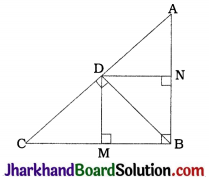
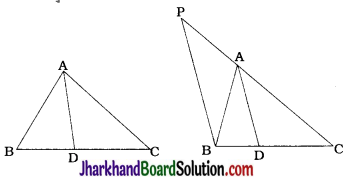
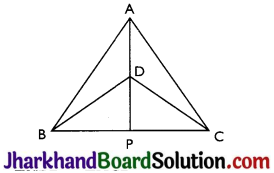
∆ABC and ∆DBC are two isosceles triangles on the same base BC and vertices A and D are on the same side of BC (see Fig). If AD is extended to intersect BC at P, show that
JAC Class 9 Maths Solutions Chapter 7 Triangles Ex 7.3 - 1
(i) ΔABD ≅ ΔACD
(ii) ΔABP ≅ ΔACP
(iii) AP bisects ∠A as well as ∠D.
(iv) AP is the perpendicular bisector of BC.
Answer:
Given: ΔABC and ΔDBC are two isosceles triangles.
Proof: (i) In ΔABD and ΔACD,
AD = AD (Common)
AB = AC (ΔABC is isosceles)
BD = CD (ΔDBC is isosceles)
Therefore, ΔABD ≅ ΔACD by SSS congruence criterion.

(ii) In ΔABP and ΔACP,
AP = AP (Common)
∠PAB = ∠PAC (ΔABD ≅ ΔACD so by CPCT)
AB = AC (ΔABC is isosceles)
Therefore, ΔABP ≅ ΔACP by SAS congruence criterion.

(iii) ∠PAB = ∠PAC by CPCT as ΔABD ≅ ΔACD.
AP bisects ∠A. ………..(i)
Also, in ΔBPD and ΔCPD,
PD = PD (Common)
BD = CD (ΔDBC is isosceles)
BP = CP (ΔABP ≅ ΔACP so by CPCT)
Therefore, ΔBPD ≅ ΔCPD by SSS congruence criterion.
Thus, ∠BDP = ∠CDP by CPCT. …(ii) By (i) and (ii) we can say that AP bisects ∠A as well as ∠D.

(iv) ∠BPD = ∠CPD (by CPCT as ΔBPD = ΔCPD)
and BP = CP …(hi)
Also, ∠BPD + ∠CPD = 180° (BC is a straight line)
⇒ 2∠BPD = 180°
⇒ ∠BPD = 90° …(iv)
From (i) and (ii),
AP is the perpendicular bisector of BC.

JAC Class 9 Maths Solutions Chapter 7 Triangles Ex 7.3

Question 2.
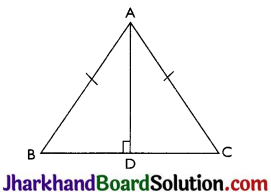
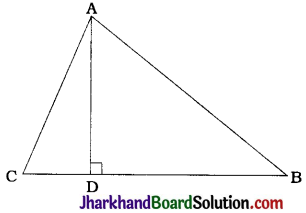
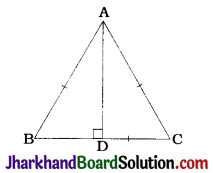
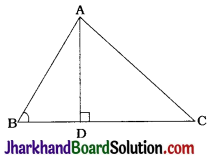
AD is an altitude of an isosceles triangle ABC in which AB = AC. Show that
(i) AD bisects BC
(ii) AD bisects ∠A.
JAC Class 9 Maths Solutions Chapter 7 Triangles Ex 7.3 - 2
Answer:
Proof: (i) In ΔABD and ΔACD,
∠ADB – ∠ADC = 90°
AB = AC (Given)
AD = AD (Common)
Therefore, ΔABD ≅ ΔACD by RHS congruence criterion.
Now,
BD = CD (by CPCT)
Thus, AD bisects BC.

(ii) ∠BAD = ∠CAD (by CPCT)
Thus, AD bisects ∠A.

Question 3.
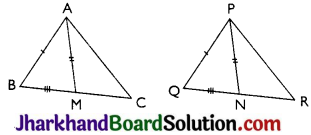
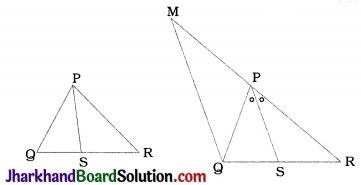
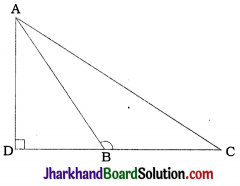
Two sides AB and BC and median AM of one triangle ABC are respectively equal to sides PQ and QR and median PN of ΔPQR (see Fig). Show that:
JAC Class 9 Maths Solutions Chapter 7 Triangles Ex 7.3 - 3
(i) ΔABM ≅ ΔPQN
(ii) ΔABC ≅ ΔPQR
Answer:
Given: AB = PQ, BC = QR and AM = PN
Proof:
(i) \(\frac{1}{2}\) BC = BM and \(\frac{1}{2}\) QR = QN (AM and PN are medians)
BC = QR (Given)
⇒ \(\frac{1}{2}\) BC = \(\frac{1}{2}\) QR
⇒ BM = QN

In ΔABM and ΔPQN,
AM = PN (Given)
AB = PQ (Given)
BM = QN (Proved above)
Therefore, ΔABM ≅ ΔPQN by SSS congruence criterion.

(ii) In ΔABC and ΔPQR,
AB = PQ (Given)
∠ABC = ∠PQR
(AABM = APQN so by CPCT) BC = QR (Given)
Therefore, ΔABC ≅ ΔPQR by SAS congruence criterion.

JAC Class 9 Maths Solutions Chapter 7 Triangles Ex 7.3

Question 4.
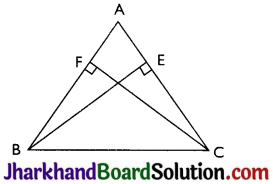
BE and CF are two equal altitudes of a triangle ABC. Using RHS congruence rule, prove that the triangle ABC is isosceles.
JAC Class 9 Maths Solutions Chapter 7 Triangles Ex 7.3 - 4
Ans. Given: BE and CF are two equal altitudes.
Proof: In ABEC and ACFB,
∠BEC = ∠CFB = 90° (Altitudes)
BC = CB (Common)
BE = CF (Given)
Therefore, ΔBEC ≅ ΔCFB by RHS congruence criterion.
Now,
∠C = ∠B (by CPCT)
Thus, AB = AC (sides opposite to the equal angles are equal.)
Therefore, ΔABC is isosceles.

Question 5.
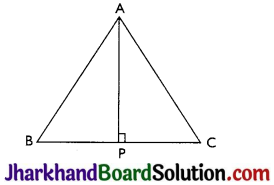
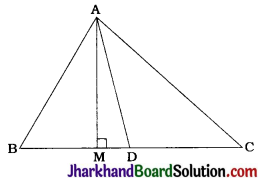
ABC is an isosceles triangle with AB = AC. Draw AP ⊥ BC to show that ∠B = ∠C.
JAC Class 9 Maths Solutions Chapter 7 Triangles Ex 7.3 - 5
Answer:
Given: AB = AC
Proof: In ΔABP and ΔACP,
AB = AC (Given)
AP = AP (Common)
Therefore, ΔABP ≅ ΔACP by RHS congruence criterion.
Thus, ∠B = ∠C (by CPCT)

JAC Class 9 Sanskrit Solutions Shemushi Chapter 2 स्वर्णकाकः

Jharkhand Board JAC Class 9 Sanskrit Solutions Shemushi Chapter 2 स्वर्णकाकः Textbook Exercise Questions and Answers.

JAC Board Class 9th Sanskrit Solutions Shemushi Chapter 2 स्वर्णकाकः

JAC Class 9th Sanskrit स्वर्णकाकः Textbook Questions and Answers

1. (अ) एकपदेन उत्तरं लिखत-(एक शब्द में उत्तर लिखिए-)
(क) माता काम् आदिशत्? (माता ने किसको आदेश दिया?)
उत्तरम् :
पुत्रीम् (बेटी को)।

(ख) स्वर्ण-काकः कान् अखादत्? (सोने का कौवा किन्हें खा गया?)
उत्तरम् :
तण्डुलान् (चावलों को)।

(ग) प्रासादः कीदृशः वर्तते? (महल कैसा है?)
उत्तरम् :
स्वर्णमयः (सोने का)।

JAC Class 9 Sanskrit Solutions Chapter 2 स्वर्णकाकः

(घ) गृहमागत्य तया का समुद्घाटिता? (घर आकर उसने क्या खोली?)
उत्तरम् :
मञ्जूषा (पेटी)।

(ङ) लोभाविष्टा बालिका कीदृशीं मञ्जूषां नयति? (लोभी लड़की कैसी मंजूषा को ले जाती है?)
उत्तरम् :
वृहत्तमाम् (सबसे बड़ी को)।

(आ) अधोलिखितानां प्रश्नानाम् उत्तराणि संस्कृतभाषया लिखत – (निम्नलिखित प्रश्नों के उत्तर संस्कृत भाषा में लिखिए-)
(क) निर्धनायाः वृद्धायाः दुहिता कीदृशी आसीत् ? (निर्धन वृद्धा की पुत्री कैसी थी?)
उत्तरम् :
निर्धनायाः वृद्धायाः दुहिता विनम्रा मनोहरा चासीत्। (निर्धन वृद्धा की पुत्री विनम्र और मनोहर थी।)

(ख) बालिकया पूर्वं कीदृशः काकः न दृष्टमः आसीत्? (बालिका के द्वारा पहले कैसा कौआ नहीं देखा गया था?)
उत्तरम् :
बालिकया पूर्वं स्वर्णपक्षो रजतचञ्चुः स्वर्णकाकः न दृष्टः आसीत्।
(बालिका के द्वारा पहले सोने के पंखों वाला, चाँदी की चोंच वाला सुनहला कौआ नहीं देखा गया था।)

(ग) निर्धनायाः दुहिता मञ्जूषायां कानि अपश्यत्? (निर्धना की पुत्री ने मंजूषा में किन्हें देखा?)
उत्तरम् :
निर्धनायाः दुहिता मञ्जूषायां महार्हाणि हीरकाणि अपश्यत्। (निर्धन की पुत्री ने मंजूषा में महँगे हीरे देखे।)

(घ) बालिका किं दृष्ट्वा आश्चर्यचकिता जाता? (बालिका क्या देखकर आश्चर्यचकित हो गई?)
उत्तरम् :
बालिका वृक्षस्योपरि स्वर्णमयं प्रासादं दृष्ट्वा आश्चर्यचकिता जाता।
(बालिका वृक्ष के ऊपर सोने का महल देखकर आश्चर्यचकित हो गई।)

JAC Class 9 Sanskrit Solutions Chapter 2 स्वर्णकाकः

(ङ) गर्विता बालिका कीदृशं सोपानम् अयाचत् कीदृशं च प्राप्नोत्?
(घमण्डी बालिका ने कैसी सीढ़ी माँगी. और कैसी प्राप्त की?)
उत्तरम् :
गर्विता बालिका स्वर्णमयसोपानम् अयाचत् ताम्रमयं च प्राप्नोत्।
(घमण्डी बालिका ने सोने की सीढ़ी माँगी और ताँबे की प्राप्त की।)

2. (क) अधोलिखितानां शब्दानां विलोमपदं पाठात् चित्वा लिखत –
(निम्नलिखित शब्दों के विलोमपद पाठ से चुनकर लिखिए-)
(i) पश्चात् …………
(ii) हसितुम् …………
(ii) अधः …………
(iv) श्वेतः …………
(v) सूर्यास्तः …………
(vi) सुप्तः …………
उत्तरम् :
शब्दः – विलोमपदम्
(i) पश्चात् – पूर्वम्
(ii) अधः – उपरि
(iii) सूर्यास्तः – सूर्योदयः
(iv) हसितुम् – रोदितुम्
(v) श्वेतः – कृष्णः
(vi) सुप्तः – प्रबुद्धः

(ख) सन्धिं कुरुत (संधि करिए-)
(i) नि + अवसत् ………
(ii) सूर्य + उदयः ……….
(iii) वृक्षस्य + उपरि ……….
(iv) हि + अकारयत् ……….
(v) च + एकाकिनी ……….
(vi) इति + उक्त्वा ……….
(vii) प्रति + अवदत् ……….
(viii) प्र. + उक्तम् ……….
(ix) अत्र + एव ……….
(x) तत्र + उपस्थिता ……….
(xi) यथा + इच्छम् ……….
उत्तरम् :
(i) न्यवसत्
(ii) सूर्योदयः
(iii) वृक्षस्योपरि
(iv) ह्यकारयत्
(v) चैकाकिनी
(vi) इत्युक्त्वा
(vii) प्रत्यवदत्
(viii) प्रोक्तम्
(ix) अत्रैव
(x) तत्रोपस्थिता
(xi) यथेच्छम्।

JAC Class 9 Sanskrit Solutions Chapter 2 स्वर्णकाकः

3. स्थूलपदान्यधिकृत्य प्रश्ननिर्माणं कुरुत –
(मोटे छपे शब्दों को आधार बनाकर प्रश्न निर्माण कीजिए-)
(क) ग्रामे निर्धना स्त्री अवसत्। (गाँव में निर्धन स्त्री रहती थी।)
(ख) स्वर्णकाकं निवारयन्ती बालिका प्रार्थयत्। (सुनहले कौए को रोकती हुई बालिका ने प्रार्थना की।)
(ग) सूर्योदयात् पूर्वमेव बालिका तत्रोपस्थिता। (सूर्योदय से पूर्व ही बालिका वहाँ उपस्थित हो गई।)
(घ) बालिका निर्धनमातुः दुहिता आसीत्। (बालिका गरीब माता की पुत्री थी।)
(ङ) लुब्धा वृद्धा स्वर्णकाकस्य रहस्यमभिज्ञातवती। (लोभी वृद्धा सुनहले कौए के रहस्य को जान गई।)

प्रश्न:-
(क) ग्रामे का अवसत्? (गाँव में कौन रहती थी?)
(ख) कं निवारयन्ती बालिका प्रार्थयत्? (किसे रोकती हुई बालिका ने प्रार्थना की?)
(ग) कस्मात् पूर्वमेव बालिका तत्रोपस्थिता? (किससे पहले ही बालिका वहाँ उपस्थित हो गई?)
(घ) बालिका कस्याः दुहिता आसीत् ? (बालिका किसकी पुत्री थी?)
(ङ) लुब्धा वृद्धा कस्य रहस्यमभिज्ञातवती? (लोभी वृद्धा किसके रहस्य को जान गई?)

4. प्रकृति-प्रत्यय-संयोगं कुरुत-(प्रकृति-प्रत्यय का संयोग कीजिए)
(पाठात् चित्वा वा लिखत) अथवा पाठ में से छाँटकर लिखिए।
(क) वि + लोक् + ल्यप् – ……………….
(ख) नि + क्षिप् + ल्यप् – ………………..
(ग) आ + गम् + ल्यप् – ………………..
(घ) दृश् + क्त्वा – …………..
(ङ) शी + क्त्वा – ………………
(च) लघु + तमप् – …………..
उत्तर :
(क) विलोक्य
(ख) निक्षिप्य
(ग) आगम्य/आगत्य
(घ) दृष्ट्वा
(ङ) शयित्वा
(च) लघुतमम्

JAC Class 9 Sanskrit Solutions Chapter 2 स्वर्णकाकः

5. प्रकृतिप्रत्यय-विभागं कुरुत-(प्रकृति-प्रत्यय को अलग कीजिए)
(क) रोदितुम् – ……………
(ख) दृष्ट्वा – ……………
(ग) विलोक्य – ……………
(घ) निक्षिप्य – ……………
(ङ) आगत्य – ………………
(च) शयित्वा – ……………
(छ) लघुतमम् – ……………
उत्तर :
(क) रुद् + तुमुन्
(ख) दृश् + क्त्वा
(ग) वि + लोक् + ल्यप्
(घ) नि + क्षिप् + ल्यप्
(ङ) आ + गम् + ल्यप्
(च) शी + क्त्वा
(छ) लघु + तमप्

6. अधोलिखितानि कथनानि कः/का, कं/ काम् च कथयति –
(निम्नलिखित कथनों को कौन किससे कहता है-)
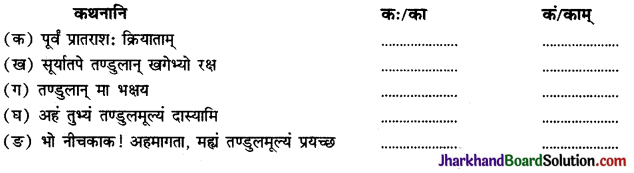
JAC Class 9 Sanskrit Solutions Chapter 2 स्वर्णकाकः 1
उत्तर :
क:/का – कं/काम्
(क) स्वर्णकाकः (सुनहला कौआ) – बालिकाम् (बालिका से)
(ख) निर्धना वृद्धा (निर्धन वृद्धा) – पुत्रीम् (पुत्री से)
(ग) निर्धना बालिका (निर्धन बालिका) स्वर्णकाकम् (सुनहले कौए से)
(घ) स्वर्णकाकः (सुनहला कौआ) – निर्धनां बालिकाम् (निर्धन बालिका से)
(ङ) गर्विता बालिका (घमण्डी बालिका) – स्वर्णकाकम् (सुनहले कौए से)

JAC Class 9 Sanskrit Solutions Chapter 2 स्वर्णकाकः

7. उदाहरणमनुसृत्य कोष्ठकगतेषु पदेषु पञ्चमीविभक्तेः प्रयोगं कृत्वा रिक्तस्थानानि पूरयत –
(उदाहरणानुसार कोष्ठक में दिये गये पदों में पंचमी विभक्ति का प्रयोग कर रिक्त-स्थानों की पूर्ति कीजिए-) यथा – मूषकः बिलाद् बहिः निर्गच्छति। (बिल)
(क) जनः ……………. बहिः आगच्छति। (ग्राम)
(ख) नद्यः …………….. निस्सरन्ति। (पर्वत)
(ग)……………. पत्राणि पतन्ति। (वृक्ष)
(घ) बालकः ……………. विभेति। (सिंह)
(ङ) ईश्वरः…………………त्रायते। (क्लेश)
(च) प्रभुः भक्तं ………….. निवारयति। (पाप)
उत्तर :
(क) ग्रामात्
(ख) पर्वतेभ्यः
(ग) वृक्षात्
(घ) सिंहात्
(ङ) क्लेशात्
(च) पापात्।

JAC Class 9th Sanskrit स्वर्णकाकः Important Questions and Answers

प्रश्न: 1.
ग्रामे का न्यवसत्? (गाँव में कौन रहती थी?)
उत्तरम् :
ग्रामे एका निर्धना वृद्धा स्त्री न्यवसत्। (गाँव में एक गरीब वृद्धा स्त्री रहती थी।)

प्रश्न: 2.
माता किम् अकरोत्? (माता ने क्या किया?)
उत्तरम् :
माता स्थाल्यां तण्डुलान् निक्षिप्य पुत्री तद्रक्षणाय आदिदेश। (माता ने थाली में चावलों को रखकर पुत्री को उनकी रक्षा करने का आदेश दिया।)

JAC Class 9 Sanskrit Solutions Chapter 2 स्वर्णकाकः

प्रश्न: 3.
किञ्चित् कालादनन्तरं किम् अभवत्? (कुछ समय पश्चात् क्या हुआ?)
उत्तरम् :
किञ्चित् कालादनन्तरम् एकः विचित्रः काकः समुड्डीय तामुपजगाम। (कुछ समय पश्चात् एक विचित्र कौआ उड़कर उसके पास आया।)

प्रश्न: 4.
बालिकया कीदृशः काकः पूर्वं न दृष्टः? (बालिका ने कैसा कौआ पहले नहीं देखा था?)
उत्तरम् :
बालिकया स्वर्णपक्षो रजतचञ्चुः स्वर्णकाकः पूर्वं न दृष्टः। (बालिका ने सोने के पंखों वाला चाँदी की चोंच वाला सुनहला कौआ पहले नहीं देखा था।) .

प्रश्न: 5.
बालिका काकं किं प्रार्थयत्? (बालिका ने कौए से क्या प्रार्थना की?)
उत्तरम् :
बालिका काकं प्रार्थयत्-तण्डुलान् मा भक्षय। मदीया माता अतीव निर्धना वर्तते। (बालिका ने कौए से प्रार्थना की-चावलों को मत खाओ। मेरी माता बहुत गरीब है।)

प्रश्न: 6.
किं विलोक्य बालिका रोदितुम् आरब्धा? (क्या देखकर ..लिका ने रोना प्रारम्भ कर दिया?)
उत्तरम् :
काकं तण्डुलान् खादन्तं हसन्तञ्च विलोक्य बालिका रोदितुम् आरब्धा। . (कौए को चावलों को खाते हुए और हँसते हुए देखकर बालिका ने रोना आरम्भ कर दिया।)

प्रश्न: 7.
बालिका (कन्या) ग्रामात बहिः कदा उपस्थिता? (बालिका गाँव से बाहर कब उपस्थित हो गई?)
उत्तरम् :
बालिका सूर्योदयात्पूर्वमेव ग्रामात् बहिः उपस्थिता। (बालिका सूर्योदय से पूर्व ही गाँव से बाहर उपस्थित हो गई।)

JAC Class 9 Sanskrit Solutions Chapter 2 स्वर्णकाकः

प्रश्न: 8.
बालिकां वृक्षस्य अधः दृष्ट्वा काकेन किं कथितम्? (वृक्ष के नीचे बालिका को देखकर कौए ने क्या कहा?)
उत्तरम् :
काकेन कथितम्-हं हो. बाले! त्वमागता, तिष्ठ, अहं त्वत्कृते सोपानमवतारयामि, तत्कथय स्वर्णमयं रजतमयमुत ताम्रमयं वा। (कौए ने कहा-अरे बालिके तुम आ गई, ठहरो, मैं तुम्हारे लिए सीढ़ी उतारता हूँ, तो कहो सोने की या चाँदी की अथवा ताँबे की।)

प्रश्न: 9.
सोपानविषये कन्या काकं किं प्रावोचत? (सीढी के विषय में बालिका ने कौए से क्या कहा?)
उत्तरम् :
कन्या काकं प्रावोचत्-अहं निर्धनमातुर्दुहिता अस्मि। ताम्रसोपानेनैव आगमिष्यामि। (बालिका ने कौए से कहा-मैं निर्धन माता की पुत्री हूँ। ताँबे की सीढ़ी से ही आऊँगी।)

प्रश्न: 10.
श्रान्तां कन्यां विलोक्य काकः किं प्राह? (कन्या को थकी हुई देखकर कौए नें क्या कहा?)
उत्तरम् :
कन्यां श्रान्तां विलोक्य काकः प्राह-पूर्वं लघुप्रातराशः क्रियताम्। (बालिका को थकी हुई देखकर कौआ बोला-पहले थोड़ा-सा सुबह का नाश्ता कर लो।)

प्रश्न: 11.
बालिका स्थाल्याविषये किं व्याजहार? (बालिका ने थाली के विषय में क्या कहा?)
उत्तरम् :
स्थाल्याविषये बालिका व्याजहार-ताम्रस्थाल्यामेवाहं निर्धना भोजनं करिष्यामि। (थाली के विषय में बालिका ने कहा-मैं गरीब हूँ, (इसलिए) ताँबे की थाली में ही भोजन करूँगी।)

JAC Class 9 Sanskrit Solutions Chapter 2 स्वर्णकाकः

प्रश्न: 12.
प्रातराशकाले कन्या कदा आश्चर्यचकिता जाता? (नाश्ते के समय बालिका कब आश्चर्यचकित हो गई?)
उत्तरम् :
कन्या तदा आश्चर्यचकिता सञ्जाता यदा स्वर्णकाकेन स्वर्णस्थाल्यां भोजनं परिवेषितम्। (बालिका तब आश्चर्यचकित हो गई जब सुनहले कौए ने सोने की थाली में भोजन परोसा।)

प्रश्न: 13.
अन्ते काकः किं ब्रूते? (अन्त में कौए ने क्या कहा?)
उत्तरम् :
अन्ते काक: ब्रूते-बालिके! अहम् इच्छामि यत् त्वं सर्वदा अत्रैव तिष्ठ परं तव माता एकाकिनी वर्तते। (अन्त में कौए ने कहा-बालिका! मैं चाहता हूँ कि तुम हमेशा यहीं पर ठहरो लेकिन तुम्हारी माँ अकेली है।)

प्रश्न: 14.
काकः कक्षाभ्यन्तरात् किम् आनयत्? (कौआ कमरे के अन्दर से क्या लाया?)
उत्तरम् :
काकः कक्षाभ्यन्तरात् तिस्रः मञ्जूषाः आनयत्। (कौआ कमरे के अन्दर से तीन सन्दूकें लाया।)

प्रश्न: 15.
मञ्जूषाः निस्सार्य काकः बालिकां किम् अवदत्? (सन्दूकें निकालकर कौए ने बालिका से क्या कहा?)
उत्तरम् :
काकः बालिकाम् अवदत्-बालिके! यथेच्छं गृहाण मञ्जूषामेकाम्। (कौआ बालिका से बोला-बालिका! इच्छानुसार एक सन्दूक ग्रहण करो।)

प्रश्न: 16.
बालिका का मञ्जूषां गृहीतवती? (बालिका ने कौनसा सन्दूक लिया?)
उत्तरम् :
बालिका लघुतमां मञ्जूषां गृहीतवती। (बालिका ने सबसे छोटा सन्दूक लिया।)

JAC Class 9 Sanskrit Solutions Chapter 2 स्वर्णकाकः

प्रश्न: 17.
मञ्जूषां प्रगृह्य बालिकया किं कथितम्? (सन्दूक को लेकर बालिका ने क्या कहा?)
उत्तरम् :
मञ्जूषा प्रगृह्य बालिकया कथितम्-इयत् एव मदीयतण्डुलाना मूल्यम्। (सन्दूक लेकर बालिका ने कहा-इतना ही मेरे चावलों का मूल्य है।)

प्रश्न: 18.
मञ्जूषां समुद्घाट्य बालिका तस्यां किम् अपश्यत्? (सन्दूक को खोलकर बालिका ने उसमें क्या देखा?)
उत्तरम् :
मञ्जूषां समुद्घाट्य बालिका तस्यां महार्हाणि हीरकाणि अपश्यत्। (सन्दूक को खोलकर बालिका ने उसमें बहुमूल्य हीरों को देखा।)

प्रश्न: 19.
अपरा वृद्धा कस्य रहस्यम् अभिज्ञातवती? (दूसरी वृद्धा किसके रहस्य को जान गई?)
उत्तरम् :
अपरा वृद्धा स्वर्णकाकस्य रहस्यम् अभिज्ञातवती। (दूसरी वृद्धा सुनहले कौए के रहस्य को जान गई।)

प्रश्न: 20.
काकः निर्धनायै बालिकायै किं दातुम् अकथयत्? (कौए ने निर्धन बालिका के लिए क्या देने को कहा?)
उत्तरम् :
काकः निर्धनायै बालिकायै तण्डुलमूल्यं दातुम् अकथयत्। (कौए ने निर्धन बालिका के लिए चावलों का मूल्य देने को कहा।)

प्रश्न: 21.
निर्धना कन्या कीदृशं सोपानं अवतारयितुम् अकथयत्? (गरीब कन्या ने कैसी सीढ़ी उतारने को कहा?)
उत्तरम् :
निर्धना कन्या ताम्रसोपानम् अवतारयितुम् अकथयत्। (गरीब कन्या ने ताँबे की सीढ़ी उतारने को कहा।)

प्रश्न: 22.
निर्धनां बालिका काकः कति मञ्जूषाः ग्रहीतुम् अकथयत्? (कौए ने निर्धन बालिका से कितनी सन्दूकें लेने को कहा?)
उत्तरम् :
काकः निर्धनां बालिकाम् एकां मञ्जूषां ग्रहीतुम् अकथयत्। (कौए ने निर्धन बालिका से एक सन्दूक लेने को कहा।) ।

JAC Class 9 Sanskrit Solutions Chapter 2 स्वर्णकाकः

प्रश्न: 23.
लुब्धया बालिकया का मञ्जूषा गृहीता? (लोभी बालिका ने कौन-सी सन्दूक ग्रहण की?)
उत्तरम् :
लुब्धया बालिकया बृहत्तमा मञ्जूषा गृहीता। (लोभी बालिका ने सबसे बड़ी सन्दूक ग्रहण की।)

रेखांकित पदान्यधिकृत्य प्रश्न निर्माणं कुरुत-(रेखांकित पदों के आधार पर प्रश्न निर्माण करिए-)

प्रश्न: 1.
स्वर्णकाकः इति कथायां लोभस्य परिणामो वर्णितः। (स्वर्णकाकः कहानी में लोभ का परिणाम वर्णित है।)
उत्तरम् :
स्वर्णकाकः इति कथायां कस्य परिणामो वर्णित:? (इस कहानी में किसका परिणाम वर्णित है?)

प्रश्न: 2.
दुहिता विनम्रा मनोहरा चासीत्। (बेटी विनम्र और मनोहर थी।)
उत्तरम् :
दुहिता कीदृशी आसीत् ? (बेटी कैसी थी?)

प्रश्न: 3.
स्थाल्यां तण्डुलान् निक्षिप्य पुत्रीम् आदिशत्। (थाली में चावल रखकर बेटी को आदेश दिया।)
उत्तरम् :
स्थाल्यां कान् निक्षिप्य पुत्रीम् आदिशत्? (थाली में किन्हें रखकर बेटी को आदेश दिया।)

प्रश्न: 4.
बालिका रोदितुमारब्धा। (बालिका ने रोना आरम्भ किया।)
उत्तरम् :
का रोदितुमारब्धा? (किसने रोना आरम्भ किया?)

JAC Class 9 Sanskrit Solutions Chapter 2 स्वर्णकाकः

प्रश्नः 5.
सूर्योदयात्पूर्वमेव सा तत्रोपस्थिता। (सूर्योदय से पूर्व ही वह वहाँ उपस्थित हो गई।)
उत्तरम् :
सा तत्र कदा उपस्थिता? (वह वहाँ कब उपस्थित हुई?)

प्रश्न: 6.
सा स्वर्णसोपानेन स्वर्णभवनम् आरोहत। (वह सोने की सीढ़ी से स्वर्ण-भवन पर चढ़ी।)
उत्तरम् :
सा केन स्वर्णभवनम् आरोहत? (वह किससे सोने के भवन पर चढ़ी?)

प्रश्नः 7.
तदा सा आश्चर्यचकिता सजाता? (तब वह आश्चर्यचकित हो गई।)
उत्तरम् :
तदा सा कीदृशी सञ्जाता? (तब वह कैसी हो गई?)

प्रश्नः 8.
स्वर्णकाकेन स्वर्णस्थाल्यां भोजनं परिवेषितम्। (स्वर्ण काक द्वारा सोने की थाली में भोजन परोसा गया।)
उत्तरम् :
स्वर्णकाकेन कस्यां भोजनं परिवेषितम्? (स्वर्ण काक ने किसमें भोजन परोसा?)

प्रश्न: 9.
काकः कक्षाभ्यन्तरात् तिस्त्रः मञ्जूषा निस्सार्य अददात्। (कौए ने कमरे के अन्दर से तीन पेटी निकालकर दी।)
उत्तरम् :
काकः कुतः तिस्त्रः मञ्जूषा निस्सार्य अददात्। (कौए ने कहाँ से तीन पेटी निकालकर दी।)

JAC Class 9 Sanskrit Solutions Chapter 2 स्वर्णकाकः

प्रश्न: 10.
लुब्धया बालिकया लोभस्य फलं प्राप्तम्? (लोभी बालिका द्वारा लोभ का फल प्राप्त किया गया।)
उत्तरम् :
कया लोभस्य फलं प्राप्तम्? (किसके द्वारा लोभ का फल प्राप्त किया गया?)
कथाक्रम-संयोजनम् अधोलिखितवाक्यानि पठित्वा कथाक्रमसंयोजनं कुरुत (निम्नलिखित वाक्यों को पढ़कर कथा-क्रम-संयोजन कीजिए)

  1. ईय॑या सा तस्य स्वर्णकाकस्य रहस्यमभिज्ञातवती।
  2. तस्मिन्नेव ग्रामे एकाऽपरा लुब्धा वृद्धा न्यवसत्।
  3. लघुतमा मञ्जूषां प्रगृह्य बालिकया कथितमियदेव मदीयतण्डुलानां मूल्यम्।
  4. काकः प्राह-पूर्वं लघुप्रातराशः क्रियताम्।
  5. भवने चित्रविचित्रवस्तूनि सज्जितानि दृष्ट्वा सा विस्मयं गता।
  6. सूर्योदयात्पूर्वमेव सा तत्रोपस्थिता।
  7. नैतादृशः स्वर्णपक्षो रजतचञ्चुः स्वर्णकाकस्तया पूर्वं दृष्टः।
  8. तस्याश्चैका दुहिता विनम्रा मनोहरा चासीत्।

उत्तरम् :

  1. तस्याश्चैका दुहिता विनम्रा मनोहरा चासीत्।
  2. नैतादृशः स्वर्णपक्षो रजतचञ्चुः स्वर्णकाकस्तया पूर्वं दृष्टः।
  3. सूर्योदयात्पूर्वमेव सा तत्रोपस्थिता।
  4. भवने चित्रविचित्रवस्तूनि सज्जितानि दृष्ट्वा सा विस्मयं गता।
  5. काकः प्राह-पूर्वं लघुप्रातराशः क्रियताम्।
  6. लघुतमा मञ्जूषां प्रगृह्य बालिकया कथितमियदेव मदीयतण्डुलानां मूल्यम्।
  7. तस्मिन्नेव ग्रामे एकाऽपरा लुब्धा वृद्धा न्यवसत्।
  8. ईय॑या सा तस्य स्वर्णकाकस्य रहस्यमभिज्ञातवती।

भाषिक-विस्तार –

1. किसी भी काम को करके’ इस अर्थ में ‘क्त्वा’ प्रत्यय का प्रयोग किया जाता है। यथा-
पठित्वा – पठ् + क्त्वा = पढ़कर
गत्वा – गम् + क्त्वा = जाकर
खादित्वा – खाद् + क्त्वा = खाकर

JAC Class 9 Sanskrit Solutions Chapter 2 स्वर्णकाकः

इसी अर्थ में अगर धातु (क्रिया) से पहले उपसर्ग होता है तो ल्यप् प्रत्यय का प्रयोग होता है। धातु से पूर्व उपसर्ग होने की स्थिति में कभी भी ‘क्त्वा’ प्रत्यय नहीं हो सकता और उपसर्ग न होने की स्थिति में कभी भी ल्यप् प्रत्यय नहीं हो सकता है। यथा –

उप + गम् + ल्यप् = उपगम्य
सम् + पूज् + ल्यप् = सम्पूज्य
वि + विलोक्य आ + ल्यप् = आदाय
निर् + गम् + ल्यप् = निर्गत्य

2. प्रश्नवाचक शब्दों को अनिश्चयवाचक बनाने के लिए चित् और चन निपातों का प्रयोग किया जाता है। ये निपात जब सर्वनाम पदों के साथ लगते हैं तो सर्वनाम पद होते हैं और जब अव्यय पदों के साथ प्रयुक्त होते हैं तो अव्यय होते हैं।

यथा – कः = कौन
कः + चन = कश्चन = कोई
कः + चित् = कश्चित् = कोई
के + चन = केचन = कोई (बहुवचन में)
के + चित् = केचित् (बहुवचन में)
का + चन = काचन = कोई (स्त्री)
का + चित् = काचित् (कोई स्त्री)
काः + चन = काश्चन = कुछ स्त्रियाँ (बहुवचन में)
काः+ चित् = काश्चित् (कुछ स्त्रियाँ) (बहुवचन में)

JAC Class 9 Sanskrit Solutions Chapter 2 स्वर्णकाकः

“किम्’ शब्द के सभी वचनों, लिंगों व सभी विभक्तियों में ‘चित्’ और ‘चन’ का प्रयोग किया जा सकता है और उसे अनिश्चयवाचक बनाया जा सकता है।

जैसे- (i) किञ्चित्-प्रथमा में
(ii) केनचित्-तृतीया में
(iii) केषाञ्चित् (केषाम् + चित्)-षष्ठी में
(iv) कस्मिंश्चित्-सप्तमी में
(v) कस्याञ्चित्-सप्तमी (स्त्रीलिङ्ग में)

इस तरह ‘चित्’ के स्थान पर ‘चन’ का प्रयोग होता है। ‘चित्’ और ‘चन’ जब अव्यय पदों में लग जाते हैं तो वे अव्यय हो जाते हैं। जैसे- क्वचित्-क्वचन कदाचित्-कदाचन

3. संस्कृत में एक से चतुर् (चार) तक संख्यावाची शब्द पुल्लिङ्ग, स्त्रीलिङ्ग तथा नपुंसकलिङ्ग में अलग-अलग रूपों में होते हैं पर पञ्च (पाँच) से उनका रूप सभी लिङ्गों में एक-सा होता है।

JAC Class 9 Sanskrit Solutions Chapter 2 स्वर्णकाकः 2

स्वर्णकाकः Summary and Translation in Hindi

पाठ परिचयः – प्रस्तुत पाठ श्री पद्मशास्त्री द्वारा विरचित ‘विश्वकथाशतकम्’ नामक कथासंग्रह से लिया गया है। जिसमें विभिन्न देशों की सौ लोक कथाओं का संग्रह है। यह वर्मा देश की श्रेष्ठतम कथाओं में से एक है, जिसमें लोभ और उसके दुष्परिणामों के साथ-साथ त्याग और उसके सुपरिणामों का वर्णन एक ‘सुनहले पंखों वाले कौए’ के माध् यम से किया गया है।

प्राचीन समय में एक गाँव में एक वृद्ध स्त्री रहती थी। उसकी पुत्री विनम्र और सुन्दर थी। एक बार माता ने उससे धूप में रखे चावलों की पक्षियों से रक्षा करने को कहा। कुछ समय पश्चात् एक सुनहले पंखों वाला कौआ उड़ता हुआ वहाँ पहुँचा और चावलों को खाने लगा।

लड़की के मना करने पर उस कौए ने उस लड़की से सूर्योदय से पहले गाँव के बाहर पीपल के पेड़ के नीचे आकर चावलों का मूल्य लेने को कहा। जब सूर्योदय से पहले वह लड़की वहाँ पहुँची तो उस लड़की ने वृक्ष के ऊपर सोने का महल देखा। लड़की की त्याग-भावना से प्रसन्न हुए कौए ने उस लड़की को सोने की सीढ़ी से ऊपर चढ़ाया तथा सोने की थाली में स्वादिष्ट भोजन कराया। लड़की ने कौए द्वारा दी गयी तीन सन्दूकों में से सबसे छोटी सन्दूक को चावलों के मूल्य के रूप में स्वीकार किया। लड़की ने घर पहुँचकर सन्दूक को खोलकर देखा, उस सन्दूक में भरे हीरों को देखकर वह बहुत प्रसन्न हुई और वह उसी दिन से धनिक बन गई।

उसी गाँव की एक लालची स्त्री को जब उस निर्धन लड़की के धनिक बनने का पता चला तो उस लालची स्त्री ने भी अपनी पुत्री से धूप में रखे चावलों की पक्षियों से रक्षा करने को कहा। जब वह सुनहला कौआ वहाँ पहुँचकर चावलों को खाने लगा तो उस कौए को लड़की ने भी उन चावलों को खाने से रोका। कौए ने उस लड़की से भी सूर्योदय से पूर्व ! गाँव के बाहर पीपल के वृक्ष के नीचे आने को कहा। वह लड़की सूर्योदय से पहले वहाँ पहुँचकर कौए की निन्दा करने । लगी और चावलों का मूल्य माँगने लगी।

कौए द्वारा सीढ़ियों की पूछने पर अभिमानी लड़की बोली कि सोने की सीढ़ियों से आऊँगी, परन्तु ‘सुनहले पंखों वाले कौए’ ने उसके लिए ताँबे की सीढ़ी दी। कौए ने उस लड़की को भोजन भी ताम्रपात्र में कराया। कौए द्वारा दी गई तीन पेटियों में से सबसे बड़ी पेटी लेकर वह खुशी-खुशी घर लौटी और जब उस लड़की ने उस पेटी को खोलकर देखा तो भयंकर काले साँप के रूप में अपने लोभ के फल को प्राप्त कर दुःखी हुई। इसके पश्चात् उसने लालच करना छोड़ दिया।

मूलपाठः, शब्दार्थाः, सप्रसंग हिन्दी-अनुवादः, सप्रसंग संस्कृत-व्यारव्याः अवबोधन कार्यम् च । __ 1. पुरा कस्मिंश्चिद् ग्रामे एका निर्धना वृद्धा स्त्री न्यवसत्। तस्याः च एका दुहिता विनम्रा मनोहरा चासीत्। एकदा माता स्थाल्यां तण्डुलान् निक्षिप्य पुत्रीम् आदिशत्। “सूर्यातपे तण्डुलान् खगेभ्यो रक्षा” किञ्चित् कालादनन्तरम् एको विचित्रः काकः समुड्डीय तस्याः समीपम् अगच्छत्।

नैतादृशः स्वर्णपक्षो रजतचञ्चुः स्वर्णकाकस्तया पूर्वं दृष्टः। तं तण्डुलान् खादन्तं हसन्तञ्च विलोक्य बालिका रोदितुमारब्धा। तं निवारयन्ती सा प्रार्थयत्- “तण्डुलान् मा भक्षया मदीया माता अतीव निर्धना वर्तते।” स्वर्णपक्षः काकः प्रोवाच, “मा शुचः। सूर्योदयात्प्राग् ग्रामाद्बहिः पिप्पलवृक्षमनु त्वया आगन्तव्यम्। अहं तुभ्यं तण्डुलमूल्यं दास्यामि।” प्रहर्षिता बालिका निद्रामपि न लेभे।

JAC Class 9 Sanskrit Solutions Chapter 2 स्वर्णकाकः

शब्दार्थाः – पुरा = प्राचीनकाले (प्राचीन समय में), कस्मिंश्चिद् = कस्मिन् चित् (किसी), ग्रामे = वसथे (गाँव में), एका निर्धना = एका दरिद्रा (एक गरीब), स्त्री = वनिता (महिला/स्त्री), न्यवसत् = वसति स्म (रहती थी), तस्याः = (उसकी), एका दुहिता = एका पुत्री (एक पुत्री), विनम्रा = विनयशीला (विनम्र), मनोहरा = हृदयहारिणी (मनोहर), च = और, आसीत् = अवर्तत (थी), एकदा = एकस्मिन् दिवसे (एक बार), माता = जननी (माता ने), स्थाल्याम् = स्थालीपात्रे (थाली में), तण्डुलान् = अक्षतान् (चावलों को), निक्षिप्य = प्रसार्य (फैलाकर/रखकर), पुत्रीम आदिशत् = आदेशमददत् (आदेश दिया), सूर्यातपे = आतपे (धूप में),

तण्डुलान् = अक्षतान् (चावलों को), खगेभ्यः = विहगेभ्यः (पक्षियों से), रक्ष = रक्षणं कुरु (रक्षा करो), किञ्चित् कालादनन्तरम् = ईषत् समयपश्चात् (कुछ समय के पश्चात्), एको विचित्रः काकः = एकः विचित्र: वायसः (एक अजीब कौआ), समुड्डीय = उत्प्लुत्य (उड़कर), तस्याः समीपम् अगच्छत् = ताम् समीपम् आगतवान् (उसके पास पहुँचा), न = मा (नहीं), एतादृशः = एतस्य प्रकारस्य (इस प्रकार का), स्वर्णपक्षः = स्वर्णमये पक्षे यस्य सः (सोने के पंखों वाला), रजतचञ्चुः = रजतमय: चञ्चुः यस्य सः (चाँदी की चोंच वाला), स्वर्णकाकः = स्वर्णस्य वायसः (सोने का कौआ/सुनहला कौआ), तया = (उस (लड़की) के द्वारा),

पूर्वम् = पुरा (पहले), दृष्टः = अपश्यत् (देखा था), तम् = उस (कौए) को), तण्डुलान् = अक्षतान् (चावलों को), खादन्तम् = भक्षयन्तम् (खाते हुए), हसन्तम् = हास्यं कुर्वन्तम् (हँसते हुए), च = और, विलोक्य = दृष्ट्वा (देखकर), बालिका = कन्या (उस लड़की ने), रोदितुम् = विलपितुम् (रोना), आरब्धा = प्रारम्भम् अकरोत् (शुरू कर दिया), तम् = (उस कौए को), निवारयन्ती = वारणं कुर्वन्ती (रोकती हुई), सा = (वह), प्रार्थयत् = न्यवेदयत् (प्रार्थना करने लगी), तण्डुलान् = अक्षतान् (चावलों को), मा = न (नहीं/मत), भक्षय = खाद (खाओ), मदीया = मम (मेरी), माता = जननी (माता), अतीव = अत्यन्तम् (अत्यन्त/अत्यधिक),

निधन = वित्तहीना/दरिद्रा (गरीब), वर्तते = अस्ति (है), स्वर्णपक्षः काकः = स्वर्णमये पक्षे यस्य सः (सोने के पंखों वाला/सुनहला कौआ), प्रोवाच = अकथयत् (कहा), मा शुचः = शोक मा कुरु (शोक मत करो), सूर्योदयात्प्राग् = भानूदयात् पूर्वम् (सूर्योदय से पहले), ग्रामाबहिः = गाँव के बाहर, पिप्पलवृक्षमनु = पिप्पलतरो: अधः (पीपल के पेड़ के नीचे), त्वया = भवत्या (तुम्हारे द्वारा), आगन्तव्यम् = आगच्छेत् (आना चाहिए), अहम् = मैं, तुभ्यम् = ते/भवत्यै (तुम्हारे लिए), तण्डुलमूल्यम् = अक्षतमूल्यम् (चावलों का मूल्य), दास्यामि = अर्पणं करिष्यामि (दूँगा), प्रहर्षिता = प्रसन्ना (खुश हुई), बालिका = कन्या (लड़की ने), निद्रामपि न लेभे = शयनम् अपि न प्राप्तम् अकरोत् (नींद भी नहीं ली/सोई भी नहीं)।

हिन्दी-अनुवादः

सन्दर्भ – प्रस्तुत गद्यांश श्रीपद्मशास्त्री द्वारा रचित ‘विश्वकथाशतकम्’ नामक कथा-संग्रह से उद्धृत ‘स्वर्णकाक:’. नामक पाठ से अवतरित है।

प्रसंग – प्रस्तुत गद्यांश में धूप में रखे बालिका द्वारा रक्षित चावलों को सुनहले कौए द्वारा खाने और चावलों का मूल्य चुकाने के लिए कहने का वर्णन है।

हिन्दी-अनुवाद – प्राचीन समय में किसी गाँव में एक गरीब वृद्ध महिला रहती थी। उसकी एक विनम्र और मनोहर पुत्री थी। एक बार माता ने थाली में चावलों को रखकर पुत्री को आदेश दिया-धूप में रखे चावलों की पक्षियों से रक्षा करना। कुछ समय पश्चात् एक अजीब कौआ उड़कर उसके पास पहुँचा।

इस प्रकार का सोने के पंखों वाला, चाँदी की चोंच वाला सुनहला कौआ उसने पहले नहीं देखा था। उसको चावलों को खाता हुआ और हँसता हुआ देखकर लड़की ने रोना शुरू कर दिया। उसको रोकते हुए वह प्रार्थना करने लगी-चावलों को मत खाओ। मेरी माता बहुत गरीब है। सुनहला कौआ बोला-दुखी मत होओ। तुम सूर्योदय से पहले गाँव के बाहर पीपल के पेड़ के नीचे आना। मैं तुम्हें चावलों का मूल्य दूंगा। खुश (प्रसन्न) हुई लड़की को नींद भी नहीं आई अर्थात् वह सोई भी नहीं।

संस्कत-व्याख्याः

सन्दर्भ: – प्रस्तुतगद्यांशः अस्माकं पाठ्यपुस्तकात् शेमुष्याः ‘स्वर्णकाकः’ नामक पाठात् अवतरितोऽस्ति। प्रस्तुतपाठः श्री पद्मशास्त्रिणा विरचितात् ‘विश्वकथाशतकम्’ नामक कथासंग्रहात् सङ्कलितः अस्ति। (प्रस्तुत गद्यांश हमारी पाठ्यपुस्तक. ‘शेमुषी’ के ‘स्वर्णकाकः’ नामक पाठ से लिया गया है। प्रस्तुत पाठ श्री पद्म शास्त्री द्वारा रचित ‘विश्वकथाशतकम्’ नाम के कथा ग्रन्थ से संकलित है।)

प्रसङ्गः – प्रस्तुतगद्यांशे वर्णितं यदेक: स्वर्णकाकः सूर्यातपे स्थाल्यां स्थितान् बालिकया रक्षितान् अक्षतान् खादति तेषां मूल्यं च प्रदातुं कथयति। (प्रस्तुत गद्यांश में वर्णित है कि एक सोने का कौआ धूप में थाली में रखे चावलों को खाता है और उनका मूल्य चुकाने के लिए कहता है।)

व्याख्याः – प्राचीनकाले कस्मिन् अपि वसथे (ग्रामे) एका दरिद्रा वृद्धा वनिता (स्त्री) वसति स्म। तस्याः एका विनयशीला हृदयहारिणी च पुत्री आसीत्। एकस्मिन् दिवसे जननी स्थाल्यां अक्षतान् प्रसार्य सुतायै आदेशम् अददात् यत् सूर्यातपे अक्षतानां विहगेभ्यः रक्षणं कुरु। ईषत् समयपश्चात् एकः विचित्रवायसः उत्प्लुत्य तस्याः समीपम् आगच्छत् । न तस्य प्रकारस्य हेममयः पक्षः रजतमयः चञ्चुः स्वर्णकाकः एतया पुरा दृष्टः। तम् (स्वर्णकाकम्) अक्षतान् भक्षयन्तम् हास्यं च कुर्वन्तं दृष्ट्वा सा कन्या विलपितुम् आरभत।

काकं वारयन्ती सा न्यवेदयत्- अक्षतान् मा खाद। मम जननी अत्यन्त दरिद्रा अस्ति। हेममयः पक्षः वायसः अकथयत्-शोकं मा कुरु। भानूदयात् पूर्वं ग्रामात् बहिः पिप्पलतरा: अधः भवती आगच्छे। अहं भवत्यै अक्षतमूल्यम् अर्पणं करिष्यामि। प्रसन्ना कन्या शयनम् अपि न प्राप्तम् अकरोत्। (प्राचीनकाल में किरा में एक गरीब बुढ़िया रहती थी। उसकी एक विनम्र, हृदय को हरण करने वाली बेटी थी। एक दिन माता ने थाली में चावलों को फैलाकर पुत्री को आदेश दिया कि सूर्य की धूप तक चावलों की पक्षियों से रक्षा करो।

कुछ समय बाद एक विचित्र कौआ उड़कर उसके पास आया। इस प्रकार का सोने के पंखों वाला और चाँदी की चोंच वाला कौआ इससे पहले नहीं देखा गया। उस (सोने के कौवे) को चावल चुगते हुए और हँसते हुए को देखकर वह कन्या रोने लगी। कौए को रोकती हुई उसने निवेदन किया-“चावलों को मत खाओ। मेरी माता बहुत गरीब है।” सोने की चोंच वाले कौवे ने कहा-“दुखी मत हो। सूरज निकलने से पहले गाँव के बाहर पीपल के नीचे आप आ जाना। मैं आपके लिए चावलों का मूल्य सौंप दूंगा।” खुश हुई कन्या सो भी नहीं पाई।)

JAC Class 9 Sanskrit Solutions Chapter 2 स्वर्णकाकः

अवबोधन कार्यम्

प्रश्न 1.
एकपदेन उत्तरत- (एक शब्द में उत्तर दीजिए-)
(क) बालिका तण्डुलान् केभ्यः रक्षेतु? (बालिका किनसे चावलों की रक्षा करे?)
(ख) ‘तण्डुलान् मा खादय’ इति कोऽवदत्? (‘चावल मत खाओ’ ऐसा किसने कहा?)

प्रश्न 2.
पूर्णवाक्येन उत्तरत – (पूरे वाक्य में उत्तर दीजिए-)
(क) बालिका केन कारणेन रोदितुम् आरब्धा? (बालिका किस कारण से रोई ?)
(ख) कीदृशः काकः बालिकया पूर्वं न दृष्टः? (बालिका ने कैसा कौआ पहले नहीं देखा?)

प्रश्न 3.
यथानिर्देशम् उत्तरत-(निर्देशानुसार उत्तर दीजिए-)
(क) “स्वर्णपक्षी’ इत्यत्र किं पदं विशेषण पदम् ?। (‘स्वर्णपक्षी’ इनमें कौनसा पद विशेषण पद है?)
(ख) ‘धनविहीना’ इति पदस्य समानार्थी गद्यांशात् चित्वा लिखत।
(‘धनविहीना’ इस पद का समानार्थी पद गद्यांश से लिखिए।)
उत्तराणि :
(1) (क) खगेभ्यः। (पक्षियों से)।
(ख) बालिका (लड़की ने)।

(2) (क) तण्डुलान् खादन्तं हसन्तं तं काकम् अवलोक्य बालिका रोदितुम् आरब्धा। (चावलों को खाते हुए हँसते हुए उस कौआ को देखकर लड़की रोने लगी।)
(ख) नैतादृशः स्वर्णपक्षो रजतचञ्चुः स्वर्ण काकस्तया पूर्व दृष्टः। (ऐसा सोने की पंखों और चाँदी की चोंच वाला सोने का कौए उसने पहले नहीं देखा था।)

(3) (क) स्वर्ण (सोना)।
(ख) निर्धना (गरीब)।

2. सूर्योदयात्पूर्वमेव सा तत्रोपस्थिता। वृक्षस्योपरि विलोक्य सा च आश्चर्यचकिता सञ्जाता यत् तत्र स्वर्णमयः प्रासादो वर्तते। यदा काकः शयित्वा प्रबुद्धस्तदा तेन स्वर्णगवाक्षात्कथितं “हहो बाले! त्वमागता, तिष्ठ, अहं त्वत्कृते सोपानमवतारयामि, तत्कथय स्वर्णमयं रजतमयम् ताम्रमयं वा”? कन्या अवदत् “अहं निर्धनमातुः दुहिता अस्मि। ताम्रसोपानेनैव आगमिष्यामि।” परं स्वर्णसोपानेन सा स्वर्ण-भवनम् आरोहता।

शब्दार्थाः – सूर्योदयात्यूर्वमेव = भानूदयात् प्राग् एव (सूर्योदय से पहले ही), सा = (वह (बालिका)), तत्रोपस्थिता = तस्मिन् स्थाने सन्निहिता (वहाँ उपस्थित हो गयी), वृक्षस्योपरि = तरोः उपरि (पेड़ के ऊपर), विलोक्य = दृष्ट्वा (देखकर), सा = (वह), च = (और), आश्चर्यचकिता = विस्मिता (आश्चर्यचकित), सञ्जाता = अभवत् (हो गयी), यत् = (कि), तत्र = तस्मिन् स्थाने (उस जगह/वहाँ) स्वर्णमयः = हेममयः (सोने का), प्रासादः = राजमन्दिरम् (महल), वर्तते = अस्ति (है), यदा = यस्मिन् समये (जब),

काकः = वायसः (कौआ), शयित्वा = शयनं कृत्वा (सोकर), प्रबुद्धः = जागरणम् अकरोत् (जागा), तदा = तस्मिन् समये (तब), तेन = काकेन (उस कौए ने), स्वर्णगवाक्षात् = हेममयवातायनात् (सोने की खिड़की से), कथितं = अकथयत् (कहा), हं हो बाले! = भो बाले (अरे बालिका), त्वमागता = भवती आगता (तुम आ गई हो), तिष्ठ = स्थिरा भव (ठहरो), अहम् = मैं, त्वत्कृते = तुभ्यम् (तुम्हारे लिए), सोपानम् = (सीढ़ी), अवतारयामि = अवतीर्णं करोमि (उतारता हूँ), तत्कथय = तु वद (तो बोलो),

स्वर्णमयं = हेममयं (सोने से बनी, सोने की), रजतमयं = रूप्यमयं (चाँदी से बनी, चाँदी की), वा = (अथवा), ताम्रमयं = लोहितायसमयं (ताँबे से बनी, ताँबे की), कन्या = बालिका (लड़की), अवदत् = प्रावोचत् (बोली), अहं निर्धनमातुः = अहं दरिद्रायाः जनन्याः (मैं निर्धन/गरीब माँ, ताम्रसोपानेनैव = लोहितायसेन निर्मितेन सोपानेन एव (ताँबे की बनी सीढ़ी से ही), आगमिष्यामि = आगमनं करिष्यामि (आऊँगी), परं = परञ्च (लेकिन), स्वर्णसोपानेन = हेमनिर्मितसोपानेन (सोने की सीढ़ी से), स्वर्णभवनम् = हेममयं भवनम् (सोने के महल को), सा = (वह), आरोहत = आरूढवती

JAC Class 9 Sanskrit Solutions Chapter 2 स्वर्णकाकः

हिन्दी-अनुवादः

सन्दर्भ – प्रस्तुत गद्यांश श्री पद्मशास्त्री द्वारा रचित ‘विश्वकथाशतकम्’ नामक कथा-संग्रह से उद्धृत ‘स्वर्णकाकः’ नामक पाठ से अवतरित है।

प्रसंग – प्रस्तुत गद्यांश में बालिका के सूर्योदय से पहले ही गाँव के बाहर पीपल के पेड़ के नीचे पहुँचकर पेड़ के ऊपर सोने के महल को देखकर आश्चर्यचकित होने एवं सोने की सीढ़ियों से स्वर्णमहल में पहुँचने का वर्णन है।

हिन्दी-अनुवाद – सूर्योदय से पहले ही वह (लड़की) वहाँ आ गयी। पेड़ के ऊपर देखकर वह आश्चर्यचकित हो गयी क्योंकि वहाँ सोने का महल था। जब कौआ सोकर जागा तब उसने सोने की खिड़की में से (झाँककर) कहा-अरे लड़की! तुम आ गयी हो, ठहरो, मैं तुम्हारे लिए सीढ़ी उतारता हूँ, तो कहो सोने से बनी (सोने की), चाँदी से बनी (चाँदी की) अथवा ताँबे से बनी (ताँबे की)? लड़की बोली-मैं गरीब माता की बेटी हूँ। ताँबे की बनी सीढ़ी से ही आऊँगी। लेकिन सोने की सीढ़ी से वह सोने के महल में पहुँची।

संस्कत-व्याख्याः

सन्दर्भः – प्रस्तुतगद्यांश अस्माकं पाठ्यपुस्तकात् शेमुष्याः ‘स्वर्णकाकः’ पाठात् उद्धृतः। पाठोऽयं श्री पद्मशास्त्रिणा विरचितात् ‘विश्वकथाशतकम्’ इति कथासंग्रहात् संकलितो वर्तते। (प्रस्तुत गद्यांश हमारी पाठ्यपुस्तक शेमुषी से ‘स्वर्णकाकः’ पाठ से उद्धृत है। यह पाठ श्री पद्म शास्त्री द्वारा रचित ‘विश्वकथाशतकम्’ कथा-संग्रह से सङ्कलित है।)

प्रसङ्गः – गद्यांशोऽयम् वर्णयति यत् बालिका काकेन निर्दिष्टस्थानम् अगच्छत्, तत्र च गत्वा सा वृक्षस्योपरि स्वर्णमयप्रासादं दृष्ट्वा विस्मिता जाता। (यह गद्यांश वर्णन करता है कि लड़की कौवा द्वारा बताये गये स्थान पर गई और वहाँ जाकर वह वृक्ष के ऊपर सोने के महल को देखकर आश्चर्यचकित हो गई।)

व्याख्याः – सा बालिका भानूदयात् प्राग् एव काकेन निर्दिष्ट स्थानं आगच्छत् । वृक्षस्य उपरि दृष्ट्वा सा विस्मिता अभवत् यत् तत्र हेममयं प्रासादम् आसीत्। यदा काकः शयनं कृत्वा जागरणम् अकरोत् तदा स हेममयात् वातायनात् अकथयत्-हे बाले! त्वम् आगतवती, स्थिरा भव अहं तुभ्यं सोपानम् अवतीर्णं करोमि, कथय तु हेममयं सोपानं रजतमयं ताम्रमयं वा? बालिका अवदत् यदहं दरिद्रायाः जनन्याः पुत्री अस्मि, ताम्रमयेन एव सोपानेन आगमिष्यामि। परञ्च सा हेममयेन सोपानेन हेममयं प्रासादं प्राप्तम् अकरोत्। (वह लड़की सूरज उगने से पहले ही कौआ द्वारा बताये हुए स्थान पर पहुँच गई।

पेड़ के ऊपर देखकर वह आश्चर्यचकित हो गई कि वहाँ सोने का महल था। जब कौआ सोकर जागा तब उसने सोने की खिड़की से कहा-‘हे बालिका तुम आ गई, ठहरो, मैं तुम्हारे लिए सीढ़ी उतारता हूँ, कहो तो सोने की, चाँदी की या ताँबे की?” लड़की बोली कि “मैं गरीब माँ की बेटी हूँ, ताँबे की सीढ़ी से ही आ जाऊँगी। परन्तु वह सोने की सीढ़ी से ही सोने के महल पर पहुँची।)

अवबोधन कार्यम्

प्रश्न 1.
एकपदेन उत्तरत – (एक शब्द में उत्तर दीजिए-)
(क) बालिका तत्र कदा उपस्थिता? (बालिका कहाँ कब उपस्थित हो गई?)
(ख) काकस्य प्रासादः कुत्र आसीत् ? (कौवे का महल कहाँ था?)

JAC Class 9 Sanskrit Solutions Chapter 2 स्वर्णकाकः

प्रश्न 2.
पूर्णवाक्येन उत्तरत – (पूरे वाक्य में उत्तर दीजिए-)
(क) बालिका कस्मात् आश्चर्यचकिता सञ्जाता? (बालिका किसलिए आश्चर्यचकित हो गई?)
(ख) कन्या काकं किम् अवदत्? (कन्या ने कौवे से क्या कहा?)

प्रश्न 3.
यथानिर्देशम् उत्तरत-(निर्देशानुसार उत्तर दीजिए-)
(क) ‘विलोक्य’ इति पदे प्रत्ययं लिखत। (‘विलोक्य’ पद में प्रत्यय लिखिए।)
(ख) ‘स्वर्णमयः प्रासादः वर्तते’ एतेषु वाक्येषु विशेषणं विशेष्यं च पदम् निर्दिशत।
(यहाँ विशेषण और विशेष्य पदों का निर्देश कीजिए।)
उत्तराणि :
(1) (क) सूर्योदयात्पूर्वम् (सूर्य निकलने से पहले)।
(ख) वृक्षस्योपरि। (वृक्ष के ऊपर)।

(2) (क) वृक्षस्योपरि स्वर्णमयं प्रासादम् अवलोक्य आश्चर्यचकिता सञ्जाता। (वृक्ष के ऊपर सोने के महल को
देखकर आश्चर्यचकित हो गई।)
(ख) अहं निर्धनमातुः दुहिता अस्मि ताम्र सोपानेनैव आगमिष्यामि। (मैं गरीब माँ की बेटी हूँ। ताँबे की सीढ़ी से ही आ जाऊँगी।)

(3) (क) ल्यप्।
(ख) विशेषणम्-स्वर्णमयः, विशेष्यं च-प्रासादः।

3. चिरकालं भवने चित्रविचित्रवस्तूनि सज्जितानि दृष्ट्वा सा विस्मयं गता। श्रान्तां तां विलोक्य काकः अवदत्-“पूर्वं लघुप्रातराशः क्रियताम्-वद त्वं स्वर्णस्थाल्यां भोजनं करिष्यसि किं वा रजतस्थाल्याम् उत ताम्रस्थाल्याम्”? बालिका अवदत्- ताम्रस्थाल्याम् एव अहं – “निर्धना भोजनं करिष्यामि।” तदा सा आश्चर्यचकिता सञ्जाता यदा स्वर्णकाकेन स्वर्णस्थाल्यां भोजनं “परिवेषितम्।” न एतादृशम् स्वादु भोजनमद्यावधि बालिका खादितवती। काकोऽवदत्- बालिके! अहमिच्छामि यत् त्वम् सर्वदा अत्रैव तिष्ठ परं तव माता तु एकाकिनी वर्तते। अत: “त्वं शीघ्रमेव स्वगृहं गच्छ।”

शब्दार्थाः – चिरकालम् = बहुकालं यावत् (बहुत देर तक), भवने = प्रासादे (महल में), चित्रविचित्रवस्तूनि = अद्भुतानि वस्तूनि (अद्भुत वस्तुओं को), सज्जितानि = अलंकृतानि (सजी हुई), दृष्ट्वा = विलोक्य (देखकर), सा = (वह), विस्मितम् = आश्चर्यचकितम् (आश्चर्यचकित), गता = सञ्जाता (हुई), श्रान्ताम् = क्लान्तां (थकी हुई), ताम् = (उसे), विलोक्य = दृष्ट्वा (देखकर), काकः = वायसः (कौआ),

अवदत् = प्राह (बोला), पूर्वम् = प्राग् (पहले), लघुप्रातराशः = लघुकल्यवर्तः (थोड़ा सुबह का नाश्ता), क्रियताम् = करोतु (करो), वद = कथय (बोलो), त्वम् = (तुम), स्वर्णस्थाल्याम् = स्वर्णेन निर्मितस्थाल्यां (सोने की थाली में), भोजनम् = अशनम् (भोजन), करिष्यसि = (करोगी), किं वा = अथवा (अथवा), रजतस्थाल्याम् = रूप्येन निर्मितस्थाल्यां (चाँदी की थाली में), अकथयत् = व्याजहार (कहा), ताम्रस्थाल्याम् = लोहितायसेन निर्मितस्थाल्यां (ताँबे की थाली में), एव = निश्चयेन (ही), अहम् = मैं, निर्धना = दरिद्रा (निर्धन), भोजनम् = अशनम् (भोजन), करिष्यामि = (करूँगी), तदा = तस्मिन् समये (तब), सा = वह (लड़की), आश्चर्यचकिता = विस्मिता (आश्चर्यचकित),

सजाता = गता (हो गई), यदा = यस्मिन् काले (जब), स्वर्णकाकेन = हेमवायसेन (सुनहले कौए ने), स्वर्णस्थाल्याम् = स्वर्णेन निर्मितस्थाल्यां (सोने की थाली में), भोजनम् = अशनम् (भोजन), परिवेषितम् = पर्यवेषणं कृतम् (परोसा), न = मा (नहीं), एतादृशम् = ईदृशं (ऐसा), स्वादु = स्वादिष्टम् (स्वादिष्ट), भोजनम् = अशनं (भोजन), अद्यावधि = वर्तमानं दिनं यावत् (आज तक), बालिका = सा कन्या (उस लड़की ने), खादितवती = भक्षितवती (खाया था),

काकः = वायसः (कौआ), अवदत् = ब्रूते (बोला), बालिके = कन्ये (बालिका), अहमिच्छामि = अहमभिलषामि (मैं चाहता हूँ), यता = कि, त्वम् = (तुम), सर्वदा = सर्वस्मिन् काले (हमेशा), अत्रैव = एतस्मिन् स्थाने एव (यहीं), तिष्ठ = वासं कुरु (रहो), परम् = परञ्च (लेकिन), तव = ते (तुम्हारी), माता = जननी (माता), वर्तते = अस्ति (है), एकाकिनी = एकला (अकेली), वम् = (तुम), शीघ्रमेव = द्रुतमेव (शीघ्र ही), स्वगृहम् = स्वगेहं (अपने घर), गच्छ = गमनं कुरु (जाओ)।

JAC Class 9 Sanskrit Solutions Chapter 2 स्वर्णकाकः

हिन्दी-अनुवादः

सन्दर्भ – प्रस्तुत गद्यांश हमारी पाठ्यपुस्तक ‘शेमुषी’ के ‘स्वर्णकाकः’ नामक पाठ से उद्धृत है। यह पाठ श्री . । . पद्मशास्त्री द्वारा रचित ‘विश्वकथाशतकम्’ नामक कथा-संग्रह से संकलित है।।

प्रसंग – यहाँ वर्णन है कि सोने के महल में सुनहले कौए ने बालिका के साथ कैसा व्यवहार किया।

हिन्दी-अनुवाद – बहुत देर तक महल में अत्यन्त अदभुत वस्तुओं को सजी हुई देखकर वह आश्चर्यचकित हो गयी। उसे थकी हुई देखकर कौआ उससे बोला कि पहले आप थोड़ा-सा सुबह का नाश्ता कर लो, बोलो तो सोने की थाली में भोजन करोगी अथवा चाँदी की थाली में या ताँबे की थाली में ? लड़की बोली कि मैं गरीब हूँ, मैं तो ताँबे की थाली में ही भोजन करूँगी। तब वह आश्चर्यचकित हो गयी जब सुनहले कौए ने उसे सोने की थाली में भोजन परोसा। लड़की ने ऐसा स्वादिष्ट भोजन आज तक नहीं खाया था। कौआ उससे बोला कि मैं चाहता हूँ कि तुम हमेशा यहीं रहो लेकिन तुम्हारी माता अकेली हैं। अतः तुम जल्दी ही अपने घर जाओ।

संस्कत-व्याख्याः

सन्दर्भ: – प्रस्तुतः गद्यांशः अस्माकं पाठ्यपुस्तकात् शेमुष्याः ‘स्वर्णकाकः’ पाठात् उद्धृतः। पाठोऽयं श्रीपद्मशास्त्रिणा विरचितात् ‘विश्वकथाशतकम्’ इति कथासंग्रहात् सङ्कलितो वर्तते। (प्रस्तुत गद्यांश हमारी पाठ्यपुस्तक ‘शेमुषी’ के स्वर्णकाकः’ पाठ से उद्धृत है। यह पाठ श्रीपद्मशास्त्री-रचित ‘विश्वकथाशतकम्’ से संकलित है।)

प्रसंग: – वर्णितमत्र यत् स्वर्णकाक: स्वप्रासादे बालिकया सह कीदृशं व्यवहारम् अकरोत्। (इसमें बालिका के साथ कौआ के सद्व्यवहार का वर्णन किया गया है।)

व्याख्या: – बहकालं यावत् स्वर्णप्रासादे अलङ्कृतानि अति अद्भुतवस्तुनि विलोक्य सा आश्चर्यचकिता अभवत्। तां क्लान्तां दृष्ट्वा काकः तामवदत् यत् पूर्वं भवती लघुकल्यवर्तं करोतु, कथय तु स्वर्णमयस्थाल्यां, रजतमयस्थाल्यां ताम्रमयस्थाल्यां वा भोजनं करिष्यसि। बालिका अवदत् यदहं निर्धना अस्मि, अहं तु ताम्रमयस्थाल्यामेव अशनं करिष्यामि। यदा स्वर्णकाकः तस्यै स्वर्णमयस्थाल्यां भोजनम् अददात्। तदा सा चकिता अभवत्। बालिका ईदृशं स्वादिष्टभोजनं वर्तमानं दिनं यावत् न अखादत्। काकः तामवदत् यदहम् अभिलषामि यत् त्वम् सदा अत्रैव वासं कुरु परं तव माता एकला अस्ति। अतः त्वं शीघ्रम् एव स्वगृहं गच्छ।

(बहुत देर तक सोने के महल में सजी हुई अनोखी वस्तुओं को देखकर वह आश्चर्यचकित हो गई। उसे थका हुआ देखकर उससे कौआ बोला कि पहले आप थोड़ा कलेवा कर लो, बोलो तुम सोने की थाली में, चाँदी की थाली में या ताँबे की थाली में भोजन करोगी। बालिका बोली कि मैं गरीब हूँ, मैं तो ताँबे की थाली में ही खाना खाऊँगी (भोजन करूँगी)। जब सोने का कौवा उसके लिए सोने की थाली में भोजन लाया तो वह चकित हो गई। लड़की ने ऐसा स्वादिष्ट भोजन आज तक नहीं खाया। कौआ उससे बोला कि मैं चाहता हूँ कि तुम सदा यहाँ ही रहो परन्तु तुम्हारी माता अकेली हैं। अतः तुम शीघ्र ही अपने घर चली जाओ।)

JAC Class 9 Sanskrit Solutions Chapter 2 स्वर्णकाकः

अवबोधन कार्यम्

प्रश्न 1.
एकपदेन उत्तरत- (एक शब्द में उत्तर दीजिए-)
(क) कानि दृष्ट्वा बालिका विस्मयं गता? (किन्हें देखकर बालिका आश्चर्य करने लगी?) ।
(ख) स्वर्णकाकेन तस्मै कस्यां भोजनं पर्यवेषितम् ? (सोने के कौवे ने कैसी थाली में उसे भोजन परोसा?)

प्रश्न 2.
पूर्णवाक्येन उत्तरत- (पूरे वाक्य में उत्तर दीजिए-)
(क) काक: बालिका कस्मात् न वारयति स्म? (कौवे ने बालिका को क्यों नहीं रोका?)
(ख) श्रान्तां बालिकाम् अवलोक्य काकः किं कर्तुम् अवदत् ? (थकी बालिका को देखकर कौवे ने क्या करने के लिए कहा?)

प्रश्न 3.
यथानिर्देशम् उत्तरत-(निर्देशानुसार उत्तर दीजिए-)
(क) ‘दृष्ट्वा सा विस्मयं गता’ अत्र सा इति सर्वनाम पदं कस्मै प्रयुक्तम्? (‘दृष्ट्वा सा विस्मयं गता’ यहाँ ‘सा’ सर्वनाम पद किसके लिए प्रयोग हुआ है?)
(ख) ‘त्वं शीघ्रमेव स्वगृहं गच्छ’ इति कः कम् अकथयत् ? (‘तुम शीघ्र अपने घर जाओ’ यह किसने किससे
कहा?)
उत्तराणि :
(1) (क) चित्रविचित्र वस्तूनि (रंग-बिरंगी अद्भुत वस्तुओं को)।
(ख) स्वर्णस्थाल्याम् (सोने की थाली में)।

(2) (क) यतः तस्य माता गृहे एकाकिनी अस्ति। (क्योंकि उसकी माँ घर पर अकेली है।) श्रान्तां बालिका अवलोक्य काकः लघुप्रातराशं कर्तुम् अवदत्। (थकी बालिका को देखकर कौवे ने थोड़ा कलेवा करने के लिए कहा।)

(3) (क) बालिकायै (बालिका के लिए।)
(ख) काकः बालिकाम् अकथयत्। (कौवे ने बालिका से कहा।)

JAC Class 9 Sanskrit Solutions Chapter 2 स्वर्णकाकः

4. इत्युक्त्वा काकः कक्षाभ्यन्तरात् तिम्रः मञ्जूषाः निस्सार्य तां प्रत्यवदत्- “बालिके! यथेच्छं गृहाण मञ्जूषामेकाम्।” लघुतमा मञ्जूषां प्रगृह्य बालिकया कथितम् इयत् एत्र मदीयतण्डुलानां मूल्यम्।
गृहमागत्य तया मञ्जूषा समुद्घाटिता, तस्यां महार्हाणि हीरकाणि विलोक्य सा प्रहर्षिता तद्दिनाद्धनिका च सजाता।

शब्दार्थाः – इत्युक्त्वा = एवं कथयित्वा (ऐसा कहकर), काकः = वायसः (कौए ने), कक्षाभ्यन्तरात् = कोष्ठस्य गर्भात् (कमरे के अन्दर से), तिस्त्रः = तीन, मञ्जूषाः = पेटिकाः (पेटियाँ), निस्सार्य = निष्कासनं कृत्वा (निकालकर), ताम् = उससे, लड़की से, प्रत्यवदत् = अकथयत् (कहा), बालिके = कन्ये (बाला), यथेच्छम् = इच्छानुसारेण (अपनी इच्छा के अनुसार), गृहाण = ग्रहणं कुरु (ले लो), मञ्जूषामेकाम् = एकां पेटिकां (एक पेटी), लघुतमाम् = क्षुद्रतमा (सबसे स्वकाकः छोटी), मञ्जूषाम् = पेटिकां (पेटी को),

प्रगृह्य = ग्रहणं कृत्वा (लेकर), बालिकया = कन्यया (बालिका द्वारा), कथितम् = उक्तम् (कहा गया), इयत् एव = एतन्मात्रम् एव (इतना ही), मदीय = मम (मेरे), तण्डुलानाम् = अक्षतानां (चावलों का), मूल्यम् = अर्घम् (कीमत/मूल्य), गृहमागत्य = सदनमागत्य (घर आकर), तया = (उसके द्वारा), मञ्जूषा = पेटिका (पेटी), समुद्घाटिता = भेदनं कृतं (खोली गई), तस्याम् = (उसमें), महार्हाणि = बहुमूल्यानि (बहुमूल्य), हीरकाणि – रत्नमुख्यानि (हीरों को), विलोक्य = दृष्ट्वा (देखकर), सा = (वह), प्रहर्षिता = आनन्दिता अभवत् (आनन्दित हुई), तदिनाद्धनिका = तस्मात् वासरात् धनिका (उसी दिन से धनवती), सजाता = अभवत् (हो गई)।

हिन्दी-अनुवादः

सन्दर्भ – प्रस्तुत गद्यांश हमारी पाठ्य-पुस्तक ‘शेमुषी’ के ‘स्वर्णकाकः’ नामक पाठ से उद्धृत है। यह पाठ श्री। पद्मशास्त्री द्वारा रचित ‘विश्वकथाशतकम्’ नामक कथा-संग्रह से संकलित है।

प्रसंग – यहाँ लड़की के लोभरहित होने तथा कौए की उसके प्रति उदारता का वर्णन है।

हिन्दी-अनुवाद – ऐसा कहकर कौए ने कमरे के अन्दर से तीन पेटियाँ (सन्दूकें) निकालकर उससे कहा-बालिका! अपनी इच्छानुसार एक सन्दूक ले लो। सबसे छोटी सन्दूक लेकर लड़की ने कहा-यह ही मेरे चावलों का मूल्य है। घर आकर उसने सन्दूक खोला, उसमें (सन्दूक में) बहुमूल्य हीरों को देखकर वह प्रसन्न हो गयी और उसी दिन से धनिक हो गई।

संस्कत-व्यारव्याः

सन्दर्भ: – प्रस्तुतगद्यांशः अस्माकं पाठ्यपुस्तकात् शेमुष्या: ‘स्वर्णकाकः’ पाठात् उद्धृतः। पाठोऽयं श्रीपद्मशास्त्रिणा विरचितात् ‘विश्वकथाशतकम् इति कथासंग्रहात् संकलितो वर्तते। (प्रस्तुत गद्यांश हमारी पाठ्यपुस्तक ‘शेमुषी’ से ‘स्वर्णकाकः’ पाठ से लिया गया है। यह पाठ श्री पद्मशास्त्री-रचित ‘विश्वकथाशतकम्’ कथा-संग्रह से संकलित है।)

प्रसंग: – गद्यांशोऽयं वर्णयति बालिकायाः लोभराहित्यं काकस्य च तां प्रति औदार्यम्। (यह गद्यांश बालिका की । लोभहीनता तथा कौए की उसके प्रति उदारता का वर्णन करता है।)

व्याख्या: – एवं कथयित्वा काकः कोष्ठस्य गर्भात् तिस्रः पेटिकाः बहिः आनीय तां (बालिकाम्) अवदत्-हे बालिके! स्वेच्छया एकां पेटिकां गृहाण। बालिका क्षुद्रतमां पेटिकां गृहीत्वा अवदत्-एतन्मात्रम् मम अक्षतानां अर्घम् अस्ति। गृहम् आगत्य सा पेटिकाम् उद्घाटयत्। तस्यां बहुमूल्यानि हीरकाणि दृष्ट्वा सा प्रसन्ना अभवत्। तस्मात् वासरात् च धनवती अभवत्। (इस प्रकार कहकर कौआ ने कोटर से तीन पेटियाँ लाकर उस बालिका से कहा-हे बालिके! अपनी इच्छा से एक पेटी ले लो। बालिका ने सबसे छोटी पेटी को लेकर कहा-‘इतना ही मेरे चावलों का मूल्य है।’ घर आकर उसने पेटी को खोला। उसमें बहुमूल्य हीरों को देखकर वह प्रसन्न हो गई। उसी दिन से वह धनवाली (धनाढ्य) हो गई।)

JAC Class 9 Sanskrit Solutions Chapter 2 स्वर्णकाकः

अवबोधन कार्यम्

प्रश्न 1.
एकपदेन उत्तरत- (एक शब्द में उत्तर दीजिए-)
(क) काकः कति मञ्जूषाः आनयत? (कौवा कितनी पेटियाँ लाया?)
(ख) बालिका कीदृशी मञ्जूषां गृहीतवती? (बालिका ने कैसी पेटी ली?)

प्रश्न 2.
पूर्णवाक्येन उत्तरत- (पूरे वाक्य में उत्तर दीजिए-)
(क) मञ्जूषायां कानि आसीत्? (कितनी मंजूषाएँ थीं ?)
(ख) मञ्जूषां प्रगृह्य बालिका किमवदत् ? (पेटी को पाकर लड़की ने क्या कहा?)

प्रश्न 3.
यथानिर्देशम् उत्तरत-(निर्देशानुसार उत्तर दीजिए-)
(क) ‘तां प्रत्यवदत्’ अत्र ‘ताम्’ इति सर्वनाम पदं कस्य स्थाने प्रयुक्तम्? (तां प्रत्यवदत् यहाँ ‘ताम्’ सर्वनाम किसके लिए प्रयोग हुआ है?)
(ख) गद्यांशात् ‘पेटिका’ इति पदस्य पर्यायं चित्वा लिखत। (गद्यांश से ‘पेटिका’ का पर्यायवाची लिखिए।)
उत्तराणि :
(1) (क) तिस्रः (तीन)।
(ख) लघुतमाम् (सबसे छोटी को)।

(2) (क) मञ्जूषायां बहुमूल्यानि हीरकाणि आसन्। (मंजूषा में महँगे हीरे थे।)
(ख) तया कथतम् इयम् मे तण्डुलानां मूल्यम्। (यह मेरे चावलों की कीमत है, ऐसा उसने कहा।)

(3) (क) बालिकाम् (बालिका को)।
(ख) मञ्जूषा (पेटी)।

5. तस्मिन्नेव ग्रामे एका अपरा लुब्धा वृद्धा न्यवसत्। तस्या अपि एका पुत्री आसीत्। ईर्ष्णया सा तस्य स्वर्णकाकस्य रहस्यम् ज्ञातवती। सूर्यातपे तण्डुलान् निक्षिप्य तयापि स्वसुता रक्षार्थं नियुक्ता। तथैव स्वर्णपक्षः काकः तण्डुलान् भक्षयन् तामपि तत्रैवाकारयत्। प्रातस्तत्र गत्वा सा काकं निर्भयन्ती प्रावोचत्-“भो नीचकाक! अहमागता, मां तण्डुलमूल्यं प्रयच्छ।” काकोऽब्रवीत्-“अहं त्वत्कृते सोपानम् अवतारयामि। तत्कथय स्वर्णमयं रजतमयं ताम्रमयं वा।” गर्वितया बालिकया प्रोक्तम्-“स्वर्णमयेन सोपानेन अहम् आगच्छामि।” परं स्वर्णकाकस्तत्कृते ताम्रमयं सोपानमेव प्रायच्छत्। स्वर्णकाकस्तां भोजनमपि ताम्रभाजने एव अकारयत्।

शब्दार्थाः – तस्मिन् एव ग्रामे = अमुष्मिन् एव वसथे (उसी गाँव में), एकाऽपरा = एका अन्या (एक दूसरी), लुब्धा = लोभवशीभूता (लोभी), वृद्धा = जरठा (बुढ़िया), न्यवसत् = वासं करोति स्म (रहती थी), तस्या = अमुष्याः (उसकी), अपि = (भी), एका पुत्री = एका दुहिता (एक पुत्री), आसीत् = अवर्तत (थी), ईर्ष्णया = मत्सरेण (ईर्ष्या से), सा = (वह), तस्य स्वर्णकाकस्य = अमुष्य हेमवायसस्य (उस सोने के कौए के), रहस्यम् = गुप्तभेदं (रहस्य को), ज्ञातवती = बोधमाना (जान गई), सूर्यातपे = भानोः उष्णतायां (धूप में), तण्डुलान् = अक्षतान् (चावलों को),

निक्षिप्य = स्थिरीकृत्य (रखकर), तयापि = (उसने भी), स्वसुता = स्वपुत्री (अपनी पुत्री), रक्षार्थम् = रक्षायाः कृते (रक्षा के लिए), नियुक्ता = नियुक्ताम् अकरोत् (नियुक्त किया), तथैव = तेनैव प्रकारेण (उसी तरह), स्वर्णपक्षः काकः = हेमपक्षः वायसः (सुनहले पंखों वाले कौए ने), तण्डुलान् = अक्षतान् (चावलों को), भक्षयन् = खादन् (खाते हुए), तत्रैव = तस्मिन् एव स्थाने (वहीं), आकारयत् = आगन्तुम् अकथयत् (बुलाया), प्रातस्तत्र = प्रातःकालं तत्र (सुबह वहाँ), गत्वा = प्रस्थानं कृत्वा (जाकर), सा = (वह),

काकम् = वायसं (कौए की), निर्भसंयन्ती = निन्दां कुर्वन्ती (निन्दा करती हुई), प्रावोचत् = अवदत् (बोली), भो नीचकाकः = हे क्षुद्रवायसः (अरे नीच कौए), अहमागता = अहम् अत्र आगच्छम् (मैं यहाँ आ गयी हूँ), मह्यम् = मम कृते (मुझे), तण्डुलमूल्यम् = अक्षतानां मूल्यं (चावलों का मूल्य), प्रयच्छ = यच्छ (दो), काकः अब्रवीत् = वायसः अवदत् (कौआ बोला), अहम् = मैं, त्वत्कृते = तुभ्यम् (तुम्हारे लिए), सोपानम् अवतारयामि = सोपानम् अवतीर्णं करोमि (सीढ़ी उतारता हूँ।), तत्कथय = तु वद (तो बोलो), स्वर्णमयम् = हेममयं (सोने की बनी), रजतमयम् = रूप्यमयं (चाँदी की बनी),

ताम्रमयम् = लोहितायसमयं (ताँबे की बनी), वा = अथवा, गर्वितया = अभिमानेन (घमण्ड से), बालिकया = कन्यया (लड़की), प्रोक्तम् = अब्रवीत् (बोली), स्वर्णमयेन सोपानेन = हेमनिर्मितसोपानेन (सोने की बनी सीढ़ी से), अहम् आगच्छामि = अहम् आगमिष्यामि (मैं आऊँगी), परम् = परञ्च (लेकिन), स्वर्णकाकः = हेमवायसः (सुनहले कौए ने), तत्कृते = तस्यै (उसके लिए), ताम्रमयं सोपानमेव = लोहितायसमयं सोपानम् एव (ताँबे की सीढ़ी ही), प्रायच्छत् = अददात् (दी), स्वर्णकाकः = हेमवायसः (सुनहले कौए ने), ताम् = (उसको), भोजनमपि = अशनमपि (भोजन भी), ताम्रभाजने = लोहितायसपात्रे (ताँबे के बर्तन में), एव अकारयत् = एव पर्यवेषयत् (ही कराया/ही दिया)।

JAC Class 9 Sanskrit Solutions Chapter 2 स्वर्णकाकः

हिन्दी-अनुवादः

सन्दर्भ – प्रस्तुत गद्यांश हमारी पाठ्यपुस्तक ‘शेमुषी’ के ‘स्वर्णकाकः’ पाठ से उद्धृत है। यह पाठ श्रीपद्मशास्त्री द्वारा रचित ‘विश्वकथाशतकम्’ नामक कथा-संग्रह से संकलित है।

प्रसंग – प्रस्तुत गद्यांश में वर्णन है कि एक लालंची महिला ने अपनी पुत्री से धूप में रखे चावलों की रक्षा करने को कहा। साथ ही सुनहले कौए के चावल खाने पर उससे उनका मूल्य लेने को भी कहा।

हिन्दी-अनुवाद – उसी गाँव में एक दूसरी लालची वृद्धा (बूढ़ी) औरत रहती थी। उसकी भी एक बेटी थी। ईर्ष्या से वह उस सुनहले कौए के रहस्य को जान गई। उसने भी धूप में चावलों को रखकर अपनी पुत्री को (उनकी) रक्षा करने के लिए नियुक्त किया। उसी तरह सुनहले पंखों वाले कौए ने चावलों को खाते हुए, उसे भी वहीं बुलाया। सुबह वहाँ जाकर वह कौए की निन्दा करती हुई बोली-अरे नीच कौए! मैं आ गयी, मुझे चावलों का मूल्य दो। कौआ बोला-मैं तुम्हारे लिए सीढ़ी उतारता हूँ, तो बोलो सोने की बनी, चाँदी की बनी अथवा ताँबे की बनी। घमण्ड से लड़की बोली-मैं सोने की बनी सीढ़ी से आऊँगी। लेकिन सुनहले कौए ने उसके लिए ताँबे की सीढ़ी ही दी। सुनहले कौए ने उसको भोजन भी ताँबे के बर्तन में ही कराया।

संस्कत-व्याख्याः

सन्दर्भ: – गद्यांशोऽयम् अस्माकं पाठ्यपुस्तकात् शेमुष्याः ‘स्वर्णकाकः’ पाठात् उद्धृतः। पाठोऽयं श्रीपद्मशास्त्रिणा विरचितात् ‘विश्वकथाशतकम्’ इति कथासंग्रहात् सङ्कलितो वर्तते। (प्रस्तुत गद्यांश हमारी पाठ्यपुस्तक ‘शेमुषी’ से ‘स्वर्णकाकः’ पाठ से लिया गया है। यह पाठ श्री पद्मशास्त्री रचित ‘विश्वकथाशतकम्’ से संकलित है।)

प्रसङ्गः – वर्णितमत्र वर्तते यदेका लुब्धा स्त्री सूर्यातपे अक्षतान् निक्षिप्य स्वपुत्रीं तेषां रक्षार्थं नियुक्तवती। स्वर्णकाके च अक्षतान् खादिते तेषां मूल्यं ग्रहीतुम् अकथयत्। (इसमें वर्णन किया गया है कि एक लोभी स्त्री धूप में चावल रखकर अपनी बेटी को उनकी रखवाली के लिए नियुक्त करती है। स्वर्णकाक चावलों को खाता है और वह उनका मूल्य ग्रहण करने के लिए कहती है।)

व्याख्या: – तस्मिन् एव ग्रामे एका अन्या लोभान्विता वृद्धा स्त्री वसति स्म। तस्याः अपि एका दुहिता आसीत्। मत्सरेण सा वृद्धा तस्य हेमवायसस्य रहस्यम् अजानीत्। सा अपि सूर्यातपे अक्षतान् स्थिरीकृत्य स्वपुर्वी तेषां रक्षार्थं नियुक्ताम् अकरोत्। तथैव हेमवायसः तण्डुलान् खादन् तामपि तत्रैव आगन्तुम् अकथयत् सा (बालिका) प्रातः तत्र प्रस्थानं कृत्वा काकस्य निन्दा कुर्वन्ती अवदत् यद् भो अधमकाक! अहमत्र उपस्थिता अस्मि। मम कृते अक्षतानां मूल्यं देहि। काकः अवदत् यत् अहं तुभ्यं सोपानम् अवतारयामि, कथय तावत् स्वर्णमयं, रूप्यमयं ताम्रमयं वा।

गर्वयुक्ता सा बालिका प्रत्यवदत् यदहं स्वर्णमयेन सोपानेन आगमिष्यामि। परं स्वर्णकाकः तस्यै ताम्रसोपानमेव अददात्। स्वर्णकाकः तस्यै अशनमपि ताम्रपात्रे एव पर्यवेषयत्। (उसी गाँव में एक दूसरी लोभी बुढ़िया रहती थी। ईर्ष्या के कारण वह बुढ़िया स्वर्णकाक के रहस्य को जानती थी। उसने भी धूप में चावल रखकर अपनी बेटी को रखवाली के लिए नियुक्त कर दिया। उसी प्रकार सोने का कौवा चावलों को खाते हुए उसे भी आने के लिए कह गया।

वह लड़की भी प्रातः वहाँ प्रस्थान करके कौवे की निन्दा करती हुई बोली-अरे नीच कौवे; मैं यहाँ उपस्थित हो गई हूँ। मेरे लिए चावलों का मूल्य दो। कौआ बोला कि मैं तेरे लिए सीढ़ी उतारता हूँ, बोलो तो सोने की चाँदी की अथवा ताँबे की? गर्वयुक्त उस लड़की ने उत्तर दिया कि मैं सोने की सीढ़ी से ही आऊँगी। लेकिन स्वर्णकाक ने उसके लिए ताँबे की सीढ़ी दी। स्वर्ण काक ने उसके लिए भोजन भी ताँबे की थाली में दिया।)

JAC Class 9 Sanskrit Solutions Chapter 2 स्वर्णकाकः

अवबोधन कार्यम

प्रश्न 1.
एकपदेन उत्तरत- (एक शब्द में उत्तर दीजिए-)
(क) निर्धारित स्थान प्राप्य लुब्धायाः वृद्धाया पुत्री काकं केन शब्देन समबोधयत्।
(निर्धारित स्थान पर पहुँच कर लोभी वृद्धा की बेटी ने कौवे को किस शब्द से संबोधित किया?)
(ख) सा कस्य रहस्यं न ज्ञातवती? (वह किसके रहस्य को नहीं जान सकी?)

प्रश्न 2. पूर्णवाक्येन उत्तरत- (पूरे वाक्य में उत्तर दीजिए-)
(क) बालिका स्वर्णकाकस्य रहस्यं कस्मात् न ज्ञातवती? (बालिका स्वर्णकाक के रहस्य को क्यों नहीं जान सकी?)
(ख) बालिका निर्भत्सयन्ती काकं किं प्रावोचत्? (बालिका ने निन्दा करते हुए कौवा को क्या कहा?)

प्रश्न 3.
यथानिर्देशम् उत्तरत-(निर्देशानुसार उत्तर दीजिए-)
(क) ‘पुत्री’ इति पदस्य पर्यायवाचि पदं गद्यांशात् अन्विष्य लिखत।
(‘पुत्री’ पद का पर्यायवाची पद गद्यांश से ढूँढ़ कर लिखिए।)
(ख) ‘तस्मिन्नेव ग्रामे’ एतयोः पदयोः किं विशेषणपदम् ?
(तस्मिन्नेव ग्रामे’ इनमें विशेषण पद कौनसा है?)
उत्तराणि :
(1) (क) नीच काक ! (नीच कौआ।)।
(ख) स्वर्णकाकस्य। (सोने के कौवे का)।

(2) (क) ईय॑या बालिका स्वर्णकाकस्य रहस्यं न ज्ञातवती। (ईर्ष्या के कारण बालिका स्वर्णकाक के रहस्य को न जान सकी।)
(ख) सा प्रांवोचत्-‘भो नीचकाक ! अहम् आगता मह्यं तण्डुल मूल्यं प्रदत्य। (वह बोली- अरे नीच कौवे! मैं आ गई हूँ, मेरे चावलों का मूल्य दो।)

(3) (क) सुता (बेटी)।
(ख) तस्मिन् (उसमें)।

6. प्रतिनिवृत्तिकाले स्वर्णकाकेन कक्षाभ्यन्तरात् तिम्रः मञ्जूषाः तत्पुरः समुत्क्षिप्ताः। लोभाविष्टा सा बृहत्तमा मञ्जूषां गृहीतवती। गृहमागत्य सा तर्षिता यावद् मञ्जूषामुद्घाटयति तावत् तस्यां भीषणः कृष्णसर्या विलोकितः। लुब्धया बालिकया लोभस्य फलं प्राप्तम्। तदनन्तरं सा लोभं पर्यत्यजत्।

शब्दार्था: – प्रतिनिवत्तिकाले = प्रत्यागमनस्य समये (वापस लौटते समय), स्वर्णकाकेन = हेमवायसेन (सोने के कौए द्वारा), कक्षाभ्यन्तरात् = कोष्ठस्य गर्भात् (कमरे के अन्दर से), तिस्रः = तीन, मञ्जूषाः = पेटिकाः (सन्दूकें/पेटियाँ), तत्पुरः = तस्याः अग्रे (उसके सामने), समुत्क्षिप्ताः = निक्षिप्ताः (रखी गईं), लोभाविष्टा = लोभवशीभूता (लोभ से घिरी), सा = (उसने), बृहत्तमाम् = विशालतमा (सबसे बड़ी), मञ्जूषाम् = पेटिकां (सन्दूक/पेटी), गृहीतवती = ग्रहणम् अकरोत् (ग्रहण की/ली),

गृहमागत्य = गेहम् आगत्य (घर आकर), सा = (उसने), हर्षिता = प्रसन्ना भवन्ती (प्रसन्न होती हुई), यावद् = यस्मिन्नेव क्षणे (जैसे ही), मञ्जूषामुद्घाटयति = पेटिकायाः भेदनम् अकरोत् (सन्दूक/पेटी को खोला), तावत् = तद्वत् एव (वैसे ही), तस्याम् = (उसमें), भीषणः = भयंकरः (भयंकर), कृष्णसर्पः = श्यामः भुजगः (काले साँप को), विलोकितः = अपश्यत् (देखा), लुब्धया बालिकया = लोभवशीभूतया बालिकया (लालची लड़की को), लोभस्य फलम् = परद्रव्याभिलाषस्य परिणाम (लोभ का फल), प्राप्तम् = (प्राप्त हो गया), तदनन्तरम् = तत्समयपश्चात् (उसके पश्चात्), सा = (उसने), लोभम् = परद्रव्याभिलाषां (लोभ को/लालच को), पर्यत्यजत् = अत्यजत् (छोड़ दिया)।

JAC Class 9 Sanskrit Solutions Chapter 2 स्वर्णकाकः

हिन्दी-अनुवादः

सन्दर्भ – प्रस्तुत गद्यांश हमारी पाठ्यपुस्तक ‘शेमुषी’ के ‘स्वर्णकाकः’ पाठ से उद्धृत है। यह पाठ श्रीपद्मशास्त्री द्वारा रचित ‘विश्वकथाशतकम्’ कथा-संग्रह से संकलित है।

प्रसंग – प्रस्तुत गद्यांश में लड़की द्वारा कौए से सबसे बड़ी सन्दूक लेने, लोभ का फल प्राप्त करने तथा लालच का त्याग करने का वर्णन है।

हिन्दी-अनवाद – (घर) वापस लौटने के समय सनहले कौए ने कमरे के अन्दर से (लाकर) तीन पेटियाँ बालिका के सामने रखी। लोभ से घिरी लड़की ने सबसे बड़ी सन्दूक ग्रहण की। घर आकर उसने प्रसन्न होते हुए जैसे ही संदूक को खोला वैसे ही उसमें भयंकर काले साँप को देखा। इस प्रकार उस लड़की को लोभ का फल प्राप्त हो गया। उसके पश्चात् उसने लोभ छोड़ दिया।

संस्कत-व्यारव्याः

सन्दर्भ: – प्रस्तुतगद्यांशः अस्माकं पाठ्यपुस्तकात् शेमुष्याः ‘स्वर्णकाकः’ पाठात् उद्धृतः। पाठोऽयं श्रीपद्मशास्त्रिणा विरचितात् ‘विश्वकथाशतकम्’ इति कथासंग्रहात् सङ्कलितो वर्तते। (प्रस्तुत गद्यांश हमारी पाठ्यपुस्तक शेमुषी के ‘स्वर्णकाकः’ पाठ से लिया गया है। यह पाठ श्री पदम्शास्त्री रचित ‘विश्वकथाशतकम्’ कथा संग्रह से संकलित है।)

प्रसङ्गः – गद्यांशोऽयं वर्णयति यद् लुब्धा बालिका लोभस्य फलं प्राप्तम् अकरोत्। (यह गद्यांश वर्णित करता है कि लोभी बालिका लोभ का फ़ल पाती है।)

व्याख्याः – प्रत्यागमनस्य समये स्वर्णकाक: कोष्ठस्य गर्भात् तिम्रः पेटिकाः बालिकायाः समक्षं निक्षिप्तवान्। लुब्धा बालिका विशालतमा पेटिकाम् अग्रहीत्। गेहम् आगता प्रसन्ना भवन्ती सा यावदेव पेटिकाम् उद्घाटयत् तावदेव अन्तः स्थितं भयङ्करम् कृष्णसर्पम् अपश्यत्। एवं सा बालिका लोभस्य फलं प्राप्तम् अकरोत्। तत्पश्चात् सा लोभम् अत्यजत्। (लौटते समय स्वर्ण काक ने कमरे के अन्दर से लाकर तीन पेटियाँ बालिका के सामने रख दी। लोभी लड़की ने सबसे बड़ी पेटी ली। घर आई हई उसने जब पेटी को खोला तो उसके अन्दर एक भयंकर काला नाग देखा। इस प्रकार उस बालिका ने लोभ का फल प्राप्त किया। इसके बाद उसने लोभ त्याग दिया।)

JAC Class 9 Sanskrit Solutions Chapter 2 स्वर्णकाकः

अवबोधन कार्यम्

प्रश्न 1.
एकपदेन उत्तरत – (एक शब्द में उत्तर दीजिए-)
(क) लोभाविष्टा कन्या कीदृशी मञ्जूषां गृहीतवती? (लोभी कन्या ने कैसी मञ्जूषा ग्रहण की?)
(ख) लुब्धया बालिकया कस्य फलं प्राप्तम्? (लोभी बालिका ने किसका फल प्राप्त किया?)

प्रश्न 2.
पूर्णवाक्येन उत्तरत- (पूरे वाक्य में उत्तर दीजिए-)
(क) मञ्जूषाम् उद्घाट्य सा किम् अपश्यत् ? (मञ्जूषा को खोलकर उसने क्या देखा?)
(ख) काकः तिस्त्रः मञ्जूषा कदा आनयत्? (कौआ तीन मञ्जूषाएँ कब लाया?)

प्रश्न 3.
यथानिर्देशम् उत्तरत-(निर्देशानुसार उत्तर दीजिए-)
(क) ‘तदनन्तरं सा लोभं पर्यत्यजत्’ अत्र सा इति सर्वनामपदं कस्य स्थाने प्रयुक्तम्?
(यहाँ ‘सा’ सर्वनाम पद किस स्थान पर प्रयुक्त हुआ है।)
(ख) ‘कृष्णसर्पो’ अत्र विशेष्य पदं किम्? (‘कृष्णसर्पो’ यहाँ विशेष्य पद क्या है?)
उत्तराणि :
(1) (क) वृहत्तमाम्। (सबसे बड़ी को)।
(ख) लोभस्य (लोभ का)।
(2) (क) मञ्जूषाम् उद्घाट्य सा कृष्ण सर्पमपश्यत्। (मंजूषा को खोलकर उसने काला साँप देखा।)
(ख) प्रतिनिवृत्तिकाले स्वर्णकाकः तिस्रः मञ्जूषाः आनयत्। (लौटते समय स्वर्णकाक तीन पेटियाँ लाया।)
(3) (क) लुब्धा बालिकाया। (लोभी बालिका के स्थान पर।)
(ख) ‘सर्पः’ अत्र विशेष्य पदम्।

JAC Class 9th Social Science Notes History Chapter 5 Pastoralists in the Modern World 

JAC Board Class 9th Social Science Notes History Chapter 5 Pastoralists in the Modern World

→  Introduction

  • Pastoralism is a way of keeping animals such as cattle, sheep, camels or goats, and involves moving from one place to another in search of water and food.
  • Pastoralism has been important in societies like India and Africa for years.

→ Pastoral Nomads and their Movements in the Mountains

  • Nomads are people who do not live at one place, but move from one place to another to earn their living.
  • The Gujjar Bakarwals of Jammu and Kashmir are great herders of goat and sheep.
  • In winter, when the high mountains were covered with snow, the Gujjars lived along with their herds in the low hills of the Shiwalik range.
  • By the end of April, they began their northern march for their summer grazing grounds. They crossed the Pir Panjal passes and entered the valley of Kashmir.
  • By the end of September, the Bakarwals were on the move again, this time on their downward journey, back to their winter base. When the high mountains were covered with snow, the herds were grazed in the low hills.
  • In a different area of the mountains, the Gaddi shepherds of Himachal Pradesh had a similar cycle of seasonal movement.
  • This pattern of cyclical movement between summer and winter pastures was typical of many pastoral communities of the Himalayas, including the Bhotiyas, Sherpas and Kinnauris. All of them had to adjust to seasonal changes and make effective use of available pastures in different places.

JAC Class 9th Social Science Notes History Chapter 5 Pastoralists in the Modern World

→ On the Plateaus, Plains and Deserts

  • Not all pastoralists operated in the mountains. They were also to be found in the pla-teaus, plains and deserts of India.
  • Dhangars were an important pastoral community of Maharashtra. Most of them were shepherds. Some were blanket
    weavers. While others were buffalo herders.
  • The Dhangars stayed in the central plateau of Maharashtra during the monsoon. Nothing but dry crops like bajra could be sown here.
  • By October, the Dhangars harvested their bajra and started on their move to west. After a march of about a month, they reached the Konkan.
  • With the onset of the monsoon, the Dhangars left the Konkan and the coastal areas with their flocks and returned to their settlements on the dry plateau.
  • Other pastoral communities of Karnataka and Andhra Pradesh were the Gollas (herded cattle), the Kurumas and Kurubas (reared sheep and goats and sold woven blankets).
  • Banjaraswere yet another well-known group of graziers. They were found in the vil-lages of Uttar Pradesh, Punjab, Rajasthan, Madhya Pradesh and Maharashtra.
  • In the deserts of Rajasthan, lived the Raikas. They combined cultivation within pastoralism.
  • One group of Raikas known as the Maru (desert) Raikas herded camels and another group reared sheep and goats.

JAC Class 9th Social Science Notes History Chapter 5 Pastoralists in the Modern World

→ Colonial Rule and Pastoral Life

  • Under colonial rule, the life of Pastoralists changed dramatically. Their grazing grounds shrank, their movements were regulated, and the revenue they had to pay increased. Their agricultural stock declined and their trades and crafts were adversely affected.
  • The colonial government wanted to transform all grazing lands into cultivated farms.
  • By expanding cultivation, it could increase its revenue collection.
  • Expansion of cultivation inevitably meant the decline of pastures and a problem for pastoralists.
  • The Forest Acts made by the British Government changed the lives of pastoralists. Some
    forest which produced commercially valuable timber like ‘deodar’ or ‘sal’ were declared as ‘reserved’. .
  • In the reserved forests, no pastoral activity was allowed, and in the protected forests, their activities were strictly restricted.
  • In 1871, the British Government in India passed the Criminal Tribes Act. This act classified communities of craftsmen, traders and pastoralists as Criminal Tribes.
  • As a result of this Act, these communities were expected to live only in notified vil¬lage settlements and they were not allowed to move without a permit from the British government.
  • In the mid nineteenth century, Grazing tax was introduced by British Government in most pastoral lands of India.
  • In order to increase income, the British Government imposed tax even on animals. The tax per head of cattle went up rapidly and the system of collection was made increasingly efficient.
  • By the decade of1880s the government began collecting taxes directly from the pastoralists. To enter a grazing tract, the pastoralists had to show their pass and pay the tax.

JAC Class 9th Social Science Notes History Chapter 5 Pastoralists in the Modern World

→ How Did these Changes Affect the Lives of Pastoralists

  • Wasteland Rules, Forest Acts, Criminal Tribes Act and imposition of grazing tax affected the lives of pastoralists adversely. These measures led to the serious shortage of pastures, as grazing lands were turned into cultivable land.
  • The shepherds and cattle herders could no longer freely graze their cattle in the forests.
  • Nomadic people had to move frequently from one place to another in search of pastures.
  • Animal stock declined as under-fed cattle died in large numbers during droughts and famines.

→ How Did the Pastoralists Cope with these Changes?

  • Pastoralists coped up with the changes in a variety of ways. Some pastoralists reduced the number of cattle in their herds, since there was not enough pasture to feed large numbers.
  • Some pastoralists discovered new pastures when movement to old grazing grounds became difficult.
  • Over the years, some richer pastoralists began buying land and settling down, giving up their nomadic life.
  • Many poor pastoralists borrowed money from moneylenders to survive. Some of them became labourers, working on fields or in small towns. Yet, pastoralists not only continue to survive in many regions but their numbers have also expanded over recent decades.
  • Many ecologists believe that in dry regions and in the mountains, pastoralism is still ecologically the most practical way of life.
  • Such changes on pastoral communities were imposed not only in our country, but also all over the world.

→ Pastoralistn in Africa

  • Africa is a continent where over half the world’s pastoral population lives.
  • Even today, over 22 million Africans depend on some forms of pastoral activities for their livelihood.
  • The different pastoral communities of Africa are Bedouins, Berbers, Maasai, Somali, Turkna and Boran.
  • Most of them lived in semi-arid grasslands or arid deserts where rain fed agriculture is difficult.
  • They raise cattle, camels, goats, sheep and donkeys and they sell milk, meat, animal skin and wool. Some of them earn through trade and transport.

JAC Class 9th Social Science Notes History Chapter 5 Pastoralists in the Modern World

→  Where have the Grazing Lands Gone?

  • The Maasai are nomadic and pastoral people who depend on milk and meat for livelihood.
  • The Maasai cattle herders live primarily in East Africa : 3,00,000 in Southern Kenya and another 1,50,000 in Tanzania.
  • The new colonial laws and regulations took away their lives in times of drought and even reshaped their social relationships.
  • One of the problems that Maasais have faced is the continuous loss <?f their grazing lands.
  • In 1885, under colonial rule, Maasai land was cut into half with an International boundary between British Kenya and German Tonganyika. The Maasais lost about 60 per cent of their pre-colonial lands.
  • As cultivation expanded, pasturelands were turned into cultivated fields.
  • Large areas of grazing lands were also turned into game reserves like the Maasai Mara in Kenya and Serengeti Park in Tanzaniya; pastoralists were not allowed to enter these reserves.

→ The Borders are Closed

  • Pastoral groups were forced to live within the boundaries of special reserves.
  • They were not allowed to move out with their stock without special permits. They were not even allowed to trade and enter the markets in white areas.
  • These restrictions adversely affected both their pastoral and trading activities. Earlier, pastoralists not only looked after animal herds, but they also traded in various products.

→ When Pastures Dry

  • The Maasais were forced to live in drought-prone areas, as a result of this, large num-bers of Maasai cattle died of starvation and diseases. There was a severe decline in the animal stock of Maasais.

JAC Class 9th Social Science Notes History Chapter 5 Pastoralists in the Modern World

→ Not All were Equally Affected

  • The colonial rules had unequal effects on elders and warrior groups of Maasai society.
  • The British imposed various restrictions on raiding and warfare. Thus, the traditional authority of both elders and warriors was negatively affected.
  • The chiefs appointed by the colonial government collected wealth overtime. They started to live in towns and got involved in trades. Their families stayed back in villages to look after land and animals.
  • The poor pastoralists did not have the resources to survive in bad times and thus they were forced to do odd jobs like charcoal burners, workers in road and building construction etc.

→ Conclusion

  • Pastoral communities in different parts of the world are affected in a variety of different way by changes in the modem world. New laws and new borders affect the patterns of their movement.
  • They change the path of their annual movements reduce their cattle numbers, pressurise for rights to enter new areas.
  • They put political pressure on the government for relief, subsidy and other forms of support and demand a right in the management of forests and water resources.
  • Economists and environmentalists have increasingly come to recognise that pastoral nomadism is a form of life that is perfectly suited to many hilly and dry regions of the world even today.

JAC Class 9th Social Science Notes History Chapter 5 Pastoralists in the Modern World

→ Important Dates and Related Events

  • 1871: The Criminal Tribes Act was passed by the colonial government in India.
  • 1850s- 1880s: The right to collect the tax was auctioned out to contractors.
  • 1880s: The government began collecting taxes directly from the pastoralists. Each of them was given a pass.
  • 1885: The Maasailand (Africa) was cut into two with an international boundary between British Kenya and German Tanganyika.

JAC Class 9th Social Science Notes History Chapter 5 Pastoralists in the Modern World

→ Nomads: People who move from one place to another to earn their living.

→ Gujjar Bakarwals: A Nomadic tribe of Jammu and Kashmir.

→ Kafila: Movement of a large number of households on a long journey.

→ Gaddi: The shepherd community of Himachal Pradesh.

→ Bhabar: A dry forested area below the foothills of Garhwal and Kumaun.

→ Bugyal: Vast meadows in the high mountains.

→ Bhotiyas, Sherpas, Kinnauris: Pastoral communities of the Himalayan region.

→ Dhars : Pasture land on the high mountains.

→ Dhangars : Pastoral community of Maharashtra.

→ Kharif: The autumn crop, usually harvested between September and October.

→ Rabi: The spring crop, usually harvested after March.

→ Stubble: Lower ends of grain stalks left in the grounds after harvesting.

→ Gollas,Kurumas,Kurubas: Pastoral communities in Karnataka and Andhra Pradesh.

→ Raikas: A pastoral tribe in Rajasthan.

→ Banjaras: A group of graziers found in U.P., Punjab, Rajasthan, Madhya Pradesh and Maharashtra.

→ Maru: A local name for Rajasthan’s desert.

JAC Class 9th Social Science Notes History Chapter 5 Pastoralists in the Modern World

→ Geneologist: A person who recounts the history of the community by narrating the facts orally.

→ Pastures: Tracts of land that are covered with a variety of grasses, roots and herbs, and wild flowers.

→ Pastoralists: A group of people that earns its living by the rearing of animals like goats, sheep, buffaloes, cows and camels.

→ Customary rights : Rights that people are used to by custom and tradition.

→ Bedouins, Berbers, Maasai, Somali, Boran and Turkang: Pastoral communities of Africa.

JAC Class 9 Social Science Notes

JAC Class 10 Maths Solutions Chapter 6 Triangles Ex 6.5

Jharkhand Board JAC Class 10 Maths Solutions Chapter 6 Triangles Ex 6.5 Textbook Exercise Questions and Answers.

JAC Board Class 10 Maths Solutions Chapter 6 Triangles Exercise 6.5

Question 1.
Sides of triangles are given below, Determine which of them are right triangles. In case of a right triangle, write the length of its hypotenuse:
1. 7 cm, 24 cm, 25 cm
2. 3 cm, 8 cm, 6 cm
3. 50 cm, 80 cm, 100 cm
4. 13 cm, 12 cm, 5 cm
Solution :
1. 7 cm, 24 cm, 25 cm.
Here, the longest side is 25 cm.
25² = 625 and 7² + 24² = 49 + 576 = 625
∴ 25² = 7² + 24²
Here, the square of the longest side equals the sum of squares of the other two sides. Hence, the triangle with sides 7 cm, 24 cm and 25 cm is a right triangle and the length of its hypotenuse, is 25 cm.

2. 3 cm, 8 cm, 6 cm
Here, the longest side is 8 cm.
8² = 64 and 3² + 6² = 9 + 36 = 45
∴ 8² ≠ 3² + 6²
Hence, the triangle with sides 3 cm, 8 cm and 6 cm is not a right triangle.

3. 50 cm, 80 cm, 100 cm
Here, the longest side is 100 cm.
100² = 10000 and
50² + 80² = 2500 + 6400 = 8900
∴ 100² ≠ 50² + 80²
Hence, the triangle with sides 50 cm, 80 cm and 100 cm is not a right triangle.

4. 13 cm, 12 cm, 5 cm
Here, the longest side is 13 cm.
13² = 169 and 12² + 5² = 144 + 25 = 169
∴ 13² = 12² + 5²
Here, the square of the longest side equals the sum of squares of the other two sides. Hence, the triangle with sides 13 cm. 12 cm and 5 cm is a right triangle and the length of its hypotenuse is 13 cm.

JAC Class 10 Maths Solutions Chapter 6 Triangles Ex 6.5

Question 2.
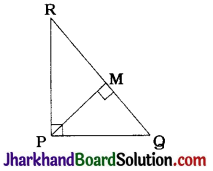
PQR is a triangle right angled at P and M is a point on QR such that PM ⊥ QR. Show that PM² = QM. MR.
Solution :
JAC Class 10 Maths Solutions Chapter 6 Triangles Ex 6.5 - 1
PQR is a triangle right angled at P and M is a point on QR such that PM ⊥ QR.
∴ ΔRMP ~ ΔPMQ ~ ΔRPQ (Theorem 6.7)
Now, ΔRMP ~ ΔPMQ
∴ \(\frac{PM}{QM}=\frac{RM}{PM}\)
∴ PM² = QM. MR

Question 3.
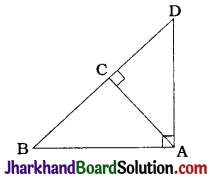
In the given figure, ABD is a triangle right-angled at A and AC ⊥ BD. Show that
1. AB² = BC.BD
2. AC² = BC.DC
3. AD² = BD.CD
Solution :
JAC Class 10 Maths Solutions Chapter 6 Triangles Ex 6.5 - 2
ABD is a triangle right angled at A and AC ⊥ BD.
∴ ΔBCA ~ ΔACD ~ ΔBAD (Theorem 6.7)
1. ΔBCA ~ ΔBAD
∴ \(\frac{AB}{DB}=\frac{CB}{AB}\)
∴ AB² = BC. BD

2. ΔBCA ~ ΔACD
∴ \(\frac{AC}{DC}=\frac{BC}{AC}\)
∴ AC² = BC. DC

3. ΔACD ~ ΔBAD
∴ \(\frac{AD}{BD}=\frac{CD}{AD}\)
∴ AD² = BD . CD

Question 4.
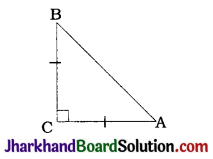
ABC is an isosceles triangle right angled at C. Prove that AB² = 2AC².
Solution :
ABC is an isosceles triangle right angled at C.
Hence, AB is the hypotenuse and the other two sides are equal, i.e., BC = AC
In ΔABC, ∠C = 90°
JAC Class 10 Maths Solutions Chapter 6 Triangles Ex 6.5 - 3
∴ By Pythagoras theorem,
AB² = BC² + AC²
∴ AB² = AC² + AC² (∵ BC = AC)
∴ AB² = 2AC²

JAC Class 10 Maths Solutions Chapter 6 Triangles Ex 6.5

Question 5.
ABC is an isosceles triangle with AC = BC. If AB² = 2AC², prove that ABC is a right triangle.
Solution :
In ΔABC, AC = BC and AB² = 2AC²
AB² = 2AC²
∴ AB² = AC² + AC²
∴ AB² = AC² + BC² (∵ AC = BC)
Hence, by the converse of Pythagoras theorem, ΔABC is right triangle in which ∠C is a right angle.

Question 6.
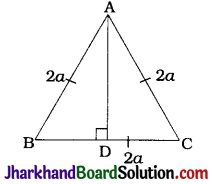
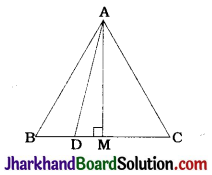
ABC is an equilateral triangle of side 2a. Find each of its altitudes.
Solution :
JAC Class 10 Maths Solutions Chapter 6 Triangles Ex 6.5 - 5
In ΔABC, AB = BC = CA = 2a.
Let AD be its altitude
∴ ∠ADB = ∠ADC = 90°
In ΔADB and ΔADC,
∠ADB = ∠ADC = 90°
AB = AC
AD = AD
∴ By RHS criterion,
= ΔADC
∴ BD = CD
But, BD + CD = BC
∴ BD = CD = \(\frac{1}{2}\)BC = \(\frac{1}{2}\)(2a) = a
Now, in ΔADB, ∠D = 90°
∴ By Pythagoras theorem,
AB² = AD² + BD²
∴ (2a)² = AD² + (a)²
∴ 4a² – a² = AD²
∴ AD² = 3a²
∴ AD = \(\sqrt{3}\)a
All the altitudes of an equilateral triangle are equal.
Hence, each of the altitudes of equilateral ΔABC with side 2a is \(\sqrt{3}\)a.

Question 7.
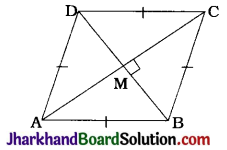
Prove that the sum of the squares of the sides of a rhombus is equal to the sum of the squares of its diagonals.
Solution :
Given: ABCD is a rhombus.
To prove : AB² + BC² + CD² + DA² = AC² + BD²
JAC Class 10 Maths Solutions Chapter 6 Triangles Ex 6.5 - 6
Proof: ABCD is a rhombus.
∴ AB = BC = CD = DA ……………(1)
Let its diagonals AC and BD intersect at M.
Then, MA = MC = \(\frac{1}{2}\)AC.
MB = MD = \(\frac{1}{2}\)BD and
∠AMB = ∠BMC = ∠CMD = ∠DMA = 90°
In ΔAMB, ∠AMB = 90°
∴ AB² = MA² + MB² (Pythagoras theorem)
∴ AB² = (\(\frac{AC}{2}\))² + (\(\frac{BD}{2}\))²
∴ 4AB² = \(\frac{\mathrm{AC}^2}{4}+\frac{\mathrm{BD}^2}{4}\)
∴ 4AB² = AC² + BD²
∴ AB² + AB² + AB² + AB² = AC² + BD²
∴ AB² + BC² + CD² + DA² = AC² + BD²

JAC Class 10 Maths Solutions Chapter 6 Triangles Ex 6.5

Question 8.
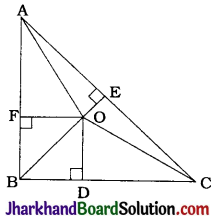
In the given figure, O is a point in the interior of a triangle ABC, OD ⊥ BC, OE ⊥ AC and OF ⊥ AB. Show that:
1. OA² + OB² + OC² – OD² – OE² – OF² = AF² + BD² + CE²
2. AF² + BD² + CE² = AE² + CD² + BF².
Solution :
JAC Class 10 Maths Solutions Chapter 6 Triangles Ex 6.5 - 7
Join OA, OB and OC.
Here, in ΔOFA and ΔOFB, ∠F = 90°, in ΔODB and ΔODC, ∠D = 90° and in ΔOEC and ΔOEA. ∠E = 90°.
Then, Pythagoras theorem is applicable in all the triangles.
1. In ΔOFA, ∠F = 90°
∴ OA² = OF² + AF²
∴ AF² = OA² – OF² …………..(1)
In ΔODB, ∠D = 90°
∴ OB² = OD² + BD²
∴ BD² = OB² – OD² …………..(2)
In ΔOEC, OE² + CE²
∴ CE² = OC² – OE² …………..(3)
Adding (1), (2) and (3).
AF² + BD² + CE² = OA² – OF² + OB² – OD² + OC² – OE²
∴ OA² + OB² + OC² – OD² – OE² – OF² = AF² + BD² + CE²

2. AF² + BD² + CE² = OA² + OB² + OC² – OD² – OE² – OF²
∴ AF² + BD² + CE² = (OA² – OE²) + (OB² – OF²) + (OC² – OD²)
∴ AF² + BD² + CE² = AE² + BF² + CD² (∵ ΔOAE, ΔOBF and ΔOCD are right triangles)
∴ AF² + BD² + CE² = AE² + CD² + BF²

Question 9.
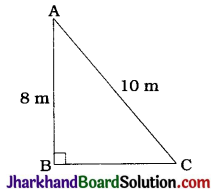
A ladder 10 m long reaches a window 8 m above the ground. Find the distance of the foot of the ladder from base of the wall.
Solution :
JAC Class 10 Maths Solutions Chapter 6 Triangles Ex 6.5 - 8
Here, AB is the wall with window at point A and AC is the ladder.
Then, AC = 10m and AB = 8 m.
In ΔABC, ∠B = 90°.
∴ AC² = AB² + BC² (Pythagoras theorem)
∴ 10² = 8² + BC²
∴ BC² = 10² – 8²
∴ BC² = 100 – 64
∴ BC² = 36
∴ BC = 6 m
Thus, the distance of the foot of the ladder from the base of the wall is 6 m.

Question 10.
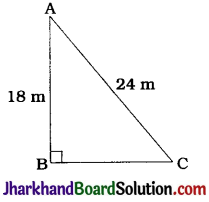
A guy wire attached to a vertical pole of height 18 m is 24 m long and has a stake attached to the other end. How far from the base of the pole should the stake be driven so that the wire will be taut?
Solution :
JAC Class 10 Maths Solutions Chapter 6 Triangles Ex 6.5 - 9
Here, AB is the vertical pole in which the guy wire is attached at point A and AC is the guy wire and 18 m the stake is attached to its end C.
Then, AC = 24 m and AB = 18 m.
In ΔABC, ∠B = 90°
∴ AC² = AB² + BC² (Pythagoras theorem)
∴ 24² = 18² + BC²
∴ BC² = 576 – 324
∴ BC² = 252
∴ BC² = 4 × 9 × 7
∴ BC = 2 × 3 × \(\sqrt{7}\)
∴ BC = 6\(\sqrt{7}\) m
Thus, the stake should be driven 6\(\sqrt{7}\)m far from the base of the pole, so as to make the wire taut.

JAC Class 10 Maths Solutions Chapter 6 Triangles Ex 6.5

Question 11.
An airplane leaves an airport and flies due north at a speed of 1000 km per hour. At the same time, another airplane leaves the same airport and flies due west at a speed of 1200 km per hour. How far apart will be the two planes after 1\(\frac{1}{2}\) hours?
Solution :
JAC Class 10 Maths Solutions Chapter 6 Triangles Ex 6.5 - 10
Here, A is the airport, B is the position of the first plane flying due north after 1\(\frac{1}{2}\) hours and C is the position of the second c- plane flying due west after 1\(\frac{1}{2}\) hours.
[Note: For the sake of simplicity, we consider that both the planes are flying at the same height and point A representing the airport is also imagined to be at the same height.]
Then, AB = distance covered by the first plane in 1\(\frac{1}{2}\) hours
= Speed × Time
= 1000 × \(\frac{3}{2}\)
= 1500 km
Similarly, AC = distance covered by the second plane in 1\(\frac{1}{2}\) hours
= Speed × Time
= 1200 × \(\frac{3}{2}\)
= 1800 km
Also, ∠BAC is the angle formed by north direction and west direction.
Hence ∠BAC = 90°
Now, in ΔABC, ∠A = 90°
∴ BC² = AB² + AC² (Pythagoras theorem)
∴ BC² = (1500)² + (1800)²
∴ BC² = 22500 + 32400
∴ BC² = 54900
∴ BC = \(\sqrt{100 \times 9 \times 61}\)
∴ BC = 300\(\sqrt{61}\) km
Thus, the two planes will be 300\(\sqrt{61}\) km apart from each other after 1\(\frac{1}{2}\) hours.

Question 12.
Two poles of heights 6m and 11 m stand on a plane ground. If the distance between the feet of the poles is 12 m, find the distance between their tops.
Solution :
JAC Class 10 Maths Solutions Chapter 6 Triangles Ex 6.5 - 11
Here, AB and CD are two erect poles of height 6 m and 11 m respectively.
The distance between the feet of the poles is 12 m.
Then, AB = 6 m, BD = 12 m, CD = 11 m, ∠B = 90° and ∠D = 90°.
Draw AE || BC.
Then, in quadrilateral ABDE.
∠B = ∠D = ∠E = ∠A = 90°.
Hence, ABDE is a rectangle.
∴ ED = AB = 6m and AE = BD = 12 m.
Then, CE = CD – DE = 11 – 6 = 5m
Now, in ΔAEC, ∠E = 90°.
∴ AC² = AE² + CE² (Pythagoras theorem)
∴ AC² = 12² + 5²
∴ AC² = 144 + 25
∴ AC² = 169
∴ AC = 13 m
Thus, the distance between the tops of the vertical poles is 13 m.

JAC Class 10 Maths Solutions Chapter 6 Triangles Ex 6.5

Question 13.
D and E are points on the sides CA and CB respectively of a triangle ABC right angled at C. Prove that AE² + BD² = AB² + DE²
Solution :
In ΔABC, ∠C is a right angle, point D lies on CA and point E lies on CB.
JAC Class 10 Maths Solutions Chapter 6 Triangles Ex 6.5 - 12
Then, all the four triangles BCD, BCA, ECD and ECA are right triangles and in each of them C is a right angle.
Hence, Pythagoras theorem is applicable in all the four triangles.
In ΔECA, AE² = EC² + CA² ……………..(1)
In ΔBCD, BD² = BC² + CD² ……………..(2)
In ΔBCA, AB² = BC² + CA² ……………..(3)
In ΔECD, DE² = EC² + CD² ……………..(4)
Adding (1) and (2).
AE² + BD² = EC² + CA² + BC² + CD²
= (BC² + CA²) + (EC² + CD²)
= AB² + DE² [By (3) and (4)]
Thus, AE² + BD² = AB² + DE²

Question 14.
The perpendicular from A on side BC of a ΔABC intersects BC at D such that DB = 3CD (see the given figure). Prove that 2AB² = 2AC² + BC².
Solution :
JAC Class 10 Maths Solutions Chapter 6 Triangles Ex 6.5 - 13
DB = 3CD
∴ BC = DB + CD = 3CD + CD
∴ BC = 4CD …………..(1)
In ΔADB, ∠D = 90°
∴ AB² = AD² + DB² (Pythagoras theorem) …………..(2)
In ΔADC, ∠D = 90°
∴ AC² = AD² + CD² (Pythagoras theorem) …………..(3)
Subtracting (3) from (2),
AB² – AC² = (AD² + DB²) – (AD² + CD²)
∴ AB² – AC² = DB² – CD²
∴ AB² – AC² = (DB + CD) (DB – CD)
∴ AB² – AC² = (BC) (3CD – CD)
∴ AB² – AC² = (BC) (2CD)
Multiplying the equation by 2, we get
2AB² – 2AC² = (BC) (4CD)
∴ 2AB² – 2AC² = (BC) (BC)
∴ 2AB² = 2AC² + BC² [By (1)]

Question 15.
In an equilateral triangle ABC, D is a point on side BC such that BD = \(\frac{1}{3}\)BC. Prove that 9AD² = 7AB².
Solution :
Given: In equilateral ΔABC, D is a point on BC such that BD = \(\frac{1}{3}\)BC.
To prove: 9AD² = 7AB²
JAC Class 10 Maths Solutions Chapter 6 Triangles Ex 6.5 - 14
Construction: Draw AM ⊥ BC, such that M lies on BC.
Proof: ΔABC is an equilateral triangle. Suppose, AB = BC = AC = a
In equilateral ΔABC, AM is an altitude.
∴ AM is a median.
∴ BM = \(\frac{1}{2}\)BC = \(\frac{1}{2}\)a
∴ BD = \(\frac{1}{3}\)BC. Hence, DC = \(\frac{2}{3}\)BC
BD = \(\frac{1}{3}\)BC = \(\frac{1}{3}\)a
DM = BM – BD = \(\frac{1}{2}\)a – \(\frac{1}{3}\)a = \(\frac{1}{6}\)a
In ΔAMB, ∠M = 90°
∴ AB² = AM² + BM²
∴ a² = AM² + \(\frac{1}{4}\)a²
∴ AM² = \(\frac{3}{4}\)a²
In ΔAMD, ∠M = 90°
∴ AD² = AM² + DM²
JAC Class 10 Maths Solutions Chapter 6 Triangles Ex 6.5 - 15
∴ 9AD² = 7a²
∴ 9AD2 = 7AB² (∵ AB = a)

JAC Class 10 Maths Solutions Chapter 6 Triangles Ex 6.5

Question 16.
In an equilateral triangle, prove that three times the square of one side is equal to four times the square of one of its altitudes.
Solution :
JAC Class 10 Maths Solutions Chapter 6 Triangles Ex 6.5 - 16
ABC is an equilateral triangle in which AD is an altitude.
Let AB = BC CA- a units.
In an equilateral triangle, an altitude is a median also.
∴ AD is a median.
∴ BD = \(\frac{1}{2}\)BC = \(\frac{a}{2}\)units
In ΔADB, ∠D = 90°
∴ AB² = AD² + BD²
∴ (a)² = AD² + (\(\frac{a}{2}\))²
∴ a² = AD² + \(\frac{a^2}{4}\)
∴ \(\frac{3}{4}\)a² = AD²
∴ 3a² = 4AD²
∴ 3 (side)² = 4 (altitude)²

Question 17.
Tick the correct answer and justify: In ΔABC, AB = 6\(\sqrt{3}\) cm, AC = 12 cm and BC= 6 cm. The angle B is:
(A) 120°
(B) 60°
(C) 90°
(D) 45°
Solution :
In ΔABC, AB = 6\(\sqrt{3}\) cm = 10.38 cm (approx),
AC = 12 cm and BC = 6 cm
Here, AC is the longest side.
Then, 12² = 144 and
(6\(\sqrt{3}\))² + (6)² – 108 + 36 = 144
Thus, 12² = (6\(\sqrt{3}\))² + (6)²
Hence, by the converse of Pythagoras theorem, ΔABC is a right triangle in which the longest side AC is the hypotenuse and its opposite angle ∠B is a right angle.
Hence, the correct answer is (C) 90°.

JAC Class 10 Maths Solutions Chapter 6 Triangles Ex 6.6

Jharkhand Board JAC Class 10 Maths Solutions Chapter 6 Triangles Ex 6.6 Textbook Exercise Questions and Answers.

JAC Board Class 10 Maths Solutions Chapter 6 Triangles Exercise 6.6

Question 1.
In the given figure, PS is the bisector of ∠QPR of ΔPQR. Prove that \(\frac{QS}{SR}=\frac{PQ}{PR}\)
Solution :
JAC Class 10 Maths Solutions Chapter 6 Triangles Ex 6.6 - 1
Construction: Through Q, draw a line parallel to PS which intersects RP extended at M.
Proof: In ΔMQR, S and P are points on QR and MR respectively and PS || MQ.
∴ \(\frac{QS}{SR}=\frac{MP}{PR}\) (BPT) ……………(1)
Now, PS || MQ and PQ is their transversal.
∴ ∠SPQ = ∠PQM (Alternate angles) ……(2)
Similarly, PS || MQ and MR is their transversal.
∴ ∠RPS = ∠PMQ (Corresponding angles) …………….(3)
PS is the bisector of ∠QPR.
∴ ∠SPQ = ∠RPS …………….(4)
From (2), (3) and (4).
∠PQM = ∠PMQ.
∴ In ΔPMQ, MP = PQ ……….(5)
From (1) and (5), we get
\(\frac{QS}{SR}=\frac{PQ}{PR}\)

JAC Class 10 Maths Solutions Chapter 6 Triangles Ex 6.6

Question 2.
In the given figure, D is a point on hypotenuse AC of ΔABC, such that BD ⊥ AC, DM ⊥ BC and DN ⊥ AB. Prove that:
1. DM² = DN . MC
2. DN² = DM . AN
Solution :
JAC Class 10 Maths Solutions Chapter 6 Triangles Ex 6.6 - 2
In quadrilateral DMBN, ∠B = ∠M = ∠N = 90°.
Hence, DMBN is a rectangle.
∴ DN = MB ………….. (1)
and DM = NB ………….. (2)
Now, BD ⊥ AC
∴ ∠BDC = 90° and ΔBDC is a right triangle in which DM is altitude on hypotenuse BC.
Then, ΔBMD ~ ΔDMC ~ ΔBDC. (Theorem 6.7)
∴ \(\frac{DM}{CM}=\frac{BM}{DM}\)
∴ DM² = BM. CM
∴ DM² = DN. MC [By (1), DN = MB] [Result (1)]
Similarly, ΔADB is a right triangle in which DN is altitude on hypotenuse AB.
∴ ΔAND ~ ΔDNB ~ ΔADB (Theorem 6.7)
∴ \(\frac{DN}{BN}=\frac{AN}{DN}\)
∴ DN2 = BN. AN
∴ DN² = DM . AN [By (2), DM = NB] [Result (2)]

Question 3.
In the given figure, ABC is a triangle in which ∠ABC > 90° and AD ⊥ CB produced. Prove that AC² = AB² + BC² + 2BC . BD.
Solution :
JAC Class 10 Maths Solutions Chapter 6 Triangles Ex 6.6 - 3
In ΔADC, ∠D = 90°
∴ AC² = AD² + DC²
∴ AD² = AC² – DC² ……………(1)
In ΔADB, ∠D = 90°
∴ AB² = AD² + DB²
∴ AD² = AB² – DB² ……………(2)
From (1) and (2).
AC² – DC² = AB² – DB²
∴ AC² = AB² + DC² – DB²
∴ AC² = AB2 + (BC + DB)² – DB²
∴ AC² = AB² + BC² + 2BC . DB + DB² – DB²
∴ AC² = AB² + BC² + 2BC . BD

JAC Class 10 Maths Solutions Chapter 6 Triangles Ex 6.6

Question 4.
In the given figure, ABC is a triangle in which ∠ABC < 90° and AD ⊥ BC. Prove that AC² = AB² + BC² – 2BC . BD.
Solution :
JAC Class 10 Maths Solutions Chapter 6 Triangles Ex 6.6 - 4
In ΔADC, ∠D = 90°
∴ AC² = AD² + CD²
∴ AD² = AC² – CD² ……………….(1)
In ΔADB, ∠D = 90°
∴ AB² = AD² + BD²
∴ AD² = AB² – BD² ……………….(2)
From (1) and (2),
AC² – CD² = AB² -BD²
∴ AC² = AB² + CD² – BD²
∴ AC² = AB² + (BC – BD)² – BD²
∴ AC² = AB² + BC² – 2BC . BD + BD² – BD²
∴ AC² = AB² + BC² – 2BC . BD

Question 5.
In the given figure, AD is a median of a triangle ABC and AM ⊥ BC. Prove that:
1. AC² = AD² + BC. DM + (\(\frac{BC}{2}\))²
2. AB² = AD² – BC. DM + (\(\frac{BC}{2}\))²
3. AC² + AB² = 2AD² + \(\frac{1}{2}\)BC²
Solution :
JAC Class 10 Maths Solutions Chapter 6 Triangles Ex 6.6 - 5
Here, ΔAMD, ΔAMC and ΔAMB are right triangles.
Also, since AD is a median, D is the midpoint of BC.
∴ CD = BD = \(\frac{BC}{2}\)
Moreover, DM = CM – CD and DM = BD – BM
1. In ΔAMC, ∠M = 90°
∴ AC² = AM² + CM²
∴ AC² = AM² + (DM + CD)²
∴ AC² = AM² + DM² + 2. DM.CD + CD²
∴ AC² = (AM² + DM²) + (2CD) (DM) + CD²
∴ AC² = AD² + BC.DM + (\(\frac{BC}{2}\))²
(∵ In ΔAMD, AD² = AM² + DM²)

2. In ΔAMB, ∠M = 90°
∴ AB² = AM² + BM²
∴ AB² = AM² + (BD – DM)²
∴ AB² = AM² + BD² – 2 BD.DM + DM²
∴ AB² = (AM² + DM²) – (2BD) · (DM) + BD²
∴ AB² = AD² – BC.DM + (\(\frac{BC}{2}\))²
(∵ In ΔAMD, AD² = AM² + DM²)

3. Now, adding the results of part (1) and (2)
AC² + AB² = AD² + BC. DM + (\(\frac{BC}{2}\))² + AD² – BC . DM + (\(\frac{BC}{2}\))²
∴ AC² + AB² = 2AD² + 2(\(\frac{\mathrm{BC}^2}{4}\))
∴ AC² + AB² = 2AD² + \(\frac{1}{2}\)BC²
[Note: In this result, if we replace BC by 2BD, we get the famous result know as Apollonius theorem : If AD is a median of ΔABC, then AB² + AC² = 2 (AD² + BD²).]

JAC Class 10 Maths Solutions Chapter 6 Triangles Ex 6.6

Question 6.
Prove that the sum of the squares of the diagonals of a parallelogram is equal to the sum of the squares of its sides.
Solution :
First of all, we prove Apollonius Theorem.
In ΔABC, let AD be a median and AM be an altitude as shown in the figure.
Then, AB² + AC²
= AM² + BM² + AM² + CM²
= 2AM² + (BD – MD)² + (CD + MD)²
= 2AM² + (BD – MD)² + (BD + MD)² (∵ CD = BD)
= 2AM² + 2BD² + 2MD²
= 2(AM² + MD²) + 2BD²
= 2AD² + 2BD²
∴ AB² + AC² = 2(AD² + BD²)
JAC Class 10 Maths Solutions Chapter 6 Triangles Ex 6.6 - 6
Let PQRS be a parallelogram in which the diagonals bisect each other at O.
Then, PO = RO = \(\frac{1}{2}\)PR and
QO = SO = \(\frac{1}{2}\)QS.
Now, in ΔPQR, QO is a median.
∴ PQ² + QR² = 2(QO² + PO²)
∴ PQ² + QR² = 2{(\(\frac{QS}{2}\))² + (\(\frac{PR}{2}\))²}
∴ PQ² + QR² = \(\frac{1}{2}\)(QS² + PR² ) ………….(1)
Similarly.
in ΔQRS, QR² + RS² = \(\frac{1}{2}\)(QR² + PR²) ……(2)
in ΔRSP, RS² + SP² = \(\frac{1}{2}\)(QS² + PR²) ……….(3)
in ΔSPQ, SP² + PQ² = \(\frac{1}{2}\)(QS² + PR²) ……….(4)
Adding (1), (2), (3) and (4), we get
2(PQ² + QR² + RS² + SP²) = 2(QS² + PR²)
∴ PQ² + QR² + RS² + SP² = QS² + PR²
Thus, the sum of the squares of the diagonals of a parallelogram is equal to the sum of the squares of its sides.

Question 7.
In the given figure, two chords AB and CD intersect each other at the point P. Prove that
1. ΔAPC ~ ΔDPB
2. AP . PB = CP . DP
Solution :
JAC Class 10 Maths Solutions Chapter 6 Triangles Ex 6.6 - 7
Here, ∠CAB = ∠CDB
(Angles in the same segment)
∴ ∠CAP = ∠BDP
Similarly,
∠ACD = ∠DBA
(Angles in the same segment)
∴ ∠ACP = ∠DBP
Now, in ΔAPC and ΔDPB,
∠CAP = ∠BDP and ∠ACP = ∠DBP.
∴ By AA criterion, ΔAPC ~ ΔDPB. (Result 1)
∴ \(\frac{AP}{DP}=\frac{CP}{BP}\)
∴ AP . PB = CP . DP (Result 2)

JAC Class 10 Maths Solutions Chapter 6 Triangles Ex 6.6

Question 8.
In the given figure, two chords AB and CD of a circle intersect each other at the point P (when produced) outside the circle.
Prove that
1. ΔPAC ~ ΔPDB
2. PA . PB = PC . PD
Solution :
JAC Class 10 Maths Solutions Chapter 6 Triangles Ex 6.6 - 8
In cyclic quadrilateral ACDB,
ΔACD + ∠ABD = 180°
Again, ∠ACD + ∠ACP = 180° (Linear pair)
∴ ∠ABD = ∠ACP
∴ ∠PBD = ∠PCA.
Similarly, ∠CAB + ∠CDB = 180° (Cyclic quadrilateral)
∠CAB + ∠CAP = 180° (Linear pair)
∴ ∠CDB = ∠CAP
∴ ∠PDB = ∠PAC
Now, in ΔPDB and ΔPAC,
∠PBD = ∠PCA
∠PDB = ∠PAC
∴ By AA criterion, ΔPAC ~ ΔPDB [Result (1)]
∴ \(\frac{PA}{PD}=\frac{PC}{PB}\)
∴ PA.PB = PC.PD [Result (2)]

Question 9.
In the given figure, D is a point on side BC of ΔABC such that \(\frac{BD}{CD}=\frac{AB}{AC}\). Prove that AD is the bisector of ∠BAC.
Solution :
JAC Class 10 Maths Solutions Chapter 6 Triangles Ex 6.6 - 9
Through B. draw a line parallel to AD to intersect CA extended at P.
Then, in ΔPBC, A and D are points on PC and BC respectively and PB || AD.
∴ \(\frac{PA}{AC}=\frac{BD}{CD}\)
Also, \(\frac{BD}{CD}=\frac{AB}{AC}\) (Given)
∴ PA = AB
Now, in ΔPAB, PA = AB
∴ ∠ABP = ∠APB …………..(1)
AD || BP and AB is their transversal.
∴ ∠ABP = ∠BAD (Alternate angles) …………..(2)
AD || BP and CP is their transversal.
∴ ∠APB = ∠CAD (Corresponding angles) …………..(3)
From (1), (2) and (3),
∠BAD = ∠CAD
Moreover, ∠BAD + ∠CAD = ∠BAC.
Hence, AD is the bisector of ∠BAC.

JAC Class 10 Maths Solutions Chapter 6 Triangles Ex 6.6

Question 10.
Nazima is fly fishing in a stream. The tip of her fishing rod is 1.8 m above the surface of the water and the fly at the end of the string rests on the water 3.6 m away from her and 2.4 m from a point directly under the tip of the rod. Assuming that her string (from the tip of her rod to the fly) is taut, how much string does she have out (see the given figure)? If she pulls in the string at the rate of 5 cm per second, what will be the horizontal distance of the fly from her after 12 seconds?
Solution :
JAC Class 10 Maths Solutions Chapter 6 Triangles Ex 6.6 - 10
Here, ΔABC represents the initial position in which A is the tip of her fishing rod, C is the fly at the end of the string and B is the point directly under the tip of the rod.
Then, in ΔABC, ∠B = 90°, AB = 1.8m and BC = 2.4 m.
∴ AC² = AB² + BC² (Pythagoras theorem)
∴ AC² = (1.8)² + (2.4)²
∴ AC² = 3.24 + 5.76
∴ AC² = 9
∴ AC = 3 m
Hence, in the initial position, she has 3 m of string out.
Length of string pulled-in in 1 sec = 5 cm
∴ Length of string pulled-in in 12 sec = 60 cm = 0.6 m
Now, in the second position, the length of string AC = 3m-0.6 m = 2.4 m and AB = 1.8 m.
Again, AC² = AB² + BC²
∴ (2.4)² = (1.8)² + BC²
∴ BC² = (2.4)² – (1.8)²
∴ BC² = (2.4 + 1.8) (2.4 – 1.8)
∴ BC² = 4.2 × 0.6
∴ BC² = 2.52
∴ BC = \(\sqrt{2.52}\)
∴ BC= 1.59 m (approx)
Now, the horizontal distance of the fly from her
= BC + 1.2 m
= (1.59 + 1.2) m
= 2.79 m

JAC Class 9 Social Science Solutions History Chapter 1 The French Revolution

JAC Board Class 9th Social Science Solutions History Chapter 1 The French Revolution

JAC Class 9th History The French Revolution InText Questions and Answers 

Activity (Page No. 5)

Question 1.
Explain why the artist has portrayed the nobleman as the spider and the peasant as the fly.
Answer:
The artist has depicted the nobleman as the spider and the peasant as the fly showing that flies work hard to get their food, they roam around here and there, whereas the spider creates a trap and catches the flies and receives food without any hard work.

In the same way, the nobleman had developed such a monarchy in the French society, in which the peasants used to arrange for livelihood with hard work and the nobleman used to get it as a tax without any hard work. Such depiction by the artist represents the exploiting class and the legal system created by him in the erstwhile French society.

Activity (Page No. 6)

Question 1.
Fill in the blank boxes in figure 4 with appropriate terms from among the following: Food riots, scarcity of grain, increased number of deaths, rising food prices, weaker bodies.
Answer:
JAC Class 9 Social Science Solutions History Chapter 1 The French Revolution 1

Activity (Page No. 7)

Question 1.
What message is Young trying to convey here? Whom does he mean when he speaks of ‘slaves’? Who is he criticising? What dangers does he sense in the situation of 1787?
Answer:

  1. Here Young is trying to convey the message that any social system based on in justice will not last long and its consequences can be disastrous for the exploiters.
  2. The ‘Slaves’ mentioned by him are the peasants, servants and landless labourers who were the underprivileged and deprived sections of French society at that time.
  3. He is criticising the complete social system and especially the noblemen and the clergy.
  4. The danger sensed by him is violence from the underprivileged section on the noblemen, clergy and their families.

Activity (Page No. 8)

Question 1.
Representatives of the Third Estate take the oath raising their arms in the direction of Bailly, the President of the Assembly, standing on a table in the centre. Do you think that during the actual event Bailly would have stood with his back to the assembled deputies? What could have been David’s intention in placing Bailly (fig.5) the way he has done?
Answer:

  1. No, I think that during the actual event, Bailly would not have stood with his back to the assembled deputies.
  2. Placing Bailly in this way, David has showed his intention to support the assembled deputies towards Bailly.

Activity (Page No. 13)

Question 1.
Identify the symbols in Box 1 which stand for liberty, equality and fraternity.
Answer:
Liberty: The broken chain, Red Phrygian cap.
Equality: The winged woman, The law tablet.
Fraternity: The bundle of rods or fasces, National colours of France such as Blue-White-Red.

JAC Class 9 Social Science Solutions History Chapter 1 The French Revolution

Question 2.
Explain the meaning of the painting of the Declaration of Rights of Man and Citizen, (Fig. 8) by reading only the symbols.
Answer:
in Fig. 8 a woman is shown wearing a blue, white and red dress. These colours are the national colours of France. The lady carrying the broken chain symbolises the freedom of the French citizens. On the other side, a winged woman is also shown which is a symbol of personification of the law. It expresses that all French citizens are law-abiding. Both pictures of women are shown on the Law Tablet which conveys the message that all are equal before the law.

Question 3.
Compare the political rights which the Constitution of 1791 gave to the citizens with Articles 1 and 6 of the Declaration (Source C). Are the two documents consistent? Do the two documents convey the same idea?
Answer:
The two documents are consistent and convey the same idea that human beings are born equal and all citizens are equal in front of the law. However, the constitution of 1791 did not give practical form to these ideas.

Question 4.
Which groups of French society would have gained from the Constitution of 1791? Which groups would have had reason to be dissatisfied? What developments does Marat (Source B) anticipate in the future?
Answer:

  1. The Third Estate of French society would have gained the maximum benefit from the Constitution of 1791.
  2. The First and Second Estates or the Aristocratic group would have the reason to be dissatisfied. They were forced to give up their privileges and a common tax was levied in return of all services.
  3. Marat anticipates another revolution in which the poor will rebel against the rich persons of the third estate and overthrow them, just like they had done to the noblemen and clergy.

Question 5.
Imagine the impact of the events in France on neighbouring countries such as Prussia, Austria-Hungary or Spain, all of which were absolute monarchies. How would the kings, traders, peasants, nobles or members of the clergy here have reacted to the news of what was happening in France?
Answer:
The shadow of the events of France must also have fallen on the absolute monarchy countries of the neighbourhood such as Prussia, Austria-Hungry or Spain etc. These autocratic monarchy countries may have reduced the exploitation of citizens by reducing their autocracy. Because they may have feared that the incident in France may be repeated here as well.

The kings, noble, clergy and other privileged sections of these countries would become fearful that what has happened in France can happen in their country also. The peasant’s traders would welcome the developments in France and sympathise with the peasants and underprivileged sections of that country.

Activity (Page No. 15)

Question 1.
Look carefully at the painting and identify the objects which are political symbols you saw in Box 1 (broken chain, red cap, fasces, Charter of the Declaration of Rights). The Pyramid stands for equality, often represented by a triangle. Use the symbols to interpret the painting. Describe your impressions of the female figure of liberty.
Answer:

  1. A red cap and the Charter of the Declaration of Rights in the lady’s hand are the political symbols.
  2. The triangle shape of pyramid stands for equality because its three equal sides represent the three Estates of the French society and signifies that their rights and powers are equal. She is holding in the other hand – The Torch of Freedom.
  3. The female figure of liberty signifies the true idea of freedom that women are equal to men. So, they should enjoy the same basic rights.

Activity (Page No. 16)

Question 1.
Compare the views of Desmoulins and Robespierre. How does each one understand the use of state force? What does Robespierre mean by ‘the war of liberty against tyranny’? How does Desmoulins perceive liberty? Refer once more to Source C. What did the constitutional laws on the rights of individuals lay down? Discuss your views on the subject in class.
Answer:
1. Desmoulins was all for a humanitarian view of democracy. He argued that a true democracy means that all persons should enjoy equal rights; everyone should enjoy the fruits of liberty. He condemned the use of force even against those who opposed the views of a democratic government.

2. Robespierre was trying to find justification for his tyranny against all resistance, by posing to be the saviour of the ideals of the revolution and the republic. For him, terror is nothing but justice and is used to meet the most urgent needs of the fatherland.

3. Desmoulins perceive liberty as happiness, reason, equality and Justice. It is the declaration of rights.

4. The constitutional laws on the rights of individuals lay down the following rights:
(a) Right to freedom,
(b) Right to equality,
(c) Right to protection of property
(d) Right against exploitation, and
(e) Right to expression.

Activity (Page No. 18)

Question 1.
Describe the persons represented in Fig. 12 their actions, their postures, the objects they are carrying. Look carefully to see whether all of them come from the same social group. What symbols has the artist included in the image? What do they stand for? Do the actions of the women reflect traditional ideas of how women were expected to behave in public? What do you think: does the artist sympathise with the women’s activities or is he critical of them? Discuss your views in class.
Answer:

  1. The persons represented in Fig 12 are women of Paris (France). Most of them came from the Third Estate. Their actions, their postures represent a rebellious violent mood.
  2. The artist included the following symbols in the image :
    (a) Hoes, swords and pitchforks to indicate power and rebellion.
    (b) A balance scale on top to indicate equality among men and women.
    (c) A drum to indicate announcement.
  3. No, the actions of the women do not reflect traditional ideas of how women were expected to behave in public.
  4. Yes, the artist sympathises with the women.

Activity (Page No. 20)

Question 1.
Compare the manifesto drafted by Olympe de Gouges (Source F) with the Declaration of the Rights of Man and Citizen (Source C).
Answer:
The Declaration of the Rights of Men and citizens declares only the rights of Men and Citizens. Rights of women are not discussed in any article of this Declaration. On the other hand, the Declaration prepared by Olympe de Gouges discusses the rights of both men and women on the basis of equality.

JAC Class 9 Social Science Solutions History Chapter 1 The French Revolution

Question 2.
Imagine yourself to be one of the women in Fig. 13. Formulate a response to the arguments put forward by Chaumette (Source G.)
Answer:
The arguments given by Chaumette are not justifiable. He has mentioned only the biological role of women. As individual, women have equal rights to men and so they must be treated equal to men. They would of course, continue their traditional roles like feeding and nurturing children, things of the household etc. but women are equally capable as men to carry out the other duties of human society also.

Activity (Page No. 21)

Question 1.
Record your impression of this print (Fig. 14). Describe the objects lying on the ground. What do they symbolise? What attitude does the picture express towards non-European slaves?
Answer:

  1. This print shows the bad condition of slaves during seventeenth century. The tri-colour banner on the top carries the slogan“The rights of man” and an inscription below says“The freedom of the unfree.”
  2. The symbols of power sword, gun etc. are lying on the ground. It shows that slavery has been abolished.
  3. The picture expresses the racial behaviour of a French woman towards non-European slaves. She is giving European clothes to them as a mark of superior culture.

Activity (Page No. 22)

Question 1.
Describe the picture in your own words. What are the images that the artist has used to communicate the following ideas: greed, equality, justice, takeover by the state of the assets of the church?
Answer:

  1. Greed: Protested by a fat man.
  2. Equality: Man and woman standing together.
  3. Justice: Two persons are going with off mood, which signifies that they did not get proper justice.
  4. Assets of the church taken over by the state. A man is shown pressed in between the force machine which signifies the confiscation of assets of the church by the state.

Activity (Page No. 24)

Question 1.
Find out more about anyone. of the revolutionary figures, you have read about in this chapter. Write a short biography of this person.
Answer:
Olympe de Gouges (1748-1793): Olympe de Gouges was one of the most important of politically active women in revolutionary France. She protested against the Constitution and the Declaration of Rights of Man and Citizen as they excluded women from basic rights that each human being was entitled to.

So, in 1791, she wrote a Declaration of Rights of Woman and Citizen, which she addressed to the Queen and to the members of the National Assembly, demanding that they act upon it. In 1793, Olympe de Gouges criticised the Jacobin government for forcibly closing down women’s clubs. She was tried by the National Convention, which charged her with treason. Soon after this, she was executed.

JAC Class 9 Social Science Solutions History Chapter 1 The French Revolution

Question 2.
The French Revolution saw the rise of newspapers describing the events of each day and week. Collect information and pictures on any one event and write a newspaper article. You could also conduct an imaginary interview with important personages such as Mirabeau, Olympe de Gouges or Robespierre.
Answer:
An article in a newspaper at the end of Bastille: On the morning of 14th July 1789, the city of Paris was in a state of alarm. Rumours spread that king would soon order the army to open fire upon the  citizens. Some 7,000 men and women gathered in front of the town hall and decided to form a people’s militia. Finally, a group of several hundred people marched towards the fortress prison, the Bastille, where they hoped to find hoarded ammunition.

In the armed fight that followed, the Commander of the Bastille was killed and the prisoners were released, though there were only seven of them. The fortress was demolished and its stone fragments were sold in the market. The Bastille, which stood for the despotic rule of the king came to an end cowardly. It masked the end of feudalism and brought in a new era.

1. Interview with Mirabeau :
Journalist: Sir, you belong to the nobility, but here you are supporting those people who are against the nobility or aristocracy.

Mirabeau: Yes, I was born in an aristocratic group but it doesn’t mean that others are doing wrong and should not protest.

Journalist: Sir, will you support certain privileges based on birth which are given to some special classes of society?

Mirabeau: No, I am not convinced of the need to do with a society of feudal privileges by birth.

2. Interview with Olympe de Gouges :
Journalist: Madam, why do you oppose the Declaration of Rights of Man and Citizen?

Gouges: I am opposing this Declaration because there is no discussion of fundamental rights of women.

Journalist: What is the reason behind your criticism for the Jacobin government?

Gouges: I am criticising the Jacobin government for forcibly closing down the women’s clubs,

3. Interview Journalist Robespierre
Journalist: Sir, How would you establish and consolidate democracy?

Robespierre: To establish and consolidate democracy, I would annihilate the enemies of the republic at home and abroad.

Journalist: What method should be adopted by a democratic government during the revolution?

Robespierre: In the time of revolution, a democratic government may relay on terror.

Journalist: Sir, what do you mean by ‘Terror’?

Robespierre: Terror is nothing but justice. It is a swift, severe and inflexible policy which is used to meet the most urgent need of the fatherland.

JAC Class 9th History The French Revolution Textbook Questions and Answers 

Question 1.
Describe the circumstances leading to the outbreak of revolutionary protest in France.
Answer:
The following circumstances led to the outbreak of revolutionary protest in France:
1. Political Causes:
Emperor Louis XVI and his queen, Marie Antoinette, wasted’ money on their luxurious living and wasteful festivities. The high posts were often sold. The whole administration was corrupt and each department had its own laws. In the absence of any uniform system, there was confusion all around. The people were tired of such a rotten system of administration and wanted a change.

2. Social Causes :
The social conditions of France were as distressing as its political organisation. The clergy and the nobility led a luxurious life and enjoyed many privileges by birth, while the peasants and the labourers led a very hard life. They had to pay heavy taxes.

In addition to the direct taxes paid to the state, peasants had to pay taxes to the first and second estates also. They had often to be content with meals of boiled grass. It was an unfair situation which led to the growth of a feeling of discontent among the members of the Third Estate.

3. Econoir causes :
Long years of war had drained the financial resources of France, added to this was the cost of maintaining the extravagant court. To meet tht e expenses, the state was forced to increase taxes imposed on common people, At this time, there was a greater demand for food grains due to huge growth in population.

As a result, the price of bread rose. Due to rising prices and inadequate wages, most of the population could not even afford the basic means of livelihood. This led to a crisis of subsistence and an increase in the gap between the rich and the poor.

4. Influence of the Philosophers and Writers :
The middle class emerged educated and wealthy during the eighteenth century. The system of privileges as promoted by the feudal society was against their interest. Being educated, the members of this class had access to various ideas of equality and freedom proposed by the French and English political and social philosophers.

These ideas got popularised among the masses as a result of intensive discussions and debates in salons/halls and coffee-houses, and through books and newspapers. The ideas of philosophers played a great role. John Locke, Jean Jacques Rousseau and Montesquieu rejected the doctrine of divine kingship.

5. Immediate Cause:
On 5th May 1789, Louis XVI called together an assembly of the Estates General to pass proposals for new taxes. Voting in the Estates General in the past had been conducted according to the principle that each Estate had one vote. But this time, members of the third Estate demanded that voting now should be conducted by the assembly as a whole, where each member would have one vote. When the king rejected this proposal, members of the third Estate walked out of the assembly in protest, which was the spark of outbreak of the French revolution.

JAC Class 9 Social Science Solutions History Chapter 1 The French Revolution

Question 2.
Which groups of French society benefitted from the revolution? Which groups were forced to relinquish power? Which sections of society would have been disappointed with the outcome of the revolution?
Answer:

  1. All the groups of Third Estate were benefitted from the revolution. These groups included peasants, artisans, petty officers, lawyers, teachers, servants, merchants, doctors and traders.
  2. The clergy and the nobility were forced to surrender power and all the privileges were taken away from them.
  3. Feudal lords, nobles, clergy and women would have been disappointed with the outcome of the revolution.

Question 3.
Describe the legacy of the French Revolution for the people of the world during the nineteenth and twentieth centuries.
Answer:
The legacy of French Revolution for the people of the world during the nineteenth and twentieth centuries can be described as given below :

  1. The French Revolution put an end to the arbitrary rule and developed the idea of Republic in Europe and in other parts of the world.
  2. It was the first national movement that adopted the ideals of “liberty, equality and fraternity”. These ideas became the basic doctrine of democracy for every nation in the 19th and 20th century.
  3. It marked the end of feudalism and brought in a new era of industrial capitalism.
  4. It initiated social and political changes that took place in different parts of Europe.
  5. It gave the term ‘Nation’ its modern meaning and promoted the concept of ‘nationalist’ which inspired the people in Poland, Germany, Netherlands and Italy to establish Nation-states in the countries.
  6. The greatest effect was the starting of mass movements all over the world and the rise of a spirit of nationalism among the people.

Question 4.
Draw up a list of democratic rights we enjoy today whose origins could be traced to the French Revolution.
Answer:
Some of the democratic rights which we enjoy today whose origins could be traced to the French revolution are given in the Indian constitution. They are :
1. Right to Equality:
The Right to Equality has its origin in the French Revolution. Which was its guiding principle. In the Indian constitution, Right to Equality means equality before the law, prohibition of discrimination on the basis of religion, descent, caste, gender or place of birth and end of titles and equality of opportunity in matters of employment.

2. Right to Liberty or Freedom:
The origin of this right can also be traced to the French Revolution. In the premble to the Indian Constitution, Right to Liberty or Freedom means ‘Freedom of Speech, expression, education, protection of the life and physical freedom, belief, faith and worship.

3. Encouraging the Spirit of Fraternity:
The French Revolution introduced the growth of the spirit of fraternity and social welfare. In the Indian constitution, the concept of ‘Fraternity’ abolishes untouchability and local or provincial anti-social feelings.

4. Inspiring the Spirit of Democracy:
The French Revolution inspired the spirit of democracy which ensured many rights, viz., right against exploitation, right to life, right to vote etc., which we are enjoying today.

JAC Class 9 Social Science Solutions History Chapter 1 The French Revolution

Question 5.
Would you agree with the view that the message of universal rights was beset with contradictions? Explain.
Answer:
Yes, I agree with the view that the message of universal rights, was beset with contradictions. Many ideals in the “Declaration of Right of Man and Citizen’ were not clear in their meanings. I can say this on the basis of the following examples:

  1. “The law has the right to forbid only actions injurious to society”. It did not mention about criminal offences against individuals.
  2. The declaration stated that, “Law is the expression of the general will. All citizens have the right to participate in its formation, personally or through their representatives. All citizens are equal before it.” Although, France became a constitutional monarchy, millions of citizens (men under the age of 25 including women) were still not allowed to vote at all.
  3. Men who were above 25 years of age and who paid taxes equal to at least 3 days of a labourer’s wages, were given the status of active citizens, i.e., they had the right to vote. This was in striking contrast to the ideals that the revolution supported.
  4. In the universal rights, nothing was mentioned about compulsory education for all.
  5. It did not give the right to freedom of trade and occupation.

Question 6.
How would you explain the rise of Napoleon?
Answer:
The rise of Napoleon Bonaparte was an indirect result of the French Revolution. After the fall of the Jacobin government, a new constitution was introduced. It provided for two elected legislative councils, and a Directory, an executive made up of five members. However, the Directors often clashed with the legislative councils, who then sought to dismiss them. This clash was responsible for political instability. Napoleon took advantage of the situation and became a dictator with the help of the army.

In 1804, Napoleon declared himself the Emperor of France. He was a brilliant General and used his armies to conquer and dominate all the neighbouring countries except Britain and Russia. However, his successes were short-lived. Britain, Prussia, Austria and Russia jointly defeated him at Leipzig, and again at Waterloo in 1815. He was captured and sent as a prisoner to the island of St. Helena where he died in 1821.

JAC Class 9 Social Science Solutions

JAC Class 9th Social Science Notes History Chapter 4 Forest Society and Colonialism Notes

JAC Board Class 9th Social Science Notes History Chapter 4 Forest Society and Colonialism Notes

Introduction

  • Forests provide us various natural resources of economic and medicinal value.
  • Due to increasing population and rapid industrialisation, world’s forest areas are disappearing at fast rate.
  • The disappearance of forests is referred to as deforestation.

→  Why Deforestation?

  • The process of deforestation began many centuries ago in India. Under colonial rule, it became more systematic and extensive.
  • As population increased over the centuries and the demand for food went up, peasants extended the boundaries of cultivation, clearing forests and breaking new land.

→ Land to be Improved

  • Forests disappeared to a great extent and cultivation area rose by 6.7 million hectares between 1880 and 1920.
  • Sleepers on the Tracks
  • The spread of railways from the 1850s created a new demand. To run locomotives, wood was needed as fuel, and to lay railway lines, sleepers were essential to hold the tracks together.
  • As the railway tracks spread through India, a larger and larger number of trees were felled.

→ Plantations

  • Large areas of natural forests were also cleared to make way for tea, coffee and rubber plantations to meet Europe’s growing need for these commodities.

JAC Class 9th Social Science Notes History Chapter 4 Forest Society and Colonialism Notes

→ The Rise of Commercial Forestry

  • The British were worried that the use of forests by local people and the reckless felling of trees by traders would destroy the forests. So they decided to invite a German expert, Dietrich Brandis, for advice, and made him the first Inspector General of Forests of India.
  • Rules about the use of forest resources had to be framed. Brandis set up the Indian Forest Service in 1864 and helped to formulate the Indian Forest Act of 1865.
  • The Imperial Forest Research Institute was set up at Dehradun in 1906. The system they taught here was called scientific forestry.
  • In scientific forestry, natural forests which had lots of different types of trees were cut down. In their place, one type of tree was planted in straight rows. This was called as plantation.
  • The Indian Forest Act, 1878 divided forests into three categories : reserved, protected and village forests. The best forests were called ‘reserved forests’. Villagers could not take anything from these forests. For house building or fuel, they could take wood from protected or village forests.

→ How were the Lives of People Affected

  • The Forest Act meant severe hardship for villagers across the country. After the Act, all their everyday practices cutting wood for their houses, grazing their cattle, collecting fruits and roots, hunting and fishing became illegal. It was also common for police constables and forest guards to harass people by demanding free food from them.

→ How did Forest Rules affect Cultivation

  • One of the major impacts of European colonialism was on the practice of shifting cultivation. European foresters regarded this practice as harmful for the forests. Therefore, the government decided to ban shifting cultivation. As a result, many communities were forcibly displaced from their homes in the forests.

JAC Class 9th Social Science Notes History Chapter 4 Forest Society and Colonialism Notes

→  Who Could Hunt

  • The customary practice of hunting was prohibited by the forest laws. Those who were caught hunting were now punished for poaching.
  • Under colonial rule, the scale of hunting increased largely, and as a result, many animals became almost extinct.

→ New Trades, New Employments and New Services

  • While people lost out in many ways after the forest department took control of the forests, some people benefitted from the new opportunities that had opened up in trade. Many communities left their traditional occupations and started trading in forest products.
  • In India, trade in forest products was a regular practice since the medieval period.
  • The British government gave sole right to large European trading firms to trade in forest products of particular areas.

JAC Class 9th Social Science Notes History Chapter 4 Forest Society and Colonialism Notes

→ Rebellion in the Forest

  • In many parts of India and the world, forest communities rebelled against the changes imposed on them.
  • In India, Siddhu and Kanu of Santhal paraganas, Birsa Munda of Chhota Nagpur, Alluri Sitarama Raju of Andhra Pradesh revolted against the new forest policy. They are still remembered today in many songs and stories.

→ The People of Bastar

  • Bastar is located in the southern most part of Chhattisgarh and borders of Andhra Pradesh, Odisha and Maharashtra.
  • A number of different communities live in Bastar such as Maria and Muria Gonds, Dhurwas, Bhatras and Halbas.
  • The people of Bastar believe that each village was given its land by the earth, and in return, they look after the earth by making some offerings at each agricultural festival.

→  The Fears of the People

  • When the colonial government proposed to reserve two-thirds of the forest in 1905, and stop shifting cultivation, hunting and collection of forest produce, the people of Bastar were very worried. They began to gather and discuss their issues in their village councils.
  • Every village contributed something to the rebellions’ expenses. Bazaars were looted, the houses of officials and traders, schools and police stations were burnt and robbed and grain redistributed.
  • The British sent troops to suppress the rebellion. It took three months for the British to regain control.
  • In a major victory for the rebels, work on reservation was temporarily suspended and the area to be reserved was reduced to roughly half of that planned before 1910.

→ Forest Transformations in Java

  • There were many similarities in the laws for forest control in Indonesia and India. Java is a place in Indonesia where the Dutch started forest management. Like the British, they also wanted timber from Java for ship building.

JAC Class 9th Social Science Notes History Chapter 4 Forest Society and Colonialism Notes

→ The Wood Cutters of Java

  • The Kalangs of Java were a community of skilled forest cutters and shifting cultivators. When the Dutch began to gain control over the forests in the eighteenth century, they tried to make the Kalangs work under them. In 1770, the Kalangs resisted by attacking a Dutch fort at Joana, but the uprising was suppressed.

→ Dutch Scientific Forestry

  • In the nineteenth century, when it became important to control territory and not just people, the Dutch enacted forest laws in Java, restricting villagers’ access to forests.
  • The Dutch first imposed rents on land being cultivated in the forest and then exempted some villages from these rents if they worked collectively to provide free labour and buffaloes for cutting and transporting timber. This was known as the blandongdiensten system.

→ Samin’s Challenge

  • Around 1890, Surontiko Samin of Randublatung village, began questioning the state ownership of the forest. Soon, a widespread movement developed.

→ War and Deforestation

  • The First World War and the Second World War had a major impact on forests. In Java, just before the Japanese occupied the region, the Dutch followed a ‘scorched earth’ policy, destroying sawmills, and burning huge piles of giant teak logs so that they would not fall into Japanese hands.
  • After the war, it was difficult for the Indonesian forest service to get their land back.

JAC Class 9th Social Science Notes History Chapter 4 Forest Society and Colonialism Notes

→ New Development in Forestry

  • Since the 1980s, governments across Asia and Africa have begun to see that scientific forestry and the policy of keeping forest communities away from forests have resulted in many conflicts.
  • Conservation of forests rather than collecting timber has become a more important goal.
  • Local forest communities and environmentalists are thinking of different forms of forest management.

→ Important Dates and Related Events

  • 1775: Split of Mataram kingdom of Java.
  • 1770: The Kalangs attack a Dutch fort at Joana in Java.
  • 1864: Setting up of the Indian Forest Service.
  • 1875: Enactment of the Indian Forest Act.
  • 1878: Amendment to Indian Forest Act.
  • 1890: Surontiko Samin of Randublatung village questioned the state ownership of forest.
  • 1899-190: Terrible famine in Bastar.
  • 1905: Government proposal to reserve two-thirds of the forests.
  • 1906: Setting up of the Imperial Forest Research Institute at Dehradun.
  • 1907-08: Famine in Bastar, again.
  • 1910: Rebellion in Bastar.
  • 1927: Amendment to the Indian Forest Act.

JAC Class 9th Social Science Notes History Chapter 4 Forest Society and Colonialism Notes

→ Colonialism: The policy or practice of a wealthy or powerful nation’s maintaining or extending its control over other countries, especially in establishing settlements or exploiting resources.

→ Deforestation: Refers to the disappearance of forests.

→ Afforestation: Development and cultivation of new forest lands.

→ Aboriginal Communities: Native communities of any place.

→ Sleepers: Wooden planks laid across railway tracks; they hold the tracks in position.

→ Scientific Forestry: A system of cutting trees controlled by the Forest Department in which old trees are cut and new trees are planted in straight rows.

→ Shifting Cultivation: A type of cultivation in which cultivators clear the forests by burning it and use the ash as manure. It is also known as slash and bum technique.

→ Criminal Tribes: Nomadic and pastoralist communities were labelled as criminal tribes because they used to steal wood from the forests.

→ Devsari or Dand or Man: A small token fee paid by the people of one village to the people of other village of Bastar in exchange of wood.

→ Blandongiensten System: This system was introduced by the Dutch in Java under which some villages were exempted from the taxes in terms of free labour and animals for cutting and transportating timber from forests.

→ Dietrich Brandis: A German expert on forests who became the first Inspector General of Forests in India.

→ Alluri Sitaram Raju: Leader of the forest community in Andhra Pradesh

JAC Class 9 Social Science Notes

JAC Class 9th Social Science Notes History Chapter 3 Nazism and the Rise of Hitler

JAC Board Class 9th Social Science Notes History Chapter 3 Nazism and the Rise of Hitler

Introduction

  • Nazism was a political ideology which flourished in Germany and influenced politics all over the world.
  • In May 1945, Germany surrendered to the Allies. Anticipating what was coming, Hitler, his propaganda minister Goebbels and his entire family committed suicide collectively in his Berlin bunker in April.
  • When genocidal war started in Germany under the shadow of the Second World War, it caused killings of millions of people in different inhuman ways.

JAC Class 9th Social Science Notes History Chapter 1 The French Revolution

→ Birth of the Weimar Republic

  • Germany was a powerful empire in the early 20th century.
  • Germany fought the First World War (1914-18) alongside the Austrian empire and against the Allies (England, France and Russia).
  • Germany made initial gains in the war by occupying France and Belgium. The Allies were strengthened by the entry of the United States of America (US) in 1917. They defeated Germany and the central powers in November, 1918.
  • The defeat of imperial Germany and the resignation of the emperor gave an opportunity to Parliamentary Parties to recast German polity.
  • A National Assembly met at Weimar and established a democratic constitution with a federal structure.
  • Deputies were elected to the German Parliament or Reichstag on the basis of equal and universal votes cast by all adults including women.
  • The peace treaty at Versailles with the Allies was a harsh and humiliating peace for Germany. So, the Weimar Republic had to face too many difficulties since its beginning.

JAC Class 9th Social Science Notes History Chapter 1 The French Revolution

→ The Effect of the War

  • The First World War had a devastating impact on the entire continent, both psychologically and financially. The Weimar Republic carried the burden of war guilt and national humiliation and was financially crippled by being forced to pay compensation.
  • Socialists, Catholics and democrats who supported the Weimar Republic were criticised and came to be known as ‘November Criminals’ by the conservative nationalists.
  • After the First World War, soldiers were placed above civilians and the media glorified their trench life. However, the truth was just the opposite. They lived a miserable life in the trenches.
  • Aggressive war propaganda, national honour and support grew for conservative dictatorship.
  • At that time in Europe, democracy was a young and fragile idea which could not survive the in stabilities of inter war.

→ Political Radicalism and Economic Crises

  • The birth of the Weimar Republic coincided with the revolutionary uprising of the Spartacist League.
  • Spartacist League was based on the pattern of the Bolshevik Revolution in Russia.
  • The Weimar Republic crushed the uprising of the Spartacist League with the help of the war veterans organisation called the Free Corps.
  • The Spartacists later founded the Communist Party of Germany.
  • Germany had fought the war largely on loans and had to pay the war reparations in gold.
  • With too much printed money in circulation, the value of the German mark fell, which brought hyperinflation in Germany.
  • At last, the Americans introduced the Dawes Plan. It helped Germany to overcome the crisis.

→ The Year of Depression

  • During the years of Depression (1924-1928), fearing a fall in prices, people made frantic efforts to sell their shares. On one single day, i.e., 24 October, 13 million shares were sold. This was the start of the Great Economic Depression. Over the next three years, between 1929 and 1932 the national income of the USA fell by half.
  • The German economy was the worst hit by the economic crisis. The number of unemployed touched an unprecedented 6 million. The economic crisis created deep anxiety and fear in people.
  • The Government failed to control the crisis and people lost confidence in the democratic parliamentary system.

JAC Class 9th Social Science Notes History Chapter 1 The French Revolution

→ Hitler’s Rise to Power

  • This crisis in the economy, polity and society, formed the background to Hitler’s rise to power. The German defeat horrified him and the Versailles Treaty made him furious. In 1919, he joined a small group called the German Workers Party. Later’ he took over the organisation and the party came to be known as the Nazi Party.
  • In 1928, the Nazi Party got only 26 percent votes in the elections to the Reichstag, the German parliament. By 1932, it had become the largest party with 37 percent votes.
  • Hitler was a powerful speaker. His passionate speeches about the fatherland and prom¬ises inspired German people.
  • Nazi propaganda skillfully projected Hitler as a messiah, a saviour, as someone who had arrived to help German people in a time of acute economic and political crisis.

→ The Destruction of Democracy

  • On 30 January, 1933, President Hindenburg offered the Chancellorship to Hitler. Hav¬ing acquired power, Hitler set out to dismantle the structure of democratic rule.
  • On 3 March, 1933, the famous Enabling Act was passed. This Act established dictatorship in Germany. It gave Hitler all powers to sideline the Parliament and rule by decree.
    Reconstruction

JAC Class 9th Social Science Notes History Chapter 1 The French Revolution

→ Reconstruction

  • Hitler assigned the responsibility of economic recovery to the economist Hjalmar Schacht who aimed at full production and full employment through a state funded work creation programme.
  • This project produced the famous German super highways and the people’s car, the Volkswagen.
  • In foreign policy, Hitler acquired quick successes.
  • Hitler pulled out of the League of Nations in 1933 and reoccupied the Rhineland in 1936.
  • In 1938, under the slogan “one people, one empire and one leader”, Austria and Germany were integrated by Hitler.
  • Hitler chose war as the way out of the approaching economic crisis.
  • In September 1939, Germany invaded Poland and this started a war with France and England.
  • In September 1940, a Tripartite Pact was signed between Germany, Italy and Japan.
  • Hitler attacked the Soviet Union in June 1941. It was a historic mistake made by Hitler.
  • The Soviet Red army defeated Germany at Stalingrad.
  • In the beginning, the US remained neutral in the Second World War. When Japan extended its support to Hitler and bombed the US base at Pearl Harbour, the US entered the Second World War.
  • The Second World War ended in May 1945 with Hitler’s defeat.
  • Japan surrendered in August 1945, after the US dropped atomic bombs on Hiroshima and Nagasaki.

→ The Nazi World View

  • According to Nazi ideology, there was no equality between people but only a racial hierarchy.
  • In this view, blond, blue-eyed, Nordic German Aryans were at the top, while Jews were located at the lowest rung. All other coloured people were placed in between, depending upon their external features.
  • The other aspect of Hitler’s ideology related to the geo-political concept of Lebensraum, or living space.
  • Hitler intended to extended the German boundaries by moving eastwards, to concentrate all the Germans geographically in one place. Poland became the laboratory for this experimentation.
    Establishment of the Racial State

→ Establishment of the Racial State

  • To implement their plan, the Nazis wanted to eliminate all those who were seen as ‘undesirable’. Nordic Aryans alone were considered ‘desirable’.Only they were seen as worth of prospering and multiplying against all others who .were classed as ‘undesirable’.
  • Jews remained the worst sufferers in nazi Germany. They were often persecuted through periodic organised violence, and expulsion from the land.

→ The Racial Utopia

  • Under the shadow of war, the Nazis proceeded to realise their murderous, racial ideal. Genocide and war became two sides of the same coin.
  • With some of the largest ghettos and gas chambers, the general government also served as the killing fields for the Jews.

→  Youth in Nazi Germany

  • Hitler felt that a strong Nazi society could be established only by teaching children, Nazi ideology. All schools were ‘cleansed’ and ‘purified’. This meant, that teachers who were Jews or seen as ‘politically unreliable’ were dismissed. All undesirable children are thrown out of schools, and finally in 1940, all undesirables were taken to the gas chambers.
  • The youth league of the Nazis was founded in 1922. Four years later, it was renamed as Hitler Youth.

JAC Class 9th Social Science Notes History Chapter 1 The French Revolution

→ The Nazi Cult of Motherhood

  • In Nazi Germany, girls had to maintain the purity of the race. They had to distance themselves from Jews, look after homes and teach their children Nazi values.
  • Those mothers who produced racially desirable children were awarded.
  • Women who maintained contacts with Jews, Poles or Russians were punished or imprisoned.
    The Art of Propaganda

→ The Art of Propaganda

  • The Nazi regime used language and media with care, and often to great effect. Nazis never used the words ‘kill’ or ‘murder’ in their official communication.
  • Mass killings were termed as special treatment, final solution, euthanasia, selection and disinfection.
  • Media was carefully used to win support for thejregime and popularise its worldview.

→ Ordinary People and the Crimes Against Humanity

  • Many ordinary people genuinely believed Nazism would bring prosperity and improve general well-being.
  • But not every German was a Nazi, many organised active resistance to Nazism, braving police repression and death.

JAC Class 9th Social Science Notes History Chapter 1 The French Revolution

→ Knowledge about the Holocaust

  • Some of the horrible practices followed by Nazis.
  • It was only after the war ended and Germany was defeated, that the world came to realise the horror of what had happened. The Jews wanted the world to remember the killings and sufferings they had endured during the Nazi killing operations, also called the ‘Holocaust’.
  • Yet the history and the memory of the Holocaust live on in memoirs, fiction, documen¬taries, poetry, memorials and museums in many parts of the world today.

→ Important Dates and Related Events

  • August 1,1914: Beginning of the First World War.
  • November 9,1918: Germany and the Central Powers defeated in First World War, Weimar Republic establised.
  • June 28, 1919: Treaty of Versailles.
  • 1922: Nazi youth league founded (later renamed as Hitler Youth).
  • 1923: Germany goes through economic crisis and hyperinflation; France, occupies the Ruhr, Germany’s coal mines area.
  • 1929: I all Street Exchange in USA crashes.
  • 1932: Nazi party becomes the largest party in Reichstag-the German Par. ‘ment.
  • 1929-1932: Great Depression, National Income of USA fell by half.
  • January 30, 1933: Hitler bec.’me Chancellor of Gtrmany.
  • February 28: Fire Decree declared in Germany:
  • March 3, 1933:Enabling Act passed, establishing Hitler’s dictatorship.
  • 1933: Germany pulls out of the league of Nations.
  • 1938: Germany and Austria integrated.
  • September 1, 1939: Germany invaded Poland. Beginning of the Second World War.
  • September, 1940: Tripartite pact between Germany, Italy and Japan signed.
  • June 22,1941: Germany invaded the USSR.
  • June 23, 1941: Beginning of mass murder of the Jews.
  • December 8,1941: The USA joined Second World War.
  • 1940-1944: Ghettoisation of Jews and their killing in gas chambers.
  • January 27, 1945: Soviet troops liberated Auschwitz.
  • May 8, 1945: Allied victory in Europe.

JAC Class 9th Social Science Notes History Chapter 1 The French Revolution

→ Allies: The Allied Powers were initially led by the UK and France. In 1941, they were joined by the USSR and USA. They fought in the Second World War against the Axis Powers, namely-Germany, Italy and Japan.

→ Genocidal: Killing on large scale leading to destruction of large sections of people.

→ Reichstag: Name of the German Parliament.

→ Free Corps: A war veterans organisation.

→ Reparation: Make up for a wrong done.

→ Deplete: Reduce, empty out.

→ Hyper Inflation: A very high rise in prices.

→ Wall Street Exchange: The name of the world’s biggest stock exchange located in the USA.

→ Proletarianisation: To become impoverished to the level of working classes.

→ Propaganda: Specific type of message directly aimed at influencing the opinion of people (through the use of posters, films, speeches, etc.)

→ Decree: An official order forced by law.

→ Nazis: Short form of National Socialist German Worker Party members.

→ Swastika: Symbol of Nazis.

→ Concentration Camp: A camp where people were isolated and detained without due process of law. Typically, it was surrounded by electrified barbed wire fences.

→ Gestapo: Secret state police of Germany.

JAC Class 9th Social Science Notes History Chapter 1 The French Revolution

→ Lebensraum: A living space.

→ Persecution: Systematic, organised punishment of those belonging to a group or religion.

→ Usurers: Moneylenders charging excessive rate of interest; often used as a term of abuse.

→ Ghettos: A separately marked area for the Jews where they could live.

→ Pauperised: Reduce to absolute poverty.

→ Synagogues: Place of worship for people of Jewish faith.

→ Jungvolk: Nazi youth groups for children below 14 years of age.’

→ Holocaust: Sufferings and atrocities that people had to bear during the Nazi killing operations.

→ Security Device: Secret state policy.

→ Nuremberg: The place where an International Military tribunal was set up at the end of the Second World War to prosecute Nazi criminals.

→ Jew: A person whose religion is Judaism.

→ Gypsy: The groups that were classified as ‘Gypsy’ had their own community identity. Sinti and Roma were two such communities.

→ Nordic German Aryans: One branch of those classified as Aryans. They lived in north European countries and had German or related origin.

→ Adolf Hitler: The central figure in post First World War Germany, set up the most dreaded military rule.

→ Goebbles: Propaganda minister of Hitler.

→ Hjalmar Schacht: Economist who was assigned the responsibility of making a plan for economic recovery of Germany.

→ Charles Darwin: A natural scientist who tried to explain the creation of plants and animals through the concept of evolution and natural selection.

→ Charlotte Beradt: Author of the Third Reich of Dreams.

JAC Class 9 Social Science Notes

JAC Class 10 Maths Solutions Chapter 5 Arithmetic Progressions Ex 5.4

Jharkhand Board JAC Class 10 Maths Solutions Chapter 5 Arithmetic Progressions Ex 5.4 Textbook Exercise Questions and Answers.

JAC Board Class 10 Maths Solutions Chapter 5 Arithmetic Progressions Exercise 5.4

Question 1.
Which term of the AP 121, 117, 113, …. is its first negative term?
[Hint: Find n for an < 0]
Solution :
For the given AP 121, 117, 113, … a = 121 and d= 117 – 121 = – 4.
Let nth term of the AP be its first negative term.
∴ an < 0
∴ a + (n – 1) d < 0
∴ 121 + (n – 1)(- 4) < 0
∴ 121 < 4 (n – 1) ∴ n > \(\frac{125}{4}\)
∴ n > 31\(\frac{1}{4}\)
Now, n being the number of a term is a positive integer and the smallest positive integer satisfying n > 31\(\frac{1}{4}\) is 32.
Hence, the 32nd term of the given AP is its first negative term.

JAC Class 10 Maths Solutions Chapter 5 Arithmetic Progressions Ex 5.4

Question 2.
The sum of the third and the seventh terms of an AP is 6 and their product is 8. Find the sum of first sixteen terms of the AP.
Solution :
For the given AP, let the first term be a and the common difference be d.
an = a + (n – 1) d
∴ a3 = a + 2d and a7 = a + 6d
According to given information,
a3 + a7 = 6
∴ (a + 2d) + (a + 6d) = 6
∴ 2a + 8d = 6
∴ a + 4d = 3
∴ a = 3 – 4d …………….(1)
Again, the product of a3 and a7 is 8.
∴ (a + 2d) (a + 6d) = 8
∴ (3 – 4d + 2d) (3 – 4d + 6d) = 8 [by (1)]
∴ (3 – 2d) (3 + 2d) = 8
∴ 9 – 4d² = 8
∴ 1 = 4d²
∴ d² = \(\frac{1}{4}\)
∴ d = \(\frac{1}{2}\) or d = – \(\frac{1}{2}\)
JAC Class 10 Maths Solutions Chapter 5 Arithmetic Progressions Ex 5.4 - 1
Thus, the required sum of first sixteen terms is 76 or 20.

Question 3.
A ladder has rungs 25 cm apart. (see the given figure). The rungs decrease uniformly in length from 45 cm at the bottom to 25 cm at the top. If the top and the bottom rungs are 2\(\frac{1}{2}\)m apart, what is the length of the wood required for the rungs?
Solution :
JAC Class 10 Maths Solutions Chapter 5 Arithmetic Progressions Ex 5.4 - 2
The distance between the top rung and the bottom rung = 2\(\frac{1}{2}\)m = 250 cm.
The distance between two successive rungs = 25 cm.
∴ Total number of rungs = \(\frac{250}{25}\) + 1 = 11
Including the top rung as well as the bottom rung
The length of the first (bottom) rung = 45 cm.
The length of the 11th rung at top = 25 cm.
The length of rung decreases uniformly.
Hence, the lengths (in cm) of rungs form an AP in which the first term = 45 and 11th term = 25.
an = a+ (n – 1)d
∴ a11 = a + 10 d
∴ 25 = 45 + 10 d
∴ – 20 = 10 d
∴ d = – 2
Thus, the length of rung uniformly decreases by 2 cm as we move from bottom to top.
Thus, the lengths (in cm) of rungs form a finite AP 45, 43, 41, ……….with 11 terms.
Then, sum of all the eleven terms will give the total length of the wood required for the rungs.
Sn = \(\frac{n}{2}\)(a + 1)
∴ S11 = \(\frac{11}{2}\)(45 + 25)
∴ S11 = \(\frac{11}{2}\) × 70
∴ S11 = 385
Thus, the total length of the wood required for the rungs is 385 cm.

JAC Class 10 Maths Solutions Chapter 5 Arithmetic Progressions Ex 5.4

Question 4.
The houses of a row are numbered consecutively from 1 to 49. Show that there is a value of x such that the sum of the numbers of the houses preceding the house numbered x is equal to the sum of the numbers of the houses following it. Find this value of x.
[Hint: Sx-1 = S49 – Sx]
Solution :
We know the sum of first n positive integers n(n+1) is given by Sn = \(\frac{n(n+1)}{2}\)
According to data, 1 + 2 + 3 + ……… + (x – 1) = (x + 1) + (x + 2) + ……….. + 49
∴ \(\frac{(x-1) \cdot x}{2}\) = (1 + 2 + 3 + … + 49) – (1 + 2 + 3 + … + x)
[Adding and subtracting (1 + 2 + 3 + … + x)}
∴ \(\frac{(x-1)(x)}{2}=\frac{49 \times 50}{2}-\frac{x(x+1)}{2}\)
∴ x(x – 1) + x(x + 1) = 49 × 50
∴ x² – x + x² + x = 49 × 50
∴ 2x² = 49 × 50
∴ x² = \(\frac{49 \times 50}{2}\)
∴ x² = 49 × 25
∴ x = 7 × 5
∴ x = 35
Thus, the value of x is 35.

Question 5.
A small terrace at a football ground comprises of 15 steps each of which is 50 m long and built of solid concrete. Each step has a rise of \(\frac{1}{4}\)m and a tread of \(\frac{1}{2}\)m (see the given figure). Calculate the total volume of concrete required to build the terrace.
[Hint: Volume of concrete required to build the first step = \(\frac{1}{4}\) × \(\frac{1}{2}\) × 50 m3]
Solution :
JAC Class 10 Maths Solutions Chapter 5 Arithmetic Progressions Ex 5.4 - 3
Volume of concrete required to build the first step = 50 × \(\frac{1}{2}\) × \(\frac{1}{4}\)m3 = \(\frac{25}{4}\)m3
Volume of concrete required to build the second step = 50 × \(\frac{1}{2}\) × (\(\frac{1}{4}\) + \(\frac{1}{4}\))m3 = \(\frac{25}{2}\)m3
Volume of concrete required to build the third step = 50 × \(\frac{1}{2}\) × (\(\frac{1}{4}\) + \(\frac{1}{4}\) + \(\frac{1}{4}\))m3 = = \(\frac{75}{4}\)m3 and so on up to 15 steps.
Thus, the volumes (in m3) of concrete required to build those 15 steps form the finite AP \(\frac{25}{4}\), \(\frac{25}{2}\), \(\frac{75}{4}\) …with 15 terms.
The sum of all the fifteen terms will give the quantity of total concrete required.
Here, a = \(\frac{25}{4}\), d = \(\frac{25}{2}-\frac{25}{4}=\frac{25}{4}\) and n = 15.
Sn = \(\frac{n}{2}\)[(2a + (n – 1) d]
∴ S15 = \(\frac{15}{2}\)[\(\frac{25}{2}\) +(15 – 1)\(\frac{25}{4}\)]
∴ S15 = \(\frac{15}{2}\) [latex]\frac{25}{2}+\frac{175}{2}[/latex]
∴ S15 = \(\frac{15}{2} \times \frac{200}{2}\)
∴ S15 = 15 × 50
∴ S15 = 750
Thus, 750 m3 of concrete is required to build the terrace.

JAC Class 9 Social Science Solutions Civics Chapter 3 Electoral Politics

JAC Board Class 9th Social Science Solutions Civics Chapter 3 Electoral Politics

JAC Class 9th Civics Electoral Politics InText Questions and Answers 

Questions of Unni & Munni (Page No. 35)

Question 1.
Do most leaders fulfil their election promises?
Answer:
During elections, most of the leaders make many big promises to the people/voters to win their support and vote. However, after the elections, most of the political leaders forget their promises and do not fulfil their election promises.

Check Your Progress (Page No. 36)

Question 2.
Jagdeep and Navpreet read this story and drew the following conclusions. Can you say which of these are right or wrong (or if the information given in the story is inadequate to call them right or wrong):
1. Elections can lead to changes in the policy of the government.
2. The Governor invited Devi Lai to become the Chief Minister because he was impressed with his speeches.
3. People are unhappy with every ruling party and vote against it in the next election.
4. The party that wins the election forms the government.
5. This election led to a lot of economic development in Haryana.
6. The congress Chief Minister need not have resigned after his party lost elections.
Answer:

  1. Right,
  2. Wrong,
  3. Inadequate information,
  4. Right,
  5. Inadequate information,
  6. Wrong.

Activity (Page No. 36)

Question 1.
Do you know when the last Assembly election was held in your state? Which other elections have taken place in your locality in the last five years? Write down the level of elections (National, Assembly, Panchayat etc.), when were they held and the name and designation (MP, MLA, etc.) of the persons who got elected from your area.
Answer:
Do it yourself.

Questions of Unni & Munni (Page No. 36, 37)

Question 1.
We have seen why democracies need to have elections. But why do rulers in non- democratic countries need to hold elections?
Answer:
Rulers in non-democratic countries hold elections because they need to show that their government and position has been achieved legally and according to the constitutional provisions.
Secondly, they want to show the world that they are not unpopular and they have the support of the people of the country which will improve their image in the sight of the world.

JAC Class 9 Social Science Solutions Civics Chapter 3 Electoral Politics

Question 2.
Ah! So, elections are like exams where politicians and parties know if they have passed or failed. But who are the examiners?
Answer:
In this case, the examiners are the voters, who give them marks in the form of votes.

Read the Cartoon (Page No. 38)

Question 1.
Read these two cartoons carefully. Write the message of each of them in your own words.
Have a discussion in class on which of the two is closer to the reality in your own locality. Draw a cartoon to depict what elections do to the relationship between voters and political leaders.
Answer:

  1. The first cartoon depicts that knowledge, planning, promises of a leader is useless if he has not achieved the essential votes.
  2. The second cartoon depicts that leaders made a lot of promises during the election campaign and achieved power. But voters are always in the hope that all promises have to be fulfilled by those leades.
    • Student discuss yourself in your class.
    • Draw the cartoon yourself.

Map based Question (Page No. 39)

Question 1.
Why is the boundary of the Gulbarga Lok Sabha constituency not the same as the district boundary of Gulbarga?
Answer:
The boundary of the Gulbarga Lok Sabha constituency is not the same as the district boundary of Gulbcrga because:

  1. Whole Karnataka State is divided into Lok Sabha constituencies according to its population
  2. The population of Gulbarga district is more than that allotted for each Lok Sabha constituency in the state.

Question 2.
Draw a similar map for your own Lok Sabha constituency.
Answer:
Students draw it yourself.

JAC Class 9 Social Science Solutions Civics Chapter 3 Electoral Politics

Question 3.
How many Assembly constituencies are there in the Gulbarga Lok Sabha constituency?
Answer:
There are 8 Assembly constituencies in the Gulbarga Lok Sabha constituency.

Question 4.
Is it the same in your own Lok Sabha constituency?
Answer:
Students do it yourself.

Questions of Unni & Munni (Page No. 40)

Question 1.
Like in Panchayats, should we not have at least one-third seats in the parliament and assemblies reserved for women?
Answer:
Since women make half of the population of our society, that’s why we must have at least one-third seats in the parliament and assemblies reserved for women.

Map based Question (Page No. 41)

Question 1.
See the map above (see map on textbook page no. 41) and answer the following questions.
1. What is the number of Lok Sabha constituencies in your state and the neighbouring two states?
Answer:
In Rajasthan, the number of Lok Sabha constituencies is 25. In its neighbouring two states, i.e., Gujarat and Uttar Pradesh, the number of constituencies are 26 and 80 respectively.

2. Which states have more than 30 Lok Sabha constituencies?
Answer:
Bihar (40), Maharashtra (48), Uttar Pradesh (80), West Bengal (42), and Tamil Nadu (39).

3. Why do some states have such a large number of constituencies?
Answer:
The number of constituencies is determined by the area and size of population of a state.

4. Why are some constituencies small in area while others are very big?
Answer:
The size of a constituency depends on its voters. An effort is made to give equal representation to whole of the population.

5. Are the constituencies reserved for the SCs and STs evenly spread all over the entire country or are there more in some areas?
Answer:
No, the constituencies reserved for the SCs and STs are not evenly spread all over the entire country. They are more in those areas where there is increased concentration of SCs, STs population.

Questions of Unni & Munni (Page No. 42)

Question 1.
Why are the candidates required to give a detailed statement of their property?
Answer:
Candidates are required to give a detailed statement of their property at the time of election because the Election Commission makes efforts to control the misuse of money power in elections. The candidate has to give information about his movable and immovable property, loan from financial institutions, tax status and income. With this information, the voters will be able to know more about the candidates and make their correct choice.

Check Your Progress (Page No. 66)

Question 1.
Match the following features of our electoral system with the principles they reflect.

PrinciplesFeatures of election system
Universal Adult FranchiseEach constituency has roughly the same population
Representation of weaker sectionsEveryone who is 18 years of age or older, has a right to vote
Open political competitionAnyone can form a party or contest elections
One vote one valueReservation of seats for the SCs and the STs

Answer:

PrinciplesFeatures of election system
Universal Adult FranchiseEveryone who is 18 years of age or older, has a right to vote
Representation of weaker sectionsReservation of seats for the SCs and the STs
Open political competitionEach constituency has roughly the same population
One vote one valueAnyone can form a party or contest elections

Activity (Page No. 44)

Question 1.
What was the election campaign like in your constituency in the last Lok Sabha elections? Prepare a list of what the candidates and parties said and did.
Answer:
Do it yourself.

Questions of Unni & Munni (Page No. 46)

Question 1.
Why are party agents present in the polling booth and the counting centre?
Answer:
Party agents are present in the polling booth and the counting centre because:

  1. They ensure that the voting takes place in a fair way.
  2. They ensure in the counting centre that the counting is done properly without any unfair means.

Check Your Progress (Page No. 46)

Question 1.
Identify the fair and the unfair electoral practices among the following:
1. A minister flags off a new train in his constituency a week before polling day.
2. A candidate promises that she will get a new train for her constituency if she is elected.
3. Supporters of a candidate take the voters to a temple and make them take an oath that they will vote for him.
4. The supporters of a candidate distribute blankets in slums in return for a promise for vote.
Answer:

  1. Unfair electoral practice,
  2. Fair electoral practice,
  3. Unfair electoral practice,
  4. Unfair electoral practice.

Questions of Unni & Munni (Page No. 47)

Question 1.
Why does the Election Commission have so much powers ? Is this good for democracy?
Answer:

  1. The Election Commission have so much powers to conduct the free and fair elections and to check the unfair practices during the election.
  2. Yes, this is good for democracy.

Check Your Progress (Page No. 48)

Question 1.
Read these headlines carefully and identify which powers are used by the Election Commission in each instance to ensure free and fair elections.
1. EC issues notification constituting 14th Lok Sabha.
Answer:
Election Commission takes decisions on every aspect of conduct and control of elections, from the announcement of elections to be declaration of results.

2. EC tightens norms for poll expenses. EC to visit Gujarat again, review poll arrangements.
Answer:
The Election Commission has fixed the amount to be spent by the candidates for each parliamentary and assembly seat. Because some political parties or candidates who have more resources can take advantage of it, the Commission has exercised its authority to conduct fair elections.

3. EC to visit Gujarat again to review poll arrangements.
Answer:
The Election Commission made another visit to review the electoral system in Gujarat due to reports of the possibility of capturing and rigging the polling stations. The commission is exercising its power to conduct free and fair elections.

4. HC asks EC to bar ‘criminal’ netas.
Answer:
Election commission takes decisions on every aspect of conduct and control of elections.

5. EC Shoots down HM advice on poll reforms.
Answer:
The Election Commission is responsible for conducting free and fair elections. The final decisional in this regard is taken by it only. It is free not to accept any suggestion. Therefore it did not accept the election suggestion of the Home Ministry.

6. Photo I-cards not mandatory in Bihar polls.
Answer:
Election Commission takes decision on every aspect of elections and control of elections from the announcement of elections to the declaration of results. It also includes the powers relating to the identification of the voters.

7. EC accepts new Haryana DGP.
Answer:
The Haryana government has transferred the current DGP as per the Commission’s directive. The Commission has used its power to transfer or appoint an impartial office for a fair election here.

8. EC will seek power to censure political ads.
Answer:
At the time of elections, political parties resort to political advertisements to discredit each
other, so the Election Commission, while exercising its power to conduct free and fair elections, allowed only those advertisements which do not accuse others.

9. EC says no immediate plan to ban Exit Polls.
Answer:
Election Commission takes decisions on every aspect of conduct and control of elections, from the announcement of elections to the declaration of results. It also includes power regarding the control of the exit polls.

10. EC orders repoll in 398 more booths.
Answer:
Election Commission takes decisions on every aspect of conduct and control of elections from the announcement of elections and order to repoll to the declaration of results.

11. EC to keep closer eye on hidden poll costs.
Answer:
Election Commission implements election laws and the code of conduct and punishes any candidate or political party that violates it. Thus, every party or candidate can get a fair and equal chance to compete.

Activity (Page No. 49)

Question 1.
Ask the eligible voters in your family whether they voted in the last election to the Lok Sabha or to the state assembly. If they did not, ask them why did they not vote. If they did, ask them which party and candidate they voted for and why. Also ask them whether they had participated in any other election-related activity like attending an election meeting or rally etc.
Answer:
Do it yourself.

Read the Cartoon (Page No. 50 – 51)

Question 1.
The leader is coming out of a press conference: “What was need to say that we have distributed tickets only amongst suitable and winnable family relations ?” Do you think that family politics is confined to only a few states or parties?
Answer:
I think that family politics is confined to not only a few states or parties but it is spread all over India.

JAC Class 9 Social Science Solutions Civics Chapter 3 Electoral Politics

Question 2.
Titled ‘Electoral Campaigns’, this cartoon was drawn in the Latin American context. Does this apply to India and to other democracies in the world?
Answer:
Yes, this cartoon applies to India and to other democracies in the world also because each candidate is allowed to spend a definite amount of money on the election campaign.

Question 3.
Is this an accurate picture (Page No. 51) of what happens to the voter before and after elections? Must this always happen in a democracy? Can you think of examples when this did not happen?
Answer:

  1. Yes, this is an accurate picture of what happens to the voter before and after elections.
  2. No, this must not be always happen in a democracy.
  3. No.

Check Your Progress (Page No. 51)

Question 1.
Here are some facts on Indian elections. Comment on each of these to say whether they reflect the strength or the weakness of our electoral system.
1. The Lok-Sabha has 12 percent women members.
Answer:
Reflects the weakness of our electoral system.

2. The Election Commission often refuses to accept the government’s advice about when the elections should be held.
Answer:
Reflects the strength of our electoral system.

3. The 16th Lok Sabha has more than 440 members whose assets are more than Rs. 1 crore.
Answer:
Reflects the weakness of our electoral system.

4. After losing an election the Chief Minister said: “I respect the people’s verdict.”
Answer:
Reflects the strength of our electoral system.

JAC Class 9th Civics Electoral Politics Textbook Questions and Answers 

Question 1.
Which of the following statements about the reasons for conducting elections are false?
(a) Elections enable people to judge the performance of the government.
(b) People select the representative of their choice in an election.
(c) Elections enable people to evaluate the performance of the judiciary.
(d) People can indicate which policies they prefer.
Answer:
(c) Elections enable people to evaluate the performance of the judiciary.

JAC Class 9 Social Science Solutions Civics Chapter 3 Electoral Politics

Question 2.
Which of these is not a good reason to say that Indian elections are democratic?
(a) India has the largest number of voters in the world.
(b) India’s Election Commission is very powerful.
(c) In India, everyone above the age of 18 has a right to vote.
(d) In India, the losing parties accept the electoral verdict.
Answer:
(a) India has the largest number of voters in the world.

Question 3.
Match the following:

It is necessary to keep the voters’ list up to date becauseThere is a fair representation of all sections of our society
Some constituencies are reserved for SCs and STs so thatEveryone has equal opportunity to elect their representative
Everyone has one and only one vote so thatAll candidates must have a fair chance of competing in elections
Party in power is not allowed to use government vehicles becauseSome people may have moved away from the area where they voted last

Answer:

(a) It is necessary to keep the voters’ list up to date because4. Some people may have moved away from the area where they voted last
(b) Some constituencies are reserved for SCs and STs so that1. There is a fair representation of all sections of our society
(c) Everyone has one and only one vote so that2. Everyone has equal opportunity to elect their representative
(d) Party in power is not allowed to use government vehicles because3. All candidates must have a fair chance of competing in elections

Question 4.
List all the different election related activities mentioned in the chapter and arrange them in a time sequence, beginning with the first activity and ending with the last. Some of these activities are given below: Releasing election manifestos; counting of votes; making of voters’ list; election campaign; declaration of election results; casting of votes; ordering of re-poll; announcing election schedule; filing nomination.
Answer:

  1. Making of voter’ list;
  2. Filing nomination;
  3. Election campaign;
  4. Ordering of re-poll;
  5. Declaraton of election results;

JAC Class 9 Social Science Solutions Civics Chapter 3 Electoral Politics

Question 5.
Surekha is an officer in-charge of ensuring free and fair elections in an assembly constituency in a state. Describe what should she focus on for each of the following stages of election:
(a) Election campaign,
(b) Polling day,
(c) Counting day.
Answer:
(a) Election Campaign:
She should ensure that election campaign is totally according to the norms of Election Commission and ends before 48 hours of polling.

(b) Polling day: Polling day should be peaceful without any violence or fake polling or rigging.

(c) Counting day: Counting should be done in fair manner and only genuine candidate, who has actually won, should be declared so.

Question 6.
The table below gives the proportion of different communities among the candidates who won elections to the US Congress. Compare these to the proportion of these communities in the population of the US. Based on this, would you suggest a system of reservation in the US Congress? If yes, why and for which communities? If no, why not?

Proportion of the Community (in per cent), in the
House of representativesPopulation of US
Blacks813
Hispanics513
Whites8670

Answer:
Based on the figures given in the table, it is clear that Blacks and hispanics have much less representation than their population in the US Congress. Some seats may be reserved for the blacks and the hispanics in the US Congress. In an open electoral competition, certain weaker sections may not stand a chance to get elected. They may not have the required resources, education and contacts to contest and win elections against others. Those who are influential and resourceful may prevent them from winning election.

Question 7.
Can we draw the following conclusions from the information given in this chapter ? Give two facts to support your position for each of these.
(a) Election Commission of India does not have enough powers to conduct free and fair elections in the country.
(b) There is a high level of popular participation in the elections in our country.
(c) It is very easy for the party in power to win an election.
(d) Many reforms are needed to make our elections completely free and fair.
Answer:
(a) No, this conclusion is not true.
(i) EC can prevent use and misuse of government machinery by party in power.
(ii) Government officers on election duty act under the order of the EC.

(b) Yes, this conclusion is true.
(i) All voters are free to vote.
(ii) Nobody can use force to prevent any voter from voting.

(c) No, this conclusion is not true.
(i) All parties have to follow the same code of conduct.
(ii) Party in power cannot use government machinery.

(d) Yes, this conclusion is true.
(i) Criminals are increasingly appearing as candidates.
(ii) The use of money power is becoming more obvious.

JAC Class 9 Social Science Solutions Civics Chapter 3 Electoral Politics

Question 8.
Chinappa was convicted for torturing his wife for dowry. Satbir was held guilty of practicing untouchability. The court did not allow either of them to contest elections. Does this decision go against the principles of democratic elections ?
Answer:
No, this decision does not go against the principles of democratic elections because they are criminals and criminals cannot contest elections.

Question 9.
Here are some reports of electoral malpractices from different parts of the world. Is there anything that these countries can learn from India to improve their elections? What would you suggest in each case?
(a) During an election in Nigeria, the officer in charge of counting votes deliberately increased the votes of one candidate and declared him elected. The court later found out that more than five lakh votes cast for one candidate were counted in favour of another.

(b) Just before elections in Fiji, a pamphlet was distributed warning voters that a vote for former Prime Minister, Mahendra Chaudhry, will lead to bloodshed. This was a threat to voters of Indian Origin.

(c) In the US, each state has its own method of voting, its own procedure of counting and its own authority for conducting elections. Authorities in the state of Florida took many controversial decisions that favoured Mr. Bush in the presidential elections in 2000. But no one could change those decisions.
Answer:
(a) Yes, Nigeria can learn from Indian vote counting system. Nigeria should adopt the method of counting like India’s election system. At the time of counting of votes, agents of all the candidates participating in the elections are present and the votes are counted in front of them. And if there is any doubt, the counting of votes can be done again. In addition to this, the government of Nigeria should also use Electronic Voting Machines (EVM) for voting.

(b) Yes, the people of Fiji can learn from the Indian electoral system. There should be such a powerful agency to deal with such threats, which can take immediate punitive action and voters can vote fairly. There should also be a provision that any party found to be involved in such activities will be debarred from contesting elections.

(c) The United States of America can learn from the Indian electoral system. India has a united system for conducting elections i.e., National Election Commission. Its rules and orders are followed equally throughout the country. This institution is independent and free from government influence. It can prohibit government decisions at the time of elections if they are not in the interest of free and fair elections.

JAC Class 9 Social Science Solutions Civics Chapter 3 Electoral Politics

Question 10.
Here are some reports of malpractices in Indian elections, identify what the problem in each case is. What should be done to correct the situation?
(a) Following the announcement of elections, the minister promised to provide financial aid to reopen the closed sugar mill.
(b) Opposition parties alleged that their statements and campaign was not given due attention in Doordarshan and All India Radio.
(c) An inquiry by the Election Commission showed that electoral rolls of a state contain name of 20 lakh fake voters.
(d) The hoodlums of a political party were moving with guns, physically preventing suporters of other political parties to meet the voters and attacking meeting of other parties.
Answer:
(a) The announcement made by the minister other the announcement of the election is a move affecting public opinion that could impede fair elections. This is an open violation of the code of conduct. For this, the Election Commission should issue a show cause notice to the minister, and if it not get the required response, it should declare his declaration invalid and take punitive action against him.

(b) This allegation of the opposition parties hinders the conduct of fair elections. This has not given equal opportunity to the opposition parties to reach out to the public. Therefore, voting may be affected. The Election Commission should get it investigated and if the complaint is found correct, then it should arrange for those parties to also communicate their view on Doordarshan and All India Radio.

(c) This way, there will be no free and fair election because all these voters can vote in favour of one party. This will affect the election results. The Election Commission should dismiss this voters’ list and issue an order to prepare the correct voters’ list. Alongwith this, orders should also be issued to punish the officials who made the wrong voters’ list.

(d) Criminalization of politics cannot lead to free and fair elections. People will not go to participate in elections for fear of criminals, thinking that they will win by illegal voting. The Election Commission should identify such people and related political party and take appropriate action against them. Proper security should be provided to all the candidates and the public should also be motivated to participate in the voting fearlessly.

JAC Class 9 Social Science Solutions Civics Chapter 3 Electoral Politics

Question 11.
Ramesh was not in class when this chapter was being taught. He came the next day and repeated what he had heard from his father. Can you tell Ramesh what is wrong with these statements?
(a) Women always vote the way men tell them to. So what is the point of giving them the right to vote?
(b) Party politics creates tension in society. Elections should be decided by consensus, not by competition.
(c) Only graduates should be allowed to stand as condidates for elections.
Answer:
(a) This statement is wrong. Women have an independent vote; they do exercise their vote on their own thinking.

(b) It is wrong. In a system of consensus, mighty and powerful will come to dominate and exploit poor and weaker sections of the society. Open elections creates a guarantee against such an exploitation.

(c) It is wrong. Educational qualifications do make a citizen more knowledgeable and alive towards the social and political situation, but the converse is not true. Every citizen, irrespective of his educational status, should be allowed his civil right to stand for elections.

JAC Class 9 Social Science Solutions

JAC Class 9 Social Science Solutions Geography Chapter 3 Drainage

JAC Board Class 9th Social Science Solutions Geography Chapter 3 Drainage

JAC Class 9th Geography Drainage InText Questions and Answers 

Find Out (Page No. 17)

Question 1.
Which river has the largest basin in India?
Answer:
Ganga river.

Find Out (Page No. 22)

Question 1.
The name of the biggest waterfall in India.
Answer:
Jog Falls (Karnataka) – 253 m (830 ft.)

Activity (Page No. 23)

Question 1.
Make a list of natural and artificial lakes with the help of the atlas.
Answer:
Natural Lakes: Nainital, Sambhar, Loktak, Pulicat, Bhimtal, Wular, Dal, Chilika, Kolleru and Barapani.
Artificial Lakes: Hirakud, Jaisamand lake, Nagaijuna Sagar, Gandhi Sagar, Gobind Sagar, Govind Ballabh Pant Sagar, Rana Pratap Sagar, Nizam Sagar.

JAC Class 9th Geography Drainage Textbook Questions and Answers 

Question 1.
Choose the right answer from the four alternatives given below:
1. In which of the following states is the Wular lake located?
(a) Rajasthan
(b) Uttar Pradesh
(c) Punjab
(d) Jammu and Kashmir.
Answer:
(d) Jammu and Kashmir.

2. The river Narmada has its source at:
(a) Satpura
(b) Brahmagiri
(c) Amarkantak
(d) Slopes of the Western Ghats.
Answer:
(c) Amarkantak

3. Which one of the following lakes is a saltwater lake?
(a) Sambhar
(b) Dal
(c) Wular
(d) Gobind Sagar.
Answer:
(a) Sambhar

4. Which one of the following is the longest river of the Peninsular India ?
(a) Narmada
(b) Krishna
(c) Godavari
(d) Mahanadi.
Answer:
(c) Godavari

5. Which one amongst the following rivers flows through a rift valley?
(a) Mahanadi
(b) Tungabhadra
(c) Krishna
(d) Tapi
Answer:
(d) Tapi

JAC Class 9 Social Science Solutions Geography Chapter 3 Drainage

Question 2.
Answer the following questions briefly:
1. What is meant by a water divide? Give an example.
Answer:
Any elevated area, such as a mountain or an upland, which separates two drainage basins, is known as a water divide. Example Ambala. It is located between the Indus and the Ganga river.

2. Which is the largest river basin in India?
Answer:
The Ganga river basin.

3. Where do the rivers Indus and Ganga have their origin?
Answer:
The river Indus originates in Tibet near the Mansarovar Lake and the Ganga originates at the Gangotri glacier. Both of them have their origin in the Himalayas.

4. Name two headstreams of the Ganga. Where do they meet to form the Ganga?
Answer:
The two headstreams of the Ganga are Bhagirathi and Alaknanda.They meet at
Devaprayag in Uttarakhand to form the Ganga.

5. Why does the Brahmaputra in its Tibetan part have less silt, despite a longer course?
Answer:
In Tibet, the river Brahmaputra carries smallest volume of water (due to less rain¬fall) and less silt as it is a cold and dry area. But when this river enters India, it passes through a region of high rainfall and thus, carries a large volume of water and considerable amount of silt.

6. Which two Peninsular rivers flow through troughs?
Answer:
The Narmada and the Tapi flow through troughs.

7. State some economic benefits of rivers and lakes.
Answer:
Some economic benefits of rivers and lakes are:

  1. They can be used for developing hydel power.
  2. They can be used for irrigation.
  3. They help to develop tourism and provide recreation.

Question 3.
Below are given names of a few lakes of India. Group them under two categories Natural lakes and lakes created by human beings: Wular, Dal, Nainital, Bhimtal, Gobind Sagar, Loktak, Barapani, Chilika, Sambhar, Rana Pratap Sagar, Nizam Sagar, Pulicat, Nagarjuna Sagar, Hirakud.
Answer:
Natural lakes: Wular, Dal, Nainital, Bhimtal, Loktak, Barapani, Chilika, Sambhar, Pulicat.
Man – made lakes: Gobind Sagar, Rana Pratap Sagar, Nizam Sagar, Nagarjuna Sagar, Hirakud.

JAC Class 9 Social Science Solutions Geography Chapter 3 Drainage

Question 4.
Discuss the significant difference between the Himalayan and the Peninsular rivers.
Answer:
Difference between the Himalayan and the Peninsular rivers:

BasicThe Himalayan RiversThe Peninsular Rivers
1. SourceThese rivers originate from the lofty Himalayan ranges and are thus named as the Himalayan rivers.These rivers originate in the Penin-sular plateau and are thus named as Peninsular rivers.
2. BasinsThese rivers have large basins and catchment areas.These rivers have small basins and catchment areas.
3. ValleysThe Himalayan rivers form deep I-shaped valleys called the gorges.The Peninsular rivers flow in comparatively shallow valleys.
4. Water flowThe Himalayan rivers are peren¬nial in nature, i.e. the water flows throughout the year in these rivers.Most of the Peninsular rivers receive water only from rainfall and water flows in these rivers in rainy season only, so these rivers are seasonal or non-perennial.
5. StageThey are still in a youthful stage.These are mature rivers.
6. MeanderThe Himalayan rivers form meanders and often shift their courses.The rivers of the Peninsular plateau follow more or less straight course and do not form meanders.
7. Deltas and EstuariesThe Himalayan rivers form big del-tas at their mouths, for example the Ganga Brahmaputra delta is the largest delta in the world.The Peninsular rivers form comparatively small deltas. Narmada and Tapti form estuaries.

Question 5.
Compare the east-flowing and the west-flowing rivers of the Peninsular plateau.
Answer:
Comparison between the East-Flowing and the West-flowing Peninsular rivers:

The East-Flowing RiversThe Wast-Flowing Rivers
1. These rivers drain into the Bay of Bengal.1. These rivers drain into the Arabian Sea.
2. These rivers form deltas.2. These rivers form estuaries.
3. These rivers have large tributaries.3. These rivers have small-sized tributaries.
4. These rivers flow through shallow valleys.4. These rivers flow through rift valleys.
5. Important east-flowing rivers are Mahanadi, Godavari, Krishna and Kaveri.5. Important west-flowing rivers are Narmada and Tapi.

JAC Class 9 Social Science Solutions Geography Chapter 3 Drainage

Question 6.
Why are rivers important for the country’s economy?
Answer:
The importance of rivers for the country’s economy can be summarised as follows:
1. They provide water which is necessary for the survival of man.
2. They provide water for irrigation.
3. They make the soil fertile which can be used for cultivation.
4. They are also able to provide food as fish is available in plenty.
5. They serve as the arteries of commerce.
6. They are used as a means of transportation.
7. They are also used for the generation of electricity.

Question 7.
(i) On an outline map of India mark and label the following rivers: Indus, Ganga, Satluj, Damodar, Krishna, Narmada, Tapi, Mahanadi and Brahmaputra.
Answer:
JAC Class 9 Social Science Solutions Geography Chapter 3 Drainage 1

JAC Class 9 Social Science Solutions Geography Chapter 3 Drainage

Question 8.
(ii) On an outline map of India mark and label the following lakes: Chilika, Sambhar, Wular, Pulicat, Kolleru.
Answer:
JAC Class 9 Social Science Solutions Geography Chapter 3 Drainage 2

Solve this crossword puzzle with the help of given clues:
Across
1. Nagarjuna Sagar is a river valley project. Name the river.
2. The longest river of India.
3. The river which originates from a place known as Beas Kund.
4. The river which rises in the Betul district of MP and flows westwards.
5. The river which was known as the “sorrow” of West Bengal.
6. The river on which the reservoir for Indira Gandhi Canal has been built.
7. The river whose source lies near Rohtang Pass.
8. The longest river of Peninsular India.

Down
9. A tributary of Indus originating from Himachal Pradesh.
10. The river flowing through fault, drains into the Arabian Sea.
11. A river of South India, which receives rainwater both in summer and winter.
12. A river which flows through Ladakh, Gilgit and Pakistan.
13. An important river of the Indian desert.
14. The river which joins Chenab in Pakistan.
15. A river which rises at Yamunotri Glacier.
Answer:
JAC Class 9 Social Science Solutions Geography Chapter 3 Drainage 3

JAC Class 9 Social Science Solutions