JAC Class 9 Maths Solutions Chapter 7 Triangles Ex 7.1

Jharkhand Board JAC Class 9 Maths Solutions Chapter 7 Triangles Ex 7.1 Textbook Exercise Questions and Answers.

JAC Board Class 9th Maths Solutions Chapter 7 Triangles Ex 7.1

Page-118

Question 1.
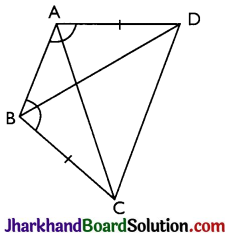
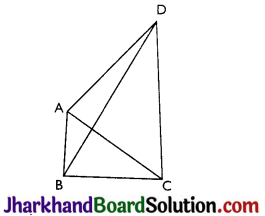
In quadrilateral ACBD, AC = AD and AB bisects ∠A (see Fig). Show that ΔABC ≅ ΔABD. What can you say about BC and BD?
JAC Class 9 Maths Solutions Chapter 7 Triangles Ex 7.1 - 1
Answer:
Given: AC = AD and AB bisects ∠A
To prove: ΔABC ≅ ΔABD
Proof: In AABC and AABD,
AB = AB (Common)
AC = AD (Given)
∠CAB = ∠DAB (AB is bisector)
Therefore, ΔABC ≅ ΔABD by SAS congruence criterion.
BC = BD (By CPCT).

JAC Class 9 Maths Solutions Chapter 7 Triangles Ex 7.1

Page-119

Question 2.
ABCD is a quadrilateral in which AD = BC and ∠DAB = ∠CBA (see Fig). Prove that
(i) ΔABD ≅ ΔBAC
(ii) BD = AC
(iii) ∠ABD = ∠BAC.
JAC Class 9 Maths Solutions Chapter 7 Triangles Ex 7.1 - 2
Answer:
Given: AD = BC and ∠DAB = ∠CBA
Proof:
(i) In ΔABD and ΔBAC,
AB = BA (Common)
∠DAB = ∠CBA (Given)
AD = BC (Given)
Therefore, ΔABD ≅ ΔBAC by SAS
congruence criterion.

(ii) Since, ΔABD ≅ ΔBAC Therefore, BD = AC (by CPCT)

(iii) Since, ΔABD ≅ ΔBAC Therefore, ∠ABD = ∠BAC (by CPCT)

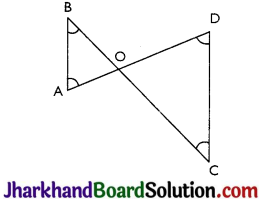
Question 3.
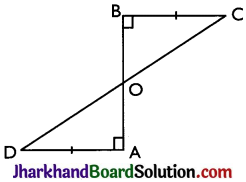
AD and BC are equal perpendiculars to a line segment AB (see Fig). Show that CD bisects AB.
JAC Class 9 Maths Solutions Chapter 7 Triangles Ex 7.1 - 3
Answer:
Given: AD and BC are perpendiculars to AB.
To prove: CD bisects AB i.e. OA = OB
Proof: In ΔAOD and ΔBOC,
∠A = ∠B = 90° (Perpendicular)
∠AOD = ∠BOC (Vertically opposite angles)
AD = BC (Given)
Therefore, ΔAOD ≅ ΔBOC by AAS congruence criterion.
Now, AO = OB (CPCT) i.e. CD bisects AB.

Question 4.
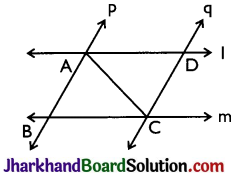
l and m are two parallel lines intersected by another pair of parallel lines p and q (see Fig). Show that ΔABC ≅ ΔCDA.
JAC Class 9 Maths Solutions Chapter 7 Triangles Ex 7.1 - 4
Answer:
Given: l || m and p || q
To prove: ΔABC ≅ ΔCDA
Proof: In ΔABC and ΔCDA,
As l || m
∴ ∠BCA = ∠DAC
(Alternate interior angles) AC = CA (Common)
As p 11q
∴ ∠BAC = ∠DCA (Alternate interior angles)
Therefore, ΔABC ≅ ΔCDA by ASA congruence criterion.

JAC Class 9 Maths Solutions Chapter 7 Triangles Ex 7.1

Question 5.
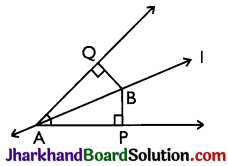
Line l is the bisector of an angle ∠A and B is any point on P. BP and BQ are perpendiculars from B to the arms of ∠A (See Fig.) Show that
JAC Class 9 Maths Solutions Chapter 7 Triangles Ex 7.1 - 5
(i) ΔAPB ≅ ΔAQB
(ii) BP = BQ or B is equidistant from the arms of ∠A.
Answer:
Given: l is the bisector of an angle ∠A.
BP and BQ are perpendiculars.
Proof:
(i) In AAPB and AAQB,
∠P = ∠Q (Right angles)
∠BAP = ∠BAQ (l is bisector)
AB = AB (Common)
Therefore, ΔAPB ≅ ΔAQB by AAS congruence criterion.

(ii) BP = BQ by CPCT.
(∵ ΔAPB ≅ ΔAQB)
Therefore, B is equidistant from the arms of ∠A.

Page-120

Question 6.
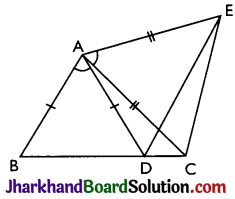
In Fig, AC = AE, AB = AD and ∠BAD = ∠EAC. Show that BC = DE.
JAC Class 9 Maths Solutions Chapter 7 Triangles Ex 7.1 - 6
Answer:
Given: AC = AE, AB = AD and ∠BAD = ∠EAC
To prove: BC = DE
Proof: ∠BAD = ∠EAC
∠BAD + ∠DAC = ∠EAC + ∠DAC (Adding ∠DAC both sides)
⇒ ∠BAC = ∠EAD
In AABC and AADE,
AC = AE (Given)
∠BAC = ∠EAD AB = AD (Given)
Therefore, ΔABC ≅ ΔADE by SAS congruence criterion.
BC = DE (by CPCT).

Question 7.
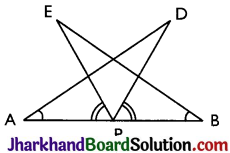
AB is a line segment and P is its mid¬point. D and E are points on the same side of AB such that ∠BAD = ∠ABE and ∠EPA = ∠DPB (see Fig). Show that
JAC Class 9 Maths Solutions Chapter 7 Triangles Ex 7.1 - 7
(i) ΔDAP ≅ ΔEBP
(ii) AD = BE
Answer:
Given: P is mid-point of AB.
∠BAD = ∠ABE and ∠EPA = ∠DPB
Proof:
(i) ∠EPA = ∠DPB
∠EPA + ∠DPE = ∠DPB + ∠DPE (Adding ∠DPE both sides)
⇒ ∠DPA = ∠EPB
In ΔDAP and ΔEBP,
∠DPA = ∠EPB
AP = BP (P is mid-point of AB)
∠BAD = ∠ABE (Given)
Therefore, ΔDAP ≅ ΔEBP by ASA congruence criterion.

(ii) AD = BE (by CPCT)

JAC Class 9 Maths Solutions Chapter 7 Triangles Ex 7.1

Question 8.
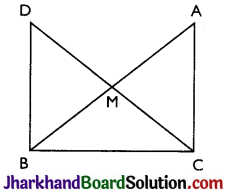
In right triangle ABC, right angled at C, M is the mid-point of hypotenuse AB. C is joined to M and produced to a point D such that DM = CM. Point D is joined to point B (see Fig). Show that:
JAC Class 9 Maths Solutions Chapter 7 Triangles Ex 7.1 - 8
(i) ΔAMC ≅ ΔBMD
(ii) ∠DRC is a right angle.
(iii) ΔDBC ≅ ΔACB
(iv) CM = \(\frac{1}{2}\)AB
Answer:
Given: ∠C = 90°, M is the mid-point of AB and DM = CM
Proof:
(i) In ΔAMC and ΔBMD,
AM = BM (M is the mid-point of AB)
∠CMA = ∠DMB (Vertically opposite angles)
CM = DM (Given)
Therefore, ΔAMC ≅ ΔBMD by SAS congruence criterion.

(ii) ∠ACM = ∠BDM (by CPCT)
Therefore, AC || BD as alternate interior angles are equal.
Now, ∠ACB + ∠DBC = 180° (co-interior angles)
⇒ 90° + ∠DBC = 180°
⇒ ∠DBC – 90°

(iii) In ΔDBC and ΔACB,
BC = CB (Common)
∠ACB = ∠DBC (Right angles)
DB = AC (by CPCT)
Therefore, ΔDBC ≅ ΔACB by SAS congruence criterion.

(iv) DC = AB (CPCT)
DM + CM = AB
⇒ CM + CM = AB (∵ DM = CM)
⇒ CM = AB
⇒ CM = \(\frac{1}{2}\) AB

JAC Class 9 Maths Solutions Chapter 2 Polynomials Ex 2.4

Jharkhand Board JAC Class 9 Maths Solutions Chapter 2 Polynomials Ex 2.4 Textbook Exercise Questions and Answers.

JAC Board Class 9th Maths Solutions Chapter 2 Polynomials Ex 2.4

Question 1.
Determine which of the following polynomials has (x + 1) a factor:
(i) x3 + x2 + x + 1
(ii) x4 + x3 + x2 + x + 1
(iii) x4 + 3x3 + 3x2 + x + 1
(iv) x3 – x2 – (2 + \( \sqrt{2} \))x + \( \sqrt{2} \)
Answer:
(i) If (x + 1) is a factor of p(x)
=x3 + x2 + x + 1, p(-1) must be zero.
p(-1) = (-1)3 + (-1)2 + (-1) + 1
= – 1 + 1 – 1 + 1 = 0
Therefore, x + 1 is a factor of this polynomial.

(ii) If (x+ 1) is a factor of p(x)
= x4 + x3 + x2 + x + 1, p(-1) must be zero.
∴ p(-1) = (-1)4 + (-1)3 + (-1)2 + (-1) + 1
= 1 – 1 + 1 – 1 + 1 = 1 ≠ 0
Therefore, x + 1 is not a factor of this polynomial.

(iii) If (x + 1) is a factor of polynomial
x4 + 3x3 + 3x2 + x + 1, p(-1) must be 0.
P(-1) = (-1)4 + 3(-1)3 + 3(-1)2 + (-1) + 1
= 1 – 3 + 3 – 1 + 1 = 1 ≠ 0
Therefore, x + 1 is not a factor of this polynomial.

(iv) If (x + 1) is a factor of polynomial
p(x) = x3 – x2 – (2 + \( \sqrt{2} \))x + \( \sqrt{2} \) , p(-1) must be 0.
p(-1) = (-1)3 – (-1)2 – (2 + \( \sqrt{2} \))(-1) + \( \sqrt{2} \)
= -1 – 1 + 2 + \( \sqrt{2} \) + \( \sqrt{2} \)
= 2\( \sqrt{2} \) ≠ 0
Therefore, x + 1 is not a factor of this polynomial.

JAC Class 9 Maths Solutions Chapter 2 Polynomials Ex 2.4

Question 2.
Use the Factor Theorem to determine whether g(x) is a factor of p(x) in each of the following cases:
(i) p(x) = 2x3 + x2 – 2x – 1, g(x) = x + 1
(ii) p(x) = x3 + 3x2 + 3x + 1, g(x) = x + 2
(iii) p(x) = x3 – 4x2 + x + 6, g(x) = x – 3
Answer:
(i) If g(x) = x + 1 is a factor of given polynomial p(x), then p(- 1) must be zero.
P(-1) = 2(-1)3 + (-1)2 – 2(-1) – 1
= 2(-1) + 1 + 2 – 1 = 0
Hence, g(x) = x + 1 is a factor of p(x).

(ii) If g(x) = x + 2 is a factor of given polynomial p(x),then p(-2) must be 0.
p(-2) = (-2)3 + 3(-2)2 + 3(-2) + 1
= – 8 + 12 – 6 + 1 = -1 ≠ 0
Hence g(x) = x + 2 is not a factor of p(x).

(iii) If g(x) = x – 3 is a factor of given polynomial p(x), then p(3) must be 0.
p(3) = (3)3 – 4(3)2 + 3 + 6 = 27 – 36 + 9 = 0

Therefore, g(x) = x – 3 is a factor of p(x).

Page – 44

Question 3.
Find the value of k, if x – 1 is a factor of p(x) in each of the following cases:
(i) p(x) = x2 + x + k
(ii) p(x) = 2x2 + kx + \( \sqrt{2} \)
(iii) p(x) = kx2 – \( \sqrt{2} \) x + 1
(iv) p(x) = kx2 – 3x + k
Answer:
(i) If x – 1 is a factor of polynomial p(x)
= x2 + x + k, then p(1) = 0
⇒ (1)2+ 1 + k = 0
⇒ 2 + k = 0
⇒ k = – 2
Therefore, value of k is – 2.

(ii) If x – 1 is a factor of polynomial p(x) = 2x2 + kx + \( \sqrt{2} \) , then p(1) = 0
⇒ 2(1)2 + k(1) + = 0
⇒ 2 + k + \( \sqrt{2} \) = 0
⇒ k = – 2 – \( \sqrt{2} \) = – (2 + \( \sqrt{2} \))
Therefore, value of k is – (2 + \( \sqrt{2} \) ).

(iii) If x – 1 is a factor of polynomial p(x) = kx2 – \( \sqrt{2} \) x + 1, then p(1) = 0
⇒ k(1)2 – \( \sqrt{2} \) (1) + 1 = 0
⇒ k – \( \sqrt{2} \) +1 = 0
⇒ k = \( \sqrt{2} \) – 1
Therefore, value of k is \( \sqrt{2} \) – 1.

(iv) If x – 1 is a factor of polynomial p(x) = kx2 – 3x + k, then p(1) = 0
⇒ k(1)2 – 3(1) + k = 0
⇒ k – 3 + k= 0
⇒ 2k – 3 = 0
Therefore, value of k is \(\frac{3}{2}\)

Question 4.
Factorise:
(i) 12x2 – 7x + 1
(ii) 2x2 + 7x + 3
(iii) 6x2 + 5x – 6
(iv) 3x2 – x – 4
Answer:
(i) 12x2 – 7x + 1
= 12x2 – 4x – 3x+ 1
= 4x (3x – 1) – 1 (3x – 1)
= (3x – 1) (4x – 1)

(ii) 2x2 + 7x + 3
= 2x2 + 6x + x + 3
= 2x (x + 3) + 1 (x + 3)
= (x + 3) (2x + 1)

(iii) 6x2 + 5x – 6
= 6x2 + 9x – 4x – 6
= 3x (2x + 3) – 2 (2x + 3)
= (2x + 3) (3x – 2)

JAC Class 9 Maths Solutions Chapter 2 Polynomials Ex 2.4

(iv) 3x2 – x – 4
= 3x2 – 4x + 3x – 4
= x (3x – 4) + 1 (3x – 4)
= (3x – 4) (x + 1)

Question 5.
Factorise:
(i) x3 – 2x2 – x + 2
(ii) x3 – 3x2 – 9x – 5
(iii) x3 + 13x2 + 32x + 20
(iv) 2y3 + y2 – 2y – 1
Answer:
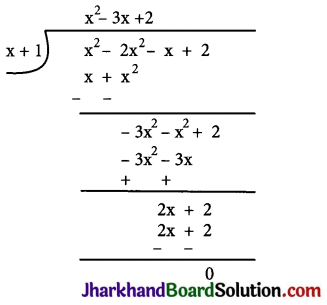
(i) Let p(x) = x3 – 2x2 – x + 2
Factors of 2 are ±1 and ± 2
By trial method, we find that p(-1) = 0
So, (x + 1) is factor of p(x)
JAC Class 9 Maths Solutions Chapter 2 Polynomials Ex 2.4 - 1
Now, Dividend = Divisor × Quotient + Remainder
= (x + 1) (x2 – 3x + 2)
= (x + 1) (x2 – x – 2x + 2)
= (x+ 1) {x(x – 1) – 2(x – 1)}
= (x + 1) (x – 1) (x – 2)

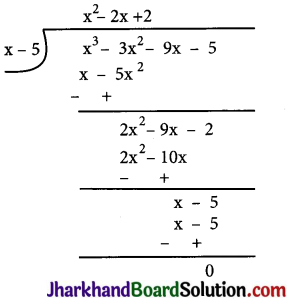
(ii) Let p(x) = x3 – 3x2 – 9x – 5
Factors of 5 are ±1 and ±5
By trial method, we find that
p(5) = 0
So, (x – 5) is factor of p(x)
JAC Class 9 Maths Solutions Chapter 2 Polynomials Ex 2.4 - 2
Now, Dividend = Divisor × Quotient + Remainder
= (x – 5) (x2 + 2x + 1)
= (x – 5) (x2 + x + x + 1)
= (x – 5) {x(x + 1) +l(x + 1)}
= (x – 5) (x + 1) (x + 1)

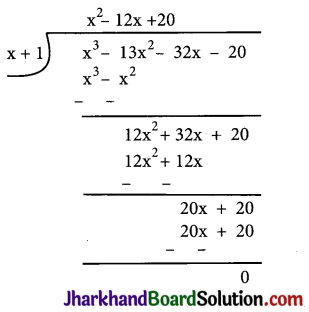
(iii) Let p(x) = x3 + 13x2 + 32x + 20
Factors of 20 are ±1, ±2, ±4, ±5, ±10 and ±20
By trial method, we find that
P(-1) = 0
So, (x+1) is factor ofp(x)
JAC Class 9 Maths Solutions Chapter 2 Polynomials Ex 2.4 - 3
Now, Dividend = Divisor × Quotient + Remainder
= (x + 1) (x2 + 12x + 20)
= (x + 1) (x2 + 2x + 10x + 20)
= (x + 1) {x(x+2) +10(x+2)}
= (x + 1) (x+2) (x+10)

JAC Class 9 Maths Solutions Chapter 2 Polynomials Ex 2.4

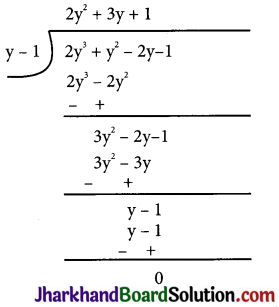
(iv) Let p(y) = 2y3 + y2 – 2y – 1
Factors of ab = 2 × (-1) = – 2 are ±1 and ±2
By trial method, we find that p(1) = 0
So, (y – 1) is factor of p(y)
JAC Class 9 Maths Solutions Chapter 2 Polynomials Ex 2.4 - 4
Now, Dividend = Divisor × Quotient + Remainder
= (y – 1) (2y2 + 3y + 1)
= (y – 1) (2y2 + 2y + y + 1)
= (y – 1) {2y(y + 1) + 1(y + 1)}
= (y – 1 )(2y + 1) (y + 1)

JAC Class 9 Maths Solutions Chapter 1 Number Systems Ex 1.5

Jharkhand Board JAC Class 9 Maths Solutions Chapter 1 Number Systems Ex 1.5 Textbook Exercise Questions and Answers.

JAC Board Class 9th Maths Solutions Chapter 1 Number Systems Exercise 1.5

Question 1.
Classify the following numbers as rational or irrational:
(i) 2 – \(\sqrt{5}\)
(ii) (3 + \( \sqrt{23}\)) – \(\sqrt{23}\)
(iii) \(\frac{2 \sqrt{7}}{7 \sqrt{7}}\)
(iv) \(\frac{1}{\sqrt{2}}\)
(v) 2π
Answer:
(i) 2 – \(\sqrt{5}\) = 2 – 2.2360679…
= -0.2360679…
Since the number is non-terminating non-recurring therefore, it is an irrational number.

(ii) (3 + \(\sqrt{23}\)) – \(\sqrt{23}\)
3 + \( \sqrt{23}\) – \(\sqrt{23}\)
= 3 = \(\frac{3}{1}\)
The number is rational number as it can represented in \(\frac{p}{q}\) form, where p, q ∈ Z, q ≠ 0

(iii) \(\frac{2 \sqrt{7}}{7 \sqrt{7}}\)
The number is rational number as it can represented in \(\frac{p}{q}\) form, where p, q ∈ Z, q ≠ 0

(iv) \(\frac{1}{\sqrt{2}}\)
= 0.7071067811…
Since the number is non-terminating non-recurring therefore, it is an irrational number.

(v) 2π = 2 × 3.1415… = 6.2830…
Since the number is non-terminating non-recurring therefore, it is an irrational number.

Question 2.
Simplify each of the following expressions:
(i) (3 + \(\sqrt{3}\)) (2 + \(\sqrt{2}\))
(ii) (3 + \(\sqrt{3}\)) (3 – \(\sqrt{3}\))
(iii) (\(\sqrt{5}\) + \(\sqrt{2}\))2
(iv) (\(\sqrt{5}\) – \(\sqrt{2}\))(\(\sqrt{5}\) + \(\sqrt{2}\))
Answer:
(i) (3 + \(\sqrt{3}\)) (2 + \(\sqrt{2}\))
= 3 × 2 + 2\(\sqrt{3}\) + 3\(\sqrt{2}\) + \(\sqrt{3}\) ×\(\sqrt{2}\)
= 6 + 2\(\sqrt{3}\) + 3\(\sqrt{2}\) + \(\sqrt{6}\)

(ii) (3 + \(\sqrt{3}\)) (3 – \(\sqrt{3}\))
= 32– (\(\sqrt{3}\))2 = 9 – 3 = 6
[∵ (a + b) (a – b) = a2 – b2]

(iii) (\(\sqrt{5}\) + \(\sqrt{2}\))2
= (\(\sqrt{5}\))2 + (\(\sqrt{2}\))2 + 2 × \(\sqrt{5}\) × \(\sqrt{2}\)
[∵ (a + b)2 = a2 + b2 + 2ab]
= 5 + 2 + 2 × \(\sqrt{5}\) ×\(\sqrt{2}\)
= 7 + 2\(\sqrt{10}\)

(iv) (\(\sqrt{5}\) – \(\sqrt{2}\))(\(\sqrt{5}\) + \(\sqrt{2}\))
= (\(\sqrt{5}\))2 – (\(\sqrt{2}\))2
= 5 – 2 = 3
[∵ (a + b) (a – b) = a2 – b2]

JAC Class 9 Maths Solutions Chapter 1 Number Systems Ex 1.5

Question 3.
Recall, 7t is defined as the ratio of the circumference (say c) of a circle to its diameter (say d). That is, n = c/d. This seems to contradict the fact that n is irrational. How will you resolve this contradiction?
Answer:
There is no contradiction. When we measure a value with a scale, we only obtain an approximate value. We never obtain an exact value. Therefore, we may not realise that either c or d is irrational. The value of n is almost equal to 22/7 or 3.14159…

Question 4.
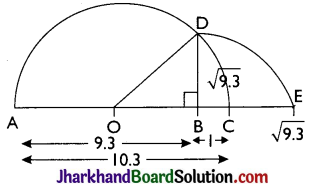
Represent \(\sqrt{9.3}\) on the number line.
Answer:
Step 1: Draw a line segment AB of 9.3 units. Extend it to C so that BC is of 1 unit.
Step 2: Now, AC = 10.3 units. Find the midpoint of AC and name it as O.
Step 3: Draw a semicircle with radius OC and centre O.
Step 4: Draw a perpendicular line segment BD to AC at point B which intersects the semicircle at D. Also, Join OD.
Step 5: Now, OBD is a right angled triangle.
JAC Class 9 Maths Solutions Chapter 1 Number Systems Ex 1.5 - 1
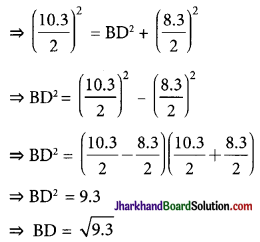
Here, OD = 10.3/2 (radius of semicircle),
OC = \(\frac{10.3}{2}\), BC = 1
OB = OC – BC = (\(\frac{10.3}{2}\)) – 1 = \(\frac{8.3}{2}\)
Using Pythagoras theorem
OD2 = BD2 + OB2
JAC Class 9 Maths Solutions Chapter 1 Number Systems Ex 1.5 - 2
Thus, the length of BD is \(\sqrt{9.3}\) units.

Step 6: Taking BD as radius and B as centre draw an arc which touches the line segment AC extended at the point E. The point E is at a distance of \(\sqrt{9.3}\) from B as shown in the figure.

JAC Class 9 Maths Solutions Chapter 1 Number Systems Ex 1.5

Question 5.
Rationalise the denominators of the following:
(i) \(\frac{1}{\sqrt{7}}\)
(ii) \(\frac{1}{\sqrt{7}-\sqrt{6}}\)
(iii) \(\frac{1}{\sqrt{5}+\sqrt{2}}\)
(iv) \(\frac{1}{\sqrt{7}-2}\)
Answer:
(i) \(\frac{1}{\sqrt{7}}\) = \(\frac{1 \times \sqrt{7}}{\sqrt{7} \times \sqrt{7}}\) = \(\frac{\sqrt{7}}{7}\)

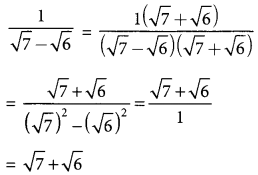
(ii) \(\frac{1}{\sqrt{7}-\sqrt{6}}\)
JAC Class 9 Maths Solutions Chapter 1 Number Systems Ex 1.5 - 3

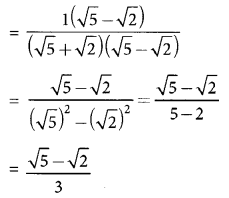
(iii) \(\frac{1}{\sqrt{5}+\sqrt{2}}\)
JAC Class 9 Maths Solutions Chapter 1 Number Systems Ex 1.5 - 4

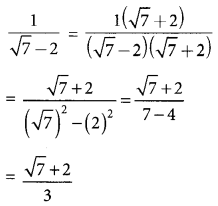
(iv) \(\frac{1}{\sqrt{7}-2}\)
JAC Class 9 Maths Solutions Chapter 1 Number Systems Ex 1.5 - 5

JAC Class 9 Maths Solutions Chapter 7 Triangles Ex 7.5

Jharkhand Board JAC Class 9 Maths Solutions Chapter 7 Triangles Ex 7.5 Textbook Exercise Questions and Answers.

JAC Board Class 9th Maths Solutions Chapter 7 Triangles Ex 7.5

Page-133

Question 1.
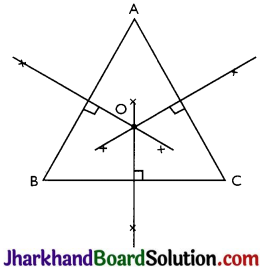
ABC is a triangle. Locate a point in the interior of ΔABC which is equidistant from all the vertices of ΔABC.
JAC Class 9 Maths Solutions Chapter 7 Triangles Ex 7.5 - 1
Answer:
In ΔABC, we can find the circumcentre by drawing the perpendicular bisectors of sides AB, BC and CA of this triangle. 0 is the point where these bisectors meet. Therefore, O is the point which is equidistant from all the vertices of ΔABC.

Question 2.
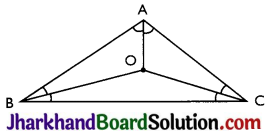
In a triangle locate a point in its interior which is equidistant from all the sides of the triangle.
Answer:
The point which is equidistant from all the sides of a triangle is called the incentre of the triangle. Incentre of a triangle is the intersection point of the angle bisectors of the interior angles of that triangle.
JAC Class 9 Maths Solutions Chapter 7 Triangles Ex 7.5 - 2
In ΔABC, we can the find the incentre of this triangle by drawing the angle bisectors of the interior angles ∠A, ∠B and ∠C of this triangle. O is the point where these angle bisectors meet. Therefore, O is the point equidistant from all the sides of ΔABC.

JAC Class 9 Maths Solutions Chapter 7 Triangles Ex 7.5

Question 3.
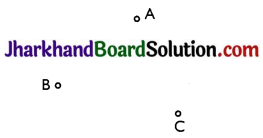
In a huge park people are concentrated at three points (see the given figure)
A: where there are different slides and swings for children,
B: near which a man-made lake is situated.
C: which is near to a large parking and exit.
JAC Class 9 Maths Solutions Chapter 7 Triangles Ex 7.5 - 3
Answer:
Maximum number of persons can approach the ice-cream parlour if it is equidistant from A, B and C. Now, A, B and C form a triangle. In a triangle, at the circumcentre is the only point that it equidistant from its vertices. So, the ice-cream parlour should be set up at the circumcentre of ΔABC.

Question 4.
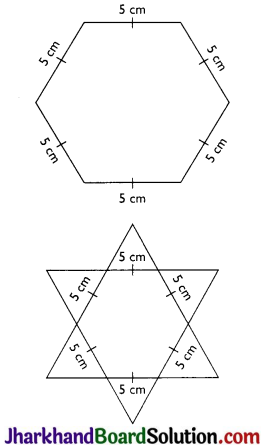
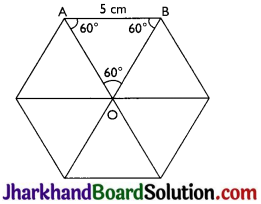
Complete the hexagonal and star shaped rangolies (see the given figure) by filling them with as many equilateral triangles of side 1 cm as you can. Count the number of triangles in each case. Which has more triangles?
JAC Class 9 Maths Solutions Chapter 7 Triangles Ex 7.5 - 4
Answer:
It can be observed that hexagonal-shaped rangoli has 6 equilateral triangles in it.
JAC Class 9 Maths Solutions Chapter 7 Triangles Ex 7.5 - 5
Area of ∆OAB = \(\frac{\sqrt{3}}{4}\) (side)2 = \(\frac{\sqrt{3}}{4}\) (5)2
= \(\frac{\sqrt{3}}{4}\) (25) = \(\frac{25 \sqrt{3}}{4}\) cm2

Area of hexagonal-shaped rangoli
= \(6 \times \frac{25 \sqrt{3}}{4}=\frac{75 \sqrt{3}}{2}\) cm2

Area of equilateral triangle having its side as 1 cm = \(\frac{\sqrt{3}}{4}\) (1)2 = \(\frac{\sqrt{3}}{4}\) cm2

Number of equilateral triangles of 1 cm side that can be filled in this hexagonal-shaped rangoli
= \(\frac{\frac{75 \sqrt{3}}{2}}{\frac{\sqrt{3}}{4}}\) = 150
Star-shaped rangoli has 12 equilateral triangles of side 5 cm in it.
JAC Class 9 Maths Solutions Chapter 7 Triangles Ex 7.5 - 6
Area of star-shaped rangoli
= \(12 \times \frac{\sqrt{3}}{4} \times(5)^2=75 \sqrt{3}\) cm2

Number of equilateral triangles of 1 cm side that can be filled in this star-shaped rangoli
= \(\frac{75 \sqrt{3}}{\frac{\sqrt{3}}{4}}\) = 300
Therefore, star-shaped rangoli has more equilateral triangles in it.

JAC Class 9 Maths Solutions Chapter 8 Quadrilaterals Ex 8.2

Jharkhand Board JAC Class 9 Maths Solutions Chapter 8 Quadrilaterals Ex 8.2 Textbook Exercise Questions and Answers.

JAC Board Class 9th Maths Solutions Chapter 8 Quadrilaterals Ex 8.2

Page-150

Question 1.
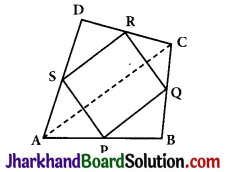
ABCD is a quadrilateral in which P, Q, R and S are mid-points of the sides AB, BC, CD and DA (see Fig). AC is a diagonal. Show that:
(i) SR || AC and SR = \(\frac {1}{2}\)AC
(ii) PQ = SR
(iii) PQRS is a parallelogram.
JAC Class 9 Maths Solutions Chapter 8 Quadrilaterals Ex 8.2 - 1
Answer:
(i) In ΔDAC,
R is the mid-point of DC and S is the mid-point of DA.
Thus by mid-point theorem, SR || AC and SR = \(\frac {1}{2}\)AC

(ii) In ΔBAC,
P is the mid-point of AB and Q is the mid-point of BC.
Thus by mid-point theorem, PQ || AC
and PQ = \(\frac {1}{2}\) AC
Also, SR = \(\frac {1}{2}\) AC
Thus, PQ = SR

(iii) SR || AC (Proved)
and, PQ || AC (Proved)
⇒ SR || PQ (Lines parallel to same line are parallel to each other)
Also, PQ = SR(Proved)
Thus, PQRS is a parallelogram.
(A quadrilateral in which a pair of sides is equal and parallel is a parallelogram).

JAC Class 9 Maths Solutions Chapter 8 Quadrilaterals Ex 8.2

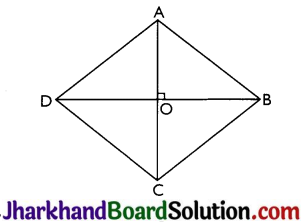
Question 2.
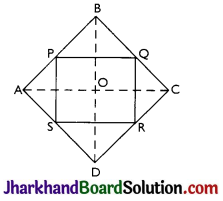
ABCD is a rhombus and P, Q, R and S are the mid-points of the sides AB, BC, CD and DA respectively. Show that the quadrilateral PQRS is a rectangle.
JAC Class 9 Maths Solutions Chapter 8 Quadrilaterals Ex 8.2 - 2
Answer:
Given: ABCD is a rhombus and P, Q, R and S are the mid-points of the sides AB, BC, CD and DA respectively.

To Prove: PQRS is a rectangle.

Construction: AC and BD are joined.

Proof: P and Q are mid-points of AB and BC respectively
⇒ PQ || AC and PQ = \(\frac{1}{2}\) AC …(i)
(By mid-point theorem)
Also, S are R are mid-points of AD and CD respectively, so, by mid-point theorem,
SR || AC and SR = \(\frac{1}{2}\)AC …(ii)
From (i) and (ii)
∴ PQ || SR and PQ = SR
⇒ PQRS is a parallelogram
As ABCD is a rhombus
AB = BC (sides of rhombus)
⇒ \(\frac{1}{2}\) AB = \(\frac{1}{2}\) BC
⇒ BP = BQ (As P and Q are mid-points of AB and BC respectively)
So, in ΔBPQ
∠BPQ = ∠BQP …(i)
(Angles opposite to equal sides are equal)
Also, BC = CD (Sides of rhombus)
⇒ \(\frac{1}{2}\) BC = \(\frac{1}{2}\) CD
⇒ CQ = CR (As Q and R are midpoint of BC and CD respectively)
So, in ACQR
∠CQR = ∠CRQ …(ii) (Angle opposites to equal sides are equal)
AB || CD (Opposite sides of a parallelogram)
⇒ ∠B + ∠C =180 …(iii)
(sum of angles on same sides of transversal is 180°)

In ΔBPQ, ∠BPQ + ∠BQP + ∠B = 180° (Angles sum property)
In ΔCQR, ∠CQR + ∠CRQ + ∠C = 180° (Angle sum property)

On adding both the equations, we get
∠BPQ + ∠BQP + ∠B + ∠CQR + ∠CRQ + ∠C = 360°
⇒ 180° + ∠BPQ + ∠BQP + ∠CQR + ∠CRQ = 360° [From (ii)]
⇒ 180° + 2 ∠BQP + 2 ∠CQR = 360° [From (i) and (ii)]
⇒ 2 (∠BQP + ∠CQR) = 360° – 180° = 180°
⇒ ∠BQP + ∠CQR = \(\frac{180°}{2}\) = 90° …(iv)

Now, ∠BQP + ∠CQR + ∠PQR = 180° (sum of angles on a straight line is 180°)
90° + ∠PQR = 180° [From (iv)]
⇒ ∠PQR = 180° – 90° = 90°
So, PQRS is a parallelogram in which one angle is 90°
⇒ PQRS is a rectangle.

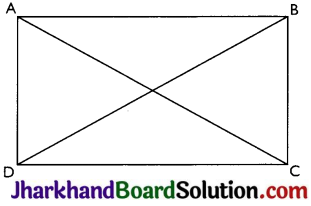
Question 3.
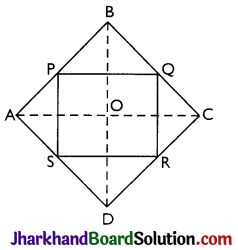
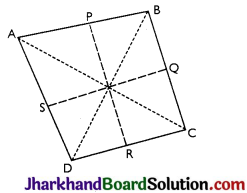
ABCD is a rectangle and P, Q, R and S are mid-points of the sides AB, BC, CD and DA respectively. Show that the quadrilateral PQRS is a rhombus.
JAC Class 9 Maths Solutions Chapter 8 Quadrilaterals Ex 8.2 - 3
Answer:
Given: ABCD is a rectangle and P, Q, R and S are mid-points of the sides AB, BC, CD and DA respectively.
To Prove PQRS is a rhombus.
Construction: AC and BD are joined.
Proof: In ∆ABC
P and Q are the mid-points of AB and BC respectively
Thus, PQ || AC and PQ = \(\frac{1}{2}\) AC (Mid-point theorem) …(i)
In ∆ADC, SR AC and SR = \(\frac{1}{2}\) AC (Mid-point theorem) …(ii)
From (i) and (ii)
∴ PQ = SR and PQ || SR
⇒ PQRS is a parallelogram.
(As in quadrilateral PQRS one pair of opposite sides is equal and parallel to each other, so, it is a parallelogram.)
AB = CD (opposite sides of rectangle)
⇒ AB = CD
⇒ BP = CR(As P and R are midpoints of AB and CD respectively)

Consider ∆PBQ and ∆RCQ
BP = CR (Proved)
BQ = CQ [As Q is a mid-point of BC]
∠B = ∠C = 90° (As each angle of a rectangle ABCD is of 90°)
⇒ ΔPBQ ≅ ΔRCQ by SAS congruence criterion.
⇒ PQ = QR (CPCT)
Also, PQ = RS and PS = QR (As opposite sides of parallelogram are equal)
∴ PQ = QR = RS = PS
So, PQRS is a parallelogram in which all sides are equal.
⇒ PQRS is a rhombus.

JAC Class 9 Maths Solutions Chapter 8 Quadrilaterals Ex 8.2

Question 4.
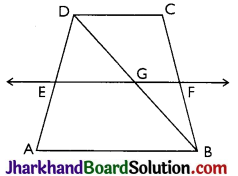
ABCD is a trapezium in which AB || DC, BD is a diagonal and E is the mid-point of AD. A line is drawn through E parallel to AB intersecting BC at F (see Fig). Show that F is the mid-point of BC.
JAC Class 9 Maths Solutions Chapter 8 Quadrilaterals Ex 8.2 - 4
Answer:
Given: ABCD is a trapezium in which AB || DC, BD is a diagonal and E is the mid-point of AD.
To prove: F is the mid-point of BC.
Proof: BD intersects EF at G.
In ∆BAD,
E is the mid-point ofAD andalsoEG || AB.
Thus, G is the mid-point of BD (Converse of mid-point theorem)
Now, EG || AB
⇒ EF || AB
⇒ GF || AB
Also, AB || CD
∴ CD || GF (Lines parallel to same line are parallel to each other)

In ABCD, G is a mid-point of BD and CD || GF
⇒ F is a mid-point of BC (By converse of mid-point theorem)
Now, in ∆BDC,
G is the mid-point of BD and also GF || AB || DC.
Thus, F is the mid-point of BC (Converse of mid-point theorem)

Page-151

Question 5.
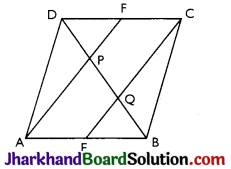
In a parallelogram ABCD, E and F are the mid-points of sides AB and CD respectively (see Fig). Show that the line segments AF and EC trisect the diagonal BD.
JAC Class 9 Maths Solutions Chapter 8 Quadrilaterals Ex 8.2 - 5
Answer:
Given: ABCD is a parallelogram. E and F are the mid-points of sides AB and CD respectively.
To prove: AF and EC trisect the diagonal BD.
Proof: ABCD is a parallelogram.
Therefore, AB || CD, also, AE || FC
Now, AB = CD (Opposite sides of parallelogram ABCD)
⇒ \(\frac{1}{2}\) AB = \(\frac{1}{2}\) CD
⇒ AE = FC (E and F are midpoints of sides AB and CD)
AECF is a parallelogram
(AE and CF are parallel and equal to each other)
AF || EC (Opposite sides of a parallelogram)

Now, in ADQC,
⇒ F is mid-point of side DC and FP || CQ (as AF || EC).
P is the mid-point of DQ (Converse of mid-point theorem)
⇒ DP = PQ …………(i)
Similarly, in AAPB,
E is mid point of side AB and EQ || AP (as AF || EC).
Q is the mid-point of PB (Converse of mid-point theorem)
⇒ PQ = QB ………….. (ii)

From equations (i) and (i),
DP = PQ = BQ
Hence, the line segments AF and EC trisect the diagonal BD.

JAC Class 9 Maths Solutions Chapter 8 Quadrilaterals Ex 8.2

Question 6.
Show that the line segments joining the mid-points of the opposite sides of a quadrilateral bisect each other.
JAC Class 9 Maths Solutions Chapter 8 Quadrilaterals Ex 8.2 - 6
Answer:
Let ABCD be a quadrilateral and p, Q, R and S are the mid-points of AB, BC, CD and DA respectively.

Now, In ∆ACD, R and S are the mid-points of CD and DA respectively.
Thus SR || AC and SR = \(\frac{1}{2}\) AC (by mid-point theorem)
Also, in DABC, P and Q are mid-point of AB and BC respectively
⇒ PQ || AC and PQ = \(\frac{1}{2}\) AC (by mid-point theorem)
So, PQ = SR and PQ || SR.
Thus, PQRS is parallelogram, [since one pair of opposite sides is equal and parallel]
PR and QS are the diagonals of the parallelogram PQRS.
So, they will bisect each other. (As diagonals of a parallelogram bisect each other.)

Question 7.
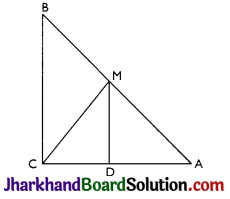
ABC is a triangle right angled at C. A line through the mid-point M of hypotenuse AB and parallel to BC intersects AC at D. Show that
(i) D is the mid-point of AC
(ii) MD ⊥ AC
(iii) CM = MA = \(\frac {1}{2}\)AB
JAC Class 9 Maths Solutions Chapter 8 Quadrilaterals Ex 8.2 - 7
Answer:
(i) In ∆ACB
M is the mid-point of AB and MD|| BC
Thus, D is the mid-point of AC (Converse of mid-point theorem)

(ii) ∠ACB = ∠ADM (Corresponding angles)
As ∠ACB = 90°
Thus, ∠ADM = 90° i.e. MD ⊥ AC

(iii) In ∆AMD and ∆CMD,
AD = CD (D is the mid-point of side AC)
∠ADM = ∠CDM (Each 90°)
DM = DM (common)
Thus, ΔADM ≅ ΔCDM by SAS congruence criterion.
AM = CM by CPCT
also, AM = \(\frac{1}{2}\) AB (M is mid point of AB)
Hence, CM = MA = \(\frac{1}{2}\) AB

JAC Class 9 Social Science Solutions Geography Chapter 2 Physical Features of India

JAC Board Class 9th Social Science Solutions Geography Chapter 2 Physical Features of India

JAC Class 9th Geography Physical Features of India InText Questions and Answers 

Find Out (Page No. 8)

Question 1.
The names of the glaciers and passes that lie in the Great Himalayas?
Answer:
Glaciers in the Great Himalayas: Siachin, Milam, Gangotri, Bhagirathi, Baltoro, Pindari.
Passes in the Great Himalayas: Burgil, Zoji La, Shipki La, Bara Lacha La, Nathu La, Bomdi La, Thaga La, Lipulekh La.

JAC Class 9 Social Science Solutions Geography Chapter 2 Physical Features of India

Question 2.
The name of the states where highest peaks are located.
Answer:

Highest PeaksStates
KanchenjungaSikkim
Nanga ParbatJammu & Kashmir (Union Territory)
Nanda DeviUttarakhand
KametUttarakhand
Namcha BarwaArunachal Pradesh

Question 3.
Find the location of Mussoorie, Nainital, Ranikhet from your atlas and also name the state where they are located.
Answer:

PlaceStates
MussoorieUttarakhand
NainitalUttarakhand
RanikhetUttarakhand


JAC Class 9th Geography Physical Features of India Textbook Questions and Answers 

Question 1.
Choose the right answer from the four alternatives given below:
1. A landmass bounded by sea on three sides is referred to as:
(a) Coast
(b) Island
(c) Peninsula
(d) None of the above.
Answer:
(c) Peninsula

2. Mountain ranges in the eastern part of India forming its boundary with Myanmar are collectively called as:
(a) Himachal
(b) Uttarakhand
(c) Purvachal
(d) None of the above.
Answer:
(c) Purvachal

3. The Western Coastal Strip, south of Goa is referred to as:
(a) Coromandel
(b) Konkan
(c) Kannad
(d) Northern Circar
Answer:
(c) Kannad

4. The highest peak in the Eastern Ghats is:
(a) Anai Mudi
(b) Kanchenjunga
(c) Mahendragiri
(d) Khasi
Answer:
(c) Mahendragiri

JAC Class 9 Social Science Solutions Geography Chapter 2 Physical Features of India

Question 2.
Answer the following questions briefly:
1. What is the ‘bhabar’?
Answer:
Bhabar is a narrow belt of plain which is about 8 to 16 km wide. It is covered with pebbles deposited by rivers lying parallel to the slopes of the Shiwaliks.

2. Name the three major divisions of the Himalayas from North to South
Answer:
(a) The Great or Inner Himalayas or the ‘Himadri’.
(b) The Middle or Lesser Himalayas or the ‘Himachal’.
(c) The Outer Himalayas or the ‘Shiwaliks’.

3. Which plateau lies between the Aravalli and the Vindhya ranges?
Answer:
The Malwa Plateau.

4. Name the island group of India having a coral origin.
Answer:
The Lakshadweep Islands.

Question 3.
Distinguish between:
1. Bhangar and Khadar
2. Western Ghats and Eastern Ghats.
Answer:
1. Difference between Bhangar and Khadar:

BhangarKhadar
1. It is the older alluvial soil.1. It is the newer alluvial soil.
2. It often contains kankar or nodules with calcium carbonates in sub-soil.2. It is finer, more sandy and free from kankar nodules.
3. Bangar is not renewed frequently. Hence, it is less fertile.3. Khadar is renewed frequently and is more fertile.
4. It is found away from the river at a higher ground level.4. It is found near river channels, in deltas and in floodplains.

2. Difference between Western Ghats and Eastern Ghats:

Western GhatsEastern Ghats
1. The Western Ghats form the western side or edge of the Deccan Plateau.1. The Eastern Ghats form the eastern side or edge of the Deccan Plateau.
2. These Ghats are regular and comparatively higher in elevation.2. These ghats have a relatively lower elevation.
3. These lie parallel to the western coast.3. These lie parallel to the eastern coast.
4. Their average elevation is 900-1600 metres.4. Their average elevation is 600 metres.
5. They are continuous and can be crossed through passes only.5. They are discontinuous and irregular and dissected by rivers draining into the Bay of Bengal.
6. The highest peak is Anai Mudi.6. The highest peak is Mahendragiri.
7. Soil is highly fertile. Rice, spices, rubber, coconuts, cashew nuts, etc. are grown.7. Soil is relatively less fertile. Groundnuts, rice, cotton, tobacco, coconuts, etc. are grown

JAC Class 9 Social Science Solutions Geography Chapter 2 Physical Features of India

Question 4.
Which are the major physiographic divisions of India? Contrast the relief of the Himalayan region with that of the Peninsular Plateau.
Answer:
The major physiographic divisions of India are:

  1. The Himalayan Mountains
  2. The Northern Plains
  3. The Peninsular Plateau
  4. The Indian Desert
  5. The Coastal Plains
  6. The Islands

The contrast between the relief of the Himalayan region with that of the Peninsular Plateau is as follows:

The Himalayan RegionThe Peninsular Plateau
1. These are young fold mountains.1. These are a part of the oldest structure of the earth’s crust.
2. These are formed of sedimentary rocks.2. These are formed of igneous and metamorphic rocks.
3. These consists of three parallel ranges: Himadri, Himachal, Shiwa- liks.3. It consists of two sections: The Central Highlands, The Deccan Plateau
4. Mostly glaciers and passes are found in this region.4. Glaciers and passes are not found in this region.
5. These contain the highest mountains.5. These are formed of low hills.
6. It is the origin of snow-fed, perennial rivers.6. It has rainfed, seasonal rivers.

Question 5.
Give an account of the Northern Plains of India.
Answer:
A description of the Northern Plains of India is given hereunder:

  1. The Northern plains lie to the south of the Himalayas.
  2. The Northern plains have been formed by the interplay of the three major river systems, namely, the Indus, the Ganga and the Brahmaputra along with then tributaries.
  3. It spreads over an area of 7 lakhs sq. km. It is about 2400 km long and 240 to 320 km broad.
  4. It is formed of alluvial soil.
  5. With a rich soil cover combined with adequate water supply and favourable climate, it is agriculturally a very productive part of India.
  6. On the basis of the difference in the relief, the plain is divided into four sections
    • Bhabar,
    • Tarai,
    • Bhangar,
    •  Khadar.

JAC Class 9 Social Science Solutions Geography Chapter 2 Physical Features of India

Question 6.
Write short notes on the following:
1. The Indian Desert
2. The Central Highlands
3. The Island Groups of India.
Answer:
1. The Indian Desert:
(a) The Indian desert lies towards the western margins of the Aravalli Hills.

(b) It is an undulating sandy plain covered with sand dunes called Barchans.

(c) This region receives very low rainfall: below 150 mm per year.

(d) It has an arid climate with low vegetation cover.

(e) Luni is the only large river in this region.

2. The Central Highlands :
(a) The part of the Peninsular plateau lying to the North of the Narmada river, covering a major area of the Malwa plateau, is known as the Central Highlands.

(b) The Vindhyan range is bounded by the Satpura range on the south and the Aravallis on the North-West. The further westward extension gradually merges with the sandy and rocky desert of Rajasthan.

(c) The flow of the rivers draining this region, namely, the Chambal, the Kalisindh, the Betwa and the Ken is from South-West to North-East, thus, indicating the slope.

(d) The Central Highlands are wider in the west but narrower in the east. The eastward extensions of this plateau are locally known as the Bundelkhand and Baghelkhand.

(e) The Chotanagpur plateau marks the further eastward extension, drained by the Damodar river.

3. The Island Groups of India:
(a) The Lakshadweep and the Andaman and Nicobar islands are the two main island groups of India.

(b) The Lakshadweep Islands group lies close to the Malabar coast of Kerala. This group of islands is composed of small coral islands. It covers a small area of 32 sq.km. Kavaratti island is the capital of Lakshadweep.

(c) The Andaman and Nicobar islands located in the Bay of Bengal extend from North to South. They are bigger in size and are more numerous and scattered. Port Blair is the capital of this island group.

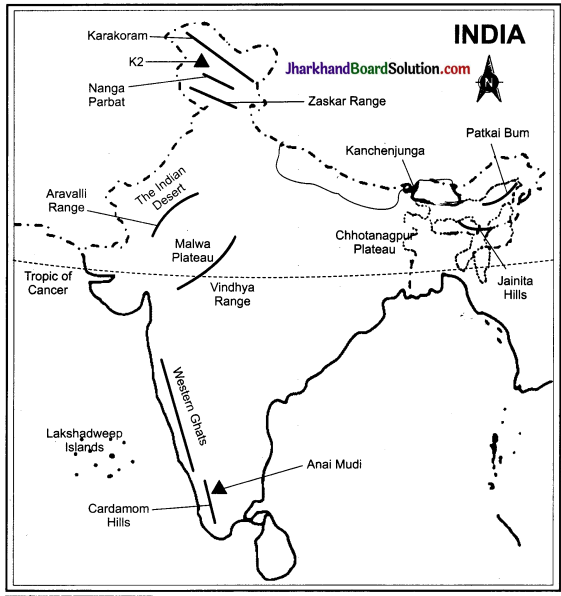
On an outline map of India, show the following:
1. Mountain and hill ranges: the Karakoram, the Zaskar, The Patkai Bum, the Jaintia, le Vindhya range, the Aravalli, and the Cardamom hills.
2. Peaks: K2, Kanchenjunga, Nanga Parbat and the Anai Mudi.
3. Plateaus: Chhota Nagpur and Malwa.
4. The Indian Desert, Western Ghats, Lakshadweep Islands.
Answer:
JAC Class 9 Social Science Solutions Geography Chapter 2 Physical Features of India 1
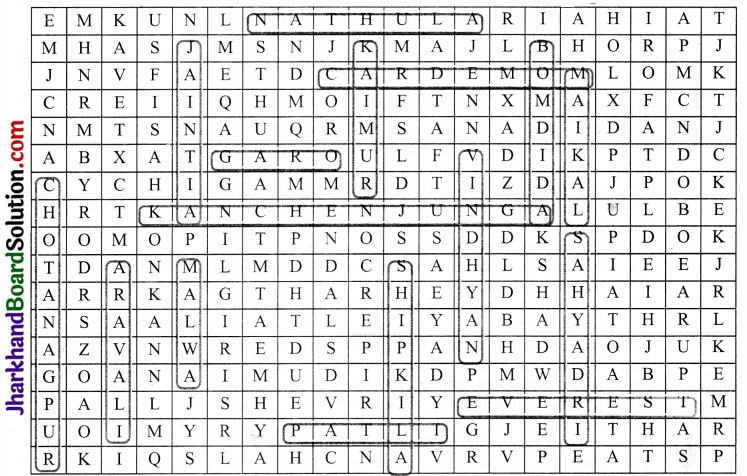
Locate the peaks, passes, ranges, plateaus, hills and dunes hidden in the puzzle. Try t find where these features are located. You may start your search horizontally, vertically diagonally.
JAC Class 9 Social Science Solutions History Chapter 5 Pastoralists in the Modern World 3
Answer:
Peaks: Kanchenjunga, Everest, Anai Mudi, Aravali

Passes: Nathu La, Shipki La, Bomdi La.

Ranges: Maikal, Sahyadri, Vindhyan.

Plateau: Chotanagpur, Malwa.

Hills: Jaintia, Kaimur, Garo, Nilgiri, Cardamom

Students can locate the above features on a map under the guidance of their teacher

JAC Class 9 Social Science Solutions

JAC Class 9 Social Science Solutions History Chapter 4 Forest Society and Colonialism

JAC Board Class 9th Social Science Solutions History Chapter 4 Forest Society and Colonialism

JAC Class 9th History Forest Society and Colonialism InText Questions and Answers 

Activity (Page No. 81)

Question 1.
Each mile of railway track required between 1,760 and 2,000 sleepers. If one average sized tree yields 3 to 5 sleepers for a 3 metre wide broad gauge track, calculate approximately how many trees would have to be cut to lay one mile of track.
Answer:
Average number of sleepers required to lay one mile railway track = \(\frac{1760+2000}{2}=1880 \)
Average number of sleepers made by 1 tree = \(\frac{3+5}{2}=4\)
Thus, number of trees would have to be cut to lay one mile of track = \(\frac{1880}{4}=470 \)
Approximately, 470 trees would have to be cut to lay one mile of track.

Activity (Page No. 83)

Question 1.
If you were the Government of India in 1862 and responsible for supplying the railways with sleepers and fuel on such a large scale, what were the steps you would have taken?
Answer:
if I were the Government of India in 1862 and responsible for supplying the railways with sleepers and fuel on such a large scale, I would have taken the following steps:

  1. I would have planned a systematic utilisation of the forest wealth; rules about the use of forest resources would have been framed.
  2. Instead of using wood, iron or stone would have been used for making sleepers. Coal is used as fuel for running the railways engines.
  3. Along with cutting down the forests, a plan for afforestation on a large-scale would have been initiated simultaneously.

Activity (Page No. 86)

Question 1.
Children living around forest areas can often identify hundreds of species of trees and plants. How many species of trees can you name?
Answer:
Fruiting Trees: Mango, Guava, Lemon, Banana etc.
Medicinal Plants: Tulsi, Neem, Babool, Sarpagandha etc.

Activity (Page No. 96)

Question 1.
Have there been changes in forest areas where you live ? Find out what these changes are and why they have happened.
Answer:
Yes, there have been many changes in forest areas where I live. These changes are as follows :

  1. There have been strict restrictions on the hunting of wild animals.
  2. A tremendous increase in the number of wild animals could be seen in these areas.
  3. There have been many check posts of forests protection offices established.
  4. Smuggling of elephant’s teeth and skin of tiger has been strictly prohibited.
  5. There have been cleaning of rivers flowing through the forest areas. These changes have been made to protect the environment.

JAC Class 9 Social Science Solutions History Chapter 4 Forest Society and Colonialismn

Question 2.
Write a dialogue between a colonial forester and an adivasi discussing the issue of hunting in the forest.
Answer:
A Sample dialouge is given below:
Colonial Forester: Who are you? What are you doing in this forest?

Adivasi: Sir, I am an adivasi. I live in nearby village. I came here to collect fruits and for hunting rabbits.

Colonial Forester: Don’t you know about the prohibition of hunting in forests?

Adivasi: But Sir, my children are hungry since five days. I came here to fulfill their food requirements.

Colonial Forester: I don’t care about it. I just know that hunting in forest is illegal. It is a crime and you will deserve a punishment for this.

Adivasi: But sir, this is our forest. Means if we, advasis, are restricted from hunting, then what other work we people will do? How will we care our family and our daily needs? Our family will die of starvation.

Colonial Forester: Look, you are arguing with me

Adivasi: Sir, we are dependent on these forests. Please let us do hunting. We will give you a share of our hunt.

Colonial Forester: Shut up! No, not at all. I have to report about you to our Forest Officer. Come with me.
Colonial forester arrests the adivasi and takes him away to his officer.

JAC Class 9th History Forest Society and Colonialism Textbook Questions and Answers 

Question 1.
Discuss how the changes in forest management in the colonial period affected the*) following groups of people:
1. Shifting cultivators
2. Nomadic and pastoralist communities
3. Firms trading in timber/forest produce.
4. Plantation owners
5. Kings/British officials engaged in shikar (hunting).
Answer:
1. Shifting cultivators:
Restriction on shifting cultivation resulted in displacement of many communities from their homes in the forests. Many were reduced to the level of starvation. Many changed their occupation and some became labourers.

2. Nomadic and Pastoralist Communities:
The forest laws deprived people of their customary rights and that meant severe hardship for the Nomadic and Pastoralist communities. They could not cut wood for their houses could not graze their cattle or collect fruits and roots, and hunting and fishing were declared illegal. Some of the nomadic communities began to be called ‘Criminal Tribes’ and were instead forced to work in factories, mines and plantations under government supervision. They were also recruited for work in plantations. Their wages were low and conditions of work were very bad.

3. Firms trading in timber/forest produce:
Under the new forest laws, lucrative opportunities opened up in the trade of forest products, specially timber. However, the trade was completely regulated under colonial government. The British governments gave many large European trading firms the sole right to trade in the forest products of particular areas.

4. Plantation owners:
Changes in forest management favoured the plantation owners who were mostly Europeans. They were given free land to destroy natural forests to make way for tea, coffee and rubber plantation, to meet the Europeans’ growing need for these commodities. But the workers on these plantations were paid very low wages. They had to live in very bad conditions;

5. Kings/British officials engaged in shikar (hunting):
Hunting of tiger and other animals had been a part of the culture of the court and nobility for centuries. The British saw large animals as a sign of a wild, primitive and savage society. Therefore, they provided strong incentives to encourage people to take guns and kill these dangerous animals. This hunting as a game for pleasure flourished under the new forest laws.

JAC Class 9 Social Science Solutions History Chapter 4 Forest Society and Colonialismn

Question 2.
What are the similarities between colonial management of the forests in Bastar and in Java ?
Answer:
Bastar is located in the southernmost part of Chhattisgarh in India, while Java is located in Indonesia. The colonial power in India was the British, while in Java it was the Dutch. The similarities between colonial management of the forests in Bastar and Java are as follows :

  1. A large number of trees were cut down for shipbuilding and railways.
  2. There was restriction on hunting at the both places.
  3. Nomads and pastoralists were restricted to enter the forests.
  4. In both of the places defaulters of forests laws were punished, harassed and
  5. Both Bastar and Java witnessed rebellion against rulers.
  6. Both the governments displaced the local communities from their traditional livelihood in order to make full use of the forest produce.
  7. Both restricted the villagers from practising shifting cultivation.

Question 3.
Between 1880 and 1920, forest cover in the Indian subcontinent declined by 9.7 million hectares, from 108.6 million hectares to 98.9 million hectares. Discuss the role of the following factors in this decline :
1. Railways
2. Shipbuilding
3. Agricultural expansion .
4. Commercial farming
5. Tea/Coffee plantations
6. Adivasis and other peasant users.

1. Railways:
Colonial rulers needed sleepers to lay railway lines which were made of hard wood. Each mile of railway track required more than 1800 sleepers. By 1890, about 25,500 km of track had been laid. As the railway tracks spread through India, a larger and larger number of trees were felled. Forests around the railway tracks started disappearing fast. Wood was used as a fuel to run the locomotives.

2. Shipbuilding:
By the early nineteenth century, there was shortage of oak
trees in England which were the basic input for ship industry. This created a problem of timber supply for the Royal Navy. By the 1820s, search parties were sent to explore the forest resources of India. Within a decade, trees were being felled on a massive scale and vast quantities of timber were being exported from India. ‘

3. Agricultural expansion: In 1600, approximately one sixth of the total of India’s land area was under cultivation but now it is 42% because of the increasing population. In the early nineteenth century, the colonial state thought that forests were unproductive. They were considered to be wilderness that had to be brought under cultivation, so that the land could yield agricultural products and revenue, and enhance the income of the state. So, between 1880 and 1920, cultivated area rose by 6.7 million hectares.

4. Commercial farming:
Commercial farming was also responsible for deforestation. The Britishers directly encouraged the production of commercial crops like jute, sugar, cotton, tea, wheat etc. They encouraged their production because these crops were required as raw material and cereals were required to feed the growing urban population of Europe. Thus, forests were cleared for growing commercial crops.

5. Tea/Coffee plantations:
Large areas of forests were also cleared to make way for plantation crops like tea, coffee and rubber. These crops were grown to meet the Europeans’ growing demand. Plantation owners made big profits, making the workers work for long hours and at low wages.

6. Adivasis and other peasant users:
Adivasis and peasants cleared forests for shifting cultivation and commercial farming. Apart from this, they cut down the trees for fuel.

JAC Class 9 Social Science Solutions History Chapter 4 Forest Society and Colonialismn

Question 4.
Why are forests affected by wars?
Answer:
Forests are affected by wars due to various reasons which are as follow :

  1. In the modern times, the defending armies hid themselves and their war material under the cover of the thick forests to avoid detection. As such the enemy forces target forest areas to capture the opposing soldiers and their war materials.
  2. Because of pre-occupation of the participant countries in the war, many proposals for promoting the forests culture have to be abandoned half-way and many such forests became prey of neglect.
  3. To meet war needs, sometimes forests are cut indiscriminately and as a result forests vanished with no times one after the other.
  4. Fearing the capture of forest areas by the enemy, sometimes the existing governments themselves cut down the trees recklessly, destroy the saw mills and bum huge piles of logs.
  5. Finding the forest staff in difficulty and engaged during the war times, some people expand their agricultural land at the cost of the forest land.

JAC Class 9 Social Science Solutions

JAC Class 9 Social Science Solutions History Chapter 3 Nazism and the Rise of Hitler

JAC Board Class 9th Social Science Solutions History Chapter 3 Nazism and the Rise of Hitler

JAC Class 9th History Nazism and the Rise of Hitler InText Questions and Answers 

Activity (Page No. 61)

Question 1.
Read Sources A and B :
1. What do they tell you about Hitler’s imperial ambition?
2. What do you think Mahatma Gandhi would have said to Hitler about these ideas?
Answer:
1. The two texts (Source ‘A’ and Source ‘B’) tell that Hitler’s imperialistic ambition was to expand the boundaries of Germany till wherever they could possibly reach. In Source ‘A’ he believed that an aggressive nation will find methods to adjust its teritory to its population’s size. In source ‘B’, he was comparing Germany’s size to that of Russia and wanted Germany to become a world power of similar size.

2. Mahatma Gandhi held a strongly opposite view. He believed in non-violence and peaceful co-existence of different races, communities and nations. Gandhi would have told Hitler to drop the idea of aggression against other nations from his mind, as violence begets violence.

Activity (Page No. 63)

Question 1.
What does citizenship mean to you? Look at Chapters 1 and 3 and write 200 words on how the French Revolution and Nazism defined citizenship.
Answer:
For me, Citizenship is a fundamental right of any person to live in his birth country or any favourable country. The French Revolution and Nazism both defined citizenship with different points of view.

1. French Revolution:
As per the French Revolution, all men are equal and free by birth and their rights are also equal. Freedom, prosperity, protection and protest against exploitation are the initial rights of a citizen. All men are free to express their views and to reside at any place of their choice. In a democratic country, there is rule of law and no one is above the law.

2. Citizenship in the view of Nazism:
Nazism defined citizenship on the basis of racial hierarchy. Therefore, they denied the citizenship of the Jews. Moreover, they treated them very cruelly and threw out them from Germany.

JAC Class 9 Social Science Solutions History Chapter 3 Nazism and the Rise of Hitler

Question 2.
What did the Nuremberg Laws mean to the ‘undesirables’ in Nazi Germany? What other legal measures were taken against them to make them feel unwanted?
Answer:
Basically, The Nuremberg Laws of citizenship of September 1935, meant that the ‘undesirables’ had no right to live along with the other citizens. These included Jews, Gypsies, Blacks and other nationalities like Polish and Russian people. Following other legal measures were taken against them to make them feel unwanted :

  1. Only persons of German or related blood would henceforth to be German citizens, enjoying the protection of the German empire.
  2. Marriages between Jews and Germans were forbidden.
  3. Extramarital relations between Jews and Germans were declared a crime.

Activity (Page No. 66)

Question 1.
If you were a student sitting in one of these classes, how would you have felt towards Jews?
Answer:
If I had been a student sitting in one of these classes, I would have felt very bad as I would be missing my friends who used to play with me earlier. I would have felt sympathetic towards them and would have hated the Nazi government for this action. Other legal measures included:

  1. Boycott of Jewish businesses.
  2. Expulsion from government services.
  3. Forced selling and confiscation of their properties.
  4. Jews were forbidden to hoist the national flag.

Question 2.
Have you ever thought of the stereotyped of other communities that people around you believe in? How have they acquired them?
Answer:
I have thought about the stereotypes of other communities that we believe in. They usually inherit from their forefathers and the traditions and customs of the community to which they belong.

Activity (Page No. 67)

Question 1.
Look at Figs. 23, 24 and 27. Imagine yourself to be a Jew or a Pole in Nazi Germany. It is September 1941, and the law forcing Jews to wear the Star of David has just been declared. Write an account of one day in your life.
Answer:
I was roaming on the streets of Berlin. I was very hungry and thirsty. I was searching for a gentle German lady who could give me a loaf of bread. But Alas! This could be my never ending search. Soon I heard a noise of a crowd which was chasing some boys. The people told me to enter in that crowd. All people wore a Star of David. As I felt that they were also Jews like me, I also ran along with them but unfortunately I was caught with them and all of us were thrown into the concentration camp.

Activity (Page No. 69)

Question 1.
How would you have reacted to Hitler’s ideas if you were:
1. A Jewish woman
2. A non-Jewish German woman
Answer:

  1. As a Jewish woman, I would have reacted with fear sense of insecurity, anger and hatred.
  2. As a non-Jewish German woman, I would try to mobilise support secretly and help the victims of Nazi persecution.

Question 2.
What do you think this poster (Fig. 28) is trying to depict?
Answer:
I think this poster is trying to make mockery of the Jews by projecting them as money hungry.

Activity (Page No. 70)

Question 1.
Look at Figs. 29 and 30 and answer the following: What do they tell us about Nazi propaganda? How are the Nazis trying to mobilise different sections of the population?
Answer:
From figure 29 and 30, we learn about the Nazi propaganda that they conduct in order to win the support of the working classes. The second poster is telling them to vote for Hitler, who has fought of the frontline in World War II. The first poster is condemning the Capitalists and Bolsheviks, because they are enemies of Nazism. By this method, the Nazis tried to mobilise different sections of the society to their cause.

Activity (Page No. 71)

Question 1.
Why does Erna Kranz say, ‘I could only say for myself? How do you view her opinion?
Answer:
Erna Kranz was telling Lawrence Rees about his personal experiences of the 1930s. According to him, people were now seeing hope. People’s salary has increased. Germany will develop again afresh. Now a good era is about to begin.

Activity (Page No. 74)

Question 1.
Write a one page history of Germany.
1. As a school child in Nazi Germany.
2. As a Jewish survivor of a concentration camp.
3. As a political opponent of the Nazi regime.
Answer:
1. As a school child in Nazi Germany:
In Nazi Germany, the condition of school children was very miserable. The Nazis started their ideological training when the child was three years old. As soon as he even started to think, he was given a small flag to wave. Ten-year-olds had to enter Jungvolk, a Nazi school. At 14, all boys had to join the Nazi youth organization, Hitler Youth, where they learnt to worship war, glorify aggression and violence, condemn democracy, and hate Jewish communities, gypsies and all those categorised as ‘undesirable’.

After a period of rigorous ideological and physical training, they joined the labour service, usually at the age of 18. Then they had to serve in the armed forces and enter one of the Nazi organisations. In this way, their whole life was spent under the conservative thinking which was forced on them. School children were segregated from their Jewish friends. They had to read textbooks that were prepared only for advertising the Nazi ideas. Even the function of sports was to nurture a spirit of violence and aggression among children. They were forced to choose boxing for sport.

2. As a Jewish survivor of a concentration camp:
The German Nazis will be always remembered for their brutality towards the Jews. This is a black chapter of German history. Jews from Jewish houses, concentration camps and ghettos from different parts of Europe were brought to death factories by goods trains where they were brutally tortured. I am afraid still now to remember those incidents.

Although I was alive there, but I felt my death hundred times. Jews were often persecuted through periodic organised violence and torture and then sent to concentration camps. Finally, they were left in gas chambers for death. The life of Jews were very miserable even out of the concentration camps. They were terrorised, pauperised and segregated from the society, and forced to leave the country.

All Jews had to wear a yellow Star of David on their breasts. This identity mark was stamped on their passport and houses too. They were kept in Jewish houses like ghettos that became sites of extreme misery and poverty. In any case of suspection or violation of law, they were sent to concentration camps where a new period of torture was started which resulted into their death. Millions of Jews were killed in gas chambers in front of our eyes.

3. As a political opponent of the Nazi regime:
Nazi rule in Germany was built up on the foot of propaganda. Nothing would be found to acquire new territories by war. This never brings a long peace and prosperity in any country. Although, I am a strong supporter of nationalism, but Nazi meaning for nationalism was totally disagreeable to me.

To achieve German nationalism, an investment of large amount on army is not right from any point of view. Nazi behaviour towards women and children was totally unfair. To hate the Jews and worship Hitler was complete injustice to them. The history will never forgive the Nazis for their failed trial to mislead the German masses by the propaganda of their uncivilian characters.

JAC Class 9 Social Science Solutions History Chapter 3 Nazism and the Rise of Hitler

Question 2.
Imagine that you are Helmuth. You have had many Jewish friends in school and do not believe that Jews are bad. Write a paragraph on what you would say to your father.
Answer:
Dear Papa, I have many Jewish friends. We are learning to hate the Jews in our school. Jews have been thrown out from the school and taken to gas chambers for death. After all, what sin have they committed for which they are being treated like this? Why they are doing this to the Jews? Why Jews are sentenced to death illegally?

Are they not human beings like us? Do they not feel like us? Can you imagine if someone brought me to gas chamber and leave me there for death? Is the acceptance of Jewish religion a crime? If yes, then what will be the punishment for Christians whatever they are doing with Jews? Jesus will never forgive the Nazis for their brutality towards The Jews.

JAC Class 9th History Nazism and the Rise of Hitler Textbook Questions and Answers 

Question 1.
Describe the problems faced by the Weimar Republic.
Answer:
Weimar Republic faced many problems right since its birth. These were as follows:

  1. This Republic carried the burden of war guilt and was financially disabled by being forced to pay war compensation.
  2. Hyperinflation made the German mark valueless and caused immense hardship for the common man.This economic crisis led to widespread inflation, misery and despair.
  3. In the Weimar Republic, both the communists and socialists became staunch enemies and could not make common cause against Adolf Hitler.
  4. Both revolutionaries and militant nationalists craved for radical solutions, which was not easy. Within its short life, the Weimar Republic saw twenty different cabinets and the liberal use of Article 48. All this created a political crisis in Germany.
  5. It became very unpopular among the Germans because it lost the vanity of the nation to the hands of Allied powers.

Question 2.
Discuss why Nazism became popular in Germany by 1930.
Answer:
The principal causes responsible for popularising Nazism in Germany can be summed up as follows :
1. Discontent due to the Treaty of Versailles:
After defeating the Germany, Allies had imposed many unjust conditions on Germany. It was forced to accept them under the threat of aggression. The aggression gave rise to Nazism in Germany.

2. Political Instability in Germany:
Under the Weimar Republic, there existed political instability. Between 1919-1933 A.D. as many as 21 coalition governments were formed and dissolved. Policies changed frequently. Democracy failed to give any relief to the people. Hitler promised a stable and strong government. He won the support of the people.

3. Unfaithful democracy in Germany:
Germany had no tradition of running a parliamentary democracy. Germany to say the least was “a democracy without democrat”. The democracy was against the German culture and tradition. Therefore, people could not understand the functional activities of parliamentary institutions. There were deep political differences between the communists and the Nazis. Because of above reasons democracy failed to achieve faith among German citizens.

4. The Economic Crisis:
Unemployment, inflation, price-rise, ruin of German trade and industry, coupled with general world depression created economic disaster of the worst order in Germany. Hitler blamed the Weimar republic for the plight of the masses and promised relief to the people on economic front, and he won their confidence.

5. Threat of Communism:
The communists in Germany tried to stage a revolution on the pattern of the Soviet revolution of 1917 A.D. Thus, the German capitalists extended full support to Hitler’s Nazi Party as the party was against socialism.

6. Hitler’s Dynamic Personality:
Hitler had a dynamic personality. He was influential and charming. He was a great organiser, an excellent orator and a tireless worker. His passion and his words moved people. He promised to build a strong nation, undo the injustice of the Versailles Treaty and restore the dignity of the German people. His appeal touched the emotions of the people.

Question 3.
What are the peculiar features of Nazi thinking?
Answer:
The peculiar features of Nazi thinking were as follows:

  1. They believed that the strong should rule the world and the rest should accept their leadership.
  2. They believed in racial hierarchy, where the Nordic German1 Aryans were at the top and the Jews at the lowest rung.
  3. The Nazis believed that the Jews were their irreconcilable enemies. So the Jews were victimized and killed.
  4. The Nazis believed in the geopolitical concept of ‘Lebensraum’ or living space i.e., new territories had to be acquired for the German nation.
  5. Women were seen as mere bearers of the Aryan culture and race.

JAC Class 9 Social Science Solutions History Chapter 3 Nazism and the Rise of Hitler

Question 4.
Explain why Nazi propaganda was effective in creating a hatred for Jews.
Answer:
Nazi propaganda was effective in creating a hatred for Jews because of the following reasons :
1. Role of Traditional Christians:
Jews remained the worst sufferers in Nazi Germany. Nazi’s hatred for Jews had a precursor in the traditional Christian hostility towards Jews. They had been stereotyped as killers of Christ and usurers. Until medieval times, Jews were barred from owning land. They survived mainly through trade and money lending.

2. Various Theories:
The Nazis started using theories of Darwin” and Herbert Spencer to propagate against Jews. So, people started justifying their hatred for Jews as they were considered inferior race and had no right to survive according to these two theories.

3. Propaganda at School Level:
Nazis started their propaganda right from school level. School textbooks were rewritten to justify ideas of race.

4. Propaganda at Home:
Motherhood was also used by Nazis to propagate against the Jews. Mothers were supposed to teach their children Nazi values. There was a code of conduct for all the women.

5. Propaganda through Press and Radio:
The Nazi regime needed languages and media with care to propagate against the Jews. Nazi ideas were spread through visual images like films, radio, movies etc. Jews were shown as rats and pests. Various code words were used to eliminate the Jews to protect the government from the world’s reaction.

Question 5.
Explain what role women had in Nazi society. Return to Chapter 1 on the French revolution. Write a paragraph comparing and contrasting the role of women in the two periods.
Answer:
Role of Women in Nazi Society : Equality of opportunity for both sexes had become an accepted principle by democracy everywhere in the world, but in Nazi Germany, a woman was valuable only as “a mother of pure Nordic (Aryan) children”. She was encouraged to preserve the purity of Aryan race and never to get involved in love affair with a Jew or a Russian or a Pole.

Those held guilty of love making with such persons were paraded with “shaven heads” through the streets. On the other hand, women would take pride in giving birth to as many children as they could. A comparative study of the Role of Women during Nazi Rule and the French Revolution:

  1. Women played an important role in the French Revolution. They took equal part in social and political developments of their country. On the other hand, the Nazis thought that it was wrong on the part of women to demand their rights.
  2. Most of the French women had to work for a living along with the men, but German women were not allowed to work along with men.
  3. In France, both men and women were treated equal, but in Germany, women were considered nothing more than the bearers of the Aryan culture and race.
  4. French women were free to change their patterns, but there was a code of conduct for the German women. They were not allowed to mix with anyone except Nordic Aryans.

JAC Class 9 Social Science Solutions History Chapter 3 Nazism and the Rise of Hitler

Question 6.
In what ways did the Nazi state seek to establish total control over its people?
Answer:
The Nazi state seek to establish total control over its people in the following ways:
1. Political control:
Politically Germany was a single-party system where only the Nazi party could wield power. All the other parties had been banned. The state was led by as all powerful leaders. Even the army and the judiciary were controlled by the Nazi party.

2. Economic Control:
The Minister of Economies controlled all financial institutions such as banks and insurance companies. He also exercised rigid control over industries, factories and trading and commercial activities. In order to supply food to soldiers, many articles of food were rationed. Wage rates and prices of all articles of daily use were fixed.

3. Control over Education:
To propagate Nazism, the whole education system was put under the control of the state. School textbooks were rewritten. Racial science was introduced to justify the idea of race. Jewish teachers and Jewish children were thrown out of the school.

4. Control over social and cultural life:
The whole of the media, educational system and sports activities were controlled by the state. Women were declared second class citizens in Germany. Their concern should be their kitchens and giving birth to healthy children. Hundreds of thousands of Germans suffering from hereditary diseases were sterilized and thus prevented from giving birth to weak and unhealthy children.

JAC Class 9 Social Science Solutions

JAC Class 9 Maths Solutions Chapter 7 Triangles Ex 7.4

Jharkhand Board JAC Class 9 Maths Solutions Chapter 7 Triangles Ex 7.4 Textbook Exercise Questions and Answers.

JAC Board Class 9th Maths Solutions Chapter 7 Triangles Ex 7.4

Page-132

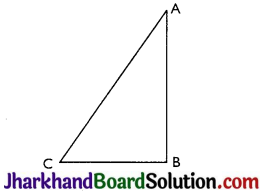
Question 1.
Show that in a right angled triangle, the hypotenuse is the longest side
JAC Class 9 Maths Solutions Chapter 7 Triangles Ex 7.4 - 1
Answer:
ABC is a triangle right angled at B.
Now,
∠A + ∠B + ∠C = 180°
⇒ ∠A + ∠C = 90° (∵ ∠B = 90°)
So ∠A < 90° and ∠C < 90°
⇒ ∠B > ∠A and ∠B > ∠C
⇒ AC > BC and AC > AB [As side opposite to larger angle is longer]

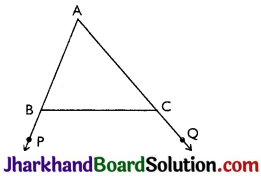
Question 2.
In Fig, sides AB and AC of AABC are extended to points P and Q respectively. Also, ∠PBC < ∠QCB. Show that AC > AB.
JAC Class 9 Maths Solutions Chapter 7 Triangles Ex 7.4 - 2
Answer:
Given: ∠PBC < ∠QCB
Proof: ∠ABC + ∠PBC = 180°
⇒ ∠PBC = 180° – ∠ABC …(i)
Also, ∠ACB + ∠QCB = 180°
⇒ ∠QCB = 180° -∠ACB
⇒ ∠PBC < ∠QCB (Given)
⇒ 180° – ∠ABC < 180° – ∠ACB
(From (i) and (ii))
⇒ – ∠ABC < – ∠ACB
⇒ ∠ABC > ∠ACB
⇒ AC > AB (As sides opposite to larger angle is longer.)

JAC Class 9 Maths Solutions Chapter 7 Triangles Ex 7.4

Question 3.
In Fig, ∠B < ∠A and ∠C < ∠D. Show that AD < BC.
JAC Class 9 Maths Solutions Chapter 7 Triangles Ex 7.4 - 3
Answer:
Given: ∠B < ∠A and ∠C < ∠D
Proof: In ΔAOB,
∠B < ∠A ⇒ AO < BO ……….(i)
(Side opposite to smaller angle is smaller)
In ΔCOD
∠C < ∠D ⇒ DO < CO…(ii)
(Side opposite to smaller angle is smaller)
Adding (i) and (ii)
AO + OD < BO + OC
⇒ AD < BC

Question 4.
AB and CD are respectively the smallest and longest sides of a quadrilateral ABCD (see Fig). Show that ∠A > ∠C and ∠B > ∠D.
JAC Class 9 Maths Solutions Chapter 7 Triangles Ex 7.4 - 4
Answer:
In ΔABD,
AB < AD (As AB is the shortest side)
∴ ∠ADB < ∠ABD ……..(i) (Angle opposite to longer side is larger.)
Now, in ΔBCD,
BC < DC (As CD is the longest side)
∴ ∠BDC < ∠CBD …..(ii) (Angle opposite to longer side is larger.)
Adding (i) and (ii), we get
∠ADB + ∠BDC < ∠ABD + ∠CBD
⇒ ∠ADC < ∠ABC
⇒ ∠B > ∠D
Similarly, in Δ ABC,
AB < BC (As AB is the smallest side)
∠ACB < ∠B AC …(iii) (Angle opposite to longer side is larger)
Now, in ΔADC,
AD < DC (As CD is the longest side)
∠DCA < ∠DAC …(iv) (Angle opposite to longer side is larger)
Adding (iii) and (iv), we get
∠ACB + ∠DCA < ∠BAC + ∠DAC
⇒ ∠BCD < ∠BAD
⇒ ∠A > ∠C

Question 5.
In Fig, PR > PQ and PS bisects ∠QPR. Prove that ∠PSR > ∠PSQ
JAC Class 9 Maths Solutions Chapter 7 Triangles Ex 7.4 - 5
Answer:
Given: PR > PQ and PS bisects ∠QPR
To prove: ∠PSR > ∠PSQ
Proof: ∠PQR > ∠PRQ …….(i)
(PR > PQ as angle opposite to longer side is larger)
∠QPS = ∠RPS …(ii) (PSbisects ∠QPR)
∠PSR = ∠PQR + ∠QPS ………(iii)
(exterior angle of a triangle equals the sum of opposite interior angles)
∠PSQ = ∠PRQ + ∠RPS …(iv)
(exterior angle of a triangle equals the sum of opposite interior angles)
Adding (i) and (ii)
∠PQR + ∠QPS > ∠PRQ + ∠RPS
⇒ ∠PSR > ∠PSQ [from (iii) and (iv)]

JAC Class 9 Maths Solutions Chapter 7 Triangles Ex 7.4

Page-133

Question 6.
Show that of all line segments drawn from a given point not on it, the perpendicular line segment is the shortest.
JAC Class 9 Maths Solutions Chapter 7 Triangles Ex 7.4 - 6
Answer:
Given: Let l is a line segment and B is a point lying on it. We draw a line segment AB perpendicular to 1. Let C be any other point on 1.
To prove: AB < AC
Proof: In ∆ABC,
∠B = 90°
Now, ∠A + ∠B + ∠C = 180°
⇒ ∠A + ∠C = 90°
⇒ ∠C < 90° (∠B = 90°)
⇒ ∠C < ∠B
∴ ∠C must be acute angle or ∠C < ∠B
⇒ AB < AC (Side opposite to the larger angle is longer.)

JAC Class 10 Sanskrit रचना वाक्य निर्माणम्

Jharkhand Board JAC Class 10 Sanskrit Solutions रचना वाक्य निर्माणम् Questions and Answers, Notes Pdf.

JAC Board Class 10th Sanskrit Rachana वाक्य निर्माणम्

पद एवं उनके वाक्य प्रयोग :

पदाधारितवाक्यानां निर्माणम्

1. राजानं – सभासदः राजानं पश्यन्ति।
2. मन्त्रिणा राजा मन्त्रिणा सह वार्ता करोति।
3. विदुषे – राजा विदुषे ग्रन्थं ददाति।
4. राज्ञः – राज्ञः वचनं पालनीयम्।

सर्वनामशब्दाधारितवाक्यानाम् निर्माणम्

1. एषा – एषा मम भगिनी।
2. भवती – भवती अध्यापिका अस्ति।
3. यूयं – यूयं संस्कृतं पठत।
4. सः – सः बालकः अस्ति।

JAC Class 10 Sanskrit रचना वाक्य निर्माणम्

उपसर्गाधारितवाक्यानाम् निर्माणम्

1. अधिवसति – शिवः कैलासम् अधिवसति।
2. अपकरोति – दुर्जनः सदा अपकरोति।
3. प्रभवति – हिमालयात् गङ्गा प्रभवति।
4. संहरति – राजा शत्रून् संहरति।

अव्ययाधारितवाक्यानाम् निर्माणम्

1. सदा – बटुः सदा पठति।
2. समया – ग्रामं समया नदी वहति।
3. प्रभृतिः – अहं बाल्यकालात् प्रभृतिः अत्र वसामि।
4. इदानीं – इदानी वृष्टिः भवति।

हलन्तशब्दाधारितवाक्यानाम् निर्माणम्

1. श्रद्धावान् – श्रद्धावान् ज्ञानं लभते।
2. वाक् – वाक् मधुरा अस्ति।
3. सरित् – सरितः वहन्ति।
4. महत् – रोगिसेवा महत् कार्यं भवति।

JAC Class 10 Sanskrit रचना वाक्य निर्माणम्

अजन्तशब्दाधारितवाक्यानाम् निर्माणम्

1. विष्णुः – विश्वस्य पालकः विष्णुः।
2. लता – अने शोभते लता।
3. धेनुः – नन्दिनी वसिष्ठस्य धेनुः।
4. अश्रुः – बालकस्य नेत्राभ्याम् एकैकम् अश्रुः पतति।

कारकाधारितवाक्यानाम् निर्माणम्

1. धिक् – धिक् दुर्जनम्। (दृष्टि व्यक्ति को धिक्कार है।)
2. सह – पुत्रः पित्रा सह गच्छति। (पुत्र पिता के साथ जाता है।)
रमेशः मया सह पठति। (रमेश मेरे साथ पढ़ता है।)
बालकाः मित्रः सह क्रीडन्ति। (बालक मित्रों के साथ खेलते हैं।)
3. नमः – गुरवे नमः। (गुरु के लिए नमस्कार है।)
4. क्रुध् – दुर्जनः सज्जनाय क्रुध्यति। (दुष्ट व्यक्ति सज्जन पर क्रोध करता है।)
पिता पुत्राय क्रुध्यति। (पिता पुत्र पर क्रोध करता है।)

प्रत्ययाधारित वाक्य निर्माणम्

1. पठित्वा – छात्रः अत्र पठित्वा गच्छति। (छात्र यहाँ पढ़कर जाता है।)
2. गत्वा – छात्रः विद्यालयं गत्वा पठति। (छात्र विद्यालय जाकर पढ़ता है।)
3. आगत्य – रामः अत्र आगत्य पठति। (राम यहाँ आकर पढ़ता है।)
4. प्रणम्य – सेवकः प्रणम्य अवदत्। (सेवक प्रणाम करके बोला।)

JAC Class 10 Sanskrit रचना वाक्य निर्माणम्

पदाधारित वाक्य निर्माणम्

1. आसन् – बालकाः कक्षायाम् आसन्। (बालक कक्षा में थे।)
2. कुर्वन्ति – छात्राः गृहकार्यं कुर्वन्ति। (छात्र गृहकार्य करते हैं।)
3. अपतत् – सोहनः अश्वात् अपतत्। (सोहन घोड़े से गिर पड़ा।)
4. गच्छताम् – तौ गृहं गच्छताम्। (वे दोनों घर जावें।)

अभ्यासः

प्रश्न 1.
अधोलिखितशब्दानां सहायतया वाक्यनिर्माणं कुरुत-(निम्न शब्दों की सहायता से वाक्य-निर्माण कोजिए।)
[जीवितम्, शरणम्, दशनैः, निर्मलम्, करणीयम्, भृशम्, नगरात्, कान्तारे, क्षणमपि, कलरवः, जनेभ्यः, वनप्रदेशम्।]
उत्तरम् :
जीवितम् – प्रदूषितपर्यावरणे जीवितं कठिनं जातम्। (प्रदूषित पर्यावरण में जीवन कठिन हो गया है।)
शरणम् – श्रीकृष्णः शरणं मम। (श्रीकृष्ण मेरे आश्रय हैं।)
दशनैः – मानवः दशनैः भोजनं खादति। (मनुष्य दाँतों से खाना खाता है।)
निर्मलम् – निर्मलम् एव जलं पिबेत्। (शुद्ध जल ही पीना चाहिए।)
करणीयम् – कर्त्तव्यम् एव करणीयम्। (करने योग्य कार्य करना चाहिए।)
भृशम् – अद्य जलं भृशं दूषितम्। (आज पानी बहुत प्रदूषित है।)
नगरात – नगरात बहिरेव एकम् उद्यानम् अस्ति। (नगर के बाहर ही एक बाग है।)
कान्तारे – सीता निर्जनकान्तारे रामेण सह अगच्छत्। (सीता निर्जन वन में राम के साथ गई।)
क्षणमपि – न कश्चित् क्षणमपि तिष्ठति अकर्मकृत्। (कोई क्षणभर भी बिना काम किए नहीं रहता।)
कलरवः – खगानां कलरवः अतिमनोहरः भवति। (पक्षियों का कलरव मनोहर होता है।)
जनेभ्यः – स्वस्ति स्यात् जगतां जनेभ्यः। (संसार के लोगों का कल्याण हो।)
वनदेशम् – पशवः प्रातरेव वनप्रदेशं गच्छन्ति। (पशु प्रातः ही वन प्रदेश को जाते हैं।)

JAC Class 10 Sanskrit रचना वाक्य निर्माणम्

प्रश्न 2.
अधोलिखितानां पदानां सहायतया वाक्यनिर्माणं कुरुत-(निम्नलिखित शब्दों की सहायता से वाक्य बनाइए-)
[विमुक्ता, पितुहम्, दृष्ट्वा]
उत्तरम् :
विमुक्ता – सा व्याघ्रमारी निजबुद्ध्या व्याघ्रभयाद् विमुक्ता। (वह व्याघ्रमारी अपनी बुद्धि से बाघ के भय से मुक्त हो गई।)
पितुर्ग्रहम् – नार्यः रक्षाबन्धनोत्सवे पितुर्गृहं गच्छन्ति। (स्त्रियाँ रक्षाबन्धन के त्यौहार पर पिता के घर जाती हैं।)
दृष्ट्वा – सिंह दृष्ट्वा भयाद् असौ पलायितवान्। (सिंह को देखकर डर से वह भाग गया।)

प्रश्न 3.
अधोलिखितशब्दानां सहायतया वाक्यानां निर्माणं कुरुत- (निम्नलिखित शब्दों की सहायता से वाक्य का निर्माण कीजिए)-
[कृत्वा, सुखम्, समन्ततः, गात्राणाम्, लाघवम्, सुविभक्तता, आरोग्य, परमम्, पिपासा, सहसा]
उत्तरम् :
कृत्वा – सा गृहकार्यं कृत्वा विद्यालयं गच्छति। (वह गृहकार्य करके विद्यालय को जाती है।)
सुखम् – यावत् जीवेत् सुखं जीवेत्। (जब तक जीओ सुख से जीओ।)
समन्ततः – जनाः समन्ततः तत्र आगताः (लोग सभी ओर से वहाँ आ गये।)
गात्राणाम् – गात्राणाम् अनीशोऽहमस्मि। (मैं अपने अंगों का भी स्वामी नहीं हूँ।)
लाघवम् – मनुष्यः प्रयत्नलाघवम् अनुसरति। (मनुष्य प्रयत्न लाघव का अनुसरण करता है। )
सुविभक्तता – गात्राणाम् अपि सुविभक्तता शोभते। (अंगों का सुन्दर विभाजन शोभा देता है।)
आरोग्यम् – आरोग्यं परमं सुखम्। (नीरोग होना सबसे बड़ा सुख है।)
परमम् – दारिद्रयं परमापदां पदम्। (दरिद्रता महान आपदाओं का स्थान है।)
पिपासा – ग्रीष्मे पिपासा अतिबाधते। (गर्मियों में प्यास अधिक कष्ट देती है।)
सहसा – सहसा विदधीत न क्रियाम्। (अकस्मात् कोई काम नहीं करना चाहिए।)

प्रश्न 4.
अधोलिखितशब्दानां सहायतया वाक्यनिर्माणं कुरुत – (निम्नलिखित शब्दों की सहायता से वाक्य-निमाण कीजिए-)
[उपसृत्य, अलम्, लालनीयः, खलु, नामधेयम्, धिक, अपूर्वः, श्लाघ्या, त्वरयति।]
उत्तरम् :
उपसृत्य – रामः जनकम् उपसृत्य प्रणमति। (राम पिता के पास जाकर प्रणाम करता है।)
अलम् – अलं विवादेन। (विवाद मत करो।)
लालनीयः – शिशु पित्रोः लालनीयः भवति। (बच्चा पिता का लाडला होता है।)
खलु – मा खलु चापलं कुरु। (निश्चित ही चपलता मत करो !)
नामधेयम् – किं ते नामधेयम् ? (तेरा क्या नाम है ?)
धिक् – धिक् त्वाम्। (तुझे धिक्कार है।)
अपूर्वः – अपूर्वः कोऽपि कोशोऽयं विद्यते तव भारती। (हे सरस्वती ! यह तुम्हारा खजाना अनोखा है।)
श्लाघ्या – श्लाघ्या इयं रामायणी कथा। (यह रामायण की कथा सराहनीय है।)
त्वरयति – श्रमस्य फलं मां त्वरयति। (श्रम का फल मुझसे जल्दी करवा रहा है।)

JAC Class 10 Sanskrit रचना वाक्य निर्माणम्

प्रश्न 5.
अधोलिखित पदानां सहायताया वाक्य निर्माणं कुरुत। (निम्न पदों से वाक्य बनाइये)
[हलमा पपात, जवन, कषावल, वषभ, भारम, धेनूनाम्, अश्रूणि, वासवः, बोदुम्।]
उत्तरम् :
हलम् – वृषभौ हलम् स्कन्धो धृत्वा क्षेत्रं गच्छतः। (बैल हल लेकर खेत पर जाते हैं।)
पपात – एकं पाषाण खण्डं उपरितः पपात तेन सः हतः। (एक पत्थर का टुकड़ा ऊपर से गिरा, जिससे वह मर गया।)
जवेन – सः जवेन गच्छति एव, मार्गेऽहं मिलितवान्। (वह तेज गति से जा ही रहा था कि रास्ते में मैं मिल गया)
कृषीवलः – कृषीवल: अन्नमुत्पादयति। (किसान अन्न पैदा करता है।)
वृषभः – वृषभः कृषिकार्ये कृषकस्य सदैव सहायतां करोति। (बैल खेती के काम में किसान की सदैव सहायता करता है।)
भारम् – निर्बलः जनः भारम् न सोढुं शक्नोति। (निर्बल व्यक्ति भार नहीं ढो सकता।)
धेनूनाम् – सर्वासां धेनूनाम् जननी सुरभिः। (सभी गायों की माता सुरभि है।)
अश्रूणि – तस्य नेत्राभ्याम् अश्रूणि पतन्ति। (उसकी आँखों से आँसू गिरते हैं।)
वासवः – इन्द्रः वासवः इति नाम्नानि ख्यातः। (इन्द्र वासव के नाम से भी प्रसिद्ध हैं।)
बोढुम् – स्वस्थ मनुष्य एव भारं बोढुं शक्नोति। (स्वस्थ मनुष्य ही बोझा ढो सकता है।)

प्रश्न 6.
अधोलिखितपदानां सहायतया वाक्यनिर्माणं कुरुत (निम्नलिखित पदों की सहायता से वाक्य बनाइए)
उत्तरम् :
महान् – सुभाषः महान् पुरुषः आसीत्। (सुभाष महान् पुरुष था।)
समः – न कोऽपि वीरः रामेण समः। (राम के समान कोई वीर नहीं।)
कृत्वा – बालकः गृहकार्यं कृत्वा विद्यालयं गच्छति। (बालक गृहकार्य करके विद्यालय जाता है।)
ध्रुवम् – ध्रुवम् एव सः आयास्यति। (निश्चित ही वह आयेगा।)
अपगमे – मेघजालस्यापगमे चन्द्रः दृश्यते। (मेघजाल के हट जाने पर चन्द्रमा दिखाई पड़ता है।)
निमित्तम् – मूर्खाः किमपि निमित्तं विधाय कलहं कुर्वन्ति। (मूर्ख कोई कारण रखकर झगड़ा करते हैं।)
प्रथमः – पुस्तके प्रथमः पाठः मङ्गलाचरणं भवति। (पुस्तक में पहला पाठ मंगलाचरण होता है।)
यथा – यथा वृष्टिः भवति तथैव जलं प्रवहति। (जैसे वर्षा होती है वैसे ही जल बहता है।)
एव – माम् सः एव जानाति। (मुझे वह ही जानता है।)
सेवितव्यः – आचार्यः सर्वतोभावेन सेवितव्यः। (आचार्य की पूर्ण रूप से सेवा करनी चाहिए।)

JAC Class 10 Sanskrit रचना वाक्य निर्माणम्

प्रश्न 7.
अधोलिखित पदानां सहायतया वाक्य निर्माणं कुरुत – (निम्न पदों की सहायता से वाक्य निर्माण कीजिए।)
[समीपे, प्रहर्तुम्, आरूढः, आकृष्य, तुदन्ति, गर्जति, इतस्ततः, सन्नपि, जायते, किमर्थम्।]
उत्तरम् :
समीपे – समीपे एव उद्यानमस्ति यत्र वयं भ्रमामः। (पास में एक उद्यान है जहाँ हम घूमते हैं।)
प्रहर्तुम् – चौरः गृहस्वामिनः उपरि प्रहर्तुम् ऐच्छत। (चोर ने गृहस्वामी पर प्रहार करना चाहा।)
आरूढः – रथम् आरूढ़ः अर्जुनः शत्रून हन्ति। (रथ पर चढ़ता हुआ अर्जुन शत्रुओं को मारता है।)
आकृष्य – वानरः सिंहस्य कर्णमाकृष्य वृक्षमारोहति। (वानर सिंह का कान खींचकर पेड़ पर चढ़ जाता है।)
तुदन्ति – किमर्थं मामेव तुदन्ति सर्वे मिलित्वा। (तुम सभी मिलकर क्यों तंग कर रहे हो?)
गर्जति – सिंहः उच्चैः गर्जति। (सिंह जोर से दहाड़ता है।)
इतस्ततः – वानरं दृष्ट्वा बालकः इतस्ततः धावन्ति। (बन्दर को देखकर बालक इधर-उधर दौड़ते हैं।)
सन्नपि – सिंह सन्नपि वानरेभ्य विभेति। (शेर होते हुए भी वानरों से डरते हो।)
जायते – कामात् जायते क्रोधः। (काम से क्रोध पैदा होता है।)
किमर्थम् – त्वं किमर्थम् अत्र आगतोऽसि? (तुम यहाँ किसलिए आये हो?)

प्रश्न 8.
अधोलिखितानां पदानां सहायतया वाक्यनिर्माणं कुरुत – (निम्नलिखित पदों की सहायता से वाक्य बनाइये।)
उत्तरम् :
भूरि – सः निर्धनेभ्यः भूरि धनमयच्छत्। (उसने निर्धनों के लिए बहुत-सा धन दिया।)
संलग्नः – साधुः स्वकार्ये संलग्नः अभवत् (साधु अपने काम में लग गया।)
विचार्य – किञ्चित् विचार्य सोऽवदत्। (कछ विचार कर वह बोला।)
उपस्थातुम् – अंहं विद्यालये उपस्थातुम् असमर्थोऽस्मि। (मैं विद्यालय में उपस्थित होने में असमर्थ हूँ।)
अन्येधुः – अन्येधुः सः विदेशं गतवान्। (दूसरे दिन वह विदेश चला गया।)
निकषा – ग्रामं निकषा पाठशाला अस्ति। (गाँव के पास पाठशाला है।)।
वक्तुम् – अपि किमपि वक्तुम् इच्छति भवान्। (क्या आप कुछ कहना चाहते हैं ?)
अध्वनि – स: मां अध्वनि सर्वम् एव वृत्तम् अकथयत्। (उसने मुझसे मार्ग में सारा वृत्तान्त कह दिया।)
भुक्ष्व – भुक्ष्व इदानी स्वकर्मणः फलम्। (भोग अब अपने कर्म का फल।)

प्रश्न 9.
अधोलिखित शब्दानां सहायतया वाक्य निर्माणं कुरुत –
(निम्नलिखित शब्दों की सहायता से वाक्य निर्माण कीजिये।)
[यच्छति, विद्याधनम्, चित्ते, वाचि, त्यक्त्वा, पक्वं, वदने, प्रोक्तम्, परिभूयते, आत्मनः]
उत्तरम् :
यच्छति – धनिकः भिक्षुकेभ्यः भोजनं यच्छति। (धनवान भिक्षुओं को भोजन देता है।)
विद्याधनम् – विद्याधनं सर्वधन प्रधानम्। (विद्याधन सभी धनों में प्रमुख है।)
चित्ते – न चित्ते केभ्यः अपि अहितभावः भवेत्। (मन में किसी के लिये अहित का भाव न हो।)
वाचि – वाचि सत्यम् भवेत्। (वाणी में सत्यता होनी चाहिये।)
त्यक्त्वा – परपीडनं त्यक्त्वा सदैव परोपकारमेव कुर्यात्। (दूसरों को दुख देने को त्यागकर परोपकार करना चाहिये।)
पक्वं – पक्वमेव फलं मधुरं भवति। (पका हुआ फल ही मीठा होता है।)
वदने – तस्य वदने स्मिति तस्य प्रसन्नतां दर्शयिति। (उसके मुँह पर मुस्कराहट उसकी प्रसन्नता को दर्शाती है।)
प्रोक्तम् – इति महापुरुषैः प्रोक्तम्। (ऐसा महापुरुषों ने कहा)
परिभूयते – मूर्खः सर्वत्रैव परिभूयते। (मूर्ख सब जगह अपमानित किया जाता है।)
आत्मनः – आत्मनः हितचिन्तनमेव स्वार्थम्। (अपना हित सोचना ही स्वार्थ है।)

JAC Class 10 Sanskrit रचना वाक्य निर्माणम्

प्रश्न 10.
अधोलिखितानां पदानां सहायतया वाक्यनिर्माणं कुरुत।
(निम्नलिखित पदों की सहायता से वाक्य-निर्माण कीजिए।)
[जातम्, अकस्मात्, बहुभूमिकानि, महत्कम्पनम्, भीषणम्, विभीषिका, खलु, वस्तुतः, निर्माय।]
उत्तरम् :
जातम् – स्वातन्त्र्यं प्राप्य भारतं राष्ट्र प्रसन्नं जातम्। (स्वतन्त्रता प्राप्त करके भारत राष्ट्र प्रसन्न हो गया।)
अकस्मात् – अकस्मात् एव युद्धस्य स्थितिः उपस्थिता। (अचानक ही युद्ध की स्थिति उपस्थित हो गई।)
बहुभूमिकानि – महानगरेषु बहुभूमिकानि भवनानि सन्ति। (महानगरों में बहुमंजिले भवन हैं।)
महत्कम्पनम् – भूकम्पे जाते धरायाः महत् कम्पनम् आरभते। (भूकम्प आने पर धरती का अत्यन्त काँपना आरम्भ होता है।)
भीषणम् – कौरवपाण्डवयोः भीषणं युद्धम् अजायत। (कौरव-पाण्डवों का भीषण युद्ध हुआ।)
विभीषिका – भूकम्पस्य विभीषिका युद्धाद् अपि भयङ्करा। (भूकम्प की आपदा युद्ध से भी अधिक भयंकर है।)
खलु – मा खलु चापलं कुरु। (निश्चय ही चपलता मत करो।)
वस्तुतः – वस्तुतः प्रदूषणम् एव रोगाणां कारणम्। (वास्तव में प्रदूषण ही रोगों का कारण है।)
निर्माय – खगाः अपि नीडं निर्माय निवसन्ति। (पक्षी भी घोंसला बनाकर निवास करते हैं।)

प्रश्न 11.
अधोलिखितानां पदानां सहायतया वाक्य-निर्माणं कुरुत – (निम्नलिखित शब्दों की सहायता से वाक्य बनाइये)
[द्रष्टुम्, निष्क्रम्य, प्रविश्य, पिधाय, भवान्, रक्षसि, क्व, ज्ञायते, दुष्करम्।]
उत्तरम् :
द्रष्टुम् – बालकः चलचित्रं द्रष्टुम् इच्छति। (बालक चलचित्र देखना चाहता है।)
निष्क्रम्य – मूषक: बिलात् निष्क्रम्य भूमौ लुण्ठति। (चूहा बिल से निकलकर धरती पर लोटता है।)
प्रविश्य – सा कक्षां प्रविश्य आचार्यां नमति। (वह कक्षा में प्रवेश करके आचार्या को नमस्कार करती है।)
पिधाय – धनिकः कुम्भं पिधाय भूमौ निक्षिप्तवान्। (धनवान् ने घड़े को ढंककर धरती में रख दिया।)
भवान् – भवान् कुत्र गच्छति ? (आप कहाँ जा रहे हैं ?)
रक्षसि – हे ईश्वर ! त्वं सर्वान् रक्षसि। (हे ईश्वर ! तू सबकी रक्षा करता है।)
क्व – इदानीं सः धूर्तः क्व गतः ? (अब वह चालाक कहाँ गया ?)
ज्ञायते – सर्वमिदं मया ज्ञायते। (यह सब मुझे ज्ञात है।)
दुष्करम् – कः कुर्यात् इदं दुष्करं शिविना विना ? (शिवि के बिना इस दुष्कर कार्य को और कौन करे!)

JAC Class 10 Sanskrit रचना वाक्य निर्माणम्

प्रश्न 12.
अधोलिखितानां शब्दानां सहायतया वाक्यनिर्माणं कुरुत – (निम्नलिखित शब्दों की सहायता से वाक्य बनाइये।)
उत्तरम् :
भुक्तम् – तेन भोजनं भुक्तम्। (उसने खाना खाया।)
निपीतम् – मया भोजनान्ते तक्रं निपीतम्। (मैंने भोजन के बाद छाछ पी है।)
वद – सत्यं वद। (सत्य बोल।)
परितः – ग्रामं परितः राजमार्गः। (गाँव के चारों ओर सड़क है।)
रसालमुकुलानि – भ्रमराः वसन्तकाले रसालमुकुलानि आश्रयन्ते। (भौरे वसन्तकाल में आम के बौर का आश्रय लेते हैं।)
हन्त – हन्त ! अनेके वीराः हताः युद्धे। (खेद है, अनेक वीर युद्ध में मारे गये।)
पूरयित्वा – वारिदः जलाशयान् पूरयित्वा रिक्तः भवति। (बादल जलाशयों को भरकर खाली हो जाता है।)
काननानि – सीता लक्ष्मणेन सह काननानि द्रष्टुम् अगच्छत्। (सीता लक्ष्मण के साथ जंगलों को देखने गई।)
जलदः – जलदः वर्षति जलं च प्रवहति। (बादल बरसता है और पानी बहता है।)

JAC Class 9 Maths Solutions Chapter 8 Quadrilaterals Ex 8.1

Jharkhand Board JAC Class 9 Maths Solutions Chapter 8 Quadrilaterals Ex 8.1 Textbook Exercise Questions and Answers.

JAC Board Class 9th Maths Solutions Chapter 8 Quadrilaterals Ex 8.1

Page-146

Question 1.
The angles of quadrilateral are in the ratio 3 : 5 : 9 : 13. Find all the angles of the quadrilateral.
Answer:
Let the angles be 3x, 5x, 9x and 13x.
Sum of the interior angles of the quadrilateral = 360°
Now, 3x + 5x + 9x + 13x = 360°
⇒ 30x = 360°
⇒ x = 12°
Angles of the quadrilateral are:
3x = 3 × 12° = 36°
5x = 5 × 12° = 60°
9x = 9 × 12° = 108°
13x= 13 × 12°= 156°

Question 2.
If the diagonals of a parallelogram are equal, then show that it is a rectangle.
JAC Class 9 Maths Solutions Chapter 8 Quadrilaterals Ex 8.1 - 1
Answer:
Given: AC = BD
To prove: ABCD is a rectangle.
Proof: In order to prove ABCD is a rectangle we need to prove that one of its interior angle is right angle.
In ΔABD and ΔBAD,
BA = BA (Common)
BC = AD (Opposite sides of a parallelogram are equal)
AC = BD (Given)
Therefore, ΔABC = ΔBAD by SSS congruence criterion.
⇒ ∠A = ∠B (by CPCT)
Also, ∠A + ∠B = 180° (Sum of the angles on the same side of the transversal)
⇒ 2∠A = 180°
⇒ ∠A = 90° = ∠B
Thus, ABCD is a rectangle.
JAC Class 9 Maths Solutions Chapter 8 Quadrilaterals Ex 8.1

Question 3.
Show that if the diagonals of a quadrilateral bisect each other at right angles, then it is a rhombus.
JAC Class 9 Maths Solutions Chapter 8 Quadrilaterals Ex 8.1 - 2
Answer:
Let ABCD be a quadrilateral whose diagonals bisect each other at right angles.
Given: OA = OC, OB = OD and ∠AOB = ∠BOC = ∠COD = ∠DOA = 90°
To prove: ABCD is parallelogram and AB = BC = CD = AD
Proof: In ΔAOB and ΔCOB,
OA = OC
∠AOB = ∠COB = 90°
OB = OB (Common)
Therefore, ΔAOB ≅ ΔBOC by SAS congruence criterion.
Thus, AB = BC (by CPCT)
Similarly, we can prove,
AB = BC = CD = AD Opposites sides of a quadrilateral are equal hence ABCD is a parallelogram.
Thus, ABCD is rhombus.

Question 4.
Show that the diagonals of a square are equal and bisect each other at right angles.
JAC Class 9 Maths Solutions Chapter 8 Quadrilaterals Ex 8.1 - 3
Answer:
Given: Let ABCD be a square and its diagonals AC and BD intersect each other at O.
To prove: AC = BD, AO = OC and ∠AOB = 90°
Proof: In ΔABC and ΔBAD,
AB = BA (Common)
∠ABC = ∠BAD = 90° (Each angle of square is of 90°)
BC = AD (All sides of square are equal)
Therefore, ΔABC ≅ ΔBAD by SAS congruence criterion.
Thus, AC = BD (by CPCT).
i.e., diagonals are equal.

Now, In ΔAOB and ΔCOD,
∠BAO = ∠DCO (Alternate interior angles)
∠AOB = ∠COD (Vertically opposite angles)
AB = CD (Given)
Therefore, ΔAOB = ΔCOD by AAS congruence criterion.
Thus, AO = CO and BO = DO by CPCT i.e.
Diagonals bisect each other.
Now, In ΔAOB and ΔCOB,
OB = OB (common)
AO = CO (Proved above)
AB = CB (Sides of the square)
Therefore, ΔAOB ≅ ΔCOB by SSS congruence criterion.
∴ ∠AOB = ∠COB (CPCT)
Also, ∠AOB + ∠COB = 180°
(Linear pair)
Thus, ∠AOB = ∠COB = 90° i.e.
Diagonals bisect each other at right angles.

Question 5.
Show that if the diagonals of a which diagonals AC and BD bisect each other at right angles at O.
JAC Class 9 Maths Solutions Chapter 8 Quadrilaterals Ex 8.1 - 4
Answer:
Given: Let ABCD be a quadrilateral in which diagonals AC and BD bisect each other at right angles at O.
To prove: Quadrilateral ABCD is a square.
Proof: In ΔAOB and ΔCOD,
AO = CO (Diagonals bisect each other)
∠AOB = ∠COD (Vertically opposite angles)
OB = OD (Diagonals bisect each other)
Therefore, ΔAOB ≅ ΔCOD by SAS congruence criterion.
Thus, AB = CD by CPCT. ……. (i)
Now, In ΔAOD and ΔCOD,
AO = CO (Diagonals bisect each other)
∠AOD = ∠COD = 90° (Diagonals bisect each other at right angle)
OD = OD (Common)
Therefore, ΔAOD ≅ ΔCOD by SAS congruence criterion.
Thus, AD = CD by CPCT
Similarly, ΔCOD ≅ ΔBOC and BC = CD (CPCT)
⇒ AD = BC = CD = AB ……… (ii)
Also, as diagonals bisect each other, so, ABCD is a parallelogram.

Consider ΔACD and ΔBDC
AD = BC (Proved above)
CD = CD (Common)
AC = BD (Given)
⇒ ΔACD ≅ ΔBDC (by SSS congruence criterion)
⇒ ∠ADC = ∠BCD (CPCT)
As ABCD is a parallelogram so,
AD || BC
⇒ ∠ADC + ∠BDC = 180° (Angles on the same side of transversal)
∴ ∠ADC – ∠BCD = 90°.
So, ABCD is a parallelogram in which all sides are equal and one angle is 90°
⇒ ABCD is a square.

JAC Class 9 Maths Solutions Chapter 8 Quadrilaterals Ex 8.1

Question 6.
Diagonal AC of a parallelogram ABCD bisects ∠A (see Fig.). Show that
(i) it bisects ∠C also,
(ii) ABCD is a rhombus.
JAC Class 9 Maths Solutions Chapter 8 Quadrilaterals Ex 8.1 - 5
Answer:
(i) As ABCD is a parallelogram
⇒ AB || CD and AD || BC
⇒ ∠BAC = ∠ACD …….(i)
(Alternate interior angles)
∠CAD = ∠ACB ……. (ii)
(Alternate interior angles)
Also, ∠CAD = ABAC …….. (iii)
(As AC bisects ∠A)
Therefore, ∠BCA=∠DCA [By (i), (ii), (iii)]
⇒ AC bisects ∠C.

(ii) As ABCD is a parallelogram
⇒ AD = BC and AB = CD …(iv)
Also, as ∠CAD = ∠ACB (Alternate interior angles)
and ∠ACB = ∠ACD (Proved)
⇒ ∠CAD = ∠ACD
⇒ AD = CD …(v)
(sides opposites to equal angles are equal)
Similarly, AB = BC …(vi)
Therefore, AB = BC = CD = AD (By (iv), (v) (vi))
So, ABCD is a parallelogram in which all sides are equal.
⇒ ABCD is a rhombus.

Question 7.
ABCD is a rhombus. Show that diagonal AC bisects ∠A as well as ∠C and
JAC Class 9 Maths Solutions Chapter 8 Quadrilaterals Ex 8.1 - 6
Answer:
Let ABCD is a rhombus and AC and BD be its diagonals.
Proof: In ΔACD – AD = CD (Sides of a rhombus)
∠DAC = ∠DCA
(Angles opposite to equal sides of a triangle are equal)
Also, AB || CD (Opposite sides of rhombus are parallel)
⇒ ∠DAC = ∠BCA (Alternate interior angles)
⇒ ∠DCA = ∠BCA
Therefore, AC bisects ∠C.
In ∆ABC,
AB = BC (Sides of a rhombus)
⇒ ∠BAC = ∠BCA (Angles opposite to equal sides are equal)
Also, AD || BC (Opposite sides of rhombus are parallel)
⇒ ∠DAC = ∠BCA (Alternate interior angles)
∴ ∠BAC = ∠DAC
⇒ AC bisects ∠A
Similarly we can prove that diagonal BD bisects ∠B as well as ∠D.

Question 8.
ABCD is a rectangle in which diagonal AC bisects ∠A as well as ∠C. Show that:
(i) ABCD is a square
(ii) diagonal BD bisects ∠B as well as ∠D.
JAC Class 9 Maths Solutions Chapter 8 Quadrilaterals Ex 8.1 - 7
Answer:
(i) AB || CD and AD || BC (∵ opposite sides of rectangle are parallel)
⇒ ∠1 = ∠4 and∠2=∠3 (Alternate interior angles)
Also, as AC bisects ∠A and ∠C
⇒ ∠1 = ∠2 and ∠3 = ∠4
Therefore ∠2 = ∠4
So, in ΔACD,
AD = CD (sides opposite to equal angles are equal)
Also, AD = BC and AB = CD (∵ opposite sides of rectangle are equal)
∴ AB = BC = CD = AD
⇒ ABCD is a rectangle in which all sides are equal
⇒ ABCD is a square.

(ii) In ΔABD,
AB = AD (sides of a square)
⇒ ∠5 = ∠7 (Angles opposite to equal sides are equal)
Also, as AB || CD
⇒ ∠5 = ∠8 (Alternate interior angles)
∴ ∠7 = ∠8
⇒ BD bisects ∠D
Similarly, BD bisects ∠B.

Page-147

Question 9.
In parallelogram ABCD, two points P and Q are taken on diagonal BD such that DP = BQ (see Fig). Show that:
JAC Class 9 Maths Solutions Chapter 8 Quadrilaterals Ex 8.1 - 8
(i) ΔAPD ≅ ΔCQB
(ii) AP = CQ
(iii) ΔAQB ≅ ΔCPD
(iv) AQ = CP
(v) APCQ is a parallelogram
Answer:
(i) In ΔAPD and ΔCQB,
DP = BQ (Given)
∠ADP = ∠CBQ (Alternate interior angles)
AD = BC (Opposite sides of a ||gm)
Thus, ΔAPD ≅ ΔCQB
(by SAS congruence criterion)

(ii) AP = CQ by CPCT as ΔAPD ≅ ΔCQB.

(iii) In ΔAQB and ΔCPD,
BQ = DP (Given)
∠ABQ = ∠CDP (Alternate interior angles)
AB = CD (Opposite sides of a ||gm)
Thus, ΔAQB ≅ ΔCPD by SAS congruence criterion.

(iv) AQ = CP by CPCT as ΔAQB ≅ ΔCPD.

(v) From (ii) and (iv), we get opposite sides of quadrilateral APCQ are equal. Thus, APCQ is a ||gm.

JAC Class 9 Maths Solutions Chapter 8 Quadrilaterals Ex 8.1

Question 10.
ABCD is a parallelogram and AP and CQ are perpendiculars from vertices A and C on diagonal BD (see Fig). Show that
(i) ΔAPB ≅ ΔCQD
(ii) AP = CQ
JAC Class 9 Maths Solutions Chapter 8 Quadrilaterals Ex 8.1 - 9
Answer:
(i) In ΔAPB and ΔCQD,
∠ABP = ∠CDQ (Alternate interior angles)
∠APB = ∠CQD = 90° (∵ AP and CQ are perpendiculars)
AB = CD (Opposite sides of a is a parallelogram)
Thus, ΔAPB ≅ ΔCQD (by AAS congruence criterion)

(ii) AP = CQ by CPCT as ΔAPB ≅ ΔCQD.

Question 11.
In ΔABC and ΔDEF, AB = DE, AB || DE, BC = EF and BC || EF. Vertices A, B and C are joined to vertices D, E and F respectively (see Fig).
Show that
(i) quadrilateral ABED is a parallelogram
(ii) quadrilateral BEFC is a parallelogram
(iii) AD || CF and AD = CF
(iv) quadrilateral ACFD is a parallelogram
(v) AC = DF
(vi) ΔABC ≅ ΔDEF.
JAC Class 9 Maths Solutions Chapter 8 Quadrilaterals Ex 8.1 - 10
Answer:
(i) AB = DE and AB || DE (Given)
Thus, quadrilateral ABED is a parallelogram because a pair of opposite sides of a quadrilateral are equal and parallel to each other.

(ii) Again BC = EF and BC || EF.
Thus, quadrilateral BEFC is a parallelogram.

(iii) Since ABED and BEFC are parallelograms.
⇒ AD = BE and BE = CF
(Opposite sides of a parallelogram are equal)
Thus, AD = CF.
Also, AD || BE and BE || CF
(Opposite sides of a parallelogram are parallel)
Thus, AD || CF

(iv) AD and CF are opposite sides of quadrilateral ACFD which are equal and parallel to each other.
Thus, ACFD is a parallelogram.

(v) AC || DF and AC = DF because ACFD is a parallelogram.

(vi) In ∆ABC and ∆DEF,
AB = DE (Given)
BC = EF (Given)
AC = DF (Opposite sides of a parallelogram ACFD)
Thus, ∆ABC ≅ ∆DEF (by SSS congruence criterion)

JAC Class 9 Maths Solutions Chapter 8 Quadrilaterals Ex 8.1

Question 12.
ABCD is a trapezium in which AB || CD and AD = BC.
Show that
(i) ∠A = ∠B
(ii) ∠C = ∠D
(iii) ΔABC ≅ ΔBAD
(iv) diagonal AC = diagonal BD
JAC Class 9 Maths Solutions Chapter 8 Quadrilaterals Ex 8.1 - 11
[Hint: Extend AB and draw a line through C parallel to DA intersecting AB produced at E.]
Answer:
Construction: Draw a line through C parallel to DA intersecting AB produced at E.
Proof:
(i) In quadrilateral ∆DCE
AE || CD (as AB || CD)
AD || CE (By construction)
∴ ∆DCE is a parallelogram as opposite sides are parallel
CE = AD (Opposite sides of a parallelogram)
AD = BC (Given)
Therefore, BC = CE
⇒ ∠CBE = ∠CEB
(Angles opposite to equal sides)
also, ∠A + ∠CBE = 180°
(Angles on the same side of transversal and ∠CBE = ∠CEB)
∠B + ∠CBE = 180° (Linear pair)
⇒ ∠A = ∠B

(ii) ∠A + ∠D = ∠B+ ∠C= 180° (Angles on the same side of transversal)
⇒ ∠A + ∠D = ∠A + ∠C (∵ ∠A = ∠B)
⇒ ∠D = ∠C

(iii) In ∆ABC and ∆BAD,
AB = AB (Common)
∠DAB = ∠CBA (Proved)
AD = BC (Given)
Thus, ∆ABC ≅ ∆BAD by SAS congruence criterion.

(iv) Diagonal AC = diagonal BD by CPCT as ∆ABC ≅ ∆BAD.