JAC Class 10 Science Solutions Chapter 4 Carbon and Its Compounds

Jharkhand Board JAC Class 10 Science Solutions Chapter 4 Carbon and Its Compounds Textbook Exercise Questions and Answers.

JAC Board Class 10 Science Solutions Chapter 4 Carbon and Its Compounds

Jharkhand Board Class 10 Science Carbon and Its Compounds Textbook Questions and Answers

Question 1.
Ethane, with the molecular formula C2H6 has …
(a) 6 covalent bonds.
(b) 7 covalent bonds.
(c) 8 covalent bonds.
(d) 9 covalent bonds.
Answer:
7 covalent bonds.

Question 2.
Butanone is a four carbon compound with the functional group ….
(a) carboxylic acid.
(b) aldehyde.
(c) ketone.
(d) alcohol.
Answer:
ketone.

Question 3.
While cooking, if the bottom of the vessel is getting blackened on the outside, it means that…
(a) the food is not cooked completely.
(b) the fuel is not burning completely.
(c) the fuel is wet.
(d) the fuel is burning completely.
Answer:
the fuel is not burning completely.

JAC Class 10 Science Solutions Chapter 4 Carbon and Its Compounds

Question 4.
Explain the nature of the covalent bond using the bond formation in CH3Cl.
Answer:
The atomic numbers of carbon, hydrogen and chlorine are 6, 1 and 17 respectively. Hence, their electronic configuration may be written as follows :

AtomK shellL shellM shell
Carbon24
Hydrogen1
Chlorine287
  • This indicates that, carbon requires 4 electrons to complete its octet; hydrogen requires 1 electron to complete its duplet and chlorine requires 1 electron to complete its octet.
  • Therefore, carbon shares its four electrons, one electron each with three hydrogen atoms and one electron with chlorine atom to form four covalent bonds completing its octet.
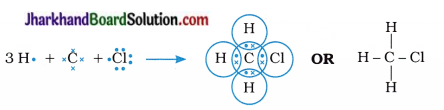
    JAC Class 10 Science Solutions Chapter 4 Carbon and Its Compounds 1
  • Thus, carbon attains the stable electronic configuration of nearest noble gas neon, hydrogen attains the electronic configuration of noble gas helium, while chlorine acquires the electronic configuration of noble gas argon.
  • In short, chloromethane forms three C – H and one C – Cl covalent bonds.

Question 5.
Draw the electron dot structures for –
(a) Ethanoic acid
(b) H2S
(c) Propanone
(d) F2
Answer:
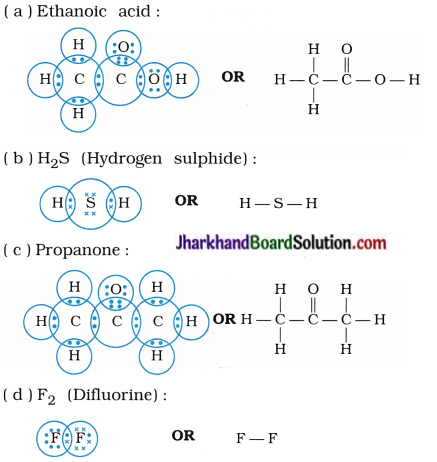
JAC Class 10 Science Solutions Chapter 4 Carbon and Its Compounds 2

Question 6.
What is an homologous series ? Explain with an example.
Answer:
Definition : A series of compounds in which hydrogen atom / atoms remain in carbon chain are replaced by same functional group, then it constitute the homologous series.
OR
A series of organic compounds in succession which differ by a definite group (like – CH2 -) is called homologous series.
Explanation:
CH3 – OH Methanol
CH3 – CH2 – OH Ethanol
CH3 – CH2 – CH2 – OH Propanol
CH3 – CH2 – CH2 – CH2 – OH Butanol

  • It is a homologous series of alcohol where each member of the series possesses functional group – OH (Hydroxyl group).
  • The difference in molecular formula between two successive members of the series is equal to -CH2-, hence, difference in molecular masses of any two successive members of the series is 14 u.

JAC Class 10 Science Solutions Chapter 4 Carbon and Its Compounds

Question 7.
How can ethanol and ethanoic acid be differentiated on the basis of their physical and chemical properties?
Answer:
Difference in physical properties :

Physical propertyEthanolEthanoic acid
1. SmellPleasant (Sweet)Vinegar-like strong
2. TasteBurning tasteSour
3. Melting point (K)156290
4. Boiling point (K)351391

Difference in chemical properties :

Reaction withEthanolEthanoic acid
1. Sodium bicarbonateCO2 gas does not evolve.CO2 gas is evolved.
2. Alkaline KMnO4Pink colour of KMnO4 disappear.Pink colour of KMnO4 does not disappear.

Question 8.
Why does micelle formation take place when soap is added to water? Will a micelle be formed in other solvents such as ethanol also?
Answer:
A soap molecule has two ends which possess different properties. One end of soap has a polar head which is called hydrophilic head, while the other end has a non-polar tail which is also called hydrophobic tail.

  • Polar head has affinity towards water molecules, while non-polar tail being hydrophobic has no affinity towards water molecules.
  • When soap is dissolved in water, the polar head dissolves in water but non-polar tail remains outside the water surface. As a result, spherical micelles are formed.
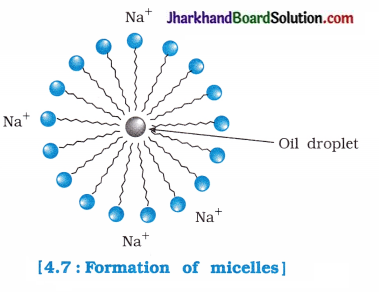
    JAC Class 10 Science Solutions Chapter 4 Carbon and Its Compounds 3
  • Since, soap is soluble in ethanol, therefore micelle formation does not take place in ethanol.

Question 9.
Why are carbon and its compounds used as fuels for most applications?
Answer:
When carbon is burnt in the presence of air or oxygen, it forms carbon dioxide and water with a release of a large amount of heat and light.
C(s) + O2(g) → CO2(g) + Heat + Light

  • When carbon and its compounds are burnt, additional heat energy is not required for consistent burning.
  • Hence, carbon and its compounds are used as fuels for most applications.

Question 10.
Explain the formation of scum when hard water is treated with soap.
Answer:
Hard water possesses calcium and magnesium ions which combine with soap molecules to form curdy white precipitate of calcium and magnesium salts, which is called scum.
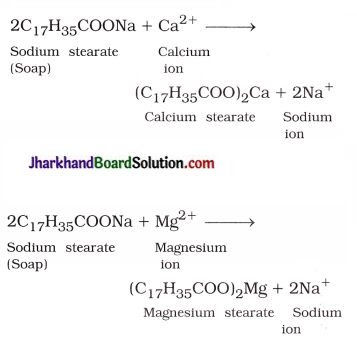
JAC Class 10 Science Solutions Chapter 4 Carbon and Its Compounds 4

Question 11.
What change will you observe if you test soap with litmus paper (red or blue)?
Answer:
Soap is basic (alkaline) in nature, it turns red litmus paper blue, while, it does not have any effect on blue litmus paper.

Question 12.
What is hydrogenation? What is its industrial application?
Answer:
A reaction in which unsaturated hydrocarbons add hydrogen in the presence of catalysts such as nickel or palladium to form saturated hydrocarbons is known as hydrogenation reaction.

Industrial application : It is used to convert vegetable oil into vegetable ghee.
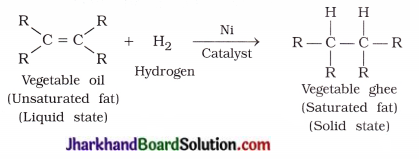
JAC Class 10 Science Solutions Chapter 4 Carbon and Its Compounds 5

Question 13.
Which of the following hydrocarbons undergo addition reactions?
C3H6, C3H8, C2H2 and CH4
Answer:
C3H6 and C2H2 are unsaturated hydrocarbons, hence, they undergo addition reaction.
JAC Class 10 Science Solutions Chapter 4 Carbon and Its Compounds 6

Question 14.
Give a test that can be used to differentiate between saturated and unsaturated hydrocarbons.
Answer:
Butter contains saturated fats while cooking oil contains unsaturated fats.

Unsaturated compound decolourise the pink colour of alkaline KMnO4 solution.
When butter is treated with a few drops of alkaline KMnO4 solution, the pink colour of KMnO4 does not disappear, while, when cooking oil is treated with a few drops of alkaline KMnO4 solution, its pink colour disappears.

JAC Class 10 Science Solutions Chapter 4 Carbon and Its Compounds

Question 15.
Explain the mechanism of the cleaning action of soaps.
Answer:
The molecules of soap are sodium or potassium salts of long chain carboxylic acids.

  • Two ends of soap molecule possess different properties. One end is hydrophilic and it dissolves in water, while the other end is hydrophobic and it dissolves in hydrocarbons.
  • When soap is at the surface of water, the hydrophobic ‘tail’ of soap will not be soluble in water and the soap will align along the surface of water with the ionic end in water and the hydrocarbon ‘tail’ protruding out of water.
    JAC Class 10 Science Solutions Chapter 4 Carbon and Its Compounds 7
  • Inside water, these molecules have a particular orientation that keeps the hydrocarbon portion out of the water.
  • This happens due to the formation of clusters of molecules in which the hydrophobic tails are in the interior part of the cluster and the ionic ends are on the surface of the cluster.
  • This formation is called a micelle.
  • Soap in the form of a micelle collects the oily dirt in the centre of it and is able to clean.
  • These micelles exist in solution as a colloid.
  • Micelles do not cluster to precipitate because of ion-ion repulsion.
  • Thus, the dirt suspended in the micelles is also easily rinsed away.
  • The soap micelles are large enough to scatter light, hence a soap solution appears cloudy.

Jharkhand Board Class 10 Science Carbon and Its Compounds InText Questions and Answers

Question 1.
What would be the electron dot structure of carbon dioxide which has the s formula CO2?
Answer:
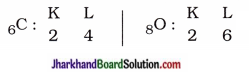
The electronic configuration of carbon and oxygen are as follows:
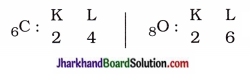
JAC Class 10 Science Solutions Chapter 4 Carbon and Its Compounds 8
Thus, carbon has 4 electrons and oxygen s has 6 electrons in the valence shell.

JAC Class 10 Science Solutions Chapter 4 Carbon and Its Compounds 8a

Question 2.
What would be the electron dot structure of a molecule of sulphur which is made-up of eight atoms of sulphur? [Hint: The eight atoms of sulphur are joined together in the form of a ring.]
Answer:
The electronic configuration of 16S is as follows :
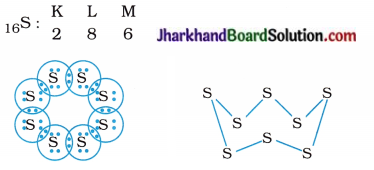
JAC Class 10 Science Solutions Chapter 4 Carbon and Its Compounds 9

Question 3.
Why is the conversion of ethanol to ethanoic acid an oxidation reaction?
Answer:
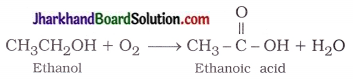
The conversion of ethanol to ethanoic acid is shown below:
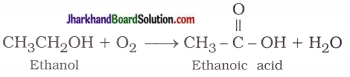
JAC Class 10 Science Solutions Chapter 4 Carbon and Its Compounds 10
In this reaction, a molecule of ethanol contains one oxygen atom while ethanoic acid contains two oxygen atoms. Hence, oxygen atom is added during the reaction; therefore, this conversion is an oxidation reaction.

Question 4.
A mixture of oxygen and ethyne is burnt for welding. Can you tell why a mixture of ethyne and air is not used?
Answer:
Ethyne is an unsaturated hydrocarbon.

  • Combustion of ethyne in air produces a yellow flame with lot of black smoke.
  • Due to this incomplete combustion, heat produced is very less than the heat required for welding; hence, the mixture of ethyne and air is not used for welding.
  • When the combustion of ethyne is carried out with oxygen, due to complete combustion heat produced is very large which is usually needed for welding; hence the mixture of ethyne and oxygen is used for welding.
  • 2[CH ≡ CH] + 5O2 → 4CO2 + 2H2O + Heat and Light

Question 5.
How would you distinguish experimentally between an alcohol and a carboxylic acid?
Answer:
An alcohol and a carboxylic acid can be distinguished experimentally by the following tests :
(1) Sodium hydrogencarbonate test: Take a small amount of each substance in two different test tubes and add to it an aqueous solution of sodium hydrogencarbonate.

  • Test tube in which brisk effervescence of CO2 gas appear contains carboxylic acid.
  • Solution of ethanol does not produce brisk effervescence of CO2 gas.

(2) Alkaline potassium permanganate test:
Take a small amount of each substance in two different test tubes, and add to it a few drops of alkaline potassium permanganate and warm the test tubes.

  • The purple colour of potassium permanganate disappear in the test tube containing alcohol.
  • Solution of carboxylic acid does not discharge the colour of potassium permanganate.

Question 6.
What are oxidising agents?
Answer:
Substances, which are capable of adding oxygen to other substances are known as oxidising agents. For example, alkaline KMnO4, acidic K2Cr2O7.

Question 7.
Would you be able to check if water is hard by using a detergent?
Answer:
No. Because detergent produces foam in both hard and soft water.

JAC Class 10 Science Solutions Chapter 4 Carbon and Its Compounds

Question 8.
People use a variety of methods to wash clothes. Usually after adding the soap, they ‘beat’ the clothes on a stone, or beat it with a paddle, scrub with a brush or the mixture is agitated in a washing machine. Why is agitation necessary to get clean clothes?
Answer:
Soap decreases the surface tension of water. When the soap is applied to any dirty clothes or on stains, the non-polar tail containing hydrocarbon part is attracted towards the molecule of dirt, oil or grease; while the polar tail part is attracted towards water. Thus, micelles are formed. Hence, to remove the micelles from the surface of the clothes, agaitation of clothes is necesary.

Question 9.
How many structural isomers can you draw for pentane?
Answer:
Structural isomers of pentane (C5H12) :
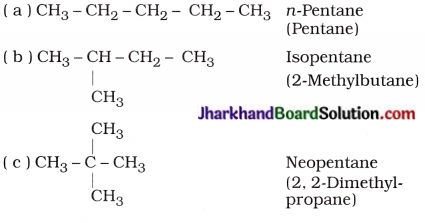
JAC Class 10 Science Solutions Chapter 4 Carbon and Its Compounds 11

Question 10.
What are the two properties of carbon which lead to the huge number of carbon compounds we see around us?
Answer:
Carbon atom forms covalent bonds by sharing of electrons with other atoms to form numerous compounds. The number of carbon compounds known to chemists was recently estimated about three millions. Carbon has ability to form a large number of compounds. Two factors noticed in this case are as follows :

Catenation property of carbon : Carbon has the unique ability to form bonds with other atoms of carbon, giving rise to large number of molecules. This property of carbon is called catenation.

  • Carbon compounds consist of long chains of carbon, branched chains of carbon or in the ring form or cyclic form.
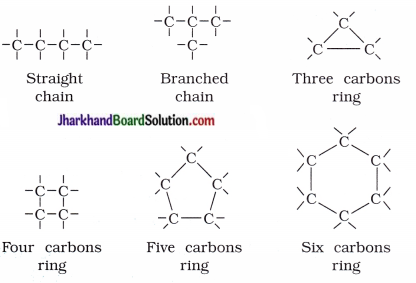
    JAC Class 10 Science Solutions Chapter 4 Carbon and Its Compounds 12
  • Carbon atom may be linked with other atoms by single, double or triple bonds.
  • Compounds of carbon, which are linked by only single bonds between the carbon atoms are called saturated compoundsr
  • Compounds of carbon, having double or triple c bonds between the carbon atoms are called unsaturated compounds.
  • No other element exhibits the property of catenation to the extent seen in carbon compounds. Silicon forms compounds with hydrogen which have chains of upto seven or eight atoms, but these compounds are very reactive.
  • The carbon-carbon bond is very strong and hence it is stable.
  • Since carbon has a valency of four, it is capable of bonding with four other atoms of carbon or atoms of some other monovalent elements.
  • Compounds of carbon are formed with oxygen, hydrogen, nitrogen, sulphur, chlorine and many other elements giving rise to compounds with specific properties which depend on the elements other than carbon present in the molecule.
  • The bond formed by carbon with most other elements are very strong, which makes compounds exceptionally stable.
  • Carbon being small in size, it enables the nucleus to hold on to the shared pairs of electrons strongly. Hence, strong bonds are formed by carbon.

Question 11.
What will be the formula and electron dot structure of cyclopentane?
Answer:
The general formula of cycloalkane is CnH2n; hence, molecular formula of cyclopentane Is C5H10.
The electron dot structure of cyclopentane is shown below:
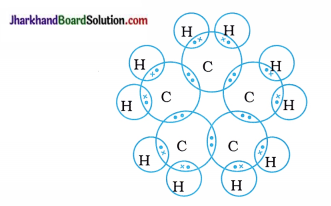
JAC Class 10 Science Solutions Chapter 4 Carbon and Its Compounds 13

Question 12.
Draw the structures for the following compounds:
(i) Ethanoic acid
(ii) Bromopentane
(iii) Butanone
(iv) Hexanal
Are structural isomers possible for bromo-pentane?
Answer:
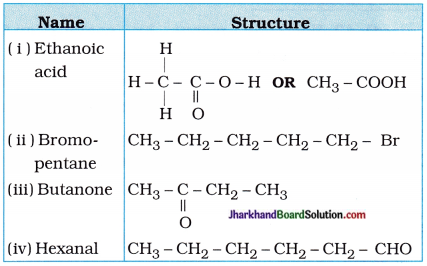
JAC Class 10 Science Solutions Chapter 4 Carbon and Its Compounds 14
Possible structural isomers of bromopentane are as follows :
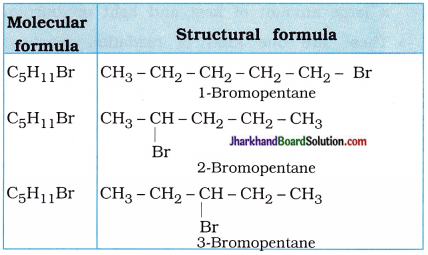
JAC Class 10 Science Solutions Chapter 4 Carbon and Its Compounds 15

Question 13.
How would you name the following compounds?
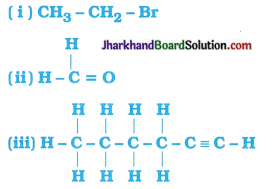
JAC Class 10 Science Solutions Chapter 4 Carbon and Its Compounds 16
Answer:
The name 0f the given compounds are:

  • Bromoethane
  • Methanal
  • Hex-l-yne or Hexyne.

Activity 4.1 [T.B. Pg. 58]

Aim : To demonstrate that most of the things we use in our day to day life consists of carbon.

Questions:

  • Make a list of ten things you have used or consumed since morning.
  • Compile this list with the lists made by your s classmates and then sort the items into the? adjascent table.

If there are items which are made-up of? more than one material, put them into both < the relevant columns.
Answer:
A list of ten things used or consumed s since morning is given below:
Toothbrush, toothpaste, bucket, water, soap, S detergent, cooking utensils, cup, milk, medicine, S’ newspaper, books.

Things made of metalThings made of glass / clayOthers
Cooking utensils, bucketCupToothbrush, toothpaste, water, soap, detergent, milk, medicine, news-paper, books.

Activity 4.2 [T. B. Pg. 67]

Aim : To study the concept of homologous series.

Questions:

Question 1.
Calculate the difference in the formulae and molecular masses for (a) CH3OH and C2H5OH, (b) C2H5OH and C3H7OH and (c) C3H7OH and C4H9OH
Answer:

Difference in formulaeDifference in molecular masses
(a) C2H5OH – CH3OH = CH2[2(12) + 6(1) +1(16)] – [1(12) + 4(1) + 1(16)] = 46 – 32 = 14 u
(b) C3H7OH – C2H5OH = CH2[3(12) + 8(1)+1(16)] – [2(12) + 6(1) + 1(16)] = 60 – 46 = 14 u
(c) C4H9OH- C3H7OH = CH2[4(12) + 10(1) + 1(16)] – [3(12) + 8(1) + 1(16)] = 74 – 60 = 14 u

Question 2.
Is there any similarity in these three compounds mentioned above?
Answer:
Similarity observed in above three compounds are as follows :

  • Difference in molecular formulae of these compounds is CH2.
  • Difference in molecular masses of these compounds is 14 u.
  • In the nomenclature of these compounds, a common suffix -ol is written.
  • These compounds are represented by the general formula CnH2n+1OH.
  • Chemical reactions of these compounds are identical.
  • All the three compounds are alcohols.

Question 3.
Arrange these alcohols in the order of increasing carbon atoms to get a family. Can we call this family a homologous series?
Answer:
Alcohols in the increasing order of carbon atoms are as follows:
CH3OH, C2H5OH, C3H7OH, C4H9OH
Yes, we call this family a homologous series.

JAC Class 10 Science Solutions Chapter 4 Carbon and Its Compounds

Question 4.
Generate the homologous series for compounds containing up to four carbons for the other functional groups given in Q. 30.
Answer:
Homologous series for halogen group : [CnH2n+1X]
CH3Cl, C2H5Cl, C3H7Cl, C4H9Cl
→ Homologous series for aldehyde group : [CnH2nO]
HCHO, CH3CHO, CH3CH2CHO, CH3CH2CH2CHO

→ Homologous series for ketone group : [CnH2nO]
CH3COCH3, CH3COC2H5, CH3COC3H7, CH3COC4H9

→ Homologous series for carboxylic acid group : [CnH2nO2]
HCOOH, CH3COOH, CH3CH2COOH, CH3CH2CH2COOH

Activity 4.3 [T. B. Pg. 69]

Aim : To study the flame of burning of carbon compounds.

Caution:
This activity needs the teacher’s assistance.

Activity:

  • Take some carbon compounds (naphthalene, camphor, alcohol) one by one on a spatula t and burn them in the flame.
  • Observe the nature of the flame and note s whether smoke is produced.
  • Place a metal plate above the flame. Is there a deposition on the plate in case of any of the compounds?

Observation :

  • Camphor and alcohol burn with a blue non-luminous flame and there is no sooty deposit on the metal plate.
  • Naphthalene burns with a luminous yellow flame and there is sooty deposit on the metal plate.

Inference :
Camphor and alcohol are saturated hydrocarbons, while, naphthalene is an unsaturated hydrocarbon.

Activity 4.4 [T. B. Pg. 69]

Aim: To study the flame formed by complete and incomplete combustion.

Activity:
Light a bunsen burner and adjust the air hole at the base to get different types of flames / presence of smoke.

Questions:

Question 1.
When do you get a yellow flame?
Answer:
When the holes of the bunsen burner are not opened, enough supply of oxygen-rich air is not available, hence, incomplete combustion of hydrocarbon produces a yellow flame.

Question 2.
When do you get a blue flame?
Answer:
When the holes of the bunsen burner are opened, enough supply of oxygen-rich air is available, hence, complete combustion of hydrocarbon takes place and blue flame is formed.

Activity 4.5 [T. B. Pg. 70]

Aim: To study the oxidation of alcohols with alkaline KMnO4.

Activity:

  • Take about 3 mL of ethanol in a test tube and warm it gently in a water bath.
  • Add a 5 % solution of alkaline potassium permanganate dropwise to this solution.

Questions :

Question 1.
Does the colour of potassium permanganate persist when it is added initially?
Answer:
When KMnO4 is added to alcohol, the colour of KMnO4 disappears initially, because, it oxidises ethanol to ethanoic acid and itself S is reduced to MnO2.
[Note: This reaction is known as Bayer’s test.]

Question 2.
Why does the colour of potassium perman-ganate not disappear when excess is added?
Answer:
KMnO4 solution when added more than required, then some of the KMnO4 remains unused and hence its colour does not disappear.

Activity 4.6 [T. B. Pg. 72]

Aim: To study the reaction of sodium metal with ethanol.

Activity:

  • Teacher’s demonstration
  • Drop a small piece of sodium, about the size j of a couple of grains of rice into ethanol? (absolute alcohol).

Questions:

Question 1.
What do you observe?
Answer:
Hydrogen gas is evolved due to reaction between ethanol and sodium metal.

Question 2.
How will you test the gas evolved?
Answer:
When a burning matchstick is brought near? the hydrogen gas, it burns with a popping sound.

Activity 4.7 [T. B. Pg. 73]

Aim : To study the strength of dilute acetic acid and dilute hydrochloric acid.

Activity:
Compare the pH of dilute acetic acid and dilute hydrochloric acid using both litmus paper and universal indicator.

Questions:

Question 1.
Are both acids indicated by the litmus test?
Answer:
Both acids turn blue litmus to red, thus, both the acids are indicated by the litmus test.

Question 2.
Does the universal indicator show them as equally strong acids?
Answer:
The pH values of both acids of same concentration as obtained by using universal indicator are different. The pH value of dilute acetic acid is 4, while that of dilute hydrochloric acid is 2, which indicates that acetic acid is a weak acid than hydrochloric acid.

JAC Class 10 Science Solutions Chapter 4 Carbon and Its Compounds

Activity 4.8 [T. B. Pg. 73]

Aim: To study the preparation and properties of an ester.

Activity:

  • Take 1 mL ethanol (absolute alcohol) and 1 mL glacial acetic acid along with a few drops of concentrated sulphuric acid in a test tube.
  • Warm in a water-bath for at least five minutes as shown in figure 4.4.
  • Pour into a beaker containing 20 – 50 mL of water and smell the resulting mixture.
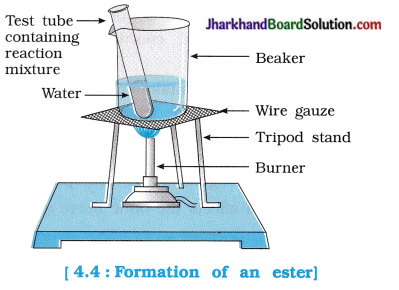
    JAC Class 10 Science Solutions Chapter 4 Carbon and Its Compounds 17
  • When the mixture of absolute alcohol and glacial acetic acid is heated in presence of few drops of concentrated sulphuric acid, it forms a sweet smelling ester.

Activity 4.9 [T. B. Pg. 74]

Aim: To show the evolution of carbon dioxide gas by the reaction of carboxylic acid with sodium carbonate or sodium hydrogencarbonate.

  • Set up the apparatus as shown in Chapter 2, Activity 2.5.
  • Take a spatula full of sodium carbonate in a test tube and add 2 mL of dilute ethanoic acid.

Questions:

Question 1.
What do you observe?
Answer:
When sodium carbonate is added to 2 mL dilute solution of ethanoic acid, a brisk effervescence appear due to evolution of carbon dioxide gas.

Question 2.
Pass the gas produced through freshly prepared lime water. What do you observe?
Answer:
When the evolved gas is passed through freshly prepared lime water, it turns milky due to the formation of insoluble calcium hydroxide.

Question 3.
Can the gas produced by the reaction between ethanoic acid and sodium carbonate be identified by this test?
Answer:
Yes. Carbon dioxide gas produced by the reaction can be identified by this test.
Repeat this activity with sodium hydrogen- carbonate instead of sodium carbonate.

Activity 4.10 [T. B. Pg. 74]

Aim: To study the solubility of oil in soap solution.

Activity:

  • Take about 10 mL of water in two separate test tubes.
  • Add a drop of oil (cooking oil) to both the test tubes and label them as A and B.
  • To test tube B, add a few drops of soap solution.
  • Now, shake both the test tubes vigorously s for the same period of time.

Questions:

Question 1.
Can you see the oil and water layers separately in both the test tubes immediately after you stop shaking them?
Answer:
In test tube A, two separate layers are seen, while in test tube B separate layers are not seen.

Question 2.
Leave the test tubes undisturbed for some time and observe. Does the oil layer separate out? In which test tube does this happen first?
Answer:
In test tube A, two separate layers of oil and water are formed, while, in test tube B separate layers are not formed.

Activity 4.11 [T. B. Pg. 76]

Aim : To study the reaction of soap with hard and soft water.

Activity:

  • Take about 10 mL of distilled water (or rain water) and 10 mL of hard water (from a tube) well or hand pump) in separate test tubes.
  • Add a couple of drops of soap solution to both.
  • Shake the test tubes vigorously for an equal period of time and observe the amount of foam formed.

Questions:

Question 1.
In which test tube do you get more foam?
Answer:
The test tube which contains soft water, i.e., distilled water or rain water, produces foam easily.

Question 2.
In which test tube do you observe a curdy white precipitate?
Answer:
The test tube which contains hard water, i.e., tube well water, produces curdy white precipitates.

Note for the teacher:
If hard water is not available in your locality, prepare Some hard water by dissolving hydrogen-carbonates/sulphates, chlorides of calcium or magnesium in water.

Activity 4.12 [T. B. Pg. 76]

Aim : To study the solubility of soap and detergent in hard water.

Activity:

  • Take two test tubes with about 10 mL of hard water in each.
  • Add five drops of soap solution to one and five drops of detergent solution to the other.
  • Shake both test tubes for the same period.

Questions:

Question 1.
Do both test tubes have the same amount of foam?
Answer:
Both the test tubes do not contain the same amount of foam. The test tube with soap solution contains little foam in it.

Question 2.
In which test tube is a curdy white solid formed?
Answer:
The test tube to which soap solution was added produced a curdy white solid substance.
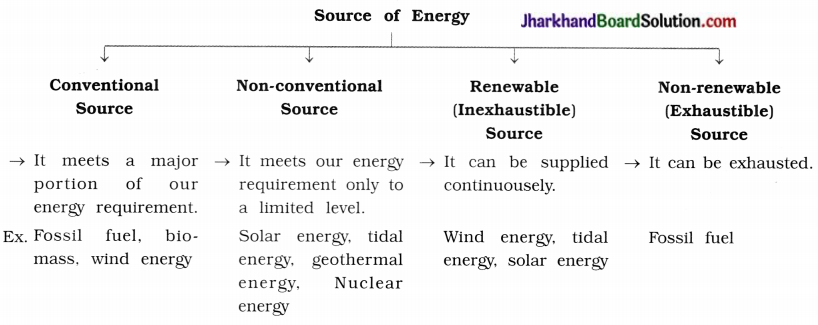
JAC Class 10 Science Notes Chapter 14 Sources of Energy

Students must go through these JAC Class 10 Science Notes Chapter 14 Sources of Energy to get a clear insight into all the important concepts.

JAC Board Class 10 Science Notes Chapter 14 Sources of Energy

→ Energy can neither be created nor destroyed.

→ Energy is the capacity of a system to perform work.

→ Source of energy: The source which can provide energy conveniently is called source of energy.

→ A good source of energy : A source should be easily accessible, easy to store and transport and able to do large amount of work.
JAC Class 10 Science Notes Chapter 14 Sources of Energy 1

→ Fossil fuel : Coal, petroleum products and natural gas, etc. are fossil fuels.

→ The growing demand for energy is largely met by fossil fuels which are non-renewable sources of energy.

→ The thermal power plants produce heat energy from fuels and converts it into electrical energy.

JAC Class 10 Science Notes Chapter 14 Sources of Energy

→ A quarter of energy requirement in India is met by Hydropower plants.

→ Biomass : The matter obtained from living organisms is called biomass.

→ Fire wood, cow-dung cake. etc. form fuels which are plant and animal products. These sources are called biomass, which are traditionally used as fuels.

→ Charcoal: When wood is burnt in a limited supply of oxygen charcol is left behind as the residue.

→ Biogas: It is produced by decomposition of cow-dung, agriculture wastes, vegetable waste and sewage in absence of oxygen.

  • Biogas is an excellent fuel as it contains upto 75 % methane.
  • Biogas plant provides fuel gas as well as manure.

→ Wind energy: The kinetic energy of the wind can be used to get electricity on a commercial scale. Wind energy is an environment friendly and efficient source of renewable energy.

→ Solar energy: Solar energy is the root of all energy.

  • India receives solar energy for greater part of the year.
  • Solar cooker, solar water heater, solar cell panel, etc. are widely used now-a-days.

→ Ocean energy : Tidal energy, wave energy and ocean thermal energy are considered as ocean energy.

  • Due to high and low tides, the difference in sea level gives tidal energy.
  • Wave energy would be a viable proposition only where waves are very strong.
  • Temperature difference between the water at the surface and water at depths is exploited to obtain ocean thermal energy.

→ Geothermal energy : Heat energy can be exploited from the steam trapped in rocks near the hot springs. This is called geothermal energy.

JAC Class 10 Science Notes Chapter 14 Sources of Energy

→ Nuclear energy: It is obtained by nuclear reactions, i.e.,

  • Nuclear fission – The fission of an atom of uranium.
  • Nuclear fusion – Joining of lighter nuclei (hydrogen isotopes) to create a heavier nucleus (helium).

→ CNG (Compressed Natural Gas) : CNG is considered as the cleaner alternative to petrol or diesel.

→ Renewable energy is available in our natural environment, in the form of repetitive current of energy.

JAC Class 10 Science Notes Chapter 13 Magnetic Effects of Electric Current

Students must go through these JAC Class 10 Science Notes Chapter 13 Magnetic Effects of Electric Current to get a clear insight into all the important concepts.

JAC Board Class 10 Science Notes Chapter 13 Magnetic Effects of Electric Current

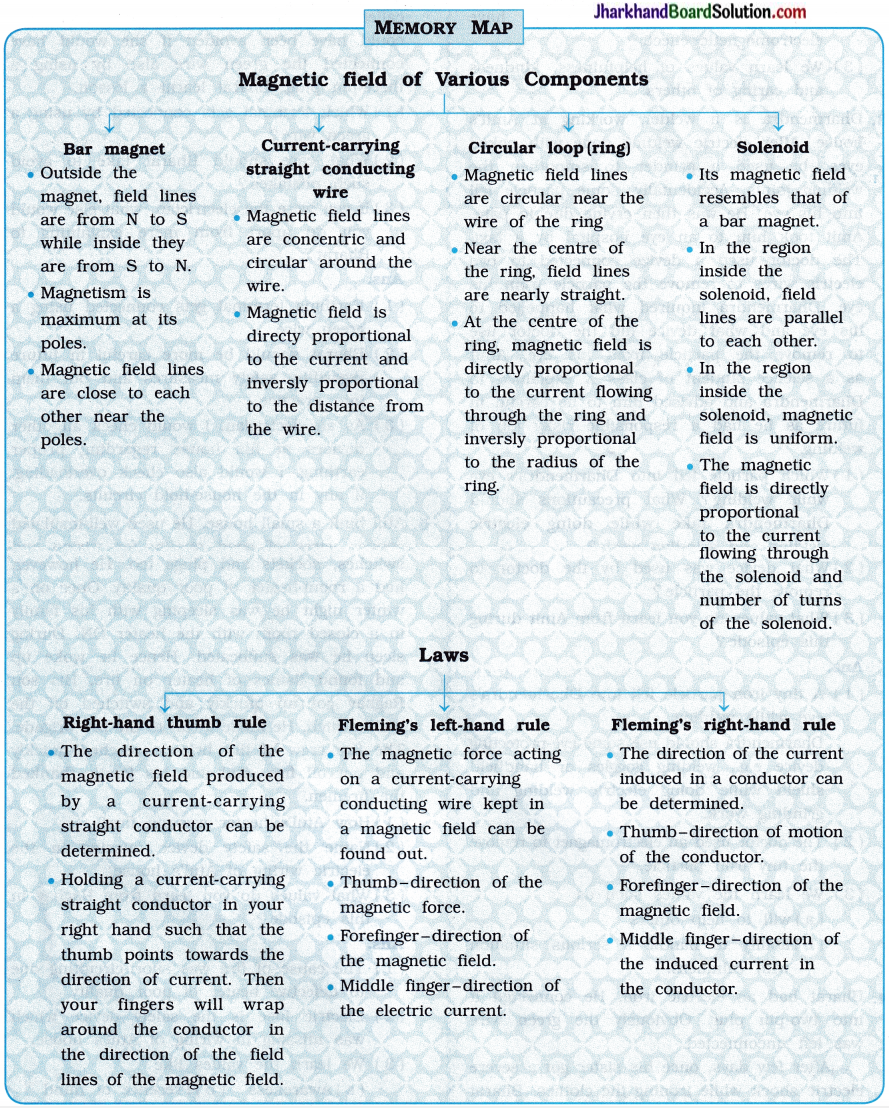
→ Magnet: A magnet is a piece of magnetic material, occuring naturally or made artificially by magnetizing iron or steel, which attracts pieces of magnetic substances such as iron, nickel and cobalt.

→ Magnetic field: The region surrounding a magnet in which the force of attraction and repulsion due to that magnet can be detected (using magnet or magnetic substances) is called the magnetic field.

[Each point in this field has a particular strength. The field at each point also has a definite direction.]

→ Magnetic field lines : The lines along which the iron filings align / arrange themselves due to force acting on them in the magnetic field of a bar magnet are called magnetic field lines.

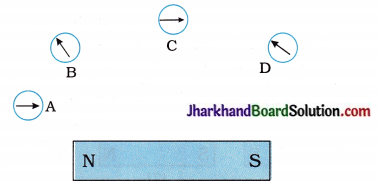
Note : The path followed by the north pole of a compass needle (magnetic needle) placed in a region of magnetic field, such as that of a bar magnet, is called a magnetic field line. It shows how the magnetic force changes from point to point.

→ Characteristics of magnetic field lines:

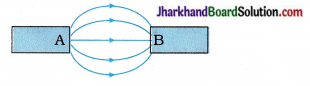
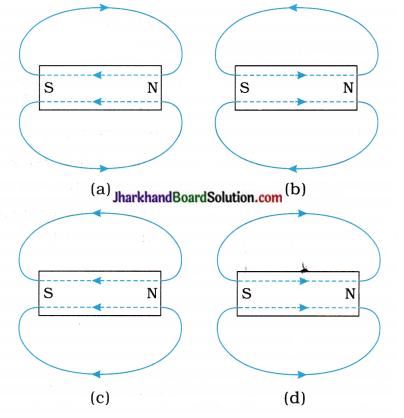
  • The magnetic field lines emerge from north pole and merge at the south pole outside the magnet, while inside the magnet the direction of field lines is from its south pole to its north pole.
    Thus, the magnetic field lines are closed and continuous curve.
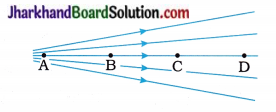
  • The magnetic field lines are crowded near the pole where the magnetic field is strong and are far apart near the middle of the magnet and far from the magnet where the magnetic field is weak.
  • The magnetic field lines never intersect each other because if they do so, there would be two directions of magnetic field at that point which is absurd.
  • In case the field lines are parallel and equidistant, these represent a uniform magnetic field.
    Important note: The relative strength of the magnetic field is shown by the degree of closeness of the field lines.

JAC Class 10 Science Notes Chapter 13 Magnetic Effects of Electric Current

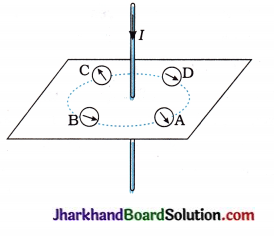
→ Oersted’s observations : When a magnetic needle is placed near a conducting wire carrying a current, the magnetic needle deflects. The deflection is observed in the opposite direction, when the direction of the current is reversed. This shows that when an electric current passes through a conducting wire a magnetic field is produced around it.

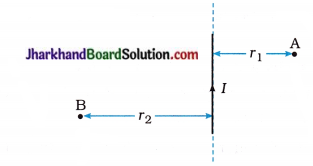
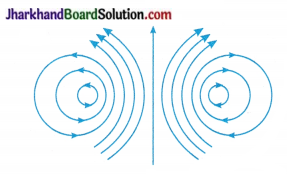
→ Magnetic field due to a current through a straight conductor: The magnetic field lines due to a current through a straight conductor form concentric circles around the conductor. The strength of this magnetic field is proportional to the current through the conductor and inversely proportional to the distance of the given point from the conductor.

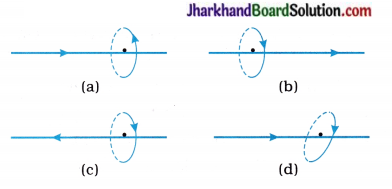
→ Right-hand thumb rule: Imagine that you are holding a current-carrying straight conductor in your right hand such that the thumb points towards the direction of current. Then your fingers of right hand wrap around the conductor in the direction of the field lines of the magnetic field.

→ Magnetic field due to a current through a circular loop: The magnetic field lines due to a current through a circular loop form concentric circles. These circles become larger and larger as we move away from the wire and at the centre of the circular loop, the arcs of these large circles appear as straight lines. The magnetic field at the centre of the circular loop is proportional to the current through the loop and inversely proportional to the radius of the circular loop.

→ Solenoid: A coil of many circular turns of insulated copper wire wrapped closely in the shape of a cylinder is called a solenoid. The magnetic field due to a current in a solenoid is similar to that of a bar magnet. The magnetic field lines inside a solenoid are straight lines parallel to each other. The magnetic field inside a solenoid is uniform.

→ Electromagnet: An electromagnet is a magnet consisting of a long coil of insulated copper wire wound around a soft iron core in the form of a rod. It is magnetised only when an electric current is passed through the coil.

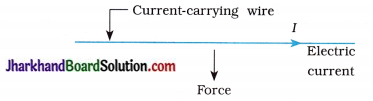
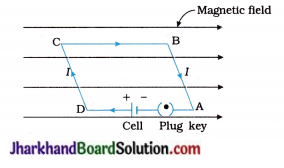
→ Force on a current- carrying conductor placed in a magnetic field: When a conductor carrying an electric current is placed in a magnetic field, magnetic force acts on it. This force is perpendicular to the direction of the magnetic field as well as the direction of the current and is proportional to the electric current, magnetic field of the magnet, the length of the conductor inside the magnetic field and on the angle between the directions of the magnetic field and the current. It is maximum when this angle is 90°. The direction of this force can be determined using Fleming’s left-hand rule.

→ Fleming’s left-hand rule: Stretch the thumb, forefinger and middle finger of your left hand such that they are mutually perpendicular. If the first (fore) finger points in the direction of magnetic field and second (middle) finger points in the direction of current, then the thumb will point in the direction of motion or the force acting on the conductor.

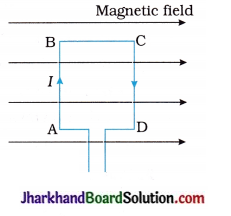
→ Electric motor: It converts electrical energy into mechanical energy. In this case, a current-carrying coil kept in a strong magnetic field experiences a force. As a result, the coil starts rotating.
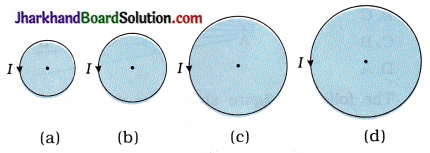
→ Electromagnetic induction: The process, by which a changing magnetic field in a conductor induces a current in another conductor is called electromagnetic induction.
OR
An electric current produced in a closed circuit by a changing magnetic field is called an induced current. This phenomenon is called electromagnetic induction.

→ Induced potential difference (or electromotive force): Because of the rate of change of number of magnetic field lines linked with the loop during the relative motion of a magnet and loop or due to a changing current in a nearby conductor, an electric potential difference is induced in the coil. It is called induced potential difference (or electromotive force).

The electromotive force induced in a loop is proportional to the rate of change of number of magnetic field lines associated with the loop and the number of turns of a loop.

→ Fleming’s right-hand rule : Stretch the thumb, forefinger and middle finger of right hand so that they are perpendicular to each other. If forefinger indicates the direction of the magnetic field and thumb shows the direction of motion of conductor, then the middle finger will show the direction of induced current.

→ Electric generator: It converts mechanical energy into electrical energy. Its working is based on electromagnetic induction. The generator by which a unidirectional current (DC) can be obtained is called a DC generator and that by which an alternating current (AC) is obtained is called an AC generator.

JAC Class 10 Science Notes Chapter 13 Magnetic Effects of Electric Current

→ Direct Current (DC) and Alternating Current (AC) : If a current flows only in one direction, it is called a direct current (DC). DC is obtained with a battery and DC generator.

The current whose direction changes periodically with time is called an alternating current (AC). AC is obtained with an AC generator.

→ Domestic electric circuits: In India, the AC voltage used for domestic purposes is 220 V and its frequency is 50 Hz. Three wires, namely live, neutral and earthing wire enter our house through a main fuse passing through an electric meter at the meter-board. The potential difference between the live and neutral wire is 220 V.

The earthing wire is connected to a copper plate placed in a deep pit dug near the house. This wire is connected to the metallic body of the appliances, so that one does not experience shock.
Two types of electric lines are available for domestic usage. One is of 5 A and other is of 15 A rating. The entire wiring of the house is done in parallel connections.

→ Fuse : An electric fuse is an important component of all domestic circuits. It is used to avoid incidents such as electric shock, fire, damage to an electric appliance due to (a) short-circuiting or (b) overloading (drawing a current beyond a specified limit) in a circuit. A fuse is a most important safety device. It consists of a short, thin, tin-plated copper wire having low melting point. It melts and breaks the circuit if the current exceeds a safe value.
A fuse is always connected in series with the live wire and in the beginning of the circuit.
JAC Class 10 Science Important Questions Chapter 14 उर्जा के स्रोत

Jharkhand Board JAC Class 10 Science Important Questions Chapter 14 उर्जा के स्रोत Important Questions and Answers.

JAC Board Class 10 Science Important Questions Chapter 14 उर्जा के स्रोत

अतिलघु उत्तरीय प्रश्न

प्रश्न 1.
ऊर्जा का मूल स्रोत क्या है?
उत्तर:
ऊर्जा का मूल स्रोत सूर्य है, जिसके अंतरंग में नाभिकीय संलयन क्रिया हो रही है।

प्रश्न 2.
सूर्य में ऊर्जा उत्पत्ति का कारण क्या है?
उत्तर:
सूर्य के अंतरंग में उपस्थित हाइड्रोजन परमाणुओं के नाभिकीय संलयन की क्रिया ही ऊर्जा उत्पत्ति का कारण है।

प्रश्न 3.
दृश्य प्रकाश की तरंग दैर्ध्य सीमा क्या है?
उत्तर:
दृश्य प्रकाश की तरंग दैर्ध्य सीमा है- 4000 से 70004 तक अथवा तरंग दैर्ध्य 4 x 10⁻⁷ मी से 7 x 10⁻⁷ मी

प्रश्न 4.
प्रकाश संश्लेषण के लिए प्रकाश का कौन-सा घटक उत्तरदायी है?
उत्तर:
प्रकाश संश्लेषण के लिए प्रकाश का घटक दृश्य प्रकाश उत्तरदायी है।

प्रश्न 5.
पवन ऊर्जा के उपयोग के लिए बनाई दो युक्तियों के नाम बताइये।
उत्तर:
पवन चक्की, जलपम्प।

प्रश्न 6.
सागरीय तापीय ऊर्जा किसे कहते हैं?
उत्तर:
महासागर की सतह के जल तथा गहराई के जल के ताप में अन्तर के कारण उपलब्ध ऊर्जा को सागरीय तापीय ऊर्जा कहते हैं।

प्रश्न 7.
सूर्य के नाभिक में हाइड्रोजन का कौन-सा समस्थानिक होता है?
उत्तर:
सूर्य के नाभिक में हाइड्रोजन का भारी समस्थानिक ड्यूटेरियम \(\left({ }_1 \mathrm{H}^2\right)\) होता है।

प्रश्न 8.
दो नाभिकीय ईंधनों के नाम लिखिए।
उत्तर:
दो नाभिकीय ईंधनों के नाम हैं-

  • U-235 ( यूरेनियम 235)
  • Pu – 239 (प्लूटोनियम-239)

JAC Class 10 Science Important Questions Chapter 14 उर्जा के स्रोत

प्रश्न 9.
श्रृंखला अभिक्रिया के प्रकारों के नाम लिखो।
उत्तर:
शृंखला अभिक्रिया दो प्रकार की होती है-

  • नियन्त्रित (या सीमित) श्रृंखला अभिक्रिया।
  • अनियन्त्रित (या असीमित) शृंखला अभिक्रिया।

प्रश्न 10.
नाभिकीय संलयन को परिभाषित कीजिए।
उत्तर:
अति उच्च दाब तथा उच्च ताप (लगभग 107K) पर दो हल्के नाभिकों का परस्पर संयुक्त होकर एक भारी नाभिक बनाने की अभिक्रिया को नाभिकीय संलयन कहते हैं। इस अभिक्रिया में असीमित ऊर्जा मुक्त होती है।

प्रश्न 11.
नाभिकीय ऊर्जा क्या है?
उत्तर:
पदार्थ के परमाणुओं के केन्द्र में स्थित नाभिक असीमित ऊर्जा के भण्डार हैं। इसी ऊर्जा को नाभिकीय ऊर्जा कहते हैं। प्रायः ये नाभिकीय संलयन एवं नाभिकीय विखण्डन के फलस्वरूप मुक्त होती है।

प्रश्न 12.
यूरेनियम के दो समस्थानिकों के नाम व संकेत लिखिए।
उत्तर:
यूरेनियम के दो समस्थानिक हैं-

  • यूरेनियम-235 या \({ }_{92} \mathrm{U}^{235}\)
  • यूरेनियम-238 या \({ }_{92} \mathrm{U}^{238}\)

प्रश्न 13.
सूर्य में ऊर्जा का मुख्य स्रोत क्या है?
उत्तर:
सूर्य में ऊर्जा का मुख्य स्रोत हाइड्रोजन की संलयन क्रिया है।

प्रश्न 14.
नाभिकीय रियेक्टर में प्रयुक्त ईंधन का नाम लिखिए।
उत्तर:
नाभिकीय रियेक्टर में प्रयुक्त ईंधन है- यूरेनियम – 235 या \({ }_{92} \mathrm{U}^{235}\)।

प्रश्न 15.
\({ }_{92} \mathrm{U}^{235}\) के नाभिक में प्रोटॉनों तथा न्यूट्रॉनों की संख्या लिखिए।
उत्तर:
\({ }_{92} \mathrm{U}^{235}\) के नाभिक में-
प्रोटॉनों की संख्या = 92
न्यूट्रॉनों की संख्या = 235 – 92 = 143

प्रश्न 16.
परमाणु बम एवं हाइड्रोजन बम में होने वाली क्रियाओं के नाम लिखिए।
उत्तर:
परमाणु बम नाभिकीय विखण्डन एवं हाइड्रोजन बम में नाभिकीय संलयन की क्रियाएँ होती हैं। दोनों में ही अनियन्त्रित श्रृंखला अभिक्रिया होती है।

प्रश्न 17.
नाभिकीय संलयन में ऊर्जा का स्रोत क्या है?
उत्तर:
नाभिकीय संलयन में ऊर्जा का स्रोत हाइड्रोजन के समस्थानिक ड्यूटेरियम हैं।

प्रश्न 18.
नाभिकीय रियेक्टर में प्रयुक्त मन्दक का नाम लिखिए।
उत्तर:
नाभिकीय रियेक्टर में प्रयुक्त मन्दक भारी जल (D2O) अथवा ग्रेफाइट हैं।

प्रश्न 19.
\({ }_{92} \mathrm{U}^{238}\) से क्या तात्पर्य है?
उत्तर:
\({ }_{92} \mathrm{U}^{238}\) यूरेनियम का वह स्थायी समस्थानिक है जिसके नाभिक में 92 प्रोटॉन तथा 146 न्यूट्रॉन होते हैं।

JAC Class 10 Science Important Questions Chapter 14 उर्जा के स्रोत

प्रश्न 20.
नाभिकीय विखण्डन क्या है?
उत्तर:
नाभिकीय विखण्डन- एक भारी नाभिक पर मन्द न्यूट्रॉन की बमबारी करने पर उसके लगभग समान आकार के दो हल्के नाभिकों में टूटने की क्रिया को नाभिकीय विखण्डन कहते हैं। इस क्रिया में अपार ऊर्जा उत्सर्जित होती है।

प्रश्न 21.
नाभिकीय विखण्डन का महत्त्वपूर्ण उपयोग क्या है?
उत्तर:
नाभिकीय विखण्डन का महत्त्वपूर्ण उपयोग मानव कल्याण हेतु रचनात्मक कार्यों जैसे विद्युत उत्पादन करने में होता है।

प्रश्न 22.
समस्थानिक किसे कहते हैं?
उत्तर:
किसी तत्त्व विशेष के दो या दो से अधिक ऐसे परमाणु जिनका परमाणु क्रमांक समान हो किन्तु परमाणु द्रव्यमान भिन्न-भिन्न समस्थानिक कहलाते हैं, जैसे यूरेनियम के दो समस्थानिक \({ }_{92} \mathrm{U}^{235}\) एवं \({ }_{92} \mathrm{U}^{238}\) होते हैं।

प्रश्न 23.
ऊर्जा किस रूप में स्थानान्तरित होती है?
उत्तर:
ऊर्जा तरंगों के रूप में स्थानान्तरित होती है। इन ऊर्जा तरंगों का तरंग दैर्ध्य भिन्न-भिन्न होता है। ऊर्जा की सभी तरंगों का उद्गम सूर्य से होता है।

प्रश्न 24.
ऊर्जा का विशाल स्त्रोत क्या है?
उत्तर:
सूर्य ऊर्जा के सभी रूपों का विशाल स्रोत है।

प्रश्न 25.
दृश्य प्रकाश में सबसे कम तरंगदैर्ध्य किस रंग की है?
उत्तर:
दृश्य प्रकाश में सबसे कम तरंगदैर्घ्य बैंगनी रंग की है।

प्रश्न 26.
दृश्य प्रकाश में सबसे अधिक तरंगदैर्ध्य किस रंग की है?
उत्तर:
दृश्य प्रकाश में सबसे अधिक तरंग दैर्ध्य लाल रंग की है।

प्रश्न 27.
प्रकाश की कौन-सी तरंगों में गर्म करने का गुण पाया जाता है?
उत्तर:
प्रकाश की अवरक्त तरंगों में गर्म करने का गुण पाया जाता है।

प्रश्न 28.
सौर ऊर्जा को किन-किन रूपों में रूपान्तरित किया जा सकता है?
उत्तर:
सौर ऊर्जा को ऊष्मा ऊर्जा, प्रकाश ऊर्जा, विद्युत ऊर्जा आदि रूपान्तरित किया जा सकता है।

प्रश्न 29.
उन तत्त्वों के नाम लिखिए, जिनका उपयोग सौर सेल के निर्माण में किया जाता है।
उत्तर:
सौर सेल सिलिकॉन तथा गैलेनियम जैसे अर्द्ध-चालकों से बनाए जाते हैं।

प्रश्न 30.
हमारी पृथ्वी से सूर्य कितनी दूरी पर है?
उत्तर:
हमारी पृथ्वी से सूर्य 15 करोड़ किलोमीटर दूर स्थित है।

प्रश्न 31.
सूर्य का द्रव्यमान क्या है?
उत्तर:
सूर्य का द्रव्यमान लगभग 1029 टन है।

प्रश्न 32.
सूर्य कितने वर्षों से जल रहा है?
उत्तर:
जीवाश्मों के आधार पर यह अनुमान लगाया जाता है कि सूर्य पिछले सात से आठ अरब वर्षों से प्रदीप्तमान है।

JAC Class 10 Science Important Questions Chapter 14 उर्जा के स्रोत

प्रश्न 33.
सूर्य का सम्पूर्ण प्रायः द्रव्यमान किस तत्त्व के कारण है?
उत्तर:
सूर्य का सम्पूर्ण प्रायः द्रव्यमान हाइड्रोजन तत्त्व के कारण है।

प्रश्न 34.
सूर्य से विकरित दो अदृश्य प्रकाश किरणों के नाम लिखिए।
उत्तर:
सूर्य से विकरित दो अदृश्य प्रकाश किरणें पराबैंगनी तथा अवरक्त प्रकाश किरणें हैं।

प्रश्न 35.
पृथ्वी के वायुमण्डल के ऊपरी सतह के प्रति वर्गमीटर क्षेत्रफल में सूर्य की कितनी ऊर्जा प्राप्त होती है?
उत्तर:
पृथ्वी के वायुमण्डल की ऊपरी सतह सूर्य से लगभग 1.36 जूल ऊर्जा प्रति सेकण्ड प्रति वर्ग मीटर प्राप्त करती है। इसका कुछ भाग अंतरिक्ष में परावर्तित हो जाता है तथा कुछ भाग वायुमण्डल में उपस्थित जल वाष्प, ओजोन, धूल तथा CO2 द्वारा अवशोषित कर लिया जाता है।

अतिलघु उत्तरीय प्रश्न

प्रश्न 1.
सूर्य में ऊर्जा उत्पत्ति की क्रिया को समझाइये।
उत्तर:
सूर्य के क्रोड में हाइड्रोजन व हीलियम विशाल मात्रा में हैं। ये तत्त्व परमाण्विक अवस्था में है। हाइड्रोजन परमाणु सूर्य के क्रोड में अति तीव्र वेग से सभी दिशाओं गमन कर रहे हैं हैं तथा एक-दूसरे टकरा रहे हैं। प्रयोगों से यह स्थापित किया गया है कि जब हाइड्रोजन परमाणु संलयन द्वारा (जुड़कर) हीलियम के अधिक भारी परमाणु बनाते हैं, तो अति विशाल मात्रा में ऊर्जा उत्सर्जित होती है।

परमाणुओं के नाभिकों के जुड़ने की इस क्रिया संलयन कहते हैं। सूर्य के क्रोड में यह प्रक्रिया निरन्तर व अबाध गति से हो रही है। यह क्रिया कई चरणों में को होती है। प्रथमतः हाइड्रोजन के दो नाभिक संलयित होकर भारी हाइड्रोजन, जिसे ड्यूटीरियम कहते हैं का एक परमाणु निर्मित करते हैं, तत्पश्चात् ड्यूटीरियम के दो परमाणु संलयन द्वारा हीलियम के एक नाभिक की रचना करते हैं।

प्रश्न 2.
सौर ऊर्जा के दो लाभ बतायें।
उत्तर:
सौर ऊर्जा के दो लाभ निम्न हैं-

  • सौर ऊर्जा से विद्युत ऊर्जा प्राप्त की जाती है जो बिल्कुल प्रदूषण रहित होती है।
  • सौर ऊर्जा के उपयोग से कोयले तथा पेट्रोलियम जैसे अनवीकरणीय ऊर्जा स्रोत को संरक्षित किया जा सकता है।

प्रश्न 3.
सौर सेल और सौर पैनल में क्या अन्तर है?
उत्तर:
सौर सेल और सौर पैनल में निम्नलिखित अन्तर हैं-

सौर सेलसौर पैनल
1. सौर सेल अर्द्ध चालक युक्त वह युक्ति है जो सौर ऊर्जा की अत्यल्प मात्रा को विद्युत ऊर्जा में परिवर्तित कर देती है।1. सौर पैनल, बहुत बड़ी संख्या में सौर सेल को एक विशेष क्रम में जोड़कर बनायी गई युक्ति है।
2. इसकी दक्षता बहुत कम होती है।2. इसकी दक्षता आवश्यकतानुसार बढ़ायी जा सकती है।
3. सौर सेल अधिक ऊर्जा वाले उपकरणों को चालित नहीं कर पाता है।3. सौर पैनल द्वारा उत्पादित ऊर्जा को संचायक बैटरी में भण्डारित किया जा सकता है, इसलिए इससे अधिक ऊर्जा वाले उपकरणों को भी चालित किया जा सकता है।

प्रश्न 4.
बड़े बाँध किस प्रकार विद्युत उत्पादन में सहायक क्षं?
उत्तर:
सौर ऊर्जा द्वारा प्रकृति में जल चक्र के रूप में जल का पुन: चक्रण होता रहता है। वर्षा का पानी नदियों में बहता रहता है जो हमें जल ऊर्जा उपलब्ध करवाता है। नदियों के इस पानी को बाँध बनाकर संगृहित कर दिया जाये तो नदियों के पानी की गतिज ऊर्जा बाँधों में स्थितिज ऊर्जा के रूप में संचित हो जाती है।

बाँध में एकत्र पानी का बाँध के नीचे जल विद्युत संयंत्र लगाकर उसके टरबाइन पर गिराये जाने पर बाँध के स्थिर पानी की स्थितिज ऊर्जा गतिज ऊर्जा में बदल जाती है जिससे टरबाइन घूमने लगते हैं फलस्वरूप जल विद्युत संयंत्र का आर्मेचर घूमने लगता है तथा विद्युत उत्पन्न हो जाती है। इस प्रकार प्रकृति से प्राप्त जल ऊर्जा का विद्युत ऊर्जा उत्पादन में बड़े बाँध सहायक है।

प्रश्न 5.
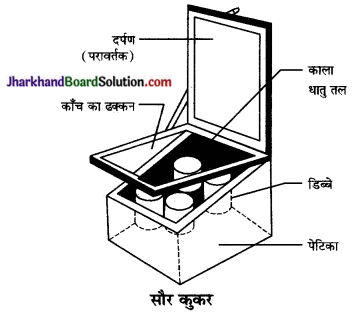
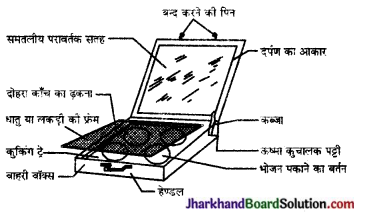
बॉक्सनुमा सौर कुकर का नामांकित चित्र बनाइए।
उत्तर:
JAC Class 10 Science Important Questions Chapter 14 उर्जा के स्रोत 1

प्रश्न 6.
बॉक्सनुमा सौर कुकर तथा गोलीय परावर्तक युक्त सौर कुकर में चार अन्तर लिखिए।
उत्तर:
बॉक्सनुमा सौर कुकर तथा गोलीय परावर्तक सौर कुकर में अन्तर निम्नलिखित हैं-

बॉक्सनुमा सौर कुकरगोलीय परावर्तक युक्त सौर कुकर
1. इससे रात में भोजन नहीं पकाया जा सकता है।1. इसमें अवतल अथवा परवलयिक परावर्तक होता है जो सौर ऊर्जा को एक छोटे-से क्षेत्र में संकेन्द्रित कर देता है।
2. यह उस स्थान के लिए उपयोगी नहीं है जहाँ हमेशा बादल छये रहते हैं।2. इसमें अपेक्षाकृत काफी उच्च ताप प्राप्त होता है।
3. इसे हम किसी भी स्थान पर नहीं रख सकते हैं।3. यह तीव्र आँच में पकने वाले खाद्य पदार्थों के लिए उपयोगी है।
4. इसका उपयोग सेंकने या तलने के लिए नहीं किया जा सकता है।4. यह सेंकने तथा तलने के लिए भी उपयोग किया जा सकता है।

प्रश्न 7.
सौर ऊर्जा का स्रोत क्या है?
उत्तर:
सौर ऊर्जा का स्रोत इसके केन्द्र में हो रहे हाइड्रोजन परमाणु की नाभिकीय संलयन क्रिया है। इस अभिक्रिया में दो हल्के हाइड्रोजन परमाणु के नाभिक परस्पर संयुक्त होकर एक भारी एवं स्थायी हीलियम का नाभिक बनाते हैं तथा अत्यधिक परिमाण में ऊर्जा विमोचित करते हैं। यही ऊर्जा सौर ऊर्जा है। इसे निम्न समीकरण द्वारा दर्शाया जाता है-
\({ }_1^2 \mathrm{H}+{ }_1^2 \mathrm{H} \longrightarrow{ }_2^4 \mathrm{He}\) + ऊर्जा

प्रश्न 8.
पराबैंगनी किरणें क्या हैं? इसके गुण लिखिए।
उत्तर:
पराबैंगनी किरणें-ये वे चुम्बकीय तरंगें हैं जिनकी तरंग दैर्ध्य 1 x 10⁻⁸ मी से 4 x 10⁻⁷ मी तक होती है। ये अदृश्य किरणें हैं जिनकी पहचान फोटोग्राफिक फिल्म द्वारा की जाती है।

पराबैंगनी किरणों के गुण-

  • ये अदृश्य किरणें हैं।
  • ये फोटोग्राफिक प्लेट को काला कर देती हैं।
  • इसकी अधिक मात्रा मानव जीवन के लिए हानिकारक होती है।

प्रश्न 9.
सूर्य प्रकाश के प्रमुख संघटकों को संक्षेप में समझाइये।
उत्तर:
सूर्य प्रकाश के तीन प्रमुख संघटक हैं-

  • पराबैंगनी प्रकाश- बैंगनी रंग की तरंग दैर्ध्य से कम तरंग दैर्ध्य वाले प्रकाश को पराबैंगनी प्रकाश कहते हैं। यह मानव नेत्र द्वारा दिखाई नहीं देता तथा सभी सजीवियों के लिए हानिकारक होता है।
  • दृश्य प्रकाश बैंगनी रंग से लाल रंग तक के तरंग दैर्ध्य वाले प्रकाश को दृश्य प्रकाश कहते हैं। यह मानव नेत्र द्वारा दिखाई देता है।
  • अवरक्त प्रकाश- लाल रंग की तरंग दैर्ध्य से अधिक तरंग दैर्ध्य वाले प्रकाश को अवरक्त प्रकाश कहते हैं। यह भी मानव नेत्र द्वारा दिखाई नहीं देता है।

JAC Class 10 Science Important Questions Chapter 14 उर्जा के स्रोत

प्रश्न 10.
सोलर सेल क्या है? इसके कोई तीन उपयोग लिखिए।
उत्तर:
सोलर सेल- सोलर सेल वह है जो सौर प्रकाश को सीधे ही विद्युत में रूपान्तरित कर देती है।
सोलर सेल के उपयोग-

  • विद्युत स्रोत के रूप में समस्त कृत्रिम उपग्रहों में किया जाता है।
  • केलकुलेटर, घड़ियाँ तथा अन्य छोटे उपकरणों को चलाने में।
  • प्रकाश व्यवस्था में रेडियो तथा दूरदर्शन के अभिग्राहियों को प्रचलित करने में।

प्रश्न 11.
सोलर कुकर के चार लाभ लिखिए।
उत्तर:
सोलर कुकर के लाभ-

  • सोलर कुकर के उपयोग से ईंधन की बचत होती है।
  • सोलर कुकर में धुआँ नहीं निकलता जिससे पर्यावरण प्रदूषित नहीं होता।
  • इसके उपयोग से भोजन के पोषक तत्त्व नष्ट नहीं होते।
  • इसे इच्छित स्थान पर ले जाया जा सकता है।

प्रश्न 12.
सोलर कुकर की कोई चार सीमाएँ लिखिए।
उत्तर:
सोलर कुकर की सीमाएँ-

  • इससे रात में भोजन नहीं पकाया जा सकता है।
  • यह उस स्थान के लिए उपयोगी नहीं है जहाँ हमेशा बादल छाये रहते हैं।
  • इसे हम किसी भी स्थान पर नहीं रख सकते हैं।
  • इसका उपयोग सेंकने या तलने के लिए नहीं किया जा सकता है।

प्रश्न 13.
सौर ऊष्मक (हीटर) किस सिद्धान्त पर कार्य करता है?
उत्तर:
सौर ऊष्मक काले रंग प्रयोग किया जाता है जो ऊष्मा का अच्छा अवशोषक किन्तु बुरा परावर्तक होने के कारण प्रकाश ऊर्जा का ऊष्मीय विकिरण (अवरक्त प्रकाश) को अवशोषित कर लेता है, फलत: सौर ऊष्मक में रखी वस्तु गर्म हो जाती है। अधिक ऊष्मा प्राप्त करने के लिए दर्पणों का प्रयोग किया जाता है जो प्रकाश को एकत्र करने का कार्य करते हैं।

प्रश्न 14.
सूर्य का हमारे लिए क्या महत्त्व है?
उत्तर:
सूर्य निम्नलिखित कारणों से हमारे लिए महत्त्वपूर्ण है-

  • सूर्य हमारे लिए ऊर्जा का सबसे अधिक प्रत्यक्ष एवं विशाल स्रोत है।
  • यह पृथ्वी पर वायु प्रवाह तथा जल चक्र की निरन्तरता बनाये रखने के लिए आवश्यक शक्ति प्रदान करता है।
  • यह पृथ्वी के समस्त जीवन को संपोषित करता है।
  • सूर्य द्वारा विकरित ऊर्जा को यान्त्रिक ऊर्जा में परिवर्तित करके हम अपने विभिन्न कार्यों को सम्पन्न करते हैं।

प्रश्न 15.
जल ऊर्जा किसे कहते हैं? इसके दो उपयोग लिखिए।
उत्तर:
जल ऊर्जा – बहते हुए जल में बहुत ज्यादा मात्रा में गतिज ऊर्जा होती है जिससे यान्त्रिक कार्य किये जा सकते हैं, इसे ही जल ऊर्जा कहते हैं।
उपयोग-

  • जल चक्कियों के पार्टी को घुमाने में।
  • जलविद्युत संयंत्र को संचालित कर विद्युत उत्पन्न करने में।

प्रश्न 16.
जल विद्युत का क्या अर्थ है?
उत्तर:
बहते हुए जल की ऊर्जा का उपयोग करके जो विद्युत उत्पन्न की जाती है, उसे जल विद्युत कहते हैं। जल की स्थितिज ऊर्जा को गतिज ऊर्जा में बदलकर टरबाइन की सहायता से जनरेटर को चलाया जाता है, इससे जनरेटर की कुण्डलियों में विद्युत धारा प्रवाहित होने लगती है। इस विद्युत को ही जल विद्युत कहते हैं।

प्रश्न 17.
आँधियाँ कैसे उत्पन्न होती हैं?
उत्तर:
वायु की दो सन्निकट पट्टिकाओं में असमान ऊष्माग्राहिता के कारण तापान्तर उत्पन्न होता है तब ठण्डी वावु पट्टिका अति तीव्र गति से दाब डालती हुई ऊष्ण वायु पट्टिका की ओर बढ़ती है। चूँकि उष्ण पट्टिका उसी गति से उस स्थान से प्रस्थान नहीं कर पाती, अतः दोनों वायु पट्टिकाओं में टकराहट (संघट्ट) होती है। इसके फलस्वरूप औधियाँ उत्पन्न होती हैं।

प्रश्न 18.
वायु का प्रवाह कैसे उत्पन्न होता है?
उत्तर:
भूमध्यरेखीय स्थानों पर सूर्य की किरणें सीधी पड़ती हैं अतः वे स्थान अधिक गर्म हो जाते हैं। दूसरी ओर ध्रुवों पर सूर्य की किरणें तिरछी पड़ती हैं अतः वे अपेक्षाकृत कम गर्म हो पाते हैं। इस तापान्तरण के कारण वायुमण्डल में अलग-अलग तापों की परतें बन जाती हैं। गर्म वायु हल्की होने के कारण ऊपर उठ जाती है और भूमध्य रेखीय वायुमण्डल में गरम वायु जमा हो जाती उधर ध्रुव प्रदेशों में ठण्डी वायु पृथ्वी के तल के और पास आ जाती है। इस प्रकार वायुमण्डल में वायु का प्रवाह पृथ्वी तल के समीप ध्रुवों से भूमध्य रेखा की ओर होने लगता है, यही वायु प्रवाह या पवन है।

प्रश्न 19.
ऊर्जा संकट के कोई दो कारण लिखो।
उत्तर:
ऊर्जा संकट के कारण निम्नलिखित हैं-

  • जनसंख्या में अत्यधिक वृद्धि के कारण अनवीकरणीय ऊर्जा स्रोतों का अत्यन्त दोहन करना।
  • कम दक्षता वाली मशीनों के उपयोग के कारण ऊर्जा के अधिकांश भाग का ह्रास हो जाना।

प्रश्न 20.
नाभिकीय रियेक्टर क्या है?
उत्तर:
नाभिकीय रियेक्टर वह युक्ति है जिसमें नाभिकीय विखण्डन की श्रृंखला अभिक्रिया को नियन्त्रित करके अत्यधिक ऊर्जा प्राप्त की जाती है जिसका उपयोग विभिन्न रचनात्मक कार्यों हेतु किया जाता है। वास्तव में नाभिकीय रियेक्टर नाभिकीय विखण्डन की क्रिया द्वारा उत्पन्न ऊष्मीय ऊर्जा से टरबाइन चलाकर विद्युत ऊर्जा उत्पन्न करता है।

प्रश्न 21.
श्रृंखला अभिक्रिया से क्या समझते हैं?
उत्तर:
शृंखला अभिक्रिया ऐसी नाभिकीय विखण्डन अभिक्रिया जिसमें अभिक्रिया को प्रारम्भ करने वाला न्यूट्रॉन, अभिक्रिया के दौरान भी उत्पन्न होता है तथा अभिक्रिया को लगातार आगे बढ़ाता रहता है, शृंखला अभिक्रिया कहलाती है।

जब मन्दगामी न्यूट्रॉन की यूरेनियम-\(\left({ }_{92} \mathrm{U}^{235}\right)\) पर बमबारी की जाती है तो प्रत्येक यूरेनियम नाभिक लगभग समान आकार के दो खण्डों में टूट जाता है तथा तीन नये न्यूट्रॉन, X-किरणें तथा ऊपर अपार मात्रा में ऊर्जा उत्सर्जित होती है। ये नये न्यूट्रॉन अनुकूल ‘परिस्थितियों में अन्य यूरेनियम नाभिकों का विखण्डन करते हैं। इस प्रकार नाभिकों के विखण्डन की एक श्रृंखला बन जाती है जो एक बार प्रारम्भ होने पर स्वतः ही जारी रहता है जब तक समस्त यूरेनियम समाप्त नहीं हो जाता है, यह सम्पूर्ण अभिक्रिया शृंखला अभिक्रिया कहलाती है।

प्रश्न 22.
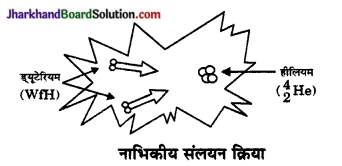
नाभिकीय संलयन क्या है? एक उदाहरण देकर समझाइए।
अथवा
नाभिकीय संलयन को चित्र द्वारा समझाइये।
उत्तर:
नाभिकीय संलयन- अति उच्च दाब एवं उच्च ताप ( लगभग 107K) पर दो हल्के नाभिकों का परस्पर संयुक्त होकर एक भारी नाभिक बनाने की अभिक्रिया को नाभिकीय संलयन कहते हैं। इस अभिक्रिया में असीमित ऊर्जा मुक्त होती है।

उदाहरण- हाइड्रोजन के समस्थानिक ड्यूटेरियम के दो नाभिक \(\left({ }_1^2 \mathrm{H}\right)\) संलयित होकर एक हीलियम नाभिक \(\left({ }_4^2 \mathrm{He}\right)\) बनाते हैं तो बहुत अधिक ऊर्जा मुक्त होती है।
\({ }_1^2 \mathrm{H}+{ }_1^2 \mathrm{H} \rightarrow{ }_2^4 \mathrm{He}+21.6\)MeV ऊर्जा
JAC Class 10 Science Important Questions Chapter 14 उर्जा के स्रोत 2

प्रश्न 23.
नाभिकीय ऊर्जा के कोई तीन लाभ लिखिए।
उत्तर:
नाभिकीय ऊर्जा के लाभ-

  • U-235, की छोटी-सी मात्रा से अत्यधिक मात्रा में ऊर्जा मुक्त होती है।
  • नाभिकीय विखण्डन के लिए ऑक्सीजन की आवश्यकता नहीं होती है।
  • यूरेनियम पर्याप्त मात्रा में उपलब्ध होने पर नाभिकीय ऊर्जा हमेशा मिल सकती है।

प्रश्न 24.
नाभिकीय विखण्डन के महत्त्वपूर्ण उपयोग क्या हैं?
उत्तर:
नाभिकीय विखण्डन का उपयोग निम्नलिखित कार्यों होता है-

  • नाभिकीय विखण्डन की श्रृंखला अभिक्रिया को नियन्त्रित करके इससे प्राप्त ऊर्जा को विद्युत उत्पादन हेतु उपयोग में लाया जाता है।
  • नाभिकीय विखण्डन से प्राप्त उत्पादों का उपयोग उद्योग, कृषि तथा चिकित्सा के क्षेत्र में किया जाता है।
  • नाभिकीय विखण्डन की अनियन्त्रित श्रृंखला अभिक्रिया द्वारा परमाणु बम का निर्माण किया जाता है जिसका उपयोग युद्ध के क्षेत्र में किया जाता है।

प्रश्न 25.
नाभिकीय रियेक्टर के कोई तीन उपयोग लिखो।
उत्तर:
नाभिकीय रियेक्टर के निम्नलिखित उपयोग होते हैं-

  • विद्युत ऊर्जा उत्पादन में
  • विखण्डीय पदार्थों को बनाने में।
  • नाभिकीय शोध कार्यों में।

प्रश्न 26.
नाभिकीय रियेक्टर का सिद्धान्त समझाइये।
उत्तर:
नाभिकीय रियेक्टर ऊष्मा रूपान्तर के सिद्धान्त पर कार्य करता है। नाभिकीय रियेक्टर कंक्रीट की मोटी दीवारों से बना होता है। इसमें एक स्टील पात्र में नियन्त्रित नाभिकीय विखण्डन की क्रिया (क्रांतिक नाभिकीय अभिक्रिया) द्वारा अत्यधिक मात्रा में ऊष्मीय ऊर्जा उत्पन की जाती है। इस ऊष्मीय ऊर्जा से जल को वाष्पित करके उसकी भाप से टरबाइन चलाया जाता है। टरबाइन के अपने या डायनमो की कुण्डली भी घूमने लगती है जिससे विद्युत ऊर्जा ऊर्जा उत्पन्न होती है। इसका उपयोग विभिन्न रचनात्मक कार्यों के लिए किया जाता है।

प्रश्न 27.
नाभिकीय विखण्डन से क्या अभिप्राय है?
उत्तर:
नाभिकीय विखण्डन-यह वह नाभिकीय अभिक्रिया है जिसमें एक भारी नाभिक दो लगभग समान आकार के हल्के नाभिक खण्डों में टूट जाता है तथा दो या तीन नये न्यूट्रॉन, X किरणें उत्सर्जित होती हैं और अत्यधिक ऊर्जा विमोचित होती है। अतः नाभिकीय विखण्डन से अभिप्राय उस नाभिकीय ऊर्जा स्रोत से है जिसमें एक भारी अस्थायी नाभिक, खण्डित होता हुआ दो या तीन न्यूट्रॉन के साथ अत्यधिक परिमाण में ऊर्जा विमोचित करती है।

प्रश्न 28.
नाभिकीय ऊर्जा क्या है? इसके दो शान्तिपूर्ण उपयोग लिखिए।
उत्तर:
नाभिकीय संलयन तथा नाभिकीय विखण्डन क्रिया में मुक्त ऊर्जा ही नाभिकीय ऊर्जा है। इसका शान्तिपूर्ण उपयोग है-

  • विद्युत ऊर्जा के उत्पादन में।
  • चिकित्सा क्षेत्र में कैंसर रोग के इलाज में।

प्रश्न 29.
नाभिकीय अभिक्रिया तथा रासायनिक अभिक्रिया में प्रमुख अन्तर क्या हैं? लिखिए।
उत्तर:
नाभिकीय अभिक्रिया तथा रासायनिक अभिक्रिया में प्रमुख अन्तर निम्नलिखित हैं-

नाभिकीय अभिक्रियारासायनिक अभिक्रिया
1. इस अभिक्रिया में परमाणु के नाभिक भाग लेते हैं जिनका विखण्डन या संलयन होता है।1. इस अभिक्रिया में परमाणु के बाह्यतम कक्षा के इलेक्ट्रॉन भाग लेते हैं।
2. इस अभिक्रिया में परमाणु संयोजित होकर पुनः व्यवस्थित नहीं होते।2. इस अभिक्रिया में परमाणु केवल विभिन्न प्रकार से संयोजित होकर पुन: व्यवस्थित हो जाते हैं।
3. इस अभिक्रिया में नये कणों तथा नाभिकों का निर्माण होता है।3. इस अभिक्रिया में नए परमाणु का निर्माण होता है।
4. इस अभिक्रिया के फलस्वरूप अत्यधिक मात्रा में ऊर्जा उत्पन्न होती है।4. इस अभिक्रिया के फलस्वरूप बहुत कम मात्रा में ऊर्जा उत्पन्न या अवशोषित होती है।

प्रश्न 30.
ऊर्जा संकट क्या है? ऊर्जा संकट के दो कारण लिखिए।
उत्तर:
ऊर्जा के प्रमुख प्राकृतिक स्रोतों जैसे- कोयला, पेट्रोलियम एवं प्राकृतिक गैस की मात्रा पृथ्वी पर सीमित है। इंजन के आविष्कार से लेकर आज तक इन्हीं ऊर्जा संसाधनों पर हम निर्भर करते हैं। चूँकि ये दुर्लभ तथा अनवीकरणीय ऊर्जा स्रोत हैं जिसका दोहन इतनी अधिक दर से हो रहा है कि ये अतिशीघ्रता से समाप्त हो सकते है, फलस्वरूप भविष्य में ऊर्जा प्राप्त न हो सकने की अर्शिका से संसार में एक प्रकार का भय व्याप्त हो गया है इस परिस्थिति को ही ऊर्जा संकट कहते हैं।

उक्त ऊर्जा संकट के कारण –

  • जनसंख्या में अत्यधिक के कारण अनवीकरणीय ऊर्जा स्रोतों का अत्यन्त दोहन किया जाता है।
  • कम दक्षता वाली मशीनों के उपयोग के कारण ऊर्जा के अधिकांश भाग का ह्रास होना।

प्रश्न 31.
सागरीय तापीय ऊर्जा किसे कहते हैं?
उत्तर:
महासागर की सतह के जल तथा गहराई में स्थित जल के ताप में सदैव अन्तर होता है। कई स्थानों पर यह अन्तर 20°C तक हो सकता है। इस रूप में उपलब्ध ऊर्जा को सागरीय तापीय ऊर्जा (Ocean Ther- mal Energy ) या संक्षिप्त में OTE कहते हैं सागरीय तापीय ऊर्जा को विद्युत जैसे उपयोगी रूप में परिवर्तित किया जा सकता है।

JAC Class 10 Science Important Questions Chapter 14 उर्जा के स्रोत

प्रश्न 32.
ज्वारीय तरंगें किस प्रकार उत्पन्न होती हैं?
उत्तर:
सागरीय ऊर्जा एक अन्य रूप में भी उपलब्ध होती है और वह है- सागरीय लहरों से सम्बद्ध ऊर्जा। सागर की सतह पर चलने वाली वायु की तीव्र धाराओं से उत्पन्न ऊँची-ऊँची लहरें निरंतर तट पर ऊपर-नीचे उठती- गिरती रहती हैं। ऊँची-ऊँची लहरें निरंतर तट पर टकराती हैं, तो यह लहरें ज्वारीय तरंगें कहलाती हैं।

प्रश्न 33.
पवन चक्की का कार्यकारी सिद्धान्त लिखिए। अथवा पवन चक्की का सिद्धान्त स्पष्ट करें।
उत्तर:
जब पवन चक्की के ब्लेडों से वायु टकराती है, तो उन पर एक बल लगता है, जिससे पवन चक्की घूमने लगती है। पवन चक्की का घूर्णन उसके ब्लेडों की विशिष्ट बनावट के कारण सम्भव होता है, जो किसी विद्युत पंखों के ब्लेडों के समान ही होती है जिस प्रकार विद्युत पंखे के ब्लेडों के घूमने से वायु गतिशील हो जाती है, ठीक इसी प्रकार गतिशील वायु पंखे को घुमाती है। पवन चक्की द्वारा कुएँ या खदानों में भरे पानी को बाहर निकाला जा सकता है या विद्युत उत्पन्न की जा सकती है।

प्रश्न 34.
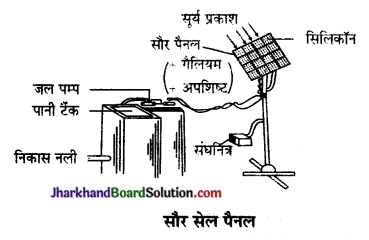
सौर ऊर्जा का विद्युत ऊर्जा में रूपान्तरण करने की किसी एक युक्ति का वर्णन कीजिए। अथवा सौर सेल पैनल का वर्णन कीजिए एवं उपयोगिता लिखिए
उत्तर:
सौर ऊर्जा को विद्युत ऊर्जा में परिवर्तित करने के लिए सौर सेल या सौर पैनल प्रयुक्त करते हैं।

सौर सेल पैनल – सौर सेल प्रकाश-विद्युत प्रभाव के सिद्धान्त पर कार्य करती है जो सीधे ही सौर ऊर्जा को विद्युत ऊर्जा में रूपान्तरित कर देती हैं सौर सेल की दक्षता कम होने के कारण अनेक सौर सेलों को विशेष क्रम में व्यवस्थित कर दिया जाता है जिससे विभिन्न कार्यों के लिए पर्याप्त परिमाण में विद्युत ऊर्जा प्राप्त की जा सकती है सौर सेलों की यह व्यवस्था सौर सेल पैनल कहलाती है। सौर पैनल से सौर सेलों को जोड़ने के लिए चाँदी का प्रयोग किया जाता है सौर पैनल में निर्मित विद्युत दिष्ट धारा होती है।

सौर सेल पैनल की उपयोगिता –

  • इसका उपयोग कृत्रिम उपग्रहों तथा अंतरिक्षयानों में विद्युत उपलब्ध करने हेतु किया जाता है।
  • दूरस्थ वन ग्रामों की सड़कों पर प्रकाश करने. सिंचाई के लिए जलपंपों को चलाने तथा रेडियो एवं टेलीविजन सेटों को चलाने किया जाता है।
    JAC Class 10 Science Important Questions Chapter 14 उर्जा के स्रोत 3

दीर्घ उत्तरीय प्रश्न

प्रश्न 1.
प्रकाश ऊर्जा का अवशोषण किन-किन रूपों में होता है? समझाइये।
उत्तर:
जब प्रकाश ऊर्जा पृथ्वी के वायुमण्डल से होकर गुजरती है तो उनमें से केवल 47% ऊर्जा ही पृथ्वी सतह तक पहुँचती है, शेष ऊर्जा वायुमण्डल में अवशोषित एवं कुछ परावर्तित हो जाती है।

प्रकाश ऊर्जा का अवशोषण निम्नलिखित रूपों में होता है-
(1) पराबैंगनी प्रकाश का अवशोषण प्रकाश की पराबैंगनी किरणें लगभग पूरी तरह वायुमण्डल की ओजोन परत द्वारा अवशोषित कर ली जाती हैं।

(2) अवरक्त प्रकाश का अवशोषण- पृथ्वी की सतह द्वारा अवरक्त प्रकाश अवशोषित की जाती है ये अवरक्त प्रकाश अपने मार्ग में आने वाली सभी वस्तुओं को गर्म कर देता है। फलस्वरूप पृथ्वी सतह के जल तथा पृथ्वी की सतह को गर्म कर देती है अर्थात् अवरक्त प्रकाश ऊष्मा के रूप में पृथ्वी के विभिन्न घटकों द्वारा अवशोषित कर ली जाती है। अप्रत्यक्ष रूप से सौर ऊर्जा का अवशोषण महासागरीय ऊर्जा का पवन ऊर्जा के रूप में होता है।

(3) दृश्य प्रकाश का अवशोषण-पौधों में रासायनिक ऊर्जा के रूप में दृश्य प्रकाश का अवशोषण होता है जो जैव द्रव्यमान में परिवर्तन द्वारा जीवाश्म ईंधन के रूप में प्राप्त होता है। पौधों एवं जन्तुओं में भोजन के रूप में अवशोषण सतत होता रहता है। कुछ भाग वायुमण्डल में उपस्थित जल वाष्प, ओजोन परत, धूल कण तथा CO2 द्वारा अवशोषित कर लिया जाता है।

प्रश्न 2.
सौर तापन युक्तियाँ किसे कहते हैं? सौर कुकर का वर्णन निम्न शीर्षकों में करें-
(i) सिद्धान्त
(ii) नामांकित रेखाचित्र,
(iii) कार्यविधि
उत्तर:
सौर तापन युक्ति- वे युक्तियाँ जो सूर्य से प्राप्त ऊर्जा का अधिक से अधिक संग्रह कर सकें तथा संगृहित ऊष्मा का क्षय कम-से-कम करें, सौर तापन युक्तियाँ कहलाती हैं।

सौर कुकर का वर्णन-
(i) सिद्धान्त- काले रंग की सतह पर परावर्तक सतह की तुलना में अधिक ऊष्मा का अवशोषण होता है इसलिए सौर कुकर में काली सतह का उपयोग करके उसे ऊष्मारोधी बॉक्स में रखकर उसकी ऊपरी सतह को किसी काँच की पट्टी से बैंक दिया जाता है जिससे काली सतह द्वारा ऊष्मा का अधिक अवशोषण तथा कम-से-कम व्यय होता है फलस्वरूप उसका आन्तरिक भाग अत्यधिक गर्म हो जाता है।

(ii) नामांकित रेखाचित्र-
JAC Class 10 Science Important Questions Chapter 14 उर्जा के स्रोत 4

(iii) कार्यविधि – काले रंग से पुता ऐलुमिनियम के बर्तन में वह खाद्य पदार्थ रख देते हैं जिसे पकाना है। यह बर्तन कुकर के अन्दर रखकर समतल कांच के ढक्कन द्वारा ढक देते हैं अब सौर कुकर को सूर्य के प्रकाश में इस प्रकार व्यवस्थित करके रख देते हैं कि का प्रकाश समतल दर्पण से परावर्तित होकर कुकर अन्दर प्रवेश करे।

पेटिका के अन्दर एवं बर्तनों के बाहर काला रंग ऊष्मा को अवशोषित करता है। पेटिका के ऊपर रखी समतल कौन की प्लेट ग्रीन हाउस प्रभाव उत्पन्न करती है जिससे बॉक्स के अन्दर का ताप 2-3 घण्टे में लगभग 100°C से 140- तक पहुँच जाता है और बर्तन में रखा खाद्य पदार्थ पक जाता है।

प्रश्न 3.
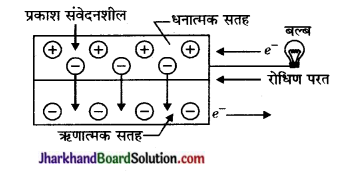
अर्द्धचालक क्या? सौर सेल के कार्य सिद्धान्त की व्याख्या कीजिए।
उत्तर:
अर्द्धचालक- अर्द्धचालक वे पदार्थ होते हैं जो सामान्यतः विद्युत के सुचालक नहीं होते किन्तु इनमें कुछ विशेष अपद्रव्य मिला दिये जायें तो उनकी चालकता बढ़ जाती है। इन पर प्रकाश पड़ने से इनकी विद्युत चालकता और बढ़ जाती है जैसे- सिलिकॉन तथा गैलियम।
JAC Class 10 Science Important Questions Chapter 14 उर्जा के स्रोत 5
सौर सेल का कार्य सिद्धान्त-सौर सेल प्रायः अपद्रव्य मिश्रित अर्द्धचालक पदार्थ की परतों से बना होता है। जब इन परतों पर सूर्य का प्रकाश पड़ता है तो अर्द्धचालक के दो भागों में विभवान्तर उत्पन्न हो जाता है। अर्द्धचालक से मुक्त हुए इलेक्ट्रॉनों के कारण इसमें धारा प्रवाहित होने लगती है। 4 वर्ग सेण्टीमीटर साइज के किसी सौर सेल द्वारा 60 मिली ऐम्पियर धारा लगभग 0.4-0.5V पर उत्पन्न होती है। इस अर्द्धचालकों से निर्मित सौर सेलों की दक्षता 10-18% है जबकि आधुनिक सेलेनियम सोलर सेल की दक्षता 25% तक है।

प्रश्न 4.
पवन के प्रवाहित होने के कारणों की व्याख्या कीजिए।
उत्तर:
पवन के प्रवाहित होने के लिए निम्नलिखित कारण उत्तरदायी हैं-

  • पृथ्वी की अपनी अक्ष के परितः घूर्णन गति।
  • पृथ्वी के भूमध्य रेखीय भाग का ताप अधिक व ध्रुवों के पास का ताप कम होना।
  • स्थानीय संवहन धाराएँ।

पृथ्वी के भूमध्य रेखीय भागों पर सूर्य की किरणें सीधे आपतित होती हैं जबकि ध्रुवीय भागों पर सूर्य की किरणें तिरछी आपतित होती हैं अतः भूमध्य रेखीय भागों में पृथ्वी तल के समीप की वायु ध्रुवीय भागों की अपेक्षा अतिशीघ्र तथा अधिक गर्म हो जाती हैं, इसके फलस्वरूप पृथ्वी पर संवहन धाराएँ बन जाती हैं तथा भूमध्य रेखीय भांगों की वायु अधिक गर्म होने के कारण ऊपर उठने लगती है।

इनके खाली स्थान को भरने के लिए ध्रुवीय स्थानों की अपेक्षाकृत ठण्डी वायु भूमध्यरेखीय भाग की और बहने लगती है। वायु के इस प्रवाह में पृथ्वी के घूर्णन तथा स्थानीय संवहन धाराओं के कारण लगातार बाधा पड़ती रहती है, इसी का परिणाम है-पवन। ये मंद वेग पवन से लेकर विनाशकारी टारनेडो तक परिवर्तित हो सकती हैं।

JAC Class 10 Science Important Questions Chapter 14 उर्जा के स्रोत

प्रश्न 5.
जल विद्युत उत्पादन को सचित्र समझाइये।
उत्तर:
जल विद्युत उत्पादन- आजकल नदियों में प्राकृतिक रूप से बहते हुए पानी की गतिज ऊर्जा को बाँध बनाकर स्थितिज ऊर्जा के रूप में संचित कर लिया जाता है जिससे विद्युत संयंत्र द्वारा विद्युत उत्पादित की जाती है।

बाँध के उच्च स्तर से जल को पाइपों द्वारा उसके तली के पास लगाये गये जल विद्युत संयंत्र (विद्युत जनित्र) तक गिराया जाता है। इससे जल की स्थितिज ऊर्जा गिरते हुए पानी की गतिज ऊर्जा में परिवर्तित हो जाती है। पाइप से गिरता हुआ पानी टरबाइनों को घुमाता है जो विद्युत जनित्रों में आर्मेचर को घुमाती है, आर्मेचर के घूमने से विद्युत उत्पादित होती है। इस पूरे प्रक्रम में ऊर्जा का रूपान्तरण निम्न प्रकार होता है-बाँध में भंडारित जल की स्थितिज ऊर्जा गिरते हुए पानी की गतिज ऊर्जा में रूपांतरित होती है। ये ऊर्जा टरबाइन में घूर्णन गति उत्पन्न करता है। जनरेटर इस गतिज ऊर्जा को विद्युत ऊर्जा में रूपान्तरित कर देता है।

प्रश्न 6.
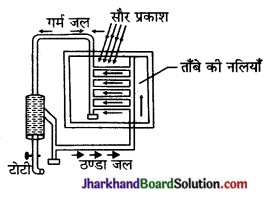
सौर जल ऊष्मक का वर्णन निम्नांकित शीर्षकों में कीजिए – (i) सिद्धान्त, (ii) उपकरण का रेखाचित्र, (iii) कार्यविधि।
उत्तर:
सौर जल ऊष्मक-सौर जल ऊष्मक एक ऐसी युक्ति है जिसमें सौर ऊर्जा का उपयोग करके ठण्डे जल से गर्म जल प्राप्त किया जाता है।
(i) सिद्धान्त-सौर जल ऊष्मक में सौर ऊर्जा का रूपान्तरण ऊष्मा ऊर्जा के रूप में होता है जब सूर्य का प्रकाश संग्राहक पर पड़ता है तो इसके काले रंग में रंगे ताँबे की सर्पिलाकार नली अवरक्त किरणें अवशोषित कर ऊष्मा उत्पन्न करती है। यह ऊष्मा पानी को गर्म कर देती है।

(ii) उपकरण का रेखाचित्र-
JAC Class 10 Science Important Questions Chapter 14 उर्जा के स्रोत 6

(iii) कार्यविधि – चित्र में सौर जल ऊष्मक प्रदर्शित है। सौर जल ऊष्मक को छत पर खुले स्थान में इस प्रकार स्थायी रूप से व्यवस्थित कर दिया जाता है कि सूर्य से आने वाली अधिक-से-अधिक किरणें सीधे इस पर पड़ें।

सूर्य से आने वाली किरणें जब ताँबे की नलियों की काली सतह पर पड़ती हैं तो ये सतह ऊष्मा को अवशोषित कर लेती हैं। चूँकि ताँबा, ऊष्मा का सुचालक है, अतः शीघ्र ही यह अवशोषित ऊष्मा नलियों में बहने वाले जल को मिल जाती है जिससे जल में संवहन धारायें बन जाती हैं तथा गर्म जल ऊपर उठकर गर्म जल संग्राहक में चला जाता है और ठण्डा जल नीचे नलियों में आ जाता है, यह प्रक्रम चलता रहता है और गरम जल टोंटी से प्राप्त होता रहता है।

प्रश्न 7.
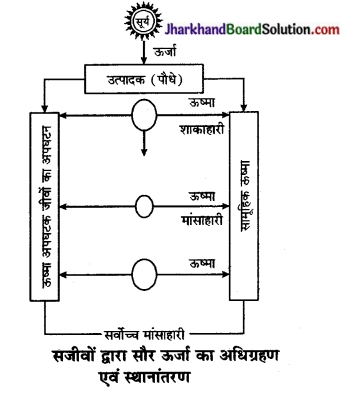
प्रकाश ऊर्जा का अवशोषण किन-किन रूपों में तथा किस प्रकार होता है? समझाइए। अथवा सौर ऊर्जा का सजीवों में अधिग्रहण एवं स्थानान्तरण प्रक्रम को सचित्र समझाइये।
उत्तर:
सूर्य से ऊर्जा का प्रवाह शुरू होता है। हरे पौधे प्रकाश संश्लेषण प्रक्रिया द्वारा इस सौर ऊर्जा को अंतर्ग्रहण करते हैं। सौर ऊर्जा अजैव वातावरण के माध्यम से जीवों में प्रवेश करती है। केवल वही पौधे सौर ऊर्जा को अंतर्ग्रहण करते हैं, जिनमें क्लोरोफिल नामक हरित वर्णक होता है। इस ऊर्जा को अंतर्ग्रहण करने के पश्चात् पौधे इसे रासायनिक ऊर्जा में परिवर्तित कर देते हैं जो कार्बोहाइड्रेट के रूप में संगृहित हो जाती है। इस ऊर्जा का कुछ अंश पौधे अपनी वृद्धि तथा ऊतकों के निर्माण में उपयोग करते हैं तथा जो ऊर्जा उपयोग नहीं होती, वह ऊष्मा के रूप में मुक्त हो जाती है।
JAC Class 10 Science Important Questions Chapter 14 उर्जा के स्रोत 7
शाकाहारी जन्तु इन पौधों को भोजन के रूप में खाते हैं। शाकाहारी जन्तुओं को मांसाहारी तथा मांसाहारी जन्तुओं को सर्वोच्च मांसाहारी खाते हैं। पौध एवं प्राणियों के मृत शरीर को अपघटक जीवाणु अपना भोजन बनाते हैं तथा उन्हें अपघटित कर खाद के समान उपयोगी बनाते हैं। इस प्रकार हरे पौधों द्वारा सर्वप्रथम सौर ऊर्जा का अधिग्रहण किया जाता है तत्पश्चात् अन्य सजीवों में ऊर्जा का स्थानान्तरण खाद्य श्रृंखला के द्वारा होता है।

प्रश्न 8.
सौर ऊर्जा का विद्युत ऊर्जा में रूपान्तरण करने का वर्णन कीजिए तथा सौर सेल पैनल की उपयोगिता लिखिए।
उत्तर:
सौर सेल एक ऐसी युक्ति है, जो सौर ऊर्जा को विद्युत ऊर्जा में परिवर्तित करती है। लगभग 100 वर्ष पहले यह खोज की जा चुकी थी कि सेलेनियम की किसी पतली पर्त को सौर प्रकाश में रखने पर विद्युत उत्पन्न होती है। यह भी ज्ञात था कि सेलेनियम के किसी टुकड़े पर आपतित सौर ऊर्जा का केवल 0.6 प्रतिशत ही विद्युत में परावर्तित हो पाता है। चूँकि इस प्रकार के सौर सेल की दक्षता बहुत कम थी, इसलिए विद्युत उत्पन्न करने के लिए इस परिघटना का उपयोग करने के कोई विशेष प्रयत्न नहीं किए गए।

सबसे पहला व्यावहारिक सौर सेल सन् 1954 में बनाया गया था। यह सेल लगभग 1.0 प्रतिशत सौर ऊर्जा को विद्युत ऊर्जा में परिवर्तित कर सकता था। आजकल अर्द्धचालकों से निर्मित सौर सेल द्वारा कहीं अधिक दक्षता प्राप्त की जा चुकी है। अंतरिक्ष कार्यक्रमों द्वारा उत्पन्न बढ़ती हुई माँग के कारण भी अधिक-से-अधिक दक्ष सौर सेलों को विकसित करने की दर में वृद्धि हुई है। आधुनिक सेलेनियम सौर सेल की दक्षता 25% तक है, जबकि अर्द्ध- चालकों से निर्मित सौर सेलों की दक्षता 10-18% है।

आजकल प्रायः सौर सेल, सिलिकॉन तथा गैलेनियम जैसे अर्द्धचालकों से बनाए जाते हैं अर्द्धचालक ऐसे पदार्थ हैं, जिनमें सामान्यतः विद्युत प्रवाहित नहीं की जा सकती है अर्थात् वे सुचालक नहीं होते किन्तु विद्युतरोधियों की तुलना में इनमें कुछ सीमा तक विद्युत का चालन सम्भव है परन्तु यदि अर्द्धचालकों में कुछ विशेष अपद्रव्य मिला दिया जाए तो उनकी चालकता अर्थात् विद्युत चालन की सामर्थ्य अभूतपूर्व रूप से बढ़ जाती है।

प्रकाश पड़ने पर भी अर्द्धचालकों की चालकता बढ़ जाती है। सौर सेल में अपद्रव्य मिश्रित अर्द्धचालकों की परतें इस प्रकार व्यवस्थित की जाती हैं कि प्रकाश पड़ने पर अर्द्धचालक के दो भागों में विभवान्तर उत्पन्न हो जाए। 4 वर्ग सेमी साइज के किसी सौर सेल द्वारा 60 मिली ऐम्पीयर धारा लगभग 0.4-0.5V पर उत्पन्न होती है। किस सौर सेल पैनल में अनेक सौर सेल विशेष क्रम में व्यवस्थित होते हैं, उसमें विभिन्न कार्यों के लिए कति परिमाण में विद्युत प्राप्त की जा सकती है।

सौर सेल पैनल की उपयोगिता – सौर सेलों का उपयोग दुर्गम तथा दूरस्थ स्थानों में अत्यन्त प्रभावशाली सिद्ध हुआ है। समस्त कृत्रिम उपग्रहों तथा अन्तरिक्ष अन्वेषक चिनि मुख्यतः सौर पैनलों द्वारा उत्पादित विद्युत पर निर्भर करते हैं। भारत में सौर सेलों का उपयोग प्रकाश व्यवस्था में तथा जल पम्पों, रेडियो तथा दूरदर्शन के अभिग्राहियों को प्रचलित करने के लिए किया गया है। इसके अतिरिक्त इनका उपयोग द्वीप स्तम्भों (Light houses) में तथा तट से दूर निर्मित खनिज तेल के कुएँ खोदने के रिंग को विद्युत ऊर्जा प्रदान करने में भी होता है।

प्रश्न 9.
जैव मात्रा किसे कहते हैं?
उत्तर:
वनस्पतियों एवं जंतुओं के शरीर में स्थित पदार्थों को जीव द्रव्यमान (मात्रा) कहते हैं किसी जीव की के बाद जीव द्रव्यमान का उपयोग घरेलू ईंधन के रूप में किया जा सकता है। वास्तव में लकड़ी कृषि अपशिष्ट तथा गोबर के कण्डे सब मिलाकर गाँवों की ऊर्जा की आवश्यकता का 80% अंश प्रदान करते हैं।

चूँकि गोबर के कण्डों का दहन अपूर्ण होता है तथा वे अत्यधिक धुआँ उत्पन्न करते हैं, इसलिए ईंधन के रूप में इनके प्रयोग न केवल लाभप्रद तत्त्व नष्ट होते हैं, अपितु इनसे वातावरण भी प्रदूषित होता है इसलिए गोबर के कण्डों को सीधा जलाना अविवेकपूर्ण है। इसके स्थान पर गोबर को गोबर गैस में परिवर्तित करना चाहिए, जो एक साफ-सुथरा ईंधन है गोबर गैस बनाने के बाद बचे अवशेष में अत्यधिक पोषक तत्त्व होते हैं, जिसे खाद के रूप में उपयोग किया जाता है।

प्रश्न 10.
अन्तः दहन इंजन किसे कहते हैं? इसकी रचना एवं कार्यविधि समझाइए।
उत्तर:
अन्तः दहन इंजन- इस इंजन में ईंधन की अल्प मात्रा सिलिण्डर में डालकर प्रज्वलित की जाती है। दहन के दौरान निकली गैसों के द्वारा उत्पन्न दाब पिस्टन को बाहर धकेलता है। किसी निश्चित समय में सिलिण्डर के अन्दर केवल थोड़ी-सी मात्रा में ईंधन जलते हैं, इसलिए इसे अन्त: दहन इंजन कहते हैं। अन्त: दहन इंजन का आविष्कार रूडोल्फ डीजल तथा निकोलस आटो ने किया था।

अन्तः दहन इंजन का सिद्धान्त (Principle of In ternal Combustion Engine ) – इस इंजन द्वारा बहुत अल्प मात्रा में ईंधन को सिलिण्डर में प्रज्वलित किया जाता है इस दहन द्वारा निकली गैसों से उत्पन्न दाब द्वारा पिस्टन को बाहर की तरफ धकेलकर उसे गतिशील बनाया जाता है।

अन्तः दहन इंजन की रचना तथा विधि – अन्त: दहन इंजन में एक समय पर बहुत ही अल्प मात्रा में ईंधन को सिलिण्डर में जलाया जाता है। इसी इंजन को सुविधानुसार छोटे आकार में बनाया जाता है। इस इंजन में ईंधन को जलाकर गैसों में परिवर्तित करना तभी गैसों के दबाव से पिस्टन को गतिशील बनाना निम्न चरणों में पूर्ण होता है-

  • अन्तर्ग्रहण – सर्वप्रथम ईंधन की अल्प मात्रा तथा वायु का मिश्रण सिलिण्डर में प्रविष्ट कराया जाता
  • सम्पीडन – ईंधन तथा वायु के मिश्रण को सम्पीडित किया जाता है।
  • दहन – मिश्रण को प्रज्वलित किया जाता है।
  • विस्तारण प्रज्वलन के कारण अत्यधिक मात्रा में ऊष्मा उत्पन्न होती है जो दहन के समय निकली गैसों को प्रसारित करती है गैसों के प्रसारण से बल उत्पन्न होता है, जो पिस्टन को बाहर धकेलता है।
  • निर्गम – अन्त में निर्गम वाल्व के खुलने से दहन के उपोत्पाद बाहर निकाल दिये जाते हैं।

प्रश्न 11.
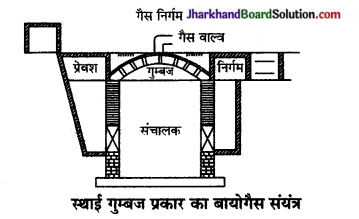
स्थायी गुम्बज प्रकार के बायोगैस संयन्त्र का नामांकित चित्र सहित वर्णन कीजिए।
उत्तर:
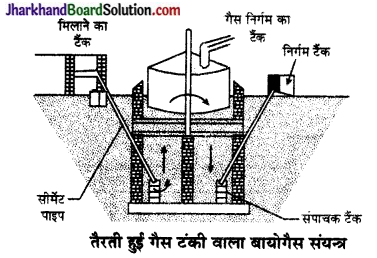
दो प्रकार के बायोगैस संयन्त्र प्रचलन में हैं-

  • स्थिर गुम्बदनुमा टंकी वाले बायोगैस संयन्त्र।
  • प्लावित (तैरती हुई) टंकी वाले बायोगैस संयन्त्र।

स्थिर गुम्बदनुमा टंकी वाले बायोगैस संयन्त्र मुख्य भाग निम्न प्रकार हैं- (a) संपाचक ( टैंक), (b) मिलाने का टैंक, (c) निर्गम टैंक, (d) गुम्बदनुमा टैंक।

(a) संपाचक – यह एक स्टील का या कंक्रीट का बेलनाकार टैंक होता है, जिसका व्यास आवश्यकतानुसार रखा जाता है, यह जमीन के अन्दर या ऊपर बनाया जाता है।
JAC Class 10 Science Important Questions Chapter 14 उर्जा के स्रोत 8

(b) मिलाने का टैंक व

(c) निर्गम टैंक-संपाचक से दो अन्य छोटे-छोटे टैंक सम्बन्धित रहते हैं, जिनमें एक है मिलाने का टैंक, जिसमें गोबर या अन्य अपशिष्ट पदार्थों का घोल डाला जाता है व दूसरा निर्गम टैंक, जिसमें स्लरी
(बचा हुआ घोल) एकत्र होता रहता है।

(d) गुम्बदनुमा टंकी – यह संपाचक के ऊपर स्थिर रहती है तथा इनमें बायोगैस एकत्र होती रहती है जैसा कि चित्र में प्रदर्शित है।

प्रश्न 12.
समुद्रीय तरंगें कैसे बनती हैं?
उत्तर:
समुद्री तरंगों की उत्पत्ति का कारण है- जल की सतह के नीचे गहराइयों में तापान्तर, जो ध्रुव प्रदेशों व भूमध्य रेखा पर स्थित बिन्दुओं के बीच उत्पन्न होता है तथा एक ही स्थान पर तल की ऊपरी तह व नीचे की तहाँ के बीच स्थापित होता है। इस तापान्तर के कारण भूमध्य रेखीय समुद्र की सतह का गर्म जल ध्रुवों की ओर बहने लगता है। क्योंकि वह हल्का, पतला व प्रवाहशील होता है। ध्रुवीय प्रदेशों का जल परिणामस्वरूप भूमध्य रेखा की ओर प्रवाहित होने लगता है। वायु प्रवाह तथा पृथ्वी की घूर्णन गति के कारण इसका मार्ग निर्दिष्ट होता है।

प्रश्न 13.
हवा क्यों चलती है?
उत्तर:
सूर्य द्वारा विकिरित ऊष्मा आकाश व वायुमण्डल में से होकर पृथ्वी तक पहुँचती है, किन्तु वायुमण्डल की वायु को यह गर्म नहीं करती। पृथ्वी पर ठोस धरातल तथा महासागरों के जल की सतह द्वारा इस ऊष्मा का अवशोषण होता है, जिससे दोनों सतहों के ताप में वृद्धि होती है। ताप में यह वृद्धि सभी स्थानों पर एक समान नहीं होती। भूमध्य रेखीय कटिबन्ध (क्षेत्र) में ताप वृद्धि ध्रुवीय क्षेत्रों की तुलना में (जल तथा थल) दोनों में अधिक रहती है। यह तापान्तर ही वह प्रमुख कारण है, जिसके होने से वायु प्रवाह होता है और आँधियाँ आती हैं।

JAC Class 10 Science Important Questions Chapter 14 उर्जा के स्रोत

प्रश्न 14.
मानसून किसे कहते हैं?
उत्तर:
मानसून के कारण पृथ्वी पर वर्ष के अर्द्ध- भाग में थल की सतह जल सतह की अपेक्षा अधिक उष्ण हो जाती है, तब समुद्र की सतह के ऊपर की वाष्प सन्तृप्त वायु की ओर प्रवाहित होती है। इसके कारण पृथ्वी पर लम्बी अवधि तक वर्षा होती रहती है। वर्ष के अर्द्धभाग में यह क्रिया विपरीत दिशा में होती है, तब वायु पृथ्वी की ओर से समुद्र की ओर बहती है। इसी कारण मानसून उठता है तथा यही दोनों मानसून कहलाते हैं।

पृथ्वी पर एवं सागर तल पर सूर्य ताप के कारण वाष्पन की क्रिया सतत होती रहती है। यही वाष्प बादल बन जाती है तथा बादल ठण्डक पाकर वर्षा करते हैं। इस प्रकार जल वाष्प चक्र निरन्तर चलता रहता है।

प्रश्न 15.
वायु ऊर्जा, पवन चक्की तथा सौर ऊर्जा के तीन उपयोग बताइए जल ऊर्जा का एक उपयोग लिखो।
उत्तर:
वायु ऊर्जा के उपयोग-

  • पवन चक्कियों को चलाने में।
  • भूमिगत पानी को बाहर निकालने में।
  • विद्युत के उत्पादन में।

पवन चक्की के उपयोग-

  • मक्का तथा गेहूँ आदि पीसने में
  • इसके द्वारा टरबाइन चलाकर विद्युत ऊर्जा उत्पादित की जा सकती है।
  • इस चक्की के उपयोग से खदानों में भरा पानी निकाला जा सकता है।

सौर ऊर्जा के उपयोग-

  • सौर ऊर्जा द्वारा विद्युत ऊर्जा प्राप्त की जाती
  • सौर ऊर्जा का उपयोग (सोलर कुकर द्वारा) ख्भना पकाने में किया जाता है।
  • सौर ऊर्जा को ऊष्मीय ऊर्जा में परिवर्तित क्रकरे प्राप्त ऊर्जा से पानी गर्म करना, हीटर चलाना आदि क्रियाएँ कर सकते हैं।

जल ऊर्जा के उपयोग-विद्युत उत्पादन में।

प्रश्न 16.
बाह्ल दहन इंजन और अन्तःदहन इंजन में अन्तर स्पष्ट कीजिये।
उत्तर:
बाह्य दहन इंजन और अन्तःदहन इंजन में निम्नलिखित अन्तर हैं-

बाट़ा दहन इंजनअन्तः ढहन इंजन
1. इसमें सिलेण्डर के बाहर ईंधन का दहन होता है।1. इसमें सिलेण्डर के अन्दर ईंधन का दहन होता है।
2. पिस्टन जल-वाष्प के दाब से गतिशील होता है।2. पिस्टन गैसीय दाब के कारण गतिशील होता है।
3. इसमें वाष्प बनाने के लिए बॉयलर का उपयोग होता है।3. इसमें बॉयलर का कोई उपयोग नहीं होता है।
4. इसमें प्रदूषण नहीं होता।4. इसमें प्रदूषण होता है।

प्रश्न 17.
जल विद्युत का उत्पादन कैसे करते हैं?
उत्तर:
पानी को ऊँचे स्थानों पर (बाँध द्वारा) एकत्रित किया जाता है। इस प्रकार पानी में स्थितिज ऊर्जा संग्रहीत होती है। जब इस पानी को नीचे गिराया जाता है, तो स्थितिज ऊर्जा गतिज ऊर्जा में रूपान्तरित होती है, इस गतिज ऊर्जा को यांत्रिक ऊर्जा में बदलकर टरबाइन चलाए जाते हैं। इस प्रकार टरबाइन से प्राप्त यांत्रिक ऊर्जा को विद्युत उत्पादक यंत्रों (विद्युत जनित्र ) द्वारा विद्युत ऊर्जा में परिवर्तित किया जाता है। इसका एक उदाहरण भाखड़ा बाँध है। बहुत पहले गतिशील पानी की गतिज ऊर्जा का प्रयोग पवन चक्कियों को चलाने में करते थे, जिससे गेहूँ आदि पीसा जाता था।

प्रश्न 18.
नवीकरण और अनवीकरण स्त्रोतों से आप क्या समझते हो? उदाहरण सहित लिखो।
उत्तर:

  • नवीकरण स्त्रोत – वे स्रोत, जिनमें एक निश्चित समय के बाद पुनः प्रकट होने की क्षमता होती है, नवीकरण स्रोत कहे जाते हैं।
  • उदाहरण – मिट्टी, जल और जैविक समुदाय।
  • अनवीकरण स्त्रोत – वे खोत, जिनमें पुनर्चक्रण या पुनर्स्थापना की क्षमता नहीं होती, अनवीकरण खोत कहे जाते हैं।
  • उदाहरण – जीवाश्म ईंधन-जैसे कोयला, पेट्रोलियम एवं खनिज आदि।

प्रश्न 19.
तैरती हुई गैस टंकी वाले बायोगैस संयन्त्र का सचित्र वर्णन कीजिए।
उत्तर:
तैरती हुई टंकी वाले बायोगैस संयन्त्र – इस प्रकार के गैस संयंत्र में सभी भाग गुम्बदनुमा टंकी वाले बायोगैस संयन्त्र के समान ही होते हैं। इसकी गैस संग्राहक टंकी संपाचक के ऊपर तैरती रहती है।
JAC Class 10 Science Important Questions Chapter 14 उर्जा के स्रोत 9
चित्र-तैरती हुई गैस टंकी वाला बायोगैस संयन्त्र
इसके प्रमुख भाग निम्नलिखित हैं-

  • जल तथा गोबर मिश्रण के लिए प्रवेश मार्ग
  • मुख्य टैंक
  • गैसों के लिए निर्गम
  • घोल के लिए निर्गम
  • सीमेन्ट पाइप

बायोगैस संयंत्र में जीव द्रव्यमान प्रयोग किया जाता है। जीव द्रव्यमान के अतिरिक्त मानव मल का भी उपयोग किया जाता है। गोबर तथा जल के मिश्रण को संपाचक या मुख्य टैंक में एकत्रित किया जाता है। उत्पन्न गैस निर्गम द्वार से उपयोग के लिए उपलब्ध होती रहती है तथा गैस बन जाने के बाद यन्त्र में स्तरी बची रहती है, जिसमें अत्यधिक मात्रा में नाइट्रोजन तथा फॉस्फोरस यौगिक होते हैं। इसलिए इसका उपयोग एक अच्छी खाद के रूप में होता है।

प्रश्न 20.
वायु प्रवाह के लिये आवश्यक तीन कारक बतायें। समझाइए कि पवन ऊर्जा क्या है?
उत्तर:
पवन को गतिशील करने के लिए उत्तरदायी कारक – पवन के गतिशील होने के लिए निम्नलिखित तीन कारक उत्तरदायी हैं-

  • सूर्य की स्थिति
  • तापमान का अन्तर
  • दाब का अन्तर

पवन ऊर्जा पृथ्वी का वायुमण्डल एक विशाल ऊष्मा इंजन की भाँति कार्य करता है। भूमध्य रेखीय क्षेत्रों मैं ध्रुवीय क्षेत्रों की अपेक्षा सौर प्रकाश की तीव्रता अधिक होती है। इसके परिणामस्वरूप भूमध्य रेखीय क्षेत्रों में पृथ्वी की सतह के निकट की वायु शीघ्र गर्म होकर ऊपर की ओर उठती है। इस खाली स्थान को भरने के लिये ध्रुवीय क्षेत्रों की अपेक्षाकृत ठण्डी वायु भूमध्य रेखीय क्षेत्रों की ओर बहने लगती है। इस बहती हुई वायु को पवन कहते हैं। वायु के विशाल द्रव्यमान की गतिशीलता से सम्बद्ध गतिज ऊर्जा ही पवन ऊर्जा है।

प्रश्न 21.
जैव गैस (बायोगैस) किसे कहते हैं? इसका संगठन लिखिए।
उत्तर:
जैव अपशिष्ट के विघटन से प्राप्त विभिन्न गैसों का मिश्रण जैव गैस या बायोगैस कहलाता है। इसका संगठन निम्न है – मिथेन (CH) गैस यह 65% होती है, इसके अतिरिक्त बायोगैस में कार्बन डाइ ऑक्साइड, हाइड्रोजन सल्फाइड आदि गैसें उत्पन्न होती हैं।

प्रश्न 22.
गोबर के सूखे कण्डों को जलाने से क्या हानियाँ होती हैं?
अथवा
गोवर के सूखे कण्डे बनाकर ईंधन के रूप में उपयोग करना अच्छी बात नहीं? इसके स्थान पर हमें क्या करना चाहिए और क्यों?
उत्तर:
गोबर के सूखे कण्डों को जलाने से हानियाँ – पशुओं के गोबर से बनाए गए सूखे कण्डों का दहन अपूर्ण होता है, जिसके फलस्वरूप वे अत्यधिक धुआँ उत्पन्न करते हैं। इससे वातावरण प्रदूषित होता है। पशुओं के गोबर में अनेक ऐसे महत्त्वपूर्ण पोषक तत्त्व हैं, जिन्हें मृदा में वापस पहुँचाने से मृदा की उपजाऊ शक्ति बनी रहती है। यदि गोबर के कण्डों को जलाया जाए, तो वे पोषक तत्त्व नष्ट हो जाते हैं। अतः गोबर कण्डों को सीधा जलाना विवेकपूर्ण नहीं है। गोबर को गोबर गैस में परिवर्तित करना चाहिए, जो कि एक साफ-सुथरा ईंधन है।

बहुविकल्पीय प्रश्न

1. सौर कुकर का वह भाग जो ग्रीन हाउस प्रभाव के लिए उत्तरदायी है-
(a) बॉक्स की काली परत
(b) दर्पण
(c) काँच की शीट
(d) कुकर का बाह्य आवरण
उत्तर:
(c) काँच की शीट

2. बायो गैस का मुख्य संघटक है-
(a) मेथेन
(b) CO2
(c) Ha
(d) SO2
उत्तर:
(a) मेथेन

3. ऊर्जा का अंतिम स्रोत कौन-सा है?
(a) जल
(b) सूर्य
(c) यूरेनियम
(d) जीवाश्मी ईंधन
उत्तर:
(b) सूर्य

4. नाभिकीय ऊर्जा के उपयोग में मुख्य समस्या क्या है?
(a) नाभिक का विखण्डन
(b) अभिक्रिया लगातार कैसे कराई जाए।
(c) उपयोग के बाद ईंधन का सुरक्षित निपटारा कैसे करें।
(d) नाभिकीय ऊर्जा का रूपान्तरण विद्युत ऊर्जा में कैसे करें।
उत्तर:
(c) उपयोग के बाद ईंधन का सुरक्षित निपटारा कैसे करें।

5. नाभिकीय बम को अधिविस्फोटित करने पर ताप (कुछ ही माइक्रोसेकण्ड में) हो जाता है-
(a) 107K
(b) 109K
(c) 109K
(d) 106K
उत्तर:
(a) 107K

6. पवनों का देश किसे कहा जाता है?
(a) स्वीडन
(b) डेनमार्क
(c) भारतवर्ष
(d) अमेरिका।
उत्तर:
(b) डेनमार्क

JAC Class 10 Science Important Questions Chapter 14 उर्जा के स्रोत

7. ऊर्जा के निम्नलिखित रूपों में से किसकी साज-सज्जा और उपयोग की प्रक्रिया में सबसे कम पर्यावरणीय प्रदूषण होता है?
(a) नाभिकीय ऊर्जा
(b) तापीय ऊर्जा
(c) सौर ऊर्जा
(d) भूतापीय ऊर्जा
उत्तर:
(c) सौर ऊर्जा

8. महासागरीय तापीय ऊर्जा का कारण है-
(a) महासागर तरंगों द्वारा संचित ऊर्जा
(b) महासागर में विभिन्न स्तरों पर ताप में अंतर
(c) महासागर में विभिन्न स्तरों पर दाब में अंतर
(d) महासागर में उत्पन्न ज्वार
उत्तर:
(b) महासागर में विभिन्न स्तरों पर ताप में अंतर

9. पवन चक्की में उत्पन्न ऊर्जा-
(a) वर्षा ऋतु में अधिक होती है क्योंकि नम वायु होने पर पंखुड़ियों से वायु का अधिक द्रव्यमान टकराता है।
(b) मीनार (टावर) की ऊँचाई : निर्भर करती है।
(c) पवन के वेग पर निर्भर करती है।
(d) मीनार के निकट ऊँचे वृक्ष लगाकर बढ़ाई जा सकती है।
उत्तर:
(c) पवन के वेग पर निर्भर करती है।

10. 1MW के जनित्र के लिए पवन फार्म को कितनी भूमि चाहिए?
(a) 3 हेक्टेयर
(b) 2 हेक्टेयर
(c) 4 हेक्टेयर
(d) 5 हेक्टेयर
उत्तर:
(b) 2 हेक्टेयर

11. प्रारूपी सौर सेल से कितनी विद्युत उत्पन्न होती है?
(a) 0.8 W
(b) 0.7 W
(c) 10W
(d) 11W
उत्तर:
(b) 0.7 W

12. जल विद्युत संयंत्र में-
(a) संचित जल की स्थितिज ऊर्जा विद्युत में रूपांतरित हो जाती है।
(b) संचित जल की गतिज ऊर्जा स्थितिज ऊर्जा में रूपांतरित हो जाती है।
(c) जल से विद्युत निष्कर्ष की जाती है।
(d) विद्युत प्राप्त करने के लिए जल को भाप में रूपांतरित किया जाता है।
उत्तर:
(a) संचित जल की स्थितिज ऊर्जा विद्युत में रूपांतरित हो जाती है।

13. महासागरों से हम कौन-सा ऊर्जा का स्रोत प्राप्त कर सकते हैं?
(a) ज्वारीय ऊर्जा
(b) तरंग ऊर्जा
(c) महासागर तापीय ऊर्जा
(d) ये सभी।
उत्तर:
(d) ये सभी।

14. प्राकृतिक रूप में ठोस ईंधन कौन-सा है?
(a) कोक
(b) कोयला
(c) CNG
(d) LPG
उत्तर:
(b) कोयला

15. सौर कुकर के पृष्ठ भाग को कौन से रंग से पोता जाता है ताकि वह अधिक से अधिक ऊष्मा को अवशोषित कर सकें?
(a) सफेद
(b) पीला
(c) लाल
(d) काला।
उत्तर:
(d) काला।

16. आधुनिक सौर सेल की कार्य करने की योग्यता आपके विचार से कितनी है?
(a) 75%
(b) 50%
(c) 25%
(d) 100%
उत्तर:
(c) 25%

17. भारत में भूतापीय ऊर्जा से विद्युत कहाँ उत्पन्न की जाती है?
(a) मध्यप्रदेश
(b) गुजरात
(c) हरियाणा
(d) महाराष्ट्र।
उत्तर:
(a) मध्यप्रदेश

18. सौर ऊर्जा का रासायनिक ऊर्जा में रूपान्तरण को क्या कहते हैं?
(a) प्रकाश संश्लेषण
(b) श्वसन
(c) पाचन
(d) ये सभी
उत्तर:
(a) प्रकाश संश्लेषण

19. हाइड्रोजन बम में कौन-सी अभिक्रिया प्रयुक्त होती है?
(a) नाभिकीय अभिक्रियाएँ
(b) रासायनिक अभिक्रियाएँ
(c) थर्मो नाभिकीय अभिक्रियाएँ
(d) इनमें से कोई नहीं।
उत्तर:
(c) थर्मो नाभिकीय अभिक्रियाएँ

रिक्त स्थानों की पूर्ति कीजिए

  1. प्राचीन काल में ऊष्मीय ऊर्जा का सामान्य स्रोत ………………… था।
  2. ………………… ईंधन ऊर्जा के अनवीकरणीय स्रोत हैं।
  3. भारत का पवन ऊर्जा द्वारा विद्युत उत्पादन करने वाले देशों में ………………… स्थान है।
  4. धूप में रखने पर किसी सौर सेल में ………………… तक वोल्टता विकसित होती है।
  5. हाइड्रोजन बम ………………… पर आधारित होता है।

उत्तर:

  1. लकड़ी
  2. जीवाश्मी
  3. पाँचवाँ
  4. 0.5-1.0V
  5. नाभिकीय संलयन।

JAC Class 10 Maths Solutions Chapter 7 Coordinate Geometry Ex 7.2

Jharkhand Board JAC Class 10 Maths Solutions Chapter 7 Coordinate Geometry Ex 7.2 Textbook Exercise Questions and Answers.

JAC Board Class 10 Maths Solutions Chapter 7 Coordinate Geometry Exercise 7.2

Question 1.
Find the coordinates of the point which divides the join of (- 1, 7) and (4, – 3) in the ratio 2 : 3.
Answer:
Let P(x, y) be the required point which divides the join of (- 1, 7) and (4, – 3) in the ratio 2 : 3.
Then, using the section formula, we get
x = \(\frac{2(4)+3(-1)}{2+3}\) = \(\frac{8-3}{5}\) = 1 and
y = \(\frac{2(-3)+3(7)}{2+3}\) = \(\frac{-6+21}{5}\) = 3
Thus, the coordinates of the point which divides the join of (- 1, 7) and (4, – 3) in the ratio 2 : 3 are (1, 3).

JAC Class 10 Maths Solutions Chapter 7 Coordinate Geometry Ex 7.2

Question 2.
Find the coordinates of the points of trisection of the line segment joining (4, – 1) and (- 2, – 3).
Answer:
Let A (4, – 1) and B (- 2, – 3) be the given points and let P and Q be the points of trisection of AB.
JAC Class 10 Maths Solutions Chapter 7 Coordinate Geometry Ex 7.2 - 1
Then, AP = PQ = QB
Hence, P divides AB in the ratio 1 : 2.
Therefore, the coordinates of P, by applying the section formula, are
(\(\frac{1(-2)+2(4)}{1+2}, \frac{1(-3)+2(-1)}{1+2}\)) = (2, – \(\frac{5}{3}\))
Now, Q divides AB in the ratio 2 : 1.
Therefore, the coordinates of Q, by applying the section formula, are
(\(\frac{2(-2)+1(4)}{2+1}, \frac{2(-3)+1(-1)}{2+1}\)) = (0, – \(\frac{7}{3}\))
Thus, the coordinates of the points of trisection of the line segment joining (4, – 1) and (- 2, – 3) are (2, – \(\frac{5}{3}\)) and (0, – \(\frac{7}{3}\)).

Alternative method for Q :
Here, Q is the midpoint of the line segment joining P(2, – \(\frac{5}{3}\)) and B(- 2, – 3). Therefore, by applying the midpoint formula, the coordinates of Q are
(\(\frac{2+(-2)}{2}\), \(\frac{-\frac{5}{3}+(-3)}{2}\)) = (0, – \(\frac{7}{3}\))

Question 3.
To conduct Sports Day activities, in your rectangular shaped school ground ABCD, lines have been drawn with chalk powder at a distance of 1m each. 100 flower pots have been placed at a distance of 1 m from each other along AD, as shown in the given figure. Niharika runs \(\frac{1}{4}\)th the distance AD on the 2nd line and posts a green flag. Preet runs \(\frac{1}{5}\)th the distance AD on the eighth line and posts a red flag. What is the distance between both the flags? If Rashmi has to post a blue flag exactly halfway between the line segment joining the two flags, where should she post her flag?
JAC Class 10 Maths Solutions Chapter 7 Coordinate Geometry Ex 7.2 - 2
Let us consider rectangle ABCD as coordinate plane with A as the origin.
Then, AD = 100 m and each lane number will indicate its distance on the x-axis. Niharika \(\frac{1}{4}\)th the distance AD.
∴ Distance covered by Niharika = \(\frac{1}{4}\) × 100 m
= 25 m
Niharika runs on the second line.

Hence, the coordinates of the point N where Niharika posts the green flag are (2, 25). Following the same notations, the coordinates of the point P where Preet posts the red flag are (8, 20).
To find the distance (in metres) between the two flags, we have to find the length of join of N (2, 25) and P(8, 20).
JAC Class 10 Maths Solutions Chapter 7 Coordinate Geometry Ex 7.2 - 3
Now, Rashmi has to post a blue flag exactly halfway between the green flag and the red flag.
So, we have to find the midpoint R of the join of N (2, 25) and P(8, 20).

Then, the coordinates of R, using the midpoint formula, are
(\(\frac{2+8}{2}, \frac{25+20}{2}\)) = (5, 22.5)
This suggest that Rashmi should post the blue flag on the fifth line at distance of 22.5 m from AB.
Thus, the distance between the green flag and the red flag is \(\sqrt{61}\)m and Rashmi should post the blue flag on the 5th line at distance 22.5 m from AB.

JAC Class 10 Maths Solutions Chapter 7 Coordinate Geometry Ex 7.2

Question 4.
Find the ratio in which the line segment joining the points (- 3, 10) and (6, – 8) is divided by (- 1, 6).
Answer:
Let P(- 1, 6) divide internally the line segment joining the points A(- 3, 10) and B (6, – 8) in the ratio m1 : m1.
Using the section formula, we get
JAC Class 10 Maths Solutions Chapter 7 Coordinate Geometry Ex 7.2 - 4
Comparing the x-coordinates on both the sides, we get
∴ – 1 = \(\frac{6 m_1-3 m_2}{m_1+m_2}\)
∴ – m1 – m< sub>2 = 6m1 – 3m2
∴ 7m1 = 2m2
∴ \(\frac{m_1}{m_2}=\frac{2}{7}\)
∴ m1 : m2 = 2 : 7
Then, to verify the y-coordinate,
JAC Class 10 Maths Solutions Chapter 7 Coordinate Geometry Ex 7.2 - 5
Thus, the point (- 1, 6) divides the line segment joining the points (- 3, 10) and (6, – 8) in the ratio 2 : 7.

Question 5.
Find the ratio in which the line segment joining A(1, 5) and B (- 4, 5) is divided by the x-axis. Also find the coordinates of the point of division.
Answer:
Let the ratio in which the line segment joining A(1, – 5) and B(- 4, 5) is divided by the x-axis be k : 1.
Then, by the section formula, the coordinates of the point which divides AB in the ratio k : 1 are
(\(\frac{k(-4)+1(1)}{k+1}, \frac{k(5)+1(-5)}{k+1}\)), i.e. (\(\frac{1-4 k}{k+1}\), \(\frac{5 k-5}{k+1}\))
Now, the point of division is on the x-axis.
Hence, its y-coordinate is 0.
∴ \(\frac{5 k-5}{k+1}\) = 0
∴ k = 1
Hence, the required ratio k : 1 is 1 : 1.
Now, the coordinates of the point of division
JAC Class 10 Maths Solutions Chapter 7 Coordinate Geometry Ex 7.2 - 6
Thus, the x-axis divides the line segment joining A(1, – 5) and B(- 4, 5) in the ratio 1 : 1 at the point (-\(\frac{3}{2}\), 0).

JAC Class 10 Maths Solutions Chapter 7 Coordinate Geometry Ex 7.2

Question 6.
If (1, 2), (4, y), (x, 6) and (3, 5) are the vertices of a parallelogram taken in order, find x and y.
Answer:
Let A(1, 2), B(4, y), C(x, 6) and D(3, 5) be the vertices of parallelogram ABCD. As ABCD is a parallelogram, its diagonals AC and BD bisect each other.
∴ Midpoint of AC = Midpoint of BD
JAC Class 10 Maths Solutions Chapter 7 Coordinate Geometry Ex 7.2 - 7

Question 7.
Find the coordinates of a point A, where. AB is the diameter of a circle whose centre is (2, – 3) and B is (1, 4).
Answer:
Let the coordinates of A be (x, y).
In a circle, centre is the midpoint of every diameter.
Here, AB is a diameter and (2, – 3) is the centre.
∴ Midpoint of AB = (2, – 3)
∴ (\(\frac{x+1}{2}, \frac{y+4}{2}\)) = (2, – 3)
∴ \(\frac{x+1}{2}\) = 2 and \(\frac{y+4}{2}\) = – 3
∴ x = 3 and y = – 10
Thus, the coordinates of A are (3, -10).

Question 8.
If A and B are (- 2, – 2) and (2, 4). respectively, find the coordinates of P such that AP = \(\frac{3}{7}\)AB and P lies on the line segment AB.
Answer:
A(- 2, – 2) and B (2, – 4) are given points and point P(x, y) lies on line segment AB such that AP = \(\frac{3}{7}\)AB.
Then, PB = AB – AP = AB – \(\frac{3}{7}\)AB = \(\frac{4}{7}\)AB.
Now, \(\frac{AP}{PB}\) = \(\frac{\frac{3}{7} \mathrm{AB}}{\frac{4}{7} \mathrm{AB}}\) = \(\frac{3}{4}\)
Thus, P(x, y) divides AB in the ratio 3 : 4.
Then, by section formula
(x, y) = (\(\frac{3(2)+4(-2)}{3+4}, \frac{3(-4)+4(-2)}{3+4}\))
∴ (x, y) = (-\(\frac{2}{7}\), – \(\frac{20}{7}\))
Thus, the coordinates of P are (-\(\frac{2}{7}\), – \(\frac{20}{7}\))

Question 9.
Find the coordinates of the points which divide the line segment joining A(-2, 2) and B (2, 8) into four equal parts.
JAC Class 10 Maths Solutions Chapter 7 Coordinate Geometry Ex 7.2 - 8
Answer:
Let P, Q and R be the points which divide the line segment AB joining A(-2, 2) and B(2, 8) into four equal parts.
Then, Q is the midpoint of AB.
Hence, by midpoint formula, the coordinates of Q are
(\(\frac{-2+2}{2}, \frac{2+8}{2}\)) = (0, 5)
Now, P is the midpoint of Ag.
Hence, by midpoint formula, the coordinates of P are
(\(\frac{-2+0}{2}, \frac{2+5}{2}\)) = (-1, \(\frac{7}{2}\))
Again, R is the midpoint of QB.
Hence, by midpoint formula, the coordinates of R are
(\(\frac{0+2}{2}, \frac{5+8}{2}\)) = (1, \(\frac{13}{2}\))
Thus, the coordinates of the required points are (- 1, \(\frac{7}{2}\)), (0, 5) and (1, \(\frac{13}{2}\)).

JAC Class 10 Maths Solutions Chapter 7 Coordinate Geometry Ex 7.2

Question 10.
Find the area of a rhombus if its vertices are (3, 0), (4, 5), (- 1, 4) and (- 2, – 1) taken in order.
[Hint: Area of a rhombus = \(\frac{1}{2}\) (product of its diagonals)]
Answer:
Let A (3, 0), B(4, 5), C(-1, 4) and D(-2, -1) be the vertices of rhombus ABCD.
Diagonal AC = \(\sqrt{(3+1)^2+(0-4)^2}\)
= \(\sqrt{32}\) = 4 \(\sqrt{2}\) units
Diagonal BD = \(\sqrt{(4+2)^2+(5+1)^2}\)
= \(\sqrt{72}\) = 6\(\sqrt{2}\) units
Now, area of a rhombus
= \(\frac{1}{2}\)(Products of its diagonals)
∴ Area of rhombus ABCD = \(\frac{1}{2}\) × AC × BD
= \(\frac{1}{2}\) × 4\(\sqrt{2}\) × 6\(\sqrt{2}\)
= 24 sq units
Thus, the area of given rhombus with vertices (3, 0), (4, 5), (- 1, 4) and (- 2, – 1) is 24 sq units.

JAC Class 10 Maths Solutions Chapter 12 वृतों से संबंधित क्षेत्रफल Ex 12.2

Jharkhand Board JAC Class 10 Maths Solutions Chapter 12 वृतों से संबंधित क्षेत्रफल Ex 12.2 Textbook Exercise Questions and Answers.

JAC Board Class 10 Maths Solutions Chapter 12 वृतों से संबंधित क्षेत्रफल Exercise 12.2

प्रश्न 1.
6 सेमी त्रिज्या वाले एक वृत्त के एक त्रिज्य खण्ड का क्षेत्रफल ज्ञात कीजिए, जिसका कोण 60° है।
हल :
दिया है : वृत्त की त्रिज्या (r) = 6 सेमी
त्रिज्यखण्ड का कोण (θ) = 60°
त्रिज्यखण्ड का क्षेत्रफल = πr² × \(\frac {θ}{360°}\)
= \(\frac {22}{7}\) × 6 × 6 × \(\frac {60°}{360°}\)
= \(\frac {132}{7}\)
= 18.857 वर्ग सेमी

JAC Class 10 Maths Solutions Chapter 12 वृतों से संबंधित क्षेत्रफल Ex 12.2

प्रश्न 2.
एक वृत्त के चतुर्थांश (quadrant) का क्षेत्रफल ज्ञात कीजिए जिसकी परिधि 22 सेमी है। (π = \(\frac {22}{7}\) लीजिए)
हल :
दिया है : वृत्त की परिधि = 22 सेमी
⇒ 2πr = 22
⇒ r = \(\frac{22}{2 \pi}=\frac{22 \times 7}{2 \times 22}\)
∴ r = \(\frac {7}{2}\)सेमी
वृत्त के चतुर्थांश का क्षेत्रफल = \(\frac {1}{4}\)πr²
= \(\frac{1}{4} \times \frac{22}{7} \times \frac{7}{2} \times \frac{7}{2}\)
= \(\frac {77}{8}\)
= 9.625 वर्ग सेमी

प्रश्न 3.
एक घड़ी की मिनट की सुई की लम्बाई 14 सेमी है। इस सुई द्वारा 5 मिनट में रचित क्षेत्रफल ज्ञात कीजिए ।
हल :
दिया है मिनट की सुई की लम्बाई (r) = 14 सेमी
∵ मिनट की सुई 60 मिनट में 360° का कोण बनाती है।
∴ मिनट की सुई 1 मिनट में \(\frac {360°}{60°}\) = 6° का कोण बनाएगी।
∴ मिनट की सुई 5 मिनट में 6° × 5 = 30° का कोण बनाती है।
r = 14सेमी, θ = 30°
त्रिखण्ड का क्षेत्रफल = πr² × \(\frac {θ}{360°}\)
= \(\frac {22}{7}\) × 14 × 14 × \(\frac {30°}{360°}\)
= \(\frac {154}{3}\) वर्ग सेमी
= 51.33 वर्ग सेमी (लगभग)

द्वितीय विधि :
∵ मिनट की सुई 1 घण्टे या 60 मिनट में लगाती है = 1 चक्कर
∴ मिनट की सुई 1 मिनट में लगाएगी = \(\frac {1}{60}\) चक्कर
∴ मिनट की सुई 5 मिनट में लगाएगी = \(\frac {1}{60}\) × 5 = \(\frac {1}{12}\)चक्कर
मिनट की सुई की लम्बाई (r) = 14 सेमी
तब सुई द्वारा रचित क्षेत्रफल = \(\frac {1}{12}\)πr²
= \(\frac{1}{12}=\frac{22}{7}\) × 14 × 14
= \(\frac {154}{3}\) वर्ग सेमी
= 51.33 वर्ग सेमी (लगभग)
अतः मिनट की सुई द्वारा 5 मिनट में रचित क्षेत्रफल \(\frac {154}{3}\) वर्ग सेमी या 51.33 वर्ग सेमी (लगभग)।

JAC Class 10 Maths Solutions Chapter 12 वृतों से संबंधित क्षेत्रफल Ex 12.2

प्रश्न 4.
10 सेमी त्रिज्या वाले एक वृत्त की कोई जीवा केन्द्र पर एक समकोण अन्तरित करती है। निम्नलिखित के क्षेत्रफल ज्ञात कीजिए:
(i) संगत लघु वृत्तखण्ड
(ii) संगत दीर्घ त्रिज्यखण्ड (π = 3.14 का प्रयोग कीजिए) ।
हल :
दिया है : (i) वृत्त की त्रिज्या (r) = 10 सेमी
जीवा द्वारा केन्द्र पर अन्तरित कोण (θ) = 90°
∴ संगत लघु वृत्तखण्ड का क्षेत्रफल
JAC Class 10 Maths Solutions Chapter 12 वृतों से संबंधित क्षेत्रफल Ex 12.2 - 1
अत: संगत लघु वृत्तखण्ड का क्षेत्रफल = 28.5 वर्ग सेमी।

(ii) संगत दीर्घ त्रिज्यखण्ड का क्षेत्रफल
JAC Class 10 Maths Solutions Chapter 12 वृतों से संबंधित क्षेत्रफल Ex 12.2 - 2
अतः संगत दीर्घ त्रिज्यखण्ड का क्षेत्रफल = 235.5 सेमी² ।

प्रश्न 5.
त्रिज्या 21 सेमी वाले वृत्त का एक चाप केन्द्र पर 60° का कोण अन्तरित करता है। ज्ञात कीजिए :
(i) चाप की लम्बाई
(ii) चाप द्वारा बनाए गए त्रिज्यखण्ड का क्षेत्रफल
(iii) संगत जीवा द्वारा बनाए गए वृत्तखण्ड का क्षेत्रफल ।
हल :
दिया है वृत्त की त्रिज्या (r) = 21 सेमी
चाप द्वारा केन्द्र पर बना कोण (θ) = 60°
(i) चाप की लम्बाई (L) = 2πr × \(\frac {θ}{360°}\)
= 2 × \(\frac {22}{7}\) × 21 × \(\frac {60°}{360°}\)
= 22 सेमी
अतः चाप की लम्बाई = 22 सेमी

(ii) चाप द्वारा बनाए गए त्रिज्यखण्ड का क्षेत्रफल
= πr² × \(\frac {θ}{360°}\) = \(\frac {22}{7}\) × (21)² × \(\frac {60°}{360°}\)
= \(\frac {22}{7}\) × 21 × 21 × \(\frac {1}{6}\) = 231 वर्ग सेमी
अतः अभीष्ट त्रिज्यखण्ड का क्षेत्रफल = 231 वर्ग सेमी

(iii) संगत जीवा द्वारा बने वृत्तखण्ड का क्षेत्रफल
JAC Class 10 Maths Solutions Chapter 12 वृतों से संबंधित क्षेत्रफल Ex 12.2 - 3
अतः वृत्तखण्ड का क्षेत्रफल
= 40.05 वर्ग सेमी।

JAC Class 10 Maths Solutions Chapter 12 वृतों से संबंधित क्षेत्रफल Ex 12.2

प्रश्न 6.
15 सेमी त्रिज्या वाले एक वृत्त की कोई जीवा केन्द्र पर 60° का कोण अन्तरित करती है। संगत लघु और दीर्घ वृत्तखण्डों के क्षेत्रफल ज्ञात कीजिए। (π = 3.14 और \(\sqrt{3}\) = 1.73 का प्रयोग कीजिए ।)
हल :
दिया है : वृत्त की त्रिज्या (r) = 15 सेमी
जीवा द्वारा केन्द्र पर अन्तरित कोण (θ) = 60°
∴ संगत लघु वृत्तखण्ड का क्षेत्रफल
JAC Class 10 Maths Solutions Chapter 12 वृतों से संबंधित क्षेत्रफल Ex 12.2 - 4
वृत्तखण्ड का क्षेत्रफल = वृत्त का क्षेत्रफल – लघु वृत्तखण्ड का क्षेत्रफल
= πr² – 20.4375
= 3.14 × (15)² – 20.4375
= 3.14 × 225 – 20.4375
= 706.50 – 20.4375
= 686.0625 वर्ग सेमी
अतः लघु वृत्तखण्ड का क्षेत्रफल = 20.4375 वर्ग सेमी
तथा दीर्घ वृत्तखण्ड का क्षेत्रफल = 686.0625 वर्ग सेमी

प्रश्न 7.
त्रिज्या 12 सेमी वाले एक वृत्त की कोई जीवा केन्द्र पर 120° का कोण अन्तरित करती है। संगत वृत्तखण्ड का क्षेत्रफल ज्ञात कीजिए।
(π = 3.14 और \(\sqrt{3}\) = 1.73 का प्रयोग कीजिए।)
हल :
दिया है : वृत्त की त्रिज्या (r) = 12 सेमी
जीवा द्वारा केन्द्र पर अन्तरित कोण (θ) = 120°
संगत (लघु) वृत्तखण्ड का क्षेत्रफल
JAC Class 10 Maths Solutions Chapter 12 वृतों से संबंधित क्षेत्रफल Ex 12.2 - 5
अतः अभीष्ट वृत्तखण्ड का क्षेत्रफल
= 88.44 वर्ग सेमी।

JAC Class 10 Maths Solutions Chapter 12 वृतों से संबंधित क्षेत्रफल Ex 12.2

प्रश्न 8.
चित्र में 15 मीटर भुजा वाले एक वर्गाकार घास के मैदान के एक कोने पर लगे खूँटे से एक घोड़े को 5 मीटर लम्बी रस्सी से बाँध दिया गया है। ज्ञात कीजिए-
(i) मैदान के उस भाग का क्षेत्रफल जहाँ घोड़ा घास चर सकता है।
(ii) चरे जा सकने वाले क्षेत्रफल में वृद्धि, यदि घोड़े को 5 मीटर लम्बी रस्सी के स्थान पर 10 मीटर लम्बी रस्सी से बाँध दिया जाए। (π = 3.14 का प्रयोग कीजिए ।)
JAC Class 10 Maths Solutions Chapter 12 वृतों से संबंधित क्षेत्रफल Ex 12.2 - 6
हल :
वर्गाकार मैदान की भुजा = 15 मीटर
वर्गाकार मैदान का क्षेत्रफल
= (भुजा)² = (15)²
= 225 वर्ग मीटर
(i) ∴ घोड़ा एक 5 मीटर लम्बी रस्सी से बँधा है
∵ वह अधिकतम 5 मीटर त्रिज्या वाले वृत्त के त्रिज्यखण्ड में घास चर सकेगा अर्थात् r = 5 मीटर
तथा मैदान के कोने पर बना कोण (θ) = 90°
JAC Class 10 Maths Solutions Chapter 12 वृतों से संबंधित क्षेत्रफल Ex 12.2 - 7
अतः घोड़ा को घास चरने योग्य मैदान का क्षेत्रफल = 19.625 वर्ग मीटर

(ii) यदि रस्सी की लम्बाई 10 मीटर कर दी जाए अर्थात् = 10 मीटर
JAC Class 10 Maths Solutions Chapter 12 वृतों से संबंधित क्षेत्रफल Ex 12.2 - 8
अत: घोड़ा 78.5 वर्ग मीटर क्षेत्र में घास चर सकेगा ।
∴ क्षेत्रफल में वृद्धि = 78.5 – 19.625
= 58.875 वर्ग मीटर ।

प्रश्न 9.
एक वृत्ताकार बूच (brooch) को चाँदी के तार से बनाया जाना है जिसका व्यास 35 मिमी है। तार को वृत्त के 5 व्यासों को बनाने में भी प्रयुक्त किया गया है जो उसे 10 बराबर त्रिज्य-
खण्डों में विभाजित करता है जैसा कि आकृति में दर्शाया गया है तो ज्ञात कीजिए :
(i) कुल वांछित चाँदी के तार की लम्बाई
(ii) बूच के प्रत्येक त्रिज्यखण्ड का क्षेत्रफल
JAC Class 10 Maths Solutions Chapter 12 वृतों से संबंधित क्षेत्रफल Ex 12.2 - 9
हल :
वृत्ताकार ब्रूच का व्यास = 35 मिमी
त्रिज्या (r) = \(\frac {35}{2}\) मिमी

(i) ∵ चाँदी के ब्रूच के वृत्तीय भाग की माप (परिधि)
= 2πr = π × व्यास
= \(\frac {22}{7}\) × 35 = 110 मिमी
तथा 5 व्यासों की लम्बाई = 35 × 5 = 175 मिमी
∴ चाँदी के तार की कुल लम्बाई = 110 + 175
= 285 मिमी

(ii) ∵ वृत्ताकार ब्रूच का क्षेत्रफल = πr²
= \(\frac {22}{7}\) × (\(\frac {35}{2}\))²
= \(\frac{22}{7} \times \frac{35}{2} \times \frac{35}{2}\)
= \(\frac {1925}{2}\) वर्ग मिमी
∵ ब्रूच को 10 बराबर त्रिज्यखण्डों में विभाजित किया गया है ।
∴ 1 त्रिज्यखण्ड का क्षेत्रफल
= वृत्ताकार ब्रूच का क्षेत्रफल / 10
= \(\frac{1925}{2 \times 10}\)
= \(\frac {385}{4}\)
= 96.25 वर्ग मिमी
अतः ब्रूच के प्रत्येक त्रिज्यखण्ड का क्षेत्रफल
= 96.25 वर्ग मिमी ।

JAC Class 10 Maths Solutions Chapter 12 वृतों से संबंधित क्षेत्रफल Ex 12.2

प्रश्न 10.
एक छतरी में आठ तानें हैं, जो बराबर दूरी पर लगी हुई हैं। छतरी को 45 सेमी त्रिज्या वाला एक सपाट वृत्त मानते हुए, इसकी दो क्रमागत तानों के बीच का क्षेत्रफल ज्ञात कीजिए।
JAC Class 10 Maths Solutions Chapter 12 वृतों से संबंधित क्षेत्रफल Ex 12.2 - 10
हल :
दिया है : छतरी की त्रिज्या (r) = 45 सेमी
∵ दो क्रमागत तानों के बीच एक त्रिज्यखण्ड बनता है।
∴ त्रिज्यखण्ड का कोण (θ) = \(\frac {360°}{8}\) = 45°
∴ त्रिज्यखण्ड का क्षेत्रफल = πr² × \(\frac {θ}{360°}\)
= \(\frac {22}{7}\) × (45)² × \(\frac {45°}{360°}\)
= \(\frac {22}{7}\) × 45 × 45 × \(\frac {1}{8}\)
= \(\frac {22275}{28}\)
= 795.536 वर्ग सेमी (लगभग)
अतः दो क्रमागत तानों के बीच का क्षेत्रफल = 795.536 (लगभग) वर्ग सेमी

प्रश्न 11.
किसी कार के दो वाइपर (Wipers) हैं, जो परस्पर कभी आच्छादित नहीं होते हैं। प्रत्येक वाइपर की पत्ती की लम्बाई 25 सेमी है और 115° के कोण तक घूमकर सफाई कर सकता है। पत्तियों की प्रत्येक बुहार के साथ जितना क्षेत्रफल साफ हो जाता है, वह ज्ञात कीजिए।
हल :
JAC Class 10 Maths Solutions Chapter 12 वृतों से संबंधित क्षेत्रफल Ex 12.2 - 11
दिया है वाइपर की पत्ती की लम्बाई = त्रिज्या (r) = 25 सेमी
त्रिज्यखण्ड का कोण (θ) = 115°
प्रत्येक वाइपर द्वारा साफ किया गया क्षेत्रफल = त्रिज्यखण्ड का क्षेत्रफल
= πr² × \(\frac {θ}{360°}\)
= \(\frac {22}{7}\) × (25)² × \(\frac {115°}{360°}\)
= \(\frac {22}{7}\) × 625 × \(\frac {115°}{360°}\)
= \(\frac {158125}{252}\) वर्ग सेमी
दोनों वाइपरों के द्वारा साफ किया गया क्षेत्रफल
= 2 × \(\frac{158125}{252}=\frac{158125}{126}\)
= 1254.96 वर्ग सेमी
अतः अभीष्ट सफाई का क्षेत्रफल
= 1254.96 वर्ग सेमी

JAC Class 10 Maths Solutions Chapter 12 वृतों से संबंधित क्षेत्रफल Ex 12.2

प्रश्न 12.
जहाजों को समुद्र में जलस्तर के नीचे स्थित चट्टानों की चेतावनी देने के लिए एक लाइट हाउस (light house) 80° कोण वाले एक त्रिज्यखण्ड में 16.5 किमी की दूरी तक लाल रंग का प्रकाश फैलाता है। समुद्र के उस भाग का क्षेत्रफल ज्ञात कीजिए जिसमें जहाजों को चेतावनी दी जा सके। (π = 3.14 का प्रयोग कीजिए ।)
हल :
JAC Class 10 Maths Solutions Chapter 12 वृतों से संबंधित क्षेत्रफल Ex 12.2 - 12
दिया है त्रिज्यखण्ड का कोण (θ) = 80°
त्रिज्यखण्ड की त्रिज्या (r) = 16.5 किमी
= \(\frac {33}{2}\) किमी
समुद्र के उस भाग का क्षेत्रफल जिसमें जहाजों को चेतावनी दी जा सके
JAC Class 10 Maths Solutions Chapter 12 वृतों से संबंधित क्षेत्रफल Ex 12.2 - 13
अतः अभीष्ट क्षेत्रफल = 189.97 वर्ग किमी

प्रश्न 13.
एक गोल मेजपोश पर छः समान डिजाइन बने हुए हैं जैसा कि आकृति में दर्शाया गया है। यदि मेजपोश की त्रिज्या 28 सेमी है, तो ₹ 0.35 प्रतिवर्ग सेमी की दर से इन डिजाइनों को बनाने की लागत ज्ञात कीजिए। (\(\sqrt{3}\) = 1.7 का प्रयोग कीजिए)
JAC Class 10 Maths Solutions Chapter 12 वृतों से संबंधित क्षेत्रफल Ex 12.2 - 14
हल :
दिया है : समान डिजाइनों की संख्या = 6
मेजपोश के वृत्त की त्रिज्या (r) = 28 सेमी
प्रत्येक डिजाइन त्रिज्यखण्ड के आकार है और जीवाओं द्वारा केन्द्र पर अन्तरित कोण (θ) = \(\frac {360°}{6}\) = 60°
∴ प्रत्येक वृत्तखण्ड का क्षेत्रफल
JAC Class 10 Maths Solutions Chapter 12 वृतों से संबंधित क्षेत्रफल Ex 12.2 - 15
[∵ sin 60° = \(\frac{\sqrt{3}}{2}\)]
= 410.67 – 333.2 = 77.47 वर्ग सेमी
∴ छः वृत्तखण्डों का क्षेत्रफल = 77.47 × 6
= 464.82 वर्ग सेमी
∵ 1 वर्ग सेमी डिजाइन बनाने का खर्च ₹ 0.35
∴ 464.82 वर्ग सेमी डिजाइन बनाने का खर्च
= ₹ 464.82 × 0.35
= ₹ 162.68
अत: डिजाइनों को बनाने की लागत
= ₹ 162.68

JAC Class 10 Maths Solutions Chapter 12 वृतों से संबंधित क्षेत्रफल Ex 12.2

प्रश्न 14.
निम्नलिखित में सही उत्तर चुनिए :
त्रिज्या R वाले वृत्त के उस त्रिज्यखण्ड का क्षेत्रफल जिसका कोण P° है, निम्नलिखित है:
(A) \(\frac {P°}{180°}\) × 2πR
(B) \(\frac {P°}{180°}\) × πR²
(C) \(\frac {P°}{360°}\) × 2πR
(D) \(\frac {P°}{720°}\) × 2πR²
हल :
दिया है त्रिज्यखण्ड का कोण (θ) = P°
वृत्त की त्रिज्या = R
JAC Class 10 Maths Solutions Chapter 12 वृतों से संबंधित क्षेत्रफल Ex 12.2 - 16
अत: सही विकल्प (D) है।

JAC Class 10 Science Important Questions Chapter 13 Magnetic Effects of Electric Current

Jharkhand Board JAC Class 10 Science Important Questions Chapter 13 Magnetic Effects of Electric Current Important Questions and Answers.

JAC Board Class 10 Science Important Questions Chapter 13 Magnetic Effects of Electric Current

Additional Questions and Answers

Question 1.
State at least three points of difference between the following terms / quantities :
(1) Electric motor and Electric generator
Answer:

Electric motorElectric generator
1. It converts electrical energy into mechanical energy.1. It converts mechanical energy into electrical energy.
2. A current-carrying coil placed in a magnetic field experiences force. It works on this principle.2. Whenever a coil is rotated in a magnetic field, an electric current is induced in the coil. It works on this principle of electromagnetic induction.
3. A current-carrying coil rotates in the magnetic field due to the equal (in magnitude) and opposite (in direction) forces acting on the parallel arms of the coil.3. The conducting coil is made to rotate in the magnetic field by mechanical means.
4. It is used in fans, washing machines, mixers and many such appliances.4. It is used in hospitals, shops, banks, etc. when there is a power failure.

(2) Direct Current (DC) and Alternating Current (AC)
Answer:

Direct Current (DC)Alternating Current (AC)
1. It flows only in one direction.1. Its direction is reversed at regular intervals of time.
2. It is obtained with a cell/battery or a DC generator.2. It is obtained with an AC generator.
3. Its production is expensive.3. Its production is comparatively cheaper.
4. There is large loss of electric power when it is transmitted over long distances.4. There is comparatively less loss of electric power when it is transmitted over long distances.

JAC Class 10 Science Important Questions Chapter 13 Magnetic Effects of Electric Current

(3) Permanent magnet and Electromagnet
Answer:

Permanent magnetElectromagnet
1. Its strength is fixed.1. Its strength can be changed by changing the current through the coil.
2. Its polarities are fixed.2. Its polarities can be reversed by changing the direction of the current.
3. They are usually made of alloys, e.g., Alnico Note: Alnico is an alloy of aluminium, nickel, cobalt and iron.3. It is made by inserting a soft iron rod into a copper coil / solenoid and connecting the coil / solenoid to a battery.

Question 2.
Give scientific reasons for the following statements:
(1) It is improper to use a copper wire as a fuse wire.
Answer:
The melting point of copper Is very high. Hence, it may not melt even when a current through it is more than the current rating of the circuit.
Hence, it is improper to use a copper wire as a fuse wire.

(2) We use power supply of two different current ratings at our homes.
Answer:
Each electrical appliance has its rating and draws current accordingly for its function-ing. To avoid overloading and short-circuiting, two separate circuits are used in electrical wiring at home, one of 15 A for appliances with higher power ratings and another of 5 A for bulbs, tubes, fans, etc.

(3) We use AC for electric power transmission over long distances, while most of the appliances use DC.
Answer:
Electric power transmission over long distances can result in a lot of loss of electrical energy as the energy gets dissipated as heat energy.

The loss of power is much less in the case of AC relative to DC. Hence, we use AC for electric power transmission over long distances.

Objective Questions and Answers

Question 1.
Answer the following questions in one word / sentence :
(1) Name the instrument used to determine the direction of magnetic field.
Answer:
Magnetic needle.

(2) At which position of a bar magnet is its magnetism maximum?
Answer:
Magnetic pole

(3) Is magnetic field a scalar or a vector?
Answer:
Vector

(4) What is the direction of the magnetic field inside the current-carrying circular ring as shown in the following figure?
JAC Class 10 Science Important Questions Chapter 13 Magnetic Effects of Electric Current 1
Answer:
Perpendicular to the plane of the paper and going into the plane of the paper

(5) As shown in the following figure, the magnetic force is acting in the downward direction on the current-carrying wire placed in the magnetic field. What is the direction of the magnetic field?
JAC Class 10 Science Important Questions Chapter 13 Magnetic Effects of Electric Current 2
Answer:
Prependicular to the plane of the paper and coming out of the plane of the paper

(6) Name the scientist who first suggested that a force would act on a current-carrying wire placed in a magnetic field.
Answer:
Ampere

(7) In given magnetic field, what should the direction of motion of the conductor so that the maximum induced current can be produced?
Answer:
Perpendicular to the magnetic field

(8) While a magnet is moved towards a coil, will the induced current decrease or increase? Why?
Answer:
Increase, because the number of magnetic field lines linked with the coil increases.

JAC Class 10 Science Important Questions Chapter 13 Magnetic Effects of Electric Current

(9) Which type of current can be transmitted over long distance without much loss of electrical energy?
Answer:
AC

(10) Which type of connection is done for electric appliances?
Answer:
Parallel

(11) Whose magnetic field resembles the magnetic field of a current-carrying solenoid?
Answer:
A bar magnet

(12) How much current would be induced in a coil while a magnet and the coil both move along the same line with the same velocity?
Answer:
Zero

(13) What is the other name of Right-hand thumb rule?
Answer:
Maxwell’s corkscrew rule

(14) When a wire is moved up and down in a magnetic field, a current is induced in the wire. What is this phenomenon known as?
Answer:
Electromagnetic induction

Question 2.
Fill in the blanks:

  1. The magnetic field is ………………. in the region where the magnetic field lines are very close to each other.
  2. ………………. had discovered the, magnetic effect of electric current.
  3. With the help of a ………………. the presence of electric current can be known.
  4. Electric motor converts ………………. energy into ………………. energy.
  5. Resistance of a fuse wire is and its melting point is ……………….
  6. The colour of the insulation of the earthing wire is ……………….
  7. Magnetic field at the centre of a current carrying circular ring is inversly proportional to ……………….
  8. In Fleming’s left-hand rule, the thumb denotes the direction of ……………….
  9. The appliance with the help of which electricity can be generated is known as ……………….
  10. The induced electromotive force produced in a coil is proportional to rate of change of ……………….
  11. Electromagnetic induction was discovered by ……………….
  12. In India, the direction of AC changes ………………. times in one second.
  13. Magnetic force acting on a current-carrying wire kept in a magnetic field is in ………………. direction to the magnetic field.
  14. A long wound cylindrical coil of insulated wire is called ……………….
  15. Working of an electric motor is based on ………………. rule.
  16. Working of an electric generator is based on ………………. rule.
  17. When a coil is viewed from one end, if the current flows in an anticlockwise direction, then this end behaves like a ………………. pole.
  18. When a coil is viewed from one end, if the current flows in a clockwise direction, then this end behaves like a ………………. pole.
  19. In an electric motor, the split ring acts as a ……………….
  20. The coil having many turns used in an electric motor or generator is called ……………….

Answer:

  1. Strong
  2. Oersted
  3. galvanometer
  4. electrical, mechanical
  5. high, low
  6. green
  7. its radius
  8. magnetic force
  9. an electric generator
  10. number of magnetic field lines with time
  11. Michael Faraday
  12. 100
  13. perpendicular
  14. a solenoid
  15. Fleming’s left-hand
  16. Fleming’s right-hand
  17. north
  18. south
  19. commutator
  20. armature

Question 3.
State whether the following statements are true or false:

  1. Magnetic field lines form a closed loop.
  2. Magnetism is maximum at the centre of the magnet.
  3. The direction of the magnetic field produced by the current-carrying conducting wire is determined by Fleming’s left-hand rule.
  4. While going away from the magnet, magnetic field becomes strong.
  5. At every point inside the region of a long solenoid, magnetic field is uniform.
  6. Electrical generator converts electrical energy into mechanical energy.
  7. In India, the frequency of AC is 50 Hz.
  8. All electrical appliances in a house are connected in series.
  9. The insulated cover on the neutral wire is black in colour.
  10. There is a link between electric current and magnetic field.
  11. Magnetic field lines intersect each other.
  12. Magnitude of the current induced in a circular loop depends on the speed of the magnet moving towards it.
  13. The direction of DC remains constant in time.
  14. Electromagnet consists of a current-carrying solenoid with Alnico rod (an alloy) put in it.
  15. Overloading is caused by connecting too many appliances in a single socket and using them at the same time.
  16. A stationary charge is surrounded by a magnetic field.
  17. It is safe to touch a live wire.

Answer:

  1. True
  2. False
  3. False
  4. False
  5. True
  6. False
  7. True
  8. False
  9. True
  10. True
  11. False
  12. True
  13. True
  14. False
  15. True
  16. False
  17. False

Question 4.
Match the following :
(1)

Section ‘A’Section ‘B’
1. Oerstedp. Force would act on a current-carrying conducting wire when it is placed in a magnetic field.
2. Faradayq. The rule to find the direction of the force acting on a current-carrying conductor placed in a magnetic field.
3. Amperer. When an electric current is passed through a wire, a magnetic field is produced.
4. Flemings. Induced current is produced in the coil, while moving a magnet towards the stationary coil.

Answer:
(1 – r), (2 – s), (3 – p), (4 – q).

(2)

Section ‘A’Section ‘B’
1. Right-hand thumb rulep. Gives the direction of the current induced in a conductor.
2. Fleming’s right-hand ruleq. Gives the direction of the force acting on a current-carrying conductor placed in a magnetic field.
3. Flemintg’s left-hand ruler. Gives the direction of the magnetic field around a current-carrying straight conductor.

Answer:
(1 – r), (2 – p), (3 – q)

(3)

Section ‘A’Section ‘B’
1. Current-carrying solenoidp. Is used to lift heavy objects made of iron.
2. Fuseq. Converts mechanical energy into electrical energy.
3. Electromagnetr. Behaves like a bar magnet.
4. Electric motors. Converts electrical energy into mechanical energy.
5. Electric generatort. Is used to prevent damage to the appliances and the circuit due to overloading.

Answer:
(1 – r), (2 – t), (3 – p), (4 – s), (5 – q).

JAC Class 10 Science Important Questions Chapter 13 Magnetic Effects of Electric Current

Question 5.
Choose the correct option from those given below each question:
1. The direction of the magnetic field lines in a region outside a bar magnet is …
A. from N-pole to S-pole of the magnet.
B. from S-pole to N-pole of the magnet.
C. coming out from both the poles of the magnet.
D. entering into both the poles of the magnet.
Answer:
A. from N-pole to S-pole of the magnet.

2. Which of the following statements is false?
A. The direction of the magnetic field line in a region outside a bar magnet is from N to S.
B. In the region where the magnetic field lines are at a close distance from each other, there is a strong magnetic field.
C. The magnetic field lines form closed loops.
D. The magnetic field lines can cross each other.
Answer:
D. The magnetic field lines can cross each other.

3. By which instrument can the presence of magnetic field be determined?
A. Voltmeter
B. Ammeter
C. Galvanometer
D. Magnetic needle
Answer:
D. Magnetic needle

4. Who discovered the magnetic effect of an electric current?
A. Faraday
B. Oersted
C. Volta
D. Ampere
Answer:
B. Oersted

5. With the help of which law/rule can the direction of a magnetic field be decided?
A. Faraday’s law
B. Fleming’s right-hand rule
C. Right-hand thumb rule
D. Fleming’s left-hand rule
Answer:
C. Right-hand thumb rule

6. According to the right-hand thumb rule, whose direction is indicated by the thumb?
A. Electric current
B. Magnetic field
C. Magnetic force
D. Motion of a conductor
Answer:
A. Electric current

7. The magnetic field produced by a straight conducting wire on passing the current through it is …
A. in the direction of the current.
B. in the direction opposite to that of the current.
C. circular around the wire.
D. in the direction parallel to the wire.
Answer:
C. circular around the wire.

8. What is the shape of the field line of a magnetic field passing through the centre of a current-carrying circular ring?
A. Circular
B. Straight line
C. Ellipse
D. Magnetic field is zero at the centre of the ring
Answer:
B. Straight line

9. Whose magnetic field is like the magnetic field of a bar magnet?
A. A current-carrying wire
B. A current-carrying ring
C. A current-carrying solenoid
D. A horse-shoe magnet
Answer:
C. A current-carrying solenoid

10. Who discovered electromagnetic induction?
A. Faraday
B. Oersted
C. Ampere
D. Volta
Answer:
A. Faraday

JAC Class 10 Science Important Questions Chapter 13 Magnetic Effects of Electric Current

11. What is the direction of the magnetic force acting on a current-carrying wire placed in a magnetic field?
A. Along the magnetic field
B. Along the electric current
C. Perpendicular to the magnetic field
D. Opposite to that of the magnetic field
Answer:
C. Perpendicular to the magnetic field

12. How is a current-carrying wire placed in a magnetic field so that a magnetic field does not act on it?
A. Parallel to the magnetic field
B. Perpendicular to the magnetic field
C. At an angle of 45° with magnetic field
D. At an angle of 120° with magnetic field
Answer:
A. Parallel to the magnetic field

13. State in which of the following cases, the induced current in the loop will not be obtained.
A. The loop is moved towards the magnet.
B. The magnet is moved towards the loop.
C. The loop and the magnet are moved in the opposite directions with the same speed.
D. The loop and the magnet are moved in the same direction with the same speed.
Answer:
C. The loop and the magnet are moved in the opposite directions with the same speed.

14. Which instrument is used to convert electrical energy into mechanical energy?
A. Electric generator
B. Electric motor
C. Electric iron
D. Electric oven
Answer:
B. Electric motor

15. On which principle does the electric generator work?
A. Electrical energy is converted into mechanical energy.
B. Electrical energy is converted into heat.
C. Mechanical energy is converted into electrical energy.
D. Electrical energy is converted into light.
Answer:
C. Mechanical energy is converted into electrical energy.

16. The magnitude of the AC voltage used in India is ……………. and its frequency is …………….
A. 110 V 60 Hz
B. 110 V, 50 Hz
C. 220 V, 50 Hz
D. 220 V, 60 Hz
Answer:
C. 220 V, 50 Hz

17. A wire with ……………. insulation is used for earthing.
A. red
B. black
C. green
D. white
Answer:
C. green

18. Which type of current is obtained from a battery?
A. DC
B. AC
C. AC and DC
D. Depends upon the type of the battery
Answer:
A. DC

19. Which instrument is used to know the presence of an electric current?
A. Fuse
B. Galvanometer
C. Voltmeter
D. Magnetic needle
Answer:
B. Galvanometer

20. A fuse wire is a/an …………….
A. conductor having low melting point
B. insulator having low melting point
C. semiconductor having low melting point
D. conductor having high melting point
Answer:
A. conductor having low melting point

21 is used to find the direction of a current induced in a circuit.
A. Fleming’s left-hand rule
B. Fleming’s right-hand rule
C. Right-hand thumb rule
D. Ampere’s rule
Answer:
B. Fleming’s right-hand rule

22. How many times in one second does an AC with frequency 50 Hz change its direction?
A. 25
B. 50
C. 100
D. 200
Answer:
C. 100

23. At the centre of which of the following four circular rings is the magnetic field maximum while passing equal current through each of them?
JAC Class 10 Science Important Questions Chapter 13 Magnetic Effects of Electric Current 3
A. (a)
B. (b)
C. (c)
D. (d)
Answer:
A. (a)

24. Inside a bar magnet the direction of the magnetic field lines is …………….
A. from N-pole to S-pole of the magnet
B. from S-pole to N-pole of the magnet
C. coming out from both the poles of the magnet
D. entering into both the poles of the magnet
Answer:
B. from S-pole to N-pole of the magnet

JAC Class 10 Science Important Questions Chapter 13 Magnetic Effects of Electric Current

25. When the north poles of two different magnets are placed near each other, then the force and when the north pole and the south pole are placed near each other the force of ……………. results.
A. attraction and attraction
B. attraction and repulsion
C. repulsion and attraction
D. repulsion and repulsion
Answer:
C. repulsion and attraction

26. Which figure, out of the following, shows the magnetic field lines of a bar magnet?
JAC Class 10 Science Important Questions Chapter 13 Magnetic Effects of Electric Current 4
A. (a)
B. (b)
C. (c)
D. (d)
Answer:
B. (b)

27. The following figure shows the magnetic field of a magnet. At which point is the intensity of the magnetic field more?
JAC Class 10 Science Important Questions Chapter 13 Magnetic Effects of Electric Current 5
A. D
B. C
C. B
D. A
Answer:
D. A

28. The following figure shows the magnetic field between two magnets. Which magnetic poles are there at points A and B respectively?
JAC Class 10 Science Important Questions Chapter 13 Magnetic Effects of Electric Current 6
A. South pole, north pole
B. North pole, south pole
C. North pole, north pole
D. South pole, south pole
Answer:
B. North pole, south pole

29. On what factor does the direction of the magnetic field produced by a current-carrying straight wire depend?
A. The magnitude of the electric current
B. The direction of the electric current
C. The length of the straight wire
D. The material of the straight wire
Answer:
B. The direction of the electric current

30. The magnetic field at the centre of a current carrying circular loop is ……………. to the current and ……………. to the loop’s radius.
A. inversely proportional, directiy proportional
B. directiy proportional, directiy proportional
C. directly proportional, inversely proportional
D. inversely proportional, inversely proportional
Answer:
C. directly proportional, inversely proportional

31. As we move away from a current-carrying straight wire, the magnetic field of wire varies as ……………. (Where, r is the distance between a given point and the wire.)
A. r²
B. \(\frac { 1 }{ r }\)
C. \(\frac { 1 }{ r² }\)
D. r
Answer:
B. \(\frac { 1 }{ r }\)

32. Out of the following, which statement is wrong for a current-carrying solenoid?
A. The magnetic field inside the solenoid is the same at each point.
B. Placing an iron object inside the solenoid increases the magnetic field.
C. The pattern of the magnetic field lines of the solenoid is different from that of the magnetic field lines of a bar magnet.
D. On reversing the direction of the current through the solenoid, the positions of N-pole and S-pole of the solenoid also get reversed.
Answer:
C. The pattern of the magnetic field lines of the solenoid is different from that of the magnetic field lines of a bar magnet.

33. When an iron piece is introduced inside a current-carrying solenoid the magnetic field of the solenoid …………….
A. increases
B. decreases
C. first increases then decreases
D. does not change
Answer:
A. increases

JAC Class 10 Science Important Questions Chapter 13 Magnetic Effects of Electric Current

34. The magnetic force acting on a current-carrying wire placed in a magnetic field is directiy. proportional to …………….
A. the electric current
B. the magnetic field
C. the length of the wire in the magnetic field
D. all the given
Answer:
D. all the given

35. When electric current I flows through a straight wire of length l placed in a magnetic field, a magnetic force of 1 N acts on it. If magnitude of the electric current is halved and the magnetic field is doubled, what will be the magnetic force acting on the wire?
A. 0.5 N
B. 1 N
C. 2N
D. 4 N
Answer:
B. 1 N

36. As shown in the following figure, a current-carrying coil ABCD is placed in a magnetic field. Which portion of the coil does not experience any magnetic force?
JAC Class 10 Science Important Questions Chapter 13 Magnetic Effects of Electric Current 7
A. Portion AB
B. Portion BC
C. Portion CD
D. Both A and B
Answer:
B. Portion BC

37. What happens when a bar magnet is quickly moved towards a coil?
A. The resistance of the coil increases.
B. The magnetic field linked with the coil decreases.
C. The magnetic field linked with the coil increases.
D. The coil moves towards the magnet.
Answer:
C. The magnetic field linked with the coil increases.

38. In which of the following cases will the electric current induced in the loop be maximum?
A. The magnetic field linked with the loop changes rapidly.
B. The magnetic field linked with the loop changes slowly.
C. The magnetic field linked with the loop remains constant.
D. The loop is placed in an electric field.
Answer:
A. The magnetic field linked with the loop changes rapidly.

39. What is the frequency of 220 V DC voltage?
A. 50 Hz
B. 60 Hz
C. 220 Hz
D. Zero
Answer:
D. Zero

40. What is the colour of insulation on the neutral wire coming from the electric board?
A. Red
B. Black
C. Green
D. White
Answer:
B. Black

41. What is the red coloured wire coming from the electric main board called?
A. The earthing wire
B. The neutral wire
C. The live wire
D. The fuse wire
Answer:
C. The live wire

42. On which effect of electric current does the fuse work?
A. Magnetic effect of electric current
B. Chemical effect of electric current
C. Heating effect of electric current
D. Electric effect of electric current
Answer:
C. Heating effect of electric current

43. At the time of short circuit, the electric current ……………….
A. suddenly decreases
B. suddenly increases
C. instantaneously becomes zero
D. does not change
Answer:
B. suddenly increases

44. The direction of the current in the coil of an electric motor changes per ………………. rotation.
A. two
B. one
C. half
D. one-fourth
Answer:
C. half

45. In the following figure, a magnetic needle is placed at different positions near a bar magnet. Which position of the magnetic needle represents the correct direction of the magnetic field?
JAC Class 10 Science Important Questions Chapter 13 Magnetic Effects of Electric Current 8
A. A
B. B
C. C
D. D
Answer:
C. C

46. On which metallic piece is the conducting wire wound to prepare an electromagnet?
A. Copper
B. Soft iron
C. Aluminium
D. Nichrome
Answer:
B. Soft iron

JAC Class 10 Science Important Questions Chapter 13 Magnetic Effects of Electric Current

47. To double the voltage generated in a generator, ……………….
A. the rotational speed of the coil should be halvened.
B. the number of turns of the coil should be doubled.
C. the cross-sectional area of the coil should be halvened.
D. none of the given
Answer:
B. the number of turns of the coil should be doubled.

48. In the following figure, magnetic field of different current-carrying wires is shown. Which figure represents the correct direction of the magnetic field?
JAC Class 10 Science Important Questions Chapter 13 Magnetic Effects of Electric Current 9
A. Position A
B. Position B
C. Position C
D. Position D
Answer:
B. Position B

49. A current-carrying conducting wire kept in a magnetic field should experience a force. This was suggested by ……………….
A. Oersted
B. Faraday
C. Ampere
D. Ohm
Answer:
C. Ampere

50. The magnitude of the induced current in electromagnetic induction depends on ……………….
A. the motion of the coil only
B. the motion of the magnet only
C. the relative speed of the coil and magnet
D. the deflection of the pointer in the galvanometer
Answer:
C. the relative speed of the coil and magnet

51. In Fleming’s left-hand rule, ………………. denotes the direction of the magnetic force.
A. the thumb
B. the forefinger
C. the middle finger
D. the palm
Answer:
A. the thumb

52. In the following figure, three bar magnets are shown. Magnets (1) and (3) are fixed. In which direction will the magnet (2) move?
JAC Class 10 Science Important Questions Chapter 13 Magnetic Effects of Electric Current 10
A. Towards magnet (1)
B. Towards magnet (3)
C. Upward
D. Magnet (2) will remain at rest
Answer:
B. Towards magnet (3)

53. To find the direction of the magnetic field produced by a current-carrying wire, a magnetic needle is placed at different positions as shown in the following figure. Which position of the magnetic needle corresponds to the correct direction of the magnetic field?
JAC Class 10 Science Important Questions Chapter 13 Magnetic Effects of Electric Current 11
A. Position A
B. Position B
C. Position C
D. Position D
Answer:
D. Position D

54. In the following figure, current-carrying loop ABCD is placed in a uniform magnetic field. The magnetic forces acting on wires AB and CD are in ………………. and ………………. direction respectively.
JAC Class 10 Science Important Questions Chapter 13 Magnetic Effects of Electric Current 12
A. Downward, upward
B. Downward, downward
C. Upward, upward
D. Upward, downward
Answer:
D. Upward, downward

Question 6.
Answer the following questions in very- short as directed (miscellaneous):
(1) Name the physical qualities which are indicated by the direction of the thumb and forefinger in Fleming’s right-hand rule.
Answer:
The thumb denotes direction of motion of the conductor and the forefinger indicates the direction of the magnetic field.

( 2) State the effect on the strength of the magnetic field produced at a point near a straight conductor if the electric current flowing through it increases.
Answer:
The strength of the magnetic field increases.

(3) Mention the angle between a current carrying straight conductor and magnetic field for which the force experienced by the conductor placed in a magnetic field is maximum.
Answer:
90°

(4) List two sources of magnetic fields.
Answer:
Magnet, moving charges in space, electric current through conductor.

(5) There are two wires. One of them carries a current. How will you find out which one carries a current?
Answer:
Bring a magnetic needle near the wire. The current-carrying wire will produce a deflection in the needle whereas the wire without a current will not.

(6) How will the magnetic field intensity B at the centre of a circular coil carrying current change, if the current through the coil is doubled and the radius of the coil is halved?
Answer:
The magnetic field at the centre of the coil, B ∝ \(\frac { I }{ R }\).
When current I is doubled and radius R is halved, the magnetic field at the centre of the coil becomes four times the original / initial magnetic field.

(7) PQ is a current-carrying long straight conductor in the plane of the paper as shown in the following figure. A and B are two points at distances r1 and r2 from it.
JAC Class 10 Science Important Questions Chapter 13 Magnetic Effects of Electric Current 13
If r2 > r1 at which point will the strength of the magnetic field be greater? Justify your answer.
Answer:
The magnetic field at a point near the current-carrying straight conductor is B ∝ \(\frac { 1 }{ r }\).
Hence, at point A B1 ∝ \(\frac{1}{r_1}\) and at point B B2 ∝ \(\frac{1}{r_2}\)
As r1 < r2, B1 > B2.

(8) PQ is a current- carrying long straight conductor in the plane of the paper as shown in the following figure. A and B are two points at distances r1 and r2 from it.
JAC Class 10 Science Important Questions Chapter 13 Magnetic Effects of Electric Current 13a
Mention the direction of the magnetic field produced by it at points A and B.
Answer:
Using the Right-hand thumb rule and S properties of magnetic fields lines we find that at point A magnetic field intensity would be perpendicular to the plane of paper in the inward direction (x) going into the plane and at point B it would be perpendicular to the plane of paper in the outward direction (.) [coming out of the plane.]

(9) In the experiment to show that a current-carrying conductor (rod) when placed in a uniform? magnetic field experiences a force. What will happen if you interchange the terminals of the battery connected in the circuit?
Answer:
The conductor (rod) will be deflected in the opposite direction as the direction of the current is reversed.

(10) A compass needle is placed near a current-carrying straight wire. State your observation when the current in the wire is increased. Give reason.
Answer:
The deflection of the compass needle increase.
Reason: Magnetic field strength produced s near a current-carrying straight wire is directly proportional to the current.

(11) The magnetic field lines of two bar s magnets A and B are shown below:
JAC Class 10 Science Important Questions Chapter 13 Magnetic Effects of Electric Current 14
Name the poles of the magnets facing each other.
Answer:
North poles

(12) Name any two sources of direct current.
Answer:
Electric cell and DC generator.

(13) Name the device used to prevent damage to the electrical appliances and domestic circuit due to overloading or short-circuiting.
Answer:
Electric fuse

JAC Class 10 Science Important Questions Chapter 13 Magnetic Effects of Electric Current

(14) State value of potential difference between l the live wire and neutral wire of power supply in our country.
Answer:
220 V

(15) State one difference between the wires used in the element of an electric heater and in a fuse.
Answer:
The melting point of the material of the wire used in a heater element is high while a fuse wire has low melting point.

(16) In a domestic electric circuit-wiring, with which wire do we connect a fuse?
Answer:
The live wire

(17) Mention two ways to increase the strength of the magnetic field of a current-carrying solenoid.
Answer:
Two ways to increase the strength of the magnetic field of a current-carrying solenoid :

  • Increasing the number of turns of the solenoid.
  • Increasing the current through the solenoid.

(18) Give the significance of the electric meter in a domestic circuit.
Answer:
Electric meter is used to record the consumption of electrical energy in kWh [unit] (commercial unit of electric energy) in the domestic circuit.

(19) A domestic circuit has a line of 5 A rating. How many lamps of ratings 40 W, 220 V can be run simultaneously on this line safely?
Answer:
The current rating of one lamp,
I = \(\frac { P }{ V }\) = \(\frac { 40 W }{ 220 V }\) = \(\frac { 2 }{ 11 }\) A
Thus, current of \(\frac { 2 }{ 11 }\)A is required by one lamp to glow completely.
Now, the current rating (i.e., Maximum current in the line) = 5 A.
∴ The number of lamps that can be run simultaneously on this line safely.
= \(\frac{\text { current rating of the line }}{\text { current rating of the lamp }}\)
= \(\frac{5 \mathrm{~A}}{\frac{2}{11} \mathrm{~A}}\)
= \(\frac { 55 }{ 2 }\)
= 27.5
≈ 27

(20) Give any two uses of an electromagnet.
Answer:

  1. In electric bells
  2. For separating magnetic substances such as iron and other substances having magnetic property from a metallic scrap.
  3. In hospitals, doctors use it to remove particles of iron or steel from a patient’s eye.

(21) A constant current I flows in a horizontal wire in the plane of paper from east to west as shown in the following figure :
JAC Class 10 Science Important Questions Chapter 13 Magnetic Effects of Electric Current 15
At which point will the direction of the magnetic field be from north to south?
Answer:
According to the Right-hand thumb rule, when a current-carrying wire is held in the right hand, with the stretched thumb from east to west in the direction of the current, the fingers wrapped around the wire will be from north to south at the point lying directly below the wire. Hence, the magnetic field at that point would be from north to south.

(22) How do you magnetise a piece of magnetic material?
Answer:
A piece of magnetic material can be magnetised by keeping it inside a current-carrying solenoid.

(23) How does the current in a domestic circuit differ from that used to run a clock?
Answer:
The current in a domestic circuit is an alternating current (AC), while the current used to run a clock is a direct current (DC).

(24) State what would happen to the direction of rotation of the coil of an electric motor, if the direction of the current flowing through the coil is reversed.
Answer:
The direction of rotation of the coil would be reversed.

(25) State the use of Maxwell’s corckscrew rule.
Answer:
Maxwell’s corkscrew rule is used to find the magnetic polarities of a current-carrying coil or a solenoid.

(26) What type of dynamo (a machine for changing other power into electric power or a machine to produce electric current) is used in (i) a bicycle (ii) industry?
Answer:
In a bicycle DC dynamo is used while in industry AC dynamo is used.

(27) Give one reason for not using a series arrangement for domestic circuits.
Answer:
If one of the appliances does not work and consequently the circuit becomes incomplete other appliances in the domestic circuit will stop working.

(28) What does the following symbol indicate / represent?
JAC Class 10 Science Important Questions Chapter 13 Magnetic Effects of Electric Current 16
Answer:
Electric fuse

(29) What is the function of the brushes in an AC generator?
Answer:
In 311 AC generator brushes are used to transfer current from the simple coil / armature of the generator to the load in (extermal) circuit.

(30) What determines the frequency of AC produced by a generator?
Answer:
The frequency of AC produced by a generator is determined by the rotation of the coil and is equal to the frequency of rotation of the coil.

(31) What is the role of each of the three pins in a power plug?
Answer:
The thick pin at the top of a power plug is for earthing. The live pin is on the left and the neutral pin is on the right of the power plug.

(32) State two serious hazards of electricity.
Answer:

  1. If a person accidently touches the live wire, he gets a severe shock which may prove fatal.
  2. Short-circuiting or overloading can cause a spark which may lead to fire in a building.

(33) Name an instrument used in navigation.
Answer:
Magnetic compass needle

(34) What is the effect on the resistance in the circuit at the time of short-circuit?
Answer:
At the time of short-circuit, the resistance in the circuit becomes very small (nearly zero).

(35) Name the current-carrying conductor, whose magnetic field is represented by the following diagram :
JAC Class 10 Science Important Questions Chapter 13 Magnetic Effects of Electric Current 17
Answer:
A Circular coil.

(36) What is a commutator?
Answer:
A device that reverses the direction of s flow of current through the circuit of an electric? motor is called a commutator.

(37) In an electric motor, which of the s following remains fixed and which rotates with the coil?
(i) Commutator
(ii) Brush
Answer:
(i) Commutator rotates with the coil.
(ii) Brush remains fixed.

(38) What change should be made in an AC generator, so that it may become a DC generator?
Answer:
If we replace rings R1 and R2 of an AC generator by a split ring type commutator, then it will become a DC generator.

(39) If fuses of 250 mA, 500 mA, 1 A, 5 A and 10 A were available, which one would be the most suitable for protecting an amplifier rated as 240 V, 180 W?
Answer:
1 A
Because, the current rating of an amplifier is
I = \(\frac { P }{ V }\) = \(\frac { 180 W }{ 240 V }\) = \(\frac { 3 }{ 4 }\) A = 0.75 A
Hence, the fuse of 1 A rating is most suitable compared to other given fuses for safety purpose.

(40) What is a galvanometer?
Answer:
A galvanometer is an instrument used to detect the presence of an electric current in a circuit.

(41) What are the two most commonly used domestic circuits?
Answer:

  1. 5 A for low power rating appliances.
  2. 15 A for high power rating appliances.

(42) What do you mean by earthing?
Answer:
Earthing means connecting the metal case of an electrical appliance to the earth (at zero potential) by means of a metal wire called the ‘earth wire’.

Value Based Questions With Answers

Question 1.
Shalini and his brother Amey observed a water-pump working. Shalini inquired how an electric motor works. Amey collected different parts of an electric motor e.g., field – magnets, cabon – brushes, armature, battery, switch, connecting wire, split-rings, etc. and showed them to Shalini. Amey then explained how an armature could rotate.

  1. State the principle how an electric motor works.
  2. Is an electric motor needed for water-pump to work?
  3. What values do you learn from Amey’s activities?

Answer:

  1. When a current-carrying coil is placed in a magnetic field, it experiences a force. The direction of this force is found by using the Fleming’s left-hand rule.
  2. Yes. An electric motor is needed for water-pump to work.
  3. Aptitude for practical demonstration and enthusiasm to learn.

Question 2.
Jay’s friend Dev was playing and that too with a magnet. Jay asked him not to play with a magnet. Even then Dev continued playing and brought the magnet very near to the TV screen. That TV then got damaged and there was a dark patch on that area of TV due to effect of magnetism. Jay informed all of his friends to be aware of such things in future.

  1. How was TV damaged to get dark patch, when the magnet was brought closer?
  2. Name any two domestic devices having electromagnetic effect.
  3. What values do you learn from Jay?

Answer:

  1. TV set has an electromagnet installed in it. When a magnet is brought closer to the TV screen, the two magnetic fields interfered with each other and spoiled the functioning of the TV.
  2. Mobile phones and CD players have electromagnetic effect.
  3. We learn values of helpfulness, kindness and caring of others.

Question 3.
Dharmendra is a welder, working at Amit’s house. After electric welding done with naked eyes, he used a grinder to smoothen the welding joints. Accidentally, some particle fell into his eye. He was then crying due to pain. Amit took him to an eye hospital by a taxi. The doctor used a device connected to two electric wires to remove the particle from his eye.

Dharmendra inquired what happened to his eye and what device did the doctor use to remove the particle from his eye. Amit as a science student of class X explained to Dharmendra and advised him to be careful in future as he had a responsible risky job of welding.

  1. Which particle fell into Dharmendra’s eye while welding? What precautions should Dharmendra take while doing electric welding and grinding work?
  2. What device was used by the doctor to remove the particle?
  3. What values do you learn from Amit during this episode?

Answer:

  1. A tiny iron particle fell into Dharmendra’s eye while welding. Dharmendra should use some eye-protecting device e.g., welding goggles or handheld shield while doing electric welding and grinding work.
  2. The doctor used an electromagnet to remove the tiny iron particle.
  3. We learn the values such as (a) will to help others (b) ability to handle a serious situation with calmness.

JAC Class 10 Science Important Questions Chapter 13 Magnetic Effects of Electric Current

Question 4.
Bharat had an electric iron. He connected it into two-pin plug. Obviously the green wire was left unconnected. After few days, once his sister got a severe electric shock while ironing the clothes. Bharat called the electrician. He told that this situation could have been avoided if she would have connected the green wire also by using a three-pin plug. Bharat learnt a lesson.

  1. Which terminal gets connected by using a green wire?
  2. What care should Bharat take to avoid such mistakes?
  3. If you were the electrician, what else would you do apart from mere explaining to Bharat?

Answer:

  1. Earthing terminal gets connected using a green wire.
  2. Bharat should be more careful in future regarding safety measures and put them into practice.
  3. As an electrician, I would check all other devices at his house regarding proper earthing. I would also check overloading, if any in the house-hold circuits.

Question 5.
Atul built a small house. He used well-insulated copper wires of good quality for wiring and switches, sockets and plugs too. He however, had a room-heater of poor quality. Once on a winter night .he was sleeping with his family in a closed room with the heater ON.

During sleep he was suffocated. Hence he woke up and found flames of heater on fire. His son Raghav got up quickly and switched off the main switch. He made a call to the fire brigade. The fire crew of fire brigade reached quickly and put off fire. Atul and his family thanked the firemen.

  1. How Atul’s heater was on fire?
  2. Name the safety device missing in the electric wiring of Atul’s house.
  3. What values do you learn from Raghav in this episode?

Answer:

  1. The cause of fire was short-circuiting due to defective heater of poor quality.
  2. Electric fuse is the safety device which was missing in wiring of Atul’s house.
  3. We learn the values like – (a) Awareness (b) Presence of mind

Memory Map:
JAC Class 10 Science Important Questions Chapter 13 Magnetic Effects of Electric Current 18

JAC Class 10 Maths Solutions Chapter 7 Coordinate Geometry Ex 7.3

Jharkhand Board JAC Class 10 Maths Solutions Chapter 7 Coordinate Geometry Ex 7.3 Textbook Exercise Questions and Answers.

JAC Board Class 10 Maths Solutions Chapter 7 Coordinate Geometry Exercise 7.3

Question 1.
Find the area of the triangle whose vertices are :
1. (2, 3), (-1, 0), (2, -4)
2. (5, 1), (3, 5), (5, 2)
Answer:
1. Let A (2, 3), B(-1, 0) and C(2, – 4) be the vertices of ΔABC. Then, using the formula, the area of ΔABC is given by \(\frac{1}{2}\)[2 (0 + 4) + (-1) (- 4 – 3) + 2(3 – 0)]
= \(\frac{1}{2}\)(8 + 7 + 6)
= \(\frac{21}{2}\) sq units
Thus, the area of the triangle with given vertices is \(\frac{21}{2}\) sq units.

2. The vertices of the triangle are given to be (-5, -1), (3, – 5) and (5, 2).
Then, using the formula, the area of the triangle is given by
= \(\frac{1}{2}\)[-5(-5 – 2) + 3(2 + 1) + 5 (-1 + 5)]
= \(\frac{1}{2}\)(35 + 9 + 20)
= \(\frac{1}{2}\)(64)
= 32 sq units
Thus, the area of the triangle with given vertices is 32 sq units.

JAC Class 10 Maths Solutions Chapter 7 Coordinate Geometry Ex 7.3

Question 2.
In each of the following find the value of ‘k’, for which the points are collinear:
1. (7, -2), (5, 1), (3, k)
2. (8, 1), (k, – 4), (2, – 5)
Answer:
1. If the points (7, -2), (5, 1) and (3, k) are collinear, then the area of imaginary triangle formed by those points as vertices must be zero.
∴ \(\frac{1}{2}\)[7 (1 – k) + 5 (k + 2) + 3(- 2 – 1)] = 0
∴ \(\frac{1}{2}\)[7 – 7k + 5k + 10 – 9] = 0
∴ – 2k + 8 = 0
∴ 2k = 8
∴ k = 4

2. If the points (8, 1), (k, – 4) and (2, – 5) are collinear, then the area of imaginary triangle formed by those points as vertices must be zero.
∴ \(\frac{1}{2}\)[8 (- 4 + 5) + k(-5 – 1) + 2(1 + 4)] = 0
∴ 8 – 6k + 10 = 0
∴ 18 = 6k
∴ k = 3

Question 3.
Find the area of the triangle formed by joining the midpoints of the sides of the triangle whose vertices are (0, – 1), (2, 1) and (0, 3). Find the ratio of this area to the area of the given triangle.
JAC Class 10 Maths Solutions Chapter 7 Coordinate Geometry Ex 7.3 - 1
Answer:
Let A (0, – 1), B (2, 1) and C(0, 3) be the vertices of ΔABC and let D, E and F be the midpoints of the sides BC, CA and AB respectively.
Then, coordinates of D = (\(\frac{2+0}{2}, \frac{1+3}{2}\)) = (1, 2)
Coordinates of E = (\(\frac{0+0}{2}, \frac{3-1}{2}\)) = (0, 1)
Coordinates of F = (\(\frac{0+2}{2}, \frac{-1+1}{2}\)) = (1, 0)
Area of ΔDEF
= \(\frac{1}{2}\)[1(1 – 0) + 0(0 – 2) + 1 (2 – 1)]
= \(\frac{1}{2}\)(1 + 0 + 1)
= 1 sq unit
Area of ΔABC
= \(\frac{1}{2}\)[0(1 – 3) + 2(3 + 1) + 0 (- 1 – 1)]
= \(\frac{1}{2}\)(0 + 8 + 0)
= 4 sq units
Then, area of ΔDEF : area of ΔABC = 1 : 4.
Thus, the area of triangle formed by joining the midpoints of the sides of the triangle with given vertices is 1 sq unit and the required ratio of areas is 1 : 4.

Question 4.
Find the area of the quadrilateral whose vertices, taken in order, are (-4, – 2), (- 3, – 5), (3, – 2) and (2, 3).
JAC Class 10 Maths Solutions Chapter 7 Coordinate Geometry Ex 7.3 - 2
Answer:
Let A(- 4, – 2), B(- 3, – 5), C(3, – 2) and D (2, 3) be the vertices of quadrilateral ABCD.
Drawing diagonal AC, we get two triangles ABC and ADC.
The vertices of ΔABC are A (-4, – 2), B(-3, 5) and C(3, -2).
Area of ΔABC
= \(\frac{1}{2}\)[-4(-5 + 2) + (-3) (-2 + 2) + 3(-2 + 5)]
= \(\frac{1}{2}\)[12 + 0 + 9]
= \(\frac{21}{2}\) sq units
The vertices of ΔADC are A(-4, -2), D(2, 3) and C(3, -2).
∴ Area of ΔADC
= \(\frac{1}{2}\)[- 4(3 + 2) + 2(- 2 + 2) + 3(- 2 – 3)]
= \(\frac{1}{2}\)(-20 + 0 – 15)
= \(\frac{1}{2}\)(- 35)
But area of a triangle cannot be negative.
Hence, we take the numerical value.
∴ Area of ΔADC = \(\frac{35}{2}\)sq units.
Now, area of quadrilateral ABCD
= area of ΔABC + area of ΔADC
= (\(\frac{21}{2}=\frac{35}{2}\)) sq units
= 28 sq units
Thus, the area of the given quadrilateral is 28 sq units.

JAC Class 10 Maths Solutions Chapter 7 Coordinate Geometry Ex 7.3

Question 5.
You have studied in Class IX, that a median of a triangle divides it into two triangles of equal areas. Verify this result for ΔABC whose vertices are A(4, 6), B (3, – 2) and C (5, 2).
Answer:
JAC Class 10 Maths Solutions Chapter 7 Coordinate Geometry Ex 7.3 - 3
A (4, – 6) , B (3, – 2) and C (5, 2) are the vertices of ΔABC.
Let AD be a median of ΔABC.
Then, D is the midpoint of BC.
∴ Coordinates of D are (\(\frac{3+5}{2}, \frac{-2+2}{2}\)), ie., (4, 0)
Area of ΔABC
= \(\frac{1}{2}\)[4(- 2 – 2) + 3(2 + 6) + 5(- 6 + 2)]
= \(\frac{1}{2}\)[-16 + 24 – 20]
= \(\frac{1}{2}\) (-12)
= 6 sq units (∵ Area cannot be negative.) ………(1)
Vertices of ΔADB are A (4, – 6), D (4, 0) and B (3, -2)
Area of ΔADB
= \(\frac{1}{2}\)[4(0 + 2) + 4(- 2 + 6) + 3(- 6 – 0)]
= \(\frac{1}{2}\)[18 + 16 – 18]
= 3 sq units ……(2)

Vertices of ΔADC are A (4, – 6), D (4, 0) and C (5, 2).
Area of ΔADC
= \(\frac{1}{2}\)[4 (0 – 2) + 4 (2 + 6) + 5 (- 6 – 0)]
= \(\frac{1}{2}\)[- 8 +32 – 30]
= \(\frac{1}{2}\)[-6]
= 3 sq units (∵ Area cannot be negative.) ……(3)
From (1), (2) and (3), we get
Area of ΔADB = Area of ΔADC = \(\frac{1}{2}\) Area of ΔABC
Thus, median AD divides ΔABC into two triangles ADB and ADC of equal areas.
The same result can be proved for other two medians BE and CF.
Hence, the statement that “A median of a triangle divides it into two triangles of equal areas.” is verified.

JAC Class 10 Maths Solutions Chapter 7 Coordinate Geometry Ex 7.1

Jharkhand Board JAC Class 10 Maths Solutions Chapter 7 Coordinate Geometry Ex 7.1 Textbook Exercise Questions and Answers.

JAC Board Class 10 Maths Solutions Chapter 7 Coordinate Geometry Exercise 7.1

Question 1.
Find the distance between the following pairs of points :
1. (2, 3), (4, 1)
2. (- 5, 7), (1, 3)
3. (a, b), (- a, – b)
Answer:
1. Let A (2, 3) and B (4, 1) be the given points. Then,
AB = \(\sqrt{(2-4)^2+(3-1)^2}\)
= \(\sqrt{4+4}\) = \(\sqrt{8}\) = 2\(\sqrt{2}\)
Thus, the distance between the given points is 2\(\sqrt{2}\).

2. Let A (- 5, 7) and B (- 1, 3) be the given points. Then,
AB = \(\sqrt{(-5+1)^2+(7-3)^2}\)
= \(\sqrt{16+16}\) = \(\sqrt{32}\) = 4\(\sqrt{2}\)
Thus, the distance between the given points is 4\(\sqrt{2}\).

3. Let P (a, b) and Q(- a, – b) be the given points. Then,
PQ = \(\sqrt{(a+a)^2+(b+b)^2}\)
= \(\sqrt{4 a^2+4 b^2}\)
= 2\(\sqrt{a^2+b^2}\)
Thus, the distance between the given points is 2\(\sqrt{a^2+b^2}\).

JAC Class 10 Maths Solutions Chapter 7 Coordinate Geometry Ex 7.1

Question 2.
Find the distance between the points (0, 0) and (36, 15). Can you now find the distance between the two towns A and B discussed in section 7.2.
Answer:
Let A (0, 0) and B (36, 15) be the given points.
Then,
AB = \(\sqrt{(0-36)^2+(0-15)^2}\)
= \(\sqrt{1296+225}\) = \(\sqrt{1521}\) = 39
Thus, the distance between the given points is 39.
Yes, now we can find the distance between the two towns A and B discussed in section 7.2 in the textbook.

Town B is located 36 km east and 15 km north of the town B. So, if we take town A to be situated at the origin with coordinates (0, 0) then the coordinates of town B become (36, 15). Now, as calculated above, the distance between A(0, 0) and B (36, 15) is 39. Hence, the distance between town A and town B is 39 km.

Question 3.
Determine if the points (1, 5), (2, 3) and (- 2, – 11) are collinear.
Answer:
Let A(1, 5), B(2, 3) and C (- 2, – 11) be the given points. Then,
JAC Class 10 Maths Solutions Chapter 7 Coordinate Geometry Ex 7.1 - 1
Now, 14.56 + 2.24 = 16.80 ≠ 16.28
Thus, AB + BC ≠ AC
Moreover, BC + AC ≠ AB and AC + AB ≠ BC are obvious.
Hence, the given points are not collinear.

Question 4.
Check whether (5, – 2), (6, 4) and (7, – 2) are the vertices of an isosceles triangle.
Answer:
Let the given points A (5, – 2), B (6, 4) and C(7, – 2) be the vertices of ΔABC. Then,
JAC Class 10 Maths Solutions Chapter 7 Coordinate Geometry Ex 7.1 - 2
Here, in ΔABC, AB = BC ≠ AC.
Hence, ABC is an isosceles triangle.
Thus, the given points (5, – 2), (6, 4) and (7, – 2) are the vertices of an isosceles triangle.

JAC Class 10 Maths Solutions Chapter 7 Coordinate Geometry Ex 7.1

Question 5.
In a classroom, 4 friends are seated at the points A, B, C and D as shown in the given figure. Champa and Chameli walk into the class and after observing for a few minutes Champa asks Chameli, “Don’t you think ABCD is a square?” Chameli disagrees. Using distance formula, find which of them is correct.
JAC Class 10 Maths Solutions Chapter 7 Coordinate Geometry Ex 7.1 - 3
Answer:
Here A(3, 4), B(6, 7), C (9, 4) and D(6, 1) give the position of points where those four friends are seated. Then,
JAC Class 10 Maths Solutions Chapter 7 Coordinate Geometry Ex 7.1 - 4
Thus, in quadrilateral ABCD,
AB = BC = CD = DA and AC = BD.
In other words, all the sides of quadrilateral ABCD are equal and its diagonals are also equal.
Hence, ABCD is a square.
So. Champa is correct stating that ABCD is a square.

Question 6.
Name the type of quadrilateral formed, if any, by the following points, and give reasons for your answer:
1. (- 1, – 2), (1, 0), (1, 2), (- 3, 0)
2. (- 3, 5), (3, 1), (0, 3), (- 1, – 4)
3. (4, 5), (7, 6), (4, 3), (1, 2)
Answer:
1. If possible, let A (- 1, – 2), B(1, 0), C(- 1, 2) and D(- 3, 0) be the vertices of quadrilateral ABCD. Then,
JAC Class 10 Maths Solutions Chapter 7 Coordinate Geometry Ex 7.1 - 5
Thus, in quadrilateral ABCD,
AB = BC = CD = DA and AC = BD.
Hence, ABCD is a square.

2. If possible, let A (- 3, 5), B(3, 1), C(0, 3) and D(- 1, – 4) be the vertices of quadrilateral ABCD. Then,
JAC Class 10 Maths Solutions Chapter 7 Coordinate Geometry Ex 7.1 - 6
Hence, A, B and C are collinear points in which C lies between A and B.
Hence, A, B, C and D do not form a quadrilateral.

3. If possible, let A (4, 5), B(7, 6), C(4, 3) and D (1, 2) be the vertices of quadrilateral ABCD. Then,
JAC Class 10 Maths Solutions Chapter 7 Coordinate Geometry Ex 7.1 - 7
JAC Class 10 Maths Solutions Chapter 7 Coordinate Geometry Ex 7.1 - 8
Thus, in quadrilateral ABCD, AB = CD, BC = DA, i.e., both the pairs of opposite sides are equal, but AC ≠ BD. i.e.. diagonals are not equal.
Hence, ABCD is a parallelogram.

JAC Class 10 Maths Solutions Chapter 7 Coordinate Geometry Ex 7.1

Question 7.
Find the point on the x-axis which is equidistant from (2,-5) and (-2, 9).
Answer:
Here, A (2, – 5) and B(- 2, 9) are two given points.
Coordinates of any point of the x-axis are of the form (x, 0).
Let P(x, 0) be the required point on the x-axis which is equidistant from A and B.
So, PA = PB
∴ PA² = PB²
∴ (x – 2)² + (0 + 5)² = (x + 2)² +(0 – 9)²
∴ x² – 4x + 4 + 25 = x² + 4x + 4 + 81
∴ -8x=56
∴ x = – 7
Thus, the required point on the x-axis which is equidistant from (2, – 5) and (- 2, 9) is (- 7, 0).

Question 8.
Find the values of y for which the distance between the points P (2, – 3) and Q(10, y) is 10 units.
Answer:
The distance between P(2, – 3) and 9(10, y) is given to be 10.
∴ PQ = 10
∴ PQ² = 100
∴ (2 – 10)² + (- 3 – y)² = 100
∴ 64 + 9 + 6y + y² = 100
∴ y² + 6y – 27 = 0
∴ (y + 9) (y – 3) = 0
∴ y + 9 = 0 or y – 3 = 0
∴ y = – 9 or y = 3
Thus, the required values of y are – 9 and 3.

Question 9.
If Q(0, 1) is equidistant from P (5, – 3) and R(x, 6), find the values of x. Also find the distances QR and PR.
Answer:
Q(0, 1) is equidistant from P(5, -3) and R (x, 6).
∴ PQ = RQ
∴ PQ² = RQ²
∴ (5 – 0)² + (- 3 – 1)² = (x – 0)² + (6 – 1)²
∴ 25 + 16 = x² + 25
∴ x² = 16
∴ x = ± 4
∴ x = 4 or x = – 4
JAC Class 10 Maths Solutions Chapter 7 Coordinate Geometry Ex 7.1 - 9
Thus, x = ± 4, QR = \(\sqrt{41}\) and PR = \(\sqrt{82}\) or 9\(\sqrt{2}\).

JAC Class 10 Maths Solutions Chapter 7 Coordinate Geometry Ex 7.1

Question 10.
Find a relation between x and y such that the point (x, y) is equidistant from the point (3, 6) and (- 3, 4).
Answer:
Here, point P(x, y) is given to be equidistant from points A (3, 6) and B (- 3, 4).
∴ PA = PB
∴ PA² = PB²
∴ (x – 3)² + (y – 6)² = (x + 3)² + (y – 4)²
∴ x² – 6x + 9 + y² – 12y + 36 = x² + 6x + 9 + y² – 8y + 16
∴ – 12x – 4y + 20 = 0
∴ 3x + y – 5 = 0 (Dividing by – 4)
Thus, 3x + y – 5 = 0 is the required relation between x and y.

JAC Class 10 Maths Important Questions Chapter 6 त्रिभुज

Jharkhand Board JAC Class 10 Maths Important Questions Chapter 6 त्रिभुज Important Questions and Answers.

JAC Board Class 10th Maths Important Questions Chapter 6 त्रिभुज

लघुत्तरात्मक / निबन्धात्मक प्रश्न :

प्रश्न 1.
दी गई आकृति में रेखाखण्ड XY, त्रिभुज ABC की भुजा AC के समान्तर है तथा त्रिभुज को दो समान भागों में बाँटती है। अनुपात \(\frac{AX}{AB}\) ज्ञात कीजिए।
JAC Class 10 Maths Important Questions Chapter 6 त्रिभुज - 1
हल :
दिया है
XY || AC
ΔBXY और ΔBAC में
∠BXY = ∠BAC (संगत कोण)
∠BYX = ∠BCA (संगत कोण)
∴ ΔBXY ~ ΔBAC (AA समरूपता गुणधर्म से )
JAC Class 10 Maths Important Questions Chapter 6 त्रिभुज - 2
⇒ \(\frac{AX}{AB}\) = \(\frac{2-\sqrt{2}}{2}\)
अतः \(\frac{AX}{AB}\) = \(\frac{2-\sqrt{2}}{2}\)
∴ AY : AB = (2 – \(\sqrt{2}\)) : 2

JAC Class 10 Maths Important Questions Chapter 6 त्रिभुज

प्रश्न 2.
BE और CF एक समकोण ΔABC की माध्यिकाएँ है तथा इस Δ का कोण A समकोण है। सिद्ध कीजिए : 4 (BE² + CF²) = 5BC².
हल :
दिया है : BE तथा CF समकोण ΔABC की माध्यिकाएँ है तथा ∠A = 90° हैं।
JAC Class 10 Maths Important Questions Chapter 6 त्रिभुज - 3
सिद्ध करना है: 4(BE² + CF²) = 5BC²
उपपत्ति: समकोण ΔABC में,
BC² = AB² + AC² ……….(1)
समकोण ΔABE में,
BE² = AE² + AB²
BE² = (\(\frac{AC}{2}\))² + AB²
[∵ BE, ΔABC की माध्यिका है
∴ AE = CE = \(\frac{1}{2}\)AC]
BE² = \(\frac{A C^2}{4}\) + 4AB² ……………(2)
अब समकोण ΔCAF में,
CF² = CA² + AF²
CF² = AC² + (\(\frac{AB}{2}\))²
[∵ BF, ΔABC की माध्यिका है
∴ AF = BF = \(\frac{1}{2}\)AB]
CF² = AC² + \(\frac{A B^2}{4}\)
4CF² = 4AC² + AB² …………(3)
समी. (2) और (3) को जोड़ने पर
4 (BE² + CF²) = AC² + 4AB² + 4AC² + AB²
4 (BE² + CF²) = 5 (AC² + AB²)
4 (BE² + CF²) = 5BC²
[समी. (1) के प्रयोग से] इति सिद्धम् ।

प्रश्न 3.
सिद्ध कीजिए कि दो समरूप त्रिभुजों के परिमापों का अनुपात किन्हीं दो संगत भुजाओं के अनुपात के समान होता है।
हल :
दिया है: ΔABC ~ ΔDEF
JAC Class 10 Maths Important Questions Chapter 6 त्रिभुज - 4
सिद्ध करना है :
JAC Class 10 Maths Important Questions Chapter 6 त्रिभुज - 5

JAC Class 10 Maths Important Questions Chapter 6 त्रिभुज

प्रश्न 4.
दी गई आकृति में DE || BC तथा AD : DB = 7 : 5 है, तो क्षेत्रफल (ΔDEF) / क्षेत्रफल (ΔCFB) का मान ज्ञात कीजिए।
JAC Class 10 Maths Important Questions Chapter 6 त्रिभुज - 6
हल :
दिया है
DE || BC तथा AD : DB = 7 : 5
ΔADE तथा ΔABC में,
∠ADE = ∠ABC (संगत कोण)
∠AED = ∠ACB (संगत कोण)
∴ ΔADE ~ ΔABC (AA समरूपता गुणधर्म से)
\(\frac{AD}{AB}=\frac{DE}{BC}=\frac{AE}{AC}\) ……………(1)
[समरूप त्रिभुज की संगत भुजाएँ समानुपाती होती हैं।]
परन्तु AD : DB = 7 : 5
JAC Class 10 Maths Important Questions Chapter 6 त्रिभुज - 7
ΔDFE तथा ΔCFB में
∠DEF = ∠CBF (एकान्तर कोण)
∠DFE = ∠CFB(शीर्षाभिमुख कोण)
∴ ΔDFE ~ ΔCFB
(AA समरूपता गुणधर्म से)
JAC Class 10 Maths Important Questions Chapter 6 त्रिभुज - 8

प्रश्न 5.
सिद्ध कीजिए कि एक समकोण त्रिभुज के कर्ण पर खींचे गये समबाहु त्रिभुज का क्षेत्रफल अन्य दो भुजाओं पर खींचे गए समबाहु त्रिभुजों के क्षेत्रफलों के योग के बराबर होता है।
हल :
दिया है : समकोण त्रिभुज ABC की भुजाओं AB, BC तथा AC पर समबाहु त्रिभुज खींचे गए हैं।
सिद्ध करना है : ar (ΔABN) + ar (ΔBCL) = ar(ΔACM)
JAC Class 10 Maths Important Questions Chapter 6 त्रिभुज - 9
उपपत्ति : ∵ ΔABN तथा ΔACM के प्रत्येक कोण 60° का होगा ।
अतः ΔABN ~ ΔACM (AA समरूपता गुणधर्म से)
JAC Class 10 Maths Important Questions Chapter 6 त्रिभुज - 10
JAC Class 10 Maths Important Questions Chapter 6 त्रिभुज - 11

प्रश्न 6.
दिया है कि ΔABC ~ ΔPQR, यदि \(\frac{AB}{PQ}=\frac{1}{3 }\) है, तो ar(ΔABC) / ar(ΔPQR) का मान ज्ञात कीजिए।
हल :
दिया है, ΔABC ~ ΔPQR
JAC Class 10 Maths Important Questions Chapter 6 त्रिभुज - 12

प्रश्न 7.
निम्न आकृति में, ∠D = ∠E तथा \(\frac{AB}{DB}=\frac{AE}{EC}\) है, तो सिद्ध कीजिए कि ΔBAC एक समद्विबाहु त्रिभुज है।
JAC Class 10 Maths Important Questions Chapter 6 त्रिभुज - 13
हल :
ΔADE
∠D = ∠E (दिया है)
⇒ AD = AE
(∵ बराबर कोणों की सम्मुख भुजाएँ बराबर होती हैं।)
दिया है, \(\frac{AD}{DB}=\frac{AE}{EC}\)
⇒ \(\frac{AD}{DB}=\frac{AD}{EC}\) [समी. (i) से]
⇒ DB = EC …………….(ii)
समीकरण (i) व (ii) को जोड़ने पर,
AD + DB = AE + EC
⇒ AB = AC
अत: ΔABC एक समद्विबाहु त्रिभुज हैं।

JAC Class 10 Maths Important Questions Chapter 6 त्रिभुज

प्रश्न 8.
ABC और BDE दो समबाहु त्रिभुज इस प्रकार है कि D, BC का मध्य बिन्दु है । त्रिभुजों ABC और BDE के क्षेत्रफलों में अनुपात ज्ञात कीजिए।
हल :
हम जानते हैं कि समबाहु त्रिभुज समरूप होते हैं,
अर्थात् ΔABC ~ ΔBDE
∵ D, BC का मध्य बिन्दु है,
∴ BC = 2BD ……….(i)
JAC Class 10 Maths Important Questions Chapter 6 त्रिभुज - 14
अत: ΔABC का क्षे. ΔBDE का क्षे. = 4 : 1

प्रश्न 9.
निम्न चित्र में, MN || BC और AM : MB = 1 : 2, तो ΔAMN का क्षेत्रफल / ΔABC का क्षेत्रफल का मान ज्ञात कीजिए।
JAC Class 10 Maths Important Questions Chapter 6 त्रिभुज - 15
हल :
दिया है, AM = 1K और MB = 2K
∴ AB = AM + MB = 1K + 2K = 3K
ΔAMN और ΔABC में,
∠A = ∠A (उभयनिष्ठ)
∠AMN = ∠ABC (संगत कोण)
∴ ∠AMN ~ ∠ABC (AA समरूपता से)
समरूप त्रिभुजों के क्षेत्रफल के प्रमेय से,
JAC Class 10 Maths Important Questions Chapter 6 त्रिभुज - 16

प्रश्न 10.
निम्न चित्र में, यदि AD ⊥ BC, तो सिद्ध कीजिए कि AB² + CD² = BD² + AC²
JAC Class 10 Maths Important Questions Chapter 6 त्रिभुज - 17
हल :
समकोण ΔADC मे, पाइथागोरस प्रमेय से,
AC² = AD² + CD²
⇒ AD² = AC² – CD² ……….(i)
पुन: समकोण ΔADB में, पाइथागोरस प्रमेय से
AB² = AD² + BD²
⇒ AD² = AB² – BD² ……….(ii)
समीकरण (i) और (ii) से,
AB² – BD² = AC² – CD²
⇒ AB² + CD² = AC² + BD² इति सिद्धम्

JAC Class 10 Maths Important Questions Chapter 6 त्रिभुज

प्रश्न 11.
निम्न चित्र में, यदि ΔABC ~ ΔDEF तथा उनकी भुजाओं की लम्बाइयाँ (सेमी में) उन पर अंकित है, तो प्रत्येक त्रिभुज की भुजाओं की लम्बाई ज्ञात कीजिए।
JAC Class 10 Maths Important Questions Chapter 6 त्रिभुज - 18
हल :
दिया है, ΔABC ~ ΔDEF
JAC Class 10 Maths Important Questions Chapter 6 त्रिभुज - 19
⇒ 4x – 2 = 18
⇒ x = \(\frac{20}{4}\) = 5
ΔABC में,
AB = 2x – 1 = 2 × 5 – 1 = 9 इकाई
BC = 2x + 2 = 2 × 5 + 2 = 12 इकाई
CD = 3x = 3 × 5 = 15 इकाई
ΔDEF में,
DE = 18 इकाई
EF = 3x + 9 = 3 × 5 + 9 = 24 इकाई
DF = 6x = 6 × 5 = 30 इकाई

प्रश्न 12.
चित्र में, यदि PQ || BC तथा PR || CD है, तो सिद्ध कीजिए कि \(\frac{QB}{AQ}=\frac{DR}{AR}\)
JAC Class 10 Maths Important Questions Chapter 6 त्रिभुज - 20
हल :
ΔABC में, PQ || BC
∴ आधारभूत आनुपातिकता प्रमेय से,
\(\frac{AQ}{QB}=\frac{AP}{PC}\) ………….(i)
पुन: ΔADC में,
PR || CD
∴ आधारभूत आनुपातिकता प्रमेय से,
\(\frac{AR}{RD}=\frac{AP}{PC}\) ………….(ii)
समीकरण (i) व (ii) से,
\(\frac{AQ}{QB}=\frac{AR}{RD}\)
अतः \(\frac{QB}{AQ}=\frac{DR}{AR}\) (इति सिद्धम्)

JAC Class 10 Maths Important Questions Chapter 6 त्रिभुज

प्रश्न 13.
दो समरूप त्रिभुजों के क्षेत्रफलों का अनुपात 16 : 81 है तो इनकी भुजाओं का अनुपात ज्ञात कीजिए।
हल :
समरूप त्रिभुजों के क्षेत्रफल के प्रमेय से,
समरूप त्रिभुज के क्षेत्रफलों का अनुपात = संगत भुजाओं के वर्गों का अनुपात
⇒ 16 : 81 = संगत भुजाओं के वर्गों का अनुपात
⇒ संगत भुजाओं का अनुपात = \(\sqrt{\frac{16}{81}}\) = \(\frac{4}{4}\) = 4 : 9

प्रश्न 14.
निम्न आकृति में, ABC एक त्रिभुज है। यदि \(\frac{AD}{AB}=\frac{AE}{AC}\), तो सिद्ध कीजिए DE || BC है ।
JAC Class 10 Maths Important Questions Chapter 6 त्रिभुज - 21
हल :
JAC Class 10 Maths Important Questions Chapter 6 त्रिभुज - 22
आधारभूत आनुपातिकता प्रमेय के विलोम से DE || BC (इति सिद्धम)

प्रश्न 15.
यदि दो समरूप त्रिभुजों की संगत माध्यिकाओं का अनुपात 9 : 16 है, तो इनके क्षेत्रफलों का अनुपात ज्ञात कीजिए।
हल :
∵ दो समरूप त्रिभुजों के क्षेत्रफलों का अनुपात इनकी संगत भुजाओं के वर्ग के अनुपात के बराबर होता है ।
∴ क्षेत्रफलों का अनुपात = (9)² : (16)² = 81 : 256

प्रश्न 16.
दो समरूप त्रिभुजों के परिमाप क्रमश: 25 सेमी तथा 15 सेमी है। यदि पहले त्रिभुज की एक भुजा की लंबाई 9 सेमी है, तो दूसरे त्रिभुज की संगत भुजा की लंबाई ज्ञात कीजिए।
हल :
माना दूसरे त्रिभुज की संगत भुजा की लंबाई x सेमी है।
∵ समरूप त्रिभुज की संगत भुजा की लंबाई का अनुपात उनके परिमाप के अनुपात के बराबर होता है।
∴ \(\frac{25}{15}=\frac{9}{x}\)
⇒ x = \(\frac{15 \times 9}{25}\) = 5.4 सेमी
अत: दूसरे त्रिभुज की संगत भुजा = 5.4 सेमी

JAC Class 10 Maths Important Questions Chapter 6 त्रिभुज

प्रश्न 17.
चित्र में ΔABC में, DE || BC है तथा AD = 2.4 सेमी, AB = 3 सेमी और AC = 8 सेमी है, तो AE की लम्बाई क्या है?
JAC Class 10 Maths Important Questions Chapter 6 त्रिभुज - 23
हल :
चित्र में,
DE || BC
तथा
AD = 2.4 सेमी
AB = 3.2 सेमी
AC = 8 सेमी
JAC Class 10 Maths Important Questions Chapter 6 त्रिभुज - 24

प्रश्न 18.
निम्न आकृति में, ΔABC तथा ΔXYZ दर्शाए गए हैं। यदि ABC = 3.8 सेमी, AC = 3\(\sqrt{3}\) सेमी, BC = 6 सेमी, XY = 6\(\sqrt{3}\) सेमी, XY = 7.6 सेमी, YZ = 12 सेमी तथा ∠A = 65°, ∠B = 70° हों, तो ∠Y का मान ज्ञात कीजिए।
हल :
ΔABC में,
∠A + ∠B + ∠D = 180°
65° + 70° + ∠C = 180°
∠C = 180° – 135° = 45°
अब ΔABC और ΔXYZ में
JAC Class 10 Maths Important Questions Chapter 6 त्रिभुज - 25
अर्थात् ΔABC ~ ΔXYZ
∴ ∠A = ∠X = 65°, ∠B = ∠Z = 70°
तथा ∠C = ∠Y = 45°
JAC Class 10 Maths Important Questions Chapter 6 त्रिभुज - 26

प्रश्न 19.
निम्न चित्र में, समबाहु त्रिभुज ABC में, AD ⊥ BC, BE ⊥ AC तथा CF ⊥ AB है। सिद्ध कीजिए:
4(AD² + BE² + CF²) = 9AB²
JAC Class 10 Maths Important Questions Chapter 6 त्रिभुज - 27
हल :
ΔADB और ΔADC में,
और AB = AC (दिया है)
∠B = ∠C (प्रत्येक कोण 60° है।)
और ∠ADB = ∠ADC (प्रत्येक कोण 90° है।)
∴ ΔADB ≅ ΔADC
⇒ BD = DC
⇒ BD = DC = \(\frac{1}{2}\)BC
∵ ΔADB एक समकोण त्रिभुज है,
∴ AB² = AD² + BD²
⇒ AB² = AD² + (\(\frac{BC}{2}\))²
⇒ AB² = AD² + \(\frac{B C^2}{4}\)
⇒ 4AB² = 4AD² + AB²
⇒ 3AB² = 4AD² …………(i)
इसी प्रकार से, ABEC एक समकोण त्रिभुज है,
∴ BC² = BE² + EC²
⇒ AB² = BE² + (\(\frac{AC}{2}\))²
[∵ BC = AB और EC = AE = \(\frac{AC}{2}\)]
⇒ AB² = BE² + (\(\frac{AC}{2}\))²
⇒ 4AB² = 4BE² + AC²
⇒ 4AB² = 4BE² + AB² [∵ AB = AC]
⇒ 3AB² = 4BE² …………..(ii)
अब समकोण ΔBFC में,
BC² = BF² + CF²
⇒ AB² = (\(\frac{AB}{2}\))² + CF²
⇒ AB² = \(\frac{A B^2}{4}\) + CF²
⇒ 4AB² = AB² + 4CF²
⇒ 3AB² = 4CF² ……..(iii)
समीकरण (i), (ii) और (iii) को जोड़ने पर
9AB = 4(AD² + BE² + CF²) इति सिद्धम

JAC Class 10 Maths Important Questions Chapter 6 त्रिभुज

प्रश्न 20.
दी गई आकृति में, ABC एक समद्विबाहु त्रिभुज है, जिसका कोण C है तथा AC = 4 सेमी है। AB की लम्बाई ज्ञात कीजिए।
JAC Class 10 Maths Important Questions Chapter 6 त्रिभुज - 28
हल :
दिया है, ΔABC एक समद्विबाहु त्रिभुज है,
∠C = 90° तथा AC = 4 सेमी
∴ ΔABC एक समद्विबाहु त्रिभुज है। अतः
BC = AC
ΔABC में, पाइथागोरस प्रमेय से,
AB² = AC² + BC²
AB² = AC² + AC² (∵BC = AC)
= 2 × AC²
= 2 × 4²
= 32
⇒ AB = \(\sqrt{32}\)
AB = 4\(\sqrt{2}\) सेमी

प्रश्न 21.
कर्ण BC पर एक ही तरफ दो समकोण त्रिभुज ABC, DBC बनाए गए है। यदि AC तथा BD एक- दूसरे बिन्दु पर प्रतिच्छेद करते हैं, तो सिद्ध कीजिए कि :
AP × PC = BP × DP
हल :
दिया है, ΔABC तथा ΔDBC समकोण त्रिभुज हैं।
ΔABC व ΔDBC में,
∠BAC = ∠BDC = 90°
∠BPA = ∠CPD (शीर्षाभिमुख होगा )
JAC Class 10 Maths Important Questions Chapter 6 त्रिभुज - 29
अत: AA समरूपता में,
ΔABC ~ ΔDBC
\(\frac{AP}{BP}=\frac{DP}{PC}\)
[∵ समरूप त्रिभुजों की संगत भुजाओं का अनुपात समान होता है।]
⇒ AP × PC = DP × BP इति सिद्धम्

प्रश्न 22.
दी गई आकृति में, DE || BC, AD = 1 सेमी तथा BD = 2 सेमी है। ΔABC तथा ΔADE के क्षेत्रफलों में क्या अनुपात है?
JAC Class 10 Maths Important Questions Chapter 6 त्रिभुज - 30
हल :
दिया है, DE || BC, AD = 1 सेमी तथा BD = 2 सेमी
चूँकि, DE || BC
इसीलिए, ∠ADE = ∠DBC ( संगत कोण)
JAC Class 10 Maths Important Questions Chapter 6 त्रिभुज - 31
अतः ar(ΔABC) : ar(ΔADE) = 9 : 1

रिक्त स्थानों की पूर्ति कीजिए :

प्रश्न (क)

  1. दो आकृतियाँ, जिनके आकार समान हों, परन्तु उनकी आमाप समान न हो, ……………… कहलाती हैं।
  2. दो आकृतियाँ जिनके आकार तथा आमाप दोनों समान हों, …………. आकृतियाँ कहलाती है।
  3. दो त्रिभुज समरूप होते हैं यदि उनके संगत कोण ……………….. हों ।
  4. त्रिभुजों की समरूपता को प्रकट करने के लिए उनक शीर्षों की संगतताओं को सही …………….. में लिखना आवश्यक है।
  5. यदि एक रेखा किसी त्रिभुज की दो भुजाओं को एक ही अनुपात में विभाजित करें, तो वह तीसरी भुजा के होती है।

हल :

  1. समरूप,
  2. सर्वांगसम
  3. समान,
  4. क्रम,
  5. समांतर ।

JAC Class 10 Maths Important Questions Chapter 6 त्रिभुज

निम्न में सत्य / असत्य ज्ञात कीजिए :

प्रश्न (ख)

  1. दो समरूप त्रिभुजों के क्षेत्रफल त्रिभुजों की संगत भुजाओं के वर्गों के अनुपात में होते हैं।
  2. एक समद्विबाहु त्रिभुज में कर्ण का वर्ग शेष दो भुजाओं के वर्गों के योग के बराबर होता है।
  3. यदि किसी त्रिभुज की एक भुजा का वर्ग अन्य दो भुजाओं के वर्गों के योग के बराबर हो, तो पहली भुजा का सम्मुख कोण अधिक कोण होता है।
  4. पाइथागोरस प्रमेय के बौधायन प्रमेय के नाम से भी जाना जाता है।
  5. सभी वृत्त सर्वागसम होते हैं।

हल :

  1. सत्य,
  2. असत्य,
  3. असत्य,
  4. सत्य,
  5. असत्य ।

(ग) बहुविकल्पात्मक प्रश्न :

प्रश्न 1.
यदि ΔABC ~ ΔDEF इस प्रकार है कि AB = 1.2 सेमी तथा DE = 1.4 सेमी है, तो त्रिभुजों ABC तथा DEF के क्षेत्रफलों में अनुपात है:
(A) 49 : 36
(B) 6 : 7
(C) 7 : 6
(D) 36 : 49
हल :
ΔABC ~ ΔDEF
JAC Class 10 Maths Important Questions Chapter 6 त्रिभुज - 32
अत: सही विकल्प (D) है।

JAC Class 10 Maths Important Questions Chapter 6 त्रिभुज

प्रश्न 2.
चित्र में, ABC एक समद्विबाहु समकोण त्रिभुज है जिसका समकोण C है। अतः
(A) AB² = 2AC²
(B) BC² = 2AB²
(C) AC² = 2AB²
(D) AB² = 4AC²
JAC Class 10 Maths Important Questions Chapter 6 त्रिभुज - 33
हल :
समकोण समद्विबाहु ΔABC में,
AB² = AC² + BC²
AB² = AC² + (AC) ² [∵ BC = AC]
AB² = AC² + AC²
AB² = 2AC²
अत: सही विकल्प (A) हैं।

प्रश्न 3.
चित्र में, DE || BC है। यदि \(\frac{AB}{DB}\) = \(\frac{3}{2}\) तथा AE = 2.7 सेमी है, तो EC बराबर है :
JAC Class 10 Maths Important Questions Chapter 6 त्रिभुज - 34
(A) 2.0 सेमी
(B) 1.8 सेमी
(C) 4.0 सेमी
(D) 2.7 सेमी
हल :
ΔABC में DE || BC
∴ आधारभूत समानुपातिक प्रमेय से,
JAC Class 10 Maths Important Questions Chapter 6 त्रिभुज - 35
अत: सही विकल्प (B) है।

प्रश्न 3.
यदि ΔABC ~ ΔDEF हो एवं AB = 10 सेमी, DE = 8 सेमी हो, तो ΔABC का क्षेत्रफल : ΔDEF का क्षेत्रफल होगा :
(A) 25 : 16
(B) 16 : 25
(C) 4 : 5
(D) 5 : 4
हल :
ΔABC ~ ΔDEF
JAC Class 10 Maths Important Questions Chapter 6 त्रिभुज - 36
अत: सही विकल्प (A) है।

JAC Class 10 Maths Important Questions Chapter 6 त्रिभुज

प्रश्न 4.
ΔABC में यदि D, BC का मध्य- बिन्दु इस प्रकार है कि \(\frac{AB}{AC}=\frac{BD}{DC}\) हो एवं ∠B = 70°, ∠C = 70° हो, तो ∠BAD की माप होगी :
(A) 60°
(B) 30°
(C) 20°
(D) 50°
हल :
ΔABC में,
∠A + ∠B + ∠C = 180°
⇒ ∠A + 70° + 70° = 180°
JAC Class 10 Maths Important Questions Chapter 6 त्रिभुज - 37
⇒ ∠A = 180° – 140°
∴ ∠A = 40°
अतः \(\frac{AB}{AC}=\frac{BD}{DC}\) और ∠B = ∠C
⇒ ΔABD ~ ΔACD
(SAS समरूपता कसौटी से )
∴ ∠BAD और ∠DAC आपस में बराबर होंगे।
∠BAD + ∠DAC = 40°
⇒ 2∠BAD = 40°
∴ ∠BAD = \(\frac{40°}{2}\) = 20°
अत: सही विकल्प (C) है।

प्रश्न 5.
दी गई आकृति में, XY || QR, \(\frac{PQ}{XQ}=\frac{7}{3}\) तथा PR = 6.3 सेमी है, तो YR बराबर है :
(A) 2.7 सेमी
(B) 18.9 सेमी
(C) 2.1 सेमी
(D) 0.9 सेमी
JAC Class 10 Maths Important Questions Chapter 6 त्रिभुज - 38
हल :
दिया है
त्रिभुज PQR में XY || QR, \(\frac{PQ}{XQ}\) = \(\frac{7}{3}\) तथा PR = 6.3 सेमी।
आधारभूत आनुपातिक प्रमेय से,
JAC Class 10 Maths Important Questions Chapter 6 त्रिभुज - 39
अत: विकल्प (A) सही है।

JAC Class 10 Maths Important Questions Chapter 6 त्रिभुज

प्रश्न 6.
एक 12 मीटर लम्बी ऊर्ध्वाधर छड़ की जमीन पर छाया की लम्बाई 8 मीटर लम्बी है। यदि इसी समय एक मीनार की छाया की लम्बाई 40 मीटर हो, तो मीनार की ऊँचाई होगी :
(A) 60 मीटर
(B) 60 सेमी
(C) 40 सेमी
(D) 80 सेमी
हल :
माना ऊर्ध्वाधर AB छड़ है और BC उसकी छाया है। PQ मीनार है और CQ उसकी छाया है।
JAC Class 10 Maths Important Questions Chapter 6 त्रिभुज - 40
ΔABC और ΔPQC में,
∠ACB = ∠PCQ (उभयनिष्ठ)
∠ABC = ∠PQC (प्रत्येक 90°)
कोण-कोण समरूपता गुणधर्म से,
ΔABC ~ ΔPOC
∴ \(\frac{AB}{PQ}=\frac{BC}{QC}\) (∵ समरूप त्रिभुजों की संगत भुजाएँ समानुपाती होती हैं)
⇒ \(\frac{12}{PQ}=\frac{8}{40}\)
∴ PQ = \(\frac{40 \times 12}{8}\)
= 5 × 12 = 60 मीटर
अतः सही विकल्प (A) है।

प्रश्न 7.
आकृति में, DE || BC है यदि AD = x, DB = x – 2, AE = x + 2 तथा EC = x – 1 हो, तो x का मान होगा :
JAC Class 10 Maths Important Questions Chapter 6 त्रिभुज - 41
(A) 3
(B) 2
(C) 4
(D) 1
हल :
ΔABC में,
DE || BC
\(\frac{AD}{BD}=\frac{AE}{EC}\)
⇒ \(\frac{x}{x-2}=\frac{x+2}{x-1}\)
⇒ x(x – 1) = (x – 2) (x + 2)
⇒ x² – x = x² – 4
∴ x = 4
अत: सही विकल्प (C) है।

प्रश्न 8.
आकृति में ΔACB ~ ΔAPQ है यदि BC = 8 सेमी, BA = 6.5 सेमी, PQ = 4 सेमी और AP = 2.8 सेमी हो, तो 40 का मान होगा :
JAC Class 10 Maths Important Questions Chapter 6 त्रिभुज - 42
(A) 5.6 सेमी
(B) 6.8 सेमी
(C) 10.5 सेमी
(D) 3.25 सेमी
हल :
ΔACB ~ ΔAPQ
JAC Class 10 Maths Important Questions Chapter 6 त्रिभुज - 43
अत: सही विकल्प (D) है।

प्रश्न 9.
यदि ΔABC में AB = 5 सेमी, BC = 12 सेमी और AC = 13 सेमी है, तो ∠B का मान होगा:
(A) 120°
(B) 60°
(C) 90°
(D) 45°
हल :
ΔABC में,
(AB)² + (BC)² = (5)² + (12)²
= 25 + 144 = 169
= (AC)²
∴ AB² + BC² = AC²
पाइथागोरस प्रमेय के विलोम से,
ΔABC समकोण त्रिभुज है जिसमें
∠B = 90°
अत: सही विकल्प (C) है।

JAC Class 10 Maths Important Questions Chapter 6 त्रिभुज

प्रश्न 10.
दो समरूप ΔABC और ΔPQR हैं जिनके क्षेत्रफल क्रमशः 100 सेमी² तथा 144 सेमी² है और ΔABC की ऊँचाई 6 सेमी है तो ΔPQR की ऊँचाई होगी :
(A) 12 सेमी
(B) 6.3 सेमी
(C) 7.2 सेमी
(D) 4.8 सेमी
हल :
हम जानते हैं कि दो समरूप त्रिभुजों के क्षेत्रफलों का अनुपात उनकी संगत ऊँचाइयों के वर्गों के अनुपात के समान होता है। माना ΔPQR की संगत ऊँचाई x सेमी है।

अत: सही विकल्प (C) है।

प्रश्न 11.
यदि ΔABC और ΔDEF में \(\frac{AB}{DE}=\frac{BC}{FD}\) हो, तो वे समरूप होंगे, यदि :
(A) ∠B = ∠E
(B) ∠A = ∠D
(C) ∠B = ∠D
(D) ∠A = ∠F
हल :
सही विकल्प (C) है।

प्रश्न 12.
यदि ΔDEF और ΔPQR में ∠D = ∠Q और ∠R = ∠E हो, तो निम्नलिखित में से कौन-सा सही नहीं है?
(A) \(\frac{EF}{PR}=\frac{DF}{PQ}\)
(B) \(\frac{DE}{PQ}=\frac{EF}{RP}\)
(C) \(\frac{DE}{QR}=\frac{DF}{PQ}\)
(D) \(\frac{EF}{RP}=\frac{DE}{QR}\)
हल :
सही विकल्प (B) है।

JAC Class 10 Maths Important Questions Chapter 6 त्रिभुज

प्रश्न 13.
दो समरूप त्रिभुजों के क्षेत्रफलों का अनुपात 16 : 81 है, तो त्रिभुजों की भुजाओं का अनुपात होगा :
(A) 4 : 9
(B) 16 : 81
(C) 9 : 4
(D) 2 : 3
हल :
हम जानते हैं कि दो समरूप त्रिभुजों के क्षेत्रफलों का अनुपात उनकी संगत भुजाओं के वर्गों के अनुपात के समान होता है ।
अतः दोनों भुजाओं का अनुपात = 4 : 9
अत: सही विकल्प (A) है।

JAC Class 10 Science Solutions Chapter 8 How do Organisms Reproduce?

Jharkhand Board JAC Class 10 Science Solutions Chapter 8 How do Organisms Reproduce? Textbook Exercise Questions and Answers.

JAC Board Class 10 Science Solutions Chapter 8 How do Organisms Reproduce?

Jharkhand Board Class 10 Science How do Organisms Reproduce? Textbook Questions and Answers

Question 1.
Asexual reproduction takes place through budding in…
A. amoeba
B. yeast
C. plasmodium
D. leishmania
Answer:
yeast

Question 2.
Which of the following is not a part of the female reproductive system in human beings?
A. Ovary
B. Uterus
C. Vas deferens
D. Fallopian tube
Answer:
Vas deferens

Question 3.
The anther contains
A. sepals
B. ovules
C. pistil
D. pollen grains
Answer:
pollen grains

JAC Class 10 Science Solutions Chapter 8 How do Organisms Reproduce?

Question 4.
What are the advantages of sexual reproduction over asexual reproduction?
Answer:
The advantages of sexual reproduction over asexual reproduction are as follows:

  • Sexual reproduction involves fusion of male and female gametes from male and female parents to form zygote. Thus, new generation shows variation as DNA copies from two different individuals are received.
  • Sexual reproduction involves gamete formation. During male and female gamete formation, meiosis takes place. New combination of genes occur during meiosis. This also leads to variation. Combining variation from two individuals would create new combination of variants.
  • Sexual reproduction create variation generation after generation, which is useful for survival of species over time.
  • The inbuilt tendency for variation during sexual reproduction is the basis for evolution.

Question 5.
What are the functions performed by the testis in human beings?
Answer:
The functions performed by the testis in human beings :

  • to produce sperms
  • to secrete testosterone.

Question 6.
Why does menstruation occur?
Answer:
When egg is not fertilised, the thick-spongy and highly vascular inner lining of uterus breaks causing menstruation in woman.

Question 7.
Draw a labelled diagram of the longitudinal section of a flower.
Answer:
Flower is the reproductive organ in flowering plants (angiosperms).
JAC Class 10 Science Solutions Chapter 8 How do Organisms Reproduce 1
Parts of a flower: Sepals, petals, stamens and pistils. Among these stamens and pistils are reproductive parts.

Stamens : It is a male reproductive part. It consists filament and an anther.
Anther produces pollen grains that are yellowish in colour.

Pistil : It is present in the centre of a flower and is the female reproductive part. It is made up of three parts :

  • Ovary : bottom swollen part
  • Style : middle elongated part
  • Stigma : terminal sticky part.

The ovary contains ovules and each ovule has an egg cell.

Types of flowers on the basis of reproductive parts are as follows :

  • Unisexual flowers : When flower contains either stamens or pistil, it is called unisexual flower, e.g., Papaya, watermelon.
  • Bisexual flowers : When flower contains both stamens and pistil, it is called bisexual flowers, e.g., Hibiscus, mustard, datura.

Question 8.
What are the different methods of contraception?
Answer:
JAC Class 10 Science Solutions Chapter 8 How do Organisms Reproduce 2

Question 9.
How are the modes for reproduction different in unicellular and multi-cellular organisms?
Answer:
Unicellular organisms multiply by simple cell division, i.e., by fission, budding, multi-cellular organisms have complex body organisation. They need to use more complex ways of reproduction mainly by sexual reproduction.

JAC Class 10 Science Solutions Chapter 8 How do Organisms Reproduce?

Question 10.
How does reproduction help in providing stability to populations of species?
Answer:
Reproduction gives rise to new offsprings of a species. No organism is immortal. High death-rate reduce the size of population. The rates of birth and death in a given population will determine its size.

So, reproduction is the process by which organisms increase their population and help in providing stability to population of species.

Question 11.
What could be the reasons for adopting contraceptive methods?
Answer:
The reasons for adopting contraceptive methods :

  • To prevent unwanted pragnancies.
  • To control human population.
  • To prevent the transmission of sexually transmitted diseases especially by using condoms or vaginal covering.

Jharkhand Board Class 10 Science How do Organisms Reproduce? InText Questions and Answers

Question 1.
What is the importance of DNA copying in reproduction?
Answer:
Importance of DNA copying in reproduction :

  • Transmission of hereditary information of parents to offsprings.
  • Formation of variations by changes in DNA leads to evolution of species over a period of time.

Question 2.
Why is variation beneficial to the species but not necessarily for the individual?
Answer:
When reproduction takes place, new DNA copies are generated. They may show some amount of variations. The variations may not be beneficial for an individual. But when such variations go on accumulating over a longer time span, they may change the species. This change leads to evolution.

Question 3.
How does binary fission differ from multiple fission?
Answer:

  • Binary fission is a type of fission, in which parent cell splits into two cells, example Amoeba, bacteria.
  • Multiple fission is a type of fission in which single celled organisms divide into many daughter cells at one time, example Plasmodium.

Question 4.
How will an organism be benefitted if it reproduces through spores?
Answer:
Spores remain coated with protective envelope under unfavourable condition. This helps to survive in adverse conditions. They germinate only after favourable conditions return. Thus organism is benefitted by spore formation.

Question 5.
Can you think of reasons why more complex organisms cannot give rise to new individuals through regeneration?
Answer:
More complex organisms cannot give rise to new individuals due to following reasons :

  • Different cell types perform different specialised functions.
  • Complex organisms have tissues and organs.
  • In complex organisms the regenerative ability is lost due to specialisation of tissues and organs.
  • Reproduction in more complex organisms is the function of a specific cell type.
  • Specialized cells to carry out regeneration are not present in complex animals.

Question 6.
Why is vegetative propagation practised for growing some types of plants?
Answer:
Vegetative propagation is practised for growing some types of plants because:

  • Plants produced by vegetative propagation can bear flowers and fruits earlier than those produced from seeds.
  • Plants that have lost their capability to produce seeds can be propagated by this method.
  • It helps in retaining useful characters from generation to generation.

Question 7.
Why is DNA copying an essential part of the process of reproduction?
Answer:
DNA copying is an essential part of the process of reproduction because entire genetic information of parents is passed on to next generation through DNA. The DNA in the nucleus of the cell is the information source for making proteins which in turn form the body designs.

Question 8.
How is the process of pollination different from fertilisation?
Answer:
Pollination is the process of transfer of pollen grains from the anther of a stamen to the stigma of a carpel. Fertilisation is the process of fusion of male gamete with a female gamete to form a zygote.

JAC Class 10 Science Solutions Chapter 8 How do Organisms Reproduce?

Question 9.
What is the role of the seminal vesicles and the prostate gland?
Answer:
The secretion of the seminal vesicles and the prostate gland makes transport of sperms easier and provides nutrition to the sperms.

Question 10.
What are the changes seen in girls at the time of puberty?
Answer:
In girls, breast size begins to increase, with darkening of the skin of the nipples and menstruation begins at the time of puberty.

Question 11.
How does the embryo get nourishment inside the mother’s body?
Answer:
The embryo gets nourishment from the mother’s blood with the help of special tissue called placenta. Placenta contains villi on the embryo’s side of the tissue through which glucose and oxygen pass from the mother to embryo.

Question 12.
If a woman is using a copper-T will it help in protecting her from sexually transmitted diseases?
Answer:
No, a copper-T will not help in protecting woman from sexually transmitted diseases because during sexual intercourse fluid of male and female body directly come in contact.

Activity 8.1 [T. B. Pg. 129]

To observe the asexual reproduction method -Budding in yeast.

Apparatus : Test tube, conical flask, cotton plug, cover slip, glass slide, microscope, dropper.

Materials: Water, sugar, dry yeast granules.

Procedure:

  • Take 100mL of water in conical flask. Add 10g sugar and dissolve it to prepare sugar solution.
  • Take 20 mL of sugar solution in glass test tube. Add little amount of dry yeast granules. Shake the mixture and close the test tube tightly with cotton plug.
  • Keep the test tube in warm place for 1 to 2 hours.
  • Take one or two drops of yeast solution on the glass slide with the help of dropper.
  • Now put a cover slip over it and observe under the microscope.
    JAC Class 10 Science Solutions Chapter 8 How do Organisms Reproduce 3

Questions :

Questions 1.
What is seen under the microscope?
Answer:
Yeast cells are seen under the microscope.

Questions 2.
Explain meaning of Bud.
Answer:
Bud is an outgrowth on yeast cell surface due to cell division.

Questions 3.
Can yeast live in the dormant condition?
Answer:
Yes.

Activity 8.2 [T. B. Pg. 129]

To observe the growth of fungus-Rhizopus on the piece of bread.

Apparatus : Petridish, Magnifying glass.

Material: Wet slice of bread.

Procedure :

  • Wet a slice of bread in water. Now put the wet piece of bread in petridish. Keep the petridish in dark, moist and cool environment for a week.
  • Now observe the bread slice with help of magnifying glass.
    JAC Class 10 Science Solutions Chapter 8 How do Organisms Reproduce 4

Questions :

Question 1.
What is seen on the slice of bread?
Answer:
Network of white cotton fibres-like structure is seen on the slice of bread.

Question 2.
From where did the fungi arrive on bread?
Answer:
The fungal spores arrived on bread from air.

Question 3.
Which fungi grow on the bread?
Answer:
Rhizopus fungi grow on the bread.

Question 4.
Why do spores of fungi germinate on the bread?
Answer:
Spores of fungi germinate on the bread because on bread moist environment and nutrients are available.

JAC Class 10 Science Solutions Chapter 8 How do Organisms Reproduce?

Question 5.
Reproduction through spore formation is which type of reproduction method ?
Answer:
Asexual reproduction.

Question 6.
Compare the growth of yeast and mould.
Answer:
Yeast is a type of fungus that grows as a single cell. Mould is a type of fungus that grows multicellular filamentous structures called hyphae.

These tubular branches from a single organism have multiple, genetically identical nuclei. The reproduction in yeast occurs by budding. Mould reproduces by formation of sexual or asexual spores.

Activity 8.3 [T. B. Pg. 129]

To observe binary fission in Amoeba. Apparatus: Microscope, permanent slide of Amoeba.

Procedure:

  • Observe a permanent slide of Amoeba under a microscope.
  • Observe another permanent slide of Amoeba showing binary fission.
  • Compare your observations in both the slides.
    JAC Class 10 Science Solutions Chapter 8 How do Organisms Reproduce 5

Questions :

Question 1.
Is Amoeba prokaryotic or eukaryotic organism ?
Answer:
Eukaryotic.

Question 2.
Can you give the sequence of binary fission in Amoeba?
Answer:
The sequence of binary fission in Amoeba : Nuclear division → Cytoplasmic division → Cell divides into two daughter cells.

Question 3.
Which unicellular, eukaryotic organisms reproduce through binary fission?
Answer:
Amoeba, Paramoecium, Leishmania. Euglena, etc.

Activity 8.4 [T. B. Pg. 130]

To observe filamentous algae under a microscope.

Apparatus : Microscope, slide, coverslip. Materials : Glycerine, pond water, blotting paper.

Procedure:

  • Collect water from a lake or pond that appears dark green and contains filamentous structure.
  • Put one or two filaments on a slide.
  • Put a drop of glycerine on the filaments and cover it with a coverslip.
  • Observe the slide under a microscope.
    JAC Class 10 Science Solutions Chapter 8 How do Organisms Reproduce 6

Questions :

Question 1.
State the example of filamentous organism.
Answer:
Filamentous algae : Spirogyra.

Question 2.
Can you identify different tissues in the filaments?
Answer:
No, filament of spirogyra is devoid of tissues.

Question 3.
Why is filament of spirogyra green in colour?
Answer:
A green colour of the filament of spirogyra is due to presence of chlorophyll.

Question 4.
Is spirogyra a prokaryotic or eukaryotic organism?
Answer:
Eukaryotic organism.

Question 5.
How do spirogyra reproduce asexually?
Answer:
Spirogyra reproduces asexually by fragmentation.

Activity 8.5 [T. B. Pg. 132]

To study the vegetative propagation in potato.

Apparatus : Tray, cotton

Material: Potato

Procedure:

  • Take potato tuber and observe its surface.
  • Observe the pits on its surface and bud present in the pit.
  • Make circle around them with the help of marker.
  • Cut the potato into small pieces in such a way that, some of them possess bud.
  • Now put wet cotton in the tray and put the potato pieces on it.
  • Water for some days in tray, so that cotton remains wet.
  • Observe the changes that occur in the potato piece.
    JAC Class 10 Science Solutions Chapter 8 How do Organisms Reproduce 7

Questions:

Question 1.
Is potato tuber root or stem?
Answer:
Potato tuber is stem.

Question 2.
Which other plants except potato produce buds for vegetative propagation?
Answer:
Bulbs of Ginger, amorphophalus, etc. produce buds for vegetative propagation.

Question 3.
Which are the potato pieces, that give rise to fresh green shoots and roots ?
Answer:
Only those potato pieces having bud, give rise to fresh green shoots and roots.

Activity 8.6 [T. B. Pg. 132]

To show vegetative propagation by stem cuttings.

Materials : Money-plant (pothos)

Procedure:

  • Select a money-plant. Cut some pieces which contain at least one node of leaf.
  • Cut out some other portions between two leaves.
  • Dip one end of all the pieces in water.
  • Observe over the next few days.

Questions :

Question 1.
Which pieces grow and give rise to fresh leaves?
Answer:
Those pieces with at least one node of leaf can grow and give rise to fresh leaves.

JAC Class 10 Science Solutions Chapter 8 How do Organisms Reproduce?

Question 2.
State your conclusion.
Answer:
Node is essential in a stem cutting for vegetative propagation of money-plant.

Question 3.
Can you give some other example to show vegetative propagation by stem cuttings?
Answer:
Rose, hibiscus, lemon, sugarcane, tamarind, etc.

Activity 8.7 [T. B. Pg. 135]

To observe the different parts of seed.

Materials : Seeds of Bengal gram [chana], water, wet cloth.

Procedure:

  • Soak a few seeds of Bengal gram (chana) and keep them overnight.
  • Drain the excess water and cover the seeds with a wet cloth and leave them for a day.
  • Make sure that the seeds do not become dry.
  • Cut open the seeds carefully and observe the different parts.
    JAC Class 10 Science Solutions Chapter 8 How do Organisms Reproduce 8

Questions :

Question 1.
What is an embryo of plant?
Answer:
An embryo is a future plant which develops into seedling.

Question 2.
Which are the structures seen in an embryo?
Answer:
A radicle, plumule and cotyledons occur in an embryo.

Question 3.
What is the role of cotyledon in chana?
Answer:
Cotyledons store food nutrients in chana and provide these nutrients during seed germination.

Question 4.
Which parts in seed are known as future root and as future shoot?
Answer:
Radicle is known as future root and plumule as future shoot.

Question 5.
How is an embryo formed from zygote?
Answer:
The zygote divides several times to form an embryo.