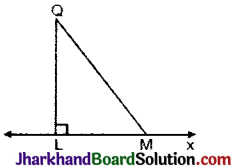
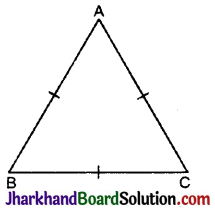
JAC Class 9 Maths Solutions Chapter 12 हीरोन का सूत्र Ex 12.1

Jharkhand Board JAC Class 9 Maths Solutions Chapter 12 हीरोन का सूत्र Ex 12.1 Textbook Exercise Questions and Answers.

JAC Board Class 9 Maths Solutions Chapter 12 हीरोन का सूत्र Exercise 12.1

प्रश्न 1.
एक यातायात संकेत पट पर ‘आगे स्कूल ‘है’ लिखा है तथा यह भुजा ‘a’ वाले एक समबाहु त्रिभुज के आकार का है। हीरोन के सूत्र का प्रयोग करके इस बोर्ड का क्षेत्रफल ज्ञात कीजिए। यदि संकेत बोर्ड पर परिमाप 180 सेमी है तो इसका क्षेत्रफल क्या होगा ?
हल:
समबाहु त्रिभुज के आकार के बोर्ड की एक भुजा की लम्बाई = a
∴ समबाहु त्रिभुज के आकार के बोर्ड का परिमाप = a + a + a = 3a
∴ त्रिभुज का अर्द्ध-परिमाप s = \(\frac{3 a}{2}\)
∴ हीरोन के सूत्र से,
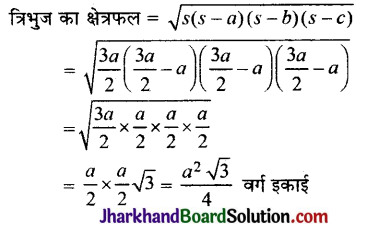
JAC Class 9 Maths Solutions Chapter 12 हीरोन का सूत्र Ex 12.1 1
यदि त्रिभुज का परिमाप 180 सेमी है, तो प्रत्येक भुजा = \(\frac{180}{3}\) = 60 सेमी होगी।
तब a = 60
∴ त्रिभुजाकार बोर्ड का क्षेत्रफल = \(\frac{a^2 \sqrt{3}}{4}\)
= \(\frac{60 \times 60 \times \sqrt{3}}{4}\) वर्ग सेमी
= 900\(\sqrt{3}\) वर्ग सेमी
अत: संकेत पट का क्षेत्रफल = 900\(\sqrt{3}\) वर्ग सेमी।

JAC Class 9 Maths Solutions Chapter 12 हीरोन का सूत्र Ex 12.1

प्रश्न 2.
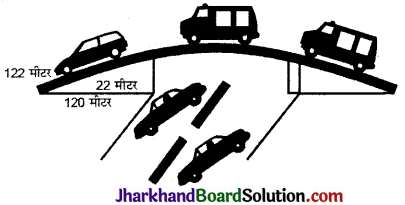
किसी फ्लाईओवर (flyover) की त्रिभुजाकार दीवार को विज्ञापनों के लिए प्रयोग किया जाता है। दीवार की भुजाओं की लम्बाइयाँ 122 मीटर, 22 मीटर और 120 मीटर हैं। इस विज्ञापन से प्रतिवर्ष 5,000 रु. प्रति मीटर की प्राप्ति होती है। एक कम्पनी ने इस दीवार को विज्ञापन देने के लिए 3 महीने के लिए किराए पर लिया। उसने कुल कितना किराया दिया ?
JAC Class 9 Maths Solutions Chapter 12 हीरोन का सूत्र Ex 12.1 2
हल:
फ्लाईओवर की त्रिभुजाकार दीवार की मापें = 122 मीटर, 22 मीटर, 120 मीटर।
∴ a = 122 मीटर, b = 22 मीटर, c = 120 मीटर
अर्द्ध परिमाप s = \(\frac{a+b+c}{2}\)
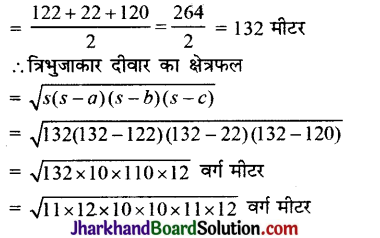
JAC Class 9 Maths Solutions Chapter 12 हीरोन का सूत्र Ex 12.1 3
= 11 × 12 × 10 वर्ग मीटर = 1,320 वर्ग मीटर
∵ 12 महीनों का 1 वर्ग मीटर क्षेत्रफल का किराया = 5,000 रु.
∴ 12 महीनों का 1,320 वर्ग मीटर क्षेत्रफल का किराया = 5,000 × 1,320 रु.
∴ 3 महीनों का 1,320 मी.2 क्षेत्रफल का किराया
= \(\frac{5,000 \times 1,320}{12} \times 3\) रु.
= 5,000 × 110 × 3 रु.
= ₹ 16,50,000.

प्रश्न 3.
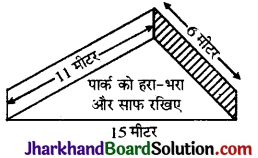
किसी पार्क में एक फिसल पट्टी (slide) बनी हुई है। इसकी पाश्वय दीवारों (slide walls) में से एक दीवार पर किसी रंग से पेन्ट किया गया है और उस पर ” पार्क को हरा-भरा और स्वच्छ रखिए” लिखा हुआ है। यदि इस दीवार की विमाएँ 15 मीटर, 11 मीटर और 6 मीटर हैं, तो रंग हुए भाग का क्षेत्रफल ज्ञात कीजिए।
JAC Class 9 Maths Solutions Chapter 12 हीरोन का सूत्र Ex 12.1 4
हल:
रंगीन त्रिभुजाकार दीवार की भुजाएँ
a = 15 मीटर, b = 11 मीटर और c = 6 मीटर
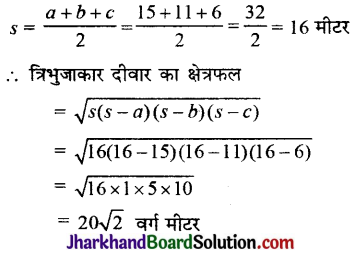
JAC Class 9 Maths Solutions Chapter 12 हीरोन का सूत्र Ex 12.1 5
अतः पेन्ट किए हुए भाग का क्षेत्रफल
= 20\(\sqrt{2}\) वर्ग मीटर।

JAC Class 9 Maths Solutions Chapter 12 हीरोन का सूत्र Ex 12.1

प्रश्न 4.
उस त्रिभुज का क्षेत्रफल ज्ञात कीजिए जिसकी दो भुजाएँ 18 सेमी और 10 सेमी तथा परिमाप 42 सेमी है।
हल:
त्रिभुज की दो भुजाएँ a = 18 सेमी तथा b = 10 सेमी हैं।
माना तीसरी भुजा c सेमी है।
त्रिभुज का परिमाप = a + b + c
= 18 + 10 + c = 28 + c
परन्तु दिया है कि परिमाप 42 सेमी है।
∴ 28 + c = 42
c = 42 – 28
c = 14 सेमी
अर्द्ध-परिमाप (s) = \(\frac{42}{2}\) = 21 सेमी
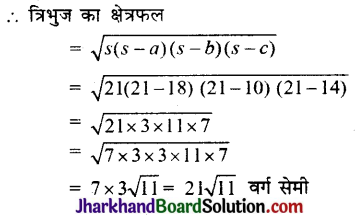
JAC Class 9 Maths Solutions Chapter 12 हीरोन का सूत्र Ex 12.1 6
अतः Δ का क्षेत्रफल = 21\(\sqrt{21}\) वर्ग सेमी।

प्रश्न 5.
किसी त्रिभुज की भुजाओं का अनुपात 12 : 17 : 25 और उसका परिमाप 540 सेमी है। इस त्रिभुज का क्षेत्रफल ज्ञात कीजिए।
हल:
माना त्रिभुज की भुजाएँ 12x सेमी, 17x सेमी तथा 25x सेमी हैं।
∴ परिमाप = 12x + 17x + 25x = 54x सेमी
⇒ 540 = 54x
⇒ x = 10
तब a = 12x = 12 × 10 = 120 सेमी
b = 17x = 17 × 10 = 170 सेमी
c = 25x = 25 × 10 = 250 सेमी
s = \(\frac{540}{2}\) = 270 सेमी
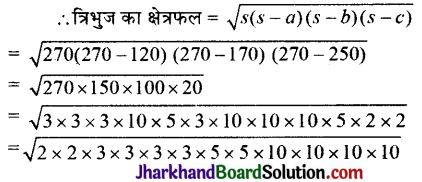
JAC Class 9 Maths Solutions Chapter 12 हीरोन का सूत्र Ex 12.1 7
= 2 × 3 × 3 × 5 × 10 × 10 = 9000 वर्ग सेमी
अतः त्रिभुज का क्षेत्रफल = 9,000 वर्ग सेमी।

JAC Class 9 Maths Solutions Chapter 12 हीरोन का सूत्र Ex 12.1

प्रश्न 6.
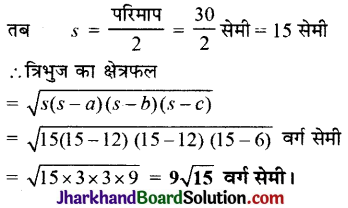
एक समद्विबाहु त्रिभुज का परिमाप 30 cm है और प्रत्येक बराबर भुजा 12 cm लम्बाई की है। इस त्रिभुज का क्षेत्रफल ज्ञात कीजिए।
हल:
त्रिभुज की तीसरी भुजा
= परिमाप – 2 × बराबर भुजाओं की लम्बाई
= (30 – 2 × 12 ) सेमी
= (30 – 24 ) cm = 6 सेमी
JAC Class 9 Maths Solutions Chapter 12 हीरोन का सूत्र Ex 12.1 8

JAC Class 9 Maths Solutions Chapter 4 दो चरों वाले रैखिक समीकरण Ex 4.1

Jharkhand Board JAC Class 9 Maths Solutions Chapter 4 दो चरों वाले रैखिक समीकरण Ex 4.1 Textbook Exercise Questions and Answers.

JAC Board Class 9 Maths Solutions Chapter 4 दो चरों वाले रैखिक समीकरण Exercise 4.1

प्रश्न 1.
एक नोटबुक की कीमत एक कलम की कीमत से दोगुनी है। इस कथन को निरूपित करने के लिए दो चरों वाला एक रैखिक समीकरण लिखिए।
हल:
माना एक नोटबुक की कीमत = x
तथा एक कलम की कीमत = y
प्रश्नानुसार,
नोटबुक की कीमत = 2 × कलम की कीमत
∴ रैखिक समीकरण, x = 2y या x – 2y = 0.

प्रश्न 2.
निम्नलिखित रैखिक समीकरणों को ax + by + c = 0 के रूप में व्यक्त कीजिए और प्रत्येक स्थिति में a, b और c के मान बताइए:
(i) 2x + 3y = \(9.3 \overline{5}\)
(ii) x – \(\frac{y}{5}\) – 10 = 0
(iii) -2x + 3y = 6
(iv) x = 3y
(v) 2x = -5y
(vi) 3x + 2 = 0
(vii) y – 2 = 0
(viii) 5 = 2x.
हल:
(i) समीकरण 2x + 3 = \(9.3 \overline{5}\) का मानक रूप 2x + 3y – \(9.3 \overline{5}\) = 0 है।
इसकी तुलना ax + by + c = 0 से करने पर,
a = 2, b = 3 और c = –\(9.3 \overline{5}\)

(ii) समीकरण x – \(\frac{y}{5}\) – 10 = 0 की तुलना ax + by + c = 0 से करने पर,
a = 1, b = \(-\frac{1}{5}\) और c = -10.

(iii) समीकरण -2x + 3y = 6 का मानक रूप = -2x + 3y – 6 = 0 है|
इसकी तुलना ax + by + c = 0 से करने पर,
a = -2, b = 3, C = -6.

(iv) समीकरण x = 3y का मानक रूप = x – 3y + 0 = 0 है। इसकी तुलना ax + by + c = 0 से करने पर,
a = 1, b = -3, c = 0.

(v) समीकरण 2x = -5y का मानक रूप 2x + 5y + 0 = 0 है।
इसकी तुलना ax + by + c = 0 से करने पर,
a = 2, b = 5, c = 0

(vi) समीकरण 3x + 2 = 0 का मानक रूप 3x + 0.y + 2 = 0 है।
इसकी तुलना ax + by + c = 0 से करने पर,
a = 3, b = 0, c = 2.

(vii) समीकरण y – 2 = 0 ⇒ 0x + y – 2 = 0 की तुलना ax + by + c = 0 से करने पर,
a = 0, b = 1 और c = -2.

(viii) समीकरण 5 = 2x को 2x + 0. y – 5 = 0 के रूप में लिख सकते हैं। इस समीकरण की तुलना ax + bx + c = 0 से करने पर, a = 2, b = 0 और c = -5.

JAC Class 9 English Solutions Moments Chapter 9 The Accidental Tourist

Jharkhand Board JAC Class 9 English Solutions Moments Chapter 9 The Accidental Tourist Textbook Exercise Questions and Answers.

JAC Board Class 9 English Solutions Moments Chapter 9 The Accidental Tourist

JAC Class 9 English The Accidental Tourist Textbook Questions and Answers

Think About it

Question 1.
Bill Bryson says, “I am in short, easily confused.” What examples has he given to justify this ?
बिल ब्रायसन कहता है, “मैं, संक्षेप में आसानी से घबरा ( भ्रमित हो) जाता हूँ ।” इस कथन को न्यायसंगत ठहराने के लिए वह क्या उदाहरण देता है ?
Answer:
Bill Bryson gives a few examples to justify this statement. Many times while searching a lavatory in a cinema, he ends up in an alley standing on the wrong side of a self-locking door. He goes to the hotel desk (reception) at least two or three times a day to enquire about his room number that he forgets.

बिल ब्रायसन इस कथन की पुष्टि के लिए कुछ उदाहरण देता है । कई बार सिनेमा में शौचालय को ढूँढ़ते हुए वह तंग गली में स्वतः बन्द होने वाले दरवाजे पर गलत स्थान पर खड़ा हो जाता है । वह होटल में दिन में डेस्क पर ( रिसेप्शन पर ) दो या तीन बार अपने कमरे का नम्बर पूछने जाता है जिसे वह भूल जाता है ।

JAC Class 9 English Solutions Moments Chapter 9 The Accidental Tourist

Question 2.
What happens when the zip on his carry-on bag gives way?
जब उसके स्वयं उठाने वाले बैग की जिप खुल (टूट) जाती है तब क्या होता है ?
Answer:
When the zip of his carry-on bag gives way, everything kept in it such as newspaper cuttings, magazines, passport, films, His tobacco tin, English coins, etc. spill out over an’ area of about the size of a tennis court.

‘जब उसके स्वयं उठाने वाले बैग की जिप खुल (टूट) जाती :- है तो इसमें रखी प्रत्येक वस्तु – अख़बारों की कतरनें, पत्रिकाएँ, पासपोर्ट, फिल्म्ज़, तम्बाकू की डिब्बी, अंग्रेजी सिक्के आदि टेनिस कोर्ट के क्षेत्र के बराबर क्षेत्र में बिखर जाते हैं ।

Question 3.
Why is his finger bleeding ? What is his wife’s reaction ?
उसकी उँगली से खून क्यों बह रहा है ? उसकी पत्नी की क्या प्रतिक्रिया है ?
Answer:
The zip of his carry-on bag gets jammed. He tries to open it and gets a long deep cut in his finger. It starts bleeding. His wife looks at him in wonder, not in anger

उसके स्वयं उठाने वाले बैग की जिप अटक जाती है । वह उसे खोलने की कोशिश करता है और उसकी उँगली में गहरा घाव हो जाता है । उँगली से खून बहने लगता है । तब उसकी पत्नी उसकी तरफ आश्चर्य से देखती है, न कि गुस्से में|

Question 4.
How does Bill Bryson end up in a ‘crash position’ in the aircraft ?
बिल ब्रायसन किस प्रकार हवाई जहाज में धराशायी होने की स्थिति में आता है ?
Answer:
Once while sitting in an aircraft, he bends to tie his shoelace. Just then the person sitting ahead of him throws his seat back into full recline and he ends up in crash position.

एक बार वह हवाई जहाज में बैठा हुआ अपने जूतों का फ़ीता बाँधने के लिए झुकता है । ठीक उसी समय उसके आगे वाला व्यक्ति अपनी सीट को पूरी तरह से पीछे झुका लेता है और वह धराशायी होने की स्थिति में आ जाता है ।

Question 5.
Why to his teeth and gums look navy blue?
उसके दाँत और मसूड़े गहरे नीले रंग के क्यों लगते हैं ?
Answer:
Once the author was writing down his important thoughts in a notebook. He started sucking one end of his pen while thinking. The ink leaked out and his teeth and gums became navy blue.

एक बार लेखक अपनी नोटबुक में अपने महत्त्वपूर्ण विचार नोट कर रहा था । वह सोचते-सोचते अपने पेन के एक सिरे को चूसने लगा। स्याही लीक कर गयी और उसके दाँत और मसूड़े गहरे नीले रंग के हो गये।

JAC Class 9 English Solutions Moments Chapter 9 The Accidental Tourist

Question 6.
Bill Bryson ‘ached to be suave.’ Is he successful in his mission ? List his ‘unsuave’ ways.
बिल ब्रायसन ‘विनीत होने के लिए तड़पता था ।’ क्या वह अपने उद्देश्य में सफल हो पाया ? उसके अविनीत तरीकों की सूची बनाइये ।
Answer:
Bill Bryson longed to behave politely. He tried hard to be suave but could never be successful. He used to rise up from the dinner table as if he had experienced a localized earthquake. He got into the car and closed the door, leaving fourteen inches of coat outside. Whenever he wore light-coloured trousers, he spoiled them with ice cream, cough syrup and motor oil. Even on the air flights he could not drink or eat anything without spoiling his own or others’ clothes.

बिल ब्रायसन विनीत होने के लिए तड़पता था । उसने विनीत होने की काफी कोशिश की लेकिन वह कभी भी सफल न हो सका । वह खाने की मेज से इस प्रकार उठता था जैसे कि वहाँ भूकम्प आ गया हो । वह कार में बैठता और चौदह इंच का कोट बाहर छोड़े बिना दरवाजा बंद नहीं करता। जब कभी वह हल्के रंग का पायजामा पहनता तो उसे वह आइसक्रीम, खाँसी की दवा और मोटर ऑयल से गंदा कर । यहाँ तक कि हवाई उड़ान में भी वह अपने या दूसरों के कपड़े गन्दे किये बिना कुछ भी खा-पी नहीं सकता था।

Question 7.
Why do you think Bill Bryson’s wife says to the children, “Take the lids off the food for Daddy” ?
आपके विचार में बिल ब्रायसन की पत्नी अपने बच्चों से क्यों कहती है, “ अपने पिता के लिए खाने के ऊपर से ढक्कन हटाओ ” ?.
Answer:
It seems that Bill’s wife knew well the ways of her husband. She tells her children to take the lids off the food for Daddy, because she is almost sure that if her husband takes off the lids himself, he will spoil his own clothes and of those who are sitting near him.

ऐसा लगता है कि उसकी पत्नी अपने पति के रंग-ढंग को भली-भाँति जानती थी । वह अपने बच्चों को पिता के लिए खाने के ऊपर से ढक्कन हटाने के लिए इसलिए कहती है क्योंकि वह जानती है कि अगर वह स्वयं ढक्कन खोलेगा तो अपने और अपने पास बैठे हुए लोगों के कपड़े जरूर खराब कर देगा ।

Question 8.
What is the significance of the title ?
(इस कहानी के) शीर्षक का क्या महत्व (औचित्य) है ?
Answer:
Accidental means ‘happening something wrong by chance’. The author often goes on tours and trips. The story is full of mishappenings in the life of the author while he is travelling. He relates his experiences in a humorous style. We see that the whole story is filled with accidental happenings which is the significance of the title.

दुर्घटनापूर्ण का अर्थ है ‘किसी बुरी चीज का अचानक घटित होना ।’ लेखक अक्सर यात्रा पर जाता है । कहानी इस प्रकार की दुर्घटनाओं से भरी है जो लेखक के जीवन में उसकी यात्रा के दौरान अचानक घटती हैं। वह अपने अनुभवों को हास्यास्पद शैली में व्यक्त करता है । हम देखते हैं कि पूरी कहानी अचानक होने वाली दुर्घटनाओं से भरी है और यही शीर्षक का महत्व ( औचित्य ) है ।

Talk About it

Question 1.
To get confused and behave in ‘unsuave’ ways like Bill Bryson is normal and human. Tell your class about any similar situation that you found yourself in.
घबरा जाना और अविनीत व्यवहार करना जैसा बिल ब्रायसन करता है, सामान्य और मानवीय व्यवहार है । अपनी कक्षा को इससे मिलती-जुलती परिस्थिति के बारे में बताइये जो आपके साथ स्वयं घटी हो ।
Answer:
Once I was travelling in a bus. The ticket – checker asked me to show my ticket. I remembered that I had put it in the bag along with my wallet. I started searching for it frantically in the bag. I emptied the bag in my lap but the ticket was nowhere to be found. I felt embarrassed. The ticket checker was looking suspiciously at me. I said, “Sorry, I couldn’t find it but I did buy one.” “All right, buy another now,” he ordered. Reluctantly. I took out my wallet and opened it. To my surprise, the ticket was there. In fact, I had put it with the balance money in my wallet.

एक बार मैं बस में यात्रा कर रहा था । टिकिट चैकर ने मुझसे अपना टिकिट दिखाने को कहा । मुझे याद था कि मैंने इसे बैग में अपने बटुए (पर्स) के साथ रखा है । मैंने बड़ी बैचेनी के साथ टिकिट को बैग में खोजना शुरू किया । मैंने अपने बैग को अपनी गोद में खाली किया लेकिन टिकिट कहीं भी नहीं मिला । मैं बहुत शर्मिंदा । टिकिट – चैकर संदेह से मुझे घूर रहा था। मैंने कहा, “मुझे खेद है, मुझे यह (टिकिट) नहीं मिल सकी परन्तु मैंने खरीदी जरूर थी ।” “ठीक है, अब दूसरी खरीद लो,” उसने बड़ी बेरुखी से कहा । मैंने अपना बटुआ निकाला और उसे खोला । वाह ! मेरी टिकिट उसमें ही थी । वस्तुतः इसे मैंने बाकी बचे पैसों के साथ बटुए में ही रख दिया था ।

JAC Class 9 English The Accidental Tourist Important Questions and Answers

Answer the following questions in about 30 words each:

निम्नलिखित प्रत्येक प्रश्न का उत्तर लगभग 30 शब्दों में दीजिए :

Question 1.
What happened when the author was checking in at the Logan Airport in Boston?
जब लेखक बोस्टन में लोगान हवाई अड्डे पर प्रवेश कर रहा था तो क्या घटित हुआ ?
Answer:
His card was in the carry-on bag, but its zip was jammed. He pulled at it. It opened with a jerk, and the contents in the carry-on bag ejected all over.

उसका कार्ड साथ ले जाने वाले बैग (कैरी – आन बैग) में था, लेकिन इसकी जिप अटक गयी थी । उसने इसको खींचा । जिप एक झटके से खुल गई और बैग का सामान चारों ओर बिखर गया ।

JAC Class 9 English Solutions Moments Chapter 9 The Accidental Tourist

Question 2.
How did the author injure his finger ? What happened thereafter ?
लेखक की उँगली कैसे घायल हुई ? उसके बाद क्या घटित हुआ ?
Answer:
The author tried to open the zip of his carry-on bag. But its zip was jammed. He pulled at it hard. His finger got injured and a lot of blood started flowing.

लेखक ने साथ लें जाने वाले बैग की जिप खोलने की कोशिश की । लेकिन वह अटक गयी थी । उसने इसे जोर से खींचा । उसकी उँगली घायल हो गयी और काफी खून बहने लगा था ।

Question 3.
Why did the author cry “My finger ! My finger!” ?
लेखक ” मेरी उँगली ! मेरी उँगली !” कहकर क्यों चिल्लाया ?
Answer:
The author was pulling the jammed zip of his bag with all his might. In this effort, his finger got a cut. So, he cried, “My finger ! My finger.”

लेखक अपने बैग की अटकी एक जिप को पूरी ताकत लगाकर खींच रहा था । इस प्रयास में उसकी उँगली कट गयी। इसलिए वह चिल्लाया ” मेरी उँगली ! मेरी उँगली ! ”

Question 4.
Why does the author not get his air miles ?
लेखक को अपने एयर माइल्ज़ क्यों प्राप्त नहीं हो पाते हैं ?
Answer:
The author doesn’t get his air miles because either he forgets to ask for them or the airline can’t record them. Sometimes, he is informed that he is not entitled to them.

लेखक को अपने एयर माइल्ज प्राप्त नहीं हो पाते हैं क्योंकि या तो वह उनके लिए पूछना भूल जाता है या एयर लाइन उनका रिकार्ड नहीं रख पाती है । कभी-कभी उसे बताया जाता है कि वह उनका हकदार नहीं है।

Question 5.
How did the lady react to the author when she was drenched twice with a soft drink by the author? उस महिला ने लेखक के प्रति कैसी प्रतिक्रिया की जब उसे लेखक द्वारा सॉफ्ट ड्रिंक से दो बार भिगो दिया गया था ?
Answer:
The author knocked a soft drink twice on a lady who was sitting beside him. She gave him a stupefied expression. She uttered some foul words for him. He had never heard these words earlier in public.

लेखक ने अपने बराबर में बैठी हुई महिला पर दो बार सॉफ्ट ड्रिंक गिरा दिया । उस महिला ने लेखक को ..ऐसे स्तब्धकारी भाव से ( इतने गुस्से से ) देखा कि उसके होश उड़ गये । उसने लेखक के लिए कुछ अपशब्द कहे । लेखक ने ये शब्द पहले कभी सबके सामने बोले जाते हुए नहीं सुने थे ।

JAC Class 9 English Solutions Moments Chapter 9 The Accidental Tourist

Question 6.
How did the author fly differently after his confused ‘accidents’ ?
लेखक अपनी भ्रमित कर देने वाली दुर्घटनाओं के बाद अलग प्रकार से कैसे उड़ता था ?
Answer:
The author always mistakenly caused inconvenience to his fellow-travellers in the aeroplane. So, later he started flying without eating, drinking or leaning over to tie his shoelace. He just sat quietly. This was to save himself from any trouble.

लेखक अपनी हवाई यात्राओं के दौरान हमेशा गलती से अपने सहयात्रियों की असुविधा का कारण बन जाता था । इसलिए बाद में उसने बिना कुछ खाये – पिये या बिना (नीचे झुके अपने जूतों के फ़ीते बाँधने के लिए) यात्रा करना शुरू कर दिया । वह बस चुपचाप बैठा रहता था । वह ऐसा स्वयं को किसी भी परेशानी से बचाने के लिए करता था ।

Question 7.
What hope did the author have when he flew to Australia ? What happened then ?
जब लेखक ऑस्ट्रेलिया के लिए हवाई जहाज से गया तो उसे क्या आशा थी ? और तब क्या घटित हुआ?
Answer:
The author hoped that he would get a zillion air miles while flying to Australia. So, he presented his card to the Airlines’ clerk. But she informed him that he was not entitled because there was a difference in his names written over the ticket and on the card.

को आशा थी कि वह ऑस्ट्रेलिया के लिए उड़ते वक्त बहुत बड़ी संख्या में एअर माइल्ज प्राप्त करेगा । अतः उसने अपना कार्ड एयर लाइन्स की क्लर्क के सामने प्रस्तुत किया । लेकिन उसने उसे (लेखक को ) सूचित किया कि वह उनका अधिकारी नहीं था क्योंकि उसके टिकिट और कार्ड पर लिखे नामों में अन्तर था ।

Question 8.
What was the author’s worst experience on a flight ?
हवाई यात्रा के दौरान लेखक का सबसे खराब अनुभव क्या था ?
Answer:
The author’s worst experience was when he was writing some important thoughts in his notebook. He started talking with a young lady sitting next to him. He was sucking thoughtfully on the end of his pen in his mouth. The ink had leaked and his mouth, teeth, chin, tongue and gums were now a striking navy blue.

लेखक का सबसे खराब अनुभव वह था जब वह अपनी नोटबुक में कुछ महत्वपूर्ण विचार लिख रहा था और तभी उसने अपने बराबर में बैठी एक नवयुवती से बातें करना प्रारम्भ कर दिया । वह अपने पेन के एक सिरे को मुँह में डाल कर चूस रहा था। पेन लीक कर गया और उसका मुँह, दाँत, ठुड्डी, जीभ और मसूड़े गहरे नीले रंग के हो गये ।

Answer the following questions in about 60 words each:

निम्नलिखित प्रत्येक प्रश्न का उत्तर लगभग 60 शब्दों में दीजिए :

Question 1.
Describe the incident related to the opening of the zip of the carry-on bag by the author.
लेखक के कैरी-ऑन बैग की जिप खुलने की घटना का वर्णन कीजिए ।
Answer:
Note: इस प्रश्न के उत्तर के लिए Text Book के प्रश्न नं. 2 का उत्तर पढ़िये ।

Question 2.
How did the author come in a crash position? What happened when he knocked a softdrink on to the lap of a lady ?
लेखक धराशायी होने की स्थिति में कैसे आया ? जब उसने एक महिला की गोंद में सॉफ्ट ड्रिंक उड़ेल दिया तो क्या हुआ ?
Answer:
Once the author was flying in an aeroplane. He pushed his seat back in full recline bent over to tie his shoelace. But at the same time someone in the seat in front of him pushed his seat back. He fell down and was pinned to the floor in a crash position. On another occasion, he knocked a soft drink twice onto the lap of a sweet lady who was sitting beside him. The author was helpless but that lady gave him a mouthful of choicest abuse.

एक बार लेखक हवाई जहाज में उड़ रहा था । वह अपने जूते के फीते बाँधने के लिए नीचे झुका । परन्तु उसी समय उसके आगे वाली सीट पर बैठे व्यक्ति ने अपनी सीट को पीछे धकेला । वह गिर गया और गिरने की अवस्था में फर्श पर जा टिका। एक दूसरे अवसर पर, उसने एक प्यारी – सी महिला की गोद में दो बार सॉफ्ट ड्रिंक उड़ेल दिया जो उसके बराबर में बैठी हुई थी । लेखक असहाय था लेकिन उस महिला ने उसे मुँहभर कर चुनिंदा गालियाँ दी।

JAC Class 9 English Solutions Moments Chapter 9 The Accidental Tourist

Question 3.
What was the author’s ‘worst experience on a flight’ ?
हवाई यात्रा के दौरान लेखक का सबसे बुरा अनुभव क्या था ?
Answer:
On the flight the author was writing some important thoughts in a notebook. He was sucking the another end of his pen while writing. He then began conversing with an attractive young lady in the next seat. He talked to her for about twenty minutes and then he went to the lavatory after that. He saw that his pen had leaked and his mouth, chin, tongue, teeth and gums were now a striking navy blue. This was the author’s ‘worst experience’.

एक उड़ान के दौरान लेखक एक नोटबुक में कुछ महत्वपूर्ण विचार लिख रहा था । लिखते समय वह पेन के दूसरे सिरे को मुँह में चूस रहा था। वह फिर बगल की सीट पर बैठी एक सुन्दर युवा महिला से बातें करने लग गया। वह उसके साथ लगभग बीस मिनट तक बातें करता रहा । उसके बाद वह शौचालय गया । उसने देखा कि पेन लीक कर गया था । उसका मुँह, ठुड्डी, जीभ, दाँत और मसूड़े गहरे नीले रंग के हो गये थे । यह लेखक का सबसे बुरा अनुभव था ।

Question 4.
The author was a frequent flyer in aeroplanes. He stood to get benefit of flying with his membership with the British Airways flyer programme, but he couldn’t get the benefit. Why ?
लेखक अक्सर हवाई यात्राएँ करता रहता था । ब्रिटिश एयरवेज़ के फ़्लायर कार्यक्रम की सदस्यता लेने के बाद उसे उड़ान पर लाभ मिलना था, परन्तु उसे यह लाभ नहीं मिल पाया । क्यों ?
Answer:
The author was a frequent traveller in aeroplanes. He had become a member of the British Airways’ flyer programme. By it he stood to get the benefit of flying in first class to places like Bali. However, sometimes he would forget to ask the airline staff about it, sometimes the airlines could not record it, and once his name did not match on the ticket and the card. So the author could not avail the chances of any air travel benefit.

लेखक अक्सर हवाई यात्राएँ करता रहता था । वह ब्रिटिश एयरवेज़ के फ्लायर प्रोग्राम का सदस्य बन गया था । इसके द्वारा वह बाली.. जैसे स्थानों पर प्रथम श्रेणी में उड़ानें भरने के लाभ के योग्य था । परन्तु कभी वह एयरलाइन कर्मी से पूछना भूल जाता, कभी एयरलाइन इसका रिकार्ड नहीं रख पाती, और एक बार तो उसका नाम टिकट पर व कार्ड पर मेल नहीं खाया। इस प्रकार लेखक हवाई यात्रा के लाभ के अवसर प्राप्त नहीं कर सका।

Question 5.
Describe the author, Bill Bryson as an accidental tourist.
लेखक बिल ब्रायसन का दुर्घटनाओं के शिकार होने वाले यात्री के रूप में वर्णन कीजिए ।
Answer:
The author often had to fly to various places. He could never have a journey without an unpleasant incident. Once the zip of his bag jammed. He pulled it hard, it suddenly gave way and all things in the bag were scattered all around. Once he was pinned between two seats of the plane while flying. On another occasion, he knocked a soft drink twice onto the lap of a lady. His worst experience was one when he got his mouth stained with dark blue ink.

JAC Class 9 English Solutions Moments Chapter 9 The Accidental Tourist

लेखक को विभिन्न स्थानों के लिए अक्सर हवाई यात्राएँ करनी पड़ती थीं । कभी ऐसा नहीं हुआ कि उसकी किसी यात्रा के दौरान कोई बुरी घटना न घटे । एक बार उसके बैग की जिप अटक गई । उसने इसे बहुत ज़ोर से खींचा। यह अचानक से खुल गई और बैग में रखी सारी चीजें चारों ओर बिखर गईं। एक बार वह हवाई जहाज की यात्रा के दौरान दो सीटों के बीच में दब गया । एक बार उसने एक महिला की गोद में दो बार सॉफ्ट ड्रिंक उड़ेल दिया । उसका सबसे खराब अनुभव वह रहा जब उसके मुँह पर गहरी नीली स्याही लग गई ।

The Accidental Tourist Summary and Translation in Hindi

About the Story

ऐसा कहा जाता है कि आज का संसार एक छोटा स्थान है क्योंकि यात्रा करना सरल हों गया है, लेकिन यात्रा करना हर किसी के लिए सरल नहीं होता । यहाँ ( इस कहानी में ) लेखक एक यात्री के रूप में हुए अपने अनुभवों पर विनोदपूर्ण ढंग से प्रकाश डाल रहा है ।

Word-Meanings And Hindi Translation

Of all the things ………….. trouble started. (Page 56)

Meanings: good at = कुशल, निपुण । outstanding (आउट्स्टैण्डिंग) = exceptionally good, विशिष्ट । perhaps (पॅ:हैप्स्) = शायद । constantly (कॉन्स्टेट्लि) = निरन्तर । wonder (वण्ड (र)) = surprise, आश्चर्य। evident (एविडण्ट) = clear, स्पष्ट । difficulty (डिफिकल्ट) = hardship, कठिनाई । pretty much beyond me (प्रिटि मच बियॉण्ड मी) = बिल्कुल मेरी पहुँच के बाहर । looking for (लुकिंग फॉ(र)) = searching, ढूँढना। lavatory (लैवॅटॅरि) = toilet, शौचालय । instance (इन्स्टन्स) example, उदाहरण | alley (ऐलि) = lane, गली। self-locking (सेल्फलॉकिंग) = स्वचालित रूप से बन्द होने वाला । particular (पॅ: टिक्युलर) specialty (स्पेश्यल्टि) = special quality, विशेषता । returning ( रिट:निंग) = going back, वापिस लौटना |

in short (इन शॉन) = संक्षेप में । confused (कनफ्यूज़्ड) = चकरा जाने वाला, भ्रमित |= खास। famille (एन फैमिली) = with family, परिवार सहित । trip (ट्रिप) = journey यात्रा । checking in (ph.v) (चेकिंग इन) = हवाई अड्डे पर पहुँचकर संबद्ध अधिकारी को अपने आगमन की सूचना देना | suddenly (सडन्लि) = अचानक remembered (रिमेम्बर्ड) = came to mind, याद आया । recently (रीस्ट्ल) = a short while back, कुछ ही समय पहले, हाल ही में । joined (जॉइण्ड) = took part, भाग लिया । frequent ( फ्रीक्वण्ट) = very often, बहुधा । flyer ( फ्लाइॲ (र)) = one who travels by air route, उड़ने वाला, हवाई यात्रा करने वाला । hanging (हैंगिंग) = लटका हुआ । trouble (टूब्लू) परेशानी, गड़बड़ी ।

हिन्दी अनुवाद उन सब चीजों में जिनमें मैं बहुत अच्छा नहीं हूँ शायद सबसे विशिष्ट है- वास्तविक संसार में रहना । मुझे निरंतर कई बातों पर आश्चर्य होता है कि लोग बिना किसी स्पष्ट कठिनाई के कितने काम कर लेते हैं जो मेरी पहुँच के बिल्कुल बाहर होते हैं । उदाहरण के लिए, मैं आपको बता नहीं सकता कि कितनी बार मैं किसी सिनेमा में शौचालय ढूँढ़ने गया हूँ और स्वयं को गली में एक स्वचालित रूप से बन्द होने वाले दरवाज़े के गलत ओर खड़ा पाया है । अब मेरी खास विशेषता यह है कि दिन में दो-तीन बार होटल के स्वागत काउण्टर ( रिसेप्शन ) पर वापिस लौटकर जाना और यह पूछना कि मेरे कमरे का नम्बर क्या है ।

संक्षेप में, मैं बहुत आसानी से चकरा जाता हूँ । मैं इसके बारे में सोच रहा था । जब हम पिछली बार परिवार सहित एक लम्बी यात्रा पर गये थे। ईस्टर ( ईसाइयों का एक त्योहार) का समय था और हम एक सप्ताह के लिए इंग्लैण्ड जा रहे थे । जब हम बोस्टन में लोगन हवाई अड्डे पर पहुँचे, और हवाई अड्डे पर पहुँचकर संबद्ध अधिकारी को अपने आगमन की सूचना दे रहे थे या जब हमारी जाँच चल रही थी तभी अचानक मुझे याद आया कि हाल ही में मैंने ब्रिटिश एयरवेज़ के बहुधा (अक्सर ) उड़ान भरने वाले यात्रियों के लिए कार्यक्रम में भाग लिया है । मुझे यह भी याद आया कि मैंने सम्बन्धित कार्ड अपनी गर्दन में लटके हुए कैरी-ऑन बैग में रखा था । और यहीं से गड़बड़ी शुरू हुई।

JAC Class 9 English Solutions Moments Chapter 9 The Accidental Tourist

The zip on the bag ……………. as it went.(Pages 56-57)

Meanings: jammed (जैम्ड) = got stuck, अटक गई, जाम हो गई । pulled ( पुल्ड) = : खींचा। yanked (यैन्क्ट) = put pressure with a jerk, झटके से ज़ोर लगाया । grunts (ग्रण्ट्स) = short low sound at the throat, घुरघुराने की आवाज़ । frowns (फ्राउन्ज़) = knitting the brows showing displeasure, गुस्से में त्योरियाँ चढ़ाना । increasing (इनक्रीजिंग) = growing, बढ़ते हुए । consternation (कॉन्स्टॅ: नेशन) = worry or annoyance, चिन्ता या क्रोध । kept this up ( केप्ट दिस अप) = continued this, यह करना जारी रखा। budge (बज) = move slightly, जरा-सा हिला । harder and harder (हाड (र) एण्ड हाड (र)) और अधिक ज़ोर से । अनुमान लगाना । happened (हैपण्ड ) guess (गेस) took place, घटित हुआ । abruptly (एब्रप्टलि) suddenly, अचानक | gave way (गेव वे) = opened, खुल गई । extravagantly (इक्स्ट्रैवगट्लि) = खुलकर, बहुत बड़ी मात्रा में ।

ejected (इजेक्टिड) = came out, बाहर आ गया ।= thewatched (वॉच्ट) = saw, देखा । dumbstruck (डमस्ट्रक) = speechless अवाक्, मानो जुबान पर ताला लग गया हो । carefully (केयरफलि) with great attention, ध्यान से, सावधानीपूर्वक | sorted (सॉटिड) arranged into classes, अलग-अलग छाँटकर व्यवस्थित किये गये । documents (डॉक्युमण्ट्स) = important papers, दस्तावेज़, ( कागजात ) | fluttery ( फ़्लटरि ) that falls with a light irregular motion, हल्के से अनियमित गति से गिरने वाला ।

cascade (कैस्केड़) = waterfall, झरना । coins (कॉइन्ज़ ) = सिक्के | bounced (बाउन्स्ड) = उछले । a variety of (अ वेराइटि ऑव ) = of different types, अलग-अलग प्रकार की । oblivions (अब्लिविअन्ज़) विस्मृतियाँ । lidless (लिडलेस) = whose lid was removed, जिसका ढक्कन खुल गया था । rolled (रॉल्ड) = लुढ़का । crazily (क्रेज़िलि ) = very fast, बहुत तेज़ी से । concourse (कॉकॉस्) open central area at airport, हवाई अड्डे का बीच का खुला हुआ भाग । disgorging ( डिरगॉ: जिंग) discharging, बाहर निकालते हुए, बिखेरते हुए | contents (कॉन्टेन्ट्स) = अन्दर की वस्तुएँ, सामग्री ।

हिन्दी अनुवाद – बैग की जिप जाम हो गई थी । इसलिए मैंने इसे खींचा और इस पर घुरघुराहट की आवाज और गुस्से के साथ झटके से ज़ोर लगाया और मेरी चिन्ता ( परेशानी) बढ़ती जा रही थी । मैं कुछ मिनट तक ऐसा करता रहा परन्तु जिप हिली भी नहीं, इसलिए मैंने घुरघुराते हुए उसे और ज़ोर से खींचा । हाँ, आप अनुमान लगा सकते हैं कि क्या हुआ होगा ।

अचानक जिप टूट गई। बैग का उस ओर का ढक्कन हटकर खुल गया और अन्दर रखी हुई प्रत्येक वस्तु – अखबारों की कतरनें, और अन्य खुले कागज़, पाइप में भरने वाले तम्बाकू का एक चौदह आउन्स का डिब्बा, मैगज़ीन्स, पासपोर्ट, इंग्लैण्ड की मुद्रा में धन, फिल्म बहुत बड़ी मात्रा में बाहर आकर एक टेनिस कोर्ट जितने बड़ेआकार के क्षेत्र में फैल गई । पता लगा ।

मैं अवाक् खड़ा देखता रहा जबकि सावधानीपूर्वक छाँटकर व्यवस्थित किये गये बहुत-से दस्तावेज़ एक हल्की आवाज़ के साथ अनियमित गति से गिरने वाले झरने की भाँति बरसते हुए से बाहर आये, सिक्के भूल-चूक से अनेक प्रकार की आवाज़ें करते हुए उछल रहे थे और अब जिसका ढक्कन खुल चुका था ऐसा तम्बाकू का डिब्बा हवाई अड्डे के बीच के खुले भाग में तेज़ी से लुढ़क रहा था और लुढ़कते समय उसमें रखी हुई सामग्री बिखरती जा रही थी ।

JAC Class 9 English Solutions Moments Chapter 9 The Accidental Tourist

“My tobacco!” ……………. for a living.” (Page 57)

Meanings : horror (हॉर (रॅ)) fear, डर । discovered (डिस्कवॅ: ड्) = found out, gashed.(गैश्ट) = cut, कट गई । shedding (शेंडिंग) = flowing, बह रहा । in a lavish manner (इन अ लैविश मैन (र)) = प्रचुरता से; अत्यधिक । good around (गुड अराउण्ड) unalarmed by,, (यहाँ) सहज रहना । flowing (फ़्लोइंग.) बहना । generally (जेनरलि) = सामान्यतः । hysterics ( हिस्टिरिक्स) = crying loudly with great fear, बहुत अधिक डर से चीखना, चिल्लाना । justified (जस्टिफाइड) = correct, उचित, न्यायसंगत ।

confused (कनफ्यूज्ड) = unable to decide what to do, भ्रमित । unable (अनेब्ल ) = असमर्थ | help (हेल्प) = doing something, कुछ करना । panic (पैनिक) = too much fear, बहुत अधिक डर । mode (मोड) = way, तरीका। point (पॉइण्ट ) = moment, situation, पल, स्थिति । expression ( इक्स्प्रेशन् ) अभिव्यक्ति, भाव wonder (वण्ड (र)) = surprise, आश्चर्य । exasperation (इग्ज़ैस्परेशन) = irritation, चिड़चिड़ापन ।

हिन्दी अनुवाद – अब जबकि ( इंग्लैंड में) एक नया बजट भी आकर चला गया है अर्थात् लागू हो गया है, ऐसे में मुझे इंग्लैण्ड में इतना तम्बाकू कितने पैसे में मिलेगा मैं यह सोचकर डर से चिल्लाया ” मेरा तम्बाकू !” और फिर मेरी चीख ” मेरी उँगली ! मेरी उँगली !” में बदल गई क्योंकि मैंने यह पाया कि मेरी उँगली जिप से कट गई थी और इससे बहुत अधिक खून बह रहा था ।

( सामान्यतः मैं खून बहने असहज नहीं होता हूँ, पर जब मेरे अपने खून की बात हो तो, हाँ, भय से चीखना – चिल्लाना पूरी तरह उचित है ।) मैं भ्रमित था और कुछ करने में असमर्थ था, ऐसे में मेरे बाल अत्यधिक भय के कारण खड़े हो गये । इस पल मेरी पत्नी ने मुझे आश्चर्य के भाव से देखा – गुस्से या चिड़चिड़ेपन से नहीं, लेकिन बस सीधे-साधे आश्चर्य से देखा और कहा, “मुझे विश्वास नहीं होता कि तुम जीने के लिए यह सब करते हो ।”

But I’m afraid ………….. get myself freed. (Page 57 )

Meanings: afraid (अफ्रेड) = sorry, खेद है । so (सो) = like this, ऐसा। catastrophes (कटैस्ट्रॅफिज़ ) = very dangerous situations, बहुत खतरनाक स्थितियाँ, महाविपत्तियाँ | travel (ट्रैवल ) = यात्रा करना । leaned over (लीन्ड ओव(र)) = stooped, झुका । tie (टाइ) = बाँधना। shoelace (शू – लेस) = जूते का फीता । just at that moment ( जस्ट ऐट दैट मोमण्ट) ठीक उसी समय । ahead (अहेड) = सामने । recline (रिक्लाइन) = move the back of (a seat) into sloping position, झुकाव । pinned ( पिन्ड) (यहाँ) दबा हुआ । helplessly (हेल्पलेस्लि) = असहाय रूप से । crash position ( क्रैश पज़ीशन) clawing (क्लॉइंग) = scratching with nails, नोंचकर | managed to get myself freed = स्वयं को निकालने में सफल हुआ । कुचले जाने की स्थिति में ।

हिन्दी अनुवाद लेकिन मुझे खेद है कि ऐसा ही है। यात्रा के दौरान मेरे साथ हमेशा बहुत खतरनाक स्थितियाँ आ जाती हैं । एक बार एक हवाईजहाज में, मैं अपने जूते का फ़ीता बाँधने के लिए झुका, ठीक उसी समय मेरे सामने की सीट पर बैठे हुए व्यक्ति ने अपनी सीट को पूरा पीछे झुका लिया और मैं असहाय रूप से दबकर कुचले जाने की स्थिति में आ गया । अपने बराबर में बैठे हुए व्यक्ति की टाँग को नोंचकर ही मैं किसी तरह वहाँ से निकल सका।

On another occasion …………. by anun. (Page 58)

Meaning:occasion (ॲकेशन) = chance, अवसर | knocked (नॉक्ट) = poured with a jerk, झटके से उड़ेल दिया, टकरा दिया । lap (लैप) गोद । beside (बिसाइड) = बगल में, बराबर में । flight attendant (फ्लाइट् अटॅण्डॅण्ट) = बिमान परिचारिका । replacement ( रिप्लेसमेण्ट्) = बदले में दूसरा स्थानापन्न | instantly (इन्स्टॅण्ट्ल) = just at that moment, तत्काल, उसी पल । to this day (टु दिस डे) = till today, आज तक। reaching out’ (रीचिंग आउट) = हाथ बढ़ा रहा । helplessly (हेल्पलेस्लि ) = where I could do nothing, असहाय रूप से । cheap (चीप) = of poor quality, सस्ती, घटिया | prop (प्रॉप) = a piece of wood, metal etc. for support, टेक; सहारा | horror movies (हॉर (र) मूवीज़) = डरावनी फिल्में ।

violently (वॉयलट्लि) = with a great jerk, धड़ाम से । swept ( स्वेप्ट) = was spilled, गिरा | perch (पॅच) = stand, टिकने का स्थान, डण्डा । stupefied ( स्ट्यूपिफ़ाइड) depriving one of sensibility, जिससे किसी का होश खो जाये, हक्का-बक्का कर देने वाले । expression ( इक्स्प्रेशन) = भाव । expect (एक्स्पेक्ट) = आशा करना । receive ( रिसीव ) = get, प्राप्त करना | repeatedly (रिपीटिड्लि) = again and again, बार-बार | drenched (ड्रेन्ट) = made wet, भिगो दिया । uttered ( अटॅ: ड्) = said, कहा, मुँह से निकाला । oath (ओथ ) = (here) some. abusive words, दुर्वचन; अपशब्द, गाली |certainly (सॅटेन्लि) surely, निश्चित रूप से । nun (नऩ) = a religious woman, तपस्विनी, मठवासिनी ।

हिन्दी अनुवाद – एक और अवसर पर मैंने अपने बराबर में बैठी हुई एक प्यारी सी छोटी महिला की गोद में एक झटके से सॉफ्ट ड्रिंक उड़ेल दिया था । विमान परिचारिका आई और उसने उसको ( उस महिला को) साफ किया और मेरे लिए बदले में एक दूसरा ड्रिंक लाई और उसी पल मैंने इसे पुनः उस महिला पर उड़ेल दिया । मुझे आज तक यह समझ में नहीं आता है कि मुझसे ऐसा कैसे हुआ। मुझे बस इतना याद है कि मैंने नये ड्रिंक की ओर अपना हाथ बढ़ाया और 1950 के दशक की “The Undead Limb” जैसे नाम वाली किसी डरावनी फिल्म में सस्ती व घटिया टेक की भाँति ड्रिंक अपने टिकने के स्थान से धड़ाम से उसकी गोद में गिर पड़ा और मैं अपनी बाँह को असहाय रूप से देखता रह गया । उस स्त्री ने मुझे ऐसे हक्के-बक्के भाव से देखा कि मेरे होश उड़ गये, जिसको आपने बार-बार भिगो दिया हो उससे आप ऐसे ही भाव की आशा कर सकते हैं। उसने अपने मुँह से मेरे लिए कुछ अपशब्द कहे जिसका पहला शब्द ‘ओह’ था और आखिरी शब्द की खातिर’, और बीच में कुछ ऐसे शब्द थे जो मैंने पहले कभी सबके सामने बोले जाते हुए नहीं सुने थे, निश्चित रूप से एक मठवासिनी ( तपस्विनी) के द्वारा तो नहीं ।

JAC Class 9 English Solutions Moments Chapter 9 The Accidental Tourist

This, however ………………. for several days. (Pages 58-59)

Meanings : however (हाउएव (र)) (एक्स्पीरिॲन्स्) (सकिंग) = चूसते हुए। thoughtfully (थॉट्फलि) = lost in thoughts, विचारमग्न होकर | end ( एण्ड ) = point, छोर, किनारा । fell into conversation ( फेल इनटु कॅन्वें: सेशन) = started talking, बातें करने लगा । attractive हालाँकि I worst (वॅस्ट्) सबसे खराब | experience अनुभव | thoughts (थॉट्स् ) = विचार | clutch ( क्लच) = hold, पकड़ना | sucking (अट्रैक्टिव) = charming, आकर्षक । amused (अम्यूज़्ड) = entertained, मन बहलाया । perhaps (पॅ: हैप्स) = possibly, शायद । scattering (स्कैटरिंग) = इधर-उधर की बातें । urbane (अॅ:बेन) = courteous and civilized, शिष्ट और सभ्य । bons mots (बॉन्ज़ मोट्स) = clever and funny remarks, मजेदार बातें । retired (रिटाइॲर्स्) = left for चला गया। lavatory (लॅवॅटरि) = toilet, शौचालय | discovered (डिस्कवर्ड) = found out, पता चला । striking (स्ट्राइकिंग) = unusual enough to draw attention, जिन पर सभी का ध्यान जाये । scrub-resistant (स्क्रब रिजिस्टण्ट ) = that may not go even after scrubbing, जो रगड़ने पर भी न छूटे । remain (रिमेन) = stay, बने रहना । several (सेवरल) कई ।

हिन्दी अनुवाद – हालाँकि, यह मेरा किसी हवाई यात्रा के दौरान रहा सबसे खराब अनुभव नहीं था । मेरा सबसे खराब अनुभव वह था जब मैं एक नोटबुक में महत्त्वपूर्ण विचारों को लिख रहा था (‘मोजे खरीदना’, ‘ड्रिंक्स को सावधानीपूर्वक पकड़ना’, इत्यादि), साथ ही मैं विचारमग्न होकर अपने पेन के छोर को चूस रहा था जैसा कि आप भी करते हैं, और मैं बगल वाली सीट पर बैठी एक आकर्षक नवयुवती से बातें करने लगा । मजेदार बातें करके शायद बीस मिनट तक मैंने उसका मनोरंजन किया, फिर मैं शौचालय चला गया जहाँ मुझे पता चला कि मेरा पेन लीक कर गया था और मेरा मुँह, ठुड्डी, जीभ, दाँत और मसूड़े सब ऐसे हो गये थे जिन पर सभी का ध्यान जाये अर्थात् वे इतने गहरे नीले हो गये थे कि रगड़ने पर भी साफ न हों और कई दिनों तक वे ऐसे ही रहने वाले थे ।

So you will ……………. is not to be. (Page 59)

Meanings: trust (ट्रस्ट) = believe, विश्वास करना । ache (एक्) = suffer, परेशानी उठाना | suave (स्वेव) sophisticated; polite, विनम्र । as if (ऐज़ इफ़) = जैसे कि । just (जस्ट) = बिल्कुल अभी । extremely (इक्स्ट्रीम्लि) = very much, अत्यधिक, बिल्कुल । localised (लोकलाइज़्ड) = to limit something to a particular place, स्थानीयकरण कर देना, उसी स्थान पर । seismic (सेस्मिक) = of earthquake, भूकम्प की । event (इवेण्ट) : incident, घटना । get in (गेट इन ) = सवार होना । various times (वेरियस टाइम्ज़) = many. times, बहुत बार ।

हिन्दी अनुवाद – इसलिए मुझे विश्वास है कि इसे आप तब समझेंगे जब मैं आपको बताऊँगा कि मैं विनम्र बनने के लिए कितना तड़पता हूँ। मैं चाहूँगा कि काश जीवन में बस एक बार मैं बिना ऐसा दिखे, भोजन की मेज से उठ खड़ा होऊँ, जैसे मानो कि मैंने बिल्कुल अभी ठीक उसी स्थान पर भूकम्पीय घटना का अनुभव किया है। एक कार में सवार होता हूँ और 14 इंच के कोट को छोड़े बिना उसके दरवाज़े को बन्द करता हूँ । और फिर जब मैं हल्के रंग का पायजामा पहनता हूँ तो दिन के अन्त तक मुझे यह पता नहीं चलता कि मैं बहुत बार च्यूइंग गम, आईसक्रीम, खाँसी के सिरप और मोटर ऑयल पर बैठ चुका हूँ । परन्तु ऐसा नहीं होना है अर्थात् ऐसा नहीं होना चाहिए ।

Now on planes ….. laundry bills.(Page 59)

Meanings : is delivered (इज़ डिलीवॅ : ड्) = is given दिया जाता है । lids (लिड्ज़) = ढक्कन । take the lids off (टेक द ‘लिड्ज़ ऑफ़ ) = remove the lids, ढक्कन हटाओ । hoods (हूड्ज़) = caps attached to dress, टोपियाँ । about to (अबाउट टु) = just going to start, होने वाले । of course ( ऑव कोर्स) = certainly, निश्चित ही । lean over ( लीन ओवॅ (र)) bend, झुकना । quietly (क्वाइट्ल) = peacefully, शान्तिपूर्वक । unexpectedly (अन्एक्स्पेक्टिड्लि) = without expecting, अप्रत्याशित रूप से अचानक ही । causing (कॉज़िंग) = doing करना । liquid (लिक्विड) = related to some drink, किसी पेय पदार्थ से सम्बन्धित | mischief (मिसचिफ ) = शरारत । at least ( ऐट लीस्ट) = कम से कम | cut down ( कट डाउन) = lessen, कम करना । laundry (लॉन्ड्रि) = washing of clothes, कपड़ों की धुलाई |

हिन्दी अनुवाद – अब हवाईजहाज में जब खाना दिया जाता है तो मेरी पत्नी कहती है, “ बच्चो ! डैडी के लिए भोजन के ढक्कन हटाओ” या ” बच्चो ! अपनी टोपियाँ चढ़ा लो । डैडी मांस काटने ही वाले हैं ।” वास्तव में, ऐसा केवल तभी होता है जब मैं अपने परिवार के साथ हवाई यात्रा पर होता हूँ । जब मैं अकेला होता हूँ तो मैं न खाता हूँ, न पीता हूँ, न अपने जूते के फीते बाँधने के लिए झुकता हूँ, और पेन को तो अपने मुँह के आसपास कभी नहीं रखता हूँ । मैं अत्यधिक शान्तिपूर्वक बैठा रहता हूँ और कभी-कभी तो अपने हाथों को रोककर बैठा रहता हूँ जिससे कि वे अप्रत्याशित रूप से उठकर कोई पेय पदार्थ सम्बन्धी शहास्त न कर दें (किसी पर पेय पदार्थ न गिरा दें) । इसमें बहुत मज़ा नहीं आता है परन्तु इससे कम से कम कपड़ों की धुलाई का खर्च तो कम होता है ।

I never did ………….. without eating. (Pages 59-60)

Meanings: frequent ( फ्रीक्वण्ट ) = very often, बहुधा । flyer ( फ्लाइॲ (र)) = one who travels by air, हवाई यात्री | flyer miles ( फ्लाइअ (र) माइल्ज्) = a kind of flyer scheme, एक प्रकार की हवाई यात्री स्कीम, फ्लायर माइल्ज । frustration ( फ्रस्ट्रेशन) = a matter of annoyance, कुण्ठा, निराशा, चिढ़ की बात । forever (फॉ(र) एव (र)) = always, हमेशा । collect (कलेक्ट) = gather, इक्ट्ठा करना । accumulated (एक्यूम्युलेटिड ) | = collected, इकट्ठे किये । divided ( डिवाइडिड ) = parted, विभाजित | either (ईदॅ (र)) = या तो । forget (फॅगेट) = भूल जाना | check in (चेक इन) = enter, प्रवेश करना | remember (रिमेम्बॅ (र)) = keep in mind, याद रखना। informs (इन्फॉम्ज़) = tells, बताता है । entitled (एनटाइटल्ड) having the right, हकदार, अधिकृत । a zillion ( ए ज़िल्यन ) = a very large number, बहुत बड़ी संख्या । shook ( शुक) = moved, हिलाया। presented (प्रेज़ेन्टिड) = showed दिखाया । explained (इक्स्प्लेन्ड ) = made clear, समझाया | close (क्लोज़) = near, घनिष्ठ । venerable (वेनरब्ल ) = worth respect, सम्मानित । relationship (रिलेशनशिप) = सम्बन्ध । that long ( दैट लाँग ) = इतना दूर ।

हिन्दी अनुवाद- प्रसंगवश, मुझे बहुधा अपने फ़्लायर माइल्ज़ कभी प्राप्त नहीं हुए। मुझे वे अब भी कभी प्राप्त नहीं होते हैं । मुझे समय पर कार्ड नहीं मिल पाता। यह मेरे लिए वास्तव में निराशा वाली बात हो गई है । मेरी जान-पहचान का प्रत्येक व्यक्ति हमेंशा अपने एयर माइल्ज़ का उपयोग करके प्रथम श्रेणी में बाली की हवाई यात्रा करता है । मैं कभी कुछ इकट्ठा नहीं कर पाता हूँ । मुझे वर्ष में 100,000 मील की हवाई यात्रा अवश्य करनी चाहिए फिर भी मैंने केवल लगभग 212 माइल्ज़ इकट्ठे किये हैं जो 23 एयरलाइन्स के बीच विभाजित हैं ।

JAC Class 9 English Solutions Moments Chapter 9 The Accidental Tourist

ऐसा इसलिए है कि या तो मैं प्रवेश करते समय एयर माइल्ज़ के लिए पूछना भूल जाता हूँ या मैं उनके बारे में पूछना याद करता हैं किन्तु उस समय तक एयर लाइन उनका लेखा-जोखा नहीं रख पाती है या चेक-इन क्लर्क मुझे बताता है कि मैं उनका अधिकारी नहीं हूँ (मुझे वे नहीं मिल सकते ) । जनवरी में ऑस्ट्रेलिया के लिए एक ऐसी उड़ान पर जिसके लिए मुझे बहुत बड़ी संख्या में एयर माइल्ज़ मिलने वाले थे जब मैंने अपना कार्ड दिखाया तो क्लर्क ने अपना सिर हिलाया और कहा कि मुझे कोई एयर माइल्ज़ नहीं मिल सकते थे। मैंने पूछा, “क्यों ?” क्लर्क बोली ” टिकिट बी. ब्रायसन के नाम से है और कार्ड डब्ल्यू. ब्रायसन के नाम पर है । ” मैंने उसे बिल (बी.) और विलियम (डब्ल्यू.) के बीच का घनिष्ठ व सम्मानित ( सबके द्वारा स्वीकृत) सम्बन्ध समझाया किन्तु उसने इसे स्वीकार नहीं किया । इसलिए मुझे मेरे एयर माइल्ज़ नहीं मिले, और मैं अभी प्रथम श्रेणी में बाली की यात्रा नहीं कर पाऊँगा । शायद, वास्तव में, यह अच्छा ही है । मैं बिना खाये इतनी लम्बी यात्रा कभी नहीं कर सकता ।

JAC Class 9 English Solutions Beehive Poem 8 On Killing a Tree

Jharkhand Board JAC Class 9 English Solutions Beehive Poem 8 On Killing a Tree Textbook Exercise Questions and Answers.

JAC Board Class 9 English Solutions Beehive Poem 8 On Killing a Tree

JAC Class 9 English On Killing a Tree Textbook Questions and Answers

Thinking about the Poem

Question 1.
Can a “simple jab of knife ” kill a tree ? Why not ?
क्या चाकू का एक साधारण प्रहार एक पेड़ को मार सकता है ? क्यों नहीं ?
Answer:
No, a “simple jab of knife” cannot kill a tree. When a tree is jabbed with a knife, it is wounded but not dead. It heals up again. New sprouts begin to grow to be a new developed tree.

नहीं, चाकू का एक साधारण प्रहार किसी पेड़ को नहीं मार सकता है । जब पेड़ को चाकू से गोदा जाता है तो यह घायल हो जाता है पर यह मरता नहीं है । यह फिर से स्वस्थ हो जाता है । नयी कोपलें फूटती हैं और नया पेड़ विकसित हो जाता है।

JAC Class 9 English Solutions Beehive Poem 8 On Killing a Tree

Question  2.
How has the tree grown to its full size? List the words suggestive of its life and activity.
पेड़ अपने पूरे आकार में कैसे बड़ा होता है ? उन शब्दों की सूची बनाइये जो इसके जीवन व गतिविधि को दर्शाते हैं ।
Answer:
The tree has grown up to its full size by taking light, air and water from nature. The words indicating its life and activity are – absorbing, consuming, feeding and sprouting.

पेड़ प्रकृति से प्रकाश, वायु तथा पानी लेकर बड़ा होता है । इसके जीवन और क्रियाशीलता के सूचक शब्द हैं अवशोषित करना, उपभोग करना, भोजन लेना, और अंकुरण ।

Question  3.
What is the meaning of ‘bleeding bark’ ? What makes it bleed ?
रक्तरंजित छाल से क्या आशय है ? यह रक्तरंजित कैसे होती है ?
Answer:
A tree’s bark leaves fluid that is known as sap after being wounded badly by hacking and chopping. At that time it looks as if it is bleeding.

जब पेड़ की छाल को बुरी तरह काटा और छीना जाता है तो इसमें से तरल पदार्थ अर्थात् पौधों का रस (sap) निकलता है उस समय ऐसा प्रतीत होता है मानो कि इसमें से खून निकल रहा हो।’

Question 4.
The poet says ‘No’ in the beginning of the third stanza, What does he mean by this?
कवि तृतीय, पद के प्रारम्भ में कहता है ‘नहीं’ । इससे उसका क्या आशय है ?
Answer:
The poet says ‘No’ in the beginning of the third stanza to suggest that small efforts are not enough to kill a tree. Much more efforts are needed to kill it.

कवि तृतीय पद के प्रारम्भ में ‘नहीं’ इसलिए कहता है कि पेड़ को मारने के लिए छोटे-मोटे प्रयास काफी ‘नहीं’ है । इसे मारने के लिए बहुत अधिक प्रयास करने होते हैं ।

JAC Class 9 English Solutions Beehive Poem 8 On Killing a Tree

Question 5.
What is the meaning of ‘anchoring earth’ and ‘earth cave’ ? ‘भूमि की जकड़न’ और ‘भूमिगत गुफा’ का क्या अर्थ है ?
Answer:
‘Anchoring earth’ means that the roots of a tree ‘keep the tree firm by holding it by its roots like a ship which is made still by an anchor’. ‘Earth cave’ means the roots live in ‘small holes under the ground’.

‘Anchoring earth’ का तात्पर्य है- ‘पेड़ की जड़ों को पृथ्वी इस तरह जकड़े रहती है जैसे जहाज का लंगर जहाज को एक जगह स्थिर रखता है।’ ‘Earth cave’ का अर्थ है कि ‘पेड़ की जड़ें पृथ्वी के भीतर छोटे खोखले स्थान’ में रहती हैं ।

Question 6.
What does he mean by ‘the strength of tree exposed’ ?
‘पेड़ की असली ताकत उजागर होने’ से कवि का क्या आशय है ?
Answer:
The above quoted words mean that ‘the roots are visible now’ which are the true source of power to a tree. When the tree is pulled out, its strenght is visible.

उपरोक्त उद्धरित शब्दों से कवि का आशय पेड़ की जड़ों के प्रदर्शित होने से है जो पेड़ की असली ताकत होती हैं । जब पेड़ को बाहर निकाला जाता है तो उसकी शक्ति प्रदर्शित हो जाती है।

Question 7.
What finally kills the tree ?
अंततः पेड़ किससे मरता है ?
Answer:
When the roots of the tree are pulled out of the ground, it cannot feed itself. It cannot get water. Gradually it dries up and becomes lifeless. And the tree is finally killed.

जब पेड़ को जड़ों सहित उखाड़ दिया जाता है तो यह स्वयं को पोषित नहीं कर पाता है। यह पानी भी प्राप्त नहीं कर पाता है । यह धीरे-धीरे सूखता है व निर्जीव हो जाता है। और पेड़ अंततः मर जाता है ।

JAC Class 9 English On Killing a Tree Important Questions and Answers

Short Answer Type Questions

Question 1.
What happens when a tree is jabbed with a knife ?
जब किसी पेड़ को चाकू से गोदा जाता है तो क्या होता है ?
Answer:
When a tree is jabbed with a knife, it gets wounded. Its bark begins sapping that can be said bleeding. But it soon heals and becomes green again. A simple jab of knife cannot take its life.

जब किसी पेड़ को चाकू से गोदा जाता है तो वह घायल हो जाता है । उसकी छाल में से एक तरल पदार्थ निकलने लगता है जिसको रक्त प्रवाह कहा जा सकता है । परन्तु शीघ्र ही वह पुनः स्वस्थ होकर हरा-भरा हो जाता है । चाकू का एक साधारण प्रहार उसका जीवन नहीं ले पाता है ।

Question 2.
What effect does hacking and chopping lay upon a tree ?
एक पेड़ पर काट-छाँट का क्या प्रभाव पड़ता है ?
Answer:
Hacking and chopping causes much pain to a tree. Its bark begins sapping. This sapping is just like the bleeding in human being. But it soon gets well and new twigs start coming out of it. This pain cannot kill it.

काट-छाँट से पेड़ को बहुत दर्द होता है। उसकी छाल में से एक तरल पदार्थ निकलने लगता है। यह तरल स्राव बिल्कुल मनुष्य में होने वाले रक्त स्राव के समान होता है। परन्तु पेड़ शीघ्र ही ठीक हो जाता है और उसमें से नई कोपलें फूटने लगती हैं । यह दर्द उसे मार नहीं पाता है ।

JAC Class 9 English Solutions Beehive Poem 8 On Killing a Tree

Question 3.
What does the poet want to tell us through this poem ?
इस कविता के माध्यम से कवि हमसे क्या कहना चाहता है ?
Answer:
The poem portrays a tree like a living being. The description of its getting wounded, bleeding, feeling pain and at last dying arouses pity in our heart. We feel an urge to save – trees.

यह कविता पेड़ को एक जीवित प्राणी के रूप में चित्रित करती है। इसके घायल होने, रक्तरंजित होने, दर्द अनुभव करने और अन्त में मर जाने का वर्णन हमारे हृदय में दया का भाव उत्पन्न करता है । हमारे मन में पेड़ों को बचाने की भावना उत्पन्न होती है।

Question 4.
Write a note on the theme of the poem. इस कविता की विषयवस्तु पर एक टिप्पणी लिखिए ।
Answer:
The theme or central idea of this poem is man’s cruelty towards trees. We humans stab trees, cause pain to them and at last deprive them of their lives. Trees that are the source of life to us get death from our hands. Through this poem, the poet appeals us to save trees.

इस कविता की विषयवस्तु या मूल भाव पेड़ों के प्रति मनुष्य की निर्दयता है । हम मनुष्य पेड़ों में चाकू घोंपते हैं, उन्हें दर्द देते हैं और अन्त में उन्हें जीवन से वंचित कर देते हैं। पेड़ जो कि हमारे जीवन का स्रोत हैं, उन्हें हमारे ही हाथों मृत्यु मिलती है । इस कविता के द्वारा कवि हमसे पेड़ों को सुरक्षित रखने की याचना करता है।

Question 5.
How does a tree flourish ?
एक पेड़ कैसे फलता-फूलता है ?
Answer:
A seed gets its food from the earth. Then it rises out and starts growing upon earth’s crust. As its food materials, it absorbs sunlight, air and water. Then leaves come out of its shoot and by and by it becomes a full grown tree.

एक बीज धरती के अन्दर से अपना भोजन प्राप्त करता है । फिर वह बाहर निकलता है और धरती की ऊपरी कठोर सतह से वृद्धि प्राप्त करने लगता है । अपने भोजन के रूप में वह धूप, हवा और पानी को अवशोषित कर लेता है । फिर उसके पतले तने से पत्तियाँ निकलती हैं और धीरे-धीरे वह एक पूरा बड़ा पेड़ बन जाता है ।

JAC Class 9 English Solutions Beehive Poem 8 On Killing a Tree

Question 6.
How does a tree defy death?
एक पेड़ कैसे मृत्यु को पीछे धकेल देता है ?
Answer:
When a tree is chopped, its bark begins sapping that can be said bleeding. But this wound is not enough to take its life. It heals and again green twigs rise out of it. These green trees change into branches and the tree develops to its former size.

जब किसी पेड़ को काटा जाता है तो उसकी छाल से एक तरल पदार्थ बहने लगता है जिसको रक्त स्राव कहा जा सकता है । परन्तु ह उसका जीवन नहीं ले पाता है । पेड़ पुनः स्वस्थ हो जाता है और उससे हरी-भरी कोपलें फूटने लगती हैं । ये कोपलें शाखाओं में बदल जाती हैं और पेड़ बढ़कर पुनः अपने पहले वाले आकार में आ जाता है ।

Question 7.
Describe the process of a tree’s dying.
एक पेड़ के मरने की प्रक्रिया का वर्णन कीजिए ।.
Answer:
The dying process in a tree starts with its uprooting. Once the root is pulled out of the earth, the tree gets scorched and chocked in sun and air. Then it becomes brown and hard. Afterwards, it twists, withers and thus the process of a tree’s dying is over.

किसी वृक्ष की मरण प्रक्रिया इसकी जड़ उखड़ने के साथ प्रारम्भ होती है। जड़ के धरती से उखाड़े जाते ही पेड़ धूप और हवा में कुम्हला जाता है। फिर वह मटमैला और कठोर हो जाता है। उसके बाद ऐंठ जाता है, मुरझा जाता है और इस प्रकार पेड़ के मरने की क्रिया पूरी हो जाती हैं ।

Question 8.
Describe the root of a tree.
पेड़ की जड़ का वर्णन कीजिए ।
Answer:
Root is the strength of a tree. All other organs of a tree are fed only through the root. It is white in colour and remains wet. It is the most sensitive part of a tree and remains hidden inside the earth.

जड़ पेड़ की शक्ति होती है। पेड़ के अन्य सभी अंगों को जड़ के माध्यम से ही भोजन प्राप्त होता है । यह सफेद रंग की होती है और गीली रहती है । यह पेड़ का सबसे संवेदनशील भाग होता है और धरती के अन्दर छुपा रहता है।

On Killing a Tree Summary and Translation in Hindi

About the Poem:

आपने लोगों को पेड़ काटते हुए देखा होगा लेकिन क्या वे पेड़ को काट सकते हैं ? क्या ऐसा करना आसान है ? चलो यह कविता पढ़ें और पता लगायें कि कवि पेड़ काटने के बारे में क्या कहता है ।

Word-Meanings And Hindi Translation

Stanza I. It takes ………… leaves. (Lines 1-9)

Word Meanings: simple (सिम्प्ल) = easy, आसान, साधारण | jab ( जैब) = sudden rough blow, आकस्मिक प्रहार | grown (ग्रोन) = developed, विकसित हुआ । consuming (कॅन्ज्यूमिंग) = से पोषण प्राप्त करता हुआ । rising (राइजिंग) = ऊपर उठता हुआ । feeding (फीडिंग) = से भोजन प्राप्त करता हुआ । crust (क्रस्ट) upper hard surface, वस्तु की ऊपरी कठोर पपड़ी | absorbing ( अब्ज़ॉबिंग) = soaking up, सोखते हुए, आत्मसात् करते हुए । sunlight ( सन्लाइट) = धूप । leprous hide ( लेप्रस हाइड) = discoloured bark, मटमैली-सी छाल । sprouting (स्प्राउटिंग) = उत्पन्न करते हुए । बहुत समय लगता है। किसी धारदार हथियार के एक धीरे-धीरे पोषण प्राप्त करते हुए, इससे ऊपर निकलते हुए,

हिन्दी अनुवाद एक वृक्ष को मृत्यु प्रदान करने में साधारण प्रहार से यह सम्भव नहीं है । क्योंकि यह धरती से इसकी ऊपरी कठोर सतह से भोजन प्राप्त करते हुए, वर्षों तक धूप, हवा और पानी को सोखते हुए और अपनी मटमैली छाल से पत्तियाँ उत्पन्न करते हुए विकसित हुआ है ।

JAC Class 9 English Solutions Beehive Poem 8 On Killing a Tree

Stanza II. So hack …….. former size. (Lines 10-18)

Word Meanings : hack ( हैक) = cut roughly by striking heavy blows, तीव्र प्रहार कर निर्ममता से काटना । chop (चॉप) = cut into pieces, काटकर टुकड़े करना । bleeding ( ब्लीडिंग) = blood coming out of the body, शरीर से खून का बहना । bark (बा: क) = छाल । heal (हील ) = फिर से स्वस्थ हो जाना । rise (राइज़) = निकलना । curled (क:ल्ड) = twisted, टेढ़ी-मेढ़ी व बल खाती । twigs (ट्विग्ज़) = टहनियाँ (यहाँ ) कोपलें । miniature(मिन्येचर) = very short, बहुत छोटी | boughs (बोज़) = branches, शाखाएँ । unchecked (अन्चेक्ट) = न रोकी गई । expand (इक्स्पॅन्ड) = grow, विकसित होना, फैलना । former ( फॉ: मर) = पहले वाला ।

हिन्दी अनुवाद – अतएव (पेड़ काटने के लिए) निर्ममतापूर्वक तीव्र प्रहार कीजिये और काटिये । किन्तु मात्र काटने कुछ नहीं होगा । परन्तु इससे इसको इतना अधिक दर्द भी नहीं होगा । और यह खून बहती हुई ( घाव भरी ) पेड़ की छाल फिर से स्वस्थ हो जायेगी तथा भूमि के निकट ( कटे हुए तने) के स्थान से फिर से टेढ़ी-मेढ़ी व बलखाती नयी-नयी व छोटी-छोटी, हरी-भरी कोपलें फूट पड़ेंगी और यदि इनको फिर से रोका या काटा न जाये तो ये छोटी-छोटी डालियाँ पहले वाले बड़े पेड़ जैसी बड़ी हो जायेंगी ।

Stanza III. No, The root ………… the earth. (Lines 19-25)

Word-Meaning: is to be pulled out ( इज टु बी पुल्ड आउट) = उखाड़ने के लिए | anchoring earth ( एंकरिंग अर्थ ) = जहाज के लंगर की तरह मजबूती से जकड़े रहने वाली पृथ्वी । snapped out (स्नैप्ट आउट) झटके के साथ बाहर खींचा जाना । entirely (इन्टाइअलि ) = पूरी तरह से । cave (केव) = गुफ़ा | strength (स्ट्रेन्थ) शक्ति | exposed (एक्स्पोज़्ड) = प्रदर्शित | source (सोस ) = स्रोत । sensitive ( सेन्सिटिव) संवेदनशील । hidden (हिड्न) = छुपा हुआ ।

हिन्दी अनुवाद – नहीं ! ( पेड़ को मारने के लिए इतना ही काफी नहीं है ।) इसे जमीन में से उखाड़ने के लिए रस्सी से बाँधकर झटके के साथ खींचना पड़ेगा जिसने इसे अपने भीतर मजबूती के साथ जहाज़ के लंगर की तरह जकड़ रखा है । अब इसकी वास्तविक शक्ति का स्रोत अर्थात् इसकी जड़ उजागर हो जाती है । इसका यह स्रोत सफेद रंग का और गीला है जो बहुत ही संवेदनशील है और यह वर्षों तक जमीन के भीतर छुपा हुआ रहा है ।

JAC Class 9 English Solutions Beehive Poem 8 On Killing a Tree

Stanza IV. Then the matter …………… is done. (Lines 26-31)

Word Meanings: scorching (स्कॉ: चिंग) = getting dried, कुम्हलाना, सूखना | choking (चोकिंग) difficulty in breathing, साँस लेने में कठिनाई | browning (ब्राउनिंग) = getting brown, भूरा या मटमैला हो जाना । hardening (हा:डनिंग) = getting hard कठोर हो जाना । twisting (ट्विस्टिंग) = bending, ऐंठना | withering (विदरिंग) = wilting, मुरझा जाना । then it is done way the tree dies,

हिन्दी अनुवाद – और फिर कुम्हलाने और सांस रुकने के दौर शुरू होते हैं सूरज की धूप इस प्रकार पेड़ का अंत हो जाता है। और हवा के सुखा डालने वाले प्रभाव ! और (असली हरा रंग उड़ने के कारण ) मटमैला हो जाना और ( नमी समाप्त होने के कारण) कठोर होते चले जाना ! (सूखने के कारण) ऐंठ जाना और मुरझा जाना ! और तब जाकर यह ( पेड़ को मारने का कार्य ) पूरा होता है ।

Explanation With Reference To Context & Comprehension Questions

Stanza -1

It takes much time to kill a tree,
Not a simple jab of the knife
Will do it. It has grown
Slowly consuming the earth,
Rising out of it, feeding
Upon its crust, absorbing
Years of sunlight, air, water,
And out of its leprous hide
Sprouting leaves.

Reference: These lines have been taken from the poem ‘On Killing a Tree’ composed by the poet Gieve Patel.

Context: These lines describe the strength of a tree. It is not easy to destroy a tree. A simple cut cannot kill it.

Explanation: Killing a tree needs a lot of time. It cannot be killed by a simple stab of knife. It has got its strength from the earth during the period of its growth. For years it has been absorbing sunlight, air and water leaves sprout out of its skin that otherwise look faded.

संदर्भ : ये पंक्तियाँ कवि Gieve Patel द्वारा रचित कविता ‘On Killing a Tree’ से ली गई हैं।

प्रसंग : इन पंक्तियों में एक पेड़ की शक्ति का वर्णन है। पेड़ का विनाश करना इतना आसान नहीं है। एक साधारण सा प्रहार पेड़ को नहीं मार सकता है।-

व्याख्या : एक पेड़ को मारने में बहुत समय लगता है। इसे चाकू के एक साधारण प्रहार से नहीं मारा जा सकता है। इसको अपने विकास के वर्षों में धरती से असीम शक्ति मिली है। यह वर्षों से सूरज की धूप, हवा व पानी को सोखता रहा है। सामान्यतः मुर्झाई सी दिखने वाली इसकी त्वचा से नई कोपलें फूटती हैं।

Questions
1. What do you mean by the term ‘And out of its leprous hide’?
2. What is not enough to kill a tree ?
3. Where does a tree rise from?
4. What does a tree absorb ?
Answers
1. The term refers to the origin of something from the dead skin or the outer part of the tree’s boughs and trunk.
2. A simple blow with a knife is not enough to kill a tree.
3. A tree rises (grows) out of the earth.
4. A tree absorbs sunlight, air and water.

Stanza 2.

So hack and chop
But this alone wont do it.
Not so much pain will do it.
The bleeding bark will heal
And from close to the ground
Will rise curled green twigs,
Miniature boughs
Which if unchecked will expand again
To former size. bis molos.

Reference: These lines have been taken from the poem ‘On Killing a Tree’ composed by the poet Gieve Patel.

JAC Class 9 English Solutions Beehive Poem 8 On Killing a Tree

Context: These lines describe the strength of a tree that takes its growth from the earth.

Explanation: A tree being very strong cannot be killed by hacking and chopping. When it is tried to kill a tree with a jab of a knife or such an instrument, it does not die instead it feels pain and from its bark bleeding starts. But it heals again. Then new curled green twigs rise from its stem from close to the ground. These grow into small branches. If their growth is not checked, the tree again grows to its former size.

संदर्भ : ये पंक्तियाँ कवि Gieve Patel द्वारा रचित कविता ‘On Killing a Tree’ से ली गई हैं।

प्रसंग : इन पंक्तियों में एक पेड़ की शक्ति का वर्णन है जो पृथ्वी से अपनी शक्ति अर्जित करता है।

व्याख्या : एक शक्तिशाली पेड़ मात्र गोदने व काटने से नहीं मारा जा सकता है। जब किसी चाकू अथवा उस जैसे अन्य यन्त्र के तीव्र प्रहार से किसी वृक्ष को मारने का प्रयास किया जाता है तो वह मरता नहीं है अपितु उसे पीड़ा महसूस होती है और उसकी छाल से रक्त बहने लगता है। लेकिन यह पुनः स्वस्थ हो जाता है। फिर जमीन पर इसके तने के पास से नई घुमावदार टहनियाँ निकलने लगती हैं। वे बड़ी होकर छोटी-छोटी शाखाएँ बन जाती हैं। यदि उनकी वृद्धि को रोका न जाये तो पेड़ पुनः बढ़कर अपने पहले वाले आकार को प्राप्त कर लेता है।

Questions
1. Explain the contrast used in ‘bleeding bark’ and ‘green twigs’.
2. How can a tree grow to its former size?
3. What happens when a tree is hacked but not uprooted?
4. Where will the green twigs rise?
Answers
1. A tree can produce small branches and leaves even after being wounded.
2. A tree can grow to its former size naturally if man does not cut it again.
3. A tree is wounded badly by hacking but it does not die until it is uprooted.
4. Green twigs will rise close to the ground.

Stanza 3.

No,
The root is to be pulled out-
Out of the anchoring earth;
It is to be roped, tied,
And pulled out-snapped out
Or pulled out entirely,
Out from the earth-cave,
And the strength of the tree exposed
The source, white and wet,
The most sensitive, hidden
For years inside the earth,

Reference: These lines have been taken from the poem ‘On Killing a Tree’ composed by the poet Gieve Patel.

Context: These lines describe a tree’s root as the source of its strength. The root of a tree is white in colour and it is very sensitive part of a tree.

Explanation: If a tree is to be killed, its root has to be pulled out of the earth that keeps holding it tightly. In order to kill a tree a rope is tied to the tree and pulled hard so that root may come out of its cave in the earth. It is the true source of a tree’s strength. It is white in colour and wet. It is most sensitive part of a tree. It remains hidden in the earth for years before it is pulled out.

संदर्भ : ये पंक्तियाँ कवि Gieve Patel द्वारा रचित कविता ‘On Killing a Tree’ से ली गई हैं।

प्रसंग : ये पंक्तियाँ किसी पेड़ की जड़ का उसकी शक्ति के रूप में वर्णन करती हैं। पेड़ की जड़ का रंग श्वेत तथा यह बहुत ही संवेदनशील भाग होती है।

व्याख्या : यदि किसी पेड़ को मारना है तो उसकी जड़ को धरती से बाहर खींचना होता है जो (धरती) उसे (जड़ को) कसकर जकड़े रखती है। पेड़ को मारने के लिए उससे एक रस्सी बाँधकर उसे जोर से खींचते है ताकि उसकी जड़ धरती की अपनी गुफा से बाहर आ सके। यह पेड़ की शक्ति का वास्तविक स्रोत होती है। यह सफेद रंग की और गीली होती है और पेड़ का सबसे अधिक संवेदनशील भाग होती है। यह बाहर खींचे जाने से पहले वर्षों तक धरती में छिपी रहती है।

Questions
1. Where does the source of the strength of a tree lie?
2. Explain the ‘anchoring earth’ in your own words.
3. How do the roots of a tree look like when they are pulled out of the earth?
4. How is the root pulled out?
Answers
1. The source of the strength of a tree lies in its roots.
2. The earth keeps a tree firm by holding it by its roots like a ship which is made still by an anchor.
3. The roots of a tree look white and wet just after these are pulled out of the earth.
4. The tree is tied with a rope and pulled. It is then that the root comes out.

JAC Class 9 English Solutions Beehive Poem 8 On Killing a Tree

Stanza 4.

Then the matter
Of scorching and choking
In sun and air,
Browning, hardening
Twisting, withering,
And then it is done.

Reference: These lines have been taken from the poem ‘On Killing a Tree’ composed by the poet Gieve Patel.

Context: These lines describe the drying up process of a tree after being uprooted.

Explanation: When the root of a tree is pulled out of the earth, it starts scorching and choking in the sun and air. By and by it grows brown and hard. Then it starts twisting and then withers down completely. Thus an end comes to a tree.

संदर्भ : ये पंक्तियाँ कवि Gieve Patel द्वारा रचित कविता ‘On Killing a Tree’ से ली गई हैं।
प्रसंग : इन पंक्तियों में एक पेड़ के सूखने की प्रक्रिया का वर्णन है। जब पेड़ को पृथ्वी से उखाड़ दिया जाता है तो वह सूखने लगता है।
व्यारव्या : जब किसी पेड़ की जड़ को खींचकर धरती से बाहर निकाल दिया जाता है तो यह धूप व वायु में झुलसने लगता है व इसकी साँस रुकने लगती है। धीरे-धीरे यह भूरे रंग का व कठोर हो जाता है। फिर यह ऐंठने लगता है और फिर पूरी तरह मुरझा जाता है। इस प्रकार एक पेड़ का अन्त हो जाता है।

Questions
1. Narrate the steps of the death of a tree.
2.What does this stanza point out?
3. What does the last line of this stanza suggest ?
4. What happens to the tree after it is uprooted ?
Answers
1. The first step is drying, then its becoming brown and hard and then twisting and at last withering.
2. This stanza points out that killing of a tree is a very cruel thing.
3. It suggests that man is selfish and he does not stop till he destroys the last bit of a tree.
4. The tree dies after it is uprooted.

Trees

Read and Enjoy

पदिये और आनन्द लीजिए-

I think that I shall never see,
A poem lovely as a tree.
A tree whose hungry mouth is prest,
Against the earth’s sweet flowing breast;
A tree that looks at God all day,
And lifts her leafy arms to pray;
A tree that may in summer wear,
A nest of robins in her hair;
Upon whose bosom snow has lain;
Who intimately lives with rain.
Poems are made by fools like me,
But only God can make a tree.

JAC Class 9 English Solutions Beehive Poem 8 On Killing a Tree

हिन्दी अनुवाद – मैं सोचता हूँ कि मैं कभी भी एक पेड़ जैसी सुन्दर कविता नहीं देखूँगा ।
एक पेड़ जिसका मुँह पृथ्वी के मधुर प्रवाहपूर्ण वक्षस्थल से लगा होता है ।
एक पेड़ जो दिन भर ईश्वर को निहारता है व अपने पत्तों रूपी भुजाओं को प्रार्थना में उठाये रखता है ।
एक पेड़ जो गर्मी में अपने बाल रूपी टहनियों में अबाबील चिड़ियों के घोंसले को आश्रय देता है ।
जिसके वक्षस्थल पर बर्फ पड़ती है,
जो वर्षा के साथ घनिष्ठता से रखता है ।
कविताएँ मेर जैसे मूखों द्वारा रची जाती हैं
लेकिन पेड़ को केवल भगवान ही बना सकते हैं।

JAC Class 9 Maths Solutions Chapter 7 त्रिभुज Ex 7.2

Jharkhand Board JAC Class 9 Maths Solutions Chapter 7 त्रिभुज Ex 7.2 Textbook Exercise Questions and Answers.

JAC Board Class 9 Maths Solutions Chapter 7 त्रिभुज Exercise 7.2

प्रश्न 1.
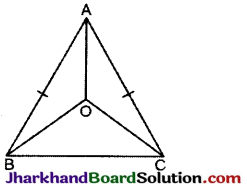
एक समद्विबाहु त्रिभुज ABC में, जिसमें AB = AC तथा ∠B और ∠C के समद्विभाजक परस्पर बिन्दु O पर प्रतिच्छेद करते हैं। A और O को जोड़िए। दर्शाइए कि :
JAC Class 9 Maths Solutions Chapter 7 त्रिभुज Ex 7.2 1
(i) OB = OC
(ii) AO कोण A को समद्विभाजित करती है।
हल:
(i) ΔABC में, AB = AC
या ∠B = ∠C
[∵ बराबर भुजाओं के सम्मुख कोण बराबर होते हैं]
या \(\frac{1}{2}\)∠B = \(\frac{1}{2}\)∠C
या ∠ABO = ∠ACO …(i)
⇒ ∠OBC = ∠OCB
∴ ∠OBC = \(\frac{1}{2}\)∠B
और ∠OCB = \(\frac{1}{2}\)∠C
या OB = OC …..(ii)
समान कोणों की सम्मुख भुजाएँ समान होती हैं।
इति सिद्धम्।

(ii) अब ΔABO तथा ΔACO में,
AB = AC [दिया है]
∠ABO = ∠ACO [समीकरण (i) से]
OB = OC [समीकरण (ii) से]
∴ ΔABO ≅ ΔACO (SAS नियम)
∠BAO = ∠CAO
या AO, ∠BAC को समद्विभाजित करता है।
इति सिद्धम् ।

JAC Class 9 Maths Solutions Chapter 7 त्रिभुज Ex 7.2

प्रश्न 2.
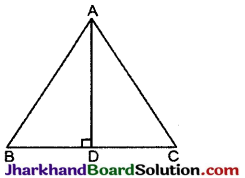
ΔABC में, AD भुजा BC का लम्ब समद्विभाजक है (देखिए आकृति)। दर्शाइए कि ΔABC एक समद्विबाहु त्रिभुज है, जिसमें AB = AC है।
JAC Class 9 Maths Solutions Chapter 7 त्रिभुज Ex 7.2 2
हल:
ΔABD तथा ΔACD में,
DB = DC [दिया है]
∠ADB = ∠ADC [प्रत्येक 90°]
AD = AD [उभयनिष्ठ]
∴ ΔABD ≅ ΔACD [SAS नियम]
और AB = AC
अतः ΔABC एक समद्विबाहु त्रिभुज है जिसमें AB = AC है।
इति सिद्धम्।

प्रश्न 3.
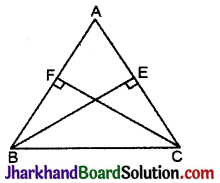
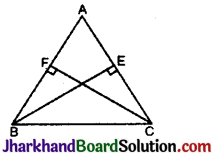
ABC एक समद्विबाहु त्रिभुज है, जिसमें बराबर भुजाओं AC और AB पर शीर्षलम्ब क्रमशः BE और CF खींचे गए हैं (देखिए आकृति) दर्शाइए कि ये शीर्षलम्ब बराबर हैं।
हल:
दिया है समद्विबाहु ΔABC में BE ⊥ AC तथा CF ⊥ AB.
सिद्ध करना है: BE = CF
JAC Class 9 Maths Solutions Chapter 7 त्रिभुज Ex 7.2 3
ΔABE तथा ΔACF में,
∠AEB =∠AFC [प्रत्येक 90°]
∠A = ∠A [उभयनिष्ठ]
तथा AB = AC [दिया है]
ΔABE ≅ ΔACF (ASA नियम)
BE = CF
अतः शीर्षलम्ब बराबर हैं।
इति सिद्धम् ।

JAC Class 9 Maths Solutions Chapter 7 त्रिभुज Ex 7.2

प्रश्न 4.
ABC एक त्रिभुज है जिसमें AC और AB पर खींचे गए शीर्षलम्ब BE और CF बराबर हैं (देखिए आकृति) दर्शाइए कि
(i) ΔABE ≅ ΔACF
(ii) AB = AC, अर्थात् ΔABC समद्विबाहु त्रिभुज है।
JAC Class 9 Maths Solutions Chapter 7 त्रिभुज Ex 7.2 4
हल:
(i) ΔABE तथा ΔACF में,
∠AEB = ∠ACF [प्रत्येक 90°]
∠BAE = ∠CAF [उभयनिष्ठ]
तथा BE = CF [दिया है]
ΔABE ≅ ΔACF [AAS नियम ]

(ii) ∵ ΔABE ≅ ΔACF
∴ AB = AC
अत: ΔABC एक समद्विबाहु त्रिभुज है। इति सिद्धम्।

प्रश्न 5.
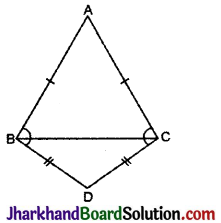
ABC और DBC समान आधार BC पर स्थित दो समद्विबाहु त्रिभुज हैं (देखिए आकृति)। दर्शाइए कि ∠ABD = ∠ACD है।
हल:
ABC में, AB = AC
∠ABC = ∠ACB …..(1)
[∵ समान भुजाओं के सम्मुख कोण]
ΔBCD में, BD = CD
∴ ∠DBC = ∠DCB …..(2)
[∵ समान भुजाओं के सम्मुख कोण]
JAC Class 9 Maths Solutions Chapter 7 त्रिभुज Ex 7.2 5
समीकरण (1) तथा (2) को जोड़ने पर,
∠ABC + ∠DBC = ∠ACB + ∠DCB
⇒ ∠ABD = ∠ACD. इति सिद्धम्।

JAC Class 9 Maths Solutions Chapter 7 त्रिभुज Ex 7.2

प्रश्न 6.
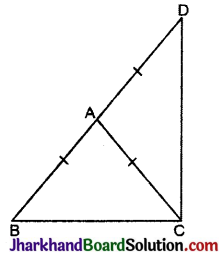
ABC एक समद्विबाहु त्रिभुज है, जिसमें AB = AC है। भुजा BA बिन्दु D तक इस प्रकार बढ़ाई गई है कि AD = AB है (देखिए आकृति) दर्शाइए कि ∠BCD एक समकोण है।
JAC Class 9 Maths Solutions Chapter 7 त्रिभुज Ex 7.2 6
हल:
ΔABC में, AB = AC [दिया है]
∠ACB = ∠ABC …..(i)
[समान भुजाओं के सम्मुख कोण]
अब AB = AD [दिया है]
AD = AC [∵ AB = AC]
इसलिए ΔADC में,
AD = AC
∠ACD = ∠ADC
[समान भुजाओं के सम्मुख कोण]
समीकरण (i) तथा (ii) को जोड़ने पर,
∠ACB + ∠ACD = ∠ABC + ∠ADC
⇒ ∠BCD = ∠ABC + ∠BDC
[∵∠ADC = ∠BDC]
⇒ ∠BCD + ∠BCD = ∠ABC + ∠BDC + ∠BCD
[∠BCD को दोनों पक्षों में जोड़ने पर
[∵∠ABC + ∠BDC + ∠BCD = 180°]
[त्रिभुज के तीनों कोणों का योग 180° होता है।]
⇒ 2∠BCD = 180°
∴ ∠BCD = 90°
अतः ∠BCD एक समकोण है। इति सिद्धम्।

प्रश्न 7.
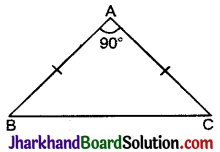
ABC एक समकोण त्रिभुज है, जिसमें ∠A = 90° और AB = AC है। ∠B और ∠C ज्ञात कीजिए।
JAC Class 9 Maths Solutions Chapter 7 त्रिभुज Ex 7.2 7
हल:
ΔABC में, ∠A = 90°
AB = AC (दिया है)
∴ ∠B = ∠C
[समान भुजाओं के सम्मुख कोण]
और ∠A + ∠B + ∠C = 180°,
[Δ के कोणों के योग का नियम]
⇒ 90° + ∠B + ∠B = 180° [∵∠C = ∠B]
⇒ 90° + 2∠B = 180° [∵∠C = ∠B]
⇒ 2∠B = 180° – 90° = 90°
या ∠B = \(\frac{90^{\circ}}{2}\) = 45°
∴ ∠C = ∠B = 45°.

JAC Class 9 Maths Solutions Chapter 7 त्रिभुज Ex 7.2

प्रश्न 8.
दर्शाइए कि किसी समबाहु त्रिभुज का प्रत्येक कोण 60° होता है।
JAC Class 9 Maths Solutions Chapter 7 त्रिभुज Ex 7.2 8
हल:
माना ΔABC एक समबाहु त्रिभुज है अतः
AB = AC = BC
अब AB = AC
⇒ ∠B = ∠C…(i)
[समान भुजाओं के सम्मुख कोण]
तथा CB = CA
∠A = ∠B… (ii)
[समान भुजाओं के सम्मुख कोण]
समी. (i) व (ii) से,
∠A = ∠B = ∠C
तथा ∠A + ∠B + ∠C = 180°
[Δ के कोणों के योग का नियम]
∴ ∠A + ∠A + ∠A = 180°
⇒ 3∠A = 180° ⇒ ∠A = 60°
∴ ∠A = ∠B = ∠C = 60°
अतः समबाहु त्रिभुज के सभी कोण 60° के होते हैं।
इति सिद्धम्।

JAC Class 9 Maths Solutions Chapter 3 निर्देशांक ज्यामिति Ex 3.3

Jharkhand Board JAC Class 9 Maths Solutions Chapter 3 निर्देशांक ज्यामिति Ex 3.3 Textbook Exercise Questions and Answers.

JAC Board Class 9 Maths Solutions Chapter 3 निर्देशांक ज्यामिति Exercise 3.3

प्रश्न 1.
किस चतुर्थांश में या किस अक्ष पर बिन्दु (− 2, 4), (3, -1), (-1, 0), (1, 2) और (-3, -5) स्थित हैं ? कार्तीय तल पर इनका स्थान निर्धारित करके अपने उत्तर सत्यापित कीजिए।
हल:
(i) बिन्दु (-2, 4) में भुज ऋणात्मक तथा कोटि धनात्मक है। अत: यह द्वितीय चतुर्थांश में है।
(ii) बिन्दु (3, -1) में भुज धनात्मक तथा कोटि ऋणात्मक है। अतः यह चतुर्थ चतुर्थांश में है।
(iii) (1, 0) में भुज ऋणात्मक तथा कोटि शून्य है। अतः यह X-अक्ष पर है।
(iv) बिन्दु (1, 2) में भुज व कोटि दोनों धनात्मक हैं। अतः यह प्रथम चतुर्थांश में है।
(v) बिन्दु (-3, -5) में भुज और कोटि दोनों ऋणात्मक हैं। अतः यह तृतीय चतुर्थांश में है।
इन बिन्दुओं का कार्तीय तल पर निर्धारण करने के लिए ग्राफ में बिन्दु (-2, 4), B(3, -1), C(-1, 0), D(1, 2) और E (-3, -5) को दर्शाया गया है।
JAC Class 9 Maths Solutions Chapter 3 निर्देशांक ज्यामिति Ex 3.3 1

JAC Class 9 Maths Solutions Chapter 3 निर्देशांक ज्यामिति Ex 3.3

प्रश्न 2.
अक्षों पर दूरी का उपयुक्त पैमाना लेकर नीचे सारणी में दिए गए बिन्दुओं को कार्तीय तल पर आलेखित कीजिए :
JAC Class 9 Maths Solutions Chapter 3 निर्देशांक ज्यामिति Ex 3.3 2
हल:
बिन्दु A(-2, 8), B (-1, 7), C(0, -1.25), D(1, 3) और E(3, -1) का आलेख निर्देशांक अक्ष खींचकर निम्न प्रकार करते हैं-
JAC Class 9 Maths Solutions Chapter 3 निर्देशांक ज्यामिति Ex 3.3 3

JAC Class 9 Maths Solutions Chapter 7 त्रिभुज Ex 7.5

Jharkhand Board JAC Class 9 Maths Solutions Chapter 7 त्रिभुज Ex 7.5 Textbook Exercise Questions and Answers.

JAC Board Class 9 Maths Solutions Chapter 7 त्रिभुज Exercise 7.5

प्रश्न 1.
ABC एक त्रिभुज है। इसके अभ्यन्तर में एक ऐसा बिन्दु ज्ञात कीजिए, जो ΔABC के तीनों शीर्षो से समदूरस्थ है।
हल:
दिया है : ΔABC
ज्ञात करना है : बिन्दु P जो शीर्षों A, B तथा C से समदूरस्थ है।
JAC Class 9 Maths Solutions Chapter 7 त्रिभुज Ex 7.5 1
रचना : भुजाओं AB तथा BC के लम्ब समद्विभाजक खींचे जो एक दूसरे को प्रतिच्छेदित करते हैं।
बिन्दु P ही अभीष्ट बिन्दु है।
उपपत्ति: P को क्रमश A, B तथा C से मिलाने पर
PA = PB = PC इति सिद्धम्।

JAC Class 9 Maths Solutions Chapter 7 त्रिभुज Ex 7.5

प्रश्न 2.
किसी त्रिभुज के अभ्यंतर में एक ऐसा बिन्दु ज्ञात कीजिए जो त्रिभुज की सभी भुजाओं से समदूरस्थ है।
हल:
दिया है : ΔABC
ज्ञात करना है: भुजाओं AB, BC तथा CA से समदूरस्थ बिन्दु O।
JAC Class 9 Maths Solutions Chapter 7 त्रिभुज Ex 7.5 2
रचना : ΔABC के ∠B तथा ∠C के समद्विभाजक खींचे जो परस्पर O पर
प्रतिच्छेदित करते हैं।
O ही अभीष्ट बिन्दु है।
उपपत्ति: बिन्दु से भुजाओं AB, BC तथा CA पर
क्रमश: OR, OP तथा OQ लम्ब डाले।
नापने पर OR = OP = OQ इति सिद्धम्

प्रश्न 3.
एक बड़े पार्क में, लोग तीन बिन्दुओं (स्थानों) पर केन्द्रित हैं (देखिए आकृति) :
JAC Class 9 Maths Solutions Chapter 7 त्रिभुज Ex 7.5 3
A: जहाँ बच्चों के लिए फिसलपट्टी और झूले हैं।
B: जिसके पास मानव-निर्मित एक झील है।
C: जो एक बड़े पार्किंग स्थल और बाहर निकलने के रास्ते के निकट है।
एक आइसक्रीम का स्टॉल कहाँ लगाना चाहिए ताकि वहाँ लोगों की अधिकतम संख्या पहुँच सके ?
हल:
आइसक्रीम का स्टॉल बिन्दुओं A, B तथा C से समान दूरी पर होना चाहिए तभी समान दूरी के कारण अधिकतम लोग वहाँ पहुँच सकेंगे। इसके लिए भुजा AB तथा BC के लम्ब समद्विभाजक खींचे जाने चाहिए जो एक दूसरे को बिन्दु O पर काटते हैं।
अतः आइसक्रीम का स्टॉल लम्ब समद्विभाजकों के प्रतिच्छेदन बिन्दु पर स्थापित करना चाहिए।

JAC Class 9 Maths Solutions Chapter 7 त्रिभुज Ex 7.5

प्रश्न 4.
षड्भुजीय और तारे के आकार की रंगोलियों [देखिए आकृति (i) और (ii)] को 1 सेमी भुजा वाले समबाहु त्रिभुजों से भर कर पूरा कीजिए। प्रत्येक स्थिति में, त्रिभुजों की संख्या गिनिए किसमें अधिक त्रिभुज हैं?
JAC Class 9 Maths Solutions Chapter 7 त्रिभुज Ex 7.5 4
हल:
JAC Class 9 Maths Solutions Chapter 7 त्रिभुज Ex 7.5 5
तारे के आकार की रंगोली चित्रों से स्पष्ट है कि षडभुजीय आकृति के सम्मुख शीषों को मिलाने पर प्राप्त विकणों द्वारा उसे 5 सेमी भुजा वाले 6 समबाहु त्रिभुजों में विभक्त किया जा सकता है। तथा तारे की आकृति में निहित पभुजीय आकृति के सम्मुख शीषों को मिलाकर 5 सेमी भुजा वाले 6 अन्य समबाहु त्रिभुजों में विभक्त करने पर उसमें समबाहु त्रिभुजों की संख्या 12 होगी।

पुनः षड्भुजीय आकृति के एक समबाहु त्रिभुज जिसकी भुजा 5 सेमी है, को 1 सेमी भुजा वाले समबाहु त्रिभुजों में विभाजित कर स्पष्ट किया गया है कि 5 सेमी भुजा वाले एक समबाहु त्रिभुज को 1 सेमी भुजा वाले 25 त्रिभुजों में विभाजित किया जा सकता है, तब
स्थिति 1 : षड्भुजीय रंगोली :
इसको 1 सेमी भुजा वाले 6 × 25 = 150 समबाहु त्रिभुजों में बाँटा जा सकता है।
स्थिति 2 : तारे के आकार की रंगोली
5 सेमी भुजा वाले समबाहु त्रिभुजों की संख्या = 12
∴ आकृति में 1 सेमी भुजा वाले समबाहु त्रिभुजों की
संख्या 12 × 25 = 300
स्पष्ट है कि तारे के आकार वाली आकृति में त्रिभुजों की संख्या अधिक है।

JAC Class 9 Maths Solutions Chapter 3 निर्देशांक ज्यामिति Ex 3.2

Jharkhand Board JAC Class 9 Maths Solutions Chapter 3 निर्देशांक ज्यामिति Ex 3.2 Textbook Exercise Questions and Answers.

JAC Board Class 9 Maths Solutions Chapter 3 निर्देशांक ज्यामिति Exercise 3.2

प्रश्न 1.
निम्नलिखित प्रश्नों में से प्रत्येक प्रश्न का उत्तर दीजिए :
(i) कार्तीय तल में किसी बिन्दु की स्थिति निर्धारित करने वाली क्षैतिज और ऊर्ध्वाधर रेखाओं के क्या नाम हैं ?
(ii) इन दो रेखाओं से बने तल के प्रत्येक भाग का नाम बताइए।
(iii) उस बिन्दु का नाम बताइए जहाँ ये दोनों रेखाएँ प्रतिच्छेदित होती हैं।
हल:
(i) कार्तीय तल में किसी बिन्दु की स्थिति निर्धारित करने वाली क्षैतिज रेखाओं को X-अक्ष तथा ऊर्ध्वाधर रेखाओं को Y-अक्ष कहते हैं।
(ii) X-अक्ष और Y-अक्ष द्वारा बने प्रत्येक तल को चतुर्थांश कहते हैं।
(iii) दोनों अक्ष मूलबिन्दु (0, 0) पर प्रतिछेदित होती हैं।

प्रश्न 2.
आकृति देखकर ज्ञात कीजिए :
(i) B के निर्देशांक
(ii) C के निर्देशांक
(iii) निर्देशांक (-3, -5) द्वारा पहचाना गया बिन्दु
(iv) निर्देशांक (2, -4) द्वारा पहचाना गया बिन्दु
(v) D का भुज
(vi) बिन्दु H की कोटि
(vii) बिन्दु L के निर्देशांक
(viii) बिन्दु M के निर्देशांक
JAC Class 9 Maths Solutions Chapter 3 निर्देशांक ज्यामिति Ex 3.2 1
हल:
चित्र से स्पष्ट है कि :
(i) B के निर्देशांक (-5, 2) हैं।
(ii) C के निर्देशांक (5, -5) हैं।
(iii) निर्देशांक (-3, -5) बिन्दु E को दर्शाता है।
(iv) निर्देशांक (2, -4) बिन्दु G को दर्शाता है।
(v) बिन्दु D का भुज 6 है ।
(vi) बिन्दु H की कोटि -3 है।
(vii) बिन्दु L के निर्देशांक (0, 5) हैं।
(viii) बिन्दु M के निर्देशांक (-3, 0) हैं।

JAC Class 9 Maths Solutions Chapter 1 संख्या पद्धति Ex 1.5

Jharkhand Board JAC Class 9 Maths Solutions Chapter 1 संख्या पद्धति Ex 1.5 Textbook Exercise Questions and Answers.

JAC Board Class 9 Maths Solutions Chapter 1 संख्या पद्धति Exercise 1.5

प्रश्न 1.
बताइए नीचे दी गई संख्याओं में कौन-कौन परिमेय हैं और कौन-कौन अपरिमेय हैं:
(i) 2 – \(\sqrt{5}\),
(ii) (3 + \(\sqrt{23}\)) – \(\sqrt{23}\),
(iii) \(\frac{2 \sqrt{7}}{7 \sqrt{7}}\)
(iv) \(\frac{1}{\sqrt{2}}\)
(v) 2π.
हल:
(i) 2\(\sqrt{5}\), संख्या 2 परिमेय तथा \(\sqrt{5}\) अपरिमेय का अन्तर है। परिमेय तथा अपरिमेय संख्याओं का अन्तर अपरिमेय होता है।
∴ यह संख्या अपरिमेय होगी।
(ii) (3 + \(\sqrt{23}\)) – \(\sqrt{23}\) = 3 + \(\sqrt{23}\) – \(\sqrt{23}\) = 3, परिमेय संख्या है।
(iii) \(\frac{2 \sqrt{7}}{7 \sqrt{7}}=\frac{2}{7}\), एक परिमेय संख्या है।
(iv) \(\frac{1}{\sqrt{2}}\)
∵ परिमेय और अपरिमेय का भागफल अपरिमेय होता है।
∴ यह संख्या अपरिमेय है।
(v) 2π
यहाँ संख्या 2 परिमेय और अपरिमेय संख्या का गुणनफल अपरिमेय आता है।
∴ 2π एक अपरिमेय संख्या है।

JAC Class 9 Maths Solutions Chapter 1 संख्या पद्धति Ex 1.5

प्रश्न 2.
निम्नलिखित व्यंजकों में से प्रत्येक व्यंजक को सरल कीजिए:
(i) (3 + \(\sqrt{3}\)) (2 + \(\sqrt{2}\)),
(ii) (3 + \(\sqrt{3}\)) (3 – \(\sqrt{3}\)),
(iii) (\(\sqrt{5}\) + \(\sqrt{2}\))2,
(iv) (\(\sqrt{5}\) – \(\sqrt{2}\)) (\(\sqrt{5}\) + \(\sqrt{2}\)).
हल:
(i) (3 + \(\sqrt{3}\)) (2 + \(\sqrt{2}\))
= 3 × 2 + \(\sqrt{3}\) × 2 + 3 × \(\sqrt{2}\) + \(\sqrt{3}\) × \(\sqrt{2}\)
= 6 + 2\(\sqrt{3}\) + 3\(\sqrt{2}\) + \(\sqrt{6}\)

(ii) (3 + \(\sqrt{3}\)) (3 – \(\sqrt{3}\)) = (3)2 – (\(\sqrt{3}\))2
[(∵ a2 – b2 = (a + b) (a – b)]
= 9 – 3 = 6.

(iii) (\(\sqrt{5}\) + \(\sqrt{2}\))2
= (\(\sqrt{5}\))2 + 2 × \(\sqrt{5}\) × \(\sqrt{2}\) + (\(\sqrt{2}\))2
= 5 + 2\(\sqrt{10}\) + 2 = 7 + 2\(\sqrt{10}\)

(iv) (\(\sqrt{5}\) – \(\sqrt{2}\)) (\(\sqrt{5}\) + \(\sqrt{2}\))
= (\(\sqrt{5}\))2 – (\(\sqrt{2}\))2 = 5 – 2 = 3

प्रश्न 3.
आपको याद होगा कि को एक वृत्त की परिधि (मान लीजिए c) और उसके व्यास (मान लीजिए d) के अनुपात से परिभाषित किया जाता है अर्थात् π = \(\frac{c}{d}\) है। यह इस तथ्य का अंतर्विरोध करता हुआ प्रतीत होता है कि अपरिमेय है। इस अंतर्विरोध का निराकरण आप किस प्रकार करेंगे ?
हल:
हम जब कभी भी स्केल से या अन्य किसी युक्ति से लम्बाई नापते हैं, तब हमको केवल एक सन्निकट परिमेय मान प्राप्त होता है अतः हम यह अनुभव नहीं कर पाते कि c या d अपरिमेय हैं।
अतः π के अपरिमेय होने में कोई भी विरोधाभास नहीं है चाहे और d का मान कुछ भी हो।

JAC Class 9 Maths Solutions Chapter 1 संख्या पद्धति Ex 1.5

प्रश्न 4.
संख्या रेखा पर \(\sqrt{9.3}\) को निरूपित कीजिए।
हल:
(1) रेखाखण्ड AB = 9.3 सेमी खींचा।
(2) इसे किसी बिन्दु X तक आगे बढ़ाया और BX पर एक बिन्दु इस प्रकार लिया कि BC = 1 सेमी।
(3) AC का मध्यबिन्दु M ज्ञात किया और व्यास AC का अर्द्धवृत्त खींचा।
(4) AC के बिन्दु B से AC पर लम्ब BD खींचा जो अर्द्धवृत्त को D पर मिलता है।
JAC Class 9 Maths Solutions Chapter 1 संख्या पद्धति Ex 1.5 1
(5) केन्द्र B से BD त्रिज्या का चाप खींचा जो BX को बिन्दु पर काटता है।
(6) बिन्दु P. संख्या रेखा पर \(\sqrt{9.3}\) को निरूपित करता है।
⇒ \(\sqrt{9.3}\) = BP = 3.049 या लगभग 3.05.

प्रश्न 5.
निम्नलिखित के हरों का परिमेयकरण कीजिए:
JAC Class 9 Maths Solutions Chapter 1 संख्या पद्धति Ex 1.5 2
हाल:
JAC Class 9 Maths Solutions Chapter 1 संख्या पद्धति Ex 1.5 3
JAC Class 9 Maths Solutions Chapter 1 संख्या पद्धति Ex 1.5 4

JAC Class 9 English Solutions Beehive Poem 7 The Duck and the Kangaroo

Jharkhand Board JAC Class 9 English Solutions Beehive Poem 7 The Duck and the Kangaroo Textbook Exercise Questions and Answers.

JAC Board Class 9 English Solutions Beehive Poem 7 The Duck and the Kangaroo

JAC Class 9 English The Duck and the Kangaroo Important Questions and Answers

Short Answer Type Questions

Question 1.
What did the Duck wish and why ?
बतख ने क्या इच्छा की और क्यों ?
Answer:
The Duck was fed up of living in a pond. She thought that her life was boring in that pond. So she wished to have a ride on the Kangaroo’s back and visit the whole world.

बतख तालाब में रहते हुए इसलिए उसने कंगारू की परेशान थी। उसने सोचा कि उसका जीवन उस तालाब में नीरस व उबाऊ था। पीठ की सवारी की तथा पूरे संसार की यात्रा की इच्छा की।

JAC Class 9 English Solutions Beehive Poem 7 The Duck and the Kangaroo

Question 2.
What did the Duck plan to avoid giving trouble to the Kangaroo ?
बतख ने कंगारू को कष्ट देने से बचने के लिए क्या योजना बनाई ?
Answer:
The Duck bought four pairs of woollen socks which fitted her webbed feet perfectly. She also bought a cloak to keep out the cold. Besides, she planned to smoke a cigar everyday. She did all this for her dear Kangaroo.

बतख ने चार जोड़ी ऊनी जुराबें खरीदीं जो उसके जालीदार पैरों में सही आती थी। उसने ठण्ड को दूर रखने के लिए एक लबादा भी खरीदा। इसके अतिरिक्त उसने प्रतिदिन एक सिगार पीने की योजना बनाई । उसने ये सब अपने प्रिय कंगारू के लिए किया ।

Question 3.
Give the central idea of the poem ‘The Duck and the Kangaroo’?
कविता ‘The Duck and the Kangaroo’ का केन्द्रीय भाव बताइए ।
Answer:
The poem is in the form of a dialogue between the Duck and the Kangaroo. The Duck wishes to have a ride on the Kangaroo’s back. She promises not to give him any trouble. The Kangaroo agrees and they happily travel the whole world.

कविता बतख और कंगारू के मध्य एक वार्तालाप के रूप में है। बतख कंगारू के पीठ की सवारी की इच्छा करती है। वह (बतख ) उसे कोई भी परेशानी नहीं देने का वायदा करती है। कंगारू सहमत हो जाता है और वे खुशी-खुशी पूरे संसार की यात्रा करते हैं।

The Duck and the Kangaroo Summary and Translation in Hindi

About the Poem 

यह Edward Lear द्वारा रचित ‘Nonsense Verse’ के रूप में जानी जाने वाली एक हास्य कविता है ।

Read and Enjoy (इसे पढ़िए व आनन्द लीजिए)

Word-Meaninos And Mindi Translation

Stanza I Said ……… kangaroo (Lines 1-8)

Word-Meanings: duck (डक् = बत्तख । kangaroo ( कैंगरू )= कंगारू । gracious (ग्रेशस्) = kind, उदार, दयालु। hop (हॉप् ) = jump, फुदकना । bore (बॉर) = dull, नीरस, उबाऊ । nasty ( नास्टि) = dirty, गंदा, क्षोभ उत्पन्न करने वाला। long (लॉङ) = keenly want, तीव्र इच्छा करना, लालायित् रहना । beyond (बियॉन्ड्) = की दूसरी ओर, दूर।

हिन्दी अनुवाद – बत्तख ने कंगारू से कहा, “अहा ! आप तो बहुत अच्छा उछलते हैं ! आप मैदानों और पानी पर भी ऐसे उछलते हो, जैसे कि आप कभी रुकेंगे ही नहीं । मेरा जीवर्न तो इस गन्दे तालाब में नीरस व उबाऊ है और मेरी तीव्र इच्छा है कि मैं इससे दूर बाहर की दुनिया में जाऊँ। काश ! मैं भी आपके समान उछल सकती ।” बत्तख ने कंगारू से कहा ।

JAC Class 9 English Solutions Beehive Poem 7 The Duck and the Kangaroo

Stanza II Please. to the Kangaroo. (Lines 9-16)

Word-Meanings : ride (राइड्) = सवारी करना । still (स्टिल्) = without moving, बिना हिले-डुले, निस्तब्ध ।Quack ( क्वेक) = बत्तख की आवाज, काँ-काँ करना ।

हिन्दी अनुवाद – बत्तख ने कहा, “कृपया मुझे अपनी पीठ पर सवारी करवा दो । “मैं बिल्कुल बिना हिले-डुले बैढूँगी और ‘काँ-काँ’ के अलावा पूरे दिन कुछ नहीं बोलूँगी । और हम डी और ‘जैली बोली’ की सैर करेंगे, जमीन तथा समुद्र की यात्रा करेंगे । कृपया मुझे सवारी करवाइये ।” बत्तख ने कंगारू से कहा ।

Stanza III Said …………… Kangaroo. (Lines 17-24)

Word-Meanings : requires (रिक्वाइऑॅ:ज्) = needs, आवश्यकता है । reflection (रिफ्लेक्शंन) = careful thought, सावधानीपूर्वक किया गया विचार । perhaps (पॅँहैप्स) = probably, शायद, संभवतया । objection (अब्जेक्शन् ) = आपत्ति, ऐतराज़ । bold (बोल्ड) = निर्भीक, निडर । unpleasantly (अन्प्लेश्ज़्द्रि) = अप्रिय रूप से, बुरी तरह से । probably (प्रॅबब्लि) = सम्भवतया ।roo-matiz (रू-मटिज़) = rehumatism, ठण्ड से होने वाला गठिया या सन्धिवात का रोग ।

हिन्दी अनुवाद – कंगारू ने बंत्तख से कहा, “मुझे कुछ विचार करना पड़ेगा । शायद इससे मेरा भाग्य उदय हो जाए । किन्तु इसमें केवल एक आपत्ति नजर आती है । यदि आप मुझे निर्भीक होकर बोलने दें तो वह आपत्ति यह है कि आपके पैर बुरी तरह से गीले और ठण्डे हैं और शायद इससे मुझे गठिया हो जाए ।” कंगारू ने कहा ।

Stanza IV Said the Duck ………… a Kangaroo. (Lines 25-32)

Word-Meanings: rocks (रॉक्स) = चट्ट्रें । worsted socks (वस्टिड् सॉक्स्) = ऊनी जुराबें । webfeet ( वेब्-फीट् )= जालीदार पैर । neatly (नीट्लि) = in the right way, सही तरह से, पूरी तरह से । cloak (क्लोक्) = loose upper clothing, लबादा, ‘चोगा ।

हिन्दी अनुवाद – बत्तख ने कहा, जब मैं चट्टानों पर बैठी थी तो मैंने इस पर गम्भीरता से विचार किया था। और मैंने चार जोड़ी ऊनी जुराबें खरीदी हैं, जो मेरे जालीदार पैरों में सही आते हैं। और ठण्ड को दूर रखने के लिए मैंने एक

लबादा खरीद लिया है और मैं प्रतिदिन एक सिगार पीऊँगी । अपने प्रिय कंगारू के सच्चे प्यार का अनुसरण करने के लिए मैं यह सब करूँगी ।

JAC Class 9 English Solutions Beehive Poem 7 The Duck and the Kangaroo

StanzaV Said the Kangaroo…………….. the Kangaroo? (Lines 33-40)

Word-Meanings: ready (रेडि) = तैयार I moonlight ( मूनलाइट्) = चंद्रमा की रोशनी, चाँदनी । pale (पेल्) = मद्धिम, हल्की । balance (बैलेन्स्) = संतुलन । steady (स्टेडि) = स्थिर । quite (क्वाइट्) = पूरी तरह से। bound ( बाउण्ड )= छलाँग । three times ( थ्री टाइम्ज़ )= तीन बार । so (सो) = इतने ।

हिन्दी अनुवाद – कंगारू ने कहा, मैं चंद्रमा की मंद चाँदनी में सवारी कराने के लिए तैयार हूँ। परन्तु प्रिय बत्तख, मेरे संतुलन के लिए मेरी दुम के आखिर में मजबूती और शांति से बैठना । “इस प्रकार से वे उछल-कूद करते हुए गये और उन्होंने पूरे संसार के तीन चक्कर लगाये । और बत्तख और कंगारू के सिवाय कौन इतना प्रसन्न था अर्थात् वे बहुत प्रसन्न हुए ।

Explanation With Referenbe To Context & Comprenension Questions

Stanza 1.

Said the duck to the Kangaroo,
“Good gracious! how you hop!
Over the fields and the water too,
As if you never would stop!
My life is a bore in this nasty pond,
And I long to go out in the world beyond!
I wish I could hop like you!”
Said the Duck to the Kangaroo.

Reference : These lines have been taken from the poem ‘The Duck and the Kangaroo’ composed by Edward Lear.

Context: In these lines the Duck wants to go out in the world and hops like the Kangaroo.

Explanation : The Duck exclaimed with surprise that the Kangaroo hopped so strongly and easily. He hopped over the fields as well as over the water. His hopping never seemed to stop. The Duck said that she always lived in a pond and therefore her life was quite boring. She expressed her wish to go out in the world beyond her pond. She wished that she might be able to hop like the Kangaroo.

सन्दर्भ – ये पंक्तियाँ कवि Edward Lear द्वारा रचित कविता ‘The Duck and the Kangaroo’ से ली गई हैं।

प्रसंग – इन पंक्तियों में बतख संसार में जाना तथा कंगारू की तरह फुदकना चाहती है।

व्याखव्या – बत्तख ने आश्चर्य से कहा कि कंगारू बहुत अच्छा फुदकता है। वह खेतों की ही तरह पानी के ऊपर भी फुदकता है। ऐसा लगता है कि उसका फुदकना कभी नहीं रुकेगा। बत्तख ने कहा कि वह तो हमेशा एक तालाब में ही रहती है और इसलिए उसका जीवन बहुत नीरस हो गया है। उसने अपनी इच्छा व्यक्त की कि वह अपने तालाब से बाहर के संसार में जाना चाहती है। उसने चाहा कि काश वह कंगारू की तरह फुदक सके।

Questions
1. What is the Duck’s desire?
2. How does the Duck look at the Kangaroo?
3. How does the Duck praise the Kangaroo?
4. What does the Duck say about her life ?
Answers
1. The Duck’s desire is to hop like the Kangaroo.
2. The Duck looks with awe at the way the Kangaroo jumps over the fields and water as if he would never stop.
3. The Duck praises the Kangaroo saying that the Kangaroo hops in an extraordinary way.
4. The Duck says that her life in the pond is boring.

JAC Class 9 English Solutions Beehive Poem 7 The Duck and the Kangaroo

Stanza 2.

“Please give me a ride on your back
Said the duck to the Kangaroo.
“I would sit quite still, and say nothing but Quack.”
The whole of the long day through!
And we’d go to the Dee, and the Jelly Bo Lee,
Over the land, and over the sea;
Please take me a ride! O do!”
Said the duck to the Kangaroo.

Reference : These lines have been taken from the poem ‘The Duck and the Kangaroo’ composed by Edward Lear.

Context : In these lines the Duck requests the Kangaroo to go over the land and the sea.

Explanation : The Duck requested the Kangaroo to give her a ride on his back. She promised that she would keep sitting still on his back. She would speak nothing except ‘quack-quack’ the whole day long. She said that they would go to the places named Dee and Jelly Bo Lee. She expressed her wish to go over the land and over the sea while riding the Kangaroo’s back.

सन्द्रर्भ – ये पंक्तियाँ कवि Edward Lear द्वारा रचित कविता ‘The Duck and the Kangaroo’ से ली गई हैं।

प्रसंग – इन पंक्तियों में बतख कंगारू से धरती व पानी पर घूमने की प्रार्थना करती है।

व्याखव्या – बत्तख ने कंगारू से निवेदन किया कि वह उसे अपनी पीठ पर सवारी कराये। उसने वायदा किया कि वह उसकी पीठ पर शान्त व स्थिर बैठी रहेगी। वह पूरे दिन बस ‘क्वेक-क्वेक’ के सिवाय कुछ नहीं बोलेगी। उसने कहा कि वे ‘डी’ व ‘जेली बो ली’ नामक स्थानों पर जायेंगे। उसने कंगारू की पीठ पर सवार होकर धरती व पानी दोनों पर घूमने की इच्छा व्यक्त की ।

Questions
1. What does the Duck request the Kangaroo?
2. What does the Duck promise the Kangaroo?
3. Which places does she want to go with the Kangaroo?
4. Which poetic device has been used in the stanza?
Answers
1. The Duck requests the Kangaroo to give her a ride on his back.
2. The Duck promises the Kangaroo to sit quite still and says nothing but ‘quack’ while riding on his back.
3. She wants to go to the ‘Dee’ and the ‘Jelly Bo Lee’ with the Kangaroo.
4. It is Onomatopoeia.

Stanza 3.

Said the Kangaroo to the Duck,
“This requires some little reflection;
Perhaps on the whole it might bring me luck,
And there seems but one objection,
Which is, if you’ll let me speak so bold,
Your feet are unpleasantly wet and cold,
And would probably give me the roo-
Matiz!” said the Kangaroo.

Reference: These lines have been taken from the poem ‘The Duck and the Kangaroo’ composed by Edward Lear.

Context: In these lines Kangaroo had an objection that duck’s wet and cold feet could give him joint pain if he gave the duck a ride on his back.

Explanation: When the Duck requested the Kangaroo to give her a ride on his back, the Kangaroo said that he needed to think about it. He said that giving her a ride might be lucky for him but there seemed one problem. If the Duck did not mind, he wanted to say one thing. He told that her feet were very badly wet and cold. He was apprehensive of developing joint pain if he gave the Duck a ride on his back.

सन्दर्भ – ये पंक्तियाँ कवि Edward Lear द्वारा रचित कविता ‘The Duck and the Kangaroo’ से ली गई हैं।

प्रसंग – इन पंक्तियों में कंगारू ने आपत्ति की कि बतख के गीले और ठंडे पैर उसके जोड़ों में कहीं दर्द पैदा न कर दें यदि वह उसे अपनी पीठ पर सवारी कराये ।

व्याख्या- जब बत्तख ने कंगारू से निवेदन किया कि वह उसे अपनी पीठ पर सवारी कराये तो कंगारू ने कहा कि उसे इस विषय में सोचने की आवश्यकता है। उसने कहा कि उसे सवारी कराना उसके लिए भाग्यशाली सिद्ध हो सकता है लेकिन एक समस्या लगती है। उसने ( कंगारू ने) बत्तख से कहा कि यदि तुम्हें बुरा न लगे तो मैं एक बात कहना चाहता हूँ। उसने कहा कि उसके (बत्तख के) पैर बहुत बुरी तरह से गीले व ठण्डे थे। उसे आशंका थी कि यदि वह बत्तख को अपनी पीठ पर सवारी करायेगा तो कहीं उसे जोड़ों का दर्द न हो जाये ।

JAC Class 9 English Solutions Beehive Poem 7 The Duck and the Kangaroo

Questions
1. What may bring luck to the Kangaroo ?
2. What is ‘this’ in the second line?
3. How does the Kangaroo want to speak?
4. What is the Kangaroo worried about?
Answers
1. Taking the Duck on his back may bring luck to the Kangaroo.
2. ‘This’ means to give an assurance to the Duck to ride on the back of Kangaroo.
3. He wants to speak boldly.
4. The Kangaroo is worried about catching a cold due to the Duck’s cold and wet feet.

Stanza 4.

Said the Duck, “As I sat on the rocks,
I have thought over that completely,
And I bought four pairs of worsted socks,
Which fit my web-feet neatly.
And to keep out the cold I’ve bought a cloak,
And everyday a cigar I’ll smoke,
All to follow my own dear true
Love of a Kangaroo!”

Reference: These lines have been taken from the poem ‘The Duck and the Kangaroo’ composed by Edward Lear.

Context: In these lines the Duck has prepared herself to save the Kangaroo from any trouble.

Explanation: When the Kangaroo said that giving a ride to the duck on his back might give him joint pain, the duck said that while sitting on the rocks, she had already thought about it. She said that to tackle the problem, she had already bought four pairs of woollen socks. These fitted her web-feet very nicely. She said that she had bought a cloak to keep out the cold. Besides, she would smoke a cigar everyday to keep herself warm. She would do this all to avoid giving any trouble to her dear Kangaroo.

सन्दर्भ – ये पंक्तियाँ कवि Edward Lear द्वारा रचित कविता The Duck and the Kangaroo’ से ली गई हैं।

प्रसंग – इन पंक्तियों में बतख ने कंगारू को किसी भी तरह की समस्या से बचाने के लिए खुद को तैयार कर लिया है।

व्याख्या – जब कंगारू ने कहा कि बत्तख को अपनी पीठ पर सवारी कराने से उसके जोड़ों में दर्द हो सकता है तो बत्तख ने कहा कि चट्टानों पर बैठे-बैठे उसने पहले ही इस विषय में सोच लिया है। उसने कहा कि इस समस्या से बचने के लिए उसने पहले ही चार जोड़े ऊनी जुराबें खरीद ली हैं। वे उसके जालीदार पैरों में बिल्कुल ठीक आ रही हैं। उसने कहा कि उसने ठण्ड से बचने के लिए एक ऊपरी लबादा भी खरीद लिया हैं। इसके अलावा, वह स्वयं को गर्म रखने के लिए प्रतिदिन एक सिगार पियेगी । उसके प्रिय कंगारू को परेशानी न हो, इसलिए वह यह सब करेगी ।

Questions
1. When the Kangaroo expressed his doubt, what did the Duck reply?
2.What did she purchase for her feet?
3. What other things did the duck purchase to keep herself warm?
4. What will she do everyday?
Answers
1. She said that she had thought over his apprechension when she was sitting on the rocks.
2. She purchased four pairs of woollen socks.
3. She purchased a clock to keep herself warm.
4. She will smoke a cigar everyday.

Stanza 5.

Said the Kangaroo, “I’m ready!
All in the moonlight pale;
But to balance me well, dear Duck, sit steady!
And quite at the end of my tail!”
So away they went with a hop and a bound,
And they hopped the whole world three times round;
And who so happy- O who,
As the Duck and the Kangaroo?

Reference: These lines have been taken from the poem ‘The Duck and the Kangaroo’ composed by Edward Lear.

Context: In these lines the Kangaroo cautioned the Duck not to move while sitting on his back and then both of them enjoyed their journey across the whole world.

Explanation: It was the time of night. Pale moonlight was spread all around. At that time, the Kangaroo said to the Duck that he was ready to give her a ride on his back. But he cautioned her not to move while sitting on his back to keep his balance. Then the Duck rode the Kangaroo’s back. They hopped and jumped across the whole world and enjoyed the journey very much. They were the happiest creatures on the earth at that time.

JAC Class 9 English Solutions Beehive Poem 7 The Duck and the Kangaroo

सन्दर्भ- ये पंक्तियाँ कवि Edward Lear द्वारा रचित कविता ‘The Duck and the Kangaroo’ से ली गई हैं।

प्रसंग – इन पंक्तियों में कंगारू ने बतख को सावधान किया वह उसकी पीठ पर बिना हिले डुले बैठी रहे और तब दोनों ने पूरे संसार की यात्रा करने का आनन्द लिया ।

व्याख्या – रात्रि का समय था । हल्की पीली चाँदनी सब ओर बिखरी थी। उस समय कंगारू ने बत्तख से कहा कि वह उसे अपनी पीठ पर सवारी कराने के लिए तैयार है। लेकिन उसने उसे सावधान किया कि वह उसकी पीठ पर बिना हिले बैठी| रहे जिससे उसका सन्तुलन बना रहे। फिर बत्तख कंगारू की पीठ पर सवार हो गई। वे पूरे संसार में फुदके और उछले व बहुत मज़े से घूमे। उस समय वे पृथ्वी के सबसे अधिक प्रसन्न प्राणी थे|

Questions
1. The Kangaroo said, “I am ready “. For what was he ready?
2. For what did the Kangaroo caution the Duck?
3. How was their visit?
4. Who were the happiest creatures at that time ?
Answers
1. He was ready to give the Duck a ride on his back.
2. The Kangaroo cautioned the Duck not to move while sitting on his back to keep his balance.
3. The Duck and the Kangaroo jumped and hopped throughout the journey and had a happy visit.
4. The Duck and the Kangaroo were the happiest creatures at that time.

JAC Class 9 English Solutions Beehive Chapter 7 Packing

Jharkhand Board JAC Class 9 English Solutions Beehive Chapter 7 Packing Textbook Exercise Questions and Answers.

JAC Board Class 9 English Solutions Beehive Chapter 7 Packing

JAC Class 9 English Packing Textbook Questions and Answers

Thinking About the Text

I. Discuss in pairs and answer each question below in a short paragraph (30-40 words):

जोड़े बनाकर विचार-विमर्श कीजिये और नीचे दिये गये प्रत्येक प्रश्न का उत्तर एक छोटे अनुच्छेद ( 30 से 40 शब्दों) में दीजिये :

Question 1.
How many characters are there in the narrative ? Name them. ( Don’t forget the dog !)
इस वृत्तांत में कितने पात्र हैं ? उनके नाम बताइये । ( कुत्ते को न भूलें! )
Answer:
There are four characters in this narrative including the dog. They are the author Jerome K Jerome and his two friends – George and Harris. Besides, there is their dog Montmorency that plays an interesting role.

इस वृत्तान्त में कुत्ते को मिलाकर कुल चार पात्र हैं । वे हैं- लेखक Jerome K. Jerome और उसके दो मित्र George और Harris | इसके अतिरिक्त उनका कुत्ता Montmorency है जो रोचक भूमिका निभाता है ।

JAC Class 9 English Solutions Beehive Chapter 7 Packing

Question 2.
Why did the narrator (Jerome) volunteer to do the packing ?
वर्णनकर्त्ता (जेरोम) ने पैकिंग करने के लिए स्वयं को प्रस्तुत क्यों किया ?
Answer:
The narrator believed that he could do packing better than anyone else. He was proud of his packing skill. So he told his friends to leave the whole work of packing to him. Moreover, he would get an opportunity to boss the job.

वर्णनकर्त्ता को विश्वास था कि वह किसी अन्य से अच्छी पैकिंग कर सकता था । उसे अपनी पैकिंग कौशल पर गर्व था । अतः उसने अपने मित्रों को पैकिंग का पूरा काम उस पर छोड़ने को कहा । इसके अतिरिक्त उसको उनके (अपने मित्रों के) काम पर रौब दिखाने का एक अवसर मिलेगा।

Question 3.
How did George and Harris react to this ? Did Jerome like their reaction ?
जॉर्ज और हैरिस की इस पर क्या प्रतिक्रिया थी ? क्या जेरोम को उनकी प्रतिक्रिया अच्छी लगी ?
Answer:
George and Harris readily agreed to the narrator’s suggestion. George spread himself over the easy chair and Harris cocked his legs on the table. The narrator didn’t like their reaction because he wanted to boss the job.

जॉर्ज और हैरिस वर्णनकर्ता के सुझाव पर तुरन्त सहमत हो गये । जार्ज आराम कुर्सी पर इत्मीनान से बैठ गया और हैरिस ने मेज पर अपने पैर रख लिए । वर्णनकर्त्ता को उनकी यह प्रतिक्रिया पसन्द नहीं आयी क्योंकि वह उनके काम पर रौब जमाना चाहता था ।

Question 4.
What was Jerome’s real intention when he offered to pack ?
जब जेरोम ने सामान बाँधने के लिए अपनी सेवा प्रस्तुत की तो उसका वास्तविक इरादा क्या था ?
Answer:
In fact, Jerome himself did not want to do the packing. He wanted George and Harris to do the packing under his supervision. He intended to boss their job and teach them how to do packing properly.

वास्तव में जेरोम स्वयं पैकिंग करना नहीं चाहता था । वह चाहता था कि जॉर्ज व हैरिस उसकी निगरानी में पैकिंग करें । उसका इरादा था कि वह उनके काम पर रौब जमाये और उन्हें ठीक तरह पैकिंग करना सिखाये।

Question 5.
What did Harris say after the bag was shut and strapped? Why do you think he waited till then to ask ?
बैग के बन्द हो जाने और फीते बाँधे जाने के पश्चात् हैरिस ने क्या कहा ? आपके विचार में उसने तब तक कहने के लिए प्रतीक्षा क्यों की ?
Answer:
Harris asked the author if he didn’t want to put the boots in the bag. He did this intentionally as he wanted to tease the author. So he didn’t say anything till the bag was shut and strapped.

हैरिस ने लेखक से पूछा कि क्या वह जूतों को बैग में नहीं रखेगा । उसने ऐसा जानबूझकर किया क्योंकि वह लेखक को चिढ़ाना चाहता था । इसलिए उसने बैग के बन्द हो जाने व फीते बँध जाने तक कुछ नहीं कहा।

JAC Class 9 English Solutions Beehive Chapter 7 Packing

Question 6.
What ‘horrible idea’ occurred to Jerome a little later ?
कुछ समय पश्चात् जेरोम के मन में क्या ‘भयानक विचार’ आया ?
Answer:
A horrible idea occurred to Jerome a little later if he had packed his toothbrush or not. His toothbrush was a thing that always haunted him when he was going to travel.

कुछ समय पश्चात् जेरोम के मन में एक भयानक विचार आया कि उसने अपना टूथब्रश पैक किया है या . नहीं । उसका टूथब्रश ही एक ऐसी वस्तु थी जो उसे यात्रा पर जाते समय लगातार तंग करती रहती थी ।

Question 7.
Where did Jerome finally find the toothbrush ?
जेरोम को अन्ततः टूथब्रश कहाँ मिला ?
Answer:
Jerome unpacked the bag and shook everything to find his toothbrush. While he was putting them back one by one, he finally found it inside a boot. After this he again packed the bag.

जेरोम ने अपने टूथब्रश खोजने के लिए बैग को खोला और प्रत्येक वस्तु को हिलायी । जब वह उन वस्तुओं को एक-एक करके वापस रख रहा था तब अंत में उसे अपना टूथब्रश एक जूते में मिला। इसके बाद उसने बैग को दुबारा बाँधा ।

Question 8.
Why did Jerome have to reopen the packed bag ?
जेरोम को बन्द किया हुआ बैग फिर क्यों खोलना पड़ा ?
Answer:
Having found his toothbrush in the bag, Jerome packed the bag again. Soon he realized that he had packed his spectacles also in it. So once again he had to unpack the bag to get his spectacles.

टूथब्रश को बैग में पाने के बाद जेरोम ने बैग को पुनः पैक किया । शीघ्र ही उसने महसूस किया कि उसने अपना चश्मा इसमें (बैग में) पैक कर दिया था । चश्मे को निकालने के लिए उसे एक बार पुनः बैग को खोलना पड़ा।

Question 9.
What did George and Harris offer to pack and why ?
जॉर्ज और हैरिस ने क्या बाँधने के लिए पेशकश की और क्यों ?
Answer:
George and Harris offered to pack the hampers. They offered to do it because they had 145 to start in less than twelve hours’ time. They wanted to show that they could pack things more quickly and properly than the author.

जॉर्ज और हैरिस ने टोकरियों में सामान को पैक करने की पेशकश की। उन्होंने यह पेशकश इसलिए की क्योंकि उन्हें बारह घण्टे से कम समय में रवाना होना था । वे यह दिखाना चाहते थे कि वे लेखक से ज्यादा जल्दी एवं व्यवस्थित पैकिंग कर सकते थे ।

JAC Class 9 English Solutions Beehive Chapter 7 Packing

Question 10.
While packing the hamper, George and Harris do a number of foolish and funny things. Tick all the true statements below.
टोकरी की पैकिंग करते समय जॉर्ज और हैरिस कई मूर्खतापूर्ण व हास्यप्रद कार्य करते हैं । सही कथन पर चिह्न लगाएँ ।
(i) They started with breaking a cup.
(ii) They also broke a plate.
(iii) They squashed a tomato.
(iv) They trod on the butter.
(v) They stepped on a banana.
(vi) They put things behind them, and couldn’t find them.
(vii) They stepped on things.
(viii) They packed the pictures at the bottom and put heavy things on top.
(ix) They upset almost everything.
(x). They were very good at packing.
Answer:
(i), (iii), (iv), (vi), (vii), (ix) are the true statements.

II. What does Jerome say was Montmorency’s ambition in life? What do you think of Montmorency and why?(60 words )

मोन्टमोरेन्सी की जीवन में क्या महत्वाकांक्षा थी, इस बारे में जेरोम क्या कहता है ?आप मोन्टमोरेन्सी के बारे में क्या सोचते हो और क्यों ?( 60 शब्दों में)
Answer:
Montmorency’s ambition in life was to get in the way of each and everyone and be cursed or abused. He was their pet dog. He went to such places where he was not particularly wanted and was happy when he was cursed. We think him to be a perfect nuisance. He makes people mad. When the things are thrown at his head, he feels his day has not been wasted. It is natural, original sin that is born in him that makes him do things like that.

मोन्टमोरेन्सी की जीवन में महत्त्वाकांक्षा थी कि वह प्रत्येक के काम में व्यवधान डाले और उसे कोसा जाए या बुरा भला कहा जाये । वह उनका पालतू कुत्ता था । वह ऐसे स्थानों पर जाता था जहाँ उसकी विशेषतः जरूरत नहीं होती थी तथा जब उसे कोसा जाता था तो वह प्रसन्न होता था । हम उसे पूर्ण उपद्रवी मानते हैं । वह लोगों को पागल बना देता है । जब चीजें उसके सिर पर फेंकी जाती हैं तब वह महसूस करता है कि उसका दिन बर्बाद नहीं हुआ है । उसकी स्वाभाविक मौलिक पाप की प्रकृति उसे इस प्रकार हरकतें करने के लिए मजबूर करती है।

III. Discuss in groups and answer the following in two or three paragraphs (in about 60 words)

समूहों में विचार-विमर्श कीजिये तथा निम्नलिखित के उत्तर दो या तीन अनुच्छेदों में (लगभग 60 शब्दों में) दीजिये :

Question 1.
Of the three, Jerome, George and Harris, who do you think is the best or worst packer? Support your answer with details from the text.
जेरोम, जॉर्ज और हैरिस, इन तीनों में आपके विचार में सबसे अच्छा या सबसे घटिया सामान बाँधने वाला कौन है ? अपने उत्तर की पुष्टि पाठ से विस्तारपूर्वक करें ।
Answer:
Out of the three, Harris is the worst packer in this world. But none of them is the perfect packer. While packing the bag, Jerome commits many mistakes. He forgets to pack boots. He gets confused about toothbrush and remembers about his packed spectacles. While packing hampers, Harris packs the strawberry jam on top of a tomato and squashes it. George treads on butter. George and Harris pack the pies at the bottom and put heavy things on top and smash the pies in.

तीनों व्यक्तियों में हॅरिस सबसे खराब पैकिंग करने वाला व्यक्ति है। लेकिन उनमें से कोई भी पैकिंग करने में कुशल व्यक्ति नहीं है। बैग को पैक करते समय जेरोम कई गलतियाँ करता है । वह जूते पैक करना भूल जाता है। वह टूथब्रश को लेकर उलझन में रहता है और फिर अपने पैक किए हुए चश्मे को याद करता है। टोकरियों को पैक करते समय हैरिस एक टमाटर पर स्ट्रॉबेरी जैम को रख देता है तथा उसे कुचल देता है। जार्ज मक्खन पर पैर रख देता है । वे कचौड़ियों को बैग में बिल्कुल नीचे पैक कर देते हैं और उनके ऊपर भारी वस्तुएँ रख देते हैं और इस प्रकार वे कचौड़ियों को अन्दर ही चकनाचूर कर देते हैं ।

JAC Class 9 English Solutions Beehive Chapter 7 Packing

Question 2.
How did Montnorency ‘contribute’ to the packing ?
सामान बाँधने में मोन्टमोरेन्सी ने किस प्रकार ‘योगदान’ दिया ?
Answer:
Montmorency was their pet dog. He came and sat down on things just when Harris and George wanted to pack them. Whenever George and Harris reached for things, Mont- morency offered them his cold and wet nose. He put his leg into the jam. He scattered the teaspoons. He pretended lemons for rats and reached into the hamper to destroy them.

मोन्टमोरेन्सी उनका पालतू कुत्ता था । वह आया और उसी समय वस्तुओं पर बैठ गया जब जॉर्ज व हैरिस उनको पैक करना चाहते थे । जब भी जॉर्ज व हैरिस किसी चीज के लिए हाथ बढ़ाते, मोन्टमोरेन्सी उनकी ओर अपनी ठण्डी व गीली नाक को बढ़ा देता । उसने अपनी एक टाँग जैम (मुरब्बा) में डाल दी । उसने चम्मचों को बिखेर दिया । उसने नींबुओं को चूहे समझने का दिखावा किया और उन्हें खराब करने के लिए टोकरी में पहुँच गया।

Question 3.
Do you find this story funny ? What are the humorous elements in it ? (Pick out at least three, think about what happens, as well as how it is described.)
क्या आपको यह कहानी मनोरंजक लगती है ? इसमें हास्य के तत्व कौन-कौन से हैं ? (कम से कम तीन हास्यास्पद घटनाओं को लीजिए और उनके बारे में विचार कीजिए कि क्या घटित होता है और उसका वर्णन कैसे किया जाता है | )
Answer:
Yes, we find this story very funny. There are many humorous elements in it. Some of them are as follow:
(1) When the author packs the bag, he forgets to put the boots in it. Then he searches for his toothbrush and unpacks everything kept in the bag. Finally, he reopens the bag to take out his spectacles.

(2) George treads on the butter. Then he gets it off his slipper. George and Harris put the butter on a chair and Harris sits on it and the butter sticks to him. Now they look for the butter everywhere in the room.

(3) Montmorency, their pet dog, pretends lemons for the rats and attacks on them. He destroys three lemons out of them.

हाँ, हमें यह कहानी बहुत मनोरंजक लगती है । इस कहानी में कई हास्यप्रद तत्त्व हैं । उनमें से कुछ निम्नलिखित हैं 3:3
(1) जब लेखक बैग को पैक करता है तो वह बैग में जूतों को रखना भूल जाता है । फिर वह अपनी टूथब्रश तलाश करता है और (उसे ढूँढ़ने के लिए) बैग में रखी हुयी हर चीज को निकालता है । अन्ततः वह अपना चश्मा निकालने के लिए फिर बैग को खोलता है ।

(2) जॉर्ज मक्खन पर पैर रख देता है । फिर वह अपनी चप्पल से उसे छुड़ाता है । जार्ज और हैरिस मक्खन को एक कुर्सी पर रख देते हैं तथा हैरिस उस पर बैठ जाता है और मक्खन उससे चिपक जाता है । अब वे कमरे में हर जगह मक्खन को तलाशते हैं ।

(3) मोन्टमोरेन्सी कुत्ता नींबुओं को चूहे समझने का दिखावा करता है तथा उन पर धावा बोल देता है। वह उनमें से तीन नींबुओं को नष्ट कर देता है।

JAC Class 9 English Solutions Beehive Chapter 7 Packing

Thinking About Language

I. Match the words or phrases in Column ‘A’ with their meanings in Column ‘B’.

स्तम्भ A में दिये गये शब्दों / वाक्यांशों को स्तम्भ B में दिये गये उनके अर्थों से मिलाइये

 AB
1. slaving(i) a quarrel on an argument
2. chaos(ii) remove something from inside another thing using a sharp tool.
3. rummage(iii) strange, mysterious, difficult to explain
4. scrape out(iv) finish successfully, achieve.
5. stumble over, tumble into(v) search for something by moving things around hurriedly or carelessly.
6. accomplish(vi) complete confusion and disorder.
7. uncanny(vii) fall, or step awkwardly while walking.
8. (to have or get into) a row(viii) working hard.

Answer:
1. slaving: (viii) working hard
2. chaos: (vi) complete confusion and disorder
3. rummage : (v) search for something by moving things around hurriedly or carelessly
4. scrape out: (ii) remove something from inside another thing using a sharp tool
5. stumble over, tumble into: (vii) fall or step awkwardly while walking
6. accomplish : (iv) finish successfully, achieve
7. uncanny : (iii) strange, mysterious, difficult to explain
8. (to have or get into) a row: (i) a quarrel on an argument

II. Use suitable words or phrases from column A above to complete the paragraph given below :

ऊपर दिये गये स्तम्भ A से उचित शब्द या वाक्यांश चुनकर नीचे दिये गये अनुच्छेद को पूरा कीजिए:

During power cuts, when traffic lights go off, there is utter ____________ at cross roads.  Drivers add to the confusion by ____________ over their right of way, and nearly come to blows. Sometimes passers-by, seeing a few policemen ____________ at regulating traffic, step in to help. This gives them a feeling of having something.
Answer:
During power cuts, when traffic lights go off, there is utter chaos at cross roads. Drivers add to the confusion by getting into a row over their right of way, and nearly come to blows. Sometimes passers-by, seeing a few policemen slaving at regulating traffic, step in to help. This gives them a feeling of having accomplished something.

III. Look at the sentences below. Notice that the verbs (underlined) are all in their bare form.

निम्नलिखित वाक्यों को ध्यान से देखिये । ध्यान दीजिए कि रेखांकित क्रियाएँ अपने मूल रूप में हैं।

• Simple commands सामान्य आदेश – Stand up! – Put it here!

Direction: (to reach your home.) दिशा – (आपके घर पहुँचने के लिए)
Board Bus No. 121 and get down at Sagar Restaurant. From there turn right and walk till you reach a book shop. My home is just behind the shop.

• Dos and don’ts : करणीय व अकरणीय (करने वाली चीजें और न करने वाली )

  • Always get up for your elders.
  • Don’t shout in class.

• Instructions for making a fruit salad : फलों की सलाद बनाने के लिए निर्देश:Ingredients (संघटक)

Oranges – 2. Pine apple – one large piece, Cherries 250 grams, Bananas – 2, Any other fruit you like.
Wash the fruit. Cut them into small pieces. Mix them well. Add a few drops of lime juice. Add sugar to taste. Now add some cream (or ice cream if you wish to make fruit salad with ice cream.)

1. Now work in pairs. Give
(i) two commands to your partner.
(ii) two do’s and don’ts to a new student in your class.
(iii) directions to get to each other’s houses.
(iv) Instructions for moving the body in an exercise or a dance, or for cooking something.
Answer:
(i) Put your books in your bag. Write your name on your notebook.

(ii) Dos: (a) Always come to school in uniform. (b) Behave properly.
Don’ts: (a) Do not make a noise. (b) Never come late.

(iii) Get a taxi and get down at the post office. Walk in the by-lane till you reach a green building. My house is next to the green building.

(iv) Instructions for an exercise.
Stand erect. Join your heels. Open your toes apart. Raise your arms above your head. Bend your knees slowly. Pause till you count five. Rise again till your legs are straight. Lower your arms slowly to your sides. Repeat the exercise eight times.

JAC Class 9 English Solutions Beehive Chapter 7 Packing

2. The table below has some proverbs telling you what to do and what not to do. Fill in the blanks and add a few more such proverbs to the table.

नीचे कुछ लोकोक्तियाँ दी गई हैं जो आपको करणीय व अकरणीय (करने और न करने वाले) कार्यों को बताती हैं । रिक्त स्थानों को भरिये और कुछ लोकोक्तियाँ अपनी ओर से जोड़िये ।

PositiveNegative
(i) Save for a rainy day.
(ii) Make hay while the sun shines.
(iii) ………. before you leap.
(iv) ………. and let live.
(i) Don’t cry over split milk.
(ii) Don’t put the cart before the horse.
(iii) ……. a mountain out of a mole hill.
(iv) ……… all your eggs in one basket.

Answer:

PositiveNegative
Look before you leap.
Live and let live.
try, try again.
Think before you speak.
Mind your own business.
Don‘t make a mountain out of a mole hill.
Don‘t put all your eggs in one basket.
Never put off till tomorrow what you can do today.
Don’t build castles in the air.
Don‘t poke your nose Into others’ affairs.


Writing

You have seen how Jerome, George and Harris mess up their packing, especially of the hamper. From their mistakes you must have thought of some dos and don’ts for packing. Can you give some tips for packing by completing the paragraph below? First pack all the heavy items, especially the ones you don’t need right away. Then Here are some words and phrases you can use to begin your sentences with:
JAC Class 9 English Solutions Beehive Chapter 7 Packing 1
Answer:
First, pack all the heavy items, especially the ones you don’t need right away. Next pack lighter items that you might need. Don’t forget to pack things that are essential. Remember to pack butter, vegetables and jam at the top. Finally check that nothing has. been left out which is supposed to be packed. Then close the bag and strap it.

Speaking:

Look at this sentence. इस वाक्य को देखिये ।
“I told George and Harris that they had better leave the whole matter entirely to me”.
The words had better are used (had better का प्रयोग होता है )

in an advice or suggestion : सलाह या सुझाव देने में-
You had better take your umbrella. It looks like rain.

in an order : आदेश देने में
You had better complete your homework before you go out to play.

as a threat : धमकी के रूप में
You had better leave or I’ll have you arrested for trespass!
When we speak we say you’ d/I’ d/he’d better, instead of you had better, etc.

JAC Class 9 English Solutions Beehive Chapter 7 Packing

Work in pairs to give each other advice, orders or suggestions or even to threaten each other. Imagine situations like the following: Your partner

1. hasn’t returned a book to the library.
2. has forgotten to bring lunch.
3. hasn’t got enough change for the bus fare.
4. has found out a secret about you.
5. has misplaced your English textbook.
Answer:
1. You had better return the book to the library or they will fine you five rupees a day.
2. You had better bring your lunch, there is no canteen here.
3. You had better get enough change for the bus fare, the conductor will not give you a ticket.
4. You had better keep quiet or I’ll have you vacated my house.
5. You had better return the book to the library, someone might be in need of it.
Activity : छात्र स्वयं करें ।

JAC Class 9 English Packing Important Questions and Answers

Short Answer Type Questions

Answer the following questions in about 30 words each:

निम्नलिखित प्रत्येक प्रश्न का उत्तर लगभग 30 शब्दों में दीजिए :

Question 1.
What did the author do to tease Harris and George ?
हैरिस और जार्ज को चिढ़ाने हेतु लेखक ने कौन – सा कदम उठाया ?
Answer:
Harris had started making mistakes while George trod on the butter which stuck to his slipper. To tease them on their mistakes, the author spoke nothing but he simply sat on the edge of a table watching them.

हैरिस ने गलतियाँ करना प्रारम्भ कर दिया था और जार्ज ने मक्खन को पैर से कुचल दिया था जो कि उसके पैरों के स्लिपर से चिपक गया। उनकी गलतियों पर उन्हें चिढ़ाने के लिए लेखक ने कोई प्रतिक्रिया व्यक्त नहीं की अर्थात् वह कुछ नहीं बोला बल्कि वह सिर्फ मेज के एक किनारे बैठकर उन्हें देखता रहा ।

Question 2.
Why was the author irritated by George’s laugh ?
जार्ज की हँसी से लेखक को क्यों चिढ़ हुई ?
Answer:
The author committed a mistake. He had forgotten to keep the boots in the bag. He was upset when George laughed at his mistake. It was natural for the author to get irritated by George’s stupid loud laugh.

लेखक ने एक गलती कर दी थी । वह बैग में जूते रखना भूल गया था । वह परेशान था जब जार्ज उसकी गलती पर हँसा । जार्ज की मूर्खतापूर्ण जोर की हँसी से लेखक का चिढ़ जाना स्वाभाविक ही था।

Question 3.
What did both Harris and George do with the butter ?
हैरिस और जार्ज दोनों ने मक्खन के साथ कौन-सी हरकत की ?
Or
Describe the most interesting incident of the lesson.
इस पाठ की सबसे रोचक घटना का वर्णन करें।
Answer:
George first trod on the butter which stuck to his slipper. Then somehow he got it off and kept it on a chair. Harris unknowingly sat on the chair. The butter got stuck to him. It is the most interesting incident of this lesson.

पहले तो जार्ज ने स्लिपर पहनकर मक्खन को पैरों से कुचला जो उसके स्लिपर से चिपक गया । फिर किसी तरह खुरचकर उसने मक्खन को एक कुर्सी पर रखा । हैरिस अनजाने में ही आकर उस कुर्सी पर बैठ गया। और मक्खन उससे चिपक गया । यह इस पाठ की सबसे रोचक घटना है।

Question 4.
Who is Montmorency and how does it rouse your curiosity ?
मोन्टमोरेन्सी कौन है और किस प्रकार आपकी उत्सुकता जगाता है ?
Answer:
Montmorency is a dog. He appears in the story at the end of the packing. He disturbs the working way of others and damages many things.

मोन्टमोरेन्सी एक कुत्ता है । कहानी में पैकिंग के कार्य की समाप्ति पर इसका प्रवेश होता है। यह दूसरे लोगों के काम करने के तरीकों को बाधित करता है और अनेक चीजों को क्षति पहुँचाता है ।

JAC Class 9 English Solutions Beehive Chapter 7 Packing

Question 5.
Who packed the things in two baskets ? Enumerate the things that were put in them. दोनों टोकरियों में सामान किसने पैक किया ? इनमें कौन-कौन सी चीजें रखी गयीं ?
Answer:
George and Harris packed things in the baskets. They put items in the baskets like cups, plates, kettles, jars, stoves and frying pan besides jam, butter, cakes, tomatoes etc.

जार्ज और हैरिस ने टोकरियों में सामान पैक किया। उन्होंने टोकरियों में कप, प्लेट, केतलियाँ, मर्तबान, स्टोव, तवा या कड़ाही, जैम, मक्खन, केक, टमाटर आदि वस्तुऐं रखीं।

Question 6.
Why does the author pride himself on his packing ?
लेखक को अपने पैकिंग कार्य पर गर्व क्यों करता है ?
Answer:
The author prides himself on his packing skills because he thinks himself to be the best packer in the world. He says that packing is the thing that he knows more about than any other person living

लेखक अपने पैकिंग कार्य पर गर्व करता है क्योंकि वह स्वयं को संसार का सर्वश्रेष्ठ पैकर मानता है । वह कहता है कि पैकिंग एक ऐसा कार्य है जिसके बारे में वह किसी भी अन्य जीवित व्यक्ति से ज्यादा जानता है

Question 7.
How did George and Harris start packing ?
जॉर्ज और हैरिस ने पैकिंग का कार्य कैसे शुरू किया ?
Answer:
They started packing with breaking a cup. Then Harris packed the strawberry jam on the top of a tomato. The tomato was squashed completely due to it. George trod on the butter with his slippers on.

उन्होंने एक कप (प्याले ) को तोड़कर पैकिंग की शुरूआत की। फिर हैरिस ने टमाटर के ऊपर एक स्ट्राबेरी के मुरब्बे को रखा। इससे टमाटर बुरी तरह कुचल गया। जार्ज अपनी चप्पल पहनकर मक्खन पर चला या उसे कुचल

Question 8.
What did Montmorency do with lemons ?
मॉन्टमोरेन्सी ने नींबुओं का क्या किया ?
Answer:
Montmorency pretended that the lemons were rats. So he got into the hamper and killed three of them. It means he destroyed three lemons before Harris could land him with the frying pan.

मॉन्टमारेन्सी ने यह दिखावा किया (यह कल्पना की ) कि नींबू चूहे हैं। इसलिए वह टोकरी में घुस गया। इससे पहले कि हैरिस तवे या कड़ाही से पीटकर उसे जमीन पर पटके, उसने उनमें से तीन को मार दिया अर्थात् उसने तीन नींबूओं को नष्ट कर दिया।

Long Answer Type Questions

Answer the following questions in about 60 words each:

निम्नलिखित प्रत्येक प्रश्न का उत्तर लगभग 60 शब्दों में दीजिए :

Question 1.
Write a brief summary of the lesson.
इस पाठ का सारांश संक्षेप में लिखिए ।
Answer:
The narrator and his friends, George and Harris assembled for packing things which were to be taken on journey. Taking himself to be an expert in packing the items, the narrator started packing the things in the bag. He unpacked and repacked the bag thrice. Then his friends took up the work of packing by filling the baskets. They broke one cup and smashed the butter. Their packing was over after midnight.

कथाकार अपने दो मित्रों, जार्ज और हैरिस के साथ यात्रा पर साथ ले जाने वाले सामानों की पैकिंग के लिए एकत्र हुआ । वर्णनकर्त्ता ने स्वयं को पैकिंग का विशेषज्ञ मानकर बैग के अन्दर सामान भरना शुरू किया । उसने तीन बार बैग खोला और पुनः पैक किया । फिर उसके मित्रों ने पैकिंग का काम टोकरियाँ भरकर शुरू किया । उन्होंने एक कप तोड़ा और मक्खन को रौंदकर कुचल दिया । आधी रात के बाद उनकी पैकिंग पूरी हुई

Question 2.
According to the narrator he was an expert in packing. Do you agree with it ?
वर्णनकर्त्ता के अनुसार, वह पैकिंग का विशेषज्ञ था । क्या आप इससे सहमत हैं ?
Answer:
The narrator was not an expert in packing. It can be said after seeing his performance. He might have some superficial idea of this job. In the first instance, he forgot to put the boots in the bag and strapped it hastily. Secondly, he was much confused about his own toothbrush whether it was packed or not. Thirdly, he packed his spectacles in the bag wrongly. Thus he had to pack the items thrice.

वर्णनकर्त्ता को पैकिंग का कुछ विशेष ज्ञान अथवा अनुभव नहीं था । यह उसके कार्य को देखकर कहा जा सकता है । उसे इस कार्य का ऊपरी तौर पर कुछ ज्ञान भले हो । सबसे पहले तो वह बैग में जूते रखना ही भूल गया और उसने जल्दी से बैग को बाँध दिया । दूसरे, उसने टूथब्रश रखा कि नहीं – यह उलझन उसे बहुत परेशान करती रही। तीसरी बार उसने अपने चश्मे को ही बैग में भूल से बन्द कर दिया । इस तरह उसे तीन बार सामानों की पैकिंग करनी पड़ी ।

JAC Class 9 English Solutions Beehive Chapter 7 Packing

Question 3.
What is peculiar about the narrator’s toothbrush ?
वर्णनकर्त्ता के टूथब्रश के बारे में कौन-सी बात विचित्र लगती है ?
Answer:
The toothbrush had always been a confusing item for the narrator on his journeys. He always remained in doubts whether he had placed his toothbrush in the bag or not at its proper place. Such an idea often disturbed his sleep. He had to wake up and search for it. On several occasions he could find it just at the last moment when the train was about to come. And then he wrapped it up in his handker- chief and carried to the railway station.

यात्राओं में वर्णनकर्त्ता के लिए टूथब्रश सदा ही उलझाने और परेशान करने का कारण बना रहता था । उसके मस्तिष्क में यह सन्देह सदैव बना रहता कि बैग में सही जगह पर टूथब्रश रखा या नहीं। यहाँ तक कि इस प्रकार का विचार अक्सर उसे नींद में परेशान करता । वह उठकर उसे खोजने लगता । बहुत बार तो ऐसा होता कि टूथब्रश को अन्तिम क्षण में ही ढूँढ पाता जब ट्रेन के आने का समय हो जाता। और तब वह उसे अपने रूमाल में ही लपेटकर स्टेशन भागता था ।

Question 4.
How did the author pack the bag ? Describe.
लेखक ने बैग किस प्रकार पैक किया ? वर्णन कीजिये ।
Answer:
The author’s description of the bag packing scene was quite humorous. In the begin- ning he had forgotten to keep his boots in it. So he unpacked and packed the bag. Now he thought that he had forgotten to put his toothbrush inside. So he unpacked the bag once again. After this, the author remembered that he had packed his spectacles in- side. So he unpacked and packed the bag once again.

लेखक के बैग को पैक करने का दृश्य बहुत हास्यास्पद था। शुरूआत में वह उसमें अपने जूते रखना भूल गया था । इसलिए उसने बैग को पुनः खोला और बंद किया । अब उसे लगा कि वह अपनी टूथब्रश अन्दर रखना भूल गया । इसलिए उसने एक बार फिर बैग खोला और बंद किया । इसके बाद लेखक को याद आया कि उसने अपना चश्मा अन्दर ही पैक कर दिया। अतः उसने एक बार फिर बैग खोला और बन्द किया ।

Seen Passages

Read the following passages carefully and answer the questions given below them :

निम्नलिखित गद्यांशों को ध्यानपूर्वक पढ़िये तथा उनके नीचे दिये गये प्रश्नों के उत्तर दीजिये :

Passage – 1.

I rather pride myself on my packing. Packing is one of those many things that I feel I know more about than any other person living. (It surprises me myself, sometimes, how many such things there are.) I impressed the fact upon George and Harris and told them that they had better leave the whole matter entirely to me. They fell into the suggestion with a readiness that had something uncanny about it. George spread himself over the easy-chair, and Harris cocked his legs on the table.

This was hardly what I intended. What I had meant, of course, was, that I should boss the job, and that Harris and George should potter about under my directions, I pushing them aside every now and then with, “Oh, you!” “Here, let me do it”. “There you are, simple enough !” – really teaching them, as you might say. Their taking it in the way they did irritated me. There is nothing does irritate me more than seeing other people sitting about doing nothing when I’m working.

I lived with a man once who used to make me mad that way. He would loll on the sofa and watch me doing things by the hour together. He said it did him real good to look on at me, messing about. Now, I’m not like that. I can’t sit still and see another man slaving and working. I want to get up and superintend, and walk round with my hands in my pockets, and tell him what to do. It is my energetic nature. I can’t help it.

JAC Class 9 English Solutions Beehive Chapter 7 Packing

1. What irritates the author more than anything?
लेखक को कौन-सी बात किसी अन्य बात से ज्यादा चिढ़ाती है ?

2. What kind of nature does the author possess?
लेखक का स्वभाव किस प्रकार का है ?

3. Why does the author pride himself on packing?
लेखक को अपने पैकिंग के काम पर गर्व क्यों है ?

4. What did the author tell George and Harris ?
लेखक ने जार्ज और हैरिस से क्या कहा ?

5. What did George and Harris do after the author’s suggestion?
लेखक के प्रस्ताव के पश्चात् जॉर्ज और हैरिस ने क्या किया ?

6. What did the author really mean when he said he would pack?
जब लेखक ने कहा कि वह पैकिंग करेगा तो उस समय उसके कहने का वास्तविक तात्पर्य क्या था ?

7. What was the habit of the man with whom the author lived once?
उस व्यक्ति का स्वभाव कैसा था जिसके साथ लेखक एक बार रहा था ?

8. What did the author want to do when somebody was working hard?
जब कोई कठोर परिश्रम कर रहा होता था तो लेखक क्या करना चाहता था ?

9. Pick out the word from the passage which is the antonym of ‘worse’.

10. Find from the passage the word which means: ‘strange’
Answer:
1. When the author sees other people sitting about doing nothing when he is working, it irritates him more than anything.
जब लेखक स्वयं काम कर रहा होता है तथा अन्य लोगों को कुछ भी करते हुए नहीं देखता है तो यह बात लेखक को अन्य किसी भी बात से ज्यादा चिढ़ाती है ।

2. The author possesses energetic nature.
लेखक का स्वभाव ऊर्जस्वी है ।

3. The author thinks that he knows more about packing than any other living person. So he prides himself on packing.
लेखक समझता है कि वह पैकिंग के बारे में किसी भी अन्य जीवित व्यक्ति से ज्यादा जानता है । इसलिए उसे अपने पैकिंग के काम पर गर्व है ।

4. The author told George and Harris that they should leave the packing entirely to him.
लेखक ने जॉर्ज और हैरिस से कहा कि वे पैकिंग का काम पूरी तरह से उस पर छोड़ दें ।

5. George spread himself over the easy-chair and Harris cocked his legs on the table.
ने आराम-कुर्सी पर पसर गया ( फैलकर लेट गया) तथा हैरिस ने अपनी टाँगें मेज पर रख लीं।

6. The author really meant that he would boss the job of packing and George and Harris would potter about under his directions.
लेखक के कहने का वास्तविक तात्पर्य यह था कि वह पैकिंग के कार्य का नियन्त्रण करेगा तथा जॉर्ज व हैरिस उसके निर्देशानुसार कार्य करते रहेंगे ।

7. That man would loll on the sofa and watch the author doing things by the hour together.
वह व्यक्ति सोफे पर लेट जाता था और लेखक को घण्टों तक कार्य करते हुए देखता रहता था ।

8. The author wanted to get up and superintend and walk round with his hands in his pockets, and tell them what to do.
लेखक खड़ा होकर पर्यवेक्षण करना चाहता था और वह अपनी जेबों में हाथ डालकर घूमता रहना तथा उनको बताते रहना चाहता था कि क्या करना था ।

9. better

10. uncanny

JAC Class 9 English Solutions Beehive Chapter 7 Packing

Passage – 2.

When I had finished, George asked if the soap was in. I said I didn’t care a hang whether the soap was in or whether it wasn’t, and I slammed the bag shut and strapped it, and found that I had packed my spectacles in it, and had to re-open it. It got shut up finally at 10:05 p.m., and then there remained the hampers to do. Harris said that we should be wanting to start in less than twelve hours’ time and thought that he and George had better do the rest; and I agreed and sat down, and they had a go.

They began in a light-hearted spirit, evidently intending to show me how to do it. I made no comment; I only waited. With the exception of George, Harris is the worst packer in this world; and I looked at the piles of plates and cups, and kettles, and bottles, and jars, and pies, and stoves, and cakes, and tomatoes etc., and felt that the thing would soon become exciting. I did. They started with breaking a cup.

That was the first thing they did. They did that just to show you what they could do, and to get you interested. Then Harris packed the strawberry jam on top of a tomato and squashed it, and they had to pick out the tomato with a teaspoon. And then it was George’s turn, and he trod on the butter. I didn’t say anything, but I came over and sat on the edge of the table and watched them.

1. How did Harris squash a tomato ?
हैरिस ने एक टमाटर को किस प्रकार कुचल दिया ?

2. Who trod on the butter ?
मक्खन पर किसने पैर रख दिया ?

3. How did the author react to their funny and foolish acts?
उनके हास्यप्रद व मूर्खतापूर्ण कार्यों पर लेखक ने किस प्रकार प्रतिक्रिया की

4. When did the bag finally get shut up?
बैग अन्तिम तौर पर कब बन्द हुआ

5. Who started packing the hampers?
टोकरियों को पैक करने का काम किसने शुरू किया ?

6. How did George and Harris begin their work?
जॉर्ज और हैरिस ने अपना काम कैसे शुरू किया ?

7. Who, according to the author, is the worst packer in this world?
लेखक के अनुसार इस संसार में सबसे खराब तरीके से सामान को पैक करने वाला कौन है?

8. What was the first thing that George and Harris did while packing?
पैकिंग करते समय वह पहली चीज़ क्या थी जो जॉर्ज व हैरिस ने की ?

9. Pick out the word from the passage which is the antonym of – ‘best’

10. Find from the passage the word which means: ‘stepped on’
Answer:
1. Harris packed the strawberry jam on top of a tomato and squashed it.
हैरिस ने एक टमाटर के ऊपर स्ट्रॉबेरी जाम रख दिया और इसे कुचल दिया ।

2. George trod on the butter.
जॉर्ज ने मक्खन पर पैर रख दिया ।

3. The author did not say anything and sat on the edge of the table and watched them.
लेखक ने कुछ नहीं कहा और वह मेज के किनारे पर बैठ गया और उन पर नजर रखी।

4. The bag got shut up finally at 10:05p.m.
बैग अन्तिम तौर पर रात को 10 बजकर 5 मिनिट पर बन्द हुआ ।

5. George and Harris started packing the hampers.
जॉर्ज और हैरिस ने टोकरियों को पैक करने का काम शुरू किया ।

6. George and Harris began their work in a light-hearted spirit.
जॉर्ज और हैरिस ने प्रसन्नचित्त भाव से अपना काम शुरू किया ।

7. According to the author, with the exception of George, Harris is the worst packer in this world.
लेखक के अनुसार, जॉर्ज के अपवाद को छोड़कर, हैरिस इस संसार में सबसे खराब तरीके से सामान को पैक करने वाला व्यक्ति है ।

8. They started with the breaking of a cup.
उन्होंने एक कप तोड़ने से इसे शुरू किया।

9. worst

10. trod on.

JAC Class 9 English Solutions Beehive Chapter 7 Packing

Passage – 3.

Montmorency was in it all, of course. Montmorency’s ambition in life is to get in the way and be sworn at. If he can squirm in anywhere where he particularly is not wanted, and be a perfect nuisance, and make people mad, and have things thrown at his head, then he feels his day has not been wasted.To get somebody to stumble over him, and curse him steadily for an hour, is his highest aim and object; and, when he has succeeded in accomplishing this, his conceit becomes quite unbearable.

He came and sat down on things, just when they were wanted to be packed; and he laboured under the fixed belief that, whenever Harris or George reached out their hand for anything, it was his cold damp nose that they wanted. He put his leg into the jam, and he worried the teaspoons, and he pretended that the lemons were rats, and got into the hamper and killed three of them before Harris could land him with the frying-pan. Harris said I encouraged him. I didn’t encourage him.

A dog like that doesn’t want any encouragement. It’s the natural, original sin that is born in him that makes him do things like that. The packing was done at 12:50, and Harris sat on the big hamper, and said he hoped nothing would be found broken. George said that if anything was broken it was broken, which reflection seemed to comfort him.

1. What is Montmorency’s ambition in life ?
मोन्टमोरेन्सी के जीवन की महत्त्वाकांक्षा क्या है ?

2. What is Montmorency’s highest aim and object ?
मोन्टमोरेन्सी का सर्वोच्च लक्ष्य व उद्देश्य क्या रहता है ?

3. Where did Montmorency sit down ?
मोन्टमोरेन्सी कहाँ बैठ गया ?

4. Who was Montmorency ?
मोन्टमोरेन्सी कौन था ?

5. Who came and sat down on the things ?
कौन आया व चीज़ों पर बैठ गया ?

6. How did the dog spoil the jam ?
कुत्ते ने मुरब्बे को किस प्रकार से खराब कर दिया ?

7. When was the packing finished ?
पैकिंग कब समाप्त हुई ?

8. When does Montmorency’s conceit become quite unbearable ?
मोन्टमोरेन्सी का अहंकार कब बिल्कुल असहनीय हो जाता है ?

9. Find from the passage the word which is the opposite of – ‘discourage’

10. Find from the passage the words which mean : ‘get scolded’
Answer:
1. Montmorency’s ambition in life is to get in the way and be cursed or scolded.
मोन्टमोरेन्सी के जीवन की महत्त्वाकांक्षा है कि वह काम में व्यवधान डाले और उसे कोसा जाये।

2. Montmorency’s highest aim and object is to get somebody to stumble over him and curse him steadily for an hour.
मोन्टमोरेन्सी का सर्वोच्च लक्ष्य यह रहता है कि कोई उससे ठोकर खाकर गिरे और लगातार एक घण्टे तक उसे कोसता रहे ।

3. Montmorency sat down on the things which were wanted to be packed.
मोन्टमोरेन्सी उन वस्तुओं पर बैठ गया जिन्हें पैक किया जाना था ।

4. Montmorency was a dog.
मोन्टमोरेन्सी एक कुत्ता था ।

5. The dog, Montmorency came and sat down on the things.
कुत्ता मोन्टमोरेन्सी आया व चीजों पर बैठ गया ।

6. By putting his leg into the jam, the dog spoiled it.
मुरब्बे में पैर रखकर कुत्ते ने इसे खराब कर दिया ।

7. The packing was finished at 12:50.
पैंकिंग 12:50 पर समाप्त हुई ।

JAC Class 9 English Solutions Beehive Chapter 7 Packing

8. When Montmorency succeeds in accomplishing his aim, his conceit becomes quite unbearable.
जब मोन्टमोरेन्सी अपने लक्ष्य को पूरा करने में सफल हो जाता है तब उसका अहंकार बिल्कुल असहनीय हो जाता है ।

9. encourage

10. be sworn at

Packing Summary and Translation in Hindi

About The Lesson

यह हास्यास्पद कहानी उन तीन मित्रों की है जो यात्रा पर जाने से पूर्व सामान को पैक करते हैं । पहले वर्णनकर्ता सामान पैक करता है पैकिंग करने में वह कई बार आवश्यक वस्तुओं को पैक करना भूल जाता है तो कभी उन चीजों को पैक करता है जिन्हें पैक नहीं करना चाहिए । फिर उसके दो मित्र गलत तरीके से पैकिंग प्रारंभ करते हैं और इसी बीच उनका कुत्ता मोंटी उनके कार्य करने में दखल देता है । पूरी कहानी हास्य (विनोद) से भरी है|

Who is who in the lesson

1. Jerome K. Jerome : The narrator who considers himself to be the world’s best packer.
जेरोम के. जेरोम : यह वर्णनकर्ता का नाम है जो खुद को दुनिया का सर्वश्रेष्ठ सामान पैक करने वाला मानता है।

2. Harris : A friend to Jerome He was extremely relaxed when Jerome offered him to do the packing.
हैरिस : जेरोम का मित्र करने का प्रस्ताव रखा।
वह जो पूर्ण रूप से आराम की स्थिति में था जब जेरोम ने उसके समक्ष सामान पैक

3. George : Another friend of Jerome- He also enjoyed seeing Jerome do all the work.
जॉर्ज : जेरोम का दूसरा मित्र – वह उसे काम करते देख आनन्दित होता था ।

4. Montmorency: Pet dog of Jerome.
मोंटमारेन्सी (उर्फ मोन्टी) : जेरोम का पालतू कुत्ता।

JAC Class 9 English Solutions Beehive Chapter 7 Packing

Before You Read
(पढ़ने से पूर्व )

  • क्या आप यात्राओं पर जाना पसन्द करते हैं ? आप किस प्रकार की यात्राओं का सर्वाधिक आनन्द लेते हैं ?
  • यात्रा के लिए पैकिंग करते समय आप कैसा अनुभव करते हैं ?
  • क्या किसी यात्रा पर जाते समय आपको कभी ऐसा लगा है कि आप ऐसी कुछ चीजें भूल आये हैं जिनकी आपको बहुत अधिक आवश्यकता है या वे चीजें आपको आसानी से नहीं मिल पाती हैं ?
  • क्या इस बात पर आपकों गुस्सा आता है या यह बात आपको स्वयं पर हँसाती है ?
  • लेखक और उसके मित्र किस प्रकार सामान पैक करते हैं, यह जानने के लिए इस विवरण को पढ़िये।

Word-Meanings and Hindi Translation

1. I said I’d pack …………….. lit a cigar. (Page 82)

Word Meanings : rather (रादॅर) = quite, to some extent, काफी, किसी हद तक । pride myself on = am proud of myself, मुझे स्वयं पर गर्व है। packing (पैकिंग् ) = पैक करना, सामान बाँधना । living (लिविंग्) one who is alive, जीवित | surprises (सॅप्राइज़िज़) = wonders, चकित करता है । impressed (इम्प्रेस्ट) made someone feel, मन में बैठा दी । fact (फैक्ट्) = something that you know is true, तथ्य, वास्तविकता । had better leave = it would be better if they leave the work of packing to me, (मुझ पर ) छोड़ दें तो ज्यादा अच्छा है |whole (होल् ) = complete, सम्पूर्ण, सारा ।

matter ( मैटर्) = a subject or situation, मामला, बात entirely (इन्टाइअर्लि) = completely, पूर्णत:, पूरी तरह से | fell into (फैल् इन्दु) = accepted, स्वीकार कर लिया । suggestion ( सजेश्वन ) = an idea that somebody mentions, सुझाव | readiness (रेडिनस् ) state of being prepared, तत्परता, मुस्तैदी । uncanny (अन्कैनि) = strange, weird, विचित्र, रहस्यमय । spread (स्प्रैड्) = sat easily, (यहाँ) सहजता से बैठ गया easy-chair (ईज़ी-चेयर् ) = an easy chair with arms, आराम-कुर्सी । cocked (कॉक्ट) = raised the legs and kept, उठाकर ऊपर रख लीं ।

हिन्दी अनुवाद मैंने कहा कि ( सामान) मैं पैक कर लूँगा । किसी हद तक मैं अपनी पैकिंग अर्थात सामान पैक करने के ढंग पर गर्व का अनुभव करता हूँ । मेरे उन अनेक कार्यों में पैकिंग एक ऐसा काम है जिसमें मैं स्वयं को किसी भी अन्य जीवित व्यक्ति से अधिक कुशल मानता हूँ ( यह बात स्वयं मुझे कभी-कभी चकित करती है कि ऐसी कितनी चीजें हैं जिनके बारे मैं किसी अन्य से अधिक जानता हूँ ।) । मैंने जॉर्ज और हैरिस के मन में यह बात बैठा दी और उनसे कह दिया कि इस सारे काम को वे पूर्णतः मुझ पर छोड़ दें तो ज्यादा अच्छा है । उन्होंने इस सुझाव को इतनी तत्परता से मान लिया कि इससे ( मुझे) कुछ विचित्र – सा लगा । जार्ज स्वयं एक आराम कुर्सी पर सहजता से बैठ गया और हैरिस ने भी अपनी टाँगों को मेज पर रख लिया।

2. This was hardly ……… I’m working. (Pages 82-83)

Word Meanings: hardly (हाड्लि) = not really, बिल्कुल नहीं । intended (इन्टेण्डिड्) = had a plan, इरादा था । what I had meant = which was my plan, जो मेरा मतलब था । of course ( ऑव् कोर्स्) = naturally, ` वास्तव में । boss (बॉस्) = to give orders to someone, रौब जमाना, नियंत्रण करना । potter about (पॉटर् अबाउट्) = do some unimportant things, छोटे-मोटे काम करना । directions ( डिरेक्शन्ज़) = instructions निर्देशन । pushing (पुशिंग्) = dashing, धक्का देते हुए | aside (असाइड् ) = to one side, एक ओर, दूर। every now and then = again and again, बार-बार | enough (इनफॅ) = sufficient, पर्याप्त, काफी । their taking it in the way = their accepting my proposal in this way, मेरी बात को उनके द्वारा इस रूप में लेना । irritated (इरिटेटिड् ) = made angry, चिढ़ा दिया ।

हिन्दी अनुवाद – यह बिल्कुल वैसा नहीं था जैसा, मेरा इरादा था । वास्तव में मेरा आशय यह था कि मैं इस काम पर नियंत्रण रखूँ या रौब जमाऊँ तथा हैरिस एवं जॉर्ज मेरे निर्देशन में छोटे-मोटे काम क मैं उन्हें बार- बार एक ओर धक्का देते हुए और “अरे ! तुम !”, “यहाँ, इस काम को मुझे करने दो ।” “समझें, कितना आसान है !” आदि कहते हुए उन्हें वास्तव में सिखाता रहूँ जैसा कि आप कह सकते हैं। मेरी इस बात को उनके द्वारा इस रूप में लेने से अर्थात् जैसा उन्होंने किया उसने तो मुझे चिढ़ा दिया था । दूसरे लोगों को कुछ न करते हुए देखकर मुझे अपेक्षाकृत तब ज्यादा चिढ़ हो जाती है जब मैं काम कर रहा होता हूँ।

JAC Class 9 English Solutions Beehive Chapter 7 Packing

3. I lived with a man…………… I can’t help it. (Page 83)

Meanings:mad ( मैड् ) = insane, पागल । loll (लॉल् ) = lie lazily, लेटे या पड़े रहना । watch (वॉच्) = to see, देखना | doing things = working, काम करते हुए । by the hour together = घंटों तक । it did him real good = he felt happy to see me like this, यह उसको बड़ा अच्छा लगता था । messing about (मैसिंग् अबाउट्) = to spend time doing things unuseful, समय गँवाना, इधर-उधर के काम करना । sit still (सिट् स्टिल् ) = sitting quietly, निश्चल बैठे रहना | slaving (स्लेविंग् ) = working hard like a slave, कठोर परिश्रम करते हुए, काम में पिसते हुए | superintend ( स्यूपरिन्टेण्ड् ) = supervise, देख-रेख करना, पर्यवेक्षण करना । energetic (एनॅजेटिक् ) = full of energy, ऊर्जस्वी, कर्मठ । nature (नेचर् ) = qualities or character of a person, स्वभाव। help (हेल्प्) = avoid, बचना, टालना ।

हिन्दी अनुवाद – एक बार मैं एक ऐसे आदमी के साथ रहता था जो मुझे काम में इसी तरह पागल बना दिया करता था। वह सोफा पर लेट जाता था और घंटों तक मुझे काम करते हुए देखा करता था । वह कहता था कि मुझे इधर-उधर के काम करते हुए देखकर उसको बड़ा अच्छा लगता था । अब मैं वैसा नहीं हूँ । मैं दूसरे व्यक्ति को कठिन परिश्रम करते हुए और काम करते हुए देखकर शांत नहीं बैठ सकता। मैं खड़ा होना चाहता हूँ और पर्यवेक्षण ( देख-रेख ) करना चाहता हूँ, मैं अपनी जेबों में हाथ डालकर घूमता रहूँ और उसको यह बताता रहूँ कि क्या करना है । यह मेरा कर्मठ स्वभाव है। ऐसा किये बिना मैं नहीं रह सकता ।

4. However, I did not ………… make me so wild. (Page 83)

Meanings : however (हाउएवर्) फिर भी । anything ( एनिथिंग् ) = कुछ भी । started (स्टाटिड्) = प्रारम्भ कर दिया । seemed ( सीम्ड् ) = प्रतीत हुआ | longer job = task which took a long time, ज्यादा बड़ा काम | ain’t (एन्ट् ) = are not strapped ( स्ट्रेप्ट्) फी बाँध दिये । round (राउण्ड) सभी ओर । had forgotten (हैड फ़रगॉटन) = भूल चुका था । irritating (इरिटेटिंग् ) = annoying, चिढ़ाने वाली । senseless (सेन्सलिस्) = having no purpose, निरर्थक, (यहाँ ) मूर्खतापूर्ण । laughs (लाफ्स्) = हँसी | wild (वाइल्ड्) = mad, पागल, क्रोधोन्मत्त ।

हिन्दी अनुवाद – फिर भी मैंने कुछ नहीं कहा, केवल सामान बाँधना प्रारम्भ कर दिया । मैंने इस कार्य को जितना किया जाना समझा था, मुझे यह कार्य उससे कहीं ज्यादा बड़ा प्रतीत हुआ; किन्तु आखिरकार मैंने बैग ( थैला) तैयार कर ही लिया और मैं इसके ऊपर बैठ गया और इसके फीते बाँध दिये । ‘क्या तुम इसमें जूते नहीं रखोगे ?” हैरिस ने कहा । और मैंने चारों ओर देखा और पाया कि मैं उन्हें भूल ही गया था । अर्थात् बिल्कुल हैरिस की तरह ही । (जिस तरह हैरिस बैग बाँधने से पहले बताना भूल गया था उसी तरह मैं जूते रखना भूल गया था ।) वह वास्तव में तब तक एक भी शब्द नहीं बोला था जब तक मैंने बैग ( थैला) को बन्द कर फीते नहीं बाँध दिये थे । और तभी जॉर्ज हँस पड़ा – उसकी हँसी चिढ़ाने वाली व मूर्खतापूर्ण थी । उसकी इस प्रकार की हँसी की क्रियाएँ तो मुझे इस तरह से पागल ही बना देती हैं ।

5. I opened the bag ………. pocket-handkerchief. (Page 83)

Meanings: opened (ओपन्ड् ) = खोला । was going to close = was about to close, लगभग बन्द करने वाला था । horrible (हॉरब्ल्) = terrible, भयंकर, भयानक । idea (आइडिया ) = thought, विचार | occurred (अकर्ड) = came into mind, मन में आया, सूझा । whether ( वेदर) = कि क्या । haunts (हॉन्ट्स) = repeatedly gives trouble, बार-बार तंग करता है, पीछे पड़ता है । travel (ट्रेवल् ) = यात्रा करना । misery (मिज़रि) = full of tension, दुःखद |

dream ( ड्रीम ) = स्वप्न देखना | wake ( वेक् अप) = जागता हूँ । perspiration (पॅ:स्पॅरेशन्) = sweating, पसीना । hunt ( हण्ट्) = search, खोज करना, ढूँढ़ना । unpack (अन्पैक्) = खोलना। turn out (टॅ:न आउट्) = बाहर निकालना । forget (फर्गेट् ) = not able to remember भूलना । rush (रश्) = to move with great speed, झपटना, वेगपूर्वक आगे बढ़ना । upstairs (अॅपस्टेअर्ज़) = upper storey, ऊपरी मंजिल । moment (मॉमण्ट्) = क्षण | carry (कैरि) = ले जाना | wrapped up (रैप्ट् अप्) = covered in, लपेटा हुआ । handkerchief ( हैकंर्ची) = रूमाल ।

हिन्दी अनुवाद मैंने बैग खोला और जूतों को अन्दर पैक कर दिया और तब जैसे ही मैं इसे बन्द करने वाला था, एक भयानक विचार मेरे मन में आया । क्या मैंने अपना टूथब्रश पैक कर दिया था ? मैं नहीं जानता कि यह कैसे हो जाता है किन्तु मैं तो कभी भी यह नहीं जान पाता हूँ कि क्या मैंने अपना टूथब्रश पैक कर दिया है या नहीं। मेरा टूथब्रश ही एक ऐसी वस्तु है जो मुझे तंग करती रहती है जब मैं यात्रा कर रहा होता हूँ, और यह मेरे जीवन को दुःखद बना देती है ।

मैं स्वप्न देखता हूँ कि मैंने इसे पैक नहीं किया है और मैं घबराहट के साथ पसीने-पसीने होकर जाग जाता हूँ, तथा बिस्तर से उठता हूँ और इसे ढूँढता हूँ । और प्रातः काल में, मैं इसका उपयोग करने से पूर्व ही इसको पैक कर देता हूँ । और मुझे इसे लेने के लिए बैग को पुनः खोलना पड़ता है और यह हमेशा अन्तिम वस्तु होती है जिसे मैं बैग से निकालता हूँ; और तब मैं बैग को पुनः पैक करता हूँ और इसे ( बैग में रखना) भूल जाता और बिल्कुल अन्तिम क्षणों में मुझे इसको लेने के लिए ऊपर की मंजिल पर भागना पड़ता है और इसे अपने रूमाल लपेटकर रेलवे स्टेशन ले जाना पड़ता है ।

JAC Class 9 English Solutions Beehive Chapter 7 Packing

6. Of course I had ………. repacked once more. (Pages 83-84)

Meanings : of course ( ऑव् कोर्स) = certainly, वास्तव में, निस्सन्देह । every mortal thing (एव्रि मॉर्टल थिंग् ) = every ordinary thing, प्रत्येक साधारण वस्तु । rummaged (रॅमिड्) = moved things and made them untidy while looking for something, कुछ ढूँढ़ते हुए चीजें इधर-उधर फैलाया । the world was created = here as things were kept so disordered as they were before packing, बैग में सभी वस्तुएँ उतनी ही अव्यवस्थित थीं जितनी पैकिंग से पूर्व थी । chaos (केऑस) = disorder, अव्यवस्था । reigned (रेन्ड् ) = ruled, आधिपत्य था, बोलबाला था । own (ओन् ) = something belongs to a person, स्वयं का | held up (हैल्ड् अप्) = raised upwards after catching them, पकड़कर उठाया । shook (शुक्) = moved with short quick movements, हिलाया । found (फाउण्ड्) = discovered unexpectedly, पाया । inside (इन्साइड्) = अन्दर |

हिन्दी अनुवाद – निस्सन्देह, अब मुझे प्रत्येक साधारण वस्तु को बाहर निकालना पड़ा और वास्तव में मुझे यह (मेरा टूथब्रश) नहीं मिल सका । मैंने टूथब्रश ढूँढ़ते समय वस्तुओं को इस तरह इधर-उधर फैलाया जैसे कि उनकी स्थिति दुनिया बनने से पहले और अराजकता के समय रही होगी अर्थात् मैंने वस्तुओं को बहुत बुरी तरह फैला लिया था । वास्तव में, मुझे जॉर्ज और हैरिस का टूथब्रश तो अठारह बार मिल गया अर्थात बार – बार मिल जाता किन्तु मुझे मेरा स्वयं का टूथब्रश नहीं मिल सका । मैंने एक-एक कर वस्तुओं को वापिस रखा, प्रत्येक वस्तु को उठाया और हिलाया । तब मुझे यह टूथब्रश एक जूते में मिला। मैंने एक बार और पैकिंग की ।

7. When I had finished …………. they had a go. (Page 84)

Meanings:had finished ( हेड फिनिश्ट ) = completed the work of packing the bag, बैग की पैकिंग का काम समाप्त कर चुका था। didn’t care a hang did not care a little, जरा भी चिन्ता नहीं थी, बिल्कुल भी परवाह नहीं थी । slammed ( स्लैम्ड् ) = banged quickly, जोर से बन्द किया, धम से बन्द किया । re-open (रि- ओपन) = पुनः खोलना | finally (फाइनॅलि) = अन्तत:। remained (रिमेन्ड् ) = left over, शेष रह गया, बाकी रह गया । hampers (हैम्पॅज़) = large baskets for carrying food, डलियाँ, टोकरियाँ | he and George had better do the rest = वह (हैरिस) और जॉर्ज शेष काम करेंगे | agreed ( एग्रीड् ) = had the same opinion, सहमत हो गया । they had a go = they had started packing other articles, उन्होंने दूसरी चीजों की पैकिंग का काम शुरू कर दिया।

हिन्दी अनुवाद – जब मैं पूरी पैकिंग समाप्त कर चुका था तो जॉर्ज ने पूछा कि क्या साबुन अन्दर रख दिया है । मैंने कहा कि मैं इसकी बिल्कुल भी परवाह नहीं करता कि साबुन अन्दर है या नहीं है; और मैंने धम से (जोर से) बैग बन्द कर दिया और इसके फीते बाँध दिये। फिर मुझे पता चला कि मैंने अपना चश्मा इसमें बाँध दिया था और मुझे बैग को पुनः खोलना पड़ा । अन्त में रात्रि को 10 बजकर 5 मिनट पर बैग बन्द हुआ और फिर टोकरियों को रखने का काम बाकी रह गया । हैरिस बोला कि हमें बारह घण्टे से भी कम समय में प्रस्थान करना चाहिए और इससे उसका विचार यह था कि वह और जॉर्ज शेष काम करेंगे; मैं सहमत हो गया। बैठ गया और उन्होंने (दूसरी चीजों की पैकिंग का) काम शुरू कर दिया ।

8. They began in …………. with a teaspoon. (Pages 84-85)

Meanings: began (बिगेन् ) = started, प्रारम्भ किया । light-hearted spirit (लाइट हाटिड् स्पिरिट ) = in a gay and easy way, सहज भाव से, आराम से। evidently (एविडॅण्ट्ल) = clearly, स्पष्ट रूप से । intending (इन्टेन्डिङ) = इरादा करते हुए | show (शो) = दर्शाना । comment (कमेण्ट् ) = remark, टिप्पणी । waited (वेटिड् ) = stayed in a particular place, इन्तजार किया । exception (इक्सेप्शन् ) = a person or a thing that is not included, अपवाद | worst ( वस्ट्) सबसे बुरा ।

piles (पाइल्ज़) = heaps, ढेर 1 pies (पाइज़) = some eatable things like, ‘Kachauri’, कचौड़ियाँ | stoves (स्टव्ज़ ) स्टोव | felt (फेल्ट्) experienced a particular emotion, महसूस किया । exciting ( इक्साइटिंग् ) = provoking, उत्तेजक । breaking (ब्रेकिंग्) making something separate into two or more pieces, तोड़कर । interested ( इन्ट्रिस्टिड् ) =sharing curiosity, आकृष्ट, दिलचस्पी लेने वाला | strawberry (स्ट्रॉबेरि) स्ट्राबेरी, हिसालू (बेर . जैसा फल ) । jam (जैम्) = a sweet substance, मुरब्बा, जाम | squashed ( स्क्वैश्ट) = crushed, कुचल दिया, भुरता बना दिया | pick out (पिक् आउट्) = बाहर निकालना । teaspoon ( टीस्पून् ) छोटी चम्मच |

हिन्दी अनुवाद उन्होंने सहज भाव से काम शुरू किया, स्पष्ट रूप से उनका इरादा मुझे यह दर्शाने का था कि यह काम कैसे किया जाता है । मैंने कोई टिप्पणी नहीं की; मैंने केवल इन्तजार किया । जॉर्ज के अपवाद के साथ हैरिस इस संसार में सबसे बुरा सामान पैक करने वाला पैकर है; और मैंने प्लेटों, प्यालों, केतलियों, बोतलों, जारों, कचौड़ियों, स्टोवों, केकों, टमाटरों आदि के ढेरों को देखा और महसूस किया कि शीघ्र ही यह काम उत्तेजक बन जायेगा । ऐसा ही हुआ । उन्होंने एक कप को तोड़ते हुए इसकी शुरुआत की । यह पहला काम था जो उन्होंने किया । उन्होंने यह काम बस तुम्हें यह दिखाने के लिए किया कि वे क्या कर सकते थे और तुम्हें किस प्रकार आकृष्ट कर सकते थे । फिर हैरिस ने स्ट्राबेरी के मुरब्बे को एक टमाटर के ऊपर रख दिया और इसे ( टमाटर को) कुचल दिया । और . उन्हें कुचले हुए टमाटर को एक छोटे चम्मच से बाहर निकालना पड़ा ।

9. And then it was George’s …………. the pies on. (Pages 85-86)

Meaning: turn (टॅन) = chance, number, बारी । trodon (ट्रोड् ऑन् ) = stepped on, पैर रख दिया अर्थात् कुचल दिया | butter (बटर) = मक्खन । anything ( एनिथिंग् ) = कुछ भी । edge (एज्) = कोर, किनारा । watched (वॉच्ट्) = kept an eye on, देखा | irritated ( इरिटेटिड् ) = annoyed चिढ़ाया । nervous (नॅ: वॅस) बेचैन, व्यग्र । excited. (इक्साइटिड् ) = stimulated, उत्तेजित कर दिया। they stepped on things = they put their steps on things, उन्होंने अपने पैर वस्तुओं पर रख दिए । smashed ( स्मैश्ट) = crushed, चकनाचूर कर दिया, कुचल दिया ।

हिन्दी अनुवाद – और अब जॉर्ज की बारी थी और उसने मक्खन पर पैर रख दिया अर्थात् मक्खन को पैरों से कुचल दिया । मैंने कुछ नहीं कहा, लेकिन मैं आया और टेबल के किनारे पर बैठ गया और उन पर नजर रखी । मेरे कुछ कहने से वे इतने नहीं चिढ़ते जितने कि मेरे इस तरह देखने से चिढ़ गये। मैंने ऐसा महसूस किया। इस बात ने उनको बेचैन व उत्तेजित कर दिया । उन्होंने वस्तुओं पर पैर रख दिए और वस्तुओं को अपने पीछे रख दिया और फिर जब उन्हें उनकी जरूरत पड़ी तो उन्हें वे वस्तुऐं नहीं मिल सकीं । और उन्होंने कचौड़ियों को सबसे नीचे पैक कर दिया और भारी वस्तुएँ ऊपर रख दीं और इस तरह कचौड़ियाँ को अन्दर ही चकनाचूर कर दिया ।

JAC Class 9 English Solutions Beehive Chapter 7 Packing

10. They upset salt …………. over the room. (Page 86)

Meanings: upset (अपसेट् ) = scattered, गड़बड़ कर देना, उलट दिया । salt ( साल्ट्) = a common white substance, नमक । do more (डू मोर) = और अधिक करों । worth (वॅ: थ) = value, मूल्य 1 whole (होल्) = complete, सम्पूर्ण । got off (गॉट् ऑफ) = (here) removed, हटा लिया, छुड़ा लिया | slipper (स्लिपर) = चप्पल | tried (ट्राइड्) = प्रयास किया। kettle (केटॅल्) केतली | scrape (स्क्रेप्) = खुरचना | stuck (स्टक् ) = glued, चिपक गया । went looking for = remained searching, तलाशते रहे।

हिन्दी अनुवाद उन्होंने ( जार्ज व हैरिस ने) सारी चीजों पर नमक गिरा दिया और रही मक्खन की बात ! मैंने कभी भी अपने सम्पूर्ण जीवन में दो व्यक्तियों को एक या दो पेन्स मूल्य के मक्खन पर इतना अधिक काम करते हुए नहीं देखा जितना कि ये दोनों कर रहे थे । जॉर्ज ने अपनी चप्पल से मक्खन को हटाया उसके बाद उन्होंने ( जार्ज व . हैरिस ने) इसको केतली में रखने का प्रयास किया । यह केतली के अन्दर नहीं जा पाया और जितना अन्दर गया वह बाहर नहीं निकल सका ! आखिरकार उन्होंने तो इसे ( मक्खन को ) खुरच कर बाहर निकाला और एक कुर्सी पर रख दिया और हैरिस उस कुर्सी पर बैठ गया और इस प्रकार मक्खन उससे चिपक गया और वे इसे ( मक्खन के खुरचे हुए भाग को) पूरे कमरे में तलाशते रहे ।

11. “I’ll take my oath …………….. it in the teapot. (Page 86)

Meanings : I’ll take my oath = I swear, मैं सौगन्ध खाता हूँ । staring (स्टेअरिंग्) = looking fixedly, घूरते हुए | empty (एम्प्टि) = vacant, खाली, रिक्त | centre ( सेन्टर् ) the middle point, केन्द्र | extraordinary (इक्स्ट्रा ऑर्डिनॅरि) = असाधारण । ever (एवर्) = at any time, कभी । mysterious (मिस्टिॲरिॲस्) = impossible or difficult to understand, रहस्यमय | exclaimed (इक्स्क्लेम्ड्) cried, चिल्ला उठा । indignantly (इन्डिग्नॅट्लि) = angrily, क्रोधपूर्वक, रोषपूर्वक | spinning ( स्पिनिंग् ) = turning around, घूमते हुए, चक्कर खाते हुए । stand still (स्टैण्ड् स्टिल् ) = remain standing quietly, शान्त खड़े रहो । roared (रॉई) = shouted very loudly, दहाड़ा, चिल्लाया । flying after ( फ्लाइंग आफ्टर) running after पीछे भागते हुए। got off (गॉट ऑफ् ) (here) removed, छुड़ाया ।

हिन्दी अनुवाद – ” मैं अपनी सौगन्ध खाता हूँ कि मैंने इसे ( मक्खन को) उस कुर्सी पर रखा था, ” जॉर्ज खाली कुर्सी को घूरते हुए बोला ।
“ मुश्किल से एक मिनट पूर्व ही मैंने स्वयं तुम्हें इसे रखते हुए देखा था । ” हैरिस ने कहा । फिर उन्होंने इसे तलाशते हुए पुनः कमरे का चक्कर लगाना शुरू किया; और फिर वे पुनः कमरे के बीच में मिले और उन्होंने एक-दूसरे को घूरकर देखा ।
” मेरे द्वारा अब तक सुनी गई यह सर्वाधिक असाधारण बात हैं”, जॉर्ज ने कहा ।
” इतनी रहस्यमय !” हैरिस बोला ।
फिर जॉर्ज, हैरिस के पीछे गया और उसने मक्खन को उसके पीछे लगा देखा ।
“क्यों, यह पूरे समय से यहाँ लगा हुआ है”, वह क्रोधपूर्वक चिल्लाया ।
‘कहाँ ?” हैरिस घूमते हुए चिल्लाया ।
‘शान्त खड़े रहो, क्या तुम शान्त नहीं खड़े रह सकते ।” जार्ज उसके पीछे भागते हुए दहाड़ा । और उन्होंने इसे (मक्खन को) छुड़ाया और इसको चायदान में पैक कर दिया ।

12. Montmorency was …………….. quite unbearable. (Pages 86-87)

Meanings: Montmorency ( मोन्टमोरेंसी) = the name of a dog, कुत्ते का नाम I ambition (एम्बिशन् ) = a strong desire, महत्त्वाकांक्षा । be sworn at (बी सोर्न एट्) = (here) get scolded, कोसा जाये, गाली दी जाये। squirm (स्क्वॅ:म ) = moving discomfortly, तड़पना, छटपटाना। particularly (प्प้टक्युल ःलि) = specially, विशेष रूप से । perfect (पॅॅफेक्ट्) = complete, पूर्ण । nuisance (न्यूसॅॅ्स्) =a person causing inconvenience, उपद्रवी । thrown at (थ्रोन् एट् ) = caused to move swiftly through space, फेंका जाना ।

wasted (वेस्टिड्) = बर्बाद किया । stumble (स्टॅम्ब्ल्) = to walk in an unsteady way and fall down, ठोकर खाकर गिरना | curse (कॅ:स) कोसना । steadily (स्टेडिलि) = continuously, निरन्तर, लगातार | highest (हाइएस्ट्) = सर्वोच्च | aim (एम) = purpose, goal, लक्ष्य | object (ऑब्जिक्ट् ) = aim, उद्देश्य । succeeded ( सक्सीड्डि ) = सफल हुआ । accomplishing (अकम्प्लशिंग्) = completing, पूरा करना । conceit ( कॅन्सीट्) = too much pride in himself, अहंकार, घमण्ड | unbearable (ॲन्बेॲटॅब्ल्) intolerable, असहनीय |

हिन्दी अनुवाद – मोन्टमोरेंसी (एक कुत्ते का नाम ) निस्सन्देह इस सारी प्रक्रिया के बीच में उपस्थित था और वास्तव में, मोन्टमोरेंसी की जीवन में एक ही महत्त्वाकांक्षा रही है कि वह काम में व्यवधान डाले और उसे कोसा जाये । यदि वह कहीं ऐसी जगह छटपटाता हुआ पहुँच जाये जहाँ विशेष रूप से उसे नहीं चाहा जाता है तो वह पूरी तरह उपद्रवी बन जाता है और लोगों को पागल कर देता है और जब उसके सिर पर चीजें फेंकी जाती हैं तब वह महसूस करता है कि उसका दिन बर्बाद नहीं हुआ है। उसका सर्वोच्च लक्ष्य यही होता है कि कोई उससे ठोकर खाकर उसके ऊपर गिरे और लगातार एक घण्टे तक उसे कोसता रहे; और जब वह इस कार्य को पूरा करने में सफल हो जाता है तो उसका अहंकार बिल्कुल असहनीय हो जाता है ।

13. He came and sat ……….. the frying-pan. (Pages 87-88)

Meanings : laboured (लेबर्ड) = worked hard, मेहनत करता था । fixed (फिक्सड् ) = firm, already decided, नियत, पक्का | belief ( बिलीफ) = an acceptance, विश्वास | whenever ( व्हेनएवर ) = at any time, जब कभी । reached out (रीच्ट आउट् ) = (here) stretched out, आगे बढ़ाते थे । cold (कोल्ड् ) = ठण्डी । damp (डैम्प्) = slightly wet, नम, गीली । worried (वरीड् ) = disturbed, (यहाँ) अस्तव्यस्त कर दिया, बिखेर दिया | pretended ( प्रिटेन्डिड ) = made a false show, अभिनय करता, दिखावा करता । lemons ( लेमन्ज़ ) नींबू | hamper (हैम्पर) = basket with cover, ढक्कन वाली टोकरी | killed ( किल्ड् ) = (here) crushed or made them useless, (यहाँ ) खराब कर दिये । land = ( here ) hit, ( यहाँ) मारना या पीटना | frying-pan (फ्राइंग पान् ) = a shallow metal container with a long handle used for cooking food, कड़ाही, तवा

हिन्दी अनुवाद – जिस समय चीजों को पैंक किया जाना था ठीक उसी समय वह उन चीजों पर आकर बैठ गया; और वह इस पक्के विश्वास के साथ मेहनत करता रहा कि जब कभी हैरिस या जॉर्ज किसी वस्तु के लिए अपना हाथ बढ़ायें तो उनके हाथ में उसकी ठण्डी गीली नाक ही आये । उसने मुरब्बे में अपना पैर डाल दिया और उसने छोटी चम्मचों को बिखेर दिया फिर उसने इस प्रकार दिखावा किया मानो नींबू चूहे हों और इससे पहले कि हैरिस उसे तवे या कड़ाही से पीट सके, वह टोकरी में घुस गया और उसने उनमें से तीन नींबू खराब कर दिये ।

JAC Class 9 English Solutions Beehive Chapter 7 Packing

14. Harris said …………. went upstairs. (Page 88)

Meanings: encouraged (इन्करिज्ड् ) = provoked, प्रोत्साहित किया | encouragement (इन्करिज्मन्ट्) inspiration, प्रोत्साहन | natural (नैचुरल् ) = स्वाभाविक । original (ऑरिजिनल) inborn, मौलिक। sin (सिन्) = दोष, पाप । makes him do (मेक्स हिम डू) = compels him, उसको मजबूर करती है। was done (वॉज़ डन्) = was completed, समाप्त हुई । hoped ( होप्ट) = expected, आशा की । reflection ( रिफ्लेक्शन् ) = thought, विचार | comfort (कॅमफॅट् ) = to try to make somebody feel less worried, सान्त्वना देना, दिलासा देना। upstairs (अप्स्टेॲर्ज़) = upper storey, ऊपर की मंजिल ।

हिन्दी अनुवाद – हैरिस बोला कि मैंने उसे ( कुत्ते को शरारत करने के लिए) प्रोत्साहित किया। मैंने उसे प्रोत्साहित नहीं किया । इस प्रकार के ( शरारती ) कुत्ते को प्रोत्साहन देने की जरूरत नहीं पड़ती । उसकी स्वाभाविक मौलिक पाप की प्रकृति उसे इस प्रकार की हरकतें करने के लिए मजबूर करती है । पैकिंग रात में 12:50 पर समाप्त हुई और हैरिस बड़ी टोकरी के ऊपर बैठ गया और बोला कि उसे आशा है कि कोई भी चीज नहीं टूटी होगी । जॉर्ज ने कहा कि यदि कोई चीज टूट गई हो तो टूटने दो, ऐसा विचार उसे सान्त्वना देता-सा प्रतीत हुआ । उसने यह भी कहा कि वह सोने के लिए तैयार है । हम सभी सोने के लिए तैयार थे । उस रात हैरिस को हमारे साथ सोना था और हम ऊपर की मंजिल पर चले गये ।

15. We tossed for ………… to bed ourselves. (Page – 88)

Meanings: tossed (टॉस्ट) = threw a coin into the air to make a decision, सिक्का उछालकर निर्णय किया । prefer (प्रिफॅर्) = अधिक पसन्द करना । generally (जेनरलि) = सामान्यतः | odd (ऑङ्) = strange, अनोखी, विचित्र | fellows (कैलोज़) = साथियों, मित्रों । wake (वेक्) = जगाना । a bit of a row (अ बिट् ऑव् अ रो) = a petty quarrel,. छोटा-सा झगड़ा | split the difference = this means that they agreed on 6.30 because it was halfway between six and seven, इसका अर्थ है कि वे 6.30 पर राजी हो गए क्योंकि यह 6 व 7 के मध्य का समय था । bath (बाथ्) स्नानटब, हमाम । tumble (टॅम्ब्ल्) = fall down suddenly, गिर पड़ना, धड़ाम से गिरना ।

हिन्दी अनुवाद हमने पलंगों के लिए सिक्का उछालकर निर्णय किया और हैरिस को मेरे साथ सोना था । वह बोला :
” जेरोम, तुम्हें पलंग के अन्दर की ओर सोना ज्यादा पसन्द है या बाहर की ओर ?” मैंने कहा कि मैं सामान्यतः पलंग के अन्दर की ओर सोना ज्यादा पसन्द करता हूँ । हैरिस ने कहा कि यह अनोखी बात है ।
जॉर्ज ने कहा : “साथियों ! मैं आपको किस समय जगाऊँ ?”
हैरिस ने कहा : ” सात बजे । ”
मैं बोला : “ नहीं – छ: बजे, ” क्योंकि मैं कुछ पत्र लिखना चाहता था । हैरिस और मुझमें इस बात पर थोड़ा-सा झगड़ा हुआ किन्तु अन्त में हमने अंतर को बाँट लिया अर्थात् 6.30 पर राजी हो गये क्योंकि यह 6 व 7 के बीच का समय था और कहा कि साढ़े छः बजे । हमने कहा, “जॉर्ज, हमें साढ़े छः बजे जगा देना ।” जार्ज ने कोई उत्तर नहीं दिया, और हमने वहाँ जाने पर देखा कि वह कुछ समय से सोया हुआ था इसलिए हमने बाथटब अर्थात नहाने के टब को ऐसी जगह रख दिया जहाँ वह प्रातः उठने पर धड़ाम से उसमें गिर पड़े। फिर हम सोने के लिए चले गये ।