JAC Class 10 Science Solutions Chapter 5 Periodic Classification of Elements

Jharkhand Board JAC Class 10 Science Solutions Chapter 5 Periodic Classification of Elements Textbook Exercise Questions and Answers.

JAC Board Class 10 Science Solutions Chapter 5 Periodic Classification of Elements

Jharkhand Board Class 10 Science Periodic Classification of Elements Textbook Questions and Answers

Question 1.
Which of the following statements is not a correct statement about the trends when going from left to right across the periods of periodic table :
(a) The elements become less metallic in nature.
(b) The number of valence electrons increases.
(c) The atoms lose their electrons more easily.
(d) The oxides become more acidic.
Answer:
The atoms lose their electrons more easily.

Question 2.
Element X forms a chloride with the formula XCl2, which is a solid with a high melting point. X would most likely be in the same group of the periodic table as…
(a) Na
(b) Mg
(c) Al
(d) Si
Answer:
Mg

Question 3.
Which element has
(a) two shells, both of which are completely filled with electrons?
(b) the electronic configuration 2, 8, 2?
(c) a total of three shells, with four electrons in its valence shell?
(d) a total of two shells, with three electrons in its valence shell?
(e) twice as many electrons in its second? shell as in its first shell?
Answer:
(a) Neon (2, 8)
(b) Magnesium (2, 8, 2)
(c) Silicon (2, 8, 4)
(d) Boron (2, 3)
(e) Carbon (2, 4)

JAC Class 10 Science Solutions Chapter 5 Periodic Classification of Elements

Question 4.
(a) What property do all elements in the same column of the periodic table as boron have in common?
(b) What property do all elements in the same column of the periodic table as fluorine have in common?
Answer:
(a) In the modern periodic table, Boron is an element of group 13. Its valency is 3. Thus, all other elements of this group have valency 3.

(b) In the modern periodic table, fluorine is an element of group 17. All the elements of this group have 7 electrons in their valence shells. Therefore, the valency of all elements of this group is 1.

Question 5.
An atom has electronic configuration 2, 8, 7.
(a) What is the atomic number of this element?
(b) To which of the following elements would it be chemically similar? (Atomic numbers are given in parentheses.)
N (7) F (9) P (15) Ar (18)
Answer:
(a) The atomic number of this element is 17(2 + 8 + 7).
(b) F (9) [ ∵ Electronic configuration of F is 2, 7.]

Question 6.
The position of three elements A, B and C in the periodic table are shown below:

GroupGroup 17
A
BC

(a) State whether A is a metal or non-metal.
(b) State whether C is more reactive or less reactive than A.
(c) Will C be larger or smaller in size than B?
(d) Which type of ion, cation or anion, will be formed by element A?
Answer:
(a) Element A is an element of group 17. There are 7 electrons in their valence shell and thus by gaining one more electron it acquire a complete octet. Thus, an element A is a non-metal.

(b) On going down in a group, the atomic s size increases. Therefore, the force of attraction of the nucleus on the incoming electron decreases. As a result, reactivity decreases down the group. Since element C has larger atomic size than A, the element C is less reactive than the element A. In reference of forming positive ion, element C is more reactive than the element A.

(c) Elements B and C belong to the same period. On moving left to right in a period, atomic size (volume) decreases. Thus, the atomic size of C is smaller than B.

(d) Since element A has 7 electrons in the valence shell, it has a tendency to gain one electron to complete its octet. Thus, element A forms an anion.
A + \(\overline{\mathrm{e}}\) → A

Question 7.
Nitrogen (atomic number 7) and phosphorus (atomic number 15) belong to group 15 of the periodic table. Write the electronic configuration of these two elements. Which of these will be more electronegative? Why?
Answer:
The electronic configuration of nitrogen and phosphorus are as follows:

ElementAtomic numberElectronic configuration
KLM
Nitrogen (N)725
Phosphorus (P)15285

Nitrogen is more electronegative than phosphorus because electronegative character decreases on moving down a group.

Question 8.
How does the electronic configuration of an atom relate to its position in the modern periodic table?
Answer:
In the periodic table, position of an element depends on its electronic configuration. The position of an element can be determined by knowing the number of valence electron in its electronic configuration.
For example,
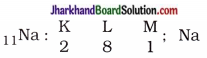
JAC Class 10 Science Solutions Chapter 5 Periodic Classification of Elements 1
Possesses one electron in its valence shell. Hence, it belongs to group 1.
→ The number of shells in the electronic configuration of an element determines its position in a period.
For example,
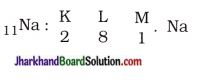
JAC Class 10 Science Solutions Chapter 5 Periodic Classification of Elements 2
has three shells (K, L and M). So, it belongs to 3rd period of the periodic table.

Question 9.
In the modern periodic table, calcium (atomic number 20) is surrounded by elements with atomic numbers 12, 19, 21 and 38. Which of these have physical and chemical properties resembling calcium?
Answer:

ElementAtomic numberElectronic configuration
kLMNO
Calcium202882
Magnesium12282
Potassium192881
Scandium212883
Strontium3828188

Elements with atomic number 12 and 38 have 2 electrons in their last shell like calcium. So, they will resemble Ca in their chemical properties.

JAC Class 10 Science Solutions Chapter 5 Periodic Classification of Elements

Question 10.
Compare and contrast the arrangement of elements in Mendeleev’s periodic table and the modern periodic table.
Answer:

Mendeleev’s periodic tableModern periodic table
1. Mendeleev’s periodic table consists of seven periods and eight groups.1. Modern periodic table consists of seven periods and eighteen groups.
2. Transition elements are not separated in the Mendeleev’s periodic table.2. Transition elements are placed in a separate groups in the modern periodic table.
3. In Mendeleev’s periodic table, elements are arranged in increasing order of their atomic masses.3. In the modern periodic table, elements are arranged in increasing order of their atomic numbers.
4. Period number and group number of an element cannot be predicted.4. Period number and group number of an element can be determined easily.
5. Mendeleev’s periodic table has descripancies and limitations.5. Modern periodic table is almost errorless.
6. Periodicity in the properties of elements cannot be explained.6. Periodicity in the properties of elements can be explained.

Jharkhand Board Class 10 Science Periodic Classification of Elements InText Questions and Answers

Question 1.
Did Dobereiner’s triads also exist in the columns of Newlands’ octaves? Compare and find out.
Answer:
Dobereiner’s triads also exist in the columns of Newlands’ octaves.

  • Lithium, sodium and potassium forms a Dobereiner’s triad.
  • Lithium, the first element of this triad is considered as the first element as Newlands’ octave, then the eighth element from it is sodium. These elements possesses similar properties according to the law of triads and the law of octaves.
  • Similarly, if sodium is considered as the first element then the eighth element from it is potassium.  Moreover, sodium and potassium possess similar properties according to both the laws.
  • Apart from these, some other elements beryllium (Be), magnesium (Mg) and calcium (Ca) obeys law of triads and the law of octaves.
  • Thus, Dobereiner’s triads also exist in the columns of Newlands’ octaves.

Question 2.
What were the limitations of Dobereiner’s classification?
Answer:
The limitations of Dobereiner’s classification are as follows:

  • All the elements known at that time could not be arranged as Dobereiner’s triad. Hence this method of classification of elements into triads was not found to be successful.
  • Three elements nitrogen (N), phosphorus (P) and arsenic (As) were then known elements, but these elements could not be classified as Dobereiner’s triad.

Question 3.
What were the limitations of Newlands’ law of octaves?
Answer:

  • Newlands’ law of octaves was applicable only to lighter elements having atomic masses up to 40 u.
    The law of octaves was applicable only s upto calcium, because after calcium every eighth element did not possess properties similar to that of the first element.
  • Newlands assumed that only 56 elements s existed in nature and no new elements would be discovered in the future. But, later on, several new elements were discovered whose properties did not fit into the law of octaves.
  • In order to fit elements into his table, Newlands adjusted two elements in the same slot, but also put some unlike elements under the same column.

For example, cobalt (Co) and nickel S (Ni) are placed in the same slot and these are placed in the same column as fluorine, chlorine and bromine which have very different properties S than these elements. Iron, which resembles cobalt and nickel in properties, has been placed far away from these elements.

Question 4.
Use Mendeleev’s periodic table to predict the formulae for the oxides of the following elements:
K, C, Al, Si, Ba
Answer:

ElementGroup number (Valency)Molecular formula of oxide
K1K<sub>2</sub>O
C4CO2
Al3Al2O3
Si4SiO2
Ba2BaO

Question 5.
Besides gallium, which other elements have since been discovered that were left by Mendeleev in his periodic table? (any two)
Answer:
Besides gallium, Mendeleev had left gaps for germanium and scandium in his periodic table.

Question 6.
What were the criteria used by Mendeleev in creating his periodic table?
Answer:
The following criteria was used by Mendeleev in creating his periodic table :

  • The properties of elements are the periodic function of their atomic masses.
  • Elements with similar properties are arranged in the same group.
  • The formula of oxides and hydrides formed by an element.

JAC Class 10 Science Solutions Chapter 5 Periodic Classification of Elements

Question 7.
Why do you think the noble gases are placed in a separate group?
Answer:
Noble gases like helium (He), neon (Ne) and argon (Ar) are chemically very inert and are present in extremely low concentrations in our atmosphere. Hence they are placed in a separate s group.

Question 8.
How could the modern periodic table remove various anomalies of Mendeleev’s periodic table?
Answer:
The modern periodic table removed three main anomalies of Mendeleev’s periodic table as discussed below:
(1) Position of isotopes : All the isotopes of an element have the same atomic number. Therefore, they are placed at one place in the same group of the periodic table.

(2) Anomalous position of some pairs of elements: In the Mendeleev’s periodic table, elements with similar properties are placed in the same group. For example, cobalt (atomic mass 58.9 u) placed first and nickel (atomic mass 58.7 u) placed later while in the modern periodic table elements are arranged in increasing order of their atomic numbers, therefore, cobalt with atomic number 27 placed first and nickel with atomic number 28 placed later.

(3) Uncertainty in discovery of new elements: Since atomic masses do not increase in a regular manner in going from one element to the next, therefore, in Mendeleev’s periodic table, it was not possible to predict as to how many new elements could be discovered between two known elements.

Since, modern periodic table is formed on the basis of atomic numbers of elements, discovery of new element become easy.

Question 9.
Name two elements you would expect to show chemical reactions similar to magnesium. What is the basis for your choice?
Answer:
In the modern periodic table, elements having same number of electrons in the valence shell show similar chemical properties.
Magnesium has two electrons in the valence shell, hence all the elements such as beryllium (Be), calcium (Ca) and strontium (Sr) having two electrons in the valence shell show similar chemical properties.

Elements of group 2
ElementAtomic numberElectronic configuration
KLMNO
Beryllium (Be)422
Magnesium (Mg)12282
Calcium (Ca)202882
Strontium (Sr)38281882

Question 10.
Name :
(a) three elements that have a single electron in their outermost shells.
(b) two elements that have two electrons in their outermost shells.
(c) three elements with filled outermost shells.
Answer:
(a) Lithium (Li), sodium (Na) and potassium (K)
(b) Magnesium (Mg) and calcium (Ca)
(c) Neon (Ne), argon (Ar) and krypton (Kr)

Question 11.
(a) Lithium, sodium, potassium are all metals that react with water to liberate hydrogen gas. Is there any similarity in the? atoms of these elements?
(b) Helium is an unreactive gas and neon is a gas of extremely low reactivity. What, if anything, do their atoms have in common?
Answer:
(a) Lithium, sodium and potassium are alkali metals which react with water to form metal hydroxides with the release of hydrogen gas.
2M + 2H2O → 2MOH + H2
Where, M = Li, Na and K
All these metals have one electron in their respective valence shells.

(b) Helium and neon are noble gases. Both the elements have their outermost shells completely filled. Helium has only K shell which is complete with 2 electrons while neon has two shells, K and L. Both these shells are complete, i.e., K s shell has 2 electrons and L shell has 8 electrons.

Question 12.
In the modern periodic table, which are the metals among the first ten elements?
Answer:
The first ten elements of the modern periodic table are as follows :
1H, 2He, 3Li, 4Be, 5B, 6C, 7N, 8O, 9F and 10Ne.
Among these elements Li and Be are metals.

Question 13.
By considering their position in the periodic table, which one of the following elements would you expect to have maximum metallic characteristics?
Ga Ge As Se Be
Answer:
Among the given elements, Be and Ga will show maximum metallic characteristics.
The arrangement of given elements in different groups and periods is as follows :
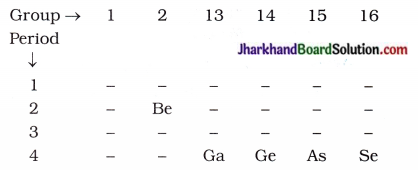
JAC Class 10 Science Solutions Chapter 5 Periodic Classification of Elements 3

Activity 5.1 [T. B. Pg. 84]

Looking at its resemblance to alkali metals and the halogen family, try to assign hydrogen a : correct position in Mendeleev’s periodic table.
To which group and period should hydrogen be assigned ?

Discussion:

  • Hydrogen is an element having lowest atomic number (Z = 1) and lowest atomic mass (1.008 u).
  • The electronic configuration of hydrogen resembles with alkali metals.
  • Like alkali metals, hydrogen combines with halogens, oxygen and sulphur to form compounds having similar molecular formulae. Hence, hydrogen can be placed along with alkali metals of group (IA).
  • Hydrogen exists as a diatomic molecule like halogens and it combines with alkali metals to form ionic compounds and with non-metals to form covalent compounds.
  • Thus, hydrogen should be placed along with halogens in group (VII).

Conclusion :
The position of hydrogen in the periodic table is controversial, however, it would be more appropriate to place it in group I and period I.

Activity 5.2 [T. B. Pg. 85]

  • Consider the isotopes of chlorine, Cl-35 and Cl-37.
  • There are two known isotopes of chlorine : Cl-35 and Cl-37.
  • The atomic number of these two isotopes is 17, hence they have similar electronic configuration and chemical properties, but their atomic masses are different.

Questions :

Question 1.
Would you place them in different slots because their atomic masses are different?
Answer:
According to Mendeleev’s periodic table, “The properties of elements are the periodic function of their atomic masses.”

  • According to Mendeleev, if these two isotopes are arranged in the order of increasing atomic masses, then their position should be before K(39.1u), but there is no vacant position available for Cl-37 in between Cl-35 and K(39.1u). Therefore they cannot be placed at the different position.

Question 2.
Would you place them in the same position because their chemical properties are the same?
Answer:
As they have similar chemical properties, they should be placed at the same position in group 17.

Activity 5.3 [T. B. Pg. 85]

Questions:

Question 1.
How were the positions of cobalt and nickel resolved in the modern periodic table?
Answer:

  • In modern periodic table, elements are arranged in increasing order of their atomic numbers.
  • The atomic number of cobalt and nickel are 27 and 28 respectively. Hence, on the basis of increasing order of their atomic numbers, cobalt is placed s in group 9 and nickel is placed in group 10.

JAC Class 10 Science Solutions Chapter 5 Periodic Classification of Elements

Question 2.
How were the positions of isotopes of various elements decided in the modern periodic table?
Answer:
In the modern periodic table, positions of isotopes of different elements are not fixed separately. Since the various isotopes of an element have the same atomic number, they are assigned the same position in the modern periodic table.

Question 3.
Is it possible to have an element with atomic number 1.5 placed between hydrogen and helium?
Answer:

  • The atomic number of an element is always definite and whole number.
  • In the modern periodic table, elements are arranged in increasing order of their atomic numbers.
  • The atomic number cannot be represented in fraction number. Thus, an element with atomic number 1.5 cannot be placed between hydrogen S and helium.

Question 4.
Where do you think should hydrogen be placed in the modern periodic table?
Answer:
Hydrogen should be placed in period and group 1 in the modern periodic table, $ since it has atomic number one.

Activity 5.4 [T. B. Pg. 87]

Questions:

Question 1.
Look at the group 1 of the modern periodic table and name the elements present in it.
Answer:
The names of the elements present in group 1 are: hydrogen (H), lithium (Li), sodium (Na), potassium (K), rubidium (Rb), cesium (Cs) and francium (Fr).

Question 2.
Write down the electronic configuration of the first three elements of group 1.
Answer:
The electronic configuration of the first three elements are as follows :

ElementHLiNa
ShellKK, LK, L, M
Electronic configuration12, 12, 8, 1

Question 3.
What similarity do you find in their electronic configurations?
Answer:
These elements possesses same number of electrons in their valence shell.

Question 4.
How many valence electrons are present in these three elements?
Answer:
These three elements have one electron in their respective valence shell.

Activity 5.5 [T. B. Pg. 87]

Questions:

Question 1.
If you look at the modern periodic table, you will find that the elements Li, Be, B, C, N, O, F and Ne are present in the second period. Write down their electronic configurations.
Answer:

Element3Li4Be5B6C7NN8O9F10Ne
ShellK, LK, LK, LK, LK, LK, LK, LK, L
Electronic configuration2, 12, 22, 32, 42, 52, 62, 72, 8

Question 2.
Do these elements also contain the same number of valence electrons?
Answer:
These elements do not contain the same number of valence electrons.

Question 3.
Do they contain the same number of shells?
Answer:
These elements contain the same number of shells (2, K and L).

Activity 5.6 [T. B. Pg. 88]

Questions :

Question 1.
How do you calculate the valency of an element from its electronic configuration?
Answer:
The valency of an element is determined by the number of valence electrons present in the outermost shell of the atom.
For elements of group 1, 2, 13 and 14, the valency is equal to the number of valence electrons and for elements of group 15, 16, 17 and 18, the valency is equal to 8 minus number of valence electrons.

Question 2.
What is the valency of magnesium with atomic number 12 and sulphur with atomic number 16?
Answer:
Electronic configuration of Mg with atomic number 12 is K L M 2 8 2
∴ Valency of Mg = 2
Electronic configuration of S with atomic number 16 is K L M 2 8 6
∴ Valency of S = 8 – 6 = 2

Question 3.
Find the valency of the first twenty elements.
Answer:

ElementAtomic numberGroup numberElectronic configurationNumber of valence electronsValency of the element
KLMN
H11111
He218222-2 = 0
Li312111
Be422222
B5132333
C6142444
N7152558-5 = 3
O8162668-6 = 2
F9172778-7=1
Ne10182888-8 = 0
Na11128111
Mg12228222
Al131328333
Si141428444
P151528558-5 = 3
S161628668-6 = 2
Cl171728778-7=1
Ar181828888-8 = 0
K191288111
Ca202288222

Question 4.
How does the valency vary in a period on going from left to right?
Answer:
In a period, the valency first increases and then decreases. In a period, the valency first increases from 1 to 4 and then decreases from 4 to 0.

Question 5.
How does the valency vary in going down a group?
Answer:
On moving down the group, the valency does not change. It remains constant.

Activity 5.7 [T. B. Pg. 88]

Questions:

Question 1.
Atomic radii of the elements of the second period are given below:

Period II elements:B BeONLiC
Atomic radius (pm):88111667415277

Arrange them in decreasing order of their atomic radii.
Answer:
Decreasing order of the atomic radii:
Period II elements : Li > Be > B > C > N > O
Atomic radius (pm) : 152  111 88 77 74 66

Question 2.
Are the elements now arranged in the pattern of a period in the periodic table?
Answer:
Now, the above elements are arranged in the pattern of a period in the periodic table.

Question 3.
Which elements have the largest and the smallest atoms?
Answer:
Lithium (Li) has the largest and oxygen (O) has the smallest atoms.

Question 4.
How does the atomic radius change as you go from left to right in a period?
Answer:
The atomic radii decreases as we move from left to right in a period.

Activity 5.8 [T. B. Pg. 89]

Questions:

Question 1.
Study the variation in the atomic radii of ? first group elements given below and arrange them in an increasing order.

Group I elements : NaLiRbCsK
Atomic radius (pm):186152244262231

Answer:
Increasing order of the atomic radii:
Group I elements : Li < Na < K < Rb < Cs
Atomic radius (pm): 152 186 231 244 262

Question 2.
Name the elements which have the smallest and the largest atoms.
Answer:
Lithium (Li) has the smallest atoms while Cesium (Cs) has the largest atoms.

Question 3.
How does the atomic size vary as you go down a group ?
Answer:
As we go down a group, the atomic size increases gradually.

JAC Class 10 Science Solutions Chapter 5 Periodic Classification of Elements

Activity 5.9 [T. B. Pg. 89 ]

Questions:

Question 1.
Examine elements of the third period and classify them as metals and non-metals.
Answer:
The elements of the third period :
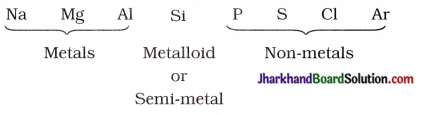
JAC Class 10 Science Solutions Chapter 5 Periodic Classification of Elements 4

Question 2.
On which side of the periodic table do you find the metals?
Answer:
Metals are present on the left side of the periodic table.

Question 3.
On which side of the periodic table do you find the non-metals?
Answer:
Non-metals are present on the right side of the periodic table.

Activity 5.10 [T. B. Pg. 89]

Questions:

Question 1.
How do you think the tendency to lose electrons changes in a group?
Answer:
As we move from top to bottom in a group, the tendency to lose electrons increases.

Question 2.
How will this tendency change in a period?
Answer:
As we move from left to right in a period, the tendency to lose electrons decreases.

Activity 5.11 [T.B.Pg. 90]

Questions:

Question 1.
How would the tendency to gain electrons change as you go from left to right across a period?
Answer:
As we go from left to right across a period, the tendency to gain electrons increases.

Question 2.
How would the tendency to gain electrons change as you go down a group?
Answer:
As we go down a group, the tendency to gain electrons decreases.
JAC Class 9 Social Science Important Questions Geography Chapter 4 Climate

JAC Board Class 9th Social Science Important Questions Geography Chapter 4 Climate

I. Objective Type Questions

India has which type of climate?
(a) Monsoon
(b) Tundra
(c) Savanna
(d) Mediterranean.
Answer:
(a) Monsoon

2. The major factor/factors controlling the climate of any region is/are:
(a) latitude
(b) altitude
(c) pressure and wind system
(d) all of these.
Answer:
(d) all of these.

3. The climate of India is strongly influenced by:
(a) local winds
(b) monsoon winds
(c) westerlies winds
(d) none of these.
Answer:
(b) monsoon winds

4. How many seasons can be indentified in India?
(a) Four
(b) Five
(c) Two
(d) Six.
Answer:
(a) Four

5. Which is the most rainy place in the world?
(a) Jaipur
(b) Leh
(c) Mawsynram
(d) Mumbai.
Answer:
(c) Mawsynram

II. Very Short Answer Type Questions

Question 1.
Define weather and climate.
Answer:
Weather refers to the state of the atmosphere over an area at any point of time, while climate refers to the sum total of weather conditions and variations over a large area for a longer period of time.

Question 2.
Define Monsoon.
Answer:
The word ‘Monsoon’ is derived from the Arabic word ‘Mausim’, which literally means season. Monsoon refers to the seasonal reversal in the wind direction during a year. It reveals the rhythm of season and changes in direction of wind.

JAC Class 9 Social Science Important Questions Geography Chapter 4 Climate

Question 3.
What is extreme climate?
Answer:
The climate which has high annual range of temperature and great variation in the amount of rainfall over the year is known as extreme climate. It is also called continental or interior climate. Example Jodhpur, Delhi.

Question 3.
Mention major factors affecting the climate of our country.
Answer:

  1. Location,
  2. Latitude,
  3. Altitude,
  4. Pressure and winds,
  5. Relief.

Question 4.
Which physical feature of India acts as an influential climate divide between India and Central sea?
Answer:
The Himalayas.

Question 5.
Name the planatery winds that blow from the subtropical high pressure zone to the equatorial low pressure zone.
Answer:
Trade winds.

Question 6.
What are trade winds?
Answer:
Trade winds are planetary winds blowing constantly from the sub-tropical high pressure zones towards the ‘Equatorial low pressure zones’. Their direction is from North-east to South-west in the North Hemisphere and from South-east to Northwest in the Southern Hemisphere.

Question 7.
Define the term season.
Answer:
The predominance of an element of weather, such as temperature, rainfall and cloudiness over a period of a few months is called season.

Question 8.
What do you understand by coriolis force?
Answer:
Coriolis force is an apparent force caused by the earth’s rotation. The coriolis force is responsible for deflecting winds towards the right in the Northern Hemisphere and towards the left in the Southern Hemisphere. This is also known as ‘Ferrel’s Law’.

JAC Class 9 Social Science Important Questions Geography Chapter 4 Climate

Question 9.
Which are the most constant jet streams?
Answer:

  1. Mid latitude jet stream,
  2. Subtropical jet stream.

Question 10.
What are cyclones?
Answer:
Cyclones are the speedy elliptical wind arrangements having low pressure at their centre and the winds moving towards centre from outside.

Question 11.
From where the western disturbances originated?
Answer:
The western disturbances originated over the Mediterranean Sea.

Question 12.
What is ITCZ?
Answer:
The Inter Tropical Convergence Zone (ITCZ) is a broad trough of low pressure in equatorial latitudes. This is where the north-east and the south-east trade winds converge. This convergence zone lies more or less parallel to the equator but moves north or south with the apparent movement of the sun.

Question 13.
What is the influence area of the monsoon?
Answer:
Regions between 20° N and 20° S latitudes.

Question 14.
How is the intensity of monsoons predicted?
Answer:
The difference in pressure over yahiti (Pacific Ocean, 18°S/14.9°W) and Darwin in Northern Australia (Indian Ocean, 12°30’S/131°E) is computed to predict the intensity of the monsoons. If the pressure differences are negative, it would mean below average and late monsoons.

Question 15.
Name the two branches in which the peninsular India divide the monsoon winds.
Answer:

  1. The Arabian Sea Branch, and
  2. The Bay of Bengal branch.

Question 16.
Name two branches in which the Bay of Bengal branch splits into.
Answer:

  1. The western branch,
  2. The north-east branch.

JAC Class 9 Social Science Important Questions Geography Chapter 4 Climate

Question 17.
What is burst of monsoon?
Answer:
Burst or break of the monsoon is sudden setting-in of rainfall, the rainfall without warning. This occurs when the monsoon branches and the jet streams come into contact with each other all of a sudden.

Question 18.
Name the four seasons of India.
Answer:

  1. Winter season (December to February)
  2. Summer season (March to May)
  3. Advancing monsoon (June to mid-September)
  4. Retreating monsoon (mid-September to November).

Question 19.
Where is high pressure found during winter?
Answer:
In the Northern plains.

Question 20.
Name the winds that blow in India during winter.
Answer:
North-east trade winds.

Question 21.
Which hot wind blows during summers in the northern plains?
Answer:
Loo.

Question 22.
What is Loo?
Answer:
Loo are local hot winds which blow during summer afternoons in the north-west and the Ganga valley regions.

Question 23.
What is Kaal Baisakhi?
Answer:
Localised thunderstorms associated with violent winds, torrential downpour, and often accompanied by hails during summer months in West Bengal are known as Kaal Baisakhi, meaning calamity for the month of Baisakh.

Question 24.
What are mango showers?
Answer:
The pre-monsoon showers occuring on the coastal regions of Kerala and Karnataka which help early ripening of mango fruit, are called mango showers.

JAC Class 9 Social Science Important Questions Geography Chapter 4 Climate

Question 25.
What type of rainfall does the North-east Branch cause?
Answer:
Heavy rainfall.

Question 26.
Define precipitation.
Answer:
Precipitation is the moisture shed by the moisture-laden winds on the surface of the earth. Precipitation includes rainfall, snowfall, hail, sleet etc.

Question 27.
Mention the two heaviest rainfall areas of the country.
Answer:

  1. The windward slopes of the Western Ghats.
  2. The Meghalaya plateau.

Question 28.
Name the place where the heaviest rainfall of the world occurs.
Answer:
Mawsynram (1080 cm).

Question 29.
Which monsoon winds cause rains generally on the Tamil Nadu coast?
Answer:
Retreating monsoon winds and north-east monsoon winds.

Question 30.
What is known as ‘October Heat’?
Answer:
Conditions of high temperature, humidity and lack of air movement lead to oppres¬sive weather conditions in the half of the October. This is known as October Heat.

III. Short Answer Type Questions

Question 1.
What is the coriolis force? State its effects on the world climate.
Answer:
Meaning of Coriolis Force: It is an apparent force caused by the Earth’s rotation. It is responsible for deflecting winds towards the right in the Northern hemisphere and towards the left in the Southern hemisphere.

Effect of Coriolis Force on the World Climate: Under the effect of coriolis force, the trade winds moving from sub-tropical high-pressure belts to equatorial low-pressure belts become North-East trade winds in the Northern hemisphere and South-East trade winds in the Southern hemisphere. As a result, they bring heavy rainfall to the Eastern Coast, while the Western Coast remains dry.

Question 2.
The pressure and wind conditions over India are unique’. Explain.
Answer:

  1. During winter, there develops a high pressure area in the north of the Himalayas, cold dry winds blow from this region to the low pressure areas over the ocean to the south.
  2. In summer, a low pressure area develops over interior Asia as well as over north western India. This causes a complete reversal of the direction of winds during sum¬mer. These winds are known as south-west monsoon winds. These bring widespread rainfall over the mainland of India.

JAC Class 9 Social Science Important Questions Geography Chapter 4 Climate

Question 3.
What are western cyclonic disturbances? Describe its effect on the Indian climate. Answer:The western cyclonic disturbances are weather phenomena brought in by westerly flow from the Mediterranean region. They occur in the month of winter and cause rainfall in North and North-Western part of India. They affect the climate of India in the following ways:

  1. By causing cyclonic rainfall in the month of winter, which is otherwise dry, western disturbance influences the weather of the North and North-Western India.
  2. Although the amount of rainfall is scant, it is highly favourable to the Rabi crops, especially wheat.
  3. They cause snowfall in the mountains.

Question 4.
What do you understand by the southern oscillation?
Answer:
The pressure systems of Pacific Ocean and Indian Ocean are inter-related. When the surface pressure is high in the sub-tropical region of the Pacific Ocean, in the Northern Hemisphere, the pressure over the southern part of the Indian Ocean tends to be low and vice- versa.

This results in shifting of winds across the Equator. The south-eastern trade winds of the Southern Hemisphere are attracted towards the low pressure of Northern Tropics. These winds often crossing the Equator become south-western monsoons. This is called southern oscillation.

Question 5.
Distinguish between Wind and Jet Streams. Answer:Differences between Wind and Jet Streams are:

WindStreams
1. Winds are moving air from high pres¬sure to low pressure areas.1. Jet streams are fast moving mass of air in the upper troposphere.
2. They move horizontally on the surface of the earth.2. They move horizontally in the troposphere.
3. Their speed is upto 75 km per hour.3. Their speed exceeds 200km/hour.
4. Winds are divided as dry winds, moist winds, cold winds and hot winds.4. Jet streams are divided into western and eastern jet streams.

Question 6.
What is EL Nino? Mention two features of this.
Answer:
EL Nino: The periodic development of warm ocean current along the coast of Peru as a temporary replacement of the cold peruvian current is called EL-Nino. Features of EL-Nino:

  1. The presence of the EL-Nino leads to an increase in sea surface temperatures.
  2. It weakens the trade winds in the regions and causes heavy rainfall, floods or droughts in different regions of the world.

JAC Class 9 Social Science Important Questions Geography Chapter 4 Climate

Question 7.
What is monsoon? Name the two branches of monsoon and briefly explain any one.
Answer:
Monsoon:
it refers to the seasonal reversal in the wind direction during a year. Bay of Bengal Branch.
(a) This branch of monsoon moves along the Bay of Bengal. It advances rapidly and arrives in the North-Eastern part of the country in first week of june.

(b) The lofty mountains cause this branch of monsoon winds to deflect towards the west over the Ganga plain.

(c) It merges with the Arabian Sea branch over the North-Western part of the Ganga plains.

Question 8.
Differentiate between cold weather season and hot weather season of India.
Answer:
Differences between cold and hot weather season are:

Cold Weather SeasonHot Weather Season
1. It begins from mid November in northern India and stays till February.1. It begins from March and stays till May.
2. The temperature decreases from South to North.2. Experiences rising temperature and falling air pressure in North India.
3. Days are warm and nights are cold.3. Hot and dry winds called ‘loo’ blow during the day.
Cold Weather SeasonHot Weather Season

Question 9.
Describe the features of the hot weather season.
Answer:
The main features of the hot weather season are as given under:

  1. It lasts from March to May.
  2. Intense low pressure develops over the north-western part of India at the end of this season.
  3. High temperature around 48°C prevails in this season.
  4. Hot dry winds, i.e., Loo blow in the afternoon. They may continue even up to midnight.
  5. Dust stroms are common during May in Punjab, Haryana, eastern Rajasthan and western Uttar Pradesh.
  6. Local storms of great intensity are also common. These local storms are associated with violent winds, torrential rains and even hailstorms, e.g., Kaal Bai- sakhi in West Bengal and Assam.

JAC Class 9 Social Science Important Questions Geography Chapter 4 Climate

Question 10.
Define Kaal Baisakhi, Loo and Mango Showers.
Answer:

  1. Kaal Baisakhi: These are the local thunderstorms associated with violent winds, torrential downpours, often accompanied by hail. They occur in West Bengal.
  2. Loo: These are stormy, hot, dry winds blowing during the day over the North and North-Western India.
  3. Mango Showers: The pre-monsoon showers which help in the ripening of mangoes in coastal Kerala and Karanataka are known as Mango Showers.

Question 11.
Why do Western Ghats receive more rainfall than Eastern Ghats?
Answer:
Western Ghats receive more rainfall than Eastern Ghats because Western Ghats receive rainfall from the Arabian Sea monsoon winds. They does not allow these winds to cross over without shedding their moisture on the western slopes. A part of these winds that reaches the Eastern Ghats is almost dry.

Question 12.
Describe the features of the Advancing Monsoon season.
Answer:
Advancing monsoon season is also known as the hot wet weather season or rainy season.
The features of the Advancing Monsoon season are:

  1. It lasts from June to September.
  2. 75% to 90% of the total annual rainfall is concentrated over this period.
  3. Distribution of rainfall is very largely governed by the relief.
  4. The monsoon rains occur in wet spells.
  5. The wet spells are interspersed with rainless dry spells.
  6. The alternation of dry and wet spells keeps on varying in intensity, frequency and duration.

Question 13.
Where is Mawsynram located? Why does it receive the highest amount of rainfall?
Answer:
Mawsynram is located in the Southern ranges of the Khasi hills in Meghalaya at a height of 1500 metre above the sea level. It receives the highest (annual 1140 cm) rainfall in the world. Mawsynram receives the highest amount of rainfall because:

  1. This place is enclosed by hills on three sides.
  2. The relief features give this place tunnel-shaped location.
  3. The Bay of Bengal monsoon is trapped in these hills. These winds try to get out of there, but are forced to cause heavy rainfall there.

III. Long Answer Type Questions

Question 1.
What are the major controls of the climate of any place? Explain.
Answer:
There are six major controls of the climate of any place. They are:
1. Latitude:
Due to the curvature of the earth, the amount of solar energy received varies according to latitude. As a result, air temperature generally decreases from the equator towards the poles.

2. Altitude:
As one goes from the surface of the earth to higher altitudes, the atmosphere becomes less dense and temperature decreases. The hills are therefore cooler during summers.

3. Pressure and wind system:
The pressure and wind system of any area depend on the latitude and altitude of the place. Thus, it influences the temperature and rainfall pattern.

4. Distance from the sea:
The sea exerts a moderating influence on climate. As the distance from the sea increases, its moderating influence decreases and the people experience extreme weather conditions.

5. Ocean currents:
Ocean currents along with onshore winds affect the climate of the coastal areas. For example, any coastal area with warm or cold currents flowing past it, will be warmed or cooled if the winds are onshore.

6. Relief:
Relief play a major role in determining the climate of a place. High mountains act a barriers for cold or hot winds. They, may also cause precipitation if they are high enough and lie in the path of rain-bearing winds. The leeward side of mountain remains relatively dry.

JAC Class 9 Social Science Important Questions Geography Chapter 4 Climate

Question 2.
How is the climate of India governed by the atmospheric conditions?
Answer:
The climate of India is governed by the following atmospheric conditions:
1. Pressure and surface winds:
The surface winds below from region of high pressure to the region of low pressure. During winter, the high pressure area lies in the north of the Himalayas. Over the ocean in the south, there is low pressure, so, wind blow from land toward sthe sea. The reverse occurs during summer.

2. Upper air circulation:
The north-easterly winds originate in sub-tropical high pres-sure belt of northern hemisphere. They blow southwards and get deflected towards right (due to coriolis force) over the low-pressure area of the Indian sub-continent. They are dry and cold and cause no rainfall. Sub-tropical westerly jet stream brings western cyclonic disturbances in north and north-western India during winter.

3. Western cyclonic disturbances and tropical cyclones:
They are a part of easterly flow. They cause heavy to very low rainfall in Eastern coast of India during the monsoon as well as in October-November.

Question 3.
Describe the main characteristics of Retreating Monsoon.
Answer:
Main Characteristics of Retreating Monsoon : Main characteristics of retreating Monsoon are the following:

  1. October and November are the months of retreating monsoon.
  2. During this time, low monsoon trough becomes weak and is replaced by high pressure. Thus, monsoon begins to retreat. By the beginning of October, it retreats completely from the Northern Plains.
  3. This period is the period of transition from hot rainy season to cold winter season. It is marked by clear sky, moist ground and high temperatures giving birth to October heat.
  4. Low pressure trough shifts to the Bay of Bengal. They give rise to cyclonic depressions which cause havoc on the eastern coasts, especially the coasts of Odisha, Andhra Pradesh and Tamil Nadu, with very strong storms and rains. The super cyclone of 1999 will remain in the memories of millions of people forever, who lost their near and dear ones alongwith their property.

Question 4
Differentiate between South-west Monsoon and North-east Monsoon.
Answer:
Difference between South-west Monsoon and North-east Monsoon:

South-west MonsoonNorth-east Monsoon
1.The winds blowing from South-west to North-east direction during the months of June to September are called South west Monsoon winds.1. The winds blowing in India from North-east to South-west direction during the months of December to February are called North-east Monsoon winds.
2. These winds blow from South-west towards low pressure region.2. These winds blow from the high pressure region towards the seas.
3. They are moisture-laden and hot.3. They are dry and cold.
4. These winds cause 75 to 90% of the total annual rainfall during the reason of south-west monsoon.4. They cause rainfall on the Tamil Nadu coast during winter.
5. The South-west Monsoon has two branch the Arabian Sea branch and I the Bay of Bengal branch.5. They do not have branches.
6. Rainy days, soothing winds and overcast sky are the characteristic features of’ the South-west Monsoon.6. Clear sky, low temperature, gentle breeze and rainless fine weather are the major features of the North-east Monsoon.

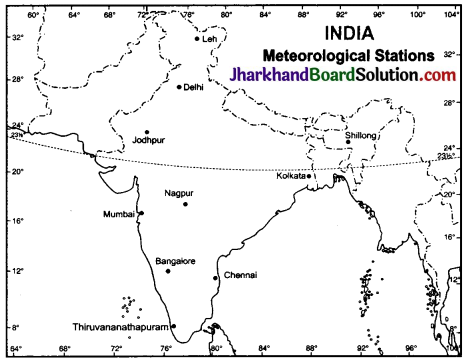
Locate & Labelling Meteorological stations cities to locate: Thiruvananthapuram, Chennai, Jodhpur, Bangalore, Mumbai, Kolkata, Leh, Shillong, Delhi, Nagpur.
Answer:
JAC Class 9 Social Science Important Questions Geography Chapter 4 Climate 1

JAC Class 9 Social Science Important Questions

JAC Class 10 Maths Solutions Chapter 9 Some Applications of Trigonometry Ex 9.1

Jharkhand Board JAC Class 10 Maths Solutions Chapter 9 Some Applications of Trigonometry Ex 9.1 Textbook Exercise Questions and Answers.

JAC Board Class 10 Maths Solutions Chapter 9 Some Applications of Trigonometry Exercise 9.1

Question 1.
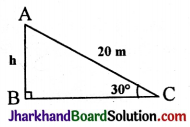
A circus artist is climbing a 20 m long rope, which is tightly stretched and tied from the top of a vertical pole to the ground. Find the height of the pole, if the angle made by the rope with the ground level is 30°.
Solution :
JAC Class 10 Maths Solutions Chapter 9 Some Applications of Trigonometry Ex 9.1 - 1
sin \(\hat{\mathrm{C}}\) = \(\frac{AB}{AC}\)
sin 30° = \(\frac{1}{2}\)
\(\frac{1}{2}\) = \(\frac{AB}{20}\)
AB = \(\frac{20}{2}\) = 10 m

JAC Class 10 Maths Solutions Chapter 9 Some Applications of Trigonometry Ex 9.1

Question 2.
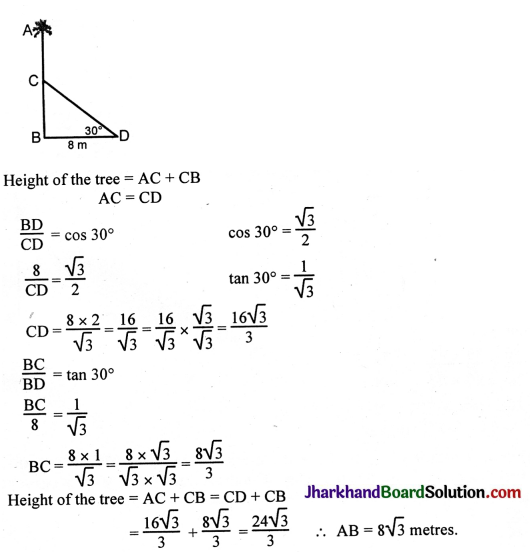
A tree breaks due to storm and the broken part bends so that the top of the tree touches the ground making an angle 30° with it. The distance between the foot of the tree to the point where the top touches the ground is 8 m. Find the height of the tree.
Solution :
JAC Class 10 Maths Solutions Chapter 9 Some Applications of Trigonometry Ex 9.1 - 2

Question 3.
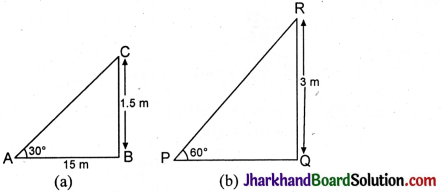
A contractor plans to install two slides for the children to play in a park. For the children below the age of 5 years, she prefers to have a slide whose top is at a height of 1.5 m, and is inclined at an angle of 30° to the ground, whereas for elder children, she wants to have a steep slide at a height of 3m, and inclined at an angle of 60° to the ground. What should be the length of the slide in each case?
Solution:
JAC Class 10 Maths Solutions Chapter 9 Some Applications of Trigonometry Ex 9.1 - 3
(i) Figure (a) shows the slide for children below the age of 5 years.
Let BC = 1.5 m be the height of the slide. Slide AC is inclined at CAB = 30° to the ground.
In right angled ΔABC, sin 30° = \(\frac{BC}{AC}\)
\(\frac{1}{2}=\frac{15}{AC}\)
⇒ AC = 3 m.

(ii) Figure (b) shows the slide for elder children. Let RQ = 3 m be the height of the slide. Slide PR is inclined at ∠RPQ = 60° to the ground.
In right angled ΔPQR, sin 60° = \(\frac{RQ}{PR}\) ⇒ \(\frac{\sqrt{3}}{2}\) = \(\frac{3}{PR}\)
PR = \(\frac{3 \times 2}{\sqrt{3}}\) = 2\(\sqrt{3}\) m.

JAC Class 10 Maths Solutions Chapter 9 Some Applications of Trigonometry Ex 9.1

Question 4.
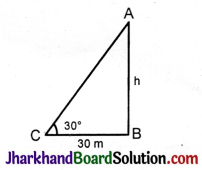
The angle of elevation of the top of a tower from a point on the ground, which is 30 m away from the foot of the tower, is 30°. Find the height of the tower.
Solution :
JAC Class 10 Maths Solutions Chapter 9 Some Applications of Trigonometry Ex 9.1 - 4
tan C = \(\frac{AB}{CB}\)
tan 30° = \(\frac{1}{\sqrt{3}}\)
tan 30° = \(\frac{h}{30}\)
\(\frac{1}{\sqrt{3}}\) = \(\frac{h}{30}\)
h\(\sqrt{3}\) = 30
h = \(\frac{30}{\sqrt{3}}=\frac{30 \times \sqrt{3}}{\sqrt{3} \times \sqrt{3}}=\frac{30 \sqrt{3}}{3}\)
h = 10\(\sqrt{3}\)mts.
Hence, height of the tower is 10\(\sqrt{3}\) mts.

Question 5.
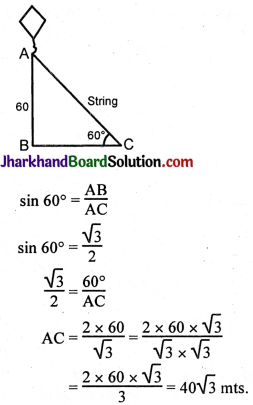
A kite is flying at a height of 60 m above the ground. The string attached to the kite is temporarily tied to a point on the ground. The inclination of the string with the ground is 60°. Find the length of the string, assuming that there is no slack in the string.
Solution :
JAC Class 10 Maths Solutions Chapter 9 Some Applications of Trigonometry Ex 9.1 - 5
Length of the string is 40\(\sqrt{3}\) mts.

JAC Class 10 Maths Solutions Chapter 9 Some Applications of Trigonometry Ex 9.1

Question 6.
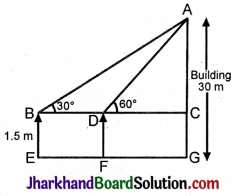
A 1.5 m tall boy is standing at some distance from a 30 m tall building. The angle of elevation from his eyes to the top of the building increases from 30° to 60° as he walks towards the building. Find the distance he walked towards the building.
Solution :
JAC Class 10 Maths Solutions Chapter 9 Some Applications of Trigonometry Ex 9.1 - 6
Let the boy be standing at point B initially. He walks towards the building and reaches point D. From the figure, the distance walked by the boy towards the building is BD.
AC = AG – CG
AC = 30 – 1.5 = 28.5
Now, in ΔABC, we have
tan 30 = \(\frac{AC}{BC}\)
BC = \(\frac{AC}{tan 30}\)
BC = 28.5\(\sqrt{3}\)
Again, in ΔADC, we have
tan 60 = \(\frac{AC}{DC}\)
DC = \(\frac{AC}{tan 60}\)
DC = \(\frac{28.5}{\sqrt{3}}\)
DC = \(\frac{28.5 \sqrt{3}}{3}\) = 9.5\(\sqrt{3}\)
BD = BC – DC
BD = 28.5\(\sqrt{3}\) – 9.5\(\sqrt{3}\)
BD = 19\(\sqrt{3}\)
The distance walked by the boy towards the building is 19\(\sqrt{3}\) m.

Question 7.
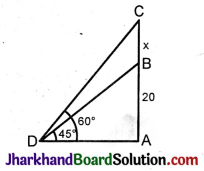
From a point on the ground, the angles of elevation of the bottom and the top of a transmission tower fixed at the top of a 20 m high building are 45° and 60° respectively. Find the height of the tower.
Solution :
JAC Class 10 Maths Solutions Chapter 9 Some Applications of Trigonometry Ex 9.1 - 7
tan 60° = \(\sqrt{3}\)
tan 45° = 1
In ΔADC, A\(\hat{\mathrm{D}}\)C = 60
tan 60° = \(\frac{AC}{AD}\)
\(\sqrt{3}\) = \(\frac{x+20}{DA}\)

In ΔBDA, A\(\hat{\mathrm{D}}\)B = 45°
tan 45° = \(\frac{AB}{AD}\) = 1
AB = AD = 20 mts.
DA\(\sqrt{3}\) = x + 20
\(\sqrt{3}\)DA = x + 20
\(\sqrt{3}\)(20) = x + 20
x = 20\(\sqrt{3}\) – 20
= 20(\(\sqrt{3}\) – 1)
Height of the tower B = 20(\(\sqrt{3}\) – 1) mts.

JAC Class 10 Maths Solutions Chapter 9 Some Applications of Trigonometry Ex 9.1

Question 8.
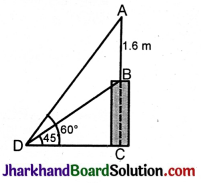
A statue, 1.6 m tall, stands on the top of a pedestal. From a point on the ground, the angle of elevation of the top of the statue is 60° and from the same point the angle of elevation of the top of the pedestal is 45°. Find the height of the pedestal.
Solution :
JAC Class 10 Maths Solutions Chapter 9 Some Applications of Trigonometry Ex 9.1 - 8
tan 60° = \(\sqrt{3}\)
In ΔADC, tan 60° = \(\frac{AC}{CD}\)
\(\sqrt{3}\) = \(\frac{AC}{CD}\)
AC = \(\sqrt{3}\)CD

In ΔBDC, tan B\(\hat{\mathrm{D}}\)C = tan 45° = \(\frac{BC}{CD}\)
1 = \(\frac{BC}{CD}\)
CD = BC.

A = AC – CB
= AC – CD (∵ CB = CD)
= \(\sqrt{3}\)CD – CD
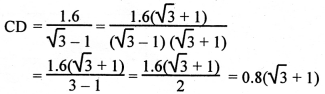
1.6 = CD(\(\sqrt{3}\) – 1)
JAC Class 10 Maths Solutions Chapter 9 Some Applications of Trigonometry Ex 9.1 - 9
Height of the pedestal = 0.8(\(\sqrt{3}\) + 1) mts.

Question 9.
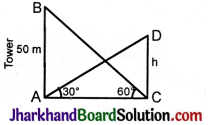
The angle of elevation of the top of a building from the foot of the tower is 30° and the angle of elevation of the top of the tower from the foot of the building is 60°. If the tower is 50 m high, find the height of the building.
Solution :
JAC Class 10 Maths Solutions Chapter 9 Some Applications of Trigonometry Ex 9.1 - 10
Let the height of the building CD be h.
tan 60° = \(\sqrt{3}\)
tan 30° = \(\frac{1}{\sqrt{3}}\)
In ΔABC, tan \(\hat{\mathrm{C}}\) = \(\frac{AB}{AC}\)
tan 60° = \(\frac{50}{AC}\)
\(\sqrt{3}\) = \(\frac{50}{AC}\)
AC\(\sqrt{3}\) = 50°
AC = \(\frac{50}{\sqrt{3}}\)mts.
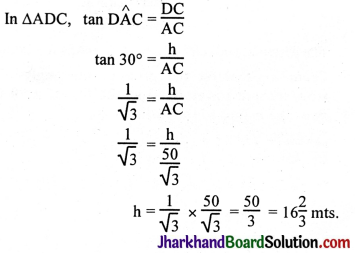
JAC Class 10 Maths Solutions Chapter 9 Some Applications of Trigonometry Ex 9.1 - 11
Height of the building = 16\(\frac{2}{3}\) mts.

JAC Class 10 Maths Solutions Chapter 9 Some Applications of Trigonometry Ex 9.1

Question 10.
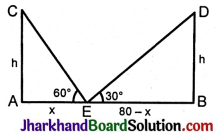
Two poles of equal heights are standing opposite each other on either side of the road, which is 80 m wide. From a point between them on the road, the angles of elevation of the top of the poles are 60° and 30°, respectively. Find the height of the poles and the distances of the point from the poles.
Solution :
JAC Class 10 Maths Solutions Chapter 9 Some Applications of Trigonometry Ex 9.1 - 12
Let AE = x.
EB = 80 – x
tan 60° = \(\sqrt{3}\)
tan 30° = \(\frac{1}{\sqrt{3}}\)
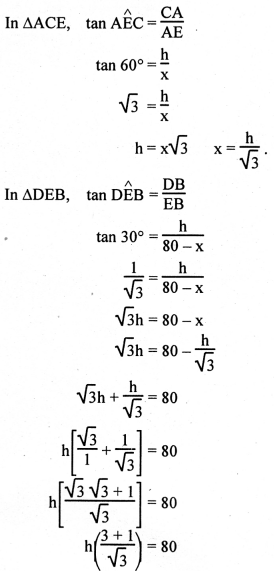
JAC Class 10 Maths Solutions Chapter 9 Some Applications of Trigonometry Ex 9.1 - 13
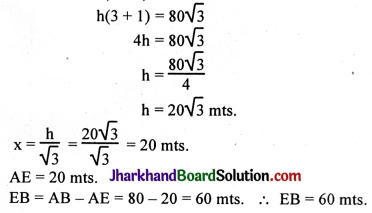
JAC Class 10 Maths Solutions Chapter 9 Some Applications of Trigonometry Ex 9.1 - 14

Question 11.
A TV tower stands vertically on the bank of a canal. From a point on the other bank directly opposite the tower, the angle of elevation of the top of the tower is 60°. From another point 20 m away from this point on the line joining this point to the foot of the tower, the angle of elevation of the top of the tower is 30°. Find the height of the tower and the width of the canal.
Solution :
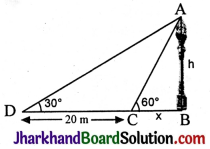
JAC Class 10 Maths Solutions Chapter 9 Some Applications of Trigonometry Ex 9.1 - 15
tan 60° = \(\sqrt{3}\)
tan 30° = \(\frac{1}{\sqrt{3}}\)
In ΔABC, tan 60° = \(\frac{AB}{BC}\) = \(\frac{h}{x}\)
\(\frac{h}{x}\) = \(\sqrt{3}\)
∴ h = \(\sqrt{3}\)x
In ΔADB, tan 30° = \(\frac{AB}{DB}\)
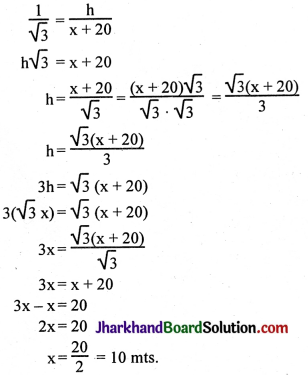
JAC Class 10 Maths Solutions Chapter 9 Some Applications of Trigonometry Ex 9.1 - 16
Height = x\(\sqrt{3}\) = 10\(\sqrt{3}\) mts. Width of the canal = 10 mts.

JAC Class 10 Maths Solutions Chapter 9 Some Applications of Trigonometry Ex 9.1

Question 12.
From the top of a 7 m high building, the angle of elevation of the top of a cable tower is 60° and the angle of depression of its foot is 45°. Determine the height of the tower.
Solution :
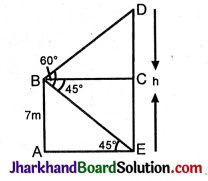
JAC Class 10 Maths Solutions Chapter 9 Some Applications of Trigonometry Ex 9.1 - 17
In ΔDBC, tan 60° = \(\frac{DC}{BC}\)
\(\sqrt{3}\) = \(\frac{DC}{BC}\)
= \(\frac{DC}{AE}\) = \(\frac{DC}{7}\) (BC = AE).

In ΔABE, tan 45° = \(\frac{AB}{AE}\)
1 = \(\frac{7}{AE}\)
∴ AE = 7 mts.
AB = BC = 7 mts.
DC = 7\(\sqrt{3}\)
∴ DE = DC + CE
= 7\(\sqrt{3}\) + 7 = 7(\(\sqrt{3}\) + 1) mts.

Question 13.
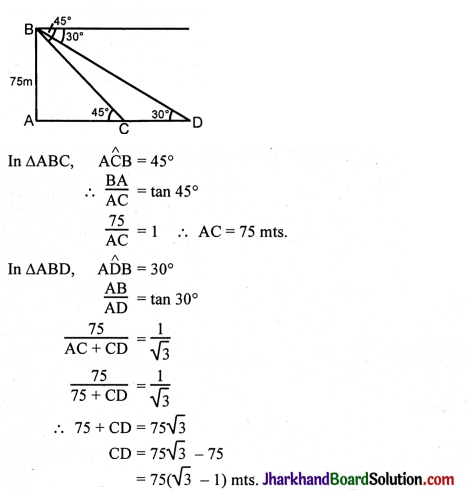
As observed from the top of a 75 m high lighthouse from the sea-level, the angles of depression of two ships are 30° and 45°. If one ship is exactly behind the other on the same side of the lighthouse, find the distance between the two ships.
Solution :
JAC Class 10 Maths Solutions Chapter 9 Some Applications of Trigonometry Ex 9.1 - 18
Hence, the distance between the two ships is 75(\(\sqrt{3}\) – 1) m.

JAC Class 10 Maths Solutions Chapter 9 Some Applications of Trigonometry Ex 9.1

Question 14.
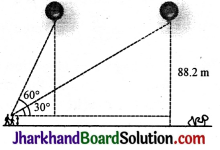
A 1.2 m tall girl spots a balloon moving with the wind in a horizontal line at a height of 88.2 m from the ground. The angle of elevation of the balloon from the eyes of the girl at any instant is 60°. After some time, the angle of elevation reduces to 30°. Find the distance travelled by the balloon during the interval.
JAC Class 10 Maths Solutions Chapter 9 Some Applications of Trigonometry Ex 9.1 - 19
Solution :
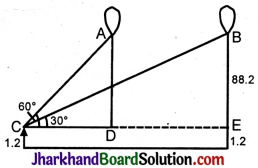
JAC Class 10 Maths Solutions Chapter 9 Some Applications of Trigonometry Ex 9.1 - 20
Let the initial position of the balloon be A and final position be B.
Height of the balloon above the girl’s height = 88.2 m – 1.2 m = 87m
Distance travelled by the balloon = DE = CE – CD
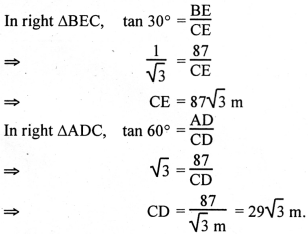
JAC Class 10 Maths Solutions Chapter 9 Some Applications of Trigonometry Ex 9.1 - 21
Distance travelled by the balloon, DE = CE – CD
= (87\(\sqrt{3}\) – 29\(\sqrt{3}\)) m
= 29\(\sqrt{3}\) (3 – 1) m
= 58\(\sqrt{3}\) m.

Question 15.
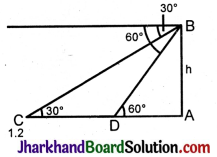
A straight highway leads to the foot of a tower. A man standing at the top of the tower observes a car at an angle of depression of 30°, which is approaching the foot of the tower with a uniform speed. Six seconds later, the angle of depression of the car is found to be 60°. Find the time taken by the car to reach the foot of the tower from this point.
Solution :
JAC Class 10 Maths Solutions Chapter 9 Some Applications of Trigonometry Ex 9.1 - 22
In ΔBCA, tan 30° = \(\frac{h}{CA}\)
\(\frac{1}{\sqrt{3}}\) = \(\frac{h}{CA}\)
CA = h\(\sqrt{3}\) mts.
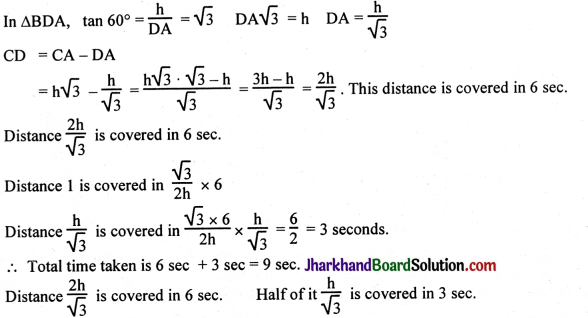
JAC Class 10 Maths Solutions Chapter 9 Some Applications of Trigonometry Ex 9.1 - 23

JAC Class 10 Maths Solutions Chapter 9 Some Applications of Trigonometry Ex 9.1

Question 16.
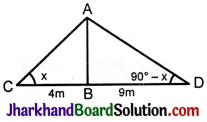
The angles of elevation of the top of a tower from two points at a distance of 4 m and 9 m from the base of the tower and in the same straight line with it are complementary. Prove that the height of the tower is 6 m.
Solution :
JAC Class 10 Maths Solutions Chapter 9 Some Applications of Trigonometry Ex 9.1 - 24
Let AB be the tower. ∠ABC = x
∴ ∠ADB = 90° – x
In ΔABC tan x = \(\frac{AB}{BC}\)
tan x = \(\frac{AB}{4}\) ……………(i)
In ΔADB tan (90° – x) = \(\frac{AB}{9}\)
cot x = \(\frac{AB}{9}\) ……………(ii)
(i) × (ii)
tan x × cot x = \(\frac{AB}{4}\) × \(\frac{AB}{9}\)
tan x × \(\frac{1}{tan x}\) = \(\frac{\mathrm{AB}^2}{36}\)
1 = \(\frac{\mathrm{AB}^2}{36}\)
AB² = 36
AB = ± \(\sqrt{36}\)
AB = ± 6
∴ Height of the tower AB = 6 m.
Note: C and D can be taken on the same side of AB.

JAC Class 9th Social Science Notes Geography Chapter 2 Physical Features of India

JAC Board Class 9th Social Science Notes Geography Chapter 2 Physical Features of India

→ Introduction

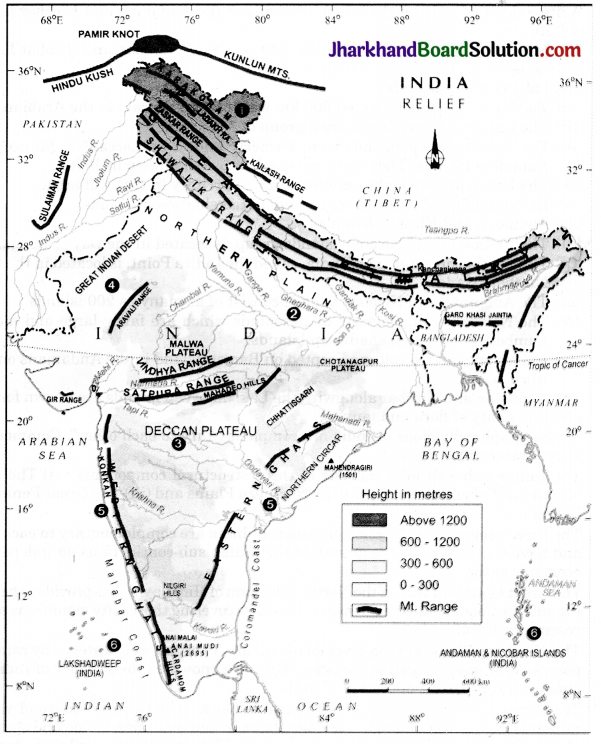
  • India has practically all the physical features of the Earth like mountains, plains, deserts, plateaus, islands etc.
  • Geologically, the land of India displays great physical variation.

→ Major Physiographic Divisions

  • The physical features of India can be grouped under the following physiographic divisions: (i) The Himalayan mountains, (ii) The Northern plains, (iii) The Peninsular plateau, (iv) The Indian desert, (v) The Coastal plains, (vi) The Islands.

→ The Himalayan Mountains

  • The Himalayan mountains are the major sources of water and forest wealth.
  • The Himalayas are geologically young and structurally fold mountains. They stretch over the Northern borders of India.
  • The Himalayas consists of three parallel ranges in its longitudinal extent: (i) The Great or Inner Himalayas or the ‘Himadri’, (ii) The Middle or lesser Himalayas or The ‘Himachal’ (iii) The Outer Himalayas or The ‘Shiwaliks’.
  • The Himalayas are also divided on the basis of regions from West to East. This demarcation is done by river valleys, i.e. the Indus, Sutlej, Kali, Teesta and Dihang rivers.
  • In the west, the part of Himalayas lying between Indus and Sutlej has been traditionally known as Punjab Himalayas.
  • The part of Himalayas lying between Sutlej and Kali rivers is known as Kumaon Himalayas.
  • The Kali and Teesta rivers demacrate the Nepal Himalayas and the part lying between Teesta and Dihang rivers is known as Assam Himalayas.
  • Purvanchal or the Eastern hills and mountains running through the North-Eastern states are mostly composed of strong sand stones, which are sedimentary rocks covered with dense forest.

JAC Class 9th Social Science Notes Geography Chapter 2 Physical Features of India

→ The Northern Plains

  • The Northern plains are the granaries of the country. They provided the base for early civilisations.
  • The Northern Plain has been formed by the interplay of the three major river systems, namely the Indus, the Ganga and the Brahmaputra along with their tributaries.
  • The Northern plain is broadly divided into three sections: (i) The Punjab plains, (ii) The Ganga plains, (iii) The Brahmaputra plains.
  • According to the variations in relief features, the northern plains can be divided into four regions:(i) Bhabar, (ii) Terai, (iii) Bangar, (iv) Khadar.
  • The largest part of the Northern plain is formed of older alluvium.

→ The Pfehinsular Plateau

  • The Peninsular Plateau is a tableland composed of the old crystalline, igneous and metamorphic rocks. This plateau consists of two broad divisions, namely, the Central Highlands, the Deccan Plateau.
  • The Western Ghats and the Eastern Ghats mark the western and the eastern edges of the Deccan Plateau respectively.
  • The Western part of the plateau, known as the Deccan Trap, contains black soil of volcanic origin.

JAC Class 9th Social Science Notes Geography Chapter 2 Physical Features of India

→ The Indian Desert

  • The Indian Desert lies towards the western sides of the Aravalli Hills. It is an undulating sandy plain covered with sand dunes.
  • Luni is the only large river in this region.
  • This region receives very low rainfall, i.e. below 150 mm per year.

→ The Coastal Plains

  • The Peninsular Plateau is boardered by stretches of narrow coastal strips, running along the Arabian Sea on the West and the Bay of Bengal on the east.
  • The Western coast consists of three sections (i) The Konkan Coast, (ii) The Kannad Plain (iii)The Malabar Coast.
  • The Eastern Coast consists of the Northern Circar and the Coromandel Coast.

→ The Islands

  • The Lakshadweep islands group lies close to the Malabar coast of Kerala and are composed of small coral islands.
  • The elongated chain of the Andaman and Nicobar islands located in the Bay of Bengal extends from North to  South.

JAC Class 9th Social Science Notes Geography Chapter 2 Physical Features of India

→ Mountain: A mountain is a large landform that rises above the surrounding land in a limited area, usually in the form of a peak.

→ Desert: A large dry area, largely devoid of vegetation for want of rain or water.

→ Plateau: A wide, flat, topped area, rising abruptly from the surrounding low-lying area or a water body.

→ Island: A piece of land that is completely surrounded by sea, a river or lake.

→ Valley: A valley is a low area between hills or mountains typically with a river running through it.

→ Ox-bow lake: A crescent-shaped lake on a river floodplain.

→ Fold Mountains: An upland area, such as the Himalayas or Alps formed by the buckling of the Earth’s crust.

→ Physiography: Shape and relief or geographical features of an area.

→ Glacier: A glacier is a huge mass of ice that moves slowly over land.

→ Tributaries: Streams or small rivers that flow into a larger river.

→ Distributary: A river that originates from a major river. It is formed near the river’s mouth before falling into the sea.

→ Waterfall: A waterfall is an area where water flows over a vertical drop or a series of steep drops in the course of a stream or river.

→ Riverine Islands: Islands on a river.

JAC Class 9th Social Science Notes Geography Chapter 2 Physical Features of India

→ Gondwana land: It was an ancient super-continent located in Southern Hemisphere which included the present-day South America, Africa, Australia snd Antarctica.

→ Bhangar: The older alluvium of the Northern Plain is called the Bhangar.

→ Khadar: The younger alluvium of the floodplains is known as the Khadar.

→ Duns: Narrow valleys found between Shiwaliks and Middle Himalayas.

→ Strait: A narrow stretch of water joining two oceans or large water bodies.

→ Barchans: Barchan also spelled Barkhan, crescent-shaped sand dunes produced by the action of wind an predominantly from one direction.

→ Tectonic Plates: Due to internal heat of the Earth, the currents of the semi-molten rocks move towards the crust, and tear it apart, dividing it into large fragments which are called Tectonic Plates.

→ Tethys: An elongated shallow sea sandwiched between two ancient landmasses.

→ Coral: Coral polyps are short-lived microscopic organisms which live in colonies. They flourish in shallow, mud free and warm waters. They secrete calcium carbonate.

→ Atolls: These are circular or horse-shoe-shaped coral reefs. Lakshadweep is one such type.

→ Gorge: The steep-sided narrow and deep valley of a river formed in its upper course is termed as a gorge. It is also called an I-shaped valley.

JAC Class 9 Social Science Notes

JAC Class 9 Social Science Important Questions Geography Chapter 3 Drainage 

JAC Board Class 9th Social Science Important Questions Geography Chapter 3 Drainage

I. Objective Type Questions

1. The river system of an area is referred to as:
(a) Water flow
(b) Drainage
(c) Delta
(d) None of these,
Answer:
(b) Drainage

2. Indian river systems can be divided into how many groups?
(a) Three
(b) Four
(c) Six
(d) Two.
Answer:
(d) Two.

3. Most of the peninsular rivers discharge their water in:
(a) Indian Ocean
(b) Bay of Bengal
(c) Arabian Sea
(d) None of these
Answer:
(b) Bay of Bengal

4. Which of the following lakes in Rajasthan is a saltwater lake?
(a) Siliserh
(b) Jaisamand
(c) Pichola
(d) Sambhar.
Answer:
(d) Sambhar.

5. The Wular lake in Jammu and Kashmir is the result of which of the following activities?
(a) Rainfall
(b) Human activity
(c) Tectonic activity
(d) None of these.
Answer:
(c) Tectonic activity

6. In which year was the Ganga Action Plan introduced?
(a) 1955
(b) 1947
(c) 1985
(d) 1995.
Answer:
(c) 1985

II. Very Short Answer Type Questions

Question 1.
What is drainage?
Answer:
The term drainage describes the river system of an area.

Question 2.
What is a drainage basin?
Answer:
The area drained by a single river system is called a drainage basin.

JAC Class 9 Social Science Important Questions Geography Chapter 3 Drainage

Question 3.
Which river has the largest river basin in the world?
Answer:
The world’s largest drainage basin is that of the Amazon river.

Question 4.
Into how many categories are the Indian rivers divided?
Answer:
The Indian rivers are divided into two major groups:

  1. The Himalayan rivers, and
  2. The Peninsular rivers.

Question 5.
Name three major rivers, which originate beyond the Himalayas.
Answer:

  1. Indus,
  2. Satluj,
  3. Brahmaputra river.

Question 6.
What do you understand by a river system?
Answer:
A group of a main river alongwith its tributaries is known as a river system.

Question 7.
From where the river Indus originates?
Answer:
The Indus rises in Tibet, near Lake Mansarovar.

Question 8.
What is the total length of the river Indus?
Answer:
2900 km.

Question 9.
Name the major rivers of the Indus river system.
Answer:
The Indus, the Satluj, the Jhelum, the Chenab, the Ravi and the Beas.

JAC Class 9 Social Science Important Questions Geography Chapter 3 Drainage

Question 10.
When was the Indus Water Treaty signed?
Answer:
In 1960.

Question 11.
How much percent of total Indus water can be used by India according to Indus Water Treaty?
Answer:
20 per cent.

Question 12.
Name the headwater of the Ganga.
Answer:
The Bhagirathi.

Question 13.
Where does the Bhagirathi join the Alaknanda?
Answer:
The Bhagirathi joins the Alaknanda at Devprayag in Uttarakhand.

Question 14.
Name the major tributaries of the Ganga.
Answer:
The Yamuna, the Ghaghara, the Gandak and the Kosi.

Question 15.
Which are the main tributaries of the Ganga that come from the Peninsular uplands?
Answer:
The Chambal, the Betwa and the Son.

Question 16.
Which river flows for the longest length in India?
Answer:
The Ganga river flows (2500 km) for the largest length in India.

Question 17.
Which is the northernmost point of the Ganga Delta?
Answer:
Farakka in West Bengal.

Question 18.
Name the largest delta of the world.
Answer:
Sunderban delta.

JAC Class 9 Social Science Important Questions Geography Chapter 3 Drainage

Question 19.
Which rivers form the Sunderban delta?
Answer:
The Ganga and the Brahmaputra.

Question 20.
By which name is the river Brahmaputra known in Tibet?
Answer:
Tsang Po.

Question 21.
What is the Sunderban famous for?
Answer:
Sunderban is famous for being the home of the Royal Bengal tiger.

Question 22.
Name four rivers rising in the Western Ghats.
Answer:

  1. Godavari,
  2. Krishna,
  3. Kaveri,
  4. Tungabhadra.

Question 23.
In which hills does the Narmada rise?
Or
From which place does the Narmada rises?
Answer:
The Narmada rises in the Amarkantak Hills in Madhya Pradesh.

Question 24.
Name the waterfall formed by the river Narmada.
Answer:
The Dhuadhar Falls.

Question 25.
Which is the largest river of the Peninsular India?
Or
Which river is also known as the ‘Dakshin Ganga’?
Answer:
The Godavari.

JAC Class 9 Social Science Important Questions Geography Chapter 3 Drainage

Question 26.
Name the main lagoon lakes of India.
Answer:
Chilika, Pulicat and Kolleru Lakes.

Question 28.
Which is the largest freshwater lake in India?
Answer:
The Wular lake (Jammu and Kashmir).

Question 29.
Which river s known as a perennial river?
Or
What are perennial rivers?
Answer:
perennial rivers are those which have water throughout the year.

Question 30.
The Satluj is a tributary of which river?
Answer:
The Satluj is a tributary of Indus River joining in Pakistan.

JAC Class 9 Social Science Important Questions Geography Chapter 3 Drainage

Question 31.
Where is the Sambhar Lake located? What is its use?
Sambhar Lake istuated near Jaipur in Rajasthan. Its water is used to produce salt.

Question 32.
From where does the Kaveri River originate?
Answer:
The Kaveri River originates from the Brahmagiri range of the Western Ghats.

III. Short Answer Type Questions

Question 1.
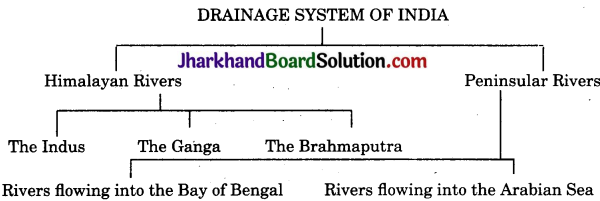
Explain the drainage system of India through a line diagram.
Answer:
JAC Class 9 Social Science Important Questions Geography Chapter 3 Drainage  1

Question 2.
Mention any two features, of the Himalayan rivers.
Answer:
Two features of the Himalayan rivers are:

  1. The Himalayan rivers have long courses from their source to the sea.
  2. These rivers perform both erosional as well as depositional activities.

Question 3.
How do the Himalayan rivers perform erosional activities and form depositional features?
Answer:

  1. In the upper course, rivers flow with great speed from higher to lower levels, causing erosion.
  2. In the middle and the lower course, they carry lots of sediments like silt and sand. So, their speed slows down.
  3. Besides, absence of slope in the lower course causes deposition and formation of various features.

JAC Class 9 Social Science Important Questions Geography Chapter 3 Drainage

Question 4.
Mention any two features of Peninsular rivers.
Answer:
Two features of Peninsular rivers are:

  1. A large number of Peninsular rivers are seasonal, as their flow depends on rainfall.
  2. Most of the Peninsular rivers originate in the Western Ghats and flow towards the Bay of Bengal.

Question 5.
Why do most of the Peninsular rivers drain into the Bay of Bengal?
Answer:
Most of the Peninsular rivers drain into the Bay of Bengal because:

  1. The Eastern Ghats are lower than the Western Ghats. These are discontinuous, allowing the rivers easy passage to the Bay of Bengal.
  2. The Deccan plateau has a gentle slope towards the East, which gives easier passage in that direction.

Question 6.
Distinguish between a tributary and a distributary.
Answer:
Difference between a tributary and a distributary:

TributaryDistributary.
1. When a small stream joins a larger one, the smaller stream is known as the tributary of the larger one.1. It is formed when a river is forced to break up into branches due to the deposition of sediments in its channel.
2. It can be found in any course of a river.2. It is found in the lower course of a river.
3. It is useful for transportation and irrigation.3. It provides a good network for transportation.
4. Example: Yamuna is a tributary of the Ganga.4. Example: Padma is a distributary of the Ganga.

Question 7.
What do you know about Indus Water Treaty?
Answer:
Indus Water Treaty is a water-sharing treaty between India and Pakistan signed on 19th September, 1960. India can use only 20 percent of the total water carried by the Indus river system. This water is used for irrigation in Punjab, Haryana and Southern and the Western parts of Rajasthan.

JAC Class 9 Social Science Important Questions Geography Chapter 3 Drainage

Question 8.
Write a note on the Tapi basin.

  1. The Tapi river originates from the sacred tank of Multai, in the Satpura ranges, in Betul district of Madhya Pradesh.
  2. It is the second-largest, west-flowing river of Peninsular India.
  3. The river flows in a rift valley parellel to the Narmada, but it is much shorter in length.
  4. The Tapi forms an estuary before falling into the Gulf of Khambhat.
  5. Its basin covers part of Madhya Pradesh, Gujarat and Maharashtra.

Question 9.
Write a short note on the Mahanadi basin.

  1. The Mahanadi has its source in the highlands of Chhattisgarh.
  2. The total length of the river is 860 kms.
  3. It covers parts of Maharashtra, Chhattisgarh, Jharkhand and Odisha.
  4. It drains into the Bay of Bengal.

JAC Class 9 Social Science Important Questions Geography Chapter 3 Drainage

Question 10.
Write a note on the Krishna basin.

  1. The Krishna river rises near Mahabaleshwar in the Western Ghats.
  2. It flows into the Bay of Bengal before forming a large delta.
  3. Its length is about 1400 km.
  4. The Bhima, the Tungabh ,fra, the Koyna and the Ghatprabha are its major tributanes.
  5. It covers Maharashtr

Question 11.
What are the major causes of river pollution?
The major causes of river pollution are as follows:

  1. The growing domestic, municipal, industrial and agricultural demand for water from rivers naturally affects the quality of water. As a result, more and more water is being drained out of the rivers, reducing their volume.
  2. A heavy load of untreated sewage and industrial effluents are emptied into the rivers. This affects not only the quality of water, but also the self cleansing capacity of the river.
  3. Increasing urbanisation and industrialisation is also responsible for increasing pollution level of many rivers.

Question 12.
Briefly explain the National-River Conservation Plan.
Answer:
The river cleaning programme in the country was initiated with the launching of the Ganga Action Plan in 1985. The Ganga Action Plan was expanded to cover other rivers, under the National River Conservation Plan launched in the year 1995. The objective of this programme is to improve the water quality of the rivers, which are the main water sources in the country, through the implementation of pollution control measures.

IV. Long Answer Type Questions

Question 1.
Describe the Indus river system.

  1. The Indus river system comprises of the Indus river and its five main tributaries The Jhelum, The Chenab, The Satluj, The Ravi and The Beas.
  2. The Indus originates from the glaciers of the Kailash Range in Western Tibet near Mansarovar Lake.
  3. It flows west and north-westwards and enters Indian territory in Ladakh.
  4. It flows through Ladakh, Baltistan and Gilgit and emerges from the mountains at Attock. Here, it is joined by the Kabul river from Afghanistan.
  5. With a total length of 2,900 kilometres, the Indus is considered as one of the longest rivers of the world.
  6. The sharing of water by India and Pakistan is regulated by the Indus Water Treaty signed by both the countries.
  7. It flows south-westwards across Pakistan to reach the Arabian Sea, east of Karachi.

JAC Class 9 Social Science Important Questions Geography Chapter 3 Drainage

Question 2.
Write a note on the Ganga river system.
Answer:
The Ganga river system includes the Ganga and its tributaries like the Yamuna, the Gomti, the Ghaghara, the Gandak, the Ramganga, the Mahaganga, the Son and the Kosi, etc.

  1. The Ganga rises in Garhwal Himalayas in Uttarakhand at an altitude of about 6,000 metres.
  2. The river acquires its name after its head-streams, Alaknanda and Bhagirathi
    which unite at Devaprayag.
  3. Flowing south-westwards, the Ganga comes out of Himalayas near Haridwar and enters the plains.
  4. The total length of the Ganga is 2,500 km.
  5. Beyond Farakka, it flows south-eastwards into Bangladesh where it is known as Padma.
  6. Before falling into Bay of Bengal, the Padma joins the Brahmaputra which is known as Jamuna and Meghna there. The delta formed by these rivers is known as the Sunderban delta.

Question 3.
Write the main characteristics of the Brahmaputra river system.
Answer:

  1. The river Brahmaputra originates from Chenayungdung glacier near Mansarovar lake in the Kailash range of the Himalayas.
  2. With a total length of 2900 km, it is one of the longest rivers of the world.
  3. Throughout the whole journey, the river passes through Tibet, India and Bangladesh. The river is known as Tsang Po in Tibet.
  4. Towards the end of its journey in Tibet, it takes a southwards turn near Namcha Barwa and enters Arunachal Pradesh as Dihang river. Traversing round the stairs of Garo hills, it bends southwards and enters Bangladesh near Dhubri. In Bangladesh, it is known as the Jamuna.
  5. At Goalundo the Jamuna joins the Ganga and is jointly known as the Padma. About 100 km further downstream, the Padma is joined by the Meghna. The river Meghna forms a very broad estuary before pouring into the Bay of Bengal.
  6. The Brahmaputra has a braided channel for most of its passage through Assam.
  7. With its tributaries like the Dihang, the Lohit, etc. discharging enormous quantities of water and silt, the river causes disastrous floods in every monsoon.

JAC Class 9 Social Science Important Questions Geography Chapter 3 Drainage

Question 4.
Explain the main features of the Narmada basin.
Answer:
The main features of the Narmada basin are as follows:

  1. This river originates from Amarkantak Hills in Madhya Pradesh and flows westwards through a rift valley between the Vindhya range to the North and the Satpura range to the South.
  2. The total length of the river from source to mouth is about 1,312 km.
  3. The Marble Rocks near Jabalpur where the Narmada flows through a deep gorge and the ‘Dhuadar falls’ where the river plunges over steep rocks are some of the picturesque locations formed by the Narmada.
  4. During much of its journey, the Narmada flows through the troughs confined by precipitous hills which do not permit any large tributaries.
  5. The river forms an estuary before entering the Gulf of Khambhat. There are several islands in the estuary of the Narmada.The Aliabet is the largest island of the river.
  6. The Narmada basin covers parts of Madhya Pradesh and Gujarat.

Question 5.
Explain the main features of the Godavari basin.
Answer:
The main features of the Godavari basin are as follows:

  1. The Godavari is the longest river of the Peninsula.
  2. It rises from the slopes of the Western Ghats in Nasik district of Maharashtra.
  3. It is often referred as the Vridha Ganga or the Dakshin Ganga because of its large size and extent.
  4. Its principal tributaries include the Parvara, the Purna, the Manjra, the Penganga, the Wainganga, the Wardha, the Pranhita, the Indravati, the Maner and the Sabari.
  5. Its length is about 1500 km and the river drains into the Bay of Bengal.
  6. The basin covers parts of Maharashtra, Madhya Pradesh, Odisha and Andhra Pradesh.

Question 6.
Write a note on the Kaveri basin.
Answer:

  1. The Kaveri is the most reverred and sacred river of South India.
  2. The source of this river lies at Talakaveri on the Brahmagiri range of hills in the Western Ghats.
  3. Total length of the river is about 760 km.
  4. It flows Eastwards and it reaches the Bay of Bengal south of Cuddalore in Tamil Nadu.
  5. The river is unique because it receives rainfall during summer as well as winter.
  6. Its main tributaries are Amravati, Bhavani, Hemavati and Kabini.
  7. Its basin drains parts of Karnataka, Kerala and Tamil Nadu.

JAC Class 9 Social Science Important Questions Geography Chapter 3 Drainage

Question 7.
Write a detailed note on the lakes of India.
Or
Lakes are of great value to human beings: Explain the statement with three examples.
Answer:
A lake is the depression filled with water on the Earth’s surface and is entirely surrounded by land. Even after being such a large country, India has comparatively fewer natural lakes. Following are the major types of lakes found in India:
1. Freshwater Lakes:
Most of the freshwater lakes are in the Himalayan region. They are of glacial origin. A glacier is one of the important agents of erosion. The erosive process of glaciers can create U-shaped valleys, and the irregular surface of a glaciated lowland in which water can accumulate. Dal lake, Bhimtal, Nainital, Loktak and Barapani are some of the important freshwater lakes of India.

2. Lakes of Tectonic Origin:
Folding and faulting produce hollows in the Earth’s crust. These hollows may contain either salt or fresh water. The Wular Lake in Jammu and Kashmir is the result of tectonic activity.

3. Saltwater Lake:
Any lake that has no natural drainage outlet, either as a surface stream or as a sustained sub-surface flow, will become saline. The Sambhar in the desert region of Rajasthan is a saltwater lake, and its water is used for producing salt.

4. Man-made Lakes or Artificial Lakes:
In order to harness water for generation of hydel power, to provide irrigation water to crops and to provide drinking water to urban places, a number of lakes have been constructed. Gobind Sagar and Govind Ballabh Pant Sagar are the two most important man-made lakes of India.

Importance of Lakes:

  1. Lakes help to regulate the flow of river. During heavy rainfall, they prevent flooding, and during the dry season, they help to maintain an even flow of water.
  2. Lakes can also be used for developing hydropower.
  3. They moderate the climate of the surroundings, maintain the aquatic ecosystem and enhance natural beauty.
  4. They help to develop tourism and provide recreation.

Question 8.
Describe the role of rivers in the national economy.
Or
Rivers have been of fundamental importance throughout human history. Justify the statement.
Answer:
1. Development of Civilisations:
Rivers have played a vital role in the development of civilisations. Most of the ancient civilisations like Indus, Aztec, etc. developed around the rivers. Rivers have been of fundamental importance throughout human history. The banks of the rivers have witnessed great cultural and economic progress since ancient times. Water is a basic natural resource, essential for all human activities,

2. Development of Agriculture:
Rivers and their associated alluvial soil provide the most productive agricultural lands of the country. The Ganga-Brahmaputra basin has been formed by the two great rivers. Irrigation from rivers has been the backbone of the development of Indian agriculture.

3. Settlement:
Their valleys contains dense and concentrated settlements. Most of the large cities are located on river banks. The rivers not only provide us essential water supplies, but they also receive, dilute and transport wastes from settlements.

4. Industrial Development:
Industrial development has flourished along rivers as many industrial processes rely on water as a raw material, as a coolant and for the generation of hydro electricity.

5. Means of Transportation:
Rivers provide primary channels of inland transportation, not only directly in the form of navigable waterways, but also indirectly through their valleys, where roads, railway lines and other routes are built.

JAC Class 9 Social Science Important Questions Geography Chapter 3 Drainage

Question 1.
On an outline map of India mark the rivers and lakes of India.
Answer:
(a) The Himalayan River System: The Indus, The Ganga and The Satluj.
(b) The Peninsular River: The Narmada, The Tapi, The Kaveri, The Krishna, The Godavri, The Mahanadi

  1. Lakes: Wular, Pulicat, Sambhar, Chilika, Vembanad, Kolleru.
  2. Mountain Peaks: K2, Kanchanjunga, Anai Mudi
  3. Coastal Plains: Konkan, Malabar, Coromandel & Northern Circar (Location & Labelling)

JAC Class 9 Social Science Important Questions Geography Chapter 1 India-Size and Location 2

JAC Class 9 Social Science Important Questions

JAC Class 9 Social Science Important Questions Geography Chapter 2 Physical Features of India

JAC Board Class 9th Social Science Important Questions Geography Chapter 2 Physical Features of India

I. Objective Type Questions

1. Which of the following represents the loftiest and one of the most rugged mountain barriers of the world?
(a) Aravali range
(b) Hindukush
(c) Himalayan mountains
(d) Kunlun mountains.
Answer:
(c) Himalayan mountains

2. The Himalayan mountains form and cover a distance of:
(a) 2510 km
(b) 1750 km
(c) 2400 km
(d) 2100 km.
Answer:
(c) 2400 km

3. Which of the following parts of India is agriculturally a productive part of India:
(a) Indian desert
(b) Northern plains
(c) Peninsular plateau
(d) Coastal plains.
Answer:
(b) Northern plains

4. Which of the following in the Brahmaputra river is the largest inhabited riverine island in the world?
(a) Andamans
(b) Lakshadweep
(c) Majuli
(d) Nicobar
Answer:
(c) Majuli

5. The Indian Desert lies towards the western margins of the :
(a) Aravalli Hills
(b) Shiwalik Hills
(c) Garo Hills
(d) Jointia Hills
Answer:
(a) Aravalli Hills

II. Very Short Answer Type Questions

Question 1.
How many physiographic divisions can India be divided into?
Answer:
India can be divided into the following physiographic divisions—

  1. The Himalayan Mountains,
  2. The Northern Plains,
  3. The Peninsular Plateau,
  4. The Indian Desert,
  5. The Coastal Plains,
  6. The Islands.

Question 2.
Name the highest mountain range of the world.
Answer:
The Himalayas.

JAC Class 9 Social Science Important Questions Geography Chapter 2 Physical Features of India

Question 3.
Write the expansion of the Himalayas.
Answer:
The Himalayas mountain ranges run in a West-East direction from the Indus to the Brahmaputra.

Question 4.
Which is the northern-most range of the Himalayas?
Answer:
The Himadri.

Question 5.
Which range of Himalayas is the most continuous range?
Answer:
The Northern-most range which is also known as Himadri or inner Himalayas is the most continuous range of Himalayas.

Question 6.
Name the most rugged range of the Himalayas.
Answer:
The Himachal.

Question 7.
Name the sub-ranges of the Himachal Himalayas.
Answer:
The sub-ranges are named as (i) Pir Panjal, (ii) Dhauladhar and (iii) Mahabharat.

Question 8.
What is the variation in height in the Shiwalik mountain range ? .
Answer:
The height of the Shiwalik mountain range varies from 900 to 1100 metres.

Question 9.
What are Shiwalik ranges made of?
Answer:
Shiwalik ranges are composed of unconsolidated sediments brought down by rivers from the main Himalayan ranges.

JAC Class 9 Social Science Important Questions Geography Chapter 2 Physical Features of India

Question 10.
Name the longitudinal divisions of the Himalayas.
Answer:

  1. Punjab Himalayas,
  2. Kumaon Himalayas,
  3. Nepal Himalayas,
  4. Assam Himalayas.

Question 11.
By which rivers the northern-most boundary of the Himalayas formed?
Answer:
The Brahmaputra.

Question 12.
By which name are the mountains spread along the eastern boundary of India- known?
Answer:
Purvachal.

Question 13.
Name the hills running through the Purvachal.
Answer:

  1. Patkai,
  2. Naga,
  3. Mizo,
  4. Manipur Hills.

Question 14.
Name the river system that forms the northern plains.
Answer:
The Northern plains are formed by the Indus, the Ganga and the Brahmaputra river systems.

Question 15.
Which is the largest riverine island in the world?
Answer:
Majuli, in the Brahmaputra river, is the largest riverine island in the world.

JAC Class 9 Social Science Important Questions Geography Chapter 2 Physical Features of India

Question 16.
What do you mean by the word ‘Doab’?
Answer:
‘Doab’ is made up of two words ‘do’, meaning ‘two’ and ‘ab’, meaning ‘water’. Thus, ‘Doab’ means a part between two rivers.

Question 17.
Into how many sections are the northern plains divided?
Answer:

  1. The Punjab Plain,
  2. The Ganga Plain,
  3. The Brahmaputra Plain.

Question 18.
What is Bhabar?
Answer:
The plains formed by the rivers, after descending from the mountains deposit pebbles in a narrow belt lying parallel to the slopes of the Shiwaliks are known as Bhabar.

Question 19.
What is Terai?
To the south of Bhabar belt, the streams and rivers re-emerge and create a wet, swampy and marshy region known as Terai.

Question 20.
The peninsular plateau can be divided into how many divisions?
Answer:
The peninsular plateau can be divided into two divisions

  1. The Central Highlands,
  2. Deccan Plateau.

Question 21.
How are the Northern Plains and Peninsular Plateau formed?
Answer:
The Northern Plains are formed by the alluvial deposits, while the Peninsular Plateau is formed by igneous and metamorphic rocks.

JAC Class 9 Social Science Important Questions Geography Chapter 2 Physical Features of India

Question 22.
Which is the ancient landmass of India?
Answer:
Peninsular region.

Question 23.
Name the North-East extensions of the Deccan Plateau.

  1. Meghalaya,
  2. Karbi-Anglong Plateau,
  3. North Cachar hills.

Question 24.
Which is the highest peak in the Western Ghats?
Answer:
Anai Mudi is the highest peak in Western Ghats. Its height is 2695 metres.

Question 25.
Which is the highest peak in the Eastern Ghats?
Answer:
Mahendragiri is the highest peak in the Eastern Ghats. Its height is 1501 metres.

Question 26.
Name the hills that lie at the junction of Eastern and Western Ghats?
Answer:
The Nilgiri Hills in Tamil Nadu lie at the junction of Eastern and Western Ghats.

JAC Class 9 Social Science Important Questions Geography Chapter 2 Physical Features of India

Question 27.
Which part of the plateau contains black soil of volcanic origin?
Answer:
The Western part of plateau known as the Deccan trap contains black soil of volcanic origin.

Question 28.
What is the Deccan Trap?
Answer:
The black soil area of the western peninsular plateau is known as Deccan Trap.

Question 29.
Where are the Aravali Hills located?
Answer:
The Aravali Hills lie on the Western and North-Western margins of the peninsular plateau.

Question 30.
Which desert is located on the western margin of the Aravali Hills?
Answer:
The Indian Desert (Thar Desert) lies towards the western margins of the Aravali Hills.

Question 31.
Which Indian coastal part is called Konkan?
Answer:
The nor’ hern part of the Indian Western Coast is known as Konkan.

Question 32.
What is the southern part of the Western Coastal Plains known as?
Answer:
The southern part of the Western Costal Plains is known as Malabar.

Question 33.
Name two sections of the eastern Coastal Strips.

  1. The Northern Circar,
  2. The Coromandel Coast.

Question 34.
Where is the Chilika Lake located? Why is it famous?
Answer:
The Chilika Lake lies in the state of Odisha, to the South of the Mahanadi delta. It is the largest salt-water lake in India.

JAC Class 9 Social Science Important Questions Geography Chapter 2 Physical Features of India

Question 35.
By which name were the Lakshadweep islands known earlier?
Answer:
Earlier, the Lakshadweep islands were known as Laccadive, Minicoy and Amindive.

Question 36.
Where is the administrative headquarters of Lakshadeweep situated?
Answer:
Kavaratti island.

Question 37.
Where is India’s only active volcano located?
India’s only active volcano is found on Barren island in Andaman and Nicobar group of Islands.

Question 38.
What are Corals?
Answer:
Coral polyps are short-lived microscopic organisms which live in colonies in shallow, mudfree and warm water.

Question 39.
What makes up the habitat in which Coral polyps flourish?
Answer:
Coral polyps flourish in a habitat consisting of shallow warm water which does not have mud. This kind of habitat is found in Lakshadweep.

Question 40.
Where is the Great Barrier Reef located?
Answer:
Australia.

Question 41.
What are Barchans?
Answer:
Barchans are crescent-shaped dunes which cover larger area of deserts. They are found in the Indian desert, mainly in Jaisalmer and and near Indo-Pak boundary.

III. Short Answer Type Questions

Question 1.
Write any four features of the Himalayan mountains.
Answer:
Following are the four features of the Himalayan mountains:

  1. The Himalayas are a geologically young and structurally fold mountains.
  2. The Himalayas act like a natural wall to keep the fertile Indo-Gangetic plains safe from the cold winds coming from Central Asia.
  3. The Himalayas are source to perennial rivers like the Indus, the Ganga and the Brahmaputra.
  4. The Himalayas are lofty and impassable natural barriers on the Northern border of India.

Question 2.
Why are the Himalayas called young fold mountains?
Answer:
Himalayas are called young fold mountains because:

  1. These are young in age compared to several other mountains.
  2. They are made of at least three major folds or parallel ranges, e.g. Himadri, Himachal and Shiwaliks.
  3. They are characterised by high peaks, gorges, I-shaped valleys, glaciers and steep slopes, which indicate that the mountains are still developing.

JAC Class 9 Social Science Important Questions Geography Chapter 2 Physical Features of India

Question 3.
Describe the Himadri.
Answer:
The Himadri or the Great or the Inner Himalayas:

  1. These are the Northern-most ranges of the Himalayas.
  2. The average elevation of the Himadri is more than 6,000 m above the sea level.
  3. They contain some of the world’s highest peaks, like, Mt. Everest (8,848 m) in Nepal “,nd Kanchenjunga (8,598 m) in India. Nanga Parbat (8,126 m) and Nanda Devi t ,817m) are the other two important Himalayan peaks in India.
  4. The G igotri and the Yamunotri glaciers which gave birth to the Ganga and the Ya mna rivers respectively are located here.

Question 4.
Describe the Middle Himalayas.
Answer:
The Himachal or the Middle Himalayas:

  1. Mountains lying to the South of the Himadri are known as Middle or lesser Himalayas or the Himachal.
  2. They have an average height of 3,700 m to 4,500 m above the sea level and extend over a width of 50 km.
  3. The ranges are mainly composed of highly compressed and altered rocks.
  4. All the important hill stations such as Dalhousie, Dharmshala, Shimla Mussoorie, Nainital and Darjeeling lie in this range.
  5. pir Panjal, Dhaula Dhar and Mahabharat ranges are its most important range:

Question 5.
Describe the Shiwaliks.
Answer:
The Shiwaliks or the Outer Himalayas:

  1. It is the Southern-most range of the Himalayas.
  2. The average altitude of Shiwalik-range varies between 900 m and 1,100 m above the sea level and extend over a width of 10-50 km.
  3. This range is made of unconsolidated material such as mud, silt, and soft rocks and is prone to earthquake and landslides.
  4. Some narrow valleys are found between Shiwaliks and Himachal. They are called ‘duns’. Example Dehradun.

Question 6.
Describe the divisions of the Himalayas from west to east along with Purvachal hills.
Answer:
On the basis of the location, Himalayas can be divided as follows:
1. Western Himalayas (Punjab Himalayas):
The Western section lying between the Indus and the Sutlej is known as the Punjab Himalayas. It covers a large part of Jammu and Kashmir and a part of Himachal Pradesh. They are made up of Ladakh, Zaskar and Pir Panjal ranges.

2. Central Himalayas (Kumaon Himalayas):
The section between the Sutlej and the Kali is known as Kumaon Himalayas. They extend through the state of Uttarakhand in India, and Nepal.

3. Eastern Himalayas (Nepal Himalayas):
The section between the Kali and the Teesta is known as the Nepal Himalayas.

4. Assam Himalayas (Purvachal):
The section between Teesta and Dihang (Tsang po) is known as the Assam Himalayas. They are made up of Patkai, Naga and Mizo Hills. These hills are mainly composed of strong sandstones.

JAC Class 9 Social Science Important Questions Geography Chapter 2 Physical Features of India

Question 7.
State any three differences-between the Himadri range and Shiwalik range. The differences between Himadri and Shiwalik ranges are:

FeaturesHimadri RangeShiwalik Range
1. LocationThis is the Northern-most and inner most range of Himalayas.This is the outermost range of Himalayas.
2. CompositionThe core of this part of Himalayas is composed of granite.This range is composed of uncon-solidated sediment brought down by rivers from the main Himalayan ranges.
3. AltitudeThe average altitude of this range is 6000 metres.The average altitude varies from 900 to 1100 metres.

Question 8.
Make a comparison between the Himachal Himalayas and the Shiwalik based on the following:

  1. Composition,
  2. Altitude.

Answer:
The comparison between the Himachal Himalayas and the Shiwaliks on the given basis is as follows:

Mountain RangeCompositionAltitude
1. Himachal HimalayasIt is the most rugged mountain system of the Himalayas. It is composed of highly compressed and altered rocks.It lies south of the Himadri with height varying from 3700 to 4500 metres.
2. ShiwaliksThe composition of Shiwalik is of unconsolidated sediments i.e. thick gravel and alluvium brought down by the Himalayan rivers.This is the outermost range of the Himalayas with height varying between 900 and 1100 metres.
Mountain RangeCompositionAltitude

Question 9.
Describe the formation of plains.
Answer:

  1. To the south of the Himalayas, a basin or depression was formed.
  2. It was gradually filled with the alluvium brought by the rivers from north and South.
  3. The North Indian Plain was thus followed between the Himalayas and the Peninsular Plateau.

Question 10.
Describe three broad sections of the Northern Plains.
Answer:
1. Punjab Plains:
The Western part of the Northern Plains is referred to as the Punjab plains. It is formed by the river Indus and its tributaries. The larger part of this plain lies in Pakistan. This section of the plain is dominated by the doabs.

2. Ganga Plain:
The Ganga plain extends between Ghaggar and Teesta rivers. It spreads over the states of North India Haryana, Delhi, Uttar Pradesh and Bihar.

3. Brahmaputra Plain:
This plain lies in Assam and partly in Jharkhand and West Bengal.

JAC Class 9 Social Science Important Questions Geography Chapter 2 Physical Features of India

Question 11.
Describe the divisions of the Northern Plains on the basis of the differences in the relief.
Or
Explain the diverse relief features of the Northen Plains.
Answer:
On the basis of the differences in the relief, the plain is divided into four sections :
1. Bhabar:
It is a narrow belt covered with pebbles lying along the foot of the Shiwaliks from the Indus to the Teesta. They are laid down by numerous streams descending down the hills. This belt is about 8 to 16 km in width.

2. Terai:
It is wet and marshy. It has a thick forest and a variety of wildlife.

3. Bhangar:
It is composed of older alluvium. It is formed higher up in the plains at river terraces. It is less fertile as compared to Khadar.

4. Khadar:
It is composed of newer alluvium. It is formed in the lower levels in the Plains near the river. It is very fertile.

Question 12.
Discuss the importance of the Northern Plains.
Answer:
The importance of the Northern Plains:

  1. With their fertile alluvial soils, flat surface, slow moving perennial rivers and favourable climate, the Great Plains of North India are of great economic and social significance.
  2. The fertile soil and ample water resources have made these plains a rich agricultural land. These plains are known as the granaries of India.
  3. The plains have a good network of roads and railways which has led to large scale industrialisation of the region.
  4. As the region has sufficient employment opportunities, so the density of population is high. More than 50% of the total population of India lives in these plains.
  5. The Northern plains is the site where the ancient civilization of Mohenjo da and Harappa developed

Question 13.
Write the main characteristics of the Central Highland.
Answer:
The Central Highlands of the Peninsular plateau lie to the north of the river Narmada.

  1. These are flanked by the Aravallis in the north-west, and consists of Malwa plateau, Bundelkhand and Baghelkhand plateau and the Chhota Nagpur plateau bound by Rajmahal Hills in the North-East. Its southern boundary is formed by the Vindhyas.
  2. The Central Highlands are made of hard, igneous and metamorphic rocks.
  3. The Central Highlands are drained by the Southern tributaries of Ganga and

Question 14.
Write a short note on‘Corals’.
Or
What are the types of corals?
Or
How are coral reefs formed? Describe the main features of the islands group which are of coral origin.
Answer:
Corals are short-lived microscopic organisms which live in colonies. They flourish in shallow, mud-free and warm waters. They secrete calcium carbonate. The coral secretion and their skeletons form coral deposits as reefs.
These roofs are mainly of three kinds:

  1. Barrier Reef,
  2. Fringing Reef,
  3. Atolls.

Atolls are circular or horse shoe-shaped coral reefs. In India, Lakshadweep Islands are of coral origin. They cover a small area of 32 sq. km. Karavatti is the administrative headquarters of Lakshadweep. This island group has great diversity of flora and fauna. The uninhabited Pitti island has a bird sanctuary.

IV. Long Answer Type Questions

Question 1.
Name the three longitudinal divisions of the Himalayas. Write the main features of each.
Or
Describe the major divisions of the Himalayas from North to South.
Or
Name the three parallel ranges of Himalayas. Write the major characteristics of each.
Answer:
The longitudinal divisions/parallel ranges/major divisions of the Himalayas are as follows:
1. Himadri

  1. The northern most range is called the Great or Inner Himalayas.
  2. It is the highest range with an average height of 6000 m.
  3. It contains all the prominent Himalayan peaks.
  4. The folds of Great Himalayas are assymetrical in nature. The core of this part of the Himalayas is composed of granite.

2. Himachal

  1. It is known as the Lesser Himalayas.
  2. It lies to the south of Himachal and forms the most rugges mountain system.
  3. The altitude varies between 3700 and 4500 metres and width is 50 km.
  4. This range consists of the famous valley of Kashmir and the Kangra Valley and Kullu Valley in Himanchal Pradesh.

3. Shiwaliks

  1. The outermost range of the Himalayas is known as the Shiwaliks.
  2. The Shiwaliks extend over a width of 10 to 50 km and have an altitude varying between 900 to 1100 m.
  3. This range is composed of unconsolidated sediments brought down by rivers from the main Himalayan ranges located further North.
  4. The valleys are covered with thick gravel and alluvium.

Question 2.
What are the uses of the Himalayas to India?
Answer:
Uses of the Himalayas to India: The Himalayas are beneficial for India in the following ways:

  1. The Himalayas are a physical wall protecting the Indian sub-continent from the rest of Asia. In the past, they stood as indestructible barriers against the aggressors from the North. This helped India to maintain its identity.
  2. The Himalayas act as a climatic barrier for the Indian sub-continent. They shield India from the cold, bleak winds coming from the Central Asia.
  3. The Himalayas also compel rain-bearing monsoon winds to shed bulk of their moisture in the Northern mountains and Northern plains.
  4. The Himalayas are snow-covered mountains having many glaciers also. These serve as a source of big perennnial rivers. These rivers have made the Indo-Gangetic plains very fertile. They are important for irrigation, navigation and generation of hydroelectric power.
  5. The Himalayas are also home to rich and varied flora and fauna. They are also a storehouse of numerous medicinal herbs.

JAC Class 9 Social Science Important Questions Geography Chapter 2 Physical Features of India

Question 3.
Describe the Deccan Plateau.
Answer:

  1. The part of the Peninsular plateau extending to south of the Vindhyas is called the Deccan plateau.
  2. It is triangular in shape. It is at its widest in the North and goes on tapering as we move towards the South.
  3. The Satpura ranges and Mahadeo Hills form its northern edge.
  4. It is flanked by the Western Ghats in the West and the Eastern Ghats on the east.
  5. The Western Ghats and the Eastern Ghats meet to form Nilgiri Mountains along the border of Karnataka and Tamil Nadu.
  6. The North-Western part of the Deccan plateau is made up of volcanic lava and is known for its black or regur soil.
  7. Unlike the Western Ghats, the Eastern Ghats are discontinuous and broken by long rivers.
  8. This plateau is drained by east-flowing rivers – Mahanadi, Godavari, Krishna and Kaveri.

Question 4.
Write the main characteristics of the Western and Eastern Coastal Plains.
Answer:
The main characteristics of the Eastern Coastal Plains are:

  1. This plain is located between the Eastern Ghats and the coast of Bay of Bengal.
  2. It is a comparatively broader plain with a average width of around 80-100 km.
  3. In the Northern part, it is referred to as the Northern Gircar, while the Southern part is known as the Coromandel Coast.
  4. Large rivers such as the Mahanadi, the Godavari, the Krishna and the Kaveri have formed extensive deltas in this coast.
  5. Lake Chilika is an important feature of this coast.
  6. Tuticorin, Chennai, Paradweep, Vishakhapatnam are the major ports of this region.

Question 5.
Write a detailed note on the Lakshadweep and the Andaman and Nicobar islands of India.
The Island Groups of India: The Lakshadweep, and Andaman and Nicobar Islands are the main island groups of India.
The Lakshadweep Islands:

  1. The Lakshadweep is located 300 km west coast of Kerala in the Arabian Sea.
  2. The Lakshadweep Islands are a group of 36 islands.
  3. The Lakshadweep Islands were formerly known as Laccadive, Minicoy and Amindive Islands. They were renamed as Lakshadweep in 1973.
  4. The Lakshadweep is the smallest Union Territory in terms of area.
  5. Kavaratti Island is the headquarters of Lakshadweep Islands.

The Andaman and Nicobar Islands:

  1. The Andaman and Nicobar Islands group is located in the Bay of Bengal.
  2. The Southernmost point of India, called the Indira Point, is located in the Great Nicobar Island.
  3. The Andaman and Nicobar Islands consist of as many as 200 islands.
  4. The Nicobar group consists of 19 islands which are fairly large and more in number than the Lakshadweep Islands.
  5. India’s only active volcano erupted on Barren Island in the Andamans on 10th April, 1991.
    The Andaman and Nicobar alongwith the Lakshadweep Islands are known for their great diversity of flora and fauna.

Question 6.
“Physiographic divisions of India are complementary to each other”. Comment the above statement.
Answer:
The Indian sub-continent consists of three structural components:

  1. The Great Mountain Wall of the North,
  2. The Northern Plains and
  3. The Great Peninsular Plateau.

The three geographical physical divisions of India are complementary to each other and have contributed to the growth of the Indian sub-continent as an independent economic entity. The Great Mountain Wall of the North in the form of Himalayas, has provided shelter to the sub-continent against aggression. The snow covering these lofty mountains are big reservoirs of water.

The Northern Plains are sea-level fertile plains. They are well-watered by rains and possess very good irrigation facilities. They are known as the granary of India and support a very large population of India. The Great Peninsular Plateau is the stable block. It is the storehouse of various minerals like iron ore, manganese, mica, bauxite and coal. Rice1 cotton and spices are also produced in large quantities in these regions. The partially-enclosed character of the sub-continent has helped it to evolve a culture of its own.

JAC Class 9 Social Science Important Questions Geography Chapter 2 Physical Features of India

Question 1.
Physical Features of India
1. Mountain Ranges: The Karakoram, the Zaskar, the Shivalik, the Aravali, the Vindhya, the Satpura, Western & Eastern Ghats

2. Mountain Peaks: K2, Kanchanjunga, Anai Mudi

3. Coastal Plains: Konkan, Malabar, Coromandel & Northern Circar (Location & Labelling)
Answer:
JAC Class 9 Social Science Important Questions Geography Chapter 1 India-Size and Location 1

JAC Class 9 Social Science Important Questions

JAC Class 10 Sanskrit Solutions Shemushi Chapter 8 विचित्रः साक्षी

Jharkhand Board JAC Class 10 Sanskrit Solutions Shemushi Chapter 8 विचित्रः साक्षी Textbook Exercise Questions and Answers.

JAC Board Class 10th Sanskrit Solutions Shemushi Chapter 8 विचित्रः साक्षी

JAC Class 10th Sanskrit विचित्रः साक्षी Textbook Questions and Answers

प्रश्न 1.
एकपदेन उत्तरं लिखत। (एक शब्द में उत्तर लिखिये)
(क) कीदृशे प्रदेशे पदयात्रा न सुखावहा?
(कैसे प्रदेश में पदयात्रा सुखद नहीं होती?)
(ख) अतिथिः केन प्रबुद्धः?
(अतिथि किससे जाग गया?)
(ग) कृशकायः कः आसीत्?
(कृशकाय कौन था?)
(घ) न्यायाधीश: कस्मै कारागार दण्डम् आदिष्टवान् ?
(न्यायाधीश ने किसके लिये कारागार दण्ड का आदेश दिया)
(ङ) कं निकषा मृत शरीरेण आसीत्?
(किसके निकट मृत शरीर था?)
उत्तराणि :
(क)विजने प्रदेश
(ख) चौरस्य पादध्वनिना
(ग) अभियुक्तः
(घ) आरक्षिणे
(ङ) राजमार्गम्।

JAC Class 10 Sanskrit Solutions Chapter 8 विचित्रः साक्षी

प्रश्न 2.
अधोलिखितानां प्रश्नानाम् उत्तराणि संस्कृतभाषया लिखत –
(निम्नलिखित प्रश्नों के उत्तर संस्कृत भाषा में लिखिए)
(क) निर्धनः जनः कथं वित्तम् उपार्जितवान् ?
(निर्धन व्यक्ति ने कैसे धन कमाया?)
उत्तरम् :
निर्धनः जनः भूरि परिश्रम्य वित्तम् उपार्जितवान्।
(निर्धन व्यक्ति ने पर्याप्त परिश्रम करके धन अर्जित किया।)

(ख) जनः किमर्थं पदातिः गच्छति ?
(व्यक्ति किसलिए पैदल चलता है ?)
उत्तरम् :
जनः परमर्थकार्येन पीडितः बसयानं विहाय पदातिरेव गच्छति।
(व्यक्ति अत्यधिक.धनाभाव से पीड़ित हुआ बस को छोड़कर पैदल ही जाता है।)

(ग) प्रसते निशान्धकारे सः किम अचिन्तयत?
(रात का अँधेरा फैल जाने पर उसने क्या सोचा ?)
उत्तरम् :
सोऽचिन्तयत् यत् निशान्धकारे प्रसृते विजने प्रदेशे पदयात्रा न शुभावहा।
(उसने सोचा कि रात्रि का अन्धकार फैल जाने पर निर्जन प्रदेश में पैदल यात्रा कल्याणकारी नहीं होती।)

(घ) वस्तुतः चौरः कः आसीत् ?
(वास्तव में चोर कौन था ?)
उत्तरम् :
वस्तुतः चौरः आरक्षी आसीत्।
(वास्तव में चोर चौकीदार था।)

(ङ) जनस्य क्रन्दनं निशम्य आरक्षी किमुक्तवान् ?
(व्यक्ति के रुदन को सुनकर चौकीदार ने क्या कहा?)
उत्तरम् :
‘रे दुष्ट! तस्मिन् दिने त्वयाऽहम् चोरितायाः मञ्जूषायाः ग्रहणात् वारितः। इदानीं निज कृत्यस्य फलं भुव। अस्मिन् चौर्याभियोगे त्वं वर्षत्रयस्य कारादण्डं लप्स्यसे।’
(‘अरे दुष्ट! उस दिन तूने मुझे चुराई गई पेटी ले जाने से रोका था। अब अपने किये हुए का फल भोग। इस चोरी के आरोप में तीन वर्ष का कारावास भोगेगा।’)

JAC Class 10 Sanskrit Solutions Chapter 8 विचित्रः साक्षी

(च) मतिवैभवशालिनः दुष्कराणि कार्याणि कथं साधयन्ति ?
(बुद्धिमान् लोग कठिन कार्यों को कैसे साधते हैं ?)
उत्तरम् :
मतिवैभवशालिनः दुष्कराणि कार्याणि नीतिं युक्तिं समालम्ब्य लीलयैव साधयन्ति।
(बुद्धिमान् लोग कठोर कर्मों को भी नीति और युक्ति का सहारा लेकर खेल ही खेल में साध लेते हैं।)

प्रश्न 3.
रेखांकितपदमाधृत्य प्रश्ननिर्माणं कुरुत –
(रेखांकित पदों के आधार पर प्रश्न-निर्माण कीजिए -)
(क) पुत्रं द्रष्टुं सः प्रस्थितः।
(पुत्र को देखने के लिए वह प्रस्थान कर गया।)
उत्तरम् :
कं द्रष्टुं सः प्रस्थितः ?
(किसको देखने के लिए वह प्रस्थान कर गया ?)

(ख) करुणापरो गृही तस्मै आश्रयं प्रायच्छत्।
(दया गृहस्वामी ने उसके लिए आश्रय प्रदान किया।)
उत्तरम् :
करुणापरो गृही कस्मै आश्रयं प्रायच्छत् ?
(दया गृहस्वामी ने किसके लिए आश्रय प्रदान किया ?)

(ग) चौरस्य पादध्वनिना अतिथिः प्रबुद्धः।
(चोर की पदचाप से अतिथि जागा।)
उत्तरम् :
कस्य पादध्वनिना अतिथिः प्रबुद्धः ?
(किसके पदचाप से अतिथि जागा ?)

(घ) न्यायाधीश: बंकिमचन्द्रः आसीत्।
(न्यायाधीश बंकिमचन्द्र था।)
उत्तरम् :
न्यायाधीशः कः आसीत् ?
(न्यायाधीश कौन था ?)

JAC Class 10 Sanskrit Solutions Chapter 8 विचित्रः साक्षी

(ङ) सः भारवेदनया क्रन्दति स्म।
(वह वजन की पीड़ा से रोने लगा।)
उत्तरम् :
सः कया क्रन्दति स्म ?
(वह किससे रोने लगा ?)

(च) उभौ शवं चत्वरे स्थापितवन्तौ।
(दोनों ने शव चौराहे पर रख दिया।)
उत्तरम् :
उभौ शवं कुत्र स्थापितवन्तौ ?
(दोनों ने शव कहाँ रख दिया ?)

प्रश्न 4.
यथानिर्देशमुत्तरत –
(निर्देशानुसार उत्तर दीजिए)
(क) आदेशं प्राप्य उभौ अचलताम्’ अत्र किं कर्तृपदम्?
(यहाँ कर्तृपद क्या है?)
उत्तरम् :
उभौ (दोनों)।

(ख) एतेन आरक्षिणा अध्वनि यदुक्तं तदवर्णयामि? अत्र ‘मार्गे’ इत्यर्थे किं पदं प्रयुक्तम्?
उत्तरम् :
अध्वनि (मार्ग में)।

(ग) ‘करुणापरो गृही तस्मै आश्रय प्रायच्छत्’ अत्र ‘तस्मै ‘ इति सर्वनाम पदं कस्मै प्रयुक्तम्?
(यहाँ ‘तस्मै’ सर्वनाम किसके लिये प्रयोग किया गया है? यहाँ ‘मार्गे ‘अर्थ में किस पद का प्रयोग किया गया है?)
उत्तरम् :
अतिथये (अतिथि के लिए)।

JAC Class 10 Sanskrit Solutions Chapter 8 विचित्रः साक्षी

(घ) ‘ततोऽसौ तौ अग्रिमे दिने उपस्थातुम् आदिष्टवान्’ अस्मिन् वाक्ये किं क्रियापदम्?
(इस वाक्य में क्रियापद क्या है?)
उत्तरम् :
आदिष्टवान् (आदेश दिया)।

(ङ) ‘दुष्कराण्यपि कर्माणि मतिवैभवशालिना?’ अत्र विशेष्य पदं किम्? (यहाँ विशेष्य पद क्या है?)
उत्तरम् :
कर्माणि (कर्म विशेष्य है)।

प्रश्न 5.
सन्धि/सन्धिविच्छेदं च कुरुत (सन्धि/सन्धि-विच्छेद कीजिए) –
(क) पदातिरेव = ………….. + ……………
(ख) निशान्धकारे = …………. + …………
(ग) अभि + आगतम् = ……………………
(घ) भोजन + अन्ते = ………………………
(ङ) चौरोऽयम् = …………….. + …………
(च) गृह + अभ्यन्तरे = ………………….
(छ) लीलयैव = ………….. + ………..
(ज) यदुक्तम् = ………….. + ………..
(झ) प्रबुद्धः + अतिथिः = …………………।
उत्तरम् :
(क) पदातिरेव = पदातिः + एव
(ख) निशान्धकारे = निशा + अन्धकारे
(ग) अभि + आगतम् = अभ्यागतम्
(घ) भोजन + अन्ते = भोजनान्ते
(ङ) चौरोऽयम् = चौरः + अयम्
(च) गृह + अभ्यन्तरे = गृहाभ्यन्तरे
(छ) लीलयैव = लीलया + एव
(ज) यदुक्तम् = यत् + उक्तम्
(झ) प्रबुद्धः + अतिथिः = प्रबुद्धोऽतिथिः।

JAC Class 10 Sanskrit Solutions Chapter 8 विचित्रः साक्षी

प्रश्न 6.
अधोलिखितानि पदानि भिन्न-भिन्नप्रत्ययान्तानि सन्ति। तानि पृथक् कृत्वा निर्दिष्टानां प्रत्ययानामधः लिखत –
(निम्नलिखित पद भिन्न-भिन्न प्रत्ययान्त हैं, उन्हें अलग-अलग करके निर्दिष्ट प्रत्ययों के नीचे लिखिए-)
[परिश्रम्य, उपार्जितवान्, दापयितुम्, प्रस्थितः, द्रष्टुम्, विहाय, पृष्टवान्, प्रविष्टः, आदाय, क्रोशितुम्, नियुक्तः, नीतवान्, निर्णेतुम्, आदिष्टवान्, समागत्य, मुदितः।]
उत्तरम् :
JAC Class 10 Sanskrit Solutions Chapter 8 विचित्रः साक्षी 1

प्रश्न 7.
(अ) अधोलिखितानि वाक्यानि बहुवचने परिवर्तयत –
(निम्नलिखित वाक्यों को बहुवचन में बदलिए)
(क) स बसयानं विहाय पदातिरेव गन्तुं निश्चयं कृतवान्।
(उसने बस छोड़कर पैदल ही जाने का निश्चय किया।)
उत्तरम् :
ते बसयानं विहाय पदातिरेव गन्तुं निश्चयं कृतवन्तः।
(उन्होंने बस छोड़कर पैदल ही जाने का निश्चय किया।)

(ख) चौरः ग्रामे नियुक्तः राजपुरुषः आसीत्।
(चोर गाँव में नियुक्त राजपुरुष था।)
उत्तरम् :
चौरा: ग्रामे नियुक्ताः राजपुरुषाः आसन्।
(चोर ग्राम में नियुक्त सिपाही थे।)

(ग) कश्चन चौरः गृहाभ्यन्तरं प्रविष्टः।
(कोई चोर घर के अन्दर घुस गया।)
उत्तरम् :
केचन चौराः गृहाभ्यन्तरं प्रविष्टाः।
(कुछ चोर घर के अन्दर घुस गए।)

JAC Class 10 Sanskrit Solutions Chapter 8 विचित्रः साक्षी

(घ) अन्येयुः तौ न्यायालये स्व-स्व-पक्षं स्थापितवन्तौ।
(दूसरे दिन उन दोनों ने न्यायालय में अपने-अपने पक्ष को रखा।)
उत्तरम् :
अन्येयुः ते न्यायालये स्व-स्व-पक्षं स्थापितवन्तः।
(दूसरे दिन उन्होंने न्यायालय में अपने-अपने पक्ष को रखा।)

(आ) कोष्ठकेषु दत्तेषु पदेषु यथानिर्दिष्टां विभक्तिं प्रयुज्य रिक्तस्थानानि पूरयत –
(कोष्ठक में दिए गए पदों में निर्देशानुसार विभक्ति का प्रयोग करके रिक्तस्थानों की पूर्ति कीजिए)

(क) सः …………. निष्क्रम्य बहिरगच्छत्। (गृहंशब्दे पंचमी)
(ख) गृहस्थः ……… आश्रयं प्रायच्छत्। (अतिथिशब्दे चतुर्थी)
(ग) तौ …………… प्रति प्रस्थितौ। (न्यायाधीशशब्दे द्वितीया)
(घ) ……………. चायाभियाग त्व वषत्रयस्य कारादण्ड लस्यय। (इदम् शब्दे सप्तमी)
चौरस्य ……………… प्रबुद्धः अतिथिः। (पादध्वनि शब्दे तृतीया)
उत्तरम् :
(क) सः गृहात् निष्क्रम्य बहिरगच्छत्।
(वह घर से निकलकर बाहर आ गया।)

(ख) गृहस्थः अतिथये आश्रयं प्रायच्छत्।
(गृहस्थ ने अतिथि के लिए सहारा दे दिया।)

(ग) तौ न्यायाधीशं प्रति प्रस्थितौ।
(वे दोनों न्यायाधीश की ओर प्रस्थान कर गए।)

(घ) अस्मिन् चौर्याभियोगे त्वं वर्षत्रयस्य कारादण्डं लप्स्यसे।
(इस चोरी के आरोप में तुम तीन वर्ष के कारावास का दण्ड भोगोगे।

JAC Class 10 Sanskrit Solutions Chapter 8 विचित्रः साक्षी

(ङ) चौरस्य पादध्वनिना प्रबुद्धः अतिथिः।
(चौर के पैरों की ध्वनि से जागा हुआ अतिथि।)

भाषिकविस्तार:

उपार्जितवान् – उप +। ✓अर्ज + तवतु
दापयितुम् – ✓दा + णिच् + तुमुन्

अदस् (यह) पुँल्लिग सर्वनाम शब्द

JAC Class 10 Sanskrit Solutions Chapter 8 विचित्रः साक्षी 2

अध्वन् (मार्ग) नकारान्त पुंल्लिङ्ग

JAC Class 10 Sanskrit Solutions Chapter 8 विचित्रः साक्षी 3

JAC Class 10th Sanskrit विचित्रः साक्षी Important Questions and Answers

शब्दार्थ चयनम् –

अधोलिखित वाक्येषु रेखांकित पदानां प्रसङ्गानुकूलम् उचितार्थ चित्वा लिखत – 

प्रश्न 1.
कश्चन निर्धनो जनः भूरि परिश्रम्य किञ्चिद् वित्तमुपार्जितवान्।
(अ) महत्
(ब) निर्धनः
(स) किञ्चित्
(द) स्वपुत्रम्
चतुर्थी
उत्तरम् :
(अ) महत्

JAC Class 10 Sanskrit Solutions Chapter 8 विचित्रः साक्षी

प्रश्न 2.
विजने प्रदेशे पदयात्रा न शुभावहा।
(अ) प्रवेशं
(ब) निर्जने
(स) तत्रैव
(द) निवसन्
उत्तरम् :
(ब) निर्जने

प्रश्न 3.
रात्रौ तस्मिन् गृहे कश्चन चौरः गृहाभ्यन्तरं प्रविष्ट:
(अ) तस्यामेव
(ब) निहिता
(स) भवने
(द) पलायितः
उत्तरम् :
(स) भवने

प्रश्न 4.
यद्यपि ग्रामस्य आरक्षी एव चौर आसीत्
(अ) ध्वनिना
(ब) धावत्
(स) आरभत
(द) रक्षापुरुषः
उत्तरम् :
(द) रक्षापुरुषः

प्रश्न 5.
अग्रिमे दिने स आरक्षी चौर्याभियोगे तं न्यायालयं नीतवान्।
(अ) अमुम्
(ब) अन्येधुः
(स) लयम्
(द) श्रुतवान्
उत्तरम् :
(अ) अमुम्

JAC Class 10 Sanskrit Solutions Chapter 8 विचित्रः साक्षी

प्रश्न 6.
तस्य मृतशरीरं राजमार्ग निकषा वर्तते –
(अ) वृत्तमवगल्य
(ब) समया
(स) उपस्थातुम्
(द) समागत्य
उत्तरम् :
(ब) समया

प्रश्न 7.
आदेशं प्राप्य उभौ प्राचलताम् –
(अ) चलताम्
(ब) काष्ठपटले
(स) द्वावेव
(द) अभियुक्तश्च
उत्तरम् :
(स) द्वावेव

प्रश्न 8.
इदानीं निजकृत्यस्य फलं भुव –
(अ) आसीत्
(ब) चोरितायाः
(स) चौर्याभियोगे
(द) परिणामम्
उत्तरम् :
(द) परिणामम्

प्रश्न 9.
न्यायाधीशेन पुनस्तौ घटनायाः विषये वक्तुमादिष्टौ –
(अ) कथयितुम्
(ब) प्रस्तुतवति
(स) आश्चर्यमघटत्
(द) मान्यवर
उत्तरम् :
(अ) कथयितुम्

JAC Class 10 Sanskrit Solutions Chapter 8 विचित्रः साक्षी

प्रश्न 10.
न्यायाधीशः आरक्षिणे कारादण्डमादिश्य तं जनं ससम्मानं मुक्तवान् –
(अ) अध्वनि
(ब) अत्यजत्
(स) रक्षिणे
(घ) अपमानं
उत्तरम् :
(ब) अत्यजत्

संस्कृतमाध्यमेन प्रश्नोत्तराणि –

एकपदेन उत्तरत (एक शब्द में उत्तर दीजिए)

प्रश्न 1.
उच्चैः क्रोशितुं कः आरभत ?
(जोर-जोर से कौन चीखने लगा ?)
उत्तरम् :
चौरः (चोर)।

प्रश्न 2.
स्वगृहात् निष्क्रम्य तत्र के आगच्छन् ?
(अपने घर से निकलकर वहाँ कौन आ नये ?)
उत्तरम् :
ग्रामवासिनः (ग्रामवासी)।

प्रश्न 3.
चौरः काम् आदाय पलायितः ?
(चोर किसको लेकर भागा ?)
उत्तरम् :
मञ्जूषाम्। (पेटी को)

JAC Class 10 Sanskrit Solutions Chapter 8 विचित्रः साक्षी

प्रश्न 4.
न्यायाधीशः कं निर्दोषम् अमन्यत ?
(न्यायाधीश ने किसको निर्दोष माना ?)
उत्तरम् :
अतिथिम् (अतिथि को)।

प्रश्न 5.
शवं न्यायालये आनेतुं कः आदिष्टवान् ?
(शव को न्यायालय में लाने का आदेश किसने दिया ?)
उत्तरम् :
न्यायाधीशः (न्याय करने वाले अधिकारी ने)।

प्रश्न 6.
भारवेदनया कः क्रन्दति स्म ?
(भार के कष्ट से कौन चीखा ?)
उत्तरम् :
अभियुक्तः (अपराधी)।

प्रश्न 7.
उच्चैः कः अहसत् ?
(जोर से कौन हँसा ?)
उत्तरम् :
आरक्षी (चौकीदार)।

प्रश्न 8.
तम् अतिथिं ससम्मानं कः मुक्तवान् ?
(उस अतिथि को ससम्मान किसने मुक्त किया ?)
उत्तरम् :
न्यायाधीशः (न्यायाधिकारी ने)।

JAC Class 10 Sanskrit Solutions Chapter 8 विचित्रः साक्षी

प्रश्न 9.
किं समालम्ब्य दुष्कराण्यपि कर्माणि कुर्वते ?
(किसका सहारा लेकर कठिन कार्य भी कर लेते हैं ?)
उत्तरम् :
नीतियुक्तिम् (नीति से पूर्ण)।

प्रश्न 10.
निशान्धकारे प्रसृते कुत्र पदयात्रा न शुभावहा ?
(रात का अँधेरा फैलने पर कहाँ पैदल यात्रा हितकारी नहीं ?)
उत्तरम् :
विजनेप्रदेशे (एकान्त प्रदेश में)।

प्रश्न 11.
भूरिपरिश्रम्य कः किञ्चिद् वित्तमुपार्जितवान् ?
(बहुत परिश्रम करके किसने कुछ धन कमाया ?)
उत्तरम् :
कश्चन निर्धनोजनः (किसी गरीब ने)।

प्रश्न 12.
रात्रौ तस्मिन् गृहे कः प्रविष्टः ?
(रात्रि में उस घर में कौन प्रविष्ट हो गया ?)
उत्तरम् :
चौरः (चोर)।

प्रश्न 13.
चौरस्य पादध्वनिना कः प्रबुद्धः ?
(चोर के पैरों की ध्वनि से कौन जाग गया ?)
उत्तरम् :
अतिथिः (आया हुआ व्यक्ति)।

प्रश्न 14.
चौर्याभियोगे तं न्यायालयं कः नीतवान् ?
(चोरी के मुकदमे में उसको न्यायालय कौन ले गया ?)
उत्तरम् :
आरक्षी (चौकीदार)।

JAC Class 10 Sanskrit Solutions Chapter 8 विचित्रः साक्षी

प्रश्न 15.
न्यायाधीशो नाम किम् आसीत् ?
(न्यायाधीश का नाम क्या था ?)
उत्तरम् :
बंकिमचन्द्रः (बंकिमचन्द्र चटर्जी)।

प्रश्न 16.
आदेशं प्राप्य उभौ किम् अकुरुताम् ?
(आदेश पाकर दोनों ने क्या किया ?)
उत्तरम् :
प्राचलताम् (चल दिए)।

प्रश्न 17.
सुपुष्टदेह कः आसीत् ?
(हष्ट-पुष्ट शरीर वाला कौन था ?)
उत्तरम् :
आरक्षी (चौकीदार)।

प्रश्न 18.
न्यायाधीशेन पुनस्तौ कस्य विषये वक्तुमादिष्टौ?
(न्यायाधीश ने फिर से उन दोनों को किसके विषय में बोलने
का आदेश दिया ?)
उत्तरम् :
घटनायाः (घटना के)।

प्रश्न 19.
न्यायाधीशः कस्मै कारादण्डमादिष्टवान्।
(न्यायाधीश ने किसके लिए कारावास (कैद) के दण्ड का आदेश दिया ?)
उत्तरम् :
आरक्षिणे (चौकीदार के लिए)।
पूर्णवाक्येन उत्तरत (पूरे वाक्य में उत्तर दीजिए)

JAC Class 10 Sanskrit Solutions Chapter 8 विचित्रः साक्षी

प्रश्न 20.
पुत्रं द्रष्टुं कः प्रस्थितः ?
(पुत्र को देखने के लिए किसने प्रस्थान किया ?)
उत्तरम् :
निर्धन: पिता (गरीब पिता ने)।

प्रश्न 21.
कः तस्मै आश्रयं प्रायच्छत् ?
(किसने उसे आश्रय प्रदान किया ?)
उत्तरम् :
करुणापरो गृही तस्मै आश्रयं प्रायच्छत्।
(दयालु गृहस्थ ने उसे सहारा प्रदान किया।)

प्रश्न 22.
पिता कस्मात् व्याकुलोऽजायत ?
(पिता किसलिए व्याकुल हो गया ?)
उत्तरम् :
एकदा पिता तनूजस्य (पुत्रस्य) रुग्णावस्थाम् आकर्ण्य व्याकुलोऽजायत।
(एक दिन पिता पुत्र के बीमार होने की सूचना पाकर व्याकुल हो गया।)

JAC Class 10 Sanskrit Solutions Chapter 8 विचित्रः साक्षी

प्रश्न 23.
सर्ववृत्तम् अवगम्य न्यायाधीशः किम् अमन्यत ?
(सारा वृत्तान्त जानकर न्यायाधीश ने क्या माना ?)
उत्तरम् :
सर्वं वृत्तम् अवगम्य न्यायाधीशः तम् अतिथिं निर्दोषम् अमन्यत आरक्षिणं च दोषभाजनम्।।
(सारा वृत्तान्त जानकर न्यायाधीश ने उस अतिथि को निर्दोष माना और चौकीदार को दोष का पात्र।)

प्रश्न 24.
अभियुक्तस्य कृते किं दुष्करम् आसीत् ?
(अभियुक्त के लिए क्या मुश्किल था ?)
उत्तरम् :
भारवतः शवस्य स्कन्धेन वहनम् अभियुक्तस्य कृते दुष्करम् आसीत्।।
(बोझिल लाश का कन्धे पर ढोना अभियुक्त के लिए मुश्किल था।)

प्रश्न 25.
शवः उत्थाय किमवदत् ?
(लाश ने उठकर क्या कहा ?)
उत्तरम् :
मान्यवर ! एतेन आरक्षिणा अध्वनि यदुक्तं तद् वर्णयामि – ‘त्वया अहं चोरितायाः मञ्जूषायाः ग्रहणात् वारितः, अतः निजकृत्यस्य फलं भुव’। (मान्यवर ! इस चौकीदार ने रास्ते में जो कहा उसका मैं वर्णन करता हूँ- ‘तुमने मुझे चुराई गई पेटी को ले जाने से रोका अतः अपने कृत्य का फल भोगो’।)

प्रश्न 26.
निर्धनजनस्य पुत्रः कुत्र निवसन् अध्ययने संलग्नः समभूत्।
(गरीब का बेटा कहाँ रहकर अध्ययन में लग गया?)
उत्तरम् :
निर्धनजनस्य पुत्रः छात्रावासे निवसन् अध्ययने संलग्नः समभूत्।
(गरीब का बेटा छात्रावास में रहते हुए अध्ययन में लग गया।)

प्रश्न 27.
चौरः उच्चैः क्रोशितुं किम् आरभत?
(चोर ने जोर-जोर से क्या चीखना प्रारंभ किया ?)
उत्तरम् :
चौरः उच्चैः क्रोशितुमारभत् “चौरोऽयं चौरोऽयम्” इति।
(चोर ने जोर से चीखना प्रारंभ किया-यह चोर है, यह चोर है।

प्रश्न 28.
अग्रिमे दिने स आरक्षी किम् अकरोत् ?
(अगले दिन चौकीदार ने क्या किया ?)
उत्तरम् :
अग्रिमे दिने स आरक्षी तं अतिथिं चौर्याभियोगे न्यायालयं नीतवान्।
(अगले दिन वह चौकीदार उस अतिथि को चोरी के मुकदमे में न्यायालय ले गया।)

प्रश्न 29.
आरक्षी अभियुक्तश्च कीदृशौ आस्ताम् ?
(चौकीदार और अभियुक्त कैसे थे ?)
उत्तरम् :
आरक्षी सुपुष्टदेहः आसीत् अभियुक्तश्च अतीव कृषकायः आसीत्।
(चौकीदार हृष्टपुष्ट था और अभियुक्त अत्यन्त दुबला-पतला था।)

प्रश्न 30.
न्यायालये किमाश्चर्यम् अघटत् ?
(न्यायालय में क्या आश्चर्य घटा ?)
उत्तरम् :
सः शवः प्रावारकमपसार्य उतिष्ठत् ?
(वह शव चादर हटाकर उठ खड़ा हुआ।)

अन्वय-लेखनम् –

अधोलिखितश्लोकस्यान्वयमाश्रित्य रिक्तस्थानानि मञ्जूषातः समुचितपदानि चित्वा पूरयत।
(नीचे लिखे श्लोक के अन्वय के आधार पर रिक्तस्थानों की पूर्ति मंजूषा से उचित पद चुनकर कीजिए।)

दुष्कराण्यपि कर्माणि ………………… लीलयैव प्रकुर्वते।।

मञ्जूषा – नीतियुक्तिम्, लीलया दुष्कराणि, अपि।

‘मति वैभवशालिनः (i) ……… समालम्ब्य (ii) ……… कर्माणि (iii) ………. (iv) ……… एव प्रकुर्वते।’ उत्तरम् : (i) नीतियुक्तिम् (ii) दुष्कराणि (ii) अपि (iv) लीलया।

प्रश्ननिर्माणम् –

अधोलिखित वाक्येषु स्थूलपदमाधृत्य प्रश्ननिर्माणं कुरुत –

1. निर्धनः भूरि परिश्रम्य किञ्चिद्वित्तमुपार्जितवान्।
(निर्धन ने बहुत परिश्रम करके कुछ धन उपार्जित किया।)

2. तस्य तनयः छात्रावासे निवसन् अध्ययने संलग्नः समभूत्।
(उसका बेटा छात्रावास में रहता हुआ अध्ययन में लग गया।)

3. व्याकुलो निर्धनः पत्रं द्रष्टुं प्रस्थितः।
(व्याकुल निर्धन पुत्र को देखने प्रस्थान कर गया।)

4. परमर्थकार्येन पीडितः सः बसयानं विहाय पदातिरेव प्राचलत्।
(अत्यधिक आर्थिक कमजोरी से पीड़ित वह बस को छोड़कर पैदल ही चल पड़ा।)

5. सायं समयेऽसौ गन्तव्याद् दूरे आसीत्।
(शाम के समय वह गन्तव्य से दूर था।)

JAC Class 10 Sanskrit Solutions Chapter 8 विचित्रः साक्षी

6. करुणापरो गृही अतिथये आश्रयं प्रायच्छत्।
(दयालु गृहस्वामी ने अतिथि के लिए आश्रय दे दिया।)

7. विचित्रा दैवगतिः।
(भाग्य की गति विचित्र है।)

8. कश्चन चौरः गृहाभ्यन्तरं प्रविष्टः।
(कोई चोर घर के अन्दर घुस गया।)

9. अतिथिमेव चौरं मत्वाऽभर्त्सयन्।
(अतिथि को ही चोर मानकर निन्दा की।)

10. अग्रिमे दिने तौ न्यायालये उपस्थातुम् आदिष्टवान्। – (अगले दिन उन दोनों को न्यायालय में उपस्थित होने का आदेश दिया।)
उत्तराणि :
1. निर्धन: भूरि परिश्रम्य किम् उपार्जितवान् ?
2. तस्य तनयः छात्रावासे निवसन् कस्मिन् संलग्नः समभूत्?
3. व्याकुलो निर्धनः कं द्रष्टुं प्रस्थितः ?
4. केन पीडितः सः बसयानं विहाय पदातिरेव प्राचलत् ?
5. सायं समयेऽसौकस्मात् दूरे आसीत् ?
6. करुणापरो गृही कस्मै आश्रयं प्रायच्छत् ?
7. कीदृशा दैवगतिः ?
8. कश्चन चौरः कुत्र प्रविष्टः ?
9. कम् एव चौरं मत्वाऽभर्स्यन् ?
10. अग्रिमे दिने तौ किं कर्तुम् आदिष्टवान् ?

भावार्थ-लेखनम् –

अधोलिखित पद्यांश संस्कृते भावार्थं लिखत –
दुष्कराण्यपि ………………………… लीलयैव प्रकुर्वते।।

भावार्थ – बुद्धिमन्तः नीत्याः युक्तयाः च आश्रयं गृहीत्वा कष्टकराणि अपि करणीयानि कार्याणि कौतुकेन सुगमतया वा सम्पादयन्ति।

अधोलिखितानां सूक्तीनां भावबोधनं सरलसंस्कृतभाषया लिखत –
(निम्नलिखित सूक्तियों का भावार्थ सरल संस्कृत भाषा में लिखिए-)

(i) निशान्धकारे प्रसृते विजने प्रदेशे पदयात्रा न शुभावहा।
भावार्थः – रात्रिकाले विस्तृते अन्धकारे निर्जने भूभागे मार्गे वा पदयात्रा शोभनीया सुखदा वा न भवति यतः अन्धकारे किमपि अशोभनीयं घटितुं शक्नोति।
(रात के समय विस्तृत अँधेरे में सुनसान प्रदेश में अथवा मार्ग में पैदल यात्रा शोभनीय या सुखद नहीं होती क्योंकि अन्धकार में कुछ भी अशोभनीय घटना घट सकती है।)

JAC Class 10 Sanskrit Solutions Chapter 8 विचित्रः साक्षी

(ii) विचित्रा दैवगतिः।
भावार्थ: – भाग्यस्य गतिः अद्भुत आश्चर्यकरा च भवति। दैवात् अकस्मात् एव शुभमशुभम् वा किमपि घटितुं शक्नोति। (भाग्य की गति अद्भुत और आश्चर्य करने वाली होती है। भाग्यवश अचानक ही शुभ या अशुभ कुछ भी घट सकता है।)

(iii) दुष्कराण्यपि कर्माणि मतिवैभवशालिनः।।
भावार्थ: – बुद्धिमन्तः जनाः नीतिगतां युक्तिम् आश्रित्य दुर्लभकार्याणि अपि सुगमतया सम्पादयन्ति।
(बुद्धिमान् लोग नीतियुक्त तरीके का सहारा लेकर कठिन कार्य को भी सम्पन्न कर सकते हैं।)

पाठ-सार –

प्रश्न – ‘विचित्र साक्षी’ इति पाठस्य सारांशः हिन्दी भाषायां।
उत्तर :
किसी धनहीन मनुष्य ने पर्याप्त मेहनत करके कुछ धन अर्जित किया। इससे वह अपने बेटे को महाविद्यालय में प्रवेश दिलाने के योग्य हो गया। एक दिन वह पिता पुत्र की अस्वस्थता के बारे में सुनकर उद्विग्न हो गया। बेटे को देखने के लिये उसने बस की सवारी छोड़कर पैदल ही चल दिया रात के अंधकार के फैलने पर समीप के गाँव में किसी दयालु गृहस्थ के यहाँ उसने आश्रय लिया। भाग्य की गति अनोखी होती है।

उसी रात उस घर में चोर घुस गया। उस घर में रखी हुई पेटी को लेकर भाग गया। आगन्तुक ने चोर को पकड़ लिया परन्तु वह चोर ही चिल्लाने लगा – “यह चोर है यह चोर है।” इस प्रकार चोर जो कि वहाँ का चौकीदार था, उसने उस आगन्तुक को चोर है, ऐसा प्रचार करके आगन्तुक को ही जेल में डाल दिया। आगामी दिन वह रक्षापुरुष उस (अतिथि) को न्यायालय ले गया। न्यायाधिकारी बंकिम चन्द्र ने अलग-अलग दोनों का स्पष्टीकरण सुना।

उसी समय कोई वहीं का निवासी कर्मचारी निवेदन करने लगा कि यहाँ से दो कोस दूर पर कोई मनुष्य किसी द्वारा मारा हुआ है। उसका शव सड़क के समीप है। आदेश दीजिये क्या किया जाये? न्यायाधिकारी ने रक्षापुरुष और अभियुक्त को उस शव को न्यायालय के अन्दर लाने का आदेश दिया। आज्ञा प्राप्त करके दोनों प्रस्थान कर गये। उस स्थान पर समीप ही एक काठ के तख्ते पर रखे हुये चादर से ढंके हुये शरीर को कंधे पर उठाकर न्यायालय की ओर प्रस्थान कर गये।

रक्षापुरुष (चौकीदार) हृष्ट-पुष्ट शरीर था और अभियोगी दुर्बल शरीर वाला था। भारयुक्त लाश को कंधे पर ढोना उसके लिये कष्टदायक था। वह वजन के कष्ट से चिल्ला उठा। उसकी चीख को सुनकर प्रसन्न हुआ चौकीदार उससे बोला “अरे दुष्ट! उस दिन मुझे तुमने चोरी की पेटी को ले जाने से रोका था, अब भोग अपने कर्म का फल। इस चोरी के मुकदमे में तुम तीन साल तक कारावास का दण्ड प्राप्त करोगे। ऐसा कहकर वह उच्च स्वर से हँसा। जैसे-तैसे दोनों ने लाश को लाकर एक चबूतरे पर रख दिया।

न्यायाधीश ने पुनः उन दोनों को घटना के विषय में कहने की आज्ञा दी। रक्षापुरुष द्वारा अपना बयान करने पर अर्थात् जब रक्षापुरुष अपना बयान कर रहा था तभी एक अनोखी घटना घटी, उस लाश ने (जो कि जीवित था) चादर को हटाकर न्यायाधीश महोदय को प्रणाम करके रास्ते का सारा वृत्तांत सुना दिया। न्यायाधीश ने रक्षापुरुष (चौकीदार) को अपराधी मानकर जेल में डालने की आज्ञा दी तथा उस व्यक्ति (अतिथि) को सम्मान सहित मुक्त कर दिया। अतएव कहा गया है-बुद्धिमान नीति का सहारा लेकर कठिनाई से किए जाने वाले कार्य को सरलता से अथवा खेल-खेल में पूरा करते हैं।

विचित्रः साक्षी Summary and Translation in Hindi

पाठ-परिचय – प्रस्तुत कथा बंगला के सुप्रसिद्ध साहित्यकार बंकिमचन्द्र चटर्जी द्वारा न्यायाधीश के रूप में दिये गये एक फैसले पर आधारित है। इसके रचयिता श्री ओमप्रकाश ठाकुर हैं। चटर्जी जितने महान् साहित्यकार थे, उतने ही प्रसिद्ध न्यायाधीश भी रहे। नीर-क्षीर विभागार्थ वे कभी-कभी ऐसी युक्तियों का प्रयोग करते थे कि गवाह के अभाव में भी न्याय हो सके। इस कथा में भी विद्वान न्यायाधीश ने एक ऐसी ही युक्ति का प्रयोग करके न्याय करने में सफलता पायी है।

JAC Class 10 Sanskrit Solutions Chapter 8 विचित्रः साक्षी

मूलपाठः,शब्दार्थाः,सप्रसंग हिन्दी-अनुवादः

1 कश्चन निर्धनो जनः भूरि परिश्रम्य किञ्चिद् वित्तमुपार्जितवान्। तेन स्वपुत्रं एकस्मिन् महाविद्यालये प्रवेशं दापयितुं सफलो जातः। तत्तनयः तत्रैव छात्रावासे निवसन् अध्ययने संलग्नः समभूत्। एकदा स पिता तनूजस्य रुग्णतामाकर्ण्य व्याकुलो जातः पुत्रं द्रष्टुं च प्रस्थितः। परमर्थकार्येन पीडितः स बसयानं विहाय पदातिरेव प्राचलत्।

पदातिक्रमेण संचलन् सायं समयेऽप्यसौ गन्तव्याद् दूरे आसीत्। निशान्धकारे प्रसृते विजने प्रदेशे पदयात्रा न शुभावहा। एवं विचार्य स पावस्थिते ग्रामे रात्रिनिवासं कर्तुं कञ्चिद् गृहस्थमुपागतः। करुणापरो गृही तस्मै आश्रयं प्रायच्छत्।

शब्दार्थाः – कश्चन = कश्चित् (किसी), निर्धनः = धनहीनः, दरिद्रः (गरीब), जनः = मनुष्यः (व्यक्ति ने). भूरि = महत्, पर्याप्तम् (बहुत, पर्याप्त), परिश्रम्य = श्रमं कृत्वा (मेहनत करके), किञ्चित् = कतिपयं (कुछ), वित्तम् : धनम् (धन), उपार्जितवान् = अर्जितवान्, (कमाया), तेन = अमुना (उससे), [सः = वह], स्वपुत्रम् = स्वकीयम् आत्मजम्, सुतम् (अपने बेटे को), एकस्मिन् महाविद्यालये = (एक महाविद्यालय में), प्रवेशं दापयितुम् = प्रवेशं कारयितुम्, प्रापयितुम् (प्रवेश दिलाने में), सफलो जातः = समर्थः अभवत् (सफल हो गया), तत्तनयः = तस्य पुत्रः, आत्मजः (उसका बेटा),

तत्रैव = तस्मिन्नेव (उसी, वही), छात्रावासे = विद्यार्थिनिवासे (छात्रावास में), निवसन् = निवासं कुर्वन् (रहता हुआ), अध्ययने = पठने (अध्ययन करने में), संलग्नः = निरत (संलग्न हो गया) समभूत् = अजायत (हो गया), एकदा = एकस्मिन् दिवसे (एक दिन), स पिता = असौ जनकः (वह पिता), तनूजस्य = पुत्रस्य (बेटे की), रुग्णताम् = अस्वस्थताम् (बीमारी को), आकर्ण्य = श्रुत्वा (सुनकर), व्याकुलो = व्यग्रः, उद्विग्नः (व्याकुल), जातः = अजायत, अभवत् (हो गया, हुआ), पुत्रम् च = सुतम् च आत्मजम् (और बेटे को), द्रष्टुम् = ईक्षितुम्, अवलोकयितुम् (देखने के लिए), प्रस्थितः = प्रस्थानम् अकरोत् (प्रस्थान कर गया), परमर्थकार्येन = परञ्च धनस्य अत्यधिक अभावेन (परन्तु धन के अत्यधिक अभाव से), पीडितः = क्लेशयुक्तः, दुःखितः (खिन्न), स = असौ (वह), बसयानं (बस-गाड़ी को), विहाय = त्यक्त्वा (छोड़कर), पदातिरेव = पादाभ्याम् एव (पैदल ही), प्राचलत् = प्रस्थितः (चला गया)।

पदातिक्रमेण = पादाभ्याम् एव सतत् (पैदल ही लगातार), सञ्चलन् = चलन्नेव (चलते हुए), सायं समये अपि = संध्याकाले अपि (सायंकाल भी), असौ = सः (वह), गन्तव्याद् दूरे = गन्तव्यस्थानात् दूरे (गन्तव्य स्थान से दूर), आसीत् = अवर्तत (था), निशान्धकारे = रात्रेः तमसि (रात के अंधेरे के), प्रसृते = विस्तृते (फैलने पर), विजने प्रदेशे = निर्जन प्रदेशे (निर्जन प्रदेश में), पदयात्रा = पदातियात्रा, पादाभ्याम् प्रयाणम् (पदयात्रा), न शुभावहा = न. कल्याणकर: (कल्याणकारी नहीं), एवं विचार्य = इत्थं विचिन्त्य (इस प्रकार सोचकर), सः = असौ (वह),

पाशवस्थिते ग्रामे = समीपस्थे ग्रामे, समीपे विद्यमाने ग्रामे (पास में बसे गाँव में), रात्रिनिवासम् = निशावासम् (रैन बसेरा), कर्तुम् = विधातुम् (करने के लिए), कञ्चिद् = कञ्चन (किसी), गृहस्थमुपागतः = दम्पत्योः समीपम् आगच्छत् (दम्पती के पास आया), करुणापरो = करुणोपेतः, दयार्द्रः (करुणामय), गही = गृहस्वामी (घर के मालिक ने), तस्मै = अमुष्मै (उसके लिए), आश्रयम् = शरणम् (सहारा), प्रायच्छत् =प्राददात् (दे दिया)।

सन्दर्भ-प्रसङ्गश्च – यह गद्यांश हमारी पाठ्यपुस्तक शेमुषी के ‘विचित्र साक्षी’ पाठ से लिया गया है। यह पाठ मूलतः श्रीमान् ओम प्रकाश ठक्कुर द्वारा रचित कथा का सम्पादित अंश है। इस कथा में न्यायाधीश श्री वंकिम चन्द्र चटर्जी महोदय द्वारा एक ऐसी युक्ति का प्रयोग किया गया है जिसे बिना गवाह के भी न्याय किया जा सकता है। इस गद्यांश में कथानायककी आर्थिक स्थिति का चित्रण किया गया है, जिससे बाध्य होकर वह एक किसी गृहस्थ में आश्रय लेता है।

हिन्दी-अनुवादः – किसी गरीब व्यक्ति ने बहुत परिश्रम करके कुछ धन कमाया। उससे वह अपने बेटे को एक महाविद्यालय में प्रवेश दिलाने में समर्थ हो गया। उसका बेटा वहीं छात्रावास में रहता हुआ अध्ययन में संलग्न हो गया। एक दिन वह पिता बेटे की बीमारी (की बात) सुनकर व्याकुल हुआ और बेटे को देखने के लिए चल दिया, परन्तु धन के अत्यधिक अभाव के कारण खिन्न हुआ वह बस को छोड़कर पैदल ही चल पड़ा।

पैदल ही लगातार चलते हुए सायंकाल को भी वह अपने गन्तव्य से दूर रहा (था) रात का अँधेरा फैलने पर ‘एकान्त प्रदेश में पैदल यात्रा हितकारी (कल्याणकारी) नहीं’ इस प्रकार सोचकर वह पास में बसे गाँव में रैन-बसेरा करने के लिए किसी गृहस्थ के पास आया। करुणामय घर के मालिक ने उसे सहारा (आश्रय) प्रदान किया।

JAC Class 10 Sanskrit Solutions Chapter 8 विचित्रः साक्षी

2 विचित्रा दैवगतिः। तस्यामेव रात्रौ तस्मिन् गृहे कश्चन चौरः गृहाभ्यन्तरं प्रविष्टः। तत्र निहितामेकां मञ्जूषाम् आदाय पलायितः। चौरस्य पादध्वनिना प्रबुद्धोऽतिथि: चौरशङ्कया तमन्वधावत् अगृह्णाच्च, परं विचित्रमघटत। शितुमारभत “चौरोऽयं चौरोऽयम्” इति। तस्य तारस्वरेण प्रबुद्धाः ग्रामवासिनः स्वगृहाद् निष्क्रम्य तत्रागच्छन् वराकमतिथिमेव च चौरं मत्वाऽभसंयन्। यद्यपि ग्रामस्य आरक्षी.एव चौर आसीत्। तत्क्षणमेव रक्षापुरुषः तम् अतिथिं चौरोऽयम् इति प्रख्याप्य कारागृहे प्राक्षिपत्।

शब्दार्थाः – दैवगतिः = दैवस्य भाग्यस्य, गतिः स्थितिः, विधेर्विधानम् (भाग्य की गति, लीला), विचित्रा = अद्भुता (अनोखी), [भवति = होती है], तस्यामेव रात्रौ = अमुष्याम् एव निशायाम् (उसी रात में), तस्मिन् गृहे = अमुष्मिन् भवने (उस घर में), कश्चन चौरः = कश्चित् तस्करः (कोई चोर), गृहाभ्यान्तरं प्रविष्टः = भवनस्य मध्ये प्रवेशमकरोत् (घर के अन्दर घुस गया), तत्र = तस्मिन् गृहे (वहाँ), निहितामेकाम् = विद्यमानां, स्थितामेकां (रखी हुई एक), मञ्जूषाम् = पेटिकाम् (पेटी को), आदाय = नीत्वा, गृहीत्वा (लेकर), पलायितः = अधावत्, (भाग गया), चौरस्य = तस्करस्य (चोर की), पादध्वनिना = चरणपातशब्देन (पदचाप से),

प्रबुद्धो = जागृतः (जागा हुआ), अतिथिः = आगन्तुकः, अभ्यागतः (अतिथि), चौरशङ्कया = तस्करस्य संशयेन (चोर की आशङ्का से), तमन्वधावत् = अमुमन्वसरत् अन्वगच्छत् (उसके पीछे दौड़ा), अगृहणाच्च = प्राप्तवान् च (और पकड़ लिया), परम् = परञ्च (लेकिन), विचित्रमघटत = अद्भुतमजायत घटितवान् (अनोखी घटना घटी), चौरः एव = तस्करः एव (चोर ही), उच्चैः = उच्चस्वरेण (जोर-जोर से), क्रोशितुम् = क्रन्दितुम्, चीत्कर्तुम् (चिल्लाना/चीखना), आरभत = आरम्भमकरोत्, आरब्धवान् (आरम्भ कर दिया), ‘चौरोऽयं चौरोऽयम्’ = एषः चौरः, एषः चौरः (यह चोर है, यह चोर है ), इति = एवं (इस प्रकार), तस्य = अमुष्य (उसके), तारस्वरेण = उच्चस्वरेण (उच्चस्वर से), प्रबुद्धाः = जागृताः (जागे हुए), ग्रामवासिनः = ग्राम्याः, ग्रामीणजनाः (गाँव में रहने वाले लोग),

स्वगृहाद् = स्व स्व भवनात् (अपने-अपने घर से), निष्क्रम्य = निर्गत्य (निकलकर), तत्रागच्छन् = तस्मिन् स्थाने आयाताः, आगतवन्तः (वहाँ आ गये), वराकमतिथिमेव च = दीनमागन्तुकमेक च (और उस बेचारे अतिथि को ही), चोरं मत्वा = तस्करं मत्वा (चोर मानकर), अभर्स्यन् = भर्त्सना, निन्दामकुर्वन् (निन्दा की), यद्यपि = वस्तुतः (वास्तव में), ग्रामस्य आरक्षी = ग्रामस्य रक्षापुरुषः (गाँव का पुलिस कर्मचारी, चौकीदार), एव चौरः आसीत् = एव तस्करोऽवर्तत (ही चोर था), तत्क्षणमेव = तत्कालमेव (तत्काल ही), रक्षापुरुषः = आरक्षी (रक्षापुरुष ने), तमतिथिम् = तमागन्तुकम् (उस अतिथि को), चौरोऽयम् = एषः तस्करः (यह चोर है), इति प्रख्याप्य = इति प्रचार्य (इस प्रकार प्रचार करके), (तम्) कारागारे = बन्दीगृहे (जेल में), प्राक्षिपत् = न्यगृणीत (डाल दिया)।

सन्दर्भ-प्रसङ्गश्च – यह गद्यांश हमारी पाठ्य पुस्तक शेमुषी के ‘विचित्रः साक्षी’ पाठ से लिया गया है। मूलतः यह पाठ श्रीमान् ओम प्रकाश ठक्कुर महोदय रचित कथा का सम्पादित अंश है। इस अंश में कथा-नायक का दुर्भाग्य वर्णित है कि उसकी उपस्थिति में ही घर में कोई चोर प्रवेश करता है तथा अतिथि द्वारा किया गया हित भी अहित हो गया।

हिन्दी-अनुवादः – भाग्य की लीला बड़ी अनोखी होती है। उसी रात में उस घर में कोई चोर घर के अन्दर घुस गया। वहाँ रखी एक पेटी को लेकर वह भाग गया। चोर की पदचाप से जागा हुआ अतिथि चोर की आशंका से चोर के पीछे दौड़ा और पकड़ लिया। लेकिन एक अनोखी घटना घटी कि उस चोर ने ही जोर-जोर से चीखना आरम्भ कर दिया। ‘यह चोर है, यह चोर है’। उसके उच्च स्वर से जागे हुए गाँव में रहने वाले लोग अपने-अपने घर से निकलकर वहाँ आ गये और उस बेचारे अतिथि को ही चोर मानकर निन्दा करने लगे। वास्तव में गाँव का चौकीदार ही चोर था। तत्काल ही उस आरक्षी (रखवाले, पुलिसवाले) ने ‘यह चोर है’ ऐसा प्रचार करके उसे बंदीगृह अर्थात् जेल में डाल दिया।

JAC Class 10 Sanskrit Solutions Chapter 8 विचित्रः साक्षी

3 अनिमे दिने स आरक्षी चौर्याभियोगे तं न्यायालयं नीतवान्। न्यायाधीशो बंकिमचन्द्रः उभाभ्यां पृथक्-पृथक् विवरणं श्रुतवान्। सर्वं वृत्तमवगत्य स तं निर्दोषम् अमन्यत आरक्षिणं च दोषभाजनम्। किन्तु प्रमाणाभावात् स निर्णेतुं नाशक्नोत्। ततोऽसौ तौ अग्रिमे दिने उपस्थातुम् आदिष्टवान्। अन्येद्यः तौ न्यायालये स्व-स्व-पक्षं पुनः स्थापितवन्तौ। तदैव कश्चिद् तत्रत्यः कर्मचारी समागत्य न्यवेदयत् यत् इतः क्रोशद्वयान्तराले कश्चिज्जनः केनापि हतः। तस्य मृतशरीरं राजमार्ग निकषा वर्तते। आदिश्यतां किं करणीयमिति। न्यायाधीशः आरक्षिणम् अभियुक्तं च तं शवं न्यायालये आनेतुमादिष्टवान्।

शब्दार्थाः – अग्रिमे दिने = आगामिदिवसे, अन्येधुः (अगले दिन), स आरक्षी = असौ रक्षापुरुषः (वह चौकीदार), चौर्याभियोगे = स्तेयस्यप्रकरणे (चोरी के मुकदमे में), तम् = अमुम् (उसको), न्यायालयम् = न्यायाधिकरणम् (न्यायालय को), नीतवान् = अनयत् (ले गया), न्यायाधीशः बंकिमचन्द्रः = न्यायाधिकारी बंकिमचन्द्रः (न्यायाधीश बंकिमचन्द्र ने), पृथक-पृथक् = भिन्नभिन्नम् (अलग-अलग), विवरणम् = स्पष्टीकरणम् (विवरण को), श्रुतवान् = अशृणोत् (सुना), सर्वम् = सम्पूर्णम् (पूरे), वृत्तमवगत्य = विवरणं, वृत्तान्तम् ज्ञात्वा (वृत्तान्त को जानकर),

स तं = असौ अमुम् (उसने उसे), निर्दोषम् = निरपराद्धम् (निरपराध), अमन्यत = मतघान् (माना), आरक्षिणं च = रक्षापुरुषं च सैनिकं (और रखवाले या चौकीदार को), दोषभाजनम् = अपराधस्य पात्रम् (दोष का भागीदार), किन्तु = परञ्च (लेकिन), प्रमाणाभावात् = प्रमाणस्य साक्षिणः अभावात् (गवाह के अभाव में, गवाह न होने के कारण), सः = असौ (वह), निर्णेतुम् नाशक्नोत् = निर्णयं कर्तुम् न अशक्नोत् (निर्णय नहीं कर सका), ततोऽसौ = ततः सः (तब उसने), तौ = अमू (उन दोनों को), अग्रिमे दिने = आगामिदिवसे, अपरेधुः (अगले दिन), उपस्थातुम् = उपस्थापयितुम् (उपस्थित होने के लिए), आदिष्टवान् = आज्ञप्तवान्, आज्ञां दत्तवान् (आदेश प्रदान किया), अन्येयुः = अपरे दिवसे (दूसरे दिन), तौ = अमू उभौ (उन दोनों ने),

न्यायालये = न्यायाधिकरणे (न्यायालय में), स्व- स्व-पक्षम् = आत्मनः कथनं, मन्तव्यम् (अपने-अपने पक्ष को), पुनः = द्वि-वारम् (फिर से), स्थापितवन्तौ = अस्थापयताम् (स्थापित किया), तदैव = तस्मिन्नेव काले (उसी समय, तभी), कश्चित् = कश्चन, कोऽपि (किसी), तत्रत्यः = तत्रभवः, तत्र निवसन् तत्रैव वास्तव्यः (वहाँ के निवासी), कर्मचारी = कर्मकारः, कार्यकर्ता, सेवकः, भृत्यः (कर्मचारी ने), समागत्य = प्राप्य, आगम्य (आकर), न्यवेदयत् = निवेदितवान् (निवेदन किया), यत् = कि, इतः = अत्रतः (यहाँ से), कोशद्वयान्तराले = द्वयोः क्रोशयोः मध्ये (दो कोस के मध्य, दो कोस की दूरी पर),

कश्चिज्जनः = कोऽपि मनुष्यः (कोई आदमी), केनापि = केनचित् (किसी के द्वारा), हतः = मारितः व्यापदितः (मारा गया), तस्य = अमुष्य (उसकी), मृतशरीरम् = शवः (लाश), राजमार्गम् = राज्ञः पथम्, जनपथस्य (राजमार्ग के, सड़क के), निकषा = समया, समीपं (समीप), वर्तते = अस्ति (है), आदिश्यताम् = आदेशं दीयताम् (आदेश दिया जाय, दीजिए), किं करणीयमिति = किं कर्त्तव्यमिति (क्या करना चाहिए), न्यायाधीशः = न्यायाधिकारी (न्यायाधीश ने), आरक्षिणम् = रक्षापुरुषम् (सैनिक को), अभियुक्तम् च = अपराधिनम् च अभियोगारोपितम् (और अभियुक्त को), तं शवम् = अमुम् मृतशरीरम् (उस लाश को), न्यायालये = न्यायाधिकरणे (न्यायालय में), आनेतुम् = आनयनाय (लाने के लिए), आदिष्टवान् = आज्ञां दत्तवान्, आज्ञप्तवान् (आदेश दिया)।।

सन्दर्भ-प्रसङ्गश्च – यह गद्यांश हमारी शेमुषी पाठ्यपुस्तक के विचित्र साक्षी’ पाठ से लिया गया है। यह पाठ मूलतः श्री ओम प्रकाश ठक्कुर रचित कथा का संपादित अंश है। इस गद्यांश में एक शव लाया जाता है, जो न्यायालय में साक्षी बनेगा।

हिन्दी-अनुवादः – अगले दिन वह चौकीदार (रक्षापुरुष) चोरी के मुकदमे में उस (अतिथि) को न्यायालय ले गया। न्यायाधीश बंकिमचन्द्र ने अलग-अलग विवरण (बयान) सुना। पूरे वृत्तान्त को जानकर उस (न्यायाधीश) ने उस (अतिथि) को निरपराध माना और रक्षापुरुष को अपराधी (माना) लेकिन प्रमाण के अभाव में वह (न्यायाधीश) निर्णय नहीं कर सका। तब उस (न्यायाधीश) ने उन दोनों (अतिथि एवं राजपुरुष) को अगले दिन उपस्थित होने के लिए आदेश प्रदान किया। दूसरे दिन उन दोनों ने न्यायालय में अपने-अपने पक्ष को फिर से स्थापित किया। तभी वहाँ के किसी रहने वाले ने आकर निवेदन किया कि यहाँ से दो कोस की दूरी पर कोई आदमी किसी के द्वारा मार दिया गया है, उसकी लाश सड़क के पास (समीप) है। आदेश दीजिए, क्या करना चाहिए। न्यायाधीश ने रक्षा पुरुष (सैनिक) और अभियुक्त को, उस शव को न्यायालय में लाने के लिए आदेश दिया।

JAC Class 10 Sanskrit Solutions Chapter 8 विचित्रः साक्षी

4 आदेशं प्राप्य उभौ प्राचलताम्। तत्रोपेत्य काष्ठपटले निहितं पटाच्छादितं देहं स्कन्धेन वहन्तौ न्यायाधिकरणं प्रति प्रस्थितौ। आरक्षी सुपुष्टदेह आसीत्, अभियुक्तश्च अतीव कृशकायः। भारवतः शवस्य स्कन्धेन वहनं तत्कृते दुष्करम् आसीत्। स भारवेदनया क्रन्दति स्म। तस्य क्रन्दनं निशम्य मुदित आरक्षी तमुवाच- ‘रे दुष्ट ! तस्मिन् दिने त्वयाऽहं चोरिताया मञ्जूषाया ग्रहणाद्वारितः। इदानीं निजकृत्यस्य फलं भुक्ष्व। अस्मिन् चौर्याभियोगे त्वं वर्षत्रयस्य कारादण्डं लप्स्यसे’ इति प्रोच्य उच्चैः अहसत्। यथाकथञ्चिद् उभौ शवमानीय एकस्मिन् चत्वरे स्थापितवन्तौ।

शब्दार्थाः – आदेशम् = आज्ञाम् (आदेश को), प्राप्य = लब्ध्वा (पाकर), उभौ = द्वावेव (दोनों ही), प्राचलताम् = प्रस्थितौ (चल पड़े), तत्रोपेत्य = तस्मिन् स्थाने समीपं गत्वा (वहाँ पास जाकर), काष्ठपटले = काष्ठस्य पटले (लकड़ी के तख्ते पर), निहितं = स्थापितम् (रखे), पटाच्छादितम् = वस्त्रेण आवृतम् (कपड़े से ढके हुए), देहम् = शरीरम् (मृत शरीर को), स्कन्धेन = कन्धे से, वहन्तौ = वहनं कुर्वन्तौ, वहमानौ (ढोते हुए), न्यायाधिकरणम् प्रति + न्यायालयं प्रति (न्यायालय की ओर), प्रस्थितौ = प्रस्थानं कृतवन्तौ (प्रस्थान कर गये/किया), आरक्षी = रक्षापुरुषः (सैनिक, चौकीदार), सुपुष्टदेहः = सुपोषितशरीरः (हृष्ट-पुष्ट शरीर वाला), आसीत् = अवर्तत (था), अभियुक्तश्च = अभियोगोपेतः च (अपराधी), कृशकायः = दुर्बल शरीरः (कमजोर शरीर वाला), (आसीत् = था), भारवतः = भारयुक्तस्य भारवाहिनः (भारी),

शवस्य = मृतशरीरस्य (लाश को), (स्कन्धेन = कन्धे पर), वहनं = वोढुम् (ढोना), तत्कृते = तस्मै (उसके लिए), दुष्करम् = कष्टकरम् (मुश्किल), आसीत् = अवर्तत (था), सः = असौ (वह), भारवेदनया = भारस्य वेदनया, भारपीडया (वजन की पीड़ा से), क्रन्दति स्म = चीत्करोति स्म, रोदिति स्म (चीख रहा था), तस्य = अमुष्य (उसके), क्रन्दनं = चीत्कारं (चीत्कार को), निशम्य = श्रुत्वा (सुनकर), मुदितः = प्रसन्न, आरक्षी = रक्षापुरुषः (चौकीदार), तमुवाच = अमुम् अवदत् (उससे बोला), रे दुष्ट ! = अरे दुर्जन! (अरे दुष्ट !), तस्मिन् = अमुष्मिन् (उस), दिने = दिवसे (दिन), त्वयाऽहं = भवता अहम् त्वया (तुमने मुझे), चोरितायाः = चौर्यस्य (चोरी की), मञ्जूषायाः = पेटिकायाः (पेटी को), ग्रहणात् = नयनात् (ले जाने से),

वारितः = वारितवान् (रोका), इदानीम् = अधुना (अब), निजकृत्यस्य = स्वकर्मणः (अपने कर्म का, करनी का), फलम् = परिणामम् (परिणाम), भुक्ष्व = भवान् अनुभवतु (भोगो, अनुभव करो), अस्मिन् = एतस्मिन् (इस), चौर्याभियोगे = स्तेयाभियोगे, प्रकरणे (चोरी के मुकदमे में), त्वम् = भवान् (तुम), वर्षत्रयस्य = त्रयाणाम् अब्दानाम् (तीन वर्ष का), कारादण्डम् = कारावासस्य दण्डम् (कैद, जेल का दण्ड), लप्स्यसे = प्राप्स्यसि (पाओगे, भोगोगे), इति प्रोच्य = एवं उक्त्वा (ऐसा कहकर), उच्चैः = उच्चस्वरेण (जोर से), अहसत् = हसितवान् (हँसा), यथाकथंचित् = येन-केन-प्रकारेण (जैसे-तैसे), उभौ = द्वावेव (दोनों), शवमानीय = मृतशरीरम् नीत्वा (लाश को लेकर), एकस्मिन् चत्वरे = एकस्मिन् चतुर्मार्गे, चतुस्थे (एक चौराहे पर), स्थापितवन्तौ = अस्थापयताम् (रख दिया)।

सन्दर्भ-प्रसङ्गश्च – यह गद्यांश हमारी पाठ्यपुस्तक ‘शेमुषी’ के ‘विचित्र साक्षी’ पाठ से लिया गया है। मूलतः यह पाठ श्री ओम प्रकाश ठक्कुर रचित कथा का सम्पादित अंश है। इस गद्यांश में आरक्षी और अतिथि का संवाद प्रस्तुत किया गया है, जो संवाद न्यायालय में प्रमाण होगा।

हिन्दी-अनुवादः – आदेश पाकर दोनों (अभियुक्त और आरक्षी) ही चल पड़े। वहाँ पास जाकर लकड़ी के तख्ने पर रखे हुए कपड़े से ढके हुए (मृत) शरीर को कन्धे पर ढोते हुए न्यायालय की ओर प्रस्थान किया। चौकीदार हृष्ट-पुष्ट शरीर वाला था (और) अपराधी कमजोर (दुबले-पतले) शरीर वाला (था)। भारी लाश का कन्धे पर ढोना उसके लिए मुश्किल (कठिन कार्य) था। वह वजन की पीड़ा से चीख रहा था। उसके चीत्कार (रुदन) को सुनकर प्रसन्न हुआ चौकीदार उससे बोला -‘अरे दुष्ट! उस दिन तूने मुझे चोरी की पेटी को ले जाने से रोका था। अब अपनी करनी का फल भोग। इस चोरी के मुकदमे में तुम तीन वर्ष की कैद भोगोगे’ ऐसा कहकर वह जोर से हँसा। जैसे-तैसे दोनों ने लाश को लाकर चौराहे पर रख दिया।

JAC Class 10 Sanskrit Solutions Chapter 8 विचित्रः साक्षी

5. न्यायाधीशेन पुनस्तौ घटनायाः विषये वक्तुमादिष्टौ। आरक्षिणि निजपक्षं प्रस्तुतवति आश्चर्यमघटत् स शवः प्रावारकमपसार्य न्यायाधीशमभिवाद्य निवेदितवान्- मान्यवर ! एतेन आरक्षिणा अध्वनि यदुक्तं तद् वर्णयामि ‘त्वयाऽहंचोरितायाः मञ्जूषायाः ग्रहणाद्वारितः, अतः निजकृत्यस्य फलं भुक्ष्व। अस्मिन् चौर्याभियोगे त्वं वर्षत्रयस्य
कारादण्ड लप्स्यसे’ इति।
न्यायाधीशः आरक्षिणे कारादण्डमादिश्य तं जनं ससम्मानं मुक्तवान्।
अतएवोच्यते-दुष्कराण्यपि कर्माणि मतिवैभवशालिनः।
नीतिं युक्ति समालम्ब्य लीलयैव प्रकुर्वते।।

शब्दार्थाः – न्यायाधीशेन = न्यायाधिकारिणा (न्यायाधीश ने), पुनस्तौ = पुनः अमू उभौ (फिर से उन दोनों को), घटनायाः विषये = घटितस्य विषये (घटना के विषय में), वक्तुमादिष्टौ = कथयितुम् आज्ञप्तौ (कहने/बोलने का आदेश दिया), आरक्षिणि = रक्षापुरुषे (रक्षापुरुष के), निजपक्षम् = आत्मकथ्यम् (अपने पक्ष को), प्रस्तुतवति = उक्तवति (कह देने पर), अर्थात् जब रक्षापुरुष (चौकीदार) अपना पक्ष प्रस्तुत कर रहा था (तब), आश्चर्यमघटत् = अद्भुतमजायत (आश्चर्यजनक घटना घटी), सः = असौ (वह), शवः = मृतकायः (लाश), प्रावारकम् = उत्तरीय वस्त्रम् (लबादे को), अपसार्य = अपवार्य (दूर करके), न्यायाधीशमभिवाद्य = न्यायाधिकारिणम् प्रणम्य अभिवादनं कृत्वा (जज को प्रणाम करके),

निवेदितवान् = न्यवेदयत् (निवेदन किया), मान्यवर ! = मान्येषु श्रेष्ठ ! (हे माननीय!), एतेन = अनेन (इस), आरक्षिणा = रक्षापुरुषेण (चौकीदार ने), अध्वनि = मार्गे (मार्ग में), यदुक्तम् = यत् कथितम् (जो कहा था), तद् वर्णयामि = तस्य वर्णनं करोमि, तत् वदामि (उसका वर्णन करता हूँ), त्वयाहम् = त्वं माम् (तुमने मुझे), चोरितायाः = चौर्यस्य (चोरी की), मञ्जूषायाः = पेटिकायाः (पेटी को), ग्रहणात् = नयनात् (ले जाने से), वारितः = अवरोधितः, निवारितः, न्यवारयः (रोका था), अत: निजकृत्यस्य = अतः स्वकर्मणः, कृतस्य (अपनी करनी का), फलम् = परिणाम (परिणाम), भुक्ष्व = अनुभव (भोगो), अस्मिन् = एतस्मिन् (इस),

चौर्याभियोगे = स्तेयप्रकरणे (चोरी के मुकदमे में, आरोप में), त्वं वर्षत्रयस्य = त्वं त्रयाणां अब्दानां (तीन वर्ष का), कारादण्डम् = कारागृह निग्रहस्य दण्डं (कैद/जेल का दण्ड), लप्स्यसे = प्राप्स्यसि (प्राप्त करोगे, पाओगे), न्यायाधीशः = न्यायाधिकारी (जज ने), आरक्षिणे = रक्षापुरुषाय (चौकीदार को), कारादण्डमादिश्य = कारागृहनिग्रहदण्डम् आज्ञाप्य (कैद के दण्ड की आज्ञा देकर), तम् जनं = अमुम् पुरुषम् (उस मनुष्य को), ससम्मानम् – सम्मानेन सहितम् (सम्मान/इज्जत के साथ), मुक्तवान् = अत्यजत् (छोड़ दिया), अत एवोच्यते = अतः एव कथ्यते (इसलिए कहा जाता है)।

JAC Class 10 Sanskrit Solutions Chapter 8 विचित्रः साक्षी

दुष्कराण्यपि ……………………………………… प्रकुर्वते।।

अन्वयः – मतिवैभवशालिनः नीतिं युक्तिं समालम्ब्य दुष्कराणि कर्माणि अपि लीलया एव प्रकुर्वते।

शब्दार्थाः – मतिवैभवशालिनः = बुद्धिमन्तः (बुद्धिमान् लोग), नीतियुक्तिम् = नीतिगतयुक्तिम् (नैतिक तरीके का), समालम्ब्य = आश्रयं गृहीत्वा, आश्रित्य (सहारा लेकर), दुष्कराणि = कष्टेन करणीयानि (कठिनाई से किए जाने योग्य), कार्याणि अपि = कर्माणि अपि (कार्यों को भी), लीलयैव = कौतुकेन, सुगमतया (खेल ही खेल में, सरलता से), प्रकुर्वते = कुर्वन्ति, सम्पादयन्ति (कर लेते हैं )।

सन्दर्भ-प्रसङ्गश्च – यह गद्यांश हमारी पाठ्यपुस्तक शेमुषी के ‘विचित्र साक्षी’ पाठ से लिया गया है। यह पाठ मूलतः श्री ओम प्रकाश ठक्कुर रचित कथा का सम्पादित अंश है। इस गद्यांश में न्यायालय में शव को साक्षी के रूप में प्रस्तुत किया जाता है, क्योंकि वह जीवित था। उसने पूरे संवाद को सुना था। यही संवाद यहाँ प्रमाण है।

हिन्दी-अनुवादः – न्यायाधीश ने फिर से उन दोनों को घटना के विषय में बोलने का आदेश दिया। रक्षापुरुष (चौकीदार) के अपने पक्ष को प्रस्तुत करने पर अर्थात् जब चौकीदार अपना पक्ष प्रस्तुत कर रहा था, तब एक आश्चर्यजनक घटना घटी। वह लाश लबादे चादर को दूर करके (फेंककर) [उठ खडी हुई तथा] न्यायाधिकारी (जज) को अभिवादन करके (पुरुष रूप से) निवेदन करने लगी- “माननीय! इस चौकीदार ने मार्ग में जो कहा था (मैं) उसका वर्णन करता हूँ तुमने मुझे चोरी की पेटी को ले जाने से रोका था। अतः अब अपने किये हुए (करनी) का फल भोगो। इस चोरी के आरोप में तुम तीन वर्ष का कैद का दण्ड पाओगे।” न्यायाधीश ने चौकीदार सिपाही को कैद के दण्ड का आदेश (आज्ञा) देकर उस व्यक्ति (अतिथि) को ससम्मान (सम्मान के साथ) मुक्त कर दिया। इसलिए कहा जाता है बुद्धिमान् लोग नैतिक तरीके का सहारा लेकर कठिनाई से किये जाने योग्य कार्यों को भी खेल ही खेल में कर लेते हैं।

JAC Class 9th Social Science Notes History Chapter 2 Socialism in Europe and the Russian Revolution 

JAC Board Class 9th Social Science Notes  Geography Chapter 2 Socialism in Europe and the Russian Revolution

→ The Age of Social Change

  • The French Revolution opened up the possibility of creating a dramatic change in the way in which society was structured.
  • The social and political changes that took place all over the European continent can be traced to the French Revolution.
  • But not everyone in Europe wanted a complete transformation of the society. Some were conservatives, while others were ‘liberals’, and ‘radicals’.
  • Through the revolution in Russia, socialism became one of the most significant and powerful ideas to shape the society in the twentieth century.

JAC Class 9th Social Science Notes History Chapter 2 Socialism in Europe and the Russian Revolution

→ Liberals, Radical sand Conservatives

  • Liberals:
    • These leaders (group of people) wanted a nation which tolerated all religions,
    • Opposed the uncontrolled power of dynastic rulers,
    • Wanted to safeguard the rights of individuals against governments,
    • They argued for a representative, elected parliamentary government, subject to laws -interpreted by a well-trained judiciary that was independent of rulers and officials.
  • Radicals:
    • They wanted a nation in which government was based on the majority of a country’s population,
    • They supported women suffragette movements,
    • They opposed the privileges of landowners and wealthy factory owners,
    • They disliked the concentration of property in the hands of a few people.
  • Conservatives: They accepted that some changes were inevitable but believed that the past had to be respected and changes had to be brought through a gradual process.

→  Industrial Society and Social Change

  • It was the beginning of the industrial revolution. Men, women and children were pushed into the factories for low wages.
  • Liberals and radicals who were the factory owners felt that efforts must be encouraged so that benefits of industrialisation may be passed on to the workers.

→ The Coming of Socialism in Europe

  • Some socialists believed in the ideas of cooperatives, while others demanded that governments encourage cooperatives.
  • These cooperatives were to be the associations of people who produced goods together and divide the profits according to the work done by members. Karl Marx and Friedrich Engels believed that a socialist society would free the workers from capitalism. This would be a communist society.

JAC Class 9th Social Science Notes History Chapter 2 Socialism in Europe and the Russian Revolution

→ Support for Socialism

  • Workers in Germany and England began forming associations to fight for better living conditions.
  • They set up funds for members in distress. They wanted reduction of working hours and right to vote.
  • By 1905, socialists and trade unionists formed ‘Labour Party’ in Britain and ‘Socialist Party’ in France.
  • However, till 1914, socialists did not succeed in forming a government in Europe.

→ The Russian Revolution

  • The government in Russia was taken over by the socialists through the October Revolution of 1917.
  • The fall of monarchy in February 1917 in Russia and the events of the October Revolution are normally called the Russian Revolution.→ The Russian Tsars had built a vast empire which included part of Poland, Finland, Latvia, Lithuania, Estonia, Ukraine and Belarus.

→ The Russian Empire in 1914

  • The major religion of Russia was the orthodox Christianity which grew out the Greek Orthodox Church.
  • The empire also included Catholics, Protestants, Muslims and Buddhists.
  • At the beginning of the twentieth century, 85 per cent of the Russian population were agriculturists.

→ Economy and Society

  • Russia was a major exporter of foodgrains. Russian cultivators produced for the market and for their own needs.
  • In Russia, prominent industrial areas were St. Petersburg and Moscow.
  • In 1890s, many factories started due to the expansion of the railway network and there was an increase in foreign investment in industries.
  • Most industries were private property of industrialists.
  • Government supervised large factories to ensure minimum wages and limited hours of work.
  • Workers were divided as social groups or by skin. Workers were sometimes united to participate in strikes.
  • In the countryside, peasants cultivated most of the land but the nobility, the crown and the orthodox church owned large properties.
  • Russian peasants wanted the land of the nobles to be given to them. They refused to pay rent and even murdered the landlords.

JAC Class 9th Social Science Notes History Chapter 2 Socialism in Europe and the Russian Revolution

→ Socialism in Russia

  • All political parties were illegal in Russia before 1914.
  • The Russian Social Democratic Workers Party was founded in 1898 by socialists who respected Marx’s ideas.
  • Socialists were active in the countryside through the late nineteenth century. They formed the Socialist Revolutionary Party in 1900.
  • This party struggled for peasants’ rights and demanded that the property belonging to nobles be transferred to peasants.
  • The Social Democratic Party was far divided into two wings, the Bolsheviks and the Mensheviks.
  • Vladimir Lenin led the Bolshevik group.

→ A Turbulent Time: The 1905 Revolution

  • In the beginning of the 20th century, Russia was still an autocracy and the Tsar was not subject to parliament.
  • The year 1904 was bad for Russian workers because of increase in prices of essential goods. Moreover, the real wages declined by 20 percent.
  • In 1905, on one Sunday, the procession of workers led by Father Gapon reached the Winter Palace. It was attacked by the police and the Cossacks.
  • Over 100 workers were killed and about 300 wounded. This incident, known as Bloody Sunday, started a series of events that came to known as the 1905 Revolution.
  • Strike took place all over the country. During the 1905 Revolution, the Tsar allowed the creation of elected consultative parliament or Duma.
  • The Tsar dismissed the first Duma within 75 days and the re-elected second Duma within 3 months.
  • The Tsar did not want any questioning of his supreme authority.

JAC Class 9th Social Science Notes History Chapter 2 Socialism in Europe and the Russian Revolution

→ The First World War and the Russian Empire

  • In 1914, the First World War started between two European alliances—Germany, Austria and Turkey (the central powers) and France, Britain and Russia (later, Italy and Romania also).
  • Russian armies lost badly in Germany and Austria between 1914 and 1916. There were over 7 million Russian casualties by 1917.
  • The war had a severe impact on industry. Large supplies of grain were sent to feed the vast army. Food scarcity became common, which sometimes led to riots in bread shops.

→  The February Revolution in Petrograd

  • In the winter of 1917, conditions in the capital, Petrograd, were grim.
  • In February 1917, a lockout of a factory in Petrograd led to many strikes and demonstrations.
  • The Duma was suspended, which ultimately lead to the resign of the Tsar.
  • Soviet leaders and Duma leaders formed a provisional movement to-run the country.

→ After February

  • In April 1917, the Bolshevik leader Lenin returned from exile and made three demands known as the ‘April Theses’.
  • Throughout the summer, the workers’ movement spread.
  • Peasants seized land between July and September 1917.

→ The Revolution of October 1917

  • The conflict between the provisional government and the Bolsheviks grew.
  • On 16 October, 1917, Lenin persuaded the petrograd Soviet and the Bolshevik party to agree to a socialist seizure of power.
  • The uprising began on 24th October, 1917.
  • There was he ivy fighting between pro-government troops and the Bolsheviks. By December 1917 the Bolsheviks controlled the Moscow-Petrograd area.

→ What changed after October

  • The Bolsheviks nationalised banks and industries in November, 1917.
  • They declared land as social property and allowed peasants to seize the land of nobles.
  • The Bolshevik party was renamed as the Russian Communist Party (Bolshevik).
  • In November 1917, the Bolsheviks conducted the elections to the Constituent Assembly, but they failed to gain majority support.
  • In January 1918, the Assembly rejected Bolshevik measures and Lenin dismissed the Assembly.
  • The Bolsheviks became the only party to participate in the elections to the all Russian Congress of Soviets which was the parliament of the country.

JAC Class 9th Social Science Notes History Chapter 2 Socialism in Europe and the Russian Revolution

→ The Civil War

  • When the Bolsheviks ordered land redistribution, the Russian army began to break up. Soldiers, mostly peasants, wished to go home for the redistribution and deserted.
  • The pro Tsarists (the whites) and the socialists (the greens) fought a civil war with the Bolsheviks (the reds) during 1918 and 1919.
  • Most non-Russian nationalists were given political autonomy in the USSR created by the Bolsheviks in 1922.

→ Making a Socialist Society

  • During the civil war, the Bolsheviks kept industries and banks nationalised.
  • They permitted peasants to cultivate the seized land to show collective work.
  • A process of centralised planning was introduced and officials made five year plans for the improvement of the economy.
  • Rapid construction brought poor working conditions for workers.
  • An extended schooling system was developed and arrangements were made for factory workers and peasants to enter universities.
  • Creches were established in factories for the children of women workers.

→  Stalinism and Collectivisation

  • The period of the early planned economy was linked to the disasters of the collectivisation of agriculture.
  • By 1927-1928, the towns in Soviet Russia were facing an acute problem of grain supplies.
  • Stalin, who headed the party after the death of Lenin, introduced firm emergency measures.
  • He introduced collective farming to reduce the shortage of grains in the country. However, bad harvests during 1930-1933 led to famines with over 4 million people dying.
  • Those who criticised Stalin’s policies were charged with conspiracy against socialism.
  • By 1939, over 2 million people were imprisoned or sent to labour camps.

→ The Global Influence of Russian Revolution and the USSR

  • The impact of the Russian Revolution was felt globally with communist parties being formed in many countries.
  • By the time of the outbreak of the Second World War, the USSR had given socialism a global face and world stature. The USSR became a great power.
  • Its industries and agriculture had developed and the poor were being fed, But it had denied the essential freedom to its citizens and adopted repressive policies for its developmental projects.
  • By the end of the 20th century, the international reputation of the USSR as a socialist country had declined, though it was recognised that socialist ideals still enjoyed respect among its people.
  • In each country, the ideas of socialism were re-thought in a variety of different ways.
  • Many Indian writers like Jawaharlal Nehru and Rabindranath Tagore were impressed by the Russian Revolution and its ideals.

→ Important Dates and Related Events

  • 1850-1880: Debates over socialism in Russia.
  • 1898: Formation of the Russian Social Democratic Workers Party.
  • 1905: The Bloody Sunday incident and the Revolution of 1905. Formation of Labour Party in Britain and Socialist Party in France.
  • 1914: The First World War started.
  • 1917: Abdication of the Tsar on 2nd March; Bolshevik uprising in Petrograd on 24th October.
  • 1918-20: The Civil War in Russia.
  • 1919: Formation of Comintern.
  • 1929 : Beginning of Collectivisation in farming.

JAC Class 9th Social Science Notes History Chapter 2 Socialism in Europe and the Russian Revolution

→ Conservatives: Group of people who believed that the past had to be respected and change had to be brought through a slow process.

→ Liberals: Group of people who opposed the uncontrolled power of dynastic rulers.

→ Radicals: Those who favoured the formation of a government based on the majority of a country’s population.

→ Democrats: Group of people who believed in universal adult Franchise.

→ Suffragette movement: A movement to provide women the right to vote.

→ Jadidists: Muslim reformers within the Russian empire.

→ Real Wage: Reflects the quantities of goods which the wages will actually buy.

→ Duma: Russian Parliament which was created in 1905 for the first time.

→ April Theses: A set of three demands made by Vladimir Lenin in April 1917  War be brought to a close, land be transferred to the peasants and banks be nationalised.

→ Autonomy: The right of a person, an organization, a region etc. to govern his/her/ its own affairs.

→ Nomadism: Lifestyle of those who do not live at one place but move from one place to another to earn their living.

→ Kulaks: The name for well-to-do peasants.

JAC Class 9th Social Science Notes History Chapter 2 Socialism in Europe and the Russian Revolution

→ Deported: Forcibly removed from one’s own country.

→ Exiled: Forced to live away from one’s own country.

→ Capitalism: It is an economic system under which the means of production are in the hands of private individual or individuals.

→ Socialism: It is an economic system under which the means of production are controlled by the society.

→ Bolsheviks: The majority group of Russian Social Democratic Workers Party
formed in 1898. This group led by Lenin was based on the ideology of Karl Marx and Friedrich Engels. They believed that party should be disciplined and should control the number and quality of its members.

→ Mensheviks: The minority group of Russian Social Democratic Workers Party formed in 1898. They thought that the party should be open to all.

→ Russian Steam Roller: The imperial Russian army came to be known as the Russian steam roller. It was the largest armed force in the world. When this army shifted its loyalty and began supporting the revolutionaries, Tsarist power collapsed.

→ Tsar: The title of the Emperor of Russia.

→ Giuseppe Mazzini: An Italian nationalist politician, journalist and activist who worked to set up a nation where all citizens would have equal rights. He was the spearhead of the Italian revolutionary movement.

→ Robert Owen: A leading English manufacturer, sought to build a co-operative community called New Harmony in Indiana (U.S.A.).

→ Karl Marx: Gave birth to the idea of socialism.

→ Friedrich Engels: Worked along with Karl Marx to give shape to the idea of Socialism.

→ Vladimir Lenin: Led the Bolshevik group to a successful revolution in Russia.

→ Father Gapon: Led the procession of workers that marched to the Winter Palace in 1904.

→ Tsarina Alexandra: Wife of Tsar Nicholas II.

→ Rasputin: Tsarina’s close confidant who had a strong influence on her.

→ Leon Trotskii: Headed the Military Revolutionary Committee appointed by the Soviet.

→ Kerenskii: Prime Minister of Russia in October, 1917.

→ Stalin: Headed the ruling party in Russia after the death of Lenin.

JAC Class 9 Social Science Notes

JAC Class 9th Social Science Notes History Chapter 1 The French Revolution

JAC Board Class 9th Social Science Notes History Chapter 1 The French Revolution

  • The French Revolution started on 14th July, 1789 with the storming of the fortress prison- the Bastille, hated by everybody, because it stood for the despotic power of the King. The fortress was demolished.
  • The beginning of chain of events started by the middle-class affected and shook the lower class and led to the execution of king in France followed by a revolt against monarchy.

→ Introduction

  • The French revolution is a landmark in the history of European continent and the world.
  • This revolution ended the monarchical system in France.
  • The slogan of French Revolution “liberty, equality and fraternity” became important ideas of the new era.

→ French Society During the Late Eighteenth Century

  • In 1774, Louis XVI of Bourbon family became the king of France.
  • Due to long years of war and maintenance of an extravagant court of the palace of Versailles, he got an empty treasury.
  • King Louis also helped thirteen American colonies to gain their indendence from Britain.
  • This war added more than 1 billion livres (unit of currency in France) to the already
    existing debt of more than 2 billion livres. .
  • To meet the expenses like maintaining army, court, running government offices or universities etc., the Franch government was forced to increase the taxes.
  • French society in the 18th century was divided into three estates and only members of the third estate paid taxes.
  • The three estates of France at that time were First Estate (the clergy), Second estate
    (the nobility), Third Estate (businessmen, merchants, court officials, lawyers, peasants, artisans, ladies, labour, servants etc.).

JAC Class 9th Social Science Notes History Chapter 1 The French Revolution

→ The Struggle to Survive

  • During 1715-1789, the population of France increased rapidly which led to rapid increase in demand for foodgrains.
  • Insufficient production increased the price of bread. But the wages of the workers did not keep pace with the rise in prices.
  • Situation became worse when bad weather conditions reduced the harvest. This condition created subsistence crisis.

→ Emergence of Middle Class

  • In the 18th century, a new social group emerged which was known as the middle class. They had become rich by expansion of overseas trade and manufacturing goods.
  • This group believed that no group of society should be privileged by birth.
  • Philosophers like John Locke, Jean Jacques Rousseau and Montesquieu considered that the middle class was solely responsible for the revolution.
  • They spread the ideas of freedom, equal laws and opportunities for all.

→ The Outbreak of the Revolution

  • On 5th May, 1789 Louis XVI called for an assembly of the Estates General to pass the proposals for new taxes.
  • First, second and third estates sent their representatives.
  • Peasants, artisans and women were denied entry to the assembly but they sent their demands and grievances through their representatives.
  • The members of the third estate demanded that voting should be conducted by taking assembly as a whole. But King Louis XVI rejected this proposal and members of the third estate walked out of the assembly in protest.
  • On 20th June, 1789, the representatives of the third estate assembled in the hall of an indoor tennis court in Versailles.
  • They declared themselves a National Assembly.
  • They also swore to draft a new constitution for France that would limit the powers of the monarch.
  • The representatives of the third estate were led by Mirabeau and Abbe Sieyes.
  • Due to severe winter, harvest was severely affected in France, which led to the increase in prices of essential commodities.
  • After spending many hours in long queues at the bakery, crowds of angry women raided the shops.
  • On 14th July, 1789, an agitated craud stormed and destroyeed the Bastille.
  • Seeing the power of the revolt, King Louis XVI recognised the proposal of National Assembly that his powers would be checked by a constitution.
  • On the night of 4th August, 1789. France passed the law for abolishing the feudal system of obligations and taxes.

→ France Becomes a Constitutional Monarchy

  • The National Assembly completed the draft of the constitution in 1791. Its main objective was to limit the powers of the monarch.
  • Under the new constitution, the laws were to be made by the National Assembly.
  • The constitution began with a declaration of the right of man and citizen.

→  France Abolishes Moranchy and Becomes a Republic

  • The National Assembly declared war against Prussia and Austria in April, 1792.
  • While men were busy fighting at the front, women had to earn a living and look after their families.
  • A large segment of the population was convinced to carry the revolution further, as the constitution of 1791 gave political rights only to the richer section.
  • On 10th August, 1792, the Jacobins attacked the palace of the Tuileries with a large number of Parisians.
  • They killed the King’s guards and held the king himself as hostage for several hours.
  • New election were held and all the men above 21 years of age were allowed to vote.
  • The newly elected assembly, the Convention, abolished monarchy on 21st September, 1792 and declared France as a‘Republic’.
  • King Louis XVI was sentenced to death by a court on the charge of treason.

→ The Reign of Terror

  • The period from 1793 to 1794 is reffered to as the ‘Reign of Terror’ in France.
  • Robespierre followed a policy of severe control and punishment.
  • Due to his harsh policies, his supporters left him in the end. He was finally convicted by a court and guillotined in July 1794.

→ A Directory Rules France

  • After the fall of the Jacobin government, the wealthier middle classes seized power.
  • The new constitution was introduced which denied the right to vote to non-propertied society.
  • It provided for two elected legislative councils. These councils appointed a Directory, an executive made up of five members.
  • The political in stability of the Directory paved the way for the rise of a military dictator- Napoleon Bonaparte.

→  Did Women have a Revolution?

  • Women played a very significant role in the French Revolution.
  • Women in France were disappointed with the constitution of 1791, as it reduced them to passive citizens who had no
    political rights.
  • They demanded political rights, viz., right to vote to be elected to the Assembly and to hold political office.
  • Finally in 1946, French women won the right to vote.

→ The Abolition of Slavery

  • The most important social reform made by the Jacobin government was to abolish slavery in French colonies.
  • After long debates, the National Convention passed a law in 1794. It declared slavery illegal and freed all the slaves in French overseas colonies.
  • After two years, Napoleon reintroduced slavery.
  • Finally, slavery was abolished in the French colonies in 1848.

→ The Revolution arid Everyday Life

  • After 1789, many changes took place in the lives of man, woman, and children in France.
  • One important law that come into effect after the storming of the Bastille in the sum¬mer of 1789 was the abolition of censorship.
  • With the abolition of censorship and the Declaration of the Right of man and citizen, freedom of speech and expression became a natural right of people.

JAC Class 9th Social Science Notes History Chapter 1 The French Revolution

→ Conclusion

  • In 1804, Nepoleon Bonaparte crowned himself as the Emperor of France.
  • He conquered the neighbouring European countries, dispossed dynasties and created kingdoms where he placed members of his family.
  • He introduced many laws such as the protection of private property and a uniform system of weights and measures provided by the decimal system.
  • Napoleon was defeated at the Battle of Waterloo in 1815.
  • The ideas of liberty and democratic rights were the most important legacy of the French Revolution.
  • Tipu Sultan and Raja Ram Mohan Roy are the two examples of Indian individuals who were inspired by the ideas of the French Revolution.

→ Important Dates and Related Events

  • 1774: Louis XVI of the Bourbon family ascended the throne of France and faced empty treasury and growing discontent within the society of the Old Regime.
  • 1789: Convocation of Estates General, Third Estate formed National Assembly, the Bastille was demolished, peasants revolted in the countryside, Assembly passed a decree abolishing the feudal system of obligations and taxes.
  • 1719: Constitution framed to limit the powers of the king and to guarantee basic rights to all human beings.
  • 1792- 93: France became a republic nation. Overthrow of the Jdcobin republic, a Directory which ruled France.
  • 1804: Napoleon became the emperor of France, annexed a large part of Europe.
  • 1815: Napoleon was defeated at Waterloo.
  • 1848: Abolition of slavery in French colonies.
  • 1945: Women in France won the right to vote.

JAC Class 9th Social Science Notes History Chapter 1 The French Revolution

→ Revolution: As a historial process, revolution refers to a movement, often violent, to overthrow an old regime and effect complete change in the fundamental institution of society.

→ Livre: Unit of currency in France, discontinued in 1794.

→ Feudal System: This system existed in the Middle Ages in Europe In this system, people received land and protection from a Lord for which they worked and fought.

→ Clergy: Group of persons invested with special functions in the Church.

→ Tithe: A tax levied by the Church, comprising one-tenth of the agricultural produce.

→ Taille: Tax to be paid directly to the state by the members of the Third Instate.

→ Subsistence Crisis: An extreme situation where the basic means of livelihood are endangered.

→ Anonymous: One whose name remains unknown.

→ Manor: An estate consisting of the Lord’s lands and his mansion.

→ Chateau: Castle or stately residence belonging to a king or a nobleman.

→ Marseillaise: The National Anthem of France.

→ Convent: Building belonging to a community devoted to a religious life.

JAC Class 9th Social Science Notes History Chapter 1 The French Revolution

→ Sans-culottes: Jacobins came to be known as the Sans-culottes, literally meaning ‘those without knee breeches’. Sans-culottes men wore in addition the red cap that symbolised liberty.

→ Convention: The newly elected assembly of France in 1792 was called the convention.

→ Republic: A form of government in which the people elect the government including the head of the government.

→ Aristocracy: The highest class in some societies.

→ Guillotine: A machine or a device consisting of two poles and a blade with which a person is beheaded. It was named after Dr. Guillotin who invented it.

→ Directory: It was an executive made up of five members.

→ Treason: Betrayal of one’s country or government.

→ Negroes: A term used for the indigenous people of Africa, south of the Sahara. It is a derogatory term, not in common use any longer.

→ Emancipation: The act of freeing.

→ Militia: An organization that operates like an army but whose members are not professional soldiers.

→ Bastille: A fort in the eastern part of Paris, used as a state prison.

→ Despot: Someone, such as a ruler, who uses power in a cruel and unfair way.

JAC Class 9th Social Science Notes History Chapter 1 The French Revolution

→ Sous: Subordinate (a French prefix).

→ Souvenir: A thing that is kept as a reminder of a person, place or event.

→ Jacobin: A political club of people which was formed to discuss the government policies and plan their own forms of action.

→ Louis XVI: He ascended the throne of France in 1774 and ruled over France during the French Revolution.

→ Rousseau: He was a great philosopher and writer of the book ‘The Social Contract’.

→ Montesquieu: A great philosopher. He wrote the book ‘The Spirit of the Laws’.

→ Abbe Sieyes: He was a priest who led National Assembly which was created in 1789. He wrote an influential pamphlet named “What is the Third Estate”.

→ Mirabeau: He also led the National Assembly. He was born in a noble family. He brought out a journal and delivered powerful speeches.

→ Maximilien Robespierre: Political leader of Jacobins who ruled over France from 1793 to 1794.

JAC Class 9 Social Science Notes

JAC Class 9 Social Science Important Questions Economics Chapter 4 Food Security in India

JAC Board Class 9th Social Science Important Questions Economics Chapter 4 Food Security in India

I. Objective Type Questions

1. What is meant by food security?
(a) Availability of food to poor people
(b) Availability of food to rich people
(c) Availability of food to all sections of people
(d) None of these
Answer:
(c) Availability of food to all sections of people

2. Which two food crops have been intensively cultivated in the Green Revolution in India,
(a) Wheat and maize
(b) Wheat and rice
(c) Wheat and mustard
(d) None of these
Answer:
(b) Wheat and rice

3. Buffer stock is created to:
(a) Maintain minimum support price
(b) Distribute food grains in the deficit areas
(c) Run the food-for-work programme
(d) All of the above
Answer:
(b) Distribute food grains in the deficit areas

4. Integrated child development service was introduced in:
(a) 1976
(b) 1978
(c) 1985
(d) 1975
Answer:
(d) 1975

5. In which state of India is the famous cooperative AMUL located:
(a) Rajasthan
(b) Gujarat
(c) Haryana
(d) Tamil Nadu
Answer:
(b) Gujarat

II. Very Short Answer Type Questions

Question 1.
What do you mean by Food Security?
Answer:
Food security means availability, accessibility, and affordability of food to all people at all times.

JAC Class 9 Social Science Important Questions Economics Chapter 4 Food Security in India

Question 2.
Who are more vulnerable to food insecurity?
Answer:
The poor are more vulnerable to food insecurity.

Question 3.
What are the three dimensions of food security?
Answer:
The three dimensions of food security are:

  1. Availability of food,
  2. Accessibility of food,
  3. Affordability of food.

Question 4.
When did the great famine of Bengal occur in India?
Answer:
1943.

Question 5.
Who were affected the most by the famine of Bengal:
Answer:

  1. The agricultural labourers,
  2. Fishermen,
  3. Transport workers,
  4. Casual labourers.

Question 6.
Name any two states of India that have faced acute food scarcity?
Answer:

  1. Bihar
  2. West Bengal.

Question 7.
Write two dimensions of hunger.
Answer:

  1. Chronic hunger,
  2. Seasonal hunger.

Question 8.
Who suffers from chronic hunger?
Answer:
Poor people suffer from chronic hunger.

Question 9.
Which type of hunger is prevalent in rural areas?
Answer:
Seasonal hunger is prevalent in rural areas.

JAC Class 9 Social Science Important Questions Economics Chapter 4 Food Security in India

Question 10.
What are the two components of food security System of India?
Answer:
The two components of food security system of India are:

  1. Buffer Stock,
  2.  Public Distribution System.

Question 11.
What is Buffer stock?
Answer:
Buffer stock is the stock of food grains (wheat and rice) procured by the government through the food corporation of India.

Question 12.
What is PDS?
Answer:
Public Distribution System refers to a system through which the food procured by the FCI is distributed among the poor through government-regulated ration shops by using ration cards.

Question 13.
FCI stands for what?
Answer:
FCI stands for Food Corporation of India.

Question 14.
Why are food-for-work schemes security implemented?
Answer:
To ensure food and nutritional to people living below poverty level.

Question 15.
What is the need of fair price shop?
Answer:
To ensure distribution of food grains to even the poorest of poor at lower than market price. ’

Question 16.
Why does the government give subsidy?
Answer:
To make sure that price of essential commodities should be within the reach of the poorest people.

Question 17.
Which social group is the target of the Annapurna Scheme?
Answer:
The Annapurna Scheme is for indigent senior citizens who are not financially sup-ported by anybody.

Question 18.
Name any two food cooperatives in India.
Answer:

  1. Amul,
  2. Mother Dairy.

III. Short Answer Type Questions

Question 1.
What are the three dimensions of food security?
Or
Explain the dimensions of food security?
Answer:
Food security has the following dimensions:
1. Availability of food:
It means food production within the country, food imports and the previous years stock stocked in government granaries.

2. Accessibility:
It means food is within reach of every person.

3. Affordability:
It means an individual has enough money to buy sufficient, safe and nutritious food to meet his dietary need.

JAC Class 9 Social Science Important Questions Economics Chapter 4 Food Security in India

Question 2.
What was declared in World Food Summit, 1995?
Answer:
The World Food Summit, 1995 declared, “Food security at the individual, household, regional, national and global levels exists when all people, at all times, have physical and economic access to sufficient, safe and nutritious food to meet their dietary needs and food preferences for an active and healthy life.”

Question 3.
How is food security affected during a calamity?
Answer:
Following are the ways in which food security gets affected dring a natural calamity.

  1. Due to natural calamity, say drought, total product ion of food grains decreases.
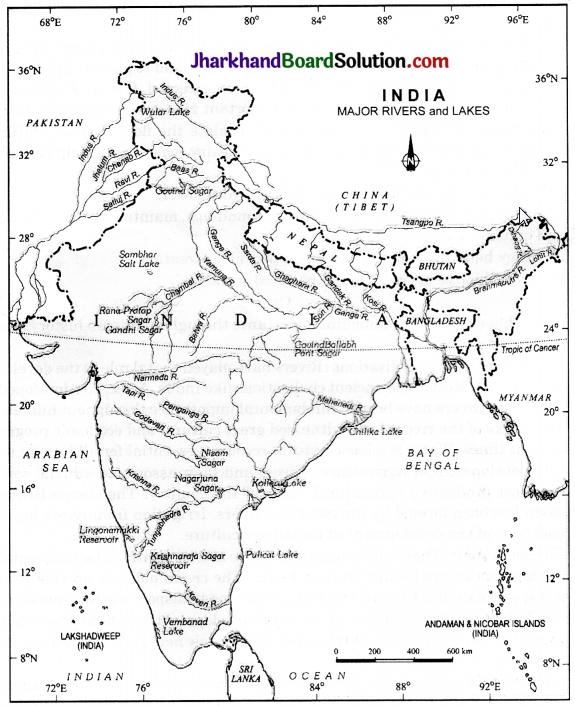
  2. Low food production leads to shortage of food in the affected areas.
  3. Due to shortage of food, prices go up. At such high prices, many people cannot afford to buy food.
  4. If such a calamity happens in a very widespread area or is stretched over a longer time period, it may cause a situation of starvation.
  5. A massive starvation might take the turn of famine.

Question 4.
What is a famine? How are people affected by a famine?
Answer:
A famine is characterised by widespread deaths due to starvation and epidemics caused by forced use of contaminated water or decaying food and loss of body re-sistance due to weakening from starvation. This occurs due to a severe shortage of . food resulting from crop failure or other calamity, which increases the price of food, making it unaffordable to the weaker sections of the population.

Question 5.
Why is food security needed in India?
Answer:
The poorest section of the society might be food insecure most of the times while persons above the poverty line might also be food insecure when the country faces a national disaster like earthquake, drought, flood, tsunami, famine, etc. Even today, there are places like Kalahandi and Kashipur in Odisha where famine-like conditions have been existing for many years and where some starvation deaths have also been reported.

Starvation deaths have also been reported in Baran district of Rajasthan, Palamau district of Jharkhand and many other remote areas during the recent years.
Therefore, food security is needed in India to ensure food at all times.

JAC Class 9 Social Science Important Questions Economics Chapter 4 Food Security in India

Question 6.
Explain the impact of green revolution on food security in India.
Answer:
Following is the impact of green revolution on food security.

  1. It made India self sufficient in food production.
  2. After green revolution no food scarcity was felt even during adverse weather conditions.
  3. With the increase in per hectare crop production as well as extension of agri-cultural activities in disadvantaged areas, it ensured regular food supply.

Question 7.
What is the need of maintaining buffer stock?
Answer:
Maintenance of Buffer stock is required for the following reasons:

  1. It ensures continuous supply of commodities to fair-price shops.
  2. It is the stock of country which can be used during any calamity.
  3. It helps farmers to sell their surplus crop at a reasonable price.

Question 8.
Write a brief note on the national food security Act, 2013.
Answer:
The national food security Act, 2013 provides for food and nutritional security life at affordable prices and enables people to live their life with dignity. Under this act 75 percent of the rural population and 50 percent of the urban population have been categorised as eligible households for food security aid.

Question 9.
What are the three kinds of ration cards?
Answer:
The three kinds of ration cards are as follows:
1. Antyodaya Cards:
Antyodaya cards for the poorest of the poor.

2. BPL Cards:
Below Poverty Line (BPL) cards for those who are below poverty line.

3. APL Cards:
Above Poverty Line (APL) cards for all others.

JAC Class 9 Social Science Important Questions Economics Chapter 4 Food Security in India

Question 10.
Explain any two types of PDS.
Answer:
Two types of PDS are as follows:
1. Revamped Public Distribution System (RPDS):
It was introduced in 1992 in 1,700 blocks in the country. The launch of RPDS was to provide the benefits of PDS to remote and backward areas.

2. Targetted Public Distribution System (TPDS): TPDS was introduced in June 1997 to adopt the principle of targetting the “poor in all areas”. It was for the first time that a differential price policy was adopted for poors and non-poor.

Question 11.
List any three characteristics of public distribution system.
Answer:
Following are the three characteristics of public distribution system.

  1. It procures grain from FCl and distributes it among the poorer sections of society.
  2. There are almost 5.5 lakh shops under this system reaching the farthest comer of country.
  3. It distributes food grains through ration card.

Question 12.
How do fair-price shops help food distribution in India?
Answer:
There are more than 5.5 lakh fair-price shops to help food distribution in India. They provide food stuff like wheat, rice, sugar, and kerosene oil on a monthly basis to ration card holders at lower than the market rates. These rates depend on the category of family, whether they are APL, BPL or Antyodaya families. This enables the poorer sections of society to have food security.

Question 13.
what is MSP? How does it help in food security?
Answer:
The Food Corporation of India (FCI) purchases wheat and rice for the government from the farmers of surplus states at pre-announced prices. This price is called minimum support price (MSP). It helps in ensuring food security in several ways:

  1. For farmers it gives surety to their crop price and encourages them to grow certain crops.
  2. For government, it ensures that they have enough crop to buy for their buffer stock and public welfare programmes.
  3. For public, this ensures that prices of a commodity will be stable and within their reach.

IV. Long Answer Type Questions

Question 1.
Describe the measures adopted by the government of India to achieve self-sufficiency in food grains;
Answer:
Following measures were adopted by government of India to achieve self-sufficiency in food grains.
1. India adopted a new strategy in agriculture, which resulted in green revolution especially in the production of wheat and rice.

2. The government of India has made the provision of buffer stock meant to dis-tribute food grains in the deficit areas and among the poorer strata of society at a price lower than the market price. This also helps to resolve the problem of shortage of food during adverse weather conditions or during the periods of calamity.

3. The government has made provision of Public Distribution System (PDS). This is meant for distribution of food grains trough government regulated ration shops (Fair price shops) among the poorer sections of the society.

4. The government has also initiated other food intervention programmes like Integrated Child Development Services (ICDS), Food-for-Work programme (FFW), Mid-Day meals, Antyodaya Anna Yojana (AAY) etc.

JAC Class 9 Social Science Important Questions Economics Chapter 4 Food Security in India

Question 2.
Explain two special schemes launched by the government in 2000.
Answer:
In 2000, two special schemes were launched viz. Antyodaya Anna Yojana and the Annapurna Scheme with special target groups of ‘poorest of the poor’ and ‘indigent senior citizens’, respectively. The functioning of these two schemes was linked with the existing network of the PDS.

1. Antyodaya Anna Yojana (AAY):
This scheme was launched in December 2000. Under the scheme one crore of the poorest among the BPL families covered under the Targetted Public Distribution System were identified. Poor families were identified by the respective state rural development departments through a Below Poverty Line (BPL) survey.

Twenty-five kilograms of food grains were made available to each eligible family at a highly subsidised rate of ₹ 2 per kg for wheat and ₹ 3 per kg for rice. This quantity has been enhanced from 25 to 35 kgs with effect from April 2002. The scheme has been further expanded twice to additional 50 lakh BPL families in June 2003 and in August 2004. With this increase, 2 crore families have been covered under the AAY.

2. Annapurna Scheme:
Annapurna Scheme (APS) was introduced in 2000 as Public Distribution Scheme to support indigent senior citizens with 10 kilograms of food grains free of cost.

JAC Class 9 Social Science Important Questions

JAC Class 9 Social Science Important Questions Economics Chapter 3 Poverty as a Challenge

JAC Board Class 9th Social Science Important Questions Economics Chapter 3 Poverty as a Challenge

I. Objective Type Questions

1. In India, approximately how many people live in poverty?
(a) 30 crore
(b) 27 crore
(c) 20.2 core
(d) 88.3 crore.
Answer:
(b) 27 crore

2. In rural areas, average calories required person per day are
(a) 2100 calories
(b) 3000 calories
(c) 2400 calories
(d) 1700 calories.
Answer:
(c) 2400 calories

3. The average number of calories required per person per day in urban areas of India are
(a) 3000 calories
(b) 2400 calories
(c) 2900 calories
(d) 2100 calories.
Answer:
(d) 2100 calories.

4. Which of the following states of India has the highest poverty ratio?
(a) Odisha
(b) Bihar
(c) Uttar Pradesh
(d) Assam
Answer:
(b) Bihar

5. When was the Rural Employment Generation programme (REGP) launched?
(a) In 1992
(b) In 2005
(c) In 1993
(d) In 1995
Answer:
(d) In 1995

II. Very Short Answer Type Questions

Question 1.
What is Poverty?
Answer:
Poverty refers to a situation in which a person is not able to get the minimum basic necessities of life, e.g. food, clothing, shelter, etc. for his or her sustenance.

JAC Class 9 Social Science Important Questions Economics Chapter 3 Poverty as a Challenge

Question 2.
What is one of the biggest challenges of independant India?
Answer:
One of the biggest challenges of independent India is to bring millions of its people out of abject poverty.

Question 3.
What did Mahatma Gandhi always emphasize?
Answer:
Mahatma Gandhi always emphasized that India would be truly independent only when the poorest of its people become free of human suffering.

Question 4.
Name some social indicators through which poverty is seen.
Answer:

  1. Illiteracy,
  2. Lack of general resistance due to malnutrition,
  3. Lack of access to healthcare,
  4. Lack of job opportunities,
  5. Lack of access to safe drinking water, sanitation, etc.

Question 5.
Define vulnerability to poverty?
Answer:
Vulnerability to poverty is a measure which describes the greater probability of certain communities or individuals becoming or remaining poor in the coming years.

Question 6.
What is poverty line?
Answer:
Poverty line is an imaginary line used by any country to determine its poverty level.

Question 7.
When is a person considered poor?
Answer:
A person is considered poor if his or her income or consumption level falls below a given “minimum level” necessary to fulfil the basic needs.

Question 8.
What is considered when determining the poverty line in India?
Answer:
While determining the poverty line in India a minimum level of food requirement, clothing, footwear, fuel and light, educational and medical requirement, etc. are determined for subsistence.

Question 9.
Why is the calorie requirement of people higher in rural areas as compared to urban areas?
Answer:
The calorie requirement of people in rural areas in higher because the rural people are engaged in more physical labour than people in urban areas.

JAC Class 9 Social Science Important Questions Economics Chapter 3 Poverty as a Challenge

Question 10.
What is the accepted average calorie requirement in India?
Answer:
The accepted average calorie requirement in India is 2400 calories per person per day in rural areas and 2100 calories per person per day in urban areas.

Question 11.
Which agency conducts the periodical sample surveys for estimating the poverty line in India?
Or
Which organization in India carries the periodical survey for the estimation of poverty?
Answer:
Poverty line is estimated periodically by the National Sample Survey Organisation (NSSO) by conducting sample surveys, generally after every 5 years.

Question 12.
What is the full form of NSSO?
Answer:
The full form of NSSO is National Sample Survey Organisation.

Question 13.
Which are the most Vulnerable groups of poverty?
Answer:
Scheduled castes, scheduled tribes, rural agricultural labour households and urban casual labour households are vulnerable to poverty.

Question 14.
What was the percentage of people living below the poverty line in 2011-12 in India.
Answer:
In 2011-12, 22 per cent of the population was living below the poverty line in India.

Question 15.
Name the two poorest states in India.
Answer:

  1. Bihar
  2. Odisha.

Question 16.
Name five states having the highest percentage of people below poverty line.
Answer:

  1. Bihar,
  2. Odisha,
  3. Assam,
  4. Madhya Pradesh,
  5. Uttar Pradesh.

JAC Class 9 Social Science Important Questions Economics Chapter 3 Poverty as a Challenge

Question 17.
Name five states having the least percentage of people below poverty line.
Answer:

  1. Kerala,
  2. Himachal Pradesh,
  3. Punjab,
  4. Andhra Pradesh,
  5. Haryana.

Question 18.
How have states like Punjab and Haryana been successful in reducing poverty?
Answer:
States like Punjab and Haryama have been successful in reducing poverty with high agricultural growth rates.

Question 19.
By what method has the state of West Bergal reduced poverty?
Answer:
Proper implementation of land reforms have helped to reduce poverty in West Bengal.

Question 20.
Why has Kerala succeeded in reducing poverty?
Answer:
By focusing more on human resource development.

Question 21.
Which standard is used by the World Bank for the estimation of poverty line?
Answer:
The World Bank uses a uniform standard for poverty line, which is the minimum income of the equivalent of $ 1.90 per person per day.

Question 22.
Why is World Bank important in estimating poverty line?
Answer:
Different countries have different poverty lines as per their existing level of devel¬opment. The World Bank compares countries by presenting a uniform standard for poverty line which is acceptable to all countries.

JAC Class 9 Social Science Important Questions Economics Chapter 3 Poverty as a Challenge

Question 23.
List some countries having the highest percentage of people below poverty line.
Answer:

  1. Nigeria,
  2. Bangladesh,
  3. India,
  4. Pakistan,
  5. China.

Question 24.
Name any two causes of poverty in India.
Answer:

  1. Low level of economic development during British rule,
  2. Inefficient administration.

Question 25.
The current anti-poverty strategy of the government is based broadly on two planks Mention these.
Or
The present anti-poverty strategy of the Government of India is broadly based on what factors?
Answer:
The present anti-poverty strategy of the Government of India is broadly based on two planks :

  1. Promotion of economic growth
  2. targetted anti-poverty programmes.

Question 26.
Name any two anti-poverty programs.
Answer:

  1. Prime Minister Rozgar Yojana (PMRY)
  2. Swarna Jayanti Gram Swarozgar Yojana (SGSY).

Question 27.
Write the full form of MNREGA.
Answer:
Full form of MNREGA is Mahatma Gandhi National Rural Employment Guarantee Act.

Question 28.
Which act guarantees minimum 100 days employment per person per year in rural areas?
Answer:
Mahatma Gandhi National Rural Employment Guarantee Act.

Question 29.
When was MNREGA passed?
Answer:
MNREGA was passed in September 2005.

JAC Class 9 Social Science Important Questions Economics Chapter 3 Poverty as a Challenge

Question 30.
Which scheme has been started to create self-employment opportunities for educated unemployed youth in rural areas?
Answer:
Prime Minister Rozgar Yojana (PMRY).

III. Short Answer Type Questions

Question 1.
How is poverty seen by social scientists?
Answer:
Poverty as seen by social scientists in the following way:

  1. Poverty relates to the level of income and consumption.
  2. Apart from this, poverty is looked at through other social indicators like illiteracy level, lack of general resistance due to malnutrition, lack of access to healthcare, lack of job opportunities, lack of access to safe drinking weather, sanitation, etc.

Question 2.
What is social exclusion? Explain with an example.
Answer:
Social exclusion is a process through which individuals or groups are excluded from facilities, benefits and opportunities that others enjoy.
Example: The caste system in India in which people belonging to certain castes are” excluded from equal opportunities.

Question 3.
Does poverty line vary with time and place?
Answer:
Yes, poverty line may vary with time and place. A person is considered poor, if his or her income or consumption level falls below a given minimum level that is necessary to satisfy basic needs. What is necessary to satisfy basic needs is different at different times and in different countries. Therefore, poverty line may vary with time and place.

Example: A person not having a car in the USA may be considered poor but in India owning a car is still considered a luxury.

Question 4.
What are the calories and rupees fixed for rural and urban areas for measuring the poverty line?
Answer:
The poverty line fixed for the rural and urban areas in India in the year 2012 was ₹ 186 and ₹ 100 per person per day for urban and rural areas, respectively. It is higher in urban areas because of higher prices of many essential commodities in urban centres. The accepted average calories requirement in India is 2400 calories in rural areas and 2100 in urban areas. It is high in the rural areas because of more physical work done by the rural people.

JAC Class 9 Social Science Important Questions Economics Chapter 3 Poverty as a Challenge

Question 5.
Briefly explain the principle measures taken in Punjab, Haryana, Kerala and West Bengal to reduce poverty.
Answer:
1. Punjab and Haryana:
These states have succeeded in reducing poverty due to high agricultural growth.

2. Kerala:
It has succeeded in reducing poverty by investing on human resource development. Kerala has the highest literacy rate in the country.

3. West Bengal:
In West Bengal land reform measures have helped in reducing poverty.

Question 6.
How are sociocultural and economic factors responsible for poverty in India?
Answer:
1. Sociocultural causes of poverty: In order to fulfil social obligations and observe religious ceremonies, most people in India including the very poor spend a lot of money. This takes them back to poverty.

2. Economic Causes of Poverty: Small farmers need money to buy agricultural inputs like seeds, fertilizer, pesticides etc. Since poor people hardly have any savings, they borrow money and when there is crop failure they become indebted. This takes pusher them into poverty.

Question 7.
Which circumstances compelled the government to start targetted anti-poverty programmes?
Answer:
Following circumstances compelled the government to start targetted anti-poverty programmes:

  1. Since the poor are not able of take advantage of the opportunities created for them, the growth in the agriculture sector is much below expectations.
  2. In agriculture sector, a large number of poor people are unemployed for most part of the year, therefore, the need for targetted anti-poverty programmes was felt.

Question 8.
Give the main feature of Rural Employment Generation Programme.
Answer:
Rural Employment Generation Programme (REGP) was launched in 1995. The main features of REGP are:

  1. Creation of self-employment opportunities in rural areas and towns.
  2. Creation of 25 lakh near Jobs under the tenth five-year plan.

Question 9.
Why were the poverty alleviation programmes not successful in most parts of India?
Answer:
The poverty alleviation programmes were not successful in most parts of India for these reasons:

  1. Lack of proper implementation and right targetting.
  2. There has been a lot of overlapping of schemes.
  3. Every year a huge number is added to the population pool of the country. This makes schemes ineffective.
  4. Despite good intentions, the benefits of these schemes do not fully reach to the deserving poor.

IV. Long Answer Type Questions

Question 1.
Analyse poverty on the basis of social exclusion and vulnerability.
Answer:
The analysis of poverty is based on social exclusion and vulnerability as follows:
1. Social exclusion:
Social exclusion means living in a poor surroundings with poor people, excluded from enjoying social equality of better off people in better surrounding. In India, Caste system is based on social exclusion. People belonging to certain castes were prevented from enjoying equal facilities, benefits and opportunities. This caused more poverty than that caused by lower income.

2. Vulnerability:
Vulnerability to poverty is a measure, which describes the greater probability of certain communities becoming or remaining poor in the coming years, e.g. members of a backward caste or individuals like widows, physically handicapped persons and so on. Vulnerability is determined by various options available to different communities in terms of assets, education, job, healthcare, etc. and analyses their ability to face various risks like natural disasters.

JAC Class 9 Social Science Important Questions Economics Chapter 3 Poverty as a Challenge

Question 2.
Explain the main features of the global poverty scenario.
Answer:
Following are the main features of global poverty scenario:

  1. The priducortion of people in developing countries living in extreme economic poverty defined by the World Bank as living on less than $ 1.90 per day has come down from from 36 per cent in 1990 to 10 per cent in 2015.
  2. Poverty J.eclined substantially in China and South-East Asian countries as a result ox rapid economic growth and massive investment in human resource development.
  3. In the countries of South Asia: India, Pakistan, Sri Lanka, Nepal, Bangladesh, Bhutan, the decline has also been rapid-34 per cent in 2005 to 16.2 per cent in 2013.
  4. In sub-Saharan Africa, poverty in fact declined from 51 per cent in 2005 to 41 per cent in 2005.
  5. In Latin America, the ratio of poverty has also declined from 10 per cent in 2005 to 4 per cent in 2015.
  6. Poverty has also resurfaced in some of the former socialist countries like Russia, where officially it was non-existent earlier.

Question 3.
“There is a strong link between economic growth and poverty reduction” Explain the statement.
Answer:
It is clear that there is a strong link between economic growth and poverty reduction. The higher growth rates have helped significantly in the reduction of poverty. In the 1980s, India’s economic growth was one of the fastest in the world. The growth rate rose from the average of about 3.5% a year in the 1970s to about 6 percent during the 1980s and 1990s.

Economic growth widens opportunities and provides the resources needed to invest in human development. This also encourages people to send their children, including the girl child, to schools in the hope of getting better economic returns from investing in education. Thus, it can be concluded that there is a strong link between economic growth and poverty reduction.

Question 4.
Describe any four poverty alleviation programmes currently being implemented in India.
Or
Describe any four anti-poverty programmes.
Answer:
Following are the four major poverty alleviation programmes implemented by the
Government of India.
1. Mahatma Gandhi National Rural Employment Guarantee Act (MNREGA)

  1. This act was passed in September 2005.
  2. This act provides 100 days assured employment every year to every rural household.
  3. It also aims at sustainable development by addressing the cause of drought, deforestation and soil erosion.
  4. One-third of the proposed jobs have been reserved for women.
  5. The scheme provided employment to 220 crore mandays of employment to 4.78 crore households.
  6. The range of wage rate for different states and union territories lies in between ₹ 281 per day to ₹ 168 per day.

2. Prime Minister Rozgar Yojana (PMRY) .

  1. This programme was launched in 1993.
  2. It is aimed at providing self-employment opportunities to educated unemployed youth in the rural and small towns.
  3. Under this programme, scheduled banks provide loans at a lower interest rate to start small businesses and set up industries.

3. Rural Employment Generation Programme (REGP)

  1. This programme was launched in 1995.
  2. The aim of the programme is to provide self-employment opportunities to educated unemployed youth in the rural areas and small towns.
  3. A target for creating 25 Lakh new Jobs has been set for this programme under the Tenth five-year plan.

4. Pradhan Mantri Gramodaya Yojana (PMGY)

  1. This programme was launched in 2000.
  2. Under this programme, the Central Government provides additional assistance to the State Government for improving basic services in the village.
  3. The major basic services covered under this programme are primary health, primary education, rural shelter, rural drinking water and rural electrification.

JAC Class 9 Social Science Important Questions Economics Chapter 3 Poverty as a Challenge

Question 5.
Review the future challenges in the context of poverty in India.
Answer:
Despite many plans to reduce poverty in India, the main reason for its partial success is lack of proper implementation and proper targetting. The benefits of these schemes could not be passed on to the poor, even after a good deal of sincere efforts have been made. Poverty has come down due to the implementation of many schemes, but the biggest problem of completely eradicating poverty is still standing before us.

Wide disparities in poverty are visible between rural and urban areas and among . different states. Certain social and economic groups are more vulnerable to poverty. Further, poverty should include not only the factor of adequate amount of food, but also other factors like education, healthcare, shelter, job security, gender equality, dignity and so on. These give as the true concept of human poverty.Poverty reduction is expected to be more effective in next 10-15 years.

In addition to anti-poverty measures, government should focus on the following to reduce poverty:

  1. Higher economic growth
  2. Universal free elementary education,
  3. Decrease in population
  4. Empowerment of women and weaker sections.

The official definition of poverty, however, captures only a limited part of what poverty really means to people. It is about a “minimum subsistence level of living rather than a “reasonable” level of living. Many scholars advocate that we must broaden the concept into human poverty. A large number of people many have been able to feed themselves.

But do they have education? or shelter? or healthcare? or job security? or self confidence? Are they free from caste and gender discrimination? Is the practice of child labour still common? World wide experience shows that with development, the definition of poverty is always a moving target.

Hopefully, we will be able to provide the minimum “necessary” in terms of only income to all people by the end of the next decade. But the target will move on for many of the bigger challenges that still remain: Providing healthcare, education and job security for all, and achieving gender equality, and dignity for the poor.

JAC Class 9 Social Science Important Questions