JAC Class 10 Maths Important Questions Chapter 3 दो चरों वाले रखिक समीकरण का युग्म

Jharkhand Board JAC Class 10 Maths Important Questions Chapter 3 दो चरों वाले रखिक समीकरण का युग्म Important Questions and Answers.

JAC Board Class 10th Maths Important Questions Chapter 3 दो चरों वाले रखिक समीकरण का युग्म

लघुत्तरात्मक / निबन्धात्मक प्रश्न :

प्रश्न 1.
एक कक्षा में विद्यार्थियों को पंक्तियों में खड़ा किया जाता है। यदि एक पंक्ति में एक विद्यार्थी को अतिरिक्त खड़ा किया जाए तो पंक्तियों की संख्या 2 कम हो जाती है और यदि एक पंक्ति में एक विद्यार्थी कम खड़ा किया जाय तो पंक्तियों की संख्या 3 बढ़ जाती है। कक्षा कुल विद्यार्थियों की संख्या ज्ञात कीजिए।
हल :
माना कि मूल पंक्तियों की संख्या x है तथा मूलतः प्रत्येक पंक्ति में y विद्यार्थी खड़े किये जाते हैं।
विद्यार्थियों की कुल संख्या = x × y = xy
अब यदि एक पंक्ति में i विद्यार्थी अतिरिक्त खड़ा किया जाये तो एक पंक्ति में विद्यार्थियों की संख्या (y + 1) हो जायेगी तथा दिये गये प्रतिबन्ध से पंक्तियों की संख्या (x – 2) हो जायेगी।
अतः विद्यार्थियों की कुल संख्या
= (y + 1) (x – 2)
∴ (y + 1) (x – 2) = x × y
⇒ xy – 2y + x – 2 = xy
⇒ x – 2y = 2 ……..(1)
पुन: एक पंक्ति में एक विद्यार्थी कम खड़ा किया जाता है तो एक पंक्ति में विद्यार्थियों की संख्या (y – 1) होगी तथा प्रश्न में दिये गये प्रतिबन्ध के अनुसार पंक्तियों की संख्या (x + 3) हो जायेगी।
अतः विद्यार्थियों की कुल संख्या
= (y – 1) (x + 3)
∴ (y – 1) (x + 3) = xy
⇒ xy + 3y – x – 3 = xy
⇒ 3y – x – 3 = 0
⇒ x – 3y = – 3 ……..(2)
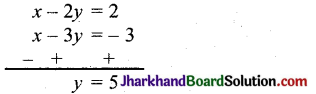
समीकरण (1) में से (2) को घटाने पर,
JAC Class 10 Maths Important Questions Chapter 3 दो चरों वाले रखिक समीकरण का युग्म - 1
समीकरण (1) में y का मान रखने पर,
x – 2 × 5 = 2
⇒ x = 2 + 10
∴ x = 12
कक्षा में विद्यार्थियों की कुल संख्या = (xy)
= 12 × 5 = 60.

JAC Class 10 Maths Important Questions Chapter 3 दो चरों वाले रखिक समीकरण का युग्म

प्रश्न 2.
k का मान ज्ञात कीजिए ताकि निम्न समीकरण युग्म का कोई हल नहीं हो
(3k + 1)x + 3y – 2 = 0
(k² + 1)x + (k – 2)y – 5 = 0
हल :
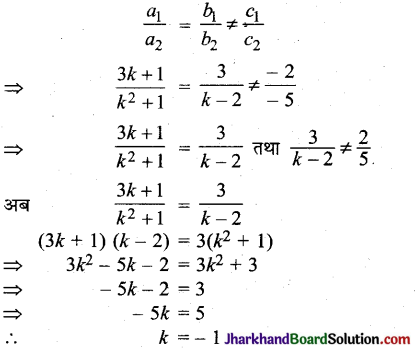
दिए गए समीकरण युग्म का कोई हल नहीं होने के लिए प्रतिबन्ध
JAC Class 10 Maths Important Questions Chapter 3 दो चरों वाले रखिक समीकरण का युग्म - 2
k = – 1 के लिए निम्न वक्तव्य सही है-
\(\frac{3}{k-2}\) ≠ \(\frac{2}{5}\)
अतः दिए गए समीकरण का कोई हल नहीं होगा। यदि k = – 1 है।

प्रश्न 3.
अशोक ने एक टेस्ट में 65 अंक अर्जित किए, जब उसे प्रत्येक सही उत्तर पर 5 अंक मिले तथा प्रत्येक गलत उत्तर पर 2 अंक की कटौती की गई। यदि उसे सही उत्तर पर 3 अंक मिलते तथा प्रत्येक गलत उत्तर पर 1 अंक कटता, तो अशोक 40 अंक अर्जित करता। इस समस्या को बीजगणितीय रूप में व्यक्त कर ग्राफ विधि से हल कीजिए। टेस्ट में कुल कितने प्रश्न थे ?
हल :
माना अशोक द्वारा सही हल किये गये प्रश्नों की संख्या = x
गलत हल किये गये प्रश्नों की संख्या = y
बीज गणितीय निरूपण – पहली शर्त के अनुसार,
⇒ 5x – 2y = 65 …….(1)
दूसरी शर्त के अनुसार,
3x – y = 40 ……………(2)
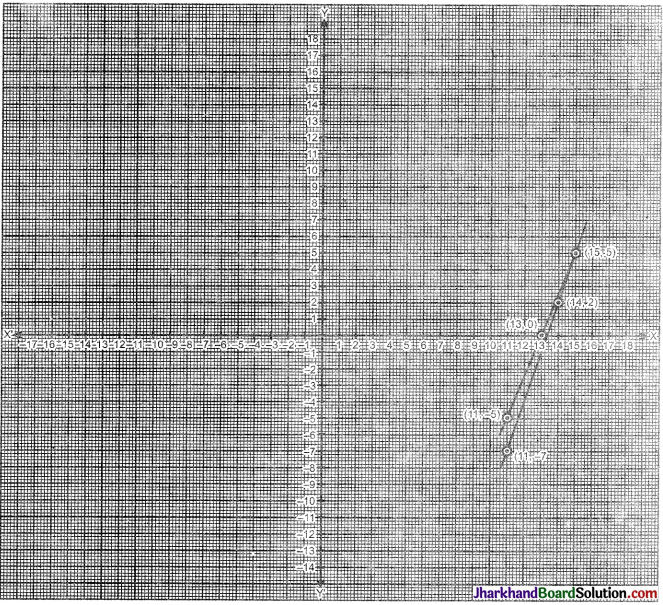
ज्यामितीय निरुपण – समी. (1) से
5x – 2y = 65
x = \(\frac{65+2 y}{5}\)
y = – 5 रखने पर, x = \(\frac{65-10}{5}=\frac{55}{5}\) = 11
y = 0 रखने पर, x = \(\frac{65-0}{5}=\frac{65}{5}\) = 13
y = 5 रखने पर, x = \(\frac{65+10}{5}=\frac{75}{5}\) = 15
सारणी – I

x111315
y-505

समी. (2) से
3x – y = 40
x = \(\frac{40+y}{3}\)
y = – 7 रखने पर x = \(\frac{40-7}{3}=\frac{33}{3}\) = 11
y = 2 रखने पर x = \(\frac{40+2}{3}=\frac{42}{3}\) = 14
y = 5 रखने पर y = \(\frac{40+5}{3}=\frac{45}{3}\) = 15

सारणी – II

x111415
y-725

JAC Class 10 Maths Important Questions Chapter 3 दो चरों वाले रखिक समीकरण का युग्म - 3

आलेख से स्पष्ट है कि दिए गए समीकरण युग्म की दो सरल रेखाऐं बिन्दु (10, 5) पर काटती है।
x = 10, y = 5
टेस्ट में प्रश्नों की संख्या
= 10 + 5 = 15.

JAC Class 10 Maths Important Questions Chapter 3 दो चरों वाले रखिक समीकरण का युग्म

प्रश्न 4.
x तथा y के लिए हल कीजिए-
27x + 31y = 85.
31x + 27y = 89.
हल :
दी गयी समीकरणं है-
27x + 31y = 85 ………….(1)
31x + 27y = 89 ………….(2)
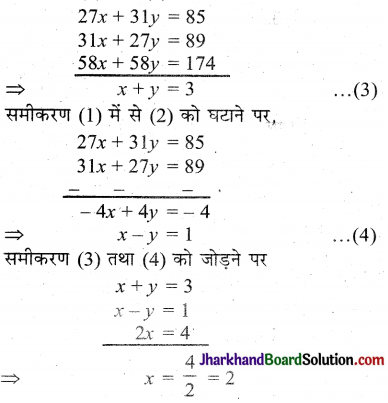
समीकरण (1) तथा (2) को जोड़ने पर,
JAC Class 10 Maths Important Questions Chapter 3 दो चरों वाले रखिक समीकरण का युग्म - 4
x का मान समीकरण (3) में रखने पर
2 + y = 3
⇒ y = 3 – 2 = 1
अतः x = 2 तथा y = 1 समीकरणों के अद्वितीय हल हैं।

प्रश्न 5.
एक तालाब को दो पाइपों द्वारा भरने में 12 घंटे लगते हैं। यदि बड़े व्यास वाले पाइप को 4 घन्टे तथा छोटे व्यास वाले पाइप को 9 घंटे प्रयोग किया जाता है तो तालाब का आधा भाग भरा जाता है। बताइये कितने समय में तालाब प्रत्येक पाइप द्वारा अलग-अलग भरा जायेगा।
हल :
माना बड़े व्यास वाला पाइप तालाब को x घंटे में तथा छोटे व्यास वाला पाइप y घंटे में भरता है।
∴ बड़े व्यास वाले पाइप द्वारा 1 घंटे में भस गया भाग = \(\frac{1}{x}\)
बड़े व्यास वाले पाइप द्वारा 4 घंटे भरा गया भाग = \(\frac{4}{x}\)
छोटे व्यास वाले पाइप द्वारा 1 घंटे में भरा गया भाग = \(\frac{1}{y}\)
छोटे व्यास वाले पाइप द्वारा 9 घंटे में भरा गया भाग = \(\frac{9}{y}\)
प्रश्नानुसार, \(\frac{4}{x}=\frac{9}{y}\) = \(\frac{1}{2}\) ……….(1)
और यदि दोनों पाइपों से तालाब 12 घंटे में भरा जाता है।
∴ \(\frac{12}{x}=\frac{12}{y}\) = 1 ……….(2)
माना कि \(\frac{1}{x}\) = a तथा \(\frac{1}{y}\) = b यह मान समीकरण (1) तथा (2) में रखने पर
4a + 9b = \(\frac{1}{2}\) ……….(3)
12a + 12b = 1 ……….(4)
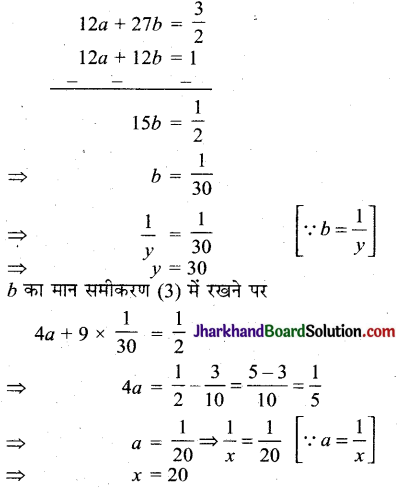
समीकरण (3) को 3 से गुणा करके इसमें से समीकरण (4) को घटाने पर
JAC Class 10 Maths Important Questions Chapter 3 दो चरों वाले रखिक समीकरण का युग्म - 5
अतः बड़े व्यास वाला पाइप 20 घन्टे तथा छोटे व्यास वाला पाइप 30 घंटे लेगा।

JAC Class 10 Maths Important Questions Chapter 3 दो चरों वाले रखिक समीकरण का युग्म

प्रश्न 6.
7 रबड़ और 5 पेन्सिलों का कुल मूल्य ₹ 58 है, जबकि 5 रबड़ और 6 पेन्सिलों का कुल मूल्य ₹ 56 है। इस समस्या को बीजगणितीय रूप में व्यक्त कर ग्राफ विधि से हल कीजिए ।
हल :
माना 1 रबड़ का मूल्य ₹ x तथा एक पेन्सिल का मूल्य ₹ y है।
प्रश्नानुसार,
∴ 7x + 5y = 58
तथा 5 रबड़ और 6 पेन्सिलों का कुल मूल्य = ₹ 56
⇒ 7x + 5y = 56
बीजगणितीय निरूपण
7x + 5y = 58 ……(1)
5x + 6y = 56 …….(2)
ज्यामितीय निरूपण:
समीकरण (1) से,
7x + 5y = 58
⇒ 5y = 58 – 7x
⇒ y = \(\frac{58-7 x}{5}\)
x = 4 रखने पर, y = \(\frac{58-7 \times 4}{5}=\frac{58-28}{5}\) = 6
x = – 1 रखने पर y = \(\frac{58-7 \times(-1)}{5}=\frac{58+7}{5}\) = 13
सारणी – I

x1113
y-50

समीकरण (2) से
5x + 6y = 56
⇒ 6у = 56 – 5x
⇒ y = \(\frac{56-5 x}{6}\)
x = – 2 रखने पर, y = \(\frac{56-5 \times(-2)}{6}=\frac{56+10}{6}\)
y = 11
x = 4 रखने पर y = \(\frac{56-5 \times 4}{6}=\frac{56-20}{6}\) = 6

सारणी – II

x1113
y-50

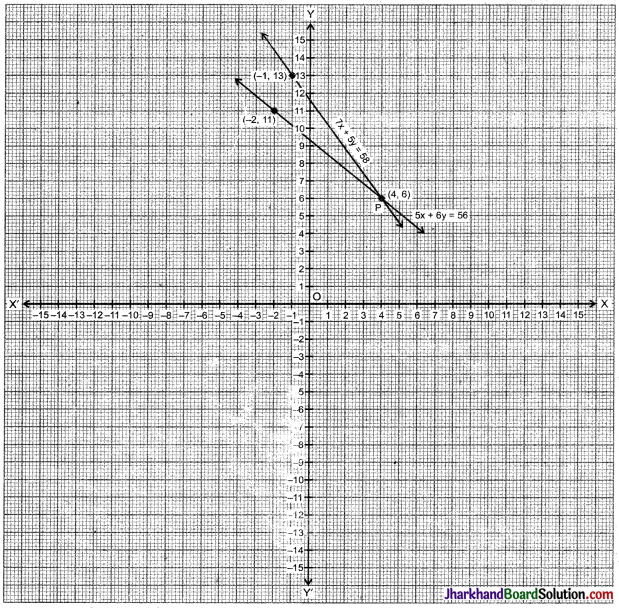
सारणी I और सारणी II से प्राप्त x और y के मानों का आलेखन करने पर हमें निम्न आलेख प्राप्त होता है।
JAC Class 10 Maths Important Questions Chapter 3 दो चरों वाले रखिक समीकरण का युग्म - 6
आलेख से स्पष्ट है कि दोनों रैखिक समीकरणों से प्राप्त सरल रेखाएँ बिन्दु P(4, 6) पर प्रतिच्छेदित होती हैं।
∴ x = 4 तथा y = 6
अतः एक रबड़ का मूल्य = ₹ 4 तथा एक पेन्सिल का मूल्य = ₹ 6

JAC Class 10 Maths Important Questions Chapter 3 दो चरों वाले रखिक समीकरण का युग्म

प्रश्न 7.
अभ्यास पुस्तिका और 3 पेन्सिलों का कुल मूल्य 17 रूपए है, जबकि 3 अभ्यास पुस्तिका और 4 पेन्सिलों का कुल मूल्य 24 रूपए है। इस समस्या को बीजगणितीय रूप में व्यक्त कर ग्राफ विधि से हल कीजिए।
हल :
माना एक अभ्यास पुस्तिका का मूल्य ₹ x तथा एक पेन्सिल का मूल्य ₹ y है।
प्रश्नानुसार,
2 अभ्यास पुस्तिका और 3 पेन्सिलों का मूल्य = ₹ 17
⇒ 2x + 3y = 17
3 अभ्यास पुस्तिका और 4 पेन्सिलों का मूल्य 3x + 4y = ₹ 24
⇒ 3x + 4y = 24
बीजगणितीय निरूपण :
2x + 3y = 17 …….(1)
3x + 4y = 24 …….(2)
ज्यामितीय निरूपण :
समीकरण (1) से,
2x + 3y = 17
⇒ 3y = 17 – 2x
⇒ y = \(\frac{17-2 x}{3}\)
x = 1 रखने पर, y = \(\frac{17-2 \times 1}{3}=\frac{15}{3}\) = 5
x = 4 रखने पर, y = \(\frac{17-2 \times 4}{3}=\frac{9}{3}\) = 3
x = 7 रखने पर, y = \(\frac{17-2 \times 57}{3}=\frac{3}{3}\) = 1
सारणी – I

x111315
y-505

समीकरण (2) से,
3x + 4y = 24
⇒ 4y = 24 – 3x
⇒ y = \(\frac{24-3 x}{4}\)
x = 0 रखने पर y = \(\frac{24-3 \times 0}{4}=\frac{24}{4}\) = 6
x = 4 रखने पर y = \(\frac{24-3 \times 4}{4}=\frac{12}{4}\) = 3
x = 8 रखने पर y = \(\frac{24-3 \times 8}{4}=\frac{0}{4}\) = 0

सारणी – II

x111315
y-505

सारणी I और सारणी II से प्राप्त x और y के मानों का आलेखन करने पर हमें निम्न आलेख प्राप्त होता है :
JAC Class 10 Maths Important Questions Chapter 3 दो चरों वाले रखिक समीकरण का युग्म - 7
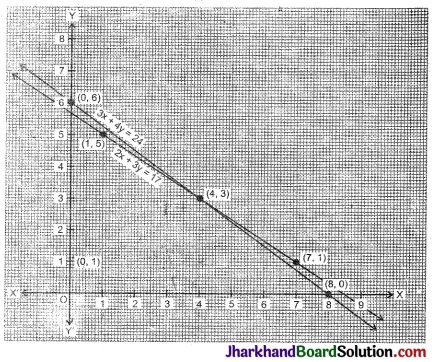
आलेख से स्पष्ट है कि दोनों रैखिक समीकरणों से प्राप्त सरल रेखाएँ बिन्दु (4, 3) पर प्रतिच्छेद करती हैं।
∴ x = 4 तथा y = 3
अतः एक पुस्तिका का मूल्य = ₹ 4
तथा एक पेन्सिल का मूल्य = ₹ 3

प्रश्न 8.
एक रेलगाड़ी एक निश्चित दूरी एक समान चाल से तय करती है। यदि यह रेलगाड़ी 6 किमी / घंटा तेज चाल से चलती तो यह निश्चित समय से 4 घंटे कम लेती तथा यदि 6 किमी / घंटा धीमी चाल से चलती तो यह निश्चित समय से 6 घंटे अधिक लेती। यात्रा की निश्चित दूरी ज्ञात कीजिए।
हल :
माना रेलगाड़ी की चाल x किमी / घंटा तथा लिया गया समय y घंटे हैं।
∴ रेलगाड़ी द्वारा तय की गई दूरी = चाल × समय = x × y = xy किमी
तेज चलने पर रेलगाड़ी की चाल = (x + 6) किमी / घंटा
रेलगाड़ी द्वारा लिया गया समय = (y – 4) घंटे
अब, दूरी = (x + 6) (y – 4)
⇒ xy = xy – 4x + 6y – 24
⇒ 4x – 6y = – 24 ………..(1)
धीमी गति से चलने पर रेलगाड़ी की चाल = (x – 6) किमी / घंटा
समय = (y + 6) घंटे
अब, दूरी = चाल × समय
⇒ xy = (x – 6) × (y + 6)
⇒ xy = xy + 6x – 6y – 36
⇒ – 6x + 6y = – 36 ………..(2)
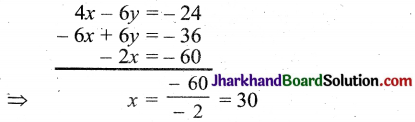
समीकरण (1) और समीकरण (2) को जोड़ने पर
JAC Class 10 Maths Important Questions Chapter 3 दो चरों वाले रखिक समीकरण का युग्म - 8
समीकरण (1) में x = 30 रखने पर
4 × 30 – 6y = 24
⇒ – 6y = – 24 – 120
⇒ y = \(\frac{-144}{-6}\) = 24
अत: रेलगाड़ी की चाल = 30 किमी / घंटा
रेलगाड़ी द्वारा लिया गया समय = 24 घंटे
तथा रेलगाड़ी द्वारा तय की गई दूरी = 30 × 24
= 720 किमी

JAC Class 10 Maths Important Questions Chapter 3 दो चरों वाले रखिक समीकरण का युग्म

प्रश्न 9.
दो संपूरक कोणों में से बड़े कोण का मान छोटे कोण के मान से 18° अधिक है। दोनों कणों के मान ज्ञात कीजिए ।
हल :
माना दिए गए कोण A तथा B हैं।
दिए है,
∠A = ∠B + 18° ………(i)
∵ ∠A व B संपूरक कोण हैं,
∴ ∠A + ∠B = 180°
[∵ संपूरक कोणों का योग 180° होता है]
समीकरण (i) से,
∠B + 18° + ∠B = 180°
2∠B = 162°
∠B = 81°
∴ अभीष्ठ ∠A = 81° + 18° = 99°
अतः अभीष्ट कोण 99° तथा 81° होगे।

प्रश्न 10.
सुमित की आयु उसके बेटे की आयु की तीन गुनी है। पाँच वर्षा के बाद, उसकी आयु अपने बेटे की आयु की ढ़ाई गुना हो जाएगी। इस समय सुमित की आयु कितने वर्ष है?
हल :
माना सुमित की वर्तमान आयु x वर्ष तथा उसके पुत्र की वर्तमान आयु y वर्ष है।
प्रश्नानुसार, x = 3y ………(i)
पाँच वर्ष बाद, सुमीत की आयु = (x + 5)
पाँच वर्ष बाद, पुत्र की आयु = (y + 5)
प्रश्नानुसार, x + 5 = 2\(\frac{1}{2}\)(y + 5) …………(ii)
समीकरण (i) का मान समीकरण (ii) में रखने पर,
3y + 5 = \(\frac{5}{2}\)(y + 5)
3y + 5 = \(\frac{5y}{2}=\frac{25}{2}\)
3y – \(\frac{5y}{2}\) = \(\frac{25}{2}\) – 5
\(\frac{6 y-5 y}{2}=\frac{25-10}{2}\)
\(\frac{y}{2}=\frac{15}{2}\)
समीकरण (i) से,
y = 15 वर्ष
x = 3 × 15 = 45 वर्ष
अतः सुमित की वर्तमान आयु 45 वर्ष तथा उसके पुत्र की वर्तमान आयु 15 वर्ष है।

प्रश्न 11.
एक पिता की आयु अपने दो बच्चों की आयु के योग के तीन गुने के समान है। 5 वर्ष के पश्चात् उसकी आयु बच्चों की आयु के योग के दुगुने के समान होगी। पिता की वर्तमान आयु ज्ञात कीजिए।
हल :
माना, पिता की वर्तमान आयु x वर्ष है तथा उसके दोनों बच्चों की वर्तमान आयु का योग y वर्ष है।
प्रश्नानुसार,
x = 3y …………….(i)
पाँच वर्ष बाद, पिता की आयु = x + 5
पाँच वर्ष बाद पुत्रों की आयु = (y + 5 + 5)
प्रश्नानुसर,
x + 5 = 2 (y + 5 + 5)
x + 5 = 2 ( y + 10 ) …………(ii)
x = 3y, समीकरण (ii) में रखने पर,
3y + 5 = 2y + 20
y = 15 वर्ष
अब, y = 15 समीकरण (i) में रखने पर,
x = 3 × 15
x = 45 वर्ष
अतः पिता की वर्तमान आयु 45 वर्ष है।

JAC Class 10 Maths Important Questions Chapter 3 दो चरों वाले रखिक समीकरण का युग्म

प्रश्न 12.
एक भिन्न \(\frac{1}{3}\) हो जाती है, अब उसके अंश से 2 घटाया जाता है, और \(\frac{1}{2}\) वह हो जाती है, जब हर में से 1 घटाया जाए। वह भिन्न ज्ञात कीजिए।
हल :
मान कि भिन्न \(\frac{x}{y}\) है
प्रश्नानुसार, \(\frac{x-2}{y}\) = \(\frac{1}{3}\) …………(i)
तथा \(\frac{x}{y-1}\) = \(\frac{1}{2}\)
⇒ 2x = y – 1
⇒ 2x + 1 = y …………(ii)
समीकरण (i) में y = 2x + 1, रखने पर,
\(\frac{x-2}{2 x+1}=\frac{1}{3}\)
3x – 6 = 2x + 1
x = 7
अब, समीकरण (ii) में x = 7 रखने पर,
y = 2 × 7 + 1
y = 15
अतः अभीष्ट भिन्न \(\frac{7}{15}\) है।

प्रश्न 13.
5 पेंसिलों तथा 7 पेनों का कुल मूल्य ₹ 250 है जबकि 7 पेंसिलों तथा 5 पेनों का कुल मूल्य ₹ 302 है। एक पेंसिल तथा एक पेन का मूल्य ज्ञात कीजिए।
हल :
माना एक पेंसिल का मूल्य ₹ तथा एक पेन का मूल्य ₹ y है।
प्रश्नानुसार,
5x + 7y = 250 ……..(1)
7x + 5y = 302 ………(2)
समीकरण (1) को 5 से तथा समीकरण (2) को 7 से गुणा करने पर
25x + 35y = 1250 ……..(3)
49x + 35y = 2114 ……..(4)
समीकरण (4) में समीकरण (3) घटाने पर
JAC Class 10 Maths Important Questions Chapter 3 दो चरों वाले रखिक समीकरण का युग्म - 9
समीकरण (1) में x = 36 रखने पर,
5 × 36 + 7y = 250
7y = 250 – 180
y = \(\frac{70}{7}\) = 10
अत: एक पेंसिल का मूल्य = ₹ 36
तथा एक पेन का मूल्य = ₹ 10

प्रश्न 14.
निम्नलिखित समीकरण युग्म को व्रज-गुणन विधि से हल कीजिए:
x – 3y – 7 = 0
3x – 5y – 15 = 0
हल :
दिया गया समीकरण युग्म
x – 3y – 7 = 0
3x – 5y – 15 = 0
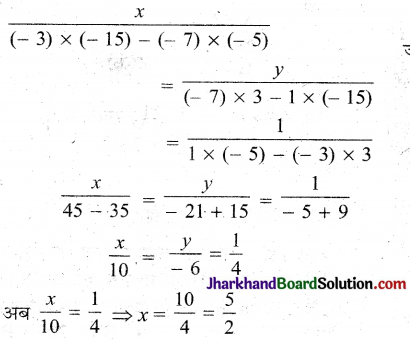
व्रज गुणन विधि से,
JAC Class 10 Maths Important Questions Chapter 3 दो चरों वाले रखिक समीकरण का युग्म - 10
तथा \(\frac{y}{-6}=\frac{1}{4}\) ⇒ y = \(\frac{-6}{4}=\frac{-3}{2}\)
अत: x = \(\frac{5}{2}\) और y = \(\frac{-3}{2}\)

JAC Class 10 Maths Important Questions Chapter 3 दो चरों वाले रखिक समीकरण का युग्म

प्रश्न 15.
दो संख्याओं का अन्तर 26 है तथा बड़ी संख्या, छोटी संख्या के तीन गुने से 4 अधिक है। संख्याएँ ज्ञात कीजिए।
हल :
माना दो संख्याएँ x और y हैं। यहाँ x > y है।
प्रश्नानुसार x – y = 26 ………(i)
तथा x = 3y +4 ………..(ii)
समीकरण (ii) x = 3y + 4 समीकरण (i) में रखने पर
3y + 4 – y = 26
⇒ 2y = 26 – 4
⇒ y = \(\frac{22}{2}\) = 11
समीकरण (i) में y = 11 रखने पर,
x – 11 = 26
⇒ x = 26 + 11 = 37
अत: संख्याएँ 37 और 11 हैं।

प्रश्न 16.
x और y के मान ज्ञात कीजिए :
\(\frac{2}{x}+\frac{3}{y}\) = 13
\(\frac{5}{x}-\frac{4}{y}\) = – 2
हल :
माना \(\frac{1}{x}\) = a तथा \(\frac{1}{y}\) = b, तब दिए गए समीकरण निम्न प्रकार से होगे :
2a + 3b = 13 …………(i)
5a – 4b = – 2 …………(ii)
समीकरण (i) को 4 से तथा (ii) को उसे गुणा करके जोड़ने पर,
8a + 12b = 52
15a – 12b = – 6
23a = 46
⇒ a = \(\frac{46}{23}\) = 2
समीकरण (i) में a = 2 रखने पर,
2 × 2 + 3b = 13
⇒ 3b = 13 – 4 = 9
⇒ b = \(\frac{9}{3}\) = 3
अब a = \(\frac{1}{x}\) ⇒ \(\frac{1}{x}\) = 2 ⇒ x = \(\frac{1}{2}\)
और b = \(\frac{1}{y}\) ⇒ \(\frac{1}{y}\) = 3 ⇒ y = \(\frac{1}{3}\)
अतः x = \(\frac{1}{2}\) तथा y = \(\frac{1}{3}\)

प्रश्न 17.
k के किन मानों (किस मान) के लिए निम्न समीकरणों के युग्म का एक अद्वितीय हल है :
x + 2y = 5 और 3x + ky + 15 = 0
हल :
दिया है, समीकरण युग्मः
x + 2y = 5
और 3x + ky + 15 = 0
दिए गए समीकरणों के युग्म की समीकरणों a1x + b1y + c1 = 0 तथा a2x + b2y + c2 = 0 से तुलना करने पर,
a1 = 1, b1 = 2, c = – 5, a2 = 3, b2 = k, c2 = 15
∵ दिए गए युग्म का एक अद्वितीय हल है,
∴ \(\frac{a_1}{a_2}\) ≠ \(\frac{b_1}{b_2}\)
अर्थात् \(\frac{1}{3}\) ≠ \(\frac{2}{k}\)
k ≠ 6
अत: 6 के अतिरिक्त, k के प्रत्येक मान के लिए दिए हुए समीकरणों के युग्म का एक अद्वितीय हल होगा।

JAC Class 10 Maths Important Questions Chapter 3 दो चरों वाले रखिक समीकरण का युग्म

प्रश्न 18.
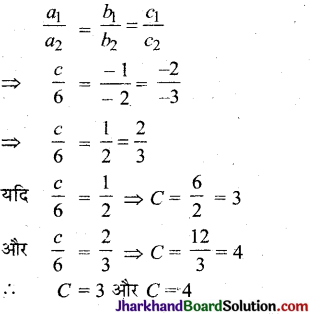
c का मान कीजिए, यदि समीकरण निकाय cx + 3y + (3 – c) = 0, 12x + cy – c = 0 के अपरिमित रूप से अनेक हल हैं।
हल :
दिए गए समीकरण हैं :
cx + 3y + (3 – c) = 0
तथा 12x + cy – c = 0
दिए गए समीकरण युग्म की समीकरण युग्म a1x + b1y + c1 = 0 तथा a2x + b2y + c2 = 0 से तुलना करने पर,
a1 = c, b1 = 3, c1 = 3 – c
तथा a2 = 12, b2 = c, c2 = – c
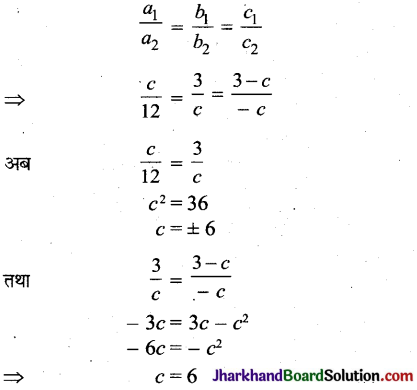
रैखिक समीकरणों के युग्म के अपरिमित रूप से अनेक हल होने के लिए शर्त:
JAC Class 10 Maths Important Questions Chapter 3 दो चरों वाले रखिक समीकरण का युग्म - 11

प्रश्न 19.
K का मान ज्ञात कीजिए यदि समीकरण निकाय 2x + 3y = 7, (k + 1) x + (2k – 1) y = 4k + 1 के अपरिमित रूप से अनेक हल हैं।
हल :
दिए गए समीकरणों का निकाय है:
2x + 3y = 7
तथा (k + 1) x + (2k – 1)y = 4k + 1
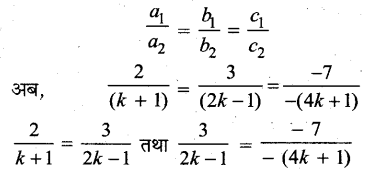
जहाँ, a1 = 2, b1 = 3, तथा c1 = – 7
और a2 = (k + 1), b2 = (2k – 1) तथा c2 = – (4k + 1)
रैखिक समीकरणों के युग्म के अपरिमित रूप में अनेक हल होने के लिए शर्त
JAC Class 10 Maths Important Questions Chapter 3 दो चरों वाले रखिक समीकरण का युग्म - 12
⇒ 4k – 2 = 3k + 3
4k – 3k = 3 + 2
k = 5
तथा 12k + 3 = 14k – 7
12k – 14k = – 7 – 3
– 2k = – 10
k = 5
अतः k = 5 है।

रिक्त स्थानों की पूर्ति कीजिए :

प्रश्न (क)

  1. दो चरों वाले रैखिक समीकरण का आलेख सदैव एक ………………. रेखा को निरूपित करता है।
  2. वह समीकरण युग्म जिसका हल अद्वितीय होता है, रैखिक समीकरणों का ………….. युग्म कहलाता है।
  3. वह समीकरण युग्म जिसका कोई हल नहीं है, रैखिक समीकरणों का ………………… युग्म कहलाता है।
  4. k का वह मान जिसके लिए समीकरण निकाय x + 2y = 3 तथा 5x + ky = 7 का कोई हल नहीं है, है ……………..
  5. ………………… विधि में दोनों समीकरणों के दो चरों में से एक चर के गुणांक के समान करके विलुप्त कर दूसरे चर का मान ज्ञात करते हैं।

हल :

  1. सरल,
  2. संगत,
  3. असंगत,
  4. 10 या ± \(\frac{14}{3}\)
  5. विलोपन

JAC Class 10 Maths Important Questions Chapter 3 दो चरों वाले रखिक समीकरण का युग्म

निम्न कथनों में सत्य / असत्य बताइए :

प्रश्न (ख)

  1. दो चरों वाले रैखिक समीकरण का आलेख सदैव एक सरल रेखा को निरूपित करता है।
  2. x और y के मानों से सम्बद्ध कोई भी युग्म जो दोनों समीकरणों को सन्तुष्ट करता हो, युग्म का शून्यक कहलाता है।
  3. प्रतिच्छेदी रेखाओं के अनन्त हल होते हैं।
  4. संपाती रेखाओं का केवल एक हल होता है।
  5. समांतर रेखाओं का निकाय असंगत होता है।

हल :

  1. सत्य,
  2. सत्य,
  3. असत्य,
  4. असत्य,
  5. सत्य

(ग) बहुविकल्पीय प्रश्न :

प्रश्न 1.
k का वह मान जिसके लिए समीकरण निकाय x + y – 4 = 0 तथा 2x + ky = 3 का कोई हल नहीं है, है:
(A) – 2
(B) ≠ 2
(C) 3
(D) 2
हल :
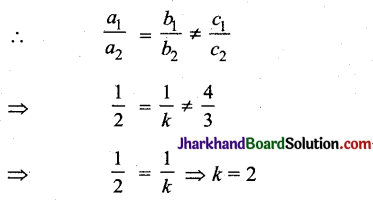
दिया है, निकाय का कोई हल नहीं है।
JAC Class 10 Maths Important Questions Chapter 3 दो चरों वाले रखिक समीकरण का युग्म - 13
अत: सही विकल्प (D) है।

JAC Class 10 Maths Important Questions Chapter 3 दो चरों वाले रखिक समीकरण का युग्म

प्रश्न 2.
K का वह मान जिनके लिए रैखिक समीकरण युग्म kx + y = k² तथा x + ky = 1 के अपरिमित रूप से अनेक हल हैं, है:
(A) ± 1
(B) 1
(C) – 1
(D) 2
हल :
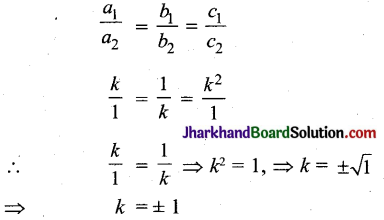
अपरिमित रूप से अनेक हल के लिए शर्त :
JAC Class 10 Maths Important Questions Chapter 3 दो चरों वाले रखिक समीकरण का युग्म - 14
अतः सही विकल्प (A) है।

प्रश्न 3.
k का वहमान जिसके लिए रैखिक समीकरण निकाय x + 2y = 3, 5x + ky + 7 = 0 असंगत है, है :
(A) \(\frac{-14}{3}\)
(B) \(\frac{2}{5}\)
(C) 5
(D) 10
हल :
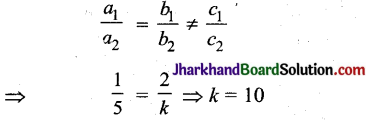
रैखिक समीकरण निकाय के लिए अंसगत होने के लिए शर्त्त :
JAC Class 10 Maths Important Questions Chapter 3 दो चरों वाले रखिक समीकरण का युग्म - 15
अत: सही विकल्प (D) है।

प्रश्न 4.
रैखिक समीकरणों y = 0 तथा y = – 6 के युग्म का एक:
(A) अद्वितीय हल है
(B) कोई हल नहीं है
(C) अनेक हल हैं
(D) सिर्फ एक हल (0, 0) है
हल :
सही विकल्प (B) है।

JAC Class 10 Maths Important Questions Chapter 3 दो चरों वाले रखिक समीकरण का युग्म

प्रश्न 5.
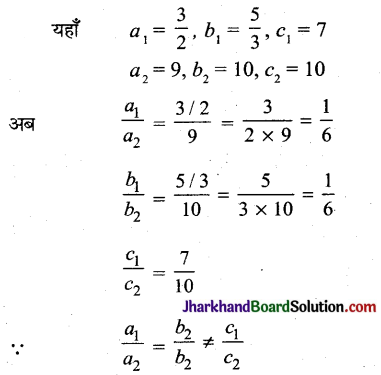
रैखिक समीकरणों \(\frac{3 x}{2}+\frac{5 y}{3}\) = 7 तथा 9x + 10y = 10 का युग्म :
(A) संगत है
(B) असंगत है
(C) संगत है तथा सिर्फ एक हल है।
(D) संगत है तथा अनेक हल हैं
हल :
JAC Class 10 Maths Important Questions Chapter 3 दो चरों वाले रखिक समीकरण का युग्म - 16
अतः सही विकल्प (B) है।

प्रश्न 6.
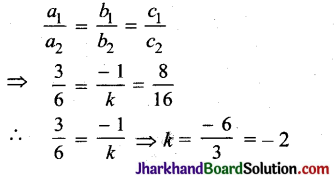
k का मान जिसके लिए समीकरण 3x – y + 8 = 0 तथा 6x + ky = – 16 संपाती रेखाओं को व्यक्त करें, है:
(A) –\(\frac{1}{2}\)
(B) \(\frac{1}{2}\)
(C) 2
(D) – 2
हल :
∵ संपाती रेखाओं के लिए शर्त :
JAC Class 10 Maths Important Questions Chapter 3 दो चरों वाले रखिक समीकरण का युग्म - 17
अत: सही विकल्प (D) है।

JAC Class 10 Maths Important Questions Chapter 3 दो चरों वाले रखिक समीकरण का युग्म

प्रश्न 7.
यदि रैखिक समीकरणों का कोई युग्म संगत हो, तो इसके आलेख की रेखाएँ होंगी :
(A) समांतर
(B) सदैव संपाती
(C) प्रतिच्छेदी या संपाती
(D) सदैव प्रतिच्छेदी
हल :
सही विकल्प (C) है।

प्रश्न 8.
समीकरण x = a और y = b का युग्म आलेखीय रूप से वे रेखाएँ निरूपित करता है, जो :
(A) समांतर हैं-
(B) (b, a) पर प्रतिच्छेद करती हैं।
(C) संपाती हैं
(D) (a, b) पर प्रतिच्छेद करती हैं
हल :
सही विकल्प (D) हैं।

प्रश्न 9.
आश्रित रैखिक समीकरणों के युग्म का एक समीकरण – 5x + 7 = 2 है। दूसरा समीकरण हो सकता है –
(A) 10x + 14y + 4 = 0
(B) – 10x – 14y + 4 = 0
(C) – 10x + 14y + 4 = 0
(D) 10x – 14y = – 4
हल :
सही विकल्प (D) है।

JAC Class 10 Maths Important Questions Chapter 3 दो चरों वाले रखिक समीकरण का युग्म

प्रश्न 10.
मेरी आयु पुत्र की आयु की तिगुनी है। 13 वर्ष बाद मेरी आयु पुत्र की आयु की दुगुनी रह जाएगी। मेरी और मेरे पुत्र की आयु बताइए-
(A) 39 वर्ष, 13 वर्ष
(B) 45 वर्ष, 15 वर्ष
(C) 30 वर्ष, 10 वर्ष
(D) 36 वर्ष, 12 वर्ष ।
हल :
मान लीजिए मेरी आयु (वर्षो में) x और मेरे पुत्र की आयु (वर्षो में) y है ।
प्रश्नानुसार, x = 3y ⇒ x – 3y = 0 … (i)
और x + 13 = 2(y + 13)
अर्थात् x – 2y = 26 – 13
⇒ x – 2y – 13 = 0
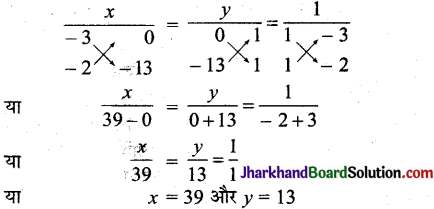
वज्रगुणन द्वारा समी. (i) व (ii) को हल करने पर
JAC Class 10 Maths Important Questions Chapter 3 दो चरों वाले रखिक समीकरण का युग्म - 18
अर्थात् मेरी आयु 39 वर्ष और मेरे पुत्र की आयु 13 वर्ष है।
अत: सही विकल्प (A) है।

प्रश्न 11.
दो अंकों वाली संख्या के अंकों का योगफल 7 है। अंकों का क्रम उलट देने पर प्राप्त संख्या पहली संख्या से 9 अधिक है। वह संख्या ज्ञात कीजिए :
(A) 43
(B) 34
(C) 52
(D) 25
हल :
मान लीजिए दी हुई संख्या में दहाई अंक x और इकाई अंक y है। तब
दी हुई संख्या = 10x + y
अंकों का क्रम उलटने पर संख्या = 10y + x
प्रश्नानुसार, x + y = 7 ⇒ x + y – 7 = 0 ………….(i)
और (10x + y) + 9 = 10y + x
और 9x – 9y + 9 = 0
या x – y + 1 = 0 ……(ii)
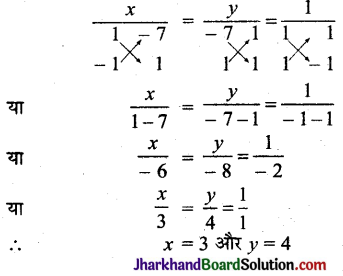
समी. (i) व (ii) को वज्रगुणन द्वारा हल करने पर,
JAC Class 10 Maths Important Questions Chapter 3 दो चरों वाले रखिक समीकरण का युग्म - 19
अतः अभीष्ट संख्या = 10x + y = 10 × 3 + 4 = 30 + 4 = 34 है।
सही विकल्प (B) है।

JAC Class 10 Maths Important Questions Chapter 3 दो चरों वाले रखिक समीकरण का युग्म

प्रश्न 12.
एक लड़के की आयु अभी अपनी माता की आयु की एक तिहाई है। यदि माता की वर्तमान आयु x वर्ष है तो 12 वर्ष बाद लड़के की आयु होगी :
(A) \(\frac{x}{3}\) + 12
(B) \(\frac{x+12}{3}\)
(C) x + 4
(D) \(\frac{x}{3}\) – 12
हल :
यहाँ माता की वर्तमान आयु = x वर्ष
माना पुत्र की वर्तमान आयु = y वर्ष
लेकिन प्रश्नानुसार, y = x × \(\frac{1}{3}\)
y = \(\frac{x}{3}\)
पुत्र की 12 वर्ष पश्चात् आयु = (y + 12) वर्ष
y = \(\frac{x}{3}\) रखने पर
अतः 12 वर्ष बाद लड़के की आयु = \(\frac{x}{3}\) + 12
सही विकल्प (A) है।

प्रश्न 13.
C के किस मान के लिए समीकरण युग्म Cx – y = 2 तथा 6x – 2y = 3 के अनन्त हल हैं:
(A) 3
(B) – 3
(C) – 12
(D) कोई मान नहीं
हल :
समीकरण युग्म को निम्न प्रकार लिखा जा सकता है :
Cx – y – 2 = 0 ……………(i)
तथा 6x – 2y – 3 = 0 ……………(ii)
समीकरण युग्म के अनन्त हल के लिए प्रतिबन्ध
JAC Class 10 Maths Important Questions Chapter 3 दो चरों वाले रखिक समीकरण का युग्म - 20
अत: विकल्प (D) सही है।

प्रश्न 14.
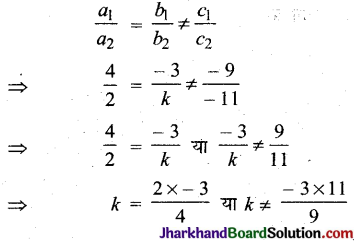
k के किस मान के लिए समीकरण युग्म 4x – 3y = 9, 2x + ky = 11 का कोई हल नहीं है-
(A) \(\frac{9}{11}\)
(B) \(\frac{1}{2}\)
(C) \(\frac{-3}{2}\)
(D) \(\frac{-2}{3}\)
हल :
दिया गया समीकरण युग्म है :
4x – 3y – 9 = 0, 2x + ky – 11 = 0
कोई हल न होने के लिए प्रतिबन्ध
JAC Class 10 Maths Important Questions Chapter 3 दो चरों वाले रखिक समीकरण का युग्म - 21
⇒ k = \(\frac{-3}{2}\) या k ≠ \(\frac{-11}{3}\)
अतः k = \(\frac{-3}{2}\)
अत: सही विकल्प (C) है।

JAC Class 10 Maths Important Questions Chapter 3 दो चरों वाले रखिक समीकरण का युग्म

प्रश्न 15.
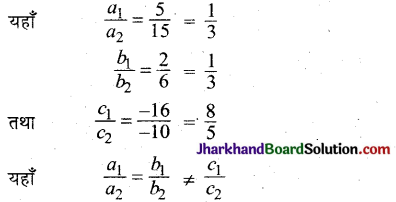
यदि समीकरणों 5x + 2y = 16 और 3x + \(\frac{6}{5}\)y = 2 का हल होगा :
(A) संगत
(B) असंगत
(C) दोनों (A) और (B)
(D) इनमें से कोई नहीं।
हल :
दिए गए समीकरण युग्म की निम्न प्रकार से भी लिख सकते हैं-
5x + 2y – 16 = 0 ……….(i)
15x + 6y – 10 = 0 ……….(ii)
JAC Class 10 Maths Important Questions Chapter 3 दो चरों वाले रखिक समीकरण का युग्म - 22
अतः दिए गए समीकरण युग्म का कोई हल नहीं है। दिया गया समीकरण युग्म असंगत है ।
सही विकल्प (B) है।

JAC Class 10 Maths Solutions Chapter 8 Introduction to Trigonometry Ex 8.4

Jharkhand Board JAC Class 10 Maths Solutions Chapter 8 Introduction to Trigonometry Ex 8.4 Textbook Exercise Questions and Answers.

JAC Board Class 10 Maths Solutions Chapter 8 Introduction to Trigonometry Exercise 8.4

Question 1.
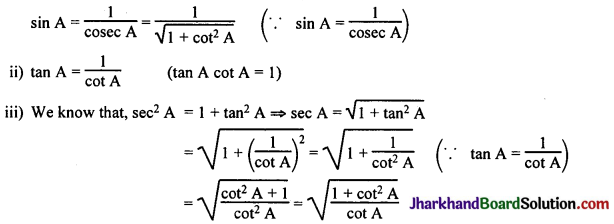
Express the trigonometric ratios sin A, sec A and tan A in terms of cot A.
Solution :
(i) We know that, cosec²A = 1 + cot² A ⇒ cosec A = \(\sqrt{1+\cot ^2 \mathrm{~A}}\)
JAC Class 10 Maths Solutions Chapter 8 Introduction to Trigonometry Ex 8.4 - 1

JAC Class 10 Maths Solutions Chapter 8 Introduction to Trigonometry Ex 8.4

Question 2.
Write all the other trigonometric ratios of ∠A in terms of sec A.
Solution :
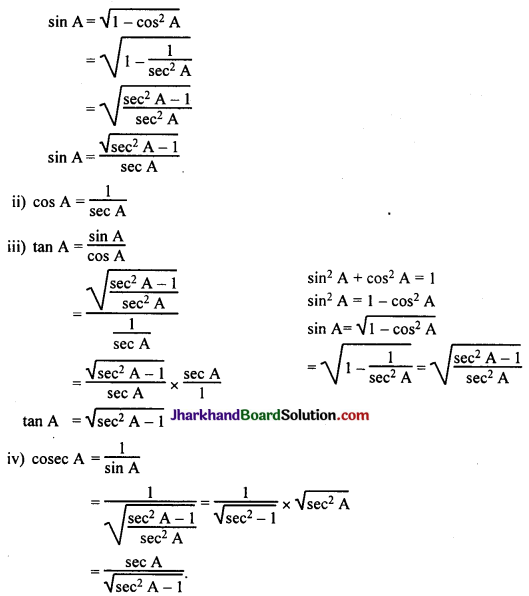
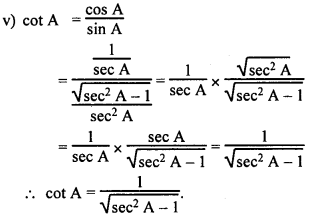
(i) sin A sin² A + cos² A = 1
sin² A = 1 – cos² A
JAC Class 10 Maths Solutions Chapter 8 Introduction to Trigonometry Ex 8.4 - 2
JAC Class 10 Maths Solutions Chapter 8 Introduction to Trigonometry Ex 8.4 - 3

Question 3.
Evaluate:
(i) \(\frac{\sin ^2 63^{\circ}+\sin ^2 27^{\circ}}{\cos ^2 17^{\circ}+\cos ^2 73^{\circ}}\)
(ii) sin 25° cos 65° + cos 25° sin 65°.
Solution :
(i) \(\frac{\sin ^2 63^{\circ}+\sin ^2 27^{\circ}}{\cos ^2 17^{\circ}+\cos ^2 73^{\circ}}\)
sin (90 – θ) = cos θ
sin (90 – 27°) = cos 27°
sin 63° = cos 27°
sin² 63 = cos² 27°

cos (90 – θ) = sin θ
cos (90° – 73°) = sin 73°
cos (17°) = sin 73°
cos² 17° = sin² 73°

(ii) sin 25° cos 65° + cos 25° sin 65°
sin (90° – θ) = cos θ
sin (90° – 25°) = cos 25°
sin (90° – 65°) = cos 65°
sin 25° = cos 65°

cos (90° – θ) = sin θ
cos (90° – 65°) = sin 65°
cos 25° = sin 65°

sin 25° = cos 65°
cos 65° . cos 65° + sin 65° . sin 65°
∴ cos² 65 + sin² 65 = 1

JAC Class 10 Maths Solutions Chapter 8 Introduction to Trigonometry Ex 8.4

Question 4.
Choose the correct option. Justify your choice.
(i) 9 sec² A – 9 tan² A=
(A) 1
(B) 9
(C) 8
(D) 0
Solution :
9 sec² A – 9 tan² A
9(1 + tan² A) – 9 tan² A
9 + 9 tan² A – 9 tan² A = 9.
∴ 9 sec² A – 9 tan² A = 9.

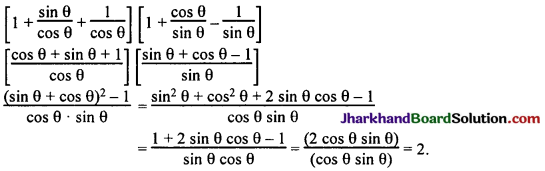
(ii) (1 + tan θ + sec θ) (1 + cot 0 – cosec θ) =
(A) 0
(B) 1
(C) 2
(D) – 1
Solution :
JAC Class 10 Maths Solutions Chapter 8 Introduction to Trigonometry Ex 8.4 - 4

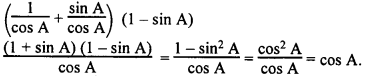
(iii) (sec A + tan A) (1 – sin A) =
(A) sec A
(B) sin A
(C) cosec A
(D) cos A
Solution :
JAC Class 10 Maths Solutions Chapter 8 Introduction to Trigonometry Ex 8.4 - 5

(iv) \(\frac{1+\tan ^2 A}{1+\cot ^2 A}\) =
(A) sec² A
(B) – 1
(C) cot² A
(D) tan² A
Solution :
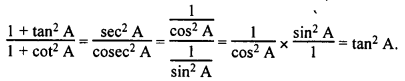
JAC Class 10 Maths Solutions Chapter 8 Introduction to Trigonometry Ex 8.4 - 6

Question 5.
Prove the following identities, where the angles involved are acute angles for which the expressions are defined.
Solution :
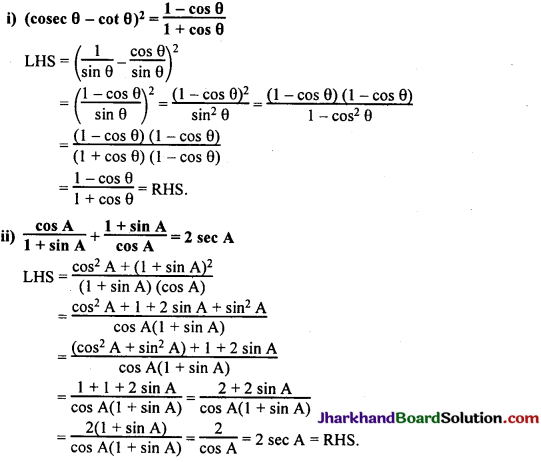
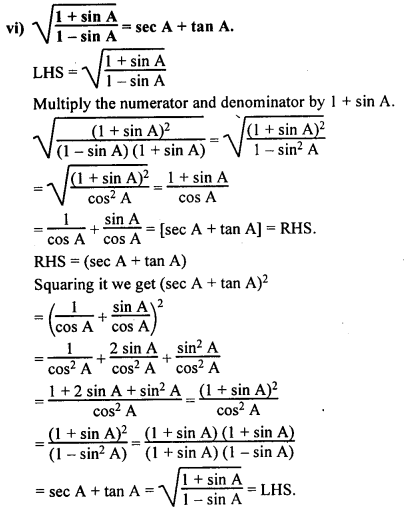
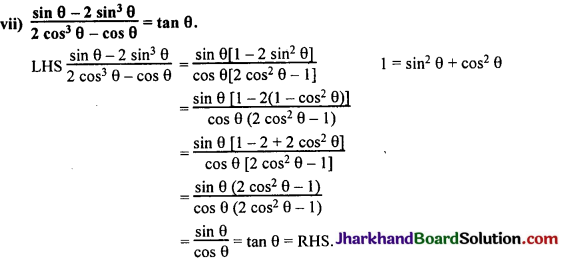
JAC Class 10 Maths Solutions Chapter 8 Introduction to Trigonometry Ex 8.4 - 7
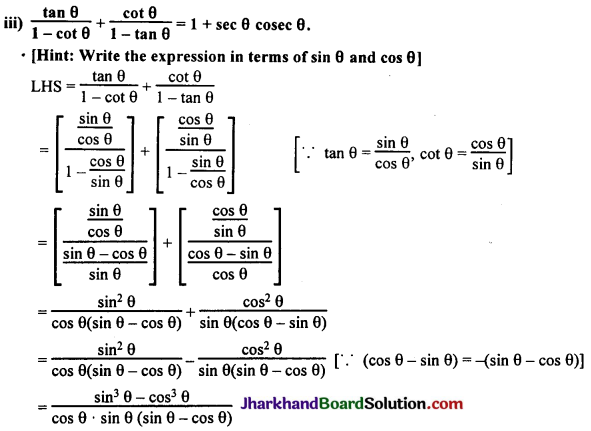
JAC Class 10 Maths Solutions Chapter 8 Introduction to Trigonometry Ex 8.4 - 8
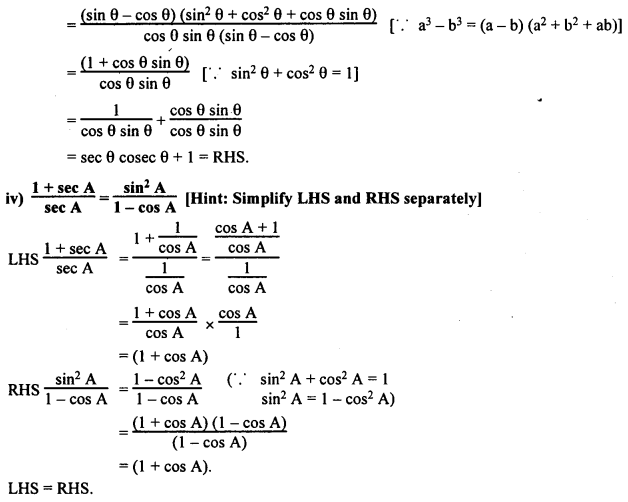
JAC Class 10 Maths Solutions Chapter 8 Introduction to Trigonometry Ex 8.4 - 9
JAC Class 10 Maths Solutions Chapter 8 Introduction to Trigonometry Ex 8.4 - 10
JAC Class 10 Maths Solutions Chapter 8 Introduction to Trigonometry Ex 8.4 - 11
JAC Class 10 Maths Solutions Chapter 8 Introduction to Trigonometry Ex 8.4 - 12

(viii) (sin A + cosec A)² + (cos A + sec A)² = 7 + tan² A + cot² A.

LHS = sin² A + cosec² A + 2 sin A cosec A + cos² A + sec² A + 2 cos A sec A [∵ (a + b)² = a² + b² + 2ab]
= (sin² A + cos² A) + (1 + cot² A) + 2 sin A . \(\frac{1}{sin A}\) + (1 + tan² A) + 2 cos A . \(\frac{1}{cos A}\) (∵ 1 + cot² A = cosec² A and sec² A = 1 + tan² A)
= 1 + 1 + cot² A + 2 + 1 + tan² A + 2 (∵ sin² A + cos² A = 1)
= 7 + tan² A + cot² A = RHS.

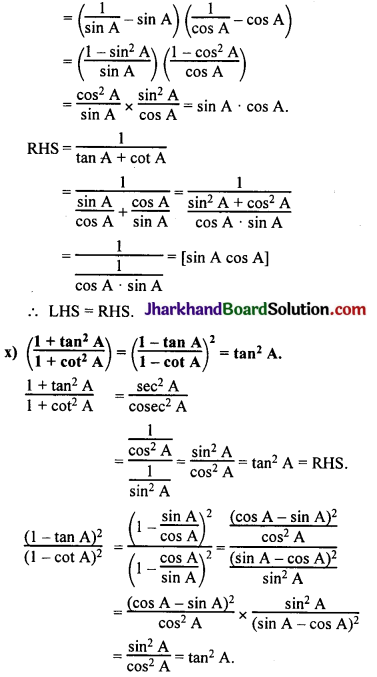
(ix) (cosec A – sin A) (sec A – cos A) = \(\frac{1}{\tan A+\cot A}\)
Solution :
[Hint: Simplify LHS and RHS separately].
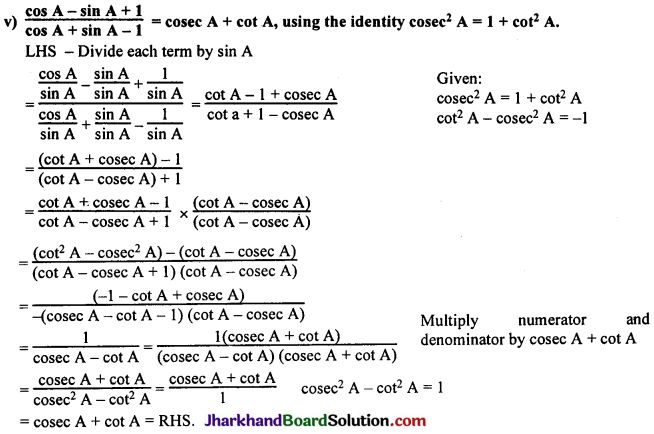
LHS = (cosec A – sin A) (sec A – cos A)
JAC Class 10 Maths Solutions Chapter 8 Introduction to Trigonometry Ex 8.4 - 13

JAC Class 10 Maths Solutions Chapter 11 Constructions Ex 11.1

Jharkhand Board JAC Class 10 Maths Solutions Chapter 11 Constructions Ex 11.1 Textbook Exercise Questions and Answers.

JAC Board Class 10 Maths Solutions Chapter 11 Constructions Exercise 11.1

In each of the following, give the justification of the construction also:

Question 1.
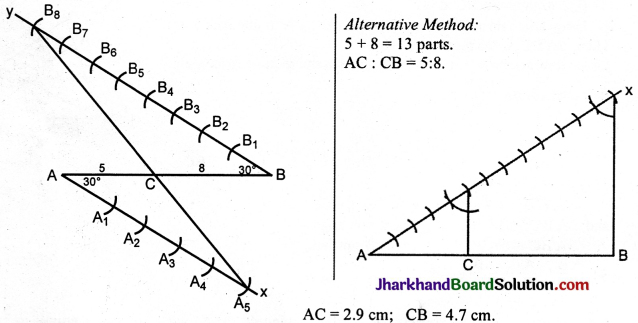
Draw a line segment of length 7.6 cm and divide it in the ratio 5 : 8. Measure the two parts.
Solution :
JAC Class 10 Maths Solutions Chapter 11 Constructions Ex 11.1 - 1
Steps of construction:
1. Draw the line segment AB = 7.6 cm.
2. At A, below AB, make an angle BAx = 30°.
3. At B, above AB, make an angle ABy = 30°.
B\(\hat{A}\)x = A\(\hat{B}\)y = 30°
These are alternate angles. ∴ Ax || By.
4. With a convenient radius cut off five equal parts
AA1 = A1A2 = A2A3 = A3A4 = A4A5 in Ax.
5. With the same radius cut off eight equal parts.
BB1 = B1B2 = B2B3 = B3B4 = B4B5 = B5B6 = B6B7 = B7B8.
6. Join A5B8. Let it cut AB at C.
AC : CB = 5 : 8.

In ΔACA5 and CBB8
1. A\(\hat{C}\)A5 = B\(\hat{C}\)B8 (V.O.A.)
2. C\(\hat{A}\)A5 = A\(\hat{B}\)B8 (Alternate angles)
3. C\(\hat{A}\)5A = B\(\hat{B}\)8C (Alternate angles)
Δs are equiangular.
∴\(\frac{\mathrm{AA}_5}{\mathrm{BB}_8}=\frac{\mathrm{CA}_5}{\mathrm{AB}_8}=\frac{\mathrm{CA}}{\mathrm{BC}}\)
∴ \(\frac{\mathrm{CA}}{\mathrm{BC}}=\frac{\mathrm{AA}_5}{\mathrm{BB}_8}=\frac{5}{8}\)

JAC Class 10 Maths Solutions Chapter 11 Constructions Ex 11.1

Question 2.
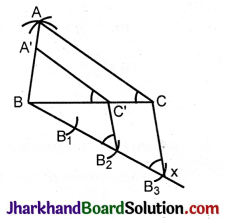
Construct a triangle of sides 4 cm, 5 cm and 6 cm and then a triangle similar to it whose sides are \(\frac{2}{3}\) of the corresponding sides of the first triangle.
Solution :
JAC Class 10 Maths Solutions Chapter 11 Constructions Ex 11.1 - 2
Steps of construction:

  1. Construct ΔABC given AB = 4 cm, BC = 5 cm, AC = cm.
  2. At B, make an acute angle CBx.
  3. Divide Bx into three equal parts with a convenient radius.
  4. Join B3C.
  5. From B2 draw a parallel to B3C.
  6. Let it cut BC at C’.
  7. At C’ make angle A’C’B = ACB.

Join A’C’.
∴ ΔABC ||| A’BC’.
JAC Class 10 Maths Solutions Chapter 11 Constructions Ex 11.1 - 3

In ΔABC and ΔA’BC’,
1.A\(\hat{B}\)C = A’\(\hat{B}\)C’ (Common angle)
2. A\(\hat{C}\)B = A’\(\hat{C’}\)B (Corresponding angles)
3. B\(\hat{A}\)C = B\(\hat{A’}\)C’ (Remaining angles)
Δs are equiangular.
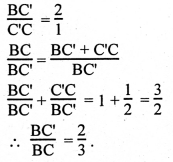
∴ \(\frac{\mathrm{AC}}{\mathrm{A}^{\prime} \mathrm{C}^{\prime}}=\frac{\mathrm{AB}}{\mathrm{A}^{\prime} \mathrm{B}^{\prime}}=\frac{\mathrm{BC}}{\mathrm{BC} \mathrm{C}^{\prime}}\) = \(\frac{3}{2}\) ∴ [latex]\frac{BC’}{BC}=\frac{2}{3}[/latex]

Question 3.
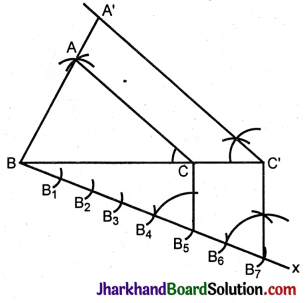
Construct a triangle with sides 5 cm, 6 cm and 7 cm and then another triangle whose sides are \(\frac{7}{5}\) of the corresponding sides of the first triangle.
Solution :
Steps of construction:

  1. Construct a triangle ABC given BC= 7 cm, AB = 5 cm, AC = 6 cm.
  2. At B, below BC, make an acute angle CBx.
  3. With a convenient radius cut off seven equal parts BB1 = B1B2 = B2B3 = B3B4 = B4B5 = B5B6 = B6B7.
  4. Join B5C.
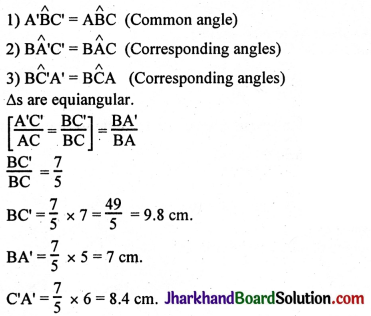
  5. From B1 draw a parallel to B5C to cut BC produced at C’.
  6. At C’ draw a parallel to CA to meet BA produced at A’.

JAC Class 10 Maths Solutions Chapter 11 Constructions Ex 11.1 - 4
A’BC’ is the required triangle.
In ΔABC and ΔA’BC’
JAC Class 10 Maths Solutions Chapter 11 Constructions Ex 11.1 - 5

JAC Class 10 Maths Solutions Chapter 11 Constructions Ex 11.1

Question 4.
Construct an isosceles triangle whose base is 8 cm and altitude 4 cm and then another triangle whose sides are 1\(\frac{1}{2}\) times the corresponding sides of the isosceles triangle.
Solution :
JAC Class 10 Maths Solutions Chapter 11 Constructions Ex 11.1 - 6
Steps of construction:

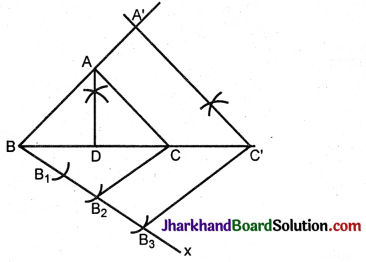
  1. Draw a line segment BC = 8 cm.
  2. Draw its perpendicular bisector.
  3. Cut off DA = 4 cm. (altitude given)
  4. Join AB and AC. ABC is the required triangle.
  5. At B, below BC, draw an acute angle CBx.
  6. With a convenient radius cut off three equal parts BB1 = B1B2 = B2B3.
  7. Join B2C.
  8. At B3 draw a parallel to B2C to meet BC extended at C’.
  9. At C’ draw a parallel to CA to meet BA produced at A’.
  10. Join A’C’. A’BC’ is the required triangle similar to ΔABC.

In ΔA’BC’ and ABC
1. A’\(\hat{B}\)C’ = A\(\hat{B}\)C (Common angle)
2. B\(\hat{A}\)‘C’ = B\(\hat{A}\)C (Corresponding angles)
3. A’\(\hat{C}\)‘B = A\(\hat{C}\)B
Δs are equiangular.
∴ \(\frac{\mathrm{A}^{\prime} \mathrm{C}^{\prime}}{\mathrm{AC}}=\frac{\mathrm{BC}}{\mathrm{BC}}=\frac{\mathrm{A}^{\prime} \mathrm{B}}{\mathrm{AB}}\)
\(\frac{BC’}{BC}\) = \(\frac{3}{2}\)
BC = 8 cm, BC’ = 8 × \(\frac{3}{2}\) = 12 cm.
BA = CA = 5.6 cm ∴ A’B = A’C’ = 5.6 × \(\frac{3}{2}\) = 8.4 cm.

Question 5.
Draw a triangle ABC with side BC = 6 cm, AB = 5 cm and ∠ABC = 60°. Then construct a triangle whose sides are \(\frac{3}{4}\) of the corresponding sides of the triangle ABC.
Solution :
JAC Class 10 Maths Solutions Chapter 11 Constructions Ex 11.1 - 7
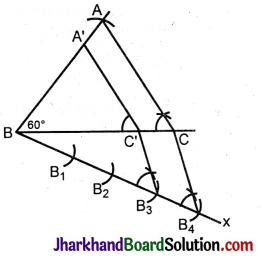
Steps of construction:

  1. Construct ΔABC given BC = 6 cm, AB = 5 cm, A\(\hat{B}\)C = 60°.
  2. At B, below BC, make an acute angle CBx.
  3. In Bx cut off four equal parts BB1 = B1B2 = B2B3 = B3B4
  4. Join B4C.
  5. From B3 draw a parallel to B4C to meet BC at C’.
  6. At C’ draw a parallel to CA to meet CA at A’.

A’BC’ is the required triangle similar to ΔABC.
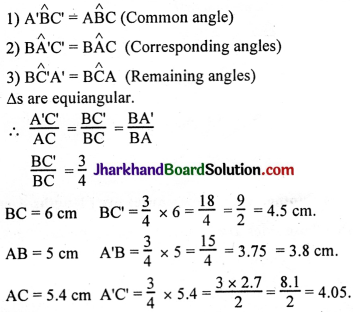
In Δs A’BC’ and ABC
JAC Class 10 Maths Solutions Chapter 11 Constructions Ex 11.1 - 8

JAC Class 10 Maths Solutions Chapter 11 Constructions Ex 11.1

Question 6.
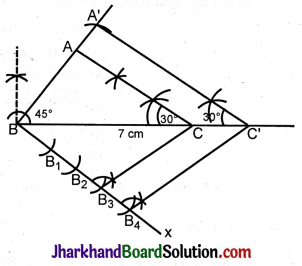
Draw a triangle ABC with side BC = 7 cm, ∠B = 45°, ∠A = 105°. Then, construct a triangle whose sides are \(\frac{4}{3}\) times the corresponding sides of ΔABC.
Solution :
JAC Class 10 Maths Solutions Chapter 11 Constructions Ex 11.1 - 9
\(\hat{A}\) + \(\hat{B}\) + \(\hat{C}\) = 180°
\(\hat{A}\) + \(\hat{B}\) = 150° (105° + 45°)
∴ \(\hat{C}\) = 30°
Steps of construction:
1. In ΔABC, BC = 7 cm.
\(\hat{B}\) = 45°, \(\hat{C}\) = 105°
∴ \(\hat{A}\) = 180° – 45° – 105°
= 180° – 150° = 30°.
Construct ΔABC given BC = 7 cm, \(\hat{B}\) = 45°, \(\hat{C}\) = 30°.
2. At B draw an acute angle CBx.
3. In Bx cut off four equal parts BB1 = B1B2 = B2B3 = B3B4 with a convenient radius.
4. Join B3C.
5. At B4 draw a parallel to B3C to meet BC produced at C’.
6. At C’ make angle of 30° equal to A\(\hat{C}\)B. Let it meet BA produced at A’.
A’BC’ is the required triangle similar to ΔABC.
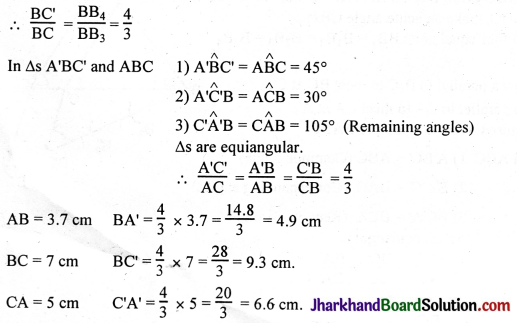
In ΔC’BB4 CB3 || C’B4
JAC Class 10 Maths Solutions Chapter 11 Constructions Ex 11.1 - 10

Question 7.
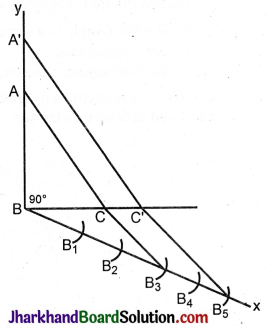
Draw a right triangle in which the sides (other than hypotenuse) are of lengths 4 cm and 3 cm. Then construct another triangle whose sides are \(\frac{5}{3}\) times the corresponding sides of the given triangle.
Solution :
JAC Class 10 Maths Solutions Chapter 11 Constructions Ex 11.1 - 11
BC’ = \(\frac{5}{3}\) × BC = \(\frac{5}{3}\) × 3 = 5 cm
BA’= \(\frac{5}{3}\) × 4 = \(\frac{20}{3}\) = 6.6 cm
A’C’ = \(\frac{5}{3}\) × 5 = \(\frac{25}{3}\) = 8.3 cm.

Steps of construction:

  1. Construct ΔABC given BC= 3 cm, \(\hat{B}\) = 90°, BA = 4 cm.
  2. At B, make an acute angle CBx.
  3. Cut off five equal parts BB1 = B1B2 = B2B3 = B3B4 = B4B5 along Bx with a convenient radius.
  4. Join B3C.
  5. At B5 draw a parallel to B3C to meet BC produced at C’.
  6. At C’ draw a parallel to CA to meet BA produced at A’.

A’BC’ is the required triangle similar to ΔABC.
BC’ : BC = BB5 = BB3
\(\frac{\mathrm{BC}^{\prime}}{\mathrm{BC}}=\frac{\mathrm{BB}_5}{\mathrm{BB}_3}\) = \(\frac{5}{3}\)

In Δs A’BC’ and ABC
1. A’\(\hat{B}\)C’ = A\(\hat{B}\)C = 90°
2. B\(\hat{A}\)‘C’ = B\(\hat{A}\)C (Corresponding angles)
3. B\(\hat{C}\)‘A’ = B\(\hat{C}\)A
Δs are equiangular.
∴ \(\frac{A’C’}{AC}\) = \(\frac{BC’}{BC}\) = \(\frac{BA’}{BA}\) = \(\frac{5}{3}\)

JAC Class 9 Social Science Important Questions Geography Chapter 6 Population 

JAC Board Class 9th Social Science Important Questions Geography Chapter 6 Population

I. Objective Type Questions

1. What is the counting of people in a country known as?
(a) census
(b) migration
(c) birth rate
(d) death rate.
Answer:
(a) census

2. Which of the following is calculated as the number of persons per unit area?
(a) population distribution
(b) population density
(c) total population
(d) None of the these.
Answer:
(b) population density

3. The population is generally grouped into which of the following categories?
(a) Aged (Above 59 years)
(b) Children (generally below 15 years)
(c) Working Age (15-59 years)
(d) All of the above.
Answer:
(d) All of the above.

4. From which of the following years, the birth rates started declining, resulting in a gradual decline in the birth of India?
(a) 1976
(b) 1990
(c) 1981
(d) 1988.
Answer:
(c) 1981

5. Which of the following along with basic sanitation amenities is available to only one- third of the rural population?
(a) Food Security
(b) Health
(c) Education
(d) Safe Drinking Water.
Answer:
(d) Safe Drinking Water.

II. Very Short Answer Type Questions

Question 1.
What is census?
Answer:
The census is the process of collection, compilation and publication of information relating to different aspects of people living in a country at a specific point of time.

JAC Class 9 Social Science Important Questions Geography Chapter 6 Population 

Question 2.
When was the first census held in India?
Answer:
The first census in India (on a limited scale) was held in 1872. The first complete census was taken in 1881 and subsequently it has been taken every 10 years.

Question 3.
What is the total population of India according to 2011 Census?
Answer:
1,210.6 million.

Question 4.
What is India’s share in world population?
Answer:
About 17.5%.

Question 5.
Name the state having highest population in India.
Answer:
Uttar Pradesh.

Question 6.
Which are the most populated and least populated states in India?
Answer:
The most populated state in India is Uttar Pradesh and least populated is Sikkim.

Question 7.
Almost 50% of India’s population lives in five states. Write their names.
Answer:
Almost 50% of India population lives in the five states of Uttar Pradesh, Maharashtra, Bihar, West Bengal and Andhra Pradesh.

JAC Class 9 Social Science Important Questions Geography Chapter 6 Population 

Question 8.
Name the less populated states of India.
Answer:
Rajasthan, Madhya Pradesh, Kashmir, Himachal Pradesh, Assam, Tripura, Naga-land, Meghalaya, Manipur, Mizoram, Sikkim and Arunachal Pradesh.

Question 9.
Name the states of India having high density of population.
Answer:
Uttar Pradesh, Maharashtra, Bihar, West Bengal and Andhra Pradesh.

Question 10.
What is the population density of India according to 2011 Census?
Answer:
It is 382 persons per square kilometre.

Question 11.
What is the major reason for the state of Kerala having a very high population density?
Answer:
Kerala has a very high population density because it has fertile soil and gets abundant rainfall, thus resulting in good prospects for agriculture.

Question 12.
What is called as annual growth rate?
Answer:
The rate or the pace of population increase per annum is called as the annual growth rate.

Question 13.
Mention the factors responsible for the population change.
Answer:

  1. Death Rate,
  2. Birth Rate,
  3. Migration.

Question 15.
What kind of migration does not change the size of the population in a country?
Answer:
Internal migration from one city to another or from rural areas to urban areas within a country does not change the size of the population.

Question 16.
What type of migration leads to changes in the distribution of population within the nation?
Answer:
Internal migration leads to changes in the distribution of population within the nation.

JAC Class 9 Social Science Important Questions Geography Chapter 6 Population 

Question 17.
What are the three divisions of age composition?
Answer:

  1. Children (0-14 years age group),
  2. Working Age (15-59 years), and
  3. Aged (Above 59 years).

Question 18.
What is the sex-ratio in India according to 2011 Census?
Answer:
It is 943 females per 100 males.

Question 19.
Which states of India have the highest and the lowest sex ratio?
Answer:
Kerala has the highest sex ratio of 1084 and Haryana has the lowest sex ratio of 877 (as per the 2011 census).

Question 20.
In which state of India the sex ratio is favourable to women?
Answer:
Kerala.

Question 21.
Who is called a literate?
Answer:
A person aged 7 years and above, who can read and write with understanding in any language, is treated as literate. ‘

Question 22.
What is the literacy rate for the country as a whole?
Answer:
It is about 73 per cent.

Question 23.
What is the male and female literary rate and the general literacy level in India as per census 2011?
Answer:
As per census of 2011, the male literacy rate is 80.90% female literacy rate is 64.6% and general literacy rate is 74.04%.

Question 24.
Name the state having the highest literacy rate in India.
Answer:
Kerela.

Question 25.
What is known as occupational structure?
Answer:
The distribution of working population of an economy according to different occupations is known as occupational distribution of population or occupational structure.

JAC Class 9 Social Science Important Questions Geography Chapter 6 Population 

Question 26.
What are the three sectors of occupations?
Answer:

  1. Primary sector,
  2. Secondary sector,
  3. Tertiary sector.

Question 27.
What are primary activities?
Answer:
Primary activities include agriculture, animal husbandary, forestry, fishing, mining and quarrying etc.

Question 28.
What are secondary activities?
Answer:
Secondary activities include manufacturing industry, building and construction work etc.

Question 29.
What are tertiary activities?
Answer:
Tertiary activities include transport, communication, commerce, banking, administration and other services.

Question 30.
What is adolescent population?
Answer:
Adolescents are generally grouped in the age-group of 10 to 19 years. It constitutes one-fifth of the total population of India.

Question 31.
When was the comprehensive Family Planning Programme launched?
Answer:
In 1952.

Question 32.
When did the National Population Policy come into effect?
Answer:
The National Population Policy come into effect in the year 2000.

III. Short Answer Type Questions

Question 1.
What are the three major aspects of population study?
Answer:
1. Population size and distribution:
First of all, we have to see how many people are there in India and where they are located. Then we have to see which states are the most populated states and which are sparsely populated states.

2. Population growth and processes of population change: The second major aspect of population study is how the population has grown and how it has changed overtime.

3. Characteristics or qualities of the population: It includes the study of age, sex composition, literacy, occupational structure and health conditions of the people.

JAC Class 9 Social Science Important Questions Geography Chapter 6 Population 

Question 2.
How is population density calculated? Where does India stand as compared to other countries with respect to population?
Answer:
The population density is calculated as the number of persons per unit of area. India’s stand in population density with respect to other countries is discussed below: India is one of the most densely-populated countries in the world.

As per census report 2011, the population density of India was 382 persons per sq. km. Due to change in climatic conditions, economic opportunities and other geographical factors, India has very regular distribution of population ranging from 1102 persons per sq. km. in Bi’ ar to only 17 persons per sq. km in Arunachal Pradesh. India is the third most dense country in the world after Bangladesh and Japan.

Question 3.
What is the growth of population?
Answer:
Growth of population refers to the change in the number of inhabitants of a country territory during a specific period of time, say during the last ten years. It can be expressed in two ways:

  1. In terms of absolute numbers,
  2. In terms of percentage change per year.

Question 4.
Describe the term annual growth rate of population. How is it affected by the birth rate?
Answer:
1. Annual Growth Rate: The rate at which the number of individuals in a population increase in one year as a fraction of the initial population is called annual growth rate of population. Effects of Birth

2. Rate on Annual Growth Rate: The annual growth rate is affected by the birth rate in the following ways.

  1. With the increase in birth rate, the annual growth rate generally increases.
  2. For a larger population even having a lower birth rate, the annual growth rate keeps on increasing.
  3. For example, since 1981, the birth rate declined rapidly; still, 182 million people were added to the total population in 1990s alone. If we calculate annual growth rate based on this data, it becomes very high.

Question 5.
What are the causes of migration in India from rural to urban areas?
Answer:
Migration from rural to urban areas in India has taken place mainly due to:

  1. Rising population in rural areas.
  2. Poverty and unemployment in rural areas.
  3. Lack of demand for labour in agriculture.
  4. Increased employment opportunities, better education and living standard in urban areas.
  5. Expansion of industrial and service sectors in the urban areas.

Question 6.
Explain the categorisation of the population of a nation on the basis of age composi¬tion.
Answer:
The population of a nation is generally grouped into three categories :

  1. Children (below 15 years), who are economically unproductive and need to be provided with food, clothing, education and healthcare.
  2. Working age (15 to 59 years), who are economically productive and biologically reproductive. They comprise the working population.
  3. The aged or elderly (60 years and above), who can be economically productive though they may have retired. They may be working voluntarily, but they are not available for employment through recruitment.

JAC Class 9 Social Science Important Questions Geography Chapter 6 Population 

Question 7.
What is the relationship between age composition and dependency ratio ? Briefly explain.
Answer:
Relationship between age composition and dependency ratio is as follows :

  1. Children below 15 years of age are economically unproductive and people aged above 59 years do not get employment through recruitment.
  2. The percentage of children and the aged affects the dependency ratio because these groups are not producers but are usually only consumers.

Question 8.
What are the reasons for low literacy rate among women in India?
Answer:

  1. In India, women generally look after domestic work and are left with no time to get education, which leads to low literacy rate among them, mostly in rural areas of the country.
  2. Lack of awareness and economic backwardness are other reasons for low literacy rate among women.

Question 9.
What do you understand by occupational structure? Briefly describe the occupational structure of India.
Answer:
1. Occupational structure: The distribution of population according to different types of occupations is referred to as the occupational structure.

2. Occupational Structure of India: In India, about 64 percent of the population is engaged only in agriculture. The proportion of population dependent on secondary and tertiary sectors is about 13 and 20 percent respectively. There has been an occupational shift in favour of secondary and tertiary sectors because of growing industrialisation and urbanisation in recent times.

Question 10.
Into how many categories are occupations generally classified?
Answer:
Occupations are generally classified into three categories:

  1. Primary occupations: These include agriculture, animal husbandry, forestry, fishing, mining and quarrying etc.
  2. Secondary occupations: These include manufacturing industry, building and construction works etc.
  3. Tertiary occupations: These include transport, communication, commerce, banking, administration and other services.

III. Long Answer Type Questions

Question 1.
Write an essay on the population distribution in India.
Answer:
Population of our country is not evenly distributed. Some regions have high density of population. The population density of India in 2011 was 382 persons per sq. km. Bihar has the highest density of population about 1,102 per sq. km, whereas Arunachal Pradesh has the lowest density of population, i.e. 17 persons per sq.km.

  1. Densely Populated Areas: These are those areas which have population of more than 300 persons per sq. km. The population is dense in these areas due to fertile soil and good rainfall.
    • Areas: Sutlej and Gangetic plain; Malabar coastal plain, Coromandel coast.
    • States: Punjab, Uttar Pradesh, Bihar, West Bengal, Kerala, Tamil Nadu.
  2. Medium Density:
    These are those areas which have population about 100-300 persons per sq. km.

    • Areas: Brahmaputra valley, industrial areas, areas around the main ports.
    • States: Gujarat, Maharashtra, Goa, Karnataka, Odisha, Andhra Pradesh and Tamil Nadu.
  3. Thinly or Sparsely Populated Areas:
    These are areas which have population less than 100 persons per sq. km. These are the areas of low unreliable and of hilly terrain where there is less levelled land for agriculture.

    • Areas: Great Indian Desert, Hills of north-eastern states.
    • States: Rajasthan, Madhya Pradesh, Kashmir, Himachal Pradesh, Assam, Tripura, Nagaland, Meghalaya, Manipur, Mizoram, Sikkim and Arunachal Pradesh.

JAC Class 9 Social Science Important Questions Geography Chapter 6 Population 

Question 2.
What is age composition ? Why does it affect the population’s social and economic structure?
Answer:
The age composition of a population refers to the number of people indifferent age groups in a country. It affects the population’s social and economic structure because:

  1. Children (0-14 years) do not contribute to the economy in any way. They require resources for their health, education etc.
  2. Adults (15-59 years) contribute to the nation’s economy by earning money. They are the working population as they feed and look after the two age groups.
  3. Aged (60 + years) do not contribute to the economy in any way. The depend on their children or their own saving. However, sometimes people belonging to this age group do work, but it is for private agencies as they are not considered for recruitment after that age.

Question 3.
What is sex ratio? Why has sex ratio been unfavourable to females? Explain it.
Answer:
Sex ratio: It is defined as the number of females per 1000 males in the population. This information is an important social indicator to measure the extent of equality between males and females in a society at a given time.
Reasons for unfavourable sex ratio for females:

  1. The infant mortality rate in India is high and female infant mortality rate is still higher.
  2. Preferential treatment is given to a male child and female children get neglected in most Indian homes.
  3. People go though prenatal sex determination test. In case of a girl child, they abort the child.
  4. Women generally have lower social political and economic status in the Indian society. We find dowry, murder, opposition to widow remarriage and low nutritional levels in women.
  5. Lack of social awareness programmes among females, especially in rural areas.

Question 4.
Define the term ‘literate’. Describe the features of literacy rate in India.
Answer:
Definition of Literate: According to the census of 2001, a person aged 7 years and above, who can read and write with understanding in any language, is termed as literate. Features of Literacy Rate in India

  1. The literacy rate is steadily improving in India.
  2. As per census 2011, the literacy rate of India is 74.04 per cent.
  3. The male literacy rate is 80.9 per cent.
  4. The female literacy rate is 64.6 per cent.
  5. India has a large gap in literacy rate between male and female population.
  6. It also exhibits social inequality between males and females.
  7. This gap in literacy rate is further increased by the declining sex ratio. Literacy is an important quality of population. For overall development and economic progress of the country, there should be high literacy rate among both males and females.

Question 5.
What is the health status of people at present? What measures have been taken to improve the health of the people? Why is the health situation still an issue of major concern for India?
Answer:
Health is an important component of population and composition, which affects the process of development. Following efforts of government programmes have registered significant improvement in the health conditions of the people :

  1. Death rate has declined from 25 per 1000 population in 1951 to 7.2 per 1000 in 2011.
  2. Life expectancy at birth has increased from 36.7 years in 1951 to 67.9 years in 2012.
  3. This substantial improvement is the result of many factors, including improvement in public health, prevention of infectious diseases and application of modern medical practices in diagnosis and treatment of ailments.

However, despite considerable achievements, the health situation is still an issue of major concern for India due to the following reasons:
(a) The per capita calorie consumption is much below the recommended levels and malnutrition affects a large percentage of our population.

(b) Safe drinking water and basic sanitation amenities are available to only one- third of the rural population.

(c) These problems need to be tackled through an appropriate population policy.

Question 6.
Explain any six significant characteristics of the adolescent population of India.
Answer:
Six significant characteristics of the adolescent population of India are as follows:

  1. Adolescent population is generally categorised in the age group of 10 to 19 years.
  2. They constitute one-fifth of the total population of India.
  3. They are the most important future resource.
  4. Nutritional requirements of adolescents are higher than those of normal children or adults.
  5. In India, a large number of adolescent girls suffer from anaemia.
  6. The adolescent girls have to be sensitised to the problems they confront.

JAC Class 9 Social Science Important Questions Geography Chapter 6 Population 

Question 7.
What is the National Population Policy (NPP 2000) ? Why was NPP 2000 initiated by the government?
Answer:
National Population Policy (NPP 2000) It is a comprehensive family planning programme initiated by the government of India. It provides a reliable and relevant policy framework for improving family welfare services and for measuring and monitoring the delivery of family welfare services and their demographic impact in future.
Reasons for Initiations NPP 2000: It was initiated by the government:

  1. To improve healthcare quality and coverage, measuring and monitoring the delivery of family welfare programme.
  2. To enable the increasingly literate and aware families to achieve their reproductive goals in the country.
  3. To achieve rapid population stabilisation.
  4. To promote synergy with the on-going educational, info-technology and socio¬economic transition.
  5. To achieve rapid population stabilisation and sustainable development as well as improvement in economic, social and human development in the new millennium.

Question 8.
Write a note on National Population Policy (NPP) 2000 and Adolescents.
Answer:
NPP 2000 identified adolescents as one of the major sections of the population that need greater attention. Besides nutritional requirements, the policy provides greater emphasis on other important needs of adolescents, including protection from unwanted pregnancies and Sexually Transmitted Diseases (STDs) like AIDS.

It called for programmes that aim towards encouraging delayed marriage and child bearing, education of adolescents about the risks of unprotected sex, making contraceptive services accessible and affordable, providing food supplements, and strengthening legal measures to prevent child marriages.

Location and Labelling
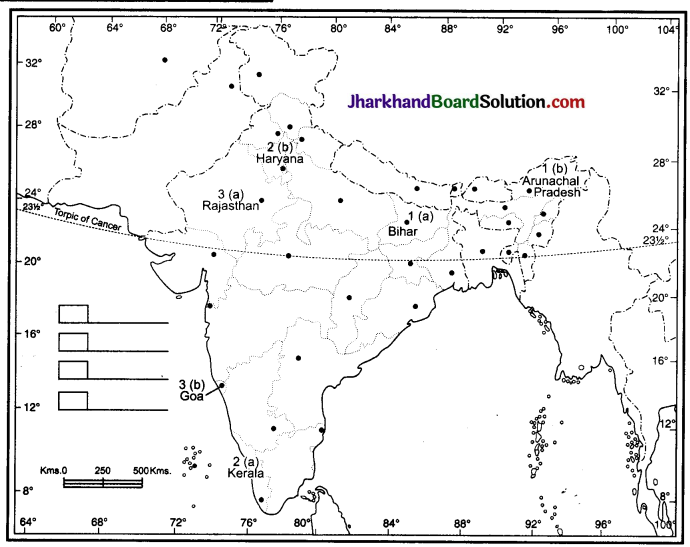
1. The state having highest and lowest density population.
2. The state having highest and lowest sex ratio.
3. Largest and smallest state according to area.
Answer:
1. (a) The state having the highest density of population is Bihar.
(b) The state having the lowest density of population is Arunachal Pradesh.

2. (a) The state having highest sex ratio-Kerala.
(b) The state having lowest sex ratio-Haryana.

3. (a) Largest state – Rajasthan.
(b) Smallest state – Goa.
JAC Class 9 Social Science Important Questions Geography Chapter 6 Population  1

JAC Class 9 Social Science Important Questions

JAC Class 10 Maths Solutions Chapter 8 Introduction to Trigonometry Ex 8.2

Jharkhand Board JAC Class 10 Maths Solutions Chapter 8 Introduction to Trigonometry Ex 8.1 Textbook Exercise Questions and Answers.

JAC Board Class 10 Maths Solutions Chapter 8 Introduction to Trigonometry Exercise 8.1

Question 1.
Evaluate the following:
(i) sin 60° cos 30° + sin 30° cos 60°
(ii) 2 tan² 45° + cos² 30° – sin² 60°
JAC Class 10 Maths Solutions Chapter 8 Introduction to Trigonometry Ex 8.2 - 1
Solution :
(i) sin 60° cos 30° + sin 30° cos 60°
\(\frac{\sqrt{3}}{2} \times \frac{\sqrt{3}}{2}\) + \(\frac{1}{2} \times \frac{1}{2}\)
\(\frac{3}{4}+\frac{1}{4}\) = 1

(ii) 2 tan² 45° + cos² 30° – sin² 60°
2(tan 45)² + (cos 30)² – (sin 60)²
2(1)² + (\(\frac{\sqrt{3}}{2}\))² – (\(\frac{\sqrt{3}}{2}\))² = 2
JAC Class 10 Maths Solutions Chapter 8 Introduction to Trigonometry Ex 8.2 - 2
JAC Class 10 Maths Solutions Chapter 8 Introduction to Trigonometry Ex 8.2 - 3

JAC Class 10 Maths Solutions Chapter 8 Introduction to Trigonometry Ex 8.2

Question 2.
Choose the correct option and justify your choice:
(i) \(\frac{2 \tan 30^{\circ}}{1+\tan ^2 30^{\circ}}\)
(A) sin 60°
(B) cos 60°
(C) tan 60°
(D) sin 30°
Solution :
JAC Class 10 Maths Solutions Chapter 8 Introduction to Trigonometry Ex 8.2 - 4

(ii) \(\frac{1-\tan ^2 45^{\circ}}{1+\tan ^2 45^{\circ}}\) =
(A) tan 90°
(B) 1
(C) sin 45°
(D) 0
Solution :
\(\frac{1-(-1)^2}{1+(1)^2}=\frac{0}{2}\) = 0

(iii) sin 2A = 2 sin A is true when A =
(A) 0°
(B) 30°
(C) 45°
(D) 60°
Solution :
sin 2A = sin 0° = 0
2 sin A = 2 sin 0° = 2(0) = 0.

(iv) \(\frac{2 \tan 30^{\circ}}{1-\tan ^2 30^{\circ}}\) =
(A) cos 60°
(B) sin 60°
(C) tan 60°
(D) sin 30°
Solution :
JAC Class 10 Maths Solutions Chapter 8 Introduction to Trigonometry Ex 8.2 - 5

Question 3.
If tan (A + B) = \(\sqrt{3}\) and tan (A – B) = \(\frac{1}{\sqrt{3}}\), 0° < A + B ≤ 90°; A > B, find A and B.
Solution :
tan(A + B) = \(\sqrt{3}\)
tan 60° = \(\sqrt{3}\)
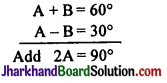
∴ A + B = 60°
tan (A – B) = \(\frac{1}{\sqrt{3}}\)
tan 30° = \(\frac{1}{\sqrt{3}}\)
∴ A – B = 30°
∴ \(\hat{\mathbf{A}}\) = 45°, \(\hat{\mathbf{B}}\) = 15°

JAC Class 10 Maths Solutions Chapter 8 Introduction to Trigonometry Ex 8.2 - 6
A + B = 60°
45 + B = 60°
B = 60 – 45 = 15
∴ B = 15°

JAC Class 10 Maths Solutions Chapter 8 Introduction to Trigonometry Ex 8.2

Question 4.
State whether the following are true or false. Justify your answer.
(i) sin (A + B) = sin A + sin B.
(ii) The value of sin θ increases as θ increases.
(iii) The value of cos θ increases as θ increases.
(iv) sin θ = cos θ for all values of θ.
(v) cot A is not defined for A = 0°.
Solution :
i) Let A = 30°, B = 60°.
sin 30° = \(\frac{1}{2}\)
sin 30 + sin 60°
sin (A + B) = sin 90° = 1
sin 60° = \(\frac{\sqrt{3}}{2}\)
\(\frac{1}{2}+\frac{\sqrt{3}}{2}\) = \(\frac{1+\sqrt{3}}{2}\)
sin (A+B) sin A + sin B
False.

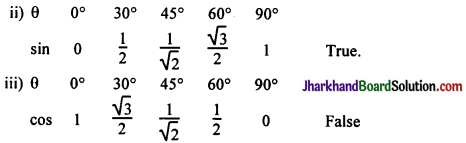
JAC Class 10 Maths Solutions Chapter 8 Introduction to Trigonometry Ex 8.2 - 7

iv) [θ = 0] sin 0 = 0
cos 0 = 1

θ = 30° sin 30° = \(\frac{1}{2}\)
cos 30° = \(\frac{\sqrt{3}}{2}\)

θ = 45° sin 45° = \(\frac{1}{\sqrt{2}}\)
cos 45° = \(\frac{1}{\sqrt{2}}\)

θ = 60° sin 60° = \(\frac{\sqrt{3}}{2}\)
cos 60° = \(\frac{1}{2}\)

θ = 90° sin 90° = 1
cos 90° = 0
False, because it is true only for θ = 45°.

(v) cot A = \(\frac{cos A}{sin A}\) . cot 0° = \(\frac{cos 0°}{sin 0°}\) = \(\frac{1}{0}\) = Undefined. True.

JAC Class 9 Social Science Solutions Geography Chapter 4 Climate

JAC Board Class 9th Social Science Solutions Geography Chapter 4 Climate

JAC Class 9th Geography Climate InText Questions and Answers 

Find Out (Page No. 27)

Question 1.
Why the houses in Rajasthan have thick walls and flat roofs?
Answer:
Rajasthan lies mostly in desert where the climate remains very hot. Due to lack of vegetation, here the sunrays fall directly on the earth. Also the winds blow very fast here. Therefore, the houses have thick walls to maintain the inner temperature of the houses and keep them cool for longer time. They have flat roofs to collect the rainwater because there is scarcity of water in Rajasthan.

Question 2.
Why is the houses in the Tarai region and in Goa & Mangalore have sloping roofs?
Answer:
The Tarai region, Goa and Mangalore are places receiving heavy rainfall throughout the year. Therefore, the houses in these regions have sloping roofs to allow the rainwater to flow down speedily. Non-accumulation of water allows sloping roofs being safe during rainy season.

JAC Class 9 Social Science Solutions Geography Chapter 4 Climate

Question 3.
Why houses in Assam are built on stilts?
Answer:
In Assam, the average rainfall is above 300 cm. Due to heavy rainfall throughout the year, the ground always remains wet. Stilts allow free flow of water on the ground and the houses are not flooded. Therefore, houses are built on stilts to avoid wetness and danger from poisonous reptiles living on the wet ground.

Question 4.
Why most of the World’s deserts are located in the western margins of continents in the sub-tropics ?
Answer:
Most of the world’s deserts are located in the western margins of continents in the sub-tropics because the prevailing winds in the tropics are tropical easterly winds. These winds become dry by the time they reach the western margins of the continents and so they bring no rainfall. Thus, the region becomes moisture-less which causes dry conditions leading to formation of deserts.

Activity (Page No. 38)

Question 1.
1. On the basis of the news items above, find out the names of places and the seasons described.
2. Compare the rainfall description of Chennai and Mumbai and explain the reasons for the difference.
3. Evaluate flood as a disaster with the help of a case study.
Answer:

  1. Rainy season Mumbai & Chennai
    Winter Season Srinagar, Amritsar, Shimla and New Delhi.
  2. Chennai receives winter rains while Mumbai monsoonal rains. In Chennai, rainfall is less than that in Mumbai.
    The main reason behind this difference is that both Mumbai and Chennai are situated in different monsoon regions.
  3. Students are requested to perform the activity on themselves.

JAC Class 9th Geography Climate Textbook Questions and Answers 

Question 1.
Choose the correct answer from the four alternatives given below:
1. Which one of the following places receives the highest rainfall in the world?
(a) Silchar
(b) Mawsynram
(c) Cherrapunji
(d) Guwahati.
Answer:
(b) Mawsynram

2. The wind blowing in the Northern plains in summers is known as :
(a) Kal Baisakhi
(b) Loo
(c) Trade winds
(d) None of these
Answer:
(b) Loo

3. Which one of the following causes rainfall during winters in north-western part of India?
(a) Cyclonic depression
(b) Retreating monsoon
(c) Western disturbances
(d) South-west monsoon
Answer:
(c) Western disturbances

4. Monsoon arrives in India as early in:
(a) May
(b) July
(c) June
(d) August
Answer:
(c) June

5. Which one of the following characterises the cold weather season in India?
(a) warm days and warm nights
(b) warm days and cold nights
(c) cold days and cold nights
(d) cold days and warm nights
Answer:
(b) warm days and cold nights

JAC Class 9 Social Science Solutions Geography Chapter 4 Climate

Question 2.
Answer the following questions briefly :
1. What are the controls affecting the climate of India?
Answer:
There are six major controls affecting the climate of India. They are: latitude, altitude, pressure and wind system, distance from the sea, ocean currents and relief features.

2. Why does India have a monsoon type of climate?
Answer:
India has a monsoon type of climate because there is a seasonal reversal in the wind system of India. During 6 months, monsoon winds blow from sea to land, and during the next 6 months, they blow from land to sea. Monsoon winds prevails between 5° and 30° latitudes on both sides of the Equator. India lies in between these latitudes, thus, it is greatly influenced by monsoon winds.

3. Which part of India does experience the highest diurnal range of temperature and why?
Answer:
The Thar desert of Rajasthan in India experiences the highest diurnal range of
temperature. It is because in the Thar desert, the weather conditions drastically change from the day to the night. During the day, there is very high temperature, while during the night, the temperature falls down significantly.

4. Which winds account for rainfall along the Malabar coast?
Answer:
South-west monsoon winds account for rainfall along the Malabar coast.

5. What are Jet streams and how do they affect the climate of India?
Answer:
Jet streams are the narrow belt of high altitude (above 12,000 m) westerly winds in the
troposphere. Their speed varies from about 110 km/h in summer to about 184 km/h in winter.
In India, these jet streams blow from south of the Himalayas, throughout the year, except in summer. The western cyclonic disturbances experienced in the north and north-western parts of the country are brought in by this westerly flow.

6. Define monsoon. What do you understand by “break” in monsoon?
Answer:
Monsoon: The word monsoon is derived from the Arabic word ‘Mausim’, which literally means season. ‘Monsoon’ refers to the seasonal reversal in the wind direction during a year. Break in Monsoon: Rains taking place only for a few days at a time is called “break in monsoon”. In brief, the intermission amid raining is termed as “break’ in monsoon. It is related to the movement of the monsoon.

7. Why is the monsoon considered a unifying bond?
Answer:
India is a vast country. Here variations are found not only in relief, climate and vegetation, but also in life. But the monsoon is a geographical factor that binds these variations of the country together and establishes unity. The arrival of the monsoon brings rains all over the country. Monsoon winds speed up the process of agriculture by providing water to us.

The entire Indian landscape, its wildlife and vegetation life, the entire agricultural program, the lifestyle of the people and their festivals, all revolve around the monsoon. Due to the monsoon, there is a rhythm of the cycle of seasons every years. This is the reason why the monsoon is considered a unifying bond.

JAC Class 9 Social Science Solutions Geography Chapter 4 Climate

Question 3.
Why does the rainfall decrease from the east to the west in Northern India?
Answer:
When the Bay of Bengal branch of south-west monsoon is obstructed by the eastern Himalayas, maximum amount of rainfall is received in West Bengal, Bihar etc. When these winds advance towards west, they go on shedding moisture. Therefore, the amount of rainfall decreases from the east to the west in Northern India.

Question 4.
Give reasons as to why:
1. Seasonal reversal of wind direction takes place over the Indian sub-continent?
Answer:
Reasons for the seasonal reversal of wind direction takes place over the Indian sub-continent are the following:
(a) During winter, there is a high-pressure area over north of the Himalayas. Cold dry winds blow from this region to the low pressure area over the oceans to the south.

(b) In summer, a low-pressure area develops over interior Asia as well as over north-western India. This causes a complete reversal of the direction of winds during summer.

2. The bulk of rainfall in India is concentrated over a few months.
Answer:
In India, most of the rainfall is caused by south-west monsoon which prevails in India only between June to September. Therefore, bulk of rainfall in India is concentrated in these four months only.

3. The Tamil Nadu coast receives winter rainfall.
Answer:
The north-east monsoon winds starts blowing in October month from the land, i.e., north-eastern parts of India to the sea. These bear no water till their access to the Bay of Bengal. However, they get some moisture from the sea here and cause rain in the coast of Tamil Nadu.

4. The delta region of the eastern coast is frequently struck by cyclones.
Answer:
The delta region of the Eastern coast of India is frequently struck by cyclones. This is because the cyclonic depressions that originate over the Andaman Sea are brought in by the sub-tropical easterly jet stream balancing over Peninsular India during the monsoon as well as during the October to November period. The depression moves along East to West direction thus hitting the Eastern coasts.

5. Parts of Rajasthan, Gujarat and the leeward side of the Western Ghats are drought- prone.
Answer:
This happens due to collision of rain bearing Arabian Sea branch of monsoon winds against the highly elevated Western Ghats and depletion of water there. Again, the Aravali hills, being not much elevated, the monsoon winds pass from there without causing rainfall.

JAC Class 9 Social Science Solutions Geography Chapter 4 Climate

Question 5.
Describe the regional variations in the climatic conditions of India with the help of suitable examples.
Answer:
The regional variations in the climatic conditions of India can be understood in the following ways :
1. Temperature:
In summer, the temperature occasionally reaches 50°C in some parts of the Rajasthan’s desert area, whereas it may be around 20°C in Pahalgam in Jammu and Kashmir. On a winter night, temperature at Drass in Jammu and Kashmir may be as low as – 45°C, while Thiruvananthapuram, on the other hand, may have a temperature of 22°G.

2. Rainfall:
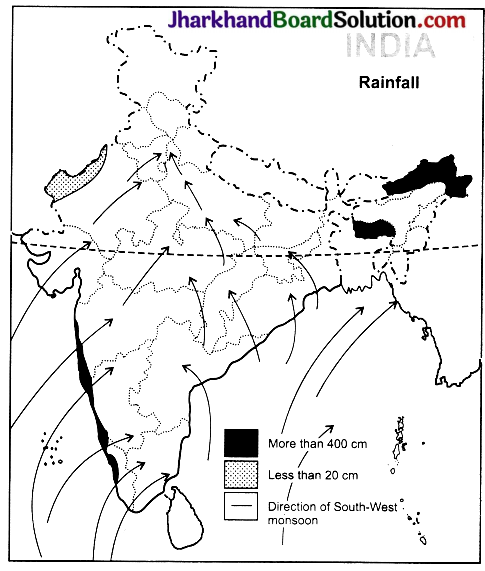
Most parts of the country receive rainfall from June to September, but some parts like Tamil Nadu coast get a large portion of rainfall during October and November. The annual precipitation also varies from over 400 cm in Meghalaya to less than 10 cm in Ladakh and Western Rajasthan.

3. Form of precipitation:
While precipitation is mostly in the form of snowfall in the upper parts of Himalayas, it rains over the rest of the country.

4. Direction of winds:
During summer, winds move from sea to land, while during winter, winds move from land to sea.

Question 6.
Discuss the mechanism of monsoon.
Answer:
The monsoons are experienced in the tropical areas roughly between 20°N and 20°S. To understand the mechanism of the monsoon, the following facts are important:

  1. The differential heating and cooling of land and water creates low pressure on the landmass of India, while the seas around experience comparatively high pressure.
  2. The shift of the position of Inter Tropical Convergence Zone (ITCZ) in summer, over the Ganga plain (this is the equitorial trough normally positioned about 5° N of the equator. It is also known as the monsoon trough during the monsoon season.)
  3. The presence of the high-pressure area, east of Madagascar, approximately at 20°S over the Indian Ocean. The intensity and position of this high-pressure area affects the Indian monsoon.
  4. The Tibetan plateau get intensely heated during summer, which results in strong vertical air currents and the formation of low pressure over the plateau at about 9 km above sea level.
  5. The movement of the westerly jet stream to the north of the Himalayas and the presence of the tropical easterly jet stream over the Indian peninsula during summer.

Question 7.
Give an account of weather conditions and characteristics of the cold season.
Answer:
Weather Conditions of the Cold Season: An account of weather conditions of the cold season is as followin :
1. Time period of the cold season:
The cold weather season begins from mid-November in Northern India and stays till February. December and January are the coldest months in the Northern part of India.

2. Temperature:
The temperature decreases from south to the north. The average temperature of Chennai, on the eastern coast, is between 24°-25°C, while in the northern plains, it ranges between 10°-15°C. Days are warm and nights are cold. Frost is common in the north and the highest slopes of the Himalayas experience snowfall.

3. Winds:
During this season, the north-east trade winds prevail over the country, it is a dry season.

4. Rainfall:
Some amount of rainfall occurs on the Tamil Nadu coast from these winds as here they blow from sea to land.

5. Air pressure:
In the northern part of the country, a feeble high-pressure region develops, with light winds moving outwards from this area.

6. Cyclonic disturbances:
A characteristic feature of the cold weather season over the northern plains is the inflow of cyclonic disturbances from the west and the north-west. These low-pressure systems originate over the Mediterranean Sea and Western Asia and move into India, along with the westerly flow. They cause the much-needed winter rains over the plains and snow fall in the mountains.

7. Characteristics of the Cold Season:
Clear sky, pleasant weather, low temperature and humidity, high range of temperature, cool and slow northern winds are the main characteristics of this season.

JAC Class 9 Social Science Solutions Geography Chapter 4 Climate

Question 8
Give the characteristics and effects of the monsoon rainfall in India.
Answer:
Characteristics of the Monsoon Rainfall: Several characteristic features of the monsoon rainfall are the following :

  1. Most of the country gets rainfall from south-west monsoons.
  2. The rainfall from the monsoon winds is variable and quite undependable.
  3. Much of the rainfall is received in 3-4 months.
  4. The distribution of rainfall is highly uneven.
  5. Indian rainfall is controlled by orography, i.e., most of the rainfall is caused due to the obstruction of moisture bearing winds.

Effects of the Monsoon Rainfall: The effects of the monsoon rainfall are as hereunder.
1. South-west monsoon does not cause rain regularly. Its amount also varies from year to year.

2. After heavy rainfall, there is decrease in its quantity. Sometimes, long duration of rainy season passes even without rains.

3. Cyclones at the head of the Bay of Bengal control the effectiveness of monsoon winds. From June to September, the number of cyclones is about 8. Intense cyclones give strength to Monsoon winds and helps in causing heavy rainfall, their less intensity causes dry spells.

4. Monsoon trough of low pressure situated over the north plains also affects the distribution of rainfall. The axis of the trough close to the Himalayas causes heavy rains in the mountains and floods in the plains resulting in a great loss to man and material.

5. Success or failure of agricultural crops depends on the amount of rainfall. Thus, Indian agriculture still remains ‘A Gamble to Monsoon’, though, we have tapped irrigation potential to a great extent.

JAC Class 9 Social Science Solutions Geography Chapter 4 Climate

Question 9.
On an outline map of India, show the following:
1. Areas receiving rainfall over 400 cm.
2. Areas receiving less than 20 cm of rainfall.
3. The direction of the south-west monsoon over India.
Answer:
JAC Class 9 Social Science Solutions Geography Chapter 4 Climate 2
1. Find out which songs, dances, festivals and special food preparations are associated with certain seasons in your region. Do they have some commonality with other regions of India?
Answer:
Students, do it yourself with the help of your teacher.

2. Collect photographs of typical rural houses, and clothing of people from different regions of India. Examine whether they reflect any relationship with the climatic condition and relief of the area.
Answer:
Students, do it yourself with the help of your teacher.

Question 1.
In table-I, the average mean monthly temperatures and amounts of rainfall of 10 representative stations have been given. It is for you to study on your own and convert them into ‘temperature and rainfall’ graphs. A glance at these visual representations will help you to grasp instantly the similarities and differences between them. One such graph (Figure 1) is already prepared for you. See if you can arrive at some broad generalisations about our diverse climatic conditions. We hope you are in for a great joy of learning. Do the following activities.
JAC Class 9 Social Science Solutions Geography Chapter 4 Climate 7

JAC Class 9 Social Science Solutions Geography Chapter 4 Climate 5
Answer:
Temperature and Rainfall graph are as shown below:
JAC Class 9 Social Science Solutions Geography Chapter 4 Climate 4
JAC Class 9 Social Science Solutions Geography Chapter 4 Climate 6

Question 2.
Re-arrange the 10 stations in two different sequences:
1. According to their distance from the equator.
2. According to their altitude above mean sea-level.
Answer:
1. According to their distance from the equator:

1. Thiruvananthapuram8°29′ N
2. Bangalore12°58′ N
3. Chennai13°4′ N
4. Mumbai19° N
5. Nagpur21°9′ N
6. Kolkata22°34′ N
7. Shillong24°34′ N
8. Jodhpur26° 18′ N
9. Delhi29° N
10. Leh34° N

2. According to their altitude above mean sea-level:

1. Kolkata6 m
2. Chennai7 m
3. Mumbai11 m
4. Thiruvananthapuram61 m
5. Delhi219 m
6. Jodhpur224 m
7. Nagpur312 m
8. Bangalore909 m
9. Shillong1461 m
10. Leh3506 m

JAC Class 9 Social Science Solutions Geography Chapter 4 Climate

Question 3.
1. Name two rainiest stations.
2. Name two driest stations.
3. Two stations with most equable climate.
4. Two stations with most extreme climate.
5. Two stations most influenced by the Arabian Sea branch of south-west monsoon.
6. Two stations most influenced by the Bay of Bengal branch of south-west monsoons.
7. Two stations influenced by both branches of the south-west monsoons.
8. Two stations influenced by retreating and north-east monsoons.
9. Two stations receiving winter showers from the western disturbances.
10. The two hottest stations in the months of :
(a) February
(b) April
(c) May
(d) June
Answer:

  1. Two rainiest stations:
    (a) Shillong,
    (b) Mumbai.
  2. Two driest stations:
    (a) Leh,
    (b) Jodhpur.
  3. Two stations with most equable climate:
    (a) Mumbai,
    (b) Thiruvananthapuram
  4. Two stations with most extreme climate:
    (a) Leh,
    (b) Jodhpur.
  5. Two stations most influenced by the Arabian sea branch of south-west monsoons:
    (a) Mumbai,
    (b) Thirvananthapuram.
  6. Two stations most influenced by the Bay of Bengal Branch of south-west monsoons:
    (a) Shillong,
    (b) Kolkata.
  7. Two stations influenced by both branches:
    (a) Nagpur,
    (b) Delhi.
  8. Two stations influenced by retreating and north-east monsoons:
    (a) Chennai,
    (b) Thiruvananthapuram.
  9. Two stations receiving winter showers from the western disturbances:
    (a) Delhi,
    (b) Leh.
  10. The two hottest stations in the month of:
    (a) February: Thiruvananthapuram and Chennai.
    (b) April: Nagpur and Chennai.
    (c) May: Nagpur and Delhi/Jodhpur.
    (d) June: Jodhpur and Delhi.

Question 4.
Now find out:
1. Why are Thiruvananthapuram and Shillong rainier in June than in July?
2. Why is July rainier in Mumbai than in Thiruvananthapuram?
3. Why are south-west monsoons less rainy in Chennai?
4. Why is Shillong rainier than Kolkata?
5. Why is Kolkata rainier in July than in June unlike Shillong which is rainier in June than in July?
6. Why does Delhi receive more rain than Jodhpur?
Answer:
1. Thiruvananthapuram is located in Kerala in the southernmost part of India. By early June, monsoon enters India from the south. One of the branches of monsoon winds, i.e., Bay of Bengal branch hits the hills located around Shillong and showers heavy rainfall. As Thiruvananthapuram and Shillong come first in the way of monsoon winds, they are more rainier in June than in July.

2. In the month of July, the monsoon winds pass from Thiruvananthapuram and enter the interior parts of India, thus, July is less rainier in this city. On the other hand, in Mumbai, the monsoon winds rising from Arabian Sea continuously cause rainfall due to the presence of Western Ghats.

3. The Bay of Bengal branch of south-west monsoons causes heavy rains in the western parts of Western Ghats. Chennai lies in the extremely east. When the monsoon winds reach over there, they become almost dry. Chennai lies in rain-shadow area of south-west monsoon.

4. Shillong is situated on hills which trap the monsoon winds and force them to cause rainfall. But Kolkata is situated in plains where monsoon winds reach comparatively late and there are no such hills which could trap the monsoon winds.

5. South-west monsoon first strikes Shillong and then Kolkata. Thus, Shillong receives more rainfall in June itself and as these winds move on to Kolkata, they start causing rainfall over there in July.

6. Delhi creates barrier in the path of south-west (Bay of Bengal branch) monsoon while Jodhpur does not create any resistance in the path of south-west (Arbian Sea Branch) monsoon.

JAC Class 9 Social Science Solutions Geography Chapter 4 Climate

Question 5.
Now think why:
1. Thiruvananthapuram has equable climate?
2. Chennai has more rains only after the fury of monsoon is over in most parts of the country?
3. Jodhpur has a hot desert type of climate?
4. Leh has moderate precipitation almost throughout the year?
5. While in Delhi and Jodhpur most of the rain is confined to nearly three months, in Thiruvananthapuram and Shillong it is almost nine months of the year? In spite of these facts see carefully if there are strong evidences to conclude that the monsoons still provide a very strong framework lending overall climatic unity to the whole country.
Answer:
1. Thiruvananthapuram has an equable climate because it is closer to the sea and its climate is moderated by the sea. Being close to the Equator, it is also influenced by the equatorial type of climate where the annual range of temperature happens to be the least.

2. Over the most parts of India, rainfall occurs due to south-west monsoon winds. These winds start retreating in September to October months. At this time, north-east trade winds blow all over India. These winds receive vapour while moving over the Bay of Bengal which immediately carry to the Coromandel coast in Tamil Nadu. Thus, Chennai receives heavy rain during winter season.

3. Jodhpur falls in the rain shadow area and it is situated near to the Thar desert. This station has, therefore, extreme climate. There is also scarce of vegetation. Thus, it has a hot desert type of climate.

4. Leh is situated on the high altitude in Ladakh. Thus, we can see here the precipitation in the form of snow. The lowest temperature also freezes the water. Therefore, Leh has moderate precipitation almost throughout the year.

5. Delhi and Jodhpur are located in the interior parts of country where monsoon winds reach comparatively late. On the other hand, Thiruvananthapuram and Shillong are located on the sea coast where monsoon winds strike first and cause heavy rainfall.

JAC Class 9 Social Science Solutions

JAC Class 9 Social Science Important Questions History Chapter 5 Pastoralists in the Modern World

JAC Board Class 9th Social Science Important Questions History Chapter 5 Pastoralists in the Modern World

I. Objective Type Questions

1. Who are the pastoral nomadic communities of Jammu and Kashmir?
(a) Raikas
(b) Gaddhi shepherds
(c) Gujjar Backarwals
(d) Bhotiyas.
Answer:
(c) Gujjar Backarwals

2. The Dhangar shepherds stayed in the central plateau of Maharasthra during the :
(a) monsoon
(b) winter
(c) autumn
(d) summer.
Answer:
(a) monsoon

3. When did the colonial government in India passed the Criminal Tribes Act?
(a) 1871
(b) In 1879
(c) In 1840
(d) In 1947
Answer:
(a) 1871

4. Where do the Massai cattle herders reside?
(a) West Africa
(b) East Africa
(c) South Africa
(d) North America
Answer:
(b) East Africa

5. Where is Samburu National Park located?
(a) Uganda
(b) Tanganyika
(c) Kenya
(d) None of the above.
Answer:
(c) Kenya

II. Very Short Answer Type Questions

Question 1.
Who are nomadic pastoralists?
Answer:
Nomadic pastoralists are people who move from one place to another with their herds to earn a living.

JAC Class 9 Social Science Important Questions History Chapter 5 Pastoralists in the Modern World

Question 2.
What is a pasture?
Answer:
It is grass or other plants grown for feeding or grazing animals, as well as land used for grazing.

Question 3.
Write the most significant feature of nomadic pastoralists.
Answer:
The most significant feature of nomadic pastoralists is their cycle of seasonal movement.

Question 4.
List some pastoral communities of the Himalayas.
Answer:
Gujjar Bakarwals, Gaddi shepherds, Bhotiyas, Sherpas and Kinnauris.

Question 5.
Where did the Gujjar herders stay in winters and summers?
Answer:
The Gujjar herders, in winters, came down to the dry forests of the Bhabar, and in summers, they went up to the high meadows i.e., the Bugyals.

Question 6.
What is Bhabar?
Answer:
Bhabar is a dry forested area below the foothills of Garhwal and Kumaun.

JAC Class 9 Social Science Important Questions History Chapter 5 Pastoralists in the Modern World

Question 7.
Who are Bugyals?
Answer:
Bugyals are the vast meadows in the high mountains.

Question 8.
In which state Dhangars are found?
Answer:
Dhangars are an important pastoral community of Maharashtra.

Question 9.
Why are the Konkani peasants welcome by Dhangar shepherds?
Answer:

  1. Dhangar flocks manure the fields.
  2. The animals feed on the stubble of the Kharif crop.

JAC Class 9 Social Science Important Questions

JAC Class 10 Science Solutions Chapter 6 Life Processes

Jharkhand Board JAC Class 10 Science Solutions Chapter 6 Life Processes Textbook Exercise Questions and Answers.

JAC Board Class 10 Science Solutions Chapter 6 Life Processes

Jharkhand Board Class 10 Science Life Processes Textbook Questions and Answers

Question 1.
The kidneys in human beings are a part of the system of ……………….
A. nutrition
B. respiration
C. excretion
D. transportation
Answer:
excretion

Question 2.
The xylem in plants are responsible for ……………….
A. transport of water
B. transport of food
C. transport of amino acids
D. transport of oxygen Answer: transport of water

Question 3.
The autotrophic mode of nutrition requires ……………….
A. carbon dioxide and water
B. chlorophyll
C. sunlight
D. all of the given
Answer:
all of the given

Question 4.
The breakdown of pyruvate to give carbon dioxide, water and energy takes place in ……………….
A. cytoplasm
B. mitochondria
C. chloroplast
D. nucleus
Answer:
mitochondria

Question 5.
How are fats digested in our bodies? Where does this process take place?
Answer:
Large fat globules break into small fine droplets by the effect of bile salts of bile juice. This is called emulsification of fats.

Pancreatic lipase acts on emulsified fats to break it and finally intestinal lipase digests fats into fatty acids and glycerol. This process take place in small intestine.

JAC Class 10 Science Solutions Chapter 6 Life Processes

Question 6.
What is the role of saliva in the digestion of food?
Answer:
Saliva contains salivary amylase (ptyalin) which digests starch into sugar.
JAC Class 10 Science Solutions Chapter 6 Life Processes 1

Question 7.
What are the necessary conditions for autotrophic nutrition and what are its by-products?
Answer:
The necessary conditions for autotrophic nutrition are:

  • Presence of chlorophyll
  • Absorption light energy
  • Splitting of water molecules
  • Reduction of carbon dioxide to carbohydrates.

Oxygen is the by-product.

Question 8.
What are the differences between aerobic and anaerobic respiration? Name some organisms that use the anaerobic mode of respiration.
Answer:

Aerobic respirationAnaerobic respiration
1. O2 is used in this process.1. O2 is not used in this process.
2. At the end of this process CO2 and H2O are produced.2. At the end of this process in medium of plant origin Ethanol and CO2 are produced and in medium of animal origin only lactic acid is produced and no CO2.
3. In aerobic respiration complete oxidation of glucose molecules occurs, in which one mole of glucose on oxidation releases much greater energy.3. In anaerobic respiration glucose molecules are incompletely oxidized, so one mole of glucose releases less energy along with the organic by products.
4. There are two phases in aerobic respiration, the first phase occurs in the cytoplasm and does not utilize O2. The second phase occurs in the mitochondria and utilizes O2.4. There is only one phase in anaerobic respiration. It occurs in the cytoplasm. It occurs entirely in the absence of O2.

Question 9.
How are the alveoli designed to maximise the exchange of gases?
Answer:
The alveoli are located at the terminal ends of bronchioles. They are balloon-like structures provides large surface area for exchange of gases with an extensive network of blood vessels.

Question 10.
What would be the consequences of a deficiency of haemoglobin in our bodies?
Answer:
A deficiency of haemoglobin in our bodies leads to a disease called anaemia. Due to this, cells of our body do not get sufficient oxygen for cellular respiration, which may lead to release less energy. Weakness, fatigue, tiredness, etc. conditions may arise.

Question 11.
Describe double circulation of blood in human beings. Why is it necessary?
Answer:
Blood passes through the heart twice during each cycle in human beings. This is called double circulation.

[Deoxygenated blood from different organs is drained and finally through vena cava it is poured in right atrium. Prom here this blood is transported to lungs via right ventricle. In lungs, blood become oxygenated and is again transported to left atrium. From here it transports in left ventricle and then by aorta to different body parts.]

It is necessary because it allows a highly efficient supply of oxygen to the body cells, which fulfill the high energy need of body.

JAC Class 10 Science Solutions Chapter 6 Life Processes

Question 12.
What are the differences between the transport of materials in xylem and phloem?
Answer:

In xylemIn phloem
1. Water and minerals are transported.1. Food especially carbohydrate, sucrose is translocated.
2. Transpiration pull becomes the major driving force for transport in xylem.2. Osmotic pressure is responsible for translocation in phloem.
3. Generally ATP is not used for transport of material in xylem.3. Phloem tissue uses ATP for translocation of food materials.
4. Vessels and tracheids are involved in transport.4. Sieve tube and companion cells are involved in translocation.

Question 13.
Compare the functioning of alveoli in the lungs to their structure and functioning.
Answer:

AlveoliNephrons
1. It is a structural and functional unit of lung.1. It is a structural and functional unit of kidney.
2. Alveoli are balloon-like structures at the terminal region of bronchioles.2. Nephrons are long-coiled tube-like structures having Bowman’s capsule at the tip.
3. The alveoli provide a surface for exchange of gases.3. Filtration of blood for removing of nitrogenous wastes take place in nephron units.
4. The wall of the alveoli contain an extensive network of blood vessels.4. A cluster of blood capillaries associated with Bowman’s capsule called glomerulus and tubular part of nephron is surrounded by network of blood capillaries.

Jharkhand Board Class 10 Science Life Processes InText Questions and Answers

Question 1.
Why is diffusion insufficient to meet the oxygen requirement of multicellular organisms like humans?
Answer:
In multicellular organisms like human, all the cells are not in direct contact with the s surrounding environment. The body structure is more complex and the body size is also large. Therefore, simple diffusion will not be sufficient to s send oxygen to every cell. It has been estimated that a period of 3 years would be needed to carry a molecule of O2 from our lungs to reach our toes through diffusion.

So, diffusion is insufficient to meet the oxygen requirement of multicellular organisms like humans.

Question 2.
What criteria do we use to decide whether something is alive?
Answer:
Movement, growth, breathing, cell-structure, etc. are the criteria we use to decide whether something is alive.

Question 3.
What are outside raw materials used for by an organisms?
Answer:

Name of outside raw materialsUsed for
1. CO2, H2OPhotosynthesis by plants
2. Carbon based food source, O2Respiration by aerobic organisms

Question 4.
What processes would you consider essential for maintaining life?
Answer:
The processes essential for maintaining life are nutrition, respiration, transport, excretion, etc.

Question 5.
What are the differences between autotrophic nutrition and heterotrophic nutrition?
Answer:

Autotrophic NutritionHeterotrophic Nutrition
1. It occurs in green plants and some bacteria.1. It occurs in animals and fungi.
2. In such mode of nutrition. food is synthesised from inorganic components, i.e., CO2 and H2O.2. In such mode of nutrition food is consumed from other organisms.
3. Photosynthesis is important process for autotrophic nutrition.3. Food digestion is important for such nutrition.

Question 6.
Where do plants get each of the raw materials required for photosynthesis?
Answer:
Raw materials required for photosynthesis :

  • CO2 : Plants get it from atmosphere.
  • H2O : Plants root absorbed it from soil.
  • Energy : Plants get it directly from sun.

Question 7.
What is the role of the acid in our stomach?
OR
What are the functions of the acid in our stomach?
Answer:
Role or Functions of the acid:

  • Acid destroys the bacteria and other microorganisms that enter the stomach, along with the food.
  • It converts the inactive enzyme pepsinogen into active enzyme pepsin.
  • It provides acidic medium required for the action of pepsin. Pepsin can digest proteins present in food only in acidic medium.
  • Insoluble mineral salts get dissolved in acid.

Question 8.
What is the function of digestive enzymes?
Answer:
Digestive enzymes hydrolyse / digest complex component (carbohydrates, lipids, proteins) of food into simple, soluble and absorbable form of nutrients.

Question 9.
How is the small intestine designed to absorb digested food?
Answer:
Small intestine is long tubular structure. The inner lining of the small intestine has numerous finger like projection called villi, which increase the surface area for absorption.

Question 10.
What advantage over an aquatic organism does a terrestrial organism have with regard to obtaining oxygen for respiration?
Answer:
The amount of dissolved oxygen is fairly low in aquatic environment as compared to the amount of oxygen in the air. So, terrestrial organisms fulfil their oxygen demand with low breathing rate as compared to aquatic organisms.

Question 11.
What are the different ways in which glucose is oxidised to provide energy in various organisms?
Answer:
There are three different ways in which glucose is oxidised to provide energy in various organisms.
JAC Class 10 Science Solutions Chapter 6 Life Processes 2

Question 12.
How is oxygen and carbon dioxide transported in human beings?
Answer:
In human beings, the respiratory pigment haemoglobin has high affinity for oxygen, so it is mostly transported by haemoglobin. Carbon dioxide is more soluble in water than oxygen and hence it is mostly transported in dissolved form in our blood.

Question 13.
How are the lungs designed in human beings to maximise the area for exchange of gases?
Answer:
The respiratory passage in the lungs, divides into smaller and smaller tubes which finally terminate in balloon – like structures alveoli. The alveoli present in lungs provide the maximum area for exchange of gases in human beings.

JAC Class 10 Science Solutions Chapter 6 Life Processes

Question 14.
What are the components of the transport system in human beings? What are the functions of these components?
Answer:

The components of the transport system in humanFunctions
1. Blood

  • Plasma
  • Red blood corpuscles
  • White blood corpuscles
  • Platelets
  • Acts as fluid transport medium of various material. Transport of food, CO2, salts and nitrogenous wastes.
  • Transport of O2.
  • Fight with invading pathogens.
  • Help in clotting mechanism during injury.
2. HeartIt acts as a blood pumping organ.
3. Blood vessels

  • Arteries
  • Veins
  • Capillaries
  • Carry blood away from the heart.
  • Carry blood from different organs and bring it back to the heart.
  • Exchange of material between the blood and surrounding cells.
4. LymphCarries digested and absorbed fat from intestine and drain excess fluid from intercellular spaces back into the blood.

Question 15.
Why is it necessary to separate oxygenated and deoxygenated blood in mammals and birds?
Answer:
It is necessary to separate oxygenated s and deoxygenated blood in mammals and birds because it allows a highly efficient supply of oxygen to the body and this is useful in their high energy needs for to maintain constant body temperature.

Question 16.
What are the components of the i transport system in highly organised plants?
Answer:
Xylem tissue (vessels and tracheids) and phloem tissue (sieve tube and companion cell) are the components of the transport system in highly organised plants.

Question 17.
How are water and minerals transported in plants?
Answer:
Water conducting channels : Xylem consists of vessels and tracheids, which form continuous water conducting channel.

Absorption of water by the roots : The root cells actively take up ions from soil. This creates a difference in the concentration of these ions between the root and the soil. Water, therefore moves into the root from the soil to eliminate this difference.

Column of water : To eliminate the concentration difference between the soil and the root, the steady movement of water into root creates column of water.

Conduction of water by root pressure : Due to absorption of water by root cells, a pressure is generated to push water in xylem element.

This pressure is insufficient to move water over the heights of plants. So, plants use another strategy to move water in xylem upwards to the highest points of the plant body.

Conduction of water by transpiration pull : The loss of water in the form of vapour from the aerial parts of the plant is known as transpiration.

The water which is lost through the stomata is replaced by water from the xylem vessels in the leaf. Evaporation of water molecules from the cells of a leaf creates a sunction which pulls water from the xylem cells of roots.

During the day when the stomata are open, the transpiration pull becomes the major driving force in the movement of water in the xylem.

At night effect of root pressure is necessary for the upward flow of water.

Thus, transpiration helps in absorption and upward movement of water and minerals dissolved in it from roots to the leaves.
JAC Class 10 Science Solutions Chapter 6 Life Processes 3

Question 18.
How is food transported in plants?
Answer:
The transport of soluble products of photosynthesis is called translocation.

  • Translocation occurs in the part of the vascular tissue known as phloem.
  • Besides, the products of photosynthesis, the phloem transports amino acids and other substances. These substances are especially delivered to roots, fruits, seeds and to growing organs where it is stored.
  • The translocation of food and other substances takes place in the sieve tubes with the help of adjacent companion cells both in upward and downward directions.
  • The translocation in phloem is achieved by utilising energy.
  • Sucrose (Sugar / Carbohydrate) is transferred into phloem tissue using energy from ATP. This increases the osmotic pressure of the tissue causing water to move into it.
  • This pressure moves the material in the phloem to tissues having less pressure. The phloem thus moves material according to the plant’s need.

Example: In the spring, sugar stored in root or stem tissue is transported to the buds which need energy to grow.

Question 19.
Describe the structure and functioning of nephrons.
Answer:
Nephron is a basic filtration unit in the kidneys.

  • Each kidney has large numbers of nephrons packed closely together.
  • Nephron is a long-coiled tubular structure which begins with a cup-shaped end. called Bowman’s capsule and it ends in collecting tubule.
  • A cluster of very thin-walled blood capillaries seen in the Bowman’s capsule is called glomerulus.
    JAC Class 10 Science Solutions Chapter 6 Life Processes 4

The purpose of making urine is to filter out waste products from blood.

  • Nitrogenous wastes such as urea, uric acid, etc. are removed from blood in the kidneys.
  • Urine is produced by filtration units i.e., nephrons.
  • Cup-shaped Bowman’s capsule collects the filtrate.
  • Some substances in the initial filtrate, such as glucose, amino acids, salts and a major amount of water are selectively reabsorbed as the urine flows along the coiled tube.
  • The amount of water reabsorbed depends on the amount of water present in the body and amount of dissolved waste which is to be excreted.
  • Thus, urine is formed in both kidneys. [In a normal healthy adult, the initial filtrate in the kidneys is about 180 L daily. However, the s volume of excreted urine is only a litre or two per day. The remaining filtrate is reabsorbed ; in the kidney tubules.]

Question 20.
What are the methods used by plants to get rid of excretory products?
Answer:
Unlike animals, the plants do not possess any special organs or system for excretion. However, the plants excrete their wastes in different ways:

  • O2 produced during photosynthesis by the green plants is set free directly in the atmosphere.
  • Plants remove surplus water by the process of transpiration through the stomata.
  • Sometimes plants store certain wastes in the cells of their leaves which are ultimately shed off.
  • Certain plants store wastes in the cellular vacuoles of their cells.
  • Other waste products such as resin and gum are stored especially in old xylem.
  • Plants excrete some waste substances into the soil around them.

Question 21.
How is the amount of urine produced regulated?
Answer:
The amount of urine formed depends on how much excess water there is in the body, and on how much of dissolved waste there is to be excreted. More water and dissolved wastes in the body will produce more urine. On the other hand, less water and less dissolved wastes will produced less urine.

Activity 6.1 [T. B. Pg. 96]

To demonstrate that chlorophyll is essential for photosynthesis.

Materials : Potted plant (money plant or croton), beaker, water bath, alcohol, iodine.

Procedure :

  • Take a potted plant of money plant or croton with variegated leaves.
  • Keep the potted plant in complete darkness for three days.
  • After three days expose the plant to bright sunlight for about 6 hours.
  • Pluck one such leaf of this plant which is green in certain parts and white in the other remaining parts.
  • Mark the green areas in it and trace them on a papersheet.
  • Boil this plucked leaf in a beaker full of alcohol and kept in boiling water bath for some time, till it becomes colourless.
  • Wash and clean this colourless leaf with water and dip it, for a few minutes, in dil. iodine solution.
  • Observe the colour of the leaf and compare this with tracing of the leaf done in the beginning.
    JAC Class 10 Science Solutions Chapter 6 Life Processes 5

Questions:

Question 1.
What happens when the plant is kept in s a dark for 2-3 days?
Answer:
All the starch gets used up when the plant is kept in a dark for 2-3 days.

Question 2.
What happens to the colour of the leaf when keep in boiling alcohol?
Answer:
When the leaf is kept in boiling alcohol, it gets decolourised.

Question 3.
What is the colour of the alcohol solution when leaf is taken out from it?
Answer:
The colour of the alcohol solution is green when leaf is taken out from it.

JAC Class 10 Science Solutions Chapter 6 Life Processes

Question 4.
State the use of iodine solution.
Answer:
Iodine solution is used to know the presence of starch.

Question 5.
What can you conclude about the presence of starch in various areas of the leaf?
Answer:
We conclude that the presence of starch is detected with iodine solution in only such areas where chlorophyll present.

Question 6.
What will you infer from this activity?
Answer:
This activity explains that chlorophyll is essential for photosynthesis and surplus glucose stored in form of starch as internal reserve energy.

Activity 6.2 [T. B. Pg. 97]

To demonstrate that carbon dioxide (CO2) necessary for photosynthesis

Materials : Potted plants, Bell-jar, watch glass, KOH (potassium hydroxide), alcohol, iodine solution.

Procedure:

  • Take two potted plants. Place them in dark for three days. This will de-starch them.
  • After three days place each of the pots on a smooth glass plate.
  • Label one pot as A and the other as B.
  • Keep a small watch glass or petri dish containing pellets of potassium hydroxide (KOH) on the glass plate near the pot A.
  • Cover both the potted plants under two separate glass bell-jars.
  • Apply a thick coat of vaseline on the bottom of the bell-jar close to the glass plate in order to make both the jars air-tight.
  • Expose both these plants to sunlight for about 2 to 3 hours.
  • Thereafter pluck one leaf each from the plants A and B and examine these leaves separately for the presence of starch therein.
    JAC Class 10 Science Solutions Chapter 6 Life Processes 6

Questions :

Question 1.
Which gas is absorbed by KOH from the air in the bell-jar?
Answer:
Carbon dioxide is absorbed by KOH from the air in the bell-jar.

Question 2.
Which potted plant (A or B) shows the presence of starch in its leaf?
Answer:
B potted plant shows the presence of starch in its leaf.

Question 3.
Why is starch not formed in the leaf of the plant kept under the bell-jar with KOH kept along with it?
Answer:
Starch is not formed in the leaf of the plant kept under the bell-jar with KOH kept along with it because KOH absorbs COa from air. So, CO2 is not available for the photosynthesis and thus starch is not formed.

Question 4.
Write your inference based on your observation and study.
Answer:
The potted plant B showed normal photosynthesis in presence of CO2. This shows that CO2 is necessary for photosynthesis.

Question 5.
In order to prevent the increase of which gas in the atmosphere, the conservation of plant organisms (trees) are important?
Answer:
To prevent the increase of CO2 gas in the atmosphere, the conservation of plant organisms (trees) are important.

Question 6.
Do both the leaves show the presence of same amount of starch?
Answer:
No.

Activity 6.3 [T. B. Pg. 99]

To check the effect of saliva on starch. Materials : Two test tubes, starch solution, iodine.

Procedure:

  • Take 1 mL starch solution in two test tubes (A and B).
  • Add 1 mL saliva to test tube A and leave both test tubes undisturbed for 20 – 30 minutes.
  • Now add a few drops of dilute iodine solution to the test tubes.
    JAC Class 10 Science Solutions Chapter 6 Life Processes 6a

Questions:

Question 1.
In which test tube do you observe a colour change?
Answer:
In test tube B colour change is observed.

Question 2.
What does this indicate about the presence or absence of starch in the two test tubes?
Answer:
Test tube B solution showed colour change means there is presence of starch. While in test tube A colour is not changed that means starch is absent.

Question 3.
What is the difference in colour of solution, A and B after adding iodine solution?
Answer:
Colour of solution A is yellow and colour of solution B is blue or black after adding iodine solution.

JAC Class 10 Science Solutions Chapter 6 Life Processes

Question 4.
The colour of solution in tube A does not change to blue or black. Why?
Answer:
The colour of solution in test tube A does not change blue or black because starch is hydrolysed by the effect of enzymes present in saliva.

Question 5.
Which component of food is digested (partially) when the food is chewed in the mouth?
Answer:
Starch (Carbohydrate) is partially digested when the food is chewed in the mouth.

Question 6.
Why does the bread or chapati tastes sweet when chewed for a longer time?
Answer:
When bread or chapati chewed for a longer time, starch is converted to simple sugar by salivary amylase. The sugar formed produces sweet taste in mouth.

Question 7.
State which of the following edible substances in our food are the source of starch: Potato, Lettuce leaf. Wheat, Maize, Sweet pea. Groundnut, Ghee.
Answer
Potato, Wheat, Maize, etc. are the sources of starch in our food.

Activity 6.4 [T. B. Pg. 101]

To demonstrate that CO2 is exhaled by us during breathing.

Materials : Two test tubes, Rubber tube, Pichkari, Lime water.

Procedure :

  • Take two clean glass test tubes. Label one of the tubes as (a) and the other as (b).
  • In each test tube add about 10 mL of freshly prepared lime water (Ca(OH)2 solution).
  • Use a syringe or pichkari to pass air through some fresh lime water taken in test tube (a).
  • Blow air through tube in a lime water taken in test tube (b).
  • Note how long it takes for this lime water to turn milk in each test tube.
    JAC Class 10 Science Solutions Chapter 6 Life Processes 7

Questions :

Question 1.
What change is observed in test tube (a) and test tube (b)? Why?
Answer:
Lime water turns milky in test tube (a) and test tube (b). Because of presence of CO2 the colour of lime water is changed.

Question 2.
In which tube does the change occur more rapidly? Why?
Answer:
In test tube (b), the change occurs more rapidly because the air that we expell contain more CO2.

Question 3.
What does this activity tell us about the amount of carbon dioxide in the air that we breathe out?
Answer:
This activity tells us that the amount of carbon dioxide is more in the air that we breathe out.

Question 4.
What you conclude from this activity?
Answer:
Carbon dioxide is produced in the process of respiration.

Activity 6.5 [T. B. Pg. 101]

To demonstrate that CO2 is produced during fermentation.

Materials : Test tube. Bent glass tube, Fruit juice, Yeast powder. Lime water. One holed cork.

Procedure :

  • Take some fruit juice or sugar solution and add some yeast to this mixture.
  • Take this mixture in a test tube fitted with one holed cork.
  • Fit the cork with a bent glass tube.
  • Dip the free end of the glass tube into a test tube containing freshly prepared lime water.
    JAC Class 10 Science Solutions Chapter 6 Life Processes 8

Questions :

Question 1.
What change is observed in the colour of Ca(OH)2 solution?
Answer:
The colour of Ca(OH)2 solution turns milky.

Question 2.
How much time does it take for the change of colour?
Answer:
It takes long time for the change of colour of lime water.

Question 3.
Which product of fermentation is responsible for bringing about the change in colour of lime water?
Answer:
CO2 is a product of fermentation is responsible for bringing about the change in colour of lime water.

Question 4.
What does this activity tell us about the products of fermentation?
Answer:
This activity tells us about the products of fermentation which are CO2 and ethanol.

Activity 6.6 [T. B. Pg. 103]

To compare the breathing rate of fish and human.

Materials : An aquarium

Procedure:

  • Observe moving fish in an aquarium.
  • Count the number of times the fish opens and closes its mouth in a minute.
  • Count the number of times you breathe in and out in a minute.
  • Compare the breathing count of fish with yours.

Questions :

Question 1.
What is an operculum?
Answer:
An operculum is folded covering of gill slits in some fishes.

Question 2.
By which organ do fish respire?
Answer:
Fish respires with gills.

Question 3.
Are the timing of the opening and closing of the mouth and gill-slits in fish coordinated in some manner?
Answer:
Yes, in fish when mouth opens, gill-slits close and vice versa.

Question 4.
How do fish respire?
Answer:
Fishes take in water through their mouths and force it over the gills where the dissolved oxygen is taken up by blood capillaries by diffusion and CO2 is released in water. Such water is discarded through gill slits.

Question 5.
What is an average breathing rate per minute in experimental fish?
Answer:
An average breathing rate 66-78 per minute in experimental fish.

JAC Class 10 Science Solutions Chapter 6 Life Processes

Question 6.
What is an average breathing rate per minute in human beings?
Answer:
An average breathing rate 12-16 per minute in human beings.

Question 7.
Why in aquatic animal the breathing rate is much faster than that seen in terrestrial animals?
Answer:
Since the amount of dissolved oxygen is fairly low in water as compared to the amount of oxygen in the air, the rate of breathing in aquatic animal like fish is much faster than that seen in terrestrial animals.

Activity 6.7 [T. B. Pg. 105]

To know the haemoglobin content in human beings and in animals like buffalo, cow, etc.

  • Visit a health centre in your locality and find out the normal range of haemoglobin content in human beings.
  • Visit a veterinary in your locality. Find out the normal range of haemoglobin content in an animal like buffalo, cow, etc.
  • Compare the difference seen in male and female human beings and animals.

Questions :

Question 1.
What is the normal range of haemoglobin content in human beings?
Answer:
The normal range of haemoglobin content 12-18 g/ decilitre.

Question 2.
Is it the same for children and adult?
Answer:
No, in children (3 month to 12 years) haemoglobin content 11.0 ± 1.5 g / decilitre.

Question 3.
Is there any difference in the haemoglobin levels for men and women?
Answer:
Yes, Men ⇒ 13-18 g / decilitre
Women ⇒ 12-16 g / dl

Question 4.
Is the haemoglobin content different in calves, male and female animals?
Answer:
Yes.

Question 5.
What is the normal range of haemoglobin content in cow and buffalo?
Answer:
Cow-10 to 15 g /decilitre
Buffalo -12.5 to 14.5 g / decilitre

Activity 6.8 [T. B. Pg. 109]

To demonstrate the physiological process of transpiration in plant.

Materials : A pot with growing plant, a pot with similar size with same amount of soil. a stick, plastic sheet.
JAC Class 10 Science Solutions Chapter 6 Life Processes 9

Procedure:

  • Take two small pots of approximately the same size and having the same amount of soil.
  • One pot labelled as (a) with a plant.
  • Place a stick of the same height in other pot labelled as (b).
  • Cover the soil in both pots with a plastic sheet.
  • Cover both pots, with plastic sheets and place them in bright sunlight for half an hour.

Questions :

Question 1.
Why the soil in both pots is covered with a plastic sheet?
Answer:
The soil in both pots is covered with a plastic sheet to prevent evaporation and loss of moisture.

Question 2.
What do you observe after half an hour?
Answer:
After half an hour, small water droplets are observed on the inner surface of a plastic sheet of pot (a).

Question 3.
What do you conclude from your observation?
Answer:
From our observation, we concluded that there is a water loss from aerial part of a plant in the form of vapour. This process is called transpiration.

JAC Class 9 Social Science Important Questions Geography Chapter 5 Natural Vegetation and Wildlife 

JAC Board Class 9th Social Science Important Questions Geography Chapter 5 Natural Vegetation and Wildlife

I. Objective Type Questions

1. Which of the following terms is being used to denote the species pf animals of a particular region or period?
(a) Fauna
(b) Animals
(c) Flora
(d) All of these.
Answer:
(a) Fauna

2. Which type of forests are restricted to heavy rainfall areas of the Western Ghats and the island groups of Lakshadweep and Andaman-Nicobar?
(a) Mangrove forests
(b) Tropical deciduous forests
(c) Tropical evergreen forests
(d) all of these.
Answer:
(c) Tropical evergreen forests

3. Which type of forest is also known as monsoon forests?
(a) Mangrove forests
(b) Tropical deciduous forests
(c) Tropical evergreen forests
(d) None of these.
Answer:
(b) Tropical deciduous forests

4. Red panda is a rare animal found in:
(a) Montane forests
(b) Tropical evergreen forests
(c) Mangrove forests
(d) all of these.
Answer:
(a) Montane forests

5. How many biosphere reserves have been set up by the government of India?
(a) Ten
(b) Twelve
(c) Five
(d) Fourteen.
Answer:
(d) Fourteen.

II. Very Short Answer Type Questions

Question 1.
What are the three forms of natural vegetation?
Answer:

  1. Forests,
  2. Grasses,
  3. Bushes.

Question 2.
How many countries of the world having mega bio-diversity?
Answer:
12 countries.

JAC Class 9 Social Science Important Questions Geography Chapter 5 Natural Vegetation and Wildlife

Question 3.
What place does India hold in the world in plant diversity?
Answer:
Tenth.

Question 4.
What place does India hold in Asia in plant diversity?
Fourth.

Question 5.
Distinguish between indigenous species and exotic species.
Answer:
The natural vegetation, which are purely Indian, are known as endemic or indigenous species, but those which have come from outside India are termed as exotic plants.

Question 6.
How does land affect the natural vegetation?
Answer:
Land affects the natural vegetation directly and indirectly. The fertile plain level is generally devoted to agriculture. The undulating and rough terrains are areas where grassland and woodlands develop and give shelter to a variety of wild life.

Question 7.
What affects the variation in duration of sunlight?
Answer:
The variation in duration of sunlight at different places is due to differences in latitude, altitude, season and duration of the day. Due to longer duration of sunlight, trees grow faster in summer.

Question 8.
How does precipitation affect the vegetation?
Answer:
In India, almost the entire rainfall is received by the advancing south-west monsoon (June to September) and retreating north-east monsoons. Areas of heavy rainfall have denser vegetation as compared to other areas of less rainfall.

Question 9.
Which type of forests found in areas having more than 200 cm of rainfall?
Answer:
Tropical evergreen forests.

JAC Class 9 Social Science Important Questions Geography Chapter 5 Natural Vegetation and Wildlife

Question 10.
Name the commercially important trees of tropical evergreen forests.
Ebony, Mahogany, Rosewood, Rubber and Cinchona.

Question 11.
Which are the most widespread forests of India?
OR
Which forests are also called monsoon forests?
Answer:
Tropical deciduous forests.

Question 12.
How are the tropical deciduous forests divided on the basis of availability of water?
Answer:

  1. Moist deciduous forests,
  2. Dry deciduous forests.

Question 13.
Write any two finding areas of moist deciduous forests.

  1. Jharkhand,
  2. West Odisha.

Question 14.
Which are the important trees of dry deciduous forests?
Answer:
Teak, Sal, Peepal and Neem.

Question 15.
Name the common animals of tropical deciduous forests.
Answer:
Lion, tiger, pig, deer, elephant, lizard, snake and tortoise.

Question 16.
In what amount of rainfall the thorn forests are found?
Answer:
Less than 70 cm of rainfall.

Question 17.
In which areas of India, the scrubs are found?
Answer:
In the north-western part of the country including semi-arid areas of Gujarat, Rajasthan, Madhya Pradesh, Chhattisgarh, Uttar Pradesh and Haryana.

Question 18.
What are the main plant species of the thorny forests?
Answer:
Acacias, palms, euphorbias and cacti.

JAC Class 9 Social Science Important Questions Geography Chapter 5 Natural Vegetation and Wildlife

Question 19.
State any two characteristics of the thorny trees and scrubs.

  1. The stems are succulent to conserve water,
  2. Leaves are mostly thick and small to minimize evaporation.

Question 20.
What type of trees are found between the height of 1500 metres and 3000 metres?
Answer:
Coniferous trees.

Question 21.
Give any four examples of coniferous trees.
Answer:
Pine, deodar, silver fir and spruce.

Question 22.
Name the common animals found in the montane forests.
Answer:
The common animals found in these forests are-Kashmir stag, spotted deer, wild sheep, jack rabbit, Tibetan antelope, yak, snow leopard, squirrels, shaggy horn wild ibex, bear and rare red panda, sheep and goats with thick hair.

Question 23.
By which nomadic tribes, the Alpine grasslands are used?
Answer:
The Gujjars and the Bakarwals.

Question 24.
Where does the mangrove vegetation found in India?
Answer:
Mangrove forests are found in the deltas of the Ganga, the Mahanadi, the Krishna, the Godavari and the Kaveri.

Question 25.
Name the most famous tree of mangrove forests.
Answer:
Sundari trees.

JAC Class 9 Social Science Important Questions Geography Chapter 5 Natural Vegetation and Wildlife

Question 26.
Name the famous animal of mangrove forests.
Answer:
Royal Bengal Tiger.

Question 27.
In which state is Gir forest located?
Answer:
Gir forest is located in Gujarat state of India.

Question 28.
How many plants have been described in Ayurveda?
Answer:
About 2000 plants.

Question 29.
How many medicinal plants have named by the World Conservation Union’s Red List?
Answer:
The World Conservation Union’s Red List has named 352 medicinal plants, of which 52 are critically threatened and 49 are endangered.

Question 30.
Which medicinal plant is used to treat blood pressure?
Answer:
Sarpagandha.

Question 31.
Where are the one-horned rhinoceros found in India?
Answer:
In swampy and marshy lands of Assam and West Bengal.

Question 32.
In which place of India wild asses are found?
Answer:
Arid areas of Rann of Kachchh.

JAC Class 9 Social Science Important Questions Geography Chapter 5 Natural Vegetation and Wildlife

Question 33.
Name the only country in the world that has both tigers and lion.
Answer:
India.

Question 34.
When was the Wildlife Protection Act of India implemented?
Answer:
In 1972.

Question 35.
Name any four biosphere reserves in India where wildlife is protected.
Answer:

  1. Nilgiri,
  2. Nanda Devi,
  3. Gulf of Mannar,
  4. Sunderban.

Question 36.
In which season, the Siberian crane comes in India?
Answer:
During the winter season.

Question 37.
Name any two National parks.
Answer:

  1. Ranthambore National Park,
  2. Kanha National Park.

Question 38.
Write the names of any two wildlife sanctuaries.
Answer:

  1. Sariska and
  2. Chandra Prabha.

Question 39.
How do the human beings influence the ecology of a region?
Answer:
Human beings utilise the vegetation and wildlife. The greed of man leads to exploitation of these resources. They insensibly cut the trees and kill the animals, creating ecological imbalance. As a result, some of the plants and animals have reached the verge of extinction.

Question 40.
Write any three developmental projects introduced by government to protect the endangered species of India.

  1. Project Tiger,
  2. Project Rhino,
  3. Project Great Indian Bustard.

JAC Class 9 Social Science Important Questions Geography Chapter 5 Natural Vegetation and Wildlife

Question 41.
How many national parks and wildlife sanctuaries have been set up to conserve our natural heritage?
Answer:
104 National Parks and 543 Wildlife Sanctuaries.

III. Short Answer Type Questions

Question 1.
Write a notes on bio-diversity in India.
Answer:
India is rich in biodiversity. It is one of the twelve mega bio-diverse countries of the world. It has 47,000 species of plants including 15000 flowering plants. India also has many species of non-flowering plants. Besides its floral diversity, India also has about 90,000 species of animals. India also has rich variety of fishes in its fresh and marine water.

Question 2.
How does the land have an impact on flora and fauna?
Answer:
Land affects the natural vegetation directly and indirectly. The nature of the land i.e., plain, hilly or a plateau, determines the kind of vegetation which will grow in it. Fertile lands are used for growing crops, vegetables and fruits.
Undulating and rough surfaces generally develop either into grasslands and woodlands (forests) and give shelter to a variety of wildlife.

Question 3.
How does the soil have an impact on flora and fauna? Explain with examples.
Answer:
The soils also vary from place to place. Different types of soils provide different types of vegetation. For example, deltaic or alluvial soil at a river delta near the sea will sustain mangrove forests, while slopes of hills have conical trees. The sandy soils of the desert support cactus and thorny bushes.

Question 4.
How does the temperature have an impact on flora and fauna?
Answer:
The character and extent of vegetation are mainly determined by temperature along- with humidity in the air. As the climate gets colder, either by increase in altitude (above 915 metres) or by moving away from the equator, the vegetation will change from tropical to sub-tropical, temperate and then alpine. For example, on the slope of the Himalayas and hills of the Peninsula, the fall in temperature affects the type of vegetation and its growth.

JAC Class 9 Social Science Important Questions Geography Chapter 5 Natural Vegetation and Wildlife

Question 5.
Explain the uses of forests.
Answer:
The uses of forests are as follows:

  1. Forests are renewable resources and play a major role in enhancing the quality of environment.
  2. They modify the local climate, control soil erosion, regulate stream flow and support a variety of industries.
  3. They provide livelihood for many communities and offer panoramic and scenic view for recreation.
  4. They control the force of winds and temperature and cause rainfall.
  5. They provide humus to the soil and natural habitat to the wildlife.

Question 6.
Distinguish between moist deciduous and dry deciduous forests.
Answer:
Differences between moist deciduous and dry deciduous forests are as follows:

Moist deciduous forestsDry deciduous forests
1. These types of forests are found in areas with annual rainfall of 100 to 200 cm.1. This types of forests are found in areas with annual rainfall of 70 to 100 cm.
2. Teak, bamboo, sal, shisham, sandalwood, khair, kusum, aijun and mulberry trees are prominent in these forests.2. Teak, sal, neem and peepal trees are prominent in these forests.
3. These forests have not been cleared much.3. Large areas of these forests have been cleared to cultivative and grazing.

Question 7.
What are the differences between thorn forests and mangrove forests?
Answer:
Differences between thorn forests and mangrove forests are as follows:

Thom forestsMangrove forests
1. These types of forests are found in areas with annual rainfall less than 70 cm.1. These types of forests are found in the delta regions of rivers and are not depen¬dent on amount of rainfall.
2. These types of forests are mainly found in most of Rajasthan, Gujarat and in some areas of Uttar Pradesh, Haryana.2. These types of forests are mainly found in the coastal delta regions.
3. Babool, kikar, palm, cactus, acacia trees and bushes are found here.3. Sundari, palm, coconut, keora and agar trees are found here.

Question 8.
Why is it necessary to conserve our natural resources of forests and wildlife?
Answer:
The natural resources are a common heritage which we have inherited from our forefathers, and in turn, we will pass them over to our future generations. Conservation does not mean that we should not use the natural resources, but it means that we should use them wisely. All the plants and animals in a given area are so closely interlinked and interdependent, that they cannot survive without each other.

The large-scale poaching (killing) of wild animals, residing in the forests by man is a serious threat to the survival of many animal and bird species. This also disturbs the food chains in which these animals occur, resulting in undesirable consequences for the whole ecosystem. Thus to avoid these consequences, special efforts of their conservation are required.

JAC Class 9 Social Science Important Questions Geography Chapter 5 Natural Vegetation and Wildlife

Question 9.
What are the major objectives to set up the Biosphere Reserves in India?
Answer:
9 Biosphere Reserves have been set up in India to protect flora and fauna. The major objectives of these Biosphere Reserves are:

  1. To conserve and maintain diversity and integrity of the natural heritage in its full form, i.e., physical environment, the flora and the fauna.
  2. To provide facilities for education, awareness and training. The major goal of setting up such reserves is to preserve the genetic diversity in crucial natural ecosystems.

Question 10.
What are the names of bio-reserves regions in India?
Answer:
The following are the bio-reserves regions in India: Sundarbans, Simplipal, Gulf of Mannar, Dihang-Dibang, Nilgiri, Dibru-Saikhoula, Nanda Devi, Agasthyamalai, Nokrek, Kangchen- dzonga, Great Nicobar, Pachmarhi, Manas, Achanakmar- ‘ Amarkantak, Kachchh, Cold Desert, Seshachalam Hill, Panna.

III. Long Answer Type Questions

Question 1.
The distribution of flora and fauna is mainly determined by the climate in India. Justify this statement by giving relevant facts.
Answer:
This is true that the distribution of flora and fauna is mainly determined by the climate. Climatic factors like temperature, photoperiod and precipitation highly affect the climate of a region in India. The given points state how climatic factors affect climate and determines distribution of flora and fauna.
1. Temperature:
The character and extent of vegetation and distribution of fauna is mainly determined by temperature alongwith humidity in the air, precipitation and soil. On the slopes of the Himalayan mountains and the hills of the peninsula above the height of 915 m, the fall in the temperature affects the types of vegetation, its growth, and changes it from tropical to sub-tropical, temperate and alpine vegetation. Along with this, they affect the distribution of wildlife too.

2. Photoperiod (Sunlight):
The variation in duration of sunlight at different places is due to differences in altitude, latitudes, season and duration of the day.
Due to longer duration of sunlight, trees grow faster in summers.

3. Precipitation:
In India, almost the entire rainfall is brought in by the advancing south-west monsoon (June to September) and retreating north-east monsoon. Area of heavy rainfall have more dense vegetation and fauna as compared to other areas of less rainfall.

JAC Class 9 Social Science Important Questions Geography Chapter 5 Natural Vegetation and Wildlife

Question 2.
Explain the important characteristics of tropical evergreen forests.
Answer:
The main characteristics of tropical evergreen or tropical rain forests are:

  1. These forests are found in areas with an annual rainfall of about 200 cm.
  2. These forests grow in the areas of high temperature and high rainfall.
  3. In these forests, trees grow very vigorously, reaching height of 60 m and above.
  4. These forests yield hardwood trees.
  5. There is no definite time for trees to shed their leaves. As such, these forests appear green all the year round.
  6. Rainy parts of Western Ghats, Assam, West Bengal, island groups of the Lakshadweep and the Andaman and Nicobar Islands and Odisha have these type of forests.
  7. Ebony, mahogany, rosewood, rubber, cinchona and shisham are some of the commercially-important trees.

Question 3.
Explain the important features of the thorn forests.
Answer:
The important features of the thorn forests are:

  1. The areas having rainfall less then 70 cm support this type of vegetation.
  2. Due to lack of moisture, the trees growing here have very small leaves and they bear thorns.
  3. The common species found here include babool, kikar and palm in the areas of moderate rainfall. In areas of more scanty rainfall, they consist of scrubs, shrubs and thorny bushes.
  4. The main features of thorny forests are that the trees are scattered and have long plant roots penetrating deep into the soil and spreading in a radial pattern to get water. Leaves are mostly thick and small to minimize loss of water,
  5. Rajasthan, Gujarat, parts of Punjab, Haryana and dry parts of Madhya Pradesh and the Deccan plateau alongwith the rain-shadow area have this type of vegetation.

Question 4.
Describe the principal features of the montane forests.
Answer:
The principal features of the montane forests are as follows:

  1. In mountainous areas, the decrease in temperature with increasing altitude leads to the corresponding change in the natural vegetation. As such there is a succession of natural vegetation belts in the same order as we see from the tropical to the tundra region.
  2. The wet temperate type of forests are found between a height of 1,000 and 2,000 metres. Evergreen broad-leaf trees such as oaks and chestnuts predominate.
  3. Between, 1,500 and 3,000 metres, temperate forests containing coniferous trees like pine, deodar, silver fir, spruce and cedar, are found. These forests cover mostly the southern slope of the Himalayas and places having high altitude in southern and north-east India.
  4. At high altitudes, generally more than 3,600 metres above sea level, temperate forests and grasslands give way to Alpine vegetation. Silver fir, junipers, pines and birches are the common trees of these forests.
  5. They get progressively stunted as they approach the snow-line. Ultimately, through shrubs and scrubs, they merge into the Alpine grasslands. At higher altitudes, mosses and lichens form part of the tundra vegetation.
  6. The common animals found in these forests are the Kashmir stag, spotted deer, wild sheep, jack rabbit, Tibetan antelope, yak, snow leopard, squirrels, shaggy horn wild ibex, bear and rare red panda, sheep and goats with thick hair.

Question 5.
Write the important characteristics of mangrove forests.
Answer:
The important characteristics of mangrove forests are:

  1. These forests occur in and around the deltas, estuaries and creeks prone to tidal influences and as such are also known as deltaic or tidal forest.
  2. White littoral forests occur at several places along the coast. Swamp forests are
    confined to the deltas of the Ganga, the Mahanadi, the Godavari, the Krishna and the Kaveri. ‘
  3. The most peculiar feature of these forests is that they can survive and grow both in fresh as well as salt water.
  4. In the Ganga-Brahmaputra delta, the most important tree is the Sundari tree, after which Sunderban has been named. Palm, coconut, keora and agar also grow in some parts of the delta.
  5. Royal Bengal Tiger is the prominent animal in these forests. Turtles, crocodiles, gharials and snakes are also found in these forests.

JAC Class 9 Social Science Important Questions Geography Chapter 5 Natural Vegetation and Wildlife

Question 6.
Write a note on the commonly-used plants in India.
Answer:
India is known for its herbs and spices from ancient times. Some 2,000 plants have been described in Ayurveda. The commonly-used plants in India are :

  1. Sarpagandha: It is found only in India and is used to treat blood pressure.
  2. Jamun: The juice from its ripe fruit is used to prepare vinegar which is carminative and diuretic and has digestive properties. The powder of the seeds is used for controlling diabetes.
  3. Aijun: The fresh juice of leaves is a cure for earache. It is also used to regulate blood pressure.
  4. Babool: Leaves are used as a cure for eye sores. Its gum is used as a tonic.
  5. Neem: It has high antibiotic and anti-bacterial properties.
  6. Tulsi: It is used to cure cough and cold.
  7. Kachnar: It is used to cure asthma and ulcers. The buds and roots are good for curing digestive problems.

Question 7.
Write a detailed note on wildlife in India.
Answer:
India has a varied fauna due to great diversity of the relief and climate. There are approximately 90,000 different species of fauna. The fresh water and marine species of fish amount to 2,546. It constitutes 12 per cent of the world’s total fish stock. India is a home to about 2,000 mammals species of birds, which account for around 13 per cent of the world’s total species of birds. India has about 5 to 8 per cent of the world’s amphibians, reptiles and mammals.

The elephants are the most magestic animals among the mammals. As they prefer hot wet forests, so they are found in the dense rainy forests of Assam in the north-east and in Kerala and Karnataka in the south. Camels are found mainly in hot and arid Thar Desert of Rajasthan. Wild asses dominate the arid areas of Rann of Kachchh One-homed rhinoceros also fall in the category of mammals.

They live in swampy and marshy land of Assam and West Bengal. The other animals included in the category of mammals are the Indian bison, Indian buffalo, nilgai (blue bull), chausingha (four-homed antelope), black buck, gazel and deer.

1. Animals of prey:
Among the animals of prey, Indian lion and tiger are remarkable. Lion’s natural habitat is confined to the Gir forests of Saurashtra in Gujarat. The famous Bengal tiger has its natural habitat in the Sunderban in the tidal forests occupying the edge of the Ganga delta. The other animals belonging to cat family are leopards, clouded leopards and snow leopards.

2. Animals of the Himalayan Regions:
Snow leopards, sheep, mountain goats, the ibex, the shrew bear and the red panda are the important animals of the Himalayas. Ladakh’s freezing high altitudes are home to yak, the shaggy horned wild ox, the Tibetan antelope, the bharal (blue sheep), wild sheep and the kiang (Tibetan wild ass). .

3. Monkeys:
Indian forests are homes of several species of monkeys. The most famous is the langur.

4. Birds:
India has a rich variety of beautiful and colourful birds. They include pheasants, geese, ducks, mynahs, parakeets, pigeons, cranes, hombills and sun birds. Most bird species inhabit forests, but some have their natural habitats in swamps and wet lands.

5. Water animals:
In the rivers, lakes and coastal areas, turtles, crocodiles and gharials are found.

JAC Class 9 Social Science Important Questions Geography Chapter 5 Natural Vegetation and Wildlife

Question 8.
What steps have been taken by the government of India to protect the flora and fauna of the country ?
Answer:
Flora and fauna are essential for the survival of human beings and to maintain the ecological balance. Due to excessive exploitation of the plants and animal resources by human beings some of them are on the verge of extinction and some have already become extinct.

To stop the indiscriminate destruction of flora and fauna, the following steps have been taken by the government of India :
1. Eighteen biosphere reserves have been establish in the country to protect flora and fauna. Four out of these, the Sundarbans in the West Bengal, Nanda Devi in Uttarakhand, the Gulf of Mannar in Tamil Nadu, the Nilgiris (Kerala, Karnataka and Tamil Nadu) have been included in the World Network of Biosphere Reserves.

2. Financial and technical assistance is provided to various botanical gardens by the government since 1992.

3. 104 National Parks, 543 Wildlife Sanctuaries and Zoological Gardens have been established to take care of this natural heritage.

Question 1.
For identification only:
Vegetation Type: Tropical Evergreen Forests, Tropical Deciduous Forests, Thorn Forests, Montane Forests and Mangrove Forests.
Answer:
JAC Class 9 Social Science Important Questions Geography Chapter 5 Natural Vegetation and Wildlife  1

Question 2.
For Locating and Labelling:
1. National Parks: Corbett, Kaziranga, Ranthambore, Shivpuri, Kanha, Simlipal and Manas.
2. Wildlife Sanctuaries: Sariska, Mudumalai, Rajaji, Dachigam.
3. National Parks: Tadoba, Sanjay Gandhi, Keloadeo, Rajgir, Bendipur, Guindy.
Answer:
JAC Class 9 Social Science Important Questions Geography Chapter 5 Natural Vegetation and Wildlife  2

JAC Class 9 Social Science Important Questions

JAC Class 10 Maths Solutions Chapter 10 Circles Ex 10.1

Jharkhand Board JAC Class 10 Maths Solutions Chapter 10 Circles Ex 10.1 Textbook Exercise Questions and Answers.

JAC Board Class 10 Maths Solutions Chapter 10 Circles Exercise 10.1

Question 1.
How many tangents can a circle have?
Solution :
A circle can have infinite number of tangents.

JAC Class 10 Maths Solutions Chapter 10 Circles Ex 10.1

Question 2.
Fill in the blanks:
(i) A tangent to a circle intersects it in ________ point (s).
(ii) A line intersecting a circle in two points is called a _______.
(iii) A circle can have _________ parallel tangents at the most.
(iv) The common point of a tangent to a circle and the circle is called ________.
Solution :
(i) one,
(ii) sccant,
(iii) two,
(iv) point of contact.

Question 3.
A tangent PQ at a point P of a circle of radius 5 cm meets a line through the centre O at a point Q so that OQ = 12 cm. Length PQ is:
JAC Class 10 Maths Solutions Chapter 10 Circles Ex 10.1 - 1
(A) 12 cm
(B) 13 cm
(C) 8.5 cm
(D) \(\sqrt{119}\) cm.
Solution :
PQ² = OQ² – OP² (Using Pythagoras theorem)
= (12)² – (5)²
= 144 – 25
= 119.
PQ = \(\sqrt{119}\) cm.

JAC Class 10 Maths Solutions Chapter 10 Circles Ex 10.1

Question 4.
Draw a circle and two lines parallel to a given line such that one is a tangent and the other, a secant to the circle.
Solution :
AB is the given line. CD is the secant and PQ is the tangent to the circle at point R.
JAC Class 10 Maths Solutions Chapter 10 Circles Ex 10.1 - 2

JAC Class 10 Science Important Questions Chapter 6 Life Processes

Jharkhand Board JAC Class 10 Science Important Questions Chapter 6 Life Processes Important Questions and Answers.

JAC Board Class 10 Science Important Questions Chapter 6 Life Processes

Additional Questions and Answers

Question 1.
Distinguish between :
(1) Gastric juice and Bile
Answer:

Gastric juiceBile
1. It is a mixture of secretions from gastric glands located in the inner wall of the stomach.1. It is secreted from the liver cells.
2. It is not stored anywhere in stomach.2. It is stored in the sac-called gall bladder.
3. It is secreted from the gastric glands in stomach and acts in the stomach itself.3. It is secreted from the liver cells and acts in the duodenum (small intestine).
4. It is an acidic digestive juice.4. It is an alkaline digestive juice.
5. It contains dil. HCl, enzyme pepsin and mucus.5. It does not contain any enzyme.

(2) Herbivores animals and Carnivores animals
Answer:

Herbivores animalsCarnivores animals
1. These animals take in only plant material as food.1. These animals take in only animal flesh and bones as well as blood as their food.
2. Their small intestine is relatively much longer than in carnivores.2. Their small intestine is relatively much shorter than in herbivores.
3. They are consumers of the first order.3. They are consumers of the second and third order.
4. The digestion of cellulose of the plant cells is quite complex and takes time.4. The digestion of flesh of the animals is quite easy and rapid.
5. Example: rabbit, cow, buffalo, goat, etc.5. Example: tiger, lion, leopard, wolf, etc.

(3) Respiration in plants and Respiration in animals
Answer:

Respiration in plantsRespiration in animals
1. In plants, exchange of gases is carried out individually by different organs (roots, stem and leaves in the process of respiration.)1. In animals, exchange of gases is carried out by some definite parts or organs of the body, meant for respiration.
2. The flow of respiratory gases from one part of the body to the other, is a slow process.2. The flow of respiratory gases from one part of the body to the other, is a rapid process.
3. The respiration in plants is slow.3. The respiration in animals is quite rapid.
4. In anaerobic respiration in plants the end product is ethanol and CO2.4. In anaerobic respiration in animals the end product is lactic acid.

(4) Xylem tissue and Phloem tissue
Answer:

Xylem tissuePhloem tissue
1. It transports water and mineral Ions absorbed by the roots to different parts of the plant.1. It transports organic products of photosynthesis from the leaves to different parts of the plant.
2. The principal conducting elements of xylem are tracheids and tracheae (vessels).2. The principal conducting elements of phloem are sieve cells and sieve tubes with companion cells.
3. The conduction occurs only in upward direction.3. The conduction occurs in both upward and downward directions.
4. It conducts only water and mineral ions.4. Along with the sugars it conducts amino acids, plant hormones and several other substances.
5. For conduction of water In the xylem, the suction force due to transpiration is the principal force.5. For conduction of organic food substances the energy required is obtained from ATP.

(5) Conduction of water in plants and Translocation of food in plants
Answer:

Conduction of water in plantsTranslocation of food in plants
1. It occurs through the xylem tissue.1. It occurs through the phloem tissue.
2. It occurs from the roots to the stem, leaves and flowers.2. It occurs from the leaves to different parts of the plant.
3. It occurs only from below upwards.3. It occurs from above downwards as well from below upwards.
4. A continuous water column is formed in the plant from root upwards which is pulled up due to suction force.4. No food column is formed but the difference of pressure causes translocation which requires energy from ATP.

(6) Atria and Ventricles
Answer:

AtriaVentricles
1. The upper two chambers of the heart are atria.1. The lower two chambers of the heart are ventricles.
2. They are relatively thin-walled.2. They are quite thick-walled.
3. Atria receive blood from different parts of the body and is poured in the ventricles.3. Ventricles receive blood from the auricles and force the blood towards different parts of the body.
4. In atrium, the blood pressure is relatively low.4. In ventricles, the blood pressure is quite high.

(7) Artery and Vein
Answer:

ArteryVein
1. The blood vessel that carries blood from the heart to different organs is called an artery.1. The blood vessel that carries blood from any organ towards the heart is called a vein.
2. In artery, the blood flows under higher pressure.2. In vein, the blood flows under somewhat low pressure.
3. The wall of the artery is relatively thick and elastic.3. The wall of the vein is relatively thin and less elastic.
4. The artery divides into several arterioles and numerous fine blood capillaries in the organs and tissues.4. In the organs and tissues, the veins are formed by the union of numerous blood capillaries and several venules.
5. Arteries carry oxygenated blood (exception -Pulmonary artery).5. Veins carry deoxygenated blood (exception -Pulmonary vein).

(8) Blood and Lymph
Answer:

BloodLymph
1. It is red coloured fluid connective tissue.1. It is a colourless liquid connective tissue.
2. It contains liquid blood plasma and freely floating blood corpuscles.2. It contains a certain amount of blood plasma, proteins and some blood cells (except red blood corpuscles).
3. It flows in the heart, arteries, veins and blood capillaries.3. It flows in the intercellular spaces, larger lymph capillaries and in lymph ducts.
4. It is an independent liquid connective tissue.4. It arises by the diffusion from the thin walls of the blood capillaries and after circulation in the body, it is poured back in the blood.

(9) Breathing and Respiration
Answer:

BreathingRespiration
1. It is a physical / mechanical process.1. It is a physiological process.
2. It occurs through the respiratory organs aided by accessory respiratory organs.2. It occurs in each and every living cell of the body.
3. The mechanism of breathing is not necessarily found in all the living organisms.3. The process of respiration occurs invariably in each and every living cell of all the living organisms.
4. It includes the physical processes of inhalation or inspiration expelled (taking in of atmospheric air) and exhalation or expiration (throwing out air contaihing CO2, into the atmosphere).4. It includes the physiological (biochemical) processes of glycolysis and Krebs cycle and also oxidative phosphorylation.
5. There are no subtypes of breathing.5. Aerobic and anaerobic respiration are the two different types of respiration.
6. Energy is utilized in this process.6. Energy is released in this process.

Question 2.
Give scientific reasons for the following statements:
(1) Proper transportation (conducting) system is necessary in higher plants.
Answer:
The green leaves of plants obtain CO2 from the atmosphere and synthesize carbohydrates. The plants, through their roots, absorb water and other raw mineral elements essential for the constitution of the body, from the soil.

In higher plants the distance between the roots and the leaves being more, the water, mineral elements and the products of photosynthesis cannot be sent to all the different parts of the plant body, merely by diffusion from cell to cell. Therefore, in order to distribute all these substances rapidly and timely, a proper transportation (conducting) system is necessary in higher plants.

(2) In very tall plants, the suction force created due to transpiration is the main conducting force for water and mineral ions through the xylem.
Answer:
The xylem tissue in all the organs of a plant remains connected to each other and forms a continuous path for the flow of water, etc. Thus, a continuous water column is formed therein.

Mere root pressure, created in small herbs, is not sufficient to push water and minerals to the great height of very tall plants. The plants adopt another way to reach the target of fulfilling the water requirement. Evaporation of water molecules in the form of vapour occurs through stomata.

Due to that a suction force arises in the cells of leaves. This suction force comes into being from the cells of the leaves and is gradually experienced in the xylem of roots. As a result, the water column in the xylem rises up. Hence in very tall plants, the suction force created due to transpiration is the main conducting force for water and mineral ions through the xylem.

(3) Translocation in the phloem takes place in both upward and downward directions.
Answer:
The phloem transports amino acids, various plant hormones and other organic substances in addition to the products of photosynthesis.

Carbohydrates are synthesized in the leaves due to photosynthesis. These carbohydrates are transported to the roots and stem through phloem. The plant hormones synthesized in shoot apex flow downwards through the phloem and the plant hormones synthesized in the root apex and the food reserve stored in roots are transported upwards through the phloem. Thus, the translocation in the phloem takes place in both, upward and downward directions.

(4) The right side chambers of the heart have deoxygenated blood and left side chambers have oxygenated blood in them.
Answer:
The four-chambered heart, in man, is formed of two atria and two ventricles. All the four chambers of the heart are separated from each other by septa.

Deoxygenated blood from different organs of the body (except lungs) is brought through s superior and inferior vena cava and poured in the right atrium and then into the right ventricle, Similarly oxygenated blood from the two lungs is brought through pulmonary veins and poured in the left atrium and then into the left ventricle.

The four-chambered heart prevents the mixing of oxygenated blood with deoxygenated blood. Hence, the right side chambers of the heart have deoxygenated blood and the left side chambers have oxygenated blood in them.

(5) Lymph separates from the blood and remixes with the blood.
Answer:
The lymph oozes out through the pores in thin walls of the blood capillaries, as a fluid from the blood flowing through the capillaries. It flows very slowly in the intercellular spaces between the tissue cells. The intercellular spaces have no walls of their own and are called lymph capillaries.

These lymph capillaries meet and join with each other to form larger ones which finally open in a vein to pour its contents. Thus, lymph, as a colourless watery fluid collects in a large lymph vessels that finally open in particular veins S in the body to pour its contents back in blood.

(6) The wall of the artery is thick and elastic while that of vein is relatively thin.
Answer:
The arteries carry blood from the heart towards different organs. When the ventricles contract, the blood is pushed in the arteries under high pressure. In order to withstand this pressure, the arteries must have thick and elastic walls. The veins receive blood from different organs and carry it to the heart. The blood in the veins flows at relatively low pressure. Hence, the wall of the veins is relatively thin and less elastic.

(7) The organisms possessing chlorophyll are autotrophs.
Answer:
The organisms, possessing chlorophyll, can trap and utilize the solar energy to synthesize their own food using CO2 and water. This process of trapping the solar energy for synthesis of ones own food is called photosynthesis and the mode of nutrition of such organisms is called autotrophic. In photosynthesis, the food synthesized is the simplest hexose sugar-glucose, which is utilized for obtaining energy. The surplus glucose is stored as reserve food in the form of starch. Hence, the organisms possessing chlorophyll are autotrophs.

(8) The stomata in leaves keep on opening and closing.
Answer:
On one or both the surfaces of the leaves of flowering plants, there are numerous stomata as minute pores. Each of these pores is guarded by a pair of guard cells. The opening and closing of the stomata is controlled by these guard cells, which contain chloroplasts.

When water enters the guard cells, the latter swell and cause the opening of stomata and when the guard cells lose water, the guard cells contract and cause the closing of stomata. Thus, the stomata in leaves keep on opening and closing due to entry and exit of water in the guard cells.

(9) The parasitic mode of nutrition is harmful for the host organism.
Answer:
In parasitic nutrition, one organism depends fully for obtaining its nutritional needs, directly on other living organism. The latter is called a host from whom the parasite directly obtains food. The parasitic organism keeps close contact with the host and sucks or absorbs nutrients from its body. The host goes on becoming weaker physically and physiological. The health of host thus is affected. Thus, the parasitic mode of nutrition is harmful for the host organism.

(10) HCl (Hydrochloric acid) is an important constituent of gastric juice.
Answer:
For the chemical digestion of food in stomach, the stomach secretes gastric juice from its gastric glands. HCl is one of the constituents of gastric juice.

HCl destroys the bacteria and other micro¬organisms entering along with the ingested food and thereby prevent the decay of food in stomach. HCl provides acidic medium for the action of gastric enzyme. HCl converts inactive enzyme pepsinogen into an active enzyme pepsin. Pepsin acts in acidic medium on proteins and starts their digestion and convert them into preoteoses and peptones. Thus, HCl is an important constituent of gastric juice.

(11) The length of small intestine of herbivorous is relatively much longer than that of carnivorous.
Answer:
The length of small intestine is different in different animals and that depends upon the nature of food taken by the animal. The carnivorous eat flesh. The digestion of flesh as food is quite easy and rapid and there is very small amount of roughage.

Hence these animals have short small intestine. The herbivorous eat grass and other vegetation. The cellulose of the plant cells is a complex substance and its complete digestion needs more space and time and hence longer small intestine and longer large intestine. Hence, the length of small intestine of herbivorous is relatively much longer than that of carnivorous.

(12) Bile is an important digestive juice though it does not contain any digestive enzymes.
Answer:
Bile is a greenish yellow alkaline digestive juice secreted from the liver cells. Bile contains bile salts, certain bile pigments but does not contain any digestive enzymes.

The bile salts turn the acidic food from stomach, alkaline and thereby provide alkaline medium for further reactions in intestine. Pancreatic enzymes and intestinal enzymes need alkaline medium. Bile salts emulsify the large fat globules into a very large number of very minute fat droplets and thereby greatly increase the exposed surface area of fat for the rapid action of lipases. Hence bile is an important digestive juice though it does not contain any digestive enzymes.

(13) Respiration is important to keep the organism in living state.
Answer:
The living cells of the body need energy for performing various vital functions. The energy is obtained by the biological oxidation of organic nutrients in the cell.

The process of breakdown of food sources for cellular needs either using oxygen or without oxygen is called respiration. The energy, so released is for continuation of various functions and thereby ‘ maintaining the living state of the organism. Thus, respiration is essential for life.

Question 3.
Carefully observe the given diagram and answer the questions related with it:
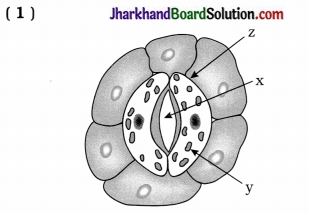
JAC Class 10 Science Important Questions Chapter 6 Life Processes 1

Questions :

  1. Identify label x and state any two process that occur through it.
  2. Identify label y and state the name of process and equation that occurs in it.
  3. Identify label z and which situation you think for the given diagram?
  4. What you think about transportation during day from label x in given diagram?

Answer:

  1. x – stomatal pore, exchange of gases and transpiration occur through it.
  2. y – chloroplast, photosynthesis process occurs in it.

    JAC Class 10 Science Important Questions Chapter 6 Life Processes 2
  3. z – guard cells, the guard cells swell when water flows into them, causing the stomatal pore to open.
  4. During the day when stomata are open, the transpiration pull becomes the major driving force in the movement of water in xylem.
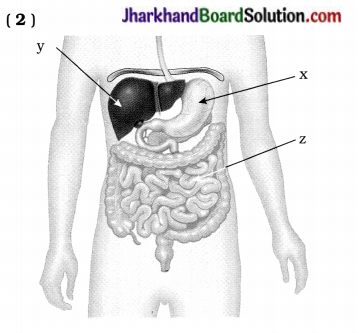
JAC Class 10 Science Important Questions Chapter 6 Life Processes 3
Questions :

  1. Identify x and state the name of enzyme secreted in it and a medium required for its action.
  2. Which juice is secreted from y? Where does it show its action and state the name of process which occurs by it?
  3. State the name of specific finger-likc projections located in z and its functions.
  4. Which other finger-like projection do you know and where can you observe it?

Answer:

  1. x – stomach, name of enzyme is pepsin and acidic medium is required for its action.
    Bile juice secreted from y. It shows its action in small intestine and emulsification (breakdown of fat globules) process occurred by it.
  2. Specific finger-like projections in the walls of z are villi. It increases surface area for absorption of food.
  3. We know other finger-like projections are pseudopodia. We can observe it on the cell surface of amoeba.
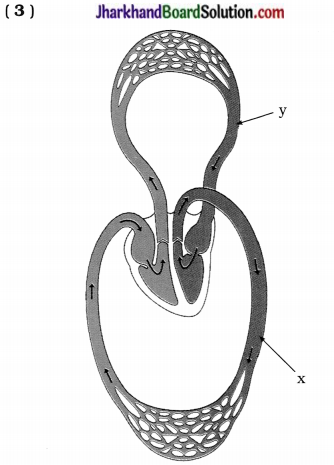
JAC Class 10 Science Important Questions Chapter 6 Life Processes 4
Questions :

  1. Which type of blood circulation you see in this diagram, what it means?
  2. Which type of blood flows through x? Which one is exceptional for this?
  3. Which type of blood flows through y? Why?
  4. How our body gets highly efficient supply of oxygen?

Answer:

  1. Double circulation. It means blood goes through the heart twice during each cycle.
  2. Oxygenated blood flows through x. Pulmonary artery is exceptional because it transports deoxygenated blood.
  3. Oxygenated blood flows through y. Because it carries blood from lungs to heart and in lungs blood becomes oxygenated.
  4. The separation of the right side and the left side of the heart is useful to keep oxygenated and deoxygenated blood from mixing.
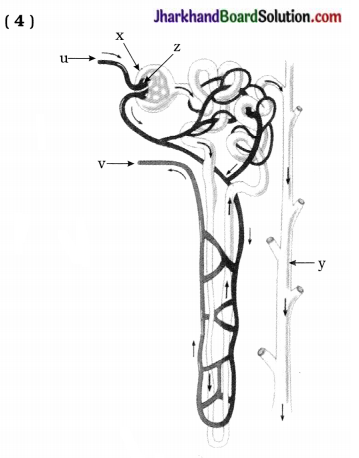
JAC Class 10 Science Important Questions Chapter 6 Life Processes 5
Questions:

  1. Which structure is shown in the above diagram? Which nitrogenous wastes is removed from blood by this structure?
  2. Identify x and mention its shape and function.
  3. Identify y and z.
  4. Compare the blood flowing through u and v blood vessles.

Answer:

  1. Structure of nephron shown in the diagram. Nitrogenous wastes such as urea and uric acid are removed from blood by it.
  2. x – Bowman’s capsule. It is cup-shaped and collects the filtrate.
  3. y – collecting duct, z – glomerulus.
  4. u – It transports oxygenated blood containing more nitrogenous wastes, v – It transports deoxygenated blood with lesser nitrogenous wastes due to filtration.

Objective Questions and Answers

Question 1.
Answer the following questions in short:
(1) Which inorganic substances are used as raw materials by autotrophic organisms?
Answer:
Water and CO2 are the inorganic substances used as raw material for the synthesis s of organic food by autotrophic organisms.

(2) What is the mode of nutrition in fungi?
Answer:
The fungi show heterotrophic nutrition, in which breakdown the food material outside the body and then absorb it.

(3) Name one organism each, having saprophytic, parasitic and holozoic modes of nutrition.
Answer:

Mode of nutritionName of organism
SaprophyticMost of fungi
ParasiticTapeworm, Ascaris
HolozoicAmoeba, Human

(4 ) In addition to carbon dioxide and water, state two other conditions necessary for the process of photosynthesis.
Answer:
Presence of chlorophyll in the cells and <: the presence of sunlight are also necessary, in addition to CO2 and water, for photosynthesis.

(5) Why there is a controversy about whether viruses are truly alive or not?
Answer:
There is a controversy about whether viruses are truly alive or not, because viruses do not show any molecular movement in them unless they infect specific host cell.

(6) Why are molecular movements needed for life?
Answer:
Molecular movements are needed for life because all the structures of living cells are made up of molecules and they must move molecules around all the time.

(7) On what the survival of heterotrophs depend? Give example of heterotrophic organisms?
Answer:
The survival of heterotrophs depends directly or indirectly on autotrophs.
Example of heterotrophic organisms : Animals and fungi.

(8) Which form of carbohydrate is stored in green plants and in human beings?
Answer:
Carbohydrates in the form of starch is stored in green plants while in human beings it is stored as glycogen.

(9) How desert plants perform process of photosynthesis?
Answer:
Desert plants take up carbon dioxide at night and prepare an intermediate which is acted upon by the energy absorbed by the chlorophyll during the day.

(10) Where does the exchange of gases occur in plants other than stomatal pores?
Answer:
The exchange of gases occurs across the surface of stems, roots and leaves other than in stomatal pores of plants.

(11) What is the function of guard cells?
Answer:
The opening and closing of the stomatal pore is a function of the guard cells.

(12) What is the essentiality of nitrogen element?
Answer:
Nitrogen is an essential element in the synthesis of protein and other compounds.

(13) Give the name of organisms that use parasitic nutritive strategy.
Answer:
The name of organisms that use parasitic nutritive strategy are cuscuta, ticks, lice, leech, tapeworm, etc.

(14) How a food vacuole is formed in amoeba?
Answer:
Amoeba takes in food using temporary finger-like extensions called pseudopodia of the cell surface which fuse over the food particle forming a food vacuole.

(15) What is peristaltic movement?
Answer:
The rhythmic movement shown by the contractions of the muscles of lining of alimentary canal which push the food only in one direction is called peristaltic movement.

(16) What causes acidity in adults?
Answer:
Acidity is caused due to excess secretion of hydrochloric acid in stomach.

(17) State the name of enzyme involved in digestion of protein and its location.
Answer:

Name of enzyme involved in digestion of proteinLocation
(1) PepsinGastric juice
(2) TrypsinPancreatic juice

(18) In which type of respiration more energy is released?
Answer:
In aerobic respiration more energy is released.

(19) Which part of root is involved in the exchange of respiratory gases?
Answer:
The root hairs, formed from the epidermal cells of the root, are involved in the exchange of respiratory gases.

(20) Name the respiratory organ of fish.
Answer:
The fish possesses pharyngeal gills as respiratory organs.

(21) In which pathway of breakdown of glucose CO2 is not produced?
Answer:
Anaerobic respiration in our muscle cells

JAC Class 10 Science Important Questions Chapter 6 Life Processes 6

(22) Why the air passage does not collapse in our body?
Answer:
Rings of cartilage are present in the trachea so that the air passage does not collapse in our body.

(23) What are the characteristics of respiratory surface?
Answer:
Respiratory surface is very fine, delicate, moist and contains an extensive network of blood vessels and it remains in contact with atmosphere.

(24) Why the lungs always contain a residual volume of air?
Answer:
Thle lungs always contain a residual volume of air so that there is sufficient time for oxygen to be absorbed and for carbon dioxide to be released.

(25) Give the name, location and function of respiratory pigment in human beings.
Answer:
In human beings, respiratory pigment
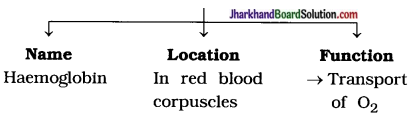
JAC Class 10 Science Important Questions Chapter 6 Life Processes 7

(26) What is called single circulation?
Answer:
Blood goes only once through the heart in the fish body during the once circulation.

(27) What is the function of blood capillaries?
Answer:
Exchange of material between blood and the surrounding cells takes place across the thin wall of blood capillaries.

(28) What is the significance of lymph?
Answer:
Lymph carries digested and absorbed fat from small intestine and drains excess fluid from intercellular space back into the blood.

(29) Who forms conducting tubes in higher plants? What are transported through it?
Answer:
Xylem and phloem forms conducting tubes in higher plants. Xylem transports water and minerals, phloem transports products of photosynthesis.

(30) How sunction is created in xylem? What is it significance?
Answer:
Evaporation of water molecules from the cells of a leaf creates a sunction in xylem. It pulls water from the xylem cells.

(31) State any two points of importance of transpiration in plants?
Answer:
Importance of transpiration in plants:

  • It helps in the absorption and upward movement of water and minerals dissolved in it from roots to the leaves.
  • It helps in temperature regulation.

(32) State the name of forces important for the movement of water in the xylem during day and at night respectively?
Answer:
Transpiration pull during day and root pressure at night are important forces for the movement of water in the xylem.

(33) Which substances are transported through phloem?
Answer:
Sucrose, amino acids and other substances are transported through phloem.

(34) Which component of phloem shows translocation of food? In which direction does s it take place?
Answer:
The translocation of food takes place in the sieve tubes with the help of adjacent companion cells of phloem and in both upward and downward directions.

(35) Explain translocation of sugar in the spring season in plants.
Answer:
In the spring season, sugar stored in root or stem tissue is translocated to the buds which need energy to grow.

(36) Which substances are selectively reabsorbed from initial filtrate in the tubular part of nephron?
Answer:
Glucose, amino acids, salts and a major amount of water are selectively reabsorbed from initial filtrate in the tubular part of nephron.

(37) Until when urine is stored in the urinary bladder?
Answer:
Urine is stored in the urinary bladder until the pressure of the expanded bladder leads to the urge to pass it out through the urethra.

(38) Why we can usually control the urge to urinate?
Answer:
We can usually control the urge to urinate because the bladder can store urine and it is under voluntary nervous control.

(39) State name and location of any three structures which are richly supplied with blood vessels.
Answer:

StructureLocation
(1) VilliWall of intestine
(2) AlveoliTerminale of bronchioles in lungs
(3) NephronIn the kidneys

Question 2.
Define : OR Explain the terms :
(1) Nutrition
Answer:
A process of transfer of a source of energy from outside the body of the organism to the inside is called nutrition.

(2) Photosynthesis
Answer:
A process of synthesis of simple form of carbohydrate, i.e. glucose with the use of solar energy, water and carbon dioxide in presence of chlorophyll is called photosynthesis.

(3) Autotrophs
Answer:
Those organisms which utilise simple inorganic sources in the form of carbon dioxide and water and synthesise complex food are called autotrophs.

(4) Heterotrophs
Answer:
Those organism which utilise complex food material prepared by other organisms are called heterotrophs.

(5) Digestion
Answer:
A process by which complex food components are transformed into simple, soluble and absorbable form with the help of enzymes is called digestion.

(6) Respiration
Answer:
A process of breakdown of food source such as glucose, in presence or in absence of oxygen inside the living cell to provide energy for cellular need is called respiration.

(7) Breathing
Answer:
A process of inhalation and exhalation is called breathing.

(8) Transpiration
Answer:
A process of loss of water in the form of vapour from the aerial parts of the plant is known as transpiration.

(9) Excretion
Answer:
The biological process involved in removal of nitrogenous metabolic wastes from the body is called excretion.

Question 3.
Fill in the blanks :

  1. The substance, used in cellular respiration, is ………………..
  2. The effect of ……………….. in transport of water is more important at night.
  3. Carbohydrate is synthesized by the reduction of COa in the process of ………………..
  4. The secretions from the liver and pancreas are poured in the ………………..
  5. Human beings show ……………….. mode of nutrition.
  6. The enzyme ……………….. digests starch and converts it into maltose.
  7. Pepsin is an enzyme that can act only in ……………….. medium.
  8. The digestion of food particle in Amoeba occurs in ………………..
  9. The ……………….. in the wall of small intestine greatly increase the surface area for absorption.
  10. The conversion of glucose into ……………….. during the first phase of the respiratory process occurs in the cytoplasm.
  11. The conduction of the photosynthetic products is called ………………..
  12. The ……………….. increases when the sucrose is transported through the phloem tissue.
  13. The suction force created due to ……………….. is the main force for the conduction of water in the xylem.
  14. The artery emerging from the left ventricle is called ………………..
  15. There is always ……………….. blood in the right auricle.
  16. As compared to blood the lymph contains ……………….. proteins.
  17. The exchange of materials between the blood and tissue cells of the body takes place through ………………..
  18. The terminal end of the excretory unit opens in the ………………..
  19. The wall of the arteries are thick and ………………..
  20. ……………….. During photosynthesis, ……………….. is evolved as by-product.

Answer:

  1. glucose
  2. root pressure
  3. photosynthesis
  4. small intestine
  5. heterotrophic
  6. amylase
  7. acidic
  8. food vacuole
  9. vIlli
  10. pyruvate
  11. translocauon
  12. osmotic pressure
  13. transpiraüon
  14. aorta
  15. deoxygenated
  16. less
  17. capillaries
  18. collectIng duct
  19. elastic
  20. oxygen

Question 4.
State whether the following statements are true or false:

  1. Euglena is an autotrophic animal.
  2. In human body the carbohydrates are stored in the form of glycogen.
  3. In photosynthesis the carbon dioxide is oxidized to form carbohydrates.
  4. The control and regulation of the opening and closing of stomata is done by the chloroplasts.
  5. Liver and pancreas produce digestive juices which help in digestion in small intestine.
  6. The liver secretes acidic bile.
  7. The cellulose in the cells of grass, can be digested by herbivores animals.
  8. The inner wall of the stomach possesses tubular glands which secrete gastric juice.
  9. Cuscuta is a plant, harmful for the host plant.
  10. The rate of breathing in terrestrial animals is much faster than that seen in aquatic animals.
  11. Cilia help in ingestion of food in paramoecium.
  12. The enzymes pepsin and trypsin digest carbohydrates and fats respectively.
  13. An artificial kidney is a device to remove nitrogenous wastes from the blood through dialysis.
  14. The bronchus ends in the alveolus.
  15. The diaphragm bends (moves) downwards at the time of expiration.
  16. The blood flows from the heart to other organs under pressure.
  17. In unicellular animals, the excretory substances are removed by diffusion in the surrounding water.
  18. The blood vessels absorb fat through the villi of the ileum.
  19. In certain plants, the useless waste substances are stored in cellular vacuoles.
  20. The wall of the blood capillaries is bilayered and thick.
  21. The body temperature is maintained by using energy in animals of classes Mammalia and Aves.
  22. The pulmonary arteries cany oxygenated blood.
  23. In plants, the conduction of water is in both upward and downward directions.
  24. The phloem tissue transports carbohydrate, amino acids and plant hormones.
  25. Blood is a red coloured, non-living liquid connective tissue.

Answer:

  1. True
  2. True
  3. False
  4. False
  5. True
  6. False
  7. True
  8. True
  9. True
  10. False
  11. True
  12. False
  13. True
  14. False
  15. False
  16. True
  17. True
  18. False
  19. True
  20. False
  21. True
  22. False
  23. False
  24. True
  25. False

Question 5.
Match the following:
(1)

Column IColumn II
1. Algaep. Saprophytic nutrition
2. Cuscutaq. Holozoic nutrition
3. Fungir. Autotrophic nutrition
4. Amoebas. Parasitic nutrition

Answer:
(1 – r), (2 – s), (3 – p), (4 – q).

(2)

Column IColumn II
1. Salivary glandsp. Beginning of protein digestion
2. Liverq. Enzyme trypsin
3. Pancreasr. Alkaline bile
4. Stomachs. Secretion of amylase

Answer:
(1 – s), (2 – r). (3 – q). (4 – p).

(3)

Column IColumn II
1. Amoebap. Omnivores
2. Paramoeciumq. Gills
3. Human beingr. Pseudopodia
4. Fishs. Cilia

Answer:
(1 – r), (2 – s), (3 – p), (4 – q).

(4)

Column IColumn II
1. Villip. Exchange of gases
2. Cartilagenous ringq. Absorption
3. Alveolusr. Helps in breathing
4. Diaphragms. Trachea

Answer:
(1 – r), (2 – s), (3 – p), (4 – q).

(5)

Column IColumn II
1. Phloemp. Urine formation
2. Excretory unitq. Upward and downward conduction
3. Pulmonary veinr. Deoxygenated blood
4. Renal veins. Oxygenated blood

Answer:
(1 – q), (2 – p), (3 – s), (4 – r).

(6)

Column IColumn II
1. Human heartp. Cup-shaped
2. Human kidneyq. Four-chambered
3. Nephronr. Bean-shaped
4. Bowman’s capsules. Long-coiled tubule

Answer:
(1 – q), (2 – r), (3 – s), (4 – p).

(7)

Column IColumn II
1. Villip. Right auricle
2. Bowman’s capsuleq. Less protein
3. Lymphr. Glomerulus
4. Vena cavas. Small intestine

Answer:
(1 – s), (2 – r), (3 – q). (4 – p).

(8)

Column IColumn II
1. Chloroplastp. Stomatal pore
2. Mitochondriaq. Digestion
3. Guard cellsr. Reduction of CO<sub>2</sub>
4. Food vacuoles. Breakdown of pyruvate using O<sub>2</sub>

Answer:
(1 – r), (2 – s), (3 – p), (4 – q).

(9)

Column IColumn II
1. Photosynthesisp. Temperature regulation
2. Respirationq. Energy stored
3. Transpirationr. Sucrose
4. Translocations. Energy released

Answer:
(1 – q), (2 – s), (3 – p), (4 – r).

Question 6.
Chart – diagram based questions:
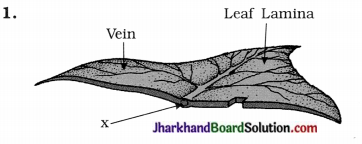
JAC Class 10 Science Important Questions Chapter 6 Life Processes 8
Identify x in diagram and state which system of plant does it indicate.
Answer:
x-phloem, xylem vascular bundle, it indicates transportation system of plant.

2.
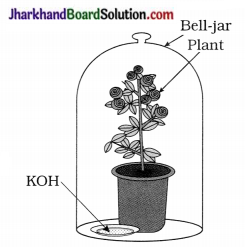
JAC Class 10 Science Important Questions Chapter 6 Life Processes 9
Why starch test is negative in any leaf of plant? What you conclude?
Answer:
Starch test is negative in any leaf of plant s because CO2 is not available as the plant is in bell-jar in which KOH absorbed CO2.
CO2 is a raw material essential for s photosynthesis.
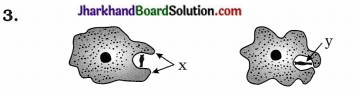
JAC Class 10 Science Important Questions Chapter 6 Life Processes 10
State the lable x and y in given diagram and also mention which life process do they indicate.
Answer:
x – pseudopodia, y – food vacuole
Life process : nutrition in amoeba

4. Fill the blanks in given table with reference to digestion process in human:
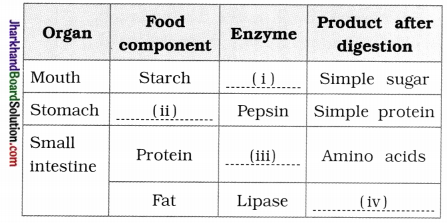
JAC Class 10 Science Important Questions Chapter 6 Life Processes 11
Answer:

  1. Amylase
  2. Protein
  3. Trypsin
  4. Fatty acid and glycerol

JAC Class 10 Science Important Questions Chapter 6 Life Processes 12
What change occurs in the solution in test tube? What is responsible for such change?
Answer:
The lime water in test tube turns milky.
We breath out CO2 which is responsible for lime water to turn milky.

6. Fill the blanks in given chart:
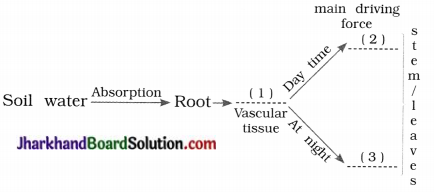
JAC Class 10 Science Important Questions Chapter 6 Life Processes 13
Answer:

  1. Xylem
  2. Transpiration pull
  3. Root pressure

7.
JAC Class 10 Science Important Questions Chapter 6 Life Processes 14
Observe the diagram and indicate which parts shows function of storage of urine and filtration of blood?
Answer:
y – kidney – filtration of blood
z – urinary bladder – storage of urine

Question 7.
Select the correct alternative from those given below each question:
1. Which of the following organism breaks down food material outside of body?
A. Mushroom
B. Cuscuta
C. Leech
D. Lice
Answer:
A. Mushroom

2. Where does the digestion of protein start in human being?
A. Mouth
B. Stomach
C. Small intestine
D. Colon
Answer:
B. Stomach

3. Which of the following type has longest small intestine?
A. Tiger
B. Human
C. Cow
D. Rat
Answer:
C. Cow

4. Which one of the following organisms can live without oxygen or air?
A. Amoeba
B. Leech
C. Green plant
D. Yeast
Answer:
D. Yeast

5. Which is the exact site for gaseous exchange s in human beings?
A. Brochus
B. Alveoli
C. Villi
D. Skin
Answer:
B. Alveoli

6. What is the product from glucose in the first phase of respiration?
A. Ethanol
B. Lactic acid
C. Pyruvic acid
D. CO2
Answer:
C. Pyruvic acid

7. What is the ultimate purpose of digestion?
A. Transportation
B. Absorption
C. Respiration
D. Assimilation
Answer:
B. Absorption

8. Which cells surround the pore of the stomata?
A. Epidermal cells
B. Companion cells
C. Sieve cells
D. Guard cells
Answer:
D. Guard cells

9. Which organ stores bile?
A. Liver
B. Pancreas
C. Small intestine
D. Gall bladder
Answer:
D. Gall bladder

10. The enzyme acting in acidic medium is ………………..
A. amylase
B. pepsin
C. trypsin
D. both B and C
Answer:
B. pepsin

11. In plants, photosynthetic products are transported through ………………..
A. vessel and sieve tube
B. tracheid and vessel
C. sieve tube and companion cell
D. sieve tube and tracheid
Answer:
C. sieve tube and companion cell

12. In which part of the body blood is oxygenated?
A. Heart
B. Liver
C. Kidney
D. Lungs
Answer:
D. Lungs

13. At which part the actual process of filtration of blood takes place in kidney?
A. Bowman’s capsule
B. Collecting duct
C. Tubular part of nephron
D. Capillaries of nephron
Answer:
A. Bowman’s capsule

14. From which part of the human heart only oxygenated blood always flows?
A. Both atria
B. Both ventricles
C. Left atrium and left ventricle
D. Right atrium and right ventricle
Answer:
C. Left atrium and left ventricle

15. As compared to blood, the lymph contains ………………..
A. fewer RBCs
B. less amount of water
C. less amount of metabolic waste
D. less amount of proteins
Answer:
D. less amount of proteins

16. Which of the following brings oxygenated blood into left atrium in heart?
A. Pulmonary vein
B. Pulmonary artery
C. Vena cava
D. Aorta
Answer:
A. Pulmonary vein

17. What happens in the process of photo-synthesis?
A. Transformation of solar energy into functional energy
B. Transformation of solar energy into chemical energy
C. Transformation of chemical energy into functional energy
D. Transformation of functional energy into chemical energy
Answer:
B. Transformation of solar energy into chemical energy

18. Which is the main force for the conduction of water through the xylem in plants?
A. Absorption of water through roots
B. Absorption of ions through roots
C. Sufficient availability of water from the soil
D. Suction due to transpiration
Answer:
D. Suction due to transpiration

19. Which of the following alternative shows the correct path of oxygenated blood flow in human beings?
A. Lungs → Pulmonary veins → Left auricle → Left ventricle → Various organs of the body
B. Lungs Pulmonary artery → Left auricle → Left ventricle → Various organs of the body
C. Lungs → Pulmonary artery → Right auricle → Right ventricle → Various organs of the body
D. Various organs of the body Right auricle → Right ventricle → Pulmonary artery → Lungs
Answer:
A. Lungs → Pulmonary veins → Left auricle → Left ventricle → Various organs of the body

20. Select the correct pair :
A. Stomata – transpiration
B. Translocation – glucose
C. Villi – egestion of feaces
D. Trachea – cartilaginous rings
Answer:
A. Stomata – transpiration
D. Trachea – cartilaginous rings

21. Which process is important for osmoregulation?
A. Nutrition
B. Circulation
C. Breathing
D. Excretion
Answer:
D. Excretion

22. Which one is the false statement for arteries?
A. Arteries carry blood from the heart towards other organs.
B. In arteries the blood flows under high pressure.
C. All arteries carry oxygenated blood.
D. The arterial walls are thick and elastic.
Answer:
C. All arteries carry oxygenated blood.

23. Resin and gum are the substances of plants.
A. excretory
B. nutritive
C. constitutional
D. reserve
Answer:
A. excretory

24. Which is the circulatory pathway of blood in the human heart?
A. Right auricle → Left auricle → Lungs → Right ventricle → Left ventricle → Different organs
B. Right auricle → Right ventricle → Lungs → Left auricle → Left ventricle → Different organs
C. Right auricle → Right ventricle Different organs → Left auricles Left ventricle → Lungs
D. Right auricle → Left auricle → Different organs → Right ventricle → Left ventricle → Lungs
Answer:
B. Right auricle → Right ventricle → Lungs → Left auricle → Left ventricle → Different organs

25. Which substance does not get reabsorbed in nephron during urine formation?
A. Glucose
B. Urea
C. Amino acid
D. Uric acid
Answer:
B. Urea, Uric acid

26. In which of following process. ATP is used?
A. Translocation of food
B. To maintain body temperature in human
C. Respiration
D. Simple diffusion in human
Answer:
Translocation of food, To maintain body temperature in human

27. Statement A: The rate of breathing is much faster in fishes.
Reason R : The blood goes only once through the heart in the fish during one cycle of passage through the body.
Which is the correct option for Statement A and Reason R?
A. Both A and R correct and R is explanation of A.
B. Both A and R correct but R is not explanation of A.
C. A is correct, R is incorrect.
D. A is incorrect, R is correct.
E. Both A and R incorrect.
Answer:
A. Both A and R correct and R is explanation of A.

28. Statement A : ATP is the energy currency for cellular processes.
Reason R: Complete oxidation of pyruvate in presence of oxygen occurs in mitochondria.
Which is the correct option for Statement A and Reason R?
A. Both A and R correct and R is explanation of A.
B. Both A and R correct but R is not explanation of A.
C. A is correct, R is incorrect.
D. A is incorrect, R is correct.
E. Both A and R incorrect.
Answer:
B. Both A and R correct but R is not explanation of A.

29. Which animals tolerate some mixing of oxygenated and deoxygenated blood streams?
A. Fishes
B. Birds
C. Mammals
D. Amphibians
Answer:
D. Amphibians

30. The diagram is labelled, which part secretes digestive juice?
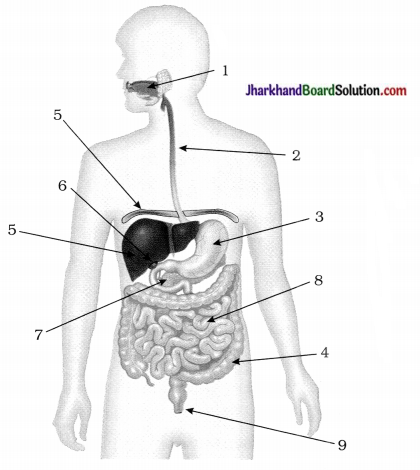
JAC Class 10 Science Important Questions Chapter 6 Life Processes 15
A. 1, 3, 5, 7
B. 2, 4. 6, 8
C. 2, 3, 5, 8
D. 1, 4, 6, 8
Answer:
A. 1, 3, 5, 7

Question 8.
Answer as directed : (Miscellaneous)
(1) Which pigment has a very high affinity for oxygen? Where is it present in human body?
Answer:
Haemoglobin in red blood cells

(2) State the equation of photosynthesis.
Answer:

JAC Class 10 Science Important Questions Chapter 6 Life Processes 15a

(3) Name of instrument used to measure blood pressure.
Answer:
Sphygmomanometer

(4) About which organism there is a controversy regarding whether it is a living being or non-living entity?
Answer:
Viruses

(5) Give the full form of ATP.
Answer:
Adenosine TriPhosphate

(6) Identify me : I am a cup-shaped structure with glomerulus and I carry out filtration.
Answer:
Bowman’s capsule

(7) Find mismatched pair :
1. One cell thick – blood capillary
2. Ring of cartilage – trachea
3. Phloem tissue – transport of sucrose
4. Platelet cells – transport of respiratory gases
Answer:
4. Platelet cells – transport of respiratory gases

(8) State the normal blood pressure of human.
Answer:
Systolic pressure 120 mm Hg and diastolic pressure 80 mm Hg

(9) Identify me : A component of gastric juice protect the inner lining of the stomach from the action of hydrochloric acid under normal condition.
Answer:
Mucus

(10) Sketch the respiratory pathway which does not produce CO2.
Answer:
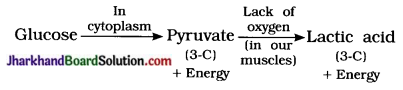
JAC Class 10 Science Important Questions Chapter 6 Life Processes 15b

(11) Which of the following organisms show parasitic nutritive strategy?
Lion, lice, bread mould, cuscuta, leech, yeast, tick
Answer:
lice, cuscuta, leech, tick

(12) Find mismatched pair:
1. Paramoecium – Fermentation
2. Peristaltic movement – All along the gut
3. Emulsifying action – Bile
4. Trachea – Windpipe
Answer:
1. Paramoecium – Fermentation

(13) Which treatment do you suggest to a patient whose both kidneys have stopped functioning?
Answer:
Hemodialysis

(14) Transpiration helps to create osmotic pressure for translocation of sucrose. State whether s this sentence true or false.
Answer:
False

Value Based Questions With Answers

Question 1.
Your younger brother complains about pain in teeth. You often notice that he frequently eats chocolates and pastries. Even he likes to eat sweets.
Questions:

  1. What do you think about the pain in teeth?
  2. Which advise will you give to your brother?
  3. What will happen if this problem is untreated?

Answer:

  1. Sugar content is very high in chocolates, pastries and sweets. Bacteria act on sugars and produce acidic substances. Acids soften? the enamel, i.e.. cause dental caries or tooth decay. Masses of bacterial cells together with food particles stick to the teeth to form dental plaque. This is responsible for pain in teeth.
  2. Brushing the teeth after eating, will remove plaque.
  3. If this problem is untreated, microorganisms may invade the gums causing inflammation and infection

Question 2.
Your uncle often complains about indigestion of after having oily food. He consults a doctor and? is diagnosed with stone in gall bladder. Doctor advised him to remove gall bladder surgically.
Questions:

  1. What is the function of gall bladder?
  2. Which process initiates the digestion of oils?
  3. After surgery, which type of food should be given to uncle?

Answer:

  1. Gall bladder stores bile juice.
  2. Emulsification (i.e.. bile salts breakdown large 5 oil globules into fine small droplets) process initiate the digestion of oils.
  3. After surgery, food with low fat content, i.e., less oil, ghee, butter, etc. is advisable.

Question 3.
Your neighbour is a chain-smoker. He often suffers from cough and lung infection. His relatives often tell him to leave smoking.

Questions:

  1. How inhaled air is filtered in the upper part of respiratory tract?
  2. Which is the effect of smoking on the upper part of respiratory tract?
  3. Why do you call smoking as injurious to health?

Answer:

  1. The upper part of respiratory tract is provided with small hair-like structures called cilia, which help to remove germs, dust and other harmful particles from inhaled air.
  2. Smoking destroys hair like cilia due to which germs, dust, smoke and other harmful chemicals enter lungs and causes harm.
  3. Smoking reduces the breathing efficiency of lungs, may cause various infection and even lung cancer. So, called it is injurious to health. Cigarette contains nicotine which can cause cancer to the respiratory organs.

Question 4.
Your subject teacher arranges a visit to a hospital, where you can observe haemodialysis.
JAC Class 10 Science Important Questions Chapter 6 Life Processes 16
Questions :

  1. Which conditions may lead to kidney failure?
  2. What is the use of artificial kidney?
  3. Explain how artificial kidneys work?

Answer:

  1. Several factors such as infections, injury or restricted blood flow to kidney reduce the activity of kidneys. This leads to accumulation of toxic nitrogenous substances, gradually may lead to kidney failure.
  2. An artificial kidney is a device to remove s nitrogenous waste products from the blood through dialysis.
  3. Artificial kidneys contain a number of tubes with a semi-permeable lining, suspended in a tank filled with dialysing fluid. This fluid has same osmotic pressure as blood but nitrogenous wastes are absent.

As shown in diagram, patient’s blood is passed through tubes. During this, nitrogenous waste products from blood pass into dialysing fluid by diffusion. The purified blood is pumped back into the patient’s vein.

Practical Skill Based Questions With Answers

Question 1.
Observe experiment arranged in your school laboratory as shown in figure.
JAC Class 10 Science Important Questions Chapter 6 Life Processes 17
Questions :

  1. State the colour of the stem and veins of the leaves.
  2. Does the volume of solution in the beaker get reduced? Why?
  3. In the T.S. of stem, which part is observed to be reddish in colour? Why?
  4. State your inference.

Answer:

  1. Reddish
  2. Yes, because plant absorbed solution from beaker through its roots.
  3. Xylem tissue becomes reddish in colour in T.S. of stem because water moves up through xylem.
  4. Water and minerals absorbed by root move in upward direction through xylem vessels.

Question 2.
Take a potted plant.

  • Insert one of its branches in a large, thin and transparent plastic/polythene bag and tie the bag at its open end with the branch.
  • Add adequate amount of water to the clay in the pot, and keep the pot exposed to sunlight for a few hours.
  • Observe the inner side of the bag after a few hours.
    JAC Class 10 Science Important Questions Chapter 6 Life Processes 18

Questions :

  1. Why are small droplets of water seen on the inner surface of the plastic/polythene bag?
  2. State the role played by sunlight in the formation of water droplets.
  3. State the passage of flow of water droplets through the potted plant.

Answer:

  1. Loss of water vapour from leaves condense and show water droplets.
  2. Sunlight is responsible for transpiration. Water is lost in the form of vapour, which creates suction and transpiration pull in upward direction.
  3. Soil root xylem → stem-xylem → leaf xylem → stomata → water vapour

Question 3.
Place two fingers of your right hand on the left wrist and feel the pulse beats.

  • Count the number of pulse beats felt by your right hand fingers in exactly one minute.
  • Repeat the counting of pulse beats twice or thrice for accuracy. Find out the mean of all readings.
  • Now run fast for a short distance for about one or two minutes, or climb the steps of a staircase quite rapidly twice or thrice.
  • And thereafter, again measure your pulse s beats.

Questions:

  1. State the normal pulse rate.
  2. State the relation of pulse rate with the rate of heart beats.
  3. State the number of pulse beats after a little running or climbing the staircase.
  4. What is the change found in the pulse rate after running, as compared to the normal pulse rate? Why?

Answer:

  1. 60- 100
  2. The pulse rate is similar to heart beats.
  3. 120 to 130 times in a minute.
  4. Pulse rate increases after riming because body requires more oxygen and to fullfil it, heart beats increase.

Memory Map:
JAC Class 10 Science Important Questions Chapter 6 Life Processes 19