JAC Class 10 Social Science Important Questions History Chapter 4 The Age of Industrialisation

JAC Board Class 10th Social Science Important Questions History Chapter 4 The Age of Industrialisation

Multiple Choice Questions

Question 1.
When were the earliest factories in England set up?
(a) 1370s
(b) 1870s
(c) 1760s
(d) 1730s
Answer:
(d) 1730s

Question 2.
Who created the cotton mill in England?
(a) James Watt
(b) Richard Arkwright
(c) Henry Patullo
(d) Seth Hukumchand
Answer:
(b) Richard Arkwright

JAC Class 10 Social Science Important Questions History Chapter 4 The Age of Industrialisation width=

Question 3.
Who improved the steam engine produced by Newcomen?
(a) James Watt
(b) Richard Arkwright
(c) Mathew Boulton
(d) Dinshaw Petit
Answer:
(a) James Watt

Question 4.
Who devised the Spinning Jenny?
(a) Richard Arkwright
(b) James Watt
(c) James Hargreaves
(d) Newcomen
Answer:
(c) James Hargreaves

Question 5.
In which year was the Spinning Jenny designed?
(a) 1674
(b) 1764
(c) 1746
(d) 1647
Answer:
(b) 1764

Question 6.
Which city on the Gujarat coast connected India to the Gulf and Red Sea ports?
(a) Dwarka
(b) Bhavnagar
(c) Porbandar
(d) Surat
Answer:
(d) Surat

Question 7.
Which town on the Coromandel Coast had trade links with Southeast Asian ports?
(a) Surat
(b) Afghanistan
(c) Persia
(d) Masulipatam
Answer:
(d) Masulipatam

Question 8.
Which town in Bengal had trade links with Southeast Asian ports?
(a) Hoogly
(b) Porbandar
(c) Dwarka
(d) Mas’ulipatnam
Answer:
(a) Hoogly

Question 9.
When was the first cotton mill in Bombay set up?
(a) 1855
(b) 1854
(c) 1862
(d) 1874
Answer:
(b) 1854

JAC Class 10 Social Science Important Questions History Chapter 4 The Age of Industrialisation width=

Question 10.
In which year was the first jute mill in Bengal set up?
(a) 1854
(b) 1862
(c) 1855
(d) 1874
Answer:
(c) 1855

Very Short Answer Type Questions

Question 1.
What is proto-industrialisation?
Answer:
Even before factories began to dot the landscape in England and Europe, there was a large-scale industrial production for an international market. This was not based on factories. Many historians now refer to this phase of industrialisation as proto-industrialisation.

Question 2.
What were trade guilds?
Answer:
Trade guilds were associations of producers that trained craftspeople, maintained control over production, regulated competition and prices, and restricted the entry of new people into the trade.

Question 3.
Why did London come to be known as a finishing centre?
Answer:
The finishing of textiles was done in London before the export merchant sold the cloth in the international market. Therefore, it came to be known as a finishing centre.

Question 4.
How did inventions in the eighteenth century help in the production process?
Answer:
A series of inventions in the eighteenth century increased the efficacy of each step of the production process (carding, twisting and spinning, and rolling). They enhanced the output per worker, enabling each worker to produce more and they made possible the production of stronger threads and yam.

Question 5.
What were the most dynamic industries of Britain in the early nineteenth century?
Answer:
Cotton and metals were the most dynamic industries of Britain in the early nineteenth century.

Question 6.
What did the historians recognise the typical workers of mid-nineteenth century as?
Answer:
Historians increasingly recognised the typical workers of mid-nineteenth century as traditional craftsperson and labourer and not as a machine operator.

Question 7.
Why did the upper classes in Victorian Britain prefer things produced by hand?
Answer:
Handmade products came to symbolise refinement and class. They were better finished, individually produced, and carefully designed. Therefore, the aristocrats and bourgeoisie of Victorian Britain preferred things produced by hand.

JAC Class 10 Social Science Important Questions History Chapter 4 The Age of Industrialisation width=

Question 8.
What do you understand by seasonality of work?
Answer:
Seasonality of work in many industries meant prolonged periods without work. After the busy season was over, the poor were jobless again. Few returned to the countryside after the winter, when the demand for labour in the rural areas opened up in places. However, most of them searched for odd jobs, which till the mid-nineteenth century were difficult to find. *

Question 9.
What was Spinning Jenny?
Answer:
Spinning Jenny speeded up the spinning process, and reduced labour demand. By turning one single wheel a worker could set in motion a number of spindles and spin several threads at the same time.

Question 10.
Why did the number of workers employed in the transport industry double in the 1840s?
Answer:
The number of workers employed in the transport industry doubled in the 1840s because after the 1840s, building activity intensified in the cities, opening up greater opportunities of employment. Roads were widened, new railway stations came up, railway lines were extended, and tunnels dug, drainage and sewers laid, and rivers embanked.

Short Answer Type Questions

Question 1.
Why couldn’t the merchants expand their production within towns in the seventeenth and eighteenth centuries?
Answer:
The merchants could not expand their production within towns in the seventeenth and eighteenth centuries because urban crafts and trade guilds were powerful. These were associations of producers that trained craftspeople, maintained control over production, regulated competition and prices, and restricted the entry of new people into the trade. Rulers granted different guilds the monopoly right to produce and trade in specific products. It was therefore, difficult for new merchants to set up business in towns.

Question 2.
How did silk and cotton goods from India dominate the international market in textiles before the age of machine industries?
Answer:

  1. Coarser cotton was produced in many countries, but India produced the finer varieties.
  2. Armenian and Persian merchants took the goods from Punjab to Afghanistan, eastern Persia and Central Asia. Bales of fine textiles were carried on camel back via the north-west frontier, through mountain passes and across deserts.
  3. A vibrant sea trade operated through the main pre-colonial ports. Surat on the Gujarat coast connected India to the Gulf and Red Sea Ports.
  4. Masulipatam on the Coromandel Coast and Hoogly in Bengal had trade links with Southeast Asian ports.

Question 3.
How were the Indian merchants and bankers involved in the network of export trades?
Answer:

  1. A variety of Indian merchants and bankers were involved in the network of export trade—financing production, carrying goods and supplying exporters.
  2. Supply merchants linked the port towns to the inland regions. They gave advances to weavers, procured the woven cloth from weaving villages, and carried the supply to the ports.
  3. At the port, the big shippers and export merchants had brokers who negotiated the price and bought goods from the supply merchants operating inland.

Question 4.
Why did East India Company face hurdles in the 1760s to ensure a regular supply of goods from India for export?
Answer:

  1. Before establishing political power in Bengal and Carnatic in the 1760s and 1770s, the East India Company had faced hurdles to ensure a regular supply of goods for export. .
  2. The French, Dutch, Portuguese and local traders competed in the market to secure woven cloth. The weavers and supply merchants could bargain and tried selling the produce to the best buyer.
  3. In their letters back to London, Company officials continuously complained of difficulties of supply and the high prices.

Question 5.
What was the new problem that the weavers faced by the 1860s?
Answer:
By the’4 860s, the weavers faced a new problem. They could not get sufficient supply of good quality raw cotton. With the outbreak of American Civil War, cotton supplies from the US were cut off. Britain turned to India for supply. As raw cotton exports from India increased, the price of cotton shot up. Weavers in India were starved of supplies and forced to buy raw cotton at exorbitant prices. In this situation, weaving could not pay.

JAC Class 10 Social Science Important Questions History Chapter 4 The Age of Industrialisation width=

Question 6.
Explain the growth of factories in India.
Answer:

  1. The first cotton mill in Bombay came up in 1854 and it went into production two years later.
  2. By 1862 four mills were at work with 94,000 spindles and 2,150 looms.
  3. In 1855, the first jute mill came up in Bengal and then seven years later, in 1862.
  4. In north India, the Elgin Mill was started in Kanpur in the 1860s, and a year later the first cotton mill of Ahmedabad was set up.
  5. By 1874, the first spinning and weaving mill of Madras began production.

Question 7.
Who were the early entrepreneurs in India? How did they amass capital to invest?
Answer:

  1. In Bengal, Dwarkanath Tagore made his fortune in the China trade then he turned to industrial investment, setting up six joint-stock companies in the 1830s and 1840s.
  2. In Bombay, Parsis like Dinshaw Petit and Jamsetjee Nusserwanjee Tata- built huge industrial empires in India. They accumulated their initial wealth partly from exports to China, and partly from raw cotton shipments to England.
  3. Seth Hukumchand- Marwari businessmen set up the first Indian jute mill in Calcutta in 1917, also traded with China so did the father & grandfather of the famous industrialist G.D. Birla.
  4. Other trade networks- Some merchants accumulated Capital by trading from Madras with Burma, others had links with the Middle East and East Africa.

Question 8.
Who and how did they control a large sector of Indian industries till the First World War?
Answer:
Till the First World War, European Managing Agencies controlled a large sector of Indian industries. Three biggest ones were Bird Heighlers & Co., Andrew Yule, and Jardine Skinner & Co. These agencies mobilised capital, set up joint- stock companies and managed them. In most instances Indian financers provided the capital while the European Agencies made all investment and business decisions. The European merchant- industrialists had their own chambers of commerce which Indian businessmen were not allowed to join.

Question 9.
Describe the role of a jobber.
Answer:
Industrialists usually employed a jobber f to get new recruits. Very often the jobber was an old and trusted worker. He got people from his village, ensured them jobs, helped them settle in the city and provided them money in times of crisis. The jobber therefore, became a person with some authority and power. He began demanding money and gifts for his favour and controlling the lives of workers.

Question 10.
With the decline of Manchester imports into India, how did the Indian mills gain importance during First World War?
Answer:
With tie British mills occupied with wartime production to meet the requirements of the army, Manchester imports into India declined. Indian mills . suddenly had a vast home market to supply. As the war prolonged, Indian ! factories were called upon to supply war needs, such as jute bags, cloth for army uniforms, tents and leather boots, horse and” mule saddles, and a host of other items. New factories were established and old ones ran multiple shifts. Many new workers were employed and everyone was made to work longer hours. Over the years industrial production boomed.

JAC Class 10 Social Science Important Questions History Chapter 4 The Age of Industrialisation width=

Question 11.
Why could not the British manufactur¬ers recapture its old position in the In¬dian market after the First World War?
Answer:
After the First World War, Manchester could never recapture its position in the Indian market. It was unable to modernise and compete with the US, Germany and Japan. The economy of Britain crumbled after the war. Cotton production collapsed and exports of cotton cloth from Britain fell dramatically. Within the colonies, local industrialists gradually consolidated their position, substituting foreign manufacturers and capturing the home market.

Question 12.
What did the Manchester industrialists do to sell their cloth in India?
Answer:
When Manchester industrialists started selling their cloth in India, they labelled the cloth bundles. It was done to make the place of manufacture and the name of the company familiar to the buyer. It was also to be a mark of quality. When buyers saw ‘MADE IN MANCHESTER’ written in bold on the label, they were expected to feel confident about buying the cloth.

Long Answer Type Questions

Question 1.
Why in the eighteenth century England, the poor peasants and artisans began working for merchants?
Answer:

  1. In the countryside, in the eighteenth century England, the poor peasants and artisans began working for the merchants because during this time the open fields were disappearing and commons were being enclosed.
  2. Earlier the cottagers and poor peasants had depended on common lands for their survival, gathering their firewood, berries, vegetables, hay and straw. Now, they had to search for alternative sources of income.
  3. Many had tiny plots of land which could not provide work to all members of the household.
  4. When merchants offered advances to produce goods for them, the peasant households accepted. This enabled them to remain in the countryside and continue to cultivate their small plots.
  5. Income from proto-industrial production supplemented their shrinking income from cultivation. It also allowed them a fuller use of their family labour resources.

Question 2.
Describe the close relationship that developed between the town and the countryside during the proto-industrial period.
Answer:

  1. During the proto-industrial period, a close relationship developed between the town and the countryside. Though most of the work was done in the countryside, the merchants were based in towns.
  2. A merchant clothier in England purchased wool from a wool stapler and carried it to the spinners; the yam (thread) that was spun was taken in subsequent stages of production to weavers, fullers, and then to dyers.
  3. The finishing was done in London before the export merchant sold the cloth in the international market.
  4. The proto-industrial system was a part of a network of commercial exchanges.
  5. It was controlled by merchants and the goods were produced by a vast number of producers working within their family farms, not in factories.

Question 3.
Does industrialisation mean only the growth of factory industries? Discuss.
Answer:
(i) Cotton and metals were the most dynamic industries in Britain. Growing . at a rapid pace, cotton was the leading sector in the first phase of industrialisation up to the 1840s. The demand of iron and steel increased rapidly when there was expansion of railways in England from the 1840s and in the colonies from the 1860s.

(ii) Even at the end of the nineteenth century, less than 20 per cent of the total workforce was employed in technologically advanced industrial sectors. Textiles was a dynamic sector but a large proportion of the output was produced not within factories, but outside, within domestic units.

(iii) Steam-powered cotton or metal industries did not bring about change in the ‘traditional’ industries. But they did not remain stagnant. Ordinary and small innovations were the basis of growth in many non-mechanised sectors, such as food processing, building, pottery, glass work, tanning, furniture making, and production of implements.

(iv) Technological changes did not spread dramatically across the industrial landscape. It was expensive and merchants and industrialists were cautious about using it because repair was costly.

JAC Class 10 Social Science Important Questions History Chapter 4 The Age of Industrialisation width=

Question 4.
The abundance of labour in the market affected the lives of workers. Explain this with reference to nineteenth century England.
Answer:
The abundance of labour in the market affected the lives of workers in many ways:
(i) The actual possibility of getting a job depended on existing networks of friendship and kin relations. Many jobseekers had to wait for weeks, spend nights under bridges or in night shelters. Some had to stay at Night Refuges that were set up by private individuals; others went to the Casual Wards maintained by the Poor Law authorities.

(ii) Seasonality of work in many industries meant prolonged periods without work. While few returned to the countryside after the winter season when labour was in demand, others looked for odd jobs, which till the mid-nineteenth century was very difficult to find.

(iii) The fear of unemployment made workers hostile to the introduction of new technology.

Question 5.
How did East India Company try to establish control over trade in India?
Answer:

  1. The European companies gradually gained power first securing a variety of concessions from local courts, then the monopoly rights to trade. This resulted in a decline of the old ports of Surat and Hoogly through which local merchants had operated.
  2. Exports from these ports fell dramatically, the credit that had financed the earlier trade began drying up, and the local bankers slowly went bankrupt.
  3. As Surat and Hoogly decayed, Bombay -and Calcutta grew. The shift from the old ports to the new ports indicated the growth of colonial power.
  4. Trade through the new ports came to be controlled by European companies, and was tarried in European ships.
  5. While many of the trading houses collapsed, those who wanted to survive had to now operate within a network shaped by ftie European trading companies.

Question 6.
In the twentieth century, handloom cloth production expanded steadily: almost trebling between 1900 and 1940 in India. How did this happen?
Answer:

  1. Handloom cloth production expanded steadily; almost trebling between 1900 and 1940 partly because of technological . changes.
  2. Handicrafts people adopted new technology if it helped them improve production without excessively pushing up costs.
  3. By the second decade of the twentieth century, weavers used looms with a fly shuttle. This increased productivity per worker, speeded up production and reduced labour demand.
  4. By 1941, over 35 per cent of handlooms in India were fitted with fly shuttles. In regions, such as Travancore, Madras, Mysore, Cochin and Bengal, the proportion was 70 to 80 per cent.
  5. There were several other small innovations that helped weavers improve their productivity and compete with the mill sector.

Activity Based Questions

Question 1.
Read the clues and solve the crossword puzzle:
Across

  1. A paid servant called to supervise weavers, collect supplies, and examine the quality of cloth
  2. An Indian soldier in the service of the British
  3. The process in which fibres, such as cotton or wool, are prepared prior to spinning
  4. A person who ‘staples’ or sorts wood according to its fibre
  5. It is a mechanical device used for weaving, moved by ropes and pullies

JAC Class 10 Social Science Important Questions

JAC Class 10 Social Science Solutions Geography Chapter 2 Forest and Wildlife Resources 

JAC Board Class 10th Social Science Solutions Geography Chapter 2 Forest and Wildlife Resources

JAC Class 10th Geography Forest and Wildlife Resources Textbook Questions and Answers

Question 1.
Choose the right answer from the four alternatives given below.
(i) Which of these statements is not a valid reason for the depletion of flora and fauna?
(a) Agricultural expansion.
(b) Large scale developmental projects.
(c) Grazing and fuel wood collection.
(d) Rapid industrialisation and urbanisation.
Answer:
(c) Grazing and fuel wood collection.

JAC Class 10 Social Science Solutions Geography Chapter 2 Forest and Wildlife Resources 

(ii) Which of the following conservation strategies do not directly involve community participation?
(a) Joint Forest Management
(b) Chipko Movement
(c) Beej Bachao Andolan
(d) Demarcation ofWildlife Sanctuaries
Answer:
(d) Demarcation ofWildlife Sanctuaries

Question 2.
Match the following animals with their category of existence.

Animals/PlantsCategory of existence
Black buckExtinct
Asiatic elephantRare
Andaman wild pigEndangered
Himalayan brown bearVulnerable
Pink head duckEndemic

Answer:

Animals/PlantsCategory of existence
Black buckEndangered
Asiatic elephantVulnerable
Andaman wild pigEndemic
Himalayan brown bearRare
Pink head duckExtinct

Question 3.
Match the following.

Reservedother forests and wastelands’ belonging to both government and private individuals and communities.
Protected forestsforests are regarded as most valuable as far as the conservation of forest and wildlife resources.
Unclassed, forestsforest lands are protected from any further depletion.

Answer:

Reservedforests are regarded as’ most valuable as far as the conservation of forest and wildlife resources.
Protected forestsforest lands are protected from any further depletion.
Unclassed forestsother forests and wastelands belonging to both government and private individuals and communities.

Question 4.
Answer the following questions in about 30 words.
(a) What is biodiversity? Why is biodiversity important for human lives?
(b) How have human activities affected the depletion of flora and fauna? Explain.
Answer:
(a) Biodiversity is immensely rich in wildlife and cultivated species, diverse in form and function, but closely integrated in a system through multiple networks of interdependencies. Biodiversity is important for humans because human beings, with biodiversity, form a complete ecological system in which we are a part and are dependent on this system for our own existence.

JAC Class 10 Social Science Solutions Geography Chapter 2 Forest and Wildlife Resources 

(b) Following human activities affected the depletion of flora and fauna:

  1. Habitat destruction, hunting, poaching, over-exploitation, environmental pollution, poisoning and forest fires.
  2. Unequal access, inequitable consumption of resources and differential sharing of responsibility for environmental well-being.
  3. Grazing and fuel-wood collection.
  4. Use valuable forest products, minerals and other resources that meet the demands of the rapidly expanding industrial-urban economy.
  5. Large-scale development projects.
  6. Mining is another important factor behind deforestation. The Buxa Tiger Reserve in West Bengal is seriously threatened by the ongoing dolomite mining. It has disturbed the natural habitat of many species and blocked the migration route of several others, including the great Indian elephant.
  7. The major threat to tiger population by poaching for trade, shrinking habitat, depletion of prey base species, growing human population, etc. The trade of tiger skins and the use of their bones in traditional medicines.

Question 5.
Answer the following questions in about 120 words.
(a) Describe how communities have conserved and protected forests and wildlife in India?
(b) Write a note on good practices towards conserving forest and wildlife.
Answer:
(a) Role of Community (local people) in Conserving Forest and Wildlife:
Community or local people are very helpful in conserving biodiversity i.e. plants and animals. Many communities live in the forest. Forest is home of many traditional people. In Rajasthan, local people came forward to stop mining activities to protect Sariska Tiger Reserve.

People of five villages in the Alwar district of Rajasthan have declared 1200 hectares of land as ‘Bhairodev Dakav Sonchuri’ in which hunting is not allowed. In Jharkhand, Munda tribe worship Mahua and Kadamba trees and they protect them.

Famous Chipko Movement in Himalayas was started by local community only. Beej Bachao Andolan in Tehri and Navdanya have produced crops without the use of synthetic chemicals. Joint Forest Management [JFM] started in Odisha is good method of involving local community in management and restoration of degraded forest.

JAC Class 10 Social Science Solutions Geography Chapter 2 Forest and Wildlife Resources 

(b) According to the state of forest report (2015), the dense forest cover has increased by 3,775 sq km since 2013.

(i) This apparent increase in the forest cover is due to conservation measures, management interventions and plantation, etc., by different agencies.

(ii) The Indian wildlife (Protection) Act was implemented in 1972, with various provisions for protecting habitats.

(iii) An all India list of protected species ‘ was also published. The thrust of the
programme was towards protecting the remaining population of certain endangered species.

(iv) Central and many state governments established national parks and wildlife sanctuaries.

(v) The central government announced several projects for protecting specific animals, which were gravely threatened, including the tiger, the one-horned rhinoceros, the Kashmir stag or hangul, three types of crocodiles etc.

(vi) Most recently, the Indian elephant, black buck (chinkara), the great Indian bustard (godawan) and the snow leopard, etc. have been full or partial legal protection against hunting and trade throughout India.

(vii) Under Wildlife Act of 1980 and 1986, several hundred butterflies, moths, beetles, and one dragonfly have been added to the list of protected species. In 1991, for the first time plants were also added to the list, starting with six species.

(viii) In Some areas of India, local communities are struggling to conserve these habitats along with government officials like Sariska Tiger Reserve, Rajasthan, Bhairodev Dakav ‘Sonchuri’, Chipko movement, the Beej Bachao Andolan in Tehri and Navdanya, joint forest management (JFM) etc.

JAC Class 10 Social Science Solutions

JAC Class 10 Social Science Important Questions Geography Chapter 2 Forest and Wildlife Resources 

JAC Board Class 10th Social Science Important Questions Geography Chapter 2 Forest and Wildlife Resources

Multiple Choice Questions

Question 1.
Buxa Tiger Reserve is seriously threatened by the mining of?
(a) Iron
(b) Coal
(c) Bauxite
(d) Dolomite
Answer:
(d) Dolomite

Question 2.
Which of the following plays a key role in the ecological system?
(a) Rocks
(b) Roads
(c) Forests
(d) None of these
Answer:
(c) Forests

JAC Class 10 Social Science Important Questions Geography Chapter 1 Resource and Development

Question 3.
Which one among the following are not a part of the complex web of ecological system?
(a) Plants
(b) Animals
(c) Computers
(d) Humans
Answer:
(c) Computers

Question 4.
Biodiversity is very important for which of the following creatures?
(a) Plants
(b) Earthworms
(c) Humans
(d) Aliens
Answer:
(c) Humans

Question 5.
What percentage of India’s wild flora and mammals are on the threatened list?
(a) 10 percent of recorded wild flora and 20 percent of mammals
(b) 20 percent of recorded wild flora and 10 percent of mammals
(c) 10 percent of cultivated species of flora and 20 percent animals
(d) None of the above.
Answer:
(a) 10 percent of recorded wild flora and 20 percent of mammals

Question 6.
Which of the following birds do not fall in the category of ‘critical’ species?
(a) Pink-headed duck
(b) Peacock
(c) Mountain quail
(d) Forest-spotted owl
Answer:
(b) Peacock

Question 7.
Which of the following is a species of grass categorised as a ‘critical’ species among the threatened list of flora and fauna?
(a) Taxus
(b) Tamarindus indica
(c) Hubbardia heptaneuron
(d) Mangifera indica
Answer:
(c) Hubbardia heptaneuron

JAC Class 10 Social Science Important Questions Geography Chapter 1 Resource and Development

Question 8.
Determining the different categories of existing plants and animal species are based on which of the following agencies?
(a) The State Forest Department
(b) International Union for Conservation of Nature and Natural Resources (IUCN).
(c) Forest Survey of India
(d) Earth Summit
Answer:
(b) International Union for Conservation of Nature and Natural Resources (IUCN).

Very Short Answer Type Questions

Question 1.
Name any one species in India which is already extinct.
Answer:
Asiatic cheetah is already extinct in India.

Question 2.
How are various species interdependent in the ecosystem?
Answer:
The plants, animals and micro-organisms recreate the quality of the air we breathe, the water we drink and the soil that produces our food without which we cannot survive.

Question 3.
What is the role of forests in ecological system?
Answer:
Forests plays a key role in the ecological system as these are also the primary producers on which all other living beings depend.

JAC Class 10 Social Science Important Questions Geography Chapter 1 Resource and Development

Question 4.
Which are endangered species?
Answer:
The cheetah, pink-headed duck, mountain quail, forest spotted owlet and plants like mahua and hubbardia are all at the verge of extinction. The survival of such species is difficult if the negative factors that have led to a decline in their population continue to operate.

Question 5.
How is colonial period to be blamed for depletion of forest?
Answer:
The greatest damage inflicted on Indian forests was during the colonial period due to the expansion of the railways, agriculture, and commercial and scientific forestry and mining activities.

Question 6.
What are the main causes of environ-mental destruction?
Answer:
Important causes of environmental destruction are unequal access, inequitable consumption of resources and differential sharing of responsibility for environmental well-being.

JAC Class 10 Social Science Important Questions Geography Chapter 1 Resource and Development

Question 7.
How are animal and plant life catego-rized?
Answer:
Animal and plant life can be categorized as follows: Normal Species, Endangered Species, Vulnerable Species, Rare Species, Endemic Species, Extinct Species.

JAC Class 10 Social Science Important Questions

JAC Class 8 Social Science Solutions Civics Chapter 8 Confronting Marginalisation

JAC Board Class 8th Social Science Solutions Civics Chapter 8 Confronting Marginalisation

JAC Class 8th Civics Confronting Marginalisation InText Questions and Answers

Page 97

Question 1.
State one reason why you think reservations play an important role in providing social justice to Dalits and Adivasis?
Answer:
Reservations plays an important role in providing social justice to Dalits and Adivasis because it creates special opportunities for them to come up in the same level as of the mainstream of the soeicty

JAC Class 8 Social Science Solutions Civics Chapter 8 Confronting Marginalisation

Question 2.
Complete the table.

List of schemesWhat is this scheme about?How do you think it will help promote social justice?
Scholarships for studentsIt’s about the financial support to weaker and underprivileged sections of the society such as SCs and STs.It will help them to get education and will bring them equal to others.
Special police stationsPolice stations specially for SCs and STs.The cases will be solved faster.
Special schemes for girls in government schoolsFree education and scholarships for girls.It will help to enroll more girls students for education.


Page 99

Question 3.
In your opinion does the force put on Rathnam to perform this ritual violate his Fundamental Rights?
Answer:
Yes, it violates Rathnam’s Fundamental Rights.

Question 4.
Why do you think the Dalit families were afraid of angering the powerful castes?
Answer:
The Dalit families were afraid of angering the powerful castes because they would be perished and won’t get work as well.

Page 100

Question 5.
Can you list two different provisions in the 1989 Act?
Answer:
Two different provisions in the 1989 Act are as follows:

  1. To occupy Dalit and Adivasis’s land forcefully and wrongfully.
  2. No forced displacement.

Question 6.
Look up the glossary and write in your own words what you understand by the term ‘morally reprehensible’.
Answer:
Any act which violates the norms and rules of dignity and decency and which goes against the values that society has accepted is termed as ‘morally reprehensible’.

Page 101

Question 7.
What do you understand by manual scavenging?
Answer:
Manual scavenging means the practice of removing human and animal waste or excreta using brooms, tin plates and baskets from dry latrines and carry these waste on their head to the disposal grounds.

JAC Class 8 Social Science Solutions Civics Chapter 8 Confronting Marginalisation

Page 101

Question 8.
Re-read the list of Fundamental Rights provided on page 14 and list two rights that this practice violates?
Answer:
Two Rights that the practice of manual scavenging violates are as follows:

  1. Right to Freedom
  2. Right to Equality.

Question 9.
Why did the Safai Karamchari Andolan tile a PIL in 2003’? What did they complain about in their petition?
Answer:
The Safai Karamchari Andolan file a PI L in 2003 for the purpose to get manual scavenging banned. In their petition, they complained that manual scavenging still existed and it is happening in government undertakings as well such as railways. They want enforcement of their Fundamental Rights.

Question 10.
What did the Supreme Court do on hearing their case in 2005?
Answer:
The Supreme Court directed every department of the union government and state governments to verify the facts within 6 months after hearing the case in 2005. If it was found to exist, then the government department has to actively take up a time bound programme for their rehabilitation.

JAC Class 8th Civics Confronting Marginalisation Textbook Questions and Answers

Question 1.
List two Fundamental Rights in the Constitution that Dalits can draw upon to insist that they be treated with dignity and as equals. Re-read the Fundamental Rights listed on page 14 to help you answer this question.
Answer:
The fundamental rights in the Constitution that Dalits can draw upon to insist that they be treated with dignity and as equals are as follows:

  1. Right to Equality:
    All persons are equal before the law. No one can be discriminated on the basis of religion, race, caste, gender or place of birth.
  2. Right against Exploitation:
    It prohibits all forms of forced labour, child labour and trafficking of human beings.

Question 2.
Re-read the story on Rathnam as well as the provisions of the 1989 Scheduled Castes and Scheduled Tribes (Prevention of Atrocities) Act. Now list one reason why you think he used this law to file a complaint.
Answer:
The Scheduled Castes and the Scheduled Tribes Prevention of Atrocities Act, 1989 seeks to punish those who humiliate or ill-treat the member of dalit or tribal groups. To seek protection against the domination and violence of the powerful castes in the village, Rathnam sought the support of law, filing his complaint under the above Act.

Question 3.
Why do Adivasi activists, including C.K. Janu, believe that Adivasis can also use this 1989 Act to fight against dispossession? Is there anything specific in the provisions of the Act that allows her to believe this?
Answer:
The Adivasi activists, including C.K. Janu, believe that Adivasis can use the 1989 Act to fight against dispossession because this Act guarantees the tribals not to be dispossessed from their land and resources forcibly. This Act confirms that the land owned by any tribal people cannot be sold to or bought by non-tribal people. If this happens, the Constitution guarantees the right of the tribal people to repossess their land.

JAC Class 8 Social Science Solutions Civics Chapter 8 Confronting Marginalisation

Question 4.
The poems and the song in this Unit allow you to see the range of ways in which individuals and communities express their opinions, their anger and their sorrow. In class, do the following two exercises:
(a) Bring to class a poem that discusses a social issue. Share this with your classmates. Work in small groups with two or more poems to discuss their meaning as well as what the poet is trying to communicate.
(b) Identify a marginalised community in your locality. Write a poem, or song, or draw a poster, etc., to express your feelings as a member of this community.
Answer:
(a) It’s a classroom activity.
(b) Students need to do it on their own.

JAC Class 8th Civics Confronting Marginalisation Important Questions and Answers

Multiple Choice Questions 

Question 1.
Marginalised groups insist the government to enforce which of the following thing/s, so they can enjoy rights equally?
(a) Laws
(b) Religion
(c) Compulsory education
(d) All of these
Answer:
(a) Laws

Question 2.
………. of the Indian Constitution states that untouchability has been abolished.
(a) Article 11
(b) Article 13
(c) Article 21
(d) Article 17
Answer:
(d) Article 17

Question 3.
Article 17 of the Constitution states that untouchability has been abolished. It means that:
(a) It is wrong to practise untouchability and that this practice will not be tolerated by a democratic government.
(b) No one can henceforth prevent Dalits from educating themselves, entering temples, using public facilities etc.
(c) Untouchability is a punishable crime now.
(d) Both b and c.
Answer:
(b) No one can henceforth prevent Dalits from educating themselves, entering temples, using public facilities etc.

Question 4.
One of the schemes that government implementation in tribal areas or in areas that have a high Dalit population is:
(a) Free or subsidised hostels for students of Dalit and Adivasi communities.
(b) Free or subsidised car for students of Dalit and Adivasi communities.
(c) Free or subsidised air conditioner for students of Dalit and Adivasi communities.
(d) None of these
Answer:
(a) Free or subsidised hostels for students of Dalit and Adivasi communities.

JAC Class 8 Social Science Solutions Civics Chapter 8 Confronting Marginalisation

Question 5.
Which of the following way/s the reservation policy work?
(a) Government across the country have their own list of SCs or Dalits, STs and backward and most backward castes.
(b) For admission to colleges, especially to institutes of professional education, such as medical colleges, governments define a set of ‘cut-off’ marks.
(c) Students applying to educational institutions and those applying for posts in government are expected to furnish proof of their caste or tribe status in the form of caste and tribe certificates.
(d) All of these
Answer:
(d) All of these

Question 6.
In addition to policies our country also has specific laws that guard against the discrimination and exploitation of marginalised communities. The Act is
(a) The Adivasi and Dalits Act 1988
(b) The Adivasi and the Scheduled Castes Act 1990
(c) The Scheduled Castes and the Scheduled Tribes (Prevention of Atrocities) Act, 1989
(d) None of these
Answer:
(c) The Scheduled Castes and the Scheduled Tribes (Prevention of Atrocities) Act, 1989

Question 7.
The names of the manual scavengers in different parts of India is/are
(a) Bhangis in Gujarat
(b) Sikkaliars in Tamil Nadu
(c) Pakhis in Andhra Pradesh
(d) All of these
Answer:
(d) All of these

Question 8.
The Central Government passed the Scheduled Tribes and Other Traditional Forest Act in the year
(a) 2005
(b) 2008
(c) 2009
(d) 2010
Answer:
(c) 2009

Question 9.
Dalit means:
(a) To highlight the discrimination of wealth.
(b) Too highlight the discrimination of caste.
(c) To highlight the discrimination of gender.
(d) None of these
Answer:
(b) Too highlight the discrimination of caste.

Question 10.
The term ‘Assertive’ means:
(a) Those who never express themselves.
(b) Those who oppose every concept.
(c) Those who express themselves strongly.
(d) Both b and c
Answer:
(a) Those who never express themselves.

Very Short Answer Type Questions

Question 1.
The force is put on Ratham to perform the ritual of washing the feet of the priest and then bathing in that water’. Which fundamental right is being violated in the case?
Answer:
The Fundamental Right which is being violated is Right to Freedom.

Question 2.
What do you mean by the ‘Reservation Policy’?
Answer:
Reservation Policy is the policy which reserve seats in education and government employment for Dalits and Adivasis.

Question 3.
What did the marginal groups rely on to protect themselves from continued exploitation by other groups?
Answer:
Marginal groups relied on Constitution to protect themselves from continued exploitation by other groups.

JAC Class 8 Social Science Solutions Civics Chapter 8 Confronting Marginalisation

Question 4.
How have the marginalised communities drawn on the fundamental rights?
Answer:
The marginalised communities have drawn on these rights in two ways: First, by insisting on their Fundamental Rights, they have forced the government to recognise the injustice done to them. Second, they have insisted that the government enforce these laws.

Question 5.
To which caste did the Bhakti poet Chokhamela from fourteenth century Maharashtra belong?
Answer:
The Bhakti poet Chokhamela from fourteenth century Maharashtra belonged to the Mahar caste, which was at that time considered untouchable.

Question 6.
W ho is questioning the idea of purity and arguing that since every human is born in the same manner, there is nothing that makes one body less or more pure than the other?
Answer:
Soyrabai, the wife of Bhakti poet, Chokhamela is questioning the idea of purity and arguing that since every human is bom in the same manner, there is nothing that makes one body less or more pure than the other.

Question 7.
Who was Kabir?
Answer:
Kabir was a fifteenth century poet and weaver who also belonged to the Bhakti tradition.

Question 8.
How many people are working as manual scavengers in government and private sectors?
Answer:
There are one lakh persons from Dalit communities who continue to be employed in this job in the country and who work in 26 lakh private and community dry latrines managed by municipalities.

Question 9.
In the year 1993, which Act was passed?
Answer:
In the year 1993, the government passed the Employment of Manual Scavengers and Construction of Dry Latrines (Prohibition) Act.

JAC Class 8 Social Science Solutions Civics Chapter 8 Confronting Marginalisation

Question 10.
What does the Scheduled Tribes and Other Traditional Forest Dwellers (Recognition of Forest Rights) Act means?
Answer:
The Scheduled Tribes and Other Traditional Forest Dwellers (Recognition of Forest Rights) Act meant to undo the historical injustices meted out to forest dwelling populations in not recognising their rights to land and resources.

Short Answer Type Questions

Question 1.
In what manner government tried to eradicate manual scavenging?
Answer:
In 1993, the government passed the Employment of Manual Scavengers and Construction of Dry Latrines (Prohibition) Act. This law prohibits the employment of manual scavengers as well as the construction of dry latrines.

Question 2.
Discuss in brief the 1989 Act made in context to Adivasi demands.
Answer:
The 1989 Act confirms what has already been promised to tribal people in the Constitution, that land belonging to tribal people cannot be sold to or bought by non-tribal people. In cases where this has happened, the Constitution guarantees the right of tribal people to re-possess their land.

Question 3.
What is manual scavenging? How is it harmful for people who practice it?
Answer:
Manual scavenging refers to the practice of removing human and animal waste/ excreta using brooms, tin plates and baskets from dry latrines and carrying it on the head to disposal grounds some distance away. Manual scavengers are exposed to subhuman conditions of work and face serious health problems. They are constantly exposed to infections that affect their eyes, skin, respiratory and gastro-intestinal systems.

JAC Class 8 Social Science Solutions Civics Chapter 8 Confronting Marginalisation

Question 4.
Explain in brief the reservation policy.
Answer:
The laws which reserve seats in education and government employment for Dalits and Adivasis are based on an important argument that in a society like ours, where for centuries sections of the population have been denied opportunities to learn and to work in order to develop new skills or vocations, a democratic government needs to step in and assist these sections.

Question 5.
Express the ideas of C.K. Janu, an Adivasi activist on violation of constitutional rights by the government of various Indian states.
Answer:
C.K. Janu, an Adivasi activist has pointed out that one of the violators of Constitutional rights guaranteed to tribal people are governments in the various states of India. It is they who allow non- tribal encroachers in the form of timber merchants, paper mills, etc., to exploit tribal land and to forcibly evict tribal people from their traditional forests in the process of declaring forests as reserved or as sanctuaries. She has also said that in cases where tribals and adivasis have already been evicted and cannot go back to their lands, they must be compensated.

Question 6.
In which way the reservation policy work?
Answer:
Governments across India have their own list of Scheduled Castes or Dalits, Scheduled Tribes and backward and most backward castes. The central government too has its list. Students applying to educational institutions and those applying for posts in government are expected to furnish proof of their caste or tribe status, in the form of caste and tribe certificates. If a particular Dalit caste or a certain tribe is on the government list, then a candidate from that caste or tribe can avail of the benefit of reservation.

JAC Class 8 Social Science Solutions Civics Chapter 8 Confronting Marginalisation

Question 7.
Mention the important features of Scheduled Tribes and Other Traditional Forest Dwellers (Recognition of Forest Rights) Act, 2006.
Answer:
The important features of Scheduled Tribes and Other Traditional Forest Dwellers (Recognition of Forest Rights) Act, 2006 are as follows:

  1. It meant to undo the historical injustices meted out to forest dwelling populations in not recognising their rights to land and resources.
  2. This Act recognises their right to homestead cultivable and grazing land and to non-timber forest produce.
  3. The Act also points out that the rights of forest dwellers includes conservation of forests and bio-diversity.

Question 8.
Dalits asserted themselves. How?
Answer:
Dalits asserted themselves in the following ways:

  1. During 1970s and 1980s, in parts of southern India, a number of assertive Dalit groups came into being and asserted their rights. They refused to perform their so-called caste duties and insisted on being treated equally.
  2. These groups demanded new laws that would list the various sorts of violence against dalits and prescribe stringent punishment for those who indulge in them.
  3. Throughout the 1970s and 1980s Adivasi people successfully organised themselves and demanded equal rights and for their land and resources to be returned to them.

Long Answer Type Questions

Question 1.
Discuss few crimes listed in Prevention of Atrocities Act, 1989.
Answer:
Few crimes which are listed in Prevention of Atrocities Act, 1989 are as follows:
(i) Firstly, it lists modes of humiliation that are both physically horrific and morally reprehensible and seeks to punish those who:

  • force a member of a Scheduled Caste or a Scheduled Tribe to drink or eat any inedible or obnoxious substance.
  • forcibly removes clothes from the person of a member of a Scheduled Caste or a Scheduled Tribe or parades him or her naked or with painted face or body or commits any similar act which is derogatory to human dignity.

(ii) Secondly, it lists actions that dispossess Dalits and Adivasis of their meagre resources or which force them into performing slave labour. Thus, the Act sets out to punish anyone who wrongfully occupies or cultivates any land owned by, or allotted to, a member of a Scheduled Caste or a Scheduled Tribe or get the land allotted to him transferred.

(iii) At another level, the Act recognises that crimes against Dalit and tribal women are of a specific kind and, therefore, seeks to penalise anyone who assaults or uses force on an woman belonging to a Scheduled Caste or a Scheduled Tribe with intent to dishonour her.

JAC Class 8 Social Science Solutions

JAC Class 10 Hindi मौखिक अभिव्यक्ति बोलना

Jharkhand Board JAC Class 10 Hindi Solutions मौखिक अभिव्यक्ति बोलना Questions and Answers, Notes Pdf.

JAC Board Class 10 Hindi मौखिक अभिव्यक्ति बोलना

(i) भाषण, वाद-विवाद –

भाषण देना एक अनूठी कला है जिसे थोड़े से अभ्यास से सीखा जा सकता है। अच्छा भाषण देने वाला व्यक्ति आज के युग में शीघ्र ही ख्याति प्राप्त कर लेता है। राजनीति, धर्म आदि तो ऐसे क्षेत्र हैं जहाँ अच्छा भाषण देने वालों ने बहुत नाम कमाया है।
भाषण देने की कला मुख्य रूप से दो आधारों पर टिकी हुई है –

  • उच्चारण और वाक्य संरचना
  • शारीरिक हाव-भाव।

JAC Class 10 Hindi मौखिक अभिव्यक्ति बोलना

अच्छे भाषण के गुण –

रोचकता – अच्छा भाषण वही कहलाता है, जो अपने भीतर रोचकता का गुण छिपाए हुए हो। उसमें श्रोता को अपने साथ बाँध लेने का गुण होना चाहिए। भाषण ऐसा होना चाहिए कि श्रोता का ध्यान पूरी तरह से भाषण देने वाले की ओर लगा रहे। रोचकता को बढ़ाने के लिए भाषण में काव्यांशों, चुटकलों, उदाहरणों, चटपटी बातों आदि का स्थान-स्थान पर प्रयोग किया जाना चाहिए।

स्पष्टता – भाषण में भाव, विषय और भाषा की स्पष्टता होनी चाहिए। भाषण देने वाले को पूर्ण रूप से पता होना चाहिए कि उसने कहाँ और क्या बोलना है। उसके मन में विचारों की व्यवस्था पहले से ही होनी चाहिए। उसे विषय पर पूर्ण रूप से अधिकार होना चाहिए। उसकी भाषा में सरलता और स्पष्टता निश्चित रूप से होनी चाहिए।

ओजपूर्ण – वक्ता को भाषण देते समय उत्साह और ओज का परिचय देना चाहिए। उसकी वाणी ऐसी होनी चाहिए जो श्रोताओं की नस- नस में मनचाहा जोश भर दे। उसके भाषण में ऐसे भाव भरे होने चाहिए कि श्रोताओं को लगे कि वे वही तो सुनना चाहते थे, जो वक्ता कह रहा है।

पूर्णता – भाषण में पूर्णता का गुण होना चाहिए। श्रोता को सदा ऐसा लगना चाहिए कि वक्ता के द्वारा कही जाने वाली बात बिलकुल पूरी है और उसमें किसी प्रकार का कोई अधूरापन नहीं है। वक्ता को किसी भी निश्चित उद्देश्य की पूर्ति की ओर स्पष्ट संकेत करना चाहिए।

श्रोताओं की रुचि के अनुसार – भाषण का औचित्य सीधा श्रोता से जुड़ा होता है। वक्ता को ऐसे विषय और उदाहरण चुनने चाहिए जो श्रोताओं की रुचि के अनुसार हों। श्रोताओं की आयु, मनोदशा और परिस्थितियों को समझ कर ही उसे बोलना चाहिए। उसे दैनिक जीवन से विभिन्न प्रसंगों को लेकर उन्हें अपने भाषण का हिस्सा बनाना चाहिए। विषय से जुड़ी विभिन्न समस्याओं को श्रोताओं के सामने उठाना चाहिए और उन समस्याओं का तर्कपूर्ण समाधान बताना चाहिए। उसे वही बात कहनी चाहिए जो कोरी कल्पना पर आधारित न होकर यथार्थ जीवन से जुड़ी हुई हो।

स्वर में आरोह-अवरोह – भाषण देते समय वक्ता को सीधी – सपाट भाषा का प्रयोग नहीं करना चाहिए। उसे श्रोताओं को संबोधित करते समय अपने स्वर में आरोह और अवरोह की ओर विशेष ध्यान रखना चाहिए। उसे स्थान-स्थान पर प्रश्न उपस्थित करके उनका समाधान प्रस्तुत करना चाहिए।

तथ्यात्मकता – भाषण में तथ्यों और सूचनाओं को प्रस्तुत करके श्रोताओं को अपनी ओर सरलता से आकृष्ट किया जा सकता है। इससे जिज्ञासा तो बढ़ती ही है पर साथ-ही-साथ वक्ता के ज्ञान का परिचय भी मिलता है।

क्रियात्मक अभिनय – वक्ता अपने चेहरे पर आए भावों, हाथों के संकेतों और गर्दन की गति से भावों के प्रकाशन में नए आयाम जोड़ सकता है। क्रियात्मक अभिनय स्वाभाविक होना चाहिए। इसकी अति कृत्रिमता को जन्म देती है जो श्रोताओं को कदापि सहन नहीं हो पाती। संभाव्यता – भाषण कल्पना के आधार पर टिका हुआ नहीं होना चाहिए। वक्ता मंच से जो भी कहे वह प्रामाणिक होना चाहिए। किसी पर झूठे आक्षेप तो कभी नहीं लगाए जाने चाहिए।

JAC Class 10 Hindi मौखिक अभिव्यक्ति बोलना

भाषणों के कुछ उदाहरण –

1. आइए, हम भी बनें जल – मित्र

मंच पर आसीन मुख्य अतिथि महोदय, सम्माननीय प्राचार्य जी, आदरणीय अध्यापकगण और मेरे प्रिय साथियो ! आज की प्रतियोगिता में मेरे संभाषण का विषय है – ‘आइए हम भी बनें जल – मित्र।’

जल हमारा जीवन है। हम भोजन के बिना तो कुछ दिन या कुछ सप्ताह जीवित रह सकते हैं पर जल के बिना अधिक देर तक जीवित नहीं रह सकते। हमारे देश में जल संकट बढ़ता जा रहा है। हम इस संकट का जिस स्तर पर अनुमान लगा रहे हैं, संकट उससे कहीं अधिक गंभीर है। एक रिपोर्ट के अनुसार गंगा, भागीरथी और अलकनंदा बेसिन के 564 ग्लेशियर तेज़ी से सिमट रहे हैं।

इनमें से आधे से अधिक सन 2075 तक पूरी तरह समाप्त हो जाएँगे। हार्वर्ड बिजनेस स्कूल के अनुसार दिल्ली के भू-जल भंडार सन 2015 तक पूरी तरह समाप्त हो जाएँगे। केंद्रीय जल आयोग की रिपोर्ट के अनुसार अप्रैल 2006 में भाखड़ा सहित उत्तर भारत के प्रमुख बाँधों में क्षमता से 70% – 90% तक पानी की कमी थी। मध्य प्रदेश के गांधी सागर बाँध में जल का स्तर शून्य पर था।

साथियो, निश्चित रूप से इसके लिए ज़िम्मेदार हम हैं। हमने जल को सहेज कर नहीं रखा। हमने बड़ी बेरहमी से भू-जल का दोहन किया है पर इतना निश्चित है कि प्रकृति हमें लंबे समय तक ऐसा नहीं करने देगी। जब जल ही नहीं रहेगा तो हम उसका दोहन कैसे कर सकेंगे ? पर ज़रा सोचो तो, तब हम सबका क्या होगा ? हमारी आने वाली पीढ़ियों का क्या होगा ?

स्पष्ट है कि जल के अनियंत्रित उपयोग पर अंकुश लगाना होगा और स्थिति को अधिक बिगड़ने से पहले हमें एक साथ दो मोर्चों पर काम करना होगा – वर्षा के जल का संग्रहण तथा उपलब्ध जल का बेहतर प्रबंधन।

हमें वर्षा के जल को सीधा भू-गर्भ में उतार देने का रास्ता अपनाना चाहिए क्योंकि वर्षा जल बिलकुल स्वच्छ होता है। देश में कई स्थानों पर ऐसा किया गया है और वहाँ भू-जल की गुणवत्ता में सुधार आया है। हमें बोरवेल तरीके का प्रयोग करना चाहिए। इस तरीके से ज़मीन में रेतीली सतह की गहराई तक पाइप डालकर जल संग्रहण किया जाता है।

साथियो, जल-संग्रहण से भी अधिक ज़रूरी है उपलब्ध जल का समझदारी से उपयोग करना। हम अपने दैनिक जीवन में कुछ आदतों को बदलकर घर में पानी की खपत को पचास प्रतिशत तक बचा सकते हैं। हम बचे हुए पेयजल को गमलों में उगे पौधों को डाल सकते हैं। कपड़े धोने का बचा पानी पोछे में इस्तेमाल कर सकते हैं। वाहनों की धुलाई बालटी में पानी लेकर करनी चाहिए न कि पाइप से। घर में लॉन की सतह शेष पक्के फर्श से नीचे रखकर, छत का पानी लॉन में छोड़ना चाहिए। प्याऊ या हैंडपंप के व्यर्थ पानी के लिए गड्ढा खुदवाना चाहिए।

भाइयो! हमें चाहिए कि पानी की बूँदें जहाँ गिरें उन्हें वहीं रोक लिया जाए। जल-संरक्षण का यही मूलमंत्र है। इसके अनगिनत समाधान आप स्वयं भी सोच सकते हैं। भू-जल भंडार एक बैंक के समान है, जिसमें पानी जाता रहता है तो निकलता भी रहता है। यदि हमने इस बैंक से केवल निकासी ही जारी रखी तो उसका परिणाम हम समझ सकते हैं। समय आ चुका है कि हम सब जल के महत्त्व को समझें और जी-जान से उसकी रक्षा करें ताकि हमारा भविष्य सुखद बना रहे।

JAC Class 10 Hindi मौखिक अभिव्यक्ति बोलना

2. जीवन

मान्यवर अध्यक्ष महोदय और आज की इस सभा में उपस्थित महानुभावो ! हम सबके मन में हमेशा ही एक प्रश्न चक्कर काटता रहता है कि जीवन क्या है ? जीवन का उद्देश्य क्या है ? जीवन को देखकर कोई इसे नश्वर कहता है और इसकी क्षणभंगुरता को देखकर परेशान रहता है। किसी को यह सुंदर सपना लगता है और कोई इसकी वास्तविकता पर मुग्ध है। कोई इसे सुखद बनाने के लिए प्रयत्न करता है तो कोई इससे परेशान होकर अपने शरीर को भी त्याग देने की ठान लेता है।

सच में तो जीवन तर्क-वितर्क का विषय नहीं है। यह हमारे अनुभव की वस्तु है। इसका उद्देश्य कहीं बाहर नहीं बल्कि इसमें ही छिपा हुआ है। यह तो हम सब के भीतर वैसे ही है जैसे दीपक की लौ में रोशनी और फूल में सुगंध और सुंदरता छिपी रहती है। प्रकाश के रहस्य को समझना ही दीपक को समझना है। सुगंध और सौंदर्य को समझना फूल को समझना है पर बुद्धि के प्रयोग से जीवन को समझने का रहस्य तो और अधिक उलझता जाता है। तब हमारा हृदय हम से महादेवी वर्मा की तरह पूछने लगता है –

किन उपकरणों का दीपक, किसका जलता है तेल ?
किसकी बाति कौन करता इसका ज्वाला से मेल ?

दीपक के जलने में ही जीवन का आनंद है। हमारी भावनाएँ ही इसे सुखद बनाती हैं या परेशान कर देती हैं तभी तो महादेवी वर्मा अपने जीवन रूपी दीपक से मधुर मधुर जलने को कहती है –

मधुर-मधुर मेरे दीपक जल!
युग-युग प्रतिदिन प्रतिक्षण प्रतिपल !

पर वहीं यह भी मान लिया जाता है कि फूल की हँसी उसकी मौत से पहले का रूप है –

धूल हाय! बनने को ही खिलता है फूल अनूप।
वह विकास मुरझा जाने का ही है पहला रूप ॥

साथियो, सबका अपना-अपना दृष्टिकोण है जीवन के प्रति। फारसी के कवि उमर खय्याम का कहना है कि –
” मरने से पहले, आओ, हम जीवन का आनंद उठा लें। फिर तो हमें मिट्टी में मिलकर मिट्टी के नीचे दब जाना है।” तो प्रसिद्ध अंग्रेज़ी ड्राइडन का मानना है –
“जब मैं जिंदगी के बारे में सोचता हूँ तो मुझे सरासर धोखा प्रतीत होता है। फिर भी आशा ने लाखों को इस प्रकार उलझा रखा है कि वे इस मिथ्या प्रवचनों से किसी तरह छूट नहीं पाते। वे सोचते हैं कि आने वाला कल उनकी कामनाओं को फल देगा। पर वास्तव में कल आज से भी असत्य होता है।”

मान्यवर, पाल लॉरेंस का कहना है – ” घड़ी भर के लिए हँसना और घंटों रोना, थोड़ा-सा आनंद और भारी दुख, बस यही जीवन है।” हैनरी वाइल्ड ने जीवन की तुलना पतझड़ के उस पत्ते से की है जो चाँद की धुंधली किरणों में काँपता है और शीघ्र ही झड़कर गिर पड़ता है।

यदि हम ध्यान से सोचें तो लगता है कि जीवन हमारे अनुभव का शास्त्र है। यह लेने के लिए नहीं है बल्कि देने के लिए है। जीवन केवल खाने और सोने का नाम नहीं है। यह तो नाम है, सदा आगे बढ़ने की लगन का जीवन विकास का सिद्धांत है, स्थिर रहने का नहीं। जीवन तो कर्म का दूसरा नाम है। जो कर्म नहीं करता, उसका अस्तित्व तो है किंतु वह जीवित नहीं होता। इस बात का कोई महत्त्व नहीं कि मनुष्य मरता किस प्रकार है, महत्त्व की बात यह है कि वह जीवित किस प्रकार रहता है।

साथियो, हमें याद रखना चाहिए कि जीवन एक गतिशील छाया मात्र है। इसका द्वार तो सीधा है पर मार्ग बहुत संकीर्ण है। आत्मज्ञान, स्वाभिमान और आत्मसंयम जीवन को अलौकिक शक्ति की तरफ़ ले जाते हैं। स्वेट मार्डेन का कहना है- ‘जो दूसरों के जीवन के अंधकार में सूर्य का प्रकाश पहुँचाते हैं, उनका इस मृत्युलोक में कभी नाश नहीं होगा।’ तभी तो रवींद्रनाथ ठाकुर कवितामयी भाषा में लिखते हैं- पत्तों पर नृत्य करती हुई ओस के समान अपने जीवन को भी समय के दलों पर नृत्य करने दो।

असल में, जीवन एक गंभीर सत्य है। ईश्वर ने इसे हमें प्रदान किया है। मृत्यु इसकी मंजिल नहीं है। वह तो एक मार्ग का दूसरी तरफ मुड़ जाना मात्र है। पता नहीं कब तक हमें इस मार्ग पर आगे बढ़ते रहना है।

JAC Class 10 Hindi मौखिक अभिव्यक्ति बोलना

(ii) सस्वर कविता – वाचन –

कविता सुनना किसे अच्छा नहीं लगता ? कविता – पाठ से बरसता रस सहज ही मन को मुग्ध कर लेता है पर कविता का पाठ करना बहुत सरल नहीं है। कुछ लोगों में इसकी जन्म- जात प्रतिभा होती है। इसके लिए अभ्यास और सूक्ष्म दृष्टि की आवश्यकता होती है। कविता – पाठ सामान्य गानों के गायन से कुछ भिन्न है। गायन में संगीत की प्रधानता होती है, स्वर लहरियों का जादू होता है और मिठास का लहलहाता सागर होता है। कोई भी कविता इन गुणों को पाकर गीत बन जाती है।

जब कोई व्यक्ति कविता-पाठ करता है तो उसे श्रोताओं की मानसिकता और स्थिति को समझकर अपनी कविता चुननी चाहिए। हर कविता कवि के अलग मूड को प्रतिबिंबित करती है और श्रोताओं पर उसका प्रभाव भी उसी प्रकार पड़ना चाहिए। हँसी- खुशी के अवसर पर करुणा से भरी कविता का कोई औचित्य नहीं है तो दुख भरे माहौल में श्रृंगार रस से भरी कविता सुनाने वाला उपहास का कारण ही बनता है। उसकी बुद्धि पर सभी को तरस आता है।

कविता-पाठ करते समय जिन बातों की तरफ़ ध्यान रखा जाना चाहिए वे हैं –

  • अवसरानुकूल कविता – पाठ का स्वर।
  • उच्चारण की स्पष्टता और शुद्धता।
  • स्वर में समुचित आरोह-अवरोह।
  • लयात्मकता और गेयता।
  • हस्त-संचालन।
  • कंठस्थता।
  • चेहरे और आँखों से भावों की अभिव्यक्ति।
  • भावानुसार स्वर की गति – योजना।

प्रत्येक कविता – पाठ करने वाले को कविता में छिपे भावों को स्वरों से उभारने का प्रयत्न करना चाहिए। उसे भावों में छिपे गूढ़ अर्थ को व्यक्त करने के लिए शब्दों और वाक्यों के बीच उचित ठहराव के महत्त्व को कभी नहीं भूलना चाहिए। काव्य-रस के अनुसार उसके चेहरे पर कठोरता, कोमलता, करुणा, श्रद्धा आदि के भाव आने चाहिए। उसकी वाणी को कोमल, कठोर, मंद, उच्च, करुण आदि रूपों में प्रकट होना चाहिए।

इसका श्रोता पर गहरा प्रभाव पड़ता है। कविता पाठ करने वाले को स्वयं कविता में पूरी तरह डूब जाना चाहिए। जहाँ तक संभव हो कविता को बिना कहीं से पढ़े प्रस्तुत करना चाहिए। इससे भावों को प्रकट होने में स्वाभाविकता मिलती है।

JAC Class 10 Hindi मौखिक अभिव्यक्ति बोलना

उदाहरण 1

मैंने जीवन के प्याले में आँसू का विषपान किया है,
और बरसते नयनों से भी सुबक सुबक कर गान किया है।

करुण रस से भरी इन दो पंक्तियों का श्रोता के हृदय पर तब प्रभाव पड़ेगा जब स्वर में करुणा का भाव हो। स्वर में बहुत अधिक उच्चता न हो और चेहरे पर बहुत उत्साह के भाव न हों। इनसे ऐसा लगना चाहिए जैसे कवि अपने हृदय में छिपी पीड़ा को व्यक्त करना चाहता हो। अपने शब्दों को प्रभावात्मकता का गुण देने के लिए उसे इस प्रकार बोलना चाहिए –

मैंने –
जीवन के प्याले में……
आँसू का
विषपान किया है,
और!
बरसते नयनों से भी
सुबक- सुबक कर …….
गान
किया है।
‘मैंने’ के पश्चात् पल भर रुक कर अपने प्रति ध्यान आकृष्ट करना चाहिए।
‘जीवन के प्याले में’ के बाद विराम से जिज्ञासा उत्पन्न करनी चाहिए।
‘आँसू का’ के साथ दुख का भाव व्यक्त होना चाहिए।
‘विषपान किया है’ में असह्यता प्रकट होनी चाहिए।
‘और’ के द्वारा कथन को आगे बढ़ाने पर बल होना चाहिए।
‘बरसते नयनों से भी’ से निराशा जगनी चाहिए।
‘सुबक सुबक कर’ में व्यथा का भाव जागृत होना चाहिए।
‘गान’ में पीड़ा से भरे व्यंग्य को प्रकट होना चाहिए।
‘किया है’ में विवशता विद्यमान रहनी चाहिए।
जब कोई कवि कविता का पाठ आरंभ करता है तो उसे कविता का शीर्षक बताने के साथ कविता में निहित भाव संक्षेप में बताने चाहिए।

JAC Class 10 Hindi मौखिक अभिव्यक्ति बोलना

उदाहरण 2

मैं आपके समक्ष राष्ट्र कवि मैथिलीशरण गुप्त की कविता सुनाने जा रहा हूँ जिसका शीर्षक है- मातृभूमि। कवि ने अपनी इस कविता में भारत-भूमि का गुणगान अति स्वाभाविक रूप से किया है।

(iii) वार्तालाप और उसकी औपचारिकताएँ –

इस संसार में कोई भी इनसान किसी दूसरे से कड़वी बात नहीं सुनना चाहता। किसी के द्वारा बोले गए मीठे शब्द दूसरों के हृदय पर भीषण गर्मी में ठंडी हवा के झोंकों-सा काम करते हैं। जो व्यक्ति स्वयं कड़वा और कठोर बोल लेते हैं वे भी अपने लिए दूसरों से मीठी आवाज़ ही सुनना चाहते हैं। कड़वी बातचीत सीधे मन पर ऐसा प्रभाव डालती है कि वह चाहकर भी कभी नहीं भूलती। अधिकांश लड़ाई-झगड़े कड़वी जुबान से ही शुरू होते हैं और अनेक बड़ी गलतियाँ मीठी जुबान से क्षमा हो जाती हैं। सभ्यता की पहचान ही सद्व्यवहार और मीठी बातचीत है। जो व्यक्ति जितना मधुर व्यवहार और मीठी बातचीत करता है उतना ही वह समाज में प्रतिष्ठा पा जाता है। चेहरे पर आई मुस्कराहट और मधुर बातचीत सबके हृदय को जीत लेने की क्षमता रखती है।

वार्तालाप की मधुरता से आपसी संबंध घनिष्ठ होते हैं। कई तरह के भेदभाव और झगड़े मिट जाते हैं। इसके लिए न तो कुछ खर्च करना पड़ता है और न ही कोई परिश्रम करना पड़ता है। इसके लिए निम्न औपचारिकताएँ हैं –

  • मीठे शब्द
  • चेहरे पर मुस्कान
  • विनम्र व्यवहार
  • अपनेपन और सहयोग का भाव
  • संवेदना
  • मृदुता

मधुर वार्तालाप दूसरों के हृदय को ही जीतने में सहायता नहीं देता बल्कि अपने मन को भी सुख-शांति प्रदान करता है। इससे व्यक्ति तनाव रहित जीवन जीने में सफलता प्राप्त कर लेता है।

शिष्ट वार्तालाप से संबंधित कुछ उदाहरण :

उदाहरण 1 – माँ-बेटे का वार्तालाप

  • माँ – ओह ! मेरी पीठ
  • शुभम – (घबरा कर) क्या हुआ मम्मी ?
  • माँ – पता नहीं बेटा ? पीठ में दर्द है।
  • शुभम – कब से है यह ?
  • माँ – आज दोपहर से।
  • शुभम – क्या पापा को बताया था आपने ?
  • माँ – नहीं… वे तो सुबह ही चले गए थे अपने काम पर।
  • शुभम – मेरे साथ अभी डॉक्टर के पास चलो।
  • माँ – रहने दे बेटा। अपने आप ठीक हो जाएगा।
  • शुभम – नहीं, माँ। हम दोनों अभी जाएँगे। आपका चेहरा दर्द से कितना पीला पड़ गया है।
  • माँ – तू बहुत ध्यान रखता है, मेरा। भगवान तुझे लंबी उमर दे।

JAC Class 10 Hindi मौखिक अभिव्यक्ति बोलना

उदाहरण 2 – अध्यापक-अध्यापक का वार्तालाप

  • गुप्ता सर – (बैठते हुए) पहले कभी देखा नहीं आप को, स्टॉफ रूम में।
  • जैन सर – सर, मैं इस स्कूल में आज ही नियुक्त हुआ हूँ।
  • गुप्ता सर – (हाथ आगे बढ़ाते हुए) यह तो बहुत अच्छा है,।
  • जैन सर – (हाथ मिलाते हुए) मैं मनोज जैन हूँ। इससे पहले जयपुर में था।
  • गुप्ता सर – किस विभाग में आए हैं, आप ?
  • जैन सर – गणित में।
  • गुप्ता सर – अरे, वाह ! मैं भी गणित में हूँ।
  • जैन सर – फिर तो बहुत अच्छा हो गया। मुझे आपका सहारा मिल जाएगा।
  • गुप्ता सर – सहारा तो मुझे आपका मिलेगा। शर्मा सर के जाने के बाद उनकी सारी कक्षाएँ भी मैं ले रहा था।
  • जैन सर – हाँ, मुझे उन्हीं का टाइम टेबल दिया गया है।
  • गुप्ता सर – मैं आपको सब बता दूँगा कि किस-किस कक्षा में क्या-क्या हो चुका है और शेष क्या रह गया है।
  • जैन सर – धन्यवाद सर।

उदाहरण 3 – अध्यापक छात्र का वार्तालाप

  • छात्र – (हाथ जोड़ते हुए) नमस्कार सर !
  • अध्यापक – नमस्कार बेटा। आज बहुत दिन बाद दिखाई दिए।
  • छात्र – सर, मुझे टाइफॉइड हो गया था। तीन सप्ताह बाद आज स्कूल आ सका हूँ।
  • अध्यापक – ओह ! अब तो पूरी तरह से ठीक हो न ?
  • छात्र – जी हाँ ….. पर मुझे आपसे कुछ पूछना है।
  • अध्यापक – पूछो, जो पूछना है।
  • छात्र – सर, मेरा बहुत-सा सिलेबस पूरा नहीं हो पाया है।
  • अध्यापक – हाँ, वह तो है। उसे अब अपने मम्मी-पापा की सहायता से पूरा कर लो।
  • छात्र – सर, उन्हें तो इक्नॉमिक्स नहीं आती। उन्होंने कभी यह विषय पढ़ा ही नहीं।
  • अध्यापक – कोई बात नहीं। तुम कुछ दिन के लिए अपनी आधी छुट्टी के समय स्टॉफ रूम में आ जाया करो। मैं तुम्हारा पिछला काम पूरा करा दूँगा।
  • छात्र – (प्रसन्न होकर) धन्यवाद सर। आपने तो मेरी समस्या पल भर में सुलझा दी।

JAC Class 10 Hindi मौखिक अभिव्यक्ति बोलना

उदाहरण 4 – फल विक्रेता से एक ग्राहक का वार्तालाप

  • ग्राहक – भैया, सेब किस भाव दिए हैं?
  • फल-विक्रेता – चालीस रुपए किलो।
  • ग्राहक – ताज़े तो हैं ये?
  • फल-विक्रेता – आज सुबह ही आए हैं। बहुत मीठे हैं।
  • ग्राहक – तुम्हारा भाव थोड़ा ज़्यादा है।
  • फल-विक्रेता – नहीं साहब। भाव तो बिलकुल ठीक है।
  • ग्राहक – वह सामने रेहड़ी वाला तो तीस रुपए किलो दे रहा है।
  • फल-विक्रेता – साहब, उसे अपने माल का भाव पता है। पिछले सप्ताह का बासी माल बेच रहा है।
  • ग्राहक – तो तुम भाव कम नहीं करोगे?
  • फल-विक्रेता – नहीं साहब। मैं तो सभी से एक ही भाव लगाता हूँ। मैं अच्छा माल रखता हूँ और मोल-भाव नहीं करता।
  • ग्राहक – ठीक है। दो किलो तोल दो।

JAC Class 10 Hindi मौखिक अभिव्यक्ति बोलना

उदाहरण 5 – बच्ची और डॉक्टर का वार्तालाप

  • डॉक्टर – क्यों बेटी ? क्या हो गया ?
  • बच्ची – डॉक्टर साहब, कल शाम से बुखार है।
  • डॉक्टर – तो कल ही दवाई लेने क्यों नहीं आई?
  • बच्ची – डर लगता था।
  • डॉक्टर – डर, मुझसे ? क्यों?
  • बच्ची – आप इंजेक्शन लगा देंगे, इसलिए।
  • डॉक्टर – तो इंजेक्शन से डर लगता है तुम्हें।
  • बच्ची – हाँ! मुझे तो इंजेक्शन देखकर ही डर लगता है। इंजेक्शन तो नहीं लगाएँगे, न?
  • डॉक्टर – नहीं, बिलकुल नहीं। दवाई देंगे और वह भी मीठी।
  • बच्ची – धन्यवाद। मैं तो डरते-डरते यहाँ तक आई थी।

उदाहरण 6 – यात्री और कंडक्टर का वार्तालाप

  • यात्री – एक टिकट देना।
  • कंडक्टर – कहाँ का ?
  • यात्री – चंडीगढ़ का।
  • कंडक्टर – अरे साहब, यह बस चंडीगढ़ नहीं जाएगी।
  • यात्री – तो?
  • कंडक्टर – तो क्या? यह पटियाला जाएगी। आप अंबाला तक का टिकट ले लीजिए। वहाँ से बस बदल लेना।
  • यात्री – ठीक है। एक टिकट दे दो।
  • कंडक्टर – यह लो टिकट।
  • यात्री – धन्यवाद।

JAC Class 10 Hindi मौखिक अभिव्यक्ति बोलना

उदाहरण 7 – गृहिणी और भिखारी का वार्तालाप

  • भिखारी – बीबी जी, रोटी दे दो। दो दिन से भूखा हूँ।
  • गृहिणी – रोटी तो दे दूँगी पर तुम कोई काम-धंधा क्यों नहीं करते ?
  • भिखारी – हमें काम देता कौन है?
  • गृहिणी – क्यों?
  • भिखारी – हम पढ़े-लिखे तो हैं नहीं।
  • गृहिणी – अरे, हट्टे-कट्टे तो हो। मेहनत – मज़दूरी नहीं कर सकते?
  • भिखारी – बीबी जी, आपने रोटी देनी है तो दो, नहीं तो मैं अगले घर जाऊँ।
  • गृहिणी – बात तो यही है। जब बिना काम किए पेट भरता हो तो काम क्यों करोगे?

(iv) कार्यक्रम प्रस्तुति –

मंच से किसी कार्यक्रम को प्रस्तुत करना अपने आप में एक कला है। अच्छे ढंग से प्रस्तुत किया गया कोई भी कार्यक्रम श्रोताओं पर जादुई प्रभाव डालता है। कोई अच्छा मंच संचालक या कलाकार उनके मन-मस्तिष्क को झकझोर सकता है, उन्हें अपने साथ झूमने या रुलाने के लिए तैयार कर सकता है। कार्यक्रम की प्रस्तुति के दो भाग होते हैं –

  • मंच संचालन करना
  • स्वयं अपना कार्यक्रम प्रस्तुत करना

1. मंच संचालन

मंच-संचालन करने वाला व्यक्ति अपने व्यक्तित्व, ज्ञान और शब्दों के कुशल प्रयोग से किसी कार्यक्रम की सफलता में अनूठा योगदान देता है। वह श्रोताओं और कार्यक्रम प्रस्तुत करने वाले कलाकार के बीच कड़ी का कार्य करता है। वही दो कार्यक्रमों के बीच के खाली समय को अपने कौशल से भरता है। उसमें जिन गुणों का होना आवश्यक है, वे हैं –

  • शब्दों और भाषा का अच्छा ज्ञान
  • हाज़िर – जवाब
  • श्रोताओं के मूड को बदलने की क्षमता
  • भाषा के आरोह-अवरोध की शक्ति का ज्ञाता

मंच-संचालक श्रोताओं को कार्यक्रमों की मंच से जानकारी देता है। वह कलाकारों के उत्साह को बढ़ाता है और श्रोताओं के मन में कार्यक्रमों के प्रति जिज्ञासा उत्पन्न करता है। वही कलाकारों के द्वारा कार्यक्रमों की प्रस्तुति से पहले उनका परिचय श्रोताओं तक पहुँचाता है।

मंच-संचालन से पहले प्रत्येक मंच – संचालक के लिए आवश्यक है कि वह प्रस्तुत किए जाने वाले सभी कार्यक्रमों की पूरी जानकारी प्राप्त कर ले और उनको लिखित रूप में अपने पास व्यवस्थित रूप में रख ले। उसे सभी कलाकारों की विशेषताओं का परिचय ज्ञात होना चाहिए। प्रस्तुत किए जाने वाले कार्यक्रमों के विषय और उनमें निहित मुख्य भावनाओं का ज्ञान भी उसे होना चाहिए ताकि वह श्रोताओं को उनका पूर्व परिचय दे सके। किसी भी कार्यक्रम की प्रस्तुति से पहले और अंत में मंच संचालक की भूमिकाएँ महत्त्वपूर्ण होती हैं।

(क) कार्यक्रम प्रस्तुति से पहले – मंच संचालक को कार्यक्रम की प्रस्तुति से पहले से कलाकार का परिचय और उसकी प्रस्तुति की जानकारी नपे-तुले और संतुलित शब्दों में श्रोताओं को देनी चाहिए। अतिशयोक्ति का प्रयोग नहीं किया जाना चाहिए।

(ख) कार्यक्रम प्रस्तुति के बाद – कार्यक्रम प्रस्तुति के बाद मंच संचालक को श्रोताओं के सामने प्रस्तुति का प्रभाव प्रकट करना चाहिए। इसका कलाकार पर भी अनुकूल प्रभाव पड़ता है।

JAC Class 10 Hindi मौखिक अभिव्यक्ति बोलना

उदाहरण –

1. कक्षा की साप्ताहिक – सभा में अंकुर के द्वारा एक देशभक्ति के भावों से परिपूर्ण कविता का सस्वर पाठ किया जाता है। आप मंच से इसकी घोषणा कीजिए तथा प्रस्तुति के बाद प्रशंसा में कुछ शब्दों को कहिए।
उत्तर :
कविता तो है – मन के कोमल भाव जब भावों में देशभक्ति की गूँज छिपी हो तो उनमें वीर रस का मिल जाना सहज-स्वाभाविक ही है। ऐसे ही वीर रस से परिपूर्ण देश भक्ति की एक कविता सुनाने के लिए आपके सामने आ रहे हैं – अंकुर।
प्रस्तुति के बाद प्रशंसा – कितना ओज भरा था अंकुर के स्वर में। यह तो सचमुच ही हमें सेना में भर्ती हो जाने की प्रेरणा दे रहे थे और यह हमारे लिए है भी अच्छा कि हम बड़े होकर देश की सेवा के मार्ग में आगे बढ़ें।
मौखिक – अभिव्यक्ति

JAC Class 10 Hindi मौखिक अभिव्यक्ति बोलना

2. विद्यालय के वार्षिक उत्सव में ‘उर्वशी’ नामक एक नृत्य-नाटिका की प्रस्तुति की जानी है। इसे रमा, पल्लवी, माधवी, अनुष्का, तनुज और गौरव प्रस्तुत करेंगे। मंच से इसकी प्रस्तुति की घोषणा कीजिए और बाद में प्रस्तुति की प्रशंसा कीजिए।
उत्तर :
नृत्य-नाटिका वह विधा है जिससे एक साथ नृत्य, संगीत और नाटक की त्रिवेणी बह निकलती है, जो दर्शकों के हृदय को अपने रस में पूरी तरह डुबो देती है। अब प्रस्तुत है आप के लिए एक नृत्य – नाटिका – उर्वशी। इसे प्रस्तुत कर रहे हैं विद्यालय की नवीं कक्षा के विद्यार्थी – रमा, पल्लवी, माधवी, अनुष्का, तनुज और गौरव। तो लीजिए, आप के सामने प्रस्तुत है – ‘उर्वशी’।
प्रस्तुति के बाद प्रशंसा – सच ही, हम तो नहा गए नृत्य, संगीत और नाट्य की त्रिवेणी में। कितना सुंदर, कितना मोहक, कितना मधुर। कमाल कर दिया आपने।

2. स्वयं अपना कार्यक्रम प्रस्तुत करना
जब कोई कलाकार मंच पर अपना कोई भी कार्यक्रम प्रस्तुत करने आता है तब वह विशेष औपचारिकता का निर्वाह करता है, जिसे मंचीय शिष्टाचार कहा जाता है। उसके लिए आवश्यक होता है कि –

  • कार्यक्रम की गरिमा के अनुसार उसके चेहरे पर भाव हों।
  • वह सहज हो।
  • मंच की ओर बढ़ते समय उसकी चाल और आंगिक क्रियाएँ स्वाभाविक हों।

कलाकार को अपना कार्यक्रम आरंभ करने से पहले मंच पर बैठे विशेष अतिथियों, निर्णायकों और श्रोताओं की ओर देखते हुए उन्हें संबोधित करना चाहिए। संबोधन में कभी भी व्यंग्य का पुट नहीं होना चाहिए। गरिमा का बना रहना अनिवार्य है, जैसे –
माननीय अध्यक्ष महोदय।
आदरणीय सभापति जी !
सम्मान्य नेता जी !
परम पूजनीय गुरुवर !
पूज्यवर !
पूजनीय गुरु जी !
प्यारे सहपाठियो !
प्रिय मित्रो !
मेरे प्रिय साथियो !
प्रातः स्मरणीय आचार्यवर !
माताओ और बहनो!
श्रद्धा
योग्य
मातृ-शक्ति !
श्रद्धेय विद्वजन !
यदि मंच पर अनेक महानुभाव विराजमान हों तो उन सब की ओर देखते हुए उन्हें संबोधित किया जाना चाहिए। जैसे –
माननीय नेता जी ! आदरणीय मुख्याध्यापक
श्रद्धेय गुरुवर!
बाहर से पधारे अतिथिगण !
और मेरे प्यारे साथियो!
जी !
अपना परिचय – यदि मंच संचालक ने आपका परिचय श्रोताओं को नहीं दिया हो तो आप अपना संक्षिप्त परिचय दें। आपके द्वारा दिया गया परिचय विस्तृत नहीं होना चाहिए। उसमें किसी भी बात को बढ़ा-चढ़ा कर तो कभी नहीं कहा जाना चाहिए। अपने परिचय के साथ आपको अपने द्वारा प्रस्तुत किए जाने वाले कार्यक्रम का संक्षिप्त परिचय भी देना चाहिए।
उदाहरण –
1. मैं भारती जुनेजा। मैं दसवीं ‘ए’ की छात्रा हूँ। मुझे कविता लिखने का शौक है। मैं आपको अपनी एक कविता सुनाने आई हूँ जिसका शीर्षक है- ‘हम भारतीय’।
2. मैं रोहन अग्रवाल। नवीं कक्षा में पढ़ता हूँ। बचपन से ही मुझे तरह-तरह के पशु-पक्षियों की आवाजें निकालने का शौक रहा है। आज मैं आपको ऐसी ही कुछ आवाजें सुनाने जा रहा हूँ।

JAC Class 10 Hindi मौखिक अभिव्यक्ति बोलना

(v) कथा / कहानी / घटना / संस्मरण को सुनाना –

कहानी सुनने – सुनाने की कहानी उतनी ही पुरानी है जितनी मानव सभ्यता। जब इनसान सभ्य हुआ होगा तब उसने अवश्य अपने जीवन से जुड़े हुए प्रसंगों को कल्पना से जोड़ कर दूसरों को सुनाया होगा और उनसे उनकी कहानियों को सुना होगा। कहानी सुनाना एक कला है। यह कला सब में नहीं होती पर इस कला को थोड़े अभ्यास से सीखा जा सकता है।

हर कहानी सुनाई जा सकती है पर कहानी सुनाने वाले को कहानी सुनने वाले की रुचि, स्थिति, मानसिकता और बौद्धिक स्तर का ध्यान अवश्य रखना चाहिए। जो भी कहानी किसी को सुनानी हो उसमें निम्नलिखित गुण अवश्य होने चाहिए –

  • कहानी चाहे सच्ची हो या काल्पनिक, पर उसे रोचक अवश्य होना चाहिए।
  • कहानी में सहजता, स्वाभाविकता और गतिशीलता होनी चाहिए।
  • कहानी की भाषा अति सरल होनी चाहिए। उसमें मुहावरे लोकोक्तियों का यथासंभव प्रयोग नहीं होना चाहिए।
  • कहानी में उपदेशात्मकता और भाषणात्मकता नहीं होनी चाहिए।
  • कहानी में जिज्ञासा और उत्सुकता बनी रहनी चाहिए।
  • कहानी का अंत चरम बिंदु पर होना चाहिए।
  • कहानी में अनावश्यक विस्तार, भूमिका आदि नहीं होने चाहिए।
  • कहानी को अपना संदेश स्वयं प्रकट करना चाहिए।

उदाहरण –

1. भीड़ से भरे बाज़ार में एक बहेलिया बैठा था। उसके पास दो पिंजरे थे। दोनों में एक-एक तोता था। दोनों तोते बहुत सुंदर थे। उनके लंबे हरे पंख, लाल चोंच, सुंदर पंजे और गले पर काली गोल रेखाएँ तो मन को मोह लेने वाली थीं। बहेलिए ने एक तोते के पिंजरे पर उसका दाम एक हज़ार रुपए लिख रखा था तो दूसरे तोते का केवल दस रुपए।

लोग पिंजरों के पास आ खड़े होते। तोतों को देखते। उन्हें खरीदने के लिए मोल-भाव करते। बहेलिया सबसे एक ही बात करता था – ‘दाम इतना ही लगेगा और दोनों तोते एक साथ लेने पड़ेंगे। मुझे कोई भी एक अकेला तोता नहीं बेचना।’ कोई भी तोते ख़रीदने को तैयार नहीं था। उन्हें उनके दामों में इतने बड़े अंतर का रहस्य समझ में नहीं आ रहा था।

उन्होंने उससे उस अंतर के बारे में पूछा। तोते वाले ने कहा – ‘आप इन्हें ले जाएँ। आपको अंतर स्वयं मालूम हो जाएगा।’ एक व्यक्ति कुछ देर सोचकर दोनों तोते ख़रीद लिए। वह उन्हें अपने घर ले गया। उसने एक हज़ार वाले तोते के पिंजरे को अपने कमरे में एक खिड़की के पास टाँग दिया। रात को जब सोने से पहले उसने कमरे की रोशनी बंद की तो तोता बोला, ‘शुभ रात्रि’। उस व्यक्ति को यह सुनना अच्छा लगा।

अगली सुबह जैसे ही उसकी आँख खुली वैसे ही तोता बोला- ‘राम, राम!’ उसने सुंदर श्लोक भी पढ़े। व्यक्ति प्रसन्न हो गया। दूसरे दिन उस व्यक्ति ने दूसरे पिंजरे को अपने कमरे में टाँगा। रात को जैसे ही अंधेरा हुआ, वैसे ही तोता पिंजरे से बोला- ‘अबे, बंद कर रोशनी। सोने भी दे। क्या उल्लू है तू ? रात भर भी जागेगा क्या ?’ व्यक्ति यह सुन कर गुस्से से भर उठा पर कुछ सोचकर उसने रोशनी बंद कर दी।

जैसे ही सवेरा हुआ, उस तोते ने गंदी-गंदी गालियाँ बकनी आरंभ कर दीं। व्यक्ति की नींद खुली। उसने गालियाँ सुनीं। उसे बहुत बुरा लगा और गुस्सा भी आया। उसने अपने नौकर को आवाज़ दी और कहा – ‘इस दुष्ट का गला अभी मरोड़ कर इसे बाहर फेंक दो।’ पहला तोता पास ही था। उसने नम्रता से कहा – ‘श्रीमान ! इसे मत मरवाओ। यह मेरा सगा भाई है। हम एक साथ जाल में फँसे थे। मुझे एक महात्मा जी ले गए थे। मैंने उनके यहाँ ईश्वर का नाम लेना सीख लिया। इसे एक बदमाश ने ले लिया था। इसने वहाँ गंदा बोलना और गाली देना सीख लिया। इसमें इसका कोई दोष नहीं है। यह तो बुरी संगत का नतीजा है।’

व्यक्ति ने पल भर सोचा और फिर अपने नौकर से कहा – ‘इस गाली देने वाले तोते को बाहर ले जाकर उड़ा दो। इसे घर में मत रखो।’

JAC Class 10 Hindi मौखिक अभिव्यक्ति बोलना

2. गाँव में पिछले कई दिनों से लगातार बारिश हो रही थी। वह रुकने का नाम ही नहीं ले रही थी। एक साधु बारिश के कारण गाँव के बाहर बने पुराने मंदिर में फँसा हुआ था। वह मंदिर बिलकुल जर्जर हो रहा था। उसकी दीवारों में जगह-जगह दरारें पड़ी थीं। कुछ दीवारें पुरानी होने के कारण झुकी हुई थीं। अचानक रात के समय मंदिर का एक बड़ा भाग ज़ोर की आवाज़ के साथ गिर गया। जहाँ साधु बैठा था, वह कोना गिरने से बच गया। साधु को चोट नहीं लगी। वह रात भर सोचता रहा – ‘मेरे यहाँ रहते भगवान का मंदिर गिरा है। मुझे इसे बनवा कर ही कहीं और जाना चाहिए।’

साधु ने अगले दिन बारिश रुकने के बाद घर-घर जाकर मंदिर के निर्माण के लिए चंदा इकट्ठा करना शुरू किया। लोगों में मंदिर के श्रद्धा थी और साधु का समझाने का तरीका भी बहुत अच्छा था। साधु विद्वान भी था। गाँव के लगभग सभी लोगों ने चंदा दिया।

मंदिर बन गया। भगवान की मूर्ति की बड़े भक्ति-भाव और उत्साह से पूजा की गई। आस-पास के गाँवों को भी भंडारे में भाग लेने के लिए निमंत्रित किया गया। सबने बड़े आनंद से भगवान का प्रसाद ग्रहण किया और श्रद्धापूर्वक सिर झुकाया।

शाम के समय गाँव में साधु बाबा ने सबका धन्यवाद करने के लिए एक सभा बुलाई। उनके हाथ में एक सूची थी। उसमें उन सब लोगों के नाम लिखे थे, जिन्होंने मंदिर के निर्माण के लिए चंदा दिया था। साधु बाबा ने बताया ‘सब से बड़ा दान एक बुढ़िया माता ने दिया था, जो दान देने स्वयं यहाँ आई थीं।’

लोगों ने सोचा कि बुढ़िया ने हज़ारों रुपया दिया होगा। अनेक लोगों ने सैकड़ों रुपए तो दिए थे। पर लोगों को तब बड़ी हैरानी हुई जब साधु बाबा ने बताया कि – ‘उन्होंने मुझे पचपन रुपए और थोड़ा-सा साग दिया है।’ लोगों ने समझा कि साधु बाबा हँसी कर रहे हैं। बाबा ने आगे कहा- ‘बुढ़िया माता इधर-उधर उगे साग को तोड़कर प्रतिदिन पास के शहर में घूम-घूमकर बेचती है। बड़ी मुश्किल से अपना पेट भर पाती है। उसने कई महीनों में इन पैसों को इकट्ठा किया था। उसकी जीवन भर की कुल संपत्ति इतनी ही थी। अपना सब कुछ दान कर देने वाली उस श्रद्धालु माता के सामने मैं अपना सिर झुकाता हूँ।’ लोगों ने सुना और सबने अपने-अपने सिर झुका लिए। सचमुच बुढ़िया माता द्वारा श्रद्धा से दिया गया दान सबसे बड़ा दान था।

JAC Class 10 Hindi मौखिक अभिव्यक्ति बोलना

3. सम्राट विक्रमादित्य अपने हाथी पर सवार होकर लाव-लश्कर के साथ एक बार नगर से गुज़र रहे थे। लोग उनकी एक झलक पाने और जय-जयकार करने के लिए खड़े थे। जब सवारी अनाज मंडी से गुज़र रही थी तब सम्राट ने देखा कि ज़मीन पर अनाज के कुछ दाने बिखरे पड़े थे। अनाज के दाने देखकर वे हाथी से उतर गए। वे घुटनों के बल ज़मीन पर बैठ गए और बोले – ‘देखो तो, इतने सारे हीरे ज़मीन पर बिखरे पड़े हैं। कितने सुंदर हैं ये !’ यह कह कर वे अनाज के दानों को अपने हाथों से बीनने लगे। उन्हें ऐसा करते देख मंत्री तथा अन्य लोग भी बिखरे अनाज को बटोरने लगे।

कुछ ही देर में सम्राट की झोली अनाज के दानों से भर गई। फिर वे सब को संबोधित करते हुए बोले- ‘ हमारे राज्य में अनाज की बरबादी पता नहीं क्यों होती है? यदि हम अनाज की बरबादी और अनादर करेंगे तो यह भी हमारा अनादर करेगा। तब भुखमरी तो फैलेगी। अब देखो तो, इतने अनाज से पाँच-सात लोगों का पेट तो भर ही सकता है। हम तो इसे पैरों तले रौंद रहे हैं।’ सभी लोगों ने एक-दूसरे की ओर देखा। उन्होंने मन-ही-मन अनाज को कभी बरबाद न करने की मौन प्रतिज्ञा की। कहते हैं कि इसके बाद सम्राट विक्रमादित्य के शासन काल में हमारे देश में अनाज की कमी कभी नहीं हुई थी।

(vi) चित्र देखकर कहानी सुनाना –

किसी चित्र को देखकर कल्पना करना मनुष्य का स्वाभाविक गुण है। उस कल्पना को कहानी के रूप में सरलता से प्रकट किया जा सकता है। अभ्यास से इस कला को निखारा जा सकता है।
उदाहरण –
एक गाँव में एक औरत अकेली ही अपने घर की रसोई के सामने चुपचाप बैठी थी। उसके चेहरे पर चिंता के भाव थे। वह बहुत रही थी।
इतने में उसके दोनों बेटे बाहर से उछलते-कूदते हुए भीतर आए। आते ही वे बोले – “माँ ! रोटी दो। भूख लगी है। ”
माँ ने उन्हें दुलारते हुए कहा – “बेटा, इसी चिंता में तो मैं कब से बैठी हूँ।
घर में आज लकड़ी नहीं है और न ही सूखे उपले हैं। मैं रोटी पकाऊँ भी तो कैसे ? तुम्हारे पिताजी भी आज गाँव से बाहर गए हुए हैं। यदि वे यहाँ होते तो सूखी लकड़ी का कोई प्रबंध कर देते। ”
लड़के कुछ देर माँ के पास चुपचाप बैठे रहे। छोटा लड़का बोला – “माँ, क्या हम दोनों लकड़ियाँ लाएँ ?” माँ ने उसके सिर पर हाथ फेरते हुए कहा – “तुम दोनों अभी बहुत छोटे हो। लकड़ियाँ भारी होती हैं। तुमसे नहीं उठेंगी… – और फिर कहाँ से लाओगे ?”
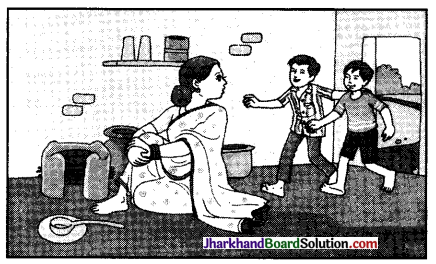
JAC Class 10 Hindi मौखिक अभिव्यक्ति बोलना 1

बड़ा लड़का अपनी उँगली से इशारा कर बोला – ” वहाँ दूर खेतों के पार बड़े- बड़े पेड़ हैं। वहाँ कई सूखी लकड़ियाँ गिरी होती हैं। हम उन्हें इकट्ठी कर लाते हैं।”

माँ ने कुछ देर सोचा और कहा – ” अच्छा जाओ। दोनों भाई इकट्ठे रहना। जंगल में बहुत आगे न जाना।’
देर से कुछ सोच दोनों लड़के लकड़ी लेने चले। आठ और दस वर्ष के दोनों भाई इतनी दूर अकेले कभी नहीं गए थे। जंगल में उन्हें आम के पेड़ के नीचे एक मोटी सूखी डाल दिखाई दी। वह आँधी से टूटकर नीचे गिरी थी।
बड़े भाई ने कहा – “ लकड़ी तो मिल गई, पर इसे हम लेकर कैसे जाएँगे ? यह तो बहुत भारी है। ”

छोटे ने कहा – ” हम इसे छोड़कर जाएँगे, तो कोई दूसरा उठा ले जाएगा।”
पर वे क्या करते ? इतनी बड़ी लकड़ी उनसे उठ नहीं सकती थी। दोनों चुपचाप लकड़ी पर बैठ गए। इतने में छोटा लड़का चिल्लाया- “देखो, वह क्या है ? इतनी चींटियाँ ! वे किसे ले जा रही हैं ?”
बड़े लड़के ने ध्यान से देखा और कहा – ” चींटियाँ मरे हुए एक मोटे कीड़े को खींच कर ले जा रही हैं।”
छोटा भाई हैरानी से बोला – ” इतनी छोटी-छोटी चींटियाँ इतने मोटे कीड़े को कैसे खींच सकती हैं?”
“यह तो मरा हुआ कीड़ा ही है। कभी-कभी तो चींटियाँ मरे हुए साँप को भी घसीटले जाती हैं” – बड़े भाई ने कहा।
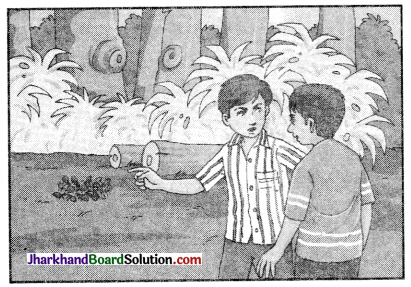
JAC Class 10 Hindi मौखिक अभिव्यक्ति बोलना 2

दोनों भाई चींटियों को ध्यान से देखने लगे। चींटियाँ धीरे-धीरे कीड़े को सरका रही थीं। कभी-कभी मोटा कीड़ा लुढ़क कर उन पर भी गिर जाता था। झट से दूसरी चींटियाँ दबी हुई चींटियों को कीड़े के नीचे से निकाल देती थीं। चींटियाँ अपने काम में लगातार लगी हुई थीं। थोड़ी ही देर में चींटियाँ कीड़े को सरका – सरका कर अपने बिल के पास ले गईं।
छोटा लड़का कुछ देर सोचता रहा। वह अपने भाई की ओर मुँह कर बोला –
” क्या हम चींटियों से भी कमज़ोर हैं ?”
बड़े लड़के ने कहा – “क्यों, क्या हुआ ? हम तो उनसे कई गुना बड़े हैं, ताकतवर हैं।”
“यदि चींटियाँ मोटे कीड़े को धकेलकर वहाँ तक ले जा सकती हैं तो हम इस लकड़ी को धकेलकर अपने घर क्यों नहीं ले जा सकते ? ” – छोटे लड़के ने कहा।
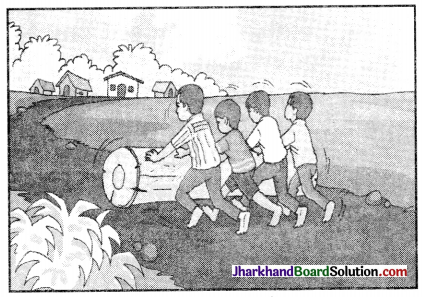
JAC Class 10 Hindi मौखिक अभिव्यक्ति बोलना 3

बड़ा लड़का उठकर खड़ा हो गया। वह बोला – ” तू यहीं बैठ। मैं अभी आया। ”
वह भाग कर गाँव वापस गया। वहाँ से अपने मित्रों को बुला लाया। मित्र अनेक थे। उन सबने मिल कर उस भारी लकड़ी को लुढ़काना आरंभ किया। सबने मिलकर खेल – ही खेल में वह लकड़ी उन दोनों भाइयों के घर पहुँचा दी।
माँ ने उन सबको शाबाशी दी और कहा – ” देखा तुमने। मिलकर काम करने से आप हर काम आसानी से कर सकते हो। सदा मिल-जुल कर काम किया करो। तुम्हारा हर काम हो जाएगा।”

JAC Class 10 Hindi मौखिक अभिव्यक्ति बोलना

(vii) परिचय देना, परिचय लेना –

हम-आप अपने-अपने समाज में रहते हैं। हम सदा एक-दूसरे का साथ पाना चाहते हैं और दूसरों को साथ देना चाहते हैं। अकेले तो हम रह ही नहीं पाते। समाज से कटकर अकेले रहना बहुत बड़ी सजा भोगने जैसा है। हमारी जान-पहचान पहले से ही अनेक लोगों से होती है पर जब हम किसी नए व्यक्ति के संपर्क में पहली बार आते हैं तो सबसे पहले हमें उससे परिचय प्राप्त करना होता है तथा उसे अपना परिचय देना होता है।

परिचय देना और परिचय लेना एक कला है। अपना परिचय देते समय हम पल भर में अपने व्यक्तित्व की पहली झलक किसी अपरिचित व्यक्ति को दे देते हैं। जब हम किसी को अपना परिचय देते हैं तब हमारे व्यवहार और हाव-भाव से अवश्य ऐसा झलकना चाहिए कि हम उससे अपना संपर्क बढ़ाना चाहते हैं। तब हमारे चेहरे पर उदासीनता या वितृष्णा के भाव कदापि नहीं होने चाहिए। हमारे चेहरे पर उत्साह और खुशी के भाव होने चाहिए तथा हमारी दृष्टि सामने वाले व्यक्ति पर होनी चाहिए। उसे ऐसा लगना चाहिए कि उससे मिलकर हमें प्रसन्नता हुई है।

I. परिचय देना :

परिचय के प्रकार – प्रायः परिचय दो प्रकार से दिया जाता है।

  • अनौपचारिक परिचय
  • औपचारिक परिचय

1. अनौपचारिक परिचय – इस प्रकार के परिचय में नाम, कक्षा या व्यवसाय का ही परिचय देना पर्याप्त होता है। यदि परिचय पाने वाला व्यक्ति आपके विषय में अधिक जानना चाहता है तो वह स्वयं बातों-बातों में आपसे पूछ लेगा।
उदाहरण –
(क) मेरा नाम रेवती है। मैं दयाल सिंह पब्लिक स्कूल में दसवीं कक्षा में पढ़ती हूँ।
(ख) मैं मोहित। दिल्ली पब्लिक स्कूल, आर० के० पुरम में नौवीं कक्षा का विद्यार्थी हूँ।

JAC Class 10 Hindi मौखिक अभिव्यक्ति बोलना

2. औपचारिक परिचय – इस प्रकार का परिचय प्रायः सभा सभाओं, सार्वजनिक कार्यक्रमों, कक्षा या बड़े समूहों में देना होता है। कई बार तो यह बता दिया जाता है कि परिचय देते समय क्या-क्या बताना होगा। सामान्य रूप से ऐसे परिचय में चार बातें बतानी होती हैं- नाम, कक्षा / व्यवसाय, विद्यालय / निवास, रुचियाँ।
उदाहरण –
(क) मेरा नाम पल्लवी है। मैं सेंट थैरेसा कान्वेंट स्कूल, करनाल में नौवीं कक्षा में पढ़ती हूँ। मैं न्यू हाउसिंग बोर्ड में रहती हूँ। कैरम खेलना, पेंटिंग करना और पुराने गाने सुनना मेरा शौक है।
(ख) मेरा नाम रोहन है। मैं डी० ए० वी० सीनियर सैकेंडरी स्कूल, जयपुर में ग्यारहवीं कक्षा का विद्यार्थी हूँ। मैं अपनी कक्षा का मॉनीटर हूँ। क्रिकेट खेलना मेरा शौक है। पत्र मित्रता करने में मेरी गहरी रुचि है।

अपने किसी सगे-संबंधी / मित्र / पड़ोसी का परिचय देना –

अपने परिचितों का किसी से परिचय कराते समय सदा ध्यान रखना चाहिए कि उनके विषय में कभी कोई ऐसी बात मुँह से नहीं निकलनी चाहिए जो उन्हें किसी भी प्रकार से बुरी लगे। सरल, सीधे और संतुलित शब्दों के प्रयोग से परिचय दिया जाना चाहिए। परिचय देते समय अतिशयोक्ति का प्रयोग नहीं करना चाहिए।

उदाहरण –

1. आपके साथ आपकी मम्मी विद्यालय के पुरस्कार वितरण समारोह में आई हैं। उनका परिचय अपनी कक्षा अध्यापिका को दीजिए।
उत्तर :
मैडम, ये मेरी मम्मी हैं। राजकीय महाविद्यालय में गणित की प्रध्यापिका हैं। मुझे पुरस्कार प्राप्त करते देखना चाहती हैं। ये आपसे मिलना भीं चाहती थीं !

JAC Class 10 Hindi मौखिक अभिव्यक्ति बोलना

2. आप बाज़ार जा रहे हैं। आपके साथ आपकी छोटी बहन है। उसका परिचय अपने मित्र से कराइए।
उत्तर :
यह उर्मि है, मेरी छोटी बहन। पाँचवीं कक्षा में पढ़ती है। इसे बाज़ार में खरीददारी करना अच्छा लगता है।

किसी प्रतिष्ठित व्यक्ति का परिचय कराना –

विद्यालय या किसी सार्वजनिक सभा में पधारे मुख्य अतिथि या किसी कलाकार का परिचय देना आवश्यक होता है। यह परिचय इस प्रकार दिया जाना चाहिए कि विशिष्ट व्यक्ति की विशेषताओं का संतुलित परिचय वहाँ उपस्थित लोगों को प्राप्त हो जाए। परिचय में अति विस्तार नहीं होना चाहिए और न ही कठिन भाषा का प्रयोग किया जाना चाहिए।

उदाहरण –

1. आपके विद्यालय में हरियाणा विद्यालय शिक्षा बोर्ड के पूर्व चेयरमैन डॉ० जयभगवान गोयल मुख्य अतिथि के रूप में पधारे हैं। हिंदी दिवस के अवसर पर वे अपने विचार प्रस्तुत करेंगे। आप उनका परिचय कराइए।
उत्तर :
प्रिय साथियो ! यह हमारा परम सौभाग्य है कि आज हिंदी दिवस के पुनीत अवसर पर हमारे बीच हिंदी साहित्य के परम विद्वान डॉ० जयभगवान गोयल पधारे हैं। हरियाणा विद्यालय शिक्षा बोर्ड के पूर्व चेयरमैन और कुरुक्षेत्र विश्वविद्यालय, कुरुक्षेत्र के हिंदी विभाग के अध्यक्ष अपने आपमें ही एक संस्था हैं। सैकड़ों पुस्तकों के रचयिता और सैकड़ों विद्यार्थियों को शोध कराने वाले शिक्षाविद् डॉ० गोयल वर्तमान में हिंदी-सेवा के प्रति समर्पित हैं। वे हमें हिंदी दिवस के महत्त्व से परिचित कराएँगे। मैं आप सबकी ओर से उनका स्वागत करते हुए उन्हें मंच पर सादर आमंत्रित करता हूँ

2. आपके विद्यालय में वार्षिक खेल-कूद प्रतियोगिता में मुख्य अतिथि के रूप में जिला के उपायुक्त पधारे हैं। उनका परिचय दीजिए।
उत्तर :
प्रिय मित्रो ! हमारे लिए अति हर्ष का विषय है कि आज हमारे बीच वह महान व्यक्तित्व खेल – कूद प्रतियोगिता के मुख्य अतिथि के रूप में पधारा है जिसने पिछले एक वर्ष में हमारे नगर की काया ही पलट दी है। अपनी दूरदृष्टि और अथक प्रयासों से हमारे आज के माननीय मुख्य अतिथि श्री राकेश देवगुण ने हमारे नगर को राज्य में एक नई पहचान प्रदान की है। ये केवल कुशल प्रशासक ही नहीं हैं बल्कि अपने समय के श्रेष्ठ खिलाड़ी भी रह चुके हैं। इन्होंने पोलो में भारतीय टीम का एशियन खेलों में प्रतिनिधित्व किया था। मैं उनके आगमन पर उनका हार्दिक आभार व्यक्त करते हुए उन्हें मंच पर आमंत्रित करता हूँ।

JAC Class 10 Hindi मौखिक अभिव्यक्ति बोलना

II. परिचय लेना :

हमें अपने जीवन में प्रतिदिन अनेक ऐसे लोग मिलते हैं, जिनसे हमारा पूर्व परिचय नहीं होता। हम किसी-न-किसी कारण उनसे परिचय पाना चाहते हैं। कई लोग हमें अच्छे लगते हैं और कई से हमारे कारोबारी संबंध होते हैं।

जब भी किसी अपरिचित से हम परिचय प्राप्त करना चाहते हैं, हमें भद्रता और शालीनता का परिचय देते हुए शिष्टाचार के सभी नियमों का पालन करना चाहिए। आरंभ में औपचारिकता बनी रहनी चाहिए और ‘आप’ शब्द का प्रयोग करना चाहिए। कभी भी ‘तू’ या ‘तुम’ जैसे शब्दों का प्रयोग नहीं करना चाहिए हँसी-मज़ाक और व्यंग्यात्मक शब्दों का प्रयोग तो कदापि नहीं करना चाहिए क्योंकि हम उस अपरिचित के स्वभाव को नहीं जानते। हमारा व्यंग्यात्मक शब्द उसे बुरा लग सकता है। परिचय प्राप्त करने से पहले सम्मानपूर्वक संबोधित करना आवश्यक होता है, जैसे –
भाई – साहब, बहन जी, अंकल, आंटी, मैडम, सर, श्रीमान जी, महोदय।
परिचय प्राप्त कर लेने के पश्चात मर्यादा का ध्यान रखते हुए नाम से भी संबोधित किया जा सकता है।
अपनत्व दिखाने के लिए बीच-बीच में नाम / जाति / संबोधन आदि का प्रयोग किया जा सकता है, जैसे-
(क) आपसे मैं पहले कह चुका हूँ, गुप्ता जी।
(ख) महेश जी, कभी उधर भी आइए।
(ग) अच्छा, बहन जी ! फिर मिलेंगे।
(घ) अरे, बेटा! मैं भी उधर ही जा रहा हूँ।
(ङ) वाह अंकल ! आप तो बहुत अच्छे हैं।

JAC Class 10 Hindi मौखिक अभिव्यक्ति बोलना

परिचय पाने के लिए संबोधन के साथ अभिवादन किया जाना चाहिए, जैसे –

(क) हैलो, सर !
(ख) नमस्ते अंकल !
(ग) आदाब, भाई जान !
(घ) नमस्कार जी।
(ङ) नमस्कार आंटी।

अभिवादन के बाद परिचय पूछा जा सकता है, जैसे –

(क) श्रीमान जी ! क्या मैं आपका शुभ नाम जान सकता हूँ?
(ख) कृपया अपना नाम बताइए।
(ग) सर ! क्या मैं आपका नाम पूछ सकता हूँ?
(घ) मैडम! क्या मैं आपका नाम जान सकता हूँ?

JAC Class 10 Hindi मौखिक अभिव्यक्ति बोलना

नाम जान लेने के पश्चात रहने का स्थान, नगर, स्कूल, कार्यालय, शिक्षा आदि के विषय में जानकारी प्राप्त की जा सकती है। परिचय प्राप्त करने के पश्चात औपचारिकतावश मिलने की खुशी अवश्य प्रकट की जानी चाहिए, जैसे –
(क) आपसे मिलकर बहुत प्रसन्नता हुई।
(ख) बहुत अच्छा लगा आपसे मिलकर, शर्मा जी।
(ग) फिर मिलना।
(घ) जल्दी फिर मिलेंगे।
(ङ) हमें आपसे मिलने का इंतजार रहेगा।

परिचय प्राप्त करने के पश्चात धन्यवाद अवश्य ज्ञापित करना चाहिए।

परिचय पाने के कुछ उदाहरण –

1. कक्षा में नया प्रवेश प्राप्त करने वाले एक लड़के से परिचय प्राप्त कीजिए।
उत्तर :

  • आप – हैलो !
  • वह – हैलो! आप ?
  • आप – मैं रोहन हूँ और इसी कक्षा में पढ़ता हूँ।
  • वह – मैं अनुराग हूँ।
  • आप – आपको इस कक्षा में पहली बार देखा है।
  • वह – हाँ। मैंने इस स्कूल में कल ही दाखिला लिया है।
  • आप – पहले कहाँ पढ़ते थे?
  • वह – मैं बेंगलुरू के मेरी कॉन्वेंट स्कूल में पढ़ता था।
  • आप – क्या आपके पापा का ट्रांसफर हो गया है ?
  • वह – हाँ।
  • आप – कहाँ रह रहे हो ?
  • वह – अभी तो घर ढूँढ़ रहे हैं। कुछ दिन के लिए गेस्ट हाउस में ठहरे हैं।
  • आप – मेरे घर के सामने एक बड़ा-सा मकान किराए के लिए खाली है।
  • वह – फिर तो बहुत अच्छा है। मैं पापा-मम्मी को बताऊँगा।
  • आप – हम भी आस – पास रहकर दोस्त बन जाएँगे।
  • वह – दोस्त तो हम बन भी गए। धन्यवाद।
  • आप – धन्यवाद।

JAC Class 10 Hindi मौखिक अभिव्यक्ति बोलना

2. सब्ज़ी की रेहड़ी के निकट खड़ी एक औरत से आप उसका परिचय प्राप्त कीजिए।
उत्तर :

  • आप – नमस्ते, बहन जी।
  • वह – नमस्ते, आप ?
  • आप – मैं नमिता हूँ। सामने वाले घर में रहती हूँ। और आप ?
  • वह – मैं मीनाक्षी। पिछली गली में रहती हूँ।
  • आप – कौन – सा मकान है आपका ?
  • वह – कोने वाला।
  • आप – अच्छा है। चलती हूँ। धन्यवाद।
  • वह – प्रसन्नता हुई आप से मिलकर।

(viii) भावानुकूल संवाद – योजना –

जब भी दो या दो से अधिक लोग आपस में बातचीत करते हैं। तब भावों के अनुसार उन की वाणी और चेहरे के हाव-भावों में परिवर्तन दिखाई देता है। क्रोध की स्थिति में उनकी आवाज़ ऊँची और तेज़ हो जाती है तो करुण अवस्था में दुख की झलक अपने आप ही आवाज़ के माध्यम से प्रकट होने लगती है। प्रसन्नता के कारण आवाज़ में विशेष चहक – सी उत्पन्न हो जाती है। भक्ति भाव के समय वह शांत हो जाती है। शब्दों का चयन भी भावों के अनुरूप बदलता दिखाई देता है। स्वरों का उतार-चढ़ाव मानसिक स्थिति के अनुसार निश्चित रूप से नए – नए रूप लेता रहता है।

संवाद योजना सदा भावानुकल होनी चाहिए। इससे जब स्वभाविकता का गुण प्रकट होता है तब वह दूसरों को अधिक प्रभावित करता है। बातचीत में कभी बनावटीपन नहीं झलकना चाहिए। यदि किसी कहानी या नाटक के संवादों को बोला जाना हो तो व्यर्थ में बनावटी हाव-भाव कभी प्रकट नहीं किए जाने चाहिए। भावों और परिस्थितियों के अनुसार आंगिक क्रियाओं का संचालन किया जाना चाहिए।

संवादों को बोलने का अभ्यास निरंतरता की माँग करता है। दूसरों के सामने संवादों को बोलकर स्वयं को सुधारा और सँवारा जा सकता है। संवादों में छिपे भावों को केवल वाणी से ही नहीं बल्कि चेहरे के हाव-भावों से भी सरलतापूर्वक व्यक्त किया जा सकता है।

JAC Class 10 Hindi मौखिक अभिव्यक्ति बोलना

कुछ उदाहरण –

1. बोर्ड परीक्षा में पुत्र के प्रथम आने की सूचना को पाकर माता-पिता के बीच हुई बातचीत।
उत्तर :

  • पिता (कंप्यूटर स्क्रीन को देखते हुए) – अरे, वाह ! कमाल कर दिया मोहित ने।
  • माता – क्यों क्या हो गया ?
  • पिता – देखो तो, उसका परीक्षा परिणाम आ गया है।
  • माता (घबराकर) – पास तो हो गया है न वह।
  • पिता – पास …….अरे ! उसने तो करिश्मा कर दिया है।
  • माता – क्या स्कूल में फर्स्ट आ गया है।
  • पिता – अरे नहीं ! वह तो पूरे राज्य में प्रथम आया है।
  • माता – क्या ?
  • पिता – हाँ, उसने तो पिछले बोर्ड परिणामों के सारे रिकार्ड तोड़ दिए हैं।
  • माता – अरे वाह !

2. मित्र के दुर्घटनाग्रस्त हो जाने पर दो लड़कों के बीच हुए संवाद।
उत्तर :

  • नरेंद्र (घबराए हुए स्वर में) – अरे, सुना तुमने !
  • राघव – क्या ?
  • नरेंद्र – परमजीत का एक्सीडेंट हो गया है।
  • राघव – कब ? कैसे ?
  • नरेंद्र – अभी, कुछ देर पहले। एक कार से।
  • राघव – कहाँ है वह ?
  • नरेंद्र – उसे अस्पताल ले गए हैं। बहुत खून बह रहा था उसका।
  • राघव – क्या तूने उसे देखा ?
  • नरेंद्र – हाँ। हम इकट्ठे ही तो खड़े थे स्कूल के बाहर।
  • राघव – कैसे हुआ यह ?
  • नरेंद्र – एक कार तेज़ गति से आई। उसने तिरछा कट मारा और परमजीत से उसकी साइड टकरा गई।
  • राघव – तो ! कारवाला रुका क्या ?
  • नरेंद्र – कहाँ ? वह तो भाग गया।
  • राघव – क्या तूने उस का नंबर नोट किया ?
  • नरेंद्र – हाँ! मैंने वह नंबर पुलिसवाले को दे दिया।
  • राघव – चलो जल्दी। हम भी अस्पताल चलेंगे।
  • नरेंद्र – हाँ, चलो।

JAC Class 10 Hindi मौखिक अभिव्यक्ति बोलना

3. पुस्तक मेले में जाने के लिए उत्सुक पुत्री और उसकी माँ के बीच के संवाद को लगभग 50 शब्दों में लिखिए।
उत्तर :

  • पुत्री – माँ, माँ।
  • माँ – क्या है? चिल्ला क्यों रही हो?
  • पुत्री – माँ, हमारे विद्यालय से पुस्तक मेले में जाने के लिए नाम माँगे गए हैं।
  • माँ – तो, मैं क्या करूँ?
  • पुत्री – मैं भी जाना चाहती हूँ, इसलिए मुझे कुछ रुपए दे देना।
  • माँ – क्या बेकार में वहाँ जाएगी? मैं तुझे शापिंग के लिए ले जाऊँगी।
  • पुत्री – नहीं, मुझे पुस्तक मेले में जाना है, वहाँ ज्ञान-विज्ञान की नई-नई पुस्तकें देखने और जानने के लिए मिलेंगी।
  • माँ – क्या रखा है, इस सबमें?
  • पुत्री – माँ, पुस्तकें सच्ची मित्र होती हैं, इनसे हमारे ज्ञान में वृद्धि होती है।
  • माँ – अच्छा, बाबा जैसी तेरी इच्छा ! अपना नाम लिखा देना और पैसे पापा से ले लेना।
  • पुत्री – धन्यवाद, मेरी अच्छी माँ।

JAC Class 10 Hindi मौखिक अभिव्यक्ति बोलना

4. स्वच्छ अभियान पर माँ-बेटी के संवाद को लगभग 50 शब्दों में लिखिए।
उत्तर :

  • माँ – रेखा, कमरे की क्या दुर्दशा कर रखी है, कहीं वस्त्र, कहीं पुस्तकें तो कहीं जूते ?
  • रेखा – ठीक ही तो है माँ! जब जिस चीज़ की ज़रूरत होती है, ले लेती हूँ।
  • माँ – फिर माँ मेरी पुस्तक, मेरी चप्पल, मेरा सूट कहाँ है कहकर चिल्लाती क्यों हो?
  • रेखा – अरे माँ! वह तो यूँ ही …..।
  • माँ – यूँ ही नहीं, स्वच्छता अभियान का अर्थ केवल झाडू लगाना नहीं होता बल्कि अपने कमरे में हर चीज़ ढंग से ठिकाने पर रखने से भी कमरा स्वच्छ और सुंदर लगता है।
  • रेखा – समझी माँ, अब से हर चीज़ व्यवस्थित रूप से रखूँगी।
  • माँ – तुम्हारा यह कार्य भी स्वच्छता अभियान का ही एक अंग होगा।

बोर्ड परीक्षाओं में पूछे गए संवाद लेखन संबंधी प्रश्न –

1. औलंपिक खेलों में भारतीय खिलाड़ियों के प्रदर्शन के बारे में अपने मित्र से हुए संवाद को लगभग 50 शब्दों में लिखिए।

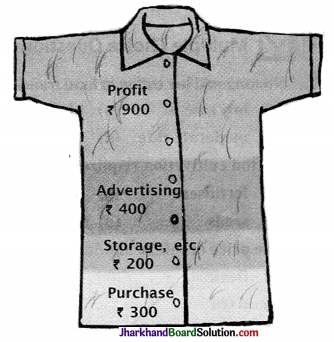
JAC Class 7 Social Science Solutions Geography Chapter 7 Human Environment: Settlement, Transport and Communication

JAC Board Class 7th Social Science Solutions Geography Chapter 7 Human Environment: Settlement, Transport and Communication

JAC Class 7th Geography Human Environment: Settlement, Transport and Communication InText Questions and Answers

Page 49

Question 1.
Where do you find dwellings made of ice? Who makes them and what are they called?
Answer:
In tundra region, we find dwellings made of ice. Eskimos makes them and they are called as igloos.

Question 2.
List the different modes of transport used by the students of your class while coming to school.
Answer:
The different modes of transport used by the students of the class while coming to school are buses, vans, cars, public transport and bicycles. Also some of them come by foot.

JAC Class 7 Social Science Solutions Geography Chapter 7 Human Environment: Settlement, Transport and Communication

Page 51

Question 3.
Can you name some more ports of the world?
Answer:
Some more ports of the world are Shanghai and Shenzhen in China, Busan in South Korea, Hamburg in Germany, Valencia in Spain, Colon in Panama, etc.

Page 52

Question 4.
Find out the names of some newspapers and TV news channels in English, Hindi and a regional language.
Answer:
The names of some newspapers and TV news channels in English, Hindi and a regional language are Newspapers
English:
The Times of India, The Hindu, The Statesman, The Hindustan Times. Hindi: Navbharat Times, Dainik Jagran, Hindustan

Bangla:
Anandabazar; Gujarati: Divya Bhaskar TV News Channels English: CNN, IBN, Times Now Hindi: Aaj Tak, Zee News, DD News

Bangla: Star Jalsha News

JAC Class 7th Geography Human Environment: Settlement, Transport and Communication Textbook Questions and Answers

Question 1.
Answer the following questions.
(i) What are the four means of transport?
Answer:
The four means of transport are

  • Roadways
  • Railways
  • Waterways
  • Airways

(ii) What do you understand by the term ‘settlement’?
Answer:
The term ‘settlement’ means a place where people build their homes to live in.

JAC Class 7 Social Science Solutions Geography Chapter 7 Human Environment: Settlement, Transport and Communication

(iii) Which are the activities practised by the rural people?
Answer:
The activities which are practiced by the rural people are farming, fishing, forestry, craftwork, trading, extracting and collecting.

(iv) Mention any two merits of railways.
Answer:
Two merits of railways are:

  • Carry heavy goods in bulk
  • Carry people to long distances very quickly and at low cost.

(v) What do you understand by communication ?
Answer:
A process by which we convey our messages to other people is known as communication.

(vi) What is mass media?
Answer: Mass media consists of newspaper, television and radio. Due to mass media we can communicate with number of people through this.

Tick (√) the correct answer.

Question 2.
(i) Which is NOT a means of communication?
(a) Telephone
(b) Books
(c) Table
Answer:
(c) Table

(ii) Which type of road is constructed under the ground?
(a) Fly over
(b) Expressways
(c) Subways
Answer:
(c) Subways

(iii) Which mode of transport is most suitable to reach an island?
(a) Ship
(b) Train
(c) Car
Answer:
(a) Ship

JAC Class 7 Social Science Solutions Geography Chapter 7 Human Environment: Settlement, Transport and Communication

(iv) Which vehicle does not pollute the environment?
(a) Cycle
(b) Bus
(c) Aeroplane
Answer:
(a) Cycle

Question 3.
Match the following.

(i) Internet(e) areas where people are engaged in manufacturing, trade and services
(ii) Canal route(d) closely built area of houses
(iii) Urban areas(c) houses on stilts
(iv) Compact settlement(d) inland waterway
(e) a means of communication

Answer:

(i) Internet(d) a means of communication
(ii) Canal route(c) inland waterway
(iii) Urban areas(a) areas where people are engaged in manufacturing, trade and services
(iv) Compact settlement(b) closely built area ofhouses

Question 4.
Give reasons. Today’s world is shrinking.
Answer:
Information is available at any place or area from any region of the world due to modem technology. With the development and progress of communication and technology, the world has shrinked. Radio, newspaper, television had brought the world closer to each other. World has even come closer due to internet and cellular phones. Hence, we can say that today’s world is shrinking:

(For Fun)

Question 5.
(i) Conduct a survey in your locality and find out how people commute to their respective workplaces using –
(a) more than two modes of transport
(b) more than three modes of transport
(c) stay within walking distance,

(ii) Mention which mode of communication you will prefer most in the following situations –
(a) Your grandfather has suddenly fallen ill. How will you inform the doctor?
(b) Your mother wants to sell the old house. How will she spread this news?
(c) You are going to attend the marriage of your cousin for which you will be absent from the school for the next two days. How will you inform the teacher?
(d) Your friend has moved out with his/her family to New York. How will you keep in touch on a daily basis?
Answer:
(i) (a) auto-rickshaw, metro and on foot
(b) metro, bus, rickshaw and on foot
(c) on foot

(ii) (a) Inform the doctor through telephone or cell phone.
(b) Will spread the news through newspaper and internet.
(c) Will send an application on leave to the teacher.
(d) Will keep in touch through internet or telephone.

JAC Class 7th Geography  Human Environment: Settlement, Transport and Communication Important Questions and Answers

Multiple Choice Questions

Question 1.
Igloos are made by
(a) Eskimos
(b) Shepherds
(c) Farmers
(d) None of these
Answer:
(a) Eskimos

Question 2.
In Asia, Indian railways is the . network.
(a) smallest
(b) slowest
(c) largest
(d) fastest
Answer:
(c) largest

JAC Class 7 Social Science Solutions Geography Chapter 7 Human Environment: Settlement, Transport and Communication

Question 3.
The ports in Europe are
(a) Singapore and Mumbai
(b) Rotterdam and London
(c) New York and London
(d) Los Angeles and Rotterdam
Answer:
(b) Rotterdam and London

Question 4.
The inland waterways are
(a) The Nile river in Africa
(b) The Great Lakes in North America
(c) The Ganga- Brahmaputra river system
(d) All of these
Answer:
(d) All of these

Question 5.
To communicate with large number of people, we use the mode/s of communication.
(a) television
(b) radio
(c) newspaper
(d) all of these
Answer:
(d) all of these

Question 6.
The cheapest mode of transport is/are
(a) Waterways
(b) Roadways
(c) Airways
(d) Railways
Answer:
(a) Waterways

Question 7.
Roads built above the ground are called as
(a) Bridges
(b) Flyovers
(c) Subways
(d) Canals
Answer:
(b) Flyovers

Question 8.
The traditional train engines are nowadays replaced by electric and diesel ones. Those are
(a) air-powered
(b) magnetic
(c) steam
(d) hydro-powered
Answer:
(c) steam

Question 9.
Air traffic is mainly affected by
(a) floods
(b) fog and storms
(c) drought
(d) None of these
Answer:
(b) fog and storms

JAC Class 7 Social Science Solutions Geography Chapter 7 Human Environment: Settlement, Transport and Communication

Question 10.
The type of houses which are less likely to find in cities are
(a) huts
(b) bunglows
(c) slums
(d) flats
Answer:
(a) huts

Very Short Answer Type Questions

Question 1.
What do you mean by the term ‘site’?
Answer:
Site is the place where a building or a settlement develops.

Question 2.
Name the cities which are connected by the Golden Quadrilateral.
Answer:
Delhi, Mumbai, Chennai and Kolkata are connected by the Golden Quadrilateral.

Question 3.
How human settlements became larger and larger?
Answer:
Human settlements became larger andlarger with the development of trade, commerce and manufacturing.

JAC Class 7 Social Science Solutions Geography Chapter 7 Human Environment: Settlement, Transport and Communication

Question 4.
In places of hot climate, which types of house are commonly found?
Answer:
In areas of hot climate, thick mud walled houses with thatched roofs are commonly found.

Question 5.
What type of transport is used for short distance?
Answer:
The means of transport used for short distances are roads.

Question 6.
Define Transhumance.
Answer:
A seasonal movement of people is known as transhumance. According to changes in seasons, people who rear animals move in search of new pastures.

Question 7.
What do you mean by wet point settlement?
Answer:
Wet point settlement is the settlement growing around water areas.

Question 8.
What are the three ways of inland waterways?
Answer:
The three ways of inland waterways are river, lake and canals.

Question 9.
What are the modern means of communication?
Answer:
The modem means of communication are email, cellular phones, fax, computers.

JAC Class 7 Social Science Solutions Geography Chapter 7 Human Environment: Settlement, Transport and Communication

Question 10.
When and where the first rail route came into started in India?
Answer:
In 1853, the first rail route came into started between Mumbai and Thane.

Short Answer Type Questions

Question 1.
Differentiate between compact and scattered settlement.
Answer:

Compact SettlementScattered Settlement
• A closely built area of dwelling where flat land is available is known as compact settlement.• The area where houses are spread over an extensive area is known as scattered settlement.
• This type of settlement is found near river valleys and fertile plain.• This type of . settlement is found in hilly regions, thick … forests and in extreme climatic conditions.

Question 2.
What are the natural conditions for selection of a site?
Answer:
The natural conditions for selection of a site are as follows:

  • Convenient climate
  • Fertile soil
  • Fertile and suitable land
  • Good availability of water

Question 3.
Mention the merits of airways.
Answer:
The merits of airways are as follows:

  • It is the only means of transport to reach the most distant and remote
    areas where no roads or railways can reach.
  • Helicopters are also very useful in most accessible places and in time of disasters and tragedies such as to rescue people, distribution of medicines, food, useful things.

Question 4.
Why it become necessary to build a permanent house?
Answer:
Human beings in early days lived on trees and in caves. When they started to grow crops it became very necessary to have a permanent house.

JAC Class 7 Social Science Solutions Geography Chapter 7 Human Environment: Settlement, Transport and Communication

Question 5.
What changes made transport easier and uncomplicated?
Answer:
Transport was made easier by invention of the wheel. With the transit of time various mode of transport developed but even today people use animals for transport. Airplanes have made travel faster. New and modem means of transport hence saves time and energy.

Question 6.
Differentiate between Communication and Transport.
Answer:

• It conveys the messages and news from one place to another such as telephone service; postal service.• It transfers goods and helps for transportation of human beings and other living beings from one place to another such as roadways, railways.
• Modes of communication are television, radio, cellular phone.• Modes of transport are airplanes, ships, train, bus, cars, etc.
• In early days, bullock carts, donkeys, camels L were used.• In early days, modes of transport was used as communication.

Question 7:
Differentiate between State Highways and National Highways.
Answer:

State HighwaysNational Highways
• The state capitals which are joined with big cities within a state are known as state highways.• The state capitals which are joined with other state capitals are known as national highways.
• They are limited within the states.• They cross many states within the country.
• Total length of the state highways in India is about 3,81,000 km.• Total length of the national highways in India is about 1,15,435 km.

Question 8.
Satellites had proved themselves very useful for the mankind. How?
Answer:
Satellites had proved themselves very useful for the mankind as they have helped in detecting mineral wealth, underground water, weather forecast, oil exploration, forest survey.

Question 9.
Which is the longest railway system in the world?
Answer:
The Trans-Siberian Railway is the longest railway system which connects St. Petersburg in Western Russia to Vladivostok on the Pacific coast.

JAC Class 7 Social Science Solutions Geography Chapter 7 Human Environment: Settlement, Transport and Communication

Question 10.
In which places, the railway network are well developed?
Answer:
The railway network are well developed in the plain and flat places.

Long Answer Type Questions

Question 1.
What are the two types of waterways? Explain.
Answer:
Waterways are the cheapest means of transport for carrying heavy and especially where there are no roads and railways. Helicopters are useful in most inaccessible areas and in times of disasters and tragedies.

JAC Class 7 Social Science Solutions

JAC Class 12 Geography Solutions Chapter 10 परिवहन तथा संचार

Jharkhand Board JAC Class 12 Geography Solutions Chapter 10 परिवहन तथा संचार Textbook Exercise Questions and Answers.

JAC Board Class 12 Geography Solutions Chapter 10 परिवहन तथा संचार

बहुविकल्पीय प्रश्न (Muhiple Choice Questions)

नीचे दिए गए चार विकल्पों में से सही उत्तर को चनिए

1. भारतीय रेल प्रणाली को कितने मंडलों में विभाजित किया गया है?
(क) १
(ख) 12
(ग) 16
(घ) 14.
उत्तर:
(ग) 16.

2. निम्नलिखित में से कौन-सा भारत का सबसे लंबा राष्ट्रीय महामार्ग है?
(क) एन एच-1
(ख) एन एच-6
(ग) एन एच-7
(घ) एन एच-8.
उत्तर;
(ग) एन एच-7.

3. राष्ट्रीय जल मार्ग संख्या-1 किस नदी पर तथा किन दो स्थानों के बीच पड़ता है?
(क) ब्रह्मपुत्र – सादिया – धुबरी
(ख) गंगा – हल्दिया – इलाहाबाद
(ग) पश्चिमी तट नहर – कोट्टापुरम से कोल्लाम।
उत्तर:
(ख) गंगा-हल्दिया-इलाहाबाद।

JAC Class 12 Geography Solutions Chapter 10 परिवहन तथा संचार

4. निम्नलिखित में से किस वर्ष में पहला रेडियो कार्यक्रम प्रसारित हुआ था?
(क) 1911
(ख) 1936
(ग) 1927
(घ) 1923.
उत्तर:
(घ) 1923.

अति लघु उत्तरीय प्रश्न (Very Short Answer Type Questions)

निम्नलिखित प्रश्नों का उत्तर लगभग 30 शब्दों में दो

प्रश्न 1.
परिवहन किन क्रिया-कलापों को अभिव्यक्त करता है? परिवहन के तीन प्रमुख प्रकारों के नाम बताओ।
उत्तर:
परिवहन तृतीयक वर्ग का क्रिया-कलाप है। परिवहन कच्चे माल को कारखानों तक पहुंचाता है। यह वस्तुओं को उत्पादन स्थल बाज़ार तक भेजता है ताकि उपभोक्ता को ये उपलब्ध हो। इस प्रकार परिवहन वस्तुओं, पदार्थों तथा विचारों को एक स्थान से दूसरे स्थान तक ले जाने के लिए प्रयोग होता है। परिवहन के मुख्य साधन हैं: स्थल, जल, वायु।

प्रश्न 2.
पाइप लाइन परिवहन के लाभ एवं हानि की विवेचना कीजिए।
उत्तर:
प्राकृतिक गैस तथा खनिज तेल के परिवहन का पाइप लाइन एक सुगम साधन है। यह एक सस्ता साधन है जो दुर्गम क्षेत्रों, घने वनों, मरुस्थलों तथा पर्वतों पर से गुज़रता है। परन्तु इसके गुणों की तुलना में अवगुण अधिक हैं।

  1. इस साधन में लोच का न होना एक प्रमुख अवगुण है।
  2. एक बार पाइप लाइन बिछा देने के पश्चात् इसकी क्षमता में वृद्धि नहीं की जा सकती।
  3. पाइप लाइन की सुरक्षा करना भी कठिन कार्य है।
  4. भूमिगत पाइप लाइन की मरम्मत में कठिनाई होती है तथा रिसाव का पता लगाना भी कठिन होता है।

JAC Class 12 Geography Solutions Chapter 10 परिवहन तथा संचार

प्रश्न 3.
संचार से आपका क्या तात्पर्य है?
उत्तर:
हम केवल वस्तुएं ही नहीं बल्कि विचारों, दर्शन तथा संदेशों का भी उपयोग करते हैं। विभिन्न साधनों के माध्यम से संचार करते समय हम अपने विचारों, दर्शन और संदेशों का विनिमय एक स्थान से दूसरे स्थान तक अथवा एक व्यक्ति से दूसरे व्यक्ति तक करते हैं।

प्रश्न 4.
भारत के वायु परिवहन के क्षेत्र में एयर इण्डिया तथा इंडियन एयर लाइन्स के योगदान की विवेचना करो।
उत्तर:
भारत में वायु परिवहन के दो खण्ड हैं आन्तरिक सेवाएं तथा अन्तर्देशीय सेवाएं। एयर इण्डिया संगठन विदेशी उड़ानों का प्रबन्ध करती है। मुम्बई, दिल्ली, कोलकाता, चेन्नई एयर इण्डिया के केन्द्र बिन्दु हैं। इण्डियन एयर लाइन्स देश के भीतरी भागों तथा पड़ोसी देशों के साथ वायु सेवाओं का प्रबन्ध करती है।

सन् 1981 से देश के भीतर दुर्गम भागों में वायुदूत एयर लाइन्स सेवाओं का भी प्रारम्भ किया गया है। 1985 में पवन हंस लिमिटेड की स्थापना दूरस्थ क्षेत्रों, वनाच्छादित तथा पहाड़ी क्षेत्रों को जोड़ने हेतु हेलीकाप्टर सेवाएं उत्पन्न करवाने के लिए की गई।

लघु उत्तरीय प्रश्न (Short Answer Type Questions)

निम्नलिखित प्रश्न के उत्तर लगभग 150 शब्दों में करो

प्रश्न 1.
भारत में परिवहन के प्रमुख साधन कौन-कौन से हैं? इनके विकास को प्रभावित करने वाले कारकों की विवेचना करो।
उत्तर:
परिवहन साधन: भारत के परिवहन के स्थल, जल तथा वायु परिवहन के निम्नलिखित साधन हैं

  1. रेल मार्ग
  2. सड़कें
  3. वायुमार्ग
  4. जल मार्ग
  5. पाइप लाइनें। भारत के विभिन्न परिवहन साधनों के विकास को निम्नलिखित कारकों ने प्रभावित किया है

1. भौतिक कारक-भारत के समतल मैदानी भागों में सड़क व रेलमार्गों का अधिक विकास हुआ है। जैसे उत्तरी मैदान में। परन्तु पर्वतीय दुर्गम प्रदेशों में रेलमार्ग तथा सड़कें कम हैं जैसे असम तथा हिमालय प्रदेश में।
2. आर्थिक कारक-बड़े-बड़े औद्योगिक, व्यापारिक नगरों तथा प्रमुख पत्तनों के समीप रेलमार्गों तथा सड़कों का अधिक विस्तार हुआ है परन्तु राजस्थान में कम आर्थिक विकास के कारण रेलमार्ग तथा सड़कें कम हैं।
3. राजनीतिक कारक-ब्रिटिश प्रशासन ने देश के संसाधनों के शोषण की नीति के कारण प्रमुख पत्तनों को देश के आन्तरिक भागों से रेलमार्गों द्वारा जोड़ दिया।

JAC Class 12 Geography Solutions Chapter 10 परिवहन तथा संचार

प्रश्न 2.
भारत के आर्थिक विकास में सड़कों की भूमिका का वर्णन करो।
उत्तर:
भारत में प्राचीनकाल से ही सड़कें महत्त्वपूर्ण रही हैं। शेरशाह सूरी ने राष्ट्रीय राजमार्ग, ग्रांड ट्रंक रोड का निर्माण किया। स्वाधीनता के पश्चात् 10 वर्षीय नागपुर योजना के अन्तर्गत सड़क मार्गों का विकास किया गया। भारत में अधिकतर पक्की सड़कें दक्षिणी भारत में हैं, क्योंकि यहां सड़कों को बनाने के लिए दक्षिणी पठार में पर्याप्त मात्रा में पत्थर मिल जाते हैं। भारतीय सड़कों की निम्नलिखित विशेषताएं हैं

  1. भारत की पक्की सड़कों की लम्बाई 7,47,000 किलोमीटर है तथा कच्ची सड़कों की लम्बाई 8 लाख 73 हज़ार किलोमीटर है।
  2. देश में राष्ट्रीय महामार्गों की लम्बाई 65769 किलोमीटर है।
  3. प्रमुख महामार्ग मुम्बई, कोलकाता, चेन्नई, दिल्ली, बंगलौर तथा श्रीनगर को मिलाते हैं।
  4. भारत में महामार्ग देश को पश्चिम में पाकिस्तान, उत्तर में तिब्बत तथा चीन, पूर्व में बांग्लादेश और बर्मा (म्यनमार) को जोड़ते हैं। (5) भारत में प्रति वर्ष 85% भागों तथा 70% भाग यातायात का परिवहन सड़कों द्वारा होता है।

परिवहन तथा संचार JAC Class 12 Geography Notes

जीवन रेखाएं (Life lines): यातायात के साधन किसी देश की जीवन रेखाएं हैं।

परिवहन तन्त्र (Transport lines): परिहवन तन्त्र भारत में सामाजिक, आर्थिक तथा राजनीतिक एकता मज़बूत करता है।

पत्तन (Ports): भारत में 12 मुख्य पत्तन हैं।

रेलमार्गों का विकास निम्नलिखित कारकों पर निर्भर करता है

  • भौतिक कारक।
  • राजनीतिक कारक।
  • आर्थिक कारक। उत्तरी मैदान में रेलों की सघनता अधिक है।

राष्ट्रीय सड़क मार्ग (National Highways): भारत में राष्ट्रीय सड़क मार्गों की लम्बाई लगभग 65769 कि० मी० है।

रेल क्षेत्र (Railway Zones): भारतीय रेल मार्गों को 9 क्षेत्रों में बांटा गया है तथा 7 नए रेल क्षेत्र बनाए जा रहे हैं।

JAC Class 7 Social Science Solutions Civics Chapter 3 How the State Government Works

JAC Board Class 7th Social Science Solutions Civics Chapter 3 How the State Government Works

JAC Class 7th Civics How the State Government Works InText Questions and Answers

Question 1.
What is happening in Patalpuram?
Answer:
Patalpuram is facing a problem of severe water crisis. People are drinking unclean water as they have no other choice. Hence, they are becoming ill and having diarrhoea. Children are the most affected in this situation.

JAC Class 7 Social Science Solutions Civics Chapter 3 How the State Government Works

Question 2.
Why is this problem serious?
Answer:
This problem is serious because a large number of people are facing the problem of serious and acute diarrhoea and many people died from this disease as well. Thus, it is important to take necessary steps to bring the situation under control immediately.

Question 3.
What action do you think can be taken in the above situation and who do you think should take this action? Discuss.
Answer:
Clean drinking water should be supplied to the people of Patalpuram. The MLA and the government should be responsible enough to take this action.

Page 32

Question 4.
Discuss the following terms with your teacher public meeting, States in India, constituency, majority, ruling party and opposition.
Answer:
Public meeting :
Public meetings are the assembly of general people in which they are made to know about the current problems faced by the people in general. States

In India:
India is divided into many units and parts with well defined boundaries. These parts or units are known as States in India.

Constituency :
Constituency is the area from where the eligible voters can cast their vote to elect their representative or leader.

Majority :
A political party whose MLAs have won more than half the number seats or constituencies in a state is said to be in majority.

Ruling party:
The party which has the majority is often known as the ruling party.

Opposition:
The elected representatives who are not from the ruling party are known as the opposition. The people can question the government’s decisions and actions. They can also raise new and concerned issues for the benefit of the people.

Question 5.
Can you explain the following terms majority, ruling party, opposition with reference to your state?
Answer:
Students need to do it on their own with ine ‘ne’ip oi teacher.

Page 33

Question 6.
Construct a table, similar to the one given for Himachal Pradesh, for your state.
Answer:
Students need to do it on their own with the help of teacher.

JAC Class 7 Social Science Solutions Civics Chapter 3 How the State Government Works

Question 7.
At times, the ruling party may not be a single party but a group of parties working together. This is called a coalition. Discuss with your teacher.
Answer:
The coalition is formed when two or more parties come together and elect their leader. The state Governor appoints their leader as the Chief Minister. The coalition parties prepare the Common Minimum Programme and present it during the period for which the coalition is formed.

Page 35

Question 8.
Can you identify the MLAs of the ruling party and the opposition in the illustration? Colour the ruling party in one colour and the opposition in another.
Answer:
Students need to do it on their own.

Page 1

Question 9.
What were the main arguments put forward by different MLAs who thought that th§ government was not taking the situation in a serious manner?
Answer:
MLA1:
He belongs to the Akhandagaon constituency. In last three weeks, several people died due to diarrhoea. He is very sad and upset that the government has not been able to check the situation although they proclaim that they are doing it.

MLA2:
He wants to know why the government hospitals are in bad conditions. We a’iso as’ks tiie government that how it plans to deal with this situation which is badly affecting the common people.

MLA3:
The Tolpatti constituency which he represents is facing shortage of water. Women had to fetch water from far away. He wants to know from the government that what actions are taken to clean and disinfect the wells and ponds.

Question 10.
If you were the health minister, how would you respond to the above discussion?
Answer:
If I were the health minister, I would promptly respond to the above discussion. I would have put mobile vans with equipments with doctors, nurses and health Workers into service for the ill people.

Question 11:
Do you think the above debate would have been useful in some ways? How? Discuss.
Answer:
Yes, the above debate would have been useful. It has highlighted many issues concerning about the public health and their solutions are sorted out in the minimum time.

JAC Class 7 Social Science Solutions Civics Chapter 3 How the State Government Works

Question 12.
In the working of the government, explain the difference between being an MLA and an MLA who is also a minister.
Answer:
An MLA is only responsible for the development of his constituency whereas, an MLA who is a minister
also has to do dual responsibilities. He is accountable for the entire state as well for his constituency also.

Page 37

Question 13.
Write two measures that the government undertook for controlling diarrhoea. The two measures that the government undertook for controlling diarrhoea are:

  • To every village, there should be supply of water through tanker trucks.
  • Creating awareness through different campaigns in order to inform people about the measures to prevent diarrhoea.

Question 4.
What is the purpose of a press conference? How does the press conference help you get information on what the government is doing?
Answer:
The purpose of the press conference is to ask questions on a particular issues about the steps taken and hear about the same. The data collected by press conference is printed in newspaper and magazines for the common people. Such conference also create a public opinion about the issue.

Page 1

Question 15.
Find out with the help of your teacher, the work done by the government departments mentioned and fill in the table.
Answer:
Students need to do it on their own

Page 40

Question 16.
Do a similar wallpaper project about any issue connected with the working of your State Government like an education programme, any law and order issue, midday meal scheme, etc.
Answer:
Students need to do it on their own.

JAC Class 7th Civics How the State Government Works Textbook Questions and Answers

Page 41

Question 1.
Use the terms ‘constituency’ and ‘represent’ to explain who an MLA is and how is the person elected?
Answer:
A state is divided into many regions known as constituencies on the basis of the population. For the Legislative Assembly, one representative is elected from every constituency and that person represents that constituency. That person is known as the Member of Legislative Assembly or MLA. Through general election, an MLA is elected. That person can be an independent or a member of a particular political party. The person who gets the maximum votes or wins the election becomes the MLA of that constituency.

Question 2.
How did some MLAs become Ministers? Explain.
Answer:
Some MLAs become Ministers as:

  • The party which is elected in majority or wins the election for the Legislative Assembly forms the government.
  • According to the constitutional norms, the ruling party elects its leader who is known as the Chief Minister, who heads the government.
  • The Chief Minister constitutes a cabinet which includes members of his party as ministers.
  • The MLAs who become the ministers are allotted with a portfolio or department of work.
  • Hence, the MLAs turned ministers become responsible for the entire state of that particular department.

Question 3.
Why should decisions taken by the Chief Minister and other ministers be debated in the Legislative Assembly?
Answer:
The decisions taken by the Chief Minister and other ministers are debated in the Legislative Assembly because at the time of debate it is discussed that whether the steps or decisions taken are in the interest of the common people or not. It is also discussed that whether it is urgent and important or not. Depending upon this they discuss how much would the cost incur of the government. They also see that anything objectionable is there for any particular community or not.

JAC Class 7 Social Science Solutions Civics Chapter 3 How the State Government Works

Question 4.
What was the problem in Patalpuram? What discussion/ action was taken by the following? Fill in the table. Public Metting Legislative Assembly Press conference Chief Minister.
Answer:
Patalpuram was facing shortage of water.

Public’ MeetingReprimanded and showed complete disapproval to the government and also showed protest, their demand were kept in front of the government.
Legislative AuembliDiscussed the problems and issues and decided the actions and steps which are to be taken.
Press ConferenceThe plan of action which was initiated by the government was presented by the Health Minister.
Chief MinisterAnnounced the compensation to the affected family, also visited the village of Patalpuram. Clearly mentioned the future actions and steps to be taken to solve the problem.

Question 5.
What is the difference between the work that MLAs do in the Assembly and the work done by government departments?
Answer:
The difference between the work that MLAs do in the Assembly and the work done by government departments are that eveiy department is headed by the Minister who is also an MLA. Any work done or proposed by the department is approved by the minister. For the completion of work, the department is responsible whereas, the minister or MLA coordinate and synchronize between the Assembly and the departments.

JAC Class 7thCivics How the State Government Works Important Questions and Answers

Multiple Choice Questions

Question 1.
The multi-level system of government is called
(a) Unitary
(b) Federal
(c) Dictatorship
(d) Monarchy
Answer:
(b) Federal

Question 2.
The MLAs represent
(a) people
(b) technology
(c) themselves
(d) only the poor and the old
Answer:
(a) people

Question 3.
The state in India which has the highest number of constituencies is
(a) Uttar Pradesh
(b) Madhya Pradesh
(c) Kerala
(d) Maharashtra
Answer:
(a) Uttar Pradesh

Question 4.
The party or the coalition of parties that wins the election with more than half of the total number of constituencies in a state is called to be in a
(a) minority
(b) profit
(c) majority
(d) none of the above
Answer:
(c) majority

Question 5.
All the parties that failed to get the majority in the election are together are said to the
(a) majority
(b) opposition
(c) minority
(d) loss
Answer:
(b) opposition

JAC Class 7 Social Science Solutions Civics Chapter 3 How the State Government Works

Question 6.
The leader of the ruling party who is the head of the state as well of the country is known as
(a) Prime Minister
(b) MP
(c) MLA
(d) Chief Minister
Answer:
(d) Chief Minister

Question 7.
Legislative Assembly is also known as
(a) Vidhan Sabha
(b) Vidhan Parishad
(c) Both (a) and (b)
(d) Lok Sabha
Answer:
(a) Vidhan Sabha

Question 8.
The Chief Minister is appointed by the
(a) President
(b) Prime Minister
(c) Governor of the state
(d) Any of the above
Answer:
(c) Governor of the state

Question 9.
The Governor of the state is appointed by the
(a) Prime Minister
(b) Supreme Court Judges
(c) High Court Judges
(d) President
Answer:
(d) President

Question 10.
The gives information to the people which acts as a link between the government and the people.
(a) Press conference
(b) Debates
(c) Mass media
(d) Mass distribution
Answer:
(c) Mass media

Very Short Answer Type Questions

Question 1.
Which institution makes laws at the central or national level?
Answer:
The Parliament makes laws at the central or national level.

Question 2.
What is the urban local government known as?
Answer:
The urban local government is known as the Municipal Corporation.

Question 3.
Who gives the approval to the ministers to take certain decisions for the common people?
Answer:
Legislative Assembly gives the approval to the ministers to take certain decisions for the common people.

Question 4.
Does the Member of the Legislative Assembly elected by the people?
Answer:
Yes, the Member of the Legislative Assembly are elected by the people.

Question 5.
How many levels of government are there? Name them.
Answer:
There are three levels of Government present. The three levels are local, state and national.

JAC Class 7 Social Science Solutions Civics Chapter 3 How the State Government Works

Question 6.
For what reason the governor of state is appointed?
Answer:
Governor of state is appointed to make sure that the State Government works

  • Bhartiya Janata Party (BJP)
  • Indian National Congress (INC)

Question 7.
What is wallpaper project?
Answer:
Wallpaper project is an interesting activity through which research can be done on particular topics of interest.

Question 8.
What do you understand by the Election Commission?
Answer:
Election Commission is an independent association or body in which the whole process of the election in our country is conducted, controlled and supervised.

Question 9.
What are the two main functions of Election Commission?
Answer:
The two main functions of Election Commission are :

  • to recognize all the political parties.
  • to allot symbols to the political parties and to independent candidates who are also contesting the election.

Question 10.
Name the two houses of state legislature in India.
Answer:
The two houses of state legislature in India are:
Legislative Assembly or Vidhan Sabha Legislative Council or Vidhan Parishad

Short Answer Type Questions

Question 1.
Define political party. Name at least two national political parties in India.
Answer:
A political organisation that follows a particular ideology and seeks to attain the political power of the state as well as of the nation is known as the political party. Two national political parties in India are

Question 2.
List four features of electoral system of India.
Answer:
Four features of electoral system of India are:

  • Single member constituency
  • Joint electorate
  • Adult franchise
  • Election petition within the rules and regulations of the Constitution.

Question 3.
What do you understand by constituency?
Answer:
Constituency is a particular area or place from which all the voters living there choose their representatives. This could be such as a panchayat ward or an area that chooses an MLA.

Question 4.
How does a government function in a state?
Answer:
The people elect their representatives as Members of the Legislative Assembly (MLAs) in the democracy, thus, it is the people who have the main authority. The ruling party members who wins the election then form the government and some members are appointed as ministers. These ministers are in charge of various departments of the government such as health, transport, etc. Whatever work is done by these departments has to be approved by the members of the legislative assembly.

JAC Class 7 Social Science Solutions Civics Chapter 3 How the State Government Works

Question 5.
In India, what are the qualifications and the disqualifications of a voter?
Answer:
In India, the qualifications and the disqualifications of a voter are:
Question ualification: according to the law, a voter must

  • be a citizen
  • have attained the age of 18 years and above.

Disqualification: according to the law, a voter must not

  • be bankrupt, traitor to the country
  • be insane person
  • been convicted for any serious crime.

Question 6.
In what ways do the people in power like the chief minister and the minister take action?
Answer:
The people in power like the chief minister and the minister take action through various departments like the Public Works Department, the Agriculture Department, the Health Department, the Education Department and so on. They also have to answer questions that are asked in the Legislative Assembly and convince people asking the questions that proper steps are being taken. At the same time, newspapers and the media widely discuss the issue and the government has to respond, for example, by holding the press conferences.

Question 7.
What do you understand by debate?
Answer:
A discussion held in the Assembly to discuss current and important problems is known as the debate. During debate, the MLAs can express their views and ask questions related to the problems and issues. They could even give suggestions about what should be done by the government for the betterment of the people. The ministers then replies to the questions asked and give assurance to the Assembly that proper steps are being taken.

JAC Class 7 Social Science Solutions Civics Chapter 3 How the State Government Works

Question 8.
Distinguish between By-election and Mid-term election.
Answer:

By-eieetionMid- term eieetion
Before the completion of the tenure of the house, if the member of the parliament, state legislative assembly dies or resigns from his constituency then the election which takes place again is known as the byelection.Before the completion of the tenure of 5 years, sometimes the president dissolves the government of the state on the advice of the Prime minister. Then the fresh elections are held. This type of election is known as the mid-term election.

Question 9.
What were the ways by which the people of Patalpuram adopt to put their grievances?
Answer:
The people of Patalpuram organised a rally and gheraos of the MLAs residence. Their leader who was the member of the opposition party demanded loudly that the action and steps should be taken immediately and to bring the public health situation under control.

Long Answer Type Questions

Question 1.
Explain the process of emergence and development of government in a state.
Answer:
In India, every state has a Legislative Assembly. Each state is divided into different areas or constituencies. From each constituency, the people elect one representative who then becomes a Member of the Legislative Assembly or better known as MLA. People stand for elections in the name of different political parties. These MLAs belong to different political parties. Apolitical party whose MLAs have won more than half the number of constituencies in a state are said to be in a majority. The political party that has the majority forms the government.

In case no party gains the majority then in that case the party with maximum elected members tries to get support from different parties or candidates. The party that proves to have maximum supporters is allowed to form the government which is also known as the coalition government. If no party proves the majority then there would be reelection.

JAC Class 7 Social Science Solutions

JAC Class 7 Social Science Solutions Civics Chapter 9 Struggles for Equality

JAC Board Class 7th Social Science Solutions Civics Chapter 9 Struggles for Equality

JAC Class 7th Civics Struggles for Equality InText Questions and Answers

Page 103

Question 1.
What do you think is meant by the expression ‘power oyer the ballot box’? Discuss.
Answer:
The expression ‘power over the ballot box’ means the power and right to vote. Every adult citizen of India has the equal right to vote during elections. To elect or replace their representatives, this right has been used by people.

Page 104

Question 2.
Can you think of one person in your family, community, village, town or city whom you respect because of their fight for equality and justice?
Answer:
Students need to do it on their own with the help of parents.

JAC Class 7 Social Science Solutions Civics Chapter 9 Struggles for Equality

Page 106

Question 3.
What issue is the Tawa Matsya Sangh (TMS) fighting for?
Answer:
The Tawa Matsya Sangh (TMS) fighting for the issue of equality.

Question 4.
Why did the villagers set up this organisation?
Answer:
The villagers set up this organisation to protect their rights.

Question 5.
Do you think that the large-scale participation of villagers has contributed to the success of the TMS? Write two lines on why you think so.
Answer:
Yes, I think that the large-scale participation of villagers has contributed to the success of the TMS because when people are united then they get strength and finally success. Also, people stand together to fight for an issue and no one can come on their way.

Page 107

Question 6.
Can you think of an incident in your life in which one person or a group of people came together to change an unequal situation?
Answer:
Students need to do it on their own.

JAC Class 7 Social Science Solutions Civics Chapter 9 Struggles for Equality

Page 108

Question 7.
Refer to the song below and answer the following questions:
The Right To Know
My dreams have the right to know
Why for centuries they have been breaking
Why don’t they ever come true My hands have the right to know
Why do they remain without work all along ‘
Why do they have nothing to do
My feet have the right to know Why from village to village they walk on their own
Why are there no signs of a bus yet My hunger has the right to know Why grain rots in godowns While I don’t even get a fistful of rice My old mother has the right to know Why are there no medicines Needles, dispensaries or bandages My children have the right to know Why do they labour day and night Why is there no school in sight

  1. What is your favourite line in the above song?
  2. What does the poet mean when he says, “My hunger has the right to know”?

Answer:
(i) Favourite line in the above song is ‘my children have the right to know’.

(ii) The poet means what he says, “ My hunger has the right to know” means that a sufferer must have a right to know the cause and reason of his suffering and pain in which he is living. He must know that who is responsible for this situation.

JAC Class 7 Social Science Solutions Civics Chapter 9 Struggles for Equality

Question 8.
Can you share with your class a local song or a poem on dignity that is from your area?
Answer:
Students need to do it on there own.

Page 109

Question 9.
What role does the Constitution play in people’s struggles for equality?
Answer:
The Constitution plays an important role in people’s struggles for equality. Our Constitution recognises the equality for all people. Movements and struggles for equality continuously refer to the Indian Constitution to make their point about equality and justice for everyone. For example, the fishworkers intheTawa Matsya Sangh hope that the provisions of the Constitution will come into existence through their participation in this movement By constantly referring to the Constitution they use it as a ‘living document’, i.e., something that has real meaning in our lives.

Question 10.
Can you make up a social advertisement on equality? You can do this in small groups.
Answer:
Students need to do it in the class.

JAC Class 7thCivics Struggles for Equality Important Questions and Answers

Multiple Choice Questions

Question 1.
Tehri Dam is in
(a) Madhya Pradesh
(b) Uttarakhand
(c) Uttar Pradesh
(d) Himachal Pradesh
Answer:
(b) Uttarakhand

Question 2.
Full form of TMS is
(a) Tawa Matsya Sangh
(b) Tawa Matsya Samiti
(c) Tawa Maan Sangh
(d) Tawa Maan Samiti
Answer:
(a) Tawa Matsya Sangh

JAC Class 7 Social Science Solutions Civics Chapter 9 Struggles for Equality

Question 3.
Tawa dam began to built in ….. and completed in
(a) 1958,1968
(b) 1968,1978
(c) 1958,1978
(d) 1978,1988
Answer:
(c) 1958,1978

Question 4.
Tawa Matsya Sangh was organised in
(a) Maharashtra
(b) Andhra Pradesh
(c) Madhya Pradesh
(d) Arunachal Pradesh
Answer:
(c) Madhya Pradesh

Question 5.
The government gave the rights for fishing in the Tawa reservoir to private contractors in
(a) 1992
(b) 1996
(c) 1994
(d) 1998
Answer:
(c) 1994

Question 6.
Similarity among Kanta, Swapna, Melani is
(a) They were all politicians
(b) They were all people of dignity
(c) They have been treated equally always
(d) They have been treated unequally
Answer:
(d) They have been treated unequally

Question 7.
A social movement consisting of adivasis, farmers, environmentalists, and human rights activists against a number of large dams being built across the Narmada river is called as
(a) Nadi Bachao Andolan
(b) Narmada Bachao Andolan
(c) Tawa Bachao Andolan
(d) None of these
Answer:
(b) Narmada Bachao Andolan

Very Short Answer Type Questions

Question 1.
What was the demand and stipulation of Tawa Matsya Sangh?
Answer:
Tawa Matsya Sangh were demanding their right to continue fishing for their livelihood.

Question 2.
Why so many people’s lives in India are highly unequal?
Answer:
People’s lives in India are highly unequal because of the poverty and the lack of resources continue to be a major reason.

JAC Class 7 Social Science Solutions Civics Chapter 9 Struggles for Equality

Question 3.
In what way the contractor hehave with the local people?
Answer:
The contractors got cheap labour from outside the village and drove the local people away. They also threaten the villagers.

Question 4.
Why in India people are treated unequally?
Answer:
People are treated unequally because of the person’s religion, caste and sex.

Question 5.
In what way Indian Constitution justify rights to equality?
Answer:
The Indian Constitution recognises all Indians as equal before the law and states that no person can be discriminated against because of their religion, sex, caste or whether they are rich or poor.

Question 6.
Why the old Tehri town and manyvillages totally and some partially were submerged?
Answer:
The old Tehri town and many villages some totally and some partially were submerged because of the construction of Tawa dam across the river.

Question 7.
In which way writers, singers, dancers and artists have also been very active in the fight against inequality?
Answer:
The writers, singers, dancers and artists have also been very active in the fight against inequality with their poems, songs and stories which inspire us and make us believe strongly in an issue and influence our efforts to correct the situation.

Short Answer Type Questions

Question 1.
What was the outcome when the Madhya Pradesh government in 1994 gave the rights for fishing in the Tawa reservoir to private contractors?
Answer:
When the Madhya Pradesh government in 1994 gave the rights for fishing in the Tawa reservoir to private contractors, they began to threat the villagers and started suppressing them. They drove them away from there and brought cheap labour from outside. The villagers could not tolerate these monsterity and wrong doing of the contractors for the long period. They stood united and set up an organisation named as Tawa Matsya Sangh to protect their rights.

JAC Class 7 Social Science Solutions Civics Chapter 9 Struggles for Equality

Question 2.
When the Tawa dam began to build, what happened?
Answer:
When the Tawa dam began to build then

  • It submerged large areas of agricultural land and forests.
  • The forest dwellers lost everything, they had nothing.
  • Some of the displaced people settled around the reservoir. They started to work on there meagre farms and apart from it they found livelihood in fishing.

Long Answer Type Questions

Question 1.
In which way, Tawa Matsya Sanghhelped the fishworkers?
Answer:
Tawa Matsya Sangh helped the fishworkers in various ways:

  • The Tawa Matsya Sangh has set up a cooperative which buys the catch at a fair price from the fishworkers.
  • The cooperative then make ceratin arrangements for transportation and sells the catch in markets to get them a good price. This arrangement enhanced the earning of the fishworkers.
  • The Tawa Matsya Sangh also started to give the fishworkers loans for repair and buying new nets.

Question 2.
Indian Constitution is called the living document. Why?
Answer:
Indian Constitution is called the living document because of the following:

  • Indian Constitution recognises the equality of all persons.
  • Indian Constitution has a true meaning in everyone’s lives.
  • Movements and struggles for equality in India continuously refer to Indian Constitution to make their point about equality and justice to everyone.
  • The starting point and base of all movements for justice and the inspiration and for all the poetry, song, stories is the recognition of equality among people.

JAC Class 7 Social Science Solutions

JAC Class 7 Social Science Solutions Civics Chapter 8 A Shirt in the Market

JAC Board Class 7th Social Science Solutions Civics Chapter 8 A Shirt in the Market

JAC Class 7th Civics A Shirt in the Market InText Questions and Answers

Page 93

Question 1.
Did Swapna get a fair price on the cotton?
Answer:
No, Swapna didn’t get a fair price on the cotton. She was paid a very low price by the local trader.

Question 2.
Why did the trader pay Swapna a low price?
Answer:
The trader paid Swapna a low price because he lent money to Swapna at the beginning of the cropping season on a particular condition that she will sell her cottons to him only. The local trader took the advantage of this position and paid her low price.

JAC Class 7 Social Science Solutions Civics Chapter 8 A Shirt in the Market

Question 3.
Where do you think large farmers would sell their cotton? How is their situation different from Swapna?
Answer:
Large farmers would sell their cotton in the market. Their situation is very much different from Swapna as she had a constraint to sell her cotton to the local trader but those farmers can sell their cotton anywhere they want.

Page 95

Question 4.
What are the following people doing at the Erode cloth market—merchants, weavers, exporters?
Answer:
The following people are doing at the Erode cloth markeL

Merchants:
They purchase the yam and give directions to the weavers about what kind of cloth has to be made. They supply cloth on order to garment manufacturers and exporters around the country.

Weavers:
The make cloth and bring this to the Erode cloth market for sale. They also make cloth on orders which they get from merchants

Exporters:
They use the cloth to make shirts to export them to the foreign buyers.

Question 5.
In what ways are weavers dependent on cloth merchants?
Answer:
Forraw materials and markets, the weavers are dependent on cloth merchants.

Page 96

Question 6.
If the weavers were to buy yarn on their own and sell cloth, they would probably earn three times more. Do you think this is possible? How? Discuss.
Answer:
Yes, this is possible. If the weavers were to buy yam on their own and sell cloth, they would probably earn three times’ more. They would buy yam at the lowest price and sell it at the highest possible price. Of their own choice, they would select the market for better price.

Question 7.
Do you find similar ‘putting-out’ arrangements in making papads, masalas, beedis ?
Answer:
Find out about this in your area and discuss in class.
Students need to do it by their own.

Question 8.
You might have heard of cooperatives in your area. It could be in milk, provisions, paddy, etc. Find out for whose benefit they were set up?
Answer:
They were set up for the benefit for those who were in want of capital.

JAC Class 7 Social Science Solutions Civics Chapter 8 A Shirt in the Market

Question 9.
What are the demands foreign buyers make on the garment exporters? Why do the garment exporters agree to these demands?
Answer:

  1. The demands foreign buyers make on the garment exporters are:
  2. Lowest prices from the garment exporters.
  3. High standards for quality product. Timely delivery.
  4. The garment exporters agree to these demands because they are likely to have maximum profit even after that.

Question 10.
HowHow do the garment exporters meet the conditions set by the foreign buyers?
Answer:
The garment exporters meet the conditions set by the foreign buyers by getting the most of the work done by the weavers at the minimum wage.

Page 98

Question 11.
Why do you think more women are employed in the Impex garment factory? Discuss.
Answer:
More women are employed in the Impex garment factory because they are ready to work even at the lowest possible wage.

Question 12.
Write a letter to the Minister asking for what you think would be proper payment to the workers.
Answer:
Students need to do it on their own.

Question 13.
The shirt below shows the profit made by the businessperson, and the various costs that he had to pay. Find out from the diagram below, what the cost price includes.
JAC Class 7 Social Science Solutions Civics Chapter 8 A Shirt in the Market 1

Answer:
Students need to do it on their own.

Page 99

Question 14.
Compare the earnings per shirt of the worker in the garment factory, the garment exporter and the businessperson in the market abroad. What do you find?
Answer:
The business person in foreign makes profit of? 600 and the garment exporter makes a profit of ? 100 on one shirt. As far as the workers are concerned they get only ? 15 for one shirt.

Question 15.
What are the reasons that the businessperson is able to make a huge profit in the market?
Answer:
The reasons that the businessperson is able to make a huge profit in the market are: He knows the method as how to get the work done at the lowest possible rate from the garment exporter.He is able to sell shirts in large quantity. He sells his shirt to the high income group.

JAC Class 7 Social Science Solutions Civics Chapter 8 A Shirt in the Market

Question 16.
You have read the chapter on advertising. Why does the businessperson spend ? 300 per shirt on advertising? Discuss.
Answer:
Students need to do it on their own.

JAC Class 7th Civics A Shirt in the Market Textbook Questions and Answers

Question 1.
What made Swapna sell the cotton to the trader instead of selling at the Kurnool cotton market?
Answer:
Swapna sold the cotton to the trader instead of selling at the Kumool cotton market because she had taken a loan from the local trader at the beginning of the cropping season. The local trader lent the money in one condition that she will sell the cotton to him only. Swapna had no other option but to agree on the trader’s terms and condition.

Question 2.
Describe the conditions of employment as well as the wages of workers in the garment exporting factory. Do you think the workers get a fair deal?
Answer:
The conditions of employment, as well as the wages of workers in the garment exporting factory, are very pitiful. They work in an unhygienic conditions. They work for long hours everyday around 10 to 12 hours a day. They are the temporary workers and doesn’t have job security. I don’t think the workers get a fair deal. They are exploited at every steps of the work.

JAC Class 7 Social Science Solutions Civics Chapter 8 A Shirt in the Market

Question 3.
Think of something common that we use. It could be sugar, tea, milk, pen, paper, pencil, etc. Discuss through what chain of markets this reaches you. Can you think of the people that help in the production or trade?
Answer:
We can take the example of sugar. Producers are the farmers who grows sugarcane. After the harvest is ready, they sell it to the traders who have the sugar mills. They produce sugar with the help of other workers. The sugar is then sold the wholesale trader in bulk. The retailers buy the sugar from the wholesale trader. Finally, the consumer gets the sugar from the retailer when required. Thus, a chain of market is created:

Producer → local trader → wholesaler retailers → consumers. The people who help in the production of sugar are producers/ farmers, traders/ sugar-mill owners, workers, wholesalers, retailers and consumers finally.

Question 4.
Arrange the statements given alongside in the correct order and then fill in the numbers in the cotton bolls accordingly. The first two have already been done for you.

  1. Swapna sells the cotton to the trader.
  2. Customers buy these shirts in a supermarket.
  3. Trader sells cotton to the Ginning Mill.
  4. Garment exporters buy the cloth from merchants for making shirts.
  5. Yarn dealers or merchants give the yam to the weavers.
  6. The exporter sells shirts to the businessperson from the USA.
  7. Spinning mill buys the cotton and sells yam to the yam dealers.
  8. Weavers return with the cloth.
  9. Ginning mill cleans the cotton and makes it into bales.

JAC Class 7 Social Science Solutions Civics Chapter 8 A Shirt in the Market 2

Answer:
The statements in correct order are:

JAC Class 7thCivics A Shirt in the Market Important Questions and Answers

Multiple Choice Questions

Question 1.
Swapna sold her cotton to local trader at
(a) low rate
(b) high rate
(c) moderate rate
(d) fair rate
Answer:
(a) low rate

Question 2.
Cotton cultivation requires
(a) fertilisers
(b) pesticides
(c) seeds
(d) All of these
Answer:
(d) All of these

Question 3.
The price of things and items can be
(a) flexible
(b) fixed
(c) Either (a) or (b)
(d) Both (a) and (b)
Answer:
(c) Either (a) or (b)

JAC Class 7 Social Science Solutions Civics Chapter 8 A Shirt in the Market

Question 4.
A person who sells item in foreign countries are known as
(a) Retailer
(b) Importer
(c) Exporter
(d) Manufacturer
Answer:
(c) Exporter

Question 5.
Erode is famous for
(a) spice market
(b) cloth market
(c) woollen market
(d) jewellery market
Answer:
(b) cloth market

Question 6.
The work of the women workers at the Impex garment factory is/ was
(a) ironing and packaging
(b) buttoning
(c) thread cutting
(d) All of these
Answer:
(d) All of these

Question 7.
Weaver’s cooperatives are helpful in providing
(a) raw materials to the weavers
(b) loans to the weavers
(c) midday meals to the weavers
(d) taking care of their kids
Answer:
(a) raw materials to the weavers

Question 8.
An arrangement between weavers and merchants is known as
(a) going out system
(b) putting-out system
(c) incoming System
(d) None of these
Answer:
(b) putting-out system

Very Short Answer Type Questions

Question 1.
What do you mean by trade?
Answer:
Trade is the sale, transfer or exchange of goods and services for a fixed price.

Question 2.
In which state Erode is located?
Answer:
Erode is located in Tamil Nadu.

Question 3.
Which people earn the minimum wage in Erode?
Answer:
The weaves earns the minimum wage in Erode.

JAC Class 7 Social Science Solutions Civics Chapter 8 A Shirt in the Market

Question 4.
Who was Swapna?
Answer:
Swapna was a small farmer in Kumool which is in Andhra Pradesh and grows cotton on her small piece of land.

Question 5.
Why did Swapna borrow money from the local trader?
Answer:
Swapna had borrowed money from thetrader to buy seeds, fertilisers, pesticides for cultivation of cotton.

Question 6.
What was the condition that the trader agree to give loan to Swapna?
Answer:
The trader agreed to give loan to Swapna on a condition that she would sell all her cotton to him.

Question 7.
Garment exporting factories maximise their own profit. How?
Answer:
Garment exporting factories maximise their own profits by getting maximum work from workers at lowest price and supply the foreign buyers at cheap rates.

Question 8.
What is the reason that more women are employed in the Impex garment factory?
Answer:
The reason that more women are employed in the Impex garment factory as they agree to work even at the lowest possible wages.

Short Answer Type Questions

Question 1.
What do you mean by putting-out system?
Answer:
Putting-out system is an arrangement between the merchant and the weavers whereby the merchant supplies the raw material and receives the finished product. It is prevalent in the weaving industry in most regions of India

Question 2.
Explain how merchants hold lot of power.
Answer:
The merchant distributes work among the weavers based on the orders he has received for cloth. The weavers get the yam from the merchant and supply him the cloth. However, this dependence on the merchants both for raw materials and markets means that the merchants have a lot of power.

Question 3.
What do you mean by the following terms: Ginning mill, Exporter and Profit.
Answer:
Ginning mill: Ginning mill is a factory where seeds are removed from cotton bolls. Then the cotton is pressed into bales to be sent for spinning into thread.

Exporter:
Exporter is a person who sells goods in foreign countries.

Profit:
Profit is the amount that is left or gained from earnings after deducting all the expenses and costs. If the costs are more than the earnings, it would lead to a loss.

JAC Class 7 Social Science Solutions Civics Chapter 8 A Shirt in the Market

Question 4.
In what ways small farmers are dependent on local traders?
Answer:
The local trader is a powerful man in the village and small farmers have to depend on him not only for loans for cultivation but also to meet other urgent needs such as illnesses, children’s school fees. Also, there are times in the year when there is no work and no income for the farmers so borrowing money is the only means of survival. In this way small farmers are dependent on local traders.

Question 5.
List the advantages of the putting-out system to the weavers.
Answer:

  • The advantages of the putting-out system to the weavers:
  • The weavers do not have to spend the money for the purchase of the yam.
  • The selling of finished cloth is also taken care of by the traders.
  • From the outset, weavers know what cloth to be made and how much quantity to be woven.

Question 6.
How do weaver’s cooperatives minimise the dependence of weavers on the cloth merchants?
Answer:
In a weaver’s cooperative, the weavers form a group and take up certain activities collectively. As we know in a cooperative, people with common interests come together and work for their mutual benefit. In the weaver’s cooperative, they procure yam from the yam dealer and distribute it among the weavers. The cooperative also does the marketing. Hence, the role of the cloth merchant is reduced and weavers get a fair price on the cloth.

Question 7.
List the disadvantages of the putting- out system for the weavers.
Answer:
The disadvantages of the putting-out system for the weavers are:

  • For raw materials and markets, the weavers have to depend on the merchants.
  • The merchants have a lot of power under this arrangement. They give orders for what is to be made and pay a very low price for making the cloth.
  • The weavers have no way of knowing for whom they are making the cloth or at what price it will be sold.

Long Answer Type Questions

Question 1.
How does the market work in favour of the rich and powerful merchants? What are the ways to overcome them?
Answer:
The market work in favour of the rich and powerful merchants in . different ways. It is usually the rich and the powerful merchants that get the maximum profit from the market. These are the people who have money and own the factories, the large shops, large land holdings, etc.

The poor people have to depend on the rich and the powerful for various things. They have to depend for loans, for raw materials and marketing of their goods and mostly for employment. Due to this dependency, the poor are exploited in the market. There are ways to overcome these such as forming cooperatives of producers and ensuring that laws are followed strictly.

JAC Class 7 Social Science Solutions Civics Chapter 8 A Shirt in the Market

Question 2.
Discuss briefly about the cloth market of Erode.
Answer:
Erode’s bi-weekly cloth market is in Tamil Nadu. It is one of the largest cloth markets in the world. A huge variety of cloth is sold in this market. People come from far and nearby places. Cloth that is made by weavers in the villages is also brought here for sale. Cloth merchants have the offices around the market who buy this cloth. Other traders from many south Indian towns also come and purchase cloth in this market.

On the market days, weavers brings the cloth that has been made on order from the merchant. These merchants supply cloth on order to garment manufacturers and exporters around the country. The cloth merchants purchase the yam and give instructions to the weavers about the kind of cloth that is to be made.

JAC Class 7 Social Science Solutions

JAC Class 7 Social Science Solutions Civics Chapter 2 Role of the Government in Health

JAC Board Class 7th Social Science Solutions Civics Chapter 2 Role of the Government in Health

JAC Class 7th CivicsRole of the Government in Health InText Questions and Answers

Page 19

Question 1.
Would you associate all or some of these pictures with ‘health’ ? In what ways? Discuss in groups.
Answer:
Students need to do it by themselves.

JAC Class 7 Social Science Solutions Civics Chapter 2 Role of the Government in Health

Question 2.
Pick two situations from the collage that are not related to illness and write two sentences on how they are related to health.
Students need to do it by themselves.

Question 3.
Can you provide a title to these columns?
Answer:
The titles can be:

  • Advancement in Health Care
  • Health situation in India

Question 4.
In India, it is often said that we are unable to provide health services for all because the government does not have enough money and facilities. After reading the above left hand column, do you think this is true? Discuss.
Answer:
No, it is not true because after reading the left hand side column, we came to know the following things:

  • Healthcare have grown significantly over the years.
  • India has the largest number of medical colleges in the world.
  • India is among the largest numbers of doctors.
  • India is the fourth largest producers of the medicines in the world.
  • India gets large number of medical tourists for many countries.

Page 21

Question 5.
Read the story given refer NCERT page-21. Then imagine that you are a Judge in the court. What would you say to Hakim Sheik?
Answer:
Being a Judge, I would try to give a fair judgment. He would be granted his due compensation and the doctors and the hospitals who denied to admit him and do the treatment would be given punishments.

Page 21

The story of Hakim Seikh Hakim Seikh was a member of the Paschim Banga Khet Mazdoor Samity (PBKMS), an organisation of agricultural labourers in West Bengal. One evening in 1992, he accidentally fell off a running train and suffered head injuries. He was in a very serious condition and needed immediate treatment. He was taken to a government hospital in Kolkata but they refused to admit him because they did not have a spare bed.Another hospital did not have the facility or the specialised doctors necessary for his treatment. I

n this way he spent 14 hours in a critical state and was taken to eight different government hospitals, but none of them admitted him. Finally, he was admitted in a private hospital, where he received treatment. He spent a lot of money oy his treatment.Angry and upset over the indifferent attitude of all the hospitals that refused to admit him, Hakim Seikh and PBKMS filed a case in the court.

JAC Class 7 Social Science Solutions Civics Chapter 2 Role of the Government in Health

Question 6.
Read the story given above. Then imagine that you are a Judge in the court. What would you say to Hakim Seikh?
Answer:
I would pronounce the judgement with due compensation to Hakim Seikh. I would also heavily fine the delinquent hospitals as deterrent punishment for dereliction of duty.

Page 24

Question 7.
Where do you go when you are ill? Are there any problems that you face? Write a paragraph based on your experience.
Ans:
I go to a private hospital or clinic. I prefer it because there is no rush. Doctors give attention to the patients immediately. We get all the services in one place only. Apart from this, the private clinics are neat and clean also. Problems to be face:

  • Non-availability of expert doctors on the spot-.
  • High cost of treatment.
  • No proper guidance and information.

Question 8.
Why did Ranjan have to spend so much money? Give reasons.
Answer:
Ranjan have to spend, so much money because his father took him to a private hospital and got a quick treatment as they are from a well to do family.

Question 9.
What problems did Aman face in the Government hospital? How do you think the hospital can work in a better manner? Discuss.
Answer:
In the public hospital, people always get long queues to wait for their turn. Hence, Aman also had to wait for his turn at the OPD section. He leaned on his father as he was feeling very sick. There turn came after a long wait and the doctor asked to do some blood tests. For blood tests also there was a long queue. They got the test results after three days.Again they visited the doctor but another doctor was on duty on that day and he prescribed the medicines.

In order to avoid these type of situations, there should be more qualified and experienced doctors and medically trained person. Facilities should be improved so that the people get the results little early. More branches of healthcare services should be provided. More mobile clinic should also be opened.

Question 10
What problems do we face in private hospitals? Discuss.
Answer:
In private hospitals we have to spend much more than the public hospitals. We have to buy the medicines from outside which the doctor will prescribe. Most of the time its mandatory to avail the facilities provided by hospital which is costlier then the outside market. Sometimes, some unnecessary tests and medicines are also given for their own profit which is not necessary for the patient.

Page 25

Question 11.
In what ways is the public health system meant for everyone?
Answer:
Public hospitals and health centres have been established by the government to provide healthcare to all citizens. The taxes we pay to the government are used to run these services. Hence, such facilities are meant for every citizen.

JAC Class 7 Social Science Solutions Civics Chapter 2 Role of the Government in Health

Question 12.
List some Public Health Centres (PHCs) or hospitals near your place. From your experience (or by visiting any one of them), find out the facilities provided and people who run the centre.
Answer:
Students need to do it on their own.

Page 26

Question 13.
How can health care be made more affordable? Discuss.
Answer:
The different ways through which we can make healthcare affordable for all are:

  • Opening more numbers of hospitals, healthcare centres, dispensaries and family welfare centres.
  • Organizing more camps for the prevention of spreading of diseases such as pulse polio.
  • To provide cheaper health services and little early to the poor people.
  • Free camps for check up of general public should be increased.
  • Among common people, spreading
  • health awareness through different means.
  • Provisions should be made to deal with unwanted situations like emergency, epidemics and pandemics.

Question 14.
Private health facilities can mean many things. Explain with the help of some examples from your area.
Answer:
Private health facilities can mean many things’. Now a days these hospitals are run by big companies. Such companies
run several businesses associated with these centres such as the facilities of pathology, laboratory, medicines, etc.

JAC Class 7th Civics Role of the Government in Health Textbook Questions and Answers

Question 1.
In this chapter you have read that health is a wider concept than illness. Look at this quote from the Constitution and explain the terms ‘living standard’ and ‘public health’ in your own words.
Answer:
Living standard :
it means the standard of living of people at which they live provided by the family or government. It also refers to the status earned by the people. It means that if they are having all comforts of life and live in a hygienic conditions then there standard of living is quite good. Whereas, if the person is not having all the necessary things for the day to day life, bound to live in a filthy and dirty place, drink polluted water and eat unhygienic foods, it means they have a low standard of living.

Public health:
it refers to the health of the general public of the country. It also refers to the-provision of quality healthcare services by the government either free or at low cost.

JAC Class 7 Social Science Solutions Civics Chapter 2 Role of the Government in Health

Question 2.
What are the different ways through which the government can take steps to provide healthcare for all? Discuss.
Answer:
The different ways through which the government can take steps to provide healthcare for all are:

  • Opening more numbers of hospitals, healthcare centres, dispensaries and family welfare centres.
  • Organizing more camps for the prevention of spreading of diseases such as pulse polio.
  • To provide cheaper health services and little early to the poor people.
  • Free camps for check up of general public should be increased.
  • Among common people, spreading health awareness through different means.
  • Provisions should be made to deal with unwanted situations like emergency, epidemics and pandemics.

Question 3.
What differences do you find between private and public health services in your area? Use the following table to compare and contrast these.

FacilityAffordabilityAvailabilityQuality
Private
Public

Answer:

FacilityAffordabilityAvailabilityQuestion uality
PrivateExpensive, very highAvailableGood quality
PublicEither free or at low costServices are available but it takes long time.There is always a rush in these hospitals.

Question 4.
‘Improvement in water and sanitation can control many diseases.’ Explain with the help of examples.
Answer:
The basic necessities for the maintenance of our health are water and sanitation. Poor quality of water causes many health issues such as dysentery, malaria, cholera, diarrhoea, jaundice. Similarly, poor sanitation causes many epidemics and diseases such as plague, dengue. Hence, improvement in water and sanitation can control many diseases. We can do simple things to achieve this such as keeping the water coolers dry, not to store water in pots, change waters in coolers, etc.

JAC Class 7thCivics Role of the Government in Health Important Questions and Answers

Multiple Choice Questions

Question 1.
The expected role of government is
(a) Polluting environment
(b) Having clean and pollution free environment
(c) Allowing people to litter around
(d) Providing filthy drinking waters to the people of the country
Answer:
(b) Having clean and pollution free environment

Question 2.
The water borne disease/s is/are
(a) Hepatitis
(b) Worms
(c) Diarrhoea
(d) All of these
Answer:
(d) All of these

JAC Class 7 Social Science Solutions Civics Chapter 2 Role of the Government in Health

Question 3.
India is the ……. largest producer of medicines in the world and also a large exporter of medicines,
(a) First
(b) Second
(c) Third
(d) Fourth
Answer:
(d) Fourth

Question 4.
Our country has the money, knowledge and people with experience but cannot make the necessary healthcare available to all its citizens such a situation is known as
(a) Paradox: Something that is contrary .to what would be expected.
(b) Healthy: Free of illness, injury and mental strain.
(c) Mundane: Boring situation.
(d) Personification: Figure of speech
Answer:
(a) Paradox: Something that is contrary .to what would be expected.

Question 5.
RMPs are
(a) Rural Medicine Property
(b) Registered Medical Property
(c) Registered Medical Practitioners
(d) Rural Multiplex Property
Answer:
(c) Registered Medical Practitioners

Question 6.
Costa Rica became a healthy country by using
(a) The money they save by not having an army but spending it on health services and facilities.
(b) Because they only eat vegetarian food
(c) The money they spend on their animals
(d) None of the above
Answer:
(a) The money they save by not having an army but spending it on health services and facilities.

Question 7.
The healthiest country/ies in South America is/are
(a) Argentina
(b) Chile
(c) Costa Rica
(d) All of these
Answer:
(c) Costa Rica

Question 8.
One of the major function of public healthcare system is to prevent the spread of dangerous diseases such as TB, malaria, jaundice, cholera, diarrhoea etc. and it is possible when
Answer:
(a) all work is done by the people of the country
(b) the government and the people . work together to achieve this common goal
(c) everything is done by the private sectors
(d) all the work is done by the government
Answer:
(b) the government and the people . work together to achieve this common goal

JAC Class 7 Social Science Solutions Civics Chapter 2 Role of the Government in Health

Question 9.
Health concerns of are generally ignored.
(a) Men
(b) Women
(c) Children
(d) both (b) and (c)
Answer:
(b) Women

Question 10.
OPD means
(a) Out Patient Department
(b) Ordinary Public Department
(c) Other Patient Department
(d) Other Public Department
Answer:
(a) Out Patient Department

Very Short Answer Type Questions

Question 1.
Which state of India guarantee the Right to Healthat first?
Answer:
Assam is the first state of India to guarantee the Right to Health.

Question 2.
What is the percentage of water borne communicable diseases?
Answer:
The percentage of water borne communicable diseases is 21%.

Question 3.
Name one communicable disease.
Answer:
T.B. or tuberculosis is one of the communicable disease.

Question 4.
Name the organisation which is responsible for healthcare policy making in India.
Answer:
The organisation which is responsible for healthcare policy making in India is The Ministry of Health and Family Welfare.

JAC Class 7 Social Science Solutions Civics Chapter 2 Role of the Government in Health

Question 5.
Write the full form of UNICEF and WHO.
Answer:
The full form of
UNICEF: UnitedNations International Children’s Emergency Fund.
WHO: World Health Organisation

Question 6.
Who runs public healthcare system?
Answer:
Government runs public healthcare system.

Question 7.
In what kind of hospitals patients see long standing queues?
Answer:
Patients and p’eople generally see long standing queues in public and government hospitals.

Question 8.
What do you mean by communicable diseases?
Answer:
Communicable diseases are diseases that are spread from one person to another in several ways such as through water, food, air, etc.

Question 9.
What do you mean by health?
Answer:
Health means leading a good and happy life without mental strain and being active, in positive spirit. Above all, ability to remain free from illness and injuries.

JAC Class 7 Social Science Solutions Civics Chapter 2 Role of the Government in Health

Question 10.
Where are private health services available?
Answer:
Private health services are available in urban areas.

Short Answer Type Questions

Question 1.
Who are medical tourists?
Answer:
Medical tourists are the foreigners who come to this country especially for medical treatment at hospitals that offer world-class facilities at a lower cost than what they would have to pay in their own countries.

Question 2.
What is the work of village health workers?
Answer:
There are health centres in the villages where there is usually a nurse and a village health worker. They are trained in dealing with common illnesses and work under the supervision and observation of doctors at the Primary Health Centre (PHC).

Question 3.
What measures can we take to prevent and treat illnesses?
Answer:
The measures we can take to prevent and treat illnesses is that we need appropriate healthcare facilities such as health centres, hospitals, laboratories for testing, ambulance services, blood banks, etc., that can provide the required care and services that patients need in time of emergency.

Question 4.
Government hospitals are less costly and expensive than the private hospitals. Why?
Answer:
Government hospitals are less costly and expensive than the private hospitals because government uses the money which we pay as tax for providing many public health services for the benefit of all citizens. Whereas, the private health services are run for their own profit and the cost of these services are very high.

Question 5.
Do you think poor people fall ill more? If so, why?
Answer:
The poor people are undernourished. These families do not get enough food to eat. They are not provided with the basic necessities such as drinking water, proper housing, neat and clean surroundings, etc. and hence are more likely to fall ill. The expenses on illness make their situation even worse.

JAC Class 7 Social Science Solutions Civics Chapter 2 Role of the Government in Health

Question 6.
What is medical ethics?
Answer:
Medical ethics means the value that guide and steer medical professionals. These values refers to the justice, honesty, dignity of work practised by the medical professionals.

Question 7.
What do you mean by health insurance?
Answer:
A policy taken by a person in which the insurance company agrees to pay a fixed and specified amount for medical expenses in case of illness or injury in lieu of a regular premium to the insurance company is known as health insurance.

Question 8.
Do you think sufficient and adequate healthcare available to all? Justify.
Answer:
No, sufficient and adequate healthcare is not available- to all. In India, we are facing a situation where private services are rising and increasing but public services are not. Majorly private services are available and that too are concentrated in urban areas. As these services are expensive, many people cannot afford them or have to borrow money when there is an illness in the family.

Women are not taken to a doctor until and unless the matter triggers as women’s health concerns are considered to be less important and valuable than the health of men in the family. Many tribal areas have few health centres and they do not run properly. Even private health services are not available there.

Question 9.
Discuss the positive features of healthcare in India.
Answer:
Positive features of healthcare in India are:

  • India has the largest number of medical colleges in the world and is among the largest producers of doctors.
  • Healthcare facilities have grown substantially and significantly over the years. In 1991, there were 11,174 hospitals but in 2000, the number grew to 18,218.
  • India is the fourth largest producer of medicines in the world and is also a large exporter of medicines.
  • India gets a large number of medical tourists from many countries. In
  • India, they come for treatment in some of the hospitals which compare with the best in the world.

Question 10.
What is the work or functions of Medical Council of India?
Answer:
The work or functions of Medical Council of India are as follows:

  • Registering the medical professionals or practitioners.
  • Granting acknowledgement and recognition of medical qualification.
  • Monitoring the medical practice in the country.
  • Maintaining uniform and good standards of medical education in India.

Long Answer Type Questions

Question 1.
We should pay taxes to the government. Why?
Answer:
We should pay taxes to the government because:

  • Government uses the tax money for providing many public services such as for healthcare, defence, police, judicial system, highways, etc. for i
    the benefit of all citizens.
  • Taxes fund developmental programmes and services such as education, health care, employment, social welfare, vocational training, etc. required for needy and the disadvantaged citizens.
  • Tax money is utilised for relief and rehabilitation in case of natural disasters such as flood, epidemic, drought.
  • Space, nuclear and missile programmes are also funded from the revenues collected as the taxes from the citizens.
  • Government provides some services especially for the poor who cannot afford to purchase them from the market.
  • In healthcare system as well medicines and other facilities are in the government hospitals. This is done by the revenues which are collected from tax.

Question 2.
Distinguish between public health services and private health services.
Answer:
The difference between public health services and private health services are:

Public health servicesPrivate health sen ices
The public health . service is a series of health centres and hospitals run by the government.Private health services are not owned or controlled by the government. It runs privately.
It is meant to provide quality healthcare services either free or at a low cost so that even the poor can get proper treatment.These services are run for profit, the cost of these services is very high and expensive.
Public health services are present in rural as well as in urban areas.Private health services are concentrated mainly in urban areas.
Patients usually have to wait in long queues in public hospitaPeople do not face such problem in private hospitals.

Question 3.
Discuss the healthcare policy of Kerala government in 1996. Did they succeeded fully?
Answer:
The healthcare policy of Kerala government in 1996 were as follows:

  • Forty per cent of the entire state budget was given to panchayats so that they could plan and provide for their requirements.
  • Now the villages could make sure proper planning for water, food, women’s development and education.
  • This meant that water supply . schemes were checked, the working . of schools and anganwadis were
    ensured and specific problems of the village were taken up.
  • Health centres were also improved. No they didn’t succeeded fully though the situation improved a lot. There were loopholes such as shortage of medicines, hospital beds and less number of doctors and workers.

JAC Class 7 Social Science Solutions