JAC Class 10 Social Science Solutions Civics Chapter 6 Political Parties 

JAC Board Class 10th Social Science Solutions Civics Chapter 6 Political Parties

JAC Class 10th Civics Political Parties InText Questions and Answers

Page 74

Question 1.
Okay, granted that we can’t live without political parties. But tell me on what grounds do people support a political party?
Answer:
There is nothing wrong with any of the political parties. It is we people who have power in a democracy. So, if we are right in our thought and action, the parties will have to work accordingly. They simply represent what we are. They also come from our society. We have ballots in our hands which give them life.

JAC Class 10 Social Science Solutions Civics Chapter 6 Political Parties 

Question 2.
The inspiration behind the following imaginary narrative is Shri Kishen Patnaik (1930-2004), also known as Kishenji. He was elected as a Member of Parliament from Sambalpur, Odisha in 1962. What did Kishenji mean by an alternative political formation? The question came up in a conversation between Sudha, Koruna, Shaheen and Gracy. All four women had led very powerful people sovements in different parts of the country. They were meeting in a village in Odisha, away from their day-to-day struggles, to think afresh the future ofpeople s movements.

The discussion naturally turned to Kishenji, who was regarded as a friend, political philosopher and moral guide by all the movement groups in the country. He had argued that people’s movements should embrace politics openly. His argument was simple yet powerful. Movements focused on a  single issue are suitable as long as we wish to achieve limited changes in a  articular aspect of life. But if we wish to bring about a fundamental social transformation, or basic change even in one aspect of life, we would need a political organisation. People s movement must establish a new political formation to act as a moral force in politics.

This was an urgent task, he said, because all the existing political parties had become irrelevant for social transformation. “But Kishenji never clarified what that organisation will be. He talked of an alternative political formation or a third force in politics.But did he mean a political party?” said Gracy. She felt that an old style political party mas not the right instrument for social change. Sudha agreed with her. “I have thought about it several times. I agree that all the struggles that we are involved with – the struggle against displacement, against globalisation, against caste and gender oppression and for an alternative kind of development – all this is political. But the moment we form a party, all the goodwill we have earned all these years will be lost. People will think of us as no different from other politicians. “Besides”, added Karuna, we have seen that a lot can be achieved by putting pressure on the existing political parties.

We tried putting up candidates in panchayat elections, but the results were not very encouraging. People respect our work, they even adore us, but when it comes to voting they go for the established political parties. Shaheen did not agree with them Let us be very clear. Kishenji wanted all the people’s movements to forge a new political party. Of course he wanted this party to be a different kind of a party. He was not for political alternatives, but for an alternative kind of politics.” Kishenji is no more. What would be your advice to these four activists? Should they form a new political party? Can a political party become a moral force in politics? What should that party be like?
Answer:

  1. We would not advice the four activists to form a new political party. But to launch a popular movement in order to bring about a fundamental social transformation.
  2. Yes, political party can become a moral force if it is based on popular participation and the fundamental principles of social transformation.
  3. As Kishenji believed in the different kind of a party based on, to provide alternative kind of politics, so the political party should be in the form of a healthy pressure group. The party must launch a new political movement to establish a new political formation to act as a moral force in politics.

Page 77

Question 3.
Let us apply what we have learnt about party systems to the various States within India. Here are three major types of party systems that exist at the State level. Can you find the names of at least two States for each of these types:
(a) Two – party system
(b) Multi – party system with two alliances
(c) Multi – party system
Answer:
(a) Two – party system: Rajasthan, Madhya Pradesh.
(b) Multi – party system with two alliances: Maharashtra, Jammu & Kashmir.
(c) Multi – party system: Bihar, Uttar Pradpsh.

Page 83

Question 4.
Why don’t parties give enough tickets to women? Is that also due to lack of internal democracy?
Answer:

  1. In patriarchal Indian society, men always tend to use authority in politics. If the parties give tickets to women, steadily the power will go into their hands, which the Indian mentality is still not ready to accept.
  2. Yes, this is an example of lack of internal democracy. At least one-third of the seats, for which the party is contesting, should be allocated to the women.

Page 85

Question 5.
Can you identify which of the challenges described in this section are being highlighted in these cartoons (on page 83 to 85). What are the ways to curb the misuse of money and muscle power in politics?
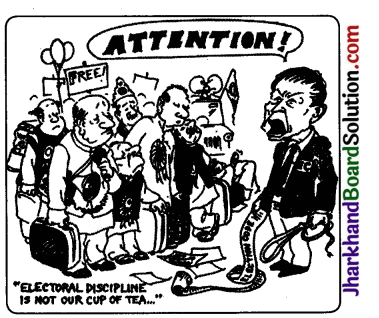
JAC Class 10 Social Science Solutions Civics Chapter 6 Political Parties  1
Answer:
The cartoons highlight the challenge of the frequent use of money and muscle power in politics shown by the political parties.

Page 86

Question 6.
Do you agree that this form of reforming political parties will be acceptable to them?
Answer:
We hope so because this is good not only for them but also for the democracy. They all are meant for strengthening democracy. They also feel the need for reformation. A fair politics will be appreciated by all the parties.

JAC Class 10th Civics Political Parties Textbook Questions and Answers

Question 1.
State the various functions political parties perform in a democracy.
Answer:
Following are the major functions performed by the political parties:
(i) Parties contest elections:
In most democracies, elections are fought mainly among the candidates put up by political parties. Parties select their candidates in different ways.

(ii) Parties put forward different policies and programmes and the voters choose from them. Each of us may have different opinions and views on what policies are suitable for the society. But no government can handle such a large variety of views. In a democracy a large number of similar opinions have to be grouped together to provide a direction in which policies can be formulated by the governments.

(iii) Parties play a decisive role in making laws for a country. Laws are debated and passed in the legislature. But since most of the members belong to a party, they go by direction of the party leadership irrespective of their personal opinions.

(iv) Parties form and run governments:
The big policy decisions are taken by the political executives who come from the political parties.

(v) Parties select leaders, train them and then make them ministers to run the government in the way they want.

(vi) Those parties that lose in the elections play the role of opposition to the parties in power, by voicing different views and criticising government for its failures or wrong policies. Opposition parties also mobilise opposition to the government.

(vii) Parties shape public opinion:
They raise and highlight issues. Parties have lakhs of members and activists spread all over the country. Many of the pressure groups are the extensions of political parties among different sections of society. Parties sometimes also launch movements for solving of problems faced by the people. Often opinions in the society crystallise on the lines parties take.

(viii) Parties provide people access to government machinery and welfare schemes implemented by governments. For an ordinary citizen it is easy to approach a local party leader than a government officer. That is why they feel close to parties even when they do not fully trust them.

JAC Class 10 Social Science Solutions Civics Chapter 6 Political Parties 

Question 2.
What are the various challenges faced by joiiticai parties?
Answer:
The various challenges faced by the political parties are:
(i) Lack of internal democracy within parties. All over the world there is a tendency in the political parties towards the concentration of power in one or few leaders at the top.

(ii) Dynastic succession is related to the first one. Since most political parties do not practise open and transparent procedures for their functioning, there are very few ways for an ordinary worker to rise to the top in a party. This keeps the parties deprived of apt leadership.

(iii) Growing role of money and muscle power in parties, especially during elections. Since parties are focussed only on winning elections, they tend to use short-cuts to win elections. They tend to nominate those candidates who have or can raise lots of money.

(iv) Parties do not seem to offer a meaningful choice to the voters: In order to offer a meaningful choice, parties must be significantly different. In recent years there has been a decline in the ideological differences among the parties in most parts of the world.

Question 3.
Suggest some reforms to strengthen parties so that they perform their functions well.
Answer:
Many suggestions are often made to reform political parties:

  1. Laws should be made to regulate the internal affairs of parties. They should follow their constitution.
  2. They should have one – third seats reserved for women candidates at every level in the organization.
  3. There should be a State funding of elections.
  4. The people should put pressure on political parties through petitions, publicity and agitations.
  5. Parties can improve if those who are interested also join the political parties.

Question 4.
What is a political party?
Answer:
A political party is a group of people who come together to contest elections and hold power in the government. They agree on some policies and programmes for the society with a view to promote the collective good.

Question 5.
What are the characteristics of a political party?
Answer:
Following are the characteristics of a political party:

  1. It is a group of people coming together to contest elections and share power.
  2. It agrees on some policies and programmes for the society with a view to promote collective good.
  3. It seeks to implement these policies by winning popular support through.
  4. It reflects a fundamental political division of the society.
  5. It is known by which part it stands for which policies it supports and whose interest it upholds.

Question 6.
A group of people who come together to contest elections and hold power in the government is called a …………
Answer:
Political Party

Question 7.
Match List 1 (organizations and struggles) with List II and select the correct answer using the codes given below the lists:

List – IList – II
1. Congress PartyA. National Democratic Alliance
2. Bharatiya – Janata PartyB. State Party
3. Communist Party of India (Marxist)C. United Progressive Alliance
4. Telugu Desam PartyD. Left Front
1234
(a)CABD
(b)CDAB
(c)CADB
(d)DCAB

Answer:
(c) C,A,D and B

Question 8.
Who among the following is the founder of the Bahujan Samaj Party?
(a) Kanshi Ram
(b) Sahu Maharaj
(c) B. R. Ambedkar
(d) Jyotiba Phule
Answer:
(a) Kanshi Ram

Question 9.
What is the guiding philosophy of the Bhartiya Janata Party?
(a) Bahujan samaj
(b) Revolutionary democracy
(c) Integral humanism
(d) Modernity
Answer:
(b) Revolutionary democracy

JAC Class 10 Social Science Solutions Civics Chapter 6 Political Parties 

Question 10.
Consider the following statements on parties:
A. Political parties do not enjoy much trust among the people.
B. Parties are often rocked by scandals involving top party leaders.
C. Parties are not necessary to run governments.
Which of the statements given above are correct?
(a) A, B and C
(b) A and B
(c) B and C
(d) A and C
Answer:
(b) A and B

Question 11.
Read the following passage and answer the questions given below:
Muhammad Yunus is a famous economist of Bangladesh. He received several international honours for his efforts to promote economic and social development for the benefit of the poor. He and the Grameen Bank he started jointly, received the Nobel Peace Prize for the year 2006. In February 2007, he decided to launch a political party and contest in theparliamentary elections. His objective was to foster proper leadership, good governance and build a new Bangladesh. He felt that only a political party different from the traditional ones would bring about new political culture. His party would be democratic from the grassroots level.

The launching of the new party, called Nagarik Shakti (Citizen’s Power) has caused stir among the Bangladeshis. While many welcomed his decision, some did not like it. “Now I think Bangladesh will have a chance to choose between good and, bad and eventually have a good government, ” said Shahedul Islam, a government official. “That government, we hope, would not only keep itself away from corruption but also make fighting corruption and lack money a top priority. ” But leaders of traditional political parties who dominated the country s politics for decades were apprehensive. “There was no debate (over him) winning the Nobel, but politics is different – very challenging and often controversial, ” said a senior leader of the Bangladesh Nationalist Party.

Some others were highly critical. They asked why he was rushing politics. “Is he being planted in politics by mentors from outside the country, ” asked one political observer. Do you think Yunus made a right decision to float a new political party? Do you agree with the statements and fears expressed by various people? How do you want this new party organised to make it different from other parties? If you were the one to begin this political party how would you defend it?
Answer:

(i) Yes, Yunus’s decision to float a new political party is right and appreciable.

(ii) I agree with the statement of the government official, Shahedul Islam that the launch of this new party may change the political culture of the country. But I don’t agree with the fear of the senior leader of Bangladesh Nationalist Party.

(iii) (1) It should be democratic from very grassroots level.

(2) It should have equal place for rich and poor, men and women, educated and non- educated, rural and urban people without any discrimination.

(3) It should draft policies which keep the society integrated and take the country towards development.

(iv) (1) The floating of such a party is necessary because the existing parties have moved away from carrying their democratic responsibilities.

(2) Instead of strengthening democracy, they are just taking it as a means to amass wealth.

(3) This party is being launched to foster proper leadership, good governance and build a new Bangladesh.

(4) It is going to bring about a totally new political culture, more democratic and more transparent.

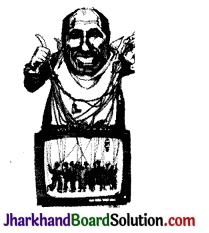
JAC Class 10 Social Science Solutions

JAC Class 10 Social Science Important Questions Civics Chapter 6 Political Parties

JAC Board Class 10th Social Science Important Questions Civics Chapter 6 Political Parties

Multiple Choice Questions

Question 1.
What is the name of the alliance that formed the government in 1998 in India?
(a) National Democratic Alliance
(b) United Progressive Alliance
(c) National Progressive Alliance
(d) United Democratic Alliance
Answer:
(a) National Democratic Alliance

Question 2.
Which of these is not a good option for a democratic state?
(a) One – party system
(b) Two – party system
(c) Multi – party system
(d) None of the above
Answer:
(a) One – party system

JAC Class 10 Social Science Important Questions Civics Chapter 6 Political Parties width=

Question 3.
Political parties exercise power through which of these functions?
(a) Parties contest elections
(b) They play a decisive role in making laws for a country
(c) They form and run governments
(d) All the above
Answer:
(d) All the above

Question 4.
Who chooses the candidates for contesting elections in India?
(a) Members and supporters of the party
(b) Top party leadership
(c) The existing government
(d) None of these
Answer:
(b) Top party leadership

Question 5.
When was the Communist Party of India- Marxist (CPI-M) formed?
(a) 1956
(b) 1986
(c) 1946
(d) 1964
Answer:
(d) 1964

Question 6.
Which of these statements is incorrect about CPI (M)?
(a) Supports socialism secularism and democracy
(b) Opposes imperialism and communalism
(c) Wants to secure socio – economic justice in India
(d) None of the above
Answer:
(d) None of the above

Question 7.
In which of these states does the CPI (M) enjoy strong support?
(a) Uttar Pradesh
(b) Andhra Pradesh
(c) West Bengal
(d) Chhattisgarh
Answer:
(c) West Bengal

JAC Class 10 Social Science Important Questions Civics Chapter 6 Political Parties width=

Question 8.
What is a signed document submitted to an officer regarding her personal information?
(a) Affidavit
(b) Declaration
(c) Agreement
(d) Appeal
Answer:
(a) Affidavit

Question 9.
Which of these statements is correct?
(a) Every party in the country has to register with the Election Commission
(b) The Commission treats all the parties equally
(c) It offers some special facilities to large and established parties
(d) All of the above
Answer:
(d) All of the above

Question 10.
How many parties are registered with the Election Commission of India?
(a) 250
(b) 300
(c) 500
(d) More than 750
Answer:
(d) More than 750

Very Short Answer Type Questions

Question 1.
Mention the three components of a political party.
Answer:
A political party has three components – the leaders, the active members and the followers.

Question 2.
What do you mean by Partisan?
Answer:
Partisan is a person who is strongly committed to a party, group or faction. Partisanship is marked by a tendency to take a side and inability to take a balanced view on an issue.

Question 3.
Explain the term Ruling Party.
Answer:
The party which wins the election with majority and runs government is called a Ruling Party.

Question 4.
What is meant by multi – party system?
Answer:
If several parties compete for power and more than two parties have a reasonable chance of coming to power either on their own strength or in alliance with others we call it a multi – party system.

Question 5.
Define opposition.
Answer:
The party that forms part of a legislature but is not in the Government is known as opposition party. Its main function is to check the activities of the Government.

Question 6.
What is Defection?
Answer:
Changing party allegiance from the party on which a person got elected (to a legislative body) to a different party is known as Defection.

JAC Class 10 Social Science Important Questions Civics Chapter 6 Political Parties width=

Question 7.
What is Affidavit?
Answer:
Affidavit is a signed document submitted to an office where a person makes a sworn statement regarding her personal information.

Question 8.
Define Election Commission.
Answer:
It is an independent multi – member body which is constituted for the superintendence, direction and conduct of elections.

Question 9.
What is meant by alliance?
Answer:
When several parties in a multi – party system join hands for the purpose of contesting elections and winning power, it is called an alliance or a front.

Question 10.
Write any one challenge to political parties in India.
Answer:
Challenge of growing role of money and muscle power in parties, especially, during elections.

Question 11.
How many parties are registered with the Election Commission of India?
Answer:
There are over 750 political parties registered with the Election Commission of India.

Short Answer Type Questions

Question 1.
Why do we need political parties? Explain.
Answer:
We need political parties for the following reasons:

  1. They put forward different policies and programmes before the people.
  2. They play a decisive role in making laws for a country.
  3. They form and run the government.
  4. They play the role of opposition to the parties in power.
  5. They shape public opinion. They raise and highlight the issue of utmost importance.
  6. They provide people access to government-run machinery and welfare schemes.

Question 2.
What is the criteria set by the Election Commission of India for political parties?
Answer:
The Election Commission of India has set certain criteria for political parties:

  1. National parties must secure at least 6% of the vote in the Lok Sabha elections or 6% of the vote in the election to at least 4 different State assemblies. They must win at least 4 seats in the Lok Sabha.
  2. State parties must secure at least 6% of the vote in an assembly election. They must win at least two seats in the assembly election.

Question 3.
What is meant by a national political party? State the conditions required to be a national political party.
Answer:
The conditions required to be a national political party:

  1. A national political party is a party that is present in several or all units of the federation. In other words, it is a country wide party.
  2. It has its units in various states. By and large all these units follow the same policies.
  3. The following are the conditions required for a party to become a national party:
  4. A party has to secure at least six per cent of total votes polled in the Lok Sabha elections or Assembly elections in four States.
  5. It has to win at least four seats in the Lok Sabha to be recognized as a national party.

Question 4.
What is meant by a regional party? State the conditions required to be recognized as a regional political party.
Answer:
The conditions required to be recognized as a regional political party:

  1. A regional party also called a State party is a political party which takes care of regional concerns and State’s interests only.
  2. It happens to have succeeded only in some States’ units of the federation. The following are the conditions required for a party to be recognised as a regional party:
  3. A party that secures at least 6 per cent of the total votes in an election to the Legislative Assembly of a state and wins at least two seats is recognised as a regional party.

Question 5.
Write a brief note on the Indian National Congress.
Answer:
The Indian National Congress was started in 1885/It was the dominant party of Indian politics at the national level and to a large extent at the State level for a long time. Since 1989 its influence has declined, but it still maintains a presence across the entire country. The party has seen many splits over the years. Ideologically, the party is centrist. It is neither leftist nor rightist. It Supports secularism and economic growth with a human face, especially towards the weaker sections of the society.

JAC Class 10 Social Science Important Questions Civics Chapter 6 Political Parties width=

Question 6.
Write a brief note on State parties in India.
Answer:
brief note on State parties in India:

  1. Parties which have their presence only in the State level are called State parties. These include parties with national – level political organisations, but which have succeeded in only a few States.
  2. Samaj Wadi Party, Rashtriya Janata Dal, Samata Party are examples of State parties with a national presence.
  3. Most State parties maintain a strong State- specific identity, like Biju Janata Dal and the Mizo National Front.
  4. Over the last few decades, State or regional parties has grown considerably.
  5. Since 1996, every government at the national level has been a coalition of parties headed usually by one national party.
  6. This has led to strengthening of the federal structure of our government.

Question 7.
What is the difference between a national party and a State party?
Answer:
There are three major differences between a national party and regional, State party:

  1. National parties have influence all over the country or in several States of India. The influence of a State party is limited to a State or a region.
  2. National parties take interest in national as well as international issues whereas regional or State parties are interested in promoting regional and State interest only.
  3. The national parties have to harmonise the national as well as State interests; whereas State parties usually stand for greater autonomy for States.

Question 8.
Why are symbols allotted to political parties in India? Explain the reasons.
Answer:
In India, every party has to register with the Election Commission. For the Commission, all parties are equal but it offers some special facilities to large and established parties.
The symbol allotted by the Commission shows that:

  1. the party is large and established.
  2. it has a well – organized presence in a large area.
  3. only the official candidate of the party can use this symbol.
  4. the party which gets it, is recognized by the Commission.
  5. the party is either a national or a State party.

Question 9.
How do money and muscle power play an important role in elections? Explain.
Answer:
Money and muscle power play an important role in elections:

  1. There is a great challenge about the growing role of money and muscle power in parties, especially during elections.
  2. Since parties are focused only on winning elections, they tend to use short-cuts to win elections. They tend to nominate those candidates who have or can raise lots of money.
  3. Rich people and companies who give funds to the parties tend to have influence on the policies and decisions of the party. In some cases, parties support criminals who can win elections.

Question 10.
What is the role of an ordinary citizen in reforming the political parties?
Answer:
The role of an ordinary citizen in reforming the political parties:

  1. People can put pressure on political parties. This can be done through petitions, publicity and agitations. Ordinary citizens, pressure groups, movements and the media can play an important role.
  2. In a democracy, everybody has been given the right to speak, right to express his ideas and right to agitate.
  3. Political parties can improve if those who are interested also join the political parties. The quality of democracy depends on the degree of public participation. It is difficult to reform politics if ordinary citizens do not take part in it and simply criticise it from outside. The problem of bad politics can be solved by more and better politics.

Long Answer Type Questions

Question 1.
Explain the necessity of political parties in democratic politics.
Answer:
Modem democracies cannot exist without political parties. They play significant roles in democracy. Following are the functions and importance of the political parties in a democracy:

  1. In most democracies, elections are fought mainly among the candidates put up by political parties.
  2. Parties put forward different policies and programmes and the voters choose from them. In a democracy, a large number of similar opinions have to be grouped together to provide a direction in which policies can be formulated by the governments. This is what the political parties do.
  3. Political parties play a decisive role in making laws for a country.
  4. Parties form and run the governments. Parties select leaders, train them and then make them ministers to run the government in the way they want.
  5. Losing parties play the role of opposition to the parties in power, by voicing different views and criticizing government for its failure or wrong policies.
  6. Parties shape public opinion. They raise and highlight issues. Many of the pressure groups are the extensions of political parties.
  7. Parties sometimes also, launch movements for the resolution of problems faced by the people.

Question 2.
Describe various ways of classifying the political system and the political parties.
Answer:
(i) Ways for classifying party system: The party system can be classified on the basis that how many parties are allowed to form, control and run the government. On this basis the party system can be classified into three categories:

  1. One – party system: In this system only one party is allowed to control and run the government. Example: China.
  2. Two – party system: In this system, however there may exist several parties but power is generally changed between only two major parties. Example: USA, UK.
  3. Multi – party system: In this system several parties compete for power. Example: India.

(ii) Ways for classifying of political parties:
1. On the basis of presence:

  • National Parties: These parties operate their functions country – wide. They have their units in various States. But by and large, all these units follow the same policies, programmes and strategies that are decided at the national level.
  • State Party: These parties do not operate their functions nation – wide. They keep their activities to a region or few states.

2. On the basis of proportion of votes and seats:

  • National Party: A party that secures at least six per cent of the total votes in the Lok Sabha elections or Assembly elections in four states and win at least four seats in the Lok Sabha is recognized as a national party.
  • State Party: A party that secures at least six per cent of total votes in an election to the Legislative Assembly of a State and wins at least two seats is recognized as a state party.

Question 3.
What is meant by dynastic succession in politics? Explain with examples.
Answer:
The dynastic succession is a major challenge for political parties in India. It affects the functioning of the political parties adversely in the following ways:

  1. The dynastic succession does not allow political parties to practise open and transparent procedures for their functioning. And, there is a limited scope for an ordinary worker to rise to the top in a party.
  2. In such a party, the leaders are in a position to favour the people close to them or even their family members.
  3. The top positions in the party are always controlled by members of one family which is unfair to other members of that party.
  4. There is a concentration of power in one or few leaders at the top.
  5. People who do not have adequate experience or popular support come to occupy positions of power.

Question 4.
Examine the institutional amendments made by different institutions to reform political parties and their leaders.
Answer:
The following are the two institutional amendments made by different institutions to reform political parties and their leaders:

(i) Anti – defection law:
The Constitution was amended to prevent elected MLAs and MPs from changing parties. This was done because many elected representatives were indulging in DEFECTION in order to become ministers or for cash rewards. Now the law says that if any MLA or MP changes parties, he or she will lose the seat in the legislature. This new law has helped bring defection down. At the same time this has made any dissent even more difficult. MPs and MLAs have to accept whatever the party leaders decide.

(ii) Affidavit:
The Supreme Court passed an order to reduce the influence of money and criminals. Now, it is mandatory for every candidate who contests elections to file an affidavit giving details of his property and criminal cases pending against him. The new system has made a lot of information available to the public. But there is no system to check if the information given by the candidates is true. As yet we do not know if it has led to decline in the influence of the rich and the criminals.

(iii) Mandatory organizational meeting and filling of ITR:
The Election Commission passed an order making it necessary for political parties to hold their organizational elections and file their income tax returns. The parties have started doing so but sometimes it is a mere formality. It is not clear if this step has led to greater internal democracy in political parties.

JAC Class 10 Social Science Important Questions Civics Chapter 6 Political Parties width=

Question 5.
Write short note on Indian national Congress and Bhartiya Janata Party.
Answer:
1. Indian National Congress (INC):

  • Popularly known as the Congress Party, is one of the oldest parties of the world, founded in 1885.
  • Played an important role in Indian politics at the national and state level.
  • Under J.L. Nehru it sought to build a modem secular democratic republic in India.
  • A centrist, party espouses secularism and welfare of weaker sections and minorities and supports new economic reforms but with a human face.
  • A coalition partners in the state of Maharashtra in alliance with the Congress.
  • Since 2004 a member of the UPA.

2. Bhartiya Janata Party (BJP):

  • Founded in 1980 by the Bhartiya Jana Sangh.
  • Wants to build a strong and modern India by drawing inspiration from India’s culture and values.
  • Cultural nationalism (or ‘Hindutva’) is an important element with conception of Indian nationhood and politics.
  • Wants integration of Jammu and Kashmir with India, a uniform civil code for all people of all religions, and ban on religious conversions.
  • Its support base increased in the 1990’s, it was earlier limited to north, west and urban areas, the party expanded its support in south, east, the north – east and to rural areas.
  • Currently leads the mling NDA coalition government at the centre.

Activity Based Questions

Question 1.
Write about the party whose symbol is shown below.
JAC Class 10 Social Science Important Questions Civics Chapter 6 Political Parties 1
Answer:
Communist Party of India – Marxist (CPI – M):
Founded in 1964. Believes in Marxism – Leninism. Supports socialism, secularism and democracy and opposes imperialism and communalism. It accepts democratic elections as a useful and helpful means for securing the objective of socio – economic justice in India. CPI – M enjoys strong support in Kerala and Tripura, especially among the poor, factory workers, farmers, agricultural labourers and the  intelligentsia.

It is critical of the new economic policies that allow free flow of foreign capital and goods into the country. It had been in power in West Bengal without a break for 30 years. In 2004 elections, it won about 6 per cent of votes and 43 seats in the Lok Sabha. It supported the UPA government from outside, without joining the government.

Question 2.
Look at the picture and answer the following questions:
JAC Class 10 Social Science Important Questions Civics Chapter 6 Political Parties 2
(a) Who was Berlusconi?
(b) When was Forza Italia founded?
(c) Write about the company owned by him?
Answer:
(a) Berlusconi was Prime Minister of Italy.
(b) Forza was founded in 1993.
(c) Berlusconi owns TV channels, the most important publishing company, a football club (AC Milan) and a bank

JAC Class 10 Social Science Important Questions

JAC Class 10 Social Science Solutions History Chapter 3 The Making of Global World

JAC Board Class 10th Social Science Solutions History Chapter 3 The Making of Global World

JAC Class 10th History The Making of Global World InText Questions and Answers

Question 1.
Explain what we mean when we say that the world ‘shrank’ in the 1500s.
Answer:
The word ‘Shrank’ stands for increased interaction among the people of various continents of the world. Before the 1500s there was not much interconnectedness, trade and commerce among the residents of various continents. But after the 1500s the commercial cultural exchange of ideas and people increased in the continents of the world that stretched from America to Asia through Europe and Africa.

JAC Class 10 Social Science Solutions History Chapter 3 The Making of Global World

Page 59

Question 2.
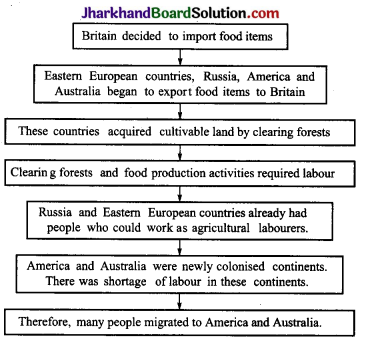
Prepare a flow chart to show how Britain’s decision to import food led to increased migration to America and Australia.
JAC Class 10 Social Science Solutions History Chapter 3 The Making of Global World 1

Question 3.
Imagine that you are an agricultural worker who has arrived in America from Ireland. Write a paragraph on why you chose to come and how you are earning your living.
Answer:
The potato crop had failed in Ireland last year and I had no money. There was no food to eat. The cities were very crowded and many diseases were prevalent. Also, we Catholics were prosecuted by the Englishmen, who were mostly Protestants. The English tried to dominate us by imposing English language on us. That is why I decided to leave Ireland and immigrate to America, where I was sure that I would have a better future. Here, I am earning my living as an agricultural labourer on a very big wheat farm. I get a regular salary and am very happy that I have left Ireland.

Page 64

Question 4.
Discuss the importance of language and popular traditions in the creation of national identity.
Answer:
A person is identified by his language and traditional practices because the language that he speaks belongs to a nation, his motherland. It is the nation which is important than an individual. Also the language and traditional practices of a land or territory develop in a long time, thus get firmly established. People are bom and die but language and traditions stay. They are always alive. They give an identity to an individual, wherever he goes. Therefore, the language and popular traditions are important in creating national identity of an individual.

Page 73

Question 5.
Who profits from jute cultivation according to the jute growers’ lament? Explain.
Answer:
The jute growers’ lament was that only the traders and moneylenders profited from jute cultivation, not the growers. Peasants of Bengal cultivated raw jute which was processed in factories for export in the form of gunny bags. They grew raw jute I hoping that a better time would come and there would be increase in exports.But this did not happen as gunny exports collapsed due to the depression. Due to glut in the local market, the price of raw jute crashed by more than 60% and so they fell into heavy debt. Thus, only the traders and moneylenders profited from jute cultivation, not the farmers.

Page 75

Question 6.
Briefly summarise the two lessons learnt by economists and politicians from the inter-war economic experience.
Answer:
The inter-war economic experience was very bad. Most of the countries were devastated and cities were destroyed.The economists and politicians learned that they had to ensure economic stability of the industrial countries. Also they understood the interdependence of national economies all over the world.Hence, they drew up an internationally accepted framework to recover and consolidate the world economy.

JAC Class 10th History The Making of Global World Textbook Questions and Answers

Write in brief:

Question 1.
Give two examples of different types of global exchanges which took place before the seventeenth century, choosing one example from Asia and one from the Americas.
Answer:
(i) Exchange of food: Food offers many examples of long distance cultural exchange. It is believed that ‘noodles’ travelled west from China to become ‘spaghetti’.

(ii) Exchange of germs:
The Portuguese andSpanish conquests and colonisation of America were decisively underway by the mid-sixteenth century. The European conquest was not just a result of superior firepower. In fact, the most powerful I weapon of the Spanish conquerors wasnot a conventional military weapon at all. It was the germs such as those of smallpox I that they carried on their person.

Because of their long isolation, America’s original inhabitants had no immunity against these diseases that came from Europe. Smallpox in particular proved a deadly killer. Once introduced, it spread deep into the continent, ahead even of any European ireaching there. It killed and decimated whole communities, paving the way for conquest.

JAC Class 10 Social Science Solutions History Chapter 3 The Making of Global World

Question 2.
Explain how the global transfer of disease in the pre-modern world helped in the colonisation of the Americas,
Answer:
The global transfer of disease in the pre modem world helped in the colonisation I of the Americas because the Native l American Indians were not immune to the diseases that the settlers and colonisers brought with them. The Europeans were more or less immune to small pox, but the native Americans, having been cut : off from the rest of the world for millions of years, had no defence against it.These germs killed and wiped out whole’communities, paving the way for foreign domination. Weapons and soldiers could be destroyed or captured, but diseases could not be fought against.

Question 3.
Write a note to explain the effects of the following:
(a) The British government’s decision to abolish the Corn Laws.
(b) The coming of rinderpest to Africa,
(c) The death of men of working-age in . Eqrope because of the World War.
(d) The Great Depression on the Indian economy.
(e) The decision of MNCs to relocate production to Asian countries,
Answer:
(a) Population growth from the late eighteenth century had increased the demand for foodgrains in Britain. As urban centres expanded and industry grew, the demand for agricultural products went up, pushing up foodgrain prices. Under pressure from landed groups, the government also restricted the import of com.

The laws allowing the government to do this were commonly known as the ‘Com Laws’. Unhappy with high food prices, industrialists and urban dwellers forced the abolition of the com laws. After the com laws were scrapped, food could be imported into Britain more cheaply than it could be produced within the country. British agriculture was unable to compete with imports. Vast areas of land were now left uncultivated, and thousands of men and women were thrown out of work.

(b) In Africa, in the 1890s, a fast-spreading disease of cattle plague or rinderpest had a terrifying impact on people’s livelihoods and the local economy. This is a good example of the widespread European imperial impact on colonised societies. It shows how in this era of conquest even a disease affecting cattle reshaped the lives and fortunes of thousands of people and their relations with the rest of the world.

The loss of cattle destroyed African livelihoods. Planters, mine owners and colonial governments now successfully monopolised what scarce cattle resources remained, to strengthen their power and to force Africans into the labour market. Control over the scarce resource of cattle enabled the European colonisers to conquer and subdue Africa.

JAC Class 10 Social Science Solutions History Chapter 3 The Making of Global World

(c) Most of the victims of the first world war belonged to young generations of working men. As a result, it reduced the workforce in Europe, thereby reducing household income. The role of women increased and led to demand for more equality of status. It made the feminist movement stronger. Women started working alongside men in every field. Women and youngsters became more independent and free with long-term effects.

(d) The impact of the Great Depression in India was felt especially in the agricultural sector. It was evident that Indian economy was closely becoming integrated to global economy. India was a British colony. It exported agricultural goods and imported manufactured goods.

The fall in agricultural price led to reduction of farmers’ income and agricultural export. The government did not decrease their tax and so, many farmers and landlords became more indebted to moneylenders and corrupt officials. It led to a great rural unrest in India.

(e) The industrial world was also hit by unemployment that began rising from the mid-1970s and remained high until the early 1990s. From the late 1970s, the MNCs also began to shift production operations to low-wage Asian countries. The relocation of industry to low-wage countries stimulated world trade and capital flows. In the last two decades the world’s economic geography has been transformed as countries such as India, China and Brazil have undergone rapid economic transformation.

Question 4.
Give tjyo examples from history to show the impact of technology on food availability.
Answer:
(i) Availability of cheap food in different markets:
Improvements in transport, faster railways, lighter wagons and larger ships helped move food more cheaply and quickly from the far away farms to the final markets.

(ii) Impact on meat:
Till the 1870s, meat from America was shipped to Europe in the form of live animals which were then slaughtered in Europe. But live animals took up a lot of ship space. But the invention of refrigerated ships made it possible to transport meat from one region to another. Now animals were slaughtered in America, Australia or New Zealand, and then transported to Europe as frozen meat.

The invention of refrigerated ship had the following advantages This reduced shipping costs and lowered meat prices in Europe.The poor in Europe could now consume a more varied diet. To the earlier monotony of bread and potatoes many, not all, could add meat, butter and eggs.Better living conditions promoted Social peace within the country, and support for imperialism abroad.

JAC Class 10 Social Science Solutions History Chapter 3 The Making of Global World

Question 5.
What is meant by the Bretton Woods Agreement?
The Bretton Woods system inaugurated an era of unprecedented growth of trade and incomes for the Western industrial nations and Japan. World trade grew annually at over 8 per cent between 1950 and 1970 and incomes at nearly 5 per cent. The growth was also mostly stable, without large fluctuations. For much of this period the unemployment rate, for example, averaged less than 5 per cent in most industrial countries.

NCERT ‘Discuss’ Questions

Question 1.
Imagine that you are an indentured Indian labourer in the Caribbean. Drawing from the details in this chapter, write a letter to your family describing your life and feelings.
Answer:
Shri Swaminathan,
B-30 Anna Nagar,
Madras (Chennai) Date 12/04/1911

Dear Papa,
Hope, all is well at your end. I am trying to get settled in this Caribbean country. Presently, I am working in Trinidad . (Caribbean) as an indentured labourer. Through this letter, I would like to draw a picture to you about my hardship and simultaneous the misbehaviour of the contractor towards me. The contractor at the time of hiring me did not provide the correct information regarding the place of work, mode of travel and living and working conditions.

Very few legal rights are provided to us. The contractor uses harsh and abusive language at the worksite. He treats us like coolies and we are an uneasy minority in the cocoa plantations in Trinidad. Whenever I do not attend my work, I am prosecuted and sent to jail. There is a lot of work at the plantations with heavy workload and sometimes I have to finish all of it one day. In case of unsatisfactory work (in the contractor’s thinking), my wages are cut. I am living a life of a slave and in great trouble.

Yours
Satyamurthy

Question 2.
Explain the three types of movements or flows within international economic exchange. Find one example of each type of flow which involved India and -Indians, and write a short account of it.
Answer:
The thAe types of movements or flows in international economic exchange are:
(i) Flow of Trade:
This refers to trade in tangible goods like wheat, cotton, etc. Historically fine cotton cloth was produced in India by the weavers and exported to European countries, but when the industrial revolution started in Europe and,the European countries imposed tariff barriers, this export of textiles dropped
drastically. In fact, India started exporting raw cotton and importing mill made cloth from England.

(ii) Flow of Labour:
This refers to migration of people in search of employment: During the nineteenth century, a large number of Indian labourers migrated to Africa, the West Indies and the other countries to work on plantations and in mines as well as in railway and road construction projects set up by the Europeans. These Indians settled in the countries where they had gone after their contracts ended and now their descendants are found in these countries.

JAC Class 10 Social Science Solutions History Chapter 3 The Making of Global World

(iii) Flow of Capital:
This refers to movement of capital over long distances for short¬term and long-term investments. Groups of Indian financiers and traders like the Sheriffs. Chatters, etc., financed agriculture plantations in various Asian and African countries using their own funds or those borrowed from the European banks.

Question 3.
Explain the causes of the Great Depression.
Answer:
The causes of the Great Depression were:
(i) Conditions Created by War: There was an immense industrial expansion in view of the increased demand of goods supplied to the army during the period of the First World War. After the war, the demand for these goods suddenly dropped and so there was no demand in many industries. There was also a large fall in the agricultural prices due to reduced demand.

(ii) Overproduction in Agriculture:
Agricultural overproduction was another major factor responsible for the depression. This was made worse by falling agricultural prices. As prices slumped and agricultural incomes declined, the farmers tried to increase the production and bring a larger volume of produce to the market to maintain their overall income. This worsened the situation by pushing down the prices of farm produce further. Various goods rotted in the markets because of lack of buyers.

(iii) Shortage of Loans: In the mid-1920’s many countries financed their investments through loans from the USA. While it was often very easy to raise loans in the USA during the boom period, the USA overseas lenders panicked at the first sign of trouble.

(iv) Multiple Effects: With the fall in prices and the prospect of a depression, the USA banks slashed domestic lending and stopped bank loans. Thousands of banks went bankrupt and were forced to close down. Factories were closed, leading to unemployment of hundreds of people who were rendered jobless, which further aggravated the crisis.

Question 4.
Explain what is referred to as the G-77 countries. In what ways can G-77 be seen as a reaction to the activities of the Bretton Woods twins?
Answer:
The developing countries did not benefit from the economic growth of the developed countries like the USA, European countries and Japan. To remove this disparity, these 77 countries organized themselves into a group called the G-77 countries. Later on, more developing countries joined the group and now it consists of about 130 countries. They have demanded a New International Economic Order, in which they have a real coptrol over their natural resources; they get more development assistance and fairer prices for raw materials exported by them.

They want better access to the markets in developed countries for their, manufactured goods. The Bretton Woods twins, IMF and World Bank, were mainly set up to favour the developed nations. They did not help the developing nations significantly as both of these institutions controlled their investments in the developing countries. So, the developing countries decided to set up their own group, the G-77, so that they could bargain better with these institutions and the developed countries for economic development and resultant benefits.

NCERT ‘Project’ Work

Question 1.
Find out more about gold and diamond mining in South Africa in the nineteenth century. Who controlled the gold and diamond companies? Who were the miners and what were their lives like?
Answer:
(i) During the 19th century in South Africa, gold was discovered in Johannesburg and diamond in Kimberly. Soon European migrants began mining of gold and diamond in South Africa, when from 1886 onwards, mining business became highly profitable. This can be attested by the data that South Africa was producing world’s 27% gold from 1886 to 1914 (the year of First World War).

JAC Class 10 Social Science Solutions History Chapter 3 The Making of Global World

(ii) Cecil Rhodes was the first European to create a gold and diamond mining monopoly buying up land and forming De Beers. Today it is world’s largest diamond producing company.

(iii) Mining companies were controlled by the Europeans and Americans , as many of white settlers migrated to South Africa; with desire of making huge profits in the mining industry. They also introduced technological advances and deep mining techniques so that profits could be increased.

(iv) The workers on the mining fields were African natives, and most of them migrated to South Africa, from other parts and colonial states of African continents.
The mining workers lived a miserable life.

For example:

  1. They were paid ten times lower wages than the white workmen.
  2. Apartheid (Racism): The discovery of gold and diamond in Southern Africa led to apartheid (racism) from as early as 1889.
  3. In 1889 chamber of mines was formed by the European industrial nations mainly to reduce African wages. This was to increase the profitability of mines. This increased racial attacks on African blacks, as they were dissatisfied a lot and lived miserable lives.

JAC Class 10 Social Science Solutions

JAC Class 10 Social Science Important Questions Civics Chapter 1 Power Sharing

JAC Board Class 10th Social Science Important Questions Civics Chapter 1 Power Sharing

Multiple Choice Questions

Question 1.
What is the linguistic composition of Belgium?
(a) 59% speak French, 40% speak Dutch, 1% speaks German
(b) 59% speak French, 40% speak German, 1% speaks Dutch
(c) 59% speak Dutch, 40% speak French, 1% speaks German
(d) 59% speak German, 40% speak Dutch, 1% speaks French
Answer:
(c) 59% speaks Dutch, 40% speaks French, 1% speaks German

Question 2.
What are the Tamil natives of Sri Lanka called?
(a) Indian Tamils
(b) Buddhist Sinhala
(c) Muslim Tamils
(d) Sri Lankan Tamils
Answer:
(d) Sri Lankan Tamils

JAC Class 10 Social Science Important Questions Civics Chapter 1 Power Sharing

Question 3.
What are the forefathers who came from India to Sri Lanka as plantation workers during colonial period, called?
(a) Indian Tamils
(b) Sinhala
(c) Sri Lankan Tamils
(d) Hindu Tamils
Answer:
(a) Indian Tamils

Question 4.
When did Sri Lanka emerge as an independent country?
(a) 1984
(b) 1948
(c) 1849
(d) 1894
Answer:
(b) 1948

Question 5.
Why did the democratically elected government in Sri Lanka adopt a series of majoritarian measures?
(a) To establish Tamil supremacy
(b) To foster Buddhism
(c) To establish Sinhala supremacy
(d) To establish Tamil Elam
Answer:
(c) To establish Sinhala supremacy

JAC Class 10 Social Science Important Questions Civics Chapter 1 Power Sharing

Question 6.
When was the Act passed to recognise Sinhala as the only official language, thus disregarding Tamil?
(a) 1596
(b) 1695
(c) 1965′
(d) 1956
Answer:
(d) 1956

Question 7.
Which religion did the new constitution stipulate that the state of Sri Lanka shall protect and foster?
(a) Buddhism
(b) Islam
(c) Hinduism
(d) Christianity
Answer:
(a) Buddhism

Question 8.
What led to Civil War in Sri Lanka?
(a) Power sharing .
(b) Principle of majoritarianism
(c) Community government
(d) Modem democracies
Answer:
(b) Principle of majoritarianism

Question 9.
Constitution of which country prescribes that the number of Dutch and French-speaking ministers shall be equal in the central government?
(a) England
(b) Sri Lanka
(c) India
(d) Belgium
Answer:
(d) Belgium

JAC Class 10 Social Science Important Questions Civics Chapter 1 Power Sharing

Question 10.
In which country are the state governments not subordinate to the Central government?
(a) Belgium
(b) Sri Lanka
(c) Both Sri Lanka and Belgium
(d) None of the above
Answer:
(a) Belgium

Very Short Answer Type Questions

Question 1.
What is the meaning of the term ‘ethnic’?
Answer:
The term ‘ethnic’ is a social division based on shared culture. People belonging to the same ethnic group believe in their common descent because of similarities of physical type or of culture or both. They need not always have the same religion or nationality.

Question 2.
Name the countries Brussels shares its border with.
Answer:
Brussels shares its border with France, the Netherlands, Germany and Luxembourg.

Question 3.
What was the special problem faced by Brussels?
Answer:
Brussels presented a special problem. The Dutch-speaking people constituted a majority in the country, but a minority in the capital.

Question 4.
What is majoritarianism?
Answer:
Majoritarianism is a belief that the majority community should be able to rule a country in whichever way it wants, by disregarding the wishes and needs of the minority.

Question 5.
What did the Sri Lankan government adopt to establish Sinhala supremacy?
Answer:
The democratically elected government of Sri Lanka adopted a series of majoritarian measures to establish Sinhala supremacy.

Question 6.
In which part of Sri Lanka did the political organisations demand an independent Tamil Eelam (state) be formed?
Answer:
By 1980s several political organisations were formed demanding an independent Tamil Eelam (state) in northern and eastern parts of Sri Lanka.

Question 7.
What is ‘community government’?
Answer:
The third kind of government in Belgium is the ‘community government’, elected by people belonging to one language community Dutch, French and German-speaking no matter where they live. This government has the power regarding cultural, educational and language-related issues.

JAC Class 10 Social Science Important Questions Civics Chapter 1 Power Sharing

Question 8.
What is the meaning of power sharing?
Answer:
Sharing of power by various groups in the society and levels of the government for the smooth functioning of the nation is known as power sharing.

Question 9.
Which community enjoys majority in Sri Lanka?
Answer:
The Sinhala community enjoys a big majority in Sri Lanka.

Question 10.
Differentiate between ‘Sri Lankan Tamils’‘and ‘Indian Tamils’.
Answer:
Tamil natives of the country of Sri Lanka are called ‘Sri Lankan Tamils’. The rest, whose forefathers came from India as plantation workers during colonial period, are called ‘Indian Tamils’.

Short Answer Type Questions

Question 1.
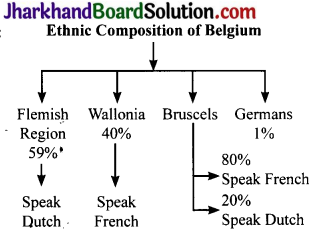
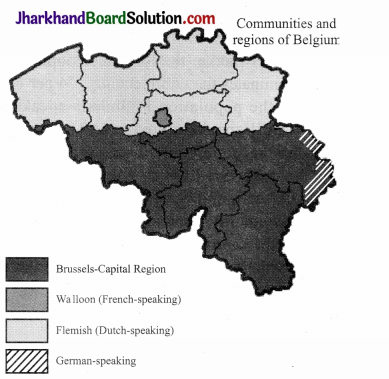
Describe the ethnic composition of Belgium.
Answer:
Ethnic Composition of Belgium
JAC Class 10 Social Science Important Questions Civics Chapter 1 Power Sharing 1

The ethnic composition of Belgium is very complex. Of the country’s total population, 59 per cent lives in the Flemish region and speaks Dutch language. Another 40 per cent people living in the Wallonia region and speak Belgians speak German. In the capital city Brussels, 80 per cent speak French while 20 per cent are Dutch-speaking.

Question 2.
What led to tensions between the French and Dutch in Belgium?
Answer:
The minority French-speaking community was relatively rich and powerful. This was resented by the Dutch-speaking community who got the benefit of economic development and education much later. This led to tensions between the Dutch-speaking and French-speaking communities during the 1950s and 1960s. The tension between the two communities was more acute in Brussels. Brussels faced a special problem. The Dutch-speaking people constituted a majority in the country, but a minority in the capital.

Question 3.
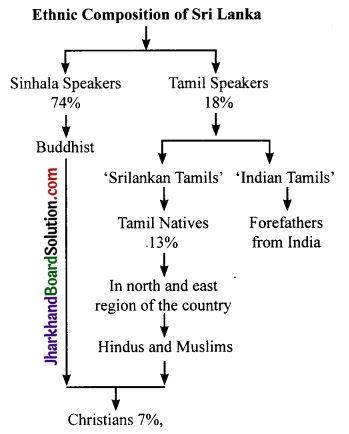
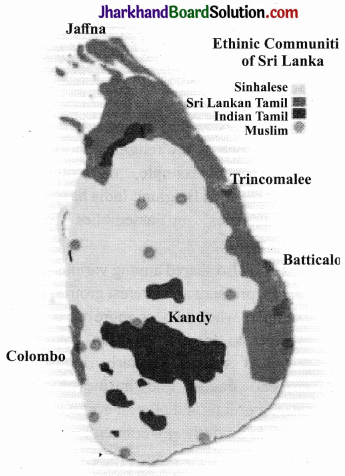
Describe the ethnic composition of Sri Lanka.
Answer:
JAC Class 10 Social Science Important Questions Civics Chapter 1 Power Sharing 2
Sri Lanka has a diverse population. The major social groups are the Sinhala
speakers (74 per cent) and the Tamil speakers (18 per cent). Among Tamils there are two sub-groups. Tamil natives of the country are called ‘Sri Lankan. Tamils’ (13 per cent). The rest, whose forefathers came from India as plantation workers during colonial period, are called ‘Indian Tamils’. Sri Lankan Tamils are concentrated in the north and east of the country. Most of the Sinhala-speaking people are Buddhists, while most of the Tamils are Hindus or Muslims. There are about 7 per cent Christians, who are both Tamil and Sinhala.

Question 4.
How was majoritarianism established in Sri Lanka?
Answer:
When Sri Lanka emerged as an independent country in 1948, the leaders of the Sinhala community sought to secure dominance over government by virtue of their community. The democratically elected government adopted a series of. majoritarian measures to establish Sinhala supremacy. In 1956, an Act was passed to recognise Sinhala as the only official language, thus, disregarding Tamil. The governments followed preferential policies that favoured Sinhala applicants for university positions and government jobs. A new constitution stipulated that the state shall protect and foster Buddhism.

JAC Class 10 Social Science Important Questions Civics Chapter 1 Power Sharing

Question 5.
What are the different ways in which minority communities get a fair share in poweb?
Answer:

  1. Power can be shared among different social groups such as religious and linguistic groups.
  2. The ‘community government’ in Belgium is elected by the people belonging to one language community, no matter where they live. The government has the power regarding cultural, educational and language-related issues.
  3. In some countries there are constitutional and legal arrangements to support the weaker sections and women to get representation in the legislatures and administration.
  4. This allows the diverse social groups to participate in the functioning of the government, who would otherwise feel alienated from the government.

Question 6.
How did the Tamil community of Sri Lanka react to the majoritarianism in Sri Lanka?
Answer:

  1. The Sri Lankan Tamils launched parties and struggles for the recognition of Tamil as an official language, for regional autonomy and equality of opportunity in securing education and jobs.
  2. But their demand for more autonomy to provinces populated by the Tamils was repeatedly denied.
  3. By the 1980s several political organisations were formed demanding an independent Tamil Eelam (state) in northern and eastern parts of Sri Lanka.
  4. The distrust between the two communities turned into widespread conflict. It soon turned into a civil war.

Question 7.
How is the Belgian government similar to that of Indian government?
Answer:

  1. Both India and Belgium follow federal form of power. Power is shared among governments at different levels.
  2. While in Belgium, different levels of government is known as Federal form of government. In India it is known as Central or Union government.
  3. Power is also shared among different social groups, such as religious and linguistic groups. There is ‘community government’ in Belgium and ‘reserved constituencies’ in assemblies and the parliament in India.

Question 8.
Power sharing arrangements can also be seen in the way political parties, pressure groups and movements control or influence those in power. Justify.
Answer:

  1. In contemporary democracies, citizens have the freedom to choose among various contenders. This occurs in the form of competition among different political parties.
  2. Power is shared among different political parties to represent different ideologies and social groups. Sometimes this sharing can be direct when parties form an alliance to contest elections or form a coalition government.
  3. Interest groups, such as those of industrialists, farmers, traders and businessmen also have a share in governmental power, either through participation in governmental committees or bringing influence on the decision-making process.

Question 9.
Why is power sharing necessary in a country like India?
Answer:

  1. India is a country of diverse culture, tradition, language, tribes and socially and economically weaker people.
  2. With diverse composition of population, it becomes necessary to support and encourage each group to participate in the functioning of the government.
  3. Only if everyone is kept together, a country can run peacefully. It teaches us tolerance and we learn from each other und accept each other. It widens our views and approach to running the nation.
  4. The various groups are represented in the legislatures and administration. The constitution clearly lays down the laws for their representation. Therefore, power sharing is necessary in a country like India.

JAC Class 10 Social Science Important Questions Civics Chapter 1 Power Sharing

Question 10.
How many times did the Belgian leaders amend their constitution between 1970 and 1993, and why?
Answer:
The Belgian leaders recognised the existence of regional differences and cultural diversities. Between 1970 and 1993, they amended their constitution four times as to work out an arrangement that would enable everyone to live together in the same country.

Long Answer Type Questions

Question 1.
Discuss the Belgian model of accommodating and recognising the existence of regional differences and cultural diversities.
Answer:
The Belgian leaders took a few steps to accommodate and recognise the existence of regional differences and cultural diversities. These were:

  1. Constitution mentions that the number of Dutch and French-speaking ministers shall be equal in the central government. Some special laws require the support of majority of members from each linguistic group. Thus, no single community can make decisions unilaterally.
  2. Many powers of the central government have been given to state governments of the two regions of the country. The state governments are not subordinate to the Central Government.
  3. Brussels has a separate government in which both the communities have equal representation. The French-speaking people accepted equal representation in Brussels because the Dutch-speaking community has accepted equal representation in the Central Government.
  4. The third kind of government is the ‘community government’, elected by the people belonging to one language community Dutch, French and German-speaking, no matter where they live. This government has the power regarding cultural, educational and language-related issues.

Question 2.
Discuss in detail why power sharing is desirable.
Answer:
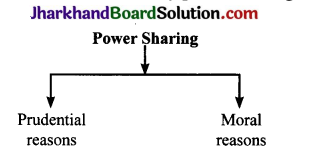
There are two different reasons why power sharing is desirable.
(i) Prudential Reasons:
Power sharing reduces the possibility of conflict between social groups. As social conflict often leads to violence and political instability, power sharing is a good way to ensure the stability of political order. Although, imposing the will of the majority community over the others may look like an attractive option in the short run, in the long run it undermines and damages the unity of the nation.

(ii) Moral Reasons:
The second deeper reason is that power sharing is the spirit of democracy. Democracy involves the participation of people in the functioning of the coyntry. People have the right to be informed and consulted on how they are to be governed. A legitimate government is one where citizens, through participation, acquire a stake in the system.

Question 3.
Discuss the system of checks and balances.
Answer:

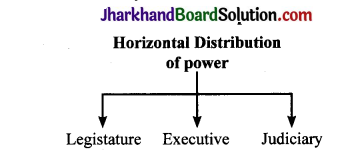
  1. Power is shared among different organs of the government, such as the legislature, executive and judiciary.
  2.  This horizontal distribution of power allows different organs of the government placed at the same level to exercise different powers.
  3. This ensures that none of the organs exercise unlimited power. Each organ checks the others.
  4. Even though ministers and government officials exercise power, they are responsible to the Parliament or State Assemblies.
  5. Similarly, the judges are appointed by the executives but they can check the functioning of executives or laws made by the legislatures. This results in a balance of power among various institutions.
  6. This arrangement is called a system of checks and balances.

JAC Class 10 Social Science Important Questions Civics Chapter 1 Power Sharing

Question 4.
Explain how power can be shared among governments at different levels.
Answer:

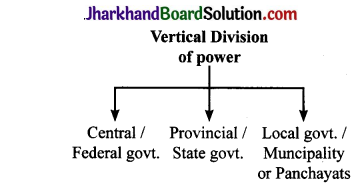
  1. Power can be shared among governments at different levels a general government for the entire country and governments at the provincial or regional level.
  2. In some countries, general government for the entire country is called the federal government.
  3. In India, it is the Central or Union Government. The governments at provincial level are called by different names in different countries.
  4. In India, it is known as State Government. The constitution clearly lays down the powers of different levels of government.
  5. The same principle can be extended to levels of government lower than the State government, such as the municipality and panchayat.
  6. The division of power involving higher and lower levels of government is called vertical division of power.

Activity Based Questions

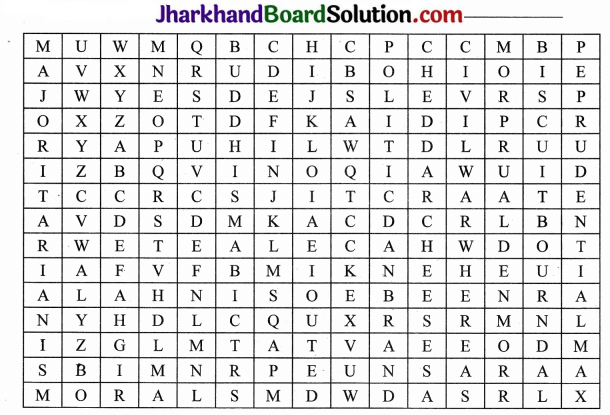
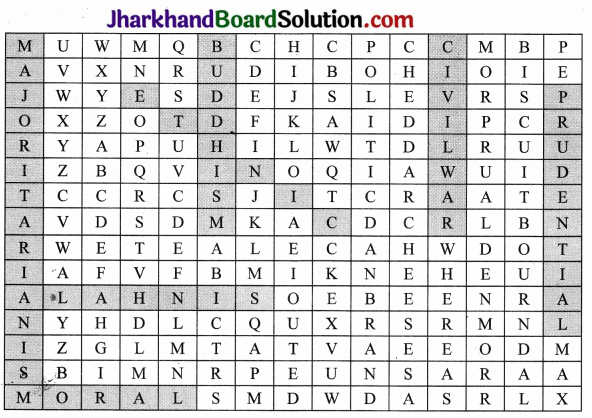
Read the clues and search for the answers from the word search box:

  1. A social division based on shared culture
  2. A belief that majority community should be able to rule a country in whichever way it wants, by disregarding the wishes and needs of the minority
  3. The only official language in Sri Lanka, as passed by Act in 1956
  4. A violent conflict between opposing groups within a country that becomes so intense that it appears like a war
  5. These reasons stress that power sharing will bring out better outcomes
  6. These reasons emphasise the very act of power sharing as valuable
  7. Anew constitution in Sri Lanka stipulated that the state shall protect and foster this religion

JAC Class 10 Social Science Solutions Civics Chapter 1 Power Sharing 7
Answer:
JAC Class 10 Social Science Important Questions Civics Chapter 1 Power Sharing 7

1. Ethnic
2. Majoritarianism
3. Sinhala
4. Civil war
5. Prudential
6. Moral
7. Buddhism

JAC Class 10 Social Science Important Questions

JAC Class 10 Social Science Solutions Civics Chapter 1 Power Sharing

JAC Board Class 10th Social Science Solutions Civics Chapter 1 Power Sharing

JAC Class 10th Civics Power Sharing InText Questions and Answers

Page 2

Question 1.
Look at the maps of Belgium and Sri Lanka. In which region, do you find concentration of different communities?
Communities and regions of Belgium
JAC Class 10 Social Science Solutions Civics Chapter 1 Power Sharing 1
JAC Class 10 Social Science Solutions Civics Chapter 1 Power Sharing 2
Answer:
In Belgium, there are two major linguistic groups: 59 per cent of the people live in the Flemish region (north) and are the Dutch-speaking people. Around 40% of the population occupy the Wallonia region and speak French. The one per cent German-speaking population lives in the eastern region of Belgium.

In Sri Lanka, the Sinhalese population dominates the entire country. 74 per cent of the population is Sinhala – speakers. Tamil speakers comprise 18 per cent of the population. There are two sub groups! Sri Lankan Tamils live in the northern and eastern coastal regions of the country. Indian Tamils are clustered in the central region and scattered in the southern region. Muslims are distributed throughout the country.

Page 5

Question 2.
Read any newspaper for one week and make clippings of news related to ongoing conflicts or wars. A group of live students could pool their clippings together and do the following:

  • Classify these conflicts by their location (your state, India, outside India).
  • Find out the cause of each of these conflicts. How many of these are related to power sharing disputes?
  • Which of these conflicts could be resolved by working out power sharing arrangements?

Answer:
Hints:
Students can find out about conflicts from newspapers and also visit the newspaper archives. Within India, students may read about Cauvery Water Dispute between Karnataka and Tamil Nadu. Outside India, the students can study the American Civil War which was fought in the United States of America from 1861 to 1865 by President Abraham Lincoln against slavery.

JAC Class 10 Social Science Solutions Civics Chapter 1 Power Sharing

Question 3.
Annette studies in a Dutch medium school in the northern region of Belgium. Many French-speaking students in her school want the medium of instruction to be French. Selvi studies in a school in the northern region of Sri Lanka. All the students in her school are Tamil speaking and they want the medium of instruction to be Tamil. If the parents of Annette and Selvi were to approach respective governments to realise the desire of the child who is more likely to succeed? And why?

Answer:
Annette’s parents are more likely to succeed when they approach the government because Belgian leaders recognised the existence of regional differences and cultural diversities. They have the  community government, which is elected by the people belonging to one language, Dutch, French and German – speaking, no matter where they live.

This government has the power regarding cultural, educational and language-related issues. Selvi’s parents are less likely to succeed because the Sinhalese have established their supremacy in Sri Lanka. In 1956, an Act was passed to recognise Sinhala as the only official language, thus disregarding Tamil.

Question 4.
Can you help poor Vikram in answering Vetal?
(a) If you had the power to rewrite the rules in Lebanon what would you do?
(b) Would you adopt the ‘regular’ rules followed everywhere, as Khalil suggests? Or stick to the old rules? Or do something else?
Answer:
(a) Democracy is a government “of the people by the people and for the people”. But it doesn’t mean to make a situation that can cause disturbances and bloodsheds in the society. It is based on “live and let live”. So if there is an agreement among different communities in the country on the basis of fixed power sharing among them, it is right. There is no need to rewrite the rule.

(b) If the rules of the Lebanon is providing all the people to caste vote and contest elections as per agreement of power. sharing among different communities, I would not adopt the ‘regular’ rules followed everywhere, as Khalil suggests. I would stick to the rules made after agreement among different communities. I don’t need to do something else.

Question 5.
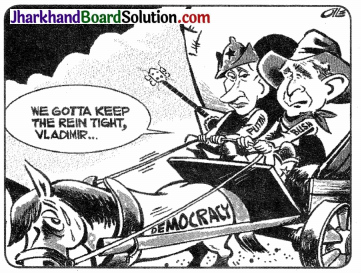
In 2005, some new laws were made in Russia giving more powers to its president. During the same time the US president visited Russia. What, according to this cartoon, is the relationship between democracy and concentration of power? Can you think of some other examples to illustrate the point being made here?
JAC Class 10 Social Science Solutions Civics Chapter 1 Power Sharing 3
Answer:
(i) Democracy, in general represents the will of the common people. But when the power is concentrated in a particular hand, in a democratic government, this individual outlasts the will of the common people. The same thing has been shown in the cartoon where democracy is run by selected people, at their will, without taking care of the will of the general people.

(ii) We can illustrate a few more such examples. For example, in Pakistan, there is an elected democratic government but this is not the true representation of the will of the people. Once elected, the power – carrying men run the government as per their wishes. Iraq was another example where democracy was being run in an autocratic manner.

JAC Class 10 Social Science Solutions Civics Chapter 1 Power Sharing

Question 6.
In my school, the class monitor changes every month. Is that what you call a power – sharing arrangement?
Answer:
No, the changing of class monitor every month cannot be called a power-sharing arrangement. Because, in power – sharing arrangement, there are different institutions and intersect groups which exercise their power and check the actions of each other. This arrangement is also called a system of checks and balances.

Page 10

Question 7.
Here are some examples of power – sharing. Which of the four types of power – sharing do these represent? Who is sharing power with whom?
(a) The Bombay High Court ordered the Maharashtra state government to immediately take action and improve living conditions for the 2,000 odd children at seven children’s homes in Mumbai.
(b) The government of Ontario state in Canada has agreed to a land claim settlement with the aboriginal community. The Minister responsible for Native Affairs announced that the government will work with aboriginal people in a spirit of mutual respect and cooperation.
(c) Russia’s two influential political parties, the Union of Right Forces and the Liberal Yabloko Movement, agreed to unite their organisations into a strong right – wing coalition. They propose to have a common list of candidates in the next parliamentary elections.
(d) The finance ministers of various stales in Nigeria got together and demanded that the federal government declare its sources of income. They also wanted to know the formula by which the revenue is distributed to various state governments.
Answer:
(a) (i) This is an example of power sharing among different organs of the government.
(ii) Here the power is shared between the judiciaiy and the executive.

(b) (i) This is an example of sharing of power among different social groups.
(ii) Here, the power is shared between the aboriginals and other social groups.

(c) (i) This is an example of power sharing arrangements in the way political parties pressure groups and movements control or influence power.
(ii) Here, the power is being shared between SPS and the liberal Yabloko movement.

(d) (i) This is an example of power sharing among governments at different levels.
(ii) Here, the power is being shared between federal and state governments and also among the state governments.

JAC Class 10th Civics Power Sharing Textbook Questions and Answers

Question 1.
What are the different forms of power sharing in modern democracies? Give an example of each of these.
Answer:
In modem democracies, power can be shared in many different forms.
(i) Horizontal distribution of power:
JAC Class 10 Social Science Solutions Civics Chapter 1 Power Sharing 4
The different organs of the government at the same level, such as the legislature, the executive and the judiciary exercise different powers.

  1. This ensures that none of the organs can exercise unlimited power.
  2. Each organ checks the others. This results in a balance of power. For example, though the judges are appointed by the executive, they can check the functioning of the executive or laws made by the legislatures.
  3. This arrangement is called a system of checks and balances.

(ii) Vertical division of power:
JAC Class 10 Social Science Solutions Civics Chapter 1 Power Sharing 5
In this system, the power is divided among different levels of government, such as the central or the federal government, the provincial or state governments, and then the municipality and the panchayat. The constitution clearly lays down the powers of different levels of government.

(iii) Power is shared among different social groups, such as religious and linguistic groups/For example, the ‘community government’ of Belgium is elected by the people belonging to one language community, Dutch, French and German speaking, no matter where they live. This government has the power regarding cultural, educational and language – related issues. In some countries, there are constitutional and legal arrangements whereby socially weaker sections, and women are represented in the legislatures and administration.

(iv) Power is shared among various political parties, pressure groups and movements, which .control or influence those in power. Jn a democracy, the citizens have the right to choose among the various contenders for power. Two or more political parties share their power when a coalition government is formed. There are various interest groups, such as traders and businessmen, farmers, industrialists, etc. who have a share in governmental power, either through participation in governmental committees or bringing influence on the decision-making process.

JAC Class 10 Social Science Solutions Civics Chapter 1 Power Sharing

Question 2.
State one prudential reason and one moral reason for power – sharing with an example from the Indian context.
OR
Give two reasons why power sharing is desirable.
Answer:
Power Sharing
JAC Class 10 Social Science Solutions Civics Chapter 1 Power Sharing 6
(i) Prudential reasons state that power – sharing will bring better outcomes. It helps reduce the possibility of conflict between social groups. It ensures the stability of political order. Imposing the will of the majority on others is not only oppressive for the minority, but also undermines the unity of the nation. For example, in India there are reserved constituencies in the parliament and assemblies for OBC, SCs and STs.

(ii) Moral reasons emphasise the very act of power – sharing as valuable. Power – sharing is the very spirit of democracy. A democratic rule involves sharing power with those affected by its exercise, and who have to live with its effects. A legitimate government is one where citizens, through participation, acquire a stake in the system.

Question 3.
After reading this chapter, three students drew different conclusions. Which of these do you agree with and why? Give your reasons in about 50 words. Thomman Power sharing is necessary only in societies which have religious, linguistic or ethnic divisions. Mathayi Power sharing is suitable only for big countries that have regional divisions. Ouseph  Every society needs some form of power – sharing even if it is small or does not have social divisions.
Answer:
One will agree with Ouseph’s conclusion that every society needs some form of power – sharing even if it is small or does not have social divisions. Power – sharing is not affected or influenced by the size of the country. It is necessary in societies with linguistic, religious or ethnic divisions. This will make the population feel included in everything. It is also required in a country where there are no social or religious divisions for peace and stability of the nation.

JAC Class 10 Social Science Solutions Civics Chapter 1 Power Sharing

Question 4.
The Mayor of Merchtem, a town near Brussels in Belgium, has defended a ban on speaking French in the town’s schools. He said that the ban would help all non – Dutch speakers integrate in this Flemish town. Do you think that this measure is in keeping with the spirit of Belgium’s power – sharing arrangements? Give your reasons in about 50 words.
Answer:
Defending the ban on speaking French in schools in Merchtem by the Mayor of the town is not in keeping with the spirit of Belgium’s power sharing arrangements. The Belgian model of governance accommodates and recognises the existence of regional differences and cultural diversities. They amended their constitution four times between 1970 and 1993 so as to work out an arrangement that would enable everyone to live together within the same country.

Question 5.
Read the following passage and pick out any one of the prudential reasons for power sharing offered in this. “We need to give more power to the panchayats to realise the dream of Mahatma Gandhi and the hopes of the makers of our Constitution. Panchayati Raj establishes true democracy. It restores power to the only place where power belongs in a democracy in the hands of the people.

Giving power to Panchayats is also a way to reduce corruption and increase administrative efficiency. When people participate in planning and implementation of developmental schemes, they would naturally exercise greater control over these schemes. This would eliminate the corrupt middlemen. Thus, Panchayati Raj will strengthen the foundations of our democracy.
Answer:
The prudential reasons are: Panchayati Raj establishes true democracy. In this system, true power lies in the hands of the people. It not only reduces corruption and increases administrative efficiency, but eliminates corruption of middlemen. People are directly involved in planning and implementation of developmental schemes. This keeps the people of all sections of the society involved in the functioning of the government. It brings political stability and reduces violence. It involves sharing of power.

JAC Class 10 Social Science Solutions Civics Chapter 1 Power Sharing

Question 6.
Different arguments are usually put forth in favour of and against power sharing. Identify those which are in favour of power sharing and select the answer using the codes given below. Power sharing:
A. reduces conflict among different communities.
B. decreases the possibility of arbitrariness.
C. delays decision making process.
D. accommodates diversities.
E. increases instability and divisiveness.
F. promotes people’s participation in government.
G. undermines the unity of a country.

(a)ABDF
(b)ACEF
(c)ABDG
(d)BCDG

Answer:
(a) A,B,D and F

Question 7.
Consider the following statements about power sharing arrangements in Belgium and Sri Lanka.
A. In Belgium, the Dutch – speaking majority people tried to impose their domination on the minority French – speaking community.

B. In Sri Lanka, the policies of the government sought to ensure the dominance of the Sinhala -speaking majority.

C. The Tamils in Sri Lanka demanded a federal arrangement of power sharing to protect their culture, language and equality of opportunity in education and jobs.

D. The transformation of Belgium from unitary government to a federal one prevented a possible division of the country on linguistic lines. Which of the statements given above are correct?
(a) A, B, C and D
(b) A, B and D
(c) C and D
(d) B, C and D
Answer:
(d) B, C and D

JAC Class 10 Social Science Solutions Civics Chapter 1 Power Sharing

Question 8.
Match List I (forms of power sharing) with List II (forms of government) and select the correct answer using the codes given below in the lists:

List-IList-II
1. Power shared among different organs of the governmentA. Community government
2. Power shared among governments at different levelsB. Separation of powers
3. Power shared by different social groupsC. Coalition government
4. Power shared by two or more k political partiesD. Federal government

Answer:

1234
(a)DABC
(b)BCDA
(c)BDAC
(d)CDAB

Answer:
(c) B,D,A and C

Question 9.
Consider the following two statements on power sharing and select the answer using the codes given below:
A. Power sharing is good for democracy.
B. It helps to reduce the possibility of conflict between social groups. Which of these statements are true and false?
(a) A is true but B is false
(b) Both A and B are true
(c) Both A and B are false
(d) A is false but B is true
Answer:
(b) Both A and B are true

JAC Class 10 Social Science Solutions

JAC Class 10 Social Science Important Questions History Chapter 2 Nationalism in India

JAC Board Class 10th Social Science Important Questions History Chapter 2 Nationalism in India

Multiple Choice Questions

Question 1.
In which year did Mahatma Gandhi decide to launch a nationwide satyagraha against the proposed Rowlatt Act (1919)?
(a) 1919
(b) 1920
(c) 1921
(d) 1930
Answer:
(a) 1919

JAC Class 10 Social Science Important Questions History Chapter 2 Nationalism in India

Question 2.
Where was the Khilafat Committee formed in March 1919?
(a) Aligarh
(b) Poona
(c) Bombay
(d) Nagpur
Answer:
(c) Bombay

Question 3.
When did the Jallianwala Bagh incident take place?
(a) 13 April 1919
(b) 13 April 1920
(c) 26 January 1930
(d) 11 March 1931
Answer:
(a) 13 April 1919

Question 4.
Who was the spiritual head of the Islamic world?
(a) Abdul Ghaffar Khan
(b) The Khalifa
(c) ShaukatAli
(d) Muhammad Ali Jinnah
Answer:
(b) The Khalifa

Question 5.
Where was the demand for ‘Purna Swaraj’ formalised?
(a) Congress Session, Calcutta (September 1920)
(b) Congress Session, Nagpur (December 1920)
(c) Congress Session, Madras (1927)
(d) Congress Session, Lahore (1929)
Answer:
(d) Congress Session, Lahore (1929)

Question 6.
How was the Simon Commission greeted in India?
(a) Question: uit India Movement
(b) ‘Go back Simon’
(c) Dandi March
(d) Gandhi-Irwin Pact
Answer:
(b) ‘Go back Simon’

JAC Class 10 Social Science Important Questions History Chapter 2 Nationalism in India

Question 7.
Who announced a vague offer of ‘dominion status’ for India?
(a) Lord Irwin
(b) General Dyer
(c) Sir John Simon
(d) Henry Mayhew
Answer:
(a) Lord Irwin

Question 8.
Who is one of the industrialists who supported the Civil Disobedience Movement?
(a) Kumar Mangalam Birla
(b) Ananya Birla
(c) GautamAdani
(d) G.D. Birla
Answer:
(d) G.D. Birla

Question 9.
What did Gandhiji call the untouchables?
(a) Sanatanis
(b) Scheduled Castes
(c) Harijan
(d) Depressed Class
Answer:
(d) Depressed Class

Question 10.
Who was the first to create an image of Bharat Mata? ‘
(a) Jawaharlal Nehru
(b) Bankim Chandra Chattopadhyay
(c) Rabindranath Tagore
(d) Abanindranath Tagore
Answer:
(b) Bankim Chandra Chattopadhyay

Question 11.
Who wrote ‘Vande Mataram’?
(a) Bankim Chandra Chattopadhyay
(b) Rabindranath Tagore
(c) Abanindranath Tagore
(d) Natesa Sastri
Answer:
(a) Bankim Chandra Chattopadhyay

Question 12.
In whieh novel was ‘Vande Mataram’ included?
(a) Rangbhoomi
(b) Durgeshnandini
(c) Godan
(d) Anandamath
Answer:
(d) Anandamath

Question 13.
Who painted Bankim Chandra Chattopadhyay’s famous image of Bharat Mata?
(a) Rabindranath Tagore
(b) Mahatma Gandhi
(c) Abanindranath Tagore
(d) Natesa Sastri
Answer:
(c) Abanindranath Tagore

Question 14.
Who designed the Swaraj Flag which was a tricolour and had a spinning wheel in the centre?
(a) Abanindranath Tagore
(b) G.D. Birla
(c) Purshottamdas Thakurdas
(d) Mahatma Gandhi
Answer:
(d) Mahatma Gandhi

Question 15.
Who believed that folklore was national literature?
(a) Natesa Sastri
(b) G.D. Birla
(c) Bal Gangadhar Tilak
(d) Abdul Ghaffar Khan
Answer:
(a) Natesa Sastri

Very Short Answer Type Questions

Question 1.
Explain Bardoli Satyagarha?
Answer:

  1. In 1928, Vallabhbhai Patel led the peasant movement in Bardoli, a taluka in Gujarat, against enhancement of land revenue.
  2. Bardoli Satyagraha movement was a success under the leadership of Vallabhbhai Patel.
  3. The struggle was widely publicised and generated immense sympathy in many parts of India.

Question 2.
What was the idea of satyagraha?
Answer:
The idea of satyagraha emphasised the power of truth and the need to search for truth.

JAC Class 10 Social Science Important Questions History Chapter 2 Nationalism in India

Question 3.
What was the forced recruitment?
Answer:
It was a process through which the colonial state forced the people, especially people from the rural areas, to join the army.

Question 4.
Where did Mahatma Gandhi organise successful satyagraha movements in 1916 and 1917?
Answer:
(i) In 1916, Mahatma Gandhi inspired the peasants of Champaran, Bihar to struggle against the oppressive plantation system.

(ii) In 1917, he organised a satyagraha to support the peasants of the Kheda district of Gujarat, who were affected by crop failure and plague epidemic, and could not pay the revenue and demanded relaxation of revenue collection.

(iii) In 1918 Mahatma Gandhi went to Ahemdabad to organise a satyagraha movement amongst cotton mill workers.

Question 4.
What is the Rowlatt Act, 1919?
Answer:
The Rowlatt Act, 1919 was hurriedly passed through the Imperial Legislative Council despite the united opposition of the Indian members. It gave the government enormous powers to repress political activities and allowed detention of political prisoners without trial for two years.

Question 5.
What did Gandhiji declare ajbout the British rule in India in his book Hind Swaraj (1909)?
Answer:
Mahatma Gandhi in his famous book Hind Swaraj declared that the British rule was established in India with the cooperation of Indians, and had survived only because of this ‘cooperation. If Indians refused to cooperate, British rule in India would collapse within a year, and swaraj would come.

Question 6.
What was the first step that Gandhiji proposed so that non-cooperation could become a movement?
Answer:
Gandhiji proposed that the non¬cooperation movement should begin with the surrender of titles that the government awarded, and a boycott of civil services, army, police, courts and legislative councils, schools and foreign goods.

Question 7.
What was the demand of the peasant movement?
Answer:
The peasant movement demanded reduction of revenue, abolition of begar and social boycott of oppressive landlords. In many places nai-dhobi bandhs were organised by panchayats to deprive landlords of the services of even barbers and washermen.

Question 8.
Who set up the Oudh Kisan Sabha?
Answer:
In June 1920, Jawaharlal Nehru began going around the villages in Awadh to talk with them and understand their problems. By October, the Oudh Kisan Sabha was set up by Jawaharlal Nehru, Baba Ramchandra and a few others.

JAC Class 10 Social Science Important Questions History Chapter 2 Nationalism in India

Question 9.
When was the demand for ‘Purna Swaraj’ made?
Answer:
In December 1929, under the presidency of Jawaharlal Nehru, the Lahore Congress formalised the demand for ‘Puma Swaraj’ or full independence for India.

Question 10.
What, according to Mahatma Gandhi was the most oppressive face of British rule?
Answer:
The tax on salt law and the government monopoly over its production, Mahatma Gandhi declared, revealed the most oppressive face of British rule.

Short Answer Type Questions

Question 1.
Mention three main proposals with reference to Non-Cooperation Movement, as suggested by Mahatma Gandhi.
Answer:
Gandhiji suggested that the Non Cooperation Movement should be carried out in stages:

  1. It should begin with the surrender of titles that the government awarded.
  2. The civil services, army, police, courts, legislative councils, schools and foreign goods should be boycotted.
  3. In case the government used repression, a full civil disobedience campaign would be launched.
    Through the summer of 1920, Mahatma Gandhi and Shaukat Ali toured extensively, mobilising popular support for the movement.

Question 2.
How did people react to the Jallianwala Bagh incident?
Answer:
Hundreds of people were killed in the Jallianwala Bagh incident. In many north Indian towns, people gathered on the streets. There were strikes, clashes with the police and attacks on government buildings. The government responded with brutal repression, seeking to humiliate and terrorise people. Satyagrahis were forced to rub their noses on the ground, crawl on the streets and salute to all sahibs. People were flogged, and villages around Gujranwala in Punjab and now Pakistan were bombed.

Question 3.
What were the effects of Non-Cooperation Movement on the economic front?
Answer:
Foreign goods were boycotted; liquor shops picketed and foreign clothes were burnt in huge bonfires. The import of foreign cloth halved between 1921 and 1922, its value dropping from ? 102 crore to ? 57 crore. In many places merchants and traders refused to trade in foreign goods or finance foreign trade. As the boycott movement spread, and people began discarding imported clothes and wearing-only Indian ones, production of Indian textile mills and handlooms went up.

Question 4.
Give reasons for the slow down of Non-Cooperation Movement in the cities.
Answer:
The Nob Cooperation Movement slowed down in the cities for a variety of reasons. Khadi cloth was often more expensive than mass-produced mill cloth and poor people could not afford to buy it. Similarly, the boycott of British institutions posed a problem. For the movement to be successful, alternative Indian institutions had to be set up so that they could be used in place of British ones. These were slow to come up. Therefore, students and teachers began returning to government schools and lawyers joined back work in government courts.

Question 5.
Who spearheaded the movement of tribal peasants? How was the move¬ment carried out?
Answer:
Alluri Sitaram Raju led the tribal peasants in the Gudem Hills of Andhra Pradesh in the movement. He talked of the greatness of Mahatma Gandhi and was inspired by the Non-Cooperation Movement. He persuaded people to wear khadi and give up drinking. However, he also asserted that India could be liberated only by the use of force, not non-violence. The Gudem rebels attacked police stations, attempted to kill British officials and carried on guerrilla warfare for achieving swaraj.

Question 6.
Why did Gandhiji decide to withdraw the Non-Cooperation Movement in February 1922?
Answer:
At Chauri Chaura in Gorakhpur, a peaceful demonstration in a bazaar turned into a violent clash with the police. Hearing this, Gandhiji decided to call off the Non-Cooperation Movement. He felt that the movement was turning violent in many places and satyagrahis needed to be properly trained before they would be ready for mass struggles. Also within the Congress, some leaders were tired of mass struggles and wanted to participate in elections to the provincial councils that had been set up by the Government of India Act of 1919.

JAC Class 10 Social Science Important Questions History Chapter 2 Nationalism in India

Question 7.
Give the significance of Lahore Congress of December 1929.
Answer:
In December 1929, under the presidency of Jawaharlal Nehru, the Lahore Congress formalised the demand of ‘Puma Swaraj’ or full independence for India. It was declared that 26 January 1930 would be celebrated as the Independence Day when ’ people were to take a pledge to struggle for complete independence. Therefore, Mahatma Gandhi had to device ways to relate this abstract idea of freedom to concrete issues of every day life to strengthen the struggle for freedom.

Question 8.
Why did Gandhiji decide to re-launch the Civil Disobedience Movement?
Answer:
After the Gandhi-Irwin Pact, Gandhiji consented to participate in the Round Table Conference in London and the government agreed to release the political prisoners. However, when Gandhiji went to London for the conference in December 1931, the negotiations broke down and he returned disappointed. The government had begun a new cycle of repression. Ghaffar Khan and Jawaharlal Nehru were in jail, and Congress had been declared illegal. Series of measures were taken to prevent meetings, demonstrations and boycotts. With great apprehension, Gandhiji relaunched the Civil Disobedience Movement.*

Question 10.
Why was the Congress reluctant to include workers’ demands as part of its programme of struggle?
Answer:
The Congress was reluctant to include workers’ demands as part of its programme -of struggle because:

  1. The industrial working classes did not participate in the Civil Disobedience Movement in large numbers, except in the Nagpur region.
  2.  As the industrialists came closer to the Congress, the workers stayed aloof.
  3. The Congress felt that including the workers’ demands as part of its programme of struggle would alienate industrialists and divide the anti-imperial forces.

Long Answer Type Questions

Question 1.
What was one of the ways Gandhiji thought could bring the Hindus and Muslims closer together for a broad based movement in India?
Answer:

  1. The First World War ended with the defeat of Ottoman Turkey and rumours that a harsh peace treaty was going to be imposed on the Ottoman emperor.
  2. To defend the Khalifa’s temporal powers, a Khilafat Committee was formed in Bombay in March 1919. Young Muslim leaders, brothers Muhammad Ali and Shaukat Ali discussed a possibility of mass action on the issue.
  3. Gandhiji took this as an opportunity to bring the Muslims under the umbrella of a unified national movement.
  4. At the Congress Session in Calcutta, 1920, Gandhiji convinced other leaders to start a non-cooperation movement in support of Khilafat as well as for swaraj.

Question. 2.
How did the peasants of Awadh participate in the Non-Cooperation Movement?
Answer:

(i) In Awadh, Baba Ramchandra led the peasants against talukdars and landlords who demanded from peasants exorbitantly high rents and a variety of other cesses, and forced them to do begar.

(ii) The peasants demanded reduction of revenue, abolition of begar and social boycott of oppressive landlords.

(iii) Oudh Kisan Sabha, headed by Jawaharlal Nehru, Baba Ramchandra and a few others was set up by October 1920 and within a month 300 branches opened around the region.

(iv) When the Non-Cooperation Movement began the next year, the Congress made efforts to integrate Awadh peasant struggle into the wider struggle.

(iv) The houses of talukdars and merchants were attacked, bazaars were looted, and
grain hoards were taken over. In many places, local leaders told peasants that Gandhiji had declared that no taxes were to be paid and land was to be redistributed among the poor.

(v) The name of the Mahatma was being invoked to sanction all action and aspirations.

JAC Class 10 Social Science Important Questions History Chapter 2 Nationalism in India

Question. 3.
What was the understanding of Mahatma Gandhi and notion of swaraj for the plantation workers?
Answer:

(i) For the plantation workers in Assam, freedom meant the right to move freely in and out of confined space in which they were enclosed, and it meant retaining a link with the village from which they had come.

(ii) The Inland Emigration Act of 1859 did not permit the plantation workers to leave the tea gardens without permission.

(iii) When they heard about the Non Cooperation Movement, they defied the authorities, left the plantations and headed home.

(iv) They believed Gandhi Raj was coming and everyone would be given land in their own villages. They never reached their destination.

(v) Stranded on the way by a railway and steamer strike, they were caught by the police and brutally beaten up.

Question. 4.
Why was Simon Commission greeted with resistance?
Answer:
The new Tory government in Britain constituted a Statutory Commission under Sif John Simon. It was set up in response to the nationalist movement. The commission was to look into the functioning of the constitutional system in India.aild suggest changes. The concern was that the commission did not have a single Indian member. They were all British. Therefore, when the Simon Commission came to India, they were greeted with the slogan ‘Go back Simon’. All parties, including the Congress and the Muslim League, participated in the
demonstrations.

Question 5.
Discuss how ‘Salt March’ became an effective tool of resistance against colonialism?
Answer:
(i) Gandhiji revealed that the tax on salt and the government monopoly over its production was the most oppressive face of British rule. On 31 January, 1930

(ii) Gandhiji sent a letter to Viceroy Irwin with eleven demands and stating that a Civil Disobedience Movement would be launched if the demands were not met.

(iii) These demands were wide-ranging so that all classes of the Indian society could identify with them and come together for a united campaign.

(iv) When Irwin refused to negotiate, Gandhiji started the Salt March with 78 volunteers. After marching for 240 miles from Sabarmati Ashram, they reached Dandi on 6 April and violated the salt law, manufacturing salt by boiling sea water.

(v) People were asked to refuse cooperation with the British and also break colonial laws.

(vi) Demonstrations were held in front of government salt factories, foreign cloth was boycotted, and liquor shops picketed, i
peasants refused to pay revenue and chaukidari taxes, village officials resigned and forest laws were violated.

JAC Class 10 Social Science Important Questions History Chapter 2 Nationalism in India

Question 6.
Describe the difference in approach of Mahatma Gandhi and Dalit leaders regarding the ‘untouchables’.
Answer:
(i) Gandhiji believed that swaraj would not come if untouchability was not eliminated. He called the ‘untouchables’ harijan, organised satyagraha to secure their entry into temples and access to public wells, tanks, roads and schools.

(ii) He himself cleaned toilets to dignify the

(iii) But the dalit leaders were keen on a different political solution to the problems of the community. They began organising and demanded reserved seats in educational institutions, and a separate electorate that would choose the dalit members for legislative councils.

(iv) They considered political empowerment as a solution to their social disabilities.

(v) Dalit participation in Civil Disobedience Movement was very limited, especially in Maharashtra and Nagpur region where their organisation was very strong.

Question. 7.
Discuss the Poona Pact of 1932.
Answer:
(i) Dr. B.R. Ambedkar, organised the dalits into the Depressed Classes Association in 1930, differed with Mahatma Gandhi at the second Round Table Conference by demanding separate electorates for dalits.

(ii) When the British government agreed to Ambedkar’s demand, Gandhiji began a fast unto death.

(iii) He believed that separate electorates for dalits would slow down the process of their integration into society.

(iv) Ambedkar finally accepted Gandhiji’s position and the result was the Poona Pact of September 1932.

(v) The Depressed Classes, later known as Scheduled Castes, were provided reserved seats in provincial and central legislative councils, but they were to be voted in by the general electorate.

Question 8.
The identity of the nation is most often symbolised in a figure or image. Justify.
Answer:

  1. It was in the twentieth century, with the growth of nationalism, that the identity ‘ of India came to be visually associated with the image of Bharat Mata.
  2. The image was first created by Bankim Chandra Chattopadhyay. In the 1870s, he wrote ‘Vande Mataram’ as a hymn to the motherland.
  3. Later it was included in his novel Anandamath and widely sung during the Swadeshi movement in Bengal. Moved by the Swadeshi movement, Abanindranath Tagore painted his famous image of Bharat Mata.
  4. In his painting, Bharat Mata is portrayed as an ascetic figure; she is calm, composed, divine and spiritual.
  5. In the subsequent years, the image of Bharat Mata acquired many different forms, as it circulated in popular prints and were painted by different artists.
  6. Devotion to this mother figure came to be seen as evidence of one’s nationalism.

Question 9.
Write a short note on Quit India Movement?
OR
‘The failure of the Cripps Mission and the effects of World War II created widespread discontentment in India.’ Justify the statement
Answer:
Gandhiji launched a movement calling for complete withdrawal of the British from India:
(i) The Congress Working committee, at Wardha on 14 July 1942, passed the ‘Question: uit India’ resolution demanding the immediate transfer of power to Indians and quit India.

(ii) On 8 August 1942 in Bombay, the all India Congress Committee passed the resolution launching non-violent mass struggle on the widest possible scale throughout the country.

(iii) Gandhiji delivered the famous ‘Do or Die’ speech. The call for ‘Question: uit India’ almost brought the state machinery to a standstill in large parts of the country.

(iv) People observed hartals, demonstrations and processions singing national songs and slogans.

(v) The movement was truly a mass movement in which thousands of students, workers and peasants, leaders like Jayprakash Narayan, Aruna Asaf Ali and Ram Manohar Lohia and many women like Matangini Hazra in Bangal; Kanaklata Barua in Assam and Rama Devi in Odisha actively participated.

(vi) The British responded with much force, yet it took more than a year to suppress the movement.

Activity Based Questions

Question 1.
Four places a, b, c, and d are marked on the outline political map of India. Identify these places with the help of the following information and write their correct names on the lines marked near them:
(a) Locate and name the place where Indian National Congress Session was held in September 1920.
(b) Locate and name the place where Indian National Congress Session was held in December 1920.
(c) Locate and name the place where Indian National Congress Session was held in 1927.
Answer:
(a) Calcutta, September 1920
(b) Nagpur, December 1920
(c) Madras, 1920
JAC Class 10 Social Science Important Questions History Chapter 2 Nationalism in India 1

Question 2.
Important centres of Indian National Movement are marked on the outline political map of India. Identify these places with the help of following information and write their correct names on the lines marked near them:
(a) The place where there was a movement by Indigo planters.
(b) The place where Peasant Satyagraha was held.
(c) The place where cotton mill workers organised Satyagraha.
(d) The place where Jallianwala Bagh incident took place.
(e) The incident in Uttar Pradesh that led to calling off the Non-Cooperation Movement.
(f) Civil Disobedience Movement began here.
Answer:
JAC Class 10 Social Science Important Questions History Chapter 2 Nationalism in India 2
(a) Champaran (Bihar) – Movement of Indigo planters
(b) Kheda (Gujarat) – Peasant Satyagraha
(c) Ahmedabad (Gujarat) – Cotton Mill Workers Satyagraha
(d) Amritsar (Punjab) – Jallianwala Bagh incident
(e) Chauri Chaura (Uttar Pradesh) – Calling off Non-Cooperation Movement
(f) Dandi (Gujarat) – Civil Disobedience Movement

JAC Class 10 Social Science Important Questions

JAC Class 10 Social Science Important Questions Civics Chapter 3 Democracy and Diversity

JAC Board Class 10th Social Science Important Questions Civics Chapter 3 Democracy and Diversity

Multiple Choice Questions

Question 1.
Why did Tommie Smith and John Carlos wear black socks and no shoes at the 1968 Olympics held at Mexico City?
(a) To represent Black power
(b) To represent Black poverty
(c) To represent the Civil Rights Movement in the USA
(d) To represent International Olympic Association
Answer:
(b) To represent Black poverty

Question 2.
What did the gesture of wearing black socks and no shoes by Tommie Smith and John Carlos try to draw the attention to?
(a) 1968 Olympics held at Mexico City
(b) Diversity of the United States of America
(c) Migrant community of the USA
(d) Racial discrimination in the United States
Answer:
(d) Racial discrimination in the United States

JAC Class 10 Social Science Important Questions Civics Chapter 3 Democracy and Diversity

Question 3.
Why were the Olympic medals of Tommie Smith and John Carlos taken back?
(a) For violating the Olympic spirit by making a political statement
(b) For participating in 1968 Olympics held at Mexico City
(c) For participating in Civil Rights Movement in the USA
(d) For representing the American Civil War
Answer:
(a) For violating the Olympic spirit by making a political statement

Question 4.
What were the athletes, such as Tommie Smith, John Carios and Peter Norman responding to in 1968 Olympics at Mexico City?
(a) Olympics at Mexico
(b) Civil Rights Movement in the USA
(c) Social divisions and social inequalities
(d) The Black Power Movement
Answer:
(c) Social divisions and social inequalities

Question 5.
Who led the Civil Rights Movement in the USA?
(a) Rosa Parks
(b) Nelson Mandela
(c) Abraham Lincoln
(d) Martin Luther King Jr.
Answer:
(d) Martin Luther King Jr.

JAC Class 10 Social Science Important Questions Civics Chapter 3 Democracy and Diversity

Question 6.
What was the duration of Black Power Movement?
(a) 1696 to 1795
(b) 1965 to 1976
(c) 1966 to 1975
(d) 1669 to 1759
Answer:
(c) 1966 to 1975

Question 7.
What are social differences mostly based on?
(a) Belonging to a homogeneous group
(b) Accident of birth
(c) Accident of death
(d) Belonging to the same religion
Answer:
(b) Accident of birth

Question 8.
The region of United Kingdom has been for many years the site of what type of conflict?
(a) Ethrio-political
(b) Religious
(c) Political
(d) Linguistic divisions
Answer:
(a) Ethrio – political

Question 9.
In which year did the UK government and the Nationalists reach a peace treaty?
(a) 1898
(b) 1997
(c) 1998
(d) 1999
Answer:
(c) 1998

Question 10.
Political competition along religious ending ethnic lines led to the disintegration of which country into six independent countries?
(a) Serbia
(b) Yugoslavia
(c) Hungary
(d) Romania
Answer:
(b) Yugoslavia

Very Short Answer Type Questions

Question 1.
What do you mean by Apartheid?
Answer:
Apartheid was a policy of racial discrimination followed by the White regime against the Blacks in South Africa.

Question 2.
What is Civil Rights Movement?
Answer:
Civil Rights Movement in the USA (1954-1968) refers to a set of events and reform movements aimed at abolishing legal racial discrimination against African- Americans. Led by Martin Luther King Jr., this movement practised non-violent methods of civil disobedience against racially discriminatory laws and practices.

Question 3.
Who were Afro – Americans?
Answer:
Afro – American, Black American and Blacks are the terms used to refer mainly to the descendants of Africans who were brought into America as slaves between 17th century and early 19th century.

Question 4.
What is Black Power?
Answer:
The Black Power movement emerged in 1966 and lasted till 1975, It was a more militant anti-racist movement, advocating even violence if necessary to end racism in the US.

JAC Class 10 Social Science Important Questions Civics Chapter 3 Democracy and Diversity

Question 5.
What is Homogeneous society?
Answer:
It is a society that has similar kind of people, especially where there are no significant ethnic differences.

Question 6.
Who are called Migrants?
Answer:
Migrant is anybody who shifts from one region or country to another region within a country or to another country, usually for work or other economic opportunities.

Question 7.
Mention one impact of Migration.
Answer:
Migration turns a homogeneous country into a multi-cultural country.

Question 8.
Who led the Civil Rights Movement in USA?
Answer:
Martin Luther King (Junior).

Question 9.
When do overlapping differences happen?
Answer:
Overlapping differences happen when one kind of social difference becomes more important than the other and people start feeling that they belong to different communities.

JAC Class 10 Social Science Important Questions Civics Chapter 3 Democracy and Diversity

Question 10.
Give one positive way in which social divisions affect politics.
Answer:
This allows various disadvantaged and marginal social groups to express their grievances and get the government to attend to these.

JAC Class 10 Social Science Important Questions

JAC Class 10 Social Science Solutions Civics Chapter 3 Democracy and Diversity

JAC Board Class 10th Social Science Solutions Civics Chapter 3 Democracy and Diversity

JAC Class 10th Civics Democracy and Diversity Textbook Questions and Answers

Question 1.
Discuss three factors that determine the outcomes of politics of social divisions.

How people percieve I heir identitiesHim political leaders raise the de ads of any communityHow Covernmeot reacts to demands
1. As singular difficult to accommodate E.g., Ireland.1. Demand must be within the framework of the constitution1.Willing to share power and accommodate reasonable demands of minority.
2. As multiple – with nationality – they can stay together. E.g., India, Belgium.2. Sri Lanka – demand for only Sinhala
3. Yugoslavia – demands of ethnic communities can not be accommodated.

Question 2.
When does a social difference become a social division?
JAC Class 10 Social Science Solutions Civics Chapter 3 Democracy and Diversity 1

Question 3.
How do social divisions affect politics? Give two examples.
Answer:
(i) If social division is of such type that people see their identities in singular and exclusive terms, it becomes very difficult to accommodate. For example, as long as people in Ireland saw themselves as only Catholic or Protestant, their differences were difficult to reconcile.

(ii) If social division is of such type that the rulers are willing to share power and accommodate the reasonable demand of minority community social division becomes less threatening. For example, in Belgium, the demands of Dutch and French – speaking people could be accommodated without harming one another and the country

Question 4.
……….. social differences create possibilities of deep social divisions and tensions……………. social differences do not usually lead to conflicts.
Answer:
overlapping, crosscutting

JAC Class 10 Social Science Solutions Civics Chapter 3 Democracy and Diversity

Question 5.
In dealing with social divisions which one of the following statements is NOT correct about democracy?
(a) Due to political competition in a democracy, social divisions get reflected in politics.
(b) In a democracy it is possible for communities to voice their grievances in a peaceful manner.
(c) Democracy is the best way to accommodate social diversity.
(d) Democracy always leads to disintegration of society on the basis of social divisions.
Answer:
(d) Democracy always leads to disintegration of society on the basis of social divisions.

Question 6.
Consider the following three statements.
(a) Social divisions take place when social differences overlap.
(b) It is possible that a person can have multiple identities.
(c) Social divisions exist in only big countries like India.
Which of the statements is/are correct?
(a) A, B and C
(b) A and B
(c) B and C
(d) Only C
Answer:
(b) A and B

Question 7.
Arrange the following statements in a logical sequence and select the right answers by using the code given below.
A. But all political expression of social divisions need not be always dangerous.
B. Social divisions of one kind or the other exist in most countries.
C. Parties try to win political support by appealing to social divisions.
D. Some social differences may result in social divisions.
(a) D, B, C, A
(b) D,B,A,C
(c) D, A, C, B
(d) A, B, C, D
Answer:
(a) D, B, C, A

JAC Class 10 Social Science Solutions Civics Chapter 3 Democracy and Diversity

Question 8.
Among the following, which country suffered disintegration due to political fights on the basis of religious and ethnic identities?
(a) Belgium
(b) India
(c) Yugoslavia
(d) Netherlands
Answer:
(c) Yugoslavia

Question 9.
Read the following passage from a famous speech by Martin Luther King Jr. in 1963. Which social division is he talking about? What are his aspirations and anxieties? Do you see a relationship between this speech and the incident in Mexico Olympics mentioned in this chapter?
“I have a dream that my four little children will one day live in a nation where they will not be judged by the colour of their skin but by the content of their character. Let freedom ring. And when this happens, and when we allow freedom ring when we let it ring from every village and every hamlet, from every state and every city, we will be able to speed up that day when all of God’s children black men and white men, Jews and Gentiles, Protestants and Catholics will be able to join hands and sing in the words of the old Negro spiritual ‘Free at last! Free at last! Thank God Almighty, we are Free at last! ’I have a dream that one day this nation will rise up and live out the true meaning of its creed ‘We hold these truths to be self – evident that all men are created equal”.
Answer:
The speech of Martin Luther King Jr in USA is about racial discrimination:

  1. He is referring to the segregation policies adopted by the Whites towards the coloured people. Martin Luther is asking for equality and same opportunities for Black a§ the Whites.
  2. His aspirations are for his children and citizens of America to live in a country which is truly free of colour and race, religion, gender where everyone is equal. He aspired for a country where there will be security for all.
  3. Yes, his speech and the incident at the Mexico Olympics are both parts of a movement to highlight the plight of the African – American people.

JAC Class 10 Social Science Solutions

JAC Class 10 Social Science Important Questions Civics Chapter 7 Outcomes of Democracy

JAC Board Class 10th Social Science Important Questions Civics Chapter 7 Outcomes of Democracy

Multiple Choice Questions

Question 1.
How many countries of the world today claim and practise some kind of democratic politics?
(a) Less than 25 countries
(b) More than 25 countries
(c) Less than 100 countries
(d) More than 100 countries
Answer:
(d) More than 100 countries

Question 2.
On what idea is democracy based on?
(a) Deliberation and negotiation
(b) Dictatorial rule .
(c) Corruption and inefficiency
(d) Delayed decisions and procedures
Answer:
(a) Deliberation and negotiation

JAC Class 10 Social Science Important Questions Civics Chapter 7 Outcomes of Democracy

Question 3.
Democracy is preferred to dictatorship everywhere except
(a) China
(b) India
(c) Pakistan
(d) Bangladesh
Answer:
(c) Pakistan

Question 4.
Which form of governance has slightly higher rate of economic growth?
(a) Monarchy
(b) Democracy
(c) Federal
(d) Dictatorship
Answer:
(d) Dictatorship

Question 5.
Name two countries where the top 20 per cent take away more than 60 per cent of the national income, leaving less than 3 per cent for the bottom
(a) Denmark and Hungary
(b) South Africa and Brazil
(c) Russia and USA
(d) United Kingdom and USA
Answer:
(b) South Africa and Brazil

JAC Class 10 Social Science Important Questions Civics Chapter 7 Outcomes of Democracy

Question 6.
What was the rate of economic growth of all democratic regimes from 1950 to 2000? ‘
(a) 4.42
(b) 4.28
(c) 3.95
(d) 4.34
Answer:
(c) 3.95

Question 7.
Name the country where the top 20 per cent people take away 34.4 per cent of the national income.
(a) Hungary
(b) Russia
(c) United Kingdom
(d) Denmark
Answer:
(a) Hungary

Question 8.
In which country does more than half of its population live in poverty?
(a) Bhutan
(b) China
(c) Nepal
(d) Bangladesh
Answer:
(d) Bangladesh

Question 9.
Democratics usually develop a procedure to conduct their
(a) inefficiency
(b) competition
(c) atrocities
(d) debates
Answer:
(b) competition

Question 10.
Democracy stands much superior to any other form of government in
(a) delaying decision making
(b) promoting dignity and freedom of the individual
(c) being biased towards certain communities
(d) creating conflicts between communities
Answer:
(b) promoting dignity and freedom of the individual

Very Short Answer Type Questions

Question 1. Why is democracy a better form of government when compared with dictatorship or any other alternative?
Answer:
Democracy is a better form of government when compared with dictatorship or any other alternative because it:

  1. promotes equality among citizens;
  2. enhances the dignity of the individual;
  3. improves the quality of decision-making;
  4. provides a method to resolve conflicts; and
  5. allows room to correct mistakes.

Question 2.
What should be the first thought towards the outcome of democracy?
Answer:
The first step towards thinking carefully about the outcomes of democracy is to recognise that democracy is just a form of government. It can only create conditions for achieving something. The citizens have to take advantage of those conditions and achieve those goals.

Question 3.
What should be the most basic outcome of democracy?
Answer:
The most basic outcome of democracy should be that it produces a government that is accountable to the citizens, and responsive to the needs and expectations of the citizens.

JAC Class 10 Social Science Important Questions Civics Chapter 7 Outcomes of Democracy

Question 4.
Why are non-democratic governments quick and efficient in decision making and implementation?
Answer:
Non – democratic governments do not have to bother about deliberation in assemblies or worry about majorities and public opinion. Therefore, they can be very quick and efficient in decision making and implementation.

Question 5.
When do democratic governments not have a good record?
Answer:
Democratic governments do not have a good record when it comes to sharing information with citizens.

Question 6.
Why is there an overwhelming support for democratic government?
Answer:
There is an overwhelming support for democratic government because it is a legitimate government. A democratic government is people’s own government. People wish to be ruled by representatives elected by them.

Question 7.
What does democracy fall behind in when compared with dictatorship?
Answer:
When compared with dictatorship, democracy falls short in economic growth. Dictatorships have slightly higher rate of economic growth.

JAC Class 10 Social Science Important Questions Civics Chapter 7 Outcomes of Democracy

Question 8.
What is one definite plus point of democratic regimes?
Answer:
Democratic regimes have the ability to handle social differences, divisions and conflicts.

Question 9.
How does democracy stand much superior to any other form of government?
Answer:
Democracy stands much superior to any other form of government in promoting dignity and freedom of the individual.

Question 10.
What is the most distinctive feature of democracy?
Answer:
The most distinctive feature of democracy is that its examination never gets over. As democracy passes one test, it produces another test. As people get some benefits of democracy, they ask for more and want to make democracy even better.

Short Answer Type Questions

Question 1.
What are the common features of democracy? How are democracies, different from each other?
Answer:

  1. Over a hundred countries of the world today claim and practise some kind of democratic politics.
  2. They have formal constitutions, they hold elections, they have parties and they guarantee rights of citizens.
  3. These democracies are very much different from each other in terms of their social situations, their economic achievements and their cultures. What may be achieved and not achieved under each of these democracies will be very different.

Question 2.
How is a democratic government transparent?
Answer:

  1. In a democracy, if a citizen wants to know whether a decision was taken through the correct procedures, one can find this out.
  2. One has the right and the means to examine the process of decision making. This is known as transparency.
  3. Democratic government develops mechanisms for citizens to hold the government accountable and mechanisms for citizens to take part in decision making whenever they think fit.

Question 3.
Why is democracy a legitimate government?
Answer:

  1. Democratic government may be slow, less efficient, not always responsive or clean. But a democratic government is people’s own government. That is why it is a legitimate government.
  2. There is an overwhelming support for the idea of democracy all over the world. Support exists for democracy in countries with democratic regimes as well as countries without democratic regimes.
  3. People wish to be ruled by the representatives elected by them.

Question 4.
Why do economic developments of a democratic country worry us?
Answer:

  1. When we consider all democracies and dictatorships for all the fifty years between 1950 and 2000, dictatorships have slightly higher rate of economic growth.
  2. The inability of democracy to achieve higher economic development worries people.
  3. This alone cannot be the reason to reject democracy.
  4. Economic development depends on several factors, such as country’s population, size, global economic priorities adopted by the country etc.
  5. The difference in rates of economic development between less developed countries with dictatorships and democracies is negligible.

Question 5.
Democracies do not appear to be very successful in reducing economic inequalities. Discuss.
Answer:

  1. The poor constitute a large proportion of voters and no party would like to lose their votes. Yet democratically elected governments do not appear to be as keen to address the question of poverty as one would expect them to.
  2. The situation is worse in certain countries. In Bangladesh, more than half of its population lives in poverty.
  3. People in several poor countries are now dependent on the rich countries even for food supplies.

Question 6.
How does democracy stand much superior to any other form of 1 government in promoting dignity and freedom of the individual?
Answer:

  1. Every individual wants to receive respect from fellow beings. Often conflicts arise among individuals because some feel that they are not treated with due respect.
  2. The passion for respect and freedom is the basis of democracy. Democracies throughout the world have recognised this, at least in principle. This has been achieved in various degrees in various democracies.
  3. For example, long struggles by women have created sensitivity today that respect to and equal treatment of women are necessary ingredients of a democratic society.

Question 7.
Some delay is bound to happen in decision making and implementation in a democracy. Explain this in terms of costs.
Answer:
Decision making and implementation in a democracy.

  1. Non – democratic rulers do not have to bother about deliberation in assemblies or worry about majorities and public opinion. Therefore, they can be quick and efficient in decision making and implementation.
  2. The decisions may not be accepted by people and therefore face problems. Democracy is based on the idea of deliberation and negotiation. Hence, it will take more time to follow procedures before arriving at a decision.
  3. Because it has followed procedures, its decisions will not only be acceptable to the people and effective, but the cost of time that democracy pays will be worth it.

Question 8.
Write reasons why a democratic government is preferred to other forms of governments.
Answer:

  1. Democracy promotes equality among its citizens. It enhances the dignity of the individual and people are free to make decisions.
  2. In a democracy conflicts are solved amicably and there is room to correct mistakes.
  3. These are the reasons why a democracy is preferred to other forms of governments.

JAC Class 10 Social Science Important Questions Civics Chapter 7 Outcomes of Democracy

Question 9.
Mention a few factors that determine the economic growth of a country.
Answer:
The factors that determine the economic growth of a country are:

  1. Population
  2. Size
  3. Natural resources
  4. Relationship with other countries
  5. Global situation
  6. Geographic position
  7. Economic policies of the government.

Question 10.
What is the political outcome of democracy?
Answer:

  1. Political outcome of democracy can be seen in the form decentralisation of powers. It is expected from the democracies that power should be decentralised and be divided from higher levels to lower levels.
  2. Powers in India are divided from central government till local bodies.
  3. In a democracy, there should be a retirement age for the politicians so that young individuals can come forward and take charge of the country.

Long Answer Type Questions

Question 1.
The prime duty of any democratic governfnent is to reduce inequality in wealth among its citizens and eliminate poverty. Discuss.
Answer:

  1. The development strategies of a democracy should always work towards •the goaf of reducing the gap between the rich and the poor.
  2. Economic growth should ensure that wealth is distributed in such a way that all citizens of the country will have a share and lead a better life.
  3. In a democracy it is possible to provide equal opportunity to all the citizens to prosper because democracies are based on political equality as all individuals have equal right in electing their representatives. In practise we find that democracies have not been able to bridge the gap between the rich and the poor.
  4. In most democracies a small number of rich enjoy a highly disproportionate share of wealth while the poor find it difficult to meet the basic needs of life, such as food, clothing, house, education and health.
  5. It is the duty of a democratic country to lift the poor from the clutches of poverty, for all citizens have equal rights in a democracy.
  6. Programmes, for the upliftment of the poor are necessary. Free education, free healthcare is very necessary in poor democracies.
  7. India is implementing many schemes for the upliftment of the poor. The gap between the poor and the rich is slowly becoming narrower in India.

Question 2.
Wat are the two conditions that a democracy must fulfil to accommodate social diversities in a community?
Answer:
Two conditions that a democracy must fulfil to accommodate social diversities in a community are:

  1. The majority always need to work with the minority so that governments function to represent the general view. Majority and minority opinions are not permanent.
  2. Rule by majority does not become rule by majority community in terms of religion or race or linguistic group, etc. Rule by majority means that in case of every decision or in case of every election, different persons and groups may and can form a majority. Democracy remains democracy only as long as every citizen has a chance of being in majority at some point of time.

Question 3.
Does a democratic government respect the dignity of women?
Answer:

  1. Yes, democratic governments respect the dignity of women. Long struggles by women have created some sensitivity today that respect to and equal treatment of women are necessary ingredients of a democratic society.
  2. It does not mean that women are actually always treated with respect but once the principle is recognised, it becomes easier for women to wage a struggle against what is unacceptable legally and morally.
  3. In a non – democratic regime, this unacceptability would not have legal basis because the principle of individual freedom and dignity would not have legal and moral force.

Question 4.
The fact that people are complaining in a democracy is itself a testimony to the success of democracy. Give reasons in support of your answer.
Answer:

  1. Complaints from people about the government in a democracy shows that democracy is a success in that nation as it shows that people have developed awareness and the ability to expect and look critically at people in power, and the high and mighty.
  2. A public expression of dissatisfaction with democracy shows the success of the democratic country. It transforms people from the status of a subject into that of a citizen.
  3. People believe that they can make a difference with their votes about the way a government is supposed to run.

JAC Class 10 Social Science Important Questions Civics Chapter 7 Outcomes of Democracy

Question 5.
Distinguish between democratic government and non-democratic government.

Democratic GovernmentNon – democratic Government
(i) Democracy is based on the idea of deliberation and negotiation.(i) Non – democratic rulers do not have to bother about deliberation in assemblies or worry about majorities and public opinion.
(ii) Opinions of the people are considered. Hence, decision making and implementation takes time.(ii) Opinions of the people are not considered. Therefore, decisions are taken quickly and efficiently.
(iii) It is a transparent government. There are mechanisms for citizens to hold the government accountable for its action.(iii) There is no transparency in non-democratic governments.
(iv) Democratic governments are legitimate. People are ruled by representatives elected by them.(iv) In non – democratic governments people are ruled entirely by the rulers of the nation and the citizens have no say in it.
(v) Economic growth and development is little slow.(v) Dictatorships have slightly higher rate of economic growth.
(vi) Democracies usually develop a procedure to resolve conflicts among different groups.(vi) Non – democratic regimes do not pay attention to internal social differences or suppress it.
(vii) Democracy stands much superior to any other form of government in promoting dignity and freedom of the individual.(vii) In non – democratic governments, the principle of individual freedom and dignity does not have legal and moral force.

Activity Based Questions

Question 1.
Divide the class into two groups and organise a debate on ‘Are democratic governments more successful or Communist regimes’?
Hints:

  1. List a few countries following democratic regime and communist regime.
  2. Compare the advantages of democratic governments and communist governments in those nations.
  3. Discuss the history of democratic nations and communist nations and the struggle they had to go through.
  4. Analyse which type of government was more successful in overcoming the challenges faced by them.
  5. Let the moderator decide the pros and cons of having both the regimes.

JAC Class 10 Social Science Important Questions

JAC Class 10 Social Science Solutions Civics Chapter 7 Outcomes of Democracy

JAC Board Class 10th Social Science Solutions Civics Chapter 7 Outcomes of Democracy

JAC Class 10th Civics Outcomes of Democracy InText Questions and Answers

Page 91

Question 1.
Can you think of what and how the government knows about you and your family (for example ration cards and voter identity cards)? What are the sources of information for you about the government?
Answer:
The government comes to know about us and our family through:

  1. Census: Every ten years, the government conducts census. The surveyors visit homes to know the age sex, family background, professional background, and home town of residents. These details are analysed and published in general in Census reports.
  2. The government maintains records of birth death and marriage through registrations. We come to know about the policies and programmes of the government through various political parties, Right to Information (RTI) Act, and various governmental department websites.

Page 93

Question 2.
The cartoon on this page and next three pages tell us about the disparities between the rich and poor. Should the gains of economic growth be evenly distributed? How can the poor get a voice for a better share in a nation? What can the poor countries do to receive a greater share in the world’s wealth?
Answer:
Yes, the gains of economic growth should be evenly distributed. Pressure groups or welfare organisations may be formed so that the poor can voice their grievances and opinions to the government. They may write down their suggestions in a letter, do a signature campaign and submit the letter to the Prime Minister for action. They may also form small action groups to utilise their talents and put them to use.

JAC Class 10 Social Science Solutions Civics Chapter 7 Outcomes of Democracy

Page 94

Question 3.
What would be your verdict on democracy if you had to base it purely on economic performance of democratic regimes in terms of growth and equal distribution?
Answer:
As seen in Table 1, the growth rate of all democratic regimes has been 3.95 percent while it has been 4.42 percent for all dictatorial regimes for the last 50 years. The dictatorial nations have performed better in terms of economic growth as compared to democratic regimes. However, when we look at the economic growth of poor countries under dictatorship (4.34 percent) and poor countries under democracy (4.28 percent), the difference is negligible. In Table 2, with regards to distribution of national income, in most countries, the top 20 percent of the population fetch more than 50 percent of national income while bottom 20 percent get less than 10 percent of the share in national income. This reflects unequal distribution of national income.

Page 95

Question 4.
Democracy is a rule of the majority. The poor are in majority. So democracy must be a rule of the poor. How can this not be the case?
Answer:
Yes, the poor are in a majority. But rule by majority does not become rule by majority community in terms of religion or race or linguistic group, etc. Rule by majority means that in case of every decision or in case of every election, different persons and groups may and can form a majority. Therefore, it cannot be rule of poor people always as it will cause a division in the society. Democracy remains democracy only as long as every citizen has a chance of being in majority at some point of time.

Page 96

Question 5.
All you are saying is that democracy ensures that people do not break each other’s head. This is not harmony. Should we be happy about it?
Answer:
No society can fully and permanently resolve conflicts among different groups. But one can certainly learn to respect these differences and also evolve mechanisms to negotiate the differences. Democracy is best suited to produce this outcome. Democracy stands as much superior to any other form of government in promoting dignity and freedom of the individual.

JAC Class 10 Social Science Solutions Civics Chapter 7 Outcomes of Democracy

Page 97

Question 6.
The two images depict two different kinds of effects democratic politics can have on social divisions. Take one example for each image and write a paragraph each on the outcome of democratic politics in both situations.
JAC Class 10 Social Science Solutions Civics Chapter 7 Outcomes of Democracy 1
Answer:
The first image reflects how democratic politics can create a division in the society on the basis of caste, race, religion, etc. It can cause differences amongst people in the society and lead to conflicts. This is not healthy for democracy. The second image reflects that in a democracy, differences can be resolved without conflicts when majority works along with the minority. Rule by majority means in case of every election, different persons and groups may and can form a majority. Democracy remains a democracy only as long as every citizen has a chance of being in a majority at some point of time.

Page 98

Question 7.
Rosa Parks Still Inspires The above cartoon and graph illustrate a point made in this section (Dignity and freedom of the citizens). Underline the sentences from this section which connect to the cartoon or graph.
Answer:
Rosa Parks was an American activist in the civil rights movement in the United States. She refused to vacate her seat in the bus in the ‘coloured section’ to a White passenger, after the Whites – only section was filled. This cartoon reflects the’ discrimination faced by people on the basis of colour, race, caste, etc. Every nation had to struggle for equal rights and equal opportunities.
JAC Class 10 Social Science Solutions Civics Chapter 7 Outcomes of Democracy 2

JAC Class 10th Civics Outcomes of Democracy Textbook Questions and Answers

Question 1.
How does democracy produce an accountable, responsive and legitimate government?
Answer:
Democracy produces an accountable, responsive and legitimate government:
(i) Accountable government:
The most basic outcome of democracy is that it produces a government that is accountable to the citizens, and responsive to the needs and expectations of the citizens.

(ii) Responsive government:
Democratic government develops mechanisms for citizens to hold the government accountable and mechanisms for citizens to take part in decision making whenever they think fit. A citizen has the right and the means to examine the process of decision making. This is known as transparency. This factor is often missing from a non – democratic government.

(iii) Legitimate government:
Democratic government is a legitimate government. It may be slow, less efficient, not always responsive or clean. But a democratic government is people’s own government. That is why there is an overwhelming support for the idea of democracy all over the world. People wish to be ruled by representatives elected by them.

JAC Class 10 Social Science Solutions Civics Chapter 7 Outcomes of Democracy

Question 2.
What are the conditions under which democracies accommodate social diversities?
Answer:
Democracies always try to accommodate social diversities.
(i) Democracies usually develop a procedure to conduct their competition. This reduces the possibility of tensions becoming explosive or violent. Democracies accommodate various social divisions. For example, Belgium recognised the existence of regional differences and cultural diversities. It made several adjustments in its constitution to include equal number of Dutch and French speaking ministers in the central government.

(ii) One should learn to respect the differences among various groups and evolve mechanisms to negotiate the differences. Democracy is best suited to produce this outcome. Ability to handle social differences, divisions and conflicts is a plus point of democratic regimes. Democracy must fulfil two conditions in order to achieve this outcome:

  1. The majority always need to work with the minority so that governments function to represent the general view.
  2. Rule by majority does not become rule by majority community in terms of religion or raceor linguistic group, etc. Rule by majority means that in case of every decision or in case of every election, different persons and groups may and can form a majority. Democracy remains a democracy only as long as every citizen has a chance of being in majority at some point of time.

Question 3.
Give arguments to support or oppose the following assertions:
(a) Industrialised countries can afford democracy but the poor need dictatorship to become rich.
(b) Democracy can’t reduce inequality of incomes between different citizens.
(c) Government in poor countries should spend less on poverty reduction, health, education and spend more on industries and infrastructure.
(d) In democracy all citizens have one vote, which means that there is absence of any domination and conflict.
Answer:
(a) In opposition to this statement:
It is not true that industrialised countries can afford democracy but the poor need dictatorship to become rich. Democracy is the preferred form of governance these days. It is a better form of government when compared with dictatorship or any other alternatives. India became independent in 1947 and was included in Third World countries. Now it is one of the fastest economies. Under Robert Mugabe’s authoritarian regime from 1987 to 2017, there was widespread human rights violation.

(b) In opposition to this statement:
It is not true that democracies cannot reduce inequalities of income between different citizens. The Minimum Wages Act enacted by the government takes care of the small farmers and small industrialists. Several schemes have been introduced by the government such as Jawahar Rojgar Yojna, Integrated Rural Development Program, Kasturba Gandhi Balika Vidyalaya, Livestock Insurance Scheme, etc.

(c) In opposition to this statement:
In a developing country like India, it is not possible for the government to spend less on poverty reduction, health and education, and spend more on industries and infrastructure. The poor and weaker class need support of the government for basic facilities and it is the responsibility of a democratic government to try to bring about equality in the society through providing services and subsidies for the economically weaker section.

(d) In support of this statement:
Universal Adult Franchise is followed in democracies where each adult citizen gets the right to cast one vote. Though there may be conflicts and differences between various groups and political parties, these are resolved in a constitutional manner.

JAC Class 10 Social Science Solutions Civics Chapter 7 Outcomes of Democracy

Question 4.
Identify the challenges to democracy in the following descriptions. Also suggest policy/institutional mechanism to deepen democracy in the given situations:
(a) Following a High Court directive a temple in Orissa that had separate entry doors for dalits and non – dalits allowed entry for all from the same door.
(b) A large number of farmers are committing suicide in different States of India.
(c) Following allegation of killing of Three civilians in Gandwara in a fake encounter by Jammu and Kashmir police, an enquiry has been ordered.
Answer:
(a) A democracy faces several challenges. The challenges of inequality and untouchability have been identified here. There are many divisions in the society. There are ways to deal with such issues. In this case the High Court took action and allowed the dalits and non – dalits to enter from the same door. To deepen democracy, there should be laws instated in the Constitution of India banning discrimination on the basis of caste, religion or any other factors.

(b) The challenges of poverty are being highlighted here. The government should bring out schemes and programmes for the support of farmers. They should be given seeds, fertilisers, pesticides at subsidised rates. The farmers should be given loans at low interest rates.

(c) This issue reflects the challenges of dignity and freedom of citizens, trust of the people in the government and challenges of corruption. There should be transparency in the working of the various government departments, including the police department. There should be a stringent action against such issues and peace should be restored in the State.

Question 5.
In the context of democracies, which of the following ideas is correct – democracies have successfully eliminated:
(a) conflicts among people.
(b) economic inequalities among people.
(c) differences of opinion about how marginalised sections are to be treated.
(d) the idea of political inequality.
Answer:
(d) the idea of political inequality.

Question 6.
In the context of assessing democracy which among the following is odd one out. Democracies need to ensure:
(a) free and fair elections
(b) dignity of the individual
(c) majority rule
(d) equal treatment before law
Answer:
Democracies need to ensure all the above. It needs to hold free and fair elections, promote the dignity of the individual, ensure majority rule and provide equal treatment before law.

Question 7.
Studies on political and social inequalities in democracy show that
(a) democracy and development go together.
(b) inequalities exist in democracies.
(c) inequalities do not exist under dictatorship.
(d) dictatorship is better than democracy.
Answer:
(b) inequalities exist in democracies.

JAC Class 10 Social Science Solutions Civics Chapter 7 Outcomes of Democracy

Question 8.
Read the passage below:
Nannu is a daily wage earner. He lives in Welcome Mazdoor Colony, a slum habitation in East Delhi. He lost his ration card and applied for a duplicate one in January 2004. He made several rounds to the local Food & Civil Supplies office for the next three months. But the clerks and officials would not even look at him, leave alone do his job or bother to tell him the status of his application. Ultimately, he filed an application under the Right to Information Act asking for the daily progress made on his application, names of the officials, who were supposed to act on his application and what action would be taken against these officials for their inaction. Within a week of filing application under the Right to Information Act, he was visited by an inspector from the Food Department, who informed him that the card had been made and he could collect it from the office.

When Nannu went tocollect his card next day, he was given a very warm treatment by the Food & Supply Officer (FSO), who is the head of a Circle. The FSO offered him tea and requested him to withdraw his application under the Right to Information Act, since his work had already been done. What does Nannu’s example show? What impact did Nannu’s action have on officials? Ask your parents their experiences when they approach government officials to attend their problems.
Answer:
This example shows that the government officials in certain departments are very relaxed and not proactive to the needs and requirements of the people. The government officials have realised that there are laws which the citizens can use for taking action against people or departments for non-performance or non – functioning. The officials need to perform their duty. The Right to Information Act has been of great help to the people.

The citizens are aware of various laws and can pressurise the officials and take action against them. The government health departments are also sometimes very relaxed. The doctors are often not regular in their duties. They usually get occupied in administrative work and do not look after their patients. Sometimes strict action needs to be taken to wake up the officials and get them into action.

JAC Class 10 Social Science Solutions

JAC Class 10 Social Science Important Questions Civics Chapter 8 Challenges to Democracy

JAC Board Class 10th Social Science Important Questions Civics Chapter 8 Challenges to Democracy

Multiple Choice Questions

Question 1.
Which one of the following statements is true?
(a) The promise of democracy is far from being realised anywhere in the world.
(b) Democracy is better than any other form of government.
(c) Democracy faces many challenges.
(d) All of the above
Answer:
(c) Democracy faces many challenges.

Question 2.
What is not true regarding a challenge?
(a) Any sort of problem or difficulty is called a challenge
(b) A challenge is a difficulty which is significant and which can be overcome.
(c) A challenge is a difficulty that carries within it an opportunity for progress.
(d) Once we overcome a challenge, we go up to a higher level than before.
Answer:
(a) Any sort of problem or difficulty is called a challenge

JAC Class 10 Social Science Important Questions Civics Chapter 8 Challenges to Democracy

Question 3.
Which one of the following countries is facing the foundational challenge of democracy?
(a) Ghana
(b) China
(c) Myanmar
(d) All of these
Answer:
(d) All of these

Question 4.
Which one of the following countries is facing the challenge of expansion of democracy?
(a) India
(b) US
(c) Sri Lanka
(d) All of these
Answer:
(d) All of these

Question 5.
Democracy in Nepal is facing which type of problem?
(a) Challenge of expansion
(b) Challenge of deepening of democracy
(c) Foundational challenge of democracy
(d) None of these
Answer:
(d) None of these

Question 6.
How many parts of the globe is not under democratic government?
(a) One – sixth
(b) One – fourth
(c) One – third
(d) None of these
Answer:
(b) One – fourth

Question 7.
Which of the following statements is/are correct in the context of the foundational challenge of democracy?
(a) Making the transition to democracy and then instituting democratic government.
(b) This involves bringing down the existing non-democratic regime and keeping military away from controlling the government.
(c) Establishing a sovereign and functional state
(d) All of the above
Answer:
(d) All of the above

JAC Class 10 Social Science Important Questions Civics Chapter 8 Challenges to Democracy

Question 8.
What is the tempting way of reforming politics?
(a) Legal ways
(b) Illegal ways
(c) Both (a) and (b)
(d) None of the above
Answer:
(a) Legal ways

Question 9.
Which type of challenge is being faced by most of the democracies of the world?
(a) Foundational challenge
(b) Challenge of expansion
(c) Challenge of deepening of democracy
(d) None of these
Answer:
(b) Challenge of expansion

Question 10.
Which one of the following is not true regarding ‘Democratic Reforms’?
(a) Legal measures can sometimes prove to be counter-productive.
(b) The media should play an active role.
(c) Legal measures always help in reforming politics.
(d) Political empowerment and participation of citizens can help.
Answer:
(c) Legal measures always help in reforming politics.

Very Short Answer Type Questions

Question 1
Define challenge.
Answer:
A challenge is not just any problem. We usually call only those difficulties a ‘challenge’ which are significant and which can be overcome. A challenge is a difficulty that carries within it an opportunity for progress. Once we overcome a challenge we go up to a higher level than before.

Question 2.
Mention the three main challenges faced by a democracy.
Answer:
The three main challenges are the foundational challenge, the challenge of expansion and the challenge of deepening democracy.

Question 3.
What is the foundational challenge of democracy?
Answer:
The foundational challenges of democracy are bringing down the existing non – democratic regime, keeping military away from controlling government and establishing a sovereign and functional state.

JAC Class 10 Social Science Important Questions Civics Chapter 8 Challenges to Democracy

Question 4.
How is challenge of ‘deepening of democracy’ faced by democracies?
Answer:
This involves straightening of the institutions and practices of democracy. This should happen in such a manner that people can realise their expectations of democracy.

Question 5.
Give importance of a law in forms of democracy.
Answer:
‘The Right to Information’ Act is a law that empowers the people to find out what is happening in government and act as watch dog of democracy.

Question 6.
How do we define a true democracy?
Answer:

  1. The rulers elected by the people must take all the major decision.
  2. Elections must offer a choice and fair opportunity to the people to change the current rulers.

Question 7.
What are the basic rights of citizens for exercising voting rights?
Answer:

  1. The rulers elected by the people must take all the major decisions.
  2. Elections must offer a choice and fair opportunity to the people to change the current rulers.
  3. The choice and opportunity should be available to all the people on an equal basis.
  4. The exercise of this choice must lead to a government limited by basic rules of the constitution and citizens rights.

Question 8.
What kind of challenge is facing by one – fourth countries of the world?
Answer:
One – fourth countries of the world are facing the foundational challenge of democracy.

JAC Class 10 Social Science Important Questions Civics Chapter 8 Challenges to Democracy

Question 9.
What are reforms?
Answer:
The suggestions or proposals about overcoming various challenges to democracy are called ‘democracy reform’ or ‘political reforms’.

Question 10.
Which law empowers the people to act as watch dogs of the government in a democracy?
Answer:
Right to Information Act is the law that empowers the people to act as watch dogs of the government in a democracy.

JAC Class 10 Social Science Important Questions