JAC Class 10 Social Science Important Questions Geography Chapter 7 Lifelines of National Economy

JAC Board Class 10th Social Science Important Questions Geography Chapter 7 Lifelines of National Economy

Multiple Choice Questions

Question 1.
Which is not the national highway?
(a) Grand Trunk Road
(b) Agra-Mumbai Road
(c) Mathura Road
(d) Greater Noida Express Highways
Answer:
(d) Greater Noida Express Highways

Question 2.
The name of the National Highway No. 2 is
(a) Grand Trunk Road
(b) Agra-Mumbai Road
(c) Mathura Road
(d) Delhi-Mumbai Road
Answer:
(a) Grand Trunk Road

JAC Class 10 Social Science Important Questions Geography Chapter 7 Lifelines of National Economy

Question 3.
National Highway connecting Delhi, Mumbai, Chennai and Kolkata is termed as
(a) Locomotives
(b) Gauge
(c) Golden quadrilateral
(d) Dock
Answer:
(c) Golden quadrilateral

Question 4.
What does BOT stands for?
(a) Bureau of Transport
(b) Bureau of Trans-communication
(c) Build, Operate and Transfer
(d) Bureaucracy Official against Terrorists
Answer:
(c) Build, Operate and Transfer

Question 5.
Kochi in Kerala is the example of which of the following ports?
(a) Tidal Port
(b) Natural Harbour
(c) Artificial Harbour
(d) Recently developed
Answer:
(b) Natural Harbour

Question 6.
Which of the following is not the factor, which-influence the distribution of railway in the country?
(a) Physiographic factors
(b) Economic factors
(c) Administrative factors
(d) Political factors
Answer:
(d) Political factors

JAC Class 10 Social Science Important Questions Geography Chapter 7 Lifelines of National Economy

Question 7.
Which of the following is not the devel-opment in the field of communication?
(a) Cellular phone
(b) Laptop
(c) Internet e-commerce
(d) pipeline
Answer:
(d) pipeline

Question 8.
Trade carried in cities, towns and villages is called
(a) External Trade
(b) Local Trade
(c) Internal Trade
(d) International Trade
Answer:
(b) Local Trade

Question 9.
Border Roads Organisation was established in
(a) 1950
(b) 1955
(c) 1958
(d) 1960
Answer:
(d) 1960

Question 10.
The air transport was nationalised in the year
(a) 1947
(b) 1950
(c) 1953
(d) 1957
Answer:
(c) 1953

Very Short Answer Type Questions

Question 1.
What are the two major means of land transport?
Answer:
The two major means of land transport are:

  1. Roadways
  2. Railways

Question 2.
What are express or free highways?
Answer:
Express or free highways are the national highways with 4 to 6 lanes meant to meet the requirement of fast traffic movement across the country.

Question 3.
Name the means of mass communication.
Answer:
Books, Journals, Magazines, Newspapers, Radio, Television and Films.

Question 4.
What are the three names of Express or Freeways?
Answer:
Three names are:

  1. Golden Question uadrilateral
  2. North-South and East-West Corridors
  3. Connectivity of 10 major ports with Golden Question uadrilateral and Corridors

Question 5.
Why International trade is called an “Economic Barometer”?
Answer:
The economic prosperity of a country depends upon international trade. The per capita trade of a country is the index of a country’s development, hence it is called an economic barometer.

Question 6.
What comes under the category of second class mail?
Answer:
Book packets, registered newspapers and periodicals come under the category of second class mail.

JAC Class 10 Social Science Important Questions Geography Chapter 7 Lifelines of National Economy

Question 7.
What is a railway gauge? Name three types of gauges found in India.
Answer:
A railway gauge refers to the width between two rails. There are three types of railway gauge in India. They are:

  1. Broad Gauge (1.676 metres)
  2. Metre Gauge (1.000 metres)
  3. Narrow Gauge (0.762 metre and 0.610 metre).

Question 8.
Name the two navigational rivers of India.
Answer:
Ganga and the Brahmaputra.

Question 9.
Name ihe four ports which have developed recently.
Answer:
(a) New Mangalore
(b) Haldia
(c) Nhava Sheva
(d) Ennore

Question 10.
Why metalled roads are called all weather roads?
Answer:
Metalled roads are made of cement, concrete or even bitumen of coal. They do not go out of use in the rainy season. Therefore, they are called all weather roads.

Short Answer Type Questions

Question 1.
What are national highways?
Answer:
The highways which link all major cities of extreme parts of the country are known as national highways. These are the primary road systems. They are maintained by the Central Public Works Department (CPWD).

Question 2.
What are state highways?
Answer:
Roads linking a state capital with different district headquarters are known as State Highways. These roads are constructed and maintained by the State Public Works Department (PWD) in States and Union Territories.

JAC Class 10 Social Science Important Questions Geography Chapter 7 Lifelines of National Economy

Question 3.
What are border roads? Mention its importance.
Answer:
Strategically important roads in the bordering areas of the country are called border roads. These roads are in the northern and north-eastern border areas. Importance of Border roads:

  1. Border roads have improved accessibility in areas of difficult terrain.
  2. These roads have helped in the economic development of border areas.
  3. These are used to supply military equipment to the borders of our country.

Question 4.
Describe the importance of Railways in India.
Answer:
Indian Railways

  1. Is the principal mode of transportation for freight and passengers in India.
  2. Is suitable for long distance travel.
  3. Conducts multiple activities like business, sightseeing, and pilgrimage along with transportation of goods.
  4. Plays an important role of national integration.
  5. Binds the economic life of the country as well as accelerates the development of the industry and agriculture.
  6. Is the largest public sector undertaking in the country.

Question 5.
Mention the importance of water transport.
Answer:
Water transport is important because:

  1. Waterways are the cheapest means of transport.
  2. It is the most suitable transport for carrying heavy and bulky goods.
  3. It is a fuel-efficient and environment- friendly mode of transport.

Question 6.
Name three important networks of pipeline transportation in the country.
Answer:
Three important networks of pipelines are:

  1. Pipeline from oil field in upper Assam to Kanpur (Uttar Pradesh).
  2. Pipeline from Salaya in Gujarat to Jalandhar in Punjab.
  3. Pipeline from Hazira in Gujarat to Jagdishpur in Uttar Pradesh.

Question 7.
Describe the importance of communi-cation in modern days.
Answer:
Modem life is so complex that one has to depend on others. The same is true of the countries as well. No country today can prosper without the co-operation and assistance of others. This requires movement of goods and materials between countries. Trade provides us with our necessities and also adds to amenities and comfort of life.

Question 8:
What is mass communication?
Answer:
Mass communication plays a vital role – in creating awareness among the people about? various national programmes and policies. These provide healthy entertainment as well. Important means of mass communication are radio, television, newspapers including magazines, books and films. These means communicate with several people at a time, and, hence, are called means of mass communication.

JAC Class 10 Social Science Important Questions Geography Chapter 7 Lifelines of National Economy

Question 9.
The Great Plains has more railways than the Himalayan Mountains. Why?
Answer:
The distribution pattern of the railway network in the country has been .influenced by physiographic, economic and administrative factors. Level lands of the great plains of India, with high density of population and rich agriculture and greater industrial activity, have favoured development of railways in these areas. Flood plains of Bihar and Assam, and the rugged topography of the Himalayan region, have very few railway lines.
Sparsely populated sandy deserts of Rajasthan and hilly tracts of the Sahyadri are unfavourable for the development of railways.

Question 10.
Mention the importance of tourism as a trade.
Answer:
The importance of tourism as a trade is:

  1. Our country earns foreign exchange through Tourism.
  2. More than 15 million people are directly engaged in the tourism industry.
  3. Tourism also promotes national integration.
  4. It provides support to local handicrafts and cultural pursuits.
  5. It also helps in the development of international understanding about our culture and heritage.
  6. Heritage tourism, eco-tourism, adventure tourism, cultural tourism, medical tourism and business tourism promote development of all sectors of economy.

Long Answer Type Questions

Question 1.
Explain why the means of transport and communication are called lifelines of our national economy.
Answer:
Transport and communication are called lifelines of our national economy because:

  1. They help in increasing cooperation and assistance between countries by easy movement of goods and material between countries.
  2. They help in trade and commerce within a country.
  3. They have reduced distances thus bringing the world closer.
  4. They help in both production and distribution of goods and movement of large number of people and over long distance.
  5. They provide important links between producers and consumers of goods.
  6. They bring people very close to one another by promoting interdependence among people.

Question 2.
‘Roadways have an edge over railways in India.’ Justify the statement with arguments.
Answer:
The growing importance of road transport vis-a-vis rail transport is rooted in the following reasons:

  1. Construction cost of roads is much lower than that of railway lines.
  2. Roads can traverse comparatively much dissected and undulating topography.
  3. Roads can negotiate higher gradients of slopes and as such can traverse mountains such as the Himalayas.
  4. Road transport is economical in transportation of few persons and relatively small amount of goods over short distances.
  5. It also provides door-to-door service, thus the cost of loading and unloading is much lower.
  6. Road transport is also used as a feeder to other modes of transport such as they provide a link between railway stations, air and sea ports.

Question 3.
Describe the factors which influence the ‘di&tiribution pattern of Railway network in India.
Answer:
The distribution pattern of the Railway network in the country has been largely influenced by physiographic, economic and administrative factors.

  1. The density of railway network is high in the northern plains because they are vast level land, have high population density and rich agricultural resources. But, a large number of rivers create obstacles because it requires construction of bridges across their wide beds.
  2. In the hilly terrains of the peninsular region, railway tracts are laid through low hills, gaps or tunnels. Therefore, it is difficult to construct railway lines.
  3. The Himalayan mountainous regions are unfavourable for the construction of railway lines due to high relief, sparse population and lack of economic opportunities.
  4. It is difficult to lay railway lines on the sandy plain of western Rajasthan, swamps of Gujarat, forested tracks of Madhya Pradesh, Chhattisgarh, Odisha and Jharkhand.
  5. Sinking of track in some areas and landslides make it difficult for railways.

JAC Class 10 Social Science Important Questions Geography Chapter 7 Lifelines of National Economy

Question 4.
Describe the importance of pipelines in India.
Answer:
Pipelines are important because:

  1. They are used for transporting crude oil, petroleum products and natural gas from oil fields and natural gas fields to refineries, fertilizer factories and big thermal power plants.
  2. Solids can also be transported through a pipeline when converted into slurry.
  3. Refineries at Barauni, Mathura, Panipat and gas based fertilizer plants, could be located in the interiors of India due to pipelines.
  4. Initial cost of laying pipelines is high but subsequent running costs are minimal.
  5. Pipelines rule out trans-shipment (during transportation) losses or delays.

Question 5.
Mention the importance of mass communication.
Answer:
The importance of mass communication is as follows:

  1. Mass communication provides entertainment.
  2. It creates awareness among people about various national programmes and policies.
  3. It provides variety of programmes in national, regional and local languages for various categories of people, spread over different parts of the country.
  4. It strengthens democracy in the country by providing news and information to the masses.
  5. It helps in rural development which is suffering from illiteracy and superstitious social practices.
  6. It helps in agriculture sector by providing the farmers information on new agricultural practices.

Activity Based Questions

Question 1.
Locate the four cities came in Golden Quadrilateral and join them in a line map of India.

  1. Golden Question uadrilateral
  2. North-South Corridor, East-West Corridor.
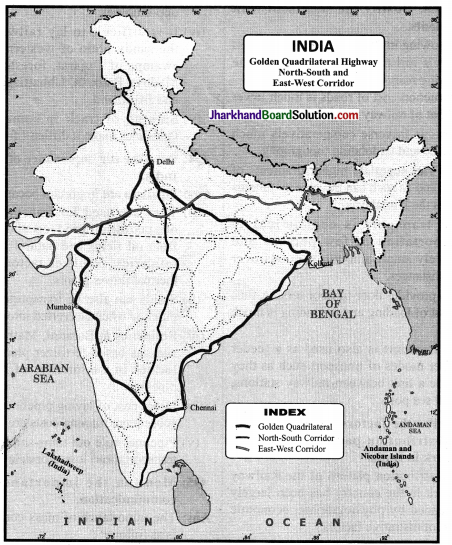
JAC Class 10 Social Science Important Questions Geography Chapter 7 Lifelines of National Economy 1

Question 2.
Locate and label the following on an outlined map of India.
(i) Major Ports – Kandla, Mumbai, Marmagao, New Mangalore, Kochi, Tuticorin, Chennai, Vishakhapatnam, Paradip, Kolkata (Haldia).
Answer:
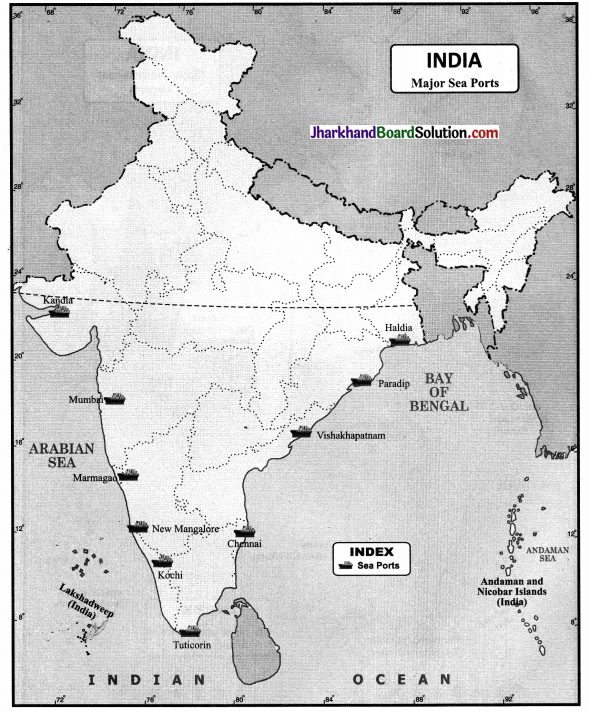
JAC Class 10 Social Science Important Questions Geography Chapter 7 Lifelines of National Economy 2
(ii) International Airports – Amritsar, Delhi, Mumbai, Thiruvananthapuram, Chennai, Kolkata, Hyderabad.
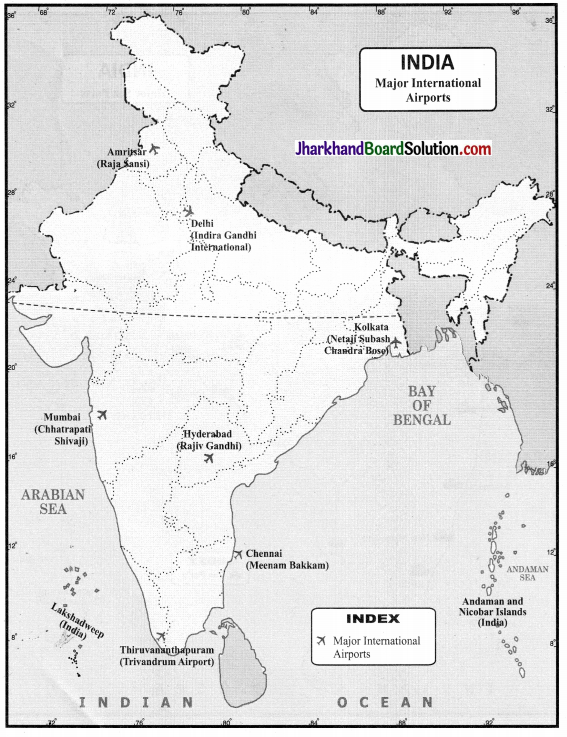
JAC Class 10 Social Science Important Questions Geography Chapter 7 Lifelines of National Economy 3

JAC Class 10 Social Science Important Questions

JAC Class 10 Social Science Solutions Geography Chapter 7 Lifelines of National Economy

JAC Board Class 10th Social Science Solutions Geography Chapter 7 Lifelines of National Economy

JAC Class 10th Geography Lifelines of National Economy InText Questions and Answers

Page 80

Question 1.
Find out places linked by the National Highway 2 and 3.
Answer:
National Highway 2 – Delhi to Kolkata National Highway 3 – Agra to Mumbai

Page 82

NCERT ‘Activity’

Question 2.
Find out the current Railway zones and their headquarters. Also locate the headquarters of Railway zones on the map of India.
Answer:

Zonal RailwaysHeadquarters
1. Central RailwayMumbai
2. Eastern RailwayKolkata
3. Northern RailwayNew Delhi
4. North-Eastern RailwayGorakhpur
5. North-East Frontier RailwayMaligaon
6. Southern RailwayChennai
7. Southern-Central RailwaySecunderabad
8. South-Eastern RailwayKolkata
9. Western RailwayMumbai
10. East-Central RailwayHeadquarters
11. East Coast RailwayHazipur
12. North-Central RailwayBhubaneshwar
13. North-Western RailwayPrayagraj
14. South-East Central RailwayJaipur
15. South-Western RailwayBilaspur

Follow the given table and locate the points on the map.

Question 3.
Railway line has been extended from Banihal to Baramula in the Kashmir valley. Locate these two towns on the map of India.
Answer:
Do it yourself

Page 86

Question 4.
Why is air travel preferred in the north-eastern states?
Answer:
Air travel is preferred in the north-eastern states because it is difficult to construct roads or railways on the uneven terrain in the north-eastern states. It can easily cover difficult terrain, big and wide rivers (e.g., Brahmaputra), dissected relief (many river valleys between places), dense forests, frequent flooding and also some international frontiers (Bangladesh), etc.

JAC Class 10 Social Science Solutions Geography Chapter 7 Lifelines of National Economy

Question 5.
Find out the names of the countries connected by Air India.
Answer:
The countries connected by Air India are: France, Canada, Germany, Israel, Japan, UK, Bangladesh, UAE, Kenya, USA, Australia, Italy, etc.

Page 89

Question 6.
On the map of India show important tourist places of your State/UT and its connectivity with other parts of the country by ailways/roadways/airways.
Answer:
Do it yourself.

JAC Class 10th Geography Lifelines of National Economy Textbook Questions and Answers

Question 1.
Choose the right answer from the four alternatives given below.
(i) Which two of the following extreme locations are connected by the east-west corridor?
(a) Mumbai and Nagpur
(b) Silchar and Porbandar
(c) Mumbai and Kolkata
(d) Nagpur and Siligudi
Answer:
(b) Silchar and Porbandar

JAC Class 10 Social Science Solutions Geography Chapter 7 Lifelines of National Economy

(ii) Which mode of transportation reduces trans-shipment losses and delays?
(a) Railways
(b) Roadways
(c) Pipeline
(d) Waterways
Answer:
(c) Pipeline

(iii) Which one of the following states is not connected with the H.V.J. pipeline?
(a) Madhya Pradesh
(b) Maharashtra
(c) Gujarat
(d) Uttar Pradesh
Answer:
(b) Maharashtra

(iv) Which one of the following ports is the deepest land-locked and well protected port along the east coast?
(a) Chennai
(b) Paradip
(c) Tuticorin
(d) Vishakhapatnam
Answer:
(d) Vishakhapatnam

JAC Class 10 Social Science Solutions Geography Chapter 7 Lifelines of National Economy

(v) Which one of the following is the most important modes of transportation in Indian
(a) Pipeline
(b) Railways
(c) Roadways
(d) Airways
Answer:
(c) Roadways

(vi) Which one of the following terms is used to describe trade between two or more countries?
(b) International trade
(c) External trade
(d) Local trade
Answer:
(b) International trade

Question 2.
Answer the following questions in about 30 words.
(a) State any three merits of roadways.
(b) Where and why is rail transport the most convenient means of transportation?
(c) What is the significance of the border roads?
(d) What is meant by trade? What is the difference between international and local trade?
Answer:
(a) Three merits of roadways are:

  1. Construction cost of roads is much lower than that of railway lines.
  2. Roads can traverse comparatively much dissected and undulating topography.
  3. Roads can negotiate higher gradients of slopes and as such can traverse mountains such as the Himalayas.

(b) The northern plains with their vast level land, high population density and rich agricultural resources provide the most favourable condition for the growth of rail transportation.

(c) Border Roads Organisation, a Government of India undertaking constructs and maintains roads in the bordering areas of the country. This organisation was established in 1960 for the development of the roads of strategic importance in the northern and north-eastern border areas. These roads have improved accessibility in areas of difficult terrain and have helped in the economic development of these areas.

(d) Trade is the movement of goods and services between regions of economic gain. Trade between two or more countries is termed as International trade, It takes . place through sea, air or land routes. While trade occurring in a region within the same country is called local trade. It takes place in the local markets.

Question 3.
Answer the following questions in about 120 words.
(a) Why are the means of transportation and communication called the lifelines of a nation and its economy?
(b) Write a note on the changing nature of the international trade in the last fifteen years.
Answer:
(a) The means of transportation and commurfication are called the lifelines of a nation and its economy because these are prerequisite for the economic development of the country. Transportation connects one part of the country to the other part. This helps in movement of goods and people from one region to the other.

JAC Class 10 Social Science Solutions Geography Chapter 7 Lifelines of National Economy

Industries cannot manufacture goods if the raw materials and finished goods are not transported from one place to the other. Agriculture also depends on transportation as the grains are needed to be transported to the market places. Development of various means of communication has been one of the major factors Miich have facilitated the process of globalisation. Telecommunication systems and the internet have helped in the -development of trade and business activities.

(b) Trade between two countries is called international trade. It may take place through sea, air or land routes. Advancement of international trade of a country is an index to its economic prosperity. It is, therefore, considered the economic barometer for a country. India has trade relations with most of the countries in the world. Her share of international trade has been on an increase in the last few years.

(i) India mainly exported agricultural and allied products gems and jewellery, chemicals and related products.
(ii) Petroleum and petroleum products, gems and jewellery chemicals related products, base metals, electronic items and machinery are some important items of import. India has emerged as a software giant at an international level. It has been earning foreign exchange through the export of information and technology.

NCERT ‘Quiz Drive’

  1. Northern terminal of the North-south corridor.
  2. The name of National Highway No. 2.
  3. The headquarter of the southern railway zone.
  4. The rail gauge with a track width of 1.676 m.
  5. The southern terminal of the National Highway No. 7.
  6. A Riverine Port.
  7. Busiest railway junction in Northern India.

Answer:

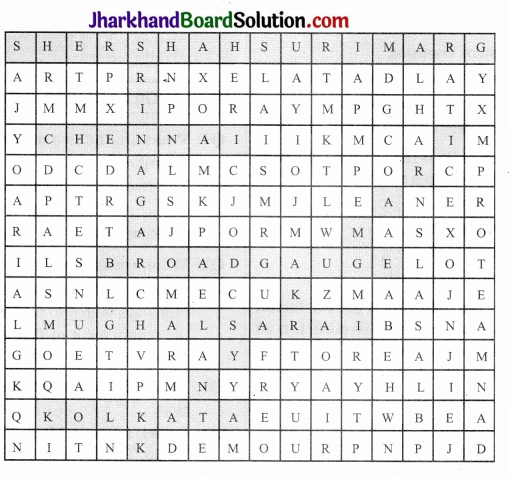
  1. Srinagar
  2. Sher Shah Suri Marg
  3. Chennai
  4. Broad Gauge
  5. Kanyakumari
  6. Kolkata Port Trust
  7. Mughalsarai

NCERT ‘Activity’

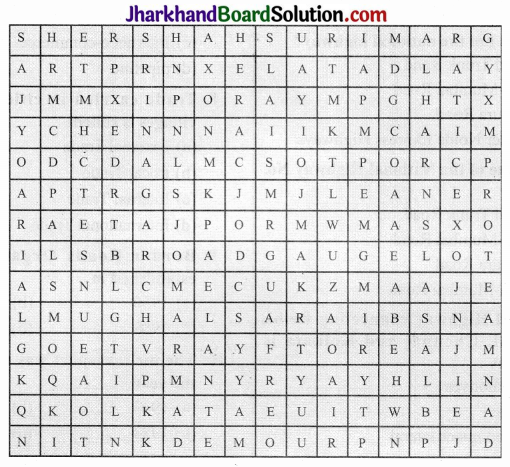
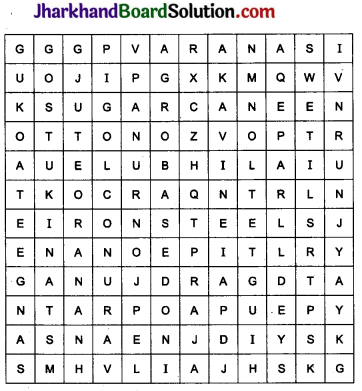
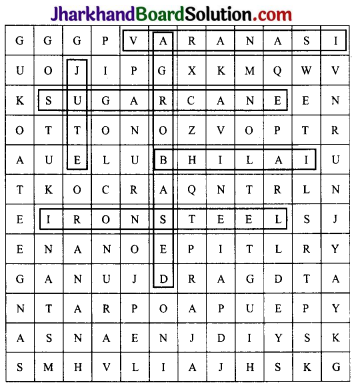
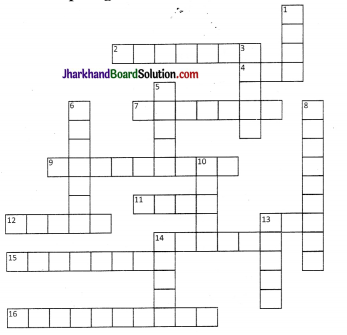
Start your search vertically, horizontally or diagonally and reach various destinations across the country!
JAC Class 10 Social Science Solutions Geography Chapter 7 Lifelines of National Economy 1
Answer:
JAC Class 10 Social Science Solutions Geography Chapter 7 Lifelines of National Economy 2

JAC Class 10 Social Science Solutions

JAC Class 10 Social Science Important Questions Civics Chapter 5 Popular Struggles and Movements

JAC Board Class 10th Social Science Important Questions Civics Chapter 5 Popular Struggles and Movements

Multiple Choice Questions

Question 1.
When was the King Birendra killed in a mysterious massacre of the royal family?
(a) 2000
(b) 2001
(c) 2002
(d) 2003
Answer:
(b) 2001

Question 2.
When did King Gyanendra dismiss the then prime minister and dissolve the Parliament?
(a) In February 2005
(b) In February 2006
(c) In March 2006
(d) In April 2006
Answer:
(a) In February 2005

JAC Class 10 Social Science Important Questions Civics Chapter 5 Popular Struggles and Movements

Question 3.
Against whom the people of Bolivia led a successful struggle?
(a) Limited franchise
(b) Government’s apathy towards public facilities
(c) Privatisation of water
(d) Lack of educational facilities
Answer:
(c) Privatisation of water

Question 4.
Which financial agency/organisation pressurised the government to give up its control of municipal water supply?
(a) International Monetary Fund
(b) World Bank
(c) Central Bank of Bolivia
(d) None of these
Answer:
(b) World Bank

Question 5.
What is not true regarding public interest groups?
(a) hey represent some common or general interest
(b) Members of the organisation may not benefit from the cause that the organisation represents
(c) They promote collective rather than selective good
(d) They aim to help their own members
Answer:
(d) They aim to help their own members

Question 6.
Who won Bolivia’s water war?
(a) People
(b) Government
(c) MNC
(d) None of these
Answer:
(a) People

Question 7.
Most of the time democracy evolves through what?
(a) Consensus
(b) Popular struggles
(c) Both the above
(d) None of the above
Answer:
(b) Popular struggles

Question 8.
Which one of the following is not true about the pressure groups?
(a) They are directly engaged in party politics
(b) They take a political stance
(c) They organise protests
(d) They try to gain public support
Answer:
(d) They try to gain public support

Question 9.
Through what outstanding democratic conflicts are usually resolved?
(a) Mass mobilisation
(b) Institutions like the Parliament or the Judiciary
(c) Both the above
(d) None of the above
Answer:
(c) Both the above

JAC Class 10 Social Science Important Questions Civics Chapter 5 Popular Struggles and Movements

Question 10.
Which of these is one of the agencies of organised politics?
(a) Political parties
(b) Pressure groups
(c) Movement groups
(d) All of the above
Answer:
(d) All of the above

Very Short Answer Type Questions

Question 1.
When was the movement for democracy in Nepal conducted? What was its aim?
Answer:
The movement for democracy in Nepal was conducted in April 2006. Its aim was to restore democracy.

Question 2.
What was SPA in Nepal?
Answer:
SPA was Seven Party Alliance of all the major political parties in the parliament of Nepal.

Question 3.
What was the outcome of the struggle of people in Bolivia?
Answer:
The contract with the MNC was cancelled and water supply was restored to the municipality at old rates.

Question 4.
What are pressure groups?
Answer:
Pressure groups are organizations that attempt to influence government policies.

Question 5.
How are most of the trade unions and students’ union are established or afflicted in India?
Answer:
Most of the unions and students’ organization in India are either established or afflicted to one or other political party e.g. ABVP (BJP), NSUI (Congress).

Question 6.
Some parties grow out movements. Give one example.
Answer:
When the Assam movement led by students against the ‘foreigners’ came to an end, it led to the information of the Asom Gana Parishad.

JAC Class 10 Social Science Important Questions Civics Chapter 5 Popular Struggles and Movements

Question 7.
Which organization led the protest against water privatisation in Bolivia?
Answer:
FEDECOR led the protest against water privatisation in Bolivia.

Question 8.
Name any two sectional interest groups.
Answer:
Two sectional interest groups of India are Hind Mazdoor Sabha and Bengal Jute Mill Workers’ Union.

JAC Class 10 Social Science Important Questions Civics Chapter 5 Popular Struggles and Movements

Question 9.
Who were Maoists?
Answer:
Those communists who believed in the ideology of Mao, the great leader of the Chinese Revolution were called Maoists.

Question 10.
Give one difference between Nepal and Bolivia movements.
Answer:
The movement in Nepal was to establish democracy, while the struggle in Bolivia involved claims on an elected, democratic government.

JAC Class 10 Social Science Important Questions

JAC Class 10 Social Science Solutions Civics Chapter 5 Popular Struggles and Movements

JAC Board Class 10th Social Science Solutions Civics Chapter 5 Popular Struggles and Movements

JAC Class 10th Civics Popular Struggles and Movements Textbook Questions and Answers

Question 1.
In what ways do pressure groups and movements exert influence on politics?
Answer:
Pressure groups and movements exert influence on politics in a variety of ways:

  1. They try to gain public support and sympathy for their goals and their activity by carrying out information campaigns, organizing meetings, file petition, etc.
  2. They often organize protest activity like strikes or disrupting government programs.
  3. Business groups often employ professional lobbyists or sponsors expensive advertisements.
  4. In some instances, the pressure groups are either formed or led by the leaders of political parties or act as extended arms of political parties.
  5. Sometimes political parties grow out of movements.
  6.  In most cases, the relationship between parties and interest or movement groups is not so direct.

Question 2.
Describe the forms of relationship between pressure groups and political parties?
Answer:
The relationship between political parties and pressure groups can take different forms. Pressure groups are often formed and led by politicians and political parties. Most trade unions and students organisations in India are either established by or affiliated to one or the other major political party. Political parties sometimes grow out of movements. Parties like DMK and AIADMK were formed this way. Many a times the issues raised by pressure or movement groups are taken up by political parties leading to a change in the policies of the parties.

JAC Class 10 Social Science Solutions Civics Chapter 5 Popular Struggles and Movements

Question 3.
Explain how the activities of pressure groups are useful in the functioning of a democratic government.
Answer:

  1. It may initially appear that it is not healthy for groups that promote the interest of one section to have influence in democracy.
  2. It may seem that these groups wield power without responsibility!
  3. Pressure groups and movements may not get their funds and support from the people.
  4. Putting pressure on the rulers is not unhealthy activity in a democracy as long as everyone gets this opportunity.
  5. Public interest groups and movements perform a useful role in countering this useful role or countering this undue influence and reminding the government of the needs and concerns of ordinary citizens.

Question 4.
What is a pressure group? Give a few examples.
Answer:
A pressure group is an organisation which attempts to influence government policies through protests and demonstrations. Pressure groups are formed when people with similar opinions get together for similar objectives. Examples of pressure groups are FEDECOR and BAMCEF.

Question 5.
What is the difference between a pressure group and a political party?
Answer:

Pressure GroupPolitical Party
(i) They attempt to influence gavernment policies.(i) They aim to directly control or share power.
(ii) People with common interest come together to achieve a common objective.(ii) It is directly answerable to the people.

Question 6.
Organisations that undertake activities to promote the interests of specific social sections such as workers, employees, teachers, and lawyers are called ……….. groups.
Answer:
Sectional Interest

Question 7.
Which among the following is the special feature that distinguishes a pressure group from a political party?
(a) Parties take political stances, while pressure groups do not bother about political issues.
(b) Pressure groups are confined to a few people, while parties involve larger number of people.
(c) Pressure groups do not seek to get into power, while political parties do.
(d) Pressure groups do not seek to mobilise people, while parties do.
Answer:
(c) Pressure groups do not seek to get into power, while political parties do.

Question 8.
Match List I (organisations and struggles) with List II and select the correct answer using the codes given below the lists:

List IList II
1. Organisations that seek to promote the interests of a particular section or groupA. Movement
2. Organisations that seek to promote common interestB. Political parties
3. Struggles launched for the resolution of a social problem with or without an organisational structureC. Sectional interest groups
4. Organisations that mobilise people with a view to win political powerD. Public interest groups
1234
(a)CDBA
(b)CDAB
(c)DCBA
(d)BCDA

Answer:
(b) C,D,A and B

Question 9.
Match List I with List II and select the correct answer using the codes given below the lists:

List IList II
1. Pressure groupA. Narmada Bachao Andolan
2. Long-term movementB. Asom Gana Parishad
3. Single issue movementC. Women’s movement
4. Political partyD. Fertilizer dealers’ association
1234
(a)DCAB
(b)BADC
(c)CDAB
(d)BDCA

Answer:
(a) D,C,A and B

Question 10.
Consider the following statements about pressure groups and parties.
A. Pressure groups are the organised expression of the interests and views of specific social sections.
B. Pressure groups take positions on political issues.
C. All pressure groups are political parties.
Which of the statements given above are correct?
(a) A, B, and C
(b) A and B
(c) B and C
(d) A and C
Answer:
(b) A and B

JAC Class 10 Social Science Solutions Civics Chapter 5 Popular Struggles and Movements

Question 11.
Mewat is one of the most backward areas in Haryana. It used to be a part of two districts, Gurgaon and Faridabad. The people of Mewat felt that the area will get better attention if it were to become a separate district. But political parties were indifferent to this sentiment. The demand for a separate district was rais’ed by Mewat Educational and Social Organisation and Mewat Saksharta Samiti in 1996. Later, Mewat Vikas Sabha was founded in 2000 and carried out a series of public awareness campaigns. This forced both the major parties, Congress and the Indian National Lok Dal, to announce their support for the new district before the assembly elections held in February 2005. The new district came into existence in July 2005. In this example what is the relationship that you observe among movement, political parties and the government? Can you think of an example that shows a relationship different from this one?
Answer:
From the example of Mewat, we can infer that movements take up issues which have been ignored by political parties. Political parties may then be influenced by these demands when they grab their own manifesto. Finally, the party which comes to power ends up implementing steps which fulfil these demands.

The six – year long Assam movement (19791985), led by the All Assam Students Union (AASU), was aimed against the infiltration of foreigners from Bangladesh into Assam. At the end of this movement, the state assembly was dissolved, the government was dismissed, and fresh elections were held. The Asom Gana Parishad, formed out of the AASU, contested and won the elections, forming the Government of Assam. In this example, we see a political party being formed out of a pressure group, which then goes on to form the government.

JAC Class 10 Social Science Solutions

JAC Class 10 Social Science Important Questions Civics Chapter 2 Federalism

JAC Board Class 10th Social Science Important Questions Civics Chapter 2 Federalism

Multiple Choice Questions

Question 1.
Which form of power sharing is most commonly referred to as federalism?
(a) Horizontal division of power
(b) Vertical division of power
(c) Division of power among various comnjunities
(d) Sharing of power among political parties
Answer:
(b) Vertical division of power

Question 2.
Which period saw the rise of regional political’parties in many States of the country?
(a) Period after 1990
(b) Period after 2000
(c) Period after 1980
(d) Period after 1970
Answer:
(a) Period after 1990

JAC Class 10 Social Science Important Questions Civics Chapter 2 Federalism

Question 3.
Which are the basic objectives of a federal system?
(a) To safeguard and promote unity of the country
(b) To accommodate regional diversity
(c) To share powers among different communities
(d) Both (a) and (b)
Answer:
(d) Both (a) and (b)

Question 4.
What are the kinds of routes through which federations have been formed?
(a) One route involves independent States coming together on their own to form a bigger unit.
(b) The second route is where a large country decides to divide its powers between the States and the national government.
(c) Both (a) and (b)
(d) None of these
Answer:
(c) Both (a) and (b)

Question 5.
In which Schedule of the Indian Constitution are the 22 scheduled languages included?
(a) Tenth schedule
(b) Eighth schedule
(c) Twelfth schedule
(d) Ninth schedule
Answer:
(b) Eighth schedule

Question 6.
Which of the following is incorrect regarding a unitary government?
(a) There is either only one level of government or the sub-units are subordinate to the Central government.
(b) The Central government can pass on orders to the provincial government.
(c) A State government is conservable to Central government.
(d) The powers of State governments are guaranteed by the Constitution.
Answer:
(d) The powers of State governments are guaranteed by the Constitution.

Question 7.
Which body conducts the elections to panchayats and municipalities?
(a) Election Commission
(b) State Election Commission
(c) State High Court
(d) Parliament
Answer:
(b) State Election Commission

JAC Class 10 Social Science Important Questions Civics Chapter 2 Federalism

Question 8.
What is true regarding sources of revenue in a federal system?
(a) States have no financial powers or independent sources of revenue.
(b) States are dependent on revenue or funds on the Central government.
(c) Sources of revenue for each level of government are clearly specified to ensure its financial autonomy.
(d) States have no financial autonomy.
Answer:
(c) Sources of revenue for each level of government are clearly specified to ensure its financial autonomy.

Question 9.
When was the use of English for official purposes stopped?
(a) 1956
(b) 1958
(c) 1960
(d) 1965
Answer:
(d) 1965

Question 10.
What is the third tier of government known as?
(a) Village Panchayats
(b) State Government
(c) Local Self-government
(d) Zila Parishad
Answer:
(c) Local Self – government

Very Short Answer Type Questions

Question 1.
Define federalism.
Answer:
Federalism is a system of government in which the power is divided between a central authority and various constituent units of the country.

Question 2.
How is a federal government organized?
Answer:
Power is divided between a central authority and various constituent units of the country.

Question 3.
What are the other factors besides politics that keep the federations united?
Answer:
Respect for diversity and desire for living together.

Question 4.
In which list of the Indian Constitution does a railway come? Why?
Answer:
It comes under Union List because it is a subject of national importance and requires a uniform policy throughout the country.

JAC Class 10 Social Science Important Questions Civics Chapter 2 Federalism

Question 5.
How much majority in the parliament is required to amend any part of the Indian Constitution?
Answer:
Any change to it has to be first passed by both the Houses of Parliament with at least a two-third majority.

Question 6.
What is meant by residuary subjects?
Answer:
The subjects which are not mentioned in Union, State and Concurrent Lists are called residuary subjects. The Union Government has the power to legislate on them.

Question 7.
Which level of government in India can make laws on the subjects included in the Concurrent List?
Answer:
Concurrent List includes subjects of common interest to both Union Government as well as the State Governments.

Question 8.
In a federalism, who resolves the disputes between different levels of the government?
Answer:
The highest court (e.g., Supreme Court in the case of India) acts as an umpire in case disputes arise between different levels of government.

Question 9.
Give an important feature of ‘holding together’ federation. Which are the countries where it exists?
Answer:
In this federation, the Central government tends to be more powerful vis-a-vis the States. ‘Holding together’ federations exist in India, Spain and Belgium.

JAC Class 10 Social Science Important Questions Civics Chapter 2 Federalism

Question 10.
What is a coalition government?
Answer:
Coalition government refers to a government formed by the coming together of at least two political parties. Usually, partners in a coalition form a political alliance and adopt a common programme.

Short Answer Type Questions

Question 1.
What makes India a Federal Country?
Answer:

  1. India is a nation with many languages, religions and regions. It emerged as an independent nation after a long and painful partition.
  2. Several princely states became a part of the country soon after independence. India was declared as a Union of States by the Constitution.
  3. The Indian Union is based on the principle of federalism.
  4. The Constitution earlier provided a two – tieir system of government the Union government (Central government) representing the Union of India and the State governments. Later Panchayats and Municipalities were added as a third tier of federalism.
  5. All these different forms of government enjoy separate jurisdiction.

Question 2.
When did Belgium shift from a unitary to a federal form of government? Why?
Answer:

  1. In 1993, Belgium shifted from a unitary to a federal form of government.
  2. It happened because the regional government were given constitutional powers and they were no longer dependent on the central government.

Question 3.
What do you mean by a unitary political system? Does Sri Lanka have a federal political system? What is the major demand of Tamil leaders in Sri Lanka?
Answer:

  1. In a unitary political system, the national government has all the powers in its hands.
  2. No Sri Lanka has a unitary political system.
  3. Tamil leaders want Sri Lanka to become a truly federal system.

Question 4.
How has the special status of Jammu and Kashmir changed?
Answer:

  1. The Jammu and Kashmir Reorganisation Bill, 2019 was passed by the Indian parliament in August 2019.
  2. The Bill proposed bifurcation of the state into two Union Territories – Jammu and Kashmir and Ladakh.
  3. The centre also revoked the special status of Jammu and Kashmir by withdrawing Article 370 of the Indian constitution.
  4. Jammu and Kashmir will have its legislative assembly, and Ladakh will be directly governed by the centre.

Question 5.
Write a brief note on the language policy adopted in India.
Answer:

  1. The ‘Language policy’ was the second test for Indian federation. No language was given the status of National language by our Constitution.
  2. Hindi was identified as the official language. But only about 40 per cent of Indians have Hindi as their mother tongue.
  3. 21 other languages besides Hindi, are recognised as Scheduled Languages by the Constitution.
  4. A candidate in an examination conducted for the Central Government positions may opt to take the examination in any of these languages.
  5. States too have their own official languages. Much of the government work takes place in the official language of the concerned State.
  6. The flexibility shown by Indian political leaders helped our country avoid any conflict based on languages.

Question 6.
Write a brief note on village councils.
Answer:

  1. Village councils looked after the affairs of the village, police and judicial powers and were the lines of contact with higher authorities on matters affecting the villages.
  2. Custom and religion elevated them to a sacred position of authority.
  3. These councils were the pivot of administration, the centre of social life, and, a focus of social solidarity.

Question 7.
What is a Gram Sabha? Describe any four functions of a Gram Sabha.
Answer:
Gram Sabha:
A body comprising all adult members of a village or a group of villages. Functions of Gram Sabha are as under:

  1. It elects the members of the Gram Panchayat.
  2. The Gram Sabha supervises the work of the village Panchayat.
  3. It apprqves the annual budget of the Panchayat.
  4. It reviews the performance of the Gram Panchayat.

Question 8.
Why is decentralization favoured in democracy? Identify any two reasons.
Answer:
(i) When power is taken away from Central and State governments and given to local government, it is called decentralization.

(ii) (1) The basic idea behind decentralization is that there are a large number of problems and issues which are best settled at the local level. People have better knowledge of problems in their localities.
(2) They also have better ideas on where to spend money and how to manage things more efficiently.
(3) Besides, at the local level it is possible for the people to directly participate in decision making. This helps to inculcate a habit of democratic participation.

Question 9.
Compare the federations of coming together type and holding together type.

Coming Together FederationHolding Together Federation
(i) Independent States come together on their own to form a bigger unit.(i) A large country decides to divide its power between the constituent units and the national government.
(ii) All constituent States usually have equal power and the States enjoy certain amount of autonomy.(ii) Central government tends to be more powerful.
(iii) The main aim of this federation is to pool their sovereignty and maintain their separate identity to increase their security.(iii) In this type of federation, there is an absence of pooling sovereignty and maintaining identity.
(iv) Some examples are U.S.A., Australia and Switzerland.(iv) Some examples are India, Belgium and Spain.

Question 10.
Indian Constitution has a unitary bias. Support the statement with one example.
Answer:
The power sharing arrangement between the Union and the State given in the Constitution of India clearly distributes power between the two In this sense it is federal. But the system becomes unitary when the residuary power rests with the union.

Long Answer Type Questions

Question 1.
What are the duties of Central and State governments?
Answer:

  1. The duties of the Union or Central government include subjects of national
    foreign affairs banking communications and currency.
  2. This is because a uniform policy on these . matters will be maintained throughout
    the country. All the laws pertaining to the above duties must be given only by the Union government.
  3. The duties of the State governments include subjects of the State and local importance such as police, trade, commerce, agriculture and irrigation. All the laws pertaining to the above duties must be given only by the State governments.
  4. Some aspects have to be taken care of, by both, the Union government as well as the State goyemments. These are education, forest, trade unions, marriage, adoption and succession. Both governments can make laws on these subjects.
  5. If their laws conflict with each other, the law made by the Union Government will prevail.

Question 2.
Explain the power sharing, among government at different levels.
Answer:
The powers of government have been divided into three lists:
1. Union List:
It contains 97 subjects like defense, foreign affairs, railways, post and telegraphs, foreign trade and currency and coinage, etc. The Union government alone can make laws on subjects mentioned in this list.

2. State List:
It includes 66 subjects like police and jails, agriculture, public health, local government, trade and commerce, liquor, etc. The State governments alone can make laws on subjects mentioned in this list.

3. Concurrent List:
It includes 47 subjects like education, forests and trade union, marriage and divorce, etc. Both Union government as well as State governments can make laws on subjects mentioned in this list. In case of conflict, the law made by the Union government will prevail.

4. Residuary subjects:
Powers lie with the Centre. In such cases, only Parliament has the power to make laws on these subjects like computer software.

Question 3.
Critically analyze the Centre – State relations prior to 1990 and after.

  1. Prior to 1990, except for once, the Congress ruled at the Centre for about 40 years. These were the years when the single party made the government.
  2. The government at the Centre ruled the States with biased views. It supported those States which had a government formed by the same party.
  3. The rise of regional politics in many States has changed the Centre-State relations significantly after 1990. This was also the beginning of the era of coalition governments at the Centre.
  4. Since, no single party got a clear majority in the Lok Sabha, major national parties had to enter into an alliance with many small regional parties. Hence, regional parties do take care of their States.
  5. This led to a new culture of power sharing and respect for the autonomy of State government. It became difficult for the Central government to dismiss State governments in an arbitrary manner.

Question 4.
‘India has a large cultural, regional and religious diversity, but there is unity among people.’ What factors are responsible for this? Elaborate.
Answer:
The real success of federalism in India can be attributed to the nature of democratic politics in our country. This ensured that the spirit of federalism, respect for diversity and desire for living together became shared ideals in our country.

(i) The spirit of federalism:
The Constitution clearly provided a three-fold distribution of legislative powers between the Union government and the State governments.

(ii) Respect for diversity:
The creation of Linguistic States was the first and a major test for democratic politics in our country. This was done to ensure that people who spoke the same language lived in the same State. Some States were created not on the basis of language but to recognize
differences based on culture, ethnicity or geography.

(iii) Desire for living together:
Country decides to divide its power between the constituent States and the national government. The Constitution declared India as a Union of States, although, it did not use the word federation. In India, we have ‘holding together’ federation. In this second category, the Central Government tends to be more powerful vis-a-vis the State to keep the country united which has large cultural, regional and religious diversities.

(iv) Absence of national language:
Our Constitution did not give the status of national language to any one language. Hindi was identified as the official language. Besides Hindi, there are 21 other languages recognized as Scheduled Languages by the Constitution as safeguard to protect other languages. Much of the government work takes place in the official language of the concerned State.

(v) Independent Judiciary:
The judiciary plays an important role in overseeing the implementation of constitutional provisions and procedures.

JAC Class 10 Social Science Important Questions Civics Chapter 2 Federalism

Question 5.
In Panchayati Raj system l/3rd of the seats have been reserved for women. Do you feel that the same should be done for State Legislatures and Parliament? Support your answer with arguments.
Answer:
1. In favour:
(i) Many feminists and women’s movement feel that unless women control power their problems will not get adequate attention. This can be ensured with more women as elected representatives.

(ii) This problem can be solved legally binding to have a fair proportion of women in the elected bodies. This is what the Panchayati Raj has done in India. One – third of seats in local government bodies in panchayats and municipalities are now reserved for women.

(iii) Women’s organizations and activists have been demanding a similar reservation of at least one-third of seats in the Lok Sabha and State Assemblies for women. A reservation bill with this proposal has been pending before the Parliament for more than a decade.

(iv) Aims at eliminating gender inequality and discrimination against women through political empowerment of women.

2. In against:
(i) Question uota is not an answer to women’s problems and quota results in discrimination on the basis of gender  violation of the democratic right of people to choose their representatives.

(ii) The reservation will only help elite women who are proxy of powerful men; women candidates may not get party ticket to contest from unreserved constituencies etc. Therefore, there is no need for reservations for women in the Legislatures.

(iii) Political parties should be made responsible to ensure distribution of tickets to various social and economic strata of society  especially marginalized and disadvantaged groups, get adequate representation.

Question 6.
Explain the working of Local Self Government in India in rural areas?
OR
Briefly explain the levels of rural local government in India.
OR
How has Panchayat Raj system been organized?
Answer:
Rural local government is known as Panchayati Raj
(i) Village Level:

  1. Each village or a group of villagers in some states has a gram panchayat. This is a council consisting of several ward members, called panch and a president or sarpanch.
    They are directly elected by all the adult population living in that ward or village
  2. The Panchayat works under the overall supervision of the gram sabha. All the voters in the village are its members:
    • It is the decision – making body for the entire village.
    • It has to meet at least twice or thrice in a year to approve the annual budget of the gram panchayat.
    • to review the performance of the gram panchayat.

(ii) Block Level

  1. A few gram panchayats are grouped togejher into panchayat samiti or block or mandal.
  2. All the panchayat members in that area elect the members of this representative body.

(iii) District Level

  1. All the panchayat samitis or mandals in a district together constitute the Zilla (district) parishad.
  2. Most members of the Zilla parishad are elected.
  3. Members of the Lok Sabha, MLA’s of that district and other officials of other district level bodies are also its members.
  4. Zilla parishad chairperson is the political head of the Zilla parishad.

Question 7.
What is gram sabha?
Answer:

  1. It is the village parliament (legislature). The panchayat under the supervision of the gram sabha.
  2. All the voters in the village are its members.
  3. It has to meet at least twice or thrice a year to approve the annual budget of the gram panchayat and to review the performance of the gram panchayat.

Question 8.
Explain the working of Local Self Government in India in rural areas?
OR
How are local bodies organized in urban areas?
Answer:
Local government bodies for urban areas:

  1. Municipalities are set up towns
  2. Big cities are constituted into Municipal Corporation.
  3. Elected bodies consisting of people’s representatives control both municipalities and municipal corporations.
  4. Municipal chairperson is the political head of the Municipality.
  5. In a municipal corporation such an officer is called the mayor.

Activity Based Questions

Question 1.
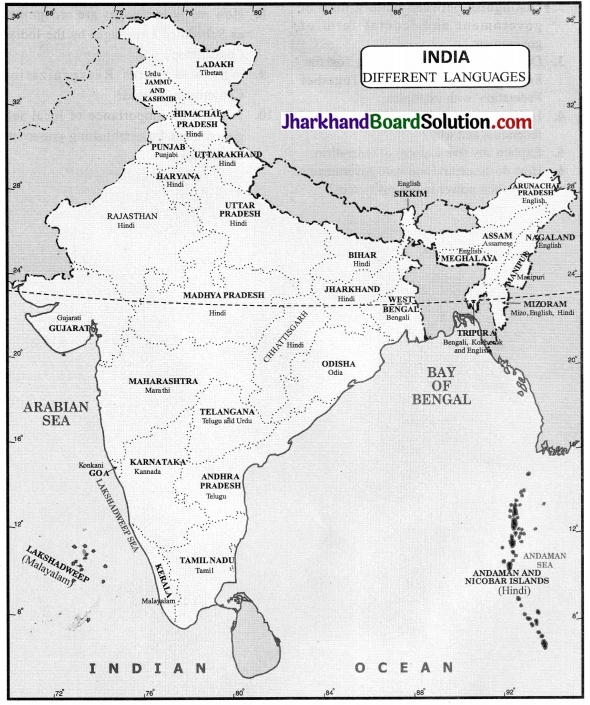
Prepare a linguistic map of India.
JAC Class 10 Social Science Important Questions Civics Chapter 2 Federalism 1

JAC Class 10 Social Science Important Questions

JAC Class 10 Social Science Solutions Civics Chapter 2 Federalism

JAC Board Class 10th Social Science Solutions Civics Chapter 2 Federalism

JAC Class 10th Civics Federalism InText Questions and Answers

Page 14

Question 1.
I am confused. What do we call the Indian government? Is it Union, Federal or Central?
Answer:
India is made up of States by ‘holding together,’ so, without any confusion we should call it a federal State and the government at the centre is called the Central government.

Page 15

Question 2.
If federalism works only in big countries, why did Belgium adopt it?
Answer:
Belgium adopted federalism because even though it is a small country, it has diverse population with multilingual groups. .These linguistic groups have their owp intersects which might lead to social conflict. Therefore, it was thought that, possible social conflict and political instability could be avoided by the federal system pf power sharing.

Page 16

Question 3.
Some Nepalese citizens were discussing the proposals on the adoption of federalism in their new Constitution. This is what some of them said:
Khag Raj:
I don’t like federalism. It would lead to reservation of seats for different caste groups as in India.
Sarita: Ours is not a very big country. We don’t needfederalism.
Babu Lai:
I am hopeful that Terai areas will get more autonomy if they get their own state government.
Ram Ganesh:
I like federalism because it will mean that powers that were earlier enjoyed by the king will now be exercised by our elected representatives. If you were participating in this conversation what would be your response to each of these? Which of these reflect a wrong understanding of what federalism is? What makes India a federal country?
Answer:
(i) Response to Khag Raj:
No, It is not true. Different caste groups are given their rights, which they have been kept deprived of for years. Federalism truly serves the purpose when it believes in mutual trust. This is the spirit of democracy.

1.Response to Sarita:
No Sarita, Nepal is also a diverse country consisting of group of people having different interests. For example, Belgium was a small country, but had social conflict. This could only be resolved by making a federation. So a federal system is required that takes care of its people equally.

2. Response to Babu Lai:
No, I do not agree as do not think only about the Terai area. There are other areas as well which need more autonomy. We should contribute to the development of the nation equally.

3. Response to Ram Ganesh:
Yes I agree. When power is concentrated in one hand, it harms the will of the common people. In a democracy, people rule themselves through institution of self-governance. The decentralization of power will ensure due respect to diverse groups and views that exist in the society, and everyone will have a voice in the shaping of public policy.

(ii) Of these Khag Raj and Sarita have a wrong understanding of what federalism is.

(iii) In India there are three levels of government The Central, State and local governments. They have their own jurisdictions. There is a Constitution which declares their powers and duties. There is an apex court under an independent judiciary which can resolve disputes among them. All the State  governments have their own sources of income. Income is also shared with the Central government. All these features make India a federal country.

JAC Class 10 Social Science Solutions Civics Chapter 2 Federalism

Question 4.
Isn’t that strange? Did our Constitution makers not know about federalism? Or did they wish to avoid talking about it?
Answer:
It is not strange. Our Constitution makers were aware of the concept of federalism. But, intentionally, they did not talk about it. This was because our democracy was passing through a ascent stage where they had to take steps to consolidate different free princely States.

If they had been given more autonomy, we might have faced many divisions of our country. They supposed that with maturity of democracy, proper changes would be brought in the Constitution to make the nation more federal. So they left this issue to the people and future leaders to decide about.

Page 17

Question 5.
If agriculture and commerce are state subjects, why do we have ministers of agriculture and commerce in the Union cabinet?
Answer:
This is because the States have to deal with each other in commerce and agricultural commodities. There are chances when a State will act arbitrarily. In that condition problems will arise regarding price control, tax, etc. The country has to deal with other nations in these subjects. So, a separate ministry for agriculture and commerce is necessary in the Union Cabinet.

Page 18

Question 6.
Pokharan, the place where India conducted its nuclear tests, lies in Rajasthan. Suppose the Government of Rajasthan was opposed to the Central Government’s nuclear policy could it prevent the Government of India from conducting the nuclear tests?
Answer:
No the government of Rajasthan could not prevent the government of India from conducting the nuclear tests.

Question 7.
Suppose the Government of Sikkim plans to introduce new textbooks in its schools. But the Union Government does not like the style and content of the new textbooks. In that case, does the state government need to take permission from the Union Government before these textbooks can be launched?
Answer:
Yes in this case the government of Sikkim will take permission from the Union government because education is a subject of Concurrent list on which both State and Union governments can make laws and in case of any conflict of law, only the Union law prevails.

JAC Class 10 Social Science Solutions Civics Chapter 2 Federalism

Question 8.
Suppose the Chief Ministers of Andhra Pradesh, Chhattisgarh and Odisha have different policies on how their state police should respond to the naxalites. Can the Prime Minister of India intervene and pass an order that all the Chief Ministers will have to obey?
Answer:
No, police is a State subject on which only the States can make laws.

Page 20

Question 9.
Why Hindi? Why not Bangla or Telugu?
Answer:
The government of India, in its Constitution declares Hindi and English as our official languages. But, being a federal government it cannot impose its will on the people who speak a language other than Hindi. Hindi is the official language but only 40% of its population speaks Hindi. This is the flexibility shown by the Union government that States have their own official languages. We respect the language and culture of each other. So, people are free to speak in the language of their choices. Each State has its official language.

Page 2

Question 10.
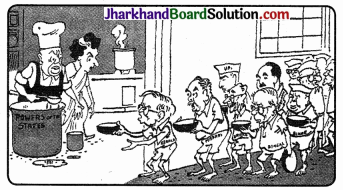
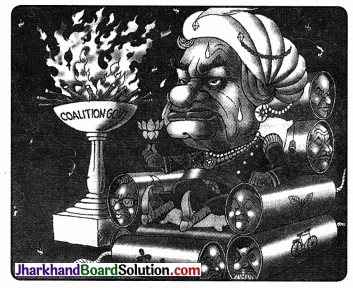
Here are two cartoons showing the relationship between Centre and States. Should the State go to the Centre with a begging bowl? How can the leader of a coalition keep the partners of government satisfied?
JAC Class 10 Social Science Solutions Civics Chapter 2 Federalism 1
The state plead for more powers
JAC Class 10 Social Science Solutions Civics Chapter 2 Federalism 2
Perils of Running a Coalition Government
Answer:
Yes, the state should go to the centre not with a begging bowl, not for more powers but for some privileges and financial preferences and security. The leader of a coalition keep the partners of government satisfied by giving some or other powers and privileges to every partner according to the proportions of their participation in the government.

Question 11.
Are you suggesting that regionalism is good for our democracy? Are you serious?
Answer:
In no way regionalism can be good for our democracy. In a country like ours, we have multicoloured cultures, languages and traditions, India’s glory lies in its diversity but it does not mean that one region or State is supported and the other is kept deprived. We grow and develop when each region grows and develops. We should develop with the spirit of mutual trust and living together. Hence, I am serious while saying that there is no place for regionalism in our democracy.

Page 25

Question 12.
Prime Minister runs the country. Chief Minister runs the state. Logically, then, the Chairperson of Zila Parishad should run the district. Why does the D.M. or Collector administer the district?
Answer:
The president of Zila Parishad is the political head. All the decisions are made under his leadership. In fact, the DM is the administrative head, who executes the decisions of the Parishad. This is, an example of sharing of power between legislative and executive. So, it is correct that the DM administers the district.

Question 13.
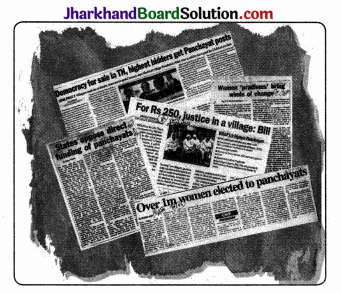
What do these newspaper clippings have to say about efforts of decentralisation in India?
JAC Class 10 Social Science Solutions Civics Chapter 2 Federalism 3
Answer:

  1. The first clipping of ‘Tamil Nadu’ (TN) shows the misuse of three-tier- system.
  2. The second clipping on mandatory rule of Nayaya Panchayat
  3. The third clipping regarding states oppose direct funding reflects to utilize the proper “channels of Decentralisation”.
  4. The fourth and fifth clipping shows the “Women Empowerment” at the grassroots level.

JAC Class 10th Civics Federalism Textbook Questions and Answers

Question 1.
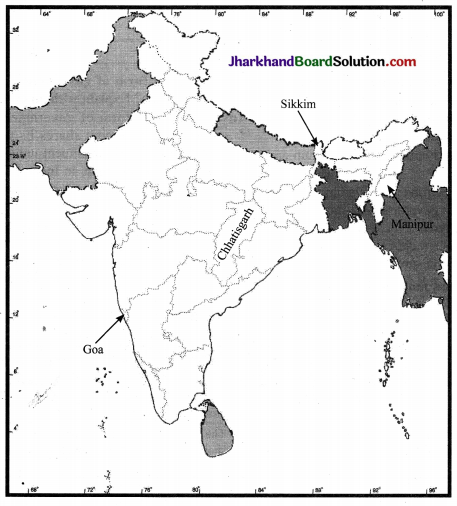
Locate the following States on a blank outline political map of India:
Manipur, Sikkim, Chhattisgarh and Goa.
Answer:
JAC Class 10 Social Science Solutions Civics Chapter 2 Federalism 4

Question 2.
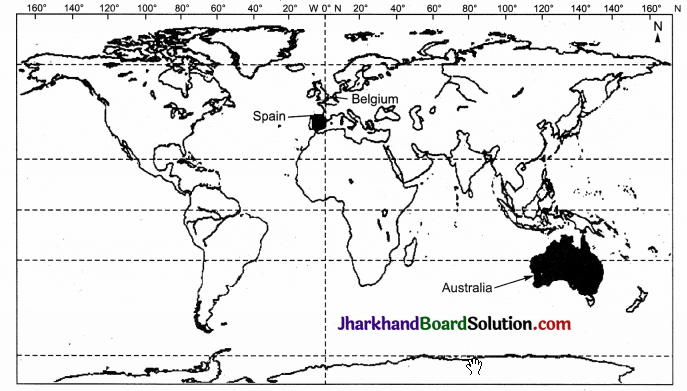
Identify and shade three federal countries (other than India) on a blank outline political map of the world.
Answer:
Federal countries other than India
JAC Class 10 Social Science Solutions Civics Chapter 2 Federalism 5

Question 3.
Point out one feature in the practice of federalism in India that is similar to and one feature that is different from that of Belgium.
Answer:

  1. Similar Feature: Both Belgium and India have a three-tier government.
  2. Different Feature: In Belgium there is a community government as the third tier, while we have a local self-government (not based on races/castes) in India as the third tier of the government.

Question 4.
What is the main difference between a federal form of government and a unitary one? Explain with an example.
Answer:
In a federal form of government, the Central government shares its powers with the various constituent units of the country. For example, in India, power is divided between the government at the Centre and the various State governments. In a unitary form of government, all the power is exercised by only one government. For example, in Sri Lanka, the National government has all powers.

JAC Class 10 Social Science Solutions Civics Chapter 2 Federalism

Question 5.
State any two differences between the local government before and after the Constitutional amendment in 1992.

Local government before the Constitutional amendment in 1992Local government after the Constitutional amendment in 1992
(i) Elections were not held regularly.(i) It is mandatory to hold regular elections to local government bodies.
(ii) Local governments did not have any power or resources of their own.(ii) The State governments are required to share some powers and revenue with local government bodies.

Question 6.
Fill in the blanks:
1. Since the United States is a………… type of federation.
Answer:
coming together

2. All the constituent States have equal powers and States are……… vis-a-vis the federal government.
Answer:
strong

3. But India is a……… type of federation and some States have more power than others.
Answer:
holding together

4. In India, the ….. government has more powers.
Answer:
Central

Question 7.
Here are three reactions to the language policy followed in India. Give an argument and an example to support any of these positions.
Sangeeta: The policy of accommodation has strengthened national unity.
Arman: Language – based States have divided us by making everyone conscious of their language.
Harish: This policy has only helped to consQuestion lidate the dominance of English over all other languages.
Answer:
The argument by Sangeeta is more appropriate. Language is not just a tool for communication but a part of the culture and mindset which takes hundreds of years to evolve. People are sentimentally attached to their language. The language policy of India is an attempt to instill a sense of respect of others culture and this has definitely helped in strengthening national unity.

Question 8.
The distinguishing feature of a federal government is:
(a) National government gives some powers to the provincial government.
(b) Power is distributed among the legislature executive and judiciary.
(c) Elected officials exercise supreme power in the government.
(d) Governmental power is divided between different levels of government.
Answer:
(d) Governmental power is divided between different levels of government.

Question 9.
A few subjects in various Lists of the Indian Constitution are given here. Group them under the Union, State and Concurrent Lists as provided in the table below.
A. Defence
B. Police
C. Agriculture
D. Education
E. Banking
F. Forests
G. Communications
H. Trade
I.  Marriages
Answer:

Union ListDefence, Banking, Communications
State ListPolice, Agriculture, Trade
Concurrent ListEducation, Forests, Marriage

Question 10.
Examine the following pairs that give the level of government in India and the powers of the government at that level to make laws on the subjects mentioned against each. Which of the following pairs is not correctly matched?

(a) State GovernmentState List
(b) Central GovernmentUnion List
(c) Central and State GovernmentsConcurrent List
(d) Local GovernmentsResiduary Powers

Answer:
(d) Local Governments –  Residuary Powers

Question 11.
Match List I with List II and select the correct answer using the codes given below the lists:

List-IList-II
1. Union of IndiaA. Prime Minister
2. StateB. Sarpanch
3. Municipal CorporationC. Governor
4. Gram PanchayatD. Mayor


1234
(a)DABC
(b)BCDA
(c)ACDB
(d)CDAB

Answer:
(c) A,C,D, and B

Question 12.
Consider the following two statements:
(A). In a federation the powers of the federal and provincial governments are clearly demarcated.
(B). India is a federation because the powers of the Union and State Governments are specified in the Constitution and they have exclusive jurisdiction on their respective subjects.
(C). Sri Lanka is a federation because the country is divided into provinces.
(D). India is no longer a federation because some powers of the States have been devolved to the local government bodies. Which of the statements given above are correct?
(a) A, B and C
(b) A, C and D
(c) A and B only
(d) B and C only
Answer:
(c) A and B only

JAC Class 10 Social Science Solutions

JAC Class 10 Social Science Important Questions Civics Chapter 4 Gender Religion and Caste

JAC Board Class 10th Social Science Important Questions Civics Chapter 4 Gender Religion and Caste

Multiple Choice Questions

Question 1.
What did Gandhiji mean when he said that religion and politics can never be separated?
(a) Effect of Hinduism on politics is more
(b) Effect of Islam on politics is more
(c) Need moral values in politics
(d) None of these
Answer:
(c) Need moral values in politics

JAC Class 10 Social Science Important Questions Civics Chapter 4 Gender Religion and Caste

Question 2.
In some places in India, by how much the child sex ratio has fallen to as low as?
(a) 927
(b) 840
(c) 820
(d) 800
Answer:
(d) 800

Question 3.
Which of these countries has no official state religion?
(a) Sri Lanka
(b) Pakistan
(c) England
(d) All of these
Answer:
(d) All of these

Question 4.
The percentage of elected women members in the Lok Sabha has never reached what per cent of its total strength?
(a) 25%
(b) 15%
(c) 10%
(d) 5%
Answer:
(c) 10%

Question 5.
Caste system in modern India has undergone with which great changes?
(a) Fundamental
(b) Socio – economic
(c) Cultural
(d) Professional
Answer:
(b) Socio – economic

Question 6.
What is leading to the breakdown of caste hierarchy?
(a) Large – scale urbanisation
(b) Growth of literacy and education
(c) Occupational mobility
(d) All of the above
Answer:
(d) All of the above

JAC Class 10 Social Science Important Questions Civics Chapter 4 Gender Religion and Caste

Question 7.
What is the exact ratio of scheduled castes and scheduled tribes in 2001?
(a) Scheduled castes constitute 17.8% and scheduled tribes 9.2%.
(b) Scheduled castes constitute 20.4% and scheduled tribes 8.2%.
(c) Scheduled castes constitute 15.6% and scheduled tribes 7.8%.
(d) Scheduled castes constitute 16.2% and scheduled tribes 8.2%.
Answer:
(d) Scheduled castes constitute 16.2% and scheduled tribes 8.2%.

Question 8.
Which of these is true about the most ugly form of communalism?
(a) Communal violence
(b) Riots
(c) Massacre
(d) All the above
Answer:
(d) All the above

Question 9.
What is meant by ‘Communal Politics’?
(a) Participation of different communities in politics
(b) When state power is used to establish domination of one religious group over the rest
(c) Communist type of government
(d) All of the above
Answer:
(b) When state power is used to establish domination of one religious group over the rest

Question 10.
Which of these matters deal with the ‘Family Laws’?
(a) Marriage and divorce
(b) Adoption
(c) Inheritance
(d) All of these
Answer:
(d) All of these

Very Shortanswer Type Questions

Question 1.
What is sexual division of labour?
Answer:
A system in which all work inside the home is either done by the women of the family, or organised by them through the domestic helpers.

Question 2.
What do you mean by Feminist?
Answer:
A woman or a man who believes in equal rights and opportunities for women and men is called feminist.

Question 3.
Define patriarchy.
Answer:
Patriarchy literally mean rule by father. This concept is used to refer to a system that values men more and gives them power oyer women.

JAC Class 10 Social Science Important Questions Civics Chapter 4 Gender Religion and Caste

Question 4.
What are family laws?
Answer:
Those laws that deal with family related matters such as marriage, divorce, adoption, inheritance, etc. In our country, different family laws apply to followers of different religions.

Question 5.
What is urbanisation?
Answer:
Urbanisation is the shift of population from rural areas to urban areas.

Question 6.
What is occupational mobility?
Answer:
Occupational mobility is the shift from one occupation to another, usually when a new generation takes up occupations other than those practised by their ancestors.

Question 7.
What do you mean by caste hierarchy?
Answer:
Caste hierarchy is a ladder like formation in which all the caste groups are placed from the ‘highest’ to the ‘lowest’ castes.

Question 8.
What helped to improve women’s role in public life?
Answer:
Political expression of gender division and political mobilization throughout the world on this question, helped to improve women’s role in public life.

Question 9.
Name few countries where participation of women in public life is very high.
Answer:
In Scandinavian countries such as Sweden, Norway and Finland, the participation of women in public life is very high.

JAC Class 10 Social Science Important Questions Civics Chapter 4 Gender Religion and Caste

Question 10.
Why did the makers of our Constitution choose India to be a secular state?
Answer:
Communalism was and continues to be one of the major challenges to democracy in our country. The makers of our Constitution were aware of this. This is why they chose the model of a secular state.

Short Answer Type Questions

Question 1.
“Gender division is not based on biology but on social expectations and stereotypes”. Support the statement.
Answer:
Gender division is a form of hierarchical & social division which is found everywhere. It tends to be understood as natural and unchangeable.

  1. In our society from the very childhood, boys and girls are brought up to believe I that the main responsibility of women is housework and bringing up children.
  2. There is a sexual division of labour in most families where women do all work inside the home.
  3. It is not that men cannot do the work, but it is the society which makes them understand that these domestic labour is the sole responsibility of women.
  4. Majority of women do some paid work in addition to domestic labour.
  5. As a result, women’s role in public life, specially in politics is minimal in most societies, women face disadvantage, discrimination and oppression in various ways.

Question 2.
What is the official approach of the government of India about the religion?
Answer:

  1. There is no official religion in India.
  2. The constitution provides to all individuals and communities freedom to profess practice and propagate any religion or not to follow any.

Question 3.
What does our Constitution do to ensure equality within religious communities?
Answer:

  1. The Constitution prohibits discrimination on the grounds of religion.
  2. It also allows the State to intervene in the matters of religion in order to ensure equality within religious communities. For example, it bans untouchability.

Question 4.
What is Communalism?
Answer:

  1. The term ‘Communalism’ is widely used across South Asia to describe the systematic misuse of religion for political purposes.
  2. It represents the processes of political construction of community identities along religious lines.
  3. Communal politics represents one’s own religious community in an antagonistic relationship with ‘the other religious community.’ Socially engineered prejudice, tension and conflict between religious communities constitute communalism.
  4. Communalism Combat stands for equal respect to all religions and is opposed to the cynical manipulation of faith in the pursuit of power; therefore, we are opposed to both majority and minority communalism.

Question 5.
Name any three steps which have been taken by the government for the protection of Scheduled Castes and Scheduled Tribes.
Answer:
Three steps taken by the Government of India for the protection and welfare of Scheduled Castes and Scheduled Tribes in India are:

  1. Passing of Untouchability Offences Act, 1995.
  2. Reservation of seats in the local bodies (73rd and 74th Constitutional Amendment Acts).
  3. Scholarships and book – bank scheme for children belonging to these groups.

Question 6.
Write a brief note on the Hindu caste system.
Answer:

  1. The Hindu caste system reflects Indian occupational and socially defined hierarchies.
  2. Ancient Sanskrit sources divide society into four major categories, priests or Brahmin, warriors or Kshatriya, traders or Vaishya and labourers or Shudra. In addition to these castes we also have the “untouchables.”
  3. The Indian society is divided into thousands of jatis, which are local groups based on occupation.
  4. Despite economic modernisation and laws countering discrimination against the lower end of the caste structure and outlawing “untouchables,” the caste system remains an important source of social identification and a potent factor in the political life of the country.

Question 7.
What are feminist movements?
Answer:
Women in different parts of the world organised and agitated for equal rights. These agitations demanded enhancing the political and legal status of women and improving their educational and career opportunities. These movements are called feminist movements.

JAC Class 10 Social Science Important Questions Civics Chapter 4 Gender Religion and Caste

Question 8.
What are the positive aspects of caste system in Indian politics?
Answer:

  1. The caste system plays different kinds of roles in politics. In some situations, expression of caste differences in politics gives many disadvantaged communities the space to demand their share of power.
  2. Caste politics has helped people from Dalits and Backward Castes to gain better access to decision making.
  3. Several political and non-political organisations have been demanding and agitating for an end to discrimination against particular castes, for more dignity and more access to land, resources and opportunities.
  4. Caste privilege and solidarity provide a kind of safety net. This will probably change as economic competition intensifies; but caste assertion largely precludes class solidarity.

Question 9.
How are caste and politics interrelated in India?
Answer:
Caste and politics are interrelated in India in the following ways:

  1. When parties choose candidates in elections, they keep in mind the caste composition of the electorate and nominate candidates from different castes so as to get necessary support to win elections.
  2. Political parties and candidates in elections make appeal to caste sentiment to muster support. Some political parties are known to favour some castes and are seen as their representatives.
  3. Universal adult franchise and the principle of one person one vote compelled political leaders to gear up to the task of mobilizing and securing political support.

Question 10.
Give three reasons why caste hierarchy is breaking down in India.
Answer:
Three reasons of caste hierarchy breaking in India are as follows:

  1. With economic development, large – scale urbanization, growth of literacy and education, occupational mobility and the weakening of the position of landlords in the villages, the old notions of caste hierarchy are breaking down.
  2. Now, most of the times, in urban areas it does not matter much who is walking along next to us on a street or eating at the next table in a restaurant.
  3. The Constitution of India prohibited any caste – based discrimination and laid the foundations of policies to reverse the injustices of the caste system.

Long Answer Type Questions

Question 1.
How women face disadvantage, discrimination and oppression in various ways?
Answer:
Women face disadvantage, discrimination and oppression in the following ways:
(i) The literacy rate among women is only 54 per cent compared with 76 per cent among men. Similarly, a smaller proportion of girl students goes for higher studies. When we look at school results, girls perform as well as boys, if not better in some places. But they drop out because parents prefer to spend their resources for their sons’ education rather than spending equally for their daughters.

(ii) No wonder the proportion of women among the highly paid and valued jobs is still very small. On an average an Indian woman works one hour more than an average man every day. Yet much of her work is not paid and therefore often not valued.

(iii) The Equal Wages Act provides that equal wages should be paid to equal work. However in almost all areas of work, from sports and cinema, to factories and fields, women are paid less than men, even when both do exactly the same work.

(iv) In many parts of India, parents prefer to have sons and find ways to have the girl child aborted before she is bom. Such sex – selective abortion has led to a decline in child sex ratio (number of girl children per thousand boys) in the country to merely 927.

JAC Class 10 Social Science Important Questions Civics Chapter 4 Gender Religion and Caste

Question 2.
Unlike gender differences, the religious differences are often expressed in the field of politics. Explain some instances involve a relationship between religion and politics.
Answer:
Some instances which involve a relation ship between religion and politics are as follows:

  1. Gandhiji used to say that religion can never be separated from politics. What he meant by religion was not any particular religion like Hinduism or Islam but moral values that inform all religions. He believed that politics must be guided by ethics drawn from religion.
  2. Human rights groups in our country have argued that most of the victims of communal riots in our country are people from religious minorities. They have demanded that the government take special steps to protect religious minorities.
  3. Women’s movement has argued that FAMILY LAWS of all religions discriminate against women. So they have demanded that government should change these laws to make them more equitable.

Question 3.
How does communalism threaten the Indian Democracy? Explain.
Answer:
The above statement can be explained in the following ways:

  1. Communalism involves religious prejudices, stereotypes of religious community and belief in the superiority of one’s religion over other religions.
  2. A communal mind often leads to a quest for political dominance of one’s own religious unity.
  3. Political mobilization on religious lines is another frequent form of communalism. In electoral politics, this often involves special appeal to the interests or emotions of voters of one religion in preference to others.
  4. Sometimes communalism in India takes its most ugly form of communal violence, riots and massacre.
  5. Communal prejudices and propaganda need to be countered in everyday life and religion based mobilization needs to be countered in the arena of politics.

Question 4.
”The focus on caste in politics can sometimes give an impression that elections are all about caste and nothing else. That is far from true.” Explain the statement.
Answer:
The explanation of the above statement is as follows:
1. No parliamentary constituency in the country has a clear majority of one single caste. So, every candidate and party needs to win the confidence of more than one caste and community to win elections.

2. No party wins the votes of all the voters of a caste or community. When people say that a caste is a ‘vote bank’ of one party, it usually means
that a large proportion of the voters from that caste vote for that party.

3. Many political parties may put up candidates from the same caste (if that caste is believed to dominate the electorate in a particular constituency). Some voters have more than one candidate from their caste while many voters have no candidate from their caste.

4. The ruling party and the sitting MP or MLA frequently lose elections in our country. That could not have happened if all castes and communities were frozen in their political preferences. While caste matters in electoral politics, so do many other factors:

  • The voters have strong attachment to political parties which is often stronger than their attachment to their caste or community.
  • People within the same caste or community have different interests depending on their economic condition.
  • Rich and poor or men and women from the same caste often vote very differently.
  • People assessment of the performance of the government and the popularity rating of the leaders matter and are often decisive in elections.

Question 5.
Politics must be guided by ethics. Explain the statement with incorporating three values.
Answer:
Politics must be guided by ethics for which following values should be incorporated in our political system:
(i) Equality:
The basis of democracy is equality. All are equal before the law. Every citizen will be provided with the equality of status and opportunity. The traditional social inequalities should come to an end.

(ii) Fraternity:
Our politics must be accommodated by the value of fraternity. All the’Citizens of India have been assured about the dignity of individual and the unity and integrity of the nation. All of us should behave like the members of the family. No one should be treated as inferior.

(iii) Justice:
Every citizen should have social, political and economic justice. Citizens cannot be discriminated on the grounds of caste, religion and gender. The government should work for the reduction of social inequalities and welfare of all.

Activity Based Questions

Population of different religious groups in India, 2011
JAC Class 10 Social Science Important Questions Civics Chapter 4 Gender Religion and Caste 7
Question 1.
Picture Interpretation Study the pie chart carefully and answer the following questions:
(a) Which religious groups are minority communities in India?
(b) What is the percentage of Jains in India’s total population?
(c) What is the percentage of Christians in India’s total population?
Answer:
(a) Muslim, Sikh, Christian, Buddhist, Jain, etc., are the minority communities of India.
(b) The percentage of Jains in India’s total population is 0.4%.
(c) The percentage of Christians in India’s total population is 2.3%.

JAC Class 10 Social Science Important Questions

JAC Class 10 Social Science Important Questions Geography Chapter 6 Manufacturing Industries

JAC Board Class 10th Social Science Important Questions Geography Chapter 6 Manufacturing Industries

Multiple Choice Questions

Question 1.
How is the industry classified on the basis of their main role?
(a) Agro-based and mineral-based industry
(b) Small-scale and large-scale industry
(c) Heavy and light industry
(d) Basic and consumer industry
Answer:
(d) Basic and consumer industry

Question 2.
Which is an example of agro-based industry?
(a) Cement industry
(b) Iron and steel industry
(c) Jute textile industry
(d) Ele’ctronics industry
Answer:
(c) Jute textile industry

Question 3.
Where was the first textile mill set up in India?
(a)’Mutnbai
(b) Gujarat
(c) Kolkata
(d) Kerala
Answer:
(a)’Mutnbai

JAC Class 10 Social Science Important Questions Geography Chapter 6 Manufacturing Industries

Question 4.
Which is a private sector industry?
(a) BHEL
(b) Coal India
(c) SAIL
(d) TISCO
Answer:
(d) TISCO

Question 5.
Which country is the largest producer of raw jute and jute goods?
(a) Bangladesh
(b) Myanmar
(c) India
(d) Indonesia
Answer:
(c) India

Question 6.
Which industry is seasonal in nature?
(a) Automobile industry
(b) Sugar industry
(c) Chemical industry
(d) Fertiliser industry
Answer:
(b) Sugar industry

Question 7.
Which country is the world’s largest consumer of steel?
(a) India
(b) China
(c) Japan
(d) Germany
Answer:
(b) China

JAC Class 10 Social Science Important Questions Geography Chapter 6 Manufacturing Industries

Question 8.
Which region in India has the largest concentration of iron and steel industries?
(a) South India
(b) Himalayan belt
(c) North-east India
(d) Chhotanagpur Plateau
Answer:
(d) Chhotanagpur Plateau

Question 9.
Which is the second most important metallurgical industry in India?
(a) Aluminium smelting
(b) Chemical industry
(c) Iron and steel industry
(d) Fertiliser industry
Answer:
(a) Aluminium smelting

Question 10.
Which state has emerged as the electronic capital of India?
(a) Mumbai
(b) Noida
(c) Bengaluru
(d) Chennai
Answer:
(c) Bengaluru

Very Short Answer Type Questions

Question 1.
What are secondary activities?
Answer:
Secondary activities are those which process

Question 2.
How is the economic strength of a country measured?
Answer:
The economic strength of a country is measured by the development of its manufacturing industries.

Question 3.
What are the factors that influence the location of an industry?
Answer:
The factors that influence the location of an industry are availability of raw material, labour, capital, power, market, etc. The key to decision of the factory location is the least cost. Government policies and specialised labour also influence the location of industry.

Question 4.
What are consumer industries?
Answer:
Consumer industries produce goods for direct use by consumers, such as sugar, toothpaste, paper, sewing machines, fans, etc.

Question 5.
What are joint sector industries?
Answer:
Joint sector industries are run jointly by the state and individuals or a group of individuals. Oil India Ltd. (OIL) is jointly owned by public and private sector.

JAC Class 10 Social Science Important Questions Geography Chapter 6 Manufacturing Industries

Question 6.
Which is the only industry in the country, which is self-reliant?
Answer:
The textile industry is the only industry which is self-reliant and complete in the value chain, i.e., from raw material to the highest value added products.

Question 7.
Why maximum iron and steel industries are concentrated in Chhotanagpur Plateau region?
Answer:
Maximum iron and steel industries are concentrated in Chhotanagpur Plateau region because of the relative advantages in this region for the development of this industry. This includes low cost of iron ore, high grade raw materials in proximity, cheap labour and vast growth potential in the home market.

Question 8.
Though India is an important iron and steel producing country in the world, yet it is not able to perform to its full potential. Why?
Answer:
Though India is an important iron and steel producing country in the world, yet it is not able to perform to its full potential because of

  1. high costs and limited availability of coking coal,
  2. lower productivity of labour,
  3. irregular supply of power, and
  4. poor infrastructure.

Question 9.
What has been the major impact of information technology and electronics industry? |
Answer:
The major impact of information technology and electronics industry has been on employment generation. Liberalisation resulted in the demand for new and contemporary models in the market.

Short Answer Type Questions

Question 1.
Agriculture and industry move hand in hand. Discuss.
Answer:
Agriculture and industry are not exclusive of each other. They move hand in hand. For instance, the agro-industries in India have given a major boost to agriculture by raising its productivity. They depend on the latter for raw materials and sell their products, such as irrigation pumps, fertilisers, insecticides, pesticides, plastic and PVC pipes, machines and tools, etc. to the farmers. Thus, development and competitiveness of manufacturing industry has not only assisted agriculturists in increasing their production but also made the production processes very efficient.

Question 2.
Industrialisation and urbanisation go hand in hand. Explain.
Answer:
After an industrial activity starts, urbanisation follows. Sometimes, the industries are located in or near the cities. Thus, industrialisation and urbanisation go hand in hand. Cities provide markets, and services, such as banking, insurance, transport, labour, consultants and financial advice, etc. to the industry. Many industries tend to come together to make use of the advantages offered by the urban centres known as agglomeration economies. Gradually, a large industrial agglomeration takes place.

Question 3.
With the help of a flow chart describe the industry and market linkage.
Answer:
JAC Class 10 Social Science Important Questions Geography Chapter 6 Manufacturing Industries 1

Question 4.
Discuss the classification of industries on the basis of ownership.
Answer:
On the basis of ownership, industries are classified into:

  1. Public sector:
    Owned and operated by government agencies, e.g., BHEL, SAIL, .etc.
  2. Private sector industries:
    Owned and operated by individuals or a group of individuals. For example, TISCO, Bajaj Auto Ltd., Dabur Industries, etc.
  3. Joint sector industries:
    Jointly run by the state and individuals or a group of individuals, e.g., Oil India Ltd. (OIL).
  4. Cooperative sector industries:
    Owned and operated by the producers or suppliers of raw materials, workers or both. They pool in the resources and share the profits or losses proportionately, such as, sugar industry in Maharashtra, coir industry in Kerala, etc.

Question 5.
Explain the close link of cotton textiles with agriculture. How does it support other industries?
Answer:
The cotton textiles industry has close links with agriculture. It provides a living to farmers, cotton boll pluckers and workers engaged in ginning, spinning, weaving, dyeing, designing, packaging, tailoring and sewing. The industry by creating demands supports many other industries, such as chemicals and dyes, mill stores, packaging materials and engineering works.

Question 6.
Give the factors responsible for the location of jute textile industries in the Hugli basin.
Answer:
Factors responsible for the location of jute textile industries in the Hugli basin are proximity of the jute producing areas, inexpensive water transport, support of good network of railways, roadways and waterways to facilitate movement of raw material to the mills, abundant water for processing raw jute, and cheap labour from West Bengal, and adjoining states of Bihar, Odisha and Uttar Pradesh.

JAC Class 10 Social Science Important Questions Geography Chapter 6 Manufacturing Industries

Question 7.
Why, in recent years, there is a tendency for the sugar mills to shift and concentrate in the southern and western states?
Answer:
In recent years there has been a tendency for the sugar mills to shift and concentrate in the southern and western states, especially in Maharashtra because the cane produced here has higher sucrose content and the cooler climate ensures a longer crushing season. The cooperatives are also more successful here.

Question 8.
Give the differences between mini steel plants and an integrated steel plant.
Answer:
Mini steel plants are smaller than the integrated steel plants. They have electric furnaces, use steel scrap and sponge iron. They have re-rollers that use steel ingots as well. They produce mild and alloy steel of given specifications. On the other hand, an integrated steel plant is large. It handles everything in one complex, from putting together raw material to steel making, rolling and shaping.

Question 9.
How is aluminium useful and what it is used to manufacture? Where are aluminium smelting plants located?
Answer:
Aluminium is light, resistant to corrosion, a good conductor of heat, malleable and becomes strong when it is mixed with other metals. It is used to manufacture aircraft, utensils and wires. It has gained popularity as a substitute of steel, copper, zinc and lead in a number of industries. Aluminium smelting plants are located in Odisha, West Bengal, Kerala, Uttar Pradesh, Chhattisgarh, Maharashtra and Tamil Nadu.

Question 10.
Describe the chemical industries of India.
Answer:
The chemical industry in India is fast growing and diversifying. It comprises both large and small scale manufacturing units. Rapid growth has been recorded in both inorganic and organic sectors. The chemical industry is its own largest consumer. Basic chemicals are processed to further produce other chemicals that are used in industrial application, agriculture or directly for consumer markets.

Long Answer Type Questions

Question 1.
Manufacturing industry is considered the backbone of development in general and economic development in particular. Justify.
Answer:
Manufacturing sector is considered the backbone of development in general and economic development in particular because:

  1. Manufacturing industries not only help in modernising agriculture, but also help to reduce the heavy dependence of people on agricultural income by providing them jobs in secondary and tertiary sectors.
  2. Industrial development aims to eradicate unemployment and poverty. Public sector industries and joint sector ventures were started with the philosophy to bring down regional disparities by establishing industries in tribal and backward areas.
  3. Export of manufactured goods brings in foreign exchange and expands trade and commerce.
  4. Countries that transform their raw materials into a wide range of furnished goods of higher value are prosperous. India’s prosperity lies in increasing and diversifying its manufacturing industries as quickly as possible.

Question 2.
Briefly describe the fertiliser industry of India.
Answer:
The fertilizer industry is centred around the production of nitrogenous fertilizers (mainly urea), phosphatic fertilizers and ammonium phosphate (DAP) and complex fertilizers which have a combination of nitrogen (N), phosphate (P), and potash (K) Potash is entirely imported as the country does not have any reserves of commercially usable potash or potassium compounds in any form.

After the Green Revolution, the industry has spread to several other parts of the country. Half of the fertiliser production is from the states of Gujarat, Tamil Nadu, Uttar Pradesh, Punjab and Kerala. Other significant producers are Andhra Pradesh, Odisha, Rajasthan, Bihar, Maharashtra, Assam, West Bengal, Goa, Delhi, Madhya Pradesh and Karnataka.

Question 3.
Discuss the effect of industries on air and water.
Answer:
Industries are responsible for four types of pollution: air, water, land and noise. The thermal power plants also cause pollution. Air pollution: It is caused by the presence of high proportion of undesirable gases, such as sulphur dioxide and carbon monoxide. Air-bome particulate materials contain both solid and liquid particles like dust, sprays mist and smoke. Smoke is emitted by chemical and paper factories, brick kilns, refineries and smelting plants and burning of fossil fuels in big and small factories that ignore polluting norms. Toxic gas leaks are hazardous and can have long-term effects.

JAC Class 10 Social Science Important Questions Geography Chapter 6 Manufacturing Industries

Water pollution:
It is caused by organic and inorganic industrial wastes and effluents discharged into rivers. Pollution is caused by paper, chemical, textile and dyeing, petroleum refineries, tanneries and electroplating industries that release dyes, detergents, acids, salts and heavy metals like lead and mercury, pesticides, fertilisers, synthetic chemicals with carbon, etc. into the water bodies. Fly ash, phospogypsum, iron and steel slags are the major solid wastes in India.

Question 4.
Explain the steps taken by NTPC to control and reduce pollution.
Answer:
NTPC, a major power providing corporation in India, has ISO certification for EMS (Environment Management System) 14001. The corporation has a pro-active approach for preserving the natural environment and resources, such as water, oil and gas, fuel in places where it is setting up power plants. They have .’ made If possible through

  1. Optimum utilisation of equipment adopting latest techniques and upgrading existing equipment.
  2. Minimising waste generation by maximising ash utilisation.
  3. Providing green belts for nurturing ecological balance and addressing the question of special purpose vehicles for afforestation.
  4. Reducing environmental pollution through ash pond management, ash water recycling system and liquid waste management.
  5. Ecological monitoring, reviews and online database management for all its power stations.

Activity Based Questions

Question 1.
Which industry am I?
1. I am a basic industry as all other industries heavy, medium and light, depend on me for their machinery. I am needed to manufacture a variety of engineering goods, construction material, defence, medical, telephonic, scientific equipment and a variety of consumer goods.

2. My basic ingredient is bauxite. I am a good substitute of steel, copper, zinc and lead in a number of industries.

3. Decontrol of my price and distribution since 1989 and other policy reforms have led to rapid strides in my capacity, process, technology and production. Efforts are being made to generate adequate domestic demand and supply in order to sustain me.

4. After the liberalisation, the coming in of new and contemporary models stimulated the demand for me in the market, which led to the healthy growth of my industry. I am located around Delhi, Gurugram, Mumbai, Pune, Chennai, Kolkata, Lucknow, Indore, Hyderabad, Jamshedpur and Bengaluru.

5. I cover a wide range of products from transistor sets to television, telephones, cellular telecom, telephone exchange, radars, computers and many other types of equipment.
Answer:

  1. Iron and steel industry
  2. Aluminium smelting industry
  3. Cement industry
  4. Automobile industry
  5. Information technology and electronics industry

Question 2.
On a political map of India, mark the major cotton textiles industries.
Answer:
JAC Class 10 Social Science Important Questions Geography Chapter 6 Manufacturing Industries 2

Question 3.
On a political map of India, mark the major Iron and Steel plants of India.
JAC Class 10 Social Science Important Questions Geography Chapter 6 Manufacturing Industries 3

Question 4.
On a political map of India, mark the major software technology parks of India.
JAC Class 10 Social Science Important Questions Geography Chapter 6 Manufacturing Industries 4

JAC Class 10 Social Science Important Questions

JAC Class 10 Social Science Solutions Geography Chapter 6 Manufacturing Industries

JAC Board Class 10th Social Science Solutions Geography Chapter 6 Manufacturing Industries

JAC Class 10th Geography Manufacturing Industries InText Questions and Answers

Page 63

Question 1.
Do you have some ideas about these industries?
Answer:
The diyas are usually handcrafted by the people in the cottage industries. Factories which make sugar are agro – based industries. Industries which depend on agricultural raw materials for manufacturing products are known as agro – based industries, e.g. sugar, tea, coffee. Shoes, utensils and clothes are made in factories which may be small or large, may be owned jointly or by the government or by an individual or a group.

Page 65

Question 2.
Classify the following into two groups on the basis of bulk and weight of raw material and finished goods. Oil, Knitting needles, Brassware, Fuse wires, Watches, Sewing machines, Shipbuilding, Electric bulbs, Paint brushes, Automobiles
Answer:
On the basis of bulk and weight of raw materials and finished goods, industries can be classified as heavy industries and light industries.

1. Heavy industries:
Oil, brassware, ship-building, automobiles.

2. Light industries:
Knitting needles, fuse wires, watches, sewing machines, electric bulbs, paint brushes.

JAC Class 10 Social Science Solutions Geography Chapter 6 Manufacturing Industries

Page 66

Question 3.
Why did Mahatma Gandhi lay emphasis on spinning yarn and weaving khadi?
Answer:
Mahatma Gandhi laid emphasis on spinning. yam and weaving khadi because it could generate employment in rural areas and make the villagers more self – sufficient. It encouraged the use of country – made clothes instead of purchasing imported machine – made clothes.

Question 4.
Why is it important for our country to keep the mill sector loomage lower than power loom and handloom?
Answer:
The mill sector employs less people than the power loom and handloom industries. Less importance is to be given to mill sector loomage to encourage the power looms and handloom which generates lot of employment in the rural areas. It gives a boost to the rural economy and tries to make the villagers self – sufficient. It is to sustain the livelihoods of the weavers and the growth of the village community.

Page 68

Question 5.
Why is it important for us to improve our weaving sector instead of exporting yarn in large quantities?
Answer:
Yam is an unprocessed product. Therefore, exporting it would bring less profit. If the weaving sector is improved, it will offer employment to many workers and the fabric can be sold at a much higher value. This will bring in more profit.

Page 69

Question 6.
Make a list of all such goods made of steel that you can think of.
Answer:
Some goods made of steel are auto parts, surgical tools, defence equipment, household items like cutlery, etc.

Question 7.
Why is the per capita consumption of steel so low in India?
Answer:
The per capita consumption of steel is low in Iqdia because:

  1. Infrastructure is poor. Steel needs to be transported and hence, transport network needs to be improved. Power supply is erratic.
  2. High cost of steel makes it difficult to manufacture it and many to buy it.

Question 8.
Collect information about products of steel plants in India.
Answer:
Steel is needed to manufacture a variety of engineering goods, construction material, defence, medical, telephonic, scientific equipment and a variety of consumer goods.

JAC Class 10 Social Science Solutions Geography Chapter 6 Manufacturing Industries

Page 71

Question 9.
Have you read about the Kalinganagar controversy? Collect information from different sources and discuss.
Answer:
Kalinganagar is a planned industrial town in Jajpur district, Odisha. It is rich in iron ore. It is a tribal area and when Tata Steel decided to set up their plant, there was resistance by the local tribal people of the region as they would have lost their land and subsequently their livelihood. On January 2, 2006 there was police firing where few tribals were killed. This led to issues of setting up of steel plant and  industrialisation in Odisha. Read journals, magazines and visit the archives to read the old newspapers to find out details of the controversy.

Page 72

Question 10.
A factory produces aluminium sauce pans with plastic handles. It obtains aluminium from a smelter and a plastic component from another factory. All the manufactured saucepans are sent to a warehouse.
(a) (i) Which raw material is likely to be most expensive to transport and why?
(ii) Which raw material is likely to be the cheapest to transport and why?
(b) Do you think the cost of transporting the finished products after packaging is likely to be cheaper or more expensive than the cost of transporting aluminium and plastic? Why?
Answer:
(a) (i) Aluminium smelting requires bauxite which is very bulky and heavy. Therefore, aluminium is likely to be expensive to transport as aluminium smelting becomes expensive.

(ii) Plastic is likely to be cheapest to transport because plastic factories are widely spread all over the country. Plastic is not heavy and can be easily transported.

(b) Transporting the finished product after packaging will be expensive because packaging needs care and the finished products need to be handled carefully.

Page 73

Question 11.
Where would it be economically viable to set up the cement manufacturing units?
Answer:
Cement requires heavy raw materials like limestone, silica, gypsum and alumina. It also requires coal and power. Therefore, cement industries will be ideally located near the source of raw material and where coal is found in abundance, andthere is a good power supply.

Question 12.
Find out where the plants are located in other states of India. Find their names.
Answer:
The names of the major companies in cement industry and locations of their major eement plants in India are given below:

1. India Cements:
4 plants in Andhra Pradesh at Yerraguntla, Chilamkur, Vishnupuram and Malkapur. 3 plants in Tamil Nadu at Sankir Nagar, Dalavoi and Sankari.

2. Jaypee Group Century Cement:

  • Cluster of plants at Satna, Madhya Pradesh Plants at
  • Baikunth, Dist. Raipur in Chhattisgarh,
  • Sarlanagar, Dist. Satna, in Madhya Pradesh
  • Gadchandur, Dist. Chandrapur, Maharashtra
  • Sagardighi, Dist. Murshidabad, Paschim Banga

3. L & T Cement: 5 plants at:

  • Jafrabad, Gujarat
  • Hirmi, Chhattisgarh
  • Chandrapur, Maharashtra
  • Tadipatri, Andhra Pradesh
  • Arakonam, Tamil Nadu

4. ACC Cement:
17 plants spread over the states of Chhattisgarh, Himachal Pradesh Jharkhand, Karnataka, Madhya Pradesh, Maharashtra, Odisha, Rajasthan, Tamil Nadu, Uttar Pradesh and Paschim Banga

5. Cement Corporation of India: 41 plants all over India

6. Ambuja Cement:
16 plants spread over the states of Gujarat, Paschim Banga, Chhattisgarh, Punjab, Uttar Pradesh, Rajasthan, Himachal Pradesh, Uttarakhand, Kerala and Maharashtra

7. JK Cement: Gotan, Mangrol and IMiimbahera, all in Rajasthan

JAC Class 10th Geography Manufacturing Industries Textbook Questions and Answers

Question 1.
What are the different forms of power sharing in modern democracies? Give an example of each of these.
(i) Which one of the following industries uses limestone as a raw material?
(a) Aluminium
(b) Cement
(c) Plastic
(d) Automobile
Answer:
(b) Cement

JAC Class 10 Social Science Solutions Geography Chapter 6 Manufacturing Industries

(ii) Which one of the following agencies markets steel for the public sector plants?
(a) HAIL
(b) SAIL
(c) TATA Steel
(d) MNCC
Answer:
(b) SAIL

(iii) Which one of the following industries uses bauxite as a raw material?
(a) Aluminium Smelting
(b) Cement
(c) Paper
(d) Steel
Answer:
(a) Aluminium Smelting

(iv) Which one of the following industries manufactures telephones, computer, etc.
(a) Steel
(b) Electronic
(c) Aluminium Smelting
(d) Information Technology
Answer:
(b) Electronic

Question 2.
Answer the following briefly in not more than 30 words.
(a) What is manufacturing?
(b) Namp any three physical factors for the location of the industry.
(c) Name any three human factors for the location of an industry.
(d) What are basic industries? Give an example.
(e) Name the important raw materials used in the manufacturing of cement?
Answer:
(a) Manufacturing is production of goods in large quantities after processing from raw materials to more valuable products.

(b) Three physical factors for the location of the industry are:

  1. Availability of raw material
  2. Cheap and efficient power supply
  3. Suitable climate for the establishment of an industry, especially the agro-based industries.

(c) Three human factors for the location of an industry are:

  1. Availability of cheap and skilled labourers.
  2. Availability and access to services, such as banking, insurance, consultants and financial advice, etc.
  3. Market

(d) Basic industries are those industries on which other industries depend for the supply of raw materials to produce other goods. For example, iron and steel industry is a basic industry, which is required for the manufacture of automobiles, engineering goods, medicines, scientific equipment, etc.

(e) The important raw materials used in the manufacture of cement are limestone, silica, alumina and gypsum.

Question 3.
Write the answers of the following questions in 120 words.
(a) How are integrated steel plants different from mini steel plants? What problems does the industry face? What recent developments have led to a rise in the production capacity?
(b) How do industries pollute the environment?
(c) Discuss the steps to be taken to minimise environmental degradation by industry?
Answer:
(a) An integrated steel plant is large. It handles everything in one complex from putting together raw material to steel making, rolling and shaping. Mini steel plants are smaller than the integrated steel plants. They have electric furnaces, use steel scrap and sponge iron. They produce mild and alloy steel of given specifications. Though India is an important iron and steel producing country in the world, it is not able to perform to its full potential because of the following problems:

  1. high costs and limited availability of coking coal,
  2. lower productivity of labour,
  3. irregular supply of power, and
  4. poor infrastructure.

Liberalisation and Foreign Direct Investment along with the efforts of private entrepreneurs have given a boost to the industry. There is a need to allocate resources for research and development to produce steel more computatively.

(b) Industries cause four types of pollution: air, water, thermal and noise.
(i) Air pollution:
It is caused by the presence of high proportion of undesirable gases, such as sulphur dioxide and carbon monoxide; solid and liquid air – borne particulate matters like dust, smoke, etc. Smoke is emitted by various factories, refineries, and by burning of fossil fuels. Gas leaks can be hazardous with long term effects.

(ii) Water pollution:
It is caused by the organic and inorganic industrial wastes and effluents discharged into rivers from factories, such as paper and pulp, chemical, textile and dyeing, petroleum refineries, tanneries, electroplating industries, etc. Pollutants like dyes, detergents, acids, mercury, pesticides, and fertilisers get released into water bodies. Fly ash, phosphogypsum and iron and steel slags are the major solid wastes in India.

(iii) Thermal pollution:
It occurs when hot water from factories and thermal plants is drained into rivers and ponds before cooling. Wastes from nuclear power plants and weapon production facilities cause cancers, birth defects and miscarriages. Soil becomes polluted from dumping of wastes, such as glass, chemicals, industrial effluents, packaging, etc. which contaminate the ground water.

JAC Class 10 Social Science Solutions Geography Chapter 6 Manufacturing Industries

(iv) Noise pollution:
It results in irritation and anger, also causes hearing impairment, increase in heart rate, blood pressure and psychological effects also. It is a source of stress.

(c) Various steps can be taken to minimise environmental degradation by an industry:

  1. Minimising the use of water for processing by reusing and recycling it in two or more successive stages.
  2. Harvesting rainwater to meet water requirements
  3. Treating hot water and effluents releasing them in rivers and ponds. Industrial effluents can be treated in three phases
    • Primary treatment by mechanical means, such as screening, grinding, flocculation and sedimentation.
    • Secondary treatment by biological process.
    • Tertiary treatment by biological, chemical and physical processes. This involves recycling of wastewater.
  4. Overdrawing of groundwater should be regulated.
  5. Factories should be fitted with smoke stacks, electrostatic precipitators, fabric filters, scrubbers and inertial separators to reduce particulate matter and smoke.
  6. Oil and gas can be used instead of coal.
  7. Machineries and generators should be fitted with silencers.

NCERT ‘Activity’

Question 1.
Give one word for each of the following with regard to industry. The number of letters in each word are hinted in brackets.
(a) Used to drive machinery
(b) People who work in a factory
(c) Where the product is sold
(d) A person who sells goods
(e) Thing produced
(f) To make or produce
(g) Land, Water and Air degraded
Answer:
(a) Power
(b) Workers
(c) Markets
(d) Retailer
(e) Produce
(f) Manufacture
(g) Pollution

JAC Class 10 Social Science Solutions Geography Chapter 6 Manufacturing Industries

NCERT ‘Project’ Work

Select one agro-based and one mineral based industry in your area.
1.What are the raw materials they use?
2. What are the other inputs in the process of manufacturing that involve transportation cost?
3. Are these factories following environmental norms?
Hints:

  1. Take an appointment with the owner or manager of these industries and arrange a visit.
  2. List the raw materials, machines and number of people employed.
  3. Classify the industry.
  4. Where do the processed goods go? Are these goods sold in the market or they go for further processing?
  5. Who are the buyers or consumers of these products?
  6. Find out what steps they are taking to control the pollution from their factories. Find out if any nearby river or any water body is getting polluted by the discharge from the industries.

NCERT ‘Activity’

Question 1.
Solve the puzzle by following your search horizontally and vertically to find the hidden answers.
JAC Class 10 Social Science Solutions Geography Chapter 6 Manufacturing Industries 1

  1. Textiles, sugar, vegetable oil and plantation industries deriving raw materials from agriculture are called.
  2. The basic raw material for sugar industry.
  3. This fibre is also known as the ‘Golden Fibre.
  4. Iron – ore, coking coal, and limestone are the chief raw materials of this industry.
  5. A public sector steel plant located in Chhattisgarh.
  6. Railway diesel engines are manufactured in Uttar Pradesh at this place.

Answer:

  1. AGROBASED
  2. SUGARCANE
  3. JUTE
  4. IRON AND STEEL
  5. BHILAI
  6. VARANASI

JAC Class 10 Social Science Solutions Geography Chapter 6 Manufacturing Industries 2

JAC Class 10 Social Science Solutions

JAC Class 10 Social Science Solutions Civics Chapter 4 Gender Religion and Caste

JAC Board Class 10th Social Science Solutions Civics Chapter 4 Gender Religion and Caste

JAC Class 10th Civics Gender Religion and Caste InText Questions and Answers

Page 41

Question 1.
Discuss all these perceptions of an ideal woman that prevail in our society. Do you agree with any of these? If not what is your image of an ideal woman?
JAC Class 10 Social Science Solutions Civics Chapter 4 Gender Religion and Caste 1
Answer:
It is good to see that women are showing their talent in every walk of life. It is not right to be agreed with any one perception of women, shown through the figures, along. In my view, an ideal woman is that who has the quality of managing both house work and work outside the house. Of course this needs an equal cooperation of man.
JAC Class 10 Social Science Solutions Civics Chapter 4 Gender Religion and Caste 2

Question 2.
Can you identify your district on this map? What is the child sex ratio in it? How is it different from others with a different colour?
Answer:
Do it yourself.
Hint: First, locate your State and then identify your district. For finding child sex ratio, take the help of legends shown on the map.

JAC Class 10 Social Science Solutions Civics Chapter 4 Gender Religion and Caste

Question 3.
Identify the States where most districts have child sex ratio below 850.
Answer:
Rajasthan, Punjab and Haryana are the states where most districts have child sex ratio below 850.

Question 4.
Compare this map with the poster on the next page. How do the two of them tell us about the same issue?
JAC Class 10 Social Science Solutions Civics Chapter 4 Gender Religion and Caste 3
Answer:
Both map and poster are concerned about the decreasing trend of child sex ratio.

Page 44

Question 5.
Could you think of some reasons why women’s representation is so low in India? Do you think America and Europe have achieved a satisfactory level of women’s representation?
Answer:
(i) The women’s literacy rate is very low and if some are educated, they are not politically motivated. They and their male family members think that politics is not the profession of women. Political parties are also not giving tickets to women candidates to fight election in proportion to their population.

(ii) No, neither America nor Europe has achieved a satisfactory level of women’s representation. In America there are only 20.2 per cent and in Europe only 19.6 per cent women in the national Parliament. These percentages are not proportional to their population in the respective countries.

Page 45

Question 6.
If casteism and communalism are bad, what makes feminism a good thing? Why don’t we oppose all those who divide the society on any lines caste, religion or gender?
Answer:
(i) Feminism believes in equal rights and opportunities for men and women. It is a collection of movements and ideologies aimed at defining, establishing and defending equal political, economic and social rights for women. A feminist advocates or supports the rights and equality of women. Enhanced women power can make our society more strong.

(ii) Thus feminism can not be regarded as a bad thing. But casteism and communalism usually divide the society and enhance inequality. These two are major challenges to our democracy. Our  onstitution makers were aware of these challenges.

(iii) That is why they chose the model of a secular State. Also the Constitution of India prohibited any caste – based discrimination and laid the foundations of policies to reverse the injustices due to casteism. So we must oppose casteism and communalism but not feminism.

JAC Class 10 Social Science Solutions Civics Chapter 4 Gender Religion and Caste

Question 7.
This cartoon offers an understanding of why the Women’s Reservation Bill has not been passed in the Parliament. Do you agree with this reading.
JAC Class 10 Social Science Solutions Civics Chapter 4 Gender Religion and Caste 4
Answer:
Yes, the cartoon reflects that our legislature is man – dominated. Every gate to the parliament is well narrated by men who do not wish women to enter the course. But they pretend to show that very soon they are going to pass a bill regarding women’s reservation in the house.

Page 46

Question 8.
I am not religious. Why should I bother about communalism and secularism?
Answer:
(i) If I am not religious, it means I don’t believe in god, i.e., there are no deities.

(ii) Communalism is a social phenomenon which is based on the idea that religion is the principal basis of social community. It believes that people who follow different religions can not belong to the same social community. Sometimes it takes most ugly form of communal violence, riots and massacre. So communalism needs to be combated.

(iii) Secularism means there is no State religion. State should respect all religions. India does not have an official State religion. So whether I am religious or not, I must be secular and should not favour or discriminate against any religion. This attitude only can maintain a healthy atmosphere in our country.

Page 47

Question 9.
I often crack jokes about people from one religion. Does that make me communal?
Answer:

  1. Cracking joke is not a bad thing. It decreases our mental stress. But if we often crack jokes about people from one particular religion it becomes a serious matter.
  2. Religion means a belief or the worship of god or the supernatural. The faith is very much based on personal and community grounds.
  3. We should not make jokes about people of any religion. Religion is a very sensitive issue. Ridiculing one’s religion may result in communal tension in the society and we will be responsible for it.

Page 51

Question 10.
I don’t care what my caste is. Why are we discussing all this in the textbook? Are we not promoting casteism by talking about caste?
Answer:
India is a multilingual, multireligious and caste based country. There are people of different castes living together in Indian society. So reality cannot be hidden. This is the reason why there is a discussion on caste in this textbook. We cannot promote casteism only by talking about castes.

Question 11.
Now you don’t like it! Didn’t you tell me that wherever there is domination, we should discuss it in Political Science? Will caste disappear if we keep mum about it?
Answer:

  1. Caste has become a very strong phenomenon in Indian politics. That is why whenever and wherever there is the domination of one caste over others, we discuss it in political science.
  2. Caste will not disappear from the Indian politics and from the society merely by keeping mum about it. Because it has become a part and parcel of our political and social system.

Page 53

Question 12.
Do you think that political leaders are right to treat people belonging to a caste as ‘vote banks’?
Answer:
I think that political leaders are not right in treating people belonging to a caste as vote banks. The reason is that making a vote bank based on caste will divide the velocity into different groups by dirty game of politicians and political parties during elections to win the election. It can create tension among different castes, as a result there may be blood sheds on the occasion of polling.

JAC Class 10th Civics Gender Religion and Caste Textbook Questions and Answers

Question 1.
Mention different aspects of life in which women are discriminated or disadvantaged in India.
Answer:
(i) Literacy Rate:
The literacy rate among women is only 54% as compared with 76% among men. A smaller proportion of girl students go for higher studies because parents prefer to spend their resources on their sons’ education than spending equally on their daughters.

(ii) Unpaid Work:
The proportion of women among the highly paid and valued jobs is still very small. Though on an average, Indian women works one hour more than men eveiy day, most of them are not paid equally and their work is often not valued.

(iii) The Equal Remuneration Act, 1976 – Provides that equal wages should be paid to equal work in almost all areas of work. Women are paid less than men, even when both do exactly the same work.

(iv) Sex Ratio:
In many parts of India, parents prefer to have sons and find ways to have the girl “child aborted before she is born. This has led to a decline in the child sex ratio (the number of girl children per thousand boys) in the country to merely 919.

(v) Domestic Violence:
There are reports of various kinds of harassment, exploitation and violence against women. Both urban and rural areas have become unsafe for women. They are not safe even within their own homes from beating and other forms of domestic violence.

JAC Class 10 Social Science Solutions Civics Chapter 4 Gender Religion and Caste

Question 2.
State different forms of communal politics with one example each.
Answer:
Communalism can take various forms in politics
(i) The most common expression of communalism is in everyday beliefs. These routinely involve religious prejudices, stereotypes of religious communities and belief in the superiority of one’s religion over other religions. This is so common that we often fail to notice it, even when we believe in it.

(ii) A communal mind often leads to a quest for political dominance of one’s own religious community. For those belonging to majority community, this takes the form of majoritarian dominance. For those belonging to the minority community, it can take the form of a desire to form a separate political unit.

(iii) Political mobilisation on religious lines is another frequent form of communalism. This involves the use of sacred symbols, religious leaders, emotional appeal and plain fear in order to bring the followers of one religion together in the political arena. In electoral politics this often involves special appeal to the interests or emotions of voters of one religion in preference to others.

(iv) Sometimes communalism takes its most ugly form of communal violence, riots and massacre. India and Pakistan suffered some of the worst communal riots at the time of partition. The post – Independence period has also seen large scale communal violence.

Question 3.
State how caste inequalities are still continuing in India.
Answer:

  1. Still people prefer to establish marriage relationships in their own caste or .community.
  2. People tend to cast vote in favour of candidates belonging to their community.
  3. Despite constitutional provisions, untouchability has not ended completely.
  4. Some of the older aspects of caste have persisted even today. Effects of centuries of advantages and disadvantages continue to be felt.
  5. Caste continues to be closely linked to economic status.
  6. It has been politicized now. So, it can be said that caste inequalities are still continuing in India.

Question 4.
State two reasons to say that caste alone cannot determine election results in India.
Answer:
Caste alone cannot determine election results in India because:

(i) No Parliamentary constituency has a clear majority of one single caste.
(ii) No party wins all the votes of a particular caste. A caste is a ‘vote bank’ of one party.

Question 5.
What is the status of women’s representation in India’s legislative bodies?
Answer:

  1. In India, the proportion of women in legislature has been very low.
  2. For example, the percentage of elected women members in Lok Sabha has never reached even 10 per cent of its total strength.
  3. Their share in the State Assemblies is less than 5 per cent.
  4. India is among the developing nations of Latin America and Africa.
  5. Reservation of one – third seats for women in Panchayati Raj and municipalities.
  6. If a women becomes a Prime Minister, most of its ministers are men.
  7. The women Reservation Bill has been pending in parliament due to lack of consensus among political parties.

Question 6.
Mention any two constitutional provisions that make India a secular state.
Answer:
The two constitutional provisions that make India a secular State are:
(i) There is no official religion for the Indian State. Unlike the status of Buddhism in Sri Lanka, that of Islam in Pakistan and that of Christianity in England, our Constitution does not give a special status to any religion.

(ii) The Constitution provides to all individuals and communities freedom to profess, practise and propagate any religion, or not to follow any.

Question 7.
When we speak of gender divisions, we usually refer to:
(a) Biological difference between men and women
(b) Unequal roles assigned by the society to men and women
(c) Unequal child sex ratio
(d) Absence of voting rights for women in democracies
Answer:
(b) Unequal roles assigned by the society to men and women

JAC Class 10 Social Science Solutions Civics Chapter 4 Gender Religion and Caste

Question 8.
In India seats are reserved for women in
(a) Lok Sabha
(b) State Legislative assemblies
(c) Cabinets
(d) Panchayati Raj bodies
Answer:
(d) Panchayati Raj bodies

Question 9.
Consider the following statements on the meaning of communal politics. Communal politics is based on the belief that:
(i) One religion is superior to that of others.
(ii) People belonging to different religions can live together happily as equal citizens.
(iii) Followers of a particular religion constitute one community.
(iv) State power cannot be used to establish the domination of one religious group over others.
Which of the statements is/are correct?
(a) (i), (ii), (iii) and (iv)
(b) (i), (ii) and (iv)
(c) (i) and (iii) only
(d) (ii) and (iv) only.
Answer:
(c) (i) and (iii) only

Question 10.
Which among the following statements about India’s Constitution is wrong?
(a) prohibits discrimination on ground of religion.
(b) gives official status to one religion.
(c) provides to all individuals freedom to profess any religion.
(d) ensures equality of citizens within religious communities.
Answer:
(c) provides to all individuals freedom to profess any religion.

Question 11.
Social divisions based on……………. are peculiar to India.
Answer:
Caste

Question 12.
Match List I with List II and select the correct answer using the codes given below the Lists:

List – IList – II
(i) A person who believes in equal rights and opportunities for women and menA. Communalist
(ii) A person who says that religion is the principal basis of communityB. Feminist
(iii) A person who thinks that caste is the principal basis of communityC. Secularist
(iv) A person who does not discriminate others on the basis of religious beliefsD. Castiest
(a)(i) – B(ii) – C(iii) – A(iv) – D
(b)(i) – B(ii) – A(iii) – D(iv) – C
(c)(i) – D(ii) – C(iii) – A(iv) – B
(d)(i) – C(ii) – A(iii) – B(iv) – D

Answer:
(b) (i) – B (ii) – A (iii) – D (iv) – C

JAC Class 10 Social Science Solutions

JAC Class 7 Social Science Solutions Geography Chapter 3 Our Changing Earth

JAC Board Class 7th Social Science Solutions Geography Chapter 3 Our Changing Earth

JAC Class 7th Geography Our Changing Earth InText Questions and Answers

Question 1.
Find out the names of a few rivers of the world that form a delta?
Answer:
Some of the rivers of the world that form a delta are Niger, Mississippi, Nile, Rhine, Ganga, Brahmaputra.

JAC Class 7th Geography Our Changing Earth Textbook Questions and Answers

Question 1.
Answer the following questions.
(i) Why do the plates move?
Answer:
There is a movement of the molten magma inside the earth hence the plates move. .

(ii) What are exogenic and endogenic forces?
Answer:
Exogenic forces are the forces that act on the surface of the earth. Endogenic forces are the forces that act in the interior of the earth.

(iii) What is erosion?
Answer:
Wearing away of the landscape by different agents such as wind, water and ice is known as erosion.

JAC Class 7 Social Science Solutions Geography Chapter 3 Our Changing Earth

(iv) How are flood plains formed?
Answer:
Layers of fine soil and other materials called sediments are deposited on the river bank during floods. This leads to the evolution of a flat fertile and productive flood plains.

(v) What are sand dunes?
Answer:
In the desert, the low-hill like structures formed by the deposition of sand are known as sand dunes.

(vi) How are beaches formed?
Answer:
When the sea waves deposits sediments along the shores of the sea, the beaches are formed.

(vii) What are ox-bow lakes?
Answer:
Ox-bow lakes are formed when the meander loop is cut-off from the main river, it forms a cut-off lake and the shape is like an ox-bow.

Tick (√) the correct answer.

Question 2.
(i) Which is not an erosional feature of sea waves?
(a) Cliff
(b)Beach
(c) Sea cave
Answer:
(b)Beach

(ii) The depositional feature of a glacier is:
(a) Flood plain
(b) Beach
(c) Moraine
Answer:
(c) Moraine

(iii) Which is caused by the sudden movements of the earth?
(a) Volcano
(b) Folding
(c) Flood plain
Answer:
(a) Volcano

(iv) Mushroom rocks are found in:
(a) Deserts
(b) River valleys
(c) Glaciers
Answer:
(a) Deserts

(v) Ox bow lakes are found in:
(a) Glaciers
(b) River valleys
(c) Deserts
Answer:
(b) River valleys

JAC Class 7 Social Science Solutions Geography Chapter 3 Our Changing Earth

Question 3.

Match the following.

(i) Glacier(a) Sea shore
(ii) Meanders(b) Mushroom rock
(iii) Beach(c) River of ice
(iv) Sand dunes(d) Rivers
(v) Waterfall(e) Vibrations of earth
(vi) Earthquake(f) Sea cliff
(g) Hard bed rock
(h) Deserts

Answer:

(i) Glacier(c) River of ice
(ii) Meanders(d) Rivers
(iii) Beach(a) Sea shore
(iv) Sand dunes(h) Deserts
(v) Waterfall(g) Hard bed rock
(vi) Earthquake(e) Vibrations of earth

Question 4.
Give reasons.
(i) Some rocks have a shape of a mushroom.
Answer:
Winds usually erode the lower section of the rock much more than the upper portion in desert. Hence, such hocks take the shape of a mushroom which have narrower base and wider top.

(ii) Flood plains are very fertile.
Answer:
The deposition of fine soil and other materials called sediments on the river banks helps in the formation of flood plains. By flood water, the soil and sediments are brought hence they are very fertile.

(iii) Sea caves are turned into stacks.
Answer:
At the rocks, sea waves strikes. Cracks develops as a result and it becomes bigger over the period and hollow like caves are formed on the rocks. These are the sea caves. These cavities becomes bigger and bigger and a times come when only the roof of the caves remain to make sea arches. To some extent, erosion breaks the roof and only walls are left. These wall like features are called stacks hence, in this manner sea waves are turned into stacks,

(iv) Buildings collapse due to earthquakes.
Answer:
Most of the buildings are not earthquake proof and safe enough to withstand the pressure of the vibrations of the earthquake. They collapse tearing apart due to insubstantial foundation and lack of adequate good materials such as steel in the interior design.

Activity

Question 5.
Observe the photographs given below. These are various features made by a river. Identify them and also tell whether they are erosional or depositional or landforms formed by both.

JAC Class 7 Social Science Solutions Geography Chapter 3 Our Changing Earth 1

Answer:
JAC Class 7 Social Science Solutions Geography Chapter 3 Our Changing Earth 2

(For Fun)

Question 6.
Solve the crossword puzzle with the help of given clues.
JAC Class 7 Social Science Solutions Geography Chapter 3 Our Changing Earth 3a
Across:
2. Loop like bend of river 4. Solid form of water
7. Moving mass of ice
9. Sudden descent of water in bed of river
11. Natural cavity on weak rocks formed by action of waves
12.Embankment on river that keeps river in its channel
13. Large body of sea water
14. Dry area where sand dunes are found
15. Small hill of sand piled by action of wind
16. Flat plain formed by river depoits during time of flood

Down:
1. Rise and fall of water caused by friction of wind on water surface
3. Flow of water in channel
5. Steep perpendicular face of rock along sea coast
6. Debris of boulder and coarse material carried by glacier
8. Crescent shaped lake formed by river meander
10. Fine sand deposited by action of wind
13. Isolated mass of rising steep rock near coastline
14. Alluvial tracts of land at mouth of river formed by river deposits

AcrossDown
2. Meander1. Wave
4. Ice3. River
7. Glacier5. Cliff
9.Waterfall6. Moraine
11. Caves8. Ox Bow lakes
12. Levee10. Loess
13. Sea13. Stack
14. Desert14. Delta
15. Sand dune
16. Flood Plain


JAC Class 7th Geography Our Changing Earth Important Questions and Answers

Multiple Choice Questions

Question 1.
The earthquake is measured with the help of
(a) Compass
(b) Seismograph
(c) Thermometer
(d) Lactometer
Answer:
(b) Seismograph

Question 2.
Sand dunes are
(a) hill like structure
(b) cave like structure
(c) wall like structure
(d) none of these
Answer:
(a) hill like structure

JAC Class 7 Social Science Solutions Geography Chapter 3 Our Changing Earth

Question 3. Inside the earth, the molten magma moves in a……manner.
(a) circular
(b) vertical
(c) horizontal
(d) spiral
Answer:
(b) vertical

Question 4.
The highest waterfall in the world is
(a) Jog Falls
(b) Victoria Falls
(c) Niagra Falls
(d) Horseshoe Falls
Answer:
(c) Niagra Falls

Question 5.
Loess is found in
(a) mountains
(b) sea
(c) plains
(d) deserts
Answer:
(d) deserts

Question 6.
Colour of infrared images that represent sandy areas, sand dunes and beaches is
(a) yellow
(b) white – cream
(c) red magenta
(d) pink – white
Answer:
(b) white – cream

Question 7.
Broken plates are known as
(a) Farallon plate
(b) Scotia plate
(c) Tectonic plate
(d) Lithospheric plate
Answer:
(d) Lithospheric plate

Question 8.
The forces which act in the interior of the earth is known as
(a) Endogenic Force
(b) Magnetic Force
(c) Exogenic Force
(d) Gravitational Force
Answer:
(a) Endogenic Force

Question 9.
One of the Endogenic Force is theSudden Force. These include/s
(a) Volcano
(b) Landslides
(c) Earthquake
(d) All of these
Answer:
(d) All of these

Question 10: The activity in a river which erodes the landscape is
(a) Swimming of humans
(b) Growth of weeds
(c) Running water
(d) Boating
Answer:
(c) Running water

Very Short Answer Type Questions

Question 1.
During an earthquake we should keep away from which places?
Answer:
During an earthquake we should keep away from the places such as chimneys, windows that shatter including mirrors and picture frames and fire places.

Question 2.
Name the major agents of erosion.
Answer:
The major agents of erosion are wind, water and ice.

Question 3.
What do you meant by vent?
Answer:
Vent is the narrow opening of the volcano.

JAC Class 7 Social Science Solutions Geography Chapter 3 Our Changing Earth

Question 4.
Name the scale that is used to measurethe earthquake.
Answer:
The Richter Scale is used to measure themagnitude of the earthquake.

Question 5.
What do you mean by distributaries?
Answer:
When the river begins to break up to a number of streams are known as distributaries.

Question 6.
Which are the two methods that wear away the landscape?
Answer:
The two methods that wear away the landscape are weathering and erosion.

Question 7.
What are the activities on the surface of the earth that create different landforms?
Answer:
The activities on the surface of the earth that create different landforms are the process of erosion and deposition.

Question 8.
What do you mean by focus?
Answer:
The focus is the place in the crust where the movement starts.

Question 9.
When the river tumbles at the steep angle over very hard rocks or down a steep valley side then what is formed?
Answer:
When the river tumbles at the steep angle over very hard rocks or down a steep valley side then waterfall is formed.

Question 10.
What is formed when the river enters the plain and twists and turns forming large bends?
Answer:
Meander is formed when the river enters the plain and twists and turns forming large bends.

Short Answer Type Questions

Question 1.
In which manner glacial morains form?
Answer:
The materials which are carried by the glacier such as rocks small and big; sand and silt gets deposited. These depositions form glacial moraines.

Question 2.
What do you understand by the term delta?
Answer:
A feature is formed when river drops off the sediments in low-lying areas usually as they enter the sea, ocean or estuary is known as delta. It has triangular shape sometimes.

JAC Class 7 Social Science Solutions Geography Chapter 3 Our Changing Earth

Question 3.
What are the three types of earthquake waves?
Answer:
The three types of earthquake waves are

  • Longitudinal waves or P waves
  • Transverse waves or S waves
  • Surface waves or L waves

Question 4.
Where are Victoria Falls and Niagra Falls located?
Answer:
Victoria Falls is located on the borders of Zambia and Zimbabwe in Africa. Niagra Falls is situated on the borders of United States of America and Canada.

Question 5.
List the important lithospheric plates.
Answer:
The important lithospheric plates are

  • The Indo-Australian Plate
  • The Eurasian Plate
  • The North American Plate
  • The South American Plate
  • The African Plate
  • The Pacific Plate
  • The Antarctic Plate

Question 6.
What are the agents of denudation?
Answer:
Denudation is the effect of two main processes – Endogenous and Exogenous.

  • The agents of denudation are
  • Wind
  • Running water
  • Sea waves
  • Glaciers

Question 7.
How do we measure the intensity of an earthquake?
Answer:
Seismograph is a machine which helps to measure an earthquake and the magnitude is measured on the Richter Scale. Hence, the intensity of the earthquake is measured in the following way:

MagnitudeAffect
4.0 or lessonly little can be felt
Over 5.0cause damages such as things falling
6.0 or morefeel very strong
7.0 or highermajor damage of this earthquake

Question 8.
When does ox-bow lakes form?
Answer:
When there is a continuous erosion and deposition occurs along the sides of the meander, the ends of the meander loop come very closer. Hence, in due period of time the meander loop cuts off from the river and forms a cut-off lake which is known as ox-bow lakes.

Question 9.
What are the two types of tectonic movement?
Answer:
The two types of tectonic movements are Vertical earth movement and Horizontal earth movement.

JAC Class 7 Social Science Solutions Geography Chapter 3 Our Changing Earth

Question 10.
Where do you think volcanoes are found?
Answer:
The place where the tectonic plates are pulled apart or come together, the volcanoes are found there. These are also found where there is thinning and stretching of earth’s crust happens such as in the rift valley (Africa).

Long Answer Type Questions

  • Due to continuous erosion and deposition along the sides of the meander, the ends of the meander loop come very close. In due period of time the meander loop cuts off from the river and forms a cut-off lake which is also called as an oxbow lake.
  • At times the river overflows its banks and and this leads to the flooding of the neighbouring areas. As it floods heavily, it deposits

Question 1.
Discuss the work of a river.
Answer:
Work of a river:

1. In the river, the running water erodes the landscape. When the river tumbles at steep angle over very hard rocks or down a steep valley side it forms a waterfall.layers of fine soil and other materials which is known as sediments along its banks. This leads to the formation of a flat fertile flood plain. This raised banks are known as levees.

2. As the river proceeds towards the sea, the speed of the flowing water
decreases and the river begins to break up into a number of streams which are known as distributaries. The river becomes so slow that it begins to deposit its load. And, each distributary forms its own mouth. The collection of sediments from all the mouths hence forms a delta.

JAC Class 7 Social Science Solutions Geography Chapter 3 Our Changing Earth

Question 2.
Write short note on the work of sea waves.
Answer:
Work of sea waves:

  • The sea waves gives rise to coastal landforms with the help of erosion and deposition. Sea waves . continuously strike at the rocks and the cracks develop. Over the period, they become larger and wider. Hence, hollow like caves are formed on the rocks. They are known as sea caves.
  • As these cavities become bigger and bigger only the roof of the caves remain at last and thus forms the sea arches.
  • Furthermore, erosion breaks the roof and only the walls are left. These walls like features are known as stacks.
  • Above sea water, the steep rocky coast rises almost vertically is known as sea cliff”.
  • The sea waves which deposits sediments along the shores forms beaches.

JAC Class 7 Social Science Solutions