JAC Class 9 Social Science Important Questions Economics Chapter 1 The Story of Village

JAC Board Class 9th Social Science Important Questions Economics Chapter 1 The Story of Village

I. Objective Type Questions

1. The main economic activity of Palampur village is
(a) Agriculture
(b) Manufacturing
(c) Dairy
(d) All of the above
Answer:
(a) Agriculture

2. What is required for the production of goods and services ?
(a) Land
(b) Labour
(c) Physical capital
(d) All of the above.
Answer:
(d) All of the above.

3. Green revolution took place in India in
(a) late 1980s
(b) late 1970s
(c) late 1960s
(d) late 2000s
Answer:
(c) late 1960s

4. To grow more than one crop on the same piece of land during the years is known as
(a) Multiple cropping
(b) Mixed cropping
(c) Modern cropping
(d) Plantatign cropping
Answer:
(a) Multiple cropping

3. is a common activity in many families of Palampur.
(a) Manufacturing
(b) Dairy
(c) Transportation
(d) Shopkeeping
Answer:
(b) Dairy

II. Very Short Answer Type Questions

Question 1.
Where is Palampur village located?
Answer:
Palampur village is located in Bulandshahar district of western Uttar Pradesh.

Question 2.
What is the main economic activity of Palampur village?
Answer:
Agriculture is the main economic activity of Palampur Village.

JAC Class 9 Social Science Important Questions Economics Chapter 1 The Story of Village

Question 3.
Write the name of various forms of transport visible on the road from Palampur to Shahpur.
Answer:
Forms of transport seen are bullock carts, tongas, bogeys, motorcycles, Jeeps, tractors and trucks.

Question 4.
Name some non-farming activities.
Answer:
Small manufacturing, shop-keeping, tailoring, carpentery, dairy; transporting, animal husbandary, etc.

Question 5.
What is the aim of production?
Answer:
The aim of production is to produce the goods and services that we want.

Question 6.
Name the factors of production.
Answer:

  1. Land,
  2. Labour,
  3. Physical capital,
  4. Human capital.

Question 7.
A What is Bigha or Guintha?
Answer:
Bigha or Guintha is the local unit of measuring land in villages.

Question 8
During which season do farmers of Palamphur grow Jowar and Bajra?
Answer:
During the rainy season (kharif) the farmers of Palampur grow Jowar and-Bajra.

Question 9.
In which season wheat is grown in Palampur village?
Answer:
During rabi season (winter), wheat is grown in Palampur village.

Question 10.
What is multiple cropping?
Answer:
To grow more than one crop on a piece of land during the year is known as multiple cropping.

Question 11.
What is the full form of‘HYV’ seeds?
Answer:
HYV stands for High Yielding Variety seeds.

JAC Class 9 Social Science Important Questions Economics Chapter 1 The Story of Village

Question 12.
In which states modern farming was first used?
Answer:
Modem farming was first introduced in Punjab, Haryana and Western Uttar Pradesh.

Question 13.
What is the disadvantage of using chemical fertilisers in modern farming methods?
Answer:
The chemicals kill bacteria and microbes, which are essential for soil fertility.

Question 14.
Which state has the highest consumption of chemical fertilisers in India?
Answer:
Punjab has the highest consumption of chemical fertilisers in India.

Question 15.
Who hires farm labourers?
Answer:
Medium and large farmers hire farm labourers.

Question 16.
Where do farm labourers come from?
Answer:
Farm labourers come either from landless families or families cultivating small plots of land.

Question 17.
From where do most of the small farmers borrow money to arrange for capital in Palampur?
Answer:
Most of the small farmers borrow money from village moneylenders in Palampur.

Question 18.
What are the non-farming activities being carried our in Palampur?
Answer:
Some of the non-farming activities being carried out in Palampur are manufacturing, transport, shopkeeping and computer education.

III. Short Answer Type Questions

Question 1.
There are some requirements for production of goods and services. What are these?
Answer:
There are four requirements for production of goods and services. These requirements are as follows:

  1. The first requirement is land and other natural resources.
  2. The second requirement is labour.
  3. The third requirement is physical capital.
  4. The fourth requirement is human capital.

JAC Class 9 Social Science Important Questions Economics Chapter 1 The Story of Village

Question 2.
What are the items that come under physical capital?
Answer:
The following items come under physical capital :
1. Fixed capital:
Tools, machines, buildings that can be used in production over many years are called fixed capital. Example Farmer’s plough, generators, turbines, computers, etc.

2. Working capital:
Raw materials and money in hand are called working capital. It is used up during the production activity. Resulting in finished goods and services that are required. Example Yarn used by the weaver, clay used by the potter.

Question 3.
How many kinds of crops are grown in Palampur?
Answer:
Following types of crops are grown in Palampur:

  1. During the rainy season (Kharif), farmers grow jowar and bajra.
  2. It is followed by cultivation of potato between October and December.
  3. In the winter season (Rabi), fields are sown with wheat.
  4. A part of the land area is also devoted to sugarcane which is harvested once every year.

Question 4.
Throw light on irrigation in the villages across India.
Answer:
Not all the villages in India have high levels of irrigation as Palampur. Apart from the riverine plains, coastal regions in our country are well-irrigated. In contrast, plateau regions such as the Deccan plateau have low levels of irrigation. Of the total cultivated area in the country, a little less than 40 per cent is irrigated even today. In the remaining areas, farming is largely dependent on rainfall.

Question 5.
What was the Green revolution? How did it solve the food crisis in India?
Answer:
Green revolution is the modern technique of using high yielding varieties of (HYV) seeds (Hyvs). increased use of chemical fertilizers and irrigation in agriculture Green Revolution was introduced in India by M.S. Swaminathan.
Green Revolution made India self-sufficient in food grains by improving crop production at a large scale.

JAC Class 9 Social Science Important Questions Economics Chapter 1 The Story of Village

Question 6.
Write any four differences between traditional and modern methods of farming.
Answer:
Four differences between traditional and modern methods of farming are as follows:

Traditional methodsModem methods
1. Seeds used are simple.1. High Yielding Variety (HYV) sees are used.
2. Fertilizer used is manure from cow dung.2. Chemical fertilizers are used.
3. Manual labour is used for all activities.3. Modern machinery is used for all activities.
4. Irrigation is done through wells and tanks4. Irrigation is done through dams, tubewells and canals.

Question 7.
Modern farming methods have overused the natural resource base. How?
Answer:
Land is a natural resource. It is necessary to be very careful in its use. But scientific reports indicate that modem farming methods have overused the natural resource base in the following ways:

  1. Green Revolution is associated with the loss of soil fertility due to increased use of chemical fertilizers.
  2. Continuous use of groundwater for tubewell irrigation has reduced the water table below the ground. Environmental resources like soil fertility and groundwater are built up over many years. Once destroyed, it is very difficult to restore them.

Question 8.
What are the bad-effects of chemical fertilizers?
Answer:
The bad-effects of chemical fertilizers are as follows:

  1. Chemical fertilizers provide minerals which dissolve in water and are immediately available to plants but they not retain in the soil for long. This means, some time after, their use, the soil become less fertile than ever before.
  2. Chemical fertilizers kill useful bacteria and other micro-organisms in the soil.
  3. Chemical fertilizers pollute groundwater, rivers and lakes.

Question 9.
Explain the distribution of land among farmers in Palampur village.
Answer:
In Palampur village, about one-third of the total of 450 families are landless, i.e., 150 families are landless. 240 families cultivate small plots of less than 2 hectares. There are 60 families of medium and large farmers who cultivate more than 2 hectares of land. A few of the large families have land extending over 10 hectares or more.

Question 10.
What is the need of labour in farming and where does it come from?
Answer:
Farming requires a great deal of hard work for various activities, like ploughing, harvesting, seeding, threshing etc. Small farmers aloi-g with their families cultivate their own fields. Thus, they provide the labour required for farming from their family itself. While medium and large farmers hire farm labourers to work on their fields.

JAC Class 9 Social Science Important Questions Economics Chapter 1 The Story of Village

Question 11.
How do most small farmers arrange the necessary capital for farming?
Answer:
Most small farmers have to borrow money to arrange for capital. They borrow from large farmers or the village moneylenders or the traders who supply various inputs for cultivation. The rate of interest on such loans is very high. They are put to great distress to repay the loan.

Question 12.
What do large farmers like Tejpal Singh do with the capital derived from surplus produce?
Answer:
Like Tejpal Singh, other large and medium farmers sell the surplus farm products. A part of the earnings is saved and kept for buying capital for the next season. Thus, they are able to arrange for capital needed for farming from their own savings. Some farmers might also use their savings to buy cattle, tractors or to set up shops.

IV. Long Answer Type Questions

Question 1.
“Palampur is a well-developed village”. Justify this statement
Or
Provide major evidents to show that Palampur a developed village.
Answer:
Palampur is a developed village due to the following reasons:
1. Palampur is well-connected with neighbouring villages and towns. Raiganj is a big village three kilometers from Palampur. An all-weather road connects the village to Raiganj and further on to the nearest small town of Shahpur.

2. Many kinds of transport are visible on this road, starting from bullock carts, tongas, bogees loaded with jaggery and other commodities, to motor vehicles like motorcycles, jeeps, tractors and trucks.

3. Palampur village has about 450 families belonging to several different castes. The 80 upper caste families have their houses made of bricks and cement plas¬tering.

4. Most of the houses have electric connections. Electricity powers all the tubewells in the fields and is used in various types of small businesses.

5. Palampur has two primary schools and one high school.

6. There is a primary health centre run by the government and one private dispensary where sick people are treated.
This description shows that Palampur has a well developed system of roads, electric¬ity and irrigation facilities, schools and health centres, so, we can say that Palampur is a well-developed village.

Question 2.
What do you mean by the factors of production? Explain.
0r
What are requirements for production of goods and services?
Answer:
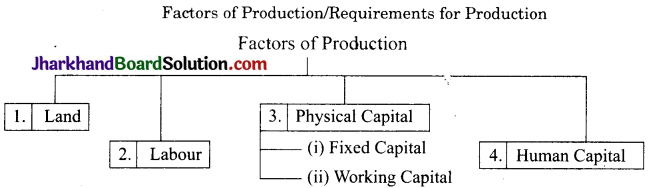
Productjpq. is organised by combining land, labour, physical capital and human capital which are collectively known as factors of production. We cart understand about these factors of production with the help of a chart as given below: Factors of Production/Requirements for Production
JAC Class 9 Social Science Important Questions Economics Chapter 1 The Story of Village 1
The description of each of them is as follows:
1. Land:
Land is the foremost factor of production. Land includes other natural resources; such as water, forests, minerals etc. which are essential for production.

2. Labour:
Labour is the second factor of production. People who perform work are known as labour. Some production activities require highly educated workers to perform the necessary tasks. Other activities require workers who can do manual work. Each worker provides labour necessary for production.

3. Physical capital:
The variety of inputs required at every stage of production is called physical capital. Physical capital can be categorised into two as follows.

(a) Fixed capital:
Tools and machines range from very simple tools to sophisticated machines, buildings etc. and these are included under fixed capital. This capital can be used in production over many years. The examples of fixed capital are, farmer’s plough, generators, turbines, computers, land, factory etc.

(b) Working capital:
Raw material and money in hand comes under working capital. This capital is used in production. Examples are-yarn used by weavers, clay used by potter, etc. Money is also required during production to make payments and buy other necessary items.

(4) Human capital:
Human capital is required to put together land, labour and physical capital and produce an output either to use yourself or to sell in the market. Knowledge and enterprise are known as human capital.

JAC Class 9 Social Science Important Questions Economics Chapter 1 The Story of Village

Question 3.
How are the farmers in Palampur village able to grow more crops from the same land? Explain.
Answer:
The following points state how the farmers in Palampur village are able to grow more crops from the same land:

  1. All land is cultivated in Palampur village and no land is left idle.
  2. Palampur’s farmers follow multiple cropping. They grow at least two main crops. Many of them also grow potato as the third crop.
  3. There is a well-developed irrigation system in Palampur village that enables the farmers to grow three different crops in one year.
  4. Electricity has played an important role in transformation of the irrigation system in the village. The previously existing Persian wheels were replaced by electric run tubewells which could irrigate much larger areas of land.
  5. Previously farmers follow modem farming methods for obtaining a higher yield.
  6. Green Revolution introduced HYV seeds and modem farming methods. The farmers of Palampur village significantly increased their agricultural produc¬tion by using HYV seeds, chemical fertilizers and pesticides.

Question 4.
What do you know about HYV seeds? Write its merits and limitations.
Answer:
HYV seeds HYV seeds means high yielding variety of seeds. These types of seeds provide much more yield than traditional seeds for the same area under cultivation.

1. Merits of HYV seeds: Compared to the traditional seeds, the high yielding variety of seeds promise to produce much greater amounts of grain on a single plant. As a result, the same piece of land can now produce far greater quantities of food grains than it was possible earlier.

2. Limitations of HYV seeds: High yielding variety of seeds need plenty of water, chemical fertilizers and pesticides to produce best results. Excessive use of these inputs reduces soil fertility over a long time period.

Question 5.
What do you mean by farm labourers? Write some characteristics of farm labourers.
Answer:
Farm labourers come either from landless families or families cultivating small plots of land. Characteristics of Farm Labourers: The chief characteristics of farm labourers are as follows:

  1. Farm labourers do not have a right over the crops grown on the land.
  2. They are paid wages by the farmer for whom they work.
  3. Paid wages can be in cash or in a kind, e.g., crop.
  4. Sometimes labourers get meals also.
  5. Wages vary widely from region to region, from crop to crop, and from one farm activity to another.
  6. A farm labourer might be employed on a daily basis or for one particular farm activity or for the whole year.
  7. They look for work every day.
  8. There is heavy competition for work among the farm labourers.

JAC Class 9 Social Science Important Questions Economics Chapter 1 The Story of Village

Question 6.
Mention ary four non-farm production activities of Palampur village.
Answer:
Following are the four main non-four production activites of Palampur village
1. Dairy:
Dairy is a common activity in many families of Palampur village. They keep buffaloes ror supplying the milk to the collection-cum-chilling center at Rani- ganj. The milk i. orocessed further for supply in various town and cities.

2. Manufacturing:
At present, less than fifty people are engaged in manufacturing in Palampur village. Unlike the manufacturing that takes place in the large factories in the towns and cities, manufacturing in Palampur involves very simple production methods and are done on a small scale. They are carried out mostly at home or in the fields with the help of family members and rarely are labourers hired.

3. Shopkeeping:
People involved in trade are not many in Palampur village. The traders of Palampur are mostly shopkeepers wrho buy various goods from wholesale markets in the cities and sell them in the village. Some of them have also opened shops selling eatables near the village bus stand.

4. Transport services:
There are a variety of vehicles on the road connecting Palampur to Raiganj. Ricksha wallahs, tonga wallays, jeep, tractor, truck drivers and people driving the traditional bullock carts and bogeys are people engaged in the transport services. They carry people and goods from one place to another and in return they get paid for it, i.e., the number of people involved in transport has grown over the last several years.

JAC Class 9 Social Science Important Questions

JAC Class 9 Sanskrit Solutions Shemushi Chapter 6 भ्रान्तो बालः

Jharkhand Board JAC Class 9 Sanskrit Solutions Shemushi Chapter 6 भ्रान्तो बालः Textbook Exercise Questions and Answers.

JAC Board Class 9th Sanskrit Solutions Shemushi Chapter 6 भ्रान्तो बालः

JAC Class 9th Sanskrit भ्रान्तो बालः Textbook Questions and Answers

1. एकपदेन उत्तरं लिखत- (एक पद में उत्तर लिखिए-)
(क) कः तन्द्रालुः भवति? (आलसी कौन होता है?)
उत्तरम् :
बालः। (बालक।)

(ख) बालक कुत्र व्रजन्तं मधुकरम् अपश्यत्? (बालक ने कहाँ. भ्रमण करते भौरे को देखा?)
उत्तरम् :
पुष्पोद्यानम्। (फुलवाड़ी में।)

(ग) के मधुसंग्रहव्यग्राः अभवन्? (कौन मधु संग्रह करने में व्यस्त था?)
उत्तरम् :
मधुकरः (भौंरा)।

JAC Class 9 Sanskrit Solutions Chapter 6 भ्रान्तो बालः

(घ) चटकः कया तृणशलाकादिकम् आददाति? (चिड़ा किससे तिनका लेता है?)
उत्तरम् :
चञ्च्वा । (चोंच से।)

(ङ) चटकः कस्य शाखायां नीडं रचयति? (चिड़ा किसकी डाल पर घोंसला बनाता है?)
उत्तरम् :
वद्रुमस्य। (बड़ के पेड़ पर।)

(च) बालकः कीदशं श्वानं पश्यति? (बालक कैसे कत्ते को देखता है?)
उत्तरम् :
पलायमानम्। (भागते हुए।)

(छ) श्वानः कीदृशे दिवसे पर्यटसि? (कुत्ता कैसे दिन में घूमता है?)
उत्तरम् :
निदाघदिवसे। (ग्रीष्म के दिन में।)

2. अधोलिखितानां प्रश्नानाम् उत्तराणि संस्कृतभाषया लिखत- (निम्नलिखित प्रश्नों के उत्तर संस्कृत भाषा में लिखिए-)
(क) बालः कदा क्रीडितुं अगच्छत्? (बालक कब खेलने के लिए निकल गया?)
उत्तरम् :
बालः पाठशालागमनवेलायां क्रीडितुं निर्जगाम। (बालक पाठशाला जाने के समय में खेलने के लिए निकल गया।)

(ख) बालस्य मित्राणि किमर्थं त्वरमाणा अभवन्? (बालक के मित्र किसलिए जल्दी में थे?)
उत्तरम् :
बालस्य मित्राणि विद्यालयगमनाय त्वरमाणा बभूवुः। (बालक के मित्र विद्यालय जाने के लिए जल्दी में थे।)

JAC Class 9 Sanskrit Solutions Chapter 6 भ्रान्तो बालः

(ग) मधुकरः बालकस्य आह्वानं केन कारणेन तिरस्कृतवान्? (भौरे ने बालक के बुलावे को किस कारण से नहीं माना?)
उत्तरम् :
मधुकरः मधुसंग्रहव्यग्रः आसीत् अत: स: बालकस्य आह्वानं न अमन्यत। (भौंरा मधुसंग्रह में व्यस्त था इसलिए उसने बालक के बुलावे को नहीं माना।)

(घ) बालकः कीदृशं चटकम् अपश्यत्? (बालक ने किस प्रकार के चटक (चिड़े) को देखा?)
उत्तरम् :
बालकः चञ्च्वा तृणशलाकादिकमाददानं चटकम् अपश्यत्। (बालक ने चोंच में तिनकों, सींक आदि को ग्रहण करते हुए एक चटक (चिड़े) को देखा।)

(ङ) बालकः चटकाय क्रीडनार्थं कीदृशं लोभं दत्तवान्? (बालक ने चटक (चिड़े) को खेलने के लिए किस प्रकार का लोभ दिया?)
उत्तरम् :
बालकः चटकाय क्रीडनार्थं ‘स्वादूनि भक्ष्यकवलानि ते दास्यामि,’ इति लोभं दत्तवान् । (बालक ने चटक (चिड़े) के लिए खेलने के लिए ‘तुम्हें स्वादिष्ट भोजन के कौर दूंगा,’ यह लोभ दिया।)

(च) खिन्नः बालकः श्वानं किम् अकथयत्? (दु:खी बालक ने कुत्ते से क्या कहा?)
उत्तरम् :
खिन्नः बालकः श्वानम् अकथयत् – “रे मानुषाणां मित्र! किं पर्यटसि अस्मिन् निदाघदिवसे? आश्रयस्वेदं प्रच्छायशीतलं तरुमूलम् इति।” (दुःखी बालक ने कुत्ते से कहा-अरे मनुष्यों के मित्र! इस गर्मी के दिन में क्यों घूम रहे हो? पेड़ की जड़ में शीतल छाया वाला यह आश्रय ले लो।)

JAC Class 9 Sanskrit Solutions Chapter 6 भ्रान्तो बालः

(छ) भग्नमनोरथ: बालः किम् अचिन्तयत्? (टूटी इच्छाओं वाले बालक ने क्या सोचा?)
उत्तरम् :
विनितमनोरथः बालः अचिन्तयत्-“कथमस्मिन् जगति प्रत्येकः स्व-स्वकृत्ये निमग्नो भवति? अथ स्वोचितमहमपि करोमि।” (टूटी इच्छाओं वाले बालक ने सोचा-“इस संसार में प्रत्येक अपने-अपने कार्य में कैसे संलग्न है? इसके बाद मैं भी अपने लिए उचित कार्य करूँगा।”)

3. निम्नलिखितस्य श्लोकस्य भावार्थं हिन्दीभाषया आङ्ग्लभाषया वा लिखत
(निम्नलिखित श्लोक का भावार्थ हिन्दी भाषा में अथवा अंग्रेजी भाषा में लिखिए-)
यो मां पुत्रप्रीत्या पोषयति स्वामिनो गृहे तस्य।
रक्षा नियोगकरणान मया भ्रष्टव्यमीषदपि।।
उत्तरम् :
हिन्दी भावार्थ-कत्ता बालक से कहता है कि जो गहस्वामी मद्ये पत्र जैसा प्रेम करता है तथा मे है, उसके घर की रक्षा करने के कार्य में मैं थोड़ा भी भ्रष्ट नहीं हो सकता अर्थात मैं अपने स्वामी के घर को छोड़कर तुम्हारे साथ इस पेड़ की छाया में बैठकर नहीं खेल सकता।

4. ‘भ्रान्तो बालः’ इति कथायाः सारांशं हिन्दीभाषया आङ्ग्लभाषया वा लिखत
(भ्रान्तो बाल:’ इस कथा का सारांश हिन्दी भाषा में अथवा अंग्रेजी भाषा में लिखिए-)

कथा का सारांश – एक बालक का मन पढ़ने में नहीं लगता था, अतः वह विद्यालय जाते समय अपने साथियों की दृष्टि से बचकर किसी बगीचे में प्रवेश कर गया। वहाँ उसने अपने साथियों के विषय में सोचा कि ये तो पुस्तकों के दास अथवा किताबी कीड़े हैं। वहाँ विद्यालय में अध्यापकों का क्रोधित चेहरा देखना पड़ेगा। अतः मैं यहाँ जीव-जन्तुओं को अपना मित्र बनाकर खेलँगा। बगीचे में उसने भौरे से अपने साथ खेलने के लिए कहा तो उसने यह कहकर खेलने से मना कर दिया कि मैं अपने मधु-संग्रह के कार्य में व्यस्त हूँ। फिर उसने घोंसला बनाने के लिए चोंच में तिनका लेकर जाते चटक (चिड़े) से अपने साथ खेलने के लिए कहा, किन्तु उसने भी अपने घोंसला बनाने के कार्य को छोड़कर खेलने से मना कर दिया।

इसके बाद बालक ने तेजी से भागते हुए कुत्ते को अपने साथ खेलने के लिए आमन्त्रित किया, किन्तु कुत्ते ने यह कहकर खेलने से मना कर दिया कि मैं अपने स्वामी के घर की रखवाली में कोई लापरवाही नहीं कर सकता।

इस प्रकार बालक ने जब देखा कि संसार का प्रत्येक प्राणी अपने-अपने कार्य में संलग्न है, केवल एक मैं ही अपना समय व्यर्थ गँवा रहा हूँ तो उसने सोचा कि मुझे भी आलस्य त्यागकर अपने कार्य में लग जाना चाहिए। यह बात मन में आते ही वह शीघ्र ही विद्यालय पहुँच गया। अभ्यास करते हुए पढ़कर बालक ने विद्वत्ता, प्रसिद्धि और सम्पत्ति प्राप्त की।

JAC Class 9 Sanskrit Solutions Chapter 6 भ्रान्तो बालः

5. स्थूलपदान्यधिकृत्य प्रश्ननिर्माणं कुरुत – (मोटे छपे पदों को आधार बनाकर प्रश्न निर्माण कीजिए-)

(क) स्वादूनि भक्ष्यकवलानि ते दास्यामि।
प्रश्न: – कीदृशानि भक्ष्यकवलानि ते दास्यामि?
(ख) चटकः स्वकर्मणि व्यग्रः आसीत्।
प्रश्न: – चटकः कस्मिन् व्यग्रः आसीत्?
(ग) कुक्कुरः मानुषाणां मित्रम् अस्ति।
प्रश्न: – कुक्कुरः केषां मित्रम् अस्ति?
(घ) स महती वैदुर्षी लब्धवान्।
प्रश्न: – स कां लब्धवान् ?
(ङ) रक्षानियोगकरणात् मया न भ्रष्टव्यम् इति।
प्रश्न: – कस्मात् मया न भ्रष्टव्यम् इति?

6. “एतेभ्य: नमः’ इति उदाहरणमनुसृत्य ‘नमः’ इत्यस्य योगे चतुर्थी विभक्तेः प्रयोगं कृत्वा पञ्चवाक्यानि रचयत।
(‘एतेभ्यः नमः’-इस उदाहरण के अनुसार ‘नमः’ के योग में चतुर्थी विभक्ति का प्रयोग करके पाँच वाक्य बनाइये।)
उत्तरम् :
1. गुरवे नमः
2. विष्णवे नमः
3. रामाय नमः
4. हरये नमः
5. सर्वेभ्य: नमः।

7. (अ) ‘क’ स्तम्भे समस्तपदानि ‘ख’ स्तम्भे च तेषां विग्रहः दत्तानि, तानि यथासमक्षं लिखत-(‘क’ स्तम्भ में । समस्तपद और ‘ख’ स्तम्भ में उनके विग्रह दिये हुए हैं। उन्हें उचित प्रकार से एक-दूसरे के सामने लिखिए-)

‘क’ स्तम्भः‘ख’ स्तम्भः
(क) दृष्टिपथम्1. पुष्पाणाम् उद्यानम्
(ख) पुस्तकदासाः2. विद्यायाः व्यसनी
(ग) विद्याव्यसनी3. दृष्टेः पन्थाः
(घ) पुष्पोद्यानम्4. पुस्तकानां दासाः

उत्तरम् :

‘क’ स्तम्भः‘ख’ स्तम्भः
(क) दृष्टिपथम्3. दृष्टेः पन्थाः
(ख) पुस्तकदासाः4. पुस्तकानां दासाः
(ग) विद्याव्यसनी2. विद्यायाः व्यसनी
(घ) पुष्पोद्यानम्1. पुष्पाणाम् उद्यानम्

JAC Class 9 Sanskrit Solutions Chapter 6 भ्रान्तो बालः

(आ) अधोलिखितेषु पदयुग्मेषु एकं विशेष्यपदम् अपरञ्च विशेषणपदम्। विशेषणपदं विशेष्यपदं च पृथक्-पृथक् चित्वा लिखत- (नीचे लिखे पदों के जोड़ों में एक विशेष्य पद है और दूसरा विशेषण पद। विशेषण पद और विशेष्य पद को अलग-अलग करके लिखिए-)

विशेषणम् विशेष्यम्
(क) खिन्नः बाल: ……….. ……….
(ख) पलायमानं श्वानम् ………. …………..
(ग) प्रीतः बालकः ……… ……….
(घ) स्वादूनि भक्ष्यकवलानि ………. ……….
(ङ) त्वरमाणाः वयस्याः ………… …………
उत्तरम् :
विशेषणम् विशेष्यम्
(क) खिन्नः बालः
(ख) पलायमानं श्वानम्
(स) पलायमानं श्वानम्
(ग) प्रीतः बालकः
(घ) स्वादूनि भक्ष्यकवलानि
(ङ) त्वरमाणाः वयस्याः

JAC Class 9th Sanskrit भ्रान्तो बालः Important Questions and Answers

प्रश्न: 1.
बालेन सह किं कर्तुं कोऽपि न उपलभ्यमान आसीत्? (बालक के साथ क्या करने के लिए कोई भी उपलब्ध नहीं था?)
उत्तरम् :
बालेन सह क्रीडाभिः कालं यापयितुं कोऽपि प्राप्तः न आसीत्। (बालक के साथ खेलने में समय व्यतीत करने के लिए कोई भी मिला नहीं था।)

प्रश्न: 2.
मित्राणां दृष्टिपथं परिहरन् बालः किम् अकरोत् ? (मित्रों की दृष्टि से बचते हुए बालक ने क्या किया?)
उत्तरम् :
मित्राणां दृष्टिपथं परिहरन् बालः एकम् उद्यानम् अगच्छत्। (मित्रों की दृष्टि से बचते हुए बालक एक बाग में गया।)

JAC Class 9 Sanskrit Solutions Chapter 6 भ्रान्तो बालः

प्रश्न: 3.
बालकस्य मतेन तस्य सहपाठिनः कीदृशाः आसन्? (बालक के मतानुसार उसके सहपाठी किस प्रकार के थे?)
उत्तरम् :
बालकस्य मतेन तस्य सहपाठिनः वराकाः पुस्तकदासाः आसन्। (बालक के मत में उसके सहपाठी बेचारे पुस्तकों के दास थे।)

प्रश्न: 4.
मधुकरः किम् अगायत् ? (भौरे ने क्या गाया?)
उत्तरम् :
करः अगायत-वयं हि मधुसंग्रहव्यग्राः। (भौरे ने गाया-हम सब निश्चय ही मधसंग्रह में व्यस्त हैं।)

प्रश्न: 5.
बालः चटकं किं त्यक्तुं कथयति? (बालक चटक पक्षी से क्या त्यागने के लिए कहता है?)
उत्तरम् :
बालः चटकं शुष्कं तृणं त्यक्तुं कथयति। (बालक चटक पक्षी से सूखे तिनके को त्यागने को कहता है।)

प्रश्नः 6.
बालः परिक्रम्य कम् अपश्यत्? (बालक ने घूमकर किसे देखा?)
उत्तरम् : बालः परिक्रम्य गच्छन्तं श्वानम् अपश्यत्। (बालक ने घूमकर जाते हुए कुत्ते को देखा।)

प्रश्न: 7.
बालः क्रीडासहायकं कं पश्यति? (बालक खेलने में सहायक किसे देखता है?)
उत्तरम् :
बालः क्रीडासहायकं श्वानं पश्यति। (बालक खेलने में सहायक कुत्ते को देखता है।)

JAC Class 9 Sanskrit Solutions Chapter 6 भ्रान्तो बालः

प्रश्नः 8.
कोऽपि किं न सहते? (कोई भी क्या नहीं सहता है?)
उत्तरम् :
कोऽपि वृथा कालक्षेपं न सहते। (कोई भी व्यर्थ समय व्यतीत करना नहीं सहता है।)

प्रश्न: 9.
बालः कदा महतीं वैदुषी, प्रथां, सम्पदं च लेभे? (बालक ने कब महान् विद्वत्ता, प्रसिद्धि और सम्पत्ति को प्राप्त किया?)
उत्तरम् :
विद्याव्यसनी भूत्वा बाल: महती वैदुर्षी, प्रथां, सम्पदं च लेभे। (विद्याव्यसनी होकर बालक ने महान् विद्वत्ता, प्रसिद्धि और सम्पत्ति को प्राप्त किया।)

प्रश्न: 10.
भ्रान्त बालेन सह अन्ये वयस्याः कस्मात् क्रीडितुम् उपलभ्यमानाः न आसन्? (भ्रान्त बालक के साथ मित्र किसलिए खेलने के लिए उपलब्ध नहीं थे?).
उत्तरम् :
यतः ते सर्वेऽपि पूर्व दिनपाठान् स्मृत्वा विद्यालय गणनाय त्वरमाणाः अभवन्। (क्योंकि वे सभी पहले दिन के पाठों को याद करके विद्यालय जाने के लिए तत्पर थे।)

प्रश्न: 11.
तंद्रालुः बालकः किमनुभवन् उद्यानं प्राविशत्? (आलसी बालक क्या अनुभव करता हुआ बाग में प्रविष्ट हुआ?)
उत्तरम् :
लज्जामनुभवन् तंद्रालुः बालः उद्यानं प्राविशत्। (लज्जा अनुभव करता हुआ बालक बाग में प्रविष्ट हो गया।)

प्रश्न: 12.
‘विरमन्तु एते बराक दुस्तकदासाः’ इति केन उक्तम्? (‘इन्हें रहने दो ये तो बेचारे किताबों के गुलाम हैं।’ यह किसने कहा?)
उत्तरम् :
तन्द्रालु बालकेन उक्तम्। (आलसी बालक ने कहा।)

JAC Class 9 Sanskrit Solutions Chapter 6 भ्रान्तो बालः

प्रश्न: 13.
निष्कुट वासिनः के सन्ति? (निष्कुटवासी कौन हैं?)
उत्तरम् :
खगाः निष्कुट वासिनः सन्ति। (पक्षी निष्कुट वासी हैं।)

प्रश्न: 14.
तन्द्रालुः बालः कीदृशं चटकम् अपश्यत्? (आलसी बालक ने कैसी चिड़िया को देखा?)
उत्तरम् :
तन्द्रालुः बालक: चञ्चच्चा तृणशलाको दिकम् आददानम् चटकं अपश्यत्। (आलसी बालक ने चोंच में तिनकादि लाते हुए चिड़ा को देखा।)

प्रश्न: 15.
चटकस्य नीडं कुत्र आसीत्? (चिड़ा का घोंसला कहाँ था?)
उत्तरम् :
चटकस्य नीडं वद्रुमस्य शाखायाम् आसीत्। (चिड़े का घोंसला बड़वृक्ष की शाखा पर था।)

रेखांकित पदानि आधुत्य प्रश्ननिर्माणं कुरुत-(रेखांकित शब्दों को आधार पर प्रश्ननिर्माण कीजिए-)

प्रश्न: 1.
बालः पाठशालागमन बेलायां क्रीडितुम् अगच्छत्। (बच्चा पाठशाला जाने के समय में खेलने चला गया।)
उत्तरम् :
बालः कदा क्रीडितुम् अगच्छत् ? (बालक कब खेलने चला गया?)

JAC Class 9 Sanskrit Solutions Chapter 6 भ्रान्तो बालः

प्रश्न: 2.
न वयस्येषु उपलब्धः आसीत् (मित्रों में कोई उपलब्ध नहीं था?)
उत्तरम् :
केषु न उपलब्धः आसीत् ? (किनमें उपलब्ध नहीं था?)

प्रश्न: 3.
सः पुष्पोद्यानं व्रजन्तं मधुकरम् आह्वयत्। (उसने बाग में जाते भौरे का आह्वान किया।)
उत्तरम् :
सः कुत्र व्रजन्तं मधुकरम् आह्वयत् ? (उसने कहाँ जाते हुए भौरे को बुलाया?)

प्रश्न: 4.
क्रुद्धस्य उपाध्यायस्य मुखं द्रष्टुं नैव इच्छामि। (क्रुद्ध शिक्षक का मुख नहीं देखना चाहता।)
उत्तरम् :
कस्य मुखं नैव द्रष्टुं इच्छामि? (किसका मुँह नहीं देखना चाहता?)

प्रश्न: 5.
निष्कुटवासिनः मम वयस्याः। (कोटवासी मेरे मित्र है।)
उत्तरम् :
के मम वयस्या:? (मेरे मित्र कौन हैं ?)

प्रश्न: 6.
पुष्पोद्यानं व्रजन्तं मधुकरं दृष्ट्वा क्रीडितुम् आह्वयत्। (फुलवाड़ी में जाते भौरे को देखकर खेलने को बुलाया।)
उत्तरम् :
कीदृशं मधुकरं दृष्ट्वा क्रीडितुम् आह्वयत्? (कैसे भौरे को खेलने के लिये बुलाया?)

JAC Class 9 Sanskrit Solutions Chapter 6 भ्रान्तो बालः

प्रश्न: 7.
पक्षिणो मनुष्येण नोपगच्छन्ति। (पक्षी मनुष्यों के पास नहीं जाते।)
उत्तरम् :
पक्षिणं केषु नोपगच्छन्ति ? (पक्षी कहाँ नहीं जाते?)

प्रश्न: 8.
सः पुत्रप्रीत्या पालयति। (वह पुत्र-प्रेम से पालता है।)
उत्तरम् :
सः कथम् पालयति? (वह कैसे पालता है?)

प्रश्न: 9.
निषिद्धः सः बालो भग्नमनोरथं अभवत्। (रोका हुआ वह बालक निराश हो गया।)
उत्तरम् :
निषिद्ध सः बालः कीदृशोऽभवत्? (अस्वीकृत बालक कैसा हो गया?)

प्रश्न: 10.
सः त्वरितं पाठशालाम् अगच्छत्। (वह शीघ्र पाठशाला को चला गया।)
उत्तरम् :
सः त्वरितं कुत्र अगच्छत् ? (वह शीघ्र कहाँ चला गया?)

कया-क्रम संयोजनम

अधोलिखितवाक्यानि पठित्वा कथाक्रमसंयोजनं कुरुत-(निम्नलिखित वाक्यों को पढ़कर कथाक्रम संयोजन कीजिए-)

  1. मानुषस्य मम मित्रं भविष्यसि।
  2. वयं हि मधुसंग्रहव्यग्रा इति।
  3. अथ स पुष्पोद्याने वजन्तं मधुकरम् अपश्यत्।
  4. भूयो द्रक्ष्यामि क्रुद्धस्य उपाध्यायस्य मुखम्।
  5. कोऽपि न वयस्येषु उपलभ्यमान आसीत्।
  6. अहं पुनरात्मानं विनोदयिष्यामि।
  7. बालः पाठशालागमनवेलायां क्रीडितुं निर्जगाम।
  8. तन्द्रालुः बालो एकाकी किमपि उद्यानं प्रविवेश।

उत्तरम् :

  1. बालः पाठशालागमनवेलायां क्रीडितुं निर्जगाम।
  2. कोऽपि न वयस्येषु उपलभ्यमान आसीत्।
  3. तन्द्रालुर्बालो एकाकी किमपि उद्यानं प्रविवेश।
  4. अहं पुनरात्मानं विनोदयिष्यामि।
  5. भूयो द्रक्ष्यामि क्रुद्धस्य उपाध्यायस्य मुखम्।
  6. अथ स पुष्पोद्यानं व्रजन्तं मधुकरम् अपश्यत्।
  7. वयं हि मधुसंग्रहव्यग्रा इति।
  8. मानुषस्य मम मित्रं भविष्यसि।

JAC Class 9 Sanskrit Solutions Chapter 6 भ्रान्तो बालः

परियोजनाकार्यम्

(क) एकस्मिन् स्फोरकपत्रे (Chart-paper) एकस्य उद्यानस्य चित्रं निर्माय संकलय्य वा पञ्चवाक्येषु तस्य वर्णनं कुरुत।
(एक चार्ट पेपर पर एक बगीचे का चित्र बनाकर अथवा संकलित करके पाँच वाक्यों में उसका वर्णन कीजिए।)
उत्तरम् :
छात्र स्वयं करें।

(ख) ‘परिश्रमस्य महत्त्वम’ इति विषये हिन्दीभाषया आङग्लभाषया वा पञ्चवाक्यानि लिखत।
उत्तरम् :
(‘परिश्रम का महत्त्व’ इस विषय पर हिन्दी भाषा या अंग्रेजी भाषा में पाँच वाक्य लिखो-)

1. इस संसार में सभी परिश्रम का महत्त्व स्वीकार करते हैं।
2. परिश्रमी व्यक्ति अपने परिश्रम से अपने लक्ष्य की पूर्ति कर लेता है।
3. परिश्रम से असम्भव कार्य भी सम्भव बनाये जा सकते हैं।
4. परिश्रम के बिना संसार में सुखमय जीवन असम्भव है।
5. परिश्रम ही सफलता की कुंजी है।

भाषिक विस्तारः

1. यस्य च भावेन भावलक्षणम्-जहाँ एक क्रिया के होने से दूसरी क्रिया के होने का ज्ञान हो तो पहली क्रिया के कर्ता में सप्तमी विभक्ति होती है। इसे ‘सति सप्तमी’ या ‘भावे सप्तमी’ भी कहते हैं।
यथा – उदिते सवितरि कमलं विकसति।
गर्जति मेघे मयूरः अनृत्यत्।
नृत्यति शिवे नृत्यन्ति शिवगणाः।
हठमाचरति बाले भ्रमरः अगायत् ।
उदिते नैषेधे काव्ये क्व माघः क्व च भारविः।

JAC Class 9 Sanskrit Solutions Chapter 6 भ्रान्तो बालः

2. अन्य पदार्थ प्रधानो बहुव्रीहिः-जिस समास में पूर्व और उत्तर पदों से भिन्न किसी अन्य पद के अर्थ का प्राधान्य होता है वह बहुव्रीहि समास कहलाता है।
यथा – पीताम्बरः – पीतम् अम्बरं यस्य सः (विष्णुः)।
नीलकण्ठः – नीलं कण्ठं यस्य सः (शिवः)।
अनुचिन्तितपूर्वदिनपाठाः – अनुचिन्तिताः पूर्वदिनस्य पाठा: यैः ते।
विनितमनोरथ: – विनितः मनोरथः यस्य सः।
दत्तदृष्टि: – दत्ता दृष्टिः येन सः।

भ्रान्तो बालः Summary and Translation in Hindi

पाठ का सारांश – प्रस्तुत पाठ ‘संस्कृतप्रौढ़पाठावलिः’ नामक ग्रन्थ से सम्पादित कर ग्रहण किया गया है। इस कथा में एक ऐसे बालक का चित्रण है, जिसका मन अध्ययन की अपेक्षा खेल-कूद में लगा रहता है। वह विद्यालय न जाकर खेलने के उद्देश्य से बगीचे में प्रवेश करता है, लेकिन खेलने के लिए उसे एक साथी की आवश्यकता होती है। अत: वह अपने साथ खेलने के लिए भौरे को बुलाता है, भौंरा कहता है कि मैं फूलों के रस को इकट्ठा कर रहा हूँ, मैं नहीं आ सकता। इस प्रकार बालक पुनः प्रयास करता है और चिड़िया को स्वादिष्ट भोजन देने का वायदा करते हुए खेलने के लिए बुलाता है।

लेकिन वह भी अपने कार्य को महत्त्व देती है। दुःखी बालक कुत्ते को बुलाता है, कुत्ता भी अपने मालिक के घर की निगरानी करने के कार्य को महत्त्व देता है और अपना कार्य करने के लिए तेजी से भाग जाता है। इस प्रकार सबके मना करने पर तथा सारे प्राणियों को अपने काम में लगा देखकर तथा स्वयं को अपना समय व्यर्थ में गँवाते हुए देखकर बालक अत्यन्त दुःखी होता है और स्वयं भी विद्याध्ययन में अपना समय व्यतीत करने का निश्चय करता है। वह अपने विद्यालय वापस चला जाता है, इस प्रकार वह बालक विद्याध्ययन कर महान् विद्वान् बनकर प्रसिद्धि और सम्पत्ति प्राप्त करता है।

[मूलपाठः,शब्दार्थाः,सप्रसंग हिन्दी अनुवादः,सप्रसंग संस्कृत व्यारव्याः अवबोधन कार्यम च]

1. भ्रान्तः कश्चन बालः पाठशालागमनवेलायां क्रीडितुम् अगच्छत्। किन्तु तेन सह केलिभिः कालं क्षेप्तुं तदा कोऽपि न वयस्येषु उपलभ्यमान आसीत्। यतः ते सर्वेऽपि पूर्वदिनपाठान् स्मृत्वा विद्यालयगमनाय त्वरमाणाः अभवन्। तन्द्रालुः बाल: लज्जया तेषां दृष्टिपथमपि परिहरन् एकाकी किमपि उद्यानं प्राविशत्।।
सः अचिन्तयत् – “विरमन्तु एते वराकाः पुस्तकदासाः। अहं तु आत्मानं विनोदयिष्यामि। सम्प्रति विद्यालयं गत्वा भूयः क्रुद्धस्य उपाध्यायस्य मुखं द्रष्टुं नैव इच्छामि। एते निष्कुटवासिनः प्राणिन एव मम वयस्याः सन्तु इति।
अथ सः पुष्पोद्यानं व्रजन्तं मधुकरं दृष्ट्वा तं क्रीडितुम् द्वित्रिवारं आह्वयत्। तथापि, सः मधुकरः अस्य बालस्य वान तिरस्कृतवान्। ततो भूयो भूयः हठमाचरति बाले सः मधुकरः अगायत् – “वयं हि मधुसंग्रहव्यग्रा” इति।

JAC Class 9 Sanskrit Solutions Chapter 6 भ्रान्तो बालः

शब्दार्थ: – भ्रान्तः = पथभ्रष्टः (भ्रमित), कश्चन = कोऽपि (कोई), बालः = बालकः (बालक), पाठशालागमनवेलायाम् = विद्यालयगमनसमये (विद्यालय जाने के समय), क्रीडितुम् = खेलितुम् (खेलने के लिए), अगच्छत् = गतः (गया), किन्तु = परञ्च (लेकिन), तेन = अमुना (उसके), सह = सार्धं (साथ), केलिभिः = क्रीडाभिः (खेलों द्वारा), कालं क्षेप्तुम् = समयं यापयितुम् (समय बिताने के लिए), कोऽपि = कश्चन अपि (कोई भी), न = मा (नहीं), वयस्येषु = मित्रेषु (मित्रों में), उपलभ्यमानः = प्राप्तमानः (उपलब्ध हुआ), आसीत् = अवर्तत (था), यतः = (क्योंकि), ते = अमी (वे), सर्वेऽपि = समस्ताः अपि (सभी), पूर्वदिनपाठान् = पूर्वदिवसस्य अध्यायान् (पहले दिन के पाठों को),

स्मृत्वा = स्मरणं कृत्वा (स्मरण करके), विद्यालयगमनाय = पाठशालां गन्तुम् (विद्यालय जाने के लिए), त्वरंमाणाः = त्वरां कुर्वन्तः (शीघ्रता कर रहे), अभवन् = आसन् (थे), तन्द्रालुः = अलसः (आलसी), बालः = बालकः (बालक), लज्जया = शर्म से, तेषाम् = अमीषाम् (उनकी), दृष्टिपथम् = दृष्टिम् (निगाह से), अपि = भी, परिहरन् = दूरीकुर्वन् (दूर रहता हुआ, बचता हुआ), एकाकी = एक एव (अकेला ही), किमपि =.कस्मिन् (किसी), उद्यानम् = उपवनम् (बगीचे में), प्राविशत् = प्रवेशम् अकरोत् (प्रवेश कर गया), सः = असौ (वह, उसने), अचिन्तयत् = चिन्तितवान् (सोचा), विरमन्तु = तिष्ठन्तु (रहने दो), एते = इमे (ये), वराकाः = दीनाः, दयापात्राणि (बेचारे, दया के पात्र),

पुस्तकदासाः = पुस्तकानां किंकराः (पुस्तकों के गुलाम/दास.), अहम् = मैं, तु = तो (फिर), आत्मानम् = स्वकीयं (अपना), विनोदयिष्यामि = मनोविनोदं करिष्यामि (मनोरंजन करूँगा), सम्प्रति विद्यालय गत्वा = अधुन पाठशालां प्राप्य, भूयः = पुनः (फिर), क्रुद्धस्य उपाध्यायस्य = कुपितस्य गुरोः (क्रुद्ध गुरु के), मुखम् = आस्यं (मुख को), द्रष्टुं = दर्शनं (देखना), नैव इच्छामि = नावलोकितुम् इहे (देखना नहीं चाहता), निष्कुटवासिनः = वृक्षकोटरनिवासिनः (वृक्ष के कोटरों में रहने वाले), एव = ही, प्राणिनः = जीवजन्तवः (प्राणी), मम = मे (मेरे),

वयस्याः = मित्राणि (मित्र), सन्तु = भवन्तु (हों), अथ = एतदनन्तरम् (इसके बाद), सः = असौ (वह), पुष्पोद्यानम् = पुष्पोपवनम् (फूलों के बगीचे में), व्रजन्तम् = भ्रमणं कुर्वन्तं (घूमते हुए), मधुकरम् = भ्रमरम् (भौरे को), दृष्ट्वा = अवलोक्य (देखकर), तम् = अमुम् (उसे), क्रीडितुम् = केलिनिमित्तम् (खेलने के निमित्त), द्वित्रिवारम् आह्वयत् = द्विः त्तिः वारं आमन्त्रयत् (दो-तीन बार बुलाया/आमन्त्रित किया), तथापि = (फिर भी),

सः = असौ (वह) (उस भौरे ने), मधुकरः = भ्रमरः (भौरे), अस्य = (इस), बालस्य = बालकस्य (बालक के), आह्वान = आमन्त्रणम् (बुलावे को), तिरस्कृतवान् = अमन्यत (नहीं माना) ततोः = तदानीं (तब), भूयो भूयः = पुनः-पुनः (बार बार), हठमाचरति = आग्रहपूर्वकं व्यवहारं कुर्वति सति (हठ करने पर), बाले = बालके (बालक के), सः मधुकरः अगायत् = असौ भ्रमरः अगायत् (उसने गाया), वयम् = हम सब, हि = निश्चयेन (निश्चय ही), मधुसंग्रहव्यग्राः = पुष्परससंकलने तत्पराः (पुष्पों के रस के संग्रह में लगे हए हैं)।

हिन्दी अनुवादः

सन्दर्भ – प्रस्तुत गद्यांश हमारी पाठ्यपुस्तक ‘शेमुषी’ के ‘भ्रान्तो बालः’ नामक पाठ से उद्धृत है। यह पाठ ‘संस्कृत प्रौढ़पाठावलिः’ नामक ग्रन्थ से लिया गया है।
प्रसंग – प्रस्तुत गद्यांश में एक ऐसे बालक का वर्णन है जो विद्यालय जाने के समय में खेलने के लिए निकल गया। उस (बालक) ने खेलने के लिये भौरे को बुलाया। भौरे ने खेल के बजाय काम को महत्त्वपूर्ण माना। यह यहाँ वर्णन किया गया है।

हिन्दी-अनुवाद – भ्रमित हुआ कोई बालक विद्यालय जाने के समय खेलने के लिए निकल गया। किन्तु उसके साथ खेल द्वारा समय बिताने के लिए मित्रों में कोई भी उपलब्ध न था; क्योंकि वे सभी पहले दिन के पाठों को याद करके विद्यालय जाने के लिए शीघ्रता कर रहे थे। आलसी बालक लज्जा (शर्म) से उनकी निगाह (दृष्टि) से भी बचता हुआ अकेला ही किसी बगीचे में प्रवेश कर गया। उसने सोचा कि ये बेचारे पुस्तकों के दास बने रहें।

मैं तो अपना मनोरंजन करूँगा। (यदि विद्यालय जाऊँगा तो) निश्चय ही फिर क्रुद्ध गुरु के मुख को देखूगा। वृक्ष की कोटरों में रहने वाले ये प्राणी ही मेरे मित्र होवें। इसके बाद उसने फूलों के बगीचे में घूमते हुए भौरे को देखकर उसे खेलने के लिए आमन्त्रित किया। उस (भौरे) ने उसके दो-तीन (बार के) आमन्त्रण को भी नहीं माना। तब बालक के बार-बार हठ करने पर उस भौरे ने गाया-हम सब निश्चय ही मधुसंग्रह में व्यस्त हैं। संस्कत-व्याख्याः

JAC Class 9 Sanskrit Solutions Chapter 6 भ्रान्तो बालः

सन्दर्भ: – प्रस्तुतगद्यांशः अस्माकं पाठ्यपुस्तकस्य ‘शेमुष्याः’ ‘भ्रान्तो बालः’ नामक पाठात् उद्धृतोऽस्ति। पाठोऽयं ‘संस्कृतप्रौढ़पाठावलिः’ नामक ग्रन्थात् ग्रहीतोऽस्ति। (प्रस्तुत गद्यांश हमारी पाठ्यपुस्तक ‘शेमुषी’ के ‘भ्रान्तो बालः’ नामक पाठ से उद्धृत है। यह पाठ ‘संस्कृत- प्रौढ़पाठावलिः’ नामक ग्रन्थ से लिया गया है।)

प्रसंग: – प्रस्तुतगद्यांशे एकस्य एतादृशबालकस्य वर्णनमस्ति यः पाठशालागमनवेलायां क्रीडितुं निर्जगाम। सः (बालकः) भ्रमरं क्रीडनाय आह्वयत्। भ्रमरः क्रीडनस्य अपेक्षा कार्य महत्त्वपूर्णम् अमन्यत । इदमत्र वर्णितम्। (प्रस्तुत गद्यांश में एक ऐसे बालक का वर्णन है जो पाठशाला जाने के समय खेलने निकल गया। वह बालक भौरे को खेलने के लिए बुलाता है। भौरा खेलने की अपेक्षा कार्य को महत्वपूर्ण मानता है।)

व्याख्याः – पथभ्रष्टः कोऽपि बालकः विद्यालयगमनसमये खेलितुं निष्क्रान्तः। परन्तु अमुना सार्धं क्रीडाभिः समयं यापयितुं मित्रेषु कश्चन अपि प्राप्तमान मा अवर्तत; यतः अमी समस्ताः अपि पूर्वदिवसस्य अध्यायान् स्मरणं कृत्वा पाठशाला गन्तुं त्वरां कुर्वन्तः आसन्। अलस: बालकः लज्जया अमीषां दृष्टिम् अपि दूरी कुर्वन् एक एव कस्मिन् उपवने प्रवेशम् अकरोत्। असौ अचिन्तयत् यत् इमे दीनाः पुस्तकानां किंकराः तिष्ठन्तु।

अहं भूयः स्वकीयस्य चित्तविनोदं करिष्यामि। (विद्यालयं चेद् गमिष्यामि तर्हि) ननु पुनः कुपितस्य गुरोः आस्यम् ईक्षिष्ये। वृक्षकोटरनिवासिनः इमे जीवजन्तवः एव मे मित्राणि भवन्तु। तदनन्तरम् असौ पुष्पोपवने भ्रमणं कुर्वन्तं भ्रमरम् अवलोक्य अमुं केलिनिमित्तम् आमन्त्रयत्। असौ (भ्रमरः) द्विः त्रिः अस्य आह्वानमेव मा अंगीकृतवान्। तदानी बालके पुनः पुनः आग्रहपूर्वकं व्यवहारं कुर्वति सति असौ भ्रमरः अगायत्-वयं निश्चयेन पुष्परससंकलने।

(राह से भटका कोई बालक विद्यालय जाते समय खेलने निकल गया परन्तु इसके साथ खेल में समय व्यतीत करने के लिए मित्रों में से कोई नहीं मिला क्योंकि वे सभी पहले दिन के पढ़े हुए को याद कर के पाठशाला जाने के लिए जल्दी कर रहे थे। आलसी बालक शर्म से इनसे निगाह बचाते हुए किसी एक उपवन में प्रवेश कर गया। वह सोचने लगा कि ये गरीब (बेचारे) किताबों के गुलाम रहें। मैं तो अपना मनोविनोद करूँगा। विद्यालय जाऊँगा तो निश्चित नाराज शिक्षक का मुँह देखंगा।

पेड़ के खोखले (कोटर) में निवास करने वाले ये जीव-जन्तु ही मेरे मित्र हों। इसके बाद वह फूलबगिया में भ्रमण करते हुए भौरे को देखकर उसे खेलने के लिए आमन्त्रित किया। उस भौरे ने उसके दो-तीन बार के आह्वान को स्वीकार नहीं किया। तब बालक के आग्रहपूर्वक व्यवहार करने पर वह भौंरा गाने लगा। हम निश्चित ही फूलों का रस संग्रह करने में रत हैं।)

अवबोधन कार्यम्

प्रश्न 1.
एकपदेन उत्तरत- (एक शब्द में उत्तर दीजिए-)
(क) भ्रान्तः बाल: मधुकरं कुत्र अपश्यत्? (भ्रान्त बालक ने भौरे को कहाँ देखा?)
(ख) भ्रान्तः बालः क्रीडितुं कदा अगच्छत् ? (भ्रान्त बालक खेलने कब गया?)

प्रश्न 2.
पूर्णवाक्येन उत्तरत- (पूरे वाक्य में उत्तर दीजिए-)
(क) निषिद्धेषु बालकेषु भ्रान्तबालः किम् अकथयत्? (बालकों के मना करने पर भ्रान्त बालक ने क्या कहा?)
(ख) मधुकरः भ्रान्तबालाय किम कथयत्? (भौरे ने भ्रान्त बालक से क्या कहा?)

JAC Class 9 Sanskrit Solutions Chapter 6 भ्रान्तो बालः

प्रश्न 3.
यथानिर्देशम् उत्तरत-(निर्देशानुसार उत्तर दीजिए-)
(क) ‘भ्रान्त-बालः’ अत्र विशेषण विशेष्य लिखत। (भ्रान्तः बाल:’ यहाँ विशेषण विशेष्य पद लिखिए।)
(ख) ‘मित्रेषु’ इति पदस्य गद्यांशे समानार्थी पदं अन्विष्य। (‘मित्रेषु’ पद का गद्यांश में समानार्थी पद ढूँढ़ो।)
उत्तराणि-
(1) (क) पुष्पोद्याने (फुलवाड़ी में)।
(ख) पाठशालागमनवेलायाम् (स्कूल जाने के समय)।

(2) (क) सः अचिन्तयत्-‘विरमन्तु ऐते वराकाः पुस्तकादासाः। अहं तु आत्मानं विनोदयिष्यामि। (उसने सोचा ना ये गरीब (बिचारे) पुस्तकों के गुलाम रहें, मैं तो अपना मनोविनोद करूँगा।)
(ख) मधुकर: अकथयत्-“वयं तु मधुसंग्रहे व्यग्राः स्मः। (भौरे ने कहा- हम तो शहद संग्रह करने में व्यस्त हैं।)

(3) (क) विशेषणम्-भ्रान्तः, विशेष्यम् च-बालः।
(ख) वयस्येषु (मित्रों में)।

2. तदा स बालः ‘अलं भाषणेन अनेन मिथ्यागर्वितेन कीटेन’ इति विचिन्त्य अन्यत्र दत्तदृष्टि: चञ्च्वा तृणशलाकादिकम् आददानम् एकं चटकम् अपश्यत्, अवदत् च-“अयि चटकपोत! मानुषस्य मम मित्रं भविष्यसि। एहि क्रीडावः। एतत् शुष्कं तृणं त्यज स्वादूनि भक्ष्यकवलानि ते दास्यामि” इति। स तु “मया वटदुमस्य शाखायां नीड कार्यम्” इत्युक्त्वा स्वकर्मव्यग्रोः अभवत्।

तदा खिन्नो बालकः एते पक्षिणो मानुषेषु नोपगच्छन्ति। तद् अन्वेषयामि अपरं मानुषोचितम् विनोदयितारम् इति विचिन्त्य पलायमानं कमपि श्वानम् अवलोकयत्। प्रीतो बालः तम् इत्थं समबोधयत् खरे मानुषाणां मित्र! किं पर्यटसि अस्मिन् निदाघदिवसे? इदं प्रच्छायशीतलं तरुमूलम् आश्रयस्व। अहमपि क्रीडासहायं त्वामेवानुरूपं पश्यामीति। कुक्कुरः प्रत्यवदत् –

यो मां पुत्रप्रीत्या पोषयति स्वामिनो गृहे तस्य।
रक्षानियोगकरणान्न मया भ्रष्टव्यमीषदपि।। इति।

JAC Class 9 Sanskrit Solutions Chapter 6 भ्रान्तो बालः

शब्दार्थाः – तदा = तस्मिन् काले, तदानीं (तब), सः = असौ (उस), बालः = बालकः (बालक ने), अलम् = कृतम् [बस (मना करने के अर्थ में], अनेन = एतेन (इससे), मिथ्यागवितेन कीटेन = व्यर्थाहङ्कारयुक्तेन कीटकेन (झूठे गर्वयुक्त कीट से), इति = अनेन प्रकारेण (इस प्रकार), विचिन्त्य = विचार्य (सोचकर), अन्यत्रः = अन्यं स्थानं प्रति (दूसरी ओर), पश्यन् (देखते हए), चञ्च्वा = चञ्चपटेन (चोंच से), तणशलाकादिकम् = नालान् इषिकादीन (तिनकों, सींक आदि को), आददानम् = गृह्णन्तम् (ग्रहण करते हुए को), एकं चटकं = एकं खगम (एकपक्षी को), अपश्यत् = ऐक्षत (देखा),

अवदत् च = अकथयत् (और बोला), अयि = (अरे), चटकपोत! = खग! (पक्षी/चिड़े!), मानुषस्य = मानवस्य (मनुष्य के), मम = मे (मेरे), मित्रम् = वयस्यः (मित्र), भविष्यसि = होगे, बनोगे, एहि = आगच्छ (आओ), क्रीडावः = खेलावः (खेलें), एतत् शुष्कम् = इदं नीरसम् (इस सूखे), तृणम् = नालं (तिनके को), त्यज = उत्सृज (छेड़ो), स्वादूनि = स्वादिष्टानि (स्वादयुक्त), भक्ष्यकवलानि = भक्षणीयग्रासाः (खाने के लिए उपयुक्त कौर),

ते = तुभ्यम् (तुम्हारे लिए), दास्यामि = दूँगा, इति = अनेन प्रकारेण (इस प्रकार), स = असौ (वह), तु = तो, वटदूमशाखायाम् = वटवृक्षस्य शाखायां (बरगद के पेड़ की शाखा पर), नीडः = कुशालयः (घोंसला), कार्यम् = कर्तव्य रचितव्य (बनाना है), इत्युक्त्वा = एवं कथयित्वा (ऐसा कहकर), स्वकर्मव्यग्रोः = स्वकीये कार्ये संलग्नः (अपने काम में व्यस्त), अभवत् = अजायत (हो गया), तदा = तदानी (तब), खिन्नोः = दुःखितः (दुःखी), बालकः = बालः (बालक ने), एते = इमे (ये),

पक्षिणोः = खगाः (पक्षी), मानुषेषु = मानवेषु (मनुष्यों के), नोषगच्छन्ति = न उपगच्छन्ति (पास नहीं जाते हैं), तद् = तो, अन्वेषयामि = अन्वेषणं करोमि (खोजता हूँ), अपरम् = अन्यं (दूसरा), मानुषोचितम् = मानवेभ्यः उचितं (मनुष्यों के लिए उचित), विनोदयितारम् = मनोरञ्जनकारिणम् (मनोरंजन करने वाला), विचिन्त्य = चिन्तविला (सोचकर), पलायमानम् = धावमानं/धावन्तम् (भागते हुए), कमपि = किसी, श्वानम् = कुक्कुरं (कुत्ते को),

अवलोकयत् = अपश्यत् (देखा), प्रीतो = प्रसन्नः (प्रसन्न), बालः = बालकः (बालक ने), तम् = अमुम् (उसको), इत्थम् = अनेन प्रकारेण (इस प्रकार), समबोधयत् = संबोधितम् अकरोत् (सम्बोधित किया), रे = भो (अरे), मनुषाणाम् = मानवानां (मनुष्यों के), मित्र! = वयस्य! (मित्र!), किम् = केन हेतुना (क्यों), पर्यटसि = भ्रमणं करोषि (घूम रहे हो), अस्मिन् = इह (इस), निदाघदिवसे = ग्रीष्मदिवसे (गर्मी के दिन में), इदम् = एतत् (यह), प्रच्छायशीतलम् = शीतलछायायुक्तम् (शीतल छाया वाला),

तरुमूलम् = वृक्षस्य अधः (पेड़ की जड़ में), आश्रयस्व = आश्रयं लभस्व (आश्रय लो), अहमपि = मैं भी, क्रीडासहायम् = क्रीडा सहायं (खेलने में सहायक), त्वामेवानुरूपं = तब योग्यम् (तुम्हारे उपयुक्त/समान), पश्यामीति = ऐसा देखता हूँ, कुक्कुरः = श्वानः (कुत्ता ने), प्रत्यवदत् = प्रत्युत्तरेण अवदत् (उत्तर दिया),यो = जो, माम् = मुझे, पुत्रप्रीत्या = पुत्रवत् प्रेम्णा (पुत्र के समान प्रेम से), पोषयति = पालयति (पालता है), स्वामिनो = प्रभोः (स्वामी के), गृहे = गेहे (घर में), तस्य = अमुष्य (उस), रक्षानियोगकरणान्न = सुरक्षाकार्यवशात् न (रक्षा के कार्य में लगे होने से नहीं), मया = मुझे, भ्रष्टव्यमीषदपि = अल्पमात्रम् अपि पतितव्यम् (थोड़ा-सा भी हटना चाहिए)।

JAC Class 9 Sanskrit Solutions Chapter 6 भ्रान्तो बालः

हिन्दी अनुवादः

सन्दर्भ – प्रस्तुत गद्यांश हमारी पाठ्यपुस्तक ‘शेमुषी’ के ‘भ्रान्तो बालः’ नामक पाठ से उद्धृत है। यह पाठ ‘संस्कृतप्रौढ़पाठावलिः’ नामक ग्रन्थ से लिया गया है।

प्रसंग – इस गद्यांश में यह वर्णन है कि खेलने के लिए इच्छुक बालक ने एक चटक (चिड़े) और कुत्ते को बुलाया किन्तु खेलने के लिए उन दोनों ने ही अपने काम को अधिक महत्त्वपूर्ण माना।

हिन्दी-अनुवाद – तब उस बालक ने ‘इस झूठे गर्वयुक्त कीट से बस (इस झूठे गर्वयुक्त कीट को छोड़ो)’, इस प्रकार (सोचकर) दूसरी ओर देखते हुए एक चटक चिड़े को चोंच से तिनकों, सींक आदि को ग्रहण करते हए देखा और बोला-“अरे चटक चिड़े! मुझ मनुष्य के मित्र बनोगे। आओ खेलें। इस सूखे तिनके को छोड़ो मैं तुम्हें स्वादयुक्त खाने के लिए उपयुक्त कौर दूँगा।” वह तो ‘बरगद के पेड़ की शाखा पर घोंसला बनाना है, तो कार्य से जाता हूँ’ इस प्रकार कहकर अपने काम में व्यस्त हो गया।

तब दुःखी बालक ने सोचा-ये पक्षी मनुष्यों के पास नहीं जाते हैं। तब मनुष्य के लिए उचित मनोरंजन करने वाला दूसरा साथी खोजता हूँ। इस प्रकार घूमकर भागते हुए किसी कुत्ते को देखा। प्रसन्न बालक ने उसे इस प्रकार सम्बोधित किया- अरे मनुष्यों के मित्र! इस गर्मी के दिन में क्यों घूम रहे हो? वृक्ष की जड़ में शीतल छाया वाला यह आश्रय ले लो। मैं भी खेलने में सहायक तुम्हारे ही समान किसी को खोज रहा हूँ। कुत्ता ने उत्तर दिया-जो मुझे पुत्र के समान प्यार से पालता है, उस स्वामी के घर में रक्षा करने के कार्य से मुझे थोड़ा-सा भी नहीं हटना चाहिए।

JAC Class 9 Sanskrit Solutions Chapter 6 भ्रान्तो बालः

संस्कत-व्यारव्याः

सन्दर्भ: – प्रस्तुतगद्यांशः अस्माकं पाठ्यपुस्तकस्य ‘शेमुष्याः’ ‘भ्रान्तो बालः’ नामक पाठात् उद्धृतोऽस्ति। पाठोऽयं ‘संस्कृतप्रौढ़पाठावलिः’ नामक ग्रन्थात् गृहीतोऽस्ति। (प्रस्तुत गद्यांश हमारी पाठ्यपुस्तक ‘शेमुषी’ के ‘भ्रान्तो बालः’ नामक पाठ से उद्धृत है। यह पाठ ‘संस्कृत- प्रौढ़पाठावलिः’ नामक ग्रन्थ से लिया गया है।)

प्रसंग: – अस्मिन् गद्यांशे वर्णनमस्ति यत् क्रीडनाय इच्छुक: बालकः एकं चटकं कुक्कुरं च क्रीडनाय आह्वयत् परं तौ द्वावपि स्वकर्तव्यम् अधिकमहत्त्वपूर्णम् अमन्यताम्। (इस गद्यांश में वर्णित है कि खेलने के लिए इच्छुक बालक एक गौरैया और मुर्गे से खेलने का आग्रह करता है, परन्तु दोनों अपने कर्त्तव्य को महत्वपूर्ण मानते हैं।)

व्याख्या: – तदानीम् असौ बालकः ‘अलम् एतेन व्यर्थाहङ्कारयुक्तेन कीटेन’ अनेन प्रकारेण अन्यं स्थानं पश्यन् एकं चटकं चञ्चुपुटेन नालान् इषिकादीन् च गृह्णन्तम् अपश्यत् अवदत् च-भो चटक! खग! मे मानवस्य वयस्यः भविष्यति। आगच्छ खेलावः, उत्सृज एतत् नीरसं नालं, स्वादिष्टाः भक्षणीयग्रासाः तुभ्यं दास्यामि। असौ तु चटकः कुशालयः कर्तव्यः वटवृक्षस्य शाखायाम्, अतः गच्छामि कार्येण इति कथयित्वा स्वकीये कार्ये संलग्नः अभवत्। तदानीं दुःखितः बाल: अचिन्तयत् यत् इमे खगाः मानवान् न उपगच्छन्ति अत: अन्वेषणं करोमि अन्यस्य मानवोचितमनोरञ्जनकारिणः, तदा सः भ्रमणं कृत्वा धावमानं कमपि कुक्कुरम् अपश्यत्।

प्रसन्नः असौ बालकः तं कुक्कुरम् अनेन प्रकारेण सम्बोधितवान्-भो मानवानां वयस्य! केन हेतुना भ्रमणं करोषि इह ग्रीष्मदिवसे? वृक्षस्य मूले शीतलछायायुक्तम् एतत् आश्रयं लभस्व। अहमपि खेलने सहायकं त्वामेव योग्यं पश्यामि। श्वानः प्रत्युत्तरेण एवम् अवदत्-यः मां पुत्रवत् प्रेम्णा पालयति, तस्य स्वामिनः गेहे सुरक्षाकार्यात् मया अल्पमात्रमपि न पतितव्यम्। (तब वह बालक ‘इस मिथ्या घमंड करने वाले कीड़े (भौरे) को रहने दो’ इस प्रकार एक अन्य स्थान देखता हुआ एक चटक को तिनका, सींक आदि चोंच में लिए हुए देखा और बोला-अरे चिड़ा, पक्षी, मुझ मानव के मित्र बनोगे। आओ खेलें, छोड़ो यह नीरस तिनका, स्वादिष्ट खाने योग्य तुम्हें दूँगा। वह चिड़ा तो ‘घोंसला बनाने को बड़ के पेड़ की शाखा पर चला गया। ऐसा कहकर अपने कार्य में संलग्न हो गया।

तभी दुःखी बालक ने सोचा कि ये पक्षी मनुष्यों के पास नहीं जाते हैं, अतः किसी अन्य मनोविनोद करने वाले को ढूँढ़ता हूँ। तब उसने घूमकर दौड़ते हुए एक कुत्ते को देखा। प्रसन्न हुआ वह बालक कुत्ते को इस प्रकार सम्बोधित करने लगा-अरे मनुष्यों के मित्र! यहाँ गर्मी के दिन में क्यों घूम रहे हो? पेड़ की जड़ से शीतल छाया युक्त यह आश्रय पाओ। मैं भी खेलने में तुम्हीं को सहायक देख रहा हूँ। कुत्ता उत्तर में इस प्रकार बोला-“जो मुझको बेटे की तरह प्रेम से पालता है उस स्वामी के घर में सुरक्षा कार्य (रखवाली) से मुझे किंचित भी पतित नहीं होना चाहिए।”)

JAC Class 9 Sanskrit Solutions Chapter 6 भ्रान्तो बालः

अवबोधन कार्यम्

प्रश्न 1.
एकपदेन उत्तरत- (एक शब्द में उत्तर दीजिए-)
(क) भ्रान्त बाल: चटकाय कस्य प्रलोभनं ददाति? (भ्रान्त बालक गौरैया को क्या प्रलोभन देता है?)
(ख) भ्रान्त बालकः कीदृशं श्वानम् अपश्यत्? (भ्रान्त बालक ने कैसे कुत्ते को देखा?)

प्रश्न 2.
पूर्णवाक्येन उत्तरत- (पूरे वाक्य में उत्तर दीजिए-)
(क) कुक्कुरः भ्रान्तबालाय किमुदतरत्? (कुत्ते ने भ्रान्त बालक को क्या उत्तर दिया?)
(ख) खिन्नोबालः खगानां विषये किं चिन्तयति? (खिन्न बालक पक्षियों के विषय में क्या सोचता है?)

प्रश्न 3.
यथानिर्देशम् उत्तरत-(निर्देशानुसार उत्तर दीजिए-)
(क) ‘प्रसन्नः’ इति पदस्य विलोमपदं गद्यांशात् चिनुत। (‘प्रसन्नः’ पद का विलोम पद गद्यांश से चुनिए।)
(ख) ‘प्रीतो बालः तम् इत्थं समबोधयत्’ इति वाक्ये ‘तम्’ इति सर्वनामपदं कस्य संज्ञाशब्दस्य स्थाने प्रयुक्तम्?
(‘प्रीतो बालः तम् इत्थं समबोधयत्’ वाक्य में ‘तम्’ सर्वनाम पद किसके लिए प्रयोग हुआ है?)
उत्तराणि :
(1) (क) भक्ष्य कवलानि (खाद्य-कौर)।
(ख) पलायमानम् (भागते हुए)।

(2) (क) अहं तु स्वामिनः गृहे रक्षानियोग कारणात् न गन्तुं शक्नोमि। (मैं तो स्वामी के घर पर रक्षा कार्य के कारण नहीं जा सकता।)
(ख) खिन्नोबाल: खगानां विषये चिन्तयति यत् एते पक्षिण: मानुषेषु नोपगच्छन्ति। (खिन्न बालक पक्षियों के विषय में सोचता है कि ये पक्षी मनुष्यों के पास नहीं आते।)

(3) (क) ‘खिन्नः’ (दुखी)।
(ख) कुक्कुरम् (कुत्ते को)।

JAC Class 9 Sanskrit Solutions Chapter 6 भ्रान्तो बालः

3. सर्वेः एवं निषिद्धः स बालो भग्नमनोरथः सन्-‘कथमस्मिन् जगति प्रत्येक स्व-स्वकार्ये निमग्नो भवति। न कोऽपि मामिव वृथा कालक्षेपं सहते। नम एतेभ्यः यै. मे तन्द्रालुतायां कुत्सा समापादिता। अथ स्वोचितम् अहमपि करोमि इति विचार्य त्वरितं पाठशालाम् अगच्छत्।
ततः प्रभति स विद्याव्यसनी भत्वा महती वैदषी प्रथां सम्पदं च अलभत।

शब्दार्थाः – सर्वैः = समस्तैः (सबके द्वारा), एवम् = अनेन प्रकारेण (इस प्रकार), निषिद्धः = अस्वीकृतः (मना किया गया), स बालो = असौ बालकः (वह बालक), भग्नमनोरथः सन् = खण्डितकामः भूत्वा (टूटी इच्छाओं वाला होकर), कथमस्मिन् = केन प्रकारेण एतस्मिन् (किस प्रकार इस), जगति = संसारे (संसार में), प्रत्येकम् = प्रत्येक, स्व-स्वकार्ये = स्वकीये कार्ये (अपने कार्य में), निमग्नो भवति = संलग्नः वर्तते (लगा हुआ है/संलग्न है), न = मा (नहीं), कोऽपि = कश्चन अपि (कोई भी), मामिव = मेरे जैसा, वृथा = व्यर्थम् (बेकार, व्यर्थ),

कालक्षेपम् = समयस्य यापनम् (समय का बिताना), सहते = सहनं करोति (सहन करता है), नमः = नमस्कारः (नमस्कार है), एतेभ्यः = एभ्यः (इन सबके लिए), यैः = (जिन्होंने), मे = मम (मेरी), तन्द्रालुतायाम् = आलस्ये (आलस्यता में), कुत्सा = घृणा (अरुचि), समापादिता = उत्पन्ना (उत्पन्न कर दी है), अथ = एतदनन्तरं (इसके पश्चात्), स्वोचितम् अहमपि = स्वकीयस्य कृते उचितम् अहमपि (अपने लिए उचित कार्य को मैं भी),

करोमि = करता हूँ, करूँगा, इति विचार्य = एवं विचारं कृत्वा (इस प्रकार विचार करके), त्वरितम् = शीघ्रम् (शीघ्र), पाठशालाम् = विद्यालयम् (विद्यालय को), अगच्छत् = प्राप्तः (पहुँचा), ततः प्रभृति = तस्मात् समयात् (तब से लेकर), स = असौ (उसने), विद्याव्यसनी = अध्ययनरतः (विद्या में रत रहने वाला), भूत्वा = होकर, महतीं = महान्, वैदुषीम् = विद्वत्तां (विद्वत्ता को), प्रथाम् = प्रसिद्धिं (प्रसिद्धि को), सम्पदम् = सम्पत्तिं (सम्पत्ति को), च = और, अलभत = प्राप्तम् अकरोत् (प्राप्त किया)।

JAC Class 9 Sanskrit Solutions Chapter 6 भ्रान्तो बालः

हिन्दी अनुवादः

सन्दर्भ – प्रस्तुत गद्यांश हमारी पाठ्यपुस्तक ‘शेमुषी’ के ‘भ्रान्तो बाल.’ नामक पाठ से उद्धृत है। यह पाठ ‘संस्कृत प्रौढ़पाठावलिः’ नामक ग्रन्थ से लिया गया है।

प्रसंग – यह गद्यांश वर्णन करता है कि बालक जीवन में कार्य का महत्त्व जानकर विद्या अध्ययन के कार्य में व्यस्त हो गया और उसने महान् प्रसिद्धि प्राप्त कर ली।

हिन्दी-अनुवाद – सबके द्वारा इस प्रकार मना किया गया वह बालक टूटी इच्छाओं वाला होकर ‘कैसे इस संसार में प्रत्येक (प्राणी) अपने-अपने काम में लगा हुआ है। मेरे समान कोई भी अपने समय को व्यर्थ व्यतीत करना सहन नहीं . करता। इन सबको नमस्कार है, जिन्होंने आलस्यता में मेरी घृणा उत्पन्न कर दी है। इसके पश्चात् मैं भी अपने लिए उचित कार्य करूँगा। इस प्रकार विचार कर (वह) शीघ्र पाठशाला पहुँचा। तब से लेकर उसने विद्या अध्ययन में रत रहने वाला होकर महान् विद्वत्ता, प्रसिद्धि और सम्पत्ति को प्राप्त किया। संस्कत-व्यारव्याः

सन्दर्भ: – प्रस्तुतगद्यांशः अस्माकं पाठ्यपुस्तकस्य ‘शेमुष्याः’ ‘भ्रान्तो बालः’ नामक पाठात् उद्धृतोऽस्ति। पाठोऽयं ‘संस्कृतप्रौढ़पाठावलिः’ नामक ग्रन्थात् गृहीतोऽस्ति। (प्रस्तुत पाठ हमारी पाठ्यपुस्तक ‘शेमुषी’ के ‘भ्रान्तो बालः’ नामक पाठ से उद्धृत है। यह पाठ ‘संस्कृत प्रौढ़पाठावलिः’ नामक ग्रन्थ से लिया गया है।)

JAC Class 9 Sanskrit Solutions Chapter 6 भ्रान्तो बालः

प्रसंग: – गद्यांशोऽयं वर्णयति यत् बालकः जीवने महत्त्वं ज्ञात्वा अध्ययनरतः अभूत् स च महती प्रसिद्धि प्राप्नोत्। (यह गद्यांश वर्णन करता है कि बालक जीवन में कर्म का महत्त्व जानकर अध्ययनरत हो गया तथा महती प्रसिद्धि को प्राप्त किया।)

व्याख्या: – समस्तैः अनेन प्रकारेण अस्वीकृतः स बालकः खण्डितकामः भूत्वा ‘केन प्रकारेण एतस्मिन् संसारे प्रत्येकः स्वकीये कार्ये संलग्नः वर्तते। न कश्चनपि अहमिव व्यर्थं समयस्य यापनं सहते। एभ्यः नमस्कारः यैः मम आलस्ये घृणा उत्पन्ना। एतदनन्तरम् अहमपि स्वकीस्य कृते उचितं करिष्यामि।’ एवं विचारं कृत्वा स शीघ्रमेव विद्यालयं प्राप्तः। तस्मात् समयात् प्रभृतिः असौ अध्ययनरतः भूत्वा महती विद्वत्ता, प्रसिद्धिं, सम्पत्तिं च प्राप्नोत्।

(सभी के द्वारा इस प्रकार अस्वीकार किया हुआ वह बालक टूटी कामनाओं वाला (निराश हुआ)-“किस प्रकार इस संसार में प्रत्येक (प्राणी) अपने-अपने कार्य में लगा हुआ है। कोई भी मेरी तरह व्यर्थ समय बरबाद करने को सहन नहीं करता। इनको प्रणाम, जिन्होंने मेरे आलस्य में घृणा की। इसके बाद मैं भी अपने लिए उचित करूँगा।” इस प्रकार विचार कर वह शीघ्र ही विद्यालय पहुँचा। इसलिए समय से पहले ही उसने अध्ययन में रत होकर अत्यधिक विद्वत्ता, प्रसिद्धि और समृद्धि को प्राप्त किया।)

अवबोधन कार्यम्

प्रश्न 1.
एकपदेन उत्तरत – (एक शब्द में उत्तर दीजिए-)
(क) सर्वैः निषिद्धः बालः कीदृशोऽभवत् ? (सबके द्वारा मना किया हुआ बालक कैसा हो गया?)
(ख) अन्ते विचार्य बालः कुत्र गतः? (अन्त में विचार कर बालक कहाँ गया?)

प्रश्न 2.
पूर्णवाक्येन उत्तरत- (पूरे वाक्य में उत्तर दीजिए-)
(क) सर्वैः निषिद्धः बालः किम् अचिन्तयत्? (सबके द्वारा मना किया गया बालक क्या सोचने लगा?)
(ख) सर्वेषां शिक्षा श्रुत्वा बालकः कीदृशोऽभवत्? (सबकी सीख पाकर बालक कैसा हो गया?)

JAC Class 9 Sanskrit Solutions Chapter 6 भ्रान्तो बालः

प्रश्न 3.
यथानिर्देशम् उत्तरत-(निर्देशानुसार उत्तर दीजिए-)
(क) ‘प्रत्येकम्’ पदस्य समास विग्रहं कुरुत। (प्रत्येकम् पद का समास-विग्रह कीजिए।)
(ख) ‘बालः भग्नमनोरथः’ इत्यनयो पदयोः विशेषण पदं लिखत। (‘बाल: भग्नमनोरथः’ इनमें विशेषण पद लिखिये।)
उत्तराणि-
(1) (क) भग्नमनोरथः (जिसका मनोरथ टूट गया हो)।
(ख) पाठशालाम् (विद्यालय को)।

(2) (क) सोऽचिन्तयत्-“कथमस्मिन् जगति प्रत्येकं स्व-स्वकार्ये निमग्नो भवति। न कोऽपि मामिव वृथायाकालक्षेपं सहते। (उसने सोचा-‘क्या इस संसार में सभी अपने-अपने कार्य में डूबे हुए (व्यस्त) हैं, मेरी तरह कोई व्यर्थ समय व्यतीत नहीं करता है?)
(ख) सर्वेषां शिक्षा श्रुत्वा सः विद्याव्यसनी भूत्वा महती वैदुर्षी प्रथां सम्पदं च अलभत। (सभी की सीख सुन कर उसने विद्यार्थी होकर महान विद्वत्ता प्राप्त कर सम्पत्ति प्राप्त की।)

(3) (क) एकम् एकम् (अव्ययीभाव)।
(ख) भग्नमनोरथः (निराश हुआ)।

JAC Class 9 Maths Solutions Chapter 10 Circles Ex 10.2

Jharkhand Board JAC Class 9 Maths Solutions Chapter 10 Circles Ex 10.2 Textbook Exercise Questions and Answers.

JAC Board Class 9th Maths Solutions Chapter 10 Circles Ex 10.2

Page-173

Question 1.
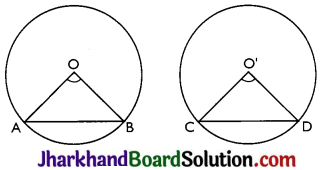
Recall that two circles are congruent if they have the same radii. Prove that equal chords of congruent circles subtend equal angles at their centres.
Answer:
Given: AB = CD (Equal chords)
To prove: ∠AOB = ∠CO’D
Proof: In AAOB and ACO’D,
JAC Class 9 Maths Solutions Chapter 10 Circles Ex 10.2 - 1
OA = O’C
OB = O’D
AB = CD
∴ ∆AOB ∆CO’D
(SSS congruence criterion)
Thus, ∠AOB ≅ ∠CO’D by CPCT.
i.e. Equal chords of congruent circles subtend equal angles at their centres.

JAC Class 9 Maths Solutions Chapter 10 Circles Ex 10.1

Question 2.
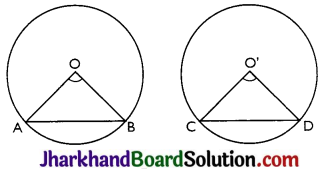
Prove that if chords of congruent circles subtend equal angles at their centres, then the chords are equal.
JAC Class 9 Maths Solutions Chapter 10 Circles Ex 10.2 - 2
Answer:
Given: ∠AOB = ∠CO’D (Equal angles)
To prove: AB = CD
Proof: In ∆AOB and ∆CO’D,
OA = O’C (Radii)
∠AOB = ∠CO’D (Given)
OB = O’D (Radii)
∴ ∆AOB ≅ ∆CO’D
(SAS congruence criterion)
Thus, AB = CD by CPCT.
If chords of congruent circles subtend equal angles at their centres, then the chords are equal.

JAC Class 10 Sanskrit रचना संकेत आधारित वार्तालाप लेखनम्

Jharkhand Board JAC Class 10 Sanskrit Solutions रचना संकेत आधारित वार्तालाप लेखनम् Questions and Answers, Notes Pdf.

JAC Board Class 10th Sanskrit Rachana संकेत आधारित वार्तालाप लेखनम्

निर्देश – संवाद-लेखन का उद्देश्य विद्यार्थियों को संस्कृत में सम्भाषण क्षमता को प्रेरित करना एवं मूल्यांकन करना है। ताकि विद्यार्थी संस्कृत के माध्यम से वार्तालाप करने में सक्षम हो सकें और अपने भावों को संस्कृत में व्यक्त कर सकें। वार्तालाप पूर्णरूपेण संस्कृत में ही लिखा जाएगा तथा उत्तर भी संस्कृत में ही अपेक्षित है अर्थात् वार्तालाप को संस्कृत में ही लिखना है। यहाँ उत्तर में वाक्यों का हिन्दी अर्थ दिया गया है। वह केवल समझने के लिए है, उत्तर-पुस्तिका में नहीं लिखना है।

संवाद अथवा वार्तालाप दो या दो से अधिक व्यक्तियों के मध्य होता है। इसकी दो प्रमुख शैलियाँ हैं – (i) प्रश्नात्मक संवाद (ii) आदेशात्मक संवाद। संवाद में उत्तर सदैव ही प्रश्नानुसार होने चाहिए। जिस शैली और वाच्य में प्रश्न पूछा गया हो, उसी शैली और वाच्य में उत्तर दिया जाना चाहिए। संवाद में निपुणता प्राप्त करने के लिए प्रश्नोत्तर निर्माण का अच्छा अभ्यास होना चाहिए। साथ ही परस्पर सम्भाषण का अभ्यास भी करना चाहिए। इस प्रश्न को अच्छी तरह हल करने के लिए विद्यार्थियों को निम्नलिखित बातें ध्यान में रखनी चाहिए –
1. पूरे संवाद को ध्यान से पढ़ना चाहिए।
2. प्रथम प्रश्न का उत्तर लिखने से पहले दूसरे प्रश्न को अवश्य पढ़ लेना चाहिए, क्योंकि संवाद में प्रश्नों के उत्तर प्रायः अगले प्रश्न के अन्दर ही मिल जाते हैं।
3. उत्तर देते समय वाक्य को लम्बा नहीं रखना चाहिए।
4. उत्तर प्रश्न के अनुसार ही होना चाहिए अर्थात् अपेक्षित उत्तर ही होना चाहिए।
5. संवाद-लेखन में लिंग-वचन का ध्यान रखना अत्यन्त आवश्यक है।
6. यदि संवाद बड़े और छोटे व्यक्ति के मध्य हों तो छोटे व्यक्ति का संवाद आज्ञात्मक नहीं होना चाहिए।
7. वार्तालाप के काल का ध्यान भी रखना आवश्यक है।
8. मञ्जूषा में दिए गये शब्दों के चयन के समय कर्ता-क्रिया, संज्ञा-सर्वनाम तथा विशेषण-विशेष्य आदि के समुचित समन्वय को भी ध्यान में अवश्य रखना चाहिए।
9. मंजूषा के शब्दों को ध्यानपूर्वक पढ़कर ही प्रयोग करना चाहिए।
10. आदेशात्मक-संवाद में उत्तर प्रायः वर्तमान काल या भूतकाल में होते हैं, अतः तदनुसार ही उत्तर देना चाहिए।

JAC Class 10 Sanskrit रचना संकेत आधारित वार्तालाप लेखनम्

1. मञ्जूषातः उपयुक्तपदानि गृहीत्वा अध्ययनविषये पितापुत्रयोः संवादं पूरयतु
मञ्जूषा – अध्यापकः, विषये, गणिते, व्यवस्थां, स्थानान्तरणम्, अध्ययनं, समीचीनं, काठिन्यम्।
पिता – रमेश! तव ……………कथं प्रचलति?
रमेशः – हे पितः! अध्ययनं तु…………….प्रचलति।
पिता – कोऽपि विषयः एतादृशः अस्ति यस्मिन् त्वं …………… अनुभवसि?
रमेशः – आम्! …………. मम स्थितिः सम्यक् नास्ति। यतोहि अस्माकं विद्यालये इदानीं गणितस्य ………… नास्ति।
पिता – त्वं पूर्वं तु माम् अस्मिन् ……………… न उक्तवान् !
रमेशः – पूर्वं तु अध्यापक-महोदयः आसीत् परं एकमासात् पूर्वमेव तस्य …………….अन्यत्र अभवत्।
पिता – अस्तु। अहं तव कृते गृहे एव गणिताध्यापकस्य ……………. करिष्यामि।
रमेशः – धन्यवादाः।
उदाहरणार्थ – समाधानम्: –
पिता – रमेश! तव अध्ययनं कथं प्रचलति? (रमेश! तेरा अध्ययन (पढ़ाई) कैसा चल रहा है ?)
रमेशः – हे पितः! अध्ययनं तु समीचीनं प्रचलति। (पिताजी! अध्ययन तो ठीक चल रहा है।)
पिता – कोऽपि विषयः एतादृशः अस्ति यस्मिन् त्वं काठिन्यम् अनुभवसि? (कोई भी विषय ऐसा है, जिसमें तुम्हें कठिनाई अनुभव हो रही हो?)
रमेशः – आम्! गणिते मम स्थितिः सम्यक् नास्ति। यतोहि अस्माकं विद्यालये इदानीं गणितस्य अध्यापकः नास्ति। (हाँ! गणित में मेरी स्थिति ठीक नहीं है। क्योंकि हमारे विद्यालय में इस समय गणित का अध्यापक नहीं है।)
पिता – त्वं पर्वं तमाम अस्मिन विषये न उक्तवान ! (तुमने पहले तो मुझसे इस विषय के बारे में नहीं कहा।)
रमेशः – पूर्वं तु अध्यापक-महोदयः आसीत् परं एकमासात् पूर्वमेव तस्य स्थानान्तरणम् अन्यत्र अभवत्। (पहले तो अध्यापक महोदय थे, लेकिन एक महीने पूर्व ही उनका स्थानान्तरण दूसरी जगह हो गया।)
पिता – अस्तु। अहं तव कृते गृहे एव गणिताध्यापकस्य व्यवस्थां करिष्यामि। (हो! मैं तुम्हारे लिए घर पर ही गणित अध्यापक की व्यवस्था करूँगा।)
रमेशः – धन्यवादाः। (धन्यवाद।)

2. मञ्जूषायां प्रदत्तपदैः ‘जयपुरभ्रमणम्’ इति विषये मित्रयोः परस्परं वार्तालापं पूरयतु।
मञ्जूषा – मित्रैः, जयपुरं, कार्यक्रमः, दर्शनीयम्, यात्रानुभवविषये, द्रक्ष्यामः
विनोदः – अंकित ! श्वः भवान् कुत्र गमिष्यति?
अंकितः – अहं ……………..गमिष्यामि।
विनोदः – तत्र किमपि कार्यं वर्तते? अथवा …… एवं गच्छति?
अंकितः – कार्यं नास्ति, अहं तु …………….. सह भ्रमणार्थं गच्छामि।
विनोदः – जयपुरे कुत्र-कुत्र भ्रमणस्य …………….. अस्ति?
अंकितः – वयं तत्र आमेर-दुर्ग, जयगढ़दर्ग, गोविन्ददेव-मन्दिरं च ……….
विनोदः – तत्र नाहरगढ़-दुर्गमपि पश्यतु। तदपि …………….. अस्ति।
अंकितः – यदि समयः अवशिष्टः भविष्यति तर्हि निश्चयेन तत्र गमिष्यामः।
विनोदः – बाढू मित्र ! नमस्ते! इदानीम् अहं गच्छामि। सोमवासरे आवां पुनः मिलिष्यावः। तदा वार्तालापं करिष्यावः।
उत्तरम् :
विनोदः – अंकित! श्वः भवान् कुत्र गमिष्यति? (अंकित कल आप कहाँ जाओगे?)
अंकितः – अहं जयपुरं गमिष्यामि। (मैं जयपुर जाऊँगा।)
विनोदः – तत्र किमपि कार्यं वर्तते? अथवा भ्रमणार्थम् एव गच्छति? (वहाँ कोई भी कार्य है अथवा घूमने के लिए ही जाना है।)
अंकितः – कार्यं नास्ति, अहं तु मित्रैः सह भ्रमणार्थं गच्छामि। (कार्य नहीं है, मैं तो मित्रों के साथ घूमने के लिए जाता हूँ।)
विनोदः – जयपुरे कुत्र-कुत्र भ्रमणस्य कार्यक्रमः अस्ति? (जयपुर में कहाँ-कहाँ घूमने का कार्यक्रम है?)
अंकित: – वयं तत्र आमेर-दुर्गं, जयगढ़दुर्ग, गोविन्ददेव-मन्दिरं च द्रक्ष्यामः।
(हम सब वहाँ आमेर किला, जयगढ़ किला और गोविन्द मन्दिर देखेंगे।)
विनोदः – तत्र नाहरगढ़-दुर्गमपि पश्यतु। तदपि दर्शनीयम् अस्ति। (वहाँ नाहरगढ़ किला भी देखो, वह भी देखने योग्य है।)
अंकित: – यदि समयः अवशिष्टः भविष्यति तर्हि निश्चयेन तत्र गमिष्यामः।
(यदि समय शेष रहेगा तो निश्चित रूप से वहाँ जायेंगे।)
विनोदः – बाढ़ मित्र ! नमस्ते! इदानीम् अहं गच्छामि। सोमवासरे आवां पुनः मिलिष्यावः। तदा यात्रानुभवविषये वार्तालापं करिष्यावः। (ठीक ! मित्र नमस्ते। इस समय मैं जाता हूँ। सोमवार को हम दोनों फिर मिलेंगे। तब यात्रा विषय के बारे में बातचीत करेंगे।)

JAC Class 10 Sanskrit रचना संकेत आधारित वार्तालाप लेखनम्

3. मञ्जूषायाः उपयुक्तपदानि गृहीत्वा गुरुशिष्ययोः मध्ये क्रीडायाः विषये संवादं पूरयत।
[मञ्जूषाः अध्ययनम्, क्रीडने बहुलाभम्, आवश्यकता, अधुना, करोषि, क्रीडाङ्गणे, क्रीडायै]
अध्यापकः – प्रवीण! त्वम् अत्र किं ………….. ?
प्रवीणः – हे गुरो! अहम् ………….. किमपि न करोमि।
अध्यापकः – तर्हि गच्छ। तव मित्राणि तत्र ………….. क्रीडन्ति, तैः सह क्रीड।
प्रवीणः – मम………….. रुचिः नास्ति। अतः अहं न क्रीडामि।
अध्यापकः – स्वस्थशरीरस्य स्वस्थमनसः च कृते क्रीडायाः अस्माकं जीवने महती…………..भवति।
प्रवीणः – यदि अहं क्रीडायां ध्यानं दास्यामि तर्हि मम ………….. बाधितं भविष्यति।
अध्यापकः – एतद् समीचीनं नास्ति। क्रीडायै स्वल्पसमयम् एव प्रयच्छ। अल्पसमयः अपि शरीराय………… प्रदास्यति।
प्रवीणः – बाढ़म् श्रीमन् ! इतः आरभ्य अहं कञ्चित् समयं ………….. अपि दास्यामि।
उत्तरम् :
अध्यापकः – प्रवीण! त्वम् अत्र किं करोषि ? (प्रवीण! तुम यहाँ क्या कर रहे हो?)
प्रवीणः – हे गुरो! अहम् अधुना किमपि न करोमि। (हे गुरु ! मैं अब कुछ भी नहीं कर रह)
अध्यापकः – तर्हि गच्छ। तव मित्राणि तत्र क्रीडाङ्गणे क्रीडन्ति, तैः सह क्रीड। (तो जाओ! तुम्हारे मित्र वहाँ खेल के मैदान में खेल रहे हैं। उनके साथ खेलो।)
प्रवीणः – मम क्रीडते रुचिः नास्ति। अतः अहं न क्रीडामि। (मेरी खेलने में रुचि नहीं है। इसलिए मैं नहीं खेलता हूँ।)
अध्यापकः – स्वस्थशरीरस्य स्वस्थमनसः च कृते क्रीडायाः अस्माकं जीवनं महती आवश्यकता भवति। (स्वस्थ शरीर का स्वस्थ मन और खेल का हमारे जीवन के लिए बहुत महत्व है।)
प्रवीणः – यदि अहं क्रीडायां ध्यानं दास्यामि तर्हि मम अध्ययनं बाधितं भविष्यति। (यदि मैं खेल में ध्यान दूंगा, तो मेरी पढ़ाई (अध्ययन) में बाधा होगी।)
अध्यापकः – एतद् समीचीनं नास्ति। क्रीडायै स्वल्पसमयम् एव प्रयच्छ। अल्पसमयः अपि शरीरस्य बहुलाभम् प्रदास्यति। (यह ठीक नहीं है। खेलने के लिए थोड़ा समय ही दो। थोड़ा समय भी शरीर को बहुत लाभ देगा।)
प्रवीणः – बाढ़म् श्रीमान् ! इतः आरभ्य अहं कञ्चित् समयं क्रीडायै अपि दास्यामि। (श्रीमान् जी ठीक है! अब प्रारम्भ करके मैं कुछ समय खेलने के लिए भी दूंगा।)

JAC Class 10 Sanskrit रचना संकेत आधारित वार्तालाप लेखनम्

4. मञ्जूषायां प्रदत्तशब्दानां सहायतया मातापुत्रयोः मध्ये वार्तालापं पूरयतु।
मञ्जूषाः – वस्तूनि, आपणं, सायंकाले, विद्यालयस्य, मातुलः, भोजनं, त्वं
माता – राघव! ……………किं करोषि?
राघवः – अहं मम …………… गृहकार्यं करोमि।
माता – पुत्र! गृहकार्यानन्तरम् …………… गत्वा ततः दुग्धं शाकफलानि च आनय।
राघवः – अहं …………… पुस्तकं क्रेतुम् आपणं गमिष्यामि तदा दुग्धं शाकफलानि च आनेष्यामि।
माता – सायंकाले न, त्वं तु पूर्वमेव गत्वा आनय।
राघवः – शीघ्रं किमर्थम्?
माता – अद्य तव …………… आगमिष्यति, अतः …………….. समयात् पूर्वमेव पक्ष्यामि।
राघवः – मातुल: आगमिष्यति चेत् अहम् इदानीम् एव गत्वा …………… क्रीत्वा आगच्छामि।
उत्तरम् :
माता – राघव! त्वं किं करोषि? (राघव! तुम क्या कर रहे हो?)
राघवः – अहं मम विद्यालयस्य गृहकार्यं करोमि। (मैं अपने विद्यालय का गृहकार्य कर रहा हूँ।)
माता – पुत्र! गृहकार्यानन्तरम् आपणं गत्वा ततः दुग्धं शाकफलानि च आनय। (पुत्र! गृहकार्य के बाद बाजार जाकर वहाँ से दूध, सब्जी और फल ले आओ।)
राघवः – अहं सायंकाले पुस्तकं क्रेतुम् आपणं गमिष्यामि तदा दुग्धं शाकफलानि च आनेष्यामि। (मैं सायं के समय पुस्तक खरीदने बाजार जाऊँगा, तब दूध, सब्जी और फल ले आऊँगा।)
माता – सायंकाले न, त्वं तु पूर्वमेव गत्वा आनय। (सायं के समय नहीं, तुम तो पहले ही जाकर लाओ।)
राघवः – शीघ्रं किमर्थम? (जल्दी किसलिए?)
माता – अद्य तव मातुलः आगमिष्यति, अतः भोजनं समयात् पूर्वमेव पक्ष्यामि। (आज तुम्हारे मामा आयेंगे, इसलिए खाना समय से पहले पकाऊँगी।)
राघवः – मातुल: आगमिष्यति चेत् अहम् इदानीम् एव गत्वा वस्तूनि क्रीत्वा आगच्छामि। (मामाजी आयेंगे ठीक, मैं इस समय ही जाकर वस्तुएँ खरीदकर आता हूँ।)

5. मञ्जूषातः उचितानि पदानि चित्वा अधोलिखितं संवादं पूरयत।
(मंजूषा से उचित पद चुनकर अधोलिखित संवाद पूरा कीजिए।)
मञ्जूषा – गातुम्, इच्छन्ति, वयं, महोदये, परन्तु, यदि, शोभनम्, आवश्यकता।
अध्यापिका – बालाः ! किं भवन्तः किञ्चित् प्रष्टुम्: (i) ……………. ?
बालाः – महोदये ! (ii) ……………… तु गातुम् इच्छामः।
अध्यापिका – गातुम इच्छन्ति ! (ii) ……………….. अहं त (iv) ………………. न समर्था।
बालाः – (v) ……………….. ! वयं गास्यामः समूहगानम्। (vi) ……………. भवती अपि।
अध्यापिका – (vii) ……………… ! अहम् अपि गास्यामि। गीतं किम् अस्ति ? किं वाद्ययन्त्राणाम् अपि (viii) ……………… अस्ति।
बालाः – वाद्ययन्त्राणि यदि सन्ति, शोभनम्। अन्यथा एतानि विना एव गास्यामः। गीतं तु ‘पोङ्गल’ इति उत्सवेन सम्बद्धम् अस्ति।
अध्यापिका – एवं ! तदा गायामः।
बालाः – (सस्वरं गायन्ति)
उत्तरम् :
अध्यापिका – बालाः ! किं भवन्तः किञ्चित् प्रष्टुम् इच्छन्ति ? (बच्चो ! क्या आप कुछ पूछना चाहती हैं ?)
बालाः – महोदये ! वयं तु गातुम् इच्छामः। (महोदया ! हम तो गाना चाहती हैं।)
अध्यापिका – गातुम् इच्छन्ति ! परन्तु अहं तु गातुम् न समर्था। – (गाना चाहती हैं ! लेकिन मैं तो गाने में समर्थ नहीं हूँ।)
बालाः – महोदये ! वयं गास्यामः समूहगानम्। यदि भवती अपि। (महोदया ! हम गायेंगे समूहगान। यदि आप भी।)
अध्यापिका – शोभनम् ! अहम् अपि गास्यामि। गीतं किम् अस्ति ? किं वाद्ययन्त्राणाम् अपि आवश्यकता अस्ति ? (अच्छा ! मैं भी गाऊँगी। गीत क्या है ? क्या वाद्य यन्त्रों की भी आवश्यकता है ?)
बालाः – वाद्ययन्त्राणि यदि सन्ति, शोभनम्। अन्यथा एतानि विना एव गास्यामः। गीतं तु ‘पोङ्गलः’ इति उत्सवेन सम्बद्धम् अस्ति। (वाद्ययन्त्र (बाजे) यदि हैं तो अच्छा है। अन्यथा इनके बिना ही गायेंगे (सही)। गीत तो ‘पोंगल’ उत्सव से सम्बद्ध है।)
अध्यापिका – एवम् ! तदा गायामः। (यह बात है ! तो गाते हैं।)
बालाः – (सस्वरं गायन्ति) (सस्वर गाते हैं।)

JAC Class 10 Sanskrit रचना संकेत आधारित वार्तालाप लेखनम्

6. मञ्जूषातः उचितानि पदानि चित्वा अधोलिखितं संवादं पूरयत।
(मंजूषा से उचित पद चुनकर निम्नलिखित संवाद पूरा करो।)
मञ्जूषा – अवश्यमेव, आचारः, पाठशालाम्, एका, पञ्चदश, स्नेहशीलः, तव, अध्येतुम्, पाठशालायाम्, गच्छसि।
कृष्णः – त्वं कुत्र (i) ………………..?
राधा – अहम् (ii) ………………. गच्छामि।
कृष्णः – (iii) ………….” पाठशालायां कति शिक्षकाः ?
राधा – मम पाठशालायाम् (iv) “………….. शिक्षकाः।
कृष्णः – तव (v) ………. शिक्षिका न अस्ति ?
राधा – (vi) …………….. शिक्षिका अस्ति।
कृष्णः – शिक्षकाणां (vii) ………………. कीदृशः अस्ति ?
राधा – (viii) …………….. ।
उत्तरम् :
कृष्णः – त्वं कुत्र गच्छसि ? (तुम कहाँ जा रही हो ?)
राधा – अहं पाठशालां गच्छामि। (मैं पाठशाला जा रही हूँ।)
कृष्णः – तव पाठशालायां कति शिक्षकाः ? (तुम्हारी पाठशाला में कितने शिक्षक हैं ?)
राधा – मम पाठशालायां पञ्चदश शिक्षकाः। (मेरी पाठशाला में पन्द्रह शिक्षक हैं।)
कृष्णः – तव पाठशालायां शिक्षिका न अस्ति ? (तुम्हारी पाठशाला में शिक्षिका नहीं है ?)
एका शिक्षिका अस्ति। (एक शिक्षिका है।)
कृष्णः – शिक्षकाणां आचारः कीदृशः अस्ति ? (शिक्षकों का व्यवहार कैसा है ?)
राधा – स्नेहशीलः। (प्रेमपूर्णः)

7. मञ्जूषातः उचितानि पदानि चित्वा अधोलिखितं सख्योः संवादं पूरयत।
(मंजूषा से उचित शब्द चुनकर निम्न दो सखियों के संवाद को पूरा कीजिए।)
मञ्जूषा – वाता, भोजनं, चिकित्सकः, इच्छामि, सेवार्थं, गृहे, चिकित्सालये, व्याकुला, श्रोष्यति, तत्र।
रमा – प्रिय सखि लते ! किमर्थं (i) ……………. असि ?
लता – मम पिता अतीव रुग्णः। राजकीय (ii)……………. प्रवेशितः।
रमा – एवम्! ? किं तव माता (iii) ……………. नास्ति?
लता – मम माता अपि (iv)……………. चिकित्सालयं गता।
रमा – तर्हि त्वं मया सह चल। मम गृहे (v) ……………. कुरु।
लता – भोजनं न (vi)…………….। रमाणु मम पिता अपि तस्मिन्नेव चिकित्सालये (vii) ………….. अस्ति।
लता – (अहं चिकित्सालये तेन सह (viii) ………………… करिष्यामि।
उत्तरम् :
रमा – प्रिय सखि लते ! किमर्थं व्याकुला असि ? (प्यारी सखी लता, किसलिए व्याकुल है ?)
लता – मम पिता अतीव रुग्णः। राजकीय चिकित्सालये प्रवेशितः। (मेरे पिताजी बहुत बीमार हैं। सरकारी अस्पताल में भर्ती कराए हैं।)
रमा – एवम् ! किं तव माता गृहे नास्ति ? (क्या तुम्हारी माँ घर पर नहीं है ?)
लता – मम माता अपि सेवार्थं चिकित्सालयं गता। (मेरी माताजी भी सेवा के लिए अस्पताल गईं।)
रमा – तर्हि त्वं मया सह चल। मम गृहे भोजनं कुरु। (तो तुम मेरे साथ चलो। मेरे घर पर भोजन करो।)
लता – भोजनं न इच्छामि। (भोजन की इच्छा नहीं है।)
रमा – शृणु मम पिता अपि तस्मिन्नेव चिकित्सालये चिकित्सकः अस्ति। (सुन, मेरे पिताजी भी उसी अस्पताल में डॉक्टर हैं।)
लता – अहं चिकित्सालये तेन सह वार्ता करिष्यामि। (मैं अस्पताल में उनसे बात करूँगी।)

JAC Class 10 Sanskrit रचना संकेत आधारित वार्तालाप लेखनम्

8. मञ्जूषातः उचितानि पदानि चित्वा अधोलिखितं ‘नागरिकनाविकयोः संवादं’ पूरयत।
(मंजूषा से उचित शब्द चुनकर निम्नलिखित ‘नागरिक-नाविक संवाद’ की पूर्ति कीजिए।)
मञ्जूषा – तारकानि, नौका, नक्षत्र-विद्याम्, त्रिचतुर्थांशः, चतुर्थांशः, गणना, जीवनस्य, उदरं, सम्पूर्णमेव, तरणम्।
नागरिकः – भोः नाविक ! (i) ………….. जानासि ?
नाविकः – नहि नहि अहं तु प्रतिदिनं (ii) ………….. दृष्ट्वा नमामि।
नागरिकः – (हसन्) भो मूर्ख ! तव जीवनस्य (iii) ……………. नष्टः। गणितं पठितवान् किम् ?
नाविकः – (iv) ……………. जानामि न तु गणितम्।
नागरिकः – अरे तव (v) ……………. अर्धं व्यर्थः गतः। वृक्षविज्ञानं जानासि ?
नाविकः – न जानामि। कथमपि (vi)…………….. चालयामि (vii)…………….. च पालयामि।
नागरिकः – हा हन्त! तव जीवनस्य (viii) ……………. व्यर्थः गतः।।
नाविकः – श्रीमान् वायु प्रकोपः उत्पन्नः। अहं तु कुर्दित्वा तरामि। किं त्वं तरणं जानासि ?
उत्तरम् :
नागरिकः – भो नाविक! नक्षत्रविद्यां जानासि ? (अरे नाविक ! क्या तुम नक्षत्र विद्या को जानते हो ?)
नाविकः – नहि नहि अहं तु प्रतिदिनं तारकानि दृष्ट्वा नमामि। (नहीं नहीं मैं तो नित्य तारों को देखकर नमस्कार करता हूँ।)
नागरिकः – (हसन्) भो मूर्ख ! तव जीवनस्य चतुर्थांश: नष्टः। गणितं पठितवान् किम् ?
(हँसकर) अरे मूर्ख तेरे जीवन का चौथाई भाग नष्ट हो गया। क्या गणित पढ़ा है?]
नाविकः – गणनां जानामि न तु गणितम्। (गिनती तो जानता हूँ गणित नहीं।)
नागरिकः – अरे तव जीवनस्य अर्धंः व्यर्थः गतः। वृक्षविज्ञानं जानासि ? (अरे तेरे जीवन का आधा बेकार गया वृक्ष विज्ञान जानते हो?)
नाविकः – न जानामि। कथमपि नौकां चालयामि उदरं च पालयामि। (नहीं जानता ! जैसे तैसे नौका चलाता हूँ और पेट पालता हूँ।)
नागरिकः – हा हन्त ! तव जीवनस्य त्रिचतुर्थांशः व्यर्थः गतः। (अरे खेद है ! तेरे जीवन का तीन-चौथाई भाग व्यर्थ गया।)
नाविकः – श्रीमान्, वायु प्रकोपः उत्पन्नः। अहं तु कूर्दयित्वा तरामि। किं त्वं तरणं जानासि ? (श्रीमान् तूफान आ गया है। मैं तो कूद कर तैर जाता हूँ। क्या तुम तैरना जानते हो ?)

JAC Class 10 Sanskrit रचना संकेत आधारित वार्तालाप लेखनम्

9. निम्नलिखितं संवादं मञ्जूषाप्रदत्तपदसहायतया पूरयित्वा पुनः लिखत।
(निम्नलिखित संवाद को मंजूषा में दिए शब्दों की सहायता से पूरा करके पुनः लिखिए।)
[मञ्जूषाः अस्माभिः, नावगच्छामि, हीरकं, तेन, उपहारः, प्रत्यागताः कर्त्तव्यं, कर्त्तव्यबोधः, मूल्यवान्, तदर्थम्।]
गौरवः – निधे ! मम पितृमहोदयाः ह्यः विदेशात् (i) …………….।
निधिः – शोभनम् ! ततः (ii) ………….. किम् आनीतम् ?
गौरवः – एकः अतीव मूल्यवान् (iii) …………….।
निधिः – किमपि स्वर्णं (iv) ……………. वा ?
गौरवः – नहि ततोऽपि अधिकं मूल्यवान् (v) …………….
निधिः – कर्तव्यबोधः इति ? किम् (vi) …………….।
गौरवः – एष बोधः यत् (vii) ……………. देशनिन्दां त्यक्त्वा तदर्थं (viii) ………… पालनीयम्।
निधिः – सत्यम्। वय सत्यम्। वयं भारतीयाः केवलं निन्दामः।
उत्तरम् :
गौरवः – निधे ! मम पितृमहोदयाः ह्यः विदेशात् प्रत्यागताः। (निधि, मेरे पिताजी कल ‘विदेश से लौट आये।)
निधिः – शोभनम् ! ततः तेन किम् आनीतम् ? (अच्छा, वहाँ से वे क्या लाये ?)
गौरवः – एकः अतीव मूल्यवान् उपहारः। (एक बेशकीमती उपहार।)
निधिः – किमपि स्वर्णं हीरकं वा ? (क्या कोई सोना या हीरा ?)
गौरवः – नहि, ततोऽपि अधिकं मूल्यवान् कर्त्तव्यबोधः। (नहीं, उससे भी अधिक कीमती ‘कर्त्तव्यबोध’।
निधिः – कर्त्तव्यबोधः इति किम् ? नावगच्छामि। (कर्त्तव्यबोध क्या है ? नहीं जानता।)
गौरवः – एष बोधः यत् अस्माभिः देशनिन्दां त्यक्त्वा तदर्थं कर्त्तव्यं पालनीयम्। (यह बोध कि हमें देश की निन्दा त्यागकर उसके लिए कर्त्तव्य-पालन करना चाहिए।)
निधिः – सत्यम्, वयं भारतीयाः केवलं निन्दामः। (सच, हम भारतीय केवल निन्दा करते हैं।)

10. मञ्जूषातः उचितानि पदानि चित्वा अधोलिखितं ‘मातापत्रयोः संवादं पुरयत।।
(मंजूषा से उचित शब्द चुनकर निम्नलिखित ‘माता और पुत्र के संवाद’ की पूर्ति कीजिए।)
[मञ्जूषा – धनं, शर्करां, विना, पीतवान्, अम्ब, द्विदलं च, करोषि, दुग्धं, प्रक्षालयामि, आनयामि।]
माता – कनक ! किं (i) ………… त्वम् ?
कनक – पाठं पठामि (ii)…………….।
माता – दुग्धं पीतवान् ?
कनक – (iii) ……………. नैव पीतम्।
माता – तर्हि दुग्धं (iv) ……………….. आपणं गच्छसि किम् ?
कनक – अम्ब ! किम् (v) ……………. ततः ?
माता – आपणं गत्वा लवणं (vi)……………. तण्डुलान् गुडं (vii)…….. आनय। कनक तर्हि शीघ्रं (viii) ……………. स्यूतं च ददातु अम्ब !
उत्तरम् :
माता – कनक! किं करोषि त्वम् ? (कनक! तुम क्या कर रहे हो ?)
कनक – पाठं पठामि अम्ब ! (माँ! पाठ पढ़ रहा हूँ।)
माता – दुग्धं पीतवान् ? (दूध पिया?)
कनक – दुग्धं नैव पीतम्। (दूध नहीं पिया।)
माता – तर्हि दुग्धं पीत्वा आपणं गच्छसि किम् ? (तो दूध पीकर बाजार जा रहे हो क्या ?)
कनक – अम्ब ! किम् आनयामि ततः? (माँ! वहाँ से क्या लाऊँ ?)
माता – आपणं गत्वा लवणं, शर्करां, तण्डुलान्, गुडं, द्विदलं च आनय। (बाजार जाकर नमक, चीनी, चावल, गुड़ और दाल ले आओ।)
कनक – तर्हि शीघ्रं धनं स्यूतं च ददातु, अम्ब ! (तो जल्दी ही धन और थैला दे दो माँ।)

JAC Class 10 Sanskrit रचना संकेत आधारित वार्तालाप लेखनम्

11. अधोलिखितं संवादं मञ्जूषाप्रदत्तपदसहायतया पूरयित्वा पुनः लिखत।
(निम्नलिखित संवाद को मंजूषा में प्रदत्त पदों की सहायता से पूरा करके पुनः लिखिए।)
[मञ्जूषा – अद्य, प्रदर्शनी, भवत्याः, अनुजः, कलानिकेतने, जानामि, सौभाग्यम्, करिष्यामः, एकाकी, स्वागतम्।]
प्रभा – शोभने ! कुत्र गच्छसि ?
शोभना – चित्र (i)……………. द्रष्टुम् (ii)…………….।
प्रभा – (iii) ……………. कलानिकेतनस्य प्राङ्गणे चित्र प्रदर्शनी प्रदर्शिता।
शोभना – अहं (iv)…………….। अद्य अहमपि (v)……………. गृहम् आगमिष्यामि। प्रभा मम (vi) …………….। भवत्याः स्वागतम्। किम् एकाकी एव आगमिष्यसि ?
शोभना – न न ! मम माता (vii) ……………. च अपि भविष्यतः।।
प्रभा – एवम्। प्रथमं मम गृहम् आगच्छतु। ततः मिलित्वा चलिष्यामः।
शोभना – एवमेव (viii) …………….। उत्तरम् प्रभा – शोभने! कुत्र गच्छसि ? (शोभना, कहाँ जा रही हो ?)
शोभना – चित्रप्रदर्शनी द्रष्टुं कलाकेन्द्रे। (चित्र प्रदर्शनी देखने कला केन्द्र में 1)
प्रभा – अद्य कलानिकेतनस्य प्राङ्गणे चित्रप्रदर्शनी प्रदर्शिता। (आज कलानिकेतन के प्राङ्गण में चित्र प्रदर्शनी दिखाई गई।)
शोभना – अहं जानामि। अद्य अहमपि भवत्याः गृहम् आगमिष्यामि। (मैं जानती हूँ। आज मैं भी आपके घर आऊँगी।)
प्रभा – मम सौभाग्यम्। भवत्याः स्वागतम्। किम् एकाकी एव आगमिष्यसि। (मेरा सौभाग्य। आपका स्वागत। क्या अकेली ही आओगी ?)
शोभना – न, न ! मम माता अनुजः च अपि भविष्यतः। (न, न ! मेरी माताजी और छोटा भाई भी (दोनों) होंगे।)
प्रभा – एवम्। प्रथमं मम गृहम् आगच्छतु। ततः मिलित्वा चलिष्यामः। (ऐसा है। पहले मेरे घर आओ। वहाँ से मिलकर चलेंगे।)
शोभना – एवमेव करिष्यामः। (ऐसा ही करेंगे।)

12. मजूषातः उचितानि पदानि चित्वा अधोलिखित गौरवसौरभयोः संवादं पूरयत।
(मंजूषा से उचित शब्दों को चुनकर निम्न गौरव और सौरभ दोनों के संवाद को पूरा कीजिए।)
मम्जूषा – त्वया, भविष्यति, उत्सवः, अवश्यमेव, विद्यालयम्, बालकाः, करिष्यसि, किम्, पितृजनाः, मङ्गलाचरणम्।।
गौरवः – किं त्वं श्वः (i) ………….. गमिष्यसि ?
सौरभः – मम विद्यालये श्वः (ii) ……….. अस्ति। अत: (iii) ………. अहं विद्यालयं गमिष्यामि।
गौरवः – किम् अन्येऽपि (iv)……………. आगमिष्यन्ति ?
सौरभः – न केवलं बालकाः अपितु तेषां (v) ………… अपि आगमिष्यन्ति।
गौरवः – त्वम् उत्सवे किं किं (vi) …………….।
सौरभः – अहं (vii) ……………. पठिष्यामि।
गौरवः – (viii)……………. तत्र क्रीडाः अपि भविष्यन्ति ?
सौरभः – आम्। तत्र अनेकाः क्रीडाः भविष्यन्ति।
उत्तरम् :
गौरवः – किं त्वं श्वः विद्यालयं गमिष्यसि ? (क्या तुम कल स्कूल जाओगे ?)
सौरभः – मम विद्यालये श्वः उत्सवः अस्ति। अतः अवश्यमेव अहं विद्यालयं गमिष्यामि। (मेरे विद्यालय में कल उत्सव है। अतः अवश्य ही मैं विद्यालय को जाऊँगा।)
गौरवः – किम् अन्येऽपि बालकाः आगमिष्यन्ति ? (क्या अन्य बालक भी आयेंगे ?)
सौरभः – न केवलं बालकाः अपितु तेषां पितृजनाः अपि आगमिष्यन्ति। (न केवल बालक अपितु उनके पितृजन भी आयेंगे।)
गौरवः – त्वम् उत्सवे किं किं करिष्यसि ? (तुम उत्सव में क्या-क्या करोगे ?)
सौरभः – अहं मङ्गलाचरणं पठिष्यामि। (मैं मंगलाचरण पढूँगा।)
गौरवः – किं तत्र क्रीडाः अपि भविष्यन्ति ? (क्या वहाँ खेलकद होंगे ?)
सौरभः – आम्, तत्र अनेकाः क्रीडाः भविष्यन्ति। (हाँ, वहाँ अनेक खेल होंगे।)

JAC Class 10 Sanskrit रचना संकेत आधारित वार्तालाप लेखनम्

13. मञ्जूषातः उचितानि पदानि चित्वा अधोलिखितं ‘मातापुत्रयोः संवादं’ पूरयत।
(मंजूषा से उचितं शब्द चुनकर निम्नलिखित ‘माता और पुत्र दोनों के संवाद’ को पूरा कीजिए।)
[मञ्जूषा – नैव, दीपावली, स्वयमेव, रचयसि, तिमिराच्छन्नं, सन्ध्यासमयः, तान् अत्रानय, दीपकाः, स्वस्ति।]
पुत्रः – मातः किं त्वमद्य पक्वान्नं मिष्ठान्नं च (i) …………….?
माता – पुत्र किं त्वं न जानासि यत् अद्य (ii) ……………. उत्सवः अस्ति ?
पुत्रः – (ii) ……………. तु। कथय, दीपमालिकायाः उत्सवः कीदृशः भवति ?
माता – अस्तु, त्वं (iv)……………. ज्ञास्यसि। अधुना (v) ……………. सञ्जातः नभः च (vi) ……………. अस्ति।
पुत्रः – ततः किम् ?
माता – गृहे (vii) ………… सन्ति। त्वं तान् (viii) ………..। अहं तान् प्रज्वालयामि।
पुत्रः – यदाज्ञापयति माता।
माता – स्वस्ति अस्तु ते।
उत्तरम् :
पुत्रः – मातः किं त्वम् अद्य पक्वान्नं मिष्ठान्नं च रचयसि ? (माताजी क्या तुम आज पकवान और मिष्ठान्न बना रही हो ?)
माता – पुत्र किं त्वं न जानासि यत् अद्य दीपावली उत्सवः अस्ति ? (बेटा क्या तुम नहीं जानते कि आज दीपावली उत्सव है ?)
पुत्र – नैव तु। कथय, दीपमालिकायाः उत्सवः कीदृशः भवति ? (नहीं तौ। कहो, दीपावली का उत्सव कैसा होता है ?)
माता – अस्तु, त्वं स्वयमेव ज्ञास्यसि। अधुनां सन्ध्यासमयः सम्जातः नभः च तिमिराच्छन्नं अस्ति। (खैर, तुम स्वयं ही जान जाओगे। अब संध्या समय हो गया और आकाश अंधेरै से टक गया है।)
पुत्रः – ततः किम् ? (तब क्या ?)
माता – गृहे दीपकाः सन्ति। त्वं तान् अत्र आनय। अहं तान् प्रज्वालयामि। (घर में दीपक है। तुम उन्हें यहाँ ले आओ। मैं उन्हें जलाती हूँ।)
पुत्रः – यथाज्ञापयति माता। (जो आज्ञा माँ)
माता – स्वस्ति अस्तु ते। (तेरा कल्याण हो।)

14. अधोलिखितं संवादं मञ्जूषाप्रदत्तपदसहायतया पूरयित्वा पुनः लिखत।
(निम्नलिखित संवाद को मंजूषा में दिये गए शब्दों की सहायता से पूर्ण करके पुनः लिखिए।)
[धनेशः नीरेशः च विद्यालयस्य अल्पाहारगृहे उपविष्टौ, दशवर्षीयः रामेश्वरः आगम्य चायपात्राणि स्थापयति।]
(धनेश और नीरेश विद्यालय के अल्पाहारगृह में बैठे हुए थे। दसवर्षीय रामेश्वर आकर चाय-पात्रों को रखता है।)
मञ्जूषा – सफलतां, अवश्यम्, इच्छामि, पटनातः, सप्ताहः, दिवङ्गता, त्यक्त्वा, करवाणि, पठितुं, दुष्टैः, भवता।
धनेशः – अरे ! कदा प्रभृति अत्र कार्यं करोषि ? पूर्वं तु न अवलोकितः।
रामेश्वरः – (i) ……………….. एव जातः।
धनेशः – एवं सप्ताहः अभवत्। कुतः आगतः त्वम् ?
रामेश्वरः – (ii) ………………।
धनेशः – त्वं मध्ये एव पठनं (iii) ……………… कथं पटनातः इह आगतः ?
रामेश्वरः – किं (iv) ……………… ? मम अभागिनो जनकः पूर्वं (v) ……………… हतः। अधुना मम माता अपि (vi) ……………..। अनाथः अहं कथं निहिं कुर्याम् ?
धनेशः – किं त्वं (vii) ……….. नेच्छसि ?
रामेश्वरः – (viii) ……………… परं विद्या नास्ति मम भाग्ये।
उत्तरम् :
धनेशः – अरे ! कदा प्रभृति अत्र कार्यं करोषि ? पूर्वं तु न अवलोकितः। (अरे ! कब से यहाँ कार्य कर रहे हो ? पहले तो नहीं देखा।)
रामेश्वरः – सप्ताहः एव जातः। (सप्ताह ही हुआ है।)
धनेशः – एवं सप्ताहः अभवत्। कुतः आगतः त्वम् ? (इस प्रकार एक सप्ताह हो गया। कहाँ से आये हो तुम ?)
रामेश्वरः – पटनातः (पटना से)।
धनेशः – त्वं मध्ये एव पठनं त्यक्त्वा कथं पटनातः इह आगतः ? (तुम बीच में ही पढ़ाई छोड़कर क्यों पटना से यहाँ आ गये ?)
रामेश्वरः – किं करवाणि ? मम अभागिनो जनकः पूर्व दुष्टैः हतः। अधुना मम माता अपि दिवंगता। अनाथः अहं कथं निहिं कुर्याम् ? (क्या करूँ ? मुझ अभागे के पिताजी पहले दुष्टों द्वारा मार दिये गये। अब मेरी माताजी भी दिवंगत हो गयीं। मैं अनाथ कैसे निर्वाह करूँ ?)
धनेशः – किं त्वं पठितुं नेच्छसि ? (क्या तू पढ़ना नहीं चाहता ?)
रामेश्वरः – अवश्यम् इच्छामि, परं विद्या नास्ति मम भाग्ये। (अवश्य चाहता हूँ, परन्तु विद्या मेरे भाग्य में नहीं है।)

JAC Class 10 Sanskrit रचना संकेत आधारित वार्तालाप लेखनम्

15. मञ्जूषातः चितानि पदानि चित्वा अधोलिखितं संवादं पूरयत।
(मंजूषा से उचित पदों को चुनकर निम्नलिखित संवाद को पूरा करो।)
[मञ्जूषा – कृषकाः, तदा, प्रष्टुम्, आम्, भानुः, जानीमः, यदा, नृत्यन्ति, कदा, महोदये !]
अध्यापिका – वसन्त ! किं त्वं किञ्चित् (i) …………….. इच्छसि ?
वसन्तः – (ii) ………….. महोदये ! अहं प्रष्टुम् इच्छामि यत् कोकिलः कदा गायति ?
अध्यापिका – कोकिलः (iii) ……………… गायति (iv) …………… वसन्तागमनं भवति। सुमेधे ! कथय तमः (v) ……………… नश्यति ?
सुमेधा – (vi) ……………… ! यदा (vii) ……………… उदयति, तमः तदा नश्यति।
अध्यापिका – अति शोभनम्। मयूराः कदा (viii) ……………… ?
भास्करः – अहं वदामि। यदा मेघाः गर्जन्ति तदा।
अध्यापिका – शोभनम् ! कथयत, कृषका: कदा नृत्यन्ति ?
सर्वेः – वयं जानीमः। यदा वृष्टिः भवति, कृषकाः नृत्यन्ति।
उत्तरम् :
अध्यापिका – वसन्त ! किं त्वं किञ्चित् प्रष्टुम् इच्छसि ? (वसन्त ! क्या तुम कुछ पूछना चाहते हो ?)
वसन्तः – आम् महोदये ! अहं प्रष्टुम् इच्छामि यत् कोकिलाः कदा गायति ? (हाँ महोदया ! मैं पूछना चाहता हूँ कि कोयल कब गाती है ?)
अध्यापिका – कोकिलाः यदा गायति, तदा वसन्तागमनं भवति। सुमेधे ! कथय, तमः कदा नश्यति ? (कोयल जब गाती है, तब वसन्त का आगमन होता है। सुमेधा ! कहो, अँधेरा कब नष्ट होता है ?)
सुमेधा – महोदये ! यदा भानुः उदयति, तमः तदा नश्यति। (महोदया ! जब सूर्य उदय होता है, तब अँधेरा नष्ट होता है।)
अध्यापिका – अति शोभनम्। मयूराः कदा नृत्यन्ति ? (बहुत अच्छा। मोर कब नाचते हैं ?)
भास्करः – अहं वदामि। यदा मेघाः गर्जन्ति तदा। (मैं बताता हूँ। जब मेघ गर्जते हैं तब।)
अध्यापिका – शोभनम् ! कथयत, कृषकाः कदा नृत्यन्ति ? (सुन्दर, कहो किसान कब नाचते हैं ?)
सर्वे – वयं जानीमः। यदा वृष्टिः भवति, कृषकाः नृत्यन्ति। (हम जानते हैं। जब वर्षा होती है, किसान नाचते हैं।)

16. मञ्जूषातः उचितानि पदानि चित्वा अधोलिखितं संवादं पूरयत।
(मंजूषा से उचित शब्द चुनकर निम्नलिखित संवाद को पूरा करें।)
मञ्जूषा – शोभनम्, अगच्छः, छात्राणाम्, ज्ञातम्, अकरोत्, अनिवार्यः, अहम्, अस्तु, प्रार्थनाम्, पुनः परीक्षाम्।।
स्वातिः – सखि ! किं त्वं ह्यः विद्यालयं (i) ……………… ?
शोणम् – स्वाते ! (ii) ……………… तु ह्यः भ्रातुः विवाहम् अगच्छम्।.
स्वातिः – किन अजानाः त्वं यत् संस्कृताध्यापिका ह्यः (iii) ……………… लघुपरीक्षाम् (iv) ……………..।
शोणम् – मया (v) ……………… आसीत्, परं भ्रातुः विवाहः अपि (vi) ……………… आसीत्।।
स्वातिः – (vii) ……………. त्वं श्वः अवश्यम् अध्यापिकां क्षमा याचस्व (viii) ……………. च कुरु यत् सा पुनः परीक्षां नयतु।
शोणम् – शोभनम् इदं मया अवश्यं कर्त्तव्यम्।
उत्तरम् :
स्वातिः – सखि ! किं त्वं ह्यः विद्यालयं अगच्छ: ? (सखि ! क्या तुम कल विद्यालय गयी थीं ?)
शोणम् – स्वाते ! अहं तु ह्यः भ्रातुः विवाहे अगच्छम्। (स्वाति ! मैं तो कल भाई के विवाह में गयी थी।)
स्वातिः – किं न अजानाः त्वं यत् संस्कृताध्यापिका ह्यः छात्राणाम् लघुपरीक्षाम् अकरोत्। (क्या तुम नहीं जानतीं कि संस्कृत अध्यापिका ने कल छात्राओं की लघु परीक्षा की।)
शोणम् – मया ज्ञातम् आसीत्, परं भ्रातुः विवाहः अपि अनिवार्यः आसीत्। (मुझे ज्ञात था, परन्तु भाई का विवाह भी अनिवार्य था।)
स्वातिः – अस्तु, त्वं श्वः अवश्यम् अध्यापिकां क्षमा याचस्व प्रार्थनां च कुरु यत् सा पुनः परीक्षां नयतु। (खैर, तुम कल अवश्य अध्यापिका से क्षमा माँग लो और प्रार्थना करो कि वह पुनः परीक्षा ले लें।)
शोणम् – शोभनम्, इदं मया अवश्यं कर्त्तव्यम्। (सुन्दर, यह मुझे अवश्य करना चाहिए।)

JAC Class 10 Sanskrit रचना संकेत आधारित वार्तालाप लेखनम्

17. मञ्जूषातः पदानि विचित्य अधोलिखितं संवादं पूरयित्वा उत्तरपुस्तिकायां लिखत।
(मंजूषा से शब्दों को चुनकर निम्नलिखित संवाद को पूरा करके उत्तर-पुस्तिका में लिखिए।)
मञ्जूषा – बान्धवेभ्यः, दीपावली, नवीनानि, शाटिकाम्, वितरिष्यामः, लक्ष्मीपूजनम्, गत्वा, मिष्टान्नम्, क्रीत्वा, दास्यसि।
सुखदा – सखि, किं जानासि, अद्य कः उत्सवः अस्ति ?
नम्रता – अद्य (i) ……………… अस्ति। सुखदा तदा तु अद्य वयं (ii) ……………… वस्त्राणि धारयामः।
नम्रता – मम माता अपि नवीनां (iii) ……………… धारयिष्यन्ति। सुखदा अहं पित्रा सह विपणिं (iv) ……………… क्रीडनकानि (v) ……… च क्रेष्यामि।
नम्रता – त्वं मिष्टान्नं (vi) ……………… किं करिष्यसि ?
सुखदा – वयं मिष्टान्न परिवाराय (vii) ……………य दास्यामः।
नम्रता – किं मित्रेभ्यः किञ्चित् न (viii) ……………… ?
उत्तरम् :
सुखदा – सखि, किं जानासि, अद्य कः उत्सवः अस्ति ? (सखि ! जानती हो, आज क्या त्योहार है ?)
नम्रता – अद्य दीपावली अस्ति। (आज दीपावली है।)
सुखदा – तदा तु अद्य वयं नवीनानि वस्त्राणि धारयामः। (तब तो आज हम नये वस्त्र पहनते हैं।)
नम्रता – मम माता अपि नवीनां शाटिकां धारयिष्यति। (मेरी माताजी भी नयी साड़ी पहनेंगी।)
सुखदा – अहं पित्रा सह विपणिं गत्वा क्रीडनकानि मिष्टान्नं च क्रेष्यामि। (मैं पिताजी के साथ बाजार जाकर खिलौने और मिठाई खरीदूँगी।)
नम्रता – त्वं मिष्टान्नं क्रीत्वा किं करिष्यसि ? (तुम मिठाई खरीदकर क्या करोगी?)
सुखदा – वयं मिष्टान्न परिवाराय बान्धवेभ्यः च दास्यामः। (हम मिठाई परिवार के लिए और बान्धवों को देंगे।)
नम्रता – किं मित्रेभ्यः किञ्चित् न दास्यसि ? (क्या मित्रों के लिए कुछ नहीं दोगी ?)

18. अधोलिखितं संवादं मञ्जूषा प्रदत्तपदसहायतया पूरयित्वां पुनः उत्तरपुस्तिकायां लिखत।
(निम्नलिखित संवाद को मंजूषा में दिए गए पदों की सहायता से पूरा करके पुनः उत्तर-पुस्तिका में लिखिए।)
मञ्जूषा – प्राणरक्षा, उपायः, बृहदाकारः शुष्कं, गमिष्यामः, त्वम्, व्याकुलाः, बकः, शनैः शनैः, आपदि। |
बकः – अयि भो मण्डूकाः ! शृणुत। अस्य जलाशयस्य जलं शीघ्रमेव (i) ……………. भविष्यति।
मण्डूकाधिपतिः – हा हन्त ! कथम् अस्माकं (ii) ……………… भविष्यति ?
बकः – इदानीं भवतः प्राणरक्षार्थम् एक एव (iii) ………………।
मण्डूकाधिपतिः – शीघ्रं कथय। अस्माकं प्राणा: (iv) ……………… भवन्ति।
बकः – अत्र समीपे एव एकः (v) …………. जलाशयः। तस्य जलं कदापि न शुष्यति। तत्र गन्तव्यम्।
मण्डूकाधिपतिः – भो मित्र ! कथं वयं तत्र (vi) ………………।
बकः – मित्रस्य कर्त्तव्यं (vii) ……………… मित्ररक्षा। अतः अहम् एव युष्मान् तत्र नेष्यामिः।
मण्डूकाधिपतिः – ननु सत्यं किम्। वयं तु बहवः (viii) ……………… एक एव।
उत्तरम् :
बकः – अयि भो मण्डूकाः ! शृणुत। अस्य जलाशयस्य जलं शीघ्रमेव शुष्कं भविष्यति। (अरे मेढको ! सुनो। इस तालाब का पानी शीघ्र ही सूख जाएगा।)
मण्डूकाधिपतिः – हा हन्त ! कथम् अस्माकं प्राणरक्षा भविष्यति ? (अरे खेद है ! हमारे प्राणों की रक्षा कैसे होगी ?)
बकः – इदानीं भवतः प्राणरक्षार्थम् एक एव उपायः। (अब आपकी प्राण-रक्षा के लिए एक ही उपाय है।)
मण्डूकाधिपतिः – शीघ्रं कथय। अस्माकं प्राणाः व्याकुलाः भवन्ति। (जल्दी कहो। हमारे प्राण व्याकुल हो रहे हैं।)
बकः -अत्र समीपे एव एकः बृहदाकारः जलाशयः। तस्य जलं कदापि न शुष्यति। तत्र गन्तव्यम्। (यहाँ समीप ही एक विशाल जलाशय है। उसका जल कभी नहीं सूखता। वहाँ जाना चाहिए।)
मण्डूकाधिपतिः – भो मित्र ! कथं वयं तत्र गमिष्यामः ? (हे मित्र ? हम वहाँ कैसे जाएँगे?)
बकः – मित्रस्य कर्त्तव्यम् आपदि मित्ररक्षा। अत: अहमेव युष्मान् तत्र नेष्यामि। (मित्र का कर्तव्य है- आपत्ति में मित्र की रक्षा। अतः मैं ही तुम्हें वहाँ ले जाऊँगा।)
मण्डूकाधिपति – ननु सत्यं किम् ? वयं तु बहवः त्वम् एक एव। (अरे सच क्या ? हम तो बहुत हैं और तुम एक ही हो।)

JAC Class 10 Sanskrit रचना संकेत आधारित वार्तालाप लेखनम्

19. निम्नलिखितं संवादं मञ्जूषाप्रदत्तपदसहायतया पूरयित्वा पुनः उत्तरपुस्तिकायां लिखत।
(निम्नलिखित संवाद को मंजूषा में दिए गए पदों की सहायता से पूरा करके पुनः उत्तर-पुसि लिखें।)
मञ्जूषा – मूर्खाणां, कार्याणि, अनुभवात्, परस्य, आत्मनः, महान्, बुद्धिमान्, शिक्षते, मूर्खः, मूर्खतमः।।
राघवः – भो रमणीक ! भवान् कथम् ईदृशः (i) ………………….. जातः ?
रमणीकः – (ii) ………………….. कृपया एव।
राघवः – भोः कथं मूर्खाणां कृपया भयान् (iii) ………………….. जात: ?
रमणीकः – आम् ! अहं मूर्खः कृतानि (iv) ………………….. अपश्यं तानि अत्यजत्।
राघवः. – एवम्। परेषाम् (v) ………………….. शिक्षां गृहीत्वा भवान् बुद्धिमान् जातः किम् ?
रमणीकः – सत्यम् ! यः परेषां अनुभवात् (vi) ………………….. सः एव बुद्धिमान्।
राघवः – कः तावत् (vii) ………………….. ?
रमणीकः – यः (viii) ………………….. अनुभवात् न शिक्षते, पुनः आमूलात् प्रयत्नं करोति।
उत्तरम् :
राघवः – भो रमणीक ! भवान् कथम् ईदृशः महान् जातः ? (अरे रमणीक ! आप कैसे ऐसे महान् हो गये ?)
रमणीकः – मूर्खाणां कृपया एव। (मूों की कृपा से ही।)
राघवः – भोः ! कथं मूर्खाणां कृपया भवान् बुद्धिमान् जातः। (अरे ! मूों की कृपा से आप कैसे बुद्धिमान् हो गये।)
रमणीकः – आम्। अहं मूर्खः कृतानि कार्याणि अपश्यं तानि अत्यजत्। (हाँ ! मैंने मों द्वारा किये गये कार्यों को देखा, उन्हें त्याग दिया।)
राघवः – एवम्। परेषाम् अनुभवात् शिक्षां गृहीत्वा भवान् बुद्धिमान् जातः किम् ? (यह बात है/ऐसा। आप दूसरों के अनुभव से सीख ग्रहण करके बुद्धिमान् हुए हो क्या ?)
रमणीकः – सत्यम्। यः परेषाम् अनुभवात् शिक्षते सः एव बुद्धिमान्। (सच ! जो दूसरों के अनुभव से सीखता है वह ही बुद्धिमान् है।)
राघवः – कः तावत् मूर्खः ? (तो मूर्ख कौन है ?)
रमणीकः – यः परस्य अनुभवात् न शिक्षते, पुनः आमूलात् प्रयत्नं करोति। (जो दूसरे के अनुभव से नहीं शिक्षा लेता है और आरम्भ से प्रयत्न करता है।)

20. निम्नलिखितं संवादं मञ्जूषाप्रदत्तपदसहायतया पूरयित्वा पुनः लिखत।
(निम्नलिखित संवाद को मञ्जूषा में दिये हुए पदों की सहायता से पूर्ण करके पुनः लिखिए।)
मञ्जूषा – कासरोगी, सत्यम्, कासति, कुक्कुराः, चौराणां, गुणाः, दधिसेवनम्, गुणः, सम्यक्, तत्कथम्।
रुग्णः – भो वैद्य ! औषधं यच्छ, परन्तु अहं (i) …………………… न त्यक्ष्यामि।
वैद्यः – चिन्ता मा अस्तु। दधिसेवने बहवः (ii) …………………..।
रुग्णः – किं (iii) ………………….. इदम् ? के च ते गुणाः ?
वैद्यः – (iv) ………….. ……… यदि दधि सेवते, तस्य गृहं चौरा: न प्रविशन्ति।
रुग्णः – दधिसेवनेन सह (v) ………………….. कः सम्बन्धः ?
वैद्यः – दधिसेवी कासरोगी सर्वां रात्रिं (vi) …………….. एव, जागर्ति कुतः चौरभयम्।
रुग्णः – कस्तावत् अन्यः (vii) ………………….. ?
वैद्यः – (viii) ………………….. त न दशान्त। …………… तं न दशन्ति।
उत्तरम् :
रुग्णः – भो वैद्य ! औषधं यच्छ, परन्तु अहं दधिसेवनं न त्यक्ष्यामि। (अरे वैद्य जी ! दवाई दीजिये, परन्तु मैं दही खाना नहीं छोडूंगा।)
वैद्यः – चिन्ता मा अस्तु। दधिसेवने बहवः गुणाः। (चिन्ता मत करो। दही सेवन करने में बहुत से गुण हैं।)
रुग्णः – किं सत्यम् इदम् ? के च ते गुणाः ? (क्या यह सच है ? वे गुण कौन से हैं ?)
वैद्यः – कासरोगी यदि दधि सेवते, तस्य गृहं चौरा: न प्रविशन्ति। (खाँसी का रोगी यदि दही सेवन करता है तो उसके घर में चोर नहीं प्रवेश करते।)
रुग्णः – दधिसेवनेन सह चौराणां कः सम्बन्धः ? (दही के सेवन के साथ चोरों का क्या सम्बन्ध है ?)
वैद्यः – दधिसेवी कासरोगी सर्वां रात्रि कासति एव, जाई कुतः चौरभयम्। (दही-सेवन करने वाला खाँसी का रोगी सारी रात खाँसता है, जागता है, फिर चोर का डर कहाँ से।)
रुग्णः – कस्तावत् अन्यः गुणः ? (तो और कौन-सा गुण है ?)
वैद्यः – कुक्कुराः तं न दशन्ति। (कुत्ते उसको नहीं खाते।)

JAC Class 10 Sanskrit रचना संकेत आधारित वार्तालाप लेखनम्

21. मञ्जूषातः उचितानि पदानि चित्वा अधोलिखितं संवादं पूरयत।
(मञ्जूषा से उचित पद चुनकर निम्नलिखित संवाद को पूरा कीजिए।)
मञ्जूषा – शोभनम्, गच्छामि, ह्यः, जनकः, पीडितः, प्रतिश्यायेन, अधुना, इदानीम्, मुग्धे !, श्वः।
ईशा – त्वं (i) ……… ……… विद्यालयं कथं न अगच्छः ?
मुग्धा – ह्यः मम (ii) ………………….. अस्वस्थः आसीत्।
ईशा – तव जनक: केन रोगेण (iii) ………………….. आसीत् ?
मुग्धा – सः (iv) ………………….. पीडितः आसीत्।
ईशा – (v) ………………….. सः स्वस्थः अस्ति न वा ?
मुग्धा – (vi) …………………. सः स्वस्थः अस्ति।
ईशा – (vii) ………. ……. किं त्वं श्व: विद्यालयम् आगमिष्यसि ?
मुग्धा – अहम् (viii) ………………….. अवश्यं विद्यालयम् आगमिष्यामि।
उत्तरम् :
ईशा – त्वं ह्यः विद्यालयं कथं न अगच्छः ? (तू कल विद्यालय क्यों नहीं गयी ?)
मुग्धा – ह्यः मम जनकः अस्वस्थः आसीत्। (कल मेरे पिताजी बीमार थे।)
ईशा – तव जनकः केन रोगेण पीडितः आसीत् ? (तुम्हारे पिताजी किस रोग से पीड़ित थे ?)
मुग्धा – सः प्रतिश्यायेन पीडितः आसीत्। (वे प्रतिश्याय (सर्दी-जुकाम) से पीड़ित थे।)
ईशा – इदानीं सः स्वस्थः अस्ति न वा ? (अब वे स्वस्थ हैं या नहीं ?)
मुग्धा – अधुना सः स्वस्थः अस्ति। (अब वे स्वस्थ हैं।)
ईशा – मुग्धे ! किं त्वं श्वः विद्यालयम् आगमिष्यसि ? (मुग्धे ! क्या तुम कल विद्यालय आओगी ?)
मुग्धा – अहम् श्वः अवश्यं विद्यालयम् आगमिष्यामि। (कल मैं अवश्य विद्यालय आऊँगी।)

22. मञ्जूषातः उचितानि पदानि चित्वा द्वयोः सख्योः संवादं पूरयत।
(मंजूषा से उचित शब्दों को चुनकर दो सखियों के वार्तालाप को पूरा कीजिए।)
मञ्जूषा – स्थानान्तरणवशात्, कक्षायाम्, तव, विद्यालयात्, वससि, आगता, अहं, नवमकक्षा।।
मेघाः – स्वागतं ते अस्यां (i) …………………..।
सुधाः – धन्यवादाः।
मेघाः – प्रियसखि ! किं (ii) ………………….. नाम ?
सुधाः – मम नाम सुधा अस्ति। मेघाः -सुधे ! कस्मात् (iii) ………………….. आगता अस्मि ?
सुधाः – अहं जयपुरनगरस्य केन्द्रीय विद्यालयात् आगता अस्मि।
मेघाः – अहमपि (iv) ………………….. पर्यन्तं तत्रैव अपठम्। पितु (iv) ………………….. अत्र आगता।
सुधाः – अहमपि अननैव कारणेन अत्र (vi) ………….।
मेघाः – अधुना त्वं कुत्र (vii) ………………….. ?
सुधाः – अधुना (viii) …………. जवाहरनगरे वसामि।
उत्तरम् :
मेघाः – स्वागतं ते अस्यां कक्षायाम्। (तुम्हारा इस कक्षा में स्वागत है।)
सुधाः – धन्यवादाः। (धन्यवाद)
मेघाः – प्रिय सखि ! किं तव नाम ? (प्रिय सखी ! तुम्हारा क्या नाम है ?)
सुधाः – मम नाम सुधा अस्ति। (मेरा नाम सुधा है।)।
मेघाः – सुधे ! कस्मात् विद्यालयात् आगता अस्मि ? (सुधा ! किस विद्यालय से आई हो ?)
सुधाः – अहं जयपुरनगरस्य केन्द्रीय विद्यालयात् आगता अस्मि। (मैं जयपुर नगर के केन्द्रीय विद्यालय से आई हूँ।)
मेघाः – अहमपि नवमकक्षा पर्यन्त तत्रैव अपठम्। पितुः स्थानान्तरणवशात् अत्र आगता। (मैं भी नवीं कक्षा तक वहाँ ही पढ़ी। पिताजी के स्थानान्तरण के कारण यहाँ आई।)
सुधाः – अहमपि अनेनैव कारणेन अत्र आगता। (मैं भी इसी कारण से यहाँ आई हूँ।)
मेघाः – अधुना त्वं कुत्र वससि ? (अब तुम कहाँ रहती हो ?)
सुधाः – अधुना अहम् जवाहरनगरे वसामि। (अब मैं जवाहरनगर में रहती हूँ)

JAC Class 10 Sanskrit रचना संकेत आधारित वार्तालाप लेखनम्

23. मञ्जूषातः चितानि पदानि गृहीत्वा ‘मित्र संभाषणम्’ इति विषय रिक्तस्थानानि पूरयित्वा लिखत –
(मंजूषा से उचित पदों को लेकर ‘मित्र संभाषण’ इस विषय पर रिक्त स्थान को पूरा करके लिखिए।)
[मञ्जूषा – विद्यालयम्, भवतः, गोविन्दः, कुतः, आगच्छामि, अहम्, सप्तवादने, पठति। ]
(i) ………………. नाम किम् ?
(ii) मम नाम …………………..।
(iii) भवान् ………………….. आगच्छति ?
(iv) अहं गृहतः ……………….।
(v) भवान् कदा ………………….. गच्छति।
(vi) अहं प्रातः ………………….. विद्यालयं गच्छामि।
(vii) विद्यालये किं किं………………..।
(viii) ………….. गणितं, विज्ञानं, संस्कृतमित्यादिविषयान् पठामि।।
उत्तरम् :
(i) भवतः नाम किम् ? (आपका नाम क्या है ?)
(ii) मम नाम गोविन्दः। (मेरा नाम गोविन्द है।)
(iii) भवान् कुतः आगच्छति ? (आप कहाँ से आए हो?)
(iv) अहं गृहतः आगच्छामि। (मैं घर से आ रहा हूँ।)
(v) भवान् कदा विद्यालयम् गच्छति। (आप कब विद्यालय जाते हो?)
(vi) अहं प्रातः सप्तवादने विद्यालयं गच्छामि। (मैं प्रातः सात बजे विद्यालय को जाता हूँ।)
(vii) विद्यालये किं किं पठति। (विद्यालय में क्या-क्या पढ़ते हो ?)
(viii) अहं गणितं, विज्ञानं, संस्कृतमित्यादिविषयान् पठामि।
(मैं गणित, विज्ञान, संस्कृत आदि विषयों को पढ़ता हूँ।)

24. मञ्जूषातः उचितानि पदानि गृहीत्वा ‘धूम्रपान निवारणाय’ इति विषये गुरुशिष्ययोः संवादं पूरयत –
(मंजूषा से उचित पदों को लेकर ‘धूम्रपान निवारणाय’ इस विषय पर गुरु-शिष्य के संवाद को पूरा करो।)
मञ्जूषा – गन्तुम्, अस्य, तुभ्यं, धूम्रपानं, स्वास्थ्य, प्रेरणीया, मया, दुर्व्यसनस्य।
सोहनः – गुरुवर ! अहं पश्यामि विद्यालये केचन छात्रा ………………… कुर्वन्ति।
गुरुः – वत्स ! धूम्रपानं ……………… विनाशकमस्ति।
सोहनः – गुरुवर ! कोऽस्य ………………….. निवारणोपायः।
गुरुः – पुत्र ! जन-जागतिरेवे ………………. दुर्व्यसनस्य निवारणोपायः।
सोहनः – गुरुवर ! ……… किं करणीयम् ?
गुरुः – त्वया छात्राः ………… यत् अस्माभिः धूम्रपान न करणीयम्।
सोहनः – गुरुवर ! ………… किं करणीयम्।
गुरुः – वत्स ! महत्वपूर्ण विषयोपरि वार्ता कर्तुं ………… धन्यवादं ददामि।
उत्तरम् :
सोहनः – गुरुवर ! अहं पश्यामि विद्यालये केचन छात्रा धूम्रपानं कुर्वन्ति। (गुरुजी ! मैं विद्यालय के कुछ छात्रों को धूम्रपान करते देखता हूँ।)
गुरुः – वत्स ! धूम्रपानं स्वास्थ्य विनाशकमस्ति। (बेटा ! धूम्रपान स्वास्थ्य का विनाश करने वाला है।)
सोहनः – गुरुवर ! कोऽस्य दुर्व्यसनस्य निवारणोपायः। (गुरुजी ! कोई इस दुर्व्यसन को दूर करने का उपाय है।)
गुरुः – पुत्र ! जन-जागतिरेव अस्य दुर्व्यसनस्य निवारणोपायः। (पुत्र! जन-जाग्रति ही इसके निवारण का उपाय है।)
सोहनः – गुरुवर ! मया किं करणीयम् ? (गुरुवर ! मुझे क्या करना चाहिए ?)
गुरुः – त्वया छात्राः प्रेरणीयाः यत् अस्माभिः धूम्रपानं न करणीयम्। (तुम छात्रों को प्रेरणा दी कि उन्हें धूम्रपान नहीं करना चाहिए।)
सोहनः – गुरुवर। एवमेव करोमि। अधुना अहं गन्तम् इच्छामि। (गुरुजी! ऐसा ही करता हूँ। अब मैं जाना चाहता हूँ।)
गुतः – वत्स ! महत्वपूर्ण विषयोपरि वातां कर्तुं तुभ्यं धन्यवादं ददामि। (बेटे ! महत्वपूर्ण विषय पर वार्तालाप करने के लिए तुम्हें धन्यवाद देता हूँ।)

JAC Class 10 Sanskrit रचना संकेत आधारित वार्तालाप लेखनम्

25. अधोलिखितं संवादं मञ्जूषाप्रदत्तपदसहायतया पूरयित्वा पुनः लिखत।
(निम्नलिखित संवाद को मंजूषा में दिये हुए पदों की सहायता से पूरा करके पुनः लिखिए।)
मञ्जूषा – मैट्रोयानेन, अगच्छ:, आवाम्, विद्यालयः, चलिष्यामि, अवश्यमेव, दृष्ट्या, तस्मिन्।
रमा – लतिके ! तव (i) ………………….. दिल्ली नगरस्य छविः अद्यत्वे केन प्रतीयते ?
लतिका – मम विचारे तु (ii) …………………..।
रमा – किं त्वं कदापि तस्मिन् (iii) ………………….. ?
लतिका – अनेकशः (iv) ………………….. तु तेनैव प्रतिदिनं मया गम्यते।
रमा – लतिके ! अहम् अपि त्वया सह (v) ………………….. यात्रां कर्तुमिच्छामि।
लतिका – सखि ! द्वितीये शनिवासरे अवकाशे (vi) ………………….. तेन प्रगतिक्षेत्रे गमिष्यामः।
रमा – अहम् अपि (vii) …………………..।
लतिका – आम, त्वां तत्र (viii) ………………….. नेष्यामि।
उत्तरम् :
रमा – लतिके ! तव दृष्ट्या दिल्लीनगरस्य छविः अद्यत्वे केन प्रतीयते ? (लतिका ! तेरी दृष्टि से दिल्ली नगर की छवि आज किससे प्रतीत होती है ?)
लतिका – मम विचारे तु मैट्रोयानेन। (मेरे विचार से तो मैट्रोयान से।)
रमा – किं त्वं कदापि तस्मिन् अगच्छः ? (क्या तुम कभी उसमें गयी हो ?)
लतिका – अनेकशः, विद्यालयः तु तेनैव प्रतिदिनं मया गम्यते। (अनेक बार, विद्यालय तो उसी के द्वारा रोजाना मेरे द्वारा जाया जाता है।)
रमा – लतिके ! अहम् अपि त्वया सह तस्मिन् यात्रां कर्तुमिच्छामि। (लतिका ! मैं भी तेरे साथ उसमें यात्रा करना चाहती हूँ।)
लतिका – सखि ! द्वितीये शनिवासरे अवकाशे आवां तेन प्रगतिक्षेत्रे गमिष्यावः। (सखि ! दूसरे शनिवार के अवकाश में हम दोनों उस प्रगति क्षेत्र में जाएँगी।)
रमा – अहम् अपि चलिष्यामि। (मैं भी चलूँगी।)
लतिका – आम्, त्वां तत्र अवश्यमेव नेष्यामि। (हाँ, तुम्हें वहाँ अवश्य ही ले चलूँगी।)

JAC Class 9th Social Science Notes Civics Chapter 2 Constitutional Design 

JAC Board Class 9th Social Science Notes Civics Chapter 2 Constitutional Design

→ Introduction

  • In a democracy, there are certain basic rules that the citizens and the government have to follow. All such rules together are known as constitution.
  • It is the supreme law of country.
  • It determines the rights of citizens, the powers of the government and how the government should function.
  • In this chapter, we will discuss about the need of the constitution and making of the Indian constitution.

→ Democratic Constitution in South Africa

  • After a long struggle for freedom, South Africa became independent and got its democratic constitution.
  • Nelson Mandela fought for its freedom and for rights and equality among black and white people.
  • Alongwith seven other leaders, he was sentenced to life imprisonment in 1964 for daring to oppose the apartheid regime in his country.
  • He spent the next twenty eight years in South Africa’s most dreaded prison, Robben Island.

→ Struggle Against Apartheid

  • Apartheid was the name of a system of racial discrimination unique to South Africa. The white rulers treated all non-whites as inferiors. The non-whites did not have voting rights.
  • In apartheid system
    • The blacks were forbidden from living in white areas.
    • They culd work in white areas only if they had a permit.
    • Trains, buses, taxis, hotels, hospitals, schools and colleges, libraries, cinema halls, theatres, beaches, swimming pools, public toilets were all separate for the whites and blacks. This was called segregation. They could not even visit the churches where the whites worshipped.
    • Blacks could not form associations or protest against this terrible treatment.
  • The African National Congress (ANC) was the umbrella organization that led the struggle against the policies of segregation. This included many workers’ unions and the Communist Party. Many sensitive whites also joined the ANC to oppose apartheid and played a leading role in this struggle.

JAC Class 9th Social Science Notes Civics Chapter 2 Constitutional Design

→ Towards a New Constitution

  • As protest and struggles against apartheid increased, the government realized that they could no longer keep the blacks under their rule through repression.
  • Finally, at the midnight of 26 April 1994,the new national flag of the Republic of South Africa was unfurled, making it a newly-born democracy in the world.
  • After the partition of India and Pakistan, the constituent assembly was divided into constituent assemblies of India and Pakistan.
  • The constituents assembly that wrote the Indian constitution constituted 299 members.
  • The assembly adopted the constitution on 26th November, 1949. It came into effect on 26th January, 1950. To mark this day, we celebrate 26th January as Republic Day every year.
  • The constitution does not reflect the view of its members alone but expresses a broad consensus of its time.
  • The assembly was dominated by the Indian National Congress, which included a variety of political and regional groups of people.
  • First, some basic principles were decided, and then a drafting committee under the chairmanship of Dr. B.R. Ambedkar prepared a draft constitution for discussion.
  • The discussion of the draft constitution took place clause by clause.
  • The members of the drafting committee completed the work in 114 days spread over three years.
  • More than two thousand constitutional amendments were made. Every document presented and every word spoken in the constituent assembly has been recorded and preserved.
  • These debates provide the rationale behind every provision of the constitution and are used interpret the meaning of the constitution.

JAC Class 9th Social Science Notes Civics Chapter 2 Constitutional Design

→ The Dream and the Promise

  • Mahatma Gandhi was not a member of the Constituent Assembly but many members of it followed his vision.
  • In 1931, he had expressed himself in his magazine “Young India’ that he wanted to frame a constitution that provides an effective voice to the poor and the underprivileged.
  • Dr. Bhimrao Ambedkar wanted political, social and economic equality for all.
  • Jawaharlal Nehru wanted equality of opportunity to all and removal of poverty and ignorance and control of diseases.

→ Philosophy of the Constitution

  • The values that inspired and guided the freedom struggle formed the foundation for India’s democracy.
  • These values are included in a short statement of its basic valeus, which is called the preamble to the Indian constitution. They guide all the articles of the Indian constitution.
  • It is inspired by the American model of the constitution which begins with a preamble.
  • It provides a standard to examine and evaluate any law and action of government, to find out whether it is good or bad. It is the soul of the Indian Constitution.

→ Institutional Design

  • A constitution embodies the values and philosophy into institutional arrangements. Most of the Indian constitution details these arrangements.
  • The constitution describes the institutional arrangements in legal language.
  • The makers of the constitution made a provision for making amendments to the constitution from time to time; these changes are called constitutional amendments.

→ Important Dates and Related Events

  • 1928: Motilal Nehru and eight other congress leaders drafted a constitution for India.
  • 1931: A session of the Indian National Congress was held in Karachi.
  • July 1946: Elections to the Constituent Assembly were held.
  • Nov. 1949: On the 26th, the Assembly adopted the constitution.
  • Jan. 1950: The constitution came into force on 26th January.
  • 1950: Since the 1950s, the blacks, coloreds and Indians fought against the apartheid system.
  • April 1994: On 26th, South Africa was declared as democratic republic country.

JAC Class 9th Social Science Notes Civics Chapter 2 Constitutional Design

→ Constitution: Supreme law of a country, containing fundamental rules governing the politics and society in a country.

→ Apartheid: The official policy of racial separation and illtreatment of blacks followed by the government of South Africa between 1948 and 1989.

→ Constituent Assembly: An assembly of people’s representatives that writes a constitution for a country.

→ Clause: A distinct section of a document.

→ Draft: A preliminary version of a legal document.

→ Philosophy: The most fundamental principles underlying one’s thoughts and actions.

→ Preamble: An introductory statement in a constitution which states the reason and
guiding values of the constitution.

→ Constitutional Amendment: Achange in the constitution made by the supreme legislative body in a country.

→ Treason: The offence of attempting to overthrow the government of the state to which the offender owes allegiance.

→ Tryst: A meeting or meeting place that has been agreed upon.

JAC Class 9 Social Science Notes

JAC Class 10 Sanskrit Solutions Shemushi Chapter 9 सूक्तयः

Jharkhand Board JAC Class 10 Sanskrit Solutions Shemushi Chapter 9 सूक्तयः Textbook Exercise Questions and Answers.

JAC Board Class 10th Sanskrit Solutions Shemushi Chapter 9 सूक्तयः

JAC Class 10th Sanskrit सूक्तयः Textbook Questions and Answers

प्रश्न 1.
एकपदेन उत्तरं लिखत। (एक शब्द में उत्तर लिखिये)
(क) पिता पुत्राय बाल्ये किं यच्छति? (पिता पुत्र के लिये बचपन में क्या देता है?)
उत्तरम् :
विद्याधनम् (विद्यारूपी धन)।

(ख) विमूढधीः कीदृशीं वाचं परित्यजति? (मूढ़ कैसी वाणी त्यागता है?)
उत्तरम् :
धर्मप्रदाम् (धर्म प्रदान करने वाली)।

(ग) अस्मिन् लोके के एव चक्षुष्मन्तः प्रकीर्तिताः? (इस लोक में कैसे व्यक्ति आँखों वाले कहलाते हैं?)
उत्तरम् :
विद्वान्सः (विद्वान लोग)।

JAC Class 10 Sanskrit Solutions Chapter 9 सूक्तयः

(घ) प्राणेभ्योऽपि कः रक्षणीयः? (प्राणों से भी कौन रक्षा करने योग्य है?)
उत्तरम् :
सदाचारः (सदाचरण)।

(ङ) आत्मनः श्रेयः इच्छन् नरः कीदृशं कर्म न कुर्यात्?
(अपना श्रेय चाहने वाले व्यक्ति को कैसा कर्म नहीं करना चाहिये?)
उत्तरम् :
परेभ्योऽहितम् (दूसरों के लिये अहित)।

(च) वाचि किं भवेत्? (वाणी कैसी हो?)
उत्तरम् :
धर्मप्रदा।

प्रश्न 2.
स्थूलपदानि आधृत्य प्रश्न निर्माणं कुरुत (मोटे पदों के आधार पर प्रश्न निर्माण कीजिये।)
यथा – विमूढधीः पक्वं फलं परित्यज्य अपक्वं फलं भुङ्क्ते?
कः पक्वं फलं परित्यज्य अपक्वं फलं भुङ्क्ते।
(क) संसारे विद्वांसः ज्ञानचक्षुभिः नेत्रवन्तः कथ्यन्ते।
उत्तरम् :
संसारे के ज्ञानचक्षुभिः नेत्रवन्तः कथ्यन्ते?

(ख) जनकेन सुताय शैशवे विद्याधनं दीयते।
उत्तरम् :
जनकेन कस्मै शैशवे विद्याधनं दीयते?

JAC Class 10 Sanskrit Solutions Chapter 9 सूक्तयः

(ग) तत्वार्थस्य निर्णयः विवेकेन कर्तुं शक्यः।
उत्तरम् :
कस्य निर्णयः विवेकेन कर्तुं शक्यः?

(घ) धैर्यवान् लोके परिभवं न प्राप्नोति।
उत्तरम् :
धैर्यवान् कुत्र परिभवं न प्राप्नोति?

(ङ) आत्मकल्याणम् इच्छन् नरः परेषाम् अनिष्टं न कुर्यात्।
उत्तरम् :
आत्मकल्याणम् इच्छन् नरः केषाम् अनिष्टं न कुर्यात्।

प्रश्न 3.
पाठात् चित्वा अधोलिखितानां श्लोकानाम् अन्वयम् उचित पदं क्रमेण पूरयत –
(पाठ से छाँटकर उचित पद के क्रम से निम्नलिखित श्लोकों के अन्वयों की पूर्ति कीजिए-)
(क) पिता ………… बाल्ये महत् विद्याधनम् यच्छति अस्य पिता किं तपः तेपे इत्युक्तिः ……….. ।
उत्तरम् :
पिता पुत्राय बाल्ये महत् विद्याधनम् यच्छति अस्य पिता किं तपः तेपे इत्युक्तिः कृतज्ञता ।

(ख) येन ………… यत् प्रोक्तं तस्य तत्वार्थ निर्णयः येन कर्तुं ………… भवेत्, सः ……….. इति ……… ।
उत्तरम :
येन केनापि यत् प्रोक्तं तस्य तत्वार्थ निर्णयः येन कर्तुं शक्यो भवेत. सः विवेक इति ईरितः ।

JAC Class 10 Sanskrit Solutions Chapter 9 सूक्तयः

(ग) य आत्मनः श्रेयः …………. सुखानि च इच्छति, परेभ्य अहितं ………… कदापि च न ………. ।
उत्तरम् :
यः आत्मनः श्रेयः प्रभूतानि सुखानि च इच्छति, परेभ्य अहितं कर्म कदापि च न कुर्यात् ।

प्रश्न 4.
अधोलिखितम् उदाहरणद्वयं पठित्वा अन्येषां प्रश्नानाम् उत्तराणि लिखत – (निम्न दो उदाहरणों को पढ़कर अन्य प्रश्नों के उत्तर लिखिए-)
JAC Class 10 Sanskrit Solutions Chapter 9 सूक्तयः 1

प्रश्न 5.
मञ्जूषायाः तद्भावात्मकसूक्ती: विचित्य अधोलिखितकथनानां समक्षं लिखत – (मंजूषा से उस भाव की सूक्ति छाँटकर निम्न कथनों के सामने लिखिए-)
(क) विद्याधनं महत। …………….
(ख) आचारः प्रथमो धर्मः ……………
(ग) चित्ते वाचि च अवक्रता एव समत्वम्। ………………
[मञ्जूषा – आचरेण तु संयुक्तः सम्पूर्ण फल भाग्भवेत्। मनसि एक वचसि एक कर्मणि एकं महात्मनाम्। विद्याधनं सर्वधन प्रधानम्। सं वो मनांसि जानताम्। विद्याधनं श्रेष्ठं तन्मूलमितरद्धनम्। आचारप्रभवो धर्मः सन्तश्चाचारलक्षाः]
उत्तर :
(क) विद्याधनं महत।
(i) विद्याधनं सर्वधन प्रधानम्।
(ii) विद्याधनं श्रेष्ठं तन्मूलमितरद्धनम्।

(ख) आचारः प्रथमो धर्मः
(i) आचरेण तु संयुक्तः सम्पूर्ण फल भाग्भवेत्।
(ii) आचार प्रभवो धर्मः सन्तश्चाचारलक्षणाः

JAC Class 10 Sanskrit Solutions Chapter 9 सूक्तयः

(ग) चित्ते वाचि च अवक्रता एव समत्वम्।
(i) मनसि एक वचसि एक कर्मणि एकं महात्मनाम्
(ii) सं वो मनांसि जानताम्।

प्रश्न 6.
(अ) अधोलिखितानां शब्दानां पुरतः उचितं विलोम शब्द कोष्ठकात् चित्वा लिखत
(निम्नलिखित शब्दों के सामने उचित विलोम शब्द कोष्ठक से छाँटकर लिखिए-)
(क) पक्वः ……………. । (परिपक्व, अपक्व, क्वथितः)
(ख) विमूढधीः …………… । (सुधी, निधिः मन्दधी:)
(ग) कातरः ……………. । (अकरुणः, अधीरः, अकातरः)
(घ) कृतज्ञता ……………. (कृपणता, कृतघ्नता, कातरता)
(ङ) आलस्यम् ……………. । (उद्विग्नता, विलासिता, उद्योगः)
(च) परुषा ……………. । (पौरुषी, कोमला, कठोरा)
उत्तरम् :
(क) अपक्व
(ख) सुधी
(ग) अकातरः
(घ) कृतघ्नता
(ङ) उद्योगः
(च) कोमला।

(आ) अधोलिखितानां शब्दानां त्रयः समानार्थकाः शब्दाः मञ्जूषायाः चित्वा लिखन्ताम्।
(निम्न शब्दों के तीन समानार्थक शब्द मंजूषा से छाँटकर लिखिए-)
JAC Class 10 Sanskrit Solutions Chapter 9 सूक्तयः 2
उत्तरम् :
(क) प्रभूतम् – भूरि, विपुलम्, बहु
(ख) श्रेयः – शुभम्, शिवम्, कल्याणम्
(ग) चित्तम् – मनः, मानसम्, चेतः
(घ) सभा – परिषद्, संसद, सभा
(ङ) चक्षुष – लोचनम्, नेत्रम्, नयनम्
(च) मुखम् – ‘ आननम्, वदनम्, वक्त्रम्

JAC Class 10 Sanskrit Solutions Chapter 9 सूक्तयः

प्रश्न 7.
अधस्तात् समास विग्रहाः दीयन्ते तेषां समस्त पदानि पाठाधारण दीयन्ताम्।
(नीचे समास विग्रह दिए हैं, उनके समस्त पद पाठ के आधार पर दीजिए-)
उत्तरम् :
JAC Class 10 Sanskrit Solutions Chapter 9 सूक्तयः 3

JAC Class 10th Sanskrit सूक्तयः Important Questions and Answers

शब्दार्थ चयनम् –

अधोलिखित वाक्येषु रेखांकित पदानां प्रसङ्गानुकूलम् उचितार्थ चित्वा लिखत –

प्रश्न 1.
पिता यच्छति पुत्राय बाल्ये विद्याधनं महत्।
(अ) दीप्ति
(ब) अशनम्
(स) महत्
(द) ददाति
उत्तरम् :
(द) ददाति

प्रश्न 2.
पिताऽस्य किं तपस्तेपे इत्युक्तिस्तत्कृतज्ञता –
(अ) विद्या
(ब) तस्य
(ब) तस्य
(स) जनक
(द) उक्तिः
उत्तरम् :
(स) जनक

JAC Class 10 Sanskrit Solutions Chapter 9 सूक्तयः

प्रश्न 3.
अवकता यथा चित्ते तथा वाचि भवेद् यदि –
(अ) वक्रता
(ब) ऋजुता
(स) सुचि
(द) वृत्त
उत्तरम् :
(ब) ऋजुता

प्रश्न 4.
तदेवाहुः महात्मानः समत्वमिति तथ्यतः –
(अ) यथार्थरूपेण
(ब) यदात्मनः
(स)
(द) इत्याहुः
उत्तरम् :
(अ) यथार्थरूपेण

प्रश्न 5.
त्यक्त्वा धर्मप्रदां वाचं परुषां योऽभ्युदीरयेत्।
(अ) परित्यज्य
(ब) विमूढ़धीः
(स) तथ्यतः
(द) अपक्वं
उत्तरम् :
(अ) परित्यज्य

प्रश्न 6.
विद्वांस एव लोकेऽस्मिन् चक्षुष्मन्तः प्रकीर्तिताः –
(अ) जिह्वः
(ब) नेत्रवंतः
(स) अन्येषाम्
(द) चक्षुर्नामनी
उत्तरम् :
(ब) नेत्रवंतः

JAC Class 10 Sanskrit Solutions Chapter 9 सूक्तयः

प्रश्न 7.
यत् प्रोक्तं येन केनापि तस्य तत्त्वार्थनिर्णयः।
(अ) तेन
(ब) परिणामम्
(स) परिणति
(द) विवेक
उत्तरम् :
(स) परिणति

प्रश्न 8.
वाक्पटुधैर्यवान् मंत्री सभायामप्यकातर:
(अ) प्रतिभाशालिनः
(ब) अकातरः
(स) नपरिभूयते
(द) धृतिमान्
उत्तरम् :
(द) धृतिमान्

प्रश्न 9.
य इच्छत्यात्मनः श्रेयः प्रभूतानि सुखानि च –
(अ) कल्याणम्
(ब) इच्छति
(स) परेभ्य
(द) कदापि
उत्तरम् :
(अ) कल्याणम्

JAC Class 10 Sanskrit Solutions Chapter 9 सूक्तयः

प्रश्न 10.
आचारः प्रथमो धर्मः इत्येतद् विदुषां वचः –
(अ) तस्मात्
(ब) प्रज्ञानां
(स) प्राणेभ्यः
(घ) सदाचारम्
उत्तरम् :
(ब) प्रज्ञानां

संस्कृतमाध्यमेन प्रश्नोत्तराणि –

एकपदेन उत्तरत (एक शब्द में उत्तर दीजिए)

प्रश्न 1.
पिता पुत्राय किं यच्छति?
(पिता पुत्र के लिये क्या देता है?
उत्तरम् :
विद्याधनम् (विद्यारूपी धन)।

प्रश्न 2.
पिता कस्मै विद्याधनं यच्छति?
(पिता किसके लिये विद्या धन देता है?)
उत्तरम् :
पुत्राय (पुत्र के लिये)।

प्रश्न 3.
यथा अवक्रता चित्ते तथैव कुत्रापि भवेत्।
(जैसी सरलता चित्त में होती है वैसी ही कहाँ होनी चाहिए?)
उत्तरम् :
वाचि (वाणी में)।

JAC Class 10 Sanskrit Solutions Chapter 9 सूक्तयः

प्रश्न 4.
चित्ते वाचि च किं गुणः भवेत्?
(चित्त और वाणी में क्या गुण होना चाहिये?)
उत्तरम् :
अवक्रता (सरलता)।

प्रश्न 5.
बुद्धिमन्तः पुरुषाः कीदृशीं वाणी वदन्ति?
(बुद्धिमान लोग कैसी वाणी बोलते हैं?)
उत्तरम् :
धर्मप्रदाम् (धर्मयुक्त)।

प्रश्न 6.
कीदृशीं वाचं न वदेत्?
(कैसी वाणी नहीं बोलनी चाहिये।)
उत्तरम् :
परुषाम् (कठोर)।

प्रश्न 7.
अस्मिन् लोके चक्षुमन्तः के?
(इस लोक में नेत्रों वाला कौन हैं?)
उत्तरम् :
विद्वांस (विद्वान लोग)।

JAC Class 10 Sanskrit Solutions Chapter 9 सूक्तयः

प्रश्न 8.
विद्वांसः एव अस्मिन् लोके के प्रकीर्दिना?
(विद्वान लोग ही इस लोक में क्या कहलाता है?)
उत्तरम् :
चक्षुष्मन्तः (आँखों वाले)।

प्रश्न 9.
येन तत्वार्थ निर्णयः कर्तुं शक्यो भवेत् सः किं कथ्यते?
(जिसके द्वारा यथार्थ निर्णय किया जाना समर्थ है, वह क्या कहलाता है?)
उत्तरम् :
विवेकः।

प्रश्न 10.
विवेकः कीदृशः निर्णयं कर्तुं शक्यो भवेत?
(विवेक कैसा निर्णय करने में समर्थ होता है?)
उत्तरम् :
तत्वार्थ (यथार्थ)।

प्रश्न 11.
वाक्पटुः मंत्री कैः न परिभूयते?
(वाक्पटु मंत्री किनसे पराजित नहीं होता?)
उत्तरम् :
परैः (शत्रुओं से)।

प्रश्न 12.
मन्त्रिपदस्थस्य एकं गुणं लिखत।
(मन्त्रि पद पर स्थित व्यक्ति का एक गुण लिखिये।)
उत्तरम् :
वाक्पटुता।

JAC Class 10 Sanskrit Solutions Chapter 9 सूक्तयः

प्रश्न 13.
यः आत्मनः श्रेयः इच्छति तेन परेभ्यः किं न करणीय?
(अपना भला चाहता है, उसे अन्य व्यक्तियों के साथ क्या नहीं करना चाहिये?)
उत्तरम् :
अहितम् (अहित)।

प्रश्न 14.
अहितं कर्म केभ्यः न कुर्यात्।
(अहित कर्म किसके लिये नहीं करना चाहिये।)
उत्तरम् :
परेभ्यः (अन्यों के लिये)।

प्रश्न 15.
कः प्रथमः धर्मः? (प्रथम धर्म क्या है?)
उत्तरम् :
आचारः।

प्रश्न 16.
विशेषतः प्राणेभ्योऽपि किं रक्षेत्?
(विशेषतः प्राणों से भी किसकी रक्षा करनी चाहिये?)
उत्तरम् :
सदाचारम्।

पूर्णवाक्येन उत्तरत (पूरे वाक्य में उत्तर दीजिए)

प्रश्न 17.
के प्रति कृतज्ञो भवेत् ?
(किसके प्रति कृतज्ञ होना चाहिये?)
उत्तरम् :
पितरं प्रति। (पिता के प्रति।)

JAC Class 10 Sanskrit Solutions Chapter 9 सूक्तयः

प्रश्न 18.
समत्वं किमुच्यते? (समत्व क्या कहलाता है?)
उत्तरम् :
मनसि वाचि च अवक्रता समत्वमिति कथ्यते।
(मन और वाणी में सरलता भी समत्व कहलाता है।)

प्रश्न 19.
परुषां वाचं त्यक्त्वा कीदृशी वाणी वदेत्?
(कठोर वाणी को त्यागकर कैसी वाणी बोलनी चाहिये?
उत्तरम् :
परुषां वाचं त्यक्त्वा धर्मप्रदां वाचं वदेत्।
(कठोर वचनों को त्यागकर धर्मप्रद वाणी बोलनी चाहिए।)

प्रश्न 20.
चक्षुर्नामनी के मते ? (चक्षुर्नामनी क्या माने जाते हैं?)
उत्तरम् :
वदने ये नेत्रे ते तु चक्षुर्नामनी मते।
(चेहरे पर जो नेत्र हैं वे तो नाम मात्र की आँखें हैं।)

प्रश्न 21.
मन्त्री कैः गुणैरुपेतो भवेत्।
(मन्त्री किन गुणों से युक्त होना चाहिये?)
उत्तरम् :
मन्त्री वाक्पटुता, धैर्य सभायां वीरतादिभिः गुणैरुपेतो भवेत् ।
(मंत्री वाक्पटुता, धैर्य, सभा में वीरता आदि गुणों से युक्त होना चाहिए।)

प्रश्न 22.
‘कथमपि’ इति पदस्य हेतोः किं पदं प्रयुक्तम्?
(‘कथमपि’ पद के लिये किस पद का प्रयोग किया है?)
उत्तरम् :
केनापि प्रकारेण (कैसे भी या किसी प्रकार से)।

JAC Class 10 Sanskrit Solutions Chapter 9 सूक्तयः

प्रश्न 23.
मानवः संसारे किं लब्धम् इच्छति?
(मानव संसार में क्या प्राप्त करना चाहता है?)
उत्तरम् :
मानवः संसारे श्रेयः सुखानि च लब्धुम् इच्छति।
(मानव संसार में कल्याण और सुख प्राप्त करना चाहता है?)

प्रश्न 24.
कस्मात् रक्षेत् सदाचारम्? (किसलिये सदाचार की रक्षा करनी चाहिये?)
उत्तरम् :
आचार: प्रथमः धर्मः तस्मात् सदाचारं रक्षेत्।
(आचार पहला धर्म है, अतः सदाचार की रक्षा करनी चाहिये।)

प्रश्न 25.
का उक्तिः कृतज्ञता? (क्या कथन कृतज्ञता है?)
उत्तरम् :
‘पिताऽस्य किं तपस्तेपे’ इति उक्तिः कृतज्ञता।
(पिता ने इसके लिये कितना तप किया, यह उक्ति ही कृतज्ञता है)

प्रश्न 26.
चित्ते वाचि च अवक्रता कस्य समत्वं भवति?
(चित्त और वाणी में सरलता किसका समत्व होता है?)
उत्तरम् :
तत्महात्मनः तथ्यतः समत्वमिति कथ्यते।

JAC Class 10 Sanskrit Solutions Chapter 9 सूक्तयः

प्रश्न 27.
ये परुषां वाणीं वदन्ति ते कीदृशः मनाः ?
(जो कठोर वाणी बोलते हैं वे कैसे लोग हैं?)
उत्तरम् :
ये जनाः परुषां वाणी वदन्ति ते मूढधियः भवन्ति।
(जो छ । कठोर वाणी बोलते हैं वे विमूढ़मति होते हैं।)

प्रश्न 28.
अन्येषां ये वदने नेत्रे ते के मते ?
(अन्य लोगों के चेहरे पर जो आँखें हैं वह क्या माने गये हैं?)
उत्तरम् :
अन्येषां ये वदने नेत्रे ते तु चक्षुर्नामनी मते।
(दूसरों के चेहरे पर जो नेत्र हैं वे तो मात्र आँखें ही मानी गई हैं।)

प्रश्न 29.
मंत्री कीदृशः भवेत्? (मन्त्री कैसा होना चाहिये?)
उत्तरम् :
मन्त्री: वाक्पटुः धैर्यवान् सभायामपि अकातरः भवेत्।
(मन्त्री वाक्पटु, धैर्यवान् और सभा में भी वीर या साहसी होना चाहिये)।

प्रश्न 30.
यः अन्येभ्योः अहितं न करोति सः किं लभते?
(दूसरों के लिये जो अहित नहीं करता वह क्या पाता है?)
उत्तरम् :
यो अन्येभ्यः अहितं न करोति स: श्रेयः प्रभूतानि सुखानि लभते।
(जो अन्यों के लिये अहित नहीं करता, वह श्रेय और बहुत से सुख प्राप्त करता है।)

JAC Class 10 Sanskrit Solutions Chapter 9 सूक्तयः

प्रश्न 31.
आचारः प्रथमः धर्मः इति केषां वचः?
(आचार प्रथम धर्म है, यह किसका वचन है?)
उत्तरम् :
आचार: प्रथमः धर्मः इति विदुषां वचः।
(आचार प्रमुख धर्म है, यह विद्वानों का वचन है।)

अन्वय-लेखनम् –

अधोलिखितश्लोकस्यान्वयमाश्रित्य रिक्तस्थानानि मञ्जूषातः समुचितपदानि चित्वा पूरयत।
(नीचे लिखे श्लोक के अन्वय के आधार पर रिक्तस्थानों की पूर्ति मंजूषा से उचित पद चुनकर कीजिए ।)

1. पिता यच्छति पुत्राय ………………………………. इत्युक्तिस्तत्कृतज्ञता॥
मञ्जूषा – पिता, तत्, तपः, विद्याधनं।
बाल्ये (i)…… पुत्राय महत् (ii)……यच्छति। अस्य पिता किं (iii)…… तेपे इति उक्तिः (iv)……कृतज्ञता।
उत्तरम् :
(i) पिता (ii) विद्याधनं (iii) तपः (iv) तत् ।

2. अवकता यथा चित्ते ……………. समत्वमिति तथ्यतः।
मञ्जूषा – महात्मनः, अवक्रता, इति, वाचि।।
यथा (i)…… चित्ते तथा यदि (ii)…… भवेत् तदैव (अवक्रता) (iii)…… तथ्यतः समत्वम् (iv)……आहुः। उत्तरम् : (i) अवक्रता (ii) वाचि (iii) महात्मनः (iv) इति।

3. त्यक्त्वा धर्मप्रदां …………………………………… विमूढधीः।
मञ्जूषा – त्यक्त्वा, विमूढधीः, फलं, फलम्।
यो (i)…… धर्मप्रदां वाचं (i)…… परुषामभ्युदीरयेत सः पक्वं (iii)…… परित्यज्यं अपक्वं (iii)……भुङ्क्ते।
उत्तरम् :
(i) विमूढधी: (ii) त्यक्त्वा (iii) फलम् (iv) फलं।

JAC Class 10 Sanskrit Solutions Chapter 9 सूक्तयः

4. विद्वास एवं ……………………………………………………….. चक्षुर्नामनी मते ॥
मञ्जूषा – चक्षुर्नामनी, लोके, अन्येषां, चक्षुष्मन्तः।
अस्मिन् (i)…… विद्वान्सः एव (ii)…… प्रकीर्तिताः। (iii)……वदने तु ये (iv)….. मते।
उत्तरम् :
(i) लोके (ii) चक्षुष्मन्तः (iii) अन्येषां (iv) चक्षुर्नामनी।

5. यत् प्रोक्तं येन केनापि ………………………….. विवेक इतीरितः॥
मञ्जूषा – शक्यो, तत्वार्थ, विवेक, केनापि। येन (i) ……… यत् प्रोक्तम् तस्य (ii) ……….. निर्णयः येन कर्तुं (iii) ………. भवेत् सः (iii)…… इति ईरितः।
उत्तरम् :
(i) केनापि (ii) तत्वार्थ (iii) शक्यो (iv) विवेक।

6. वाक्पटुधैर्यवान् मंत्री ……………………………….. परैर्न परिभूयते।।
मञ्जूषा – धैर्यवान्, परैः, केनापि, अकातरः।
वाक्पटुः (i) …………. सभायाम् अपि (ii) ………… सः (iii)…… प्रकारेण (iv)…… न परिभूयते।
उत्तरम् :
(i) धैर्यवान् (ii) अकातरः (iii) केनापि (iv) परैः।

7. य इच्छत्यात्मनः श्रेयः …………………….. परेभ्यः कदापि च ।
मणूणा – परेभ्यः, सुखानि, कलापि, आत्मना यः (i)…… श्रेयः प्रभूतानि (ii)…… च इच्छति, (iii)…… अहितं कर्म (iv)…… च न कुर्यात्।
उत्तरम् :
(i) आत्मनः (ii) सुखानि (iii) परेभ्यः (iv) कदापि।

8. आचारः प्रथमो धर्मः …………………… प्राणेभ्योऽपि विशेषतः।।
आचारः (i) ……….. धर्मः इति एतद् (i) ………. वचः तस्मात् (iii)…… सदाचारं प्राणेभ्योऽपि (iii) ………..।
उत्तरम् :
(i) प्रथमो (ii) विदुषां (iii) विशेषतः (iv) रक्षेत्।

प्रश्ननिर्माणम् –

अधोलिखित वाक्येषु स्थूलपदमाधृत्य प्रश्ननिर्माणं कुरुत –

1. पितापुत्राय बाल्ये विद्याधनं यच्छति। (पिता पुत्र को बचपन में विद्या ही धन देता है।)
2. अवक्रता यथा चित्ते तथा वाचि भवेत् । (सरलता जैसी चित्त में होती है, वैसी वाणी में होनी चाहिए।)
3. त्यक्त्वा धर्मप्रदां वाचं परुषां चः वदति। (धर्मनिष्ठ विद्या को त्याग कर जो कठोर वाणी बोलता है।)
4. विमूढधीः भुङ्क्तेऽपक्वं फलम्। (मूर्ख व्यक्ति कच्चा फल खाते हैं।)
5. विद्वान एव लोकेऽस्मिन् चक्षुष्मन्तः प्रकीर्तितः। (विद्वान ही संसार में नेत्रवान कहलाते हैं।)
6. वाक्पटुः मन्त्री परैर्नः परिभूयते। (वाक्पटु मंत्री शत्रुओं द्वारा अपमानित नहीं होता है।) ।
7. यः इच्छति प्रभूतानि सुखानि न कुर्यात् अहितं परेभ्यः। (जो बहुत से सुख चाहता है, उसे दूसरों के लिये अहित कार्य नहीं करने चाहिये।)
8. आचारः परमोधर्मः। (आचार परम धर्म है।)
9. तस्मात् रक्षेत् सदाचारं प्राणेभ्योऽपि विशेषतः।
10. तदेवाहुः महात्मन् समत्वमिति तथ्यतः। (वही महापुरुष का यथार्थ समत्व कहलाता है।)
11. पिता पुत्राय विद्याधनं ददाति।
12. तदेवाहुः महात्मानः समत्वमिति तथ्यतः।
13. भुङ्क्तेऽपक्वं विमूढधीः।
14. विद्वांस एव लोकेऽस्मिन् चक्षुष्मन्तः।
15. स केनापि प्रकारेण परैः न परिभूयते।
उत्तराणि :
1. पिता पुत्राय कदा विद्याधने यच्छति?
2. अवक्रता यथा चित्ते तथा कस्याम् भवेत् ?
3. कीदृशीं वाणी त्यक्त्वा यः पुरुषां य वदति?
4. कः भुङ्क्तेऽपक्वं फलम्।
5. के एव लोकेऽस्मिन् चक्षुष्मन्तः प्रकीर्तिता?
6. कीदृशः मन्त्री परैः नः परिभूयते?
7. यः इच्छति प्रभूतानि सुखानि किं न कुर्यात् परेभ्यः?
8. कः परमोधर्म:?
9. तस्मात् प्राणेभ्योऽपि विशेषतः किम् रक्षेत्?
10. तदेवाहुः कस्य समत्वमिति तथ्यत:?
11. पिता कस्मै विद्याधनं ददाति?
12. तदेवाहुः कान् समत्वमिति तथ्यतः?
13. भुङ्क्तेऽपक्वं कः?
14. के एव लोकेऽस्मिन् चक्षुष्मन्तः?
15. स केनापि प्रकारेण कैः न परिभूयते?

JAC Class 10 Sanskrit Solutions Chapter 9 सूक्तयः

भावार्थ-लेखनम –

अधोलिखित पद्यांश संस्कृते भावार्थं लिखत –

1. पिता यच्छति पुत्राय …………………………… इत्युक्तिस्तत्कृतज्ञता॥

संस्कृत व्याख्या: – बाल्यकाले जनक : स्व-आत्मजाय श्रेष्ठं ज्ञान धनं ददाति। अमुष्य जनकः किं तपस्यां कृतवान् इति कथनं एव तस्योपकारः कृतज्ञता वा।

2. अवक्रता यथा चित्ते ………………………. समत्वमिति तथ्यतः।।

संस्कृत व्याख्या: – येन प्रकारेण ऋजुता मनसि भवति तेनैव प्रकारेण चेत् वाच्याम् स्यात् तदैव ऋजुता महापुरुषस्य यथार्थरूपेण समता इति उच्यते।

3. त्यक्त्वा धर्मप्रदां वाचं ………………… भुङ्क्तेऽपक्वं विमूढधीः।।

संस्कृत व्याख्या: – यः मूर्खः धार्मिकभावोत्पादिकां वाणी परित्यज्य कटुकां वाणी कठोर वचनानि वा वदति असौ तु पक्वं फलं त्यक्त्वा अपक्वं फलमेव परिणामेव भुनक्ति।

4. विद्वांस एव लोकेऽस्मिन् …………………………. चक्षुर्नामनी मते।।

संस्कृत व्याख्या:- एतस्मिन् संसारे, समाजे वा प्राज्ञा एव यथार्थतः नेत्रवन्तः कथ्यन्ते, अपरेषाम् आनने तु नाममात्रस्यैव नेत्रे स्त: मन्यते वा।

5. यत् प्रोक्तं येन ………………….. विवेक इतीरितः॥

संस्कृत व्याख्याः – येन केनापि यत्किञ्चित् अकथत् अमुष्य समता यथार्थतः परिणति कर्तुं निर्णय वा कर्तुम् समर्थः यः च कर्तुं शक्नोति असावेव विचारशीलता विवेकः वा कथ्यते।

6. वाक्पटुधैर्यवान् मंत्री …………………………………….. परैर्न परिभूयते।।

संस्कृत व्याख्याः – वाण्यां भाषणे वा चतुरः यश्च धृतिमान्, संसदि चापि यः साहसी वीरः प्रगल्भो वा असौ पुरुषः कथमपि अरिभिः नाभिभूयते अर्थात् सः कदापि न पराजयते।

JAC Class 10 Sanskrit Solutions Chapter 9 सूक्तयः

7. य इच्छत्यात्मनः श्रेयः ……………………….. परेभ्यः कदापि च ।।

संस्कृत व्याख्या: – यः (मानवः) स्वकीयं कल्याणम् बहूनि सुखानि च ईहते सः अन्येभ्यः अहित कार्य न कुर्यात्। अर्थात् तेन अन्येभ्यः अहित कार्य कदापि न कर्त्तव्यम्।

8. आचारः प्रथमो धर्मः ……………………. प्राणेभ्योऽपि विशेषतः।।

संस्कृत व्याख्या: – सदाचारः सदाचरणं वा मानवस्य प्रमुखो धर्म कर्त्तव्य वा। एवं प्राज्ञानां वचनानि। अनेन प्रकारेण सद्व्यवहारं सदाचरणं वा प्राणपणेनापि रक्षणीयम् भवति।

सूक्तयः Summary and Translation in Hindi

पाठ-परिचय – यह पाठ मूलत: तमिल भाषा के ‘तिरक्कुरल’ नामक ग्रंथ से लिया गया है। यह ग्रन्थ तमिल भाषा का वेद कहलाता है। इसके रचनाकार ‘तिरुवल्लुवर’ हैं। प्रथम शताब्दी इसका रचना काल स्वीकार किया गया है। धर्म, अर्थ और काम का प्रतिपाद्य है यह ग्रंथ। यह तीन भागों में विभक्त है। तिरु शब्द श्रीवाचक है अर्थात् तिरु का अर्थ है ‘श्री’। अतः तिरक्कुरल शब्द का अभिप्राय होता है- श्री से युक्त वाणी। इस ग्रंथ में मानवों के लिये जीवनोपयोपी सत्य को सरल और सुबोधगम्य पद्यों द्वारा प्रतिपादित किया गया है।

मूलपाठः, अन्वयः,शब्दार्थाः, सप्रसंग हिन्दी-अनुवादः

1. पिता यच्छति पुत्राय बाल्ये विद्याधनं महत्।
पिताऽस्य किं तपस्तेपे इत्युक्तिस्तत्कृतज्ञता॥1॥

अन्वयः – बाल्ये पिता पुत्राय महत् विद्याधनं यच्छति। अस्य पिता किं तपः तेपे इति उक्तिः तत् कृतज्ञता।

शब्दार्थाः – बाल्ये = बाल्यकाले (बचपन में). पिता = जनकः (पिता ने), पत्राय = आत्मजस्य कते (पत्र के लिये), महत् = श्रेष्ठं (उत्तम, महान), विद्याधनं = ज्ञान रूपं धनं (विद्या धन), यच्छति = ददाति (देता है), तस्य = अमुष्य (उसका), पिता = जनक (पिता), किं तपः तेपे = कि तपस्यां कृतवान (क्या तपस्या की), इति उक्तिः = एवं कथनं (ऐसा कहना), तत् कृतज्ञता = तस्य उपकृति (उसका अहसान है)।

सन्दर्भ-प्रसङ्गश्च – यह श्लोक हमारी ‘शेमुषी’ पाठ्यपुस्तक के ‘सूक्तयः’ पाठ से लिया गया है। इस श्लोक में कवि कहता है कि पिता ही बाल्यकाल में शिक्षक होता है, जिसका मानव को कृतज्ञ होना चाहिये।

हिन्दी-अनुवादः – बाल्यकाल में पिता ही पुत्र को महान् विद्यारूपी धन प्रदान करता है। पिता इसके लिये कितनी तपस्या करता है। यह उसका अहसान है।

JAC Class 10 Sanskrit Solutions Chapter 9 सूक्तयः

2. अवक्रता यथा चित्ते तथा वाचि भवेद् यदि।
तदेवाहुः महात्मानः समत्वमिति तथ्यतः।।2।।

अन्वयः – यथा अवक्रता चित्ते तथा यदि वाचि भवेत् तदैव (अवक्रता) महात्मनः तथ्यतः समत्वम् इति आहुः।

शब्दार्थाः – यथा = येन प्रकारेण (जिस प्रकार), अवकता = ऋजुता, सरलता (सीधापन), चित्ते = यदि (यदि), वाधि = वाच्याम, वाण्याम् अपि (वाणी में भी), भवेत् – स्यात् (हो), अवकता – सरलता, ऋजुता (सीधापन), यदात्मनः = महापुरुषस्य (महात्मा को), तथ्यता – यथार्थरूपेण (वास्तव में), समत्वम् – समता (समानता), इत्याहुः = इत्युच्यते (इस प्रकार कहलाती है।)

सन्दर्भः प्रसङ्गश्च – यह पद्य हमारी ‘शेमुषी’ पाठ्यपुस्तक के सूक्तयः पाठ से लिया गया है। यह पाठ मूलतः तिरुवल्लुवर कृत ‘तिरक्कुरल’ के संस्कृत अनुवाद से लिया गया है। इस पद्य में अवक्रता और समता भाव के महत्व को प्रतिपादित किया है।

हिन्दी-अनुवादः – सरलता जैसे मन में हो वैसी ही वाणी में भी होनी चाहिये। वास्तव में यही महापुरुष या महान् आत्मा का समत्व कहलाता है।

3. त्यक्त्वा धर्मप्रदां वाचं परुषां योऽभ्युदीरयेत्।
परित्यज्य फलं पक्वं भुङ्क्तेऽपक्वं विमूढधीः।।3।।

अन्वयः – यो विमूढ़धीः धर्मप्रदां वाचं त्यक्त्वा परुषामभ्युदीरयेत सः पक्वं फलम् परित्यज्यं अपक्वं फलं भुङ्क्ते।

शब्दार्थाः – यः = यो जनः (जो व्यक्ति), विमूढधीः = मूर्खः, बुद्धिहीनः (मूर्ख या बुद्धिहीन, अज्ञानी), धर्मप्रदां = धार्मिकभावोत्पादिकां (धर्म भाव पैदा करने वाली), वाचं = वाणीम् (वाणी को), त्यक्त्वा = परित्यज्य (त्यागकर), परुषाम् = कटुकं, कर्कशां (कठोर), अभ्युदीरयेत = प्रयुज्यते, वदति (बोलता है, प्रयोग करता है) सः = असौ (वह), पक्वं फलं = (पके फल से), परित्यज्य = त्यक्त्वा (त्यागकर) अपक्वं = न पक्वं (कच्चे) फलम् = परिणामं (फल को) भुक्ते = खादति। –

सन्दर्भ-प्रसङ्गश्च – यह श्लोक हमारी ‘शेमुषी’ पाठ्यपुस्तक के सूक्तयः पाठ से लिया गया है। यह पाठ मूलतः तिरुवल्लुवर कृत ‘तिरक्कुरल’ इस काव्य के संस्कृत अनुवाद से संकलित है। इस श्लोक में धर्मप्रदा वाणी का महत्व प्रतिपादित किया गया है।

हिन्दी-अनुवादः – धर्म प्रदान करने वाली वाणी को त्याग कर जो कठोर वाणी बोलता है वह मूढ़मति पके हुए फल . को त्याग कर कच्चे फल को ही खाता है।

JAC Class 10 Sanskrit Solutions Chapter 9 सूक्तयः

4. विद्वांस एव लोकेऽस्मिन् चक्षुष्मन्तः प्रकीर्तिताः।
अन्येषां वदने ये तु ते चक्षुर्नामनी मते।। 4।।

अन्वयः – अस्मिन् लोके विद्वान्सः एव चक्षुष्मन्तः प्रकीर्तिताः। अन्येषां वदने तु ये चक्षुर्नामनी मते ।

शब्दार्थाः – अस्मिन् लोके = एतस्मिन् संसारे, समाजे वा (संसार या समाज में), विद्वांस एव = प्राज्ञः एव (विद्वान् ही) चक्षषमन्तः = नेत्रवंतः (नेत्रों वाले), प्रकीर्तिता = मताः, कथ्यन्ते (कहलाते हैं) अन्येषाम् = अपरेषां (दूसरे) मुखे = आनने (मुँह, पर तो), चक्षुर्नामनी = नाममात्र चक्षु (नाममात्र की आँख), मते = मन्वते (मानी जाती है)।

सन्दर्भ-प्रसङ्गश्च – यह श्लोक हमारी ‘शेमुषी’ पाठ्यपुस्तक के सूक्तयः पाठ से लिया गया है। यह पाठ मूलतः तमिल कवि तिरुवल्लुवर कृत ‘तिरक्कुरल’ के संस्कृत अनुवाद से संकलित है। इस पद्य में कवि ने विद्वानों को ही नेत्रों वाला बताया गया है।

हिन्दी-अनुवादः – विद्वान लोगों को ही इस लोक में आँखों वाला कहा गया है। अन्य के मुख (आनन) पर जो आँखें होती हैं, वे तो नाम की आँखें मानी गई हैं।

JAC Class 10 Sanskrit Solutions Chapter 9 सूक्तयः

5. यत् प्रोक्तं येन केनापि तस्य तत्त्वार्थनिर्णयः।
कर्तुं शक्यो भवेद्येन स विवेक इतीरितः॥5॥

अन्वयः – येन केनापि यत् प्रोक्तम् तस्य तत्वार्थ निर्णयः येन कर्तुं शक्यो भवेत् सः विवेक इति ईरितः।।

शब्दार्थाः – येन केनापि यत् प्रोक्तम् = यः कश्चित् यदकथयत् (जिस किसी से जो कहा), तस्य = अमुष्य (उसका), तत्वार्थ = यथार्थ (जैसा का तैसा), निर्णयः = परिणति (निर्णय करना) येन कर्तुं शक्यो भवेत् = यः कर्तुम् शक्नोति (जो कर सकता है), सः = असौ (वह), विवेक = ज्ञानं (सोच-समझ), इति ईरितः = इति कथ्यते (ऐसा कहलाता है)।

सन्दर्भ-प्रसङ्गश्च- यह पद्य हमारी ‘शेमुषी’ पाठ्यपुस्तक के ‘सूक्तयः’ पाठ से लिया गया है। मूलतः यह पाठ तमिल कवि तिरुवल्लुवर कृत ‘तिरक्कुरल’ के संस्कृतानुवाद से संकलित है। इस श्लोक में कवि कहता है कि तत्वार्थ निर्णय विवेक से ही सम्भव है।

हिन्दी-अनुवादः – जिस किसी के द्वारा जो कहा गया है वह उसका यथार्थ निर्णय है, वह करने में समर्थ होना चाहिये, वह विवेक कहलाता है।

6. वाक्पटुधैर्यवान् मंत्री सभायामप्यकातरः।
स केनापि प्रकारेण परैर्न परिभूयते ।।6।।

अन्वयः – वाक्पटुः धैर्यवान् सभायाम् अपि अकातरः सः केनापि प्रकारेण परैः न परिभूयते।

शब्दार्थाः – वाक्पटु = वाचि, सम्भाषणे वा पटुः (बातचीत में चतुर), धैर्यवान् = धृतिमान् (धैर्य रखने वाला), सभायामपि = संसदि अपि (सभा में भी), अकातरः = वीरः, साहसी च (वीर और साहसी), सः = असौ (वह), केनापिप्रकारेण = कथमपि (ये भी), परैः = शत्रुभिः, अरिभिः (शत्रुओं द्वारा), नपरिभूयते = नाभिभूतये पराभूत (पराजित नहीं होगा)।

सन्दर्भ-प्रसङ्गश्च – यह पद्य ‘शेमुषी’ पाठ्यपुस्तक के सूक्तयः पाठ से लिया है। मूलतः यह तमिल कवि रचित तिरुक्कुरल ग्रंथ के संस्कृत अनुवाद से संकलित है। इस श्लोक में कवि कहता है कि जिसका मंत्री वाक्कुशल, धैर्यवान व सभा में निर्भय होता है, वह शत्रुओं से कभी भी पराजित नहीं होता।

हिन्दी-अनुवादः – वाणी में चतुरता, धैर्ययुक्त, सभा में भी जो साहसी हो, ऐसा मंत्री किसी भी प्रकार से शत्रुओं द्वारा पराजित नहीं किया जा सकता है।

JAC Class 10 Sanskrit Solutions Chapter 9 सूक्तयः

7. य इच्छत्यात्मनः श्रेयः प्रभूतानि सुखानि च।
न कुर्यादहितं कर्म स परेभ्यः कदापि च ।।7।।

अन्वयः – यः आत्मनः श्रेयः प्रभूतानि सुखानि च इच्छति, परेभ्यः अहितं कर्म कदापि च न कुर्यात्।

शब्दार्थाः – यः = यो (जो), आत्मनः = स्वकीयं (अपने), श्रेयः = कल्याणम् (कल्याण को) (तथा), प्रभूतानि = बहूनि (बहुत से), सुखानि = सुखसाधनानि (सुखों को), इच्छति = ईहते (चाहता है), सः = उसे, परेभ्य = अन्येभ्यो (दूसरों का), अहितं = नुकसान (हानि), कार्यम् = करणीयम् (काम), कदापि न कुर्यात् = कदापि न कर्त्तव्यम् (कभी नहीं करना चाहिये।)

सन्दर्भ-प्रसङ्गश्च – यह पद्य हमारी ‘शेमुषी’ पाठ्य-पुस्तक के ‘सूक्तयः’ पाठ से लिया गया है। मूलतः यह पाठ तमिल ल्लुवरकृत ‘तिरुकुरुल’ के संस्कृत अनुवाद से संकलित है। इस श्लोक में कवि कहता है कि जो मनुष्य अपना भला चाहता है उसे दूसरों का अहित नहीं करना चाहिये।

हिन्दी-अनुवादः – जो व्यक्ति अपना भला तथा बहुत सारे सुख चाहता है उसे दृ मरे के लिये कभी कोई अहित कर्म नहीं करना चाहिये।

JAC Class 10 Sanskrit Solutions Chapter 9 सूक्तयः

8. आचारः प्रथमो धर्मः इत्येतद् विदुषां वचः।
तस्माद् रक्षेत् सदाचारं प्राणेभ्योऽपि विशेषतः।।8।।

अन्वयः – आचारः प्रथमो धर्मः इति एतद् विदुषां वचः तस्मात् विशेषतः सदाचारं प्राणेभ्योऽपि रक्षेत्।

शब्दार्थाः – आचारः = सदाचारः (आचरण), प्रथमः धर्मः = प्रमुखो धर्मः (पहला धर्म है), इति = एव (इस प्रकार), विदुषां – प्रज्ञानां (विद्वान में), वचन = वचनानि, (उक्ति), तस्मात् = अनेन कारणेन (इसी वजह से), सदाचारम् = सद्व्यवहारं (सदाचार की), प्राणेभ्यः = प्राणपणेन (प्राणों की बाजी लगाकर), रक्षेत् = त्रायेत (रक्षा करनी चाहिये)।

सन्दर्भ-प्रसङ्गश्च – यह पद्य हमारी ‘शेमुषी’ पाठ्य-पुस्तक के ‘सूक्तयः’ इस ग्रन्थ से उद्धृत है। यह पाठ मूलतः तमिल कवि तिरुवल्लुवर विरचित ‘तिरुकुरुल’ के संस्कृत-अनुवाद से सङ्कलित है। इस श्लोक में कवि आचार को प्रथम धर्म कहते हुए सदाचार का महत्व कहता है।

हिन्दी-अनुवादः – सदाचार पहला धर्म है। यह विद्वानों का वचन है, इसलिये विशेष रूप से प्राणों की बाजी लगाकर भी सदाचार की रक्षा करनी चाहिये।

JAC Class 9 Social Science Important Questions Civics Chapter 5 Democratic Rights

JAC Board Class 9th Social Science Important Questions Civics Chapter 5 Democratic Rights

I. Objective Type Questions

1. Which of the following countries had a major terrorist attack an 11 September 2001?
(a) United states of America
(b) China
(c) India
(d) South Africa
Answer:
(a) United states of America

2. Which of the following countries is ruled by a dynasty?
(a) China
(b) Saudi Arabia
(c) Japan
(d) India
Answer:
(b) Saudi Arabia

3. Kosovo was a province of which of the following countries before its split?
(a) Egypt
(b) Yugoslabia
(c) USA
(d) Saudi Arabia
Answer:
(b) Yugoslabia

4. Which one of the following is a Fundamental Right in India?
(a) Right to freedom of religion
(b) Right against Exploitation
(c) Cultural and Educational rights
(d) All of these
Answer:
(d) All of these

5. When was the national human rights commission established in India?
(a) 1947
(b) 1950
(c) 1993
(d)2019
Answer:
(c) 1993

II. Very Short Answer Type Questions

Question 1.
What was the reason given by United States of America for imprisoning people at guantanamo bay?
Answer:
United States of America considered the people as their enemies and linked them to the attack on New York on 11th September, 2001.

JAC Class 9 Social Science Important Questions Civics Chapter 5 Democratic Rights

Question 2.
Which body exposed to the world that prisoners at guantanama bay were being tortured in ways that violated the US law.
Answer:
Amnesty International.

Question 3.
What was Milosavic’s attitude towards the albanians?
Answer:
Milosavic was a narrow-minded Serb nationalist, who wanted serbs to dominate the albanians as his government was hostile to the kosovo albanions.

Question 4.
What is meant by the term‘Right’.
Answer:
Rights are reasonable claims of person recognised by society and sanctioned by law.

Question 5.
What is the need of rights in a democracy. Give a reason.
Answer:
Rights are necessary for the very systenance of democracy.

Question 6.
Define Fundamental Rights.
Answer:
Basic human rights guaranteed in the constitution are called Fundamental Rights. Articles 12 to 35 of the constitution deal with fundamental Rights.

Question 7.
How many fundamental Rights does the Indian constitution provide?
Answer:
Indian constitution provides six fundamental rights.

Question 8.
Which articles of the constitution deal with Fundamental Rights?
Answer:
Articles 12 to 35.

JAC Class 9 Social Science Important Questions Civics Chapter 5 Democratic Rights

Question 9.
According to which fundamental right, the public places should be accessible to all the persons?
Answer:
Under right to equality, the public places should be accessible to all the persons.

Question 10.
Mention any four freedoms given in the constitution of India.
Answer:

  1. Freedom of speech and expression,
  2. Assembly for peaceful manner.

Question 11.
What do you understand by human trafficking?
Answer:
gale and purchase of human beings‘is called human trafficking?

Question 12.
What is meant by the term‘Begar’?
Answer:

Question 13.
‘Begar’ is a practice where the worker is forced to render service to the ‘master’ free
Answer:
The fundamental rights, which ensures the ban on bounded labour is ‘Right against exploitation’.

Question 14.
What is the minimum age below which no one can employ a child?
Answer:
The constitution prohibits child labour. No one can employ a child below the age of 14 to work in any factory.

Question 15.
What is a secular state?
Answer:
ln a secular state, no religion can get any privilege or favour and there is no official

JAC Class 9 Social Science Important Questions Civics Chapter 5 Democratic Rights

Question 16.
If our fundamental rights are violated, where can we seek the remedy?
Answer:
if our fundamental rights are violated, we seek remedy from the supreme court or high court.

Question 17.
Who called the right to constitutional remedies, the heart and soul of our constitution?
Answer:
Dr. B.R. Ambedkar called the right to constitutions remedies, ‘the heart and soul’ of our constitution.

Question 18.
Can a law violating fundamental rights be made?
Answer:
There can be no law or action that violates the fundamental rights.

Question 19.
What is writs?
Answer:
A formal document containing an order of the court to the government issued only by high court or the supreme court is called writs.

Question 20.
“From time to time, the courts gave judgements to expand the scope of rights.” What are these rights?
Answer:

  1. Right to freedom of press
  2. Right to informations
  3. Right to education
  4. Right to food.

Question 21.
Who has the responsibility to provide free and compulsory education to all children up to the age of 14 years?
Answer:
The governments are responsible for providing free and compulsory education to all children up to the age of 14 years.

JAC Class 9 Social Science Important Questions Civics Chapter 5 Democratic Rights

Question 22.
Name any two political rights.
Answer:

  1. Right to vote,
  2. Right to contest election.

Question 23.
Give any twro features of fundamental rights.
Answer:
Two important features of fundamental rights are that these are limited and these can be suspended during emergency.

Question 24.
What are Human Rights?
Answer:
The Human Rights are such essential conditions of life, without which no person can be a human being in the real sense. These are natural to man like the breath in his nostrils. Any denial of these human rights means to the denial of existence of man himself.

III. Short Answer Type Questions

Question 1.
Who was Milosevic? What was his government’ policy towards the albanians?”
Answer:
Milosevic was a narrow-minded serb nationalist leader who won elections in
Yugoslavia. His government behaved very harshly towards the Albanians of kosovo. The population as over whelming ethnic albanians in kosovo. But the serb people were in abundance throughout the country. He wanted the serbs to have complete control over the country.

Question 2.
What are rights? Why is it said that right comes with an obligation to respect others rights? Explain.
Answer:
Right: Rights are the reasonable claims of persons recognised by society and sanctioned by law. Rights come with an obligation to respect other’s rights as.

  1. All of us want to live happily, without fear and without being subjected to degraded treatments .
  2. For this we expect others to behave in such a way that does not harm us.
  3. So a right is possible when we make a claim that is equally possible for others.
  4. The claims should be reasonable and such that can be available to others in equal measure.

Question 3.
Why do we need rights in a democracy? Describe it.
Answer:
Rights are necessary for the very sustance of a democracy. Without rights, democracy will become meaningless and ineffective. For democratic elections, it is necessary that citizens should have the right to express their opinions, form political parties and take part in political activities. Rights protect minorities from the oppression of majority.

They ensure the majority cannot do whatever it likes. The government is expected to protect citizen’s rights. But sometimes elected government may not protect or may even attack the rights of their own citizens. So, some rights need to be placed higher than the government so that it cannot violate them.

JAC Class 9 Social Science Important Questions Civics Chapter 5 Democratic Rights

Question 4.
Mention the Fundamental Rights which have been provided to the citizens by the constitution.
Answer:

  1. Right to Equality (Articles 14 to 18)
  2. Right to Freedom (Articles 19 to 22)
  3. Right against Exploitation (Articles 23 and 24)
  4. Right to Freedom of Religion (Articles 25 to 28)
  5. Cultural and Educational Rights (Articles 29 and 30)
  6. Right to constitutional Remedies (Articles 32)

Question 5.
Mention any two exceptions to the Right to equality.
Answer:
The Right to Equality contains two exceptions, which are as follows:

  1. The state can make special provisions for women and children, scheduled castes and scheduled tribes and backward classes. These sections of our society need special protection because, often, they have been the victims of unequal treatment.
  2. The state can reserve some posts in the government offices of SCs, STs and OBCs.

Question 6.
What are the various aspects of ‘Right to Equality’?
The various aspects of ‘Right to Equality’ are as follows:
1. Equality before Law:
The constitution guarantees that all citizens are equal before law. There is no discrimination on the basis of race, caste, sex or
place of birth. The state cannot discriminate against anyone in the matter of employment.

2. Protection of Weaker Sections:
The right to equality gives special provisions for women and children.

3. Reservation:
In legislatures, educational institution and government offices, some seats are reserved for the persons belonging to the weaker sections of society.

4. Ban on Untouchability:
Untouchability has been made an offence. Anyone who practises untouchability is liable to punishment. No citizen can be denied across to shops, public restaurants, hotels and places of public entertainment

Question 7.
“Right to Freedom” is a cluster of six rights. Mention these rights.
Answer:
The Article 19 gives six fundamental freedoms, which are given below:

  1. Freedom of speech and expression.
  2. Freedom to assemble peacefully and without arms.
  3. Freedom to form association or unions.
  4. Freedom of movement throughout India.
  5. Freedom to reside and settle in any part of India.
  6. Freedom to practice any profession or to carry on any occupation.

Question 8.
What are the rules to be followed while arresting or detaining a person?
Answer:
The following rules have to be followed while arresting or detaining a person.

  1. A person who is arrested and detained in custody will have to be informed of the reasons for such arrest and detention.
  2. A person who is arrested and detained shall be produced before the nearest
    magistrate within a period of 24 hours of arrest.
  3. Such a person has the right to cousult a lawyer or engage a lawyer for his defence.

Question 9.
Which provisions are made in the constitution to prevent exploitation of the weaker sections.
Answer:
Following are the three provisions made in constitution to prevent exploitation of the weaker sections.

  1. The constitution prohibits traffic in human beings especially the weaker sections.
  2. The constitution also prohibits child labour. No one can employ a child below the age of 14 to work in any factory or mine or any hazardous work.
  3. The constitution prohibits forced labour or begar in any form because begar is a practice where the worker is forced to render service to the master free of charge or at a nominal remuneration.

JAC Class 9 Social Science Important Questions Civics Chapter 5 Democratic Rights

Question 10.
Mention any three features of Right to Freedom of Religion.
OR
‘India is a secular state’. Justify by giving examples.
Answer:
India is a secular state because the Indian constitution provides us Right to Freedom of Religion under Article 25 to 28 with the objective to sustain the principle of secularism in the country. Right to Freedom of Religion provides religious freedom to all the citizens of India. The main declaration of this Right are as under:

  1. All religions are equal before the state and no religion will be given preference over the other.
  2. Citizens are free to practice their respective religions.
  3. No state can run institutions which can give religious education. Religious communities can set up charitable institutions of their own. However, there could be activities in such institutions are performed according to the laws laid down by the government.

Question 11.
Explain the Right to Cultural and Educational rights.
Answer:
India is a multi-religious, multi-lingual and multi-cultural nation, each having its own identity and characteristics. To preserve these diversities, it is natural to grant the following cultural and Educational Rights to the minorities and other communities.

1. Right to conserve the Language, Script and Culture (Article 29):
Under this Right minorities have the right to conserve their distinct language, script or culture, and to join state-owned or state-aided institution without discriminations.

2. Right to Establish Educational Institutions (Article 30):
Under this, each minority group has a right to establish and administer educational institutions of its choice. The state shall not discriminate between minorities while granting aid to their educational institutions.

Question 12.
How does constitution safeguard Fundamental Rights?
OR
Explain the Right which protects all other Rights.
OR
What do you mean by the ‘Right to Constitutional Remedy’?
Answer:
Right to Constitutional Remedy is the Right which protects all other Rights.

  1. The constitution States that the courts have a duty to protect citizens’ rights.
  2. Every citizen has a right to go to a court to enforce his fundamental rights.
  3. He can challenge any act of the Government against his fundamental rights.
  4. Courts can issue orders to the government in case of violation of the fundamental rights.
  5. These court orders are known as Writs.

Question 13.
The right to constitutional remedies is the ‘heart and soul’ of the Indian constitution”. Justify the statement.
OR
Why did Br. B.R. Ambedkar call the right to constitutional remedies the heart and soul of our constitution?
Answer:
The right to constitution remedies is the heart and soul of the indian constitution was said by Dr. B.R. Ambedkar because.

  1. When any of our rights is violated we can seek remedy through courts. If it is a fundamental right, we can directly approach or the supreme court or the high court of the state.
  2. If any act of legislature or executive takes already or limits any of the fundamental rights, it will be invalid. We can challenge such law of the central or the state government in the court of law.
  3. The supreme court and the high court have the power to issue writs, orders or directions for the enforcements of the fundamental rights.
  4. Right to constitutional remedies makes other rights effective. This right is the guardian of other rights.

JAC Class 9 Social Science Important Questions Civics Chapter 5 Democratic Rights

Question 14.
What is National Human Rights Commission? What are its functions?
Answer:
National Human Rights Commission (NHRC) is an independent commission. It was set up in 1993 to perform the following functions:

  1. It can make an independent and credible inquiry into any case of violation of human rights.
  2. It can inquire into any case of violation or negligence in controlling it by any government officer.
  3. It can take any step to promote human rights in the country.
  4. It can summon witnesses and question any government official.
  5. It can visit any prison for inspection or send its own team for on-the-spot inquiry.

Question 15.
Describe the near rights given to the citizens by the constitution of South Africa?
Answer:
In South Africa the following new rights have been given by the constitution to its
citizens.

  1. Right to privacy So that citizens or their home cannot be searched, their phones cannot be tapped, their communication can not be opened.
  2. Right to an environment that is not harmful to their health or well being.
  3. Right to have access to adequate housing.
  4. Right to have access to health care services. Sufficient food and water; no one may be refused emergency medical treatment.

Question 16.
Explain the international covenant on economic, social and cultural rights.
Answer:
The following rights were accepted in the international convenant.

  1. Right to work opportunity to everyone to earn livelihood by working.
  2. Right to safe and healthy working conditions, fair wages that can provide decent standard of living for the workers and their families.
  3. Right to adequate standard of living including adequate food, clothing and housing.
  4. Right to health: medical care during illness, special care for worsen during child birth and prevention of epidemics.
  5. Right to education: free and compulsory primary education, equal access to higher education.

IV. Long Answer Type Questions

Question 1.
What was the Amnesty International’s report regarding the prisoners in Guantanamo Bay? Describe
OR
Explain the condition of prisoners in Guantanamo Bay
Answer:
condition of prisoners in Guantanamo Bay About 600 people were secretly picked up the United States of America’s forces from all over the world and put in a prison Guantanamo Bay, and area near Cuba controlled by American Navy. The Americ, Government said they were enemies of the USA and linked them to the attack 01 New York (USA) on 11th September 2001.

In most cases, the governments of their countries were not asked or even informed about their imprisonment. Families of prisoners, media or even United Nations Organization’s representatives were not allowed to meet them. The USA army arrested them, interrogated them and decided whether to keep them there or not. There was no trial before any magistrate in the USA. Even the prisoners could not approach courts in their own country.

Amnesty International’s Report The amnesty International reported that the prisoners were being tortured in ways that violated the united nations organization’s laws. They were being denied the treatment that even prisoners of war must get as per international treaties. Prisoners were not released even after they were officially declared not guilty. An independent inquiry by the UN supported these findings.

JAC Class 9 Social Science Important Questions Civics Chapter 5 Democratic Rights

Question 2.
The rights of citizens are being violated in Saudi Arabia justify this statement.
Answer:
The rights of citizens are being violated in Saudi Arabia. This is clear from the following facts.

  1. The country is ruled by a hereditary king and the people hance no role in electing or changing their rulers.
  2. The king selects the legislature as well as the executive. He appoints the judges and can change any of their decisions.
  3. Citizens cannot form political parties or any political organizations. Media cannot report anything that the monarch does not like.
  4. There is no freedom of religions. Every citizen is required to be muslim. Non- muslim residents can follow their religion in private, but not in public.
  5. Women are subjected to many public restrictions. The testimony of one man is considered equal to that of two women.

Question 3.
What fundamental rights are given by the Indian constitution to the citizens? Describe in detail.
Answer:
The Indian constitution has given 6 fundamental rights to the citizens.
1. Right to equality (Articles. 14-18)
2. Right to freedom (Articles. 19-22)
3. Right against exploitation (Articles. 23-24)
4. Right to freedom of religion. (Articles. 25-28)
5. Cultural and Educational right (Articles. 29-30) and
6. Right to constitutional remedies. (Articles. 23-35)

1. The right to equality includes equality before the law the prohibition of discrimination on grounds of religion, race, caste, gender or place of birth, equality of opportunity in matters of employment, the abolition of untouchability and abolition of titles.

2. The right of freedom includes freedom of speech and expression, assembly, association or union or cooperatives, movement.
Residence, and right to practice any profession or oecupat ;on.

3. The right against exploitation prohibits all forms of forced labour, child labour and trafficking of human beings.

4. The right of freedom of religion includes freedom of conscience and free profession,
practice, and propagation of religion, freedom to manage religious affairs, freedom from certain taxes and freedom from religious instructions in certain educational institutes. .

5. Cultural and educational rights preserve the right of any section of citizens to conserve their culture, language or script, and right of minorities to establish and administer educational institutions of their choice.

6. The right to constitutional remedies is present for enforcement of fundamental right. This right makes other rights effective. When any of the fundamental rights are violated, then citizens can directly approach the supreme court or the high courts. Both courts have the power to writs for the enforcement of the rights.

JAC Class 9 Social Science Important Questions Civics Chapter 5 Democratic Rights

Question 4.
What are the freedom provided by the Indian constitution to every citizen? Describe any one.
Answer:
The indian constitution has provided the following freedoms to every citizen:

  1. Freedom of speech and expression.
  2. Assembly in a peaceful manner.
  3. Form associations and unions.
  4. Move freely through out the country.
  5. Reside in any part of the country.
  6. Practice any profession, or to carry on any occupation, trade or business.

Freedom of speech and expression:
Freedom of speech and expression is a fundamental human right. It reinforces all other human rights, allowing society to develop and progress. Freedom of speech and expression means the right to express One’s own convictions and opinions freely by words of mouth, writing, printing, pictures or any other mode.

We may express our views through pamphlets, magzines, news papers, paintings, poetry or songs. How ever, we can not use this freedom to stimulate violence against others and excite people to rebel against government. Neither can we use it to against other’s by saying false and mean things that cause to a person’s reputation. “This right is available only to a citizen of India and not the foreign nationals.

JAC Class 9 Social Science Important Questions

JAC Class 9 Social Science Important Questions Civics Chapter 4 Working of Institutions

JAC Board Class 9th Social Science Important Questions Civics Chapter 4 Working of  Institutions

I. Objective Type Questions

1. Who is the highest formal authority in our country?
(a) The President of India
(b) The Vice-President of India
(c) The Prime Minister on India
(d) The Chief Justice India
Answer:
(a) The President of India

2. The Indian parliament consists of how many houses?
(a) One
(b) Two
(c) Three
(d) Four
Answer:
(b) Two

3. Which is called as ‘upper chamber’ of the Indian parliament?
(a) Lok Sabha
(b) Rajya Sabha
(c) President’s office
(d) None of the above
Answer:
(b) Rajya Sabha

4. Which of the following is called as ‘Lower chamber’ of the parliament?
(a) Rajya Sabha
(b) Lok Sabha
(c) President’s office
(d) None of the above
Answer:
(b) Lok Sabha

5. Which one of the following is incorrect about the supreme court of India?
(a) It can hear appeals against the decisions of the high courts.
(b) It is the highest court of appeal in civil cases. –
(c) it cannot take up any dispute between citizens of the county.
(d) All of these.
Answer:
(d) All of these.

II. Very Short Answer Type Questions

Question 1.
Which are the three institutions in a Parliamentary democracy ?
Answer:

  1. Legislature,
  2. Executive and
  3. Judiciary.

Question 2.
What do you understand by office memorandum?
Answer:
A communication issued by an appropriate authority stating the policy or decision of the government is called office memorandom.

JAC Class 9 Social Science Important Questions Civics Chapter 4 Working of Institutions

Question 3.
What is the full form of SEBC?
Answer:
SEBC Socially and Educationally Backward classes.

Question 4.
Who are the decision makers in India?
Answer:
The president, the Prime Minister and the parliament are the decision makers.

Question 5.
Who is formally the country’s highest officer?
OR
Who is the head of the country in India?
Answer:
President.

Question 6.
Who is the head of government?
Answer:
Prime minister is the head of the government.

Question 7.
Which political institutions take all important policy decisions in our country?
Answer:
The Prime Minister and the cabinet are institutions that take all important policy decisions.

Question 8.
How many Houses of Indian parliament are there?
Answer:
The Indian parliament has two houses

  1. Lok Sabha
  2. Rajya Sabha.

Question 9.
When was the second backward classes commission set up?
Answer:
In 1979.

JAC Class 9 Social Science Important Questions Civics Chapter 4 Working of Institutions

Question 10.
Who was the head of the second backward classes commission?
Answer:
B.P. Mandal.

Question 11.
Mention any one recommendation of the mantal commission.
Answer:
One recommendation is that 27% of government jobs be reserved for the socially and educationally backward classes.

Question 12.
Who is the final authority for making laws in any country?
Answer:
The parliament is the final authority for making laws in any country.

Question 13.
How many members are presently in Lok Sabha?
Answer:
There are 545 members on Lok Sabha presently.

Question 14.
Name the three components of the Indian Parliament.
Answer:

  1. The President of the Union.
  2. The Lok Sabha or the House of the People.
  3. The Rajya Sabha or the Council of States.

Question 15.
What do you know about Lok Sabha?
Answer:
Lok Sabha is the lower house of the Indian parliament, which is directly elected by the people and exercises the real power on behalf of the people.

Question 16.
What is Rajya Sabha?
Answer:
Rajya Sabha is the upper house of the Indian parliament, which is indirectly elected by the people.

Question 17.
How many members are presently in Rajya Sabha?
Answer:
There are 245 memebers in Rajya Sabha presently.

Question 18.
What is the term of Lok Sabha?
Answer:
Five years.

Question 19.
What is the tenure of the members of Rajya Sabha?
Answer:
Six years.

Question 20.
Can this house be dissolved or is it permanent?
Answer:
Rajya Sabha is a parmanent house, so it can not be dissolved wheres Lok Sabha can be dissolved.

Question 21.
Which is the Upper House of the Parliament?
Answer:
The Rajya Sabha.

JAC Class 9 Social Science Important Questions Civics Chapter 4 Working of Institutions

Question 22.
Which is the Lower house of the Parliament?
Answer:
The Lok Sabha.

Question 23.
In what ways Lok Sabha exercises supreme power over Rajya Sabha?
Answer:
Lok Sabha exercises more powers on money matter and during the joint session, final decision is taken by Lok Sabha because of its large number of members.

Question 24.
Who exercises more powers in money matters?
Answer:
The Lok Sabha.

Question 25.
Which house is better placed with regard to control over the executive in our country?
Answer:
Lok Sabha.

Question 26.
What do we mean by government?
Answer:
By government we refer to the executive.

Question 27.
In which house of the Indian parliament a money bill can be introduced?
Answer:
Lok Sabha.

Question 28.
Describe the type of executive.
Answer:

  1. political executive
  2. permanent executive.

Question 29.
Who are civil servants?
Answer:
Person, working in civil services are called civil sarvants.

JAC Class 9 Social Science Important Questions Civics Chapter 4 Working of Institutions

Question 30.
What work do secretaries of different departments do?
Answer:
The secretaries provide the necessary back ground information to the ministers to . take decisions.

Question 31.
Which is the most important political institution in our country?
Answer:
Prime Minister is the most important political institution in our country.

Question 32.
Who appoints the Prime Minister in our country?
Answer:
The President appoints the Prime Minister in our country.

Question 33.
Whom does the President appoint as Prime Minister?
Answer:
The President appoints the leader of the majority party or the coalition of parties that commands a majority in the Lok Sabha.

Question 34.
Who is the leader of the Lok Sabha?
Answer:
The Prime Minister.

Question 35.
What is the tenure of the Prime Minister?
Answer:
The Prime Minister does not have a fixed tenur. He continues in power so long as he remain the leader of the majority party or coalition.

Question 36.
How are members of Council of Minister appointed india?
Answer:
The members of Council of Minister appointed by the president on the advice of the Prime Ministers.

Question 37.
A person who is not a memeber of any house of parliament is appointed as minister within what time he has to get elected to one of the house of the parliament?
Answer:
Within 6 months, he has to be elected to one of the house of the parliament.

Question 38.
Which types of ministers are included in the union council of ministers?
Answer:
Union council of ministers include cabinet ministers, ministers of state and ministers of state with independent charges.

Question 39.
Who presides over cabinet meetings?
Answer:
The Prime Minister presides over cabinet meetings.

Question 40.
State any two functions of the Prime Minister.
Answer:

  1. Presiding over cabinet meetings.
  2. Distibution and redistribution of work to ministers.

Question 41.
In which type of government the Prime Minister cannot take decisions as he likes?
Answer:
The Prime Minister of a coalition government can not take decisions as he likes.

JAC Class 9 Social Science Important Questions Civics Chapter 4 Working of Institutions

Question 42.
The President of India is like the Queen of which country?
Answer:
The President of India is like the Queen of Britain whose functions are to a large extent ceremonial.

Question 43.
What is the term of office for the President?
Answer:
Five years.

Question 44.
Who supervises the functioning of all political institutions in the country?
Answer:
The President supervises the overall functioning of all the political institutions in the country.

Question 45.
How is the President elected in India?
Answer:
The President in India is not directly elected by the public. Members of the parliament and members of the legislative assemblies of the entire country are elected by him.

Question 46.
In whose name are international treaties and agruments made?
Answer:
All international treaties and agreements are made in the name of the president.

Question 47.
Who is the supreme commander of India’s defence forces?
Answer:
The President is the supreme commander of the defence forces of India.

Question 48.
A bill passed by parliament becames law only after whose approval?
Answer:
A bill passed by parliament becomes law only after the approval of the President.

Question 49.
State any two functions of the President.
Answer:

  1. He appoints the Prime Minister.
  2. He approves bills passed by the parliament.

Question 50.
When can the President exercise his discretionary powers in the matter of appointment of the Prime Minister?
Answer:
When a party or coalition does not get a majority in the Lok Sabha, the President can exercise his discretionary powers.

Question 51.
What is the highest Court in the country called?
Answer:
The Supreme Court.

JAC Class 9 Social Science Important Questions Civics Chapter 4 Working of Institutions

Question 52.
Where is the Supreme Court located in India?
Answer:
Delhi.

Question 53.
Describe the structure of Indian judiciary.
Answer:
The Indian judiciary consists of a supreme court for the entire nation, High courts in the states, district courts and the courts at local level.

Question 54.
Who controls the judicial administration of the country.
Answer:
The supreme court controls the judicial administration of the country

Question 55.
Whose verdict is required by all the courts of the country?
Answer:
Of the supreme court.

Question 56.
All the courts of the country have to decide whose decision?
Answer:
Of the supreme court.

Question 55.
Which dispute can the supreme court hear?
Answer:
The supreme court can hear any of the following disputes.

  1. Between citizens of the country,
  2. Between citizens and government,
  3. Between two or next more state government, and
  4. Between government at the union and state level.

Question 58.
Name the institution where disputes between two or more state governments are finally settled in our country.
Answer:
The disputes between two or more state governments are finally settled in the supreme court.

Question 59.
Which is the highest court of appeal in civil and criminal cases?
Answer:
Supreme court.

JAC Class 9 Social Science Important Questions Civics Chapter 4 Working of Institutions

Question 60.
Which institution can hear appeal against the decisions of the high courts?
Answer:
The supreme court can hear appeals against the decisions of the high courts.

Question 61.
What does independence of the judiciary means?
Answer:
Indepenence of the judiciary means that it is not under the control of the legislature or the executive.

Question 62.
What is the procedure for the removal of Judges of the Supreme Court ?
Answer:
A Judge can be removed by the President on the grounds of ‘proved misbehaviour or incapacity’ but the resolution for his impeachment should be passed by both the Houses.

Question 63.
Who have the power to interpret the constitution of the country?
Answer:
The supreme court and the high courts have the power to interpret the constitution of the country.

Question 64.
In what ways does the powers and independence of the Indian judiciary give him the ability to function ?
Answer:
The powers and the independence of the Indian judiciary allow it to act as the guardian of the fundamental right.

Question 65.
Why is the Supreme court called the ‘Guardian of the Constitution’?
Answer:
The written constitution of the country is the fundamental law of the land. It is the supreme law, above all men, matters and legislation. The Supreme Court has been given the power to interpret the constitution, declare the law and enforce the principle of and balances, prevalent in the constitution.

Question 66.
‘The Supreme Court is the Guardian of the Fundamental Rights’. Explain.
Answer:
The Supreme Court is the guardian of the Fundamental Rights. A citizen, whose fundamental right has been violated by any individual, government or institution, may move to the Supreme Court for the protection of his Fundamental Rights.

Question 67.
What is PIL?
Answer:
Public Interest Litigation (PIL) means litigation for the protection of public interest. It is the power given to the public by courts through Judicial activism. Such cases may occur when the victim does not have the necessary resources to commence litigation or his freedom to move court has been suppressed.

III. Short Answer Type Questions

Question 1.
Why do we need the political institutions? Give reasons?
Answer:
We need political institutions for the following:
1. To Take Decisions:
Institutions are required to take decisions regarding the policies, to collect taxes, spending money on administration, defence and development programmes.

2. Implementation of Decisions:
The decisions which are taken by one institution have to be implemented. Most of the decisions are implemented by permanent executives.

3. To Solve the Dispute:
In a democratic country disputes may occur over decisions. So, courts have been established to solve the disputes.

4. Right decisions:
Institutions provide solid base to democracy. They provide an opportunity for a wider set of people to be consulted in any decision. These institutions help the rulers to take right decisions.

JAC Class 9 Social Science Important Questions Civics Chapter 4 Working of Institutions

Question 2.
Give any two differences between the Lok Sabha and the Rajya Sabha.
Answer:
The differences between the Lok Sabha and the Rajya Sabha are as follows.

Lok SabhaRajya Sabha
1. The members of the Lok Sabha are directly elected by the people.1. Members of the Rajya Sabha are indirectly elected by the members of the legislative assemblies.
2. The tenure of Lok Sabha is 5 years. The house can be dissolved berfore the expiry of the tenure.2. The tenure of Rajya Sabha members is 6 years but one-third members retire after every 2 years. It can not be dissolved, it is a parmanent house.

Question 3.
Lok Sabha is more powerful than Rajya Sabha’. Analyse the statement.
Answer:
Lok Sabha is more powerful than Rajya Sabha. This is clear from the following facts.

  1. Any ordinary law needs to be passed by both the houses but in case of conflict, view of Lok Sabha prevails because it has large number of members.
  2. Once the Lok Sabha passes the budget or any other money related law, Rajya Sabha cannot reject it. The Rajya Sabha can delay it for a maximum of 14 days or suggest changes in it which may or may not be accepted by the Lok Sabha.
  3. Most importantly, the Lok Sabha controls the Council of Ministers. If the majority of the Lok Sabha members say that they have no confidence in the Council of Ministers, then all the ministers including the Prime Minister have to resign. Thus, it can be concluded that Lok Sabha is more powerful than Rajya Sabha.

Question 4.
Differentiate between a Money Bill and an Ordinary Bill? (Any three)
Answer:

Money BillOrdinary Bill
1. A bill deals with income, expenditure, loans, investments and taxes is a Money Bill.1. Any bill which is not a Money Bill is an Ordinary Bill.
2. It can be introduced only in the Lok Sabha.2. It may be introduced in either House of the Parliament.
3. Prior permission of the President is sought to introduce this bill.3. It is not necessary to take any prior permission of the President to introduce this bill.
4. The Rajya Sabha cannot reject a Money Bill. It can only make recommendations for changes in the Bill.4. It is necessary to pass this bill by Rajya Sabha also. If Rajya Sabha rejects this bill, it can not be passed.

Question 5.
Differentiate between political executive and permanent executives.
Answer:
The following are the differences between a political executive and a permanent executive

Political executivePermanent executive
1. Elected by the people (voters) for specific period.1. Appointed a long term basis.
2. Answerable to the people.2. Answerable to the government.
3. Political leaders are political executives3. Civil servants are the permanent executives.

JAC Class 9 Social Science Important Questions Civics Chapter 4 Working of Institutions

Question 6.
Why does the political executive have more power than the non political executive?
Answer:
There are following reasons for this.

  1. In democracy, the will of the people is paramount, political executives are the elected representative of the public. Therefore, they use all the power on behalf of the people.
  2. Political executives (ministers) are ultimately accountable to the public for their policy and decision.

Question 7.
How is the election of Prime Minister in India?
Answer:
There is no direct election for the post of Prime Minister in India. The President appoints the Prime Minister. The President appoints the leader of the majority party or coalition parties in the Lok Sabha as the Prime Minister.

In case no single party or alliance gets a majority, the president appoints the person most likely to secure a majority support. The Prime Minister does not have a fixed tenure. He continues in power so long as he remains the leader of the majority party or coalitions.

Question 8.
Write any three constraints on the powers of the Prime Minister of a coalition government.
Answer:
Following are the three constraints on the powers of Prime Minister of coalition government.

  1. The agenda and policies of the government are usually decided as a common minimum programme which includes all the views and demands of coalition partners.
  2. The Prime Minister has to accommodate different groups and fraction in his party as well as his alliance partners.
  3. He has to pay attention to the views and positions of his coalition partners for
    the survival of his government.

Question 9.
Briefly describe which classes of ministers are there in the council of ministers.
Answer:
The Council of Ministers consists of three classes of ministers.

  1. Cabinet minister: They are usually for leaders of the ruling party or parties who are incharge of the major ministeries.
  2. Ministers of state with independent charge: They are usually incharge at smaller ministries. They participate in the cabinet meetings only when specially invited.
  3. Ministers of state: They are attached to and required to assist cabinet ministers.

Question 10.
Explain the collective responsibility of fhe Cabinet.
Answer:
The Council of Ministers is collectively responsible and accountable to the Lok Sabha. The cabinet owes collective responsibility for all the decisions taken by it. If the Lok Sabha rejects the policy of the government on a particular issue, it is not only the Minister responsible for that subject, but also the whole council of Ministers must accept the responsibility and resign.

Question 11.
The Prime Minister is the line of communication between the Cabinet and the President. Justify by giving two examples.
Answer:

  1. The Prime Minister conveys cabinet’s decisions to the the President, and keeps him informed of all national or foreign matters of the government.
  2. He advises the President to summon and progue the Parliament and dissolve the Lok Sabha.

JAC Class 9 Social Science Important Questions Civics Chapter 4 Working of Institutions

Question 12.
Discuss the relations of the Prime Minister with the Parliament.
Answer:

  1. The Prime Minister is the leader of the Lok Sabha.
  2. The Prime Minister is the chief spokesman of the government in the Parliament.
  3. The Prime Minister is free to choose ministers as long as they are the members of Parliament.

Question 13.
In recent years the rise of coalition politics has imposed certain constraints on the power of the the Prime Minister. Justify the statement.
OR
Coalition politics has acted to curb the powers of the Prime Minister. Discuss.
Answer:

  1. The Prime Minister of coalition government can not take decisions as he likes,
  2. He has to accommodate different groups and factions in his party as well as among alliance partners.
  3. He has also to need to the view and positions of the coalition partners and other parties, on whose support the survival of the government depends.

Question 13.
Write any three legislative powers of the President of India.
Answer:
Following are the three legislative powers of the President of India.

  1. The Presindent is not a member of either house of the parliament. But she is an integral part of the legislative process. He plays an important role in making of laws.
  2. The President has the power to dissolved the Lok Sabha. He can summon joint sitting of both houses of parliament.
  3. The president has the power to send messages to either house of the parliament either regarding any pending bill or any other matter.

IV. Long Answer Type Questions

Question 1.
Why was the Mandal Commission appointed? What did it recommend to the government?
Answer:
The government of India appointed the second backward classes commission in the year 1979. B.P mandal was the head of Mandal Commission. Thus, it was popularly known as mandal commission.
It was appointed in order to:
1. Determine the criteria to identify the socially and educationally backward classes (SEBCs) in India.

2. To recommend steps to be taken for their advancement. The commission gave its report in 1980 and made following recommendations 27% of the government jobs be reserved for the socially and educationally backward classes. The report and recommendations were discussed in the parliament. On 6th August 1990, the government of India took a formal decision to implement the recommendation.

JAC Class 9 Social Science Important Questions Civics Chapter 4 Working of Institutions

Question 2.
Describe the “Indira Sawhney and others v/s union of India case” along with its major reforms.
Answer:
In 1990, the central government implemented 27% reservation for socially and educationally backward classes in government jobs in accordance with the recommendations of the mandal commission. Some persons and associations opposed the order of government of implementing reservation and filed a number of cases in the courts. People appealed to the courts to declare the order invalid and stop its implementation.

The supreme court of India bunched all these cases together and this case came to be known as the ‘India Sawhney case’. Eleven judges of the Supreme Courts heard arguments of both sides. By a majority, the Supreme Court judges in 1992 declared the order of government was valid.

Supreme Court modified the orginal order and declared. That well to-do persons among the backward classes should be excluded from getting benefit of the reservation. Hence, the department of personnel and Training issued another office memorandum on 8th September, 1993.

Question 3.
Why do we need parliament? Explain in detail.
Answer:
We need parliament for the following reasons.
1. Parliament is the final authority for making laws in any country. This task of law making or legislation is so important that these assemblies are called legislatures. Parliaments all over the world can make new laws, change existing laws, or abolish existing laws and make new ones in their place.

2. Parliament all over the world exercise some control over those who run the government. In same countries like India this control is direct and full. Those who run the government can take decisions only so long as they enjoy support of parliament.

3. Parliament is required to control public money, i.e., treasury. In most countries the public money can be spent only when parliament sanctions it.

4. Parliament is the highest forum of discussion and debate on public issues and national policy in any country. Parliament can seek information about any matter.

Question 4.
What is parliament? Explain the major powers and function of the parliament.
Answer:
Parliament A national assembly of elected representatives of India is called parliament. Following are the major powers and functions of the parliament of India.

  1. The parliament elects Presidents, Vice-President, Speaker, Deputy Speaker, ViceChairman of Rajya Sabha, etc. It can also remove President, Vice-President, Judges of the Supreme Court and High courts by passing a resolution of impeachment against them.
  2. The parliament is the final authority for making laws in any country. In India, it makes laws on the subjects of union list, concurrent list and in certain cases on state list.
  3. The parliament can seek information from and ask questions to the government and its ministers on any matter.
  4. The parliament can pass a resolution of no-confidence against the ministry and ask it to resign. Those who run the government can take decision only so long as they enjoy support of the parliament.
  5. The parliament is the highest fourm of discussion and debate oh public issues and national policies.
  6. The governmental budget is passed in the parliament and it controls all the money that government has.

JAC Class 9 Social Science Important Questions Civics Chapter 4 Working of Institutions

Question 5.
Distinguish between political and permanent executive. Why does the political executive have more power than the non-political executive?
Answer:
1. The political excecutive consists of the political leaders who have been elected by the people for a specific period. They work till the House is dissolved or their five- year term is over. The permanent executive consists of those persons who have been oppointed on a long term basis. It constitutes of civil servants.

2. In a democracy, the will of the people is supreme. The political executive, i.e. the minister is elected by the people and thus is empowered to exercise the will of the people on their behalf. He is finally answerable to the people for all the consequences of his decisions.

That is why the minister takes all the final decisions. Though, he takes the advice of experts on all technical matters. But very often experts hold different opinions before him, i.e., more than one single option. Depending on what the overall objective is, the minister decides. Therefore, he has more power than the non-political or permanent executive.

Question 6.
Who appoints the Council of Ministers? also explain its composition?
Answer:
Appointment of Council of Ministers:
After the appointment of the Prime Minister, the president appoints the minister of the Council of Ministers on the advice of the Prime Minister. The ministers are usually from the party or the coalition
that has the majority in the Lok Sabha. In other words, the President appoints the Council of Ministers on the advice of the Prime Minister.

Composition of Council of Ministers:
The council of ministers is the official name for the body that includes all the ministers. It usually has 60 to 80 ministers of different ranks. The Council of Ministers have collective responsibility to the Lok Sabha, it includes three types of ministers.

1. Cabinet ministers:
They are usually top leaders of the ruling party or parties who are in charge of the major ministries. They meet to take decisions in the name of the council of ministers cabinet is the inner ring of the Council of Ministers.

2. Ministers of state with independent charge:
They are usually incharge at smaller ministers. They participate in the cabinet meetings only when specially invited.

3. Ministers of state:
They are attached to and required to assist cabinet ministers.

JAC Class 9 Social Science Important Questions Civics Chapter 4 Working of Institutions

Question 7.
Describe the powers and functions of the Prime Minister.
Answer:
As the head of the government, the Prime Minister has wide ranging powers. The power and functions of the Prime Minister are as follows:

  1. He is free to choose ministers. He distributes and redistributes work to the ministers.
  2. All ministers work under his leadership.
  3. He chairs cabinet meetings.
  4. He coordinates the work of different departments. His decisions are “final in case disagreement aries between different departments.
  5. He exercises general supervision of different ministers.
  6. He also has the power to dismiss ministers. When the Prime Minister quits the entire ministry quits.
  7. He communicates to the president all decisions of the council of ministers relating to the administration of union and proposals of legislation.
  8. He is the leader of the nation. People always remain ready to hear his views on all political and economic issues.
  9. He is the ex-office chairman of Niti aayog. Which supervises economic policies.
  10. When he attends the international meetings, represents his nation and whatever he says there is on behalf of his country.

Question 8.
Explain the election of the President.
Answer:
1. The President is elected indirectly. Ordinary citizens play no part in this election. She is elected by the Electoral College, a joint body of elected M.Ps and M.L.As. It is a temporary body which is dissolved immediately after the election of the President is over.

2. All the members of the Electoral College are expected to indicate their preference by writing 1, 2, 3 against the names Presidential Candidates, according to their choice, on the ballot paper.

3. If any one of the candidates secures more than 50 per cent of the total number of votes polled, she is declared elected.

4. If none of the candidates secures more than 50 per cent of the total number of votes polled, the candidate with the least number of voters is eliminated. His votes are transferred to the candidate for whom the voters have indicated second preference.

Question 9.
Describe the functions and powers of the President.
Answer:
Following are the functions and powers of the President:

  1. All governmental activities take place in the name of the President.
  2. All laws and major policy decisions of the government are issued in his name.
  3. All major appointments are made in the name of the President. These include the appointment of the Chief Justice of India, the judge of Supreme Court and the High courts of the states, the governours of the states, the Election Commissioners Ambassadors to the countries, etc.
  4. All international treaties and agreements are made in the name of the President.
  5. The president is the supreme commander of the defence forces of India. He appoints to the highest posts of the defence forces.
  6. He appoints the Prime Minister and members of the Council of Ministers.
  7. Any bill passed by the parliament becomes law only after the signature of the President.
  8. Every Union Territory in India is under the President and it is administered by him. He’texercises this power through an administrator appointed by him.

JAC Class 9 Social Science Important Questions Civics Chapter 4 Working of Institutions

Question 10.
Explain in detail the differences between the presidential system of government and the parliamentary system.
Answer:
The following are the differences between the presdiential system of government and the parliamentary system.

Presidential systemParliamentary system
1. In the presidential system, the executive is elected by direct voting by the public for a fixed term.1. In the parliamentary system, the exdhtive is elected indirectly by the public for a fixed period.
2. The executive does not require the support of parliament to remain in power in this system.2. This system requires the support of the majority of parliament to remain in power.
3. In this system, often the president does not get the support of parliament for his policies. Example—United States of America.3. In this system the executive gets the support of the parliament for its policies. Example India
4. In this system, there is no difference between the nominal and the real executive of the nation. Both are the same.4. In this system, the nominal and real executive of the nation are different.
5. The president has a central role in this form of gevernment.5. The Prime Minister has a central role in this form of government.

Question 11.
Describe the function and powers of the supreme court.
Answer:
Following are the functions and powers of the supreme court:

  1. The supreme court is the highest court in the country. If controls the entire judicial administration of the country. Its decisions are binding on all other courts of the country.
  2. It hears appeals for criminal and civil matters, it also hears against the decisions of the high courts.
  3. If can hear any dispute which is
    (a) Between citizens of the country.
    (b) Between citizens and the government.
    (c) Between the government of India and one or more states.
    (d) Between the government of India and one or more states on one side and one or more states on the other.
  4. Betweeen two or more states governments.
  5. It interprets the constitution of the country.
  6. It protects the fundamental rights of citizens.

Question 12.
What do you mean by the independence of judiciary?
Answer:
By the independence of judiciary we mean that the judiciary should not be under the influence of any individual or authority. This also means a fair, impartial, fearless and honest judiciary. Following points are given below to justify the independence of judiciary :

1. Appointment of Judges:
The Judges of the Supreme Court and High Courts are appointed by the President of India on the advice of the Prime Minister. But it consults the chief justice of the Supreme Court.

2. Security of Tenure:
A Judge can remain in office till he has attained the age of 65 (in case of supreme court) and 62 years (in case of the High Court). He can be removed by the President on the grounds of “proved misbehaviour or incapacity”. But the resolution of his impeachment should be passed by two-third members of the two houses of the parliament.

3. No Discussion with Respect to the Conduct of Any Judge:
No discussion shall ‘ take place in Parliament with respect to the conduct of any judge in the discharge of his duties when a motion for this removal is under consideration.

4. Punishment for the Contempt of Court:
Genuine criticism of a judgement is allowed, but nothing should be done to lower the authority or dignity of the court.

JAC Class 9 Social Science Important Questions Civics Chapter 4 Working of Institutions

Question 13.
“The Indian judiciary is free from legislature and executive control”. Explain.
Answer:
The Indian judiciary is free from legislature and executive control. This is evident from the following points.

  1. The judges of the supreme court and high courts are appointed by the president on the advice of the Prime Minister. But it also consults the chief justice of the supreme court.
  2. The senior most judge of the supreme court is usually appointed the chief justice.
  3. Once a person is appointed a judge at the supreme or high court, it is almost impossible to remove him from his post.
  4. A judge can be removed only by an impeachment motion passed separately by two-thirds members of the two houses of the parliament. This is a very difficult task. It has never happened in the history of Indian democracy.

Question 14.
“The judiciary in India is also one of the most powerful in the world”. Explain.
Answer:
The judiciary in India is also one of the most powerful in the world. This is evident from the following points:

  1. The supreme court and high courts of India are empowered to interpret the constitution of the country.
  2. The judiciary of India can examine the legality of any act done by the executive and any law passed by the legislature.
  3. The Indian judiciary can declare any such law or any such function of the executive passed by the legislature at the national or state level as against the provisions of the constitution.
  4. The Indian judiciary also acts as protector of fundamental rights. If the public is harm by any act of the government, then any person can go to the court and get justice by presenting a public interest litigation.
  5. The judiciary can interfere the government’s decision-making power is misused.
  6. The judiciary prevents the corrupt conduct of government officials.

JAC Class 9 Social Science Important Questions

JAC Class 9 Social Science Important Questions Civics Chapter 3 Electoral Politics 

JAC Board Class 9th Social Science Important Questions Civics Chapter 3 Electoral Politics

I. Objective Type Questions

1. Name the party formed by Chaudhary Devi Lai.
(a) Lok Dal
(b) National Congress
(c) BJP
(d) All of these.
Answer:
(a) Lok Dal

2. Which of the following terms is used when fresh election is held only for constituency to fill the vacancy caused by death or resignation of a member?
(a) By election
(b) General election
(c) Parliament election
(d) Assembly election.
Answer:
(a) By election

3. Which of the following states has the largest number of Lok Sabha seats?
(a) Bihar
(b) Uttar Pradesh
(c) Rajasthan
(d) Haryana.
Answer:
(b) Uttar Pradesh

4. What is the minimum age for voting in India?
(a) 18 years
(b) 25 years
(c) 30 years
(d) 35 years.
Answer:
(a) 18 years

5. What does EVM stand for?
(a) Electronic Volt Machine
(b) Electric Vending Machine
(c) Electronic Voting Machine
(d) None of these.
Answer:
(c) Electronic Voting Machine

II. Very Short Answer Type Questions

Question 1.
Which movement did Chaudhary Devi Lai lead?
Answer:
Chaudhary Devi Lai led a movement called Nyaya Yudh (Struggle for Justice).

Question 2.
What do you mean by Elections?
Answer:
In a democracy, administration is run by the representatives who are elected by the people. The process by which people elect their representatives is called Elections.

Question 3.
What are constituencies?
Answer:
For election, the entire country is divided into fixed electoral areas with a body of registered voters. These areas are called constituencies.

JAC Class 9 Social Science Important Questions Civics Chapter 3 Electoral Politics

Question 4.
Mention a merit of electoral competition.
Answer:
One merit of electoral competition is that it gives choice to voters to choose best among the contesting candidates.

Question 5.
What is ‘party-politics’?
Answer:
Different political parties and leaders often level allegations aganist one another. Parties and candidates often use dirty tricks to win election. Such malpractices are collectively termed as ‘party-politics’.

Question 6.
What are the ‘two types’ of elections?
Answer:

  1. General Election,
  2. By-Election.

Question 7.
What do you mean by General Election?
Answer:
Elections to the Lok Sabha and the Vidhan Sabha in the states are normally held every nve years, which is known as General Election. ‘

Question 8.
What do you understand by By-Elections?
Answer:
If a representative from a constituency dies while in office or if the office falls va-cant because of reasons like resignation, fresh elections are held in that particular constituency. Such an election is called by-election.

Question 9.
Into how many constituencies has the country been divided for Lok Sabha elections?
Answer:
The country has been divided into 543 constituencies for Lok Sabha elections.

Question 10.
What is the representative, elected from each parliamentary constitutency called?
Answer:
Member of Parliament (MP).

Question 11.
Differentiate between MP and MLA.
Answer:
For Lok Sabha, the country is divided into various constituencies. The representative elected from each constituency is called Member of Parliament (MP). On the other hand, each state is divided into certain Assembly constituencies. The representative elected from them is called Member of Legislative Assembly (MLA).

Question 12.
What is the motive behind reserved constituencies?
Answer:
The motive behind reserved constituencies is to ensure proper representation of the weaker sections of our society like scheduled castes and scheduled tribes.

Question 13.
How many seats are reserved for the Scheduled Castes in the Lok Sabha?
Answer:
84 Seats.

Question 14.
How many seats are reserved for the Scheduled Tribes in the Lok Sabha?
Answer:
47 Seats.

Question 15.
What is the official name of voters’ list?
Answer:
Electoral roll.

Question 16.
What is Electoral Roll?
Answer:
The list of eligible voters is known as Electoral Roll and is commonly known as Voters’ List.

Question 17.
Who can be denied the right to vote?
Answer:
Criminals and persons with an unsound mind can be denied the right to vote.

Question 18.
What does‘EPIC’stand for?
Answer:
Election Photo Identity Card.

Question 19.
What is election symbols?
Answer:
At the time of any election, certain symbols are alloted by Election Commission to political parties. They are called election symbols.

JAC Class 9 Social Science Important Questions Civics Chapter 3 Electoral Politics

Question 20.
What is meant by Model Code of Conduct?
Answer:
Model Code of Conduct is a set of norms and guidelines to be followed by political parties and contesting condidates during election time.

Question 21.
what is ballot paper?
Answer:
A ballot paper is a sheet of paper on which the names of the contesting candidates alongwith party name and symbols are listed.

Question 22.
Nowadays, which machine is used to record votes?
Answer:
Electronic Voting Machine (EVM).

Question 23.
Who appoints the Chief Election Commissioner of India?
Answer:
The President of India.

Question 24.
What is a turnout?
Answer:
The percentage of eligible voters who cast their votes in an election is known as turnout.

III. Short Answer Type Questions

Question 1.
Why do weneed Elections?
Answer:
We need Elections because:

  1. Elec ons give the voters the right to elect their representatives or rulers.
  2. Through elections, voters can choose who will form the government and take major decisions. They can choose the party whose policies will guide the government and law-making.
  3. Elect ions provide political equality.

Question 2.
“In an election, the voters make many choices.” Explain the statement.
Answer:
in an election, the voters make many choices. This statement can be explained as follows:

  1. They can choose who will make laws for them,
  2. They an choose who will form the government and take major decisions,
  3. They can choose the party whose policies will guide the government and law-making.

Question 3.
What makes an election democratic?
Or
What are the minimum conditions required for democratic elections?
Answer:

  1. Everyone should have one vote and every vote should have equal value.
  2. Parties and candidates should be free to contest elections and should offer some real choice to the voters. The choice should be offered at regular inter¬vals. Elections must be held regularly after every few years.
  3. Elections should be conducted in a free and fair manner where people can choose as they wish.

Question 4.
Mention any four demerits of electoral competition.
Answer:
Following are the four demerits of electoral competition:

  1. An electoral competition creates a sense of disunity and ‘factionalism’ in every locality.
  2. Different political parties and candidates often use dirty tricks to win elec-tions.
  3. The pressure of winning electoral fights does not allow sensible long-term policies to be formulated.
  4. Some good people who wish to serve the country do not enter this arena as they do not like this unhealthy competition in politics.

Question 5.
Distinguish between general election and by election.
Answer:
Differences between general election and by election are as follows:

General ElectionBy Election
1. Elections are held in all constituencies at the same time either on the same time either on the same day or within a fear days. This is called a general election.1. Election is held only for one constituency to fill the vacancy caused by death of resignation of a member. This is called a by election.
2. This election are held regularly after every five years.2. This election is held before the expiry of six months from the date of the seat falls vacant.
3. By this elections, the representatives are elected for a full term of five years.3. By this election the representative is elected for the remaining period of the house and not for five years.

Question 6.
What is an Election Photo Identity Card?
Answer:
Every eligible voter whose name appears in the voters’ list, is issued an identity card by the government. This contains the photograph of the voter. The card serves , as a mark of identification at the time of polling of votes. Such card is called as an Election Photo Identity Card.

Question 7.
Who can contest an election? What is the procedure for the nomination of candidates?
Answer:
Any citizen over 25 years of age can file his nomination. Filing the nomination means he can present himself as a candidate. Every person who wishes to contest an election has to fill a ‘nomination form’ and give some amount as ‘security deposit’.

Recently, a new system of declearation has been introduced at the direction of the Supreme Court, according to which, every candidate has to make a legal declaration, giving full details of their assets and liabilities, their family and their educational qualifications. This information has to be made public. This provides an opportunity to the voters to make their decision on the basis of the information provided by the candidates.

JAC Class 9 Social Science Important Questions Civics Chapter 3 Electoral Politics

Question 8.
What is the importance of symbols in elections?
Answer:
Political parties have usually well-known symbols. Normally, a person recognises a party instantly from its symbol. Symbols are allotted by the Election Commission so that every condidate has a different symbol and the voters do not get confused.

Question 9.
What details are needed to be given by the candidates in a legal declaration?
Answer:
The candidates in a legal declaration are expected to give full details of:

  1. Serious criminal cases pending against them.
  2. Assets and liabilities of the candidates and their families.
  3. Educational qualifications of the candidates.

Question 10.
What are the corrupt election practices forbidden by law?
Answer:
Corrupt election practices forbidden by law are as follows:

  1. To bribe or threaten the voters.
  2. Using government money or other public resources to aid an election campaign.
  3. Spending more than the allowed amount of money for a Lok Sabha or Assembly election, and appeal to voters in the name of religion or caste.

Question 11.
Mention the norms of a Model Code of Conduct for election campaigns.
Answer:

  1. Use any place of worship for election propaganda;
  2. Use government vehicles, aircrafts and officials for elections;
  3. Once elections are announced, ministers shall not lay foundation stones of any projects, take any big policy decisions or make any promises of providing public facilities.

Question 12.
How are votes casted?
Answer:
On the election day, every person whose name is on the voters’ list can go to a nearby ‘polling booth’, situated usually in a local school or a government office. Once the voter goes inside the booth, the election officials identify him, put a mark on his finger and allow him to cast his vote. An agent of each candidate is allowed to sit inside the polling booth and ensure that the voting is taking place in a fair way.

Earlier the voters used to indicate who they wanted to vote for by putting a stamp on the ballot paper. Nowadays, Electronic Voting Machines (EVM) are used to record votes. The machine shows the names of the candidates and the party symbols. Independent candidates too have their own symbols, alotted by the election officials. All the voters has to do press the button against the name of the candidate he/she wants to give his/her vote.

Question 13.
How are the votes counted?
Answer:
Once the polling is over, all the EVMs are sealed and taken to a secure place. A few days later, on a fixed date, all the EVMs from a constituency are opened and the votes secured by each condidate are counted. The agents of all candidates are present there to ensure that the counting is done properly.

The candidate who secures the highest number of votes from a constituency is declared elected. In a general election, usually the counting of votes in all the constituencies takes place at the same time, on the same day. Television, radio and newspapers report this event. Within a few hours of counting, all the results are declared and it becomes clear as to who will form the next government.

Question 14.
Write any four allegations about unfair practices on election, reported in newspapers and television.
Answer:
Newspapers and television generally report the following four allegations about unfair practices in elections.

  1. Inclusion of false names and exclusion of genuine names in the voters’ list.
  2. Misuse of government facilities and officials by ruling party.
  3. Excessive use of money by rich candidates and big parties.
  4. Intimidation of voters and rigging on the polling day.

JAC Class 9 Social Science Important Questions Civics Chapter 3 Electoral Politics

Question 15.
Explain any two provisions which ensure the independency of the Election Commission.
Answer:
Following are the two provisions which ensure the independency of the Election Commission.

  1. The members of the Election Commission are appointed by the President of India, but the members are not answerable to the President of India.
  2. It is virtually impossible for the government to remove the members even if their work is not liked by the government.

Question 16.
Explain any four functions of the Election Commission of India.
Answer:
Following are the four functions of the Election Commission of India:

  1. Election Commission take decision on every aspect of conduct and control of elections.
  2. It implements the code of conduct and can punish any candidate or party that violates it.
  3. It controls the government officers who are rooted on the election duty.
  4. During the election period, the Election Commission can order the govern-ment to follow some guidelines.

Question 17.
What are the measures taken by the Election Commission to ensure free and fair elections?
Answer:
The Commission takes many measures. Some of these are as follows:

  1. It sends central observers to sensitive constituencies;
  2. The Commission prescribes the code of conduct for the election campaign, and
  3. The Commission creates conditions for a free and fair poll.

Question 18.
What factors affect citizens’ participation in electoral politics?
Answer:
The factors affecting citizens’ participation in electroal politics are:
1. The Literacy Factor:
A vast majority of voters may not be welleducated, but they have plenty of common sense and enthusiastically cast their vote.

2. Economic, Regional and Ethnic Factors:
Unemployment and poverty have made low-income groups conscious of their voting right. In western democracies, especially in the United States, the better educated and the rich, vote more than those having lower status, such as the blacks and the poor persons. In case of India, the situation is exactly opposite of that. The regional and ethnic factors considerably helped the DMK, ALA DMK, Shiv Sena, Akali Dal, Assam Gana Parishad and the Bahujan Samaj Party in India.

3. Participation of Women:
Women, as compared to men, are politically less informed but their participation has increased steadily election after election. The number of women candidates has also shown a rising trend. This is in contrast to western democracies where men vote more than women.

Question 19.
How has the interest of the voters in the election-related activities increased in recent years in India? Explain.
Answer:
The interest of the voters in the election related activities has been increasing over the years. During the 2004 election, more than one third voters took part in a campaign-related. activity. More than half of the people identify themselves as being close to one or the other political party. One out of every seven voters is a member of a political party.

Question 20.
“If elections are not free or fair, the outcome always favours the powerful.” Does the outcome of elections in India justify this statement?
Answer:
The outcome of elections in India speaks for itself:

  1. The ruling parties routinely lose elections in India both at the national and state level. In fact, in every two out of the three elections held in the last 25 years, the ruling party lost. In India, about half of the sitting MPs or MLAs lose elections.
  2. Candidates who are known to have spent a lot of money on ‘buying votes’ and those with known criminal connections, often lose elections.
  3. Barring very few disputed elections, the electoral outcomes are usually accepted as ‘people’s verdict’ by the defeated party.

JAC Class 9 Social Science Important Questions Civics Chapter 3 Electoral Politics

Question 21.
Explain any four challenges and limitation to free and fair elections in India.
Answer:
Following are the four challenges and limitation to free and fair elections in India:

  1. Candidates and political parties with a lot of money enjoy a big and unfair advantage over smaller parties or independent candidates.
  2. Candidates with criminal records have been able to push others out of electoral race and secure a ticket from major parties.
  3. Some families tend to doominate political parties and secure tickes for their own family members.
    (iv) Smaller parties and independents suffer a huge disadvantage compared to bigger parties.

IV. Long Answer Type Questions

Question 1.
What are reserved constituSncies ? Why are they required?
Answer:
A true democracy provides equal opportunity to all the individuals and sections of the society to take part in elections, get elected and share the responsibility of gov-ernance of the country. In our country, the weaker section constitutes, by and large, Scheduled Castes (SCs), Scheduled Tribes (STs), Other Backward Castes (OBCs) and Women.

For elections to be meaningful, a level playing field is to be provided to both the weakers and the powerful sections of the society. With this in view, our constitution contains the provision of reserved constituency. By reserved constituency, we mean a constituency in which only a person belonging to that particular group can contest an election for which the seat has been rserved. For example, in a SC constituency, only a person belonging to one of the SCs can contest elections. Similarly, for a ST constituency, only a ST person can be the candidate.

Question 2.
Explain the entire election process.
Answer:
The entire election process can be briefy stated as follows:
1. Notification of Election Dates:
The elections process begins with the notifica¬tion of the election dates by the Election Commission.

2. Prepareation of Electoral Rolls:
Once the constituencies are decided the next step is to decide the voters who can vote. In a democratic elections, the list of those who are eligible to vote is prepared much before the elections. The list of eligible voters is known as Electoral Roll and is commonly known as Voters’ List.

3. Nomination of Candidates:
Political parties nominate their candidates who get the part}- symbol and support. Every person who wishes to contest an election has to file a ‘Nomination form’ and deposit some amount as security deposit.

4. Scrutinising of Nomination Papers:
The nomination papers are scrutinised on the fixed date. Incomplete or incorrect papers are rejected by the Commission.

5. Withdrawal of Nominations:
The candidates are given a date for withdrawal of their names after the withdrawal, the final list is printed. Election symbols are alloted to the candidates.

6. Election Campaign:
When the final list gets printed by the Returning Officer,
different political parties launch their election campaigns to canvass for their candidates. The political parties issue their election manifestos and propagate their programmes to the people through public meeting, processions, rallies, newspapers, booklets and radio etc.

7. Polling:
Public holiday is declared on the election day, so that each voter may exercise his/her vote.

8. Counting of Votes: After the election is over, the counting personnels are appointed by the Election Officer, who, at a fixed place and at the fixed time, start their counting work in the presence of the Returning Officer.

9. Declaration of Results: After the counting of votes is over, the election officer declares the candidate getting the maximum votes, elected.

10. Election Petitions:
After the declaration of election results, the defeated candidate of the constituency can file an election petition against the successful candidate within a fixed period to the concerned court or election tribunal. If the allegations are proved true, the court declares the election of the successful candidate invalid and it declares the defeated candidate as successful.

Question 3.
Why slogan are used by political parties? Mention any four successful slogans given by different political parties in various elections.
Answer:
In election campaign, various political parties use slogans to attract the voters and get them to vote for their party on that basis:
Following are the four successful slogans given by different political parties in various elections:
1. The congress party led by Indira Gandhi gave the slogan of Garibi Hatao (Remove poverty) in the Lok Sabha election of 1971. The party promised to reorient all the policies of the government to remove poverty from the country.

2. The Janata Party gave the slogan of Save Democracy in the Lok Sabha election of 1977, under the leadership of Jaya Prakash Narayan. The party promised to undo the atrocities committed during emergency and restore civil liberties.

3. The Left Front gave the slogan of land to the tiller in the West Bengal Assembly elections of 1977.

4. ‘Protect the Self Respect of the Telugus’ was the slogan used by N.T. Rama Rao, the leader of the Telugu Desam Party in Andhra Pradesh Assembly elections in 1983.

JAC Class 9 Social Science Important Questions Civics Chapter 3 Electoral Politics

Question 4.
What maks elections in India democratic?
1. Independent Election Commission:
In our country the elections are conducted by an independent body, i.e., Election Commission. It enjoys same kind of independence that the judiciary enjoys. The Chief Election Commissioner is appointed by the President but once appointed he/she is not answerable to the President or the Government.

2. Popular Participation:
People’s participation in election is usually measures by voter turnout figures. Turnout indicates the percent of eligible voters who actually cast their vote. Over the last fifty years, the turnout in Europe and North America has declined. In India, the turnout has either remained stable or actually gone up.

3. Paticipation of Underprivileged:
In India, the poor, illiterate and under-privileged people vote in larger proportion as compared to the rich and privileged section. This is in contrast to western democracies.

4. Participation of People in Election-Related Activities:
It is not only the turnover and casting of votes but the people are also taking a lot of interest in election-related activities. According to a survey, one out of every seven voters is a member of a political party. During the general elections of 2004, more than one-third voters took part in campaign-related activities.

5. Acceptance of Election Outcome:
One final test of the free and fairness of election has in the outcome itself. If elections are not free and fair, the outcome
always favours the powerful ruling party. Usually, the ruling party does not accept the outcome of a rigged elections.

JAC Class 9 Social Science Important Questions Civics Chapter 3 Electoral Politics

Question 5.
Mention the functions of Election Commission.
Answer:
1. Conduct of Elections:
The Election Commission is obliged to conduct all elec¬tions to the Parliament and State Assemblies. It also supervises and directs the elections to the office of the President and Vice-President of India.

2. Recognition of Political Parties:
The Election Commission grants recognition to political parties. For this purpose, it has evolved its own procedure.

3. Allotment of Symbols:
The Election Commission allots symbols to political parties and to independent candidates.

4. Ensuring Free and Fair Elections:
To ensure free and fair elections is one of the major functions of the Election Commission.

5. The Model Code of Conduct for Elections:
Another important function of the Election Commission is to prescribe a Model Code of Conduct for the candidates and political parties, which is ought to be followed by them.

6. Preparation of Electoral Rolls:
The Election Commission prepares electoral rolls and includes the names of the valid voters in the electoral rolls.

7. Appointment of Electoral Staff:
The Election Commission appoints Chief Electoral officers for every state and one Returning Officer for every constituency. These officers appoint several other officers to make arrangement for the elections.

Question 6.
State the limitations and challenges to the elections in India.
Answer:
The limitations and challenges to the elections in India are as follows:

  1. Candidates and parties with a lot of money may not be sure of their victory, but they do enjoy a big and unfair advantage over smaller parties and independents.
  2. In some parts of the country, candidates with criminal connection have been able to push others out of the electoral race and to secure a ‘ticket’ from major parties.
  3. Some families tend to dominate political parties; tickets are distributed to relatives from these families.
  4. Very often, elections offer little choice to ordinary citizens, for both the major parties are quite similar to each other, both in policies and practice.
  5. Smaller parties and independent candidates suffer a huge disadvantage compared to bigger parties.
  6. These deeper issues are matter of concern for those who believe in democracy. That is why, citizens, social activists and organisations have been demanding reforms in our electoral system.

JAC Class 9 Social Science Important Questions

JAC Class 9 Social Science Important Questions Civics Chapter 2 Constitutional Design

JAC Board Class 9th Social Science Important Questions Civics Chapter 2 Constitutional Design

I. Objective Type Questions

1. On which island Nelson Mandela was kept in prison?
(a) Andman and Nicobar island
(b) Robben island
(c) Greenland island
(d) None of the above.
Answer:
(b) Robben island

2. The constitution of India was framed by:
(a) British Parliament
(b) Indian Parliament
(c) A Constituent Assembly
(d) All of these.
Answer:
(c) A Constituent Assembly

3. When was first meeting of the Consitituent Assembly held?
(a) 1946
(b) 1940
(c) 1935
(d) 1949.
Answer:
(a) 1946

4. Who was the Chairman of the Drafting Committee?
(a) Dr. Rajendra Prasad
(b) Dr. B.R. Ambedkar
(c) Mahatma Gandhi
(d) Jawaharlal Nehru.
Answer:
(b) Dr. B.R. Ambedkar

5. In 1931, who wrote about his expectation from the constitution in his magazine “Young India’?
(a) Jawaharlal Nehru
(b) Mahatma Gandhi
(c) Dr. B.R. Ambedkar
(d) Motilal Nehru.
Answer:
(b) Mahatma Gandhi

II. Very Short Answer Type Questions

Question 1.
Who said these words “I have fought against white domination and I have fought against black domination”?
Answer:
Nelson Mandela.

JAC Class 9 Social Science Important Questions Civics Chapter 2 Constitutional Design

Question 2.
For what crime did the white government of South Africa prosecute Nelson Mandela?
Answer:
For the crime of demanding freedom.

Question 3.
Name the leader who led the struggle against racial discrimination?
Answer:
Nelson Mandela.

Question 4.
What is Apartheid?
Answer:
The official policy of racial separation and illtreatment of blacks followed by the government of South Africa between 1948 and 1989.

Question 5.
On the basis of what did the system of apartheid divide people?
Answer:
On the basis of skin colour, the system of apartheid divided people.

Question 6.
Name the umbrella organisation that led the struggle against the policies of segregation.
Answer:
African National Congress (ANC).

Question 7.
On which day did South Africa gain independence from the rule of the white minority?
Answer:
South Africa gained Independence from the rule of the white minority on 26th April, 1994.

Question 8.
Which constitution has inspired democrats all over the world?
Answer:
The constitution of South Africa has inspired democrats all over the world.

Question 9.
What is Constitution?
Answer:
The constitution is a fundamental legal document according to which the government of a country functions.

Question 10.
Which national leader tried to draft a constitution for India in 1928?
Answer:
The Constituent Assembly adopted the constitution on 20th November, 1949.

Question 11.
Define the Constituent Assembly.
Answer:
The drafting of the document called the constitution was done by an assembly of elected representatives called the Constituent Assembly.

JAC Class 9 Social Science Important Questions Civics Chapter 2 Constitutional Design

Question 12.
Name the body which prepared the constitution of India.
Answer:
Constituent Assembly.

Question 13.
When were the elections to the Constituent Assembly held?
Answer:
The elections to the Constituent Assembly were held in July, 1946.

Question 14.
How many members of the Constituent Assembly wrote the Indian Constitution?
Answer:
299 members.

Question 15.
When did the Constituent Assembly adopt the constitution of India?
Answer:
The Constituent Assembly adopted the constitution on 26th November, 1949.

Question 16.
When was the Indian constitution came into effect?
Answer:
The Indian constitution come into effect on 26th January, 1950.

Question 17.
Who was the President of the Constituent Assembly?
Answer:
Dr. Rajendra Prasad.

Question 18.
Who was the Chariman of the Drafting Committee?
Answer:
Dr. Bhimrao Ramji Ambedkar.

Question 19.
What is meant by the term‘Preamble’?
Answer:
The Preamble is an introduction to the constitution which contains the ideals and . basic principles of the Indian Constitution.

Question 20.
Which part of the Indian constitution is called soul of the constitution?
Answer:
The preamble of the Indian constitution is called soul of the constitution.

Question 21.
Which guiding value of the constitution of India means people have the supreme right to make decision?
Answer:
Sovereign.

JAC Class 9 Social Science Important Questions Civics Chapter 2 Constitutional Design

Question 22.
What is meant by the term ‘socialist’?
Answer:
The term ‘socialist’ in the contect of the Indian constitution means a person who believes that the wealth generated by society should be shared equally by all members of the society.

Question 23.
What is meant by declaring India as a Sovereign State?
Answer:
A sovereign state means that Indian people have supreme right to make decisions on internal as well as external matters. No external power can dictate the government of India.

Question 24.
“India is a secular country.” Justify.
Answer:
In India, there is no official religion. All citizens have the right to follow any religion. The Indian government treats all religious beliefs and practices with equal respect.

Question 25.
What proves that India is democratic? Give two points.
Answer:

  1. India is democratic, as the government is elected by the people directly after every five years.
  2. People enjoy equal political rights and hold their rulers accountable.

Question 26.
What is meant by the term ‘Republic’?
Answer:
If the head of the state is an elected person and not a hereditary position, then it is called as Republic.

Question 27.
Why is India called a Republic?
Answer:
India is called a Republic because the head of the state is an elected person and not from a hereditary position.

Question 28.
What does the term ‘liberty’ signify as mentioned in the preamble of the Indian constitution?
Answer:
It signifies that the citizens are free to express their opinions and there are no unreasonable restrictions on their liberty.

Question 29.
What do you mean by constitutional amendment?
Answer:
A change in the constitution made by the supreme legislative body in the country is known as constitutional amendment.

III. Short Answer Type Questions

Question 1.
What was the ‘Policy of Apartheid’? Explain.
Or
What do you understand by the ‘Policy of Apartheid’? How did this policy come to an end?
Answer:
Policy of Apartheid: The policy of apartheid was a system of racial discrimination unique to South Africa. It was imposed on the black by the white Europeans. In this system, the blacks were forbidden from living in white areas. They could work in white areas only if they had a permit.

Trains, buses, taxis, hotels, hospitals, schools, colleges, libraries, cinema halls, theatres, beaches, swimming pools, public toilets, etc. were all separate for the whites and the blacks. This policy came to an end on 26th April, 1994, when the Republic of South Africa was bom with a multifacial government.

JAC Class 9 Social Science Important Questions Civics Chapter 2 Constitutional Design

Question 2.
“The partheid system in South Africa was particularly oppressive for the blacks”. Justify the statement with arguments.
Answer:
The following arguments are presented in support of this statement:

  1. The blacks were forbidden from living in white areas. They could work in white areas only if they had a permit.
  2. Trains, buses, taxis, hotels, hospitals, schools and colleges, libraries, cinema halls, theatres, beaches, swimming pools, public toilets, churchs, etc. were all separate for the whites and blacks.
  3. Blacks could not form associations or protest against their terrible treatment.

Question 3.
Explain any three efforts made by the people of South Africa to struggle against the apartheid system :
Answer:
The following three efforts were made by the people of South Africa to struggle against the apartheid system.

  1. From 1950 onwards, the blacks, coloured and Indians fought against the apartheid system. They launched protest marches and strikes.
  2. The African national congress led the struggle against this policy of segregation. Many workers’ unions and the Communist Party joined this movement.
  3. Even many sensitive whites joined the African National Congress and played a leading role in this movement.

Question 4.
Explain the role of Nelson Mandela in the struggle against apartheid.

  1. Nelson Mandela was one of the most able, efficient and far-sighted leaders of the African National Congress (ANC).
  2. It was under his leadership, that the struggle against apartheid reached its climax.
  3. Due to the participation in the movement against apartheid, he was sentenced to life imprisonment in 1964. He spent the next 28 years in prison.
  4. In the 90’s due to activities of the ANC and the support it got from other countries of the world, South African regime was completely isolated from the world.
  5. In order to create a favourable atmosphere, Nelson Mandela was released in 1990.
  6. In 1994, the first democratic elections were held and Nelson Mandela was elected the President of South Africa.

Question 5.
South Africans call themselves a ‘rainbow nation’. Can you guess why?
Answer:
South Africans call themselves a ‘rainbow nation’ because there are whites, blacks, coloured people and Indians in South Africa who have different skin colours. But they are living and working together as one people, unified like the colours of a rainbow.

Question 6.
What is the constitution? What does it explain?
Answer:
The constitution of a country is a set of written rules that are accepted by all people living together in a country. Constitution is the supreme law that determines the relationship among citizens and also the relationship between the people and government. The constitution explains:

  1. the organisation and structures of the three organs of the government, namely, the Legislature, the Executive and the Judiciary.
  2. their powers and functions.
  3. their mutual relations.
  4. their limitations, and
  5. the rights and duties of the citizens.

Question 7.
What functions does the constitution perform?
Answer:
The constitution performs the following functions:

  1. It generates a degree of trust and cordination that is necessary for different kind of people to like together.
  2. It specifies how the government will be constituted, who will have power to take which decisions.
  3. It lay down limits on the powers of the government and tells us what the right of the citizens are.
  4. It expresses the aspirations of the people about creating a good society.

JAC Class 9 Social Science Important Questions Civics Chapter Chapter 2 Constitutional Design

Question 8.
‘Formation of Indian constitution was no less difficult than that of South Africa.’ Do you agree ? Explain with five arguments. What were the difficulties faced during the making of Indian Constitution?
Answer:
The difficulties faced during the making of Indian constitution were as follows:

  1. The making of the constitution for a huge and diverse country like India was not an easy task.
  2. At that time, the people of India were emerging from the states of subjects to that of citizens.
  3. The country was bom through a partition on the basis of religious differences.
  4. The British had left it to the rulers of the princely states to decide whether they wanted to merge with India or with Pakistan or remain independent. The merger of these princely states was a difficult and uncertain task.
  5. When the constitution was being written, the future of the country did not look as secure as it does today.

Question 9.
“The Constituent Assembly was a galaxy of outstanding leaders”. Explain.
Answer:
It was India’s good fortune that when it emerged as an independent country, it had the benefit of a galaxy of outstanding leaders. Some of these leaders, who were elected to the Constituent Assembly, were fully conscious about the enormity of the task before them.

Great men and women from different communities were entrusted with the momentous task of drafting the constitution of free India. They came to the Constituent Assembly from all parts of the country, making it a miniature India. The Assembly was dominated by the Indian National Congress but with leaders having different opinions.

Question 10.
What was the procedure adopted for making the Indian constitution ?
Answer:
The ‘Drafting Committee’ chaired by Dr. B. R. Ambedkar prepared a draft of the Indian constitution for discussion.
Several rounds of discussion took place on the draft constitution clause by clause. The members worked for 114 days spread over three years. More than two thousand amendments were considered. Every document presented and every work spoken in the Constituent Assembly has been recorded and preserved. These are called Constituent Assembly Debates.

Question 11.
“The working of the Constituent Assembly has given sanctity to the constitution.”Explain.
Answer:

  1. The Constituent Assembly worked in a systematic, open and consensual manner.
  2. First, some basic principles were decided and agreed upon. Then a drafting committee prepared a Draft Constitution for discussion.
  3. Several rounds of through discussion took place on the Draft Constitution, clause by clause. More than two thousand amendments were considered. The members deliberated for 114 days, spread over three years.
  4. Every document presented and every word spoken in the Constituent Assembly has been recorded and preserved. These are called the ‘Constituent Assembly Debates’.
  5. Though the Constituent Assembly was not directly elected by the people, its sessions were open to the press and the people.

Question 12.
What is Preamble to our constitution? What is its importance.
Answer:
The Preamble contains the ideals and basic principles of the Indian Constitution. The Preamble is not a part of the constitution, but it has been described as ‘Key to the Constitution.’ It is not enforceable by the court of law. No one can go to the court and say that the Preamble has not been enforced by the government. Still, the preamble serves as the guiding light of the constitution. Importance of Preamble:

  1. It contains the philosophy on which the entire constitution has been built.
  2. It provides a standard to examine and evaluate any law and action of the government, to find out whether it is good or bad. It is the soul of the Indian constitution.

JAC Class 9 Social Science Important Questions Civics Chapter 2 Constitutional Design

Question 13.
“Indian Constitution is both rigid and flexible.” Explain.
Answer:
Usually the federal constitutions are rigid, but our constitution presents a mixture of flexibility and rigidity. Some parts of it can be amended by parliament by a simple majority, while other parts are less flexible. They require, for their amendment, a special majority, that is two-thirds of the members of both Houses should vote for that legislation. Then there are Articles which fall under the third category. They require for their amendment a two-third majority of both Houses plus ratification by the legislatures of not less than one-half of the States.

III. Long Answer Type Questions

Question 1.
Explain the struggle of the South African People against apartheid.
Answer:
The policy of’apartheid was imposed by the whites over the blacks. Under this, people of South Africa were discriminated on the basis of colour and race.

  1. The African National Congress (ANC) was the umbrella organisation that led the struggle against the policies of segregation. This included many workers’ unions and the Communist Party.
  2. Many sensitive whites also joined the ANC to oppose apartheid, and played a leading role in this struggle.
  3. Several countries including India denounced apartheid as unjust and racist, but the white racist government continued to rule by detaining, torturing and killing thousands of blacks and coloured people.
  4. As protests and struggles against apartheid increased, the government realised that they could no longer keep the blacks under their rule through repression.
  5. The white regime changed its policies. Discriminatory laws were repealed. Ban on political parties and restrictions on the media were lifted. After 28 years of imprisonment, Nelson Mandela walked out of the jail as a free man. Finally, at the midnight of 26th April, 1994, the new national flag of the Republic of South Africa was unfurled, making it a newly born democracy in the world.

Question 2.
How did the white minority and the black majority agree to draw up a common constitution for South Africa?
Answer:

  1. Finally, at the midnight of 26th April, 1994 the new national flag of the Republic of South Africa was unfurled making the newly born democracy in the world.
  2. After the emergence of the new democratic South Africa, black leaders appealed to fellow blacks to forgive the whites for the atrocities they had committed while in power. They said let us build a new South Africa based on equality of all races and men and women, on democratic values, social justice and human rights.
  3. The party that ruled through oppression and brutal killings and the party that led the freedom struggle set together to draw up a common constitution.
  4. After two years of discussion and debate, they came out with one of the finest constitution the world has ever had.
  5. The new constitution gave to its citizens the most extensive rights available in any country.

JAC Class 9 Social Science Important Questions Civics Chapter 2 Constitutional Design

Question 3.
What is a constitution? Why do we need a constitution?
Answer:
Constitution:
The constitution of a country is a set of written rules that are accepted by all people living together in a country. Constitution is the supreme law that determines the relationship among people living in a territory (called citizens) and also the relationship between the people and government.
Need of Constitution: We need a constitution because:

  1. It generates a degree of trust and coordination that is necessary for different kinds of people to live together.
  2. It specifies how the government will be constituted and who will have power to take which decisions.
  3. It lays down limits to the powers of the government and tells us what are the rights of the citizens.
  4. It expresses the aspirations of the people about creating a good society.
  5. It grants universal adult franchise to all and establishes equality for all.
  6. The Indian constitution safeguards the interests of minorities, the backward classes, poor and weaker sections of our society.

Question 4.
Explain major difficulties faced by the makers of the Indian Constitution.
Answer:
The following were the difficulties faced by the makers of the Indian Constitution:

  1. The Indian people were emerging as free citizens from their earlier status as subjects. The constitution had to ensure that the people were given certain fundamental rights, which had not been provided earlier.
  2. The country was born through a partition on the basis of religious differences. This was a traumetic experience for the people. At least 10 Lakh people were killed on the both sides of the border in partition-related violence.
  3. The Britishers had left it to the princely states to decide whether to join either country or remain independent. This problem had to be kept in mind while framing the constitution.
  4. India was a vast and varied country with diverse languages, religions, culture, customs and beliefs. This factor was a barrier in framing the constitution.
  5. The makers of the Indian constitution had to ensure that the country remained united after the constitution came into force. This was another difficulty faced while framing the constitution.

Question 5.
Highlight the constitution assembly.
Answer:
The constitution of our country was framed by the constituent assembly which was constituted in 1946. This assembly originally had 389 members. Of them, most were elected by the provincial assemblies and some were nominated by the rulers of the native states. The first meeting of the constituent assembly was held in December, 1946.

Soon after, the country was divided into India and Pakistan. The Constituent As¬sembly was also divided into the Constituent Assembly of India and that of Pakistan. The Constituent Assembly that wrote the Indian constitution had 299 members. The assembly adopted the constitution on 26 November 1949 but it came into effect on 26 January 1950. To mark this day, we celebrate January 26 as Republic Day every year.

The Constituent Assembly included eminent persons, like Dr. Rajendra Prasad, Pt. Jawaharlal Nehru, Sardar Vallabhbhai Patel, Dr. B. R. Ambedkar, Jaipal Singh, Baldev Singh, Shyama Prasad Mukheijee, Somnath Lahiri, C. Rajagopalachari and others. Women members, like Sarojini Naidu and C. Durgabai Deshmukh also played an important role in the constituent assembly.

Question 6.
Describe any five major factors which contributed to making of Indian Constitution.
Answer:
The following were the major factors which contributed to the making of Indian Constitution:

  1. At that time, people of India were emerging from the status of subjects to that of citizens. They had become conscious of their rights.
  2. Our leaders gained confidence to learn from other countries, but on our own terms. Many of them were inspired by the ideals of the French Revolution.
  3. They were also influenced by the practices of parliamentary democracy in Britain and the Bill of Rights in the United States of America.
  4. Social Revolution in Russia inspired many Indians to think of shaping a system based on social and economic equality.
  5. The makers of the constitution were not simply coping the constitution of other countries.
    At each step, they were questioning whether the values and ideals they accepted, suited or not suited to our country. We have modified those provisions to suit our needs.

JAC Class 9 Social Science Important Questions Civics Chapter 2 Constitutional Design

Question 7.
Explain in detail the steps involved in the framing of Indian constitution.
Answer:
The drafting of the constitution was done by an assembly of elected representatives called the constituent assembly. Following were the steps involved in the framing of Indian constitution:
1. Elections to the Constituent Assembly were held in July 1946 and its first meeting was held in December 1946.

2. After partition, the Constituent Assembly was also divided into the Constituent Assembly of India and that of Pakistan.

3. The Constituent Assembly that wrote the Indian constitution had 299 members. The constitution does not only reflect the views of its members, but it also expresses a broad consensus of its time.

4. The Constituent Assembly represented the people of India, i.e., members from different language groups, castes, classes, religions and occupations.
Thus, the constitution written by the constituent assembly covered the interests of the diverse population of our country.

5. Finally, the manner in which the Constituent Assembly worked provided sanctity to the constitution. They worked in a systematic, open and consensual manner. drafting committee chaired by Dr. Bhimrao Ambedkar prepared a draft constitution. Several rounds of thorough discussion took place.

The members deliberated for 114 days, spread over almost three years. Every document was recorded and preserved. These are called as ‘Constituent Assembly Debate’ and are printed in 12 volumes. These are used to interpret the true meaning of the constitution.

6. The assembly adopted the constitution on 26th November, 1949 and it came into effect on 26th January, 1950. To mark this day we celebrate 26th January as the Republic Day of India every year.

Question 8.
Why should we accept the constitution made by Constituent Assembly more than six decades ago? Explain.
Answer:
Due to following reasons, we accept the constitution made by the Constituent Assembly more than six decades ago.
1. The constitution of India does not reflect the view of its members alone. It expresses a broad consensus of its time. Many countries of the world have had. to rewrite their constitution afresh because the basic rules were not acceptable to al1 major social groups or political parties. In some other countries, the cons tution exists as a mere piece of paper.

No one actually follows it. The expe ence of our constitution is different. Over the last half century, several grouj have questioned some provisions of the constitution. But no large social group or political party has ever questioned the legitimacy of the constitution itself. This is an unusual achievement for our constitution.

2. The constituent assembly represented the people of India. It was elected mainly by the members of the existing provincial legislatures. This ensured a fair geographical share of members from all the regions of the country. In social terms too, the assembly represented members from different language groups, castes, classes, religions and occupations.

3. The constituent assembly worked in a systematic, open and consensual manner. First, some basic principles were decided and agreed upon. Then a drafting committee chaired by Dr.B. R. Amebedkar prepared a draft constitution for discussion. Several rounds of thorough discussion took place on the draft constitution, clause by clause.

The members worked for 114 days spread over three years. More than two thousand amendments were considered. Every document presented and every word spoken in the constituent assembly has been recorded and preserved. These debates provide the rationale behind every provision of the constitution. These are used to interpret the meaning of the constitution.

JAC Class 9 Social Science Important Questions Civics Chapter 2 Constitutional Design

Question 9.
Explain the meaning of each key words of the Preamble.
Answer:
1. We the people of India:
The constitution has been drawn up and enacted by the people through their representatives and not handed down to them by a king or any outside power.

2. Sovereign:
People have supreme right to make decisions on internal as well as external matters. No external power can dictate the Government of India.

3. Socialist:
Wealth is generated socially and should be shared equally by society. The government should regulate the owemship of land and industry to reduce socio-economic inequalities.

4. Secular:
Citizens have complete freedom to follow any religion, but there is no official religion. The government treats all religious belief and practices with equal respect.

5. Democratic:
A form of government where people enjoy equal political rights, elect their rulers and hold them accountable. The government runs according to some basic rules.

6. Republic:
The Head of the State is an elected person and he does not come from a heriditary position.

7. Justice:
Citizens cannot be discriminated on the grounds of caste. The government should work for the welfare of all, especially of the disadvantaged groups.

8. Liberty:
There are no unreasonable restrictions on the citizens in what they think, how they wish to express their thoughts and the way they wish to follow up their thoughts in action.

9. Equality:
All are equal before the law. The traditional social inequalities have to be ended. The government should ensure equal opportunity for all.

10. Fraternity:
All of us should live like members of the same family. No one should treat a fellow citizen as inferior.

JAC Class 9 Social Science Important Questions

JAC Class 9 Maths Solutions Chapter 10 Circles Ex 10.1

Jharkhand Board JAC Class 9 Maths Solutions Chapter 10 Circles Ex 10.1 Textbook Exercise Questions and Answers.

JAC Board Class 9th Maths Solutions Chapter 10 Circles Ex 10.1

Page-171

Question 1.
Fill in the blanks:
(i) The centre of a circle lies in …………….. of the circle. (exterior/ interior)
(ii) A point, whose distance from the centre of a circle is greater than its radius lies in …………. of the circle, (exterior/ interior)
(iii) The longest chord of a circle is a …………. of the circle.
(iv) An arc is a ………… when its ends are the ends of a diameter.
(v) Segment of a circle is the region between an arc and …………… of the circle.
(vi) A circle divides the plane, on which it lies, in …………….. parts.
Answer:
(i) The centre of a circle lies in interior of the circle.
(ii) A point, whose distance from the centre of a circle is greater than its radius lies in exterior of the circle.
(iii) The longest chord of a circle is a diameter of the circle.
(iv) An arc is a semicircle when its ends are the ends of a diameter.
(v) Segment of a circle is the region between an arc and chord of the circle.
(vi) A circle divides the plane, on which it lies, in three parts.

JAC Class 9 Maths Solutions Chapter 10 Circles Ex 10.1

Question 2.
Write True or False: Give reasons for your answers.
(i) Line segment joining the centre to any point on the circle is a radius of the circle.
(ii) A circle has only finite number of equal chords.
(iii) If a circle is divided into three equal arcs, each is a major arc.
(iv) A chord of a circle, which is twice as long as its radius, is a diameter of the circle.
(v) Sector is the region between the chord and its corresponding arc.
(vi) A circle is a plane figure.
Answer:
(i) True.
All the line segments from the centre to the circle are of equal length.

(ii) False.
We can draw infinite number of equal chords.

(iii) False.
We get major and minor arcs for unequal arcs. So, for equal arcs on circle we can’t say it is major arc or minor arc.

(iv) True.
A chord which is twice as long as radius must pass through the centre of the circle and is diameter of the circle.

(v) False.
Sector is the region between the arc and the two radii of the circle.

(vi) True.
A circle can be drawn on the plane.