JAC Class 10 Maths Solutions Chapter 14 Statistics Ex 14.2

Jharkhand Board JAC Class 10 Maths Solutions Chapter 14 Statistics Ex 14.2 Textbook Exercise Questions and Answers.

JAC Board Class 10 Maths Solutions Chapter 14 Statistics Exercise 14.2

Question 1.
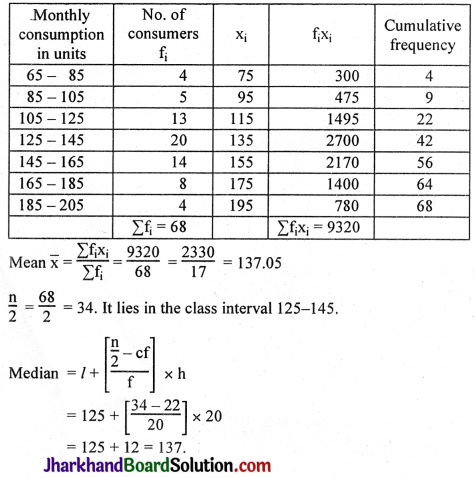
The following table shows the ages of the patients admitted in a hospital during a year:
JAC Class 10 Maths Solutions Chapter 14 Statistics Ex 14.2 1
Find the mode and the mean of the data given above. Compare and interpret the two measures of central tendency.
Solution:
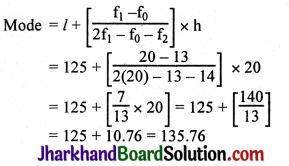
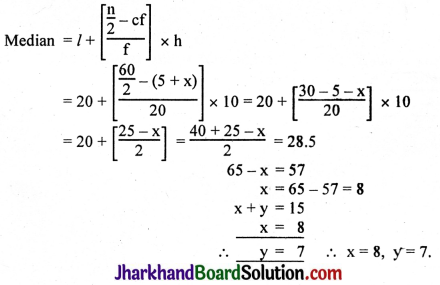
The class interval having the maximum frequencies is 35 – 45.
f1 = 23, l = 35, h = 10, f0 = 21, f2 = 14
JAC Class 10 Maths Solutions Chapter 14 Statistics Ex 14.2 2
JAC Class 10 Maths Solutions Chapter 14 Statistics Ex 14.2 3
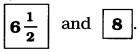
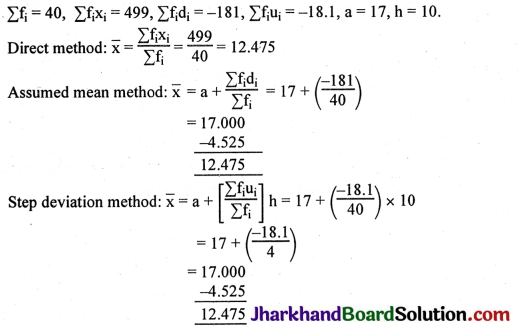
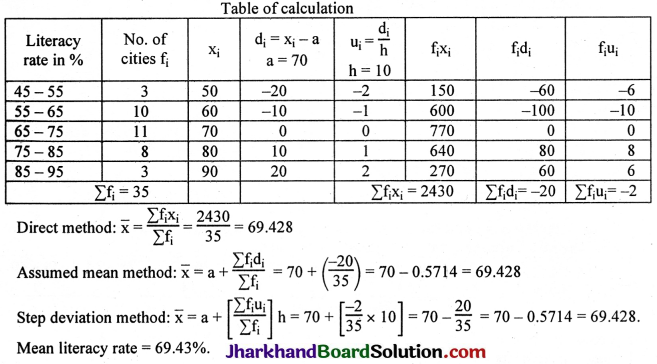
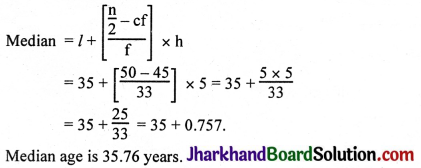
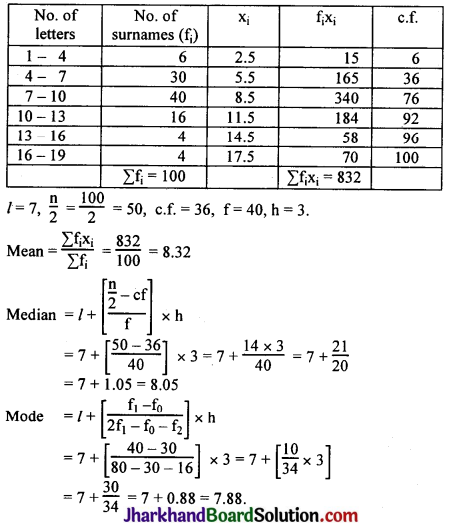
Maximum number of patients admitted in the hospital are of the age 36.8 years. The average age of the patient admitted to the hospital is 35.37 years.

JAC Class 10 Maths Solutions Chapter 14 Statistics Ex 14.2

Question 2.
The following data gives the information on the observed lifetimes (in hours) of 225 electrical
JAC Class 10 Maths Solutions Chapter 14 Statistics Ex 14.2 4
Determine the modal lifetimes of the components.
Class interval having the maximum frequency is 60 – 80.
f1 = 61, f0 = 52, f2 = 38, l = 60, h = 20.
JAC Class 10 Maths Solutions Chapter 14 Statistics Ex 14.2 5

Question 3.
The following data gives the distribution of total monthly household expenditure of 200 families of a village. Find the modal monthly expenditure of the families. Also, find the mean monthly expenditure:

Expenditure (in Rs.)No. of families
1000 – 150024
1500 – 200040
2000 – 250033
2500 – 300028
3000 – 350030
3500 – 400022
4000 – 450016
4500 – 50007

Solution:
JAC Class 10 Maths Solutions Chapter 14 Statistics Ex 14.2 6
Step deviation method: \(\bar{x}\) = a + \(\left[\frac{\sum f_i u_i}{\sum f_i}\right]\)h
= 3250 + \(\left[\frac{-235}{200}\right]\) × 500
= 3250 – \(\left[-\frac{1175}{2}\right]\)
= 3250 – 587.5
= 2662.5.
Mean expenditure Rs. 2662.50.
l = 1500, f1 = 40, f2 = 33, f0 = 24, h = 500
JAC Class 10 Maths Solutions Chapter 14 Statistics Ex 14.2 7
Modal monthly expenditure = 1847.83.

JAC Class 10 Maths Solutions Chapter 14 Statistics Ex 14.2

Question 4.
The following distribution gives the state-wise teacher-student ratio in higher secondary schools of India. Find the mode and mean of this data. Interpret the two measures.

Number of students per teacherNo. of states/U.T.
15 – 203
20 – 258
25 – 309
30 – 3510
35 – 403
40 – 450
45 – 500
50 – 552

Solution:
JAC Class 10 Maths Solutions Chapter 14 Statistics Ex 14.2 8
l = lower limit of the CI = 30, f1 = 10, f0 = 9, f2 = 3, h = 5
Mode = \(l+\left[\frac{\mathrm{f}_1-\mathrm{f}_0}{2 \mathrm{f}_1-\mathrm{f}_0-\mathrm{f}_2}\right] \times \mathrm{h}\)
= \(=30+\left[\frac{10-9}{20-9-3}\right] \times 5\)
= \(30+\left[\frac{1}{8} \times 5\right]=30+\frac{5}{8}\)
= 30 + 0.625 = 30.625.
Most states/UT’s have a student-teacher ratio of 30.6. On an average this ratio is 29.2.

Question 5.
The given distribution shows the number of runs scored by some top batsmen of the world in one-day international cricket matches.

Runs scoredNumber of batsmen
3000 – 40004
4000 – 500018
5000 – 60009
6000 – 70007
7000 – 80006
8000 – 90003
9000 – 100001
10000 – 110001

Find the mode of the data.
Solution:
l = 4000, f1 = 18, f0 = 4, f2 = 9, h = 1000
JAC Class 10 Maths Solutions Chapter 14 Statistics Ex 14.2 9

JAC Class 10 Maths Solutions Chapter 14 Statistics Ex 14.2

Question 6.
A student noted the number of cars passing through a spot on a road for 100 periods each of 3 minutes and summarised it in the table given below. Find the mode of the data.
JAC Class 10 Maths Solutions Chapter 14 Statistics Ex 14.2 10
Solution:
Class interval having the maximum frequency is 40 – 50. f1 = 20, f0 = 12, f2 = 11, l = 40, h = 10.
JAC Class 10 Maths Solutions Chapter 14 Statistics Ex 14.2 11

JAC Class 10 Maths Solutions Chapter 13 Surface Areas and Volumes Ex 13.2

Jharkhand Board JAC Class 10 Maths Solutions Chapter 13 Surface Areas and Volumes Ex 13.2 Textbook Exercise Questions and Answers.

JAC Board Class 10 Maths Solutions Chapter 13 Surface Areas and Volumes Exercise 13.2

Unless stated otherwise, take π = \(\frac{22}{7}\)

Question 1.
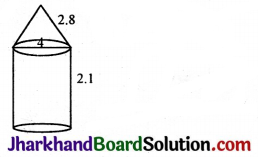
A solid is in the shape of a cone standing on a hemisphere with both their radii being equal to 1 cm and the height of the cone equal to its radius. Find the volume of the solid in terms οf π.
Solution:
The given solid is a combination of a cone and a hemisphere.
We have radius of the cone r = Radius of the hemisphere = 1 cm and height of the cone h = 1 cm.
JAC Class 10 Maths Solutions Chapter 13 Surface Areas and Volumes Ex 13.2 1
∴ Volume of the solid = Volume of the cone + Volume of the hemisphere
JAC Class 10 Maths Solutions Chapter 13 Surface Areas and Volumes Ex 13.2 2

Question 2.
Rachel, an engineering student, was asked to make a model shaped like a cylinder with two cones attached at its two ends by using a thin aluminium sheet. The diameter of the model is 3 cm and its length is 12 cm. If each cone has a height of 2 cm, find the volume of air contained in the model that Rachel made. (Assume the outer and inner dimensions of the model to be nearly the same.)
Solution:
d = 3 cm, AF = 8 cm = H, Ax = Fy = 2 cm = h, r = \(\frac{3}{2}\)
JAC Class 10 Maths Solutions Chapter 13 Surface Areas and Volumes Ex 13.2 3
Volume of the model = Volume of the cone ABC + Volume of the cylinder BCED + Volume of the cone DEF
JAC Class 10 Maths Solutions Chapter 13 Surface Areas and Volumes Ex 13.2 4

JAC Class 10 Maths Solutions Chapter 13 Surface Areas and Volumes Ex 13.2

Question 3.
A gulab jamun contains sugar syrup up to about 30% of its volume. Find approximately how much syrup would be found in 45 gulab jamuns, each shaped like a cylinder with two hemispherical ends with length 5 cm and diameter 2.8 cm.
Solution:
JAC Class 10 Maths Solutions Chapter 13 Surface Areas and Volumes Ex 13.2 5
Volume of 1 jamun = Volume of the cylinder + 2 × Volume of the hemisphere
JAC Class 10 Maths Solutions Chapter 13 Surface Areas and Volumes Ex 13.2 6

Question 4.
A pen stand made of wood is in the shape of a cuboid with four conical depressions to hold pens. The dimensions of the cuboid are 15 cm by 10 cm by 3.5 cm. The radius of each of the depressions is 0.5 cm and the depth is 1.4 cm. Find the volume of wood in the entire stand.
Solution:
JAC Class 10 Maths Solutions Chapter 13 Surface Areas and Volumes Ex 13.2 7
Volume of wood in the stand = Volume of the cuboid – Volume of wood lost in making four conical depressions
JAC Class 10 Maths Solutions Chapter 13 Surface Areas and Volumes Ex 13.2 8

Question 5.
A vessel is in the form of an inverted cone. Its height is 8 cm and the radius of its top, which is open, is 5 cm. It is filled with water up to the brim. When lead shots, each of which is a sphere of radius 0.5 cm are dropped into the vessel, one-fourth of the water flows out. Find the number of lead shots dropped in the vessel.
Solution:
Volume of water in the cone = \(\frac{\pi r^2 h}{3}\)
= \(\frac{1}{3} \times \frac{22}{7}\) × 5 × 5 × 8 cc.
= \(\frac{22 \times 25 \times 8}{21}\) c.c.
When some lead shots are dropped into the vessel, volume of the water that flows out
JAC Class 10 Maths Solutions Chapter 13 Surface Areas and Volumes Ex 13.2 9
= \(\frac{1}{4} \times \frac{22 \times 25 \times 8}{21}\)
= \(\frac{22 \times 25 \times 2}{21}\) cc
This is equal to the volume of the lead shots dropped.
Volume of a lead shot = \(\frac{4}{3}\)πr3
Let the no. of lead shots dropped be x.
The volume of x lead shots = Volume of water overflown
JAC Class 10 Maths Solutions Chapter 13 Surface Areas and Volumes Ex 13.2 10
Number of lead shots dropped = 100.

JAC Class 10 Maths Solutions Chapter 13 Surface Areas and Volumes Ex 13.2

Question 6.
A solid iron pole consists of a cylinder of height 220 cm and base diameter 24 cm, which is surrounded by another cylinder of height 60 cm and radius 8 cm. Find the mass of the pole, given that 1 cm3 of iron has approximately 8 g mass. (Use π = 3.14).
Solution:
R = 12, r = 4.
Common factor of 144 and 64 is 16 (HCF)
HCF of 220 and 60 is 20.
1 kg = 1000 gms.
JAC Class 10 Maths Solutions Chapter 13 Surface Areas and Volumes Ex 13.2 11
Volume of the given solid = Volume of the bigger cylinder + Volume of the surmounted cylinder
= πR2H + πr2h
= 3.14 × 122 × 220 + 3.14 × 82 × 60
= 3.14 × 144 × 220 + 3.14 × 64 × 60
= 3.14 × 16 × 20(9 × 11 + 4 × 3)
= 3.14 × 320(99 + 12)
= 3.14 × 320 × 111 c.c.
Mass of the solid = Volume × density
= 3.14 × 320 × 111 × 8 gm
= \(\frac{3.14 \times 320 \times 111 \times 8}{1000}\)kg.
= \(\frac{3.14 \times 32 \times 888}{100}\)
= 3.14 × 32 × 8.88
= 892.26 kg.

Question 7.
A solid consisting of a right circular cone of height 120 cm and radius 60 cm standing on a hemisphere of radius 60 cm is placed upright in a right circular cylinder full of water such that it touches the bottom. Find the volume of water left in the cylinder, if the radius of the cylinder is 60 cm and its height is 180 cm.
Solution:
h = 180 (cylinder), H = 120 (Cone).
Volume of the solid given = Volume of the cone + Volume of the hemisphere
JAC Class 10 Maths Solutions Chapter 13 Surface Areas and Volumes Ex 13.2 12
Volume of water left in the cylinder = Volume of water in the cylinder – Volume of the solid immersed
JAC Class 10 Maths Solutions Chapter 13 Surface Areas and Volumes Ex 13.2 13
JAC Class 10 Maths Solutions Chapter 13 Surface Areas and Volumes Ex 13.2 14

JAC Class 10 Maths Solutions Chapter 13 Surface Areas and Volumes Ex 13.2

Question 8.
A spherical glass vessel has a cylindrical neck 8 cm long, 2 cm in diameter; the diameter of the spherical part is 8.5 cm. By measuring the amount of water it holds, a child finds its volume to be 345 cm3. Check whether she is correct, taking the above as the inside measurements, and π = 3.14.
Solution:
r = \(\frac{8.5}{2}\), R = \(\frac{2}{2}\) = 1
JAC Class 10 Maths Solutions Chapter 13 Surface Areas and Volumes Ex 13.2 15
Volume of water in the vessel = Volume of water in the spherical part + Volume of water in the cylindrical neck.
JAC Class 10 Maths Solutions Chapter 13 Surface Areas and Volumes Ex 13.2 16
= 3.14 × 110.354 = 346.51 cm3.
The child’s answer is wrong.

JAC Class 10 Maths Notes Chapter 3 दो चरों वाले रखिक समीकरण का युग्म

Students should go through these JAC Class 10 Maths Notes Chapter 3 दो चरों वाले रखिक समीकरण का युग्म will seemingly help to get a clear insight into all the important concepts.

JAC Board Class 10 Maths Notes Chapter 3 दो चरों वाले रखिक समीकरण का युग्म

भूमिका :
हम पिछली कक्षाओं में सरल समीकरणों अर्थात् प्रथम घात ( रैखिक) तथा एक अज्ञात राशि (चर) के समीकरण का अध्ययन कर चुके हैं। व्यापक रूप में इन्हें ax + b = 0 या ax + b = c के द्वारा निरूपित किया जाता है, जहाँ a, b, c वास्तविक संख्याएँ हैं। a ≠ 0 तथा x चर है। हम यह भी जानते हैं कि ax + b = 0, a ≠ 0 का हल x = –\(\frac{b}{a}\) होता है तथा x = –\(\frac{b}{a}\) समीकरण ax + b = 0 का मूल (Root) कहलाता है।
इस अध्याय में हम दो चरों वाले रैखिक समीकरण युग्म को बीजगणितीय तथा आलेखीय विधियों से हल करेंगे।

दो चरों में रैखिक समीकरण युग्म :
समीकरण ax + by + c = 0 दो चरों वाले रैखिक समीकरण का व्यापक रूप कहलाता है जिसमें a, b, c वास्तविक संख्याएँ होती हैं तथा a ≠ 0, b ≠ 0. जैसे- 3x + 4y + 7 = 0, -5y + x = -2 तथा 2x + \(\frac{3}{11}\)y = 1 आदि दो चरों वाले रेखीय समीकरणों के कुछ उदाहरण हैं।
यदि समीकरण ax + by + c = 0 में a ≠ 0, b = 0 हो, तो यह समीकरण परिवर्तित होकर ax + c = 0 रूप ले लेती है जो कि एक घर में रैखिक समीकरण है। इसी प्रकार यदि तो ax + by + c = 0 परिवर्तित होकर by + c = 0 के रूप में आ जाती है जो कि पुनः एक चर y में रैखिक समीकरण है।
दो चरों में दो रैखिक समीकरण एक रैखिक समीकरणों का युग्म कहलाता है। ऐसे समीकरणों के युग्म को युगपत समीकरण भी कहते हैं।
a1x + b1y + c1 = 0 तथा a2x + b2y + c2 = 0 रैखिक समीकरण युग्म का सबसे व्यापक रूप है। जहाँ a1, b1, c1, a2, b2, c2 ऐसी वास्तविक संख्याएँ हैं कि
a12 + b12 ≠ 0, a22 + b22 ≠ 0.

दो चरों वाले रैखिक समीकरण युग्म का हल : दो चरों वाले रैखिक समीकरण को हल करने की दो विधियाँ हैं-
(i) लेखाचित्र विधि (Graphical Method),
(ii) बीजगणितीय विधि (Algebraic Method)
JAC Class 10 Maths Notes Chapter 3 दो चरों वाले रखिक समीकरण का युग्म 1
लेखाचित्र विधि (Graphical Method)
दो चरों वाले रैखिक समीकरण युग्म का ग्राफीय हल :
(i) सबसे पहले समीकरण युग्म का एक समीकरण लिखिए।
(ii) अब x का कोई पूर्णांक मान लेकर समीकरण में x के स्थान पर प्रतिस्थापित कर, चर y का मान निकाल लेते हैं।
(iii) यदि x का मान a तथा y का मान b प्राप्त होता है, तो एक बिन्दु (a, b) को ग्राफ पर अंकित करते हैं।
(iv) पुन: इसी प्रकार x का अन्य कोई दूसरा पूर्णांक समीकरण में प्रतिस्थापित कर y का मान निकाल लेते हैं।
(v) यदि अब x का मान c तथा y का मान d प्राप्त होता है तब बिन्दु (c, d) को ग्राफ पर अंकित करते हैं।
(vi) अब इन दोनों अंकित बिन्दुओं से ग्राफ पेपर पर आलेख खींचते हैं।
(vii) इस प्रकार पहले समीकरण का आलेख एक सरल रेखा प्राप्त होती है।
(viii) अब समीकरण युग्म का दूसरा समीकरण लेकर, ऊपर बताए गये बिन्दुओं के अनुसार दूसरे समीकरण का भी आलेख खींचते हैं।
(ix) दूसरे समीकरण का आलेख भी एक सरल रेखा प्राप्त होती है।
(x) ये दोनों सरल रेखाएँ परस्पर काटेंगी (Intersecting lines) या फिर समान्तर (Parallel lines) होंगी अथवा सम्पाती (Conincident lines) होंगी।

सम्पाती हो तो समीकरण युग्म के अनन्त (अपरिमित) सार्व हल प्राप्त होंगे-
इस प्रकार आलेखीय निरूपण निम्न प्रकार प्राप्त होता है-
JAC Class 10 Maths Notes Chapter 3 दो चरों वाले रखिक समीकरण का युग्म 2

JAC Class 10 Maths Notes Chapter 3 दो चरों वाले रखिक समीकरण का युग्म

रेखीय समीकरणों के संगत व असंगत युग्म :
संगत युग्म (Consistent pair) : यदि समीकरणों के निकाय a1x + b1y + c1 = 0; a2x + b2y + c2 = 0 के हल विद्यमान हैं, तो दिया गया समीकरण निकाय संगत निकाय कहलाता है।
संगत निकाय के निम्न दो प्रकार हैं :
(i) दो प्रतिच्छेदी रेखाएँ निरूपित करेगा अर्थात् अद्वितीय हल (Unique solution) होते हैं।
\(\frac{a_1}{a_2} \neq \frac{b_1}{b_2}\)
(ii) दो सम्पाती रेखाएँ निरूपित करेगा अर्थात् अनन्त हल (Infinitely many solutions) होते हैं।
\(\frac{a_1}{a_2}=\frac{b_1}{b_2}=\frac{c_1}{c_2}\)
असंगत युग्म (Inconsistent pair) : जब समीकरण निकाय a1x + b1y + c1 = 0; a2x + b2y + c2 = 0 का कोई भी हल विद्यमान नहीं होता तब वह निकाय असंगत निकाय कहलाता है।
(iii) दो समान्तर रेखाएँ निरूपित करेगा अर्थात् कोई हल नहीं (No solution) होते हैं।
\(\frac{a_1}{a_2}=\frac{b_1}{b_2} \neq \frac{c_1}{c_2}\)

रैखिक समीकरण युग्म का ग्राफीय विधि से हल में रेखाओं का व्यवहार :
दो चरों वाले दो समीकरणों के निकाय को निरूपित करने वाली रेखाओं के व्यवहार और हलों के होने या न होने का सार संक्षेप में निम्न प्रकार है-
(i) रेखाएँ केवल एक बिन्दु पर प्रतिच्छेद करें, तो समीकरणों का एक अद्वितीय हल होगा। – संगत समीकरण युग्म ।
(ii) रेखाएँ समान्तर भी हो सकती हैं तो इस स्थिति में समीकरणों का कोई हल नहीं होगा। – असंगत समीकरण युग्म।
(iii) रेखाएँ सम्पाती हो सकती हैं, समीकरणों के अपरिमित रूप से अनेक हल होंगे।
आश्रित (संगत) समीकरण युग्म रेखाओं के सामान्य समीकरणों को इस प्रकार निरूपित कर सकते हैं :
a1x + b1y + c1 = 0 और a2x + b2y + c2 = 0
जहाँ a1, a2, b1, b2, c1, c2 वास्तविक संख्याएँ हैं (a1 ≠ 0, b1 ≠ 0, a2 ≠ 0, b2 ≠ 0)
(i) प्रतिच्छेद करें तो \(\frac{a_1}{a_2} \neq \frac{b_1}{b_2}\); समीकरण: युग्म संगत होगा और उसका एक और केवल एक ही (अद्वितीय) हल होगा।
(ii) सम्पाती हों तो \(\frac{a_1}{a_2}=\frac{b_1}{b_2}=\frac{c_1}{c_2}\); समीकरण युग्म संगत होगा और उसके अपरिमित रूप से अनेक हल होंगे।
(iii) समान्तर हों तो \(\frac{a_1}{a_2}=\frac{b_1}{b_2} \neq \frac{c_1}{c_2}\); समीकरण युग्म असंगत होगा और उसका कोई हल नहीं होगा।
किसी भी रेखाओं के युग्म के लिए विलोम भी सत्य है।

एक रैखिक समीकरण युग्म को हल करने की बीजगणितीय विधि (Algebraic Method to Solve a Pair of Linear Equations in Two Variables) :
रैखिक समीकरण युग्म को हल करने की तीन बीजीय विधियाँ हैं-
(1) प्रतिस्थापन विधि (Method of Substitution)
(2) विलोपन विधि (Method of Elimination)
(3) वज्रंगुणन विधि (Method of Cross multiplication)

JAC Class 10 Maths Notes Chapter 3 दो चरों वाले रखिक समीकरण का युग्म

प्रतिस्थापन विधि क्रियाविधि (Working Rule) :
चरण 1. किसी एक समीकरण से एक चर x को दूसरे चर के पदों के रूप में लिख लेते हैं।
चरण 2. y के पदों में प्राप्त x के इस मान को युग्म के शेष दूसरे समीकरण में x के स्थान पर प्रतिस्थापित करके y का मान निकाल सकते हैं।
चरण 3. y के इस मान को किसी एक समीकरण में प्रतिस्थापित कर x का मान निकाल सकते हैं।

निराकरण या विलोपन विधि (Elimination Method) :
इस विधि में एक चर का विलोपन करते हैं या उसे हटा देते हैं। यह विधि कभी-कभी प्रतिस्थापन विधि से अधिक सुविधाजनक रहती है।
गुणांकों को बराबर करके हल सर्वप्रथम हम दोनों युगपत् समीकरणों को ऐसे शून्येतर गुणांकों अर्थात् शून्य को छोड़कर अन्य गुणांकों से गुणा करके दोनों समीकरणों में एक अज्ञात राशि या y के गुणांक बराबर कर लेते हैं। अब दोनों समीकरणों को आवश्यकतानुसार जोड़कर या घटाकर समान गुणांकों वाली राशि को विलुप्त करते हैं। अब हमें एक अज्ञात राशि वाला समीकरण प्राप्त होता है जिसे हल करके अज्ञात राशि का मान ज्ञात करते हैं इस मान को किसी भी एक समीकरण में प्रतिस्थापित कर दूसरी अज्ञात राशि का मान ज्ञात कर लेते हैं।

वज्रगुणन विधि (Method of Cross Multiplication) :
इस विधि में दोनों समीकरणों को इस प्रकार लिख लेते हैं कि उनके दायें पक्ष में शून्य हो ।
माना समीकरण a1x + b1y + c1 = 0.
तथा a2x + b2y + c2 = 0 हैं।
अब निम्न प्रकार लिखकर x और y के मान ज्ञात कर लेते हैं-
\(\frac{x}{b_1 c_2-b_2 c_1}=\frac{y}{c_1 a_2-c_2 a_1}=\frac{1}{a_1 b_2-a_2 b_1}\)
उपर्युक्त हल को स्मरणीय रूप में निम्न प्रकार लिखकर प्राप्त किया जा सकता है-
JAC Class 10 Maths Notes Chapter 3 दो चरों वाले रखिक समीकरण का युग्म 3
इस आरेख के अनुसार नीचे की ओर तीर वाली (↓) संख्याओं के गुणनफल में से ऊपर की ओर तीर वाली (↑) संख्याओं के गुणनफल को घटाकर लिखा जा सकता है।
अथवा
\(\frac{x}{b_1 c_2-b_2 c_1}=\frac{y}{c_1 a_2-c_2 a_1}=\frac{1}{a_1 b_2-a_2 b_1}\)

JAC Class 10 Maths Notes Chapter 3 दो चरों वाले रखिक समीकरण का युग्म

दो चरों के रैखिक समीकरणों के युग्म में बदले जा सकने वाले समीकरण :
यदि समीकरण ax + by + c = 0 के रूप में नहीं है अर्थात् \(\frac{a}{x}+\frac{b}{y}+c\) = 0 के रूप में है, तो इसे रैखिक समीकरण के रूप में निम्न प्रकार बदला जा सकता है :
माना \(\frac{1}{x}\) = P और \(\frac{1}{y}\) = q प्रतिस्थापित करने पर,
ap + bq + c = 0 प्रकार का रैखिक समीकरण बना कर हल करते हैं।

JAC Class 10 Maths Solutions Chapter 3 Pair of Linear Equations in Two Variables Ex 3.6

Jharkhand Board JAC Class 10 Maths Solutions Chapter 3 Pair of Linear Equations in Two Variables Ex 3.6 Textbook Exercise Questions and Answers.

JAC Board Class 10 Maths Solutions Chapter 3 Pair of Linear Equations in Two Variables Exercise 3.6

Question 1.
Sovle the following pairs of equations by reducing them to a pair of linear equations:
JAC Class 10 Maths Solutions Chapter 3 Pair of Linear Equations in Two Variables Ex 3.6 1
Solution:
1. The given pair of equations is
JAC Class 10 Maths Solutions Chapter 3 Pair of Linear Equations in Two Variables Ex 3.6 2
Taking \(\frac{1}{x}=a\) and \(\frac{1}{y}=b\) in both the equations, we get
\(\frac{1}{2}\)a + \(\frac{1}{3}\)b = 2 ……….(3)
\(\frac{1}{3}\)a + \(\frac{1}{2}\)b = \(\frac{13}{6}\) ………..(4)
Multiplying both the equations by 6, we get
3a + 2b = 12 ……(5)
2a + 3b = 13 ……(6)
Adding equations (5) and (6), we get
5a + 5b = 25
∴ a + b = 5 ……….(7)
Subtracting equation (6) from equation (5), we get
a – b = -1 ………..(8)
Equations (7) and (8) can be solved easily to get a = 2 and b = 3.
Then a = \(\frac{1}{x}\) = 2 and b = \(\frac{1}{y}\) = 3
∴ x = \(\frac{1}{2}\) and y = \(\frac{1}{3}\)
Thus, the solution of the given pair of equations is x = \(\frac{1}{2}\), y = \(\frac{1}{3}\)

2. The given pair of equations is
\(\frac{2}{\sqrt{x}}+\frac{3}{\sqrt{y}}=2\) ……….(1)
\(\frac{4}{\sqrt{x}}-\frac{9}{\sqrt{y}}=-1\) ……….(2)
Taking \(\frac{1}{\sqrt{x}}=a\) and \(\frac{1}{\sqrt{y}}=b\) in both the equations, we get
2a + 3b = 2 ……….(3)
4a – 9b = -1 ……….(4)
Multiplying equation (3) by 3, we get
6a + 9b = 6 ……….(5)
Adding equations (4) and (5). we get
(4a – 9b) + (6a + 9b) = -1 + 6
∴ 10a = 5
∴ a = \(\frac{1}{2}\)
Substituting a = \(\frac{1}{2}\) in equation (3), we get
2(\(\frac{1}{2}\)) + 3b = 2
∴ 1 + 3b = 2
∴ 3b = 1
∴ b = \(\frac{1}{3}\)
Now, a = \(\frac{1}{\sqrt{x}}=\frac{1}{2}\)
∴ 2 = \(\sqrt{x}\)
∴ x = 4
Again b = \(\frac{1}{\sqrt{y}}=\frac{1}{3}\)
∴ 3 = \(\sqrt{y}\)
∴ y = 9
Thus, the solution of the given pair of equations is x = 4, y = 9,

3. The given pair of equations is
\(\frac{4}{x}\) + 3y = 14 ……….(1)
\(\frac{3}{x}\) – 4y = 23 ……….(2)
Taking \(\frac{1}{x}\) = a in both the equations, we get
4a + 3y = 14 ……….(3)
3a – 4y = 23 ……….(4)
Multiplying equation (3) by 4 and equation (4) by 3 and adding them, we get
4(4a + 3y) + 3(3a – 4y) = 4(14) + 3(23)
∴ 16a + 12y + 9a – 12y = 56 + 69
∴ 25a = 125
∴ a = 5
Now, a = \(\frac{1}{x}\) = 5
∴ x = \(\frac{1}{5}\)
Substituting x = \(\frac{1}{5}\) in equation (1), we get
\(\frac{4}{\frac{1}{5}}\) + 3y = 14
∴ 20 + 3y = 14
∴ 3y = -6
∴ y = -2
Thus, the solution of the given pair of equations is x = \(\frac{1}{5}\), y = -2.

4. The given pair of equations is
\(\frac{5}{x-1}+\frac{1}{y-2}=2\) ………..(1)
\(\frac{6}{x-1}-\frac{3}{y-2}=1\) …………(2)
Taking \(\frac{1}{x-1}=a\) and \(\frac{1}{y-2}=b\) in both the equations, we get
5a + b = 2 ………..(3)
6a – 3b = 1 ………..(4)
Multiplying equation (3) by 3 and then additing equation (4) to it, we get
3(5a + b) + (6a – 3b) = 3(2) + 1
∴ 15a + 3b + 6a – 3b = 6 + 1
∴ 21a = 7
a = \(\frac{1}{3}\)
Substituting a = \(\frac{1}{3}\) in equation (4), we get
6(\(\frac{1}{3}\)) – 3b = -1
∴ 2 – 3b = 1
∴ 1 = 3b
∴ b = \(\frac{1}{3}\)
Now, a = \(\frac{1}{x-1}=\frac{1}{3}\)
∴ x – 1 = 3
∴ x = 4
Again, b = \(\frac{1}{y-2}=\frac{1}{3}\)
∴ y – 2 = 3
∴ y = 5
Thus, the solution of the given pair of equations is x = 4, y = 5.

5. The given pair of equations is \(\frac{7 x-2 y}{x y}=5\) and \(\frac{8 x+7 y}{x y}=15\)
Hence, \(\frac{7}{y}-\frac{2}{x}=5\) ………..(1)
and \(\frac{8}{y}+\frac{7}{x}=15\) ………..(2)
Taking \(\frac{1}{y}\) = a and \(\frac{1}{y}\) = b in both the equations, we get
7a – 2b = 5 ………..(3)
8a + 7b = 15 ………..(4)
Expressing the equation in the standard form, we get
7a – 2b – 5 = 0 and 8a + 7b – 15 = 0
JAC Class 10 Maths Solutions Chapter 3 Pair of Linear Equations in Two Variables Ex 3.6 3
Now, a = \(\frac{1}{y}\) = 1 ∴ y = 1
and b = \(\frac{1}{x}\) = 1 ∴ x = 1
Thus, the solution of the given pair of equations is x = 1, y = 1.

6. The given pair of equations is 6x + 3y = 6xy and 2x + 4y = 5xy
Dividing both the equations by xy, we get
\(\frac{6}{y}+\frac{3}{x}=6\) ………..(1)
\(\frac{2}{y}+\frac{4}{x}=5\) ………..(2)
Taking \(\frac{1}{y}\) = a and \(\frac{1}{x}\) = b,
we get
6a + 3b = 6
i.e., 2a + b = 2 ……(3)
2a + 4b = 5 ……(4)
Subtracting equation (3) from equation (4),
we get
(2a + 4b) – (2a + b) = 5 – 2
∴ 3b = 3
∴ b = 1
Substituting b = 1 in equation (3), we get
2a + 1 = 2
∴ 2a = 1
∴ a = \(\frac{1}{2}\)
Now, a = \(\frac{1}{y}=\frac{1}{2}\) ∴ y = 2
and b = \(\frac{1}{x}\) = 1 ∴ x = 1
Thus, the solution of the given pair of equations is x = 1, y = 2.

7. The given pair of equations is
\(\frac{10}{x+y}+\frac{2}{x-y}=4\) ………..(1)
\(\frac{15}{x+y}-\frac{5}{x-y}=-2\) ………..(2)
Taking \(\frac{1}{x+y}=a\) and \(\frac{1}{x-y}=b\) in both the equations, we get
10a + 2b = 4
i.e., 5a + b = 2 ……(3)
15a – 5b = -2 ……(4)
Multiplying equation (3) by 5 and then adding equation (4) to it, we get
5(5a + b) + (15a – 5b) = 5(2) + (-2)
∴ 25a + 5b + 15a – 5b = 10 – 2
∴ 40a = 8
∴ a = \(\frac{1}{5}\)
Substituting a = \(\frac{1}{5}\) in equation (3), we get
5(\(\frac{1}{5}\)) + b = 2
∴ 1 + b = 2
∴ b = 1
Now, a = \(a=\frac{1}{x+y}=\frac{1}{5}\)
∴ x + y = 5 ……(5)
and b = \(\frac{1}{x-y}=1\)
∴ x – y = 1 ………(6)
Adding equations (5) and (6), we get
2x = 6
∴ x = 3
Substituting x = 3 in equations (5), we get
3 + y = 5
∴ y = 2
Thus, the solution of the given pair of equations is x = 3, y = 2.

8. The given pair of equations is
\(\frac{1}{3 x+y}+\frac{1}{3 x-y}=\frac{3}{4}\) ………(1)
\(\frac{1}{2(3 x+y)}-\frac{1}{2(3 x-y)}=-\frac{1}{8}\) ………(2)
Taking \(\frac{1}{3 x+y}=a\) and \(\frac{1}{3 x-y}=b\) in both the equations, we get
a + b = \(\frac{3}{4}\) ………(3)
\(\frac{a}{2}-\frac{b}{2}=-\frac{1}{8}\)
i.e., a – b = –\(\frac{2}{8}\)
i.e., a – b = –\(\frac{1}{4}\) ………….(4)
Adding equations (3) and (4), we get
2a = \(\frac{2}{4}\)
∴ a = \(\frac{1}{4}\)
Substituting a = \(\frac{1}{4}\) in equation (3), we get
\(\frac{1}{4}+b=\frac{3}{4}\)
∴ b = \(\frac{1}{2}\)
Now, a = \(\frac{1}{3 x+y}=\frac{1}{4}\)
3x + y = 4 ………….(5)
and b = \(\frac{1}{3 x-y}=\frac{1}{2}\)
∴ 3x – y = 2 ………….(6)
Adding equations (5) and (6), we get
6x = 6
∴ x = 1
Substituting x = 1 in equations (5), we get
3(1) + y = 4
∴ y = 1
Thus, the solution of the given pair of equations is x = 1, y = 1.

JAC Class 10 Maths Solutions Chapter 3 Pair of Linear Equations in Two Variables Ex 3.6

2. Formulate the following problems as a pair of equations, and hence find their solutions:

Question 1.
Ritu can row downstream 20 km in 2 hours, and upstream 4 km in 2 hours. Find her speed of rowing in still water and the speed of the current.
Solution:
Let Ritu’s speed of rowing in still water be x km/h and the speed of the current by y km/h.
Then, her net speed going down-stream = (x + y) km/h and her net speed going upstream = (x – y) km/h.
Also, time = \(\frac{\text { distance }}{\text { speed }}\)
Then, form the first condition, we get
2 = \(\frac{20}{x+y}\)
∴ x + y = 10 ……(1)
And, from the second condition, we get
2 = \(\frac{4}{x-y}\)
∴ x – y = 2 ………..(2)
Adding equations (1) and (2), we get
2x = 12
∴ x = 6
Substituting x = 6 in equation (1), we get
6 + y = 10
∴ y = 4
Thus, Ritu’s speed of rowing in still water is 6 km/h and the speed of the current is 4 km/h.

Question 2.
2 women and 5 men can together finish an embroidery work in 4 days. while 3 women and 6 men can finish it in 3 days. Find the time taken by 1 woman alone to finish the work, and also that taken by 1 man alone.
Solution:
Suppose that 1 woman alone can finish the work in x days and 1 man alone can finish the work in y days.
∴ Work done by 1 woman in 1 day = \(\frac{1}{x}\) part and work done by 1 man in 1 day \(\frac{1}{y}\) part.
Then, work done by 2 women and 5 men together in 1 day = \(\left(\frac{2}{x}+\frac{5}{y}\right)\) part.
But, according to the first information given, 2 women and 5 men together finish the work in 4 days, i.e., in one day they can finish \(\frac{1}{4}\) part of the work.
Hence, we get the following equation:
\(\frac{2}{x}+\frac{5}{y}=\frac{1}{4}\) ……(1)
Similarly, from the second information given, we get
\(\frac{3}{x}+\frac{6}{y}=\frac{1}{3}\) ……(2)
Taking \(\frac{1}{x}\) = a and \(\frac{1}{y}\) = b in both the equations, we get
2a + 5b = \(\frac{1}{4}\) ……(3)
3a + 6b = \(\frac{1}{3}\) ……(4)
Multiplying equation (3) by 6 and equation (4) by 5, we get
12a + 30b = \(\frac{6}{4}\) ……(5)
15a + 30b = \(\frac{5}{3}\) ……(6)
Subtracting equation (5) from equation (6), we get
(15a + 30b) – (12a + 30b) = \(\frac{5}{3}-\frac{6}{4}\)
15a + 30b – 12a – 30b = \(\frac{20-18}{12}\)
∴ 3a = \(\frac{2}{12}\)
∴ a = \(\frac{1}{18}\)
Substituting a = \(\frac{1}{18}\) in equation (3), we get
2(\(\frac{1}{18}\)) + 5b = 4
∴ 5b = \(\frac{1}{4}-\frac{1}{9}\)
∴ 5b = \(\frac{5}{36}\)
∴ b = \(\frac{1}{36}\)
Now, a = \(\frac{1}{x}=\frac{1}{18}\) ∴ x = 18
and b = \(\frac{1}{y}=\frac{1}{36}\) ∴ y = 36
Thus, 1 woman alone can finish the work in 18 days and 1 man alone can finish the work in 36 days.

JAC Class 10 Maths Solutions Chapter 3 Pair of Linear Equations in Two Variables Ex 3.6

Question 3.
Roohi travels 300 km to her home partly by train and partly by bus. She takes 4 hours if she travels 60 km by train and the remaining by bus. If she travels 100 km by train and the remaining by bus, she takes 10 minutes longer. Find the speed of the train and the bus separately.
Solution:
Let the speed of the train be x km/h and the speed of the bus be y km/h.
Also, time = \(\frac{\text { distance }}{\text { speed }}\)
In the first case, she travels 60 km by train and the remaining 240 km (300 – 60) by bus.
∴ Time taken for journey by train = \(\frac{60}{x}\)h and time taken for journey by bus \(\frac{240}{y}\)h.
∴ Total time taken = \(\left(\frac{60}{x}+\frac{240}{y}\right)\)h
In the first case, total time taken = 4 h.
Hence, we get the following equation:
\(\frac{60}{x}+\frac{240}{y}=4\) ………..(1)
Similarly, in the second case, the distances she travels by train and bus are 100 km and 200 km respectively and time taken by those journies are \(\frac{100}{x}\)h and \(\frac{200}{y}\)h respectively.
In this case, the total time taken = 4 hours + 10 minutes = 4\(\frac{1}{6}\) hours.
Hence, we get the following equation:
\(\frac{100}{x}+\frac{200}{y}=4 \frac{1}{6}\)
∴ \(\frac{100}{x}+\frac{200}{y}=\frac{25}{6}\) ………..(2)
Taking \(\frac{1}{x}\) = a and \(\frac{1}{y}\) = b in both the equations, we get
60a + 240b = 4 ………..(3)
100a + 200b = \(\frac{25}{6}\) ………..(4)
Multiplying equation (3) by 5 and equation (4) by 6, we get
300a + 1200b = 20 ………..(5)
600a + 1200b = 25 ………..(6)
Subtracting equation (5) from equation (6), we get
(600a + 1200b) – (300a + 1200b) = 25 – 20
∴ 300a = 5
∴ a = \(\frac{1}{60}\)
Substituting a = \(\frac{1}{60}\) in (3), we get
60(\(\frac{1}{60}\)) + 240b = 4
∴ 1 + 240b = 4
∴ 240b = 3
∴ b = \(\frac{1}{80}\)
Now, a = \(\frac{1}{x}\) = \(\frac{1}{60}\)
∴ x = 60
and b = \(\frac{1}{y}\) = \(\frac{1}{80}\)
∴ y = 80
Thus, the speed of the train is 60 km/h and the speed of the bus is 80 km/h.

JAC Class 10 Maths Solutions Chapter 2 Polynomials Ex 2.4

Jharkhand Board JAC Class 10 Maths Solutions Chapter 2 Polynomials Ex 2.4 Textbook Exercise Questions and Answers.

JAC Board Class 10 Maths Solutions Chapter 2 Polynomials Exercise 2.4

Question 1.
Verify that the numbers given alongside of the cubic polynomials below are their zeroes. Also verify the relationship between the zeroes and the coefficients in each case:
1. 2x3 + x2 – 5x + 2; \(\frac{1}{2}\), 1, -2
2. x3 – 4x2 + 5x – 2; 2, 1, 1
Solution:
1. Let p(x) = 2x3 + x2 – 5x + 2
JAC Class 10 Maths Solutions Chapter 2 Polynomials Ex 2.4 1
Hence, \(\frac{1}{2}\) is a zero of
p(x) = 2x3 + x2 – 5x + 2.
Again,
p(1) = 2(1)3 + (1)2 – 5(1) + 2
= 2 + 1 – 5 + 2 = 0
Hence, 1 is a zero of p(x) = 2x3 + x2 – 5x + 2.
Again,
p(-2) = 2(-2)2 + (-2)2 – 5(-2)+2
= -16 + 4 + 10 + 2 = 0
Hence, -2 is a zero of
p(x) = 2x3 + x2 – 5x + 2.
Now, for p(x) = 2x3 + x2 – 5x + 2;
a = 2, b = 1, c = -5 and d = 2.
The zeroes of p (x) are α = \(\frac{1}{2}\), β = 1 and γ = -2.
Now, α + β + γ = \(\frac{1}{2}\) + 1 + (-2)
= \(-\frac{1}{2}=\frac{-(1)}{2}=\frac{-b}{a}\)
αβ + βγ + γα = (\(\frac{1}{2}\)) (1) + (1) (-2) + (-2) (\(\frac{1}{2}\))
= \(\frac{1}{2}\) – 2 – 1 = \(\frac{-5}{2}=\frac{c}{a}\) and
αβγ = (\(\frac{1}{2}\))(1)(-2) = -1 = \(\frac{-(2)}{(2)}=\frac{-d}{a}\)

2. Let p (x) = x3 – 4x2 + 5x – 2.
Then, p (2) = (2)3 – 4(2)2 + 5(2) – 2
= 8 – 16 + 10 – 2 = 0
Hence, 2 is a zero of p (x) = x3 – 4x2 + 5x – 2.
Again,
p(1) = (1)3 – 4(1)2 + 5(1) – 2
= 1 – 4 + 5 – 2 = 0
Hence, 1 is a repeated zero of p(x) = x3 – 4x2 + 5x – 2.
Now, for p(x) = x3 – 4x2 + 5x – 2, a = 1, b = -4, c = 5 and d = -2.
The zeroes of p (x) are α = 2, β = 1 and γ = 1.
Now,
α + β + γ = 2 + 1 + 1 = 4 = \(\frac{-(-4)}{1}=\frac{-b}{a}\)
αβ + βγ + γα = (2) (1) + (1) (1) + (1) (2)
= 2 + 1 + 2 = 5 = \(\frac{5}{1}=\frac{c}{a}\) and
αβγ = (2) (1) (1) = 2 = \(\frac{-(-2)}{1}=\frac{-d}{a}\)

JAC Class 10 Maths Solutions Chapter 2 Polynomials Ex 2.4

Question 2.
Find a cubic polynomial with the sum of its zeroes, sum of the product of its zeroes taken two at a time, and the product of its zeroes as 2, 7, 14 respectively.
Solution:
Let p (x) = ax3 + bx2 + cx + d, a ≠ 0, be the required cubic polynomial and its zeroes be α, β and γ
Then, as given in the data,
α + β + γ = 2 ∴ \(\frac{-b}{a}\) = 2
αβ + βγ + γα = -7 ∴ \(\frac{c}{a}\) = -7
αβγ = \(\frac{-d}{a}\) = -14
So, if a = 1, then b = -2, c = -7 and d = 14.
Hence, the required polynomial is p(x) = x3 – 2x2 – 7x + 14.

Question 3.
If the zeroes of the polynomial x3 – 3x2 + x + 1 are a – b, a, a + b, find a and b.
Solution:
For the given polynomial x3 – 3x2 + x + 1.
A = 1, B = -3, C = 1 and D = 1.
Its zeroes are given to be a – b, a and a + b.
Now, sum of zeroes = (a – b) + a + (a + b) = 3a
From the polynomial,
Sum of zeroes = \(\frac{-B}{A}=\frac{-(-3)}{1}=3\)
Hence, 3a = 3 ∴ a = 1
Product of zeroes = (a – b) × a × (a + b)
= a(a2 – b2)
From the polynomial.
Product of zeroes = \(\frac{-\mathrm{D}}{\mathrm{A}}=\frac{-1}{1}=-1\)
Hence, a (a2 – b2) = -1
1(12 – b2) = -1 ∴ 1 – b2 = -1
∴ 1 + 1 = b2 ∴ b2 = 2
∴ b = ±\(\sqrt{2}\)
Thus, a = 1 and b = ±\(\sqrt{2}\).

Question 4.
It two zeroes of the polynomial x4 – 6x3 – 26x2 + 138x – 35 are 2±\(\sqrt{3}\), find other zeroes.
Solution:
Let p (x) = x4 – 6x3 – 26x2 + 138x – 35
2 + \(\sqrt{3}\) and 2 – \(\sqrt{3}\) are zeroes of p (x).
∴ (x – 2 – \(\sqrt{3}\))(x – 2 + \(\sqrt{3}\)) = (x – 2)2 – (\(\sqrt{3}\))2
= x2 – 4x + 4 – 3
= x2 – 4x + 1
is a factor of p(x).
JAC Class 10 Maths Solutions Chapter 2 Polynomials Ex 2.4 2
Then, Quotient = x2 – 2x – 35
= x2 – 7x + 5x – 35
= x(x – 7) + 5(x – 7)
=(x – 7)(x + 5)
x – 7 = 0 gives x = 7 and x + 5 = 0 gives x = -5.
Hence, the other zeroes of the given polynomial are 7 and -5.

JAC Class 10 Maths Solutions Chapter 2 Polynomials Ex 2.4

Question 5.
If the polynomial x4 – 6x3 + 16x2 – 25x + 10 is divided by another polynomial x2 – 2x + k, the remainder comes out to be x + a, find k and a.
Solution:
JAC Class 10 Maths Solutions Chapter 2 Polynomials Ex 2.4 3
But, the remainder is given to be x + a.
Hence, comparing the coefficients of x and the constant term, we get
2k – 9 = 1 and k2 – 8k + 10 = a
Now, 2k – 9 = 1
∴ 2k = 10
∴ k = 5
and a = k2 – 8k + 10
∴ a = (5)2 – 8(5) + 10
∴ a = 25 – 40 + 10
∴ a = -5
Thus, k = 5 and a = -5.

JAC Class 10 Maths Solutions Chapter 3 Pair of Linear Equations in Two Variables Ex 3.7

Jharkhand Board JAC Class 10 Maths Solutions Chapter 3 Pair of Linear Equations in Two Variables Ex 3.7 Textbook Exercise Questions and Answers.

JAC Board Class 10 Maths Solutions Chapter 3 Pair of Linear Equations in Two Variables Exercise 3.7

Question 1.
The ages of two friends Ani and Biju differ by 3 years. Ani’s father Dharam is twice as old as Ani and Biju is twice as old as his sister Cathy. The ages of Cathy and Dharam differ by 30 years. Find the ages of Ani and Biju.
Solution:
Let the age of Ani be x years and the age of Biju be y years.
Then, from the given,
x – y = 3 ………….(1)
or y – x = 3 ………(2)
Dharam is twice as old as Ani.
∴ Age of Dharam = 2x years
Biju is twice as old as his sister Cathy. Hence, the age of Cathy is half the age of Biju.
∴ Age of Cathy = \(\frac{y}{2}\) years
Naturally, Dharam is older than Cathy by 30 years.
2x – \(\frac{y}{2}\) = 30
∴ 4x – y = 60 ………..(3)
1. We solve equation (1) and equation (3).
Subtracting equation (1) from equation (3),
we get
(4x – y) – (x – y) = 60 – 3
∴ 3x = 57
∴ x = 19
Substituting x = 19 in equation (1), we get
19 – y = 3
∴ 19 – 3 = y
∴ y = 16
Hence, the age of Ani is 19 years and the age of Biju is 16 years.

2. We now solve equation (2) and equation (3). Adding equations (2) and (3), we get
(y – x) + (4x – y) = 3 + 60
∴ 3x = 63
∴ x = 21
Substituting x = 21 in equation (2), we get
∴ y – 21 = 3
∴ y = 24
Hence, the age of Ani is 21 years and the age of Biju is 24 years.
Thus, the ages of Ani and Biju are 19 years and 16 years respectively or 21 years and 24 years respectively.

JAC Class 10 Maths Solutions Chapter 3 Pair of Linear Equations in Two Variables Ex 3.7

Question 2.
One says, “Give me a hundred, friend! I shall then become twice as rich as you.” The other replies, “If you give me ten, I shall be six times as rich as you.” Tell me what is the amount of their (respective) capital? (From the Bijaganita of Bhaskara II) [Hint: x + 100 = 2(y – 100), y + 10 = 6(x – 10)].
Solution:
Let the amount with the first person (say A) be ₹ x and the amount with the second person (say B) be ₹ y.
If B gives ₹ 100 to A. then A will have ₹(x + 100) and B will have ₹(y – 100).
Then, from the first condition, we get
x + 100 = 2(y – 100)
∴ x + 100 = 2y – 200
∴ x – 2y = -300 ………..(1)
If A gives ₹ 10 to B, then A will have ₹(x – 10) and B will have ₹(y + 10).
Then, from the second condition, we get
y + 10 = 6(x – 10)
∴ y + 10 = 6x – 60
∴ 10 + 60 = 6x – y
∴ 6x – y = 70 ………..(2)
Multiplying equation (2) by 2, we get
12x – 2y = 140 ………..(3)
Subtracting equation (1) from equation (3),
we get
(12x – 2y) – (x – 2y) = 140 – (-300)
∴ 11x = 440
∴ x = 40
Substituting x = 40 in equation (1), we get
40 – 2y = -300
∴ 40 + 300 = 2y
∴ 2y = 340
∴ y = 170
Thus, the first person has got ₹ 40 and the second person has got ₹ 170.

Question 3.
A train covered a certain distance at a uniform speed. If the train would have. been 10 km/h faster, it would have taken 2 hours less than the scheduled time. And, if the train were slower by 10 km/h; it would have taken 3 hours more than the scheduled time. Find the distance covered by the train.
Solution:
Let the regular uniform speed of the train be x km/h and regular time taken by the train be y hours. Then, the total distance of the journey = speed × time = xy km.
Now, according to the first information, the new speed = (x + 10) km/h and new time = (y – 2) hours. Then, speed × time = distance gives
(x + 10) (y – 2) = xy
∴ xy – 2x + 10y – 20 = xy
∴ -2x + 10y = 20 …………..(1)
Again, according to the second condition. the new speed = (x – 10) km/h and new time = (y + 3) hours.
Then, (x – 10) (y + 3) = xy
∴ xy + 3x – 10y – 30 = xy
∴ 3x – 10y = 30 …………..(2)
Adding equations (1) and (2), we get
(-2x + 10y) + (3x – 10y) = 20 + 30
∴ x = 50
Substituting x = 50 in equation (1), we get
-2(50) + 10y = 20
∴ -100 + 10y = 20
∴ 10y = 120
∴ y = 12
Now, the total distance covered by the train = xy = 50 × 12 = 600 km.
Thus, the distance covered by the train is 600 km.

JAC Class 10 Maths Solutions Chapter 3 Pair of Linear Equations in Two Variables Ex 3.7

Question 4.
The students of a class are made to stand in rows. If 3 students are extra in a row, there would be 1 row less. If 3 students are less in a row, there would be 2 rows more. Find the number of students in the class.
Solution:
Let the number of students in each row be x and the number of rows be y. Then total number of students = xy.
From the first condition, number of students in each row = x + 3 and the number of rows = y – 1.
∴ (x + 3)(y – 1) = xy
∴ xy – x + 3y – 3 = xy
∴ -x + 3y = 3 …………..(1)
From the second condition, number of students in each row = x – 3 and the number of rows = y + 2.
∴ (x – 3) (y + 2) = xy
∴ xy + 2x – 3y – 6 = xy
∴ 2x – 3y = 6 ……….. (2)
Adding equations (1) and (2), we get
(-x + 3y) + (2x – 3y) = 3 + 6
∴ x = 9
Substituting x = 9 in equation (1), we get
-9 + 3y = 3
∴ 3y = 12
∴ y = 4
Now, total number of students = xy = 9 × 4 = 36. Thus, the number of students in the class is 36.

Question 5.
In a ΔABC, ∠C = 3∠B = 2 (A + B). Find the three angles.
Solution:
In ΔABC, we have
∠A + ∠B + ∠C = 180°
∴ ∠A + ∠B + 3∠B = 180° (∵ ∠C = 3∠B)
∴ ZA + 4∠B = 180° …………..(1)
Again, ∠A + ∠B + ∠C = 180°
∠A + ∠B + 2(∠A + ∠B) = 180° (∵ ∠C = 2 (∠A + ∠B))
∴ 3(∠A + ∠B) = 180°
∴ ∠A + ∠B = 60° ……….(2)
Subtracting equation (2) from equation (1),
we get
(∠A + 4∠B) – (∠A + ∠B) = 180° – 60°
∴ 3∠B = 120°
∴ ∠B = 40°
Substituting ∠B = 40° in equation (2), we get
∠A + 40° = 60°
∴ ∠A = 20°
Substituting ∠B = 40° in ∠C = 3∠B, we get
∠C = 3(40°)
∴ ∠C = 120°
Thus, in ΔABC, ∠A = 20°; ∠B = 40°; ∠C = 120°
Note: Replacing ∠A + ∠B = \(\frac{\angle \mathrm{C}}{2}\) in ∠A + ∠B + ∠C = 180°, we get a simple equation in one variable is \(\frac{3}{2}\)∠C = 180°.
After solving it for ∠C, ∠B and ∠A can be found easily.

JAC Class 10 Maths Solutions Chapter 3 Pair of Linear Equations in Two Variables Ex 3.7

Question 6.
Draw the graphs of the equations 5x – y = 5 and 3x – y = 3. Determine the co-ordinates of the vertices of the triangle formed by these lines and the y-axis.
Solution:
5x – y = 5 gives y = 5x – 5

x12
y05

3x – y = 3 gives y = 3x – 3

x12
y03

Now, we draw the graphs of both the equations.
JAC Class 10 Maths Solutions Chapter 3 Pair of Linear Equations in Two Variables Ex 3.7 1
From the graph, we observe that the co-ordinates of the vertices of the triangle formed by the graphs of 5x – y = 5 and 3x – y = 3 and the y-axis are (1, 0), (0, -3) and (0, -5).

Question 7.
Solve the following pair of linear equations:
1. px + qy = p – q
qx – py = p + q
2. ax + by = c
bx + ay = 1 + c
3. \(\frac{x}{a}-\frac{y}{b}=0\)
ax + by = a2 + b2
4. (a – b)x + (a + b) y = a2 – 2ab – b2
(a + b) (x + y) = a2 + b2
5. 152x – 378y = -74
-378x + 152y = -604
Solution:
1. px + qy = p – q ……….(1)
qx – py = p + q ……….(2)
Multiplying equation (1) by p and equation (2) by q, we get
p2x + pqy = p2 -pq ……….(3)
q2x – pqy = pq + q2 ……….(4)
Adding equations (3) and (4), we get
(p2x + pqy) + (q2x – pqy) = (p2 – pq) + (pq + q2)
∴ x(p2 + q2) = p2 + q2
∴ x = 1
Substituting x = 1 in equation (1), we get
p(1) + qy = p – q
∴ qy = -q
∴ y = -1
Thus, the solution of the given pair of linear equations is x = 1, y = -1.

2. ax + by = c ……….(1)
bx + ay = 1 + c ……….(2)
Multiplying equation (1) by a and equation (2) by b, we get
a2x + aby = ac ……….(3)
b2x + aby = b + bc ……….(4)
Subtracting equation (4) from equation (3), we get
(a2x + aby) – (b2x + aby) = ac – (b + bc)
x(a2 – b2) = ac – b – bc
x = \(\frac{c(a-b)-b}{a^2-b^2}\)
Substituting x = \(\frac{c(a-b)-b}{a^2-b^2}\) in equation (1), we get
JAC Class 10 Maths Solutions Chapter 3 Pair of Linear Equations in Two Variables Ex 3.7 2
Thus, the solution of the given pair of linear equations is
x = \(\frac{c(a-b)-b}{a^2-b^2}\), y = \(\frac{c(a-b)+a}{a^2-b^2}\)

3. \(\frac{x}{a}-\frac{y}{b}=0\) ……….(1)
ax + by = a2 + b2 ……….(2)
From equation (1), we get
\(\frac{x}{a}=\frac{y}{b}\)
y = \(\frac{b}{a}\)x
Substituting y = \(\frac{b}{a}\)x in equation (2), we get
JAC Class 10 Maths Solutions Chapter 3 Pair of Linear Equations in Two Variables Ex 3.7 3
Substituting x = a in y = \(\frac{b}{a}\)x, we get
y = \(\frac{b}{a}\)(a)
∴ y = b
Thus, the solution of the given pair of linear equations is x = a, y = b.

4. (a – b)x + (a + b)y = a2 – 2ab – b2 ……….(1)
(a + b) (x + y) = a2 + b2
∴ (a + b)x + (a + b)y = a2 + b2 ……….(2)
Subtracting equation (1) from equation (2), we get
[(a + b)x + (a + b)y] – [(a – b)x + (a + b)y] = (a2 + b2) – (a2 – 2ab – b2)
∴ x(a + b – a + b) = a2 + b2 – a2 + 2ab + b2
∴ x (2b) = 2ab + 2b2
∴ x = \(\frac{2 b(a+b)}{2 b}\)
∴ x = a + b
Substituting x = a + b in equation (1), we get
(a – b)(a + b) + (a + b)y = a2 – 2ab – b2
∴ a2 – b2 + (a + b) y = a2 – 2ab – b2
∴ (a + b)y = -2ab
∴ y = \(-\frac{2 a b}{a+b}\)
Thus, the solution of the given pair of linear equations is x = a + b, y = \(-\frac{2 a b}{a+b}\)

5. 152x – 378y = -74 ……….(1)
-378x + 152y = -604 ……….(2)
Adding equations (1) and (2), we get
-226x – 226y = -678
∴ x + y = 3 (Dividing by -226) ……….(3)
Subtracting equation (2) from equation (1),
we get
(152x – 378y) – (-378x + 152y) = (-74) – (-604)
∴ 530x – 530y = 530
x – y = 1 (Dividing by 530) ……….(4)
Adding equations (3) and (4), we get
2x = 4
∴ x = 2
Substituting x = 2 in equation (3), we get 2 + y = 3
∴ y = 1
Thus, the solution of the given pair of linear equations is x = 2, y = 1.

JAC Class 10 Maths Solutions Chapter 3 Pair of Linear Equations in Two Variables Ex 3.7

Question 8.
ABCD is a cyclic quadrilateral (See the given figure). Find the angles of the cyclic quadrilateral.
JAC Class 10 Maths Solutions Chapter 3 Pair of Linear Equations in Two Variables Ex 3.7 4
Solution:
ABCD is a cyclic quadrilateral.
∠A + ∠C = 180° and ∠B + ∠D = 180°
∠A + ∠C = 180° gives 4y + 20° – 4x = 180°
∴ 4y – 4x = 160
∴ y – x = 40° (Dividing by 4) …………..(1)
∠B + ∠D = 180° gives 3y – 5° – 7x + 5° = 180°
∴ 3y – 7x = 180° …………..(2)
From equation (1), we get y = x + 40°
Substituting y = x + 40° in equation (2), we get
3(x + 40°) – 7x = 180°
∴ 3x + 120° – 7x = 180°
∴ -4x = 60°
∴ x = -15°
Substituting x = -15° in equation (1), we get
y – (-15) = 40°
∴ y + 15° = 40°
∴ y = 25°
Now, ∠A = 4y + 20° = 4(25°) + 20° = 120°,
∠B = 3y – 5° = 3 (25°) – 5° = 70°,
∠C = -4x = -4(-15) = 60° and
∠D = -7x + 5° = -7(-15°) + 5° = 110°
Thus, in the given cyclic quadrilateral ABCD.
∠A = 120°, ∠B = 70°, ∠C = 60°, ∠D = 110°.

JAC Class 10 Maths Important Questions Chapter 10 वृत्त

Jharkhand Board JAC Class 10 Maths Important Questions Chapter 10 वृत्त Important Questions and Answers.

JAC Board Class 10th Maths Important Questions Chapter 10 वृत्त

लघुत्तरात्मक / निबन्धात्मक प्रश्न :

प्रश्न 1.
दी गई आकृति में, दो वृत्त परस्पर बिन्दु C पर स्पर्श करते हैं। सिद्ध कीजिए कि C पर खींची गई उभयनिष्ठ स्पर्श रेखा, P तथा Q पह खींची गई उभयनिष्ठ स्पर्श रेखा का समद्विभाजन करती हैं।
JAC Class 10 Maths Important Questions Chapter 10 वृत्त 1
हल:
दिया है : दो वृत्त जिनके केन्द्र A तथा B हैं परस्पर बिन्दु C पर स्पर्श करते हैं।
सिद्ध करना है: C पर खींची गई स्पर्श रेखा, P तथा Q पर खींची गई स्पर्श रेखा का समद्विभाजन करती है।
उपपत्ति: हम जानते हैं कि किसी बाह्य बिन्दु से वृत्त पर खींची गई स्पर्श रेखाओं की लम्बाइयाँ बराबर होती हैं।
PR = RC …..(1)
(बिन्दु R से केन्द्र A वाले वृत्त पर खींची गई स्पर्श रेखाएँ)
तथा RQ = RC …..(2)
(बिन्दु R से केन्द्र B वाले वृत्त पर खींची गई स्पर्श रेखाएँ)
समी (1) व (2) से
PR = RQ
अत: C पर खींची गई स्पर्श रेखा, P तथा Q पर खींची गई स्पर्श रेखा का समद्विभाजन करती है।

JAC Class 10 Maths Important Questions Chapter 10 वृत्त

प्रश्न 2.
5 सेमी त्रिज्या वाले एक वृत्त के बिन्दु P पर स्पर्श रेखा PQ केन्द्र 0 से जाने वाली एक रेखा के बिन्दु Q पर इस प्रकार मिलती है कि OQ = 13 सेमी. तो PQ की लम्बाई ज्ञात कीजिए।
हल:
∵ PQ वृत्त पर एक स्पर्श रेखा है। OP वृत्त की त्रिज्या है।
JAC Class 10 Maths Important Questions Chapter 10 वृत्त 2
∴ PQ ⊥ OP अर्थात् ∠OPQ = 90°
समकोण त्रिभुज OPQ में, पाइथागोरस प्रमेय से
OQ2 = OP2 + PQ2
⇒ 132 = 52 + PQ2
⇒ PQ2 = 132 – 52
⇒ PQ2 = (13 + 5) (13 – 5)
⇒ PQ2 = 18 × 8
⇒ PQ = \(\sqrt{144}\)
⇒ PQ = 12 सेमी.
अतः PQ की लम्बाई = 12 सेमी.।

प्रश्न 3.
सिद्ध कीजिए कि दो संकेन्द्रीय वृत्तों में बड़े वृत्त की जीवा, जो कि छोटे को स्पर्श करती है, स्पर्श बिन्दु पर समद्विभाजित होती है।
हल:
दिया है : माना दो संकेन्द्रीय वृत्त जिनके केन्द्र O और त्रिज्या r और r’ हैं, r > r’
माना AB बड़े वृत्त की जीवा है, जो छोटे वृत्त को C पर स्पर्श करती है।
JAC Class 10 Maths Important Questions Chapter 10 वृत्त 3
सिद्ध करना है : AC = CB.
रचना: ∵ OC को मिलाया।
उपपत्ति: OC छोटे वृत्त की त्रिज्या है।
और जीवा AB को बिन्दु C पर स्पर्श करती है।
∴ AB, बिन्दु C पर छोटे वृत्त की स्पर्श रेखा है।
∠OCB = 90° (प्रमेय 10.1 से )
अत: AB बड़े वृत्त की जीवा है और OC ⊥ AB,
AC = CB
[∵ वृत्त के केन्द्र से जीवा पर डाला गया लम्ब जीवा को समद्विभाजित करता है]

JAC Class 10 Maths Important Questions Chapter 10 वृत्त

प्रश्न 4.
O केन्द्र वाले वृत्त के बाह्य बिन्दु P से वृत्त पर दो स्पर्श रेखाएँ PQ और PR खींची गई हैं। सिद्ध कीजिए कि QORP एक चक्रीय चतुर्भुज है।
हल:
हम जानते हैं कि स्पर्श रेखा स्पर्श बिन्दु से होकर खींची गई त्रिज्या पर लम्ब होती है।
JAC Class 10 Maths Important Questions Chapter 10 वृत्त 4
∴ ∠PRO = 90° तथा ∠PQO = 90°
∠PRO + ∠PQO = 90° + 90°
= 180° …..(1)
चतुर्भुज QORP में
∠PRO + ∠ROQ + ∠PQO + ∠QPR = 360°
⇒ ∠PRO + ∠PQO + ∠ROQ + ∠QPR = 360°
⇒ 180° + ∠ROQ + ∠QPR = 360° [समी. (1) से]
⇒ ∠ROQ + ∠QPR = 360° – 180°
⇒ ∠ROQ + ∠OPR = 180°
अतः सम्मुख कोणों का योग 180° है। अतः QORP एक चक्रीय चतुर्भुज है।

प्रश्न 5.
आकृति में, O केन्द्र वाले वृत्त की PQ एक जीवा है तथा PT एक स्पर्श रेखा है। यदि ∠QPT = 60° है, तो ∠PRQ ज्ञात कीजिए।
JAC Class 10 Maths Important Questions Chapter 10 वृत्त 5
हल:
चित्र से,
OP ⊥ PT अर्थात् OPT = 90°
∠OPQ = ∠OPT – ∠OPT
∠OPQ = 90 – 60
= 30°
ΔOPQ मैं, (वृत्त की त्रिज्या बराबर होती है।)
∠OQP = ∠OPQ = 30°
(बराबर भुजाओं के सम्मुख कोण बराबर होते हैं)
अब,
∠QP + ∠OPQ + ∠POQ = 180°
कोण का योग = 30° + 30° + ∠POQ = 180°
∠POQ = 180° – 60° = 120°
∠POQ = 360° – 120° = 240°
हम जानते हैं, वृत्त के केन्द्र पर बना कोण वृत्त की परिधि पर बने कोण का दुगना होता है।
∠POQ = 2∠PRQ
⇒ 240° = 2∠PRQ
⇒ ∠PRQ = \(\frac{240^{\circ}}{2}\) = 120°
अतः कोण PRQ की माप 120° है।

प्रश्न 6.
सिद्ध करो कि वृत्त की किसी जीवा के सिरों पर खींची गई स्पर्श रेखाएँ, जीवा से समान कोण बनाती हैं।
हल:
माना वृत्त C(O, r) की जीवा AB के सिरे A और B पर स्पर्श रेखाएँ PA और PB खींची गई हैं जो कि बिन्दु P पर काटती हैं।
माना OP, जीवा AB को C बिन्दु पर काटती है।
JAC Class 10 Maths Important Questions Chapter 10 वृत्त 6
सिद्ध करना है : ∠PAC = ∠PBC
उपपत्ति : ΔPCA और ΔPCB में,
PA = PB (बाह्य बिन्दु P से वृत्त पर स्पर्श रेखाएँ हैं)
PC = PC (उभयनिष्ठ भुजा)
∠APC = ∠BPC [∵ स्पर्श रेखाएँ PA व PB, OP के साथ समान कोण बनाती हैं]
S-A-S सर्वांगसमता से,
ΔPCA ≅ ΔPCB
⇒ ∠PAC = ∠PBC.

JAC Class 10 Maths Important Questions Chapter 10 वृत्त

प्रश्न 7.
आकृति में, 3 सेमी. त्रिज्या वाले एक वृत्त के परिगत एक त्रिभुज ABC इस प्रकार खींचा गया है कि रेखाखण्ड BD तथा DC की लम्बाइयाँ क्रमशः 6 सेमी तथा 9 सेमी है। यदि ΔABC का क्षेत्रफल 54 वर्ग सेमी है, तो भुजाओं AB तथा AC की लम्बाइयाँ ज्ञात कीजिए।
JAC Class 10 Maths Important Questions Chapter 10 वृत्त 7
हल:
3 सेमी त्रिज्या वाले वृत्त के परिगत एक ΔABC खींचा गया है। त्रिभुज की भुजाएँ BC, AB, AC वृत्त को क्रमश: D, E, F बिन्दुओं पर स्पर्श करती है।
∵ किसी बाह्य बिन्दु से, वृत्त पर खींची गई स्पर्श रेखाओं की लम्बाई समान होती हैं।
AE = AF = x (माना)
BD = BE = 6 सेमी
CD = CF = 9 सेमी
OF, OE, OA, OB तथा OC को मिलाया।
हम जानते हैं कि वृत्त की स्पर्श रेखा बिन्दु से होकर खींची गई त्रिज्या पर लम्ब होती है।
∴ OD ⊥ BC, OE ⊥ AB, OF ⊥ AC
ΔABC में, b = AB = (x + 6)
a = BC = (6 + 9) = 15 सेमी
c = AC = (x + 9) सेमी
JAC Class 10 Maths Important Questions Chapter 10 वृत्त 8
ΔOCB का क्षेत्रफल = \(\frac{1}{2}\) × आधार × शीर्षलम्ब
= \(\frac{1}{2}\) × 15 × 3 = \(\frac{45}{2}\) सेमी2
ΔCOA का क्षेत्रफल = \(\frac{1}{2}\) × आधार × शीर्षलम्ब
= \(\frac{1}{2}\) × (x + 9) × 3
= \(\frac{3 x+27}{2}\) सेमी2
ΔAOB का क्षे. = \(\frac{1}{2}\) × आधार × शीर्षलम्ब
= \(\frac{1}{2}\) × (6 + x)3 = \(\frac{18+3 x}{2}\) सेमी2
ΔABC का क्षे. = ΔOCB का क्षे. + ΔCOA का क्षे + ΔAOB का क्षे.
\(\sqrt{54 x^2+810 x}=\frac{45}{2}+\frac{3 x+27}{2}+\frac{18+3 x}{2}\)
= \(2 \sqrt{54 x^2+810 x}\) = 45 + 3x + 27 + 18 + 3x
वर्ग करने पर,
4(54x2 + 810x) = (6x + 90)2
54 × 4(x2 + 15x) = 36(x + 15)2
6x(x + 15) = (x + 15)2
6x = x + 15
5x = 15
x = 3
AE = AF = 3 सेमी
∴ AB = AE + EB = 3 + 6 = 9 सेमी
AC = AF + FC = 3 + 9 = 12 सेमी

प्रश्न 8.
दी गई आकृति में, त्रिभुज ABC की भुजाएँ AB, BC तथा CA, केन्द्र O तथा त्रिज्या r वाले वृत्त को क्रमश: P, Q तथा R पर स्पर्श करती हैं।
JAC Class 10 Maths Important Questions Chapter 10 वृत्त 9
सिद्ध कीजिए :
(i) AB + CQ = AC + BQ
(ii) क्षेत्रफल (ΔABC) = \(\frac{1}{2}\)(ΔABC का परिमाप) × r
हल:
(i) चूँकि हम जानते हैं कि बाह्य वृत्त से खींची गई स्पर्श रेखाएँ बराबर होती हैं।
अतः AP = AR …..(1)
(बिन्दु A से वृत्त पर खींची गई स्पर्श रेखाएँ)
BP = BQ …..(2)
(बिन्दु B से वृत्त पर खींची गई स्पर्श रेखाएँ)
तथा CQ = CR …..(3)
(बिन्दु C से वृत्त पर खींची गई स्पर्श रेखाएँ)
समी. (1), (2) तथा (3) को जोड़ने पर
AP + BP + CQ = AR + BQ + CR
⇒ (AP + BP) + CQ = (AR + CR) + BQ
⇒ AB + CQ = AC + BQ.

(ii) OR, OP, OA, OB तथा OC को मिलाया।
चूँकि हम जानते हैं कि स्पर्श रेखा स्पर्श बिन्दु से होकर खींची गई त्रिज्या पर लम्ब होती है।
JAC Class 10 Maths Important Questions Chapter 10 वृत्त 10
अत: OP ⊥ AB, OQ ⊥ BC तथा OR ⊥ AC
अब (ΔABC) का क्षेत्रफल = त्रिभुज BOC का क्षेत्रफल + त्रिभुज AOC का क्षेत्रफल + त्रिभुज AOB का क्षेत्रफल
= \(\frac{1}{2}\)BC × OQ + \(\frac{1}{2}\) AC × OR + \(\frac{1}{2}\)AB × OP
(∵ त्रिभुज का क्षेत्रफल = \(\frac{1}{2}\)आधार × ऊँचाई)
= \(\frac{1}{2}\)(BC × r + AC × r + AB × r)
(∵ OQ, OR तथा OP वृत्त की त्रिज्याएँ हैं)
= \(\frac{1}{2}\)(BC + AC + AB) × r
= \(\frac{1}{2}\)(ΔABC का परिमाप) × r
अत: ΔABC का क्षेत्रफल = \(\frac{1}{2}\)(ΔABC का परिमाप) × r

JAC Class 10 Maths Important Questions Chapter 10 वृत्त

प्रश्न 9.
यदि एक बिन्दु T से O केन्द्र वाले किसी वृत्त पर TA व TB स्पर्श रेखाएँ परस्पर 70° के कोण पर झुकी हों तो ∠AOB को ज्ञात कीजिए।
हल:
बिन्दु T से TA व TB वृत्त की दो स्पर्श रेखाएँ है। OA तथा OB वृत्त की त्रिज्याएँ है।
JAC Class 10 Maths Important Questions Chapter 10 वृत्त 11
अत: AT ⊥ OA तथा BT ⊥ OB (प्रमेय 10.1 से)
∴ ∠OAT = 90°
तथा ∠OBT = 90°
∠AOB + ∠ATB = 180°
∠AOB + 70° = 180°
∠AOB = 180° – 70° = 110°

प्रश्न 10.
निम्न आकृति में XP तथा XQ, केन्द्र O वृत्त पर बिन्दु X से खींची गई स्पर्श रेखाएँ हैं तथा AB वृत्त के बिंदु R पर स्पर्श रेखा है।
सिद्ध कीजिए : XA + AR = XB + BR
JAC Class 10 Maths Important Questions Chapter 10 वृत्त 12
हल:
∵ वृत्त के किसी बाह्य बिन्दु से खींची गई स्पर्श रेखाएँ बराबर होती है।
∴ XP = XQ
⇒ XA + AP = XB + BQ …..(i)
बिन्दु B से खींची गई स्पर्श रेखाएँ BQ तथा BR है।
∴ BQ = BR …..(ii)
इसी प्रकार AP = AR ……(iii)
समीकरण (i), (ii) व (iii) से
XA + AR = XB + BR

प्रश्न 11.
एक त्रिभुज ABC के अन्तर्गत एक वृत्त इस प्रकार खींचा गया है कि यह भुजाओं AB, BC तथा AC को क्रमश: P, Q तथा R पर स्पर्श करता है, यदि AB = 10 सेमी, AR = 7 सेमी तथा CR = 5 सेमी है, तो BC की लम्बाई ज्ञात कीजिए।
हल:
दिया है, AB = 10 सेमी
AR = 7 सेमी
तथा CR = 5 सेमी
JAC Class 10 Maths Important Questions Chapter 10 वृत्त 13
∵ बिन्दु A से दो स्पर्श रेखाएँ खींची गई हैं।
∴ AP = AR = 7 सेमी
∵ AB = AP + PB
⇒ 10 = 7 + PB
⇒ PB = (10 – 7) सेमी = 3 सेमी
बिन्दु B से खींची गई स्पर्श रेखाएँ BP व BQ बराबर हैं।
∴ BQ = BP = 3 सेमी
तथा बिन्दु C से खींची गई स्पर्श रेखाएँ CQ व CR बराबर हैं।
CQ = CR = 5 सेमी
अतः BC = BQ + QC
= 3 सेमी + 5 सेमी
= 8 सेमी

JAC Class 10 Maths Important Questions Chapter 10 वृत्त

प्रश्न 12.
निम्न आकृति में O केंन्द्र वाले वृत्त का व्यास AB है तथा AC इसकी एक जीवा है। ∠BAC = 30° है। यदि बिंदु C पर खींची गई स्पर्श रेखा, बढ़ाए गए व्यास AB को बिन्दु D पर प्रतिच्छेद करती है, तो दर्शाइए कि BC = BD।
JAC Class 10 Maths Important Questions Chapter 10 वृत्त 14
हल:
अर्धवृत्त में स्थित कोण समकोण होता है,
∠ACB = 90°
ΔABC में,
∠ABC + ∠ACB + ∠OAB = 180°
⇒ ∠ABC + 90° + 30° = 180°
⇒ ∠ABC = 180° – 120° = 60°
∠ABC + CBD = 180° (रैखिक युग्म)
⇒ 60° + ∠CBD = 180°
⇒ ∠CBD = 180° – 60°- 120°
ΔAOC में
OA = OC
⇒ ∠ACO = ∠OAC = 30°
अब ∠ACB = ∠ACO + ∠OCB
⇒ 90° = 30° + ∠OCB
⇒ ∠OCB = 90° – 30° = 60°
∵ स्पर्श रेखा, त्रिज्या पर लम्ब होती है।
∴ ∠ACD = 90°
⇒ ∠OCB + ∠BCD = 90°
⇒ 60° + ∠BCD = 90°
⇒ ∠BCD = 90° – 60° = 30°
ΔCBD में,
∠BCD + ∠CBD + ∠BDC = 180°
⇒ 30° + 120° + BDC = 180°
⇒ ∠BDC = 180° – 150° = 30°
∵ ∠BCD = ∠BDC = 30°
⇒ BD = BC

वस्तुनिष्ठ प्रश्न :

रिक्त स्थानों की पूर्ति कीजिए :

प्रश्न (क).

  1. दो वृत्त एक-दूसरे को ………………. बिन्दु पर प्रतिच्छेद करते हैं।
  2. वृत्त के बाहर स्थित बिन्दु से वृत्त पर ………………. स्पर्श रेखाएँ खींची जा सकती है।
  3. वह रेखा जो वृत्त को दो बिन्दुओं पर काटती है ………………. कहलाती है।
  4. त्रिभुज का अन्तः वृत्त ………………. का प्रतिच्छेदक बिन्दु होता है।
  5. वृत्त के बाहरी बिन्दु P से वृत्त पर स्पर्श रेखा, केन्द्र O से हमेशा OP से ………………… होती है।

उत्तर:

  1. दो,
  2. 2,
  3. छेदक रेखा,
  4. त्रिभुज के कोणों का समद्विभाजक,
  5. कम ।

JAC Class 10 Maths Important Questions Chapter 10 वृत्त

निम्न में सत्य / असत्य ज्ञात कीजिए :

प्रश्न (ख).

  1. वृत्त की दो स्पर्श रेखाओं की लम्बाई समान होती है।
  2. किसी वृत्त पर खींची गई छेदक रेखा वृत्त को दो बिन्दुओं पर प्रतिच्छेद करती है।
  3. समद्विबाहु त्रिभुज ABC के परिगत वृत्त पर बिन्दु से स्पर्श रेखाएँ इस प्रकार हैं कि AB = AC जो BC के समान्तर है।
  4. वृत्त के बाहर स्थित किसी बिन्दु से वृत्त पर अनेक स्पर्श रेखाएँ खींची जा सकती हैं।
  5. स्पर्श रेखा और वृत्त के उभयनिष्ठ बिन्दु को स्पर्श बिन्दु कहते हैं।

उत्तर:

  1. सत्य,
  2. सत्य,
  3. सत्य,
  4. असत्य,
  5. सत्य ।

(ग) बहुविकल्पीय प्रश्न :

प्रश्न 1.
निम्न आकृति में, यदि TP, TQ केन्द्र O वाले किसी वृत्त पर दो स्पर्श रेखाएँ इस प्रकार हैं कि ∠POQ = 115° है, तो ∠PTQ बराबर है:
JAC Class 10 Maths Important Questions Chapter 10 वृत्त 15
(A) 115°
(B) 57.5°
(C) 55°
(D) 65°
हल:
∵ ∠PTO और ∠POQ सम्पूरक कोण हैं।
∠PTQ + ∠POQ = 180°
⇒ ∠PTQ + 115° = 180°
⇒ ∠PTQ = 180° – 115° = 650
अत: सही विकल्प (D) है।

प्रश्न 2.
निम्न आकृति में, O केन्द्र वाले वृत्त पर बिन्दु B पर स्पर्श रेखा PQ खींची गई है। यदि ∠AOB = 100° है, तो ∠ABP बराबर है :
JAC Class 10 Maths Important Questions Chapter 10 वृत्त 16
(A) 50°
(B) 40°
(C) 60°
(D) 80°
हल:
दिया है,
∠AOB = 100°
∵ OA = OB
⇒ ∠OBA = ∠OAB = \(\frac{180^{\circ}-100^{\circ}}{2}\)
⇒ ∠OBA = ∠OAB = 40°
∵ स्पर्श रेखा त्रिज्या पर लम्ब होती है।
∴ ∠OBP = 90°
∴ ∠ABP + ∠ABO = 90°
⇒ ∠ABP + 40° = 90°
⇒ ∠ABP = 90° – 40° = 50°
अत: सही विकल्प (A) है।

JAC Class 10 Maths Important Questions Chapter 10 वृत्त

प्रश्न 3.
निम्न आकृति में, O केन्द्र वाले वृत्त पर बाहय बिंदु P से दो स्पर्श रेखाएँ PQ तथा PR खींची गई हैं। वृत्त की त्रिज्या 4 सेमी है। यदि ∠QPR = 90° है, तो PQ की लम्बाई होगी:
JAC Class 10 Maths Important Questions Chapter 10 वृत्त 17
(A) 3 सेमी
(B) 4 सेमी
(C) 2 सेमी
(D) 2\(\sqrt{2}\) सेमी
हल:
∵ त्रिज्या, स्पर्श रेखा पर लम्ब होती है,
∠OQP = ∠ORP = 90°
दिया है, ∠QPR = 90°
चतुर्भुज PQOR में,
∠PQO+ ∠QOR + ∠ORP + ∠RPQ = 360°
⇒ 90° + ∠QOR + 90° + 90° = 360°
⇒ ∠QOR = 360°- 270° = 90°
∴ PR = PQ
⇒ ∠POQ = ∠POR = \(\frac{90^{\circ}}{2}\) = 45°
समकोण ΔOQP में,
tan 45° = \(\frac{P Q}{O Q}\)
⇒ 1 = \(\frac{P Q}{4}\)
⇒ PQ = 4 सेमी
अत: सही विकल्प (B) है।

प्रश्न 4.
निम्न चित्र में 7 सेमी त्रिज्या के एक वृत्त के बाहय बिंदु P से स्पर्श रेखा PT खींची गई है कि PT = 24 सेमी है। यदि O वृत्त का केन्द्र है, तो PR की लंबाई है:
JAC Class 10 Maths Important Questions Chapter 10 वृत्त 18
(A) 30 सेमी
(B) 28 सेमी
(C) 32 सेमी
(D) 25 सेमी
हल:
समकोण ΔPTO में,
OP2 = OT2 + PT2
⇒ OP2 = (7)2 + (24)2
⇒ Op2 = 49 + 576 = 625
⇒ OP = 25 सेमी
∴ PR = PO + OR
= (25 + 7) सेमी
= 32 सेमी
अतः सही विकल्प (C) है।

JAC Class 10 Maths Important Questions Chapter 10 वृत्त

प्रश्न 5.
निम्न आकृति में, O वृत्त का केन्द्र है। PQ एक जीवा है तथा PT, P पर एक स्पर्श रेखा है, जो PQ के साथ 50° का कोण बनाती है। ∠POQ का मान है:
JAC Class 10 Maths Important Questions Chapter 10 वृत्त 19
(A) 130°
(B) 90°
(C) 100°
(D) 75°
हल:
∵ त्रिज्या स्पर्श रेखा पर लम्ब होती है।
∴ ∠OPT = 90°
∴ ∠OPQ + ∠QPT = 90°
⇒ ∠OPQ = 90° – 50° = 40°
∵ OP = OQ
⇒ ∠OQP = ∠OPQ = 40°
ΔPOQ में,
∠OQP + ∠OPQ + ∠POQ = 180°
⇒ 40° + 40° + ∠POQ = 180°
⇒ ∠POQ = 180° – 80° = 100°
अत: सही विकल्प (C) है।

प्रश्न 6.
एक वृत्त के केन्द्र से 13 सेमी दूरी पर स्थित एक बिन्दु Q से वृत्त पर खींची गई स्पर्श रेखा PQ की लम्बाई 12 सेमी है। वृत्त की त्रिज्या (सेमी. में) है:
(A) 25
(B) \(\sqrt{313}\)
(C) 5
(D) 1
हल:
बाह्य बिन्दु Q से PQ वृत्त पर खींची गई स्पर्श रेखा है तथा OP वृत्त की त्रिज्या है।
JAC Class 10 Maths Important Questions Chapter 10 वृत्त 20
अतः ∠OPQ = 90° (प्रमेय 10.1 से)
समकोण त्रिभुज OPQ में,
OQ2 = PQ2 + OP2 (पाइथागोरस प्रमेय से)
⇒ 132 = 122 + OP2
⇒ OP2 = 132 – 122
⇒ OP2 = (13 + 12) (13 – 12)
⇒ OP2 = 25
⇒ OP = \(\sqrt{25}\) = 5 सेमी.
अत: विकल्प (C) सही है।

प्रश्न 7.
दी गई आकृति में AP, AQ तथा BC वृत्त की स्पर्श रेखाएँ हैं। यदि AB = 5 सेमी., AC = 6 सेमी. तथा BC = 4 सेमी है, तो AP की लम्बाई (सेमी. में) है:
JAC Class 10 Maths Important Questions Chapter 10 वृत्त 21
(A) 7.5
(B) 15
(C) 10
(D) 9
हल चूँकि हम जानते हैं कि बाह्य बिन्दु से वृत्त पर खींची गई स्पर्श रेखाओं की लम्बाइयाँ बराबर होती हैं।
अत: BP = BD …..(1)
(बिन्दु B से वृत्त पर स्पर्श रेखाएँ)
CQ = CD …..(2)
(बिन्दु C से वृत्त पर स्पर्श रेखाएँ)
AP = AQ …..(3)
(बिन्दु A से वृत्त पर स्पर्श रेखाएँ) अब
AP = AB + BP ⇒ AP = 5 + BD ….. (4)
AQ = AC + CQ ⇒ AQ = 6 + CD ….. (5)
समी (4) तथा (5) को जोड़ने पर,
AP + AQ = 5 + BD + 6 + CD
⇒ AP + AP = 11 + BD + CD
[समी. (3) का प्रयोग करने पर]
⇒ 2AP = 11 + BC
⇒ 2AP = 11 + 4
⇒ 2AP = 15 ⇒ AP = 7.5 सेमी.
अत: विकल्प (A) सही है।

JAC Class 10 Maths Important Questions Chapter 10 वृत्त

प्रश्न 8.
यदि एक बाह्य बिन्दु P से एक O केन्द्र वाले वृत्त पर दो स्पर्श रेखाएँ PA और PB इस प्रकार खीची गई कि दोनों 80° के कोण पर झुकी है, तो ∠POA बराबर हैं:
(A) 50°
(B) 60°
(C) 70°
(D) 80°
हल:
बिन्दु P से PA तथा PB वृत्त पर स्पर्श रेखाएँ हैं तथा OA व OB वृत्त की त्रिज्याएँ हैं।
अत: AP ⊥ OA तथा PB ⊥ OB (प्रमेय 10.1 से)
JAC Class 10 Maths Important Questions Chapter 10 वृत्त 22
∠OAP = 90°
तथा ∠OBP = 90°
अब ∠AOB + ∠APB = 180°
⇒ ∠AOB + 70° = 180°
⇒ ∠AOB = 180° – 80°
∴ ∠AOB = 100°
∵ OP रेखा, ∠AOB का समद्विभाजक है।
∠POA = \(\frac{\angle A O B}{2}=\frac{100^{\circ}}{2}\) = 50°
∴ ∠POA = 50°
अत: सही विकल्प (A) है।

प्रश्न 9.
दी गई आकृति में, एक चतुर्भुज ABCD के अन्तर्गत खींचा गया वृत्त, इसकी भुजाओं AB, BC, CD तथा AD को क्रमश: P, Q, R तथा S पर स्पर्श करता है। यदि वृत्त की त्रिज्या 10 सेमी., BC = 38 सेमी. PB = 27 सेमी. तथा AD ⊥ CD है, तो CD की लम्बाई है:
JAC Class 10 Maths Important Questions Chapter 10 वृत्त 23
(A) 11 सेमी
(B) 20 सेमी
(C) 21 सेमी
(D) 15 सेमी
हल:
बिन्दु D से DR तथा DS वृत्त पर स्पर्श रेखाएँ हैं तथा OS व OR वृत्त की त्रिज्याएँ है।
JAC Class 10 Maths Important Questions Chapter 10 वृत्त 24
AD⊥ OS तथा DR ⊥ OR (प्रमेय 10.1 से)
AD ⊥ CD (दिया है)
चतुर्भुज DROS में,
∠D + ∠R + ∠O + ∠S = 360°
⇒ 90° + 90° + ∠O + 90° = 360°
⇒ ∠O = 360° – 270° = 90°
इस प्रकार चतुर्भुज DROS में,
∠D = ∠R = ∠O = ∠S = 90°
तथा OS = OR [एक ही वृत्त की त्रिज्याएँ]
अत: DROS एक वर्ग होगा।
अतः SD = DR = 10 सेमी
(बिन्दु D से वृत्त पर स्पर्श रेखाएँ)
∵ बिन्दु B से BP व BQ वृत्त पर स्पर्श रेखाएँ हैं।
∴ BP = BQ = 27 सेमी (प्रमेय 10.2 से)
CQ = BC – BQ
CQ = 38 – 27 = 11 सेमी
∵ बिन्दु C से CR व CQ वृत्त पर स्पर्श रेखाएँ हैं।
∴ CR = CQ (प्रमेय 10.2 से)
⇒ CR = 11 सेमी
CD = CR + DR
⇒ CD = 11 + 19
⇒ CD = 21 सेमी
अत: विकल्प (C) सही है।

JAC Class 10 Maths Important Questions Chapter 10 वृत्त

प्रश्न 10.
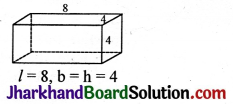
किसी 5 सेमी. त्रिज्या वाले वृत्त के एक व्यास AB के पर स्पर्श रेखा XAY खींची गई है। XY के समान्तर 4 से 8 सेमी की दूरी पर, जीवा CD की लम्बाई है:
(A) 4 सेमी
(B) 5 सेमी
(C) 6 सेमी
(D) 8 सेमी
हल:
चूँकि X-AY वृत्त पर स्पर्श रेखा है तथा OA व OC वृत्त की त्रिज्याएँ हैं।
JAC Class 10 Maths Important Questions Chapter 10 वृत्त 25
अत: XY ⊥ OA अर्थात् ∠XAO = 90° (प्रमेश 10.1 से)
∵ XY || CD (दिया गया है)
∴ ∠XAO + ∠OEC = 180°
⇒ 90° + ∠OEC = 180°
⇒ ∠OEC = 180° – 90° = 90°
AE = 8 सेमी
तथा AO = 5 सेमी (वृत्त की त्रिज्या)
∴ OE = AE – AO
= 8 – 5 = 3 सेमी
समकोण त्रिभुज OEC में,
OC2 = OE2 + CE2 (पाइथागोरस प्रमेय)
⇒ 52 = 32 + CE2
⇒ CE2 = 52 – 32
= 25 – 9 = 16
⇒ CE = \(\sqrt{16}\) = 4 सेमी
OE ⊥ CD
CE = ED
CD = 2 × CE = 2 × 4 = 8 सेमी
अतः विकल्प (D) सही है।

JAC Class 10 Maths Important Questions Chapter 10 वृत्त

प्रश्न 11.
यदि 60° पर झुकी दो स्पर्श रेखाएँ 3 सेमी त्रिज्या वाले एक वृत्त पर खींची जाती हैं, तो प्रत्येक स्पर्श रेखा की लम्बाई है:
(A) 3 सेमी
(B) \(\frac{3}{2} \sqrt{3}\) सेमी
(C) 3\(\sqrt{3}\) सेमी
(D) 6 सेमी
हल:
माना बिन्दु P से PQ तथा PR वृत्त पर स्पर्श रेखाएँ हैं। OQ तथा OR वृत्त की त्रिज्याएँ हैं।
JAC Class 10 Maths Important Questions Chapter 10 वृत्त 26
अतः PQ ⊥ OQ तथा PR ⊥ OR
अतः समकोण ΔPOQ तथा ΔPOR में
∠OQP = ∠ORP (प्रत्येक 90° है)
कर्ण PO = कर्ण PO (उभयनिष्ठ भुजा)
तथा OQ = OR (वृत्त की समान त्रिज्याएँ)
∴ ΔPOQ ≅ ΔPOR (समकोण कर्ण भुजा सर्वांगसमता गुणधर्म से)
⇒ ∠QPO = ∠RPO (CPCT)
⇒ ∠QPO = ∠RPO
= \(\frac{60^{\circ}}{2}\) = 30°
अब समकोण ΔOQP में
tan 30° = \(\frac{O Q}{P Q}\)
⇒ \(\frac{1}{\sqrt{3}}=\frac{3}{P Q}\)
⇒ PQ = 3\(\sqrt{3}\)
चूँकि बिन्दु P से PQ तथा PR वृत्त पर खींची गई स्पर्श रेखाएँ हैं और हम जानते हैं कि वृत्त पर बाह्य बिन्दु से खींची गई स्पर्श रेखाओं की लम्बाइयाँ बराबर होती है।
अत: PR = PQ
= 3\(\sqrt{3}\) सेमी.
अतः विकल्प (C) सही है।

JAC Class 10 Maths Notes Chapter 2 बहुपद

Students should go through these JAC Class 10 Maths Notes Chapter 2 बहुपद will seemingly help to get a clear insight into all the important concepts.

JAC Board Class 10 Maths Notes Chapter 2 बहुपद

भूमिका :
पिछली कक्षाओं में हमने एक व्यंजक बहुपद तथा उनकी घातों, गुणनखंड तथा गुणक के बारे में पढ़ा है। स्मरण रहे कि P(x), x चर में एक बहुपद है P(x) में x की उच्चतम घात बहुपद की घात कहलाती है। उदाहरण के लिए, 4y2 – 5y + 9, y चर में एक बहुपद है, जिसकी घात 2 है।
इस अध्याय में हम रैखिक तथा द्विघातीय बहुपदों के ज्यामितीय निरूपण (Geometrical Representation) और उनके शून्यकों के ज्यामितीय अर्थ के साथ-साथ बहुपद के गुणांकों और शून्यांकों के बीच सम्बन्धों का अध्ययन करेंगे।

बहुपद के प्रकार :
→ एकपदी (Monomial): ऐसे बहुपद को जिसमें केवल एक पद हो, एकपदी (monomial) कहते हैं:
जैसे : x2, ax, 3x2, a2x3, \(\frac{1}{2}\)x4 इत्यादि।

→ द्विपदी (Binomial): ऐसे बहुपद को जिसमें केवल दो पद हों, द्विपदी (binomial) कहते हैं; जैसे: ax + b, 5x2 + 3x, a2xn + b इत्यादि ।

→ त्रिपदी (Trinomial) ऐसे बहुपद को जिसमें केवल तीन पद हों, त्रिपदी (trinomial) कहते हैं: जैसे 3x2 + 5x – 7, ax2 + bx + c, ….. इत्यादि।

→ शून्य बहुपद (Zero polynomial): यदि किसी बहुपद में सभी पदों के गुणांक शून्य हों तो वह शून्य बहुपद कहलाता है। जैसे : p(x) = 0.
एक घात वाले बहुपद को रैखिक बहुपद, दो घात वाले बहुपद को द्विघात बहुपद और तीन घातों वाले बहुपद को त्रिघात बहुपद कहते हैं।

→ बहुपद की घात (Power of polynomial) चर x के बहुपद p(x) में x की उच्चतम घात को बहुपद की घात कहते हैं।
उदाहरण के लिए: (i) बहुपद p(x) = x5 + 4x3 – 3x2 + 2x – 3 में चर राशि x की उच्चतम घात का पद है। जिसका घातांक 5 है। अतः बहुपद की घात 5 होगी।
(ii) बहुपद p(y) = 3y3 + 4y2 – y + 8 में चर राशि की उच्चतम घात का पद 3y3 है, जिसका घातांक 3 है। अतः बहुपद P(y) की घात 3 होगी।

→ अचर बहुपद (Costant Polynomial): शून्य घात वाला बहुपद नियतांक या अचर बहुपद कहलाता है।
जैसे: p(x) = 7, g(x) = –\(\frac{3}{2}\), h(y) = 2, p(t) = 1 इत्यादि में किसी भी चर की घात शून्य होगी। अत: इस प्रकार के बहुपद अचर बहुपद कहलाते हैं।

→ रैखिक बहुपद (Linear Polynomial): घात 1 वाला बहुपद रैखिक बहुपद कहलाता है।
जैसे: 2x + 3, \(\sqrt{3}\)x + 5, y + \(\sqrt{2}\), x – \(\frac{2}{11}\), 3t + 4 इत्यादि सभी रैखिक बहुपद हैं।

→ द्विघात बहुपद (Quadratic Polynomial): घात 2 वाला बहुपद द्विघात बहुपद कहलाता है। द्विघात (Quadratic) शब्द क्वाड्रेट (quadrate) शब्द से बना है जिसका अर्थ वर्ग अर्थात् घात 2 है।
जैसे : f(x) = 2x2 + 3x – \(\frac{4}{5}\), g(y) = 2y2 – 3
h(u) = 2 – u2 + \(\sqrt{3}\)u, p(v) = \(\sqrt{3}\)v2 – \(\frac{4}{3}\)v + \(\frac{1}{2}\), इत्यादि द्विघात बहुपद हैं जिनके गुणांक वास्तविक संख्याएँ हैं।
व्यापक रूप से चर x में कोई द्विघात बहुपद f(x) = ax2 + bx + c के रूप में होता है, जहाँ a, b, c वास्तविक संख्याएँ हैं, जहाँ a ≠ 0 है।

→ त्रिघात बहुपद (Cubic Polynomial) : घात 3 का बहुपद त्रिघात बहुपद कहलाता है।
जैसे : f(x)= \(\frac{9}{5}\)x3 – 2x2 + \(\frac{7}{3}\)x – \(\frac{1}{5}\), g(x) = 2 – x3 तथा h(y) = 3y3 – 2y2 + y + 1
चर x में एक त्रिघात बहुपद का व्यापक रूप निम्न है :
f(x) = ax3 + bx2 + cx + d, जहाँ a, b, c, d वास्तविक संख्याएँ हैं जहाँ a ≠ 0 है।

JAC Class 10 Maths Notes Chapter 2 बहुपद

बीजीय व्यंजक (Algebraic Expression) : कुछ निश्चित चर तथा अचर राशियों के योग, अन्तर, गुणन, भाग इत्यादि के संयोग से बने पद को बीजीय व्यंजक कहते हैं।
उदाहरणार्थ : f(x) = x3 – 6x2 + x + 9, f(x) = -3x2 + 2x – 1 तथा f(x) = 4x + 3 इत्यादि
इस प्रकार के बीजीय व्यंजकों को बहुपद (Polynomial) कहते हैं।
बहुपद : बीजीय व्यंजक के बहुपद होने के लिए निम्नलिखित शर्तें पूर्ण होनी चाहिए :
1. चर राशि का घातांक एक धनात्मक पूर्णांक हो।
2. पदों की संख्या निश्चित (सीमित) हो।
3. प्रत्येक पद में चर का गुणांक एक वास्तविक संख्या हो।
यदि x एक चर, प्राकृत संख्या और a0, a1, a2, a3, ….. an वास्तविक सख्याएँ हैं तो
p(x) = a0 + a1x + a2x2 + …… +anxn
p(x) को चर x में एक बहुपद कहते हैं।
जहाँ a0, a1x, a2x2, a3x3, …… इसके पद (Term) कहलाते हैं और a0, a1, a2, a3….. उनके गुणांक (Coefficient) कहलाते हैं।
उदाहरण के लिए:
(i) p(x) = 3x – 2 [चर x में एक बहुपद है।]
(ii) q(y) = 3y2 – 2y + 4 [चर y मेँ एक बहुपद है।]
(iii) f(u) = \(\frac{1}{2}\)u3 – 3u2 + 2u – 4 [चर u में एक बहुपद है।]
क्योंकि इन सभी (i), (ii) एवं (iii) की घात धनात्मक पूर्णांक है तथा प्रत्येक पद में चर राशि का गुणांक एक वास्तविक संख्या है।

निम्न व्यंजकों पर ध्यान दीजिए:
(i) p(x) = 2x2 – 3\(\sqrt{x}\) यह बहुपद नहीं है क्योंकि \(\sqrt{x}\) या x1/2 में x की घात \(\sqrt{2}\) है जो कि पूर्णांक नहीं है।
(ii) f(x) = \(\frac{1}{2 x^2-2 x+5}\) में भी x के घात धन पूर्णांक नहीं हैं अतः यह बहुपद नहीं है।
(iii) q(u) = x3 – \(\frac{1}{x^2}\) + 3 में \(\frac{1}{x^2}\) या x-2 में x की घात -2 है, जो कि धन पूर्णाक नहीं है। अतः बहुपद नहीं है।

JAC Class 10 Maths Notes Chapter 2 बहुपद

बहुपद का मान (Value of Poynomial): यदि f(x) चर x में एक बहुपद है और कोई वास्तविक संख्या है तो f(x) में x के स्थान पर α का मान रखने से प्राप्त वास्तविक संख्या बहुपद f(x) का x = α पर मान होगा और इसे f(α) द्वारा व्यक्त करते हैं।
जैसे: (i) f(x) = 2x2 – 3x – 2 के x = 1 और x = -2 पर मान ज्ञात कीजिए ।
x = 1 पर, f(1) = 2(1)2 – 3(1) – 2 = 2 × 1 – 3 × 1 – 2 = 2 – 3 – 2 = -3
x = -2 पर, f(-2) = 2(-2)2 – 3(-2) – 2 = 2 × (+4) + 6 – 2 = 8 + 6 – 2 = 12
(ii) यदि बहुपद f(x) = x3 – 6x2 + 11x – 6 है, x = -1 पर बहुपद का मान ज्ञात कीजिए।
JAC Class 10 Maths Notes Chapter 2 बहुपद 1

बहुपद के शून्यक (Zeroes of Polynomial) : यदि किसी बहुपद p(x) में चर x के स्थान पर a (एक वास्तविक संख्या) प्रतिस्थापित करने पर p(a) = 0 हो, तो को बहुपद p(x) का शून्यक (Zero) कहते हैं। अर्थात् किसी भी बहुपद के शून्यकं ज्ञात करने का अर्थ होता है समीकरण p(x) = 0 को हल करना।
जैसे : (i) p(x) = 2x3 + 3x2 + 3x + 2 का शून्यक ज्ञात करना है।
x = 0 पर, p(0) = 2(0)3 + 3(0)2 + 3(0) +2
P(0) = 2 अर्थात p(0) ≠ 0
अत: शून्य, बहुपद p(x) का शून्यक नहीं है।
x = -1 पर, p(-1) = 2(-1)3 + 3(-1)2 + 3(-1) + 2 = – 2 + 3 – 3 + 2 = 0
P(-1) = 0
अत: -1 बहुपद p(x) का एक शून्यक है।

JAC Class 10 Maths Notes Chapter 2 बहुपद

विशेष :
(i) प्रत्येक रैखिक बहुपद का एक और केवल एक ही शून्यक होता है।
(ii) द्विघात बहुपद के दो शून्यक होते हैं।
(iii) त्रिघात बहुपद के तीन शून्यक होते हैं।
(iv) प्रत्येक बहुपद के वास्तविक शून्यक नहीं होते हैं।
जैसे : x2 + a, x2 + 2 तथा y2 + y + 1 का कोई भी वास्तविक शून्यक नहीं है।
p(x) = x2 + 6x + 15 का कोई शून्यक नहीं होता।
हल: माना कि p(x) = x2 + 6x + 15
∴ p(x) = {x2 + 2. (3). x + 9} + 6 = (x + 3)2 + 6
यहाँ हम देखते हैं कि x के प्रत्येक वास्तविक मान के लिए (x + 3)2 कभी भी ऋणात्मक मान ग्रहण नहीं कर सकता। अत: (x + 3)2 का मान सदैव शून्य से बड़ा ही होगा। परिणामस्वरूप f(x) का मान भी 6 या उससे अधिक होगा।
इसलिए p(x) का कोई शून्यक विद्यमान नहीं है।

बहुपद के आलेख एवं शून्यकों का ज्यामितीय अर्थ :
बहुपद p(x) के ज्यामितीय आलेख को x अक्ष जिन बिन्दुओं पर प्रतिच्छेद करता है, उन बिन्दुओं के भुज या x-निर्देशांक बहुपद p(x) के शून्यक (zeroes) के रूप में जाने जाते हैं।
रैखिक बहुपद : व्यापक रूप में एक रैखिक बहुपद f(x) = ax + b, a ≠ 0 के लिए ग्राफ एक सरल रेखा प्राप्त होती है, जो x अक्ष को ठीक एक बिन्दु \(\left(-\frac{b}{a}, 0\right)\) पर काटती है।
अत: रैखिक बहुपद p(x) = ax + b, a ≠ 0 का केवल एक शून्यक होगा क्योंकि बहुपद का आलेख x-अक्ष पर केवल एक बिन्दु पर काटता है।
JAC Class 10 Maths Notes Chapter 2 बहुपद 2

(ii) द्विघात बहुपद : किसी द्विघात समीकरण ax2 + bx + c, a ≠ 0 के लिए ग्राफ दो में से किसी एक आकार का हो सकता है या तो ऊपर की ओर खुला (∪ की तरह) अथवा नीचे की ओर खुला (∩ की तरह) का होता है जो कि a > 0 या a < 0 पर निर्भर करता है।
इन वनों को परवलय (Parabola) कहते हैं।
बहुपद ax2 + bx + c, जहाँ a ≠ 0 के शून्यक ठीक-ठीक उन बिन्दुओं के x-निर्देशांक होते हैं जहाँ बहुपद y = ax2 + bx + c को निरूपित करने वाला ग्राफ (परवलय) x-अक्ष को प्रतिच्छेद करता है।
y = ax2 + bx + c, के ग्राफ के आकार (परवलय) की तीन स्थितियाँ सम्भव हो सकती हैं।

स्थिति (I) : जब बहुपद ax2 + bx + c के दो अलग-अलग गुणनखण्ड हैं:
इस स्थिति में ax2 + bx + c का ग्राफ x-अक्ष को दो भिन्न-भिन्न बिन्दुओं A और A’ पर प्रतिच्छेद करता है तो इन बिन्दुओं के x निर्देशांक बहुपद ax2 + bx + c के दो शून्यक होते हैं।
परवलय y = ax2 + bx + c के शीर्ष के निर्देशांक \(\left(\frac{-b}{2 a}, \frac{-D}{4 a}\right)\) हैं, जहाँ D = b2 – 4ac है।
JAC Class 10 Maths Notes Chapter 2 बहुपद 3

किसी बहुपद के शून्यकों और गुणांकों में सम्बन्ध :
व्यापक रूप में, यदि द्विघात बहुपद p(x) = ax2 + bx + c, जहाँ a ≠ 0 के शून्यक α और β हों, तो हम जानते हैं कि (x – α) और (x – β), p(x) के गुणनखण्ड होते हैं।
अतः ax2 + bx + c = k(x – α) (x – β),
जहाँ k एक अचर है
= k[x2 – (α + β)x + αβ]
ax2 + bx + c = kx2 – k(α + β)x + kαβ
दोनों पक्षों से x2, x के गुणांकों तथा अचर पदों की तुलना करने पर,
a = k, b = – k (a + B) और c = kαβ
इससे प्राप्त होता है, α + β = \(\frac{-b}{a}\), αβ = \(\frac{c}{a}\)
JAC Class 10 Maths Notes Chapter 2 बहुपद 4
व्यापक रूप में, यदि त्रिघात बहुपद ax3 + bx2 + cx + d के शून्यक α, β और γ हों, तो हम जानते हैं कि (x – α), (x – β) और (x – γ) बहुपद के गुणनखण्ड होते हैं। अतः
ax3 + bx2 + cx + d = k(x – α) (x – β) (x – γ), जहाँ k एक अचर है।
= k[{x2 – (α + β)x + αβ} (x – γ)]
= k[x3 – (α + β + γ)x2 + (αβ + βγ + γα)x – αβγ]
= kx3 – k(α + β + γ)x2 + k (αβ + βγ + γλ) x – kλβγ
दोनों पक्षों से x3, x2, x के गुणांकों और अचर पदों की तुलना करने पर,
a = k, b = -k(α + β + γ)
तथा c = k(αβ + βγ + γλ), d = -kαβγ
इससे प्राप्त होता है :
JAC Class 10 Maths Notes Chapter 2 बहुपद 5

JAC Class 10 Maths Notes Chapter 2 बहुपद

बहुपदों के लिए यूक्लिड की विभाजन एल्गोरिथ्म :
माना कि p(x) और g(x) कोई दो बहुपद हैं, जहाँ g(x) ≠ 0 हो तो बहुपद q(x) और r(x) ऐसे प्राप्त किए जा सकते हैं कि
p(x) = g(x) × q(x) + r(x)
जहाँ r(x) = 0 है अथवा r(x) की घात < g(x) की घात है।
उक्त परिणाम बहुपदों के लिए विभाजन एल्गोरिथ्म कहलाता है।

JAC Class 10 Maths Solutions Chapter 3 Pair of Linear Equations in Two Variables Ex 3.2

Jharkhand Board JAC Class 10 Maths Solutions Chapter 3 Pair of Linear Equations in Two Variables Ex 3.2 Textbook Exercise Questions and Answers.

JAC Board Class 10 Maths Solutions Chapter 3 Pair of Linear Equations in Two Variables Exercise 3.2

Question 1.
Form the pair of linear equations in the following problems, and find their solutions graphically:
1. 10 students of Class X took part in a Mathematics quiz. If the number of girls is 4 more than the number of boys, find the number of boys and girls who took part in the quiz.
2. 5 pencils and 7 pens together cost 50, whereas 7 pencils and 5 pens together cost ₹ 46. Find the cost of one pencil and that of one pen.
Solution:
1. Let the number of boys be x and the number of girls be y.
Then, the equations formed as follows:
x + y = 10 ……. (1)
and y = x + 4,
i.e., y – x = 4 …… (2)
To draw the graphs of these equations,
we find two solutions for each equation.
For equation (1), x + y = 10 gives y = 10 – x.

x05
y105

For equation (2), y – x = 4 gives y = x + 4.

x02
y46

JAC Class 10 Maths Solutions Chapter 3 Pair of Linear Equations in Two Variables Ex 3.2 1
Two lines intersect at point (3, 7). Hence, x = 3 and y = 7 is the required solution of the pair of linear equations.
Thus, 3 boys and 7 girls took part in the quiz.
Verification : x = 3 and y = 7 satisfy both the equations x + y = 10 and y – x = 4.

2. Let the cost of each pencil be ₹ x and the cost of each pen be ₹ y.
Then, from the given information, we receive the following equations:
5x + 7y = 50 ……… (1)
7x + 5y = 46 ……….. (2)
To draw the graphs of these equations, we find two solutions for each equation.
For equation (1), 5x + 7y = 50 gives
y = \(\frac{50-5 x}{7}\)

x310
y50

For equation (2), 7x + 5y = 46 gives
y = \(\frac{46-7 x}{5}\)

x38
y5-2

JAC Class 10 Maths Solutions Chapter 3 Pair of Linear Equations in Two Variables Ex 3.2 2
Two lines intersect at point (3, 5). Hence, x = 3 and y = 5 is the required solution of the pair of linear equations.
Thus, the cost of each pencil is ₹ 3 and the cost of each pen is ₹ 5.
Verification : x = 3 and y = 5 satisfy both the equations 5x + 7y = 50 and 7x + 5y = 46.

JAC Class 10 Maths Solutions Chapter 3 Pair of Linear Equations in Two Variables Ex 3.2

Question 2.
On comparing the ratios \(\frac{a_1}{a_2}, \frac{b_1}{b_2}\) and \(\frac{c_1}{c_2}\), find out whether the lines representing the following pairs of linear equations intersect at a point, are parallel or coincident:
1. 5x – 4y + 8 = 0; 7x + 6y – 9 = 0
2. 9x + 3y + 12 = 0; 18x + 6y + 24 = 0
3. 6x – 3y + 10 = 0; 2x – y + 9 = 0
Solution:
5x – 4y + 8 = 0; 7x + 6y – 9 = 0
For the given pair of linear equations,
a1 = 5, b1 = -4, c1 = 8, a2 = 7, b2 = 6 and c2 = -9
Now, \(\frac{a_1}{a_2}=\frac{5}{7}, \quad \frac{b_1}{b_2}=\frac{-4}{6}=-\frac{2}{3}\)
and \(\frac{c_1}{c_2}=\frac{8}{-9}=-\frac{8}{9}\)
Here, \(\frac{a_1}{a_2} \neq \frac{b_1}{b_2}\)
Hence, the lines representing the given pair of linear equations intersect at a point.

2. 9x + 3y + 12 = 0; 18x + 6y + 24 = 0
For the given pair of linear equations, a1 = 9, b1 = 3, c1 = 12, a2 = 18, b2 = 16 and c2 = 24.
Now, \(\frac{a_1}{a_2}=\frac{9}{18}=\frac{1}{2}, \frac{b_1}{b_2}=\frac{3}{6}=\frac{1}{2}\)
and \(\frac{c_1}{c_2}=\frac{12}{24}=\frac{1}{2}\)
Here, \(\frac{a_1}{a_2}=\frac{b_1}{b_2}=\frac{c_1}{c_2}\)
Hence, the lines representing the given pair of linear equations are coincident lines.

3. 6x – 3y + 10 = 0; 2x – y + 9 = 0
For the given pair of linear equations, a1 = 6, b1 = -3, c1 = 10, a2 = 2, b2 = -1 and c2 = 9.
Now, \(\frac{a_1}{a_2}=\frac{6}{2}=3, \quad \frac{b_1}{b_2}=\frac{-3}{-1}=3\)
and \(\frac{c_1}{c_2}=\frac{10}{9}\)
Here, \(\frac{a_1}{a_2}=\frac{b_1}{b_2} \neq \frac{c_1}{c_2}\)
Hence, the lines representing the given pair of linear equations are parallel lines.

Question 3.
On comparing the ratios \(\frac{a_1}{a_2}, \frac{b_1}{b_2}\) and \(\frac{c_1}{c_2}\), find out whether the following pair of linear equations are consistent or inconsistent:
1. 3x + 2y = 5; 2x – 3y = 7
2. 2x – 3y = 8; 4x – 6y = 9
3. \(\frac{3}{2}\)x + \(\frac{5}{3}\)y = 7; 9x – 10y = 14
4. 5x – 3y = 11; -10x + 6y = -22
5. \(\frac{4}{3}\)x + 2y = 8; 2x + 3y = 12
Solution:
1. 3x + 2y = 5; 2x – 3y = 7
For the given pair of linear equations, a1 = 3, b1 = 2, c1 = -5, a2 = 2, b2 = -3 and c2 = -7.
Now, \(\frac{a_1}{a_2}=\frac{3}{2}, \frac{b_1}{b_2}=\frac{2}{-3}=-\frac{2}{3}\)
and \(\frac{c_1}{c_2}=\frac{-5}{-7}=\frac{5}{7}\)
Here, \(\frac{a_1}{a_2} \neq \frac{b_1}{b_2}\)
Hence, the given pair of linear equations is consistent.

2. 2x – 3y = 8: 4x – 6y = 9
For the given pair of linear equations,
a1 = 2, b1 = -3, c1 = -8, a2 = 4, b2 =-6 and c2 = -9.
Now, \(\frac{a_1}{a_2}=\frac{2}{4}=\frac{1}{2}, \frac{b_1}{b_2}=\frac{-3}{-6}=\frac{1}{2}\)
and \(\frac{c_1}{c_2}=\frac{-8}{-9}=\frac{8}{9}\)
Here, \(\frac{a_1}{a_2}=\frac{b_1}{b_2} \neq \frac{c_1}{c_2}\)
Hence, the given pair of linear equations is inconsistent.

3. \(\frac{3}{2}\)x + \(\frac{5}{3}\)y = 7; 9x – 10y = 14
Multiplying the first equation by 6 and expressing both the equations in the standard form, we get following equations:
9x + 10y – 42 = 0; 9x – 10y – 14 = 0
For the given pair of linear equations, a1 = 9, b1 = 10, c1 = -42, a2 = 9, b2 = -10 and c2 = -14.
Now, \(\frac{a_1}{a_2}=\frac{9}{9}=1, \frac{b_1}{b_2}=\frac{10}{-10}=-1\)
and \(\frac{c_1}{c_2}=\frac{-42}{-14}=3\)
Here, \(\frac{a_1}{a_2} \neq \frac{b_1}{b_2}\)
Hence, the given pair of linear equations is consistent.

4. 5x – 3y = 11; -10x + 6y = -22
For the given pair of linear equations, a1 = 5, b1 =-3, c1 = -11, a2 = -10, b2 = 6 and c2 = 22.
Now, \(\frac{a_1}{a_2}=\frac{5}{-10}=-\frac{1}{2}, \frac{b_1}{b_2}=\frac{-3}{6}=-\frac{1}{2}\)
and \(\frac{c_1}{c_2}=\frac{-11}{22}=-\frac{1}{2}\)
Here, \(\frac{a_1}{a_2}=\frac{b_1}{b_2}=\frac{c_1}{c_2}\)
Hence, the given pair of linear equations is consistent and dependent.

5. \(\frac{4}{3}\)x + 2y = 8; 2x + 3y = 12
For the given pair of linear equations, a1 = \(\frac{4}{3}\), b1 = 2, c1 = -8, a2 = 2, b2 = 3 and c2 = -12.
Now, \(\frac{a_1}{a_2}=\frac{\frac{4}{3}}{2}=\frac{2}{3}, \quad \frac{b_1}{b_2}=\frac{2}{3}\)
and \(\frac{c_1}{c_2}=\frac{-8}{-12}=\frac{2}{3}\)
Here, \(\frac{a_1}{a_2}=\frac{b_1}{b_2}=\frac{c_1}{c_2}\)
Hence, the given pair of linear equations is consistent and dependent.

JAC Class 10 Maths Solutions Chapter 3 Pair of Linear Equations in Two Variables Ex 3.2

Question 4.
Which of the following pairs of linear equations are consistent/inconsistent? If consistent, obtain the solution graphically:
1. x + y = 5; 2x + 2y = 10
2. x – y = 8; 3x – 3y = 16
3. 2x + y – 6 = 0; 4x – 2y – 4 = 0
4. 2x – 2y – 2 = 0; 4x – 4y – 5 = 0
Solution:
1. x + y = 5; 2x + 2y = 10
For the given pair of linear equations,
a1 = 1, b1 = 1, c1 = -5, a2 = 2, b2 = 2 and c2 = -10.
Now, \(\frac{a_1}{a_2}=\frac{1}{2}, \quad \frac{b_1}{b_2}=\frac{1}{2}\)
and \(\frac{c_1}{c_2}=\frac{-5}{-10}=\frac{1}{2}\)
Here, \(\frac{a_1}{a_2}=\frac{b_1}{b_2}=\frac{c_1}{c_2}\)
Hence, the given pair of linear equations is consistent and dependent.
Now, we draw the graphs of both the equations.
x + y = 5 gives y = 5 – x.

x05
y50

2x + 2y = 10 gives y = \(\frac{10-2 x}{2}\)

x13
y42

JAC Class 10 Maths Solutions Chapter 3 Pair of Linear Equations in Two Variables Ex 3.2 3
Here, lines representing both the equations. are coincident. Hence, any point on the line gives a solution. In general, y = 5 – x, where x is any real number is a solution of the given pair of linear equations.

2. x – y = 8; 3x – 3y = 16
For the given pair of linear equations, a1 = 1, b1 = -1, c1 = -8, a2 = 3, b2 = -3 and c2 = -16.
Now, \(\frac{a_1}{a_2}=\frac{1}{3}, \quad \frac{b_1}{b_2}=\frac{-1}{-3}=\frac{1}{3}\)
and \(\frac{c_1}{c_2}=\frac{-8}{-16}=\frac{1}{2}\)
Here, \(\frac{a_1}{a_2}=\frac{b_1}{b_2} \neq \frac{c_1}{c_2}\)
Hence, the given pair of linear equations is inconsistent.

3. 2x + y – 6 = 0; 4x – 2y – 4 = 0
For the given pair of linear equations, a1 = 2, b1 = 1, c1 = -6, a2 = 4, b2 = -2 and c2 = -4.
Now, \(\frac{a_1}{a_2}=\frac{2}{4}=\frac{1}{2}, \quad \frac{b_1}{b_2}=\frac{1}{-2}=-\frac{1}{2}\)
and \(\frac{c_1}{c_2}=\frac{-6}{-4}=\frac{3}{2}\)
Here, \(\frac{a_1}{a_2} \neq \frac{b_1}{b_2}\)
Hence, the given pair of linear equations is consistent.
Now, we draw the graphs of both the equations.
2x + y – 6 = 0 gives y = 6 – 2x.

x03
y60

4x – 2y – 4 = 0 gives y = \(\frac{4 x-4}{2}\) = 2x – 2.

x01
y-20

JAC Class 10 Maths Solutions Chapter 3 Pair of Linear Equations in Two Variables Ex 3.2 4
Here, the lines intersect at point (2, 2). Hence, x = 2 and y = 2 is the unique solution of the given pair of linear equations.

4. 2x – 2y – 2 = 0; 4x – 4y – 5 = 0
For the given pair of linear equations, a1 = 2, b1 = -2, c1 = -2, a2 = 4, b2 = -4 and c2 = -5.
Now, \(\frac{a_1}{a_2}=\frac{2}{4}=\frac{1}{2}, \quad \frac{b_1}{b_2}=\frac{-2}{-4}=\frac{1}{2}\)
and \(\frac{c_1}{c_2}=\frac{-2}{-5}=\frac{2}{5}\)
Here, \(\frac{a_1}{a_2}=\frac{b_1}{b_2} \neq \frac{c_1}{c_2}\)
Hence, the given pair of linear equations is inconsistent.

JAC Class 10 Maths Solutions Chapter 3 Pair of Linear Equations in Two Variables Ex 3.2

Question 5.
Half the perimeter of a rectangular garden, whose length is 4 m more than its width, is 36 m. Find the dimensions of the garden.
Solution:
Let the length and breadth of the rectangular garden be x m and y m respectively.
Then, from the given data, x = y + 4 and 36 = \(\frac{1}{2}\)[2(x + y)] i.e., x + y = 36 as the perimeter of a rectangle = 2 (length + breadth).
To draw the graphs, we find two solutions of each equation.
x = y + 4 gives y = x – 4

x824
y420

x + y = 36 gives y = 36 – x

x1224
y2412

JAC Class 10 Maths Solutions Chapter 3 Pair of Linear Equations in Two Variables Ex 3.2 5
Here, the lines intersect at point (20, 16). Hence, x = 20 and y = 16 is the unique solution of the pair of linear equations.
Thus, for the rectangular garden, length = 20 m and breadth = 16 m.

Question 6.
Given the linear equation 2x + 3y – 8 = 0, write another linear equation in two variables such that the geometrical representation of the pair so formed is:
1. intersecting lines
2. parallel lines
3. coincident lines
Solution:
1. For intersecting lines, \(\frac{a_1}{a_2} \neq \frac{b_1}{b_2}\). The given equation is 2x + 3y – 8 = 0. We can give another equation as 3x + 4y – 24 = 0. Here, \(\frac{a_1}{a_2}=\frac{2}{3}\) and \(\frac{b_1}{b_2}=\frac{3}{4}\) satisfying \(\frac{a_1}{a_2} \neq \frac{b_1}{b_2}\)

2. For parallel lines, \(\frac{a_1}{a_2}=\frac{b_1}{b_2} \neq \frac{c_1}{c_2}\). The given equation is 2x + 3y – 8 = 0. We can give another equation as 6x + 9y – 10 = 0.
Here, \(\frac{a_1}{a_2}=\frac{1}{3}, \quad \frac{b_1}{b_2}=\frac{1}{3}\) and \(\frac{c_1}{c_2}=\frac{4}{5}\) satisfying \(\frac{a_1}{a_2}=\frac{b_1}{b_2} \neq \frac{c_1}{c_2}\).

3. For coincident lines, \(\frac{a_1}{a_2}=\frac{b_1}{b_2}=\frac{c_1}{c_2}\). The given equation is 2x + 3y – 8 = 0.
We can give another equation as 10x + 15y – 40 = 0. Here, \(\frac{a_1}{a_2}=\frac{1}{5}\), \(\frac{b_1}{b_2}=\frac{1}{5}\) and \(\frac{c_1}{c_2}=\frac{1}{5}\) satisfying \(\frac{a_1}{a_2}=\frac{b_1}{b_2}=\frac{c_1}{c_2}\).

JAC Class 10 Maths Solutions Chapter 3 Pair of Linear Equations in Two Variables Ex 3.2

Question 7.
Draw the graphs of the equations x – y + 1 = 0 and 3x + 2y – 12 = 0. Determine the coordinates of the vertices of the triangle formed by these lines and the x-axis, and shade the triangular region.
Solution:
x – y + 1 = 0 gives y = x + 1

x-12
y03

3x + 2y – 12 = 0 gives y = \(\frac{12-3 x}{2}\)

x04
y60

JAC Class 10 Maths Solutions Chapter 3 Pair of Linear Equations in Two Variables Ex 3.2 6
The vertices of the triangle formed by the given lines and the x-axis are (-1, 0), (4, 0) and (2, 3).

JAC Class 10 Maths Solutions Chapter 3 Pair of Linear Equations in Two Variables Ex 3.4

Jharkhand Board JAC Class 10 Maths Solutions Chapter 3 Pair of Linear Equations in Two Variables Ex 3.4 Textbook Exercise Questions and Answers.

JAC Board Class 10 Maths Solutions Chapter 3 Pair of Linear Equations in Two Variables Exercise 3.4

Question 1.
Solve the following pair of linear equations by the elimination method and the substitution method:
1. x + y = 5 and 2x – 3y = 4
2. 3x + 4y = 10 and 2x – 2y = 2
3. 3x – 5y – 4 = 0 and 9x = 2y + 7
4. \(\frac{x}{2}+\frac{2 y}{3}=-1\) and x – \(\frac{y}{3}\) = 3
Solution:
1. Elimination method:
x + y = 5 ………(1)
2x – 3y = 4 ……..(2)
We multiply equation (1) by 3 and equation (2) by 1 to get following equations:
3x + 3y = 15 ……(3)
2x – 3y = 4 ……(4)
Adding equations (3) and (4), we get
(3x + 3y) + (2x – 3y) = 15 + 4
∴ 5x = 19
∴ x = \(\frac{19}{5}\)
Substituting x = \(\frac{19}{5}\) in equation (1), we get
\(\frac{19}{5}\) + y = 5
∴ y = 5 – \(\frac{19}{5}\)
∴ y = \(\frac{6}{5}\)
Thus, the solution of the given pair of linear equations is x = \(\frac{19}{5}\), y = \(\frac{6}{5}\)
Substitution method:
x + y = 5 ……(1)
2x – 3y = 4 ……(2)
From equation (1), we get y = 5 – x.
Substituting y = 5 – x in equation (2), we get
2x – 3(5 – x) = 4
∴ 2x – 15 + 3x = 4
∴ 5x = 19
∴ x = \(\frac{19}{5}\)
Substituting x = \(\frac{19}{5}\) in y = 5 – x, we get
y = 5 – \(\frac{19}{5}\)
∴ y = \(\frac{6}{5}\)
Thus, the solution of the given pair of linear equations is x = \(\frac{19}{5}\), y = \(\frac{6}{5}\)

2. Elimination method:
3x + 4y = 10 ……(1)
2x – 2y = 2 ……(2)
We multiply equation (1) by 1 and equation (2) by 2 to get following equations:
3x + 4y = 10 ……(3)
4x – 4y = 4 ……(4)
Adding equations (3) and (4), we get
(3x + 4y) + (4x – 4y) = 10 +4
∴ 7x = 14
∴ x = 2
Substituting x = 2 in equation (1), we get
3(2) + 4y = 10
∴ 4y = 10 – 6
∴ 4y = 4
∴ y = 1
Thus, the solution of the given pair of linear equations is x = 2, y = 1.

Substitution method:
3x + 4y = 10 ……(1)
2x – 2y = 2 ……(2)
From equation (2), we get 2x = 2y + 2.
i.e., x = y + 1.
Substituting x = y + 1 in equation (1), we get
3(y + 1) + 4y = 10
∴ 3y + 3 + 4y = 10
∴ 7y = 7
∴ y = 1
Substituting y = 1 in x = y + 1, we get
x = 1 + 1
x = 2
Thus, the solution of the given pair of linear equations is x = 2, y = 1.

3. Elimination method:
3x – 5y – 4 = 0 ……(1)
9x = 2y + 7 ……(2)
i.e., 3x – 5y = 4 ……(3)
9x – 2y = 7 ……(4)
We multiply equation (3) by 3 and equation (4) by 1 to get following equations:
9x – 15y = 12 ……(5)
9x – 2y = 7 ……(6)
Subtracting equation (5) from equation (6),
we get
(9x – 2y) – (9x – 15y) = 7 – 12
∴ 9x – 2y – 9x + 15y = -5
∴ 13y = -5
∴ y = –\(\frac{5}{13}\)
Substituting y = –\(\frac{5}{13}\) in equation (5), we get
9x – 15(-\(\frac{5}{13}\)) = 12
∴ 9x + \(\frac{75}{13}\) = 12
∴ 9x = 12 – \(\frac{75}{13}\)
∴ 9x = \(\frac{75}{13}\)
∴ x = \(\frac{9}{13}\)
Thus, the solution of the given pair of linear equations is x = \(\frac{9}{13}\), y = –\(\frac{5}{13}\)

Substitution method:
3x – 5y – 4 = 0 ………(1)
9x = 2y + 7 ………(2)
From equation (2), we get x = \(\frac{2 y+7}{9}\).
Substituting x = \(\frac{2 y+7}{9}\) in equation (1).
we get
3(\(\frac{2 y+7}{9}\)) – 5y – 4 = 0
∴ \(\frac{2 y+7}{9}\) – 5y – 4 = 0
∴ 2y + 7 – 15y – 12 = 0 (Multiplying by 3)
∴ -13y – 5 = 0
∴ -13y = 5
∴ y = –\(\frac{5}{13}\)
Substituting y = –\(\frac{5}{13}\) in x = \(\frac{2 y+7}{9}\)
we get,
JAC Class 10 Maths Solutions Chapter 3 Pair of Linear Equations in Two Variables Ex 3.4 1
Thus, the solution of the given pair of linear equations is x = \(\frac{9}{13}\), y = –\(\frac{5}{13}\).

4. Elimination method:
\(\frac{x}{2}+\frac{2 y}{3}=-1\) ………(1)
\(x-\frac{y}{3}=3\) ………(2)
We multiply equation (1) by 3 and equation (2) by 6 to get following equations:
\(\frac{3}{2}\)x + 2y = -3 ………(3)
6x – 2y = 18 ………(4)
Adding equations (3) and (4), we get
(\(\frac{3}{2}\)x + 2y) + (6x – 2y) = -3 + 18
∴ \(\frac{15}{2}\)x = 15
∴ x = 2
Substituting x = 2 in equation (3), we get
\(\frac{3}{2}\)(2) + 2y = -3
∴ 3 + 2y = -3
∴ 2y = -6
∴ y = -3
Thus, the solution of the given pair of linear equations is x = 2, y = -3.

Substitution method:
\(\frac{x}{2}+\frac{2 y}{3}=-1\) ………(1)
\(x-\frac{y}{3}=3\) ………(2)
From equation (2), we get x = \(\frac{y}{3}+3\)
Substituting x = \(\frac{y}{3}+3\) in equation (1).
we get
JAC Class 10 Maths Solutions Chapter 3 Pair of Linear Equations in Two Variables Ex 3.4 2
Substituting y = -3 in x = \(\frac{y}{3}+3\), we get
x = \(\frac{-3}{3}+3\)
∴ x = -1 + 3
∴ x = 2
Thus, the solution of the given pair of linear equations is x = 2, y = -3.

JAC Class 10 Maths Solutions Chapter 3 Pair of Linear Equations in Two Variables Ex 3.4

Form the pair of linear equations in the following problems and find their solutions (if they exist) by the elimination method:

Question 1.
If we add 1 to the numerator and subtract 1 from the denominator, a fraction reduces to 1. It becomes \(\frac{1}{2}\) if we only add 1 to the denominator. What is the fraction?
Solution:
Let the numerator of the required fraction be x and the denominator be y.
Then, the required fraction is \(\frac{x}{y}\)
From the first condition given, we get
\(\frac{x+1}{y-1}=1\)
∴ x + 1 = y – 1
∴ x – y = -2 …..(1)
From the second condition, we get
\(\frac{x}{y+1}=\frac{1}{2}\)
∴ 2x = y + 1
∴ 2x – y = 1 ………(2)
Now, subtracting equation (1) from equation (2), we get
(2x – y) – (x – y) = 1 – (-2)
∴ 2x – y – x + y = 3
∴ x = 3
Substituting x = 3 in equation (1), we get
3 – y = -2
∴ -y = – 2 – 3
∴ -y = -5
∴ y = 5
So, the fraction \(\frac{x}{y}=\frac{3}{5}\)
Thus, the pair of linear equations formed is x – y = -2 and 2x – y = 1; and the required fraction is \(\frac{3}{5}\)

Question 2.
Five years ago, Nuri was thrice as old as Sonu. Ten years later, Nuri will be twice as old as Sonu. How old are Nuri and Sonu ?
Solution:
Let the present age of Nuri be x years. and the present age of Sonu be y years.
Five years ago, the age of Nuri was (x – 5) years and the age of Sonu was (y – 5) years.
Then, from the first condition given, we get
(x – 5) = 3(y – 5)
∴ x – 5 = 3y – 15
∴ x – 3y = -10 ……….(1)
Ten years later the ages of Nuri and Sonu will be (x + 10) years and (y + 10) years respectively.
Then, from the second condition given, we get
(x + 10) = 2(y + 10)
∴ x + 10 = 2y + 20
∴ x – 2y = 10 ………..(2)
Subtracting equation (1) from equation (2).
we get
(x – 2y) – (x – 3y) = 10 – (-10)
∴ x – 2y – x + 3y = 10 + 10
∴ y = 20
Substituting y = 20 in equation (2).
we get
x – 2 (20) = 10
∴ x – 40 = 10
∴ x = 50
So, the present ages of Nuri and Sonu are 50 years and 10 years.
Thus, the pair of linear equations formed is x – 3y = -10 and x – 2y = 10 and the present ages of Nuri and Sonu are 50 years and 20 years respectively.

JAC Class 10 Maths Solutions Chapter 3 Pair of Linear Equations in Two Variables Ex 3.4

Question 3.
The sum of the digits of a two digit number is 9. Also, nine times this number is twice the number obtained by reversing the order of the digits. Find the number.
Solution:
Let the digit at tens place be x and the digit at units place be y in the original number.
Then, the original number = 10x + y.
From the first condition given, we get x + y = 9 ………..(1)
If the digits are reversed, in the new number the digit at tens place is y and the digit at units place is x.
Then, the new number = 10y + x.
From the second condition given, we get
9(10x + y) = 2(10y + x)
∴ 90x + 9y = 20y + 2x
∴ 88x – 11y = 0
∴ 8x – y = 0 (Dividing by 11) ……….(2)
Adding equations (1) and (2), we get
(x + y) + (8x − y) = 9 + 0
∴ 9x = 9
∴ x = 1
Substituting x = 1 in equation (1), we get
1 + y = 9
∴ y = 8
So, the original number = 10x + y
= 10(1) + 8 = 18
Thus, the pair of linear equations formed is x + y = 9 and 8x – y = 0; and the original number is 18.

Question 4.
Meena went to a bank to withdraw ₹ 2000. She asked the cashier to give her ₹ 50 and ₹ 100 notes only. Meena got 25 notes in all. Find how many notes of ₹ 50 and ₹ 100 she received.
Solution:
Suppose Meena received x notes of ₹ 50 and y notes of ₹ 100.
So, the total amount received by her = ₹ (50x + 100y)
From the first condition given, the total amount is ₹ 2000. So, we get
50x + 100y = 2000
∴ x + 2y = 40 (Dividing by 50) ……(1)
From the second condition given, we get
x + y = 25 ……(2)
Subtracting equation (2) from equation (1),
we get
(x + 2y) – (x + y) = 40 – 25
∴ y = 15
Substituting y = 15 in equation (2), we get
x + 15 = 25
∴ x = 10
Hence, Meena received 10 notes of ₹ 50 and 15 notes of ₹ 100.
Thus, the pair of linear equations formed is x + 2y = 40 and x + y = 25, and Meena received 10 notes of ₹ 50 and 15 notes of ₹ 100.

JAC Class 10 Maths Solutions Chapter 3 Pair of Linear Equations in Two Variables Ex 3.4

Question 5.
A lending library has a fixed charge for the first three days and an additional charge for each day thereafter. Saritha paid ₹ 27 for a book kept for seven days, while Susy paid ₹ 21 for the book she kept for five days. Find the fixed charge and the charge for each extra day.
Solution:
Let the fixed charge for first three days be ₹ x and the additional charge for each day exceeding the first three days be ₹ y. Saritha kept the book for 7 days.
So, she has to pay the fixed charge plus the additional charge for 4(7 – 3) days. Hence, we get the following equation for Saritha:
x + 4y = 27 …………(1)
Similarly, Susy has to pay the fixed charge plus the addition charge for 2 (5 – 3) days.
Hence, we get the following equation for Susy:
x + 2y = 21 ……….(2)
Subtracting equation (2) from equation (1),
we get
(x + 4y) – (x + 2y) = 27 – 21
∴ 2y = 6
∴ y = 3
Substituting y = 3 in equation (1), we get
x + 4(3) = 27
∴ x + 12 = 27
∴ x = 15
Hence, the fixed charge for first three days is ₹ 15 and the addition charge for each day thereafter is ₹ 3.
Thus, the pair of linear equations formed is x + 4y = 27 and x + 2y = 21; and the fixed charge and the additional charge per day are ₹ 15 and ₹ 3 respectively.

JAC Class 10 Maths Solutions Chapter 2 Polynomials Ex 2.3

Jharkhand Board JAC Class 10 Maths Solutions Chapter 2 Polynomials Ex 2.3 Textbook Exercise Questions and Answers.

JAC Board Class 10 Maths Solutions Chapter 2 Polynomials Exercise 2.3

Question 1.
Divide the polynomial p (x) by the polynomial g(x) and find the quotient and remainder in each of the following:
1. p(x) = x3 – 3x2 + 5x – 3, g(x) = x2 – 2
2. p(x) = x4 – 3x2 + 4x + 5, g(x) = x2 + 1 – x
3. p(x) = x4 – 5x + 6, g(x) = 2 – x2
Solution:
1.
JAC Class 10 Maths Solutions Chapter 2 Polynomials Ex 2.3 1
Quotient x – 3, Remainder = 7x – 9

2. p(x) = x4 – 3x2 + 4x + 5
= x4 + 0x3 – 3x2 + 4x + 5
and g(x) = x2 + 1 – x = x2 – x + 1
JAC Class 10 Maths Solutions Chapter 2 Polynomials Ex 2.3 2
Quotient = x2 + x – 3, Remainder = 8

3. p(x) = x4 – 5x + 6
= x4 + 0x3 + 0x2 – 5x + 6
and g(x) = 2 – x2 = -x2 + 2
JAC Class 10 Maths Solutions Chapter 2 Polynomials Ex 2.3 3
Quotient = -x2 – 2, Remainder = – 5x + 10

JAC Class 10 Maths Solutions Chapter 2 Polynomials Ex 2.3

Question 2.
Check whether the first polynomial is a factor of the second polynomial by dividing the second polynomial by the first polynomial:
1. t2 – 3, 2t4 + 3t3 – 2t2 – 9t – 12
2. x2 + 3x + 1, 3x4 + 5x3 – 7x2 + 2x + 2
3. x3 – 3x + 1, x5 – 4x3 + x2 + 3x + 1
Solution:
1.
JAC Class 10 Maths Solutions Chapter 2 Polynomials Ex 2.3 4
As the remainder is 0, t2 – 3 is a factor of 2t4 + 3t3 – 2t2 – 9t – 12.

2.
JAC Class 10 Maths Solutions Chapter 2 Polynomials Ex 2.3 5
As the remainder is 0, x2 + 3x + 1 is a factor of 3x4 + 5x3 – 7x2 + 2x + 2.

3.
JAC Class 10 Maths Solutions Chapter 2 Polynomials Ex 2.3 6
As the remainder is not 0, x3 – 3x + 1 is not a factor of x5 – 4x3 + x2 + 3x + 1.

Question 3.
Obtain all other zeroes of 3x4 + 6x3 – 2x2 – 10x – 5, if two of its zeroes are \(\sqrt{\frac{5}{3}}\) and \(-\sqrt{\frac{5}{3}}\)
Solution:
Since \(\sqrt{\frac{5}{3}}\) and \(-\sqrt{\frac{5}{3}}\) are given two zeroes of the polynomial, \(\left(x-\sqrt{\frac{5}{3}}\right)\left(x+\sqrt{\frac{5}{3}}\right)=x^2-\frac{5}{3}\) is a factor of the given polynomial. Then, to obtain the other zeroes of the polynomial, we divide it by x2 – \(\frac{5}{3}\)
JAC Class 10 Maths Solutions Chapter 2 Polynomials Ex 2.3 7
Now,
3x2 + 6x + 3 = 3(x2 + 2x + 1)
= 3(x + 1)2
= 3(x + 1)(x + 1)
Hence, the two zeroes of 3x2 + 6x + 3 are 1 and – 1.
Hence, the two zeroes of 3x4 + 6x3 – 2x2 – 10x – 5 other than the given zeroes are 1 and -1.

JAC Class 10 Maths Solutions Chapter 2 Polynomials Ex 2.3

Question 4.
On dividing x3 – 3x2 + x + 2 by a polynomial g(x), the quotient and remainder were x – 2 and -2x + 4, respectively. Find g(x).
Solution:
Here, dividend p(x) = x3 – 3x2 + x + 2, quotient q(x) = (x – 2) and remainder r(x) = (-2x + 4).
Now, p(x) = g(x) × q(x) + r(x)
∴ x3 – 3x2 + x + 2 = g(x) × (x – 2) + (-2x + 4)
∴ (x3 – 3x2 + x + 2) – (-2x + 4) = g(x) × (x – 2)
∴ x3 – 3x2 + 3x – 2 = g(x) × (x – 2)
∴ g(x) = \(\frac{x^3-3 x^2+3 x-2}{x-2}\)
JAC Class 10 Maths Solutions Chapter 2 Polynomials Ex 2.3 8
Hence, g(x) = x2 – x + 1.

JAC Class 10 Maths Solutions Chapter 2 Polynomials Ex 2.3

Question 5.
Give examples of polynomials p(x), g(x), q(x) and r(x), which satisfy the division algorithm and
1. deg p(x) = deg q(x)
2. deg q(x) = deg r(x)
3. deg r(x) = 0.
Solution:
1. deg p (x) = deg q (x) implies that deg g (x) = 0. i.e., g(x) is a non-zero constant. One such example can be given as p (x) = 3x2 + 15x + 13, g(x) = 3, q(x) = x2 + 5x + 4 and r(x) = 1, which satisfies the division algorithm as:
3x2 + 15x + 13 = 3(x2 + 5x + 4) + 1.

2. deg q(x) = deg r (x) implies that deg g (x) > deg q(x), because
deg g (x) > degr (x). One such example can be given as p (x) = x3 + 5x2 + 2x + 7, g(x) = x2 + 1, q(x) = x + 5 and r(x) = x + 2, which satisfies the division algorithm as:
x3 + 5x2 + 2x + 7 = (x2 + 1)(x + 5) + (x + 2).

3. deg r(x) = 0 implies that the remainder is a constant. One such example can be given as p (x) = x3 + 4x2 + 5x + 9, g(x) = x + 3, q(x) = x2 + x + 2 and r(x) = 3, which satisfies the division algorithm as:
x3 + 4x2 + 5x + 9 = (x + 3)(x2 + x + 2) + 3.
Note: There can be several examples in each of the above cases.