Jharkhand Board JAC Class 9 English Solutions Beehive Chapter 8 Reach for the Top Textbook Exercise Questions and Answers.
JAC Board Class 9 English Solutions Beehive Chapter 8 Reach for the Top
JAC Class 9 English Reach for the Top Textbook Questions and Answers
Part – I
Santosh Yadav
Thinking About the Text
I. Answer these questions in one or two sentences each. (The paragraph numbers within brackets provide clues to the answers.)
निम्नलिखित प्रत्येक प्रश्न का उत्तर एक या दो वाक्यों में दीजिये। (कोष्ठकों में दिये गये पैराग्राफ नम्बर उत्तरों के लिए संकेतार्थ हैं 1 )
Question 1.
Why was the ‘holy man’ whg gave Santosh’s mother his blessing, surprised?
वह संन्यासी जिसने सन्तोष की माँ को आशीर्वाद दिया वह चकित क्यों हुआ? (Para 1 )
Answer:
The ‘holy man’ was surprised at the reply of Santosh’s grandmother. She told him that they didn’t want a son whereas he had blessed Santosh’ mother thinking that she probably wanted a son.
वह सन्यासी सन्तोष की दादी के उत्तर से आश्चर्यचकित था । उसने सन्यासी से कहा कि उन्हें लड़का नहीं चाहिए जबकि उसने (सन्यासी ने) सन्तोष की माँ को यह सोचते हुए आशीर्वाद दिया था कि शायद वह एक पुत्र चाहती है।
Question 2.
Give an example to show that even as a young girl Santosh was not ready to accept anything unreasonable. (Para 2 )
यह दिखाने के लिए एक उदाहरण दीजिए कि सन्तोष जब छोटी थी तो कोई भी तर्कहीन बात स्वीकार करने को तैयार नहीं थी ।
Answer:
From the very beginning Santosh lived her life on her own terms. She was not content with the traditional way of life and was not ready to accept anything unreasonable. Example for this. “Where other girls wore traditional Indian dresses, she preferred shorts.”
शुरूआत से ही संतोष ने अपनी स्वयं की इच्छा से जीवन जीना प्रारम्भ किया वह जीवन को परम्परागत ढंग से जीने में संतुष्ट नहीं थी और वह कुछ भी अतर्कसंगत बात स्वीकार करने को तैयार नहीं थी। इससे संबंधित उदाहरण- “जहाँ अन्य लड़कियाँ परम्परागत भारतीय वस्त्र पहना करती थीं वहीं सन्तोष शार्ट्स (छोटे नेकर) पहनना पसन्द करती थी ।’

Question 3.
Why was Santosh sent to the local school ?
संतोष को स्थानीय स्कूल में क्यों भेजा गया ? (Para 3)
Answer:
Even though Santosh’s parents could afford to send their children to the best schools, they sent her to the local village school due to prevailing customs in the family. She completed her elementary education from there without any objection.
यद्यपि सन्तोष के माता-पिता अपने बच्चों को सबसे अच्छे स्कूलों में भेजने का खर्च उठा सकते थे लेकिन प्रचलित रीति रिवाजों के कारण उन्होंने उसे गाँव के स्थानीय स्कूल में भेज दिया था। उसने बिना किसी आपत्ति के अपनी प्रारम्भिक शिक्षा वहाँ से पूरी की।
Question 4.
When did she leave home for Delhi, and why ?
उसने दिल्ली जाने के लिए अपना घर कब छोड़ा और क्यों ? (Para 4)
Answer:
She left home for Delhi when she turned sixteen. She was under pressure from her parents to get married. She threatened her parents that she would never marry if she didn’t get a proper education.
जब वह सोलह वर्ष की हुयी तब वह घर से दिल्ली चली गयी। वह शादी करने के लिए अपने माता-पिता के दबाव में थी। उसने अपने माता-पिता को धमकी दी कि अगर उसे उचित शिक्षा नहीं मिलेगी तो वह कभी शादी नहीं करेगी।
Question 5.
Why did Santosh’s parents agree to pay for her schooling in Delhi ? What mental qualities of Santosh are brought into light by this incident? (Para 4)
संतोष के माता-पिता दिल्ली में उसके स्कूल की शिक्षा का खर्च देने को क्यों मान गये ? इस घटना से संतोष के कौन-से मानसिक गुण प्रकाशित होते हैं ?
Answer:
When Santosh politely informed her parents of her plan to earn money by working part time to pay for her school fees, they agreed to pay for her schooling. This incident shows that Santosh had iron will, firm determination and self-reliance.
जब सन्तोष ने विनम्रतापूर्वक अपने माता-पिता को अंशकालीन कार्य कर धन कमाने व स्कूल की फीस चुकाने की अपनी योजना के बारे में बताया तो वे उसके स्कूल का खर्च देने को तैयार हो गये । यह घटना सन्तोष की अडिग इच्छाशक्ति, दृढनिश्चय व आत्मनिर्भरता के गुण को दर्शाती है ।
II. Answer each of these questions in a short paragraph (around 30 words) :
निम्नलिखित में से प्रत्येक प्रश्न का उत्तर एक संक्षिप्त अनुच्छेद में दें (30 शब्दों के लगभग) :
Question 1.
How did Santosh begin to climb mountains ?
संतोष ने पहाड़ों पर चढ़ना कैसे आरम्भ किया ?
Answer:
When Santosh joined Maharani College in Jaipur, she got a room in Kasturba Hostel. From there she used to watch mountaineers climbing the Aravalli hills. One day she joined them and began to learn climbing hills.
जब सन्तोष ने जयपुर में महारानी कॉलेज में प्रवेश लिया तब उसे कस्तूरबा होस्टल में एक कमरा मिला । वहाँ से वह पर्वतारोहियों को अरावली पहाड़ियों पर चढ़ते हुए देखा करती थी । एक दिन वह उनमें शामिल हो गई और उसने पहाड़ियों पर चढ़ना सीखना शुरू किया !
Question 2.
What incidents during the Everest expedition show Santosh’s concern for her team-mates?
एवरेस्ट अभियान के दौरान कौन-सी घटनाएँ सन्तोष द्वारा अपने दल के साथियों के प्रति चिन्ता को दर्शाती हैं ?
Answer:
During the 1992 Everest mission, Santosh Yadav provided special care to a climber. He lay dying at the South Col. Unfortunately, she could not save him. But she saved another climber Mohan Singh by sharing her oxygen with him.
वर्ष 1992 के एवरेस्ट मिशन के दौरान सन्तोष यादव ने एक पर्वतारोही की विशेष देख-रेख की । वह साउथ कॉल (दक्षिणी दर्रा) पर मरणासन्न पड़ा हुआ था । दुर्भाग्यवश, वह उसे नहीं बचा सकी । किन्तु उसने एक दूसरे पर्वतारोही मोहन सिंह को अपनी ऑक्सीजन में से कुछ ऑक्सीजन उसे देकर बचा लिया ।
Question 3.
What shows her concern for the environment ?
पर्यावरण के प्रति उसकी चिन्ता किस बात से प्रदर्शित होती है ?
Answer:
Santosh is a fervent environmentalist. During her Everest missions, she collected 500 kilograms of garbage from the Himalayas and brought it down. It shows her concern for the environment.
संतोष एक उत्साही पर्यावरणविद् है । अपने एवरेस्ट अभियानों के दौरान उसने हिमालय से 500 किलोग्राम कूड़ा-कचरा एकत्र किया और इसे नीचे लेकर आई। यह बात पर्यावरण के प्रति उसकी चिन्ता को दर्शाती है ।
Question 4.
How does she describe her feelings at the summit of the Everest?
एवरेस्ट की चोटी पर अपनी भावनाओं का वर्णन वह कैसे करती है ?
Answer:
Santosh felt proud of being an Indian. She unfurled the tricolour flag of India on Mt Everest. She held it aloft on the roof of the world. She felt extremely happy thinking that the flag of India was flying on top of the world.
सन्तोष ने भारतीय होने पर गर्व महसूस किया । उसने भारतीय तिरंगा ऐवरेस्ट पर फहराया। उसने इसको संसार की छत पर ऊँचा करके उठा लिया । उसने यह सोचकर बहुत खुशी महसूस की कि भारतीय ध्वज विश्व की सबसे अधिक ऊँचाई पर फहरा रहा था ।
Question 5.
Santosh Yadav got into the record books both times she scaled Mt Everest. What were the reasons for this?
संतोष यादव का नाम रिकॉर्ड (कीर्तिमान) की पुस्तकों में दोनों बार आया जब उसने माउण्ट एवरेस्ट पर चढ़ाई. की ? इसके कारण क्या थे?
Answer:
Santosh Yadav conquered Mt Everest twice. Each time she made a record. When she scaled Mt Everest first time, she became the youngest woman in the world to climb Mt Everest. When she conquered it the second time, she became the only woman in the world to scale Mt Everest twice.
संतोष यादव ने माउण्ट एवरेस्ट को दो बार फतेह किया । प्रत्येक बार उसने रिकॉर्ड बनाया । जब उसने पहली बार चढ़ाई की तो वह माउण्ट एवरेस्ट पर चढ़ने वाली विश्व की सबसे कम आयु की महिला बनी। जब उसने दूसरी बार एवरेस्ट पर विजय पाई तो वह एवरेस्ट पर दो बार चढ़ने वाली विश्व की प्रथम महिला बन गई।
III. Complete the following statements:
निम्नलिखित कथनों की पूर्ति कीजिये :
1. From her room in Kasturba hostel, Santosh used to …………..
2. When she finished college, Santosh had to write a letter of apology to her father because …………..
3. During the Everest expedition, her seniors in the team admired her …………..
Answer:
1. ……………….. watch villagers going up the hifi and suddenly vanishing after a while.
2. ……………….. she had got herself enrolled at an institute in Uttarkashi without his permission.
3 for her climbing skills, physical fimess and mental strength while her concern for others and desire to work together with them
IV. Pick out words from the text that mean the same as the following words or expressions. (Look in the paragraphs indicated):
निम्नलिखित शब्दों या अभिव्यक्तियों के अर्थ वाले शब्दों को पाठ में से छाँटिये । ( निर्दिष्ट पैराग्राफ में देखिये):
1. took to be true without proof (1) : ………………..
2. based on reason : sensible : reasonable (2) : …………………
3. the usual way of doing things (3) : ………………..
4. a strong desire arising from within (5) : ………………..
5. the power to endure, without falling ill (7) : ………………..
Answer:
1. assumed
2. rational
3. custom
4. urge
5. endurance/resistance
Part- II
Maria Sharapova
Thinking About the Text
Working in small groups of 4-5 students, go back over the two passages on Santosh Yadav and Maria Sharapova and complete the table given below with relevant phrases or sentences.
विद्यार्थियों के छोटे-से समूहों में कार्य करते हुए संतोष यादव व मारिया शारापोवा के बारे में पीछे दिये गये दो गद्यांशों को देखिये, और सम्बंधित शब्द- समूहों या वाक्यों के नीचे दी गई तालिका को पूरी कीजिये ।
Points of Comparison/Contrast | Santosh Yadav | Maria Sharapova |
| 1. Their humble beginning 2. Their parents’ approach 3. Their will power and strong desire to succeed 4. Evidence of their mental toughness, 5. Their patriotism |
Answer:
1. Their humble beginning
Santosh Yadav : She was born in a small village Joniyawas of Rewari district in Haryana. Maria Sharapova : She was born in the frozen plains of Siberia (Russia).
2. Their parents approach
Santosh Yadav: Her parents discouraged her.
Maria Sharapova: Her father worked as much as he could do to help her.
3. Their will power and strong desire to succeed
Santosh Yadav : She left home and went to Delhi for better schooling. After that she went to Jaipur and at last, she joined Nehru Institute of Mountaineering at Uttarkashi.
Maria Sharapova : She went to Florida (USA) leaving behind her mother and worked very hard in spite of humiliation.
4. Evidence of their mental toughness
Santosh Yadav: She conquered Mt Everest twice.
Maria Sharapova : She worked hard to reach the top position in women’s tennis.
5. Their patriotism
Santosh Yadav : She felt proud of being an Indian. She unfurled India’s National Flag and held it high on top of the world.
Maria Sharapova : She retains Russian citizenship, wants to play at Olympics for Russia.
Thinking About Language:
Look at the following sentences. They each have two clauses, or two parts each with their own subject and verb or verb phrase. Often one part (italicised) tells us when or why something happened.
निम्नलिखित वाक्यों को देखिये । Subject और verb या verb phrase के साथ प्रत्येक वाक्य में दो clauses हैं या इसके दो भाग हैं। प्रायः तिरछे अक्षरों में मुद्रित भाग यह बताता है कि कोई चीज कब या क्यों हुई।
- I reached the market when most of the shops had closed. (Tells us when I reached)
- When Rahul Dravid walked back towards the pavilion, everyone stood up. (Tells us when everyone stood up)
- The telephone rang and Ganga picked it up. (Tells us what happened next)
- Gunjan has been with us ever since the school began. (Tells us for how long she has been with us)
I. Identify the two parts in the sentences below by underlining the part that gives us the information in brackets, as shown above.
नीचे दिये गये वाक्यों के दोनों भागों की पहचान कीजिये । जो भाग कोष्ठक में दी गई जानकारी देता है उसे रेखांकित कीजिये जैसा कि ऊपर दिखाया गया है।
1. Where other girls wore traditional Indian dresses, Santosh preferred shorts.
(Contrasts her dress with that of others).
2. She left home and got herself enrolled in a school in Delhi.
(Tells us what happened after the first action)
3. She decided to fight the system when the right moment arrived.
(Tells us when she was going to fight the system)
4. Little Maria had not yet celebrated her tenth birthday when she was packed off to train in the United States.
(Tells us when Maria was sent to the U.S.)
Answer:
1. Where other girls wore traditional Indian dresses, Santosh preferred shorts.
2. She left home and got herself enrolled in a school in Delhi.
3. She decided to fight the system when the right moment arrived.
4. Little Maria had not yet celebrated her tenth birthday when she was packed off to train in the United States.
II. Now rewrite the pairs of sentences given below as one sentence.
अब नीचे दिये गये वाक्य युग्मों को एक वाक्य में लिखिए ।
1. Grandfather told me about the old days. All books were printed on paper then.
2. What do you do after you finish the book? Perhaps you just throw it away.
3. He gave the little girl an apple. He took the computer apart.
4. You have nothing. That makes you very determined.
5. I never thought of quitting. I knew what I wanted.
Answer:
1. Grandfather told me about the old days when all books were printed on paper.
2. Perhaps you just throw the book away after finishing it.
3. He gave the little girl an apple and took the computer apart.
4. If you have nothing, it makes you very determined.
5. I never thought of quitting because I knew what I wanted.
Dictation
1. Read the passage once. Then close your books. Your teacher will dictate the story to you. Write it down with the correct punctuation and paragraphing.
निम्न अनुच्छेद को एक बार पढ़िये । फिर अपनी पुस्तकें बन्द कीजिए। आपके अध्यापक आपको इसे बोलकर लिखायेंगे । इसमें सही विराम चिन्ह लगाकर व इसके अनुच्छेद बनाकर लिखिए ।
नोट – अपी अध्यापक के निर्देशन में कार्य कीजिये ।
Speaking
Imagine that you are Santosh Yadav, or Maria Sharapova. You have been invited to speak at an All India Girls’ Athletic Meet, as chief guest. Prepare a short speech to motivate the girls to think and dream big and make an effort to fulfil their dreams, not allowing difficulties or defeat to discourage them. The following words and phrases may help you.
कल्पना कीजिए कि आप सन्तोष यादव या मारिया शारापोवा हैं। आपको अखिल भारतीय बालिका एथलेटिक मीट में मुख्य अतिथि के रूप में उद्बोधन के लिए आमन्त्रित किया गया है। बालिकाओं की प्रेरणार्थ एक संक्षिप्त भाषण तैयार कीजिए जिसमें उन्हें बड़े स्वप्न देखने व अपने स्वप्नों की पूर्ति हेतु प्रयास करने तथा कठिनाईयों व पराजय से हताश नहीं होने हेतु कहा गया हो। निम्न शब्द व वाक्यांश आपकी सहायता कर सकते
- self confident/confidence/sure of yourself
- self assured/assurance/belief in yourself
- morale/boost morale/raise morale
- giving somebody a boost/fillip/lift
- demoralising/unsure of yourself/insecure/lack confidence
Answer:
Speech
Honourable President of the function and other distinguished personalities, and my younger sisters, first of all I thank the organisation for inviting me to this ceremony. I always feel very glad in the company of young girls. Today I’ll share with you my experiences that might give you something to learn. I think you must try hard as I did. For achieving something great, the first and foremost condition is that we should have self confidence in ourselves. We should always dream big. We should make an effort to fulfill our dreams. We should not allow difficulties or defeat to discourage us. We should be self confident.
We should have belief in ourselves. We should boost our morale and demoralise the feeling of insecurity and lack of confidence. My brave girls! Big words need big efforts. So stand up with firm determination and try hard to achieve the goal. You may have to sacrifice your certain pleasures. But at last you will be successful. I wish you all the best.
Thank you.
Writing
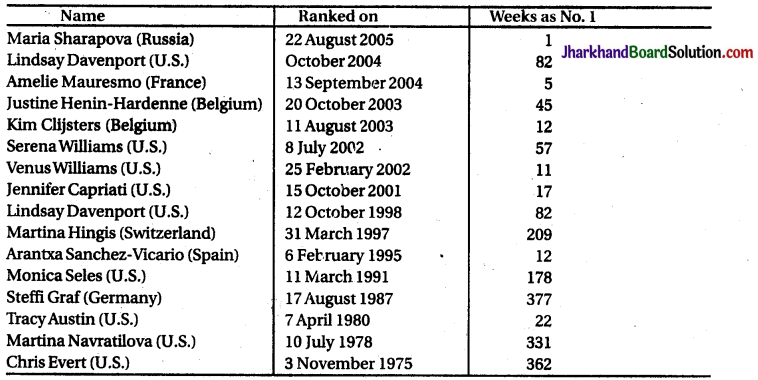
Working in pairs, go through the table below that gives information about the top women tennis players since 1975. Write a short article for your school magazine comparing and contrasting the players in terms of their duration at the top. Mention some qualities that you think may be responsible for their brief or long stay at the top spot.
युग्मों में कार्य करते हुए नीचे दी गई तालिका को ध्यान से पढ़िये। इसमें उन महिला टेनिस खिलाड़ियों के बारे में सूचना है जो 1975 से शिखर पर रही हैं । अपने विद्यालय की पत्रिका के लिए एक संक्षिप्त लेख लिखिये जिसमें इन खिलाड़ियों के शीर्ष पर रहने के काल की तुलना व विषमता प्रस्तुत की गई हो । उन गुणों का भी उल्लेख कीजिये जो आपके विचार में उनके लम्बे या थोड़े समय तक शीर्ष स्थान पर रहने के लिए उत्तरदायी रहे हों ।
Top-Ranked Women Players
1. The roll of honour of women who enjoyed life at the summit since everybody’s favourite player, Chris Evert took her place in 1975.
Answer:
Top-Ranked Women Players
(By Shalu IX-A)
Tennis is a very popular game all over the world. We should know about the women tennis players who have topped and touched the summit of success. First of all we see Chris Evert. She belonged to the US. She took her place in 1975. She maintained her first rank for 362 weeks that is indeed, a very long period for a player. She succeded in maintaining it only through sacrificing her pleasures. She had iron will and determination in achieving the goal. In 1978, Martina Navratilova of U.S. remained on the top continuously for 331 weeks.
She was also a great player of tennis and she was admired internationally. Steffi Graf from Germany became No.1 tennis player of the world on 17 August 1987 and remained on the top for 377 weeks, the longest period upto now. Martina Hingis from Switzerland, Lindsay Davenport from the U.S., Serena Williams from the U.S., Justine Henin-Hardenne from Belgium have also been world’s number one tennis players for considerably a good period. Among them Lindsay Davenport’s efforts are appreciable. She topped first on 12 Oct 1998 and remained on the summit for 82 weeks. She continued her efforts and she again became number one player in Oct. 2004 and maintained this rank for 82 weeks. Her high morale, determination, and self-confidence made her the best player in the world.
There are some women players also who became number one player in the world, but they could not maintain it for a long period. This might have happened due to their weak-willed view and age factor. Among them came Tracy Austin, Arantxa Sanchez-Vicario, Jennifer Capriati, Venus Williams, Kim Clijsters and Amelie Mauresmo.
Now we talk about Maria Sharapova from Russia. She became number one player on 22 August 2005 but she remained on this spot only for a week. Although she was determined and fiercely competitive, her humble beginning became a hurdle in her success.
II. Which of these words would you use to describe Santosh ? Find reasons in the text to support your choices, and write a couple of paragraphs describing Santosh’s character.
संतोष का वर्णन करने के लिए आप इनमें से कौन-से शब्दों का प्रयोग करेंगे ? अपनी बात की पुष्टि के लिए पाठ में से कारण ढूँढ़िये और संतोष का चरित्र दो अनुच्छेदों में लिखिये ।

- Determined: She was determined to choose the correct path and change the system. She refused to marry early and joined a school in Delhi.
- Adventurous: She went to climb the Aravalli Hills herself.
- Polite: She was firm but polite. She told her father politely that she would earn for her. schooling.
- Resourceful: She saved money and joined a course in mountaineering.
- Considerate: She helped other climbers. She shared her oxygen to save the life of a fellow climber, Mohan Singh.
- Independent: She joined the Nehru Institute of Mountaineering at Uttarkashi without asking permission from her father.
- Persevering: She kept on going on expedition after expedition till she made it to the top twice.
A Brief Character-sketch of Padmashri Santosh Yadav
Padmashri Santosh Yadav was born in Joniyawas, a small village of Rewari district in Haryana. From the very beginning, she was determined to choose the right path and change the orthodox outlook of the people of her village. She refused to marry early. She was determined to get proper education. She went to Delhi on her own and joined a school there to get good education.
Santosh Yadav took to the climbing by chance. She was fascinated to see people climbing the Aravalli Hills. She tried to climb herself with the motivation of Aravalli hills climbers. She was resourceful. She saved money and joined a course in climbing without asking permission from her father. She was able to climb the top of Mt Everest. She did it twice and at an early age. Her worrying for others is praiseworthy. She shared her oxygen to save a dying fellow climber Mohan Singh.
पद्मश्री सन्तोष यादव – एक संक्षिप्त चरित्र चित्रण
पद्मश्री संतोष यादव का जन्म हरियाणा के रेवाड़ी जिले के एक छोटे से गाँव जोनियावास में हुआ । वह शुरू से ही सही मार्ग चुनने और अपने गाँव के पुरातनपंथी लोगों के दृष्टिकोण को बदलने के लिए दृढ़ संकल्पित थी । उसने छोटी उम्र में विवाह करने से मना कर दिया । वह सही शिक्षा पाने के लिए दृढ़संकल्प थी । वह अपने आप दिल्ली चली गई और वहाँ एक स्कूल में दाखिला ले लिया ।
संतोष यादव ने पर्वतारोहण का कार्य संयोगवश ले लिया । वह लोगों को अरावली पहाड़ियों पर चढ़ते हुए देखकर आकर्षित हो गई । उसने स्वयं अरावली पहाड़ियों पर चढ़ने वाले लोगों की प्रेरणा से पहाड़ी पर चढ़ने का प्रयत्न किया । वह सूझबूझ से पूर्ण थी । उसने धन बचाकर अपने पिता की इजाजत के बिना ही पर्वतारोहण कोर्स में दाखिला ले लिया । वह एवरेस्ट के शिखर पर चढ़ने में समर्थ हुई । उसने बहुत ही छोटी अवस्था में यह कार्य दो बार किया। उसके हृदय में दूसरों के प्रति चिन्ता प्रशंसनीय है । उसने अपने एक साथी पर्वतारोही मोहन सिंह की जान बचाने के लिए अपनी ऑक्सीजन में से कुछ ऑक्सीजन दी।
JAC Class 9 English Reach for the Top Important Questions and Answers
Part – I
Santosh Yadav
Short Answer Type Questions
Answer the following questions in about 30 words each:
निम्नलिखित प्रत्येक प्रश्न का उत्तर लगभग 30 शब्दों में दीजिए :
Question 1.
Where was Santosh born ?
सन्तोष का जन्म कहाँ हुआ था ?
Answer:
Santosh, the only woman in the world who has scaled Mt Everest twice, was born in the small village of Joniyawas of Rewari district in Haryana.
संसार की एकमात्र महिला संतोष जो माउण्ट ऐवरेस्ट पर दो बार चढ़ चुकी है, का जन्म हरियाणा राज्य के रेवाड़ी जिले में स्थित एक छोटे से गाँव जोनियावास में हुआ था ।
Question 2.
How could Santosh’s parents afford to send their children to the best schools?
सन्तोष के माता-पिता अपने बच्चों को श्रेष्ठतम विद्यालयों में भेजने में किस प्रकार समर्थ थे ?
Answer:
Santosh’s parents were affluent landowners. So they could afford to send their children to the best schools, even to the country’s capital, New Delhi, which was quite close by.
सन्तोष के माता-पिता समृद्ध जमींदार थे । इसलिए वे अपने बच्चों को श्रेष्ठतम विद्यालयों तथा यहाँ तक कि देश की राजधानी नई दिल्ली में भी भेजने में समर्थ थे जो कि बिल्कुल ही निकट थी ।
Question 3.
Why was Santosh not sent to study outside her village in her childood ?
सन्तोष को बचपन में पढ़ने के लिए गाँव से बाहर क्यों नहीं भेजा गया ?
Answer:
According to the prevailing custom in the family, Santosh was not sent to study outside her village. She had to read in the local village school. But she decided to fight the system in her quiet way,
परिवार में प्रचलित परम्परा के अनुसार सन्तोष को गाँव से बाहर पढ़ने के लिए नहीं भेजा गया। उसे गाँव के ही स्थानीय विद्यालय में पढ़ना पड़ा। लेकिन उसने अपने शांत भाव से इस परम्परा के खिलाफ लड़ने का निश्चय किया।
Question 4.
What did Santosh tell her parents when she was under pressure to get married?
जब सन्तोष पर विवाह करने के लिए दबाव था तो उसने अपने माता-पिता से क्या कहा ?
Answer:
When Santosh turned sixteen, her parents pressed her to get married as per the village tradition. But Santosh threatened her parents that she would never marry if she did not get proper education.
जब सन्तोष 16 वर्ष की हुयी तो उसके माता-पिता ने गाँव की प्रथा के अनुसार उस पर शादी करने के लिए दबाव डाला। लेकिन सन्तोष ने अपने माता-पिता को यह धमकी दी कि यदि उसको उपयुक्त शिक्षा प्राप्त नहीं हुई तो वह कभी भी विवाह नहीं करेगी ।
Question 5.
Why did Santosh write a letter of apology to her father ?
सन्तोष ने अपने पिता को क्षमा-याचना का पत्र क्यों लिखा ?
Answer:
Santosh wrote a letter of apology to her father because she had got enrolled herself in a course at Uttarkashi’s Nehru Institute of mountaineering without his permission.
सन्तोष ने अपने पिता को क्षमा-याचना का पत्र इसलिए लिखा क्योंकि उसने उनकी अनुमति के बिना अपना नामांकन उत्तरकाशी के ‘नेहरू पर्वतारोहण संस्थान’ के एक पाठ्यक्रम में करवा लिया था ।
Question 6.
What qualities did Santosh develop in herself during expeditions?
सन्तोष ने अभियानों के दौरान किन-किन गुणों को विकसित किया?
Answer:
Santosh developed qualities like remarkable resistance to cold and the altitude. “Moreover, she possessed iron will, physical endurance and an amazing mental toughness. Due to these qualities, she could complete her mission.
सन्तोष ने शीत व ऊँचाई के प्रति एक उल्लेखनीय प्रतिरोधक शक्ति विकसित कर ली थी । इसके अतिरिक्त उसमें दृढ़ इच्छाशक्ति, शारीरिक सहनशीलता व अद्भुत मानसिक दृढ़ता थी । इन गुणों के कारण ही वह अपने मिशन को पूरा कर सकी ।
Question 7.
How did Santosh save her fellow climber Mohan Singh during the 1992 Everest Mission?
वर्ष 1992 के एवरेस्ट मिशन के दौरान सन्तोष ने अपने साथी पर्वतारोही मोहन सिंह को किस प्रकार बचाया ?
Answer:
During the 1992 Everest. Mission, Mohan Singh was lying in the South Col. He was about to die without oxygen. Then Santosh saved her fellow climber by sharing her oxygen with him.
वर्ष 1992 के एवरेस्ट मिशन के दौरान मोहन सिंह साउथ कोल में पड़ा हुआ था। वह बिना आक्सीजन के लगभग मरने ही वाला था। तब सन्तोष ने अपने साथी पर्वतारोही को अपनी आक्सीजन में से कुछ आक्सीजन देकर उसे बचाया ।
Question 8.
Who invited Santosh to scale Mt Everest a second time? What was her achievement?
माउण्ट एवरेस्ट पर दूसरी बार चढ़ने के लिए सन्तोष को किसने आमन्त्रित किया ? उसकी क्या उपलब्धि थी?
Answer:
Indo – Nepalese Women’s Expedition made Santosh a member of their team and invited her to scale Mt Everest a second time. The Indian Government bestowed upon her the Padmashri on setting a record as the only woman to have scaled Mt Everest twice.
इण्डो-नेपाली महिला अभियान ने सन्तोष को अपने दल का सदस्य बना लिया और उसे दूसरी बार माउण्ट एवरेस्ट पर चढ़ने के लिए आमन्त्रित किया । माउण्ट एवरेस्ट पर दो बार चढ़ने वाली विश्व की एकमात्र महिला का कीर्तिमान स्थापित करने पर उसे भारत सरकार ने पदमश्री से सम्मानित किया।
Question 9.
What efforts did Santosh make to improve the environment of the Himalayas ?
सन्तोष ने हिमालय का पर्यावरण सुधारने के लिए क्या किया ?
Ans.
Santosh is a fervent environmentalist. She collected 500 kilograms of garbage from the Himalayas and brought it down from there. Thus, she made efforts to improve the environment of the Himalayas.
सन्तोष एक उत्साही पर्यावरणविद् है । उसने हिमालय से 500 किलोग्राम कूड़ा-कचरा इकट्ठा किया और वहाँ से नीचे लेकर आई । इस प्रकार सन्तोष ने हिमालय का पर्यावरण सुधारने का प्रयास किया ।
Long Answer Type Questions
Answer the following questions in about 60 words each :
निम्नलिखित प्रत्येक प्रश्न का उत्तर लगभग 60 शब्दों में दीजिये :
Question 1.
How did Santosh struggle to get proper education ?
उपयुक्त शिक्षा प्राप्त करने के लिए सन्तोष ने किस प्रकार संघर्ष किया ?
Answer:
When Santosh was sixteen, her parents wanted her to get married. But she threatened her parents that she would never marry if she did not get proper education. Then she left her home and joined a school in Delhi to get good education. She made a plan to earn money by working part time to pay her school fees. But later her parents agreed to pay for her education. Thus, Santosh succeeded in getting proper education.
जब सतीष ‘सोलह वर्ष की हुई तो उसके माता-पिता उसका विवाह करना चाहते थे । किन्तु उसने अपने माता-पिता को धमकी दी कि यदि उसे उपयुक्त शिक्षा नहीं मिली तो वह कभी भी विवाह नहीं करेगी । तत्पश्चात् उसने अपना घर छोड़ दिया और अच्छी शिक्षा के लिए दिल्ली के एक स्कूल में प्रवेश ले लिया । उसने अपने स्कूल की फीस चुकाने के लिए अंशकालीन काम कर धन कमाने की योजना बनाई । किन्तु बाद में उसके माता-पिता उसकी शिक्षा के लिए धन देने को सहमत हो गये । इस प्रकार सन्तोष उपयुक्त शिक्षा प्राप्त करने में सफल रही ।
Question 2.
How did Santosh take to mountain climbing ?
सन्तोष ने पर्वतारोहण किस प्रकार आरम्भ किया ?
Answer:
After passing the high school examinations, Santosh joined Maharani College in Jaipur. She got a room in Kasturba Hostel from where she used to watch villagers who went the hill and suddenly vanished after a while. One day she decided to check it out herself. She found some mountaineers at the foot of the hill. She asked them if she could join them. They motivated her for climbing the mountain. So she joined them and took to mountain climbing.
हाईस्कूल की पढ़ाई पूरी करने के बाद सन्तोष ने जयपुर के महारानी कॉलेज में दाखिला ले लिया । उसे कस्तूरबा होस्टल में एक कमरा मिला जहाँ से वह ग्रामीणों को देखा करती थी जो पहाड़ी पर चढ़ते थे और कुछ समय बाद ही अचानक गायब हो जाते थे । एक दिन उसने स्वयं ही इसका पता लगाने का निश्चय किया । उसे पहाड़ी की तलहटी में कुछ पर्वतारोही मिले। उसने उनसे पूछा कि क्या वह भी उनमें शामिल हो सकती हैं । उन्होंने उसे पर्वतारोहण के लिए प्रेरित किया । इसलिए वह उनमें शामिल हो गयी और पर्वतारोहण प्रारम्भ किया।
Question 3.
How did Santosh succeed in scaling Mt Everest ?
सन्तोष माउण्ट एवरेस्ट पर चढ़ने में कैसे सफल हुई ?
Answer:
Santosh possessed some extraordinary qualities. She was equipped with an iron will, physical endurance and an amazing mental toughness. She developed a remarkable resistance to cold and the altitude. She went on an expedition every year. Her climbing skills, physical fitness and mental strength were impressive.Due to these qualities she succeeded in scaling Mt Everest.
सन्तोष में कुछ असाधारण गुण थे । वह दृढ़ इच्छाशक्ति, शारीरिक सहनशीलता तथा अद्भुत मानसिक दृढ़ता से युक्त थी । उसने शीत व ऊँचाई के प्रति उल्लेखनीय प्रतिरोधक क्षमता विकसित कर ली थी । वह प्रतिवर्ष (पर्वतारोहण) अभियान पर गई । उसका पर्वतारोहण कौशल, शारीरिक स्वस्थता तथा मानसिक शक्ति प्रभावशाली थे। इन गुणों के कारण वह माउण्ट एवरेस्ट पर चढ़ने में सफल हो गई ।
Question 4.
What feelings did Santosh have when she was on Mt Everest?
जब सन्तोष माउण्ट एवरेस्ट पर थी तब उसकी भावनाएँ क्या थीं ?
Answer:
When Santosh had reached on Mt Everest, she was overwhelmed with joy. It was truly a spiritual moment for her. Her feelings were undescribable. She said that it had taken some time for the enormity of the moment to sink in. She unfurled the Indian tricolour and held it aloft on the roof of the world. The Indian flag was flying on top of the world. She felt proud as an Indian.
जब सन्तोष माउण्ट एवरेस्ट पर पहुँची तो वह आनन्द से अभिभूत हो गई । यह वास्तव में उसके लिए एक आत्मिक क्षण था । उसकी भावनाएँ अवर्णनीय थीं । सन्तोष ने कहा कि उस क्षण की महानता को समझने में उसे कुछ समय लगा था। उसने भारतीय तिरंगा फहराया और इसे संसार की छत पर ऊँचा करके उठा लिया। भारतीय ध्वज संसार के सर्वोच्च सिरे पर फहरा रहा था । उसने एक भारतीय होने का गर्व महसूस किया ।
Seen Passages
Passage – 1.
Read the following passages carefully and answer the questions given below them:
निम्नलिखित गद्यांशों को ध्यानपूर्वक पढ़िये एवं उनके नीचे दिये गये प्रश्नों के उत्तर दीजिये :
The only woman in the world who has scaled Mt Everest twice was born in a society where the birth of a son was regarded as a blessing, and a daughter, though not considered a curse, was not generally welcome. When her mother was expecting Santosh, a travelling ‘holy man’, giving her his blessing, assumed that she wanted a son.
But, to everyone’s surprise, the unborn child’s grandmother, who was standing close by, told him that they did not want a son. The ‘holy man’ was also surprised! Nevertheless, he gave the requested blessing and as destiny would have it, the blessing seemed to work. Santosh was born the sixth child in a family with five sons, a sister to five brothers. She was born in the small village of Joniyawas of Rewari district in Haryana.
The girl was given the name ‘Santosh’, which means contentment. But Santosh was not always content with her place in a traditional way of life. She began living life on her own terms from the start. Where other girls wore traditional Indian dresses, Santosh preferred shorts. Looking back, she says now, “From the very beginning I was quite determined that if I chose a correct and a rational path, the others around me had to change, not me.” Santosh’s parents were affluent landowners who could afford to send their children to the best schools, even to the country’s capital, New Delhi, which was quite close by. But, in line with the prevailing custom in the family, Santosh had to make do with the local village school.
1. How many times has Santosh scaled Mt Everest?
सन्तोष माउण्ट एवरेस्ट पर कितनी बार चढ़ाई कर चुकी है ?
2. What did the grandmother say to the ‘holyman’?
दादी ने संन्यासी से क्या कहा ?
3. How many brothers does Santosh have?
सन्तोष के कितने भाई हैं ?
4. Where was Santosh born ?
सन्तोष का जन्म कहाँ हुआ था ?
5. What does the word ‘Santosh’ mean?
‘सन्तोष’ शब्द का क्या अर्थ होता है ?
6. Which dresses did Santosh not like to wear?
सन्तोष कौन-से (किस तरह के) वस्त्र पहनना पसन्द नहीं करती थी ?
7. How could Santosh’s parents afford to send their children to the best schools?
सन्तोष के माता-पिता अपने बच्चों को श्रेष्ठतम् विद्यालयों में भेजने में किस प्रकार समर्थ थे ?
8. What was Santosh not content with?
सन्तोष किस बात से सन्तुष्ट नहीं थी ?
9. Pick out the word from the passage which is the antonym of- ‘curse’
10. Find the words from the passage which mean: ‘in accordance with’
Answers:
1. Santosh has scaled Mt Everest twice.
सन्तोष माउण्ट एवरेस्ट पर दो बार चढ़ चुकी है ।
2. The grandmother told the holy man that they didn’t want a son.
दादी ने संन्यासी को बताया कि उन्हें लड़का नहीं चाहिए।
3. Santosh has five brothers.
सन्तोष के पाँच भाई हैं ।
4. Santosh was born in the small village of Joniyawas of Rewari district in Haryana.
सन्तोष का जन्म हरियाणा के रेवाड़ी जिले के एक छोटे से गाँव जोनियावास में हुआ था ।
5. The word ‘Santosh’ means contentment.
‘सन्तोष’ शब्द का अर्थ सन्तुष्टि है ।
6. Santosh did not like to wear traditional Indian dresses.
सन्तोष परम्परागत भारतीय वस्त्र पहनना पसन्द नहीं करती थी ।
7. They could afford to send their children to the best schools because they were affluent land-owners.
सन्तोष के माता-पिता अपने बच्चों को श्रेष्ठतम् विद्यालयों में भेजने में समर्थ थे क्योंकि वे समृद्ध जमींदार थे।
8. Santosh was not content with her place in a traditional way of life.
सन्तोष परम्परागत जीवन शैली में अपने स्थान से सन्तुष्ट नहीं थी ।
9. blessing
10. in line with
Passage – 2.
A marriage as early as that was the last thing on her mind. She threatened her parents that she would never marry if she did not get a proper education. She left home and got herself enrolled in a school in Delhi. When her parents refused to pay for her education, she politely informed them of her plans to earn money by working part time to pay her school fees. Her parents then agreed to pay for her education.
Wishing always to study “a bit more” and with her father slowly getting used to her urge for more education, Santosh passed the high school examinations and went to Jaipur. She joined Maharani College and got a room in Kasturba Hostel. Santosh remembers, “Kasturba Hostel faced the Aravalli Hills. I used to watch villagers from my room, going up the hill and suddenly vanishing after a while.
One day I decided to check it out myself. I found nobody except a few mountaineers. I asked if I could join them. To my pleasant surprise, they answered in the affirmative and motivated me to take to climbing”. Then there was no looking back for this determined young girl. She’saved money and enrolled in a course at Uttarkashi’s Nehru Institute of Mountaineering. “My college semester in Jaipur was to end in April but it ended on the nineteenth of May.”
1. What did Santosh threaten her parents?
सन्तोष ने अपने माता-पिता को क्या धमकी दी ?
2. What did Santosh tell her parents when they refused to pay for her education?
सन्तोष के माता-पिता ने उसकी शिक्षा के लिए धन देने से मना कर दिया तो उसने अपने माता-पिता से क्या ?
3. When did Santosh go to Jaipur to study there?
सन्तोष अध्ययन हेतु जयपुर कब गई ?
4. In which institute did Santosh study in Jaipur?
जयपुर में सन्तोष ने किस संस्था में अध्ययन किया ?
5. What did Santosh use to watch from her room in Kasturba Hostel ?
सन्तोष कस्तूरबा होस्टल में अपने कमरे से क्या देखा करती थी ? .
6. Why did she leave home?
उसने घर क्यों छोड़ दिया ?
7. What was her desire ?
उसकी इच्छा क्या थी ?
8. How was she a determined girl?
वह किस प्रकार एक दृढनिश्चय वाली लड़की थी ?
9. Pick out the word from the passage which is the antonym of- ‘forgets’
10. Find the word from the passage which means: ‘disappearing’
Answers:
1. Santosh threatened her parents that she would never marry if she did not get proper education.
सन्तोष ने अपने माता-पिता को धमकी दी कि यदि उसे उपयुक्त शिक्षा नहीं मिली तो वह कभी भी विवाह . नहीं करेगी ।
2. When Santosh’s parents refused to pay for her education, she told them of her plan to earn money by working part time to pay her school fees.
जब सन्तोष के माता-पिता ने उसकी शिक्षा के लिए धन देने से मना कर दिया तो उसने अपनी स्कूल फीस जमा करने के लिए अंशकालीन काम कर पैसा कमाने की योजना के बारे में उनको बताया ।
3. When Santosh had passed High School Examinations, she went to Jaipur to study there.
जब सन्तोष ने हाई स्कूल परीक्षा उत्तीर्ण कर ली, तब वह अध्ययन हेतु जयपुर गई ।
4. Santosh studied in Maharani College in Jaipur.
सन्तोष ने जयपुर में महारानी कॉलेज में अध्ययन किया ।
5. Santosh used to watch villagers from her room, going up the hill and suddenly vanishing after a while.
सन्तोष अपने कमरे से ग्रामीणों को पहाड़ी पर चढ़ते हुए एवं उन्हें थोड़ी देर में ही अचानक ओझल होते हुए देखा करती थी ।’
6. She left home to get higher education in Delhi.
उसने दिल्ली में उच्च शिक्षा पाने के लिए घर छोड़ दिया ।
7. Her desire was to study a bit more.
उसकी इच्छा कुछ अधिक अध्ययन करने की थी ।
8. She was a determined girl, She saved money and enrolled herself in a course at Uttarkashi’s Nehru Institute of Mountaineering.
वह दृढ़निश्चयी लड़की थी। उसने पैसा बचाया और उत्तरकाशी के नेहरू इंस्टिट्यूट ऑव माउन्टेनियरिंग में अपना नाम लिखवाया।
9. remembers
10. vanishing
Passage – 3.
During the 1992 Everest mission, Santosh Yadav provided special care to a climber who lay dying at the South Col. She was unfortunately unsuccessful in saving him. However, she managed to save another climber, Mohan Singh, who would have met with the same fate, had she not shared her oxygen with him.
Within twelve months, Santosh found herself a member of an Indo-Nepalese Women’s Expedition that invited her to join them. She then scaled the Everest a second time, thus setting a record as the only woman to have scaled the Everest twice, and securing for herself and India a unique place in the annals of mountaineering.
In recognition of her achievements, the Indian government bestowed upon her one of the nation’s top honours, the Padmashri. Describing her feelings when she was literally ‘on top of the world’, Santosh has said, ‘It took some time for the enormity of the moment to sink in. ……… Then I unfurled the Indian tricolour and held it aloft on the roof of the world. The feeling is indescribable. The Indian flag was flying on top of the world. It was truly a spiritual moment. I felt proud as an Indian.’
1. Whose life did Santosh save during the 1992 Everest mission?
1992 के एवरेस्ट मिशन के दौरान सन्तोष ने किसका जीवन बचाया ?
2. How did Santosh save Mohan Singh’s life?
सन्तोष ने मोहन सिंह का जीवन कैसे बचाया ?
3. What record did Santosh set ?
सन्तोष ने कौन – सा कीर्तिमान स्थापित किया ?
4. Which honour did the Indian government bestow upon Santosh ?
भारत सरकार ने सन्तोष को कौन-सा सम्मान प्रदान किया ?
5. With whom did Santosh scale the Everest second time?
सन्तोष ने एवरेस्ट पर दूसरी बार किसके साथ चढ़ाई की ?
6. To whom did Santosh Yadav provide a special care ?
सन्तोष यादव ने किसकी विशेष देख-रेख की ?
7. When did Santosh feel proud as an Indian?
सन्तोष को भारतीय होने का गर्व कब महसूस हुआ ?
8. What was a spiritual moment fo Santosh ?
सन्तोष के लिए आध्यात्मिक क्षण क्या था ?
9. Pick out the word from the passage which is the antonym of- ‘humble’
10. Find the word from the passage which means: ‘unequalled or unmatched’
Answers:
1. During the 1992 Everest mission Santosh saved the life of a climber named Mohan Singh.
1992 के एवरेस्ट मिशन के दौरान सन्तोष ने मोहन सिंह नाम के एक पर्वतारोही का जीवन बचाया।
2. Santosh saved Mohan Singh’s life by sharing her oxygen with him.
सन्तोष ने अपनी ऑक्सीजन को मोहन सिंह को देकर उसका जीवन बचाया ।
3. Santosh set a record as the only woman to have scaled the Everest twice.
सन्तोष ने दो बार एवरेस्ट पर चढ़ाई करने वाली एकमात्र महिला के रूप में कीर्तिमान स्थापित किया।
4. The Indian government bestowed upon Santosh one of the nation’s top honours, the Padmashri.
भारत सरकार ने सन्तोष को राष्ट्र के सर्वोच्च सम्मानों में से एक पद्मश्री प्रदान किया ।
5. Santosh scaled Mt Everest second time with an Indo-Nepalese Women’s Expedition team.
भारतीय नेपाली महिला अभियान दल के साथ सन्तोष एवरेस्ट पर दूसरी बार चढ़ीं ।
6. She provided special care to a climber who lay dying at the South Col.
उसने साउथ कोल में एक मरते हुए पर्वतारोही की विशेष देख-रेख की।
7. Santosh felt proud as an Indian when she unfurled the tri-colour flag on Mt Everest.
सन्तोष को भारतीय होने का गर्व महसूस हुआ जब उसने माउण्ट एवरेस्ट पर तिरंगा लहराया ।
8. When Indian flag was flying on top of the world, it was a spiritual moment for Santosh.
जब भारतीय ध्वज संसार के शिखर पर लहरा रहा था तो वह संतोष के लिए एक आध्यात्मिक क्षण था।
9. proud
10. unique
Part- II
Maria Sharapova
Answer the following questions in about 30-40 words each:
निम्नलिखित प्रत्येक प्रश्न का उत्तर लगभग 30-40 शब्दों में दीजिए :
Question 1.
Describe Maria Sharapova’s stay and training in the U.S.
मारिया शारापोवा का अमेरिका में रहना और उसके प्रशिक्षण का वर्णन कीजिए ।
Answer:
Maria Sharapova left for the U. S. A. at the age of nine only. The trip to Florida was a heart- wrenching two-years separation from her mother. Yelena was compelled to stay back in Siberia because of visa restrictions. She was very lonely there.
मारिया शारापोसा नौ साल की उम्र में अमेरिका चली गई थी। फ्लोरिडा की यात्रा के लिये उन्हें अपनी माँ येलेना से दो वर्ष की हृदय विदारक जुदाई झेलनी पड़ी। वीजा नियमों की पाबन्दी के कारण येलेना को साइबेरिया में ही रूकना पड़ा था। मारियां वहाँ बहुत अकेली थी।
Question 2.
How was Maria harassed by other tennis trainees ?
अन्य टेनिस प्रशिक्षार्थियों द्वारा मारिया को कैसे तंग किया गया ?
Or
How did the senior tennis players bully young Maria Sharapova ?
सीनियर टेनिस खिलाड़ियों ने युवा शारापोवा को किस तरह धमकाया ?
Answer:
Maria used to put up with a lot of humiliation and insults while being in the U.S.A. They used to get her up at 11 p.m. and order her to tidy up the room and clean it. It was difficult for her to do because she was in a habit of going to bed at 8 p.m.
मारिया को अमेरिका में रहकर बहुत अपमान झेलना पड़ा था। उससे वरिष्ठ खिलाड़ी उसे रात में 11 बजे जगा देते थे और कमना सुसज्जित करने व साफ करने को कहते । यह मारिया के लिये कठिन कार्य था क्योंकि वह 8 बजे सो जाया करती थी।
Question 3.
How did Maria Sharapova’s father help her in becoming a top-class tennis player ?
मारिया शारापोवा के पिता ने शीर्ष श्रेणी की टेनिस खिलाड़ी के बनने में उसकी कैसे सहायता की?
Answer:
When she was a nine-year-old girl, her father Yuri took her to Florida to get her trained as juba hoog 192. a tennis player. It was Mr Yuri only who launched her on the path to success.
जब मारिया केवल नौ वर्ष की थी तब उसके पिता यूरी उसे टेनिस खिलाड़ी का प्रशिक्षण दिलाने के लिए फ्लोरिडा (यू. एस. ) ले गये। ये मि. यूरी ही थे जिन्होंने उसे सफलता का मार्ग दिखाया।
Question 4.
How did Maria Sharapova come to realize that excellence in tennis would only come at a price?
मारिया शारापोवा ने कैसे एहसास किया कि टेनिस में दक्षता ऊँची कीमत देकर ही पाई जाएगी ?
Answer:
To be in Florida for training was a heart-wrenching two-years separation from her mother. Her mother Yelena was compelled to stay back in Siberia because of visa-restrictions. Even in America she had to face lots of challanges. So, at an early age only she had learnt that excellence in tennis would only come at a price.
मारिया प्रशिक्षण के लिय फ्लोरिडा पर गई तब उसे अपनी माँ से दो वर्ष की हृदय विदारक जुदाई झेलनी पड़ी। बीजा नियमों की पाबन्दी के कारण येलेना (उसकी माँ) को सइबेरिया में ही रुकना पड़ा। यहाँ तक कि अमेरिका में भी उसे बहुत कष्ट उठाने पड़े। तब मारिया यह समझ गई कि टेनिस में दक्षता ऊँची कीमत देकर (अधिक परिश्रम कर) प्राप्त की जा सकेगी।
Long Answer Type Questions
Answer the following questions in about 60 words each:
निम्नलिखित प्रत्येक प्रश्न का उत्तर लगभग 60 शब्दों में दीजिए :
Question 1.
What made Maria Sharapova the world number one woman in women’s tennis? What kind of a woman is she?
किस चीज ने मारिया शारापोवा को महिला टेनिस की प्रथम महिला बना दिया? वह किस प्रकार की महिला है ?
Answer:
Maria Sharapova is a determined and mentally tough woman. Due to this toughness she won the women’s singles crown at Wimbledon in 2004. In August 2005, she became the world’s number one woman in Women’s Tennis. As a woman, Maria has great self-confidence. She is very competitive. She works very hard. She is patriotic to the core. She has Russian citizenship. She hopes to play the Olympics for Russia.
मारिया शारापोवा दृढनिश्चयी और मानसिक रूप से सख्त महिला है । इसी सख्ती के कारण उसने विम्बलडन 2004 में महिलाओं का एकल का खिताब जीता । अगस्त 2005 में वह महिला टेनिस में संसार की नम्बर एक महिला बन गई । महिला होने के नाते मारिया में अत्यधिक आत्म-विश्वास है । वह बहुत प्रतिस्पर्धाशील है । वह कठिन परिश्रम करती है । वह पूर्णरूप से देशभक्त है । वह रूसी नागरिक है । वह रूस की ओर से ओलिम्पिक्स खेलने की आशा करती है ।
Question 2.
What is ‘at odds’ with Maria Sharapova? What are her hobbies? In which way does she take the game tennis as a sport?
मारिया शारापोवा के बारे में असंगत क्या है ? उसकी कौन-कौन सी रूचियाँ है ? वह टेनिस को एक खेल के रूप में किस प्रकार से देखती है ?
Answer:
Maria Sharapova has a ready smile on her face. She also dresses fashionably. She is fond of wearing modern evening gowns. She loves pancakes with chocolate spread and fizzy orange drinks. All these things are ‘at odds’ with her being the number one tennis player in the . world in Women’s Tennis. Maria is talented. She has a great desire to succeed. Money is a motivation for her. Tennis is, a business as well as a sport for her.
मारिया के चेहरे पर स्वाभाविक मुस्कान है । वह फैशन के अनुसार कपड़े भी पहनती है । वह सांयकालीन आधुनिक व फैशनेबल गाउन पहनने की शौकीन है । वह चाकलेट लगे पेनकेक और बुलबुलेदार सन्तरे का पेय लेना पसन्द करती है उसकी ये सब बातें महिला टेनिस में संसार की प्रथम टेनिस खिलाड़ी बनने के असंगत है अर्थात् उनसे मेल नहीं खाती है। मारिया एक गुणी महिला है । उसमें सफल होने की एक तीव्र इच्छा है। उसके लिए धन एक प्रोत्साहन है। उसके लिए टेनिस एक व्यवसाय भी है और खेल भी है ।
Seen Passages
Read the following passages carefully and answer the questions that follow:
निम्नलिखित गद्यांशों को ध्यानपूर्वक पढ़िए व उनके नीचे दिये गये प्रश्नों के उत्तर दीजिए :
Passage – 1.
There is something disarming about Maria Sharapova, something at odds with her ready smile and glamorous attire. And that something in her lifted her on Monday, 22 August 2005 to the world number one position in women’s tennis. All this happened in almost no time. Poised beyond her years, the Siberian born teenager took just four years as a professional to reach the pinnacle.
However, the rapid ascent in a fiercely competitive world began nine years before with a level of sacrifice few children would be prepared to endure. Little Maria had not yet celebrated her tenth birthday when she was packed off to train in the United States. That trip to Florida with her father Yuri launched her on the path to success and stardom. But it also required a heart-wrenching two- year separation from her mother Yelena.
The latter was compelled to stay back in Siberia because of visa restrictions. The nine-year old girl had already learnt an important lesson in life-that tennis excellence would only come at a price. “I used to be so lonely,” Maria Sharapova recalls. “I missed my mother terribly. My father was working as much as he could to keep my tennis-training going. So, he couldn’t see me either.”
Questions:
1. What is at odds with Maria?
2. When did she get the world number one position in women’s tennis?
उसने ‘महिला टेनिस’ में विश्व में नम्बर एक की स्थिति कब प्राप्त की ?
3. Who went to Florida with Maria ?
मारिया के साथ फ्लोरिडा कौन गया ?
4. How old was Maria when she went for the training?
मारिया कितने साल की थी जब वह प्रशिक्षण के लिए गई थी ?
5. How long did Maria take to reach the pinnacle?
मारिया को शिखर तक पहुँचने में कितने वर्ष लगे ?
6. Why could her mother not go with her?
उसकी माँ उसके साथ क्यों नहीं जा सकीं ?
7. What important lesson did Maria learn ?
मारिया ने क्या महत्त्वपूर्ण सबक सीखा?
8. Why couldn’t her father meet her?
उसके पिता उससे क्यों नहीं मिल पाते थे?
9. Pick out the word from the passage which is the antonym of- ‘slow’.
10. Find the word from the passage which means- ‘journey’.
Answers:
1. Maria’s ready smile and glamorous attire are at odds with her.
मारिया की स्वाभाविक मुस्कुराहट और भव्य वेशभूषा उसके बारे में एक असंगत बात है।
2. On Monday, 22 August 2005 she got the world number one position in women’s tennis.
सोमवार, 22 अगस्त 2005 को उसने ‘महिला टेनिस’ में विश्व में नम्बर एक की स्थिति प्राप्त की ।
3. Her father Mr Yuri went to Florida with Maria.
उसके पिता श्री यूरी उसके साथ फ्लोरिडा गये ।
4. When Maria went for training, she was only nine years old.
जब मारिया प्रशिक्षण के लिए गई थी उस समय वह केवल नौ वर्ष की थी।
5. Maria took only four years to reach the pinnacle.
मारिया को शिखर तक पहुँचने में केवल चार वर्ष लगे ।
6. Due to Visa restrictions, her mother could not go with her.
वीजा नियमों में प्रतिबंधों के कारण उसकी माँ उसके साथ नहीं जा सकीं।
7. Maria learnt that tennis excellence would only come at a price.
मारिया ने सबक सीखा कि टेनिस में श्रेष्ठता भारी कीमत पर ही प्राप्त की जा सकती है।
8. Her father couldn’t meet her because he was working hard to keep her tennis-training going.
उसके पिता उससे इसलिए नहीं मिल पाते थे क्योंकि वह उसका टेनिस प्रशिक्षण जारी रखने के लिए कठोर परिश्रम कर रहे थे।
9. rapid
10. ‘trip’
Passage – 2.
“I am very, very competitive. I work hard at what I do. It’s my job.” This is her mantra for success.Though Maria Sharapova speaks with a pronounced American accent, she proudly parades her Russian nationality. Clearing all doubts she says, “I’m Russian. It’s true that the U.S. is a big part of my life. But I have Russian citizenship. My blood is totally Russian. I will play the Olympics for Russia if they want me.”’
Like any other number of teenaged sensations, Maria Sharapova lists fashion, singing and dancing as her hobbies. She loves reading the novels of Arthur Conan Doyle. Her fondness for sophisticated evening gowns appears at odds with her love of pancakes with chocolate spread and fizzy orange drinks. Maria Sharapova cannot be pigeon-holed or categorized.
Her talent, unwavering desire to succeed and readiness to sacrifice have lifted her to the top of the world. Few would grudge her the riches she is now reaping. This is what she has to say about her monetary gains from, tennis:”Of course, money is a motivation. Tennis is a business and a sport, but the most important is to become number one in the world. That’s the dream that kept me going.”
Questions:
1. What is her mantra for success ?
उसकी सफलता का मंत्र क्या है?
2. What is a job for Maria ?
मारिया के लिए कार्य क्या है?
3. What are the things that have lifted her to the top of the world ?
वे क्या चीजें है जिसने उसे विश्व के शिखर पर पहुँचा दिया ?
4. For which country does she want to play tennis ?
वह किस देश के लिए टेनिस खेलना चाहती है?
5. What is the most important thing for Maria ?
मारिया के लिए सबसे महत्त्वपूर्ण चीज क्या है?
6. Which novels does she like to read?
वह किन उपन्यासों को पढ़ना पसन्द करती है ?
7. What is her favourite dress ?
उसकी पसंदीदा पोशाक क्या है?
8. What does she like to eat and drink ?
वह क्या खाना व पीना पसंद करती है ?
9. Pick out the word from the passage which is the antonym of – ‘fail’.
10. Find the word from the passage which means – ‘inspiration’.
Answers:
1. Her mantra for success is to work hard.
उसकी सफलता का मंत्र कठोर परिश्रम है।
2. Tennis is a job for Maria.
टेनिस ही मारिया के लिए कार्य है।
3. Her talent, unwavering desire to succeed and readiness to sacrifice lifted her to the top of the world.
उसकी प्रतिभा, सफलता की दृढ़ इच्छा तथा बलिदान के लिए तैयार रहने की भावना ने उसे शिखर पर पहुँचा दिया ।
4. She wants to play tennis for her own country Russia.
वह अपने स्वयं के देश रूस के लिए टेनिस खेलना चाहती है ।
5. The most important thing for Maria is to become number one in tennis in the world.
मारिया के लिए सबसे महत्त्वपूर्ण चीज है टेनिस में विश्व में नम्बर एक बनना ।
6. She likes to read the novels of Arthur Conan Doyle.
वह ऑर्थर कॉनन डायल के उपन्यासों को पढ़ना पसंद करती है।
7. Sophisticated evening gowns are her favourite dress.
आधुनिक एवं फैशनेबल सांध्यकालीन गाउन उसकी पसंदीदा पोशाक हैं।
.
8. She likes to take pancakes with chocolate spread and fizzy orange drinks.
वह चॉकलेट लगा पेनकेक व बुलबुलेदार संतरे का पेय पसन्द करती है।
9. succeed
10. motivation
Reach for the Top Summary and Translation in Hindi
Part – I
Santosh Yadav
About the Lesson
इस अध्याय में दो आत्मकथात्मक लेख हैं जो शीर्ष पर पहुँचने के अथक प्रयासों के बारे में बताते हैं । Part – I एक ऐसी भारतीय लड़की की आत्मकथा हैं जो अपने माता-पिता की इच्छा के विरुद्ध अपने दृढ़ निश्चय से अपना अध्ययन जारी रखते हुए एक दिन संसार की सबसे ऊँची चोटी माउण्ट एवरेस्ट पर चढ़ी | Part – II में विश्व की नम्बर एक वरीयता प्राप्त करने वाली एक टेनिस खिलाड़ी की आत्मकथा है जिसे टेनिस खेल के लिए नौ वर्ष की छोटी-सी उम्र में ही अपने पिता के साथ अमेरिका जाकर बसना पड़ा। वह कठोर परिश्रम व दृढ़ निश्चय से इस मुकाम पर पहुँच पाई ।
Before You Read ( पढ़ने से पूर्व )
कुछ समय के लिए चिन्तन कीजिये और ऐसे तीन या पाँच व्यक्तियों की एक सूची बनाइये जिनकी उपलब्धियों के लिए आप उनकी पूजा करते हैं या उनकी अत्यधिक प्रशंसा करते हैं । आपके द्वारा प्रशंसनीय व्यक्ति जीवन के किसी भी क्षेत्र जैसे – खेल, चिकित्सा, संचार या कला एवं संस्कृति से हो सकते हैं । तत्पश्चात् आपके अध्यापक आपके चयन पर आपसे विचार विमर्श करेंगे और उनका पता लगायेंगे जो आपकी कक्षा के पाँच अति प्रशंसनीय व्यक्ति हैं । [Idol = a person or thing that is loved and admired very much, a statue that is worshipped as a god अतिप्रशंसनीय व्यक्ति, मूर्ति । ]
Word-Meanings and Hindi Translation
1. The only woman in the ……………. District in Haryana. (Pages 99-100)
Word-Meanings: scaled (स्केल्ड्) = climbed, चढ़ी, चढ़ाई की। twice ( ट्वाइस् ) = two times, दो बार । was born = जन्म हुआ था । society (सॅसायटि) the aggregate of people living together, समाज । birth (बॅ:थ) = the emergence of a baby, जन्म । regarded (रिगाडिड्) considered, माना जाता था । blessing (ब्लैसिंग्) = a thing that you are grateful for, वरदान | though (दो) = in spite of the fact that, यद्यपि । (कॅ:स) = omen of destruction, अभिशाप । generally (जेनॅरॅलि) usually, सामान्यतः । welcome (वेल्कम्) = to greet, स्वागत |
was expecting = was about to give birth to Santosh, गर्भ में लिये हुए थी । travelling (ट्रेवलिंग) = roaming, घुमन्तू, भ्रमणशील । holy man (होलि मैन् ) = sage, साधु, सन्यासी। assumed (अज़्यूम्ड्) = supposed, मान लिया । surprise (सॅप्राइज़) = आश्चर्य । unborn (अन्बॉन्) born, अजन्मे । close by = near पास में ही । nevertheless (नेवॅदलेस्) = even then, फिर भी, तथापि । requested blessing = boon that was desired after request, मनचाहा वरदान। destiny ( डेस्टिनि) = fate, नियति, भाग्य । as destiny would have it = that which was written in fate happened, जो नियत था वह हुआ। seemed (सीम्ड्) = प्रतीत हुआ । = not yet
हिन्दी अनुवाद – विश्व की एकमात्र महिला जिसने दो बार माउण्ट एवरेस्ट पर चढ़ाई की वह एक ऐसे समाज में जन्मी थी जहाँ पुत्र का जन्म वरदान माना जाता था तथा एक पुत्री, यद्यपि अभिशाप तो नहीं मानी जाती थी किन्तु सामान्यतः उसका स्वागत भी नहीं होता था । जब उसकी ( सन्तोष की ) माँ सन्तोष के पैदा होने की उम्मीद लिये हुए थी तब एक भ्रमणशील संन्यासी ने यह मानकर उसको अपना आशीर्वाद दिया कि शायद वह पुत्र चाहती है । किन्तु, यह प्रत्येक के लिए आश्चर्य की बात थी कि अजन्मे बच्चे की दादी माँ ने, जो पास ही खड़ी हुई थीं, उस संन्यासी को बताया कि उन्हें पुत्र नहीं चाहिये । संन्यासी भी चकित हुआ ! तथापि उसने मनचाहा आशीर्वाद दे दिया ……. और जो नियति को मंजूर था वही हुआ, ऐसा लगा मानो आशीर्वाद काम कर गया । पाँच पुत्रों के परिवार में छठी सन्तान के रूप में सन्तोष का जन्म हुआ, वह पाँच भाईयों की बहिन थी । वह हरियाणा के रेवाड़ी जिले के छोटे से गाँव जोनियावास में जन्मी थी।
2. The girl was given …. to change, not me. (Page 100)
Word Meaning: contentment (कॅन्टेन्ट्मॅन्ट्) = satisfaction, सन्तोष । content (कॅन्टेन्ट्) = satisfied, सन्तुष्ट । traditional (ट्रेडिशनॅल्) ideas and methods that have existed for a long time, पारम्परिक, परम्परागत । way (वे) = style, तरीका, शैली । on her own terms (ऑन् हर आन् ट:म्ज़) = according to her own wish, अपनी स्वयं की इच्छा से । start (स्टाट्) = beginning, प्रारम्भ (से) । wore (वोर् ) = put on, पहनती थीं। dresses (ड्रेसेज़) = वस्त्र|
preferred ( प्रिफर्ड) = अधिकं पसंद करती थी । shorts (शॉ: ट्स) = a type of short trousers, नेकर, हाफपैण्ट आदि । from the very beginning = बिल्कुल प्रारम्भ से ही । determined (डिटॅ: मिन्ड्) = resolved, कृतसंकल्प, दृढ़निश्चित | chose (चोज़ू) = चुना | correct (करेक्ट् ) = right, सही, ठीक | rational (रैशॅनॅल्) = logical, विवेकपूर्ण, बुद्धिसंगत । path (पाथ्) = a way, रास्ता, पथ।
हिन्दी अनुवाद – लड़की को ‘सन्तोष’ नाम दिया गया जिसका अर्थ होता है कन्टेन्टमण्ट अर्थात् ‘सन्तोष’ । किन्तु सन्तोष हमेशा ही जीवन की परम्परागत शैली में जीने के लिए अपने स्थान से सन्तुष्ट नहीं थी । उसने प्रारम्भ से ही अपनी स्वयं की इच्छा से जीवन जीना प्रारम्भ कर दिया । जहाँ अन्य लड़कियाँ परम्परागत भारतीय वस्त्र पहना करती थीं वहीं सन्तोष नेकर या हाफपैण्ट (शार्ट्स) को पहनना पसंद करती थी । अपने अतीत पर विचार करते हुए वह अब कहती है, “ बिल्कुल प्रारम्भ से ही मैं पूरी तरह दृढ़संकल्प थी कि यदि मैंने सही व विवेकपूर्ण मार्ग चुना, तो ( उससे ) मेरे इर्द-गिर्द के अन्य लोगों को ही स्वयं बदलना पड़ेगा, न कि मुझे ।”
3. Santosh’s parents …………….. to do the same. (Page 100)
Word-Meanings: affluent (ऐफ्लुॲन्ट्) = prosperous, समृद्ध, धनाढ्य । landowners (लैण्ड्ओनर्स्) = persons who own land, भूस्वामी, जमींदार | afford (ॲफॉ: ड्) = have sufficient money to bear, समर्थ होना। capital (कैपिटल् ) = the city where the government of a country is, राजधानी | quite close by = very near, बिल्कुल निकट | in line with = following or in accordance with ; according to, के अनुसार | prevailing (प्रिवेलिंग्) = current, प्रचलित ।
custom (कॅस्टॅम्) = tradition, परम्परा । make do with ( मेक डू विद) = (Idiom) use something that is not good because nothing better is available, गुजारा करना, काम चलाना। local (लोकल्) of a particular place, स्थानीय | decided ( डिसाइडिड् ) = resolved, निश्चय किया | system (सिस्टॅम्) = method, व्यवस्था, पद्धति | own ( ओन् ) = स्वयं के । quiet (क्वाइट् ) = calm, शान्त । moment (मॉमण्ट्) = a very short period, क्षण | arrived (ॲराइव्ड्) = reached, आ पहुँचा। used to get married=विवाह हो जाता था । pressure (प्रेशर्) = a kind of force, दबाव ।
हिन्दी अनुवाद – सन्तोष के माता-पिता समृद्ध जमींदार थे जो अपने बच्चों को सर्वश्रेष्ठ विद्यालयों में भेजने में समर्थ थे यहाँ तक कि देश की राजधानी नई दिल्ली, जो बिल्कुल निकट थी, वहाँ भी ( वे बच्चों को भेजने में समर्थ थे ) । किन्तु परिवार में प्रचलित परम्परा के अनुसार सन्तोष को गाँव के स्थानीय विद्यालय से ही काम चलाना पड़ा। इसलिए उसने अपने स्वयं के शान्तिपूर्ण तरीके से सही क्षण आने पर व्यवस्था से लड़ने का निश्चय किया । और सही क्षण तब आया जब वह सोलह वर्ष की हुई । सोलह वर्ष की आयु में उसके गाँव की अधिकांश लड़कियों का विवाह हो जाता था । सन्तोष पर भी उसके माता-पिता द्वारा ऐसा ही करने के लिए दबाव था ।
4. A marriage as. ……………. her education: (Page 100)
Word-Meanings: marriage (मैरिज्) = the state of being husband and wife, विवाह । the last thing=the least important thing, सबसे कम महत्त्वपूर्ण बात, महत्त्वहीन | threatened (थ्रेटन्ड् ) = gave a threat, धमकी दे दी | proper (प्रॉपर्) = right, उचित | education ( एजुकेशन् ) = teaching, शिक्षा । got enrolled (गॉट इन्रॉल्ड्) = got admitted, नाम लिखाया, भरती हो गई । refused (रिफ्यूज्ड् ) = denied, मना कर दिया। pay (पे) = to give money for (school fees), अदा करना ।
politely (पॅलाइट्लि) = humbly, विनम्रतापूर्वक | informed (इन्फॉम्ड्) gave information, सूचित किया | plans ( प्लान्ज़) schemes, योजनाएँ | earn (अन्) = obtain money by working, कमाना | part time = अंशकालीन | agreed ( अग्रीड् ) = had the same opinion, सहमत हो गये ।
हिन्दी अनुवाद – यह विवाह की बात उतनी ही जल्दी हो रही थी जितनी ज्यादा महत्त्वहीन बात वह इसे मानती थी । उसने अपने माता-पिता को धमकी दी कि यदि उसे उचित शिक्षा नहीं मिली तो वह कभी विवाह नहीं करेगी। उसने घर छोड़ दिया और स्वयं का नाम दिल्ली के एक स्कूल में लिखा दिया । जब उसके माता – पिता ने उसकी शिक्षा के लिए पैसे देने से मना कर दिया तो उसने विनम्रतापूर्वक उन्हें ( माता – पिता को ) विद्यालय शुल्क चुकाने के लिए अंशकालीन कार्य कर धन कमाने की ( अपनी ) योजनाओं के बारे में बता दिया । तब उसके माता – 1 -पिता उसकी शिक्षा के लिए धन देने को सहमत हो गये।
5. Wishing always …………….. a little to climbing.” (Pages 100-101 )
Word Meaning: wishing ( विशिंग) = desiring, इच्छा करते हुए, चाहते हुए | a bit more = more, थोड़ा और अधिक | slowly (स्लोलि ) = bit by bit, धीरे-धीरे । getting used to urge (गैटिंग यूज्ड टू अर्ज) = (here) persuading her father to give her full support for studying more and more, आग्रह करते हुए । remembers (रिमेम्बर्ज़) = याद करती है, I faced (फेस्ड) = was in front of, सामने था। watch (वॉच्) = look, देखना | villagers (विलिज) = ग्रामीण | suddenly (सडन्लि) = quickly and unexpectedly, अचानक । vanishing (वैनिशिंग्) = disappearing, गायब होते हुए, ओझल होते हुए ।
after a while (आफ्टर अवाइल) after a short time, थोड़ी देर बाद ही । decided ( डिसाइडिड् ) = resolved, निश्चय किया । check it out (चेक इट आउट) = find out the truth), पता लगाना । except (इक्सेप्ट् ) = के सिवाय | mountaineers (माउण्टेनिअर्ज़) पर्वतारोही | pleasant (प्लेश्जण्ट् ) = enjoyable, सुखद, प्रिय । surprise (सॅप्राइज़) = amaze, आश्चर्य । .answered.(आन्सॅर्ड) = उत्तर दिया । affirmative (ॲफॅमॅटिव् ) = सकारात्मक, स्वीकारात्मक | motivated (मोटिवेटिड्) = inspired, प्रेरित किया । to take to = to start, आरम्भ करने के लिए | climbing ( क्लाइम्बिंग) = activity of climbing mountain, पर्वतारोहण |
हिन्दी अनुवाद – ” थोड़ा और अधिक” पढ़ने की इच्छा सदैव रखते हुए तथा अधिक शिक्षा के लिए अपने पिता से धीरे-धीरे आग्रह करते हुए सन्तोष ने हाई स्कूल परीक्षा उत्तीर्ण की और जयपुर चली गई। उसने महारानी महाविद्यालय में प्रवेश ले लिया और उसे कस्तूरबा छात्रावास में एक कमरा मिल गया । सन्तोष स्मरण करती है, “कस्तूरबा छात्रावास अरावली पहाड़ियों के सामने था ।
मैं अपने कमरे से ग्रामीणों को पहाड़ी पर ऊपर जाते हुए एवं कुछ ही देर में अचानक ओझल होते हुए देखा करती थी। एक दिन मैंने स्वयं ही इस बात के विषय में पता लगाने का निश्चय किया। मुझे कुछ पर्वतारोहियों के अतिरिक्त वहाँ कोई नहीं मिला। मैंने पूछा कि क्या मैं भी उनमें शामिल हो सकती हूँ । यह मेरे लिए सुखद आश्चर्य था कि उन्होंने सकारात्मक उत्तर दिया और मुझे पर्वतारोहण आरम्भ करने के लिए प्रेरित किया ।”
6. Then there was ……….. at Uttarkashi. (Page 101)
Word Meaning: determined (डिटॅ:मिन्ड् ) = firm in mind, दृढ़निश्चित, कृतसंकल्प | saved (सेव्ड्) = did not spend money, बचाया । enrolled (इन्रॉल्ड् ) = got her name written, नाम लिखाया । course ( कोर्स) = a complete series of lessons, पाठ्यक्रम | institute (इन्स्टिट्यूट् ) = an organisation, संस्था | mountaineering (माउण्टेनिअरिंग्) = the sport of climbing mountains, पर्वतारोहण | semester ( सिमेस्टर) = academic session, सत्र, अर्धसत्र |
ended ( एण्डिड् ) = finished, समाप्त हुआ । was supposed (वॉज़ सपोज़्ड) = was expected, अपेक्षा की जाती थी। instead (इन्स्टेड् ) = in place of, के स्थान पर, के बजाय | headed straight for (हैडिड स्ट्रेट फॉर) = went towards, सीधी चली गई । training (ट्रेनिंग्) = the action of teaching a person in a particular way, प्रशिक्षण | apology (अपॉलजि) = begging a pardon, क्षमा याचना, खेद प्रदर्शन | permission (पॅमिशॅन्) = the act of allowing somebody, अनुमति ।
हिन्दी अनुवाद – फिर इस कृतसंकल्प युवा लड़की के लिए पीछे मुड़कर देखने की कोई बात नहीं थी । उसने धन बचाया और उत्तरकाशी के नेहरू पर्वतारोहण संस्थान के एक पाठ्यक्रम में नाम लिखा दिया । ” जयपुर में मेरे महाविद्यालय का सत्र अप्रैल में समाप्त होना था किन्तु यह उन्नीस मई को समाप्त हुआ । तथा इक्कीस तारीख को मुझसे उत्तरकाशी में होने की अपेक्षा की जाती थी । इसलिये मैं घर वापिस नहीं गई; इसके बजाय मैं सीधे प्रशिक्षण के लिए चली गई । मुझे अपने पिता को क्षमायाचना के लिए एक पत्र लिखना पड़ा जिनकी अनुमति के बिना ही मैंने उत्तरकाशी में अपना नाम लिखा दिया था ।”
7.Thereafter, Santosh …………. fellow climbers.(Page 101)
Word-Meanings: thereafter (देॲरफ्टर् ) = after that, इसके बाद | expedition (एक्सपिडिशन्) = a difficult assignment, अभियान | skills (स्किल्ज़्) = an ability to do something well, कौशल, दक्षता । matured (मेच्युअर्ड) = fully developed, पूर्ण रूप से विकसित या परिपक्व होता गया। rapidly (रैपिड्ल) quickly, द्रुत गति से, तेजी से | developed (डिवेलॅप्ट् ) = विकसित कर ली । remarkable (रिमाकॅब्ल्) noteworthy, असाधारण, उल्लेखनीय । resistance (रिज़िस्टन्स्) = fighting power against something, प्रतिरोधक शक्ति |
cold (कोल्ड् ) = ठण्ड, शीत | altitude (ऐल्टिट्युड् ) = height, ऊँचाई | equipped with ( इक्विप्ट् विद) = endowed with, से सुसज्जित होकर । iron will (आइॲन् विल् ) = strong will, दृढ़ इच्छाशक्ति । physical (फिज़िकॅल्) = bodily, शारीरिक । endurance (इन्ड्युअरॅन्स्) = tolerance, सहनशक्ति, धैर्य । amazing (ॲमेजिंग्) = surprising, आश्चर्यजनक । mental (मेण्टल् ) = मानसिक ।
toughness (टॅफ्नस्) hardness, हठीलापन, कठोरता, मजबूती । proved (प्रूव्ड् ) = verified, प्रमाणित किया, सिद्ध किया । repeatedly (रिपीटिड्लि) = again and again, बारम्बार, बार-बार | culmination (कलमिनेशन् ) = climax, चरमबिन्दु, पराकाष्ठा । sincerity (सिन्सेरिटि ) = honesty, निष्ठा । shyly (शाइलि ) = timidly, संकोचपूर्वक, शर्मीलेपन से | barely (बेअ : लि) = hardly, मुश्किल से, मात्र I scaled (स्केल्ड्) = climbed, चढ़ाई की। youngest (यंगिस्ट् ) = सबसे छोटी | achieve ( अचीव् ) = attain, सफल होना, प्राप्त करना । feat (फीट्) = adventurous work, साहसिक कार्य, असाधारण कार्य ।
fitness (फिटनस्) = (here) healthiness, स्वस्थता, दुरुस्ती । strength (स्ट्रेन्थ्) = power, शक्ति, बल । impressed (इम्प्रेस्ट् ) =made somebody to feel admiration and respect, प्रभावित करते थे । seniors (सीनिअँर्ज) : वरिष्ठ I concern (कॅनर्से:न) = worry, interest, चिन्ता, दिलचस्पी | desire (डिज़ायर् ) = wish, इच्छा, आकांक्षा । special (स्पेशॅल्) = particular, विशेष | hearts (हाट्स) = हृदयों | fellow (फैलो) = companion, साथी । climbers (क्लाइम्बॅज़) = persons who climb mountains, पर्वतारोही ।
हिन्दी अनुवाद इसके बाद संतोष प्रति वर्ष एक अभियान पर गई । उसका पर्वतारोहण का कौशल तेज गति से परिपक्व होता गया । उसने ठण्ड व ऊँचाई के प्रति एक उल्लेखनीय प्रतिरोधकशक्ति भी विकसित कर ली थी । दृढ़ इच्छा-शक्ति, शारीरिक सहनशक्ति व आश्चर्यजनक मानसिक कठोरता से सुसज्जित होकर उसने स्वयं को बार-बार पर्वतारोहण के लिए सिद्ध किया । जब उसने संकोचपूर्वक अरावली के पर्वतारोहियों से पूछा था कि क्या वह उनके साथ शामिल हो सकती थी, तब उसके ठीक चार वर्ष पश्चात् 1992 में उसके कठोर परिश्रम व निष्ठा का चरमोत्कर्ष आया । मात्र बीस वर्ष की आयु में सन्तोष यादव ने माउण्ट एवरेस्ट पर चढ़ाई की और इस साहसिक कार्य को पूरा करने वाली विश्व की सबसे कम आयु की महिला बनी । यदि उसका पर्वतारोहण का कौशल, शारीरिक स्वस्थता तथा मानसिक शक्ति उसके वरिष्ठों को प्रभावित करते थे तो वहीं दूसरों के लिए चिन्ता तथा उनके साथ काम करने की इच्छा ने उसके साथी पर्वतारोहियों के हृदयों में उसके लिए एक विशेष स्थान दिला दिया ।
8. During the 1992 Everest ………….. oxygen with him. (Page 102)
Word-Meanings: during (ड्यूरिंग्) = के दौरान | mission (मिशन् ) = expedience, मिशन । provided (प्रॅवाइडिड् ) = supplied प्रदान की, उपलब्ध कराया । special (स्पेशॅल् ) = particular, विशेष । care (केअँर्) : look after, ध्यान, देख-रेख | climber (क्लाइमबॅर) = पर्वतारोही | lay (ले) = was lying, पड़ा हुआ था, लेटा हुआ था । dying (डाइंग्) = almost dead, मरणासन्न । Col (कॉल) = a low point between two group of mountains, पर्वत श्रृंखला में दो शिखरों के बीच का नीचा स्थान । unfortunately (अन्फॉ:च्यनट्लि) unluckily, दुर्भाग्यवश । unsuccessful (अन्सक्सेस्फल्) failed, विफल। saving (सेविंग) = keeping safe from death, बचाने में | managed (मैनिज्ड् ) = became successful, सफल हो गई । fate (फेट्) = destiny, नियति, (यहाँ ) मृत्यु | shared (शेॲड्) = divided, gave out, आपस में बाँटा ।
हिन्दी अनुवाद – वर्ष 1992 के एवरेस्ट मिशन के दौरान, सन्तोष यादव ने एक पर्वतारोही की विशेष देख-रेख की जो साउथ कॉल में मरणासन्न पड़ा था । दुर्भाग्यवश वह उसे बचाने में विफल रही। हालांकि वह एक और पर्वतारोही – मोहन सिंह को बचाने में सफल हो गई जो उसी प्रकार नियति (मृत्यु) का शिकार हो जाता यदि वह अपनी ऑक्सीजन में से कुछ ऑक्सीजन उसे नहीं देती तो ।
9. Within twelve months ……………. the Padmashri. (Page 102)
Word-Meaning: within (विदिन्) = in, के भीतर, के अन्दर । expedition (एक्स्पडिशन् ) = a long journy for special purpose, अभियान | invited (इन्वाइटिड् ) = made a polite request, आमन्त्रित किया । thus (दॅस्) = so, इस प्रकार । setting a record (सैटिंग अ रेकॅड) = achieving something no other person has achieved, कीर्तिमान स्थापित करते हुए । twice (ट्वाइस् ) = two times, दो बार । securing (सिक्युअरिंग्) to fix or lock something firmly सुनिश्चित करते हुए, प्राप्त करते हुए |
unique (यूनीक्) = अद्वितीय, अनुपम । annals (ऐनॅल्ज़्) = historical records, इतिहास । recognition ( रेकग्निशॅन् ) = मान्यता, सम्मान | achievements (अचीवेमन्ट्स् ) = attainment, उपलब्धियाँ | bestowed (बिस्टोड् ) = gave something to somebody to show how much she/he was respected, प्रदान किया, अर्पित किया । nation’s (नेशन्ज़् ) = राष्ट्र के | top honours (टॉप ऑनॅज) = highest awards, सर्वोच्च सम्मान ।
हिन्दी अनुवाद – बारह महीने के अन्दर ही सन्तोष ने स्वयं को इण्डो-नेपाली ( भारत – नेपाल) महिला अभियान का सदस्य पाया जिसने उसे अपने साथ शामिल होने के लिये आमन्त्रित किया था । तत्पश्चात् उसने दूसरी बार एवरेस्ट पर चढ़ाई की और इस प्रकार दो बार एवरेस्ट पर चढ़ने वाली एकमात्र महिला का कीर्तिमान स्थापित किया और पर्वतारोहण के इतिहास में स्वयं के लिए एवं भारत के लिए अद्वितीय स्थान प्राप्त किया । उसकी उपलब्धियों के सम्मान में, भारत सरकार ने राष्ट्र के सर्वोच्च सम्मानों में से एक पद्मश्री उसे प्रदान किया ।
10. Describing her feelings ……………. the Himalayas. (Page 102)
Word-Meanings: describing (डिस्क्राइबिंग) = expressing, वर्णन करते हुए । feelings (फीलिंग्ज्) = emotionŞ, भावनाएँ । literally (लिटॅरॅलि) = in reality, यथार्थ में । the enormity of moment (द इनॅॉमिटि आव मूमन्ट) = a very great moment, बहुत महत्वपूर्ण क्षण । to sink in (टू सिंक इन ) = be understood, समझने के लिए। unfurled (ॲन् फॅल्ड्) = unfolded, फहराया । the Indian tricolour (दा इण्डियन ट्राइकल र् ) = भारतीय तिरंगा held it aloft ( हैल्ड इट अलॉफ्ट) = held it up high, ऊँचा उठा लिया, ऊँचा करके पकड़ लिया।
indescribable (इन्डिस्क्राइबेब्ल्) = that which cannot be described, अवर्णनीय | flag (फ्लैग् ) = झण्डा, ध्वज flying (फ्लाइंग) = फहरा रहा । truly ( टूलि ) = really, वास्तव में, सत्यतः । spiritual (स्पिरिच्युअल्) divine, आध्यात्मिक । fervent (फॅ:वॅन्ट्) having strong and sincere feelings, जोशीली, उत्साही । = पर्यावरणवादी, पर्यावरणविद् | collected (कलेक्टिड् ) = gathered, (इन्वाइरॅनमॅन्टलिस्ट्) environmentalist garbage (गाबिज्) = rubbish, कूड़ा-कचरा ।
हिन्दी अनुवाद – जब वह यथार्थ में ‘विश्व के सर्वोच्च स्थान’ पर थी उस समय की अपनी भावनाओं का वर्णन करते हुए सन्तोष कहती है, “उस क्षण की महानता को समझने में कुछ समय लगा तत्पश्चात् मैंने भारतीय तिरंगा फहराया और इसे संसार की छत पर ऊँचा उठा लिया । उस समय की भावनाएँ अवर्णनीय हैं । भारतीय ध्वज संसार के सर्वोच्च स्थान पर फंहरा रहा था । यह वास्तव में एक आध्यात्मिक क्षण था । मैंने भारतीय होने का गर्व महसूस किया ।” सन्तोष, जो एक उत्साही पर्यावरणविद् भी है, ने हिमालय से 500 किलोग्राम कूड़ा-कचरा इकट्ठा किया और इसे नीचे लेकर आई ।
Part- II
Maria Sharapova
Before You Read ( पढ़ने से पूर्व)
एक रूसी लड़की मारिया शारापोवा महिला टेनिस के शिखर पर उस समय पहुँच गई जब वह मुश्किल से 18 वर्ष की हुई थी। उसके बारे में पढ़ते समय पता लगाइये कि क्या आप उसके व संतोष यादव के बीच में कोई तुलना कर सकते हो।
Match the following : सुमेलित कीजिए :
| Something disarming | quickly, almost immediately |
| at odds with | more calm, confident and in control than people of her age usually are |
| glamorous attire | in contrast to; not agreeing with |
| in almost no time | something that makes you feel friendly, taking away your suspiciousness |
| poised beyond her years | sent off ‘ |
| packed off | attractive and exciting clothes |
| launched | causing strong feelings of sadness |
| heart wrenching | started |
Answer:
| Something disarming | something that makes you feel friendly, taking away your suspiciousness |
| at odds with | in contrast to; not agreeing with |
| glamorous attire | attractive and exciting clothes |
| in almost no time | quickly, almost immediately |
| poised beyond her years | more calm, confident and in control than people of her age usually tire |
| packed off | sent off |
| launched | started |
| heart wrenching | causing strong feelings of sadness |
As you read, look for the answers to these questions:
आप पाठ को पढ़ते समय इन प्रश्नों के उत्तर खोजिए-
Why was Maria sent to the United States ?
मारिया को संयुक्त राज्य क्यों भेजा गया ?
Why didn’t her mother go with her?
उसकी माँ उसके साथ क्यों नहीं गईं ?
What are her hobbies? What does she like?
उसकी रुचियाँ क्या हैं? वह क्या पसन्द करती है?
What motivates her to keep going?
उसे निरन्तर आगे बढ़ने के लिए कौन-सी बात प्रेरित करती है?
Word-Meanings and Hindi Translation (Page 104)
1. There is …………… the pinnacle.
Word-Meanings: disarming ( डिसआर्मिंग) = friendly without suspicion, मैत्रीपूर्ण, बिना सन्देह की मित्रता । at odds with (एट ऑड्ज् विद्) = in contrast to, असंगत, मेल न खाने वाली । ready (रेडि) = (here) natural, स्वाभाविक 1 glamorous ( ग्लैमरस् ) = attractive, लुभावना, मोहक | attire ( अटाइअ ) = dress, वस्त्र, पोशाक । position (पॅज़िशून् ) = the place where somebody should be, स्थिति । almost (ऑल्मोस्ट्) = very nearly, करीब-करीब, लगभग। in no time (इन नो टाइम् ) = very soon, बहुत जल्दी ।
poised beyond her years (पॉइज़्ड बियॉन्ड् हर् यिअर्ज) = more calm, confident and in control than people of her age usually are, अपनी उम्र के लोगों से अधिक शान्त, आत्मविश्वासी व संयमी । teenager ( टीनेजू) = a person aged between 13 and 19 years old, किशोर (13 से 19 वर्ष का लड़का या लड़की) । took (टुक् ) = (here) taken time, समय लिया। professional (पॅफेशन्ल्) = vocational, पेशेवर । pinnacle (पिनॅकॅल्) = highest point of success, top, पराकाष्ठा, चोटी |
हिन्दी अनुवाद – मारिया शारापोवा में कोई ऐसी बात है जो विना संदेह की मित्रता जैसा अहसास कराती है परन्तु यह बात उसकी स्वाभाविक मुस्कान व मोहक वस्त्रों से मेल नहीं खाती । और मारिया की कुछ इसी बात ने उसको सोमवार 22 अगस्त 2005 को महिला टेनिस के संसार में पहले स्थान तक पहुँचा दिया। यह सब कुछ लगभग अत्यन्त ही कम समय में हुआ। अपनी उम्र के बच्चों से अधिक शांत, आत्मविश्वासी व संयमी, साइबेरिया में पैदा हुई इस किशोरी ने पेशेवर खिलाड़ी के रूप में चोटी तक पहुँचने में मात्र चार वर्ष का ही समय लिया।
2. However, the rapid …………… at a price. (Page 105)
word-Meanings : however (हाउएवर्) = although something is true, फिर भी । rapid (रैपिड्) = very quickly, तेज । ascent (एसेन्ट् ) = act of getting progress, उन्नति, उत्थान । fiercely (फिअलि ) = very strong, violent, भयंकर, जबरदस्त । competitive (कम्पेटिटिव् ) = having the desire to be more successful than others, प्रतिस्पर्धात्मक | level ( लेवूल्) = standard, स्तर | sacrifice ( सैक्रिफाइस) = the act of offering something, बलिदान | prepared (प्रिपेअर्स्) = made ready, तैयार । endure (इन्ड्युअर्) = to bear, सहना । celebrated ( सेलिब्रेटिड् ) = did something that showed you were happy, मनाया । packed off (पैक्ट ऑफ् ) = sent off, कहीं दूर भेज दिया जाना । train (ट्रेन्) = to learn how to learn a job, प्रशिक्षण पाने के लिए। trip (ट्रिप्) = यात्रा, सैर । launched (लॉन्च्ट् ) = started, प्रारम्भ कर दिया, चला दिया ।
path (पाथ्) = way, रास्ता। .stardom (स्टार्डम् ) the state of being a famous person in sports, प्रसिद्ध खिलाड़ी का दर्जा । required (रिक्वाइॲर्ड) = needed, जरूरी था, आवश्यकता थी । heart-wrenching (हार्ट् रेन्चिंग्) = causing strong feeling of sadness, हृदय विदारक । separation (सेपरेश्न् ) = parting, पृथक्करण, जुदाई | latter ( लेटर) = दो में बाद वाला ( यहाँ पर मारिया की माँ) | compelled (कम्पेल्ड् ) = forced someone to do something, बाध्य कर दिया । visa (वीजा) = an official paper through which you are allowed to enter, leave, travel in a country, वीज़ा, देश में आने या जाने की अनुमति, प्रवेश पत्र । restrictions (रिस्ट्रिक्श्नज़) limitations, प्रतिबंध । learnt a lesson (लर्ट – अ लेसन) एक सबक सीख लिया । excellence (एक्सलन्स्) the quality of being the best, श्रेष्ठता, उत्कर्ष । at a price (एट अ प्राइस् ) = (here) at high rate, बहुत ऊँची कीमत पर।
हिन्दी अनुवाद – फिर भी इस भयंकर प्रतिस्पर्धात्मक संसार में यह तीव्र उन्नति नौ वर्ष पूर्व बलिदान के उस स्तर से शुरू हुई जिसे सहने के लिए शायद ही कोई बच्चा तैयार होगा। नन्ही मारिया ने अभी अपना दसवाँ जन्मदिन भी नहीं मनाया था जब उसे प्रशिक्षण पाने के लिए संयुक्त राज्य अमेरिका भेज दिया गया । अपने पिता यूरी के साथ फ्लोरिडा की उस यात्रा ने उसे सफलता व सुविख्यात खिलाड़ी बनने के रास्ते पर चला दिया । इसके लिए उसे अपनी माँ येलेना से दो वर्ष की हृदय विदारक जुदाई भी झेलनी पड़ी ( अर्थात् उसे दो वर्ष तक माँ से अलग रहना था ) । वीजा नियमों की पाबन्दी के कारण उसकी माँ को साइबेरिया में ही रुकने को बाध्य होना पड़ा। नौ वर्ष की इस लड़की ने जीवन का एक महत्वपूर्ण सबक पहले ही सीख लिया था कि टेनिस में श्रेष्ठता केवल बहुत ऊँची कीमत पर ही हासिल की जा सकेगी।
3.”I used to ………….. me either. (Page 105)
Word Meanings: so lonely (सो लोन्लि) = very sad and alone, बहुत दुखी व अकेली । recalls (रिकॉल्ज़) = remembers, याद करती है। missed (मिस्ट् ) = कमी खली, याद सताती थी । terribly ( टेरिब्लि ) greatly, भयंकर रूप से, अत्यधिक । see (सी) = meet, मिलना । either (आइदर) = also, भी ।
हिन्दी अनुवाद – मारिया शारापोवा याद करती है, “मैं बहुत दुखी व अकेली हुआ करती थी ! मुझे अपनी माँ की अत्यधिक याद सताती थी। मेरे पिताजी मेरे टेनिस के प्रशिक्षण को जारी रखने के लिए जितना अधिक काम कर सकते थे उतना कर रहे थे। इसलिए वे मुझसे मिल भी नहीं सकते थे । ”
4. “Because I was ………………. and cleanit.” (Pages 105-106)
Word-Meanings: so young (सो यंग्) = not very old, अधिक छोटी बच्ची । go to bed (गो टु बेड्) = to sleep, सोना । pupils ( प्यूपिल्ज़् ) = students, शिष्य । wake up (वेक् अप्) = to stop sleeping, जगाना । tidy up (टाइडि अप्) = put things in order, clean, सुव्यवस्थित करना, साफ करना ।
हिन्दी अनुवाद – ‘चूँकि मैं बहुत छोटी बच्ची थी अतः मैं सायँ 8 बजे ही सो जाया करती थी। दूसरे टेनिस सीखने वाले बच्चे रात्रि में 11 बजे अन्दर आते थे और मुझे जगाकर कमरे को सुव्यवस्थित करने व इसे साफ करने का आदेश देते थे ।”
5. “Instead of ………. my dream.” (Page 106)
Word Meanings : instead of (इन्स्टेड ऑव ) = in place of, के स्थान पर | letting (लेटिंग) allowing, होने देना। depress (डिप्रेस्) = distress, निराश करना, उदास करना । determined (डिटॅ:मिण्ड्) ·resolved, दृढ़-निश्चयी । mentally (मेण्टॅलि) = मानसिक रूप से । tough (टफ्) = strong, कठोर, सख्त । quitting (क्विटिंग) = (here) losing courage, (यहाँ ) हिम्मत हारना । come from nothing (कम फ्रॉम नथिंग) = कुछ न होना । hungry = wanting something very much, किसी काम के प्रति इच्छुक । put up with (पुट् अप् विद्) = endure, सहन करना । humiliation (ह्यूमिलिएश्न् ) = अपमान, अवमानना । insults ( इन्सॅल्ट्स) : speak or treat with disrespect, अपमान, अनादर । steadfastly (स्टेड्फास्ट्ल) = with determination, अटलता से, दृढ़तापूर्वक । pursue (परस्यू) = follow, लगे रहना ।
हिन्दी अनुवाद – ‘इन बातों ने मुझे निराश करने के बजाये और अधिक शान्तिपूर्वक दृढ़ निश्चयी तथा मानसिक रूप से सख्त बना दिया। मैंने सीख लिया कि अपना स्वयं का ध्यान कैसे रखना है। मैंने कभी भी हिम्मत हारने की नहीं सोची क्योंकि मैंने जानती थी कि मुझे क्या चाहिये। जब आप कुछ नहीं से आते हैं अर्थात् जब आप किसी काम की शुरूआत करते हैं और आपके पास कुछ भी नहीं होता है तो यह आपको और भी किसी काम के प्रति इच्छुक व दृढ़ निश्चयी बना देता है मैं अपने स्वप्न को दृढ़तापूर्वक साकार करने के लिए इससे भी अधिक अपमान व अनादर सहन करने को तैयार थी । ”
6. That toughness,……………. following year. (Page 106)
Word Meanings: toughness (टॅफनिस) = strongness, मजबूती, सख्ती । runs through (रन्स थ्रू) (here) is present, मौजूद होना । । bagging (बैगिंग) winning, जीतने। singles (सिंग्ल्ज़) = a game of tennis, in which one player plays against another, एकल मैच । crown ( क्राउन्) = (here) award, खिताब । meteoric (मीटिओरिक) – very high place, बहुत ऊचे स्थान या पहले स्थान ।
हिन्दी अनुवाद – वह सख्ती आज भी मारिया में विद्यमान है। यह 2004 में विम्बिलडन में महिला एकल का खिताब अपनी झोली में डालने अर्थात् जीतने व अगले वर्ष विश्व में पहले स्थान पर तेजी से पहुँचने की कुन्जी थी ।
7. While her …………………. for success. (Page 106)
Word Meanings: frozen (फ्रोजून् ) = with a layer of ice, बर्फ से जमे हुए, हिमाच्छादित | plains (प्लेन्ज़) = flat land, मैदान | worth (वॅ:थ) = value, मूल्य । summit (समिट् ) = top, चोटी, शीर्ष | fans (फैन्ज़्) = admirers, उत्साही प्रशंसक । youngster (यंन्ग्स्टर) = (यहाँ ) मारिया | no room (नो रूम्) = जगह नहीं । | = no place, कोई sentiment (सेन्टिमम्ट्) = sensibility, भावुकता straight (स्ट्रेट) = direct, सीधा । ambition (एम्बिशॅन्) = a strong desire, महत्वाकांक्षा । amply (एम्प्ल) = plentifully, प्रचुर, पर्याप्त से अधिक । considers (कन्सिडज़) = regards, मानती है। worth it = (here) necessary, जरूरी | competitive (कम्पेटिटिव) = wanting very much to be more successful than others, प्रतिस्पर्धा में सफलता की इच्छुक या अभिलाषी ।
हिन्दी अनुवाद – साईबेरिया के हिमाच्छादित मैदानों से महिला टेनिस के शिखर तक पहुँचने की उसकी यात्रा ने एक ओर तो टेनिस के उत्साही प्रशंसकों के दिलों को छू लिया है तो दूसरी तरफ इस छोटी सी बच्ची के मन में इसके प्रति भावुकता प्रतीत नहीं होती है । जब उसकी महत्वाकांक्षा के बारे में पूछा जाता है तो वह सीधे देखकर उत्तर देती है जो यह बिल्कुल स्पष्ट कर देता है कि जो कुर्बानी उसने दी वह जरूरी थी । ” मैं प्रतिस्पर्धा में बहुत ही अधिक सफलता की इच्छुक या अभिलाषी हूँ। जो मैं करती हूँ उसमें कठोर परिश्रम करती हूँ । यह मेरा कार्य है ।” यह उसकी सफलता का मूलमंत्र है ।
8. Though Maria ………. want me. (Page 106)
Word-Meanings: pronounced (प्रनाउन्स्ट) = clear, स्पष्ट, । accent (ऐक्सन्ट्) ing, लहजा । parades ( परेड्ज़) = shows, प्रदर्शन करती है । nationality (नेशनॅलटि) = the state of being | = a way of speak- legally a cilizen of a particular nation; किसी राष्ट्र की नागरिकता । clearing all doubts (क्लियरिंग आल डाउट्स) = removing all doubts, सभी संदेहों को स्पष्ट करते हुए | citizenship ( सिटिज़न्शिप) = the state of being a citizen of a particular country, नागरिकता । a big part of my life ( अ बिग पार्ट आव माइ लाइफ) = most of my life, मेरे जीवन का अधिकांश समय ।
हिन्दी अनुवाद – यद्यपि मारिया शारापोवा स्पष्ट अमेरिकन लहजे में बोलती है फिर भी वह गर्व से अपनी रूसी नागरिकता का गौरवपूर्ण प्रदर्शन करती है। संदेहों को स्पष्ट करते हुए वह कहती है, “मैं रूसी हूँ। और यह सही है कि मेरे जीवन का अधिकांश समय संयुक्त राज्य अमेरिका में बीता है लेकिन मेरी नागरिकता रूसी है । मेरा खून पूरी तरह से रूसी है। यदि वे मुझसे अपेक्षा रखते हैं तो मैं रूस की ओर से ओलम्पिक में खेलूँगी।”
9. Like any ………….. orange drinks. (Page 106)
Word Meaning: teenaged (टीनेज्ड् ) = between 13 and 19 years old, किशोरावस्था । sensations (सेन्सेश्न्ज) = successful personalities, सफलता प्राप्त व्यक्तियों । lists (लिस्ट्स) = makes count, गिनाती है । fondness (फॉन्ड्नस् ) = affection for something, चाह । sophisticated. (सफिस्टिकेटिड् ) = (here) advanced and fashionable, यहाँ आधुनिक और फैशनेवल। gowns (गाउन्ज़) | = a long formal dress (of women), गाउन (स्त्रियों की एक पोशाक ) । pancakes (पैनकेक्स ) = मैदे, अण्डे और दूध से बना एक प्रकार तला हुआ पकवान | spread (स्प्रेड्) = to cover a surface with a layer of a soft substance, (मक्खन आदि ) वस्तु को (ब्रेड आदि पर) लगाना, चुपड़ना । fizzy drinks (फिज़ि ड्रिंक्स) = a drink that contains many small bubbles, बुलबुलेदार पेय ।
हिन्दी अनुबाद – अन्य कई किशोरावस्था में सफलता प्राप्त व्यक्तियों की भाँति मारिया शारापोवा अपनी रुचियों के रूप में फैशन, गाना और नृत्य को गिनाती है । वह ऑर्थर कॉनन डायल के उपन्यास पढ़ना पसंद करती है । सांयकालीन फैशनेवल गाउनों के प्रति उसकी चाह उसके चॉकलेट लगे हुए पैनकेक व सन्तरों के बुलबुलेदार पेय के प्रति उसके प्रेम से मेल खाती प्रतीत नहीं होती है ।
10. Maria Sharapova ………… me going. ” (Pages 106 107) Word-Meanings: cannot be pigeon-holed = cannot be put aside with the intention of ignoring, उपेक्षा की भावना से अलग थलग नहीं किया जा सकता । cannot be categorized = cannot be put into any category, किसी भी श्रेणी में नहीं रखा जा सकता । | talent (टैलन्ट् ) = natural skill, प्रतिभा । unwavering (अनवेवरिंग) = firm, दृढ़, अडिग | readiness (रेडिनस) = the state of willing to do, तत्परता । grudge (ग्रज) = envy, ईर्ष्या करना । riches (रिचेज) = money, धन | reaping (रीपिंग) = (here) getting, प्राप्त कर रही ( है ) । monetary (मनिट्ठि) = connected with money, आर्थिक | gains (गेन्ज) = profits, लाभ प्राप्ति । motivation (मोटिवेशन् ) = inspiration, प्रेरणा ।
.
हिन्दी अनुवाद – मारिया शारापोवा को उपेक्षा की भावना से अलग थलग नहीं किया जा सकता अथवा किसी श्रेणी में उसे नहीं रखा जा सकता है। उसकी प्रतिभा, सफलता के लिये दृढ़ इच्छा व बलिदान के लिए तत्परता ने उसे विश्व की चोटी पर पहुँचा दिया है। जो धन अब वह अपने कार्य के फल के रूप में प्राप्त कर रही है उससे शायद ही किसी को ईर्ष्या हो टेनिस से अपने आर्थिक लाभ के बारे में उसे यह कहना पड़ता है: ” निःसंदेह, धन एक प्रकार की प्रेरणा है। टेनिस एक व्यापार भी है और खेल भी है लेकिन सबसे महत्त्वपूर्ण बात है दुनिया में नम्बर एक बनना। यही वह स्वप्न है जिसने मुझे इसमें लगाये रखा ।”