Jharkhand Board JAC Class 9 English Solutions Beehive Chapter 1 The Fun They Had Textbook Exercise Questions and Answers.
JAC Board Class 9 English Solutions Beehive Chapter 1 The Fun They Had
JAC Class 9 English The Fun They Had Textbook Questions and Answers
Thinking About the Text
Activity:
Calculate how many years and months ahead from now Margie’s diary entry is.
गणना कीजिये कि मार्जी की डायरी की प्रविष्टि आज से कितने वर्ष एवं कितने महीने आगे की है ।
Answer:
We can assume that Margie’s diary entry is about one hundred thirty-seven years ahead from now. (Suppose we read this lesson in May 2020)
हम यह कल्पना कर सकते हैं कि मार्जी की डायरी में जो लिखा है वह आज से लगभग एक सौ सैतीस साल आगे की बात है । (कल्पना करें कि हम इस पाठ को मई 2020 में पढ़ रहे हैं ।)

I. Answer these questions in a few words or a couple of sentences each:
इनमें से प्रत्येक प्रश्न का उत्तर कुछ शब्दों या एक-दो वाक्यों में दीजिये :
Question 1.
How old are Margie and Tommy ?
मार्जी और टॉमी कितने साल के हैं ?
Answer:
Margie is an eleven-year-old girl and her friend Tommy is a thirteen-year-old boy.
मार्जी 11 वर्ष की लड़की है और उसका मित्र टॉमी 13 वर्ष का लड़का है।
Question 2.
What did Margie write in her diary ?
मार्जी ने अपनी डायरी में क्या लिखा ?
Answer:
Margie made a note in her diary on 17 May 2157. She wrote there “Today Tommy found a real book!” The story “The Fun They Had” begins with this note.
मार्जी ने 17 मई 2157 को अपनी डायरी में लिखा। उसने उसमें लिखा, “आज टॉमी ने एक वास्तविक पुस्तक पाई !” यह पाठ इसी वाक्य से प्रारम्भ होता है।
Question 3.
Had Margie ever seen a book before ?
क्या मार्जी ने पहले कभी कोई पुस्तक देखी थी ?
Answer:
Margie had never seen a book like this before. She learnt from a computer (a mechanical teacher). Her books were present on computer screen whereas, this book was printed on paper.
मार्जी ने इस प्रकार की पुस्तक इससे पहले कभी नहीं देखी। वह कम्प्यूटर से पढ़ना-लिखना सीखती थी। उसकी पुस्तकें तो कम्प्यूटर की स्क्रीन पर मौजूद थीं जबकि यह पुस्तक कागज पर छपी थी।
Question 4.
What things about the book did she find strange ?
उसको पुस्तक के विषय में क्या बातें अजीब लगीं ?
Answer:
She (Margie) found the following things strange about the book :
- It was printed on paper in place of computer screen.
- Its words did not move as the words of her books on screen did.
मार्जी ने इस पुस्तक के बारे में निम्न अजीब बातें पाई :
- यह पुस्तक कम्प्यूटर स्क्रीन की अपेक्षा कागज पर छपी थी।
- कम्प्यूटर की स्क्रीन पर पुस्तक के अक्षर चलते या हिलते डुलते थे जबकि इस पुस्तक के अक्षर हिलते डुलते नहीं थे।
Question 5.
What do you think a telebook is ?
आपके विचार में टेलीबुक क्या होती है ?
Answer:
The digital book we read on a computer or television screen is called a telebook. It is not printed on paper. It can be read and shown only on an electronic screen.
जो डिजिटल पुस्तक हम कम्प्यूटर या टेलीविजन की स्क्रीन पर पढ़ते हैं उसे टेलीबुक कहा जाता है। यह कागज पर नहीं छापी जाती है। इसे केवल इलेक्ट्रॉनिक स्क्रीन पर ही पढ़ा जा सकता है या प्रदर्शित किया जा सकता है।
Question 6.
Where was Margie’s school ? Did she have any classmates ?
मार्जी का स्कूल कहाँ था ? क्या उसके कुछ सहपाठी थे ?
Answer:
Margie’s school was in her house next to her bedroom. There was a mechanical teacher (a computer) that taught her whatever she wanted to learn. She did not have any classmate. She read in her class alone.
मार्जी का स्कूल उसके शयनकक्ष के बराबर था। वहाँ एक मैकेनिकल टीचर (कम्प्यूटर ) था वह उसे सब कुछ सिखाता था जो वह सीखना चाहती थी। उसका कोई सहपाठी नहीं था। वह अपनी कक्षा में अकेली पढ़ती थी।
Question 7.
What subjects did Margie and Tommy learn ? मार्जी और टॉमी कौन-कौन से विषय सीखते थे ?
Answer:
Margie and Tommy learnt almost every subject from their mechanical teachers (the computers). They learnt History, Geography and Arithmetic, etc. from computers.
मार्जी और टॉमी अपने मैकेनिकल शिक्षक (कम्प्यूटर) से सारे विषय सीखते थे। वे कम्प्यूटर से इतिहास, भूगोल और गणित आदि सीखते थे।
II. Answer the following with reference to the story:
कहानी के संदर्भ में निम्नलिखित का उत्तर दीजिये :
Question 1.
“I wouldn’t throw it away”.
(i) Who says these words ?
इन शब्दों को कौन कहता है ?
Answer:
Tommy says these words.
इन शब्दों को टॉमी कहता है ।
(ii) What does ‘it’ refer to ?
यहाँ ‘it’ शब्द किसके सन्दर्भ में है ?
Answer:
‘It’ refers to television screen on which the digital books appear.
‘It’ शब्द टेलीविजन स्क्रीन के सन्दर्भ में है जिस पर डिजिटल पुस्तकें प्रदर्शित होती हैं।
(iii) What is it being compared with by the speaker ?
वक्ता द्वारा इसकी तुलना किससे की जा रही है ?
Answer:
A television screen is being compared with a printed book by the speaker.
ता द्वारा एक टीवी स्क्रीन की तुलना मुद्रित पुस्तक से की जा रही है ।
Question 2.
“Sure they had a teacher, but it wasn’t a regular teacher. It was a man.”
(i) Who does ‘they’ refer to ?
‘they’ शब्द किसके संदर्भ में है ?
Answer:
‘They’ here refers to the boys and girls in the old days.
‘They’ शब्द बीते हुए समय के लड़कों व लड़कियों के संदर्भ में है ।
(ii) What does ‘regular’ mean here? यहाँ ‘regular’ का क्या अर्थ है ?
Answer:
Here’regular’ means ‘normal’, of the usual kind, i.e., mechanical teacher.
यहाँ ‘regular’ का अर्थ एक सामान्य यान्त्रिक शिक्षक से है ।
(iii) What is it contrasted with ?
इसका भेद ( अन्तर) किसके साथ दिखलाया गया है ?
Answer:
‘It’ is contrasted with the mechanical teacher.
इसका भेद ( अन्तर) यान्त्रिक शिक्षक से दिखाया गया है।
III. Answer each of these questions in a short paragraph (about 30 words) :
इनमें से प्रत्येक प्रश्न का उत्तर एक छोटे अनुच्छेद (लगभग 30 शब्दों के) में दीजिए :
Question 1.
What kind of teachers did Margie and Tommy have ?
मार्जी और टॉमी के शिक्षक किस प्रकार के थे ?
Answer:
Margie and Tommy had mechanical teachers. They taught them different subjects on the television screen. These mechanical teachers also gave them tests and homework. They used to check their answers quickly and gave them marks.
मार्जी और टॉमी के पास यान्त्रिक शिक्षक थे । वे उनको टेलीविजन स्क्रीन पर विभिन्न विषय पढ़ाते थे । ये मैकेनिकल शिक्षक उनको टेस्ट और गृहकार्य दिया करते थे । यह उनके उत्तरों को शीघ्रता से जाँचा करते थे और उन्हें अंक देते थे ।
Question 2.
Why did Margie’s mother send for the County Inspector ?.
मार्जी की माँ ने काउन्टी निरीक्षक को क्यों बुलवाया?
Answer:
Margie’s mother sent for the County Inspector as Margie’s mechanical teacher had been giving test after test in geography and she had been doing worse and worse. She was worried about Margie’s performance.
मार्जी की माँ ने काउण्टी निरीक्षक को इसलिए बुलवाया क्योंकि मार्जी का यान्त्रिक शिक्षक उसे भूगोल में लगातार टेस्ट पर टेस्ट देता जा रहा था और मार्जी उन टेस्टों को बद से बदतर करती जा रही थी । वह मार्जी के प्रदर्शन के बारे में चिन्तित थी ।
Question 3.
What did he do?
उसने क्या किया ?
Answer:
He checked the computer and found that its geography sector was working very quickly. So he opened and repaired the computer within an hour. In fact he slowed its geography sector to an average ten-year level. He patted Margie’s head and went away.
उसने कम्प्यूटर की जाँच की और यह पाया कि इसका भूगोल का सेक्टर बहुत जल्दी-जल्दी काम कर रहा था। इसलिए उसने कम्प्यूटर खोला और इसकी मरम्मत एक घंटे में ही कर दी। वास्तव में उसने उसके भूगोल खण्ड को औसतन दस वर्ष के स्तर तक धीमा कर दिया । उसने मार्जी का सिर थपथपाया और चला गया।
Question 4.
Why was Margie doing badly in geography? What did the County Inspector do to help her ?
मार्जी भूगोल में ठीक ढंग से कार्य क्यों नहीं कर रही थी ? काउन्टी निरीक्षक (कम्प्यूटर मैकेनिक) ने उसकी सहायता करने के लिए क्या किया ?
Answer:
Margie was doing badly in geography because the geography sector in her computer was geared a little too quick. The County Inspector slowed the geography sector up to an average ten year level. Now, Margie could do well in geography.
मार्जी भूगोल में इसलिए ठीक ढंग से काम नहीं कर पा रही थी क्योंकि उसके कम्प्यूटर का भूगोल खण्ड थोड़ी अधिक गति से चल रहा था । काउण्टी निरीक्षक ने भूगोल खण्ड को औसतन दस वर्ष की आयु के स्तर तक धीमा कर दिया । अब मार्जी भूगोल में अच्छे ढंग से कार्य कर सकती थी ।
Question 5.
What had once happened to Tommy’s teacher ?
एक बार टॉमी के अध्यापक को क्या हुआ था ?
Answer:
Once the history sector of Tommy’s mechanical teacher (computer) had blanked out completely. So it was taken for repairing and it took almost a month to be alright.
एक बार टॉमी के यान्त्रिक शिक्षक (कम्प्यूटर) का इतिहास खण्ड पूर्ण रूप से रिक्त हो गया था। इसलिए इसे मरम्मत के लिए ले जाया गया और इसे ठीक होने में करीब एक माह लग गया ।
Question 6.
Did Margie have regular days and hours for school ? If so, why?
क्या मार्जी के स्कूल के निश्चित दिन और घंटे होते थे ? अगर ऐसा था तो क्यों ?
Answer:
Yes, Margie had regular days and hours for school. The mechanical teacher was always on at the same time every day except Saturday and Sunday. Her mother thought that little girls learned better if they learned at regular hours.
मार्जी के स्कूल के लिए दिन और घण्टे निश्चित होते थे। मैकेनिकल शिक्षक अर्थात् कम्प्यूटर हर शनिवार और रविवार को छोड़कर हमेशा निश्चित समय पर चालू (ऑन) हो जाता था। उसकी माँ सोचती थी कि यदि छोटी बच्चियाँ नियमित समय पर अध्ययन करें तो वे बेहतर सीखती हैं ।
Question 7.
How does Tommy describe the old kind of school ?
टॉमी पुराने समय के स्कूल का वर्णन कैसे करता है ?
Answer:
Tommy describes that they had a special building. All the kids went there. If they were of the same age they (the kids of same age) learnt the same thing. They helped one another there. They laughed and shouted in the schoolyard.
टॉमी वर्णन करता है कि उनकी ( पुराने समय के स्कूलों की) एक खास इमारत होती थी । सभी बच्चे वहाँ जाते थे। यदि सभी बच्चे एक उम्र के होते तो वे सभी एक ही चीज पढ़ते थे । वे एक-दूसरे की सहायता करते थे । वे स्कूल के आँगन में हँसते थे और चिल्लाते थे ।
Question 8.
How does he describe the old kind of teachers ?
वह पुराने समय के अध्यापकों का वर्णन किस प्रकार करता है ?
Answer:
Tommy says that the old kind of teachers were men. They gave the boys and girls homework. They asked them questions. Students also used to discuss various subjects with them. The teachers were smart enough.
टॉमी कहता है कि पुराने समय के अध्यापक मानव होते थे । वे लड़के-लड़कियों को गृहकार्य दिया करते थे । वे उनसे प्रश्न पूछते थे । विद्यार्थी भी उनसे विभिन्न विषयों पर चर्चा करते थे । अध्यापक काफी चतुर होते थे।
IV. Answer each of the questions in about 60 words :
इनमें से प्रत्येक प्रश्न का लगभग 60 शब्दों में उत्तर दीजिए :
Question 1.
What are the main features of the mechanical teachers and the schoolrooms that Margie and Tomay have in the story?
कहानी में मार्जी तथा टॉमी के स्कूल कक्षों और यान्त्रिक शिक्षकों की मुख्य विशेषताएँ क्या हैं ?
Answer:
The mechanical teachers are computers. Both Tommy and Margie sit in front of them to study at the appointed time. Their lessons appear on the screen. Margie and Tommy have to insert their homework in the slots. Their homework is evaluated by the computers through punch code system. The students need not go anywhere for education as their school rooms are set in their homes. They have no classmates. They sit alone to read. They find it boring.
कम्प्यूटर्स ही यांत्रिक शिक्षक हैं । दोनों मार्जी और टॉमी अध्ययन के लिए कम्प्यूटर के सामने निर्धारित समय पर बैठते हैं । उनके पाठ स्क्रीन पर आते हैं। मार्जी और टॉमी को स्लॉट में अपना गृहकार्य डालना होता है । कम्प्यूटर द्वारा पंच कोड प्रणाली द्वारा उनके गृहकार्य का मूल्यांकन कर दिया जाता है। विद्यार्थियों को अध्ययन के लिए कहीं जाने की जरूरत नहीं पड़ती क्योंकि उनकी कक्षाएँ उनके अपने घर में ही होती हैं। उनके साथ उनका कोई भी सहपाठी नहीं होता है। वे अकेले ही पढ़ने के लिए बैठते हैं। वे इसे ऊबा देने वाला पाते थे।
Question 2.
Why did Margie hate school? Why did she think the old kind of school must have been fun?
मार्जी स्कूल से घृणा क्यों करती थी ? वह क्यों सोचती थी कि पुराने प्रकार के स्कूलों में आनन्द आता होगा ?
Answer:
Margie hated school because it had a mechanical teacher (computer) fixed in her schoolroom. She had to sit alone at the appointed time to do sums and learn things. She imagined that the old kind of school must have been fun because all the kids would go to school to study altogether. They would laugh, play and sit together in their classrooms. They would help one another in homework and in their studies. They would enjoy themselves very much in the school time.
मार्जी स्कूल से इसलिए घृणा करती थी क्योंकि इसके कक्षा-कक्ष में यान्त्रिक शिक्षक लगा हुआ था । उसे नियत समय पर सवाल करने के लिए और याद करने के लिए बैठना पड़ता था। उसने कल्पना की कि पुराने प्रकार के स्कूल आनन्ददायक होते होंगे क्योंकि सभी बच्चे एक साथ पढ़ने के लिए स्कूल जाते होंगे । वे साथ-साथ हँसते-खेलते होंगे तथा अपनी-अपनी कक्षाओं में साथ – साथ बैठते होंगे । वे गृहकार्य और पढ़ाई में एक-दूसरे की मदद करते होंगे। वे विद्यालय – समय में खूब आनन्द उठाते होंगे।
Question 3.
Do you agree wh Margie that schools today are more fun than the school in the story ? Give reasons for your answer.
क्या आप मार्जी से सहमत हैं कि आज के स्कूल कहानी के स्कूल से ज्यादा विचित्र या असाधारण हैं ? अपने उत्तर के समर्थन में तर्क दीजिये ।
Answer:
Yes, I agree with Margie. The schools of today are run in grand buildings. Kids enjoy going, staying and playing at school. They can help and talk to one another. They interact among themselves in co-curricular activities like debate, cultural programmes and sports tournaments. On the other hand, the school in this story has no human teacher, no classmates and no laughing. In such atmosphere the student gets bored in his/her schoolroom.
हाँ, मैं मार्जी से सहमत हूँ । आज के विद्यालय बड़े भवनों में चलते हैं । बच्चे स्कूल जाने, वहाँ रुकने व खेलने का आनन्द लेते हैं । वे एक-दूसरे की मदद कर सकते हैं व एक-दूसरे से वार्तालाप कर सकते हैं । वे वाद-विवाद, सांस्कृतिक कार्यक्रम व खेल प्रतियोगिताओं जैसी सह – शैक्षिक गतिविधियों से एक-दूसरे को प्रभावित कर सकते हैं। दूसरी ओर इस कहानी में वर्णित स्कूल में कोई मानव अध्यापक, कोई सहपाठी नहीं होता है और ना कोई हँसी मजाक । छात्र अपने विद्यालय – कक्ष में ऊब जाता है ।
Thinking About the Language
I. Adverbs (क्रिया – विशेषण)
Read this sentence taken from the story:
कहानी में से लिये गये इस वाक्य को पढ़िये :
They had once taken Tommy’s teacher away for nearly a month because the history sector had blanked out completely.
The word complete is an adjective. When you add-ly to it, it becomes an adverb. ‘complete’
शब्द एक विशेषण है । जब आप इसमें -ly जोड़ देते हैं तो यह क्रिया विशेषण बन जाता
1. Find the sentences in the lesson which have the adverbs given in the box below:
पाठ में से उन वाक्यों को ढूँढ़िए जिनमें वे adverbs दिए हैं जो नीचे बॉक्स में हैं-
awfully , sorrowfully,completely, loftily,carefully, differently,quickly, nonchalantly
Answer:
Sentences having these adverbs are as follows:
इन क्रिया-विशेषणों वाले वाक्य निम्नलिखित हैं :
Awfully — and it was awfully funny. (para 1)
Sorrowfully — until her mother had shaken her head sorrowfully. (para 3)
Completely — the history sector had blanked out completely. He added loftily. (para 5)
Loftily — He added loftily. (para 5)
Carefully — pronouncing the word carefully. (para 6)
Differently — each kid has to be taught differently. (para 8)
Quickly — I didn’t say I didn’t like it’, said Margie quickly. (para 8)
Nonchalantly — ‘May be’, he said nonchalantly. (para 9)
2. Now use these adverbs to fill in the blanks in the sentences below:
अब निम्नलिखित वाक्यों के रिक्त स्थानों को भरने में इन क्रिया-विशेषणों का प्रयोग कीजिए:
(i) The report must be read …………. so that performance can be improved.
(ii) At the interview, Sameer answered our questions ………….. shrugging his shoulders.
(iii) We all behave………….. when we are tired or hungry.
(iv) The teacher shook her head …………… when Ravi lied to her.
(v) I…………..forgot about it.
(vi) When I complimented Revathi on her success, she just smiled turned away.
(vii) The President of the Company is ………….. busy and will not be able to meet you.
(viii) I finished my work …………….. so that I could go out to play
Answer:
(i) carefully
(ii) loftily
(iii) differently
(iv) sorrowfully
(v) completely
(vi) nonchalantly
(vii) awfully
(viii) quickly.
याद रखिये :
क्रिया-विशेषण (Adverb) किसी कार्य को वर्णित करता है। आप विशेषणों में -ly जोड़कर क्रिया – विशेषण बना सकते हैं ।
नोट :
जब किसी विशेषण के अन्त में – y आता है तो y को i में बदलकर – ly लगाकर क्रिया – विशेषण बनाते हैं ।
उदाहरणार्थ – angry → angr – i – ly.
3. Make adverbs from these adjectives :
इन विशेषणों से क्रिया – विशेषण बनाइये :
(i) angry
(ii) happy
(iii) merry
(iv) sleepy
(v) easy
(vi) noisy
(vii) tidy
(viii) gloomy
Answer:
(i) angry – angrily
(ii) happy – happily
(iii) merry – merrily
(iv) sleepy – sleepily
(v) easy – easily
(vi) noisy – noisily
(vii) tidy – tidily
(viii) gloomy – gloomily.
II. If Not and Unless.
Imagine that Margie’s mother told her, “You’ll feel awful if you don’t finish your history lesson.”
She could also say : “You’ll feel awful unless you finish your history lesson”.
Unless का अर्थ if not होता है । Unless या if not वाले वाक्य Negative conditional sentences (नकारात्मक शर्त वाले वाक्य) होते हैं । ध्यान रखिये कि इन वाक्यों के दो भाग होते हैं । जो भाग if not या unless से प्रारम्भ होता है, वह condition (शर्त) बतलाता है । इस भाग में Present Tense की क्रिया होती है । वाक्य का दूसरा भाग हमें संभावित परिणाम बतलाता है । ( ऊपर वाले वाक्यों में ‘don’t finish’ तथा ‘finish’ क्रियाओं को ध्यान से देखो ) यह हमें बताता है कि क्या घटित होगा (यदि कोई कार्य नहीं होता है तो) । वाक्य के इस भाग में Future Tense की क्रिया आती है जैसे कि you’ll feel/you will feel.
Notice these two tenses again in the following examples:
निम्नलिखित उदाहरणों में इन दो Tenses पर पुनः ध्यान दीजिये :

Complete the following conditional sentences. Use the correct form of the verb:
निम्नलिखित conditional sentences को पूरा कीजिये । Verb के सही रूप का प्रयोग कीजिये :
1. If I don’t go to Anu’s party tonight,
2. If you don’t telephone the hotel to order food,
3. Unless you promise to write back I.
4. If she doesn’t play any games,
5. Unless that little bird flies away quickly, the cat.
Answer:
1. If I don’t go to Anu’s party tonight, she will get angry.
2. If you don’t telephone the hotel to order food, you will remain hungry.
3. Unless you promise to write back, I will not write to you.
4. If she doesn’t play any games, she will be unhealthy.
5. Unless that little bird flies away quickly, the cat will pounce on it.
Writing
A new revised volume of Isaac Asimov’s short stories has just been released. Order one set. Write a letter to the publisher, Mind fame Private Limited, 1632 Asaf Ali Road, New Delhi, requesting that a set be sent to you by Value Payable Post (VPP), and giving your address. Your letter will have the following parts.
आइज़ेक ऐसिमोव की लघु कथाओं का एक नवीन संशोधित संस्करण हाल ही में जारी हुआ है। एक सेट भेजने का आदेश कीजिए । प्रकाशक, माइण्ङफेम प्राइवेट लिमिटेड, 1632 आसफअली रोड, नई दिल्ली को अपना पता प्रेषित करते हुए वी. पी.पी. द्वारा एक सेट भेजने हेतु एक पत्र लिखिये । आपके पत्र में निम्नलिखित भाग होंगे :
Addresses of the sender and receiver (प्रेषक व प्रेषिती के पते )
The salutation ( अभिवादन)
The body of the letter (पत्र का मुख्य भाग)
The closing phrases and signature (पत्र- समाप्ति ‘वाक्यांश व हस्ताक्षर )
Answer:
215, Adarsh Nagar
Jaipur
15 April 20_ _
M/s Mindfame Private Limited
1632, Asaf Ali Road
New Delhi
Sub: Request for sending a new revised volume of Issac Asimov’s short stories
Dear Sir
I have come to know that a new revised volume of Isaac Asimov’s short stories has been released by you. I wish to place an order for one set for the same. Kindly send it by Value Payable Post (VPP) at the above given address.
Yours sincerely
Vinay
याद रखिए – औपचारिक पत्र की भाषा व्यक्तिगत पत्रों की बोलचाल की भाषा से भिन्न होती है । उदाहरण के लिए ”I’ve’ और ‘can’t’ जैसे संक्षिप्त रूपों का प्रयोग औपचारिक पत्रों में नहीं होता ।
Speaking:
In groups of four discuss the following topic :
“The Schools of the Future Will Have No Books and No Teachers!”
Your group can decide to speak for or against the motion. After this, each group will select a speaker to present its views to the entire class.
You may find the following phrases useful to present your argument in the debate.
चार-चार छात्रों की टोलियाँ (समूह) बनाकर निम्नलिखित विषय पर चर्चा कीजिए
“भविष्य के विद्यालयों में न कोई पुस्तकें होंगी और न कोई शिक्षक ! ”
आपकी टोली इस विषय के पक्ष या विपक्ष में बोलने का निर्णय कर सकती है । इसके बाद प्रत्येक टोली (समूह) एक वक्ता को चुनेगी जो उसके (टोली के) विचारों को पूरी कक्षा के समक्ष प्रस्तुत करेगा । आपको वाद-विवाद में अपने तर्क प्रस्तुत करने के लिए निम्न वाक्यांश उपयोगी सिद्ध हो सकते हैं ।
In my opinion ……. मेरे विचार से ……………
I/ we fail to understand why ……………
मैं/ हम समझने में असमर्थ हूँ / हैं कि क्यों
I whole heartedly support/oppose the view that
मैं पूरे दिल से इस विचार का समर्थन / विरोध करता हूँ किं…
At the outset let me say
सर्वप्रथम मुझे कहने दीजिये
I’d/we’d like to raise the issue of/argue against
मैं/हम इस मुद्दे को उठाना / के विरुद्ध तर्क देना चाहूँगा / चाहेंगे..
I would like to draw attention to
मैं इस ओर ध्यान दिलाना चाहूँगा कि………
My/our worthy opponent has submitted that
मेरे हमारे योग्य प्रतियोगी ने तर्क दिया है कि…………….
On the contrary………….. इसके विपरीत ……………
I firmly reject ……… मैं दृढ़तापूर्वक अस्वीकार करता हूँ ……….
Note
Do it yourself.
JAC Class 9th English The Fun They Had Important Questions and Answers
Short Answer Type Questions
Answer the following questions in about 30 words each:
निम्नलिखित प्रत्येक प्रश्न का उत्तर लगभग 30 शब्दों में दीजिये :
Question 1.
What did Margie write in her diary ?
मार्जी ने अपनी डायरी में क्या लिखा ?
Answer:
Margie wrote about an old book in her diary. On the page headed 17 May 2157, she wrote that Tommy found a real book that day. The book had pages which were yellow and crinkly.
मार्जी ने अपनी डायरी में एक पुरानी किताब के बारे में लिखा । डायरी के पेज पर 17 मई 2157 शीर्ष से उसने लिखा कि उस दिन टॉमी को एक वास्तविक किताब मिली । यह किताब पेजों वाली थी तथा इसके पेज पीले व तुड़े – मुड़े (सिलवटों वाले ) थे।
Question 2.
Why did Margie not do well in geography tests ?
मार्जी ने भूगोल के टेस्टों में अच्छा प्रदर्शन क्यों नहीं किया ?
Answer:
Margie did not do well in geography tests because the geography sector was geared a little quick, It had been giving her test after test, and she had been doing worse and worse.
मार्जी ने भूगोल के टेस्टों में अच्छा प्रदर्शन इसलिए नहीं किया क्योंकि भूगोल खण्ड को थोड़ा अधिक तेज गति पर व्यवस्थित किया गया था। यह उसे टेस्ट पर टेस्ट दिये जा रहा था तथा वह बुरे से बुरा प्रदर्शन कर रही थी।
Question 3.
Describe the appearance of the County Inspector.
काउण्टी इंस्पेक्टर के रंग-रूप का वर्णन कीजिए ।
Answer:
The County Inspector (computer mechanic) was a round little man. He had a red face. He always carried with him a whole box of tools, dials and wires.
काउण्टी इंस्पेक्टर (कम्प्यूटर मैकेनिक) गोल-मटोल नाटा आदमी था । उसका चेहरा लाल था । वह हमेशा अपने साथ औजारों, डायलों एवं तारों का एक बक्सा रखता था ।
Question 4.
Why was Margie disappointed ?
मार्जी निराश क्यों थी ?
Answer:
Margie was disappointed because she had thought that the County Inspector (Computer mechanic) would take away her mechanical teacher (computer) for a few days to repair it. But he repaired it within an hour.
मार्जी निराश थी क्योंकि उसने सोचा था कि काउण्टी इन्स्पेक्टर (कम्प्यूटर मैकेनिक) उसके यान्त्रिक शिक्षक कम्प्यूटर को मरम्मत करने के लिए कुछ दिनों के लिए ले जायेगा । किन्तु उसने इसे एक घंटे के अन्दर ही सुधार दिया ।
Question 5.
Why did Margie hate school most ?
मार्जी स्कूल से सबसे ज्यादा घृणा क्यों करती थी ?
Answer:
Margie always hated school, but now she hated it more than ever because the mechanical teacher had been giving her test after test in geography. She was unable to follow it.
मार्जी स्कूल से हमेशा ही घृणा करती थी किन्तु अब वह इससे पहले से ज्यादा घृणा करने लगी थी क्योंकि यान्त्रिक शिक्षक उसे भूगोल में टेस्ट पर टेस्ट दिये जा रहा था । वह इसे समझने में असमर्थ थी ।
Question 6.
What was the problem with Margie’s mechanical teacher (computer ) ?
मार्जी के यान्त्रिक शिक्षक (कम्प्यूटर) में क्या समस्या थी ?
Answer:
Its geography sector was set a little too quick. Margie was unable to follow it. It had been giving her test after test. As a result, Margie was lagging behind in geography.
इसका भूगोल खण्ड थोड़ी तेज गति पर समायोजित था । मार्जी इसे समझने में असमर्थ थी । यह उसे टेस्ट पर टेस्ट दे रहा था । परिणामस्वरूप मार्जी भूगोल में पिछड़ रही थी ।
Question 7.
What did the County Inspector say to Margie’s mother ?
काउण्टी इंस्पेक्टर ने मार्जी की माँ से क्या कहा ?
Answer:
The County Inspector told Margie’s mother that the geography sector of the computer was set a little too quick. He also said that those things happened sometimes. He had slowed it to an average ten year level.
काउण्टी इन्सपेक्टर ने मार्जी की माँ से कहा कि कम्प्यूटर का भूगोल खण्डं कुछ तेज गति पर समायोजित था । उसने यह भी कहा कि ऐसा कभी-कभी हो जाता है । अब उसने इसकी गति को औसतन दस साल के स्तर तक व्यवस्थित कर दिया है।
Question 8.
Describe Margie’s schoolroom.
मार्जी के विद्यालय – कक्ष का वर्णन कीजिए ।
Answer:
Margie’s schoolroom was right next to her bedroom. It contained the mechanical teacher (computer) at the table waiting for her. It was always on at the same time except on Saturdays and Sundays.
माज का विद्यालय कक्ष ठीक उसके शयन कक्ष के बगल में था । इसमें मेज पर एक यांत्रिक शिक्षक (कम्प्यूटर) था जो उसका इंतजार कर रहा होता था । यह शनिवार व रविवार को छोड़कर सदैव ठीक समय पर चालू हो जाता था ।
Question 9.
What was the fun in the olden days ?
पुराने समय में क्या विचित्र या निराली बात थी?
Answer:
In the olden days, kids used to laugh, shout and play in the school. They learned the same things. So they could help one another with the homework. They used to enjoy their studies in those days.
पुराने समय में बच्चे स्कूल में हँसते, शोर मचाते और खेलते थे । वे एक जैसी ही बातें सीखते थे । इसलिए वे गृहकार्य में एक दूसरे की मदद कर सकते थे । वे उन दिनों अपनी पढ़ाई का आनन्द उठाया करते थे ।
Question 10.
What did Margie’s grandfather once tell her ?
मार्जी के दादाजी ने एक बार मार्जी को क्या बताया था ?
Answer:
Margie’s grandfather once told her that when he was a little boy, his grandfather told him that there was a time when all stories were printed on paper.
मार्जी के दादाजी ने उसको एक बार बताया था कि जब वह छोटे लड़के थे तो उनके दादाजी ने उनको बताया था कि एक ऐसा समय था जब सभी कहानियाँ कागज पर छापी जाती थीं।
Long Answer Type Questions
Answer the following questions in about 60 words each:
निम्नलिखित प्रत्येक प्रश्न का उत्तर लगभग 60 शब्दों में दीजिये :
Question 1.
How did the County Inspector repair Margie’s mechanical teacher ? How did he behave with Margie ? काउण्टी इंस्पेक्टर ने मार्जी के यान्त्रिक शिक्षक की मरम्मत कैसे की ? उसने मार्जी के साथ कैसा व्यवहार किया ?
Answer:
The County Inspector came carrying a box of tools, wires and dials. First of all, he took the mechanical teacher apart. He repaired it in an hour. He slowed the geography sector of Margie’s mechanical teacher up to an average ten-year level. The County Inspector behaved with Margie very nicely. He smiled at Margie and gave her an apple. He patted Margie’s head twice.
काउण्टी इंस्पेक्टर अपने साथ औजारों, तारों तथा डायलों का एक बक्सा लेकर आया । सर्वप्रथम उसने यान्त्रिक शिक्षक के पुर्जे खोल दिये । उसने एक घण्टे में इसकी मरम्मत कर दी । उसने मार्जी के यान्त्रिक शिक्षक के भूगोल खण्ड को दस वर्ष की औसत गति तक धीमा कर दिया । काउण्टी निरीक्षक ने मार्जी से बड़ा अच्छा व्यवहार किया । वह मार्जी की ओर देख कर मुस्कुराया तथा उसने मार्जी को एक सेब खाने को दिया । उसने मार्जी के सिर को दो बार थपथपाया ।
Question 2.
How did Tommy explain Margie about old kind of schools ?
टॉमी ने मार्जी को पुराने किस्म के विद्यालयों के बारे में कैसे समझाया ?
Answer:
Tommy explained that children used to study in those schools centuries ago. The schools were run in special buildings. Teachers were human beings. They taught children there. They gave them homework and asked questions. Printed books were used to teach in the classrooms. Students studied the lessons through printed books only. Students used to go there in groups laughing, shouting and playing. They used to sit there together.
टॉमी ने बात समझाई । उसने उसे बताया कि शताब्दियों पूर्व बच्चे उन विद्यालयों में अध्ययन करते थे । विद्यालय विशेष भवनों में चला करते थे । अध्यापक मानव होते थे । वे वहाँ बच्चों को पढ़ाते थे । वे उन्हें गृहकार्य देते थे और प्रश्न पूछते थे । पाठों को कक्षा में पढ़ाने के लिए छपी हुई किताबें काम में ली जाती थीं । विद्यार्थी केवल छपी हुई पुस्तकों से ही अध्ययन करते थे। बच्चे वहाँ समूह में हँसते, चिल्लाते व खेलते हुए जाते थे। वे वहाँ साथ-साथ बैठा करते थे
Question 3.
How did Margie study in her schoolroom?
मार्जी अपने विद्यालय कक्ष में किस प्रकार अध्ययन करती थी ?
Answer:
Margie attended classes regularly. She did not have classes on Saturdays and Sundays. When she entered the school room, the mechanical teacher would be waiting for her. It was always on at the fixed time. The’screen was lit up and it taught her new lessons. It also asked her to insert the previous day’s homework and test papers in the proper slot. The mechanical teacher checked her homework and test papers and calculated the marks in no time.
मार्जी नियमित रूप से कक्षाओं में उपस्थित रहती थी । शनिवार और रविवार को उसकी कक्षाएँ नहीं लगती थीं। जब वह विद्यालय कक्ष में प्रवेश करती तो उसका यान्त्रिक-शिक्षक उसका इन्तजार कर रहा होता था । यह हमेशा निश्चित समय पर चालू हो जाता था । इसकी स्क्रीन प्रकाशित हो जाती थी और यह उसको नये पाठ पढ़ाता था । वह उससे पिछले दिन का गृहकार्य व टेस्ट पेपर भी उचित खाँचे में डालने के लिए कहता था । यान्त्रिक शिक्षक गृहकार्य और टेस्ट पेपर को जाँचता था और जरा-सी देर में ही उसके अंकों की गणना भी कर देता था ।
Question 4.
What is the difference between a real book and a telebook?
एक असली पुस्तक व एक टेलीपुस्तक में क्या अन्तर है ?
Answer:
A real book is printed on paper. It is a traditional book. Its words stand still. They do not move when they are read. Such books can be read easily without any electronic device. Telebooks are digital books. They can be read only on the screen of a computer. The words do not stand still in them. They continuously move on the screen. We cannot read such books without the help of electronic devices.
असली पुस्तक कागज पर मुद्रित की जाती है । यह एक परम्परागत पुस्तक होती है । इसके शब्द स्थिर होते हैं। जब उन्हें पढ़ा जाता है तो वे गति नहीं करते हैं । ऐसी पुस्तकों को किसी भी इलेक्ट्रॉनिक यन्त्र के बिना आसानी से पढ़ा जा सकता है। टेली पुस्तकें डिजिटल पुस्तकें होती हैं। उन्हें केवल कम्प्यूटर की स्क्रीन पर ही पढ़ा जा सकता है। इन पुस्तकों के शब्द स्थिर नहीं होते हैं । वे स्क्रीन पर निरन्तर गति करते रहते हैं । हम ऐसी पुस्तकों को इलेक्ट्रॉनिक यन्त्रों की मदद के बिना नहीं पढ़ सकते हैं।
Seen Passages
Read the following passages carefully and answer the questions given below them:
निम्नलिखित गद्यांशों को ध्यानपूर्वक पढ़िए एवं उनके नीचे दिए गए प्रश्नों के उत्तर दीजिए :
Passage – 1
MARGIE even wrote about it that night in her diary. On the page headed 17 May 2157, she wrote, “Today Tommy found a real book!” It was a very old book. Margie’s grandfather once said that when he was a little boy his grandfather told him that there was a time when all stories were printed on paper.
They turned the pages, which were yellow and crinkly, and it was awfully funny to read words that stood still instead of moving the way they were supposed to-on a screen you know. And then when they turned back to the page before, it had the same words on it that it had had when they read it the first time.
“Gee”, said Tommy, “what a waste. When you’re through with the book, you just throw it away, I guess. Our television screen must have had a million books on it and it’s good for plenty more. I wouldn’t throw it away.” “Same with mine,” said Margie. She was eleven and had not seen as many telebooks as Tommy had. He was thirteen. She said, “Where did you find it ?” “In my house.” He pointed without looking because he was busy reading. “In the attic.” “What’s it about?” “School.” Margie was scornful. “School? What’s there to write about school? I hate school.”
1. On which page of her diary did Margie write about the printed book?
मार्जी ने अपनी डायरी के किस पन्ने पर छपी हुई किताब के बारे में लिखा ?
2. What did Margie write on the page ?
मार्जी ने उस पन्ने पर क्या लिखा ?
3. How were the pages of the printed book ?
छपी हुई किताब के पन्ने कैसे थे ?
4. What did Margie’s grandfather tell?
5. What was awfully funny about the book?
किताब के विषय में क्या बात अत्यधिक निराली थी ?
6. How old was Margie ?
भार्जी कितने वर्ष की थी ?
7. Where did Tommy find the printed book ?
टॉमी को छपी हुई पुस्तक कहाँ मिली ?
8. Who hated school ?
विद्यालय से घृणा कौन करता था ?
9. Find the word from the passage which is the opposite to – different
10. Find the word from the passage which means: – ‘with many folds’
Answer:
1. Margie wrote on the page headed 17 May 2157 about the printed book.
मार्जी ने अपनी डायरी में 17 मई 2157 शीर्षक वाले पन्ने पर छपी हुयी किताब के बारे में लिखा ।
2. Margie wrote that Tommy had found a real book that day.
मार्जी ने लिखा कि उस दिन टॉमी को एक असली किताब मिली ।
3. The pages of the printed book were yellow and crinkly.
छपी हुई किताब के पन्ने पीले व मुड़े तुड़े थे ।
4. Margie’s grandfather told that when he was a little boy, his grandfather told him that there was a time when all stories were printed on paper.
मार्जी के दादाजी ने बताया था कि जब वह एक छोटे लड़के थे तो उनके दादाजी ने उन्हें बताया था कि एक ऐसा समय भी था जब सभी कहानियाँ कागज पर ही छापी जाती थीं ।
5. It was awfully funny to read words that stood still instead of moving the way they were supposed to – on a screen.
स्क्रीन पर चलने वाले शब्दों के बजाय स्थिर रहने वाले शब्दों को पढ़ना अत्यधिक निराली बात थी ।
6. Margie was eleven years old.
मार्जी ग्यारह वर्ष की थी ।
7. Tommy found the printed book in the attic of his house.
टॉमी को वह छपी पुस्तक उसके घर की अटारी में मिली थी ।
8. Margie hated school.
मार्जी विद्यालय से घृणा करती थी ।
9. same.
10. crinkly.
Passage – 2
Margie always hated school, but now she hated it more than ever. The mechanical teacher had been giving her test after test in geography and she had been doing worse and worse until her mother had shaken her head sorrowfully and sent for the County Inspector. He was a round little man with a red face and a whole box of tools with dials and wires.
He smiled at Margie and gave her an apple, then took the teacher apart. Margie had hoped he wouldn’t know how to put it together again, but he knew how all right, and, after an hour or so, there it was again, large and black and ugly, with a big screen on which all the lessons were shown and the questions were asked. That wasn’t so bad. The part Margie hated most was the slot where she had to put homework and test papers.
She always had to write them out in a punch code they made her learn when she was six years old, and the mechanical teacher calculated the marks in no time. The Inspector had smiled after he was finished and patted Margie’s head. He said to her mother, “It’s not the little girl’s fault, Mrs Jones. I think the geography sector was geared a little too quick. Those things happen sometimes.”
1. Why did Margie hate school ?
मार्जी विद्यालय से घृणा क्यों करती थी ?
2. Who sent for the County Inspector?
काउण्टी इंस्पेक्टर ( कंम्प्यूटर मैकेनिक) को किसने बुलवाया ?
3. How did the County Inspector look like?
काउपटी इंस्पेक्टर कैस दिखाई देता या
4. What did he give Margie?
उसने मार्जी को क्या दिया?
5. What did the County Inspector bring with him?
काउण्टी इंस्पेक्टर (कम्प्यूटर मैकेनिक) अपने साथ क्या-क्या लाया था ?
6. How much time did the County Inspector take to put the mechanical teacher right?
काउण्टी इंस्पेक्टर (कम्प्यूटर मैकेनिक) को मैकेनिकल शिक्षक (कम्प्यूटर) को सही करने में कितना समय लगा ?
7. Which part of the mechanical teacher did Margie hate most?
मैकेनिकल शिक्षक (कम्प्यूटर) के किस भाग से मार्जी सबसे अधिक घृणा करती थी ?
8. When did Margie learn to write in a punch code?
मार्जी पंच कोड में लिखना कब सीखी थी ?
9. Find the word from the passage which is the opposite to – ‘loved’
10. Find the word from the passage which means: ‘expected’
Answer:
1. Margie hated school because the mechanical teacher had continuously been giving her tests in geography and she was unable to solve them well.
मार्जी स्कूल से घृणा इसलिए करती थी क्योंकि यान्त्रिक शिक्षक उसे लगातार भूगोल के टेस्ट देता जा रहा था और वह उन्हें ढंग से हल नहीं कर पा रही थी ।
2. Margie’s mother sent for the County Inspector.
मार्जी की माँ ने काउण्टी इंस्पेक्टर (कम्प्यूटर मैकेनिक) को बुलवाया ।
3. He was a round little man with a red face.
वह लाल चेहरे वाला एक गोल-मटोल व नाटा-सा व्यक्ति था ।
4. He gave Margie an apple.
उसने मार्जी को एक सेब दिया ।
5. The County Inspector brought a whole box of tools with wires and dials with him.
काउण्टी इंस्पेक्टर अपने साथ तारों एवं डायलों से युक्त औजारों का एक पूरा बक्सा लाया था।
6. The County Inspector took about an hour to put the mechanical teacher right.
काउण्टी इंस्पेक्टर को मैकेनिकल शिक्षक (कम्प्यूटर) को सही करने में लगभग एक घण्टा लगा ।
7. Margie hated most the slot of the computer where she had to put her homework and test papers.
मार्जी कम्प्यूटर के उस स्लॉट से सबसे अधिक घृणा करती थी जहाँ पर उसे अपना गृहकार्य व टेस्ट पेपर रखने पड़ते थे।
8. Margie learnt to write in a punch code when she was six years old.
मार्जी पंच कोड में लिखना उस समय सीख गई थी जब वह छः वर्ष की थी ।
9. hated
10. hoped
Passage – 3.
Margie wasn’t prepared to dispute that. She said, “I wouldn’t want a strange man in my house to teach me.” Tommy screamed with laughter. “You don’t know much, Margie. The teachers didn’t live in the house. They had a special building and all the kids went there.” “And all the kids learned the same thing?”
“Sure, if they were the same age.”
“But my mother says a teacher has to be adjusted to fit the mind of each boy and girl it teaches and that each kid has to be taught differently.” “Just the same they didn’t do it that way then. If you don’t like it, you don’t have to read the book.” “I didn’t say I didn’t like it,” Margie said quickly. She wanted to read about those funny schools.
They weren’t even half finished when Margie’s mother called, “Margie ! School!”
Margie looked up. “Not yet, Mamma.” “Now!” said Mrs Jones. “And it’s probably time for Tommy, too.” Margie said to Tommy, “Can I read the book some more with you after school?” “May be,” he said nonchalantly. He walked away whistling, the dusty old book tucked beneath his arm.
1. What would Margie not want?
मार्जी क्या नही चाहोगी
2. Why did Tommy scream with laughter ?
टॉमी जोर से हँसते हुए क्यों चिल्लाया ?
3. Where did the teachers teach the kids ?
अध्यापक बच्चों को कहाँ पर पढ़ाते थे?
4. What did the kids of the same age learn?
एक ही उम्र के बच्चे क्या सीखते थे?
5. When will Margie read the rest of the book?
मार्जी पुस्तक का शेष भाग कब पढ़ेगी ?
6. Where did Tommy put his book when he walked away?
जब टॉमी गया तो उसने अपनी पुस्तक को कहाँ पर रखा ?
7. What did Margie want to read?
मार्जी क्या पढ़ना चाहती थी ?
8. Why couldn’t Tommy and Margie finish the book?
टॉमी व मार्जी उस पुस्तक को समाप्त क्यों नहीं कर सके थे ?
9. Find the word from the passage which is the opposite to ‘ordinary’
10. Find the word from the passage which means: ‘little children’.
Answer:
1. Margie wouldn’t want a strange man in her house to teach her.
मार्जी पढ़ाने के लिए किसी अजनबी व्यक्ति को अपने घर में नहीं आने देना चाहेगी।
2. Tommy screamed with laughter because Margie was thinking that the teachers in the olden days lived in the children’s houses.
टॉमी जोर से हँसते हुए इसलिए चिल्लाया क्योंकि मार्जी यह सोच रही थी कि पुराने समय में अध्यापक बच्चों के घरों में रहते थे ।
3. The teachers taught the kids in a special building.
अध्यापक बच्चों को एक विशेष भवन में पढ़ाते थे ।
4. The kids of the same age learned the same thing.
एक ही उम्र के बच्चे एक ही तरह की बातें सीखते थे ।
5. Margie will read the rest of the book after school.
मार्जी पुस्तक के शेष भाग को स्कूल के बाद पढ़ेगी ।
6. Tommy put his book under his arm when he walked away.
जब टॉमी गया तो उसने अपनी पुस्तक बाँह के नीचे रख ली ।
7. Margie wanted to read about the funny schools.
मार्जी उन निराले स्कूलों के बारे में पढ़ना चाहती थी।
8. Tommy and Margie couldn’t finish the book because they had to go to school.
टॉमी व मार्जी उस पुस्तक को समाप्त नहीं कर सके क्योंकि उन्हें स्कूल जाना था ।
9. special
10. kids
Passage – 4.
Margie went into the schoolroom. It was right next to her bedroom, and the mechanical teacher was on and waiting for her. It was always on at the same time everyday except Saturday and Sunday, because her mother said little girls learned better if they learned at regular hours. The screen was lit up, and it said: “Today’s arithmetic lesson is on the addition of proper fractions. Please insert yesterday’s homework in the proper slot.”
Margie did so with a sigh. She was thinking about the old schools they had when her grandfather’s grandfather was a little boy. All the kids from the whole neighbourhood came, laughing and shouting in the schoolyard, sitting together in the schoolroom, going home together at the end of the day. They learned the same things, so they could help one another with the homework and talk about it.
And the teachers were people………. The mechanical teacher was flashing on the screen: “When we add fractions 1⁄2 and 1⁄4…….” Margie was thinking about how the kids must have loved it in the old days. She was thinking about the fun they had.
1. Where was Margie’s school room?
मार्जी का विद्यालय – कक्ष कहाँ या?
2. Who was waiting for Margie ?
मार्जी का इन्तजार कौन कर रहा था ?
3. On which days did Margie not join the class?
किन दिनों में मार्जी कक्षा में उपस्थित नहीं होती थी ?
4. What did Margie’s mother say?
मार्जी की माँ क्या करती थीं
5. What was Margie thinking about?
मार्जी किस बारे में सोच रही थी
6. Who went to read in the old schools?
पुराने समय के विद्यालयों में कौन पढ़ने जाता था ?
7. Who were the teachers in the old schools?
पुराने समय के विद्यालयों में शिक्षक कौन होते थे ?
8. Who could help one another with the homework in. old schools?
पुराने समय के स्कूलों में गृहकार्य में एक-दूसरे की मदद कौन कर सकते थे ?
9. Find the word from the passage which is the opposite to – ‘worse’
10. Find the word from the passage which means: ‘a given space’
Answer:
1. Margie’s schoolroom was right next to her bedroom.
मार्जी का विद्यालय कक्ष उसके शयन कक्ष के ठीक बगल में था ।
2. The mechanical teacher was waiting for Margie.
यान्त्रिक शिक्षक अर्थात् कम्प्यूटर मार्जी का इन्तजार कर रहा था ।
3. Margie didn’t join the class on Saturday and Sunday.
शनिवार और रविवार को मार्जी कक्षा में उपस्थित नहीं होती थी ।
4. Margie’s mother said that little girls learned better if they learned at regular hours.
मार्जी की माँ कहती थीं कि यदि छोटी बच्चियाँ नियमित समय पर अध्ययन करें तो वे बेहतर सीखती हैं।
5. Margie was thinking about the old schools.
मार्जी पुराने विद्यालयों के बारे में सोच रही थी ।
6. In the olden days, all the kids from the whole neighbourhood went to read in schoolrooms.
पुराने समय में सम्पूर्ण अड़ोस-पड़ोस के सभी बच्चे विद्यालयों में पढ़ने जाते थे ।
7. The teachers were people in the old schools.
पुराने समय के विद्यालयों में व्यक्ति शिक्षक होते थे ।
8. The kids in the old schools could help one another with the homework.
पुराने समय के विद्यालयों के बच्चे गृहकार्य में एक-दूसरे की मदद कर सकते थे ।
9. better
10. slot
Before You Read ( पढ़ने से पूर्व )
यह कहानी जिसे हम पढ़ेंगे वह भविष्य के उस समय के लिए व्यवस्थित की है, जब पुस्तकें व विद्यालय जिनसे हम आज परिचित हैं सम्भवतया अस्तित्व में नहीं होंगे। तब बच्चे कैसे पढ़ेंगे ? निम्न आरेख आपको कुछ बोध करा सकता है।
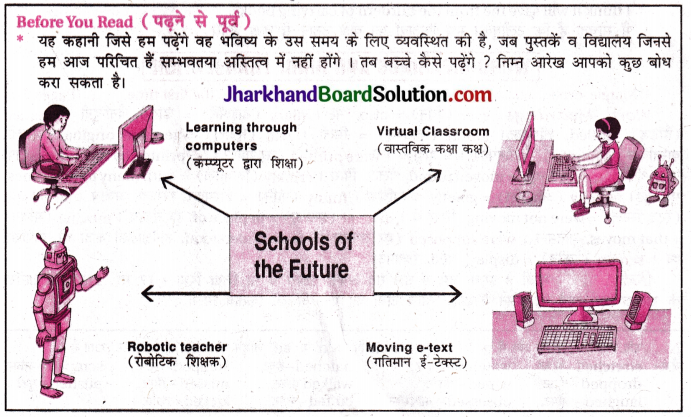
In pairs discuss three things that you like best about your school and three things about your school that you would like to change. Write them down.
अपने सहपाठियों के साथ जोड़े बनाकर उन तीन बातों पर चर्चा कीजिए जो आपके विद्यालय में आपको सर्वाधिक अच्छी लगती हैं तथा अपने विद्यालय की तीन ऐसी बातों पर भी चर्चा कीजिए जिन्हें आप बदलना चाहते हैं । उन्हें लिखिये ।
Answer:
(a) Things I like about my school are :
वे वस्तुऐं जो मैं अपने विद्यालय में पसन्द करता हूँ-
- Knowledgeable teacher. (ज्ञान से परिपूर्ण अध्यापक)
- Big playground. ( बड़ा खेल का मैदान)
- A lot of extra curricular activities. (अत्यधिक अतिरिक्त क्रिया-कलाप)
(b) Things I would like to change:
वस्तुएँ जिन्हें मैं बदलना पसन्द करूँगा-
- No homework (कोई गृहकार्य नहीं)
- More time to games and sports ( खेलकूद में और अधिक समय देना)
- Use of computer lab for all equally. ( कम्प्यूटर लैब का सभी को समान रूप से उपयोग में लाना)
Have you ever read words on a television or computer screen? Can you imaging a time when all books will be on computers, and there will be no books printed on paper? Would you like such books better?
क्या आपने कभी टेलिविजन ( या कम्प्यूटर) के परदे (स्क्रीन) पर शब्दों को पढ़ा है ? क्या आप कल्पना कर सकते हैं कि एक समय ऐसा आयेगा जब पुस्तकें कम्प्यूटरों पर होंगी और कोई भी पुस्तक कागज पर नहीं छापी जायेगी ? क्या आप इस प्रकार की पुस्तकों को अधिक पसन्द करेंगे ?
Answer:
Yes, I have read words on TV and computer screen a number of times.
हाँ मैंने टेलीविजन और कम्प्यूटर स्क्रीन पर शब्दों को कई बार पढ़ा है।
I can imagine a time of telebooks.
मैं टेलीबुक्स के समय की कल्पना पर सकता हूँ ।
I think it will save me from the burdern of carrying books.
मैं सोचता हूँ कि टेलीबुक्स मुझे किताबों का बोझ उठाने से बचा लेगी।
The Fun They Had Summary and Translation in Hindi
About the Lesson
यह कहानी हमें भावी संसार में ले जाती है जहाँ कम्प्यूटर बहुत बड़ी भूमिका निभायेंगे । ‘वास्तविक सत्य’ शब्द कम्प्यूटर सॉफ्टवेयर द्वारा निर्मित वास्तविकता के सन्दर्भ में है और ‘वास्तविक कक्षा-कक्ष’ असली कक्षा-कक्ष नहीं है बल्कि एक ऐसा स्थान है जहाँ पढ़ाई कम्प्यूटर, सॉफ्टवेयर या इन्टरनेट के माध्यम से होती है । इसके माध्यम से बच्चे जान सकेंगे कि रोबोट क्या होता है और यह अनुमान लगाने में सक्षम होंगे कि रोबोटिक शिक्षक कैसा होगा ।
Who is who in the lesson
1. Margie: Margie is a girl of eleven. She writes about this story on 17 May 2157.
मार्जी सात वर्षीय लड़की है। इस कहानी के बारे में वह 17 मई 2157 को लिखती है।
2. Tommy: Tommy is a boy of thirteen. He finds a real book. He shows it to Margie.
टॉमी तेरह वर्षीय लड़का है। उसे एक वास्तविक पुस्तक मिलती है। वह इस पुस्तक को मार्जी को दिखाता है ।
3. Mrs Jones : Mrs Jones is Margie’s mother.
श्रीमती जोन्स मार्जी की माँ हैं।
4. Mechanical Teacher: Here computer is a teacher that teaches the kids.
इस पाठ में Mechanical Teacher का तात्पर्य कम्प्यूटर से है।
5. Country Inspector: County Inspector is a computer mechanic who repairs the mechanical teacher.
काउण्टी इन्स्पेक्टर से तात्पर्य कम्प्यूटर के मैकेनिक से है जो कम्प्यूटर की मरम्मत करता है ।
Word-Meanings and Hindi Translation
1. Margie even …………… the first time. (page 5 – 6)
Word Meanings: even (ईवॅन्) = also, भी । diary (डाइॲरि) (हैडिड्) = titled, शीर्षयुक्त । found ( फाउण्ड्) = मिली | real (रिअल्) = genuine, original, असली, वास्तविक । grandfather ( ग्रैन्फादर) = दादाजी | were printed ( वर् प्रिण्टिड् ) = printed by machines, छापी जाती थीं। turned (टॅन्ड्) = moved round, पलटा, फिरा । crinkly (क्रिंक्लि ) = with many folds or lines, मुड़े-तुड़े। awfully (ऑ: फलि ) = greatly अत्यधिक | funny (फॅनि) हास्यकर, निराला, अजीब । stood still (स्टुड् स्टिल्) = were not moving, स्थिर थे । instead (इन्स्टेड्) = in place of, के बजाय । moving ( मूविंग) : that moves, गतिमान | were supposed ( वर् सपोज़्ट) = were understood, अपेक्षा की जाती थी, अपेक्षित था । screen (स्क्रीन् ) = display, परदा, चित्रपट ।
हिन्दी अनुवाद – मार्जी ने इसके बारे में उस रात अपनी डायरी में भी लिख दिया । 17 मई, 2157 की तारीख के शीर्षक वाले पन्ने पर उसने लिखा, “आज टॉमी को एक असली किताब मिली !” यह एक बहुत पुरानी पुस्तक थी। मार्जी के दादाजी ने एक बार बताया था कि जब वे एक छोटे लड़कें थे तब उनके दादाजी ने उनको बताया था कि एक समय ऐसा भी था जब सारी कहानियाँ कागज पर छापी जाती थीं ।
उन्होंने पन्नों को पलटा जो पीले व मुंड़े-तुड़े (सिलवटों वाले) से हो गये थे और उन शब्दों को पढ़ना अत्यधिक अजीब लग रहा था जो गति करने के बजाय स्थिर थे, जबकि उनसे एक परदे (स्क्रीन) पर गति करना अपेक्षित था, जैसा कि आप जानते हैं । और तब, जब उन्होंने पहले पन्ने को वापिस पलटा तो उस पर वही शब्द थे जो उस समय थे जब पहली बार उन्होंने उसे पढ़ा था ।
2. “Gee”, said Tommy, …………… “School.” (Page 6)
Word-Meanings: Gree (जी) = expressing surprise, आश्चर्य प्रकट करने के लिए प्रयुक्त शब्द ‘अरे’। waste ( वेस्ट् ) = spending money uselessly, फिजूलखर्ची । are through with (आर् थ्रू विद्) = read completely, पूरा पढ़ लेते हो । just (जस्ट) = only, मात्र, बस | throw away (थ्रो अवे) = relating to products that are to be discarded, फेंक देना । guess (गेस) = अनुमान लगाना । million ( मिलियन् ) = ten lakhs, दस लाख। plenty (प्लेण्टि ) = a lot of, प्रचुर | telebooks (टेलिबुक्स्) = books shown on screens, टेलिबुक्स अर्थात् कम्प्यूटर स्क्रीन पर प्रदर्शित की जाने वाली पुस्तकें | pointed (पॉइण्टिड् ) = indicated, इशारा किया | attic (एटिक्) = space just below the roof, used as a storeroom, अटारी, दुछत्ती ।
हिन्दी अनुवाद – ” अरे !” टॉसी ने कहा, “क्या फिजूलखर्ची है, जब आप इस पुस्तक को पूरी पढ़ लेंगे तो बस इसे फेंक देंगे, मेरा तो यही अनुमान है । हमारे टीवी की स्क्रीन ( परदे ) पर दस लाख किताबें तो होंगी ही और यह और भी अधिक किताबों हेतु उपयुक्त है । मैं इसे नहीं फेंकूँगा ।” “मेरे भी यही विचार हैं,” मार्जी ने कहा । वह ग्यारह वर्ष की थी तथा उसने इतनी टेली पुस्तकें नहीं देखीं थीं जितनी टॉमी देख चुका था । वह तेरह वर्ष का था । वह बोली, “तुम्हें यह (किताब) कहाँ मिली ?” ” मेरे घर में, उसने बिना देखे इशारा किया क्योंकि वह पढ़ने में व्यस्त था । “यह किताब किसके बारे में है ?” “स्कूल के ।”
3. Margie was scornful. ……………. country inspector (Page 6)
Word Meanings: scornful (स्कॉ: नफल् ) = contemptuous, घृणापूर्ण, तिरस्कारपूर्ण | hate (हेट्) not liking, घृणा करना । more than ever ( मोर देन ईवर ) = still more, पहले से भी अधिक । mechanical teacher (मैकेनिकॅल् टीचर) = ( here ) computer, यान्त्रिक शिक्षक अर्थात् कम्प्यूटर | geography ( जिऑग्रॅफि) भूगोल | worse (वॅ:स) = बदतर, और बुरा । had shaken (हैड् शेकन् ) = moved side by side or up and down, हिलाया था। sorrowfully (सॉरोफलि ) = with grief, दु:खपूर्वक । sent for (सेण्ट् फ़ॉर्) = called in, बुलवाया । County Inspector ( काउण्टी इन्स्पेक्टर् ) = computer mechanic, कम्प्यूटर मैकेनिक |
हिन्दी अनुवाद – मार्जी का मन घृणा से भर गया । ‘स्कूल ? स्कूल के बारे में लिखने की क्या बात है ? मैं स्कूल से घृणा करती हूँ ।’ मार्जी हमेशा स्कूल से घृणा करती थी, किन्तु अब तो वह स्कूल से पहले से भी ज्यादा घृणा करती थी । यान्त्रिक शिक्षक (कम्प्यूटर) उसे भूगोल में टेस्ट पर टेस्ट देता जा रहा था और वह उनको तब तक बद से बदतर अर्थात् खराब से भी ज्यादा खराब हल किए जा रही थी जब तक कि उसकी माँ ने दुःखपूर्वक अपना सिर नहीं हिलाया और उस इलाके के कम्प्यूटर मैकेनिक ( काउन्टी इन्स्पेक्टर) को नहीं बुलवाया ।
4. He was a round ……….. marks in no time. (Pages 6-7 )
Word Meanings: round (राउण्ड) – fat and less tall, (होल) = complete, पूरा। tools (टूल्ज़) औजार उपकरण । something, डायलों। wires ( वाइॲज्) = तारों । smiled (स्माइल्ड) मुस्कुराया | took apart (टुक् अॅपा:ट) = opened the inside parts of the computer, पुरजे खोल दिये । hoped ( होप्ट्) = wanted something to happen, आशा की थी। to put it together = to join the parts, इसके पुर्जों को जोड़ देना । knew (न्यू): had knowledge of something, जानता था । ugly (ॲग्लि ) = bad in appearance, कुरूप, भद्दा | were shown (वर् शोन् demonstrated, प्रदर्शित होते थे । slot (स्लॉट्) = a given space, time or position, छिद्र, खाँचा | punch code (पंच् कोड् ) = hole – signals, छिद्रों वाले संकेत | calculated (कैल्क्युलेइटिड् ) counted, गिनंता था, गणना करता था । marks (मा: क्स) = अंक । in no time (इन् नो टाइम) = immediately, पल भर में ।
हिन्दी अनुवाद – वह एक लाल चेहरे वाला गोल-मटोल छोटे कद का (नाटा) आदमी था तथा उसके पास डायलों व तारों सहित औजारों का एक पूरा बक्सा था । वह मार्जी की ओर देखकर मुस्कुराया तथा उसे एक सेब खाने को दिया, उसके बाद उसने अध्यापक अर्थात् कम्प्यूटर के पुरजे खोल दिये । मार्जी को आशा थी कि वह इसको पुनः जोड़ना नहीं जानता होगा किन्तु वह अच्छी तरह से यह काम जानता था और लगभग एक घण्टे बाद वह (कम्प्यूटर) अपनी जगह पुन: (ठीक होकर) आ गया जो बड़ा और काला व बदसूरत था, उसकी स्क्रीन बड़ी थी जिस पर सभी पाठ प्रदर्शित किये जाते थे और प्रश्न पूछे जाते थे । वह इतना बुरा नहीं था । वह भाग जिससे मार्जी को सबसे ज्यादा घृणा थी वह एक छेद (स्लॉट्) था जहाँ उसे अपना गृहकार्य और टेस्ट पेपर डालने पड़ते थे । उसे उनको हमेशा एक पंच कोड (छिद्रों वाले संकेत ) में लिखना पड़ता था जो उसको छः वर्ष की आयु में सिखाये गये थे और यान्त्रिक अध्यापक (कम्प्यूटर) पल भर में अंकों की गणना कर देता था ।
5. The Inspector ……….. about school?” (Page 7)
मुस्कुराया । was finished (वॉज़ बाद । patted (पैट्ड् ि) = stroked, = a part or an area, खण्ड, क्षेत्र
Word Meanings: smiled (स्माइल्ड् ) = laughed slightly, फ़िनिश्ट ) = (after) he had completed the task, अपना काम पूरा करने के थपथपाया । fault (फॉल्ट्) = mistake, दोष; गलती । sector (सेक्टर) geared ( गियर्ड् ) = adjusted to a particular standard or level, कस दिया गया था । a little too quick = a bit fast, थोड़ा अधिक तेज । happen (हैपन्) = to occur, होना या घटित होना । have slowed (हैव् स्लोड् ) = made slow, धीमा कर दिया है। average (ऐवरेज् ) = औसत |
level ( लेवल् ) = स्तर | actually (एक्चुअलि ) really, वस्तुतः, वास्तव में । overall (ओवॅरॉल) = total, सम्पूर्ण, कुल | pattern (पेटॅन) = the way in which something is done, तरीका | progress (प्रोग्रेस् ) = प्रगति, उन्नति । quite satisfactory (क्वाइट् सेटिस्फेक्टरि) पूर्णतः सन्तोषप्रद । disappointed (डिसॅपॉइन्टिड्) dejected निराश | had been hoping = was expecting, आशा कर रही थी । would take away (वुड टेक अवे) would carry away, ले जायेंगे । altogether (ऑल्टगेदर) = पूर्ण रूप से, बिल्कुल ही । nearly (निॲलि) = : almost, लगभग | history sector इतिहास खण्ड | had blanked out = had got off the screen, (स्क्रीन से) साफ हो गया था, रिक्त हो गया था । completely (कम्प्लीट्ल) = almost, पूरी तरह से ।
हिन्दी अनुवाद – अपना काम पूरा करने के बाद इन्स्पेक्टर ( कम्प्यूटर मैकेनिक) मुस्कुराया और उसने मार्जी का सिर थपथपाया। वह उसकी माँ से बोला, “श्रीमती जोन्स, यह इस छोटी बच्ची का दोष नहीं है । मैं सोचता हूँ कि भूगोल – खण्ड थोड़ा अधिक तीव्रता के स्तर पर व्यवस्थित कर दिया गया था अर्थात् थोड़ा तेज चले रहा था। वैसी बातें कभी-कभी हो जाती हैं। मैंने इसको धीमा करके औसतन दस वर्ष के स्तर पर ला दिया है। वास्तव में उसकी ( मार्जी की) प्रगति का सम्पूर्ण तरीका पूर्णतः सन्तोषजनक है ।” और उसने मार्जी के सिर को पुनः थपथपाया । मार्जी निराश थी । वह आशा कर रही थी कि कम्प्यूटर मैकेनिक शिक्षक यानी कम्प्यूटर को पूरी तरह से ले जायेंगे । वे एक बार टॉमी के शिक्षक यानी कम्प्यूटर को लगभग एक महीने के लिए ले गये थे क्योंकि इतिहास खण्ड पूरी तरह से रिक्त हो गया था। इसलिए उसने टॉमी से कहा, “कोई भी व्यक्ति स्कूल के बारे में क्यों लिखेगा ?”
6. Tommy looked …………… them questions.” (Pages 7-8)
Word Meaning: superior eyes (स्यूपिअरिअर् आईज) = showing intelligence, श्रेष्ठता दिखाते हुए। kind (काइण्ड्) = type प्रकार | stupid ( स्ट्यूपिड् ) = foolish, मूर्ख । ago ( अगो) = पहले । added ( एडिड्) आगे कहा, जोड़ा । loftily (लॉटिलि) = in a superior way, श्रेष्ठता के भाव या गर्व से । pronouncing (पॅनाउसिंग ) = announcing, उच्चारण करते हुए । carefully ( केॲफलि ) with caution, सावधानीपूर्वक । centuries (सेन्चुरीज्) = periods of hundred years, शताब्दियाँ । hurt (हॅ:ट) = sad, दुखी, आहत | shoulder (शोल्डर) = कन्धा | for a while (फॉर अ वाइल) = for some time, कुछ समय तक, कुछ समय के लिए । anyway (एनीवे) = in any case, जो कुछ भी हो । sure ( श्युअर) = definitely, निःसंदेह, निश्चय ही । regular (रेग्युलर् ) = (here) normal, of the usual kind, यहाँ अर्थ है- सामान्य | things (थिंग्ज्) = an object of thought, बातें ।
हिन्दी अनुवाद – टॉमी ने श्रेष्ठता के भाव से (बड़प्पन से) उसकी ओर देखा। ” क्योंकि यह हमारी तरह का स्कूल नहीं है, मूर्ख । यह एक पुराने प्रकार का स्कूल है जैसे कि सैकड़ों वर्ष पहले हुआ करते थे । उसने श्रेष्ठता के भाव से (गर्व से ) सावधानीपूर्वक शब्द का उच्चारण करते हुए आगे कहा, ‘शताब्दियों पूर्व ।’ मार्जी आहत थीं । ‘ठीक है, मुझे पता नहीं है कि इतने समय पूर्व किस प्रकार के स्कूल होते थे ।’ उसने उसके (टॉमी के) कन्धे के ऊपर रखकर कुछ समय तक किताब को पढ़ा फिर कहा, “जो कुछ भी हो उनके पास एक अध्यापक होता था ।” “निश्चय ही उनके पास एक अध्यापक होता था किन्तु वह कोई सामान्य प्रकार का अध्यापक नहीं होता था । वह एक आदमी होता था ।” ” एक आदमी ? एक आदमी अध्यापक कैसे हो सकता था ?” ” बिल्कुल, वह लड़के व लड़कियों को बस जीवन धारा की स्थिति या हालात बताता था और उन्हें गृहकार्य देता था तथा उनसे प्रश्न पूछता था । ”
7. “A man isn’t …………… the same age.” (Page 8)
Word Meanings: smart (स्माट्) = clever, चतुर, तेज । enough (इनॅफ् ) = sufficient, पर्याप्त, काफी । sure ( श्युअर) = definitely, निश्चित | almost ( ऑल्मोस्ट्) = लगभग | Fbetcha (आई बैच) = I bet you, I am sure, मैं शर्त लगाता हूँ, मुझे निश्चित पता है । prepared ( प्रिपेयर्ड) = ready, तैयार | dispute (डिस्प्यूट्) = disagree with, वाद-विवाद करना, झगड़ना | strange (स्ट्रेन्ज) = अपरिचित | teach ( टीच्) पढ़ाना । screamed (स्क्रीम्ड् ) = cried, चीखा, चिल्लाया। laughter ( लॉफ्टर् ) = हँसी | know (नो) special (स्पेशॅल) = not ordinary, विशेष, खास | building ( बिल्डिंग्) = भवन, स्थान ( परिसर) | kids (किड्ज्) = children, बच्चे | learned ( लर्न्ड् ) = सीखते थे।
हिन्दी अनुवाद – “एक आदमी तो इतना चतुर नहीं होता है । ”
“निश्चित रूप से वह होता है । मेरे पिताजी को उतना ही ज्ञान है जितना मेरे यान्त्रिक अध्यापक अर्थात् कम्प्यूटर को है ।”
” मैं निश्चय ही शर्त लगाकर यह कहता हूँ कि वह लगभग उतना अधिक जानते हैं (जितना एक यान्त्रिक शिक्षक अर्थात् कम्प्यूटर जानता है ) । ”
मार्जी इस बात पर वाद-विवाद करने (झगड़ने ) के लिए तैयार नहीं थी । वह बोली, “मैं नहीं चाहूँगी कि एक अपरिचित आदमी मेरे घर में रहकर मुझे सिखाए ।” टॉमी हँसते हुए चिल्लाया, “मार्जी, तुम ज्यादा नहीं जानती हो । वे अध्यापक घर में नहीं रहा करते थे । उनका एक विशेष भवन या स्थान होता था तथा सभी बच्चे वहाँ पढ़ने जाते थे ।”
‘और क्या सभी बच्चे एक ही बात सीखते थे ?” (मार्जी ने कहा ) ।
” निश्चित रूप से, यदि वे एक ही आयुवर्ग के होते थे तो । ”
8. “But my mother…………. after school?” (Page 8)
Word-Meanings : has to be adjusted = has to be arranged, अनुकूल ढालना पड़ता है । fit (फिट् ) = to make something suitable, ठीक बैठाना | mind (माइण्डु) = मन, बुद्धि | has to be taught = सिखाना होता है । differently = (डिफ्रॅन्ट्ल) = separately, अलग से, भिन्न तरीके से। just the same = in any case, फिर भी । quickly ( क्विक्लि ) = शीघ्र, जल्दी | wanted (वाण्टिड् ) = hastily, चाहती थी । funny ( फनि) = strange or unusual, विचित्र या असाधारण । weren’t even half finished = the book was not read even half part of it, आधी पुस्तक भी समाप्त नहीं की थी । called (कॉल्ड् ) = cried out, पुकारा । yet ( यट्) अभी तक | probably (प्रॉबॅब्लि) = perhaps, सम्भवतः ।
हिन्दी अनुवाद – किन्तु मेरी माँ तो कहती है कि अध्यापक को प्रत्येक उस लड़के व लड़की जिसे वह पढ़ाता है के दिमाग के अनुरूप ढालना पड़ता है तथा प्रत्येक बच्चे को अलग तरह से पढ़ाना होता है । “ऐसा ही है पर वे तब ऐसा नहीं करते थे । यदि तुम्हें पसन्द नहीं हो तो तुम्हें इस किताब को पढ़ना जरूरी नहीं है ।” “मैंने यह नहीं कहा कि मुझे यह पसन्द नहीं है, ” मार्जी ने शीघ्रता से कहा । वह उन अजीब स्कूलों के बारे में पढ़ना चाहती थी । उन्होंने अभी आधी किताब भी नहीं पढ़ी थी कि मार्जी की माँ ने पुकारा, “मार्जी ! स्कूल !” मार्जी ने ऊपर देखा और बोली, “माँ, अभी नहीं ।” “अभी !” श्रीमती जोन्स ने कहा । ” और अब शायद टॉमी का भी समय हो गया है ।” मार्जी ने टॉमी से कहा, “क्या मैं स्कूल के बाद तुम्हारे साथ इस किताब को और पढ़ सकूँगी ?”
9. “May be, ” he said ……………….. the proper slot.” (Pages 8-9 )
Word-Meanings: nonchalantly (नॉन्शॅलैण्ट्ट्लि) = not showing much interest or enthusiasm, carelessly, लापरवाही से, उदासीनतापूर्वक | walked away (वॉक्ट अव्) = went away, चला गया | whistling (विर्सेलिंग्) = सीटी बजाते हुए | dusty (डस्टि) = full of dust, धूल-धूसरित, धूल से सनी । tucked (टॅक्ट) = pressed, समेटे हुए, दबाये हुए | beneath (बिनीथ्) = under, नीचे | right next (राइट् नेक्सट्) = ठीक अगला । mechanical teacher = computer, कम्प्यूटर |
was on = was started, (कम्प्यूटर) चला हुआ था । waiting for (वैटिंग फॉर) इन्तजार कर रहा । except (इक्सेप्ट् ) = के अतिरिक्त, के सिवाय | better (बैटर् ) = बेहतर | regular (रेग्यूलर्) = नियमित | was lit up = was lighted, प्रकाशित था । arithmetic (ॲरिथ्मॅटिक) अंकगणित | addition (अॅडिशन्) जोड़, योग | proper fractions (प्रॉपर् फ्रेक्शन्ज़) = सरल भिन्न । insert (इन्स:ट्) = to place, डालना, में रख देना । proper (प्रॉपर्) = suitable, उचित । slot (स्लॉट्) = a straight narrow opening, छिद्र ।
हिन्दी अनुवाद – ” हो सकता है,” उसने लापरवाही से कहा । वह उस पुरानी धूल भरी किताब को अपनी बाँह के नीचे (काँख में) दबाकर सीटी बजाता हुआ चला गया । मार्जी स्कूल वाले कमरे में गई । वह उसके शयनकक्ष के बिल्कुल बगल में था और यान्त्रिक शिक्षक अर्थात् कम्प्यूटर चालू था और उसका इन्तजार कर रहा था । वह शनिवार व रविवार को छोड़कर रोजाना उसी समय चालू हो जाता था क्योंकि उसकी (मार्जी की) माँ कहती थी कि यदि छोटी बच्चियाँ नियमित समय पर पढ़ें तो वे अधिक अच्छा सीखती हैं । कम्प्यूटर का परदा प्रकाशित था, तथा कह रहा था, आज का अंकगणित का पाठ सरल भिन्नों को जोड़ने का है। कृपया कल का गृहकार्य उचित छेद ( स्लॉट) में डाल दीजिए ।”
10. “Margie did so ……………… the fun they had. (Page 9)
word-Meaningy : sigh (साइ) = sadly, आह, उच्छ्वास । was thinking (वॉज़ थिंकिंग) = was considering, सोच रही थी । whole (होल्) = complete, सम्पूर्ण । neighbourhood (नेबरहुड्) particular part of a town and the people who live there, अड़ोस-पड़ोस | laughing (लाफिंग) = हँसते हुए। shouting (शाउटिंग्) = making a noise, शोर मचाते हुए | schoolyard ( स्कूलयार्ड) = school compound, विद्यालय-प्रांगण। talk (टॉक्) = chat, बात करना । flashing ( फ्लैशिंग् ) = lighting up, तत्क्षण प्रकाशित कर रहा, चमका रहा । add (ऐड्) जोड़ना । fractions ( फ्रेक्शन्ज़) भिन्न । in the old days = पुराने दिनों में । the fun they had = what they enjoyed, आनन्द जो वे लेते थे।
हिन्दी अनुवाद – मार्जी ने आह भरकर ऐसा किया । वह उन पुराने स्कूलों के बारे में सोच रही थी जब उसके दादाजी के दादाजी एक छोटे बच्चे थे। पूरे अड़ोस-पड़ोस के सभी बच्चे आते, स्कूल के आँगन में हँसते और चिल्लाते, स्कूल के कमरे में एक साथ बैठते और दिन की समाप्ति पर एक साथ घर जाते । वे एक जैसी बातें सीखा करते थे इसलिए वे गृहकार्य में एक-दूसरे की सहायता कर सकते थे और इसके बारे में बातचीत कर सकते थे । और अध्यापक मनुष्य होते थे यान्त्रिक अध्यापक अर्थात् कम्प्यूटर की स्क्रीन पर प्रकाशित हो रहा था हैं.. “जब हम 1⁄2 तथा भिन्नों को जोड़ते मार्जी सोच रही थी कि पुराने दिनों में बच्चों को कितना अच्छा लगता होगा । वह उस आनन्द के बारे में सोच रही थी जो वे लेते होंगे ।